
Submitted:
17 October 2026
Posted:
20 October 2026
You are already at the latest version
Abstract
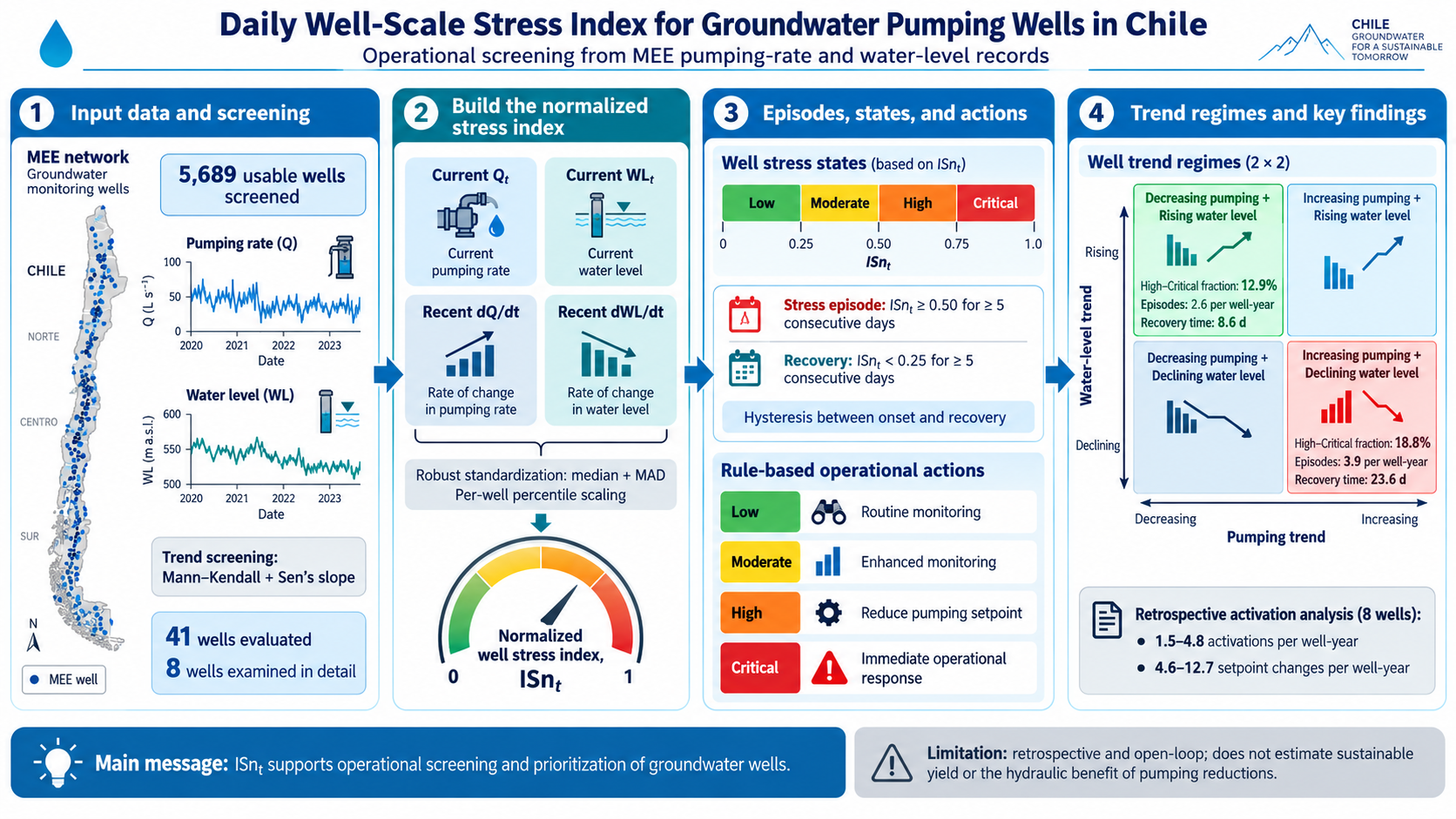
Chile’s Monitoreo de Extracciones Efectivas (MEE) network reports pumping rate and water level at abstraction wells. We propose a daily, well-specific stress index that combines current pumping rate, reported water level and their 30-day gradients through robust standardization with the median and median absolute deviation, and per-well percentile normalization. Mann–Kendall screening classified 5689 wells; 42 wells were then selected to cover the four combinations of increasing or decreasing pumping and rising or declining water level, and 41 met the minimum record length. Episodes were defined as index values of at least 0.50 for at least five consecutive days. Wells with decreasing pumping and rising water level had the lowest mean High–Critical fraction (12.9%) and episode frequency (2.6 per well-year); wells with increasing pumping and declining water level had the highest (18.8% and 3.9), although bootstrap intervals overlapped. Regime extremes were stable under weight changes of 0.05 but sensitive to the gradient window, and a prospective replay agreed with the retrospective alert state on 89.5% of days. Predefined rules applied to eight wells implied 1.5–4.8 activations and 4.6–12.7 setpoint changes per year. The index has not been validated against operational failures and does not estimate sustainable yield; it is intended for screening and operator review.
Keywords:
groundwater stress index
; groundwater monitoring
; well operation
; rule-based control
; Mann–Kendall test
; Sen’s slope
; regulatory telemetry
; Chile
Copyright: This open access article is published under a Creative Commons CC BY 4.0 license, which permit the free download, distribution, and reuse, provided that the author and preprint are cited in any reuse.