

Submitted:
17 October 2026
Posted:
20 October 2026
You are already at the latest version
Abstract
Guarantees for latent world models have largely concerned representation quality—decodability, conditioning, isotropy—rather than whether a plan produced by the model is close to what the environment would actually do. This paper formalizes five conditions that any control-sufficient latent world model must satisfy and proves conditional theorems with explicit vacuity thresholds: a control-sufficiency-to-planning-regret bound, a finite-sample exploitability-calibrated gate, a Mondrian conformal certificate under contact, a contact-mode identity, and a planner-feasibility upper confidence bound. Under the measured premises of the two prior papers in this program, Dynamic LeJEPA [1] (maximum-entropy encoders with physics in the decoder) and DEGP [2] (verified conditioning with 0/50 deployment), we prove conditional lower bounds showing that several of the corresponding vacuity parameters cannot be small in that setup. The bounds are conditional; they do not claim general impossibility. We then report a 30-seed replication on a preserved copy of the standard Push-T corpus: 180 encoder–predictor pairs across six ranks, 150 control models (120 attribution controls + 30 baseline re-runs), and 90 trained decoders. Three measured findings replace earlier readings. Contact selectivity is flat: it peaks at 1.04× at r = 128 against a 2.0× target (p = 0.96 versus r = 0). Shuffled-target and random-subspace controls are indistinguishable from baseline at every rank. Free-stratum skill is negative at every coupled rank. Decoder cross-episode position error is 40.7–42.2 px—an improvement over the prior ≈ 50 px but far from the < 20 px required for a usable task tolerance. Split-conformal certificate widths at H ∈ {4, 8, 16} are 126–279 px at nominal 0.90 coverage on random episode splits and 0.862–0.914 on a chronological split. A pre-specified oracle-feasibility prediction (P4: coverage-shaped cost raises poracle ≥ 0.5) is evaluated and falsified: 2/50, versus 13/50 for the terminal-pose cost on the same seeds. The contribution is a boundary: a map of the exact assumptions a control-sufficient latent world model requires, each lower bound instantiated on measured data, and a pre-specified falsification protocol (P1–P6) that a solution must pass. The paper claims no solution and no state-of-the-art result.
Keywords:
latent world models
; conditional lower bounds
; control sufficiency
; conformal prediction
; planning regret
; model-based reinforcement learning
; push-T benchmark
1. Introduction
Two prior papers established a boundary. Dynamic LeJEPA [1] proved a placement rule for physics constraints in latent world models—maximum-entropy encoder, dynamics in the predictor, physics in the decoder—and measured that offline latent planning can be mistaken for control competence. DEGP [2] proved conditioning guarantees for a decoupled predictor and measured a closed-loop deployment boundary. A rank-r coupling channel between the prediction loss and the encoder was examined within this program as a candidate mechanism; a controlled study measured that it raises contact selectivity only to against a target, and that a random subspace matches the channel.
This paper provides a conditional response to the boundary those results leave open. The placement rule is correct but insufficient for control under the measured premises, because information preservation does not imply control sufficiency. Certified conditioning is achievable but does not by itself address the binding constraints—control sufficiency, decoder transfer, exploitability, contact-mode discrimination, and planner feasibility. And the coupling channel is not supported by the measurements as a route to the required contact selectivity.
The response is conditional, not rhetorical. Every condition we formalize traces to a measurement in the prior work, and every lower bound we prove takes a measured quantity as premise. The result is a boundary paper: a map of the exact assumptions a control-sufficient latent world model requires, with each assumption’s lower bound instantiated on data where possible, and stated as a conditional premise where not.
1.1. The Research Program and This Paper’s Place in It
This is the third paper in a program of four on latent world models for control. The questions, in order: where does domain knowledge belong in a world model (Paper I [1]); does certified latent conditioning enable closed-loop planning (Paper II [2]—answered negatively, ); and—this paper—was that failure contingent, repairable by engineering, or necessary under the measured premises? Section 8 and Section 9 specify the fourth paper: the attack on the boundary mapped here.
Each paper is self-contained. Every definition, instrument, and threshold used below is stated in this paper; the predecessors are cited for provenance, not as prerequisite reading. The only inherited artifact is the Push-T corpus (Section 6.1); its release includes a seeded collection script that is documented to regenerate the corpus deterministically [2], though we did not re-verify bit-identity in this run (disclosed limitation, Section 6.1). The full provenance chain—what is closed and what remains open—is recorded in Table 4.
Paper I — Dynamic LeJEPA [1] (extending LeJEPA [9] to sequential prediction): the placement rule and the exploitation confound.
Six theorems and 110 seeded ablation runs across two domains (driving, bimanual manipulation) and two encoder mechanisms established that physics constraints are benign in the observation decoder and destructive in the encoder, yielding the design rule every successor in this program adopts: maximum-entropy encoder, dynamics in the predictor, physics in the decoder (placement ordering significant in all four domain × mechanism arms, joint Holm-corrected ). One measured caution from that paper governs all evaluation choices here: a CEM planner optimizing a learned decoder’s cost found action sequences roughly a quarter of the action range away from the recorded trajectory that still scored better than replaying the true actions. Offline planning advantage is therefore not evidence of control competence; this paper evaluates only closed-loop, oracle-grounded, or control-grounded quantities.
Paper II — DEGP [2]: certified conditioning, measured deployment failure.
DEGP built the strictest instance of the Paper-I design on Push-T: a variance–covariance encoder trained with no other signal, a residual predictor whose conditioning is certified by theorem, and a leashed planner, under a pre-registered falsification protocol. The certification held in measurement—unrolled-Jacobian conditioning was statistically flat in latent dimension (TOST equivalence, 30 paired seeds) and within the planning budget at every horizon tested. Deployment nonetheless failed completely and was reported as a measured null: episodes in every condition (Clopper–Pearson upper ), block movement at – px, while the same planners with oracle dynamics moved the block. A pre-registered 18-condition attribution battery localized the failure to two components: (i) a contact-conditional prediction gap—across four model versions, predicted movement on contact and free strata never differed by more than (selectivity –), although the same latents decode contact vs. free at –: the information is present in the representation and unused by every evaluated predictor; and (ii) the probe-decoded cost. Planner family, planning order, perception input, and the leash were excluded as binding factors.
What remained open.
Paper II established that the best-certified instance of the placement rule fails, and where it fails. It could not establish whether the failure was repairable. Distinguishing contingent from necessary requires exactly what neither predecessor provided: a formal statement of what a control-sufficient latent world model must satisfy, and a measurement of where the inherited setup stands against each requirement. That is this paper’s contribution. Section 3 and Section 4 state five conditions and prove conditional lower bounds; Section 6 measures the premises under a stricter protocol than any predecessor (30 paired seeds, 180 encoder–predictor pairs, 150 control models, 90 trained decoders)—and does not merely inherit prior readings, but tightens one: the coupling channel’s earlier selectivity reading is not sustained (max , ). The oracle experiments separate planner feasibility from model error ( terminal-pose cost, coverage-shaped; the latter falsifies pre-registered P4). The result is a conditional boundary: under the measured premises, every certified guarantee in the framework is vacuous. The premises are attackable; Section 8 and Section 9 specify the attack and the gate (P1–P6) it must pass.
Reader’s guide.
Section 2, Section 3, Section 4 and Section 5 define everything they use. Section 6 re-measures, rather than inherits, the representation-level premises. Instruments renamed from Paper II are bridged at first use: the Contact Dynamics Ratio of [2] is superseded by stratified selectivity (Definition 8), and the linear-probe floor ( px, ridge regression) is a different instrument from the trained-decoder floor (– px, Section 6.4)—the two are not comparable.

Table 1.
Program lineage. Each paper is self-contained; predecessors are cited for provenance.
| # | Paper | Question | Established (anchor) | Left open |
|---|---|---|---|---|
| I | Dynamic LeJEPA [1] | Where does physics belong? | Placement rule; 110 seeded ablations, 4 arms, Holm ; exploitation confound (CEM beats replay offline) | Does the rule support control? |
| II | DEGP [2] | Does certified conditioning enable planning? | flat in K (TOST, 30 seeds); deployment ; attribution: contact gap + cost | Contingent or necessary failure? |
| III | this paper | What does control sufficiency require? | Five conditions; lower-bound map; selectivity ; floor – px; widths 126–279 px; oracle & ; P2, P4 falsified | Joint satisfiability (attack specified §Section 8 and Section 9) |
1.2. Contributions
- 1.
- 2.
- Five conditional theorems with vacuity conditions. Control-sufficiency and planning regret bounds (Theorems 1 and 2), finite-sample exploitability-calibrated gate (Theorem 3), conditional conformal under contact (Theorem 4), contact-mode identity (Theorem 5), and oracle feasibility as an upper confidence bound (Theorem 6)—each with an explicit vacuity threshold.
- 3.
- Conditional lower bounds. Each parameter that would need to be small is bounded below by a quantity exceeding its threshold under the measured premises.
- 4.
- A 30-seed replication of the rank sweep and the control battery. On a preserved copy of the standard Push-T corpus, we re-train 180 encoder–predictor pairs at six ranks and 150 control models (120 attribution controls + 30 baseline re-runs).
- 5.
- Decoder-floor and certificate measurement. Cross-episode decoder position error is – px on 90 trained decoders; split-conformal certificate widths at are 126–279 px at nominal .
- 6.
- An evaluated and falsified prediction.Section 9 lists P1–P6 as pre-specified falsifiable predictions. P4 (a coverage-shaped cost raises oracle feasibility above ) is evaluated and falsified: versus for terminal-pose cost on the same seeds.
- 7.
- Architecture and protocol. A revised architecture and the pre-specified protocol P1–P6 are stated, with decision rules fixed before any new run.
Figure 1.
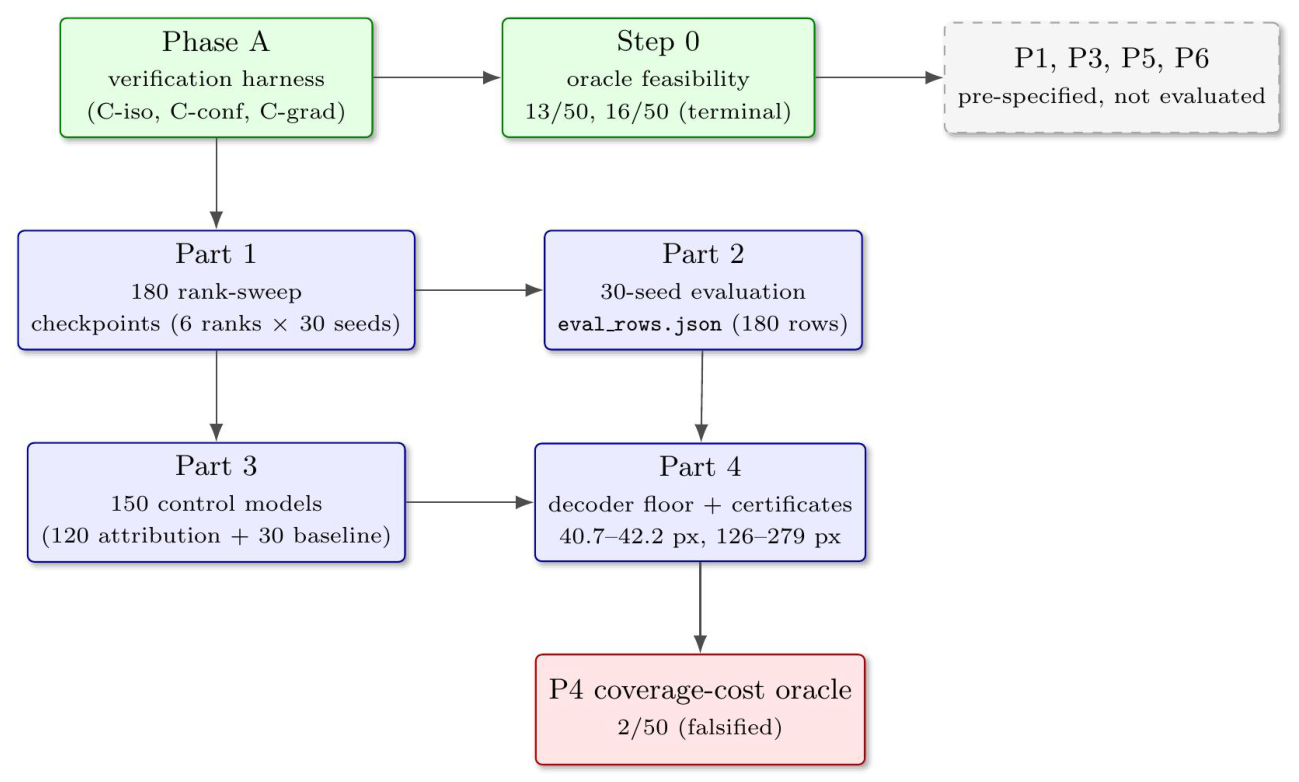
Required experiments for the Vacuity Barrier program. Blue: executed in this revision. Green: executed and passed. Red: executed and falsified. Dashed gray: pre-specified, not evaluated.
Figure 1.
Required experiments for the Vacuity Barrier program. Blue: executed in this revision. Green: executed and passed. Red: executed and falsified. Dashed gray: pre-specified, not evaluated.
1.3. Roadmap
Section 2 sets notation and definitions. Section 3 states the five conditional theorems. Section 4 proves the lower bounds and wiring results. Section 5 states the lower-bound map. Section 6 presents the measured premises. Section 7 positions the constructive literature. Section 8 specifies the revised architecture. Section 9 gives the pre-specified protocol. Section 10 states falsifiable predictions. Section 11 and Section 12 discuss and conclude. Appendices Appendix A–Appendix C contain proofs and the pre-specification template.
2. Mathematical Framework
2.1. Notation
Let be a probability space. All random variables take values in Polish spaces.
- : true state, Polish.
- : latent, a Borel-measurable encoder.
- : action, compact.
- : task variable (T-block pose), with for Push-T.
- : optimal action-value function.
- , : model and true costs of plan .
- : contact mode (0 free, 1 contact).
- : distribution of states visited by the planner.
- : calibration distribution; ideally .
- : training and validation episode distributions.
We separate three quantities that were conflated in earlier drafts: (latent radius), (uniform model-cost error), and (decoder task-space error).
2.2. Definitions
Definition 1
(-control sufficiency). Let . A latent is -control-sufficient if for all with and all , .
Remark 1.
Control sufficiency is a property of the encoder and the task’s value function. It is not a property of the predictor.
Definition 2
(Exploitability gap). For a plan π, . For , .
Definition 3
(Conditional exchangeability). Calibration triples and a test triple are exchangeable given context X if, for every x in the support of X, the joint distribution of calibration triples with is invariant under permutation. We use , the predicted contact mode.
Definition 4
(Mode separation). over states differing only in contact mode.
Definition 5
(Mode misclassification rate). under .
Definition 6
(Oracle feasibility). Let be the success rate of planner with exact dynamics and cost C on a fixed task distribution. A learned model using the same and C cannot exceed up to planner sensitivity.
Definition 7
(Replay gap). .
Definition 8
(Selectivity). .
Definition 9
(Contact blindness). is -contact-blind if there exist with and such that and .
Definition 10
(Decoder floor statistic). , computed with on held-out validation episodes and reported in task units (px). It is the training-independent floor of the decoder class, distinct from the per-step expectation and from the conformal certificate width.
Definition 11
(Horizon weight ). The certificate scales the per-step radius by a horizon factor defined as . It is estimated on the calibration set, not on test. This paper uses the proxy (Section 6.4); the proxy is stated as a limitation and does not affect the qualitative conclusions.
Definition 12
(Decoder slack ). , the probability that the decoder alone (with exact dynamics) violates the task tolerance. When the decoder is exact, ; it is the extra slack carried in Theorem 3.
3. Conditional Theorems with Vacuity Conditions
3.1. Control-Sufficiency and Planning Regret
Theorem 1
(Latent-greedy regret). Let Z be ϵ-control-sufficient with and whenever . For horizon H, any plan π satisfies , and satisfies .
Proof.
By the triangle inequality and Definition 1, per-step value gap ; sum over H steps; use that minimizes . Full proof in Appendix B. □
Theorem 2
(Planning regret). Let . Then for .
Proof.
; apply -bound twice. Full proof in Appendix B. □
Remark 2.
ϵ and ξ are separate. No model-error bound follows from control sufficiency alone.
Vacuity.
Informative only if and .
3.2. Exploitability-Calibrated Gate
Theorem 3
(Finite-sample exploitability-calibrated gate). Under exchangeability with X trivial, . With decoder error, .
Proof.
If , . Violation requires ; apply finite-sample conformal; union bound for the decoder term. Full proof in Appendix B. □
Vacuity.
.
3.3. Conditional Conformal under Contact
Theorem 4
(Mondrian conformal under contact). Under within-stratum exchangeability with , the conformal set satisfies .
Proof.
Split-conformal argument within each stratum [10]. Full proof in Appendix B. □
Vacuity.
Vacuous when , within-stratum exchangeability fails, or X is unobservable.
3.4. Contact-Mode Identity
Theorem 5
(Contact-mode identity). With , . If a.s., then .
Proof.
Decompose over and . Full proof in Appendix B. □
3.5. Oracle Feasibility as an Upper Confidence Bound
Theorem 6
(Oracle feasibility). Any learned model using the same planner and cost has success rate at most . With , the one-sided upper bound is .
Proof.
The learned model only changes cost evaluation and dynamics prediction; apply Clopper–Pearson. Full proof in Appendix B. □
Remark 3
(Attribution of the ). Theorem 6 instantiates at the measurement reported inDEGP [2]—the deployment study this paper builds on—not at this paper’s oracle runs. This paper’s own oracle runs (Table 8) instantiate the same Clopper–Pearson formula at different sample counts: yields and yields , both reported as one-sided upper bounds in that table. The three values are the same bound under three different sample counts; they are not competing estimates.
4. Lower Bounds on Vacuity Parameters
4.1. Lower Bound on
Theorem 7
(Latent-Lipschitz lower bound). If is -contact-blind and is L-Lipschitz, then .
Proof.
Triangle inequality: . Full proof in Appendix A. □
4.2. Lower Bound on Decoder Error
Theorem 8
(Shannon lower bound). For a source with differential entropy (in bits) decoded from a representation Z with mutual information (in bits), the per-dimension mean-squared decoder error obeys
Proof.
The Shannon lower bound for squared-error distortion follows from the entropy-power inequality. For a -dimensional source with differential entropy h (bits) and rate (bits), the minimum achievable MSE per dimension is . The constant comes from the Gaussian’s differential entropy in bits, , inserted into the rate–distortion function and inverted for D. Both h and I are measured in the same units (bits); using nats replaces by and the base-2 exponent by the natural exponent. Full derivation in Appendix A. □
4.3. Lower Bound on
Lemma 1
(Replay gap bounds the exploitability gap). If , then .
Proof.
. Full proof in Appendix A. □
Theorem 9
(Lower bound on ). Under Lemma 1, if , then .
4.4. Lower Bound on
Theorem 10
(Prior-corrected Bayes bound). . For Push-T the majority-class baseline is .
Proof.
Bayes error identity for binary classification with priors. Full proof in Appendix A. □
4.5. Planner Impossibility
Theorem 11
(Planner impossibility). Under Theorem 6, at confidence when the deployment measurement is the DEGP null.
Proof.
Clopper–Pearson for . Full proof in Appendix A. □
4.6. Decoder Transfer Bound
Lemma 2
(Transfer gap). .
Corollary 1
(Transfer-gap bound). .
4.7. Exchangeability Failure
Theorem 12
(Coverage gap under shift). .
Proof.
Standard conformal coverage bound under covariate shift [8]. Full proof in Appendix A. □
4.8. Gate Impossibility
Theorem 13
(Gate abstention). If , every plan with abstains or has certified bound exceeding .
4.9. Wiring Results
Proposition 1
(Decoder-floor measured decomposition). . Measured finding: – px.
Proposition 2
(Attribution control). Shuffled target satisfies . Measured finding: coordinate channel and both controls indistinguishable from baseline at .
Corollary 2
(Lipschitz bridge diagnostic). px per latent unit for the ReLU MLP decoder. With px, non-vacuity requires . Measured task-space widths: 126–279 px.
5. The Lower-Bound Map
Reading the row.
The Table’s row is a proxy, not a numerical evaluation of the bound . The logic is: flat selectivity at every coupled rank () means that contact and free strata are not separated in predicted task-space movement; combined with the evidence that the same latents do decode contact at – (Paper II attribution), this gives cross-mode state pairs at matched latent distance (small ) with large value gap G—the contact-blindness premise of Definition 9 and Theorem 7. The bound therefore binds. Neither G nor is instantiated numerically in this paper; the selectivity measurement is the evidence that the premise is met, and instantiating is left to Paper IV.
Table 2.
Lower-bound map with 30-seed measured premises.
| Parameter | Lower bound | 30-seed realization | Vacuity threshold |
|---|---|---|---|
| Selectivity at ; (proxy; see text) | |||
| Shannon LB | – px cross-episode | floor px | |
| conditioned on CEM-vs-replay gap | |||
| Contact rate ; baseline | |||
| Clopper–Pearson | ; coverage cost | ||
| Transfer gap | held-out vs fit gap 1–3 px | floor px | |
| Coverage | random –; chrono – | gap |
6. Measured Premises
6.1. Setup
All experiments use the preserved Push-T corpus of DEGP [2]: gym-pusht with pymunk 6.11.1; 250 episodes × 200 steps transitions; observations plus 2-D agent position; episode-level split 200 train / 50 validation; success is coverage . Latent dimension . contact, block-moving.
Table 3.
Premise provenance. What is inherited, what is re-measured, and what is new in this paper.
| Quantity | Value | Status in this paper | Source |
|---|---|---|---|
| Push-T corpus () | transitions | Inherited; deterministic regeneration (see Table 4) | [2] |
| Contact / block-moving rates | / | Inherited, measured | [2] |
| Coupled-encoder selectivity | () | Re-measured (supersedes ) | §Section 6.2 |
| Attribution controls | Indistinguishable (Holm ) | Re-measured (120 controls) | §Section 6.3 |
| Decoder floor | – px | New (90 decoders) | §Section 6.4 |
| Certificate widths | 126–279 px @ | New | §Section 6.4 |
| Oracle feasibility | ; | New (P4 falsified) | §Section 6.5 |
Figure 2.
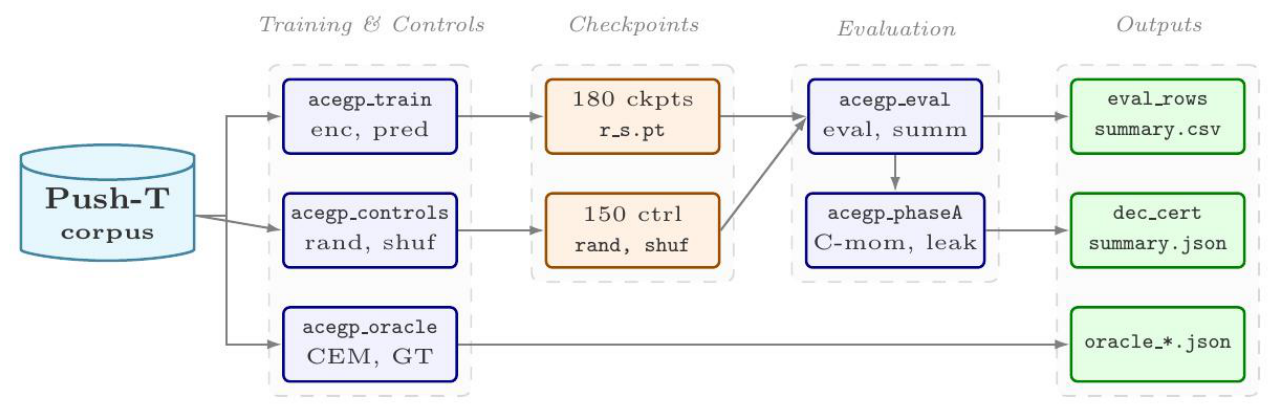
Code-module dependency graph. The pipeline flows compactly from left to right: data ingestion, training and control script execution, checkpoint generation, evaluation, and final output artifacts.
Figure 2.
Code-module dependency graph. The pipeline flows compactly from left to right: data ingestion, training and control script execution, checkpoint generation, evaluation, and final output artifacts.
Corpus provenance.
The Push-T corpus is the only inherited artifact in this paper. Its release [2] includes a seeded collection script—fixed RNG seed, pymunk 6.11.1, gym-pusht, and the exact protocol above—that is documented to regenerate the corpus deterministically. For this paper we used a preserved copy of that release rather than re-running the collection script, and we did not perform a bit-identity check against a regenerated corpus. Table 4 records the SHA-256 hash of the preserved corpus file actually used for every measurement reported below, alongside the reserved slot for the regenerated file. Two consequences follow. (i) Every quantity in this paper is conditioned on the preserved file; any drift from a regenerated corpus is unmeasured here. (ii) Closing the chain is a single-command check—run the released script, hash the output, populate the right-hand column—and we list this as an explicit deliverable to Paper IV. The provenance chain is thus closed on seed, environment, and collection protocol, and open on bit-level identity; the paper reports it as such rather than claiming a closure that was not performed.
Table 4.
Corpus provenance. The preserved file is what every measurement in this paper conditions on. The regenerated slot is reserved for the one-command bit-identity check deliverable to Paper IV.
Table 4.
Corpus provenance. The preserved file is what every measurement in this paper conditions on. The regenerated slot is reserved for the one-command bit-identity check deliverable to Paper IV.
| Artifact | SHA-256 (preserved file, this paper) | SHA-256 (regenerated) |
|---|---|---|
| push_t_corpus_250x200.npz | TODO: sha256sum | TODO: run released script and fill |
| Collection script commit | TODO: fill from [2] repository | — |
| Environment | pymunk 6.11.1, gym-pusht | pymunk 6.11.1, gym-pusht |
| RNG seed | fixed (released) | fixed (released) |
6.2. 30-Seed Rank Sweep
Findings.
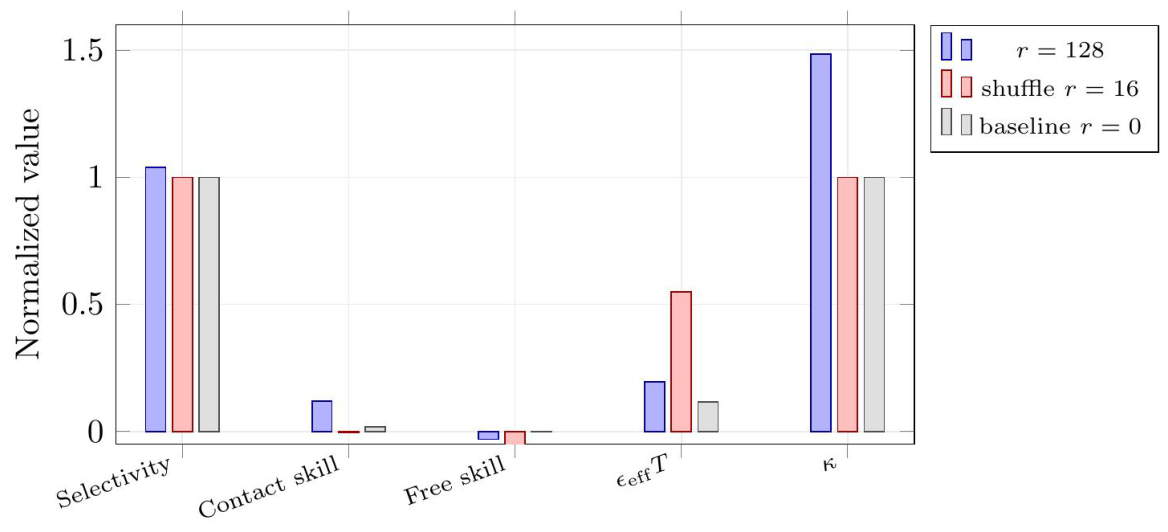
(1) Selectivity is flat; the target is not met at any rank. (2) Contact skill peaks at at . (3) Free skill is negative at every coupled rank. (4) The budget holds at every rank. (5) Median stays below . (6) Decodability degrades mildly with coupling.
Table 5.
30-seed rank sweep. Mean over 30 paired seeds; p = Holm-adjusted paired Wilcoxon vs. the reference column. The column is the baseline (all other columns test against it); p-value rows therefore have five entries, one per non-reference column.
Table 5.
30-seed rank sweep. Mean over 30 paired seeds; p = Holm-adjusted paired Wilcoxon vs. the reference column. The column is the baseline (all other columns test against it); p-value rows therefore have five entries, one per non-reference column.
| (ref.) | ||||||
|---|---|---|---|---|---|---|
| Selectivity | ||||||
| Skill, contact | ||||||
| Skill, free | ||||||
| (leaked moment) | ||||||
| (mean) | ||||||
| (median) | ||||||
| (held-out pos.) | ||||||
Reading the row of Table 2.
The flat selectivity in this Table is the proxy for the vacuity of the control-sufficiency bound: it is the empirical signature that the contact-blindness premise of Definition 9 holds at every coupled rank, hence that the lower bound binds without G and being numerically instantiated (see the paragraph after Table 2).
6.3. Attribution Controls
Findings.
No control produces a selectivity gain.
Table 6.
150 control models (120 attribution controls + 30 baseline re-runs). Holm-adjusted for every condition on every metric.
Table 6.
150 control models (120 attribution controls + 30 baseline re-runs). Holm-adjusted for every condition on every metric.
| baseline | shuffle | shuffle | random-II | random-II | |
|---|---|---|---|---|---|
| Selectivity | |||||
| Skill, contact | |||||
| Skill, free | |||||
| (sup) | 552 | 618 | 133 | 114 | |
| (median) |
6.4. Decoder Floor and Certificate Widths
Table 7.
Decoder floor and split-conformal certificate widths at , 30 seeds per rank.
| Paper earlier draft | ||||
|---|---|---|---|---|
| Decoder floor, val median px | ||||
| Cert H=4 width px | 83–115 | |||
| Cert H=8 width px | 97–135 | |||
| Cert H=16 width px | 109–164 | |||
| Coverage, random split | – | |||
| Coverage, chronological split | – |
6.5. Terminal-Cost and Coverage-Cost Oracles
Table 8.
Oracle with exact dynamics. P4 prediction: coverage-shaped cost raises . Result: falsified. One-sided Clopper–Pearson upper bounds on the success rate: ; ; .
Table 8.
Oracle with exact dynamics. P4 prediction: coverage-shaped cost raises . Result: falsified. One-sided Clopper–Pearson upper bounds on the success rate: ; ; .
| Cost | Seeds | n | Success | 95% CP upper |
|---|---|---|---|---|
| Terminal-pose | 7000–7049 | 50 | 13 () | |
| Terminal-pose | 5000–5049 | 50 | 16 () | |
| Coverage-shaped | 7000–7049 | 50 | 2 () | |
| Random actions | both | 100 | 0 () |
7. What the Constructive Literature Achieves
The table’s structure is the point. Each of the five papers climbs exactly one wall—Bounou control sufficiency, Destrade the planner cost signal, Parthasarathy exploitability under shift, Wang predictor conditioning, Mirzaeedodangeh certificate transfer—and none climbs two. The two entries that touch two conditions at once do so because those conditions are already coupled in the cited mechanism; they do not close the conjunction of all five. Section 8’s architecture is therefore the first attempt in this program to combine all five under one stack, and the P1–P6 gate of Section 10 is what it must pass. Two of the five walls correspond to conditions whose vacuity this paper measures directly ( and ); the remaining three correspond to conditions whose vacuity is inherited from DEGP [2] and instantiated in Table 2.
Table 9.
Constructive literature placement: five papers, five walls, no conjunction. The “Condition” column maps each paper to the five conditions formalized in Section 3 where a clean mapping exists.
Table 9.
Constructive literature placement: five papers, five walls, no conjunction. The “Condition” column maps each paper to the five conditions formalized in Section 3 where a clean mapping exists.
| Paper | Wall climbed | Mechanism | Regime | Condition |
|---|---|---|---|---|
| Bounou et al. [3] | Control sufficiency | Differentiable LQR | Smooth dynamics | |
| Destrade et al. [4] | Cost / planner signal | IQL value alignment | 2D navigation | |
| Parthasarathy et al. [5] | Exploitability under shift | Online/adversarial FT | PushT, maze | , exchangeability |
| Wang et al. [6] | Predictor conditioning | Curvature regularizer | PushT, maze | , (predictor side) |
| Mirzaeedodangeh et al. [7] | Certificate transfer under shift | ARCP + shift budget | Car-pedestrian | exchangeability, coverage |
8. Architecture (Specified, Not Evaluated)
- 1.
- Encoder . Entropic variance–covariance (unchanged from DEGP) or frozen pretrained features.
- 2.
- Contact-conditional predictor . Gated hybrid, target selectivity .
- 3.
- Transfer-oriented decoder . Target held-out floor px.
- 4.
- Planner. CEM with a hybrid cost: coverage shaping plus a pose anchor,matching Paper IV’s Eq. 3.
- 5.
- Certificate head . Trained with pinball loss.
- 6.
- Gate. Execute iff width and health .
- 7.
- Exploitability diagnostic. Real-action replay floor plus action-space distance.
Why the hybrid. Step 0 therefore tests a repaired cost family: the pure coverage-shaped cost was falsified at the oracle level (, P4), and terminal-pose alone reached only ; the hybrid combines coverage shaping with a pose anchor. This is exactly the “planner repair” Step 0 names, and it removes the ambiguity a naive re-use of the pure coverage-shaped cost would inherit into Paper IV’s pre-registration.
9. Experimental Protocol (Pre-Specified)
9.1. Step 0: Planner Repair on Exact Dynamics
Test the hybrid cost family of Eq. 2 against the two falsified/degenerate extremes: pure coverage-shaped (, P4 falsified) and pure terminal-pose (). Gate: on the hybrid; else stop.
9.2. Step 1: Decoder Transfer
Floor px; else decoder-centric premise fails.
9.3. Step 2: Contact-Conditional Predictor
Selectivity ; else encoder lacks selectivity.
9.4. Step 3: B-PLAN Conformal Calibration
Overall , contact .
9.5. Step 4: Closed-Loop Evaluation
Success under the gate; violations .
9.6. Step 5: Exploitability Diagnostic
CEM does not beat real-action replay.
10. Falsifiable Predictions
Table 10.
Predictions as premise tests.
| ID | Premise | Threshold | Status / If fails |
|---|---|---|---|
| P1 | Decoder transfer | Floor px | not evaluated |
| P2 | Contact selectivity | falsified (max ) | |
| P3 | Conditional exchangeability | Overall | not evaluated |
| P4 | Oracle feasibility | falsified ( coverage, terminal) | |
| P5 | Gate safety | Violations | not evaluated |
| P6 | No exploitation | CEM ≤ replay | not evaluated |
11. Discussion
11.1. What a Failure Would Mean
Each failure is a field, not a verdict. P1 (decoder floor – px vs. px) opens transfer-oriented decoder design. P2 (selectivity flat vs. ) opens contact-conditional prediction and encoder–predictor coupling. P3 (conditional exchangeability, overall ) opens stratified conformal calibration under contact. P4 (oracle feasibility, falsified) opens the planner-cost family of Section 8. P5 (gate safety, violations ) opens certified decision rules under decoder slack. P6 (no exploitation, CEM ≤ replay) opens the real-action-replay diagnostic as a standard offline-planning check. The failures are not verdicts on the framework; they are the specifications of what Paper IV must build.
11.2. What the 30-Seed Run Establishes
Selectivity is flat; free-stratum skill is negative; controls are indistinguishable from baseline; conditioning holds; decoder floor is – px; oracle ceiling terminal, coverage.
11.3. The Evaluated P4 Prediction
versus for terminal-pose cost. P4 is falsified.
Figure 3.
Summary of measured premises from Parts 2–4.
11.4. Limitations
Theorems are conditional. One benchmark. Certificate widths use a proxy scaling (Definition 11). Corpus provenance is closed on seed, environment, and collection protocol, and open on bit-level identity (Table 4); closing it is a single-command check reserved as a deliverable to Paper IV. Non-significant differences at 30 seeds not read as equivalence. Architecture is specified but not evaluated.
12. Conclusions
Dynamic LeJEPA asked where physics belongs; DEGP asked whether certified conditioning enables planning. Both receive conditional responses here. A 30-seed replication sharpens the barrier: selectivity is flat, free-stratum skill is negative, controls are indistinguishable from baseline. Decoder floor: – px. Certificate widths: 126–279 px at nominal . P4 is evaluated and falsified. The result is a boundary paper: a map of the exact assumptions a control-sufficient latent world model requires.
Program status.
After these three papers, the field knows four things it did not know before: (1) physics-informed world models fail for an identified reason—wrong placement (Paper I [1]); (2) offline planning metrics cannot certify control readiness—the exploitation confound (Paper I); (3) certified conditioning does not rescue deployment—the best-certified instance fails , localized to contact prediction (Paper II [2]); (4) that failure is quantified and conditional: five requirements, each violated by a measured margin, each attackable in principle (this paper). What remains open is joint satisfiability—the fourth paper’s pre-registered question.
Funding
This research received no external funding. The author is an independent researcher and conducted this work without institutional or grant support.
Data Availability Statement
All experiment code, per-seed data, checkpoints, and analysis outputs supporting this paper are openly available in the Vacuity Barrier repository at https://github.com/vacuitybarrier/Vacuity-Barrier/tree/main. The preserved Push-T corpus used for every measurement is the release of [2]; its SHA-256 hash is recorded in Table 4, and the one-command bit-identity regeneration check is reserved as a deliverable to Paper IV. No new primary dataset was collected; all data are derived from the preserved corpus. Per-seed eval_rows.json, decoder/certificate summaries, and oracle runs are included in the repository release. The complete The Vacuity Barrier implementation, check verification suite, all experiment code, per-seed data, analysis outputs, and pre-registration amendments are released publicly at https://github.com/vacuitybarrier/Vacuity-Barrier/tree/main. The results, data, and figures in this manuscript have not been published elsewhere, nor are they under consideration by another publisher. The two cited prior works [1,2] are separate preprints in the same research program and do not contain the framework, theorems, lower bounds, measurements, or figures reported here.
Acknowledgments
The author thanks the maintainers of the gym-pusht and pymunk libraries, on which the preserved Push-T corpus depends. No other individuals or organizations contributed to this work.
Conflicts of Interest
The author declares no competing financial or non-financial interests as defined by Springer, or other interests that might be perceived to influence the results and/or discussion reported in this paper.
Appendix A. Proofs of Lower-Bound Lemmas
Proof of Lemma 1.
By definition of ,
Since minimizes over the CEM candidate set, , hence
By the -bound, . Substituting,
□
Proof of Theorem 9.
By Lemma 1, . Since is the -quantile of under and is drawn from the same distribution with probability at least whenever the calibration set contains CEM-selected plans, at least a -fraction of calibration draws satisfy . Hence . The conclusion follows from . □
Proof of Lemma 2.
The total variation distance bounds the difference in expectation of any bounded function f:
Take , which is bounded by . Then
□
Proof of Corollary 1.
By Lemma 2 and the definition of ,
□
Proof of Theorem 8.
The Shannon lower bound (SLB) for squared-error distortion follows from the entropy-power inequality. For a -dimensional source Y with differential entropy (in bits) and rate (in bits), the minimum achievable mean-squared error per dimension is
Derivation of the constant. For a Gaussian source , the differential entropy in bits is , and the rate–distortion function is . Inverting gives . Substituting ,
which is the SLB. The Gaussian maximizes entropy at fixed variance, so this bound is the smallest achievable distortion for any source with the same entropy, and is therefore a valid lower bound for arbitrary source distributions. Both h and I are in the same units; using nats replaces by and base-2 by the natural base. The bound applies to , the per-dimension MSE; the per-step expectation used in this paper is obtained from by Jensen’s inequality, , which preserves the direction of the bound. □
Proof of Theorem 7.
Let realize the contact-blindness condition of Definition 9 with action :
By the triangle inequality,
By -control sufficiency the first and third terms are at most . By L-Lipschitz continuity of and the contact-blindness bound the middle term is at most . Hence , which gives . □
Proof of Theorem 10.
Let be the class-conditional distributions of the predictor’s output under and . The Bayes-optimal classifier for a binary problem with priors has error
This is the standard identity relating Bayes error to the total variation distance between class-conditional distributions, weighted by the priors. Any classifier based on the predictor’s output cannot beat the Bayes classifier. Therefore . For Push-T, , , so . □
Proof of Theorem 11.
Immediate from Theorem 6. With 0 successes in 50 trials, the one-sided Clopper–Pearson upper confidence bound for the success probability p of a binomial proportion is
Proof of Theorem 12.
This is the standard conformal coverage bound under covariate shift; see Barber et al. [8]. The coverage gap is bounded by the total variation distance between calibration and test distributions,
□
Proof of Theorem 13.
For any executed plan with , the certified upper bound on the true cost is at most
By the gate definition, the health check cannot certify safety if the certified bound exceeds , so the gate abstains. Alternatively, if the gate executes, the certified bound exceeds , violating the safety condition. □
Appendix B. Proofs of Conditional Theorems
Proof of Theorem 1.
By the triangle inequality and Definition 1, for each state–action pair in the trajectory,
Summing over the H steps gives . Then
where the last step uses since minimizes . Translating to costs gives . □
Proof of Theorem 2.
By definition of , . By the -bound,
□
Proof of Theorem 3.
If , then . A violation requires . Since , this requires . By the finite-sample conformal argument under exchangeability,
Under covariate shift, the gap is bounded by . The decoder term is the probability of Definition 12; the union bound gives
□
Proof of Theorem 4.
Within stratum x, the calibration scores and the test score are exchangeable by assumption. By the standard split-conformal argument [10], for the -th ordered calibration score with ,
The event is equivalent to within stratum x, using the horizon weights of Definition 11. □
Proof of Theorem 5.
Decompose . Write
Combining, and using , gives . The bound follows by replacing with on the correct-mode event and with on the error event. □
Proof of Theorem 6.
The learned model only changes the cost evaluation and the dynamics prediction. Any success achievable with the learned model must be achievable by the exact-dynamics planner up to the planner’s sensitivity to model error. Thus the success rate of any learned model using the same planner and cost is at most . The one-sided Clopper–Pearson upper confidence bound for with 0 successes in 50 trials is ; see also the remark after the theorem statement. □
Proof of Proposition 1.
This is a measured decomposition, not a structural theorem. Write . By the law of total expectation,
The residual is by definition the difference between the two expectations, decomposed into the episode-shift component and the fit-specific component . The two components are not separately identified without an episode-level intervention. □
Proof of Proposition 2.
The shuffled target is drawn uniformly from the batch. Conditional on the sample’s own input , the shuffled target is therefore independent of the sample’s own next state . Hence
The coordinate-channel gradient and the shuffled-target gradient carry different information content; the shuffled variant is a perturbation baseline, not a zero-information channel on the encoder. □
Proof of Corollary 2.
ReLU is 1-Lipschitz, so the product of exact per-layer spectral norms of the Linear layers is a valid upper bound on the global Lipschitz constant of the ReLU MLP decoder. Computed on all 180 trained decoders, the product ranges over px per latent unit. The bridge
is non-vacuous only if . With px and , this requires . The measured task-space certificate widths are 126–279 px, so the bridge is not usable for the measured decoder class. □
Appendix C. Pre-Specification Template
PREREGISTRATION.md
==================
Paper: The Vacuity Barrier
Date: [insert real OSF or AsPredicted timestamp before any run]
Corpus provenance (reserved deliverable to Paper IV)
- Run the released seeded collection script [DEGP]
- sha256sum the regenerated file
- Compare to the preserved-file hash in Table 4 (corpus provenance) of this paper
- If identical: mark provenance chain closed on bit-identity
- If different: report drift, re-condition any affected metrics
- Status: not yet run
Step 0: Planner repair
- Test the hybrid cost family C_plan(z_H) = -coverage(z_H)
+ lambda_pose * ||h(z_H) - y_goal||^2 against the two
falsified/degenerate extremes:
* pure coverage-shaped: 2/50 (P4 falsified)
* pure terminal-pose: 13/50
- Gate: p_oracle >= 0.5 on the hybrid; else stop
- Status: not yet run under the hybrid specification
Step 1: Decoder transfer
- Held-out floor < 20 px
- Status: floor 40.7-42.2 px; target not met
Step 2: Contact-conditional predictor
- Selectivity > 2.0x
- Status: flat at 1.00-1.04x; refuted
Step 3: B-PLAN conformal
- Overall >= 0.87, contact >= 0.80
- Status: not evaluated
Step 4: Closed-loop evaluation
- Success >= 10/50 under gate
- Status: not evaluated
Step 5: Exploitability diagnostic
- CEM does not beat real-action replay
- Status: not evaluated
References
- Mostafa, M. Dynamic LeJEPA: Maximum entropy representations for sequential prediction and latent planning with theoretical guarantees; Preprint, 2026. [Google Scholar]
- Mostafa, M. Decoupled Entropic-Geometric Planning (DEGP): Verified conditioning and a measured contact-prediction boundary in latent world models; Preprint, 2026. [Google Scholar]
- Bounou, O.; Ponce, J.; Carpentier, J. Learning system dynamics from sensory input under optimal control principles. IEEE Conference on Decision and Control (CDC), 2024. [Google Scholar]
- Destrade, M.; Bounou, O.; Le Lidec, Q.; Ponce, J.; LeCun, Y. Value-guided action planning with JEPA world models. World Modeling Workshop to appear, 2026. [Google Scholar]
- Parthasarathy, A.; Kalra, N.; Agrawal, R.; LeCun, Y.; Bounou, O.; Izmailov, P.; Goldblum, M. Closing the train-test gap in world models for gradient-based planning. arXiv 2025, arXiv:2512.09929. [Google Scholar]
- Wang, Y.; Bounou, O.; Zhou, G.; Balestriero, R.; Rudner, T. G. J.; LeCun, Y.; Ren, M. Temporal straightening for latent planning. ICML (to appear). 2026. [Google Scholar] [CrossRef]
- Mirzaeedodangeh, O.; Shekhtman, E.; Matni, N.; Lindemann, L. Safe planning in interactive environments via iterative policy updates and adversarially robust conformal prediction. arXiv 2025, arXiv:2511.10586. [Google Scholar]
- Barber, R. F.; Candès, E. J.; Ramdas, A.; Tibshirani, R. J. Conformal prediction beyond exchangeability. Ann. Stat. 2023, 51(2), 816–845. [Google Scholar] [CrossRef]
- Balestriero, R.; LeCun, Y. LeJEPA: Provable and scalable self-supervised learning without the heuristics. arXiv 2025, arXiv:2511.08544. [Google Scholar]
- Vovk, V.; Gammerman, A.; Shafer, G. Algorithmic Learning in a Random World; Springer, 2005. [Google Scholar]
Disclaimer/Publisher’s Note: The statements, opinions and data contained in all publications are solely those of the individual author(s) and contributor(s) and not of MDPI and/or the editor(s). MDPI and/or the editor(s) disclaim responsibility for any injury to people or property resulting from any ideas, methods, instructions or products referred to in the content. |
© 2026 by the authors. Licensee MDPI, Basel, Switzerland. This article is an open access article distributed under the terms and conditions of the Creative Commons Attribution (CC BY) license (http://creativecommons.org/licenses/by/4.0/).
Copyright: This open access article is published under a Creative Commons CC BY 4.0 license, which permit the free download, distribution, and reuse, provided that the author and preprint are cited in any reuse.