

Submitted:
10 November 2026
Posted:
12 November 2026
You are already at the latest version
Abstract
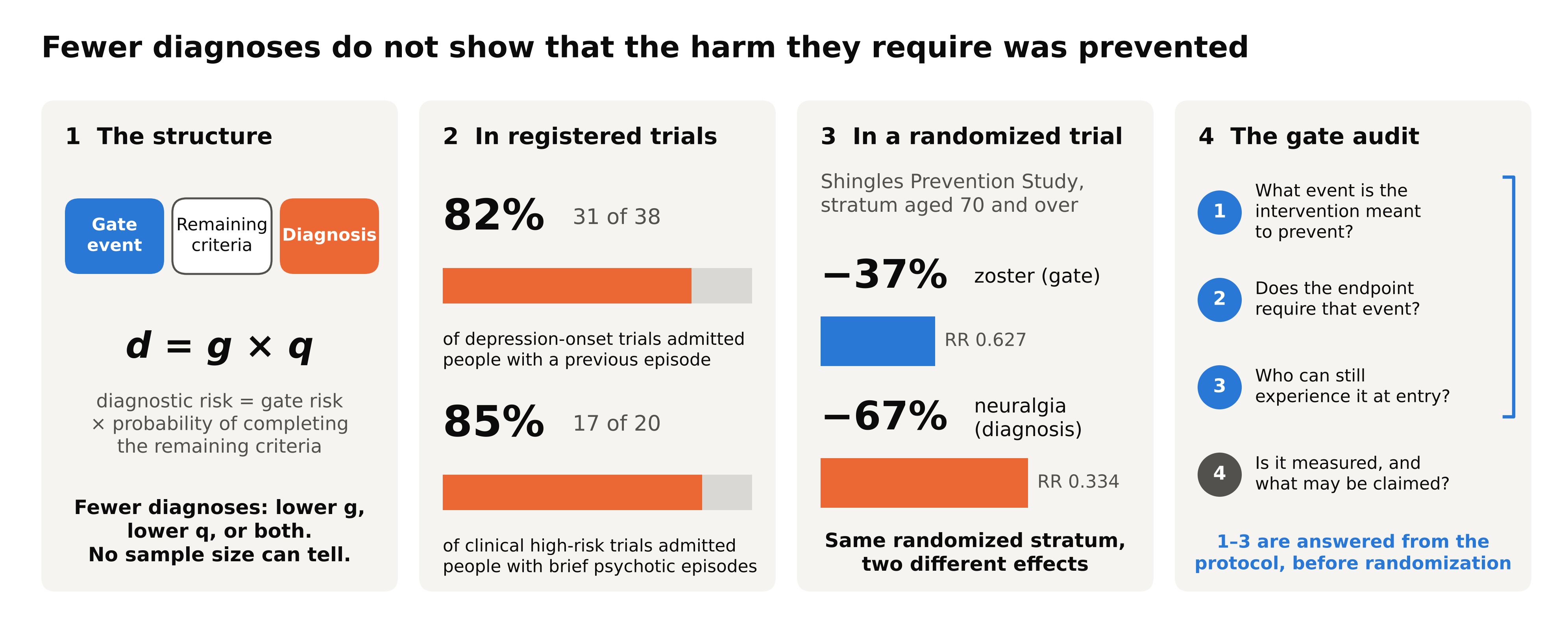
Background Prevention trials promise to prevent an event, such as a first depressive or psychotic episode or first drug use, but many count a diagnosis that requires it, and many enrol people who have already had it. Methods Formal analysis; a reanalysis of nested outcomes in two randomized zoster-vaccine programmes; and registry audits of ClinicalTrials.gov depression-prevention and clinical high-risk psychosis trials and their published reports. Results Diagnostic risk equals gate-event risk times the probability of completing the remaining criteria, so fewer diagnoses cannot, at any sample size, show that the event was prevented; in participants who have already had the event, gate risk is 1 in both arms and any effect is on recurrence. In one randomized zoster-vaccine stratum the nested endpoint fell by 67% and the event it requires by 37%, while in two other populations the two estimates nearly coincided; the endpoint alone cannot show which applies. Of 38 trials framed as preventing depression onset or incidence, 31 admitted people who had already had a depressive episode (82%, 95% confidence interval 67–91; 74% under the protocol-named categories only), and 68 of the 72 onset-framed or generically framed trials that admitted them registered a single estimate for first and recurrent episodes; in seven reports giving the figure, the share who had already had one ranged from 1% to 80% (median 33.5%). Of 20 trials in people at clinical high risk for psychosis, 19 counted only psychotic-intensity episodes that outlasted a duration threshold, so fewer transitions cannot be told from shorter episodes. A meta-analysis of depression onset pooled a trial in which 80% had already had an episode, recording 55%. Conclusions A four-question gate audit, three of whose questions are answered from the protocol and baseline data before any outcome is observed, detects the mismatch and states what each trial can claim.
Keywords:
prevention trials
; diagnostic endpoints
; eligibility criteria
; trial registration
; estimands
; principal stratification
1. Introduction
Prevention trials promise to stop something from happening: a first depressive episode, a first psychotic episode, the first use of a drug. Many of them measure something else, a diagnosis that requires the event, and many enrol people in whom the event has already happened. In a survey of ClinicalTrials.gov, about four in five randomized trials that described their aim as preventing the onset or incidence of depression (31 of 38) admitted people who had already had a depressive episode, and in the seven published reports that gave the figure, the share of participants who had already had one ranged from 1% to 80%, with a median of one third. Trials in people at clinical high risk for psychosis exclude psychotic disorder at entry by design, but 19 of 20 counted only psychotic episodes that outlasted a duration threshold, so they cannot tell fewer episodes from shorter ones. Neither failure is visible in a trial’s result; both are visible in its protocol.
Many diagnoses require such an event. A substance use disorder requires use of the substance; bipolar II disorder requires a major depressive episode; schizophrenia requires psychotic symptoms within at least six months of continuous signs of disturbance; posttraumatic stress disorder requires exposure to a traumatic event (American Psychiatric Association [APA], 2022). A trial that lowers the incidence of such a diagnosis may have prevented the event, left it unchanged, or even increased it while fewer people met the remaining criteria. The randomized result is a valid effect on the diagnosis, but it is not, by itself, evidence that the event was prevented.
The same structure holds when the endpoint is a new episode of the disorder itself. A depressive episode during follow-up entails that a first lifetime episode has occurred by the end of follow-up, so a trial of depression onset has a required event too: the first episode. In a participant who has never been depressed, the first episode and the endpoint coincide. In a participant with a previous episode, the required event occurred before randomization, no intervention can change it, and the trial can show only an effect on recurrence. A trial that enrols both and reports one estimate reports a mixture of the two, weighted by a proportion that the protocol fixes and the report often omits.
Vaccine research met this structure first, because disease requires infection: vaccine epidemiology separates effects on susceptibility to infection from effects on progression after infection, and bounds the latter within the principal stratum of people who would be infected under either assignment (Frangakis & Rubin, 2002; Halloran et al., 1997; Hudgens & Halloran, 2006). Outside vaccinology the problem is harder: the event is written into diagnostic criteria rather than detected by a laboratory test, so it is easily left unmeasured; it may have occurred before enrolment; and where the criteria require it to persist, an intervention can lower diagnoses by shortening episodes without preventing any. These are three forms of one problem, and each has a field in which it dominates: substance use, depression and psychosis.
The problem is not the familiar one of surrogate endpoints (Prentice, 1989): the diagnosis is itself clinically important, and the event is a logically necessary component of it rather than a correlated outcome, which is what makes exact limits possible. The estimand framework (International Council for Harmonisation of Technical Requirements for Pharmaceuticals for Human Use [ICH], 2019), the SPIRIT 2025 and CONSORT 2025 statements (Chan et al., 2025; Hopewell et al., 2025) and the standards of evidence of prevention science (Flay et al., 2005; Gottfredson et al., 2015) can all be met for a diagnosis while leaving undefined who could still experience the event inside it and whether that event is measured. The result is then easily read as prevention of the event, in trial reports, in meta-analyses and in the programmes built on them, however large the trial.
This article states what diagnosis-only data can and cannot identify, including when the required event precedes enrolment, and shows in two randomized zoster-vaccine programmes that effects on a nested endpoint and on the event it requires can diverge. It turns these results into a four-question audit, applied here to published trials of substance use, depression, bipolar disorder and psychosis prevention. It then measures how often registered trials of depression prevention admit people who have already had the event, how often trials of psychosis prevention in people at clinical high risk count only episodes that persist beyond a threshold, and, in the published reports, how many people who had already had the event entered. Three of the audit’s questions are answered before any outcome is observed, so investigators, registries, ethics committees, funders and journals can adopt them without new data.
2. Methods
2.1. Approach
This methodological study combines formal analysis, a reanalysis of two vaccine programmes, worked applications to four published prevention trials and a meta-analysis, and a registry audit with a follow-up of published reports. Constructed probabilities illustrate mathematical possibilities, not natural history; the vaccine programmes and trials were selected purposively to illustrate the argument, not to estimate how often misinterpretation occurs. Appendices A to E are in Online Resource 1. ChatGPT (OpenAI) and Claude (Anthropic) assisted with drafting, literature searching, language editing, source verification, checking calculations, writing the figure code, coding registry records, and locating trial reports and extracting their baseline data; the author checked every registry code against the record text, listed every figure taken from a published report with its source, reviewed and edited all content and takes full responsibility for it.
2.2. Terms
A gate is an event that must have occurred for the endpoint to be met under the criteria used, and whose prevention is the question under examination: for a drug use disorder endpoint and a question about preventing drug use, the gate is use of the drug; for a depressive-episode endpoint and a question about preventing the onset of depression, the gate is the first lifetime episode. Completion is satisfaction of the remaining requirements for the endpoint, a logical condition rather than necessarily a later stage, and a gate-anchored endpoint is one that logically requires the gate. The completion probability, q, is the probability of meeting the endpoint by a specified horizon among people who have experienced the gate by then, under a given assignment; it is not an identified causal effect. A participant is gate-positive at entry if the gate occurred before randomization and gate-free otherwise; for a gate-positive participant, gate risk is 1 under either assignment. Principal strata are groups defined by whether a participant would experience the gate under each assignment (Frangakis & Rubin, 2002); if the intervention never causes the gate (monotonicity), they are people who would experience it under either assignment (always-gate), only without the intervention (protected), or under neither.
2.3. Data and Analysis
The two zoster programmes were chosen, without a screening log, because their US package inserts report zoster and postherpetic neuralgia against compatible denominators (U.S. Food and Drug Administration [FDA], 2018, 2026); the crude estimates reproduce the primary trial reports (Oxman et al., 2005; Appendix B1). For each population I computed risk ratios for zoster and neuralgia, the conditional probability of neuralgia given zoster in each arm, the ratio of the two risk ratios with a variance that accounts for the nesting, and principal-stratum limits on the effect of vaccination on neuralgia (Hudgens & Halloran, 2006), all exploratory and nominal (Appendices A8 and B4). The four prevention trials (Garber et al., 2009; Kellam et al., 2008; Miklowitz et al., 2020; Morrison et al., 2012) were chosen, without a systematic search, because each reports a diagnostic or duration-defined endpoint with information on the gate or on gate status at entry. The meta-analysis that pools one of them (Cuijpers et al., 2021) was reanalysed from the event counts in its forest plot (Appendix E).
2.4. Registry Audit and Publication Follow-Up
The registry surveys are audits, not systematic reviews of trial evidence. Each applied one prespecified search and one coding scheme to a single registry to measure how often registered trials are designed in a way that the gate audit flags; they do not estimate intervention effects or assess the risk of bias of published trials. The protocol was written before any record was retrieved (Online Resource 2). On 11 October 2026, ClinicalTrials.gov (U.S. National Library of Medicine, 2026) was searched for interventional, randomized studies with prevention as their primary purpose, depression as condition, and outcome terms for onset, incidence, episodes, diagnosis or interviews; all 444 records retrieved were screened. A trial was included if it registered, as a primary or secondary outcome, a depressive episode or disorder established by diagnostic interview or diagnostic criteria rather than by a symptom-scale cut-off. Each record was coded, with the registry phrase on which the code rests, for its stated aim (onset, incidence, first episode or primary prevention; generic prevention; or relapse and recurrence) and its eligibility rule on previous depressive episodes. The prespecified measure was the proportion of trials framed as preventing onset, alone and together with generically framed trials, whose eligibility admitted people with a previous episode, with Wilson 95% confidence intervals (Wilson, 1927); unclear codes counted as not admitting, and the reverse was a sensitivity analysis.
The stated aim was coded from the registry wording as it stands. In this field, onset and incidence are often used for a new episode in people who are not currently depressed, whatever their history (Cuijpers et al., 2008, 2021). The audit does not test whether registrations follow that convention; it measures how many trials with such an aim register a population in which a first episode is still possible for everyone, and how many separate first from recurrent episodes.
A second search retrieved 81 randomized trials registered under psychosis with the terms clinical high risk, ultra high risk, at-risk mental state or prodromal. The instruments that define clinical high risk exclude psychotic disorder at entry by design, so the event coded in this field was not a previous psychotic disorder but a psychotic-intensity episode that had resolved before the duration threshold that defines transition. Trials in people at clinical high risk that registered transition to psychosis were coded for whether eligibility admitted people with such brief psychotic episodes, named as an entry route or included by standard risk criteria, and for whether psychotic-intensity episodes were registered regardless of duration.
After the survey, I sought the published results of every registration that admitted people who had already had the event: the 31 onset-framed depression trials and the 17 clinical high-risk trials. This follow-up was not part of the survey protocol; it was applied to every such registration, left the prespecified estimates unchanged, and could have shown that few such people enter, as it did for psychosis. Reports were searched by registry number and title between 24 and 26 October 2026 and linked to a registration when they printed its number or matched it in title, population, sample size and design. From each report, or from a baseline report of the same trial, I took the number of participants who had already had the event at entry (a previous depressive episode, or brief limited intermittent or brief intermittent psychotic symptoms), with the table or passage it comes from (Online Resource 3). The shares are summarized by their range and median; no threshold was prespecified.
3. What a Diagnosis That Requires the Gate Can and Cannot Show
Consider a defined population and follow-up horizon, with the same ascertainment rules for both events. If everyone who meets the diagnostic endpoint has experienced the gate, diagnostic risk d is the product of gate risk g and completion probability q:
d = g × q (1)
The multiplication rule is elementary; its consequence for preventive claims is not. Assignment A can act on the gate G and, directly or through the timing of the gate, on completion; the diagnosis D can occur only if G has occurred; and unmeasured susceptibility U affects both (Online Resource 4, Figure S1). Randomization identifies the effect of A on D, an effect on the product in Equation 1. From diagnoses alone it does not identify the effect of A on G, and even with G recorded, how the effect on D divides between the path through G and the direct arrow is not identified without further assumptions. The trial shows whether fewer people reached the diagnosis, not why.
3.1. A Diagnostic Effect Is Valid, but It Is a Different Effect
In the constructed example of Figure 1a and Figure 40% of control participants experience the gate and half of them complete the diagnosis, a diagnostic risk of 20%. Three interventions each reduce diagnostic risk to 12%: one lowers the gate to 24%, one leaves it at 40% and lowers completion, and one raises it to 60% while lowering completion further. The three trials would report identical diagnostic results, yet only the first prevents the gate and the third increases it; if only diagnoses are recorded, no sample size distinguishes them (Appendices A1 and A2).
Because risk ratios multiply, the gate risk ratio equals the diagnostic risk ratio divided by the relative change in completion probability. With a diagnostic risk ratio of 0.60, the gate was reduced only if completion fell by less than 40% (Figure 1b). A vague concern about mechanism thus becomes a concrete question: could the intervention plausibly have lowered completion among people with the gate by that much? Randomization does not ensure equal completion across arms, because the people who experience the gate under each assignment may differ, and interventions can change completion directly or by delaying gate events (Appendices A3 and A4).
3.2. When the Gate Has Already Occurred
Equation 1 describes participants who are gate-free at entry. If a proportion π of the sample is gate-positive at entry, their gate risk is 1 under either assignment, and their diagnostic risk is their completion probability alone, written r. Diagnostic risk in the whole sample is then:
d = π r + (1 − π) g × q (2)
Randomization balances π across arms in expectation, so the difference in diagnostic risk between arms is π times the difference in r plus (1 − π) times the difference in g × q. Three consequences follow. First, no intervention can act on the gate in the gate-positive share: whatever the trial shows for them is an effect on completion. Second, the pooled contrast equals the contrast among gate-free participants only when π is zero or the two contrasts happen to be equal, which the pooled result cannot show. Third, π is set by the eligibility rule and known at baseline, so the weight a trial places on each question can be stated before any outcome is observed.
Depression onset is the limiting case. The gate is the first lifetime depressive episode and the endpoint is a depressive episode during follow-up. For a gate-free participant a first episode during follow-up is the endpoint, so q is 1 and d equals g: the endpoint measures the gate directly. For a gate-positive participant r is the risk of recurrence. Equation 2 becomes d = π r + (1 − π) g, and a trial of depression onset that admits previous episodes estimates a weighted average of an effect on recurrence and an effect on first episodes. In depression the gate is therefore not left unmeasured, as it is in substance use; it is measured in a sample where, for a share π, it can no longer be prevented.
The three forms of the problem are three positions in one identity. Where the gate is not recorded, g and q cannot be separated in d. Where the gate precedes randomization, π is above zero and part of the estimate concerns completion only. Where completion is defined by persistence, q moves with the duration of episodes and d can fall without any change in g.
3.3. Measuring the Gate Is Necessary but Not Sufficient
Recording the gate allows its incidence to be compared directly between arms. Comparing completion only among people who experienced the gate does not identify an effect on progression, because the intervention itself decides who reaches the gate: the comparison conditions on a common effect of A and U and opens the path A → G ← U → D (Hernán et al., 2004; Online Resource 4, Figure S1b). Under monotonicity the counts identify only limits on the effect within the always-gate stratum (Appendix A8).
4. Randomized Evidence: Nested Outcomes in Two Zoster-Vaccine Programmes
The Shingles Prevention Study (SPS) of the live attenuated zoster vaccine randomized 38,546 adults aged 60 years and over, stratified at ages 60–69 and 70 and over (FDA, 2018; Oxman et al., 2005). The prespecified pooled analysis of the ZOE-50 and ZOE-70 trials of the adjuvanted recombinant vaccine reports 16,596 participants aged 70 and over (FDA, 2026). In both programmes postherpetic neuralgia requires zoster by definition, qualifying pain is defined in the same way, and participants with previous zoster were excluded, so the analysed populations were free of the gate at entry (π = 0) and Equation 1 applies to every participant.
In the SPS stratum aged 70 and over, vaccination reduced zoster by 37% (risk ratio 0.627) and neuralgia by 67% (risk ratio 0.334; Figure 2). Among participants who developed zoster, 18.5% of those given placebo and 9.8% of those vaccinated went on to neuralgia. Reading the neuralgia result as a measure of zoster prevention would have reported a reduction 1.8 times larger than the one measured (ratio of risk ratios 0.532, 95% confidence interval [CI] 0.327–0.866). In the stratum aged 60–69 the two estimates nearly coincided (0.365 and 0.347), as they did for the recombinant vaccine at ages 70 and over, where zoster and neuralgia both fell by about 90% (risk ratios 0.089 and 0.112). No comparison was prespecified, and the difference in the older SPS stratum does not survive correction for the ten comparisons reported (Appendix B5), so it is descriptive; the identification result does not depend on it. What the programmes show is that a nested endpoint can track its gate closely in one randomized population and depart from it in another, and that the endpoint alone does not show which has happened.
Comparing neuralgia between vaccinated and placebo participants who developed zoster compares groups selected after randomization, so the ratio of 9.8% to 18.5% is not an effect of vaccination on progression (Hudgens & Halloran, 2006). Assuming that vaccination never causes zoster, the counts bound that effect, among participants who would develop zoster under either assignment, between a two-thirds reduction and no upper limit (Online Resource 2, Table S1); an untestable assumption of positive selection (Zhang & Rubin, 2003) narrows the range to a reduction of 47% to 67% (Appendix B6). The live vaccine label states that vaccination reduced neuralgia among participants aged 70 and over who developed zoster (FDA, 2018), a statement that follows under positive selection but not from monotonicity alone. Both labels already separate the two effects (FDA, 2018, 2026), so the separation the audit asks for is existing regulatory practice. Counts and between-estimate comparisons are in Online Resource 4, Table S2.
5. The Gate Audit
Table 1 summarizes four questions that apply at the protocol stage, when a trial is reported, in syntheses, and whenever a published trial is used as evidence for a preventive claim. The first two are answered from the clinical question and the diagnostic criteria, the third from the eligibility rule and participants’ history at entry; only the fourth needs outcome data.
Question 1: What event is the intervention meant to prevent? The protocol should name the event, give its operational definition, state whether the target is a first occurrence or a recurrence, and specify the period over which benefit matters. A general aim such as preventing bipolar disorder or drug abuse does not answer this question.
Question 2: Does the diagnostic endpoint require that event? Every diagnostic pathway should be checked under the criterion version to be used. Bipolar I disorder can be diagnosed without any depressive episode (APA, 2022), so a combined bipolar I or II endpoint is not anchored to depression even though bipolar II disorder is (Appendix C2).
Question 3: Who can still experience the event at entry? A participant who has already experienced the gate cannot benefit from prevention of its first occurrence, only from prevention of recurrence or of completion, which are legitimate but different questions; a trial that enrols both groups mixes the two in the proportions of Equation 2, and a pooled comparison cannot generally recover the first-event effect (Appendix A5). Where the gate may have occurred before referral, the protocol has to establish gate history at entry, keep uncertain histories uncertain rather than coding them as negative, and report the number of confirmed gate-free participants by arm. Excluding only a current diagnosis, the rule stated by meta-analyses of depression onset (Cuijpers et al., 2008, 2021), does not answer this question, because it admits participants whose previous episodes have remitted.
Question 4: Is the event measured, and what may be claimed? The gate and its timing should be assessed in every eligible participant, and the proportion of gate-positive participants who meet the endpoint reported by arm alongside both marginal results, as the live zoster vaccine label already does. A statement about effects on completion is a principal-stratum question and needs its assumptions and limits stated (Appendices A8 and B7). When the gate is not measured, one sentence remains possible: the gate was reduced only if completion fell, in relative terms, by less than the diagnosis did. Where completion is defined by persistence, that sentence can be put in clinical units: the older-stratum neuralgia result could be explained without any prevention of zoster only if vaccination had shortened the pain that defines neuralgia by 40% to 58%, whereas the observed shortening would lower completion by only 11% to 16% (FDA, 2018; Appendix A9). Reports should distinguish lower event risk within a stated horizon, additional event-free time and lower diagnostic incidence; none of them establishes lifelong prevention (Appendix C3).
6. Applying the Audit to Published Prevention Trials
The audit was applied to four published trials (Online Resource 4, Table S3). Three are set out below, one for each form of the problem: an unmeasured gate, a gate that preceded randomization, and completion defined by duration. The fourth, a trial of family-focused therapy in youths at familial risk for bipolar disorder, is in Table S3: 75 of its 127 participants (59%) had already had the depressive gate (Miklowitz et al., 2020), so for them any later bipolar II diagnosis would complete a gate that preceded randomization (Question 3). Each trial fails or passes at a different question: the audit does not grade trials, it decides which claims each can support.
6.1. Universal Prevention of Substance Use: The Good Behavior Game
The Good Behavior Game is a classroom method directed at aggressive, disruptive behaviour in the first school grades. In the first cohort of the Baltimore trial, first-grade classrooms were randomized to the game or to control conditions, and participants were interviewed at ages 19 to 21 with a diagnostic interview scored to the criteria of the fourth edition of the Diagnostic and Statistical Manual of Mental Disorders (DSM-IV; Kellam et al., 2008). Lifetime illicit drug abuse or dependence was found in 12% of participants from game classrooms and 21% of those from internal control classrooms (p = .04); among males, in 19% and 38% (p = .01); and among males rated highly aggressive and disruptive in first grade, in 29% and 83% (p = .02). Effects in a second cohort were smaller and not significant.
If the event to be prevented is illicit drug use (Question 1), the endpoint requires it (Question 2), and Question 3 is answered by design, because participants were randomized as first graders. Question 4 decides what may be claimed. The outcome report presents lifetime abuse and dependence disorders, not the proportion of each group who had used illicit drugs (Kellam et al., 2008), so it shows fewer young men with drug use disorders, but not whether fewer used drugs or fewer users met the criteria. The second possibility is not remote: under DSM-IV, abuse is diagnosed when use leads to recurrent role failure, hazardous use, legal problems or continued use despite social problems (APA, 1994), so an intervention that reduces aggressive behaviour could reduce how many users meet the criteria without reducing use, and the effect was largest among the most aggressive boys. Lifetime use reported by condition would identify the effect on the gate; until then, the result supports prevention of drug use disorders in young men, and prevention of drug use only under an assumption about completion.
6.2. Depression Onset: A Trial and the Meta-Analysis That Pooled It
Garber et al. (2009) randomized 316 adolescents aged 13 to 17 years, offspring of parents with current or prior depressive disorders, to a cognitive-behavioral prevention program or usual care. Eligibility required subsyndromal symptoms, a previous depressive episode in remission, or both, and 244 of the 307 adolescents in the analysis stratified by history had already had a depressive episode (π = 0.795), so for them a new episode over the following 9 months was a recurrence. With a previous episode, 27 of 125 adolescents in the program and 40 of 119 in usual care had a new episode (risk difference −12.0 percentage points, 95% CI −23.0 to −0.1); without one, 6 of 29 and 10 of 34 did (−8.7 percentage points, 95% CI −29.9 to 12.5; Garber et al., 2009, Table 4). Summing the two strata, 33 of 154 and 50 of 153 had a new episode (21.4% and 32.7%, the incidences the report gives for the whole sample), a difference of −11.3 percentage points in which 67 of the 83 events were recurrences. The pooled estimate is the mixture of Equation 2 with four fifths of its weight on recurrence. The direct evidence on first episodes comes from 63 adolescents and is compatible with anything from a large benefit to harm; the authors drew the corresponding conclusion, that the program prevented recurrence, so Question 3 is answered in the trial report.
The difficulty arises when the trial is used as evidence for a different claim. A meta-analysis of psychological interventions to prevent the onset of depressive disorders, which required only the absence of a depressive disorder at baseline, pooled the trial with 49 others (Cuijpers et al., 2021). It entered full-sample counts (51 of 159 versus 60 of 157) that do not correspond to the 9-month analysis, and recorded 55.4% of participants as having had a previous depressive disorder, the share of the usual-care arm that qualified through history alone; by the trial’s own table the share was 79.5% (244 of 307). Only 20 of the 50 trials reported this proportion, and the authors’ reassurance that it was below 50% in most of them rests on those 20. From the published counts, the pooled risk ratio was 0.88 among trials recording a proportion below 50% and 0.94 among those recording 50% or more (ratio 1.07, 95% CI 0.78–1.47), and a meta-regression extrapolated to samples free of previous episodes gave 0.75 (95% CI 0.53–1.05; Appendix E). The pooled estimate is a valid summary of new episodes, and nothing in these data suggests that the effect on first episodes is smaller; what the data cannot do is identify that effect, because most trials did not report who could still have a first episode.
6.3. Psychotic Disorders: Completion by Duration
Schizophrenia requires psychotic symptoms with continuous signs of disturbance for at least six months; an episode lasting one to six months is schizophreniform disorder, and one shorter than a month is brief psychotic disorder (APA, 2022). For a question about preventing a first psychotic episode, the episode is the gate and its persistence is completion. In a first-episode cohort, 72% of patients with schizophreniform disorder at entry met criteria for schizophrenia within one year (Haahr et al., 2008), so an intervention that shortens episodes can lower schizophrenia diagnoses without preventing any episode.
Trials in people at clinical high risk for psychosis show the same structure in a different place. Their entry instruments exclude psychotic disorder by design, so the question is not whether participants have already had a psychotic disorder. The endpoint, transition, is defined by persistence: in a multisite trial it required psychotic-intensity experiences lasting longer than one week (Morrison et al., 2012), so fewer transitions can mean fewer psychotic-intensity episodes or shorter ones (Question 4). Entry criteria also admit people with brief limited intermittent psychotic symptoms, psychotic-intensity experiences that have already occurred and resolved within a week; participants in that trial could enter with them, and in a clinical cohort of 80 such people the 5-year risk of psychosis was 0.54 (Fusar-Poli et al., 2017). These participants are gate-positive at entry, and for them a later transition completes a gate that preceded randomization (Question 3). How many enter varies widely (see below); the duration-defined endpoint applies to every trial. A meta-analysis nonetheless describes these trials as preventing a first episode of psychosis (van der Gaag et al., 2013). The audit asks for three items: the number of participants with previous psychotic-intensity experiences at entry, every psychotic-intensity episode during follow-up, and the proportion of those episodes that persisted beyond the threshold, each by arm.
6.4. How Often Registered Trials Admit People Who Have Already Had the Event
Of the 444 registrations, 101 registered a diagnostic depression outcome (Table 2). Of the 14 that named relapse or recurrence as their target, 13 required a previous episode, matching the population to the question. Of the 38 trials that described their aim as preventing onset or incidence, or as primary prevention, 31 admitted people who had already had a depressive episode (81.6%, 95% CI 66.6–90.8): 24 excluded only current or recent depression, 4 had no criterion on depression, and 3 made a previous episode one of the routes of entry. Only 7 excluded previous episodes. Counting only the eligibility categories named in the protocol gave 73.7% of onset-framed trials (Online Resource 2). Including the 49 trials with generically framed aims, 72 of 87 admitted previous episodes (82.8%, 73.5–89.3), eight of them explicitly; one aimed to lower “the MDD onset in youth with depressive symptoms or with remitted MDD” (major depressive disorder; NCT04346784). Of these 72 trials, 4 registered recurrence as a separate target or an analysis by history of depression; the other 68 registered a single estimate for people who could and could not have a first episode, the mixture of Equation 2 with no statement of its weights. Among them is the trial by Garber et al. (2009), registered with the onset of a depressive episode as its primary outcome (NCT00073671).
The proportions changed little when unclear records were counted as admitting (85.1% of 87), when borderline inclusions and trials that enrolled no one were removed (79.4% of onset-framed trials and 81.9% overall), and between trials first posted before 2020 and from 2020 onward, after the estimand addendum was finalized (80.8% and 83.3% of onset-framed trials).
Most of the 31 registrations, the 24 that excluded only current or recent depression, follow the convention of the field, in which onset means a new episode in people not currently depressed. The finding is therefore not that these trials break a rule but what the rule delivers: an aim stated as onset, an eligibility criterion that leaves gate risk at 1 for an unstated share of participants, and one estimate for both groups.
Of the 81 registered trials in psychosis risk, 20 enrolled people at clinical high risk and registered transition to psychosis. Only 1 of the 20 registered psychotic-intensity episodes regardless of duration, a trial that counted transition to subthreshold psychosis in people without attenuated or transient symptoms at entry (NCT00204087); the other 19 counted only episodes that persisted beyond the transition threshold, so none of them could distinguish fewer psychotic episodes from shorter ones. Seventeen of the 20 admitted people who had already had brief psychotic episodes below that threshold (85.0%, 95% CI 64.0–94.8): 6 named such episodes among their entry routes and 11 used standard risk criteria that include them without excluding them; 3 excluded them. Of the 12 trials that described their aim as preventing psychosis or a first psychotic episode, 11 admitted people with brief psychotic episodes. Removing trials with mixed samples or no enrolment gave 82.4% (14 of 17).
6.5. How Many Participants Had Already Had the Event
Admission is a property of the eligibility rule; the share π of participants who had already had the event is a property of the sample. Results reports could be read for 11 of the 31 onset-framed depression trials that admitted previous episodes and for 8 of the 17 clinical high-risk trials that admitted brief psychotic episodes, two of them only as conference abstracts; most other registrations had no report, many because they were recent or still recruiting (Online Resource 3). Figure 3 shows every share that a report stated.
In the depression trials that reported it, the admission often reached the sample. In the seven reports that gave the share, it ranged from 1.1% to 80.1%, with a median of 33.5%: 80.1% in the trial by Garber et al. (2009), 40% (Gladstone et al., 2018), 33.6% (Reynolds et al., 2014), 33.5% (Bot et al., 2019), 13% and 23% in the two arms of one trial (Compas et al., 2009), 5.1% (Robinson et al., 2008) and almost nil (Dias et al., 2019). Reynolds et al. (2014) stated the aim of preventing incident episodes of major depression and stratified randomization by history, but did not separate first from recurrent episodes in the analysis. Robinson et al. (2008) entered history as a covariate, and it strongly predicted a new episode (hazard ratio 5.2). Of the four other reports, one stated only that the arms were comparable in history, and three did not give the share in the sources available.
In psychosis, the registry rule rarely reached the sample. One trial enrolled 43.2% of its participants with brief psychotic episodes (Amminger et al., 2010); the four others that reported the figure enrolled 15 such participants among 932 (1.6%; Hartmann et al., 2022; Miklowitz et al., 2014; Qurashi et al., 2024; Winter-van Rossum et al., 2025). The largest of them gave the breakdown only in a separate baseline paper (Hartmann et al., 2022), and one further full report gave none. For these trials Question 3 is mostly a question of reporting; Question 4 is the binding one, since none of them registered brief psychotic episodes during follow-up as an outcome.
7. Discussion
Vaccine research already separates effects on an event from effects among people who have it, analysing outcomes defined only after infection with principal strata (Hudgens & Halloran, 2006). This article turns that distinction into checks that a prevention trial can apply from its protocol, shows that most registered trials in two fields fail them, and adds what vaccine trials do not need: a nesting relation read from diagnostic criteria before recruitment, a term for participants in whom the gate preceded enrolment (Equation 2), and, where completion is defined by duration, the untestable assumption restated as the episode shortening a reader would have to accept. One identity covers the three fields examined. In substance use the gate goes unrecorded; in depression it is recorded but has already occurred in an unstated share of the sample; in psychosis completion is a matter of duration.
In the terms of the estimand framework (ICH, 2019), the effect on the gate, the effect on the diagnosis and the effect on completion within the always-gate stratum are three estimands. The diagnostic contrast is valid; the third is a principal-stratum estimand, familiar to prevention researchers from complier average causal effects (Stuart et al., 2008), with the gate as the stratifying variable. The defect the audit detects is therefore not a gap in the framework but a mismatch between estimand and claim, visible from the criteria before data are collected. Measuring the gate also has a practical return: with a control gate risk of 20%, a 30% reduction and unchanged completion, 615 participants per arm detect the effect on the gate with 80% power at a two-sided α of .05, whereas counting diagnoses needs 2.2 to 4.6 times as many when a half to a quarter of people with the gate go on to the diagnosis (Appendix A7), provided completion is unchanged, which the zoster data show cannot be assumed.
The depression finding does not accuse trials of departing from their field’s definition of onset. It shows what that definition estimates. Excluding only current depression yields a sample in which gate risk is already 1 for a share π of participants, and a single registered estimate then answers a question about first episodes with weight 1 − π and a question about recurrence with weight π. In the seven reports that stated π it ranged from 0.01 to 0.80; in the others it is unknown. A reader told that a programme prevents the onset of depression cannot tell from such a trial how much of the evidence concerns people who had never been depressed.
The published reports separate the two fields. In depression the admission often reached the sample, and in the one report that analysed history it strongly predicted a new episode (Robinson et al., 2008). In psychosis it rarely did, so there the problem lies in the duration-defined endpoint rather than in the sample. Reporting is the weakness common to both: four of the 11 depression reports did not give the share, the meta-analysis of depression onset could record it for 20 of its 50 trials (Cuijpers et al., 2021), and the table of included trials in the latest meta-analysis of psychosis prevention gives it for none (Minichino et al., 2025). Without it, differences between trials cannot be examined. Among the three omega-3 trials in Figure 3, the one with a positive result on transition is the one in which 43% of participants entered with brief psychotic episodes (Amminger et al., 2010); the two without an effect enrolled none and 2.2% (Qurashi et al., 2024; Winter-van Rossum et al., 2025). Three trials that also differed in setting, age range and duration of treatment cannot show that the samples explain the results; they show that the question can be asked only where Question 3 has been answered.
The audit makes no claim about whether preventive interventions work. Evidence that psychological interventions reduce new depressive episodes is modest and debated (Cuijpers et al., 2021), and the latest meta-analysis in people at clinical high risk found no active intervention with a sustained and robust effect on transition or the other outcomes it examined (Minichino et al., 2025). The argument does not depend on that evidence. Whether a trial finds an effect or not, a diagnosis that requires the event cannot show whether the event itself became less frequent; a trial that wants to know must enrol people who can still have the event and measure it separately.
7.1. Implications for Trial Design, Review and Synthesis
For syntheses and registries of prevention programmes the audit adds one rule: a result on a diagnosis supports prevention of the diagnosis, and supports prevention of the event the diagnosis requires only when that event was measured in people who could still experience it. A trial of a programme meant to prevent drug use, for instance, would report use and disorder at the same interview, and a trial targeting first major depression would make the first episode in participants with no previous episode its primary contrast.
Because three of the four questions are answered from the protocol and baseline data, the mismatch can be stopped where protocols are reviewed. Registries, ethics committees and funders can require every trial whose stated aim is to prevent the onset or incidence of a disorder to state its eligibility rule on previous events and to register the number of participants with a previous event, by arm, as a baseline variable; prevention extensions of SPIRIT 2025 and CONSORT 2025 (Chan et al., 2025; Hopewell et al., 2025) can make these items, with the conditional probability of the endpoint given the gate, part of every protocol and report, and syntheses of onset can stratify by them. In trials of transition to psychosis, the corresponding item is every psychotic-intensity episode during follow-up, whatever its duration.
The audit also changes how existing evidence is read. Every meta-analysis that pools trials as evidence of onset prevention can be stratified by the gate history of its participants, as Appendix E does for one, and every guideline or programme registry that cites a reduction in diagnoses can state whether it supports prevention of the event or only of the diagnosis. In depression, the registry audit and the published reports indicate that most trials, as registered and, where reported, as enrolled, cannot support the first claim for their full sample; in psychosis, where psychotic disorder is excluded at entry and few participants with brief episodes entered the trials that reported it, 19 of 20 registrations cannot distinguish fewer episodes from shorter ones. The same checks apply unchanged to prevention trials of substance use disorders, bipolar disorder and any other condition whose diagnosis requires a prior event, so the audit offers one standard for prevention trials across fields that now evaluate them separately.
7.2. Limitations
The identity applies only when the endpoint truly requires the gate under the stated definitions, not automatically to broad composites, retrospectively revised diagnoses or labels with unmeasured misclassification; when the event to be prevented is the diagnosis itself and every participant is gate-free, the audit raises no nesting concern. The vaccine programmes were selected purposively and no comparison was prespecified, so the divergence rests on point estimates in one stratum, and in two other populations the estimates nearly coincided; the principal-stratum limits depend on monotonicity, which is plausible but not guaranteed for a live vaccine, and the duration tipping points on a rescaling assumption calibrated to all-ages data (Appendix A9). The four prevention trials were analysed from published aggregate data and selected without a systematic search, so they show how the audit decides the use of a trial, not how often each failure occurs.
The registry audits covered one registry and two fields and coded registration text rather than full protocols. Registered eligibility criteria are abbreviated, so some trials may have excluded previous episodes in protocols that the registry does not reflect; the audit measures what registrations make checkable. Stated aims were coded from their wording, which cannot show whether investigators meant a first lifetime episode or a new episode in people not currently depressed; counting only the eligibility categories named in the protocol lowers the headline proportion from 81.6% to 73.7%. The records were coded by one rater with AI assistance, with no second independent rater, so agreement between raters could not be estimated; every code is published with the registry phrase it rests on (Online Resource 2), so that any classification can be checked and recoded. The publication follow-up was not prespecified, although it was applied to every registration that admitted the event rather than to selected trials. Reports could be read for about a third of the depression registrations and half of the psychosis-risk registrations that admitted the event, three depression reports could not be checked for the share, and one report gave different counts in its text and in a table note. Baseline tables define a previous episode in different ways, from self-report to diagnostic interview, so the shares are not strictly comparable; they were extracted by one rater with AI assistance and are listed with their sources in Online Resource 3. Independent raters and other registries are the next step; the logical result does not depend on them.
8. Conclusions
A reduction in a diagnosis that requires a harmful event is a valid result, but by itself it does not show that the event was prevented. Whether a trial can show more is settled by its protocol: name the event, verify that the endpoint requires it, enrol people who can still experience it, and measure it. About four in five registered trials that aim to prevent the onset of depression do not meet the third of these conditions as registered, and in the seven published reports that stated it, the share of participants who had already had the event ranged from 1% to 80%, with a median of one third. In trials in people at clinical high risk, where psychotic disorder is excluded at entry, 19 of 20 registrations do not meet the fourth. Applied at registration, the audit would change how prevention trials are designed wherever a diagnosis requires a prior event; applied to existing syntheses, it would show which preventive claims the evidence actually supports.
Supplementary Materials
The following supporting information can be downloaded at the website of this paper posted on Preprints.org. Online Resource 1: Appendices A to E, with the source counts and the executable Python code for every calculation. Online Resource 2: protocol, registry exports, screening decisions, codes with their supporting registry phrases and analysis code for the registry audits. Online Resource 3: publication follow-up, with the source of every share. Online Resource 4: Figure S1 and Table S2 and Table S3.
Author Contributions
Igor Villela Marroni: Conceptualization, Methodology, Formal analysis, Investigation, Data curation, Visualization, Writing – original draft, Writing – review & editing.
Funding
No funding was received for conducting this study.
Use of Generative AI
During the preparation of this work the author used ChatGPT (OpenAI) and Claude (Anthropic) to assist with drafting, literature searching, language editing, verification of sources, checking of numerical calculations, writing the code that draws the figures, coding the registry records, and locating published trial reports and extracting their baseline data. After using these tools, the author checked every registry code against the record text, listed every figure taken from a published report with the table or passage it comes from, reviewed and edited the content as needed, and takes full responsibility for the content of the publication.
Changes from version 1 The psychosis findings are restated
instruments that define clinical high risk exclude psychotic disorder at entry, and the problem identified in that field is the duration-defined endpoint, not the sample. The registry surveys are described as registry audits rather than systematic reviews. The publication follow-up (Figure 3, Online Resource 3) and a statement that the argument does not depend on whether preventive interventions are effective were added.
Changes from version 2 The identity is extended to participants in whom the gate preceded randomization (Equation 2), which places the depression audit inside the formal result: a first depressive episode is the gate of a depression-onset trial. The coding of stated aims is set against the field’s convention for onset. The share of participants who had already had the event is summarized by its range and median instead of a one-third threshold, and the proportion under the categories named in the protocol (73.7%) is reported beside the headline estimate. The zoster contrast is presented with the two populations in which the estimates coincided. No count, estimate or source was changed.
Institutional Review Board Statement
Not applicable. The study used only published aggregate data and public registry records and involved no human participants.
Data Availability Statement
All empirical inputs are published aggregate data or public registry records. Online Resource 1 contains the source counts and executable Python code that reproduces every calculation reported in the article; Online Resource 2 contains the registry exports, screening decisions, codes with their supporting registry phrases and the analysis code for the registry audits; Online Resource 3 contains the publication follow-up with the source of every figure; Online Resource 4 contains a causal diagram and two tables moved from the main text.
Conflicts of Interest
The author has no relevant financial or non-financial interests to disclose.
References
- American Psychiatric Association. (1994). Diagnostic and statistical manual of mental disorders (4th ed.).
- American Psychiatric Association. (2022). Diagnostic and statistical manual of mental disorders (5th ed., text rev.). [CrossRef]
- Amminger, G. P., Schäfer, M. R., Papageorgiou, K., Klier, C. M., Cotton, S. M., Harrigan, S. M., Mackinnon, A., McGorry, P. D., & Berger, G. E. (2010). Long-chain omega-3 fatty acids for indicated prevention of psychotic disorders: A randomized, placebo-controlled trial. Archives of General Psychiatry, 67(2), 146–154. [CrossRef]
- Bot, M., Brouwer, I. A., Roca, M., Kohls, E., Penninx, B. W. J. H., Watkins, E., van Grootheest, G., Cabout, M., Hegerl, U., Gili, M., Owens, M., & Visser, M. (2019). Effect of multinutrient supplementation and food-related behavioral activation therapy on prevention of major depressive disorder among overweight or obese adults with subsyndromal depressive symptoms: The MooDFOOD randomized clinical trial. JAMA, 321(9), 858–868. [CrossRef]
- Chan, A.-W., Boutron, I., Hopewell, S., Moher, D., Schulz, K. F., Collins, G. S., Tunn, R., Aggarwal, R., Berkwits, M., Berlin, J. A., Bhandari, N., Butcher, N. J., Campbell, M. K., Chidebe, R. C. W., Elbourne, D. R., Farmer, A. J., Fergusson, D. A., Golub, R. M., Goodman, S. N., . . . Hróbjartsson, A. (2025). SPIRIT 2025 statement: Updated guideline for protocols of randomised trials. BMJ, 389, Article e081477. [CrossRef]
- Compas, B. E., Forehand, R., Keller, G., Champion, J. E., Rakow, A., Reeslund, K. L., McKee, L., Fear, J. M., Colletti, C. J. M., Hardcastle, E., Merchant, M. J., Roberts, L., Potts, J., Garai, E., Coffelt, N., Roland, E., Sterba, S. K., & Cole, D. A. (2009). Randomized controlled trial of a family cognitive-behavioral preventive intervention for children of depressed parents. Journal of Consulting and Clinical Psychology, 77(6), 1007–1020. [CrossRef]
- Cuijpers, P., Pineda, B. S., Quero, S., Karyotaki, E., Struijs, S. Y., Figueroa, C. A., Llamas, J. A., Furukawa, T. A., & Muñoz, R. F. (2021). Psychological interventions to prevent the onset of depressive disorders: A meta-analysis of randomized controlled trials. Clinical Psychology Review, 83, Article 101955. [CrossRef]
- Cuijpers, P., van Straten, A., Smit, F., Mihalopoulos, C., & Beekman, A. (2008). Preventing the onset of depressive disorders: A meta-analytic review of psychological interventions. American Journal of Psychiatry, 165(10), 1272–1280. [CrossRef]
- Dias, A., Azariah, F., Anderson, S. J., Sequeira, M., Cohen, A., Morse, J. Q., Cuijpers, P., Patel, V., & Reynolds, C. F., III. (2019). Effect of a lay counselor intervention on prevention of major depression in older adults living in low- and middle-income countries: A randomized clinical trial. JAMA Psychiatry, 76(1), 13–20. [CrossRef]
- Flay, B. R., Biglan, A., Boruch, R. F., Castro, F. G., Gottfredson, D., Kellam, S., Mościcki, E. K., Schinke, S., Valentine, J. C., & Ji, P. (2005). Standards of evidence: Criteria for efficacy, effectiveness and dissemination. Prevention Science, 6(3), 151–175. [CrossRef]
- Frangakis, C. E., & Rubin, D. B. (2002). Principal stratification in causal inference. Biometrics, 58, 21–29. [CrossRef]
- Fusar-Poli, P., Cappucciati, M., De Micheli, A., Rutigliano, G., Bonoldi, I., Tognin, S., Ramella-Cravaro, V., Castagnini, A., & McGuire, P. (2017). Diagnostic and prognostic significance of brief limited intermittent psychotic symptoms (BLIPS) in individuals at ultra high risk. Schizophrenia Bulletin, 43(1), 48–56. [CrossRef]
- Garber, J., Clarke, G. N., Weersing, V. R., Beardslee, W. R., Brent, D. A., Gladstone, T. R. G., DeBar, L. L., Lynch, F. L., D’Angelo, E., Hollon, S. D., Shamseddeen, W., & Iyengar, S. (2009). Prevention of depression in at-risk adolescents: A randomized controlled trial. JAMA, 301(21), 2215–2224. [CrossRef]
- Gladstone, T. R. G., Terrizzi, D. A., Paulson, A., Nidetz, J., Canel, J., Ching, E., Berry, A. D., Cantorna, J., Fogel, J., Eder, M., Bolotin, M., Thomann, L. O., Griffiths, K., Ip, P., Aaby, D. A., Brown, C. H., Beardslee, W., Bell, C., Crawford, T. J., . . . Van Voorhees, B. W. (2018). Effect of internet-based cognitive behavioral humanistic and interpersonal training vs internet-based general health education on adolescent depression in primary care: A randomized clinical trial. JAMA Network Open, 1(7), Article e184278. [CrossRef]
- Gottfredson, D. C., Cook, T. D., Gardner, F. E. M., Gorman-Smith, D., Howe, G. W., Sandler, I. N., & Zafft, K. M. (2015). Standards of evidence for efficacy, effectiveness, and scale-up research in prevention science: Next generation. Prevention Science, 16(7), 893–926. [CrossRef]
- Haahr, U., Friis, S., Larsen, T. K., Melle, I., Johannessen, J. O., Opjordsmoen, S., Simonsen, E., Rund, B. R., Vaglum, P., & McGlashan, T. (2008). First-episode psychosis: Diagnostic stability over one and two years. Psychopathology, 41(5), 322–329. [CrossRef]
- Halloran, M. E., Struchiner, C. J., & Longini, I. M., Jr. (1997). Study designs for evaluating different efficacy and effectiveness aspects of vaccines. American Journal of Epidemiology, 146, 789–803. [CrossRef]
- Hartmann, J. A., Nelson, B., Amminger, G. P., Spark, J., Yuen, H. P., Kerr, M. J., Polari, A., Wallis, N., Blasioli, J., Dixon, L., Carter, C., Loewy, R., Niendam, T. A., Shumway, M., & McGorry, P. D. (2022). Baseline data of a sequential multiple assignment randomized trial (STEP study). Early Intervention in Psychiatry, 16(10), 1130–1142. [CrossRef]
- Hernán, M. A., Hernández-Díaz, S., & Robins, J. M. (2004). A structural approach to selection bias. Epidemiology, 15(5), 615–625. [CrossRef]
- Hopewell, S., Chan, A.-W., Collins, G. S., Hróbjartsson, A., Moher, D., Schulz, K. F., Tunn, R., Aggarwal, R., Berkwits, M., Berlin, J. A., Bhandari, N., Butcher, N. J., Campbell, M. K., Chidebe, R. C. W., Elbourne, D., Farmer, A., Fergusson, D. A., Golub, R. M., Goodman, S. N., . . . Boutron, I. (2025). CONSORT 2025 statement: Updated guideline for reporting randomised trials. BMJ, 389, Article e081123. [CrossRef]
- Hudgens, M. G., & Halloran, M. E. (2006). Causal vaccine effects on binary postinfection outcomes. Journal of the American Statistical Association, 101, 51–64. [CrossRef]
- International Council for Harmonisation of Technical Requirements for Pharmaceuticals for Human Use. (2019). ICH E9(R1) addendum on estimands and sensitivity analysis in clinical trials to the guideline on statistical principles for clinical trials. https://database.ich.org/sites/default/files/E9-R1_Step4_Guideline_2019_1203.pdf.
- Kellam, S. G., Brown, C. H., Poduska, J. M., Ialongo, N. S., Wang, W., Toyinbo, P., Petras, H., Ford, C., Windham, A., & Wilcox, H. C. (2008). Effects of a universal classroom behavior management program in first and second grades on young adult behavioral, psychiatric, and social outcomes. Drug and Alcohol Dependence, 95(Suppl. 1), S5–S28. [CrossRef]
- Miklowitz, D. J., O’Brien, M. P., Schlosser, D. A., Addington, J., Candan, K. A., Marshall, C., Domingues, I., Walsh, B. C., Zinberg, J. L., De Silva, S. D., Friedman-Yakoobian, M., & Cannon, T. D. (2014). Family-focused treatment for adolescents and young adults at high risk for psychosis: Results of a randomized trial. Journal of the American Academy of Child & Adolescent Psychiatry, 53(8), 848–858. [CrossRef]
- Miklowitz, D. J., Schneck, C. D., Walshaw, P. D., Singh, M. K., Sullivan, A. E., Suddath, R. L., Borlik, M. F., Sugar, C. A., & Chang, K. D. (2020). Effects of family-focused therapy vs enhanced usual care for symptomatic youths at high risk for bipolar disorder: A randomized clinical trial. JAMA Psychiatry, 77(5), 455–463. [CrossRef]
- Minichino, A., Davies, C., Karpenko, O., Christodoulou, N., Ramalho, R., Nandha, S., Damiani, S., Provenzani, U., Esposito, C. M., Mensi, M. M., Borgatti, R., Stefana, A., McGuire, P., & Fusar-Poli, P. (2025). Preventing psychosis in people at clinical high risk: An updated meta-analysis by the World Psychiatric Association Preventive Psychiatry section. Molecular Psychiatry, 30, 2773–2782. [CrossRef]
- Morrison, A. P., French, P., Stewart, S. L. K., Birchwood, M., Fowler, D., Gumley, A. I., Jones, P. B., Bentall, R. P., Lewis, S. W., Murray, G. K., Patterson, P., Brunet, K., Conroy, J., Parker, S., Reilly, T., Byrne, R., Davies, L. M., & Dunn, G. (2012). Early detection and intervention evaluation for people at risk of psychosis: Multisite randomised controlled trial. BMJ, 344, Article e2233. [CrossRef]
- Oxman, M. N., Levin, M. J., Johnson, G. R., Schmader, K. E., Straus, S. E., Gelb, L. D., Arbeit, R. D., Simberkoff, M. S., Gershon, A. A., Davis, L. E., Weinberg, A., Boardman, K. D., Williams, H. M., Zhang, J. H., Peduzzi, P. N., Beisel, C. E., Morrison, V. A., Guatelli, J. C., Brooks, P. A., . . . Silber, J. L. (2005). A vaccine to prevent herpes zoster and postherpetic neuralgia in older adults. New England Journal of Medicine, 352(22), 2271–2284. [CrossRef]
- Prentice, R. L. (1989). Surrogate endpoints in clinical trials: Definition and operational criteria. Statistics in Medicine, 8, 431–440. [CrossRef]
- Qurashi, I., Chaudhry, I. B., Khoso, A. B., Husain, M. O., Hafeez, D., Kiran, T., Lane, S., Naqvi, H. A., Minhas, F. A., Nizami, A. T., Razzaque, B., Bokhari, S. Q., Yung, A. R., Deakin, B., & Husain, N. (2024). A randomised double-blind placebo-controlled trial of minocycline and/or omega-3 fatty acids added to treatment as usual for at risk mental states: The NAYAB study. Brain, Behavior, and Immunity, 115, 609–616. [CrossRef]
- Reynolds, C. F., III, Thomas, S. B., Morse, J. Q., Anderson, S. J., Albert, S., Dew, M. A., Begley, A., Karp, J. F., Gildengers, A., Butters, M. A., Stack, J. A., Kasckow, J., Miller, M. D., & Quinn, S. C. (2014). Early intervention to preempt major depression among older black and white adults. Psychiatric Services, 65(6), 765–773. [CrossRef]
- Robinson, R. G., Jorge, R. E., Moser, D. J., Acion, L., Solodkin, A., Small, S. L., Fonzetti, P., Hegel, M., & Arndt, S. (2008). Escitalopram and problem-solving therapy for prevention of poststroke depression: A randomized controlled trial. JAMA, 299(20), 2391–2400. [CrossRef]
- Stuart, E. A., Perry, D. F., Le, H.-N., & Ialongo, N. S. (2008). Estimating intervention effects of prevention programs: Accounting for noncompliance. Prevention Science, 9(4), 288–298. [CrossRef]
- U.S. Food and Drug Administration. (2018). ZOSTAVAX (zoster vaccine live) refrigerated package insert (Revised August 2018). https://www.fda.gov/media/82524/download.
- U.S. Food and Drug Administration. (2026). SHINGRIX (zoster vaccine recombinant, adjuvanted) injectable suspension, for intramuscular use: Prescribing information (Revised February 2026). https://www.fda.gov/media/108597/download.
- U.S. National Library of Medicine. (2026). ClinicalTrials.gov [Data set]. Retrieved October 11, 2026, from https://clinicaltrials.gov/.
- van der Gaag, M., Smit, F., Bechdolf, A., French, P., Linszen, D. H., Yung, A. R., McGorry, P., & Cuijpers, P. (2013). Preventing a first episode of psychosis: Meta-analysis of randomized controlled prevention trials of 12 month and longer-term follow-ups. Schizophrenia Research, 149(1–3), 56–62. [CrossRef]
- Wilson, E. B. (1927). Probable inference, the law of succession, and statistical inference. Journal of the American Statistical Association, 22(158), 209–212. [CrossRef]
- Winter-van Rossum, I., Slot, M. I. E., van Hell, H. H., Bossong, M. G., Berger, G., Aschauer, H., Maat, A., Walitza, S., Lavan, O., Baeza, I., Dolz, M., Monducci, E., Fiori Nastro, P., Kroken, R. A., Lawrie, S. M., Díaz-Caneja, C. M., Renner, T., Schlögelhofer, M., Scharinger, C., . . . Kahn, R. S. (2025). Effectiveness of omega-3 fatty acids versus placebo in subjects at ultra-high risk for psychosis: The PURPOSE randomized clinical trial. Schizophrenia Bulletin, 51(4), 1082–1091. [CrossRef]
- Zhang, J. L., & Rubin, D. B. (2003). Estimation of causal effects via principal stratification when some outcomes are truncated by “death.” Journal of Educational and Behavioral Statistics, 28(4), 353–368. [CrossRef]
Figure 1.
Identical diagnostic benefit with different effects on the gate. a Constructed control arm (gate risk 40%, completion probability 50%, diagnostic risk 20%) and three interventions that each reduce diagnostic risk to 12%: the gate is reduced to 24%, unchanged at 40%, or increased to 60%. b With a diagnostic risk ratio of 0.60, the implied gate risk ratio as a function of the relative change in completion probability; the gate is reduced only to the right of 0.60. The shaded band shows that assuming completion changes by no more than 20% in either direction implies a gate risk ratio between 0.50 and 0.75. Values are constructed for illustration.
Figure 1.
Identical diagnostic benefit with different effects on the gate. a Constructed control arm (gate risk 40%, completion probability 50%, diagnostic risk 20%) and three interventions that each reduce diagnostic risk to 12%: the gate is reduced to 24%, unchanged at 40%, or increased to 60%. b With a diagnostic risk ratio of 0.60, the implied gate risk ratio as a function of the relative change in completion probability; the gate is reduced only to the right of 0.60. The shaded band shows that assuming completion changes by no more than 20% in either direction implies a gate risk ratio between 0.50 and 0.75. Values are constructed for illustration.
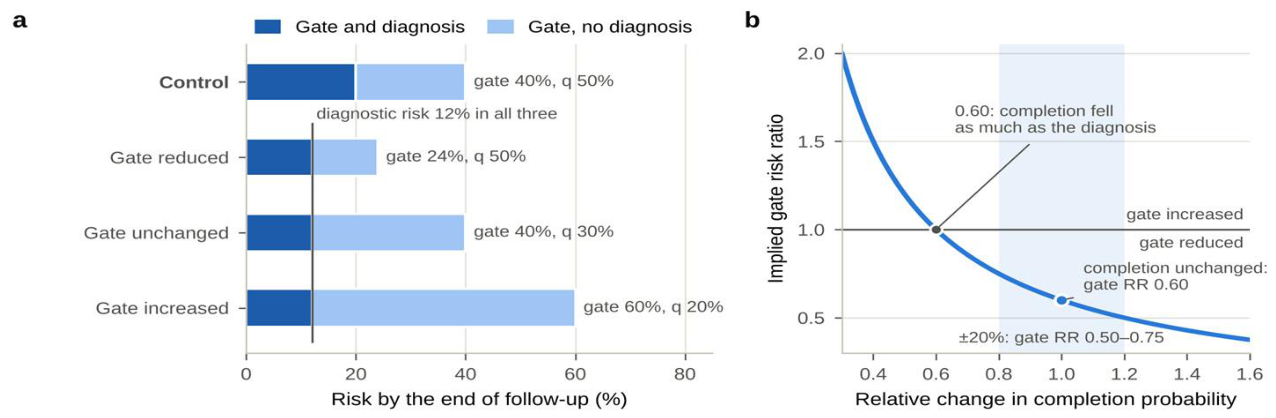
Figure 2.
Observed outcome-specific estimates in two zoster-vaccine programmes. Risk ratios (RR) with 95% confidence intervals for the gate event (zoster) and the nested diagnostic endpoint (postherpetic neuralgia), with the conditional probability of neuralgia among participants with zoster (q) for each population, vaccine versus placebo. a Shingles Prevention Study (SPS), overall and in both randomization age strata; in the stratum aged 70 and over the endpoint estimate lies below the gate estimate. b The live attenuated vaccine (SPS) and the adjuvanted recombinant vaccine (pooled ZOE-50 and ZOE-70) in participants aged 70 and over. Unadjusted event fractions over reported follow-up, calculated from the package inserts (FDA, 2018, 2026); the two programmes were not randomized against each other, and no plotted estimate is an effect on progression.
Figure 2.
Observed outcome-specific estimates in two zoster-vaccine programmes. Risk ratios (RR) with 95% confidence intervals for the gate event (zoster) and the nested diagnostic endpoint (postherpetic neuralgia), with the conditional probability of neuralgia among participants with zoster (q) for each population, vaccine versus placebo. a Shingles Prevention Study (SPS), overall and in both randomization age strata; in the stratum aged 70 and over the endpoint estimate lies below the gate estimate. b The live attenuated vaccine (SPS) and the adjuvanted recombinant vaccine (pooled ZOE-50 and ZOE-70) in participants aged 70 and over. Unadjusted event fractions over reported follow-up, calculated from the package inserts (FDA, 2018, 2026); the two programmes were not randomized against each other, and no plotted estimate is an effect on progression.
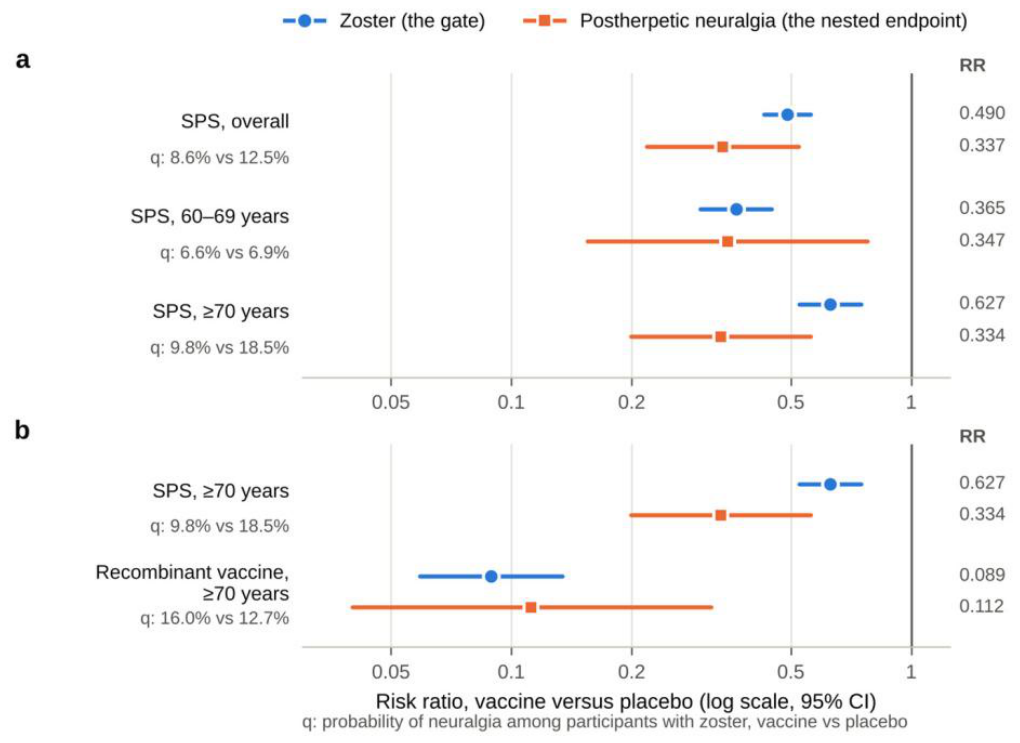
Figure 3.
Participants who had already had the event at entry, in the published reports of registered trials that admitted them. Each point is the share stated in a report: a previous depressive episode (a previous major depressive disorder in Compas et al., 2009, shown for each of its two arms; a previous mood disorder in Robinson et al., 2008) or brief limited intermittent or brief intermittent psychotic symptoms. n is the sample in which the share was reported: for Garber et al. (2009), the 316 randomized adolescents (79.5% of the 307 in the analysis by history); for Winter-van Rossum et al. (2025), the modified intention-to-treat sample. Gladstone et al. (2018) and Compas et al. (2009) reported percentages only, and Hartmann et al. (2022) is the baseline report of its trial. The vertical line at one third is a visual reference, not a prespecified threshold. The source of every value is in Online Resource 3.
Figure 3.
Participants who had already had the event at entry, in the published reports of registered trials that admitted them. Each point is the share stated in a report: a previous depressive episode (a previous major depressive disorder in Compas et al., 2009, shown for each of its two arms; a previous mood disorder in Robinson et al., 2008) or brief limited intermittent or brief intermittent psychotic symptoms. n is the sample in which the share was reported: for Garber et al. (2009), the 316 randomized adolescents (79.5% of the 307 in the analysis by history); for Winter-van Rossum et al. (2025), the modified intention-to-treat sample. Gladstone et al. (2018) and Compas et al. (2009) reported percentages only, and Hartmann et al. (2022) is the baseline report of its trial. The vertical line at one third is a visual reference, not a prespecified threshold. The source of every value is in Online Resource 3.
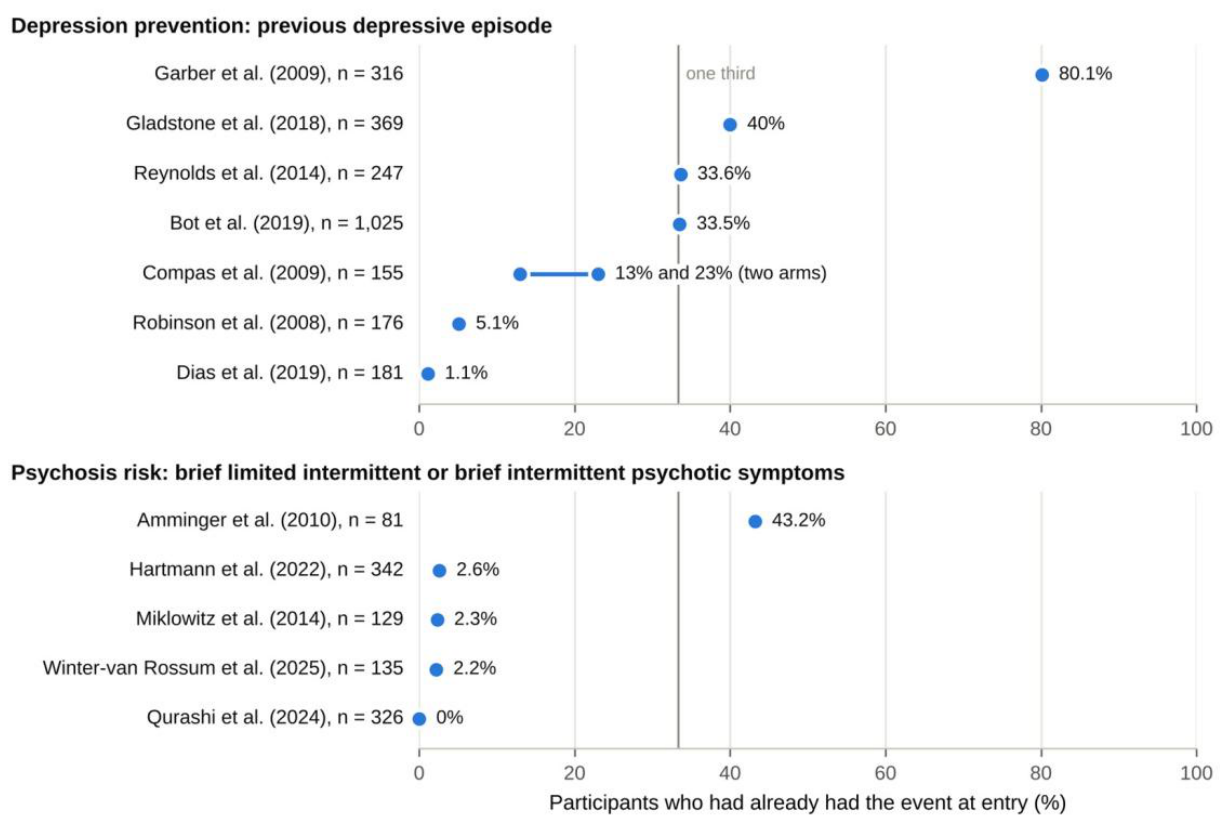

Table 1.
The gate audit: four questions for prevention trials whose endpoint is a diagnosis.
| Question | Why it matters | What to state or report |
| 1. What event is the intervention meant to prevent? | A diagnostic label can contain several clinical events or behaviours; benefit must be attached to a specific one. | Name and operational definition of the target event; first occurrence or recurrence; period over which benefit matters. |
| 2. Does the diagnostic endpoint require that event? | If it does, diagnostic risk equals gate risk × completion probability, and diagnostic risk alone does not identify the effect on the gate. | Criterion version; every diagnostic pathway; which pathways require the gate. |
| 3. Who can still experience the event at entry? | People who have already had the gate cannot benefit from prevention of its first occurrence: their gate risk is 1 in both arms. A mixed population mixes two questions, with weights π and 1 − π (Equation 2). Answerable from eligibility criteria and baseline data alone. | Gate history at entry by arm, including uncertain histories; number of confirmed gate-free participants; in syntheses, the gate history of each trial pooled. |
| 4. Is the event measured, and what may be claimed? | Direct measurement permits estimation of the gate effect. The conditional probability by arm shows which component moved; principal-stratum limits state what it implies about progression. | Gate incidence and timing by arm; conditional probability of the endpoint given the gate, by arm, with principal-stratum limits where completion effects are discussed; claim stated as prevention within follow-up, delay, or diagnostic change. |
Table 2.
Eligibility rules on previous depressive episodes in 101 registered randomized depression-prevention trials, by stated aim.
Table 2.
Eligibility rules on previous depressive episodes in 101 registered randomized depression-prevention trials, by stated aim.
| Stated aim | n | Previous episodes excluded | Only current or recent depression excluded | No criterion on depression | Previous episode one route of entry | Previous episode required | Unclear | Admits but does not require a previous episode, n (%) |
| Onset, incidence, first episode or primary prevention | 38 | 7 | 24 | 4 | 3 | 0 | 0 | 31 (81.6) |
| Generic prevention | 49 | 3 | 32 | 8 | 1 | 3 | 2 | 41 (83.7) |
| Relapse or recurrence | 14 | 0 | 1 | 0 | 0 | 13 | 0 | 1 (7.1) |
| Total | 101 | 10 | 57 | 12 | 4 | 16 | 2 | 73 (72.3) |
Note. Randomized prevention trials registered on ClinicalTrials.gov, retrieved on 11 October 2026; 444 registrations were screened and 101 registered a depressive episode or disorder established by diagnostic interview or diagnostic criteria. Only current or recent depression excluded includes 11 trials whose exclusion covered episodes in the preceding 2 to 24 months only; eight trials stated explicitly that people with previous episodes could enter. Of the 38 trials framed as preventing onset, 3 also named recurrence as a separate target; one generically framed trial planned an analysis by lifetime depression. Unclear: the eligibility wording did not establish whether previous episodes were excluded. Trial identifiers, codes and the registry phrase supporting each code are in Online Resource 2.
Disclaimer/Publisher’s Note: The statements, opinions and data contained in all publications are solely those of the individual author(s) and contributor(s) and not of MDPI and/or the editor(s). MDPI and/or the editor(s) disclaim responsibility for any injury to people or property resulting from any ideas, methods, instructions or products referred to in the content. |
© 2026 by the authors. Licensee MDPI, Basel, Switzerland. This article is an open access article distributed under the terms and conditions of the Creative Commons Attribution (CC BY) license (http://creativecommons.org/licenses/by/4.0/).
Copyright: This open access article is published under a Creative Commons CC BY 4.0 license, which permit the free download, distribution, and reuse, provided that the author and preprint are cited in any reuse.