

Submitted:
15 October 2026
Posted:
19 October 2026
You are already at the latest version
Abstract
For each Matsuo algebra in the Gorshkov–Mamontov–Staroletov classification, we prove that the Frobenius radical is the least ideal with Jordan quotient and identify the factor over ℚ. This solves both parts of their Problem 5.1 for the two infinite families and seven exceptional cases; scalar extension gives the factors over every field of characteristic zero. The argument uses a geometric characterization: a finite connected real Matsuo algebra at parameter 1/2 has Jordan quotient by its Frobenius radical if and only if its Fischer space is realized by a reflection-closed set of lines over ℝ, ℂ or ℍ, with pairwise angles 60° and 90°. The quotient map sends each axis to its rank-one orthogonal projector. Rational descent distinguishes the E₆ factor: it is the algebra of endomorphisms self-adjoint for ⟨1,1,1,1,1,3⟩, not Sym₆(ℚ). We give explicit radical generators and extend the classification to connected locally finite Fischer spaces. For the symplectic family, incidence with quadratic forms gives quotient coordinates and radical generators at both nontrivial degenerations of the Frobenius form, including non-Jordan quotients.
Keywords:
Matsuo algebra
; axial algebra of Jordan type
; Jordan algebra
; 3-transposition group
; Frobenius radical
; three-system
; quaternionic reflection group
; projective design
1. Introduction
A three-transposition group determines a commutative algebra whose distinguished idempotents record the generating involutions and their products. This Matsuo algebra need not satisfy the Jordan identity. One can therefore ask which relations must be imposed to obtain a Jordan algebra, and what algebra results. We study this question at parameter 1/2. The ideal generated by all failures of the Jordan identity is the least ideal with this property. Determining it identifies the largest Jordan quotient of the Matsuo algebra.
De Medts and Rehren classified the connected Matsuo algebras that are themselves Jordan [9]. Gorshkov, Mamontov and Staroletov then classified the cases with nonzero Frobenius radical and Jordan quotient by that radical [15, Proposition 5.2]. Their list consists of two infinite families and seven exceptional cases. Problem 5.1 of asks for the smallest ideal giving a Jordan quotient and for the corresponding factors. Theorems 3.2 and 3.4 answer these questions: the least ideal is the Frobenius radical, and Table 1 identifies every factor over ℚ. Scalar extension gives the answer over every field of characteristic zero.
The construction comes from line geometry. In a three-system, distinct lines meet at 60∘ or 90∘, and reflection in any line preserves the set. Their rank-one orthogonal projectors satisfy the Matsuo multiplication rule at parameter 1/2. The resulting homomorphism carries the Frobenius form to the trace form, so its kernel is exactly the Frobenius radical. Theorem 3.1 proves the converse: if a finite connected Matsuo algebra has Jordan quotient by its Frobenius radical, the images of its axes can be realized by such projectors over ℝ, ℂ or ℍ. The main step is to prove positivity of the quotient form by finite-group averaging in an associative representation.
This real realization does not by itself determine the rational algebra. Section 3.3 retains the Hermitian form in the coordinate construction and descends the projector map to ℚ. Eight cases have standard symmetric or Hermitian matrix factors. The E6 factor consists of the endomorphisms self-adjoint for ⟨1,1,1,1,1,3⟩; it is not Sym6(ℚ). This qualifies [9, Remark 3.5(i)]. Appendix B gives the corresponding criterion for the radical-free An family.
The projector map also makes the relations in the quotient concrete. Orthogonal line sets spanning the same subspace have the same projector sum. Section 4 determines when these frame relations generate the radical and gives star relations for the remaining family. For S1, the action on nine frames supplies the irreducibility needed in Theorem 3.2; Appendix A provides an independent certificate using Jordan defects. The spectral and power-associative consequences appear in Corollaries 3.5–3.6. Section 5 places the classified line sets within the classical special bound and projective design theory.
The E7 case leads to a further construction. Its root lines correspond to the transvections of Sp6(2), and incidence with quadratic forms describes the quotient. Section 6 extends these incidence maps and radical generators to Sp2n(2) at two singular parameter values. The quotient modules and forms are explicit, although the quotients for n ≥ 4 are not Jordan. Section 7 works out E7, and Appendix C relates its incidence coordinates to the classical root, bitangent and equiangular models. Finally, Section 8 passes through finite Fischer subspaces to identify the infinite connected systems with Jordan quotient and their real factors.
2. Projectors and Frobenius Radicals
The Frobenius radical is a natural candidate for the relations sought in the introduction. We first recall the Matsuo construction and then realize this radical as the kernel of a map to self-adjoint operators. Unless specified otherwise, Matsuo algebras and incidence modules are over ℚ, and geometric Jordan algebras are over ℝ; all fields considered have characteristic zero.
A three-transposition group (G,D) is generated by a conjugacy-stable set D of involutions such that each product of two members has order at most three. Its Fischer space has point set X = D and lines {x,y,xyx} for noncommuting x,y ∈ D. Two distinct points are collinear exactly when the corresponding involutions do not commute. The space is connected when this collinearity graph is connected. A Fischer subspace is a subset closed under taking the third point of a line.
For a finite Fischer space X and a parameter η ≠ 0,1, the Matsuo algebra Mη(X) has basis {ax:x ∈ X}. Its multiplication extends bilinearly from , zero products for distinct noncollinear points, and the following rule on a line {x,y,z}:
A Frobenius form is a symmetric bilinear form satisfying F(ab,c) = F(a,bc). The normalized Matsuo form has F(ax,ax) = 1 and matrix Gη = I + (η/2)A, where A is the collinearity adjacency matrix [32, 18, 19, 9]. We write M⊥ = radF for the vectors orthogonal to every element of M. The next lemma explains why one can quotient by this subspace even when the form is degenerate.
Lemma 2.1.The radical R of an associating form on a commutative algebra M is an ideal. The form induced on M/R is nondegenerate.
Proof. For r ∈ R and a,b ∈ M, we have F(ar,b) = F(r,ab) = 0. Thus ar ∈ R. Products and form values consequently descend to the quotient, whose form has zero radical by definition. □
A commutative algebra is Jordan if (x2y)x = x2(yx) for all x,y. We write IJ(M) for the ideal generated by the differences of these two expressions, called Jordan defects. Thus M/IJ(M) is Jordan, and IJ(M) is contained in every ideal with Jordan quotient. For a connected Matsuo algebra, every proper ideal lies in the Frobenius radical [27]. It follows that a nonzero Jordan quotient can exist only if M/M⊥ is Jordan. The least-ideal question asks how much of M⊥ is needed to impose the Jordan identity.
Orthogonal projectors provide a model for the basis idempotents. Let K be ℝ, ℂ or the quaternions ℍ, and let X be a finite set of distinct one-dimensional right K-subspaces of the positive Hermitian space Kr. We call X a three-system if the absolute inner product of unit representatives of distinct lines is 0 or 1/2 and the reflections sx = I − 2Px preserve X, where Px is orthogonal projection onto x. Thus the angles are 90∘ and 60∘. The system is indecomposable if it cannot be partitioned into two nonempty mutually orthogonal subsets. Its reflection Fischer space has third point sx(y) for nonorthogonal x,y [13, 1, 17]. See [16] for the classification.
Write Hermr(K) for the real vector space of self-adjoint r × r matrices over K.
Proposition 2.2.For such a three-system, the map
is an algebra homomorphism, where the target has product S∘T = (ST + TS)/2. Its image is the real span of the projections, and
Ψ:M1/2(X;ℝ) → Hermr(K), ax ↦ Px
F(a,b) = Retr(Ψ(a)Ψ(b)), kerΨ = radF.
In particular, the Frobenius form is positive semidefinite and the quotient is isomorphic to this Jordan subalgebra. For real root systems this is the projector construction of [9,Section 3].
Proof. The idempotent and orthogonal products are immediate. For two nonorthogonal lines, choose unit representatives u,v with u*v = 1/2 by changing the phase of v. Then u − v is a unit vector on the third line. Hence
This is the Matsuo product at η = 1/2, over each of the three associative division algebras K. The real trace pairing of the projections equals 1 on the diagonal, 0 for orthogonal pairs and 1/4 otherwise, proving (2). For a Hermitian matrix T,
This is positive unless T = 0. The form identity therefore gives the kernel assertion and positivity. □
For an A2 triple, Figure 1 shows the passage from lines to projectors. The projector coordinates double the direction angle, turning the three lines into the vertices of an equilateral triangle.
Proposition 2.2 turns linear relations among projectors into defining relations for the quotient.It does not assert that the projectors span the full ambient Hermitian algebra;Section 3determines that image. The trace realization also gives the following form inequality.
Corollary 2.3 (Norton inequality).In every projector quotient above,
where X = Ψ(x), Y = Ψ(y) and ∥Z∥2 = Retr(Z*Z). This follows by expanding the two sides and using cyclicity of the real trace. It applies equally to the pullback form on M. See [14, Theorem 6.5] for this inequality in Euclidean Jordan algebras.
3. Classification and the Least Jordan Ideal
We now show that the projector construction accounts for every finite connected Matsuo algebra whose quotient by the Frobenius radical is Jordan. We then determine the least ideal and the rational algebra in each case of the Gorshkov–Mamontov–Staroletov list. Throughout this section the parameter is 1/2. The geometric argument is over ℝ; the least-ideal and factor identifications extend to all fields of characteristic zero.
3.1. Jordan Quotients and Three-Systems
For an idempotent e in a real Jordan algebra J, write Jλ(e) = {z ∈ J:e∘z = λz} for its Peirce eigenspaces. In a Jordan quotient of M1/2 by an ideal contained in its Frobenius radical, the images of the Matsuo axes have J1(e) = ℝe. Their Peirce involutions act as −1 on J1/2(e) and as +1 on J0(e)⊕J1(e), and permute the axes as the corresponding Fischer-space involutions [18]. These involutions will be used to obtain a positive definite form.
Theorem 3.1 (geometric realization).Let (G,D) be a finite connected 3-transposition group with ∣D∣ ≥ 2, and put M = M1/2(G,D) over ℝ. Then J = M/M⊥ is Jordan if and only if its Fischer space is the Fischer space of a finite indecomposable three-system over ℝ, ℂ or ℍ. In the Jordan case there is a choice of K ∈ {ℝ,ℂ,ℍ} and r ≥ 2 such that
with the normalized Frobenius form carried to Retr(XY). The lines 𝓁x form a spanning indecomposable three-system. In particular the form on M is positive semidefinite. Rank two occurs only for the three-point system A2.
The difficult direction is to recover a positive line geometry from the Jordan quotient. The proof uses the structure theory of finite-dimensional Jordan algebras and finite-group averaging, without the finite classification of three-transposition groups.
Proof. The implication from a three-system follows from Proposition 2.2. Its projector span is a Jordan algebra; an arbitrary ambient choice of K need not make that span all of Hermr(K).
Conversely, suppose that J = M/M⊥ is Jordan. Every proper ideal of M lies in M⊥ [27], so J is simple. The images ex of the axes are distinct idempotents with J1(ex) = ℝex: their pairwise Frobenius products are 0 or 1/4, their squared lengths are one, and quotienting preserves the one-dimensional 1-eigenspace. The centroid consists of the linear maps commuting with all multiplication operators. If γ belongs to the centroid, then γex ∈ ℝex. Thus γ − c kills a nonzero axis for some c ∈ ℝ; its kernel is an ideal, so γ = c. Hence J is central simple and Jℂ is simple [23]. Write r for its degree and T for its generic trace. Then T(1) = r and T(ex) = 1.
Put N = ∣D∣, let κ be the collinearity valency, and set . Pairing line partners in the Matsuo product gives ex∘s = (1 + κ/4)ex. Since the axes span J, it follows that s = (1 + κ/4)1. Taking traces and using κ ≤ N − 1 gives
N = r(1 + κ/4), N(4 − r) ≤ 3r.
Degree one is impossible because the axes are distinct. In degree two, N ≤ 3; connectedness gives a Fischer line, so the space is A2, whose projector quotient is Sym2(ℝ). An exceptional central simple Jordan algebra has degree 3 and dimension 27 [24]. It would give 27 ≤ N ≤ 9, a contradiction. The same structure theorem therefore makes J special, meaning that it embeds in an associative algebra equipped with the symmetrized product.
To prove positivity, we seek an associative representation in which the axes become orthogonal projectors. The unital special envelope of J is finite-dimensional: for a basis x1,…,xd, the relations xjxi = 2(xi∘xj) − xixj and reduce every word to a linear combination of ordered square-free words. Specialness makes the canonical map injective [24]. The intersection of J with the associative radical is zero, since that intersection is a Jordan ideal and the radical contains no nonzero idempotent. Choose a simple factor of the semisimple quotient on which J has nonzero image. Simplicity makes this representation faithful, and its image generates
A = EndK(V), K ∈ {ℝ,ℂ,ℍ}.
For an axis e, put ge = 1 − 2e. The Peirce decomposition in A+ gives τe = Ad(ge) on J. These involutions permute the finite spanning set of axes, so they generate a finite group Γ. The group maps onto Γ; its kernel commutes with J, hence with the generated algebra A, and lies in Z(A)×. Every element of has real determinant ±1. Thus every kernel scalar has absolute value one and preserves any positive definite K-Hermitian form h0 on V.
Choose a lift for each γ ∈ Γ and set
This is independent of the chosen lifts and invariant under . For the real inner product Reh, each ge is an orthogonal involution and each e is an orthogonal projector. Hence all of J consists of self-adjoint operators, and β(x,y) = trℝ,V(xy) is a positive definite associative form. The comparison operator between β and the nondegenerate Frobenius form F belongs to the centroid. Thus β = cF, with c = β(e,e) > 0, proving positivity of F.
The classification of simple Euclidean Jordan algebras now gives J≅Hermr(K) for K = ℝ,ℂ or ℍ; degree two and the exceptional case have already been settled.
Finally primitive idempotents in these matrix algebras are rank-one projectors. The normalized trace form agrees with the Frobenius form: both are associative and take value one at an axis. Their trace products give precisely angles 90∘ and 60∘. The Matsuo relation and the projector identity show that the third point on a Fischer line is the reflected line. Connectedness gives indecomposability. The projectors span all of J by construction, so the lines span Kr. □
The indecomposable three-systems are An,Dn,E6,E7,E8 over ℝ, the additional complex systems G(3,3,m),K5,K6, and the additional quaternionic systems S1,U [6, 7, 30; 16]. Here K5 and K6 are also denoted G33 and G34.
3.2. The Nine Cases and the Smallest Jordan Ideal
We now return to the least ideal IJ = IJ(M). Table 1 lists the cases where the Frobenius radical is nonzero and the quotient is Jordan [15, Proposition 5.2]. Rows 1 and 2 have m ≥ 4. Here N is the number of axes, J = M/M⊥, and h = dimJ1/2(e) is the dimension of the half-Peirce space in the quotient at an axis e.
The last column anticipates the rational identifications in Theorem 3.4. Put , , ℍℚ = (−1,−1)ℚ and q6=⟨1,1,1,1,1,3⟩. The notation Hermr(E) and Hermr(ℍℚ) uses the standard adjoint; Herm6(ℚ,q6) consists of the endomorphisms self-adjoint for q6.
Theorem 3.2. In each of the nine cases, IJ = M⊥ over every characteristic-zero field. Over ℝ, the factors are the real scalar extensions of the algebras in Table 1.
Proof. The ideal IJ is characteristic, is contained in M⊥ because that quotient is Jordan, and is nonzero because these Matsuo algebras are not Jordan [9]. It therefore suffices to prove that M⊥ is irreducible under a group of automorphisms.
For Dm, let xij be the sum of the two axes associated with ei + ej and ei − ej, and let yij be their difference. The projector images of the yij are independent off-diagonal symmetric matrices, whereas xij maps to Eii + Ejj. Consequently
By the two-subset permutation-module decomposition [25], this is the irreducible characteristic-zero 𝔖m-module S(m−2,2) inside the permutation module on two-subsets. This proves the assertion uniformly for all m ≥ 4.
For G(3,3,m), let σij be the sum of the three axes on ei − ωtej, t = 0,1,2. Their projector sum is ; the coefficient-sum-zero combinations for each pair map injectively to its two-dimensional real off-diagonal Hermitian space. The kernel is therefore the same two-subset module, with σij in place of xij, and is again S(m−2,2).
In cases 3–8, the action on the transposition class is primitive of rank three by Fischer’s theorem [13, Theorem 3.3.5; 20, Section 6]. Its orbits on ordered pairs are equality, distinct commuting pairs and noncommuting pairs. Thus its permutation commutant has dimension three. The three adjacency eigenspaces are nonzero invariant summands, so each is absolutely irreducible, including M⊥. In case 9, the stabilizer action described after Proposition 4.4 is two-transitive on the nine frames. The augmentation module, consisting of frame coefficients with sum zero, is M⊥, so the same argument applies. Appendix A gives an independent certificate by Jordan defects. This proves IJ = M⊥ over ℝ.
All multiplication constants are rational. Both the Frobenius kernel and the ideal generated by the polarized Jordan defects commute with characteristic-zero scalar extension. Equality over ℝ therefore gives equality over ℚ, then over every characteristic-zero field. The real factor types follow from the preceding theorem and the displayed pairs (dimJ,h): the equations
determine r and Δ∈{1,2,4}. □
dimJ = r+Δr(r − 1)/2, h=Δ(r − 1)
The rank-three step above is a consequence of Fischer’s theorem; exact orbit enumeration provides an independent check. In the order (diagonal, distinct commuting, noncommuting), the orbital sizes for cases 3–8 are
(120,7560,6720), (36,540,720), (63,1890,2016),
(126,5670,10080), (45,540,1440), (165,5940,21120).
The dimensions in Table 1 can also be read directly from the multiplication and Frobenius matrices. For an axis a, let La be multiplication by a, and put T = 4La and G4 = 4I + A. Then the half-Peirce dimension in the quotient is
because 4T − T2 is four times the half-Peirce projector. The Gram rank gives the quotient dimension, while this formula gives the listed half-Peirce dimensions.
h = rankℚ(G4(4T − T2)),
3.3. The Factors Over the Rationals
Identifying the matrix algebra over ℝ leaves its rational Hermitian form undetermined. For a nondegenerate Hermitian space (V,h), write Herm(V,h) for its self-adjoint endomorphisms, with product (XY + YX)/2. The following descent lemma reduces the rational identification to a coordinate model and a proof that its projectors span this algebra.
Lemma 3.3 (projector descent).Let K0be ℚ, E or ℍℚ, and let (V,h) be a positive definite K0-Hermitian space containing a three-system L. Suppose that its projectors span Herm(V,h)⊗ℚℝ over ℝ. Then
M1/2(L;ℚ)/M⊥≃Herm(V,h).
Proof. The projectors and the projector homomorphism are defined over ℚ. Its rational rank equals its real rank, so it is onto. The trace-form identity and positivity after extending to ℝ give kerΨ = M⊥. □
The projector-span hypothesis is essential. A real three-system placed in a complex space can span the underlying complex vector space while its projectors span only a real symmetric matrix algebra.
Theorem 3.4 (rational factors).The last column ofTable 1gives the Jordan factors over ℚ. Over any field F of characteristic zero, the factors are obtained by tensoring that column with F. Together with Theorem 3.2, this answers [15, Problem 5.1].
Proof. We apply Lemma 3.3 to rational coordinate models. The Dm lines ei ± ej have projectors spanning Symm(ℚ): their sums and differences give diagonal pair sums and symmetric off-diagonal matrices. Three diagonal pair sums isolate any diagonal entry. Likewise, the three lines ei − ωtej on each support pair in G(3,3,m) give its two-dimensional rational off-diagonal space and its diagonal pair sum. This proves both families for every m ≥ 4.
The standard E8 coordinates are rational. For E6, take the subsystem defined by x6 = x7 = −x8. It contains 40 roots of type D5 and 32 half-integral roots. Its rational span has basis
with Gram matrix diag(1,1,1,1,1,3). For E7, use the roots ±2ei and the vectors with entries ±1 on the complement of a Fano-plane line, and zero elsewhere. These give 63 lines in standard ℚ7. The projector ranks for E6,E7,E8 are 21,28,36.
e1,…,e5,e6 + e7 − e8,
Put θ = ω − ω2. The K6 model consists of the 45 lines ei − ωtej in E6 and the 81 distinct lines
Its 45-line residue perpendicular to (1,…,1) is K5. Their projector ranks are 36 and 25. To determine the residue form, let , where
Using 1 + ω + ω2 = 0 gives . The last five columns span (1,…,1)⊥ and have Gram matrix 6I5. Its Hermitian form is therefore similar to the standard form. Scalar multiples have the same adjoint involution, so the K5 factor is Herm5(E).
Appendix A gives the S1 realization in standard . Embed it in , adjoin e5 and
and take reflection closure. The resulting U system has 165 lines, projector rank 45, and residue S1 at e5. Thus its factor is Herm5(ℍℚ). Exact coordinate calculations verify these finite angle, closure and rank assertions. The names of the systems follow from the three-system classification used in Theorem 3.1.
Finally, the multiplication and Frobenius matrices are rational, so
The ideal generated by the polarized Jordan identity also commutes with scalar extension: its generators are multilinear and all multiplication maps are rational. This proves both assertions over F. □
The symmetric-matrix description in [9, Remark 3.5(i)], repeated in the introduction of [15], requires a qualification for E6. Its factor is Herm6(F,q6), which is isomorphic to Sym6(F) exactly when 3 is a square in F. Indeed, these self-adjoint Jordan algebras are isomorphic exactly when their quadratic forms are similar [23; 29]. In even dimension the determinant square class is a similarity invariant, so similarity to the identity form forces 3 to be a square. The converse follows directly from q6=⟨1,1,1,1,1,3⟩. In particular, the rational factor is not Sym6(ℚ).
In Table 1 after scalar extension, E⊗F = F[t]/(t2 + 3) carries its canonical involution. If this algebra splits, Hermr(E⊗F)≃Mr(F)+. If ℍℚ⊗F splits, Hermr(ℍℚ⊗F) is the Jordan algebra fixed by a symplectic involution on M2r(F).
Two consequences describe the same least ideal from different viewpoints. The first reads positivity and degeneracy from the collinearity spectrum. The second shows that requiring power-associativity already forces the Jordan quotient.
Corollary 3.5 (spectral characterization).Let (G,D) be a finite connected three-transposition group. The Frobenius form of M1/2(G,D;ℝ) is positive semidefinite with nonzero radical if and only if (G,D) has one of the two families or seven exceptional central types in Table 1.
Proof. Its Gram matrix is I + A/4, where A is the adjacency matrix of the noncommuting graph. The stated condition is equivalent to the least eigenvalue of A being −4. Hall–Shpectorov’s classification [20, Section 7.3.3] gives precisely the two families and seven exceptional central types in Table 1. □
Degeneracy is essential here. The complete diagrams of 3u:2 have a positive-definite Frobenius form at η = 1/2, but for u ≥ 3 their Matsuo algebras are not Jordan [9].
An algebra is power-associative if the subalgebra generated by each element is associative. Although this is weaker than the Jordan identity in general, it gives the same least ideal in the nine cases.
Corollary 3.6 (power-associative quotients).In each of the nine cases, over every characteristic-zero field, M⊥is also the least ideal whose quotient is power-associative.
Proof. The quotient by M⊥ is Jordan, hence power-associative. Conversely, let I be a proper ideal such that M/I is power-associative. Since I ⊆ M⊥, the generating axes remain nonzero in the quotient. Their multiplication operators remain semisimple, their 1-eigenspaces remain one-dimensional, and their eigenspaces satisfy the same fusion law. Thus M/I is a primitive axial algebra of Jordan type 1/2. Its power-associativity gives the identities x2x2 = xx3 and x3x2 = xx4. Over a characteristic-zero field these polynomial identities hold after every scalar extension. Segev’s Main Theorem and Remark 1.3 therefore imply that M/I is Jordan. Theorem 3.2 gives M⊥ ⊆ I. □
4. Frame Relations
The equality IJ = M⊥ identifies the ideal, but does not yet give convenient generators. The projector model suggests comparing orthogonal bases: the sum of their projections depends only on the subspace they span. These relations generate the radical in every case of Table 1 except the G(3,3,m) family. We then examine the frame geometry of S1.
4.1. Relations for the Classified Systems
Let L be a three-system, and let a𝓁 denote its Matsuo basis. For an orthogonal set F ⊆ L, write . A frame relation is a difference fF − fF' where the two orthogonal sets span the same subspace. The sets need not be full frames of the ambient space.
Theorem 4.1.Every frame relation lies in the Frobenius radical. For Dm (m ≥ 4), E6,E7,E8,K5,K6,S1,U, these relations span the radical. In the real systems Dm,E6,E7,E8, relations inside D4 subsystems already suffice. For G(3,3,m) with m ≥ 4 there are no nonzero frame relations; its radical is instead spanned by the star relations
where σij is the sum of the three axes on ei − ωtej, t = 0,1,2. For An and G(3,3,3) the radical is zero.
σij + σkl − σik − σjl (i,j,k,l distinct),
Proof. The sum of the projectors associated with an orthogonal set is the orthogonal projection onto its span. Thus every frame relation lies in the projector kernel, which is the Frobenius radical. Their span is invariant under the reflection group.
For Dm, the radical description in the least-ideal theorem is the irreducible two-subset module S(m−2,2). It contains the nonzero relation
where xij is the sum of the two axes on ei + ej and ei − ej. This compares two orthogonal bases of the same coordinate four-space. Its permutation orbit therefore spans the radical and consists of D4 relations.
xij + xkl − xik − xjl,
For E6,E7,E8, a D4 subsystem supplies such a nonzero relation. The span of all D4 relations is invariant and the radical is irreducible under the rank-three reflection action, so that span is the whole radical. This also explains why full ambient frames are unnecessary: E6 has no orthogonal frame of size six, but the four-dimensional relations suffice.
For K5 and K6, the columns of C6 in Theorem 3.4 give full orthogonal frames: each exponent column sums to zero modulo three, so all six columns represent K6 lines, and the last five lie in its K5 residue. In U, the lines on e1 ± e2, e3 ± e4 and e5 form a full frame. If F is a full frame, choose a line 𝓁 ∉ F. It meets some member m ∈ F at 60∘, since F spans the ambient space. Its reflection sends F to a different full frame: r𝓁(m) is at 60∘ to m and cannot be another member of F. Hence a nonzero frame relation exists. Its invariant span is the full radical, by the rank-three irreducibility already proved.
For S1, the nine disjoint frames give eight independent differences. Proposition 4.3 identifies their span with the eight-dimensional radical.
For G(3,3,m), two distinct lines are orthogonal exactly when their index pairs are disjoint. An orthogonal set therefore has disjoint two-coordinate supports. Any line of L in its span must be supported on one of those pairs and must coincide with the selected line there. Consequently two orthogonal sets with the same span are equal, and there are no nonzero frame relations. On the other hand, the radical is the irreducible two-subset module on the sums σij. The displayed nonzero four-index star relation belongs to it, so its permutation orbit spans the radical.
Finally the Gram forms for An and G(3,3,3) are nonsingular, giving the final assertion. □
The D4 example in Figure 2 makes the frame relations explicit: three orthogonal frames give two independent relations, accounting for the entire radical.
, the displayed coefficient columns give the radical basis f1 − f2,f1 − f3. Each frame has projector sum I4; the quotient is Sym4(ℚ).
These relations also characterize functions on the line set that come from self-adjoint operators. A linear functional on the Matsuo algebra descends to the projector quotient exactly when it annihilates the radical.
Corollary 4.2 (frame functions).For Dm (m ≥ 4), E6,E7,E8,K5,K6,U,S1, a real function f on the lines has equal sums on orthogonal sets with the same span if and only if
for a unique self-adjoint operator H in the corresponding Jordan factor.
f(𝓁) = Retr(HP𝓁)
Proof. The frame conditions say that f, viewed as a linear functional on the Matsuo algebra, vanishes on the frame-relation space. By Theorem 4.1 this is the projector kernel. The trace pairing represents the descended functional by a unique H. The converse follows from equality of projector sums. □
For G(3,3,m) with m ≥ 4, the frame conditions are vacuous, whereas the projector image has codimension m(m − 3)/2 in the space of all functions on the lines.
Full frames have a useful graph-theoretic interpretation. For the systems with nonzero radical, the noncommuting graph has valency κ = 4(N/r − 1) and least eigenvalue −4. Hoffman’s bound limits the size of a coclique, or set of pairwise nonadjacent vertices, to 4N/(κ + 4) = r. A full orthogonal frame attains this bound, and its centred indicator lies in the radical. Each line outside the frame meets exactly four of its members nonorthogonally: pair its projector with the sum of the frame projectors, which is I.
For K5 and U, take the system’s lines as points and its full orthogonal frames as blocks. These incidence structures are generalized quadrangles of orders (4,2) and (4,8). Each frame has five members, and every point outside it is orthogonal to exactly one member. The rank-three action is transitive on orthogonal pairs, so every such pair lies in a full frame. Distinct frames meet in at most one point: otherwise a point of one outside the other would be orthogonal to two members of the latter. This proves the generalized-quadrangle axioms. Each point has N/5 + 3 orthogonal neighbours, partitioned into sets of four by the frames through it. Thus there are three or nine frames through each point, giving 27 or 297 frames in total.
4.2. The Nine Quaternionic Frames
The S1 radical is reducible under its reflection group. The case-9 proof in Theorem 3.2 uses a larger group of automorphisms that acts irreducibly. The nine orthogonal frames make both actions explicit.
Proposition 4.3 (the frame radical of S1).The 36 lines of the quaternionic system S1 have nine disjoint full frames F1,…,F9, and two distinct lines are orthogonal exactly when they belong to the same frame. For M = M1/2(S1),
In particular, dimM⊥ = 8, and the projector homomorphism identifies M/M⊥ with Herm4(ℍ) over ℝ.
Proof. The frame description and the orthogonality assertion are given by Griffeth–Guevara [16]. The nonorthogonality adjacency matrix is therefore
A = J36 − diag(J4,…,J4).
It acts by 32 on constants, by −4 on block-constant vectors whose nine block values sum to zero, and by 0 on vectors having sum zero within each block. These subspaces have dimensions 1,8,27, respectively. The Frobenius Gram matrix I + A/4 consequently has spectrum 9(1),0(8),1(27). Its kernel is precisely the displayed frame-sum space. The projector image has dimension 28, while dimℝHerm4(ℍ) = 28; hence the homomorphism is onto. □
The nine frames are mutually unbiased: the trace product of projectors from distinct frames is 1/4. They form a complete set, since their three-dimensional traceless projector spaces are mutually orthogonal in the 27-dimensional traceless part of Herm4(ℍ). Nine quaternionic mutually unbiased bases in dimension four already occur in [22, Example 21]; see also [5].
To describe the reflection action on the radical, label the frames by the points of an affine plane. The 192 Fischer lines involve twelve triples of frames, with sixteen Fischer lines per triple. Each triple supports a D4 subsystem, and these twelve triples form the lines of AG(2,3) [16]. Its four parallel classes will index the radical summands.
Proposition 4.4 (the four radical summands).Index the nine frames byand put. For a direction d, with parallel affine lines L1,L2,L3, define
Then M⊥ = ⨁dRd. The four summands have dimension two and are irreducible over ℚ and ℝ under the reflection group. Its action on the nine frames is 32:2.
Proof. The frame sums identify the radical with the augmentation module on . A reflection belonging to Fp acts on frame labels by q ↦ 2p − q, so the induced group consists of translations and inversion. It preserves each parallel class. A translation outside d cyclically permutes its three affine lines, acting on Rd with minimal polynomial X2 + X + 1, irreducible over ℚ and ℝ. For the auxiliary inner product making the bp orthonormal, distinct Rd are orthogonal because affine lines of distinct directions meet once. Their dimensions sum to eight. □
A single difference bp − bq generates precisely the three summands whose directions differ from ⟨p − q⟩ (Figure 3). Two differences in distinct directions generate the radical. A general radical vector can have nonzero components in all four summands. The reflection action has rank five on frames and rank six on the 36 axes.
The full automorphism action is larger. Realize S1 as the residue perpendicular to a line 𝓁 in U, as in the proof of Theorem 3.4. The stabilizer of 𝓁 in the reflection group of U induces automorphisms of the residue. The induced frame group is ASL(2,3) of order 216: exact Schreier enumeration through all 165 lines gives affine maps on the nine frames with determinant-one linear parts, and their closure has order 216. Its action is two-transitive. Its permutation action on the four parallel classes is transitive, with kernel 32:2, precisely the frame action of the S1 reflections. Thus the frame augmentation module M⊥ is absolutely irreducible under this larger group, as used in Theorem 3.2.
4.3. Kantor’s Quaternionic Line Sets
The nine mutually unbiased frames suggest comparing S1 with Kantor’s quaternionic line sets. This comparison also tests whether the angle and orthogonality data determine a three-system. The enumeration below finds two configurations with those data, only one of which is reflection-closed.
Kantor’s construction [26, Sections 4–6 and 8.3] associates quaternionic line sets to orthogonal spreads. In dimension four, the extraspecial group P = Q8∘D8∘D8 acts on ℍ4: Q8 acts by left scalar multiplication, while the two dihedral factors act by the real Pauli matrices on ℝ2⊗ℝ2. The quotient P/Z(P) is a six-dimensional quadratic space of minus type over 𝔽2. Its 27 nonzero singular vectors lie in 45 totally singular two-spaces. An orthogonal spread partitions these vectors into nine such spaces. The inverse image of each two-space in P is an elementary abelian group of order eight; its four joint eigenspaces on which the central involution acts as −1 are quaternionic lines forming an orthogonal frame. The nine frames are mutually unbiased.
Proposition 4.5 (exact enumeration).The quadratic space has 200 orthogonal spreads, in two-orbits of sizes 40 and 160. The orbit of size 40 gives S1. The other orbit gives an inequivalent configuration with the same orthogonality graph 9K4 and the same 576 unordered pairs at 60∘. For 432 of these pairs, the third line lies outside the configuration. Its reflection closure has 72 lines.
Proof. Exact enumeration gives all partitions of the 27 singular vectors by nine of the 45 singular two-spaces. The 36 symmetries indexed by nonsingular vectors generate an orthogonal group of order 51 840; their action on the 200 partitions has the stated orbit sizes. For every spread, separate integer-quaternion calculations give 36 distinct lines, 54 unordered orthogonal pairs and 576 pairs at 60∘. All third lines remain in the set for the 40 spreads; exactly 432 fail this test for each of the other 160.
The unitary matrix 2−1/2(H2⊕H2), where , carries the rational S1 model of Appendix A to one of the closed configurations. Kantor’s equivalence theorem [26] identifies equivalence of the line sets with equivalence of their spreads. Finally, closing one representative of the second orbit under all reflections until no new line appears gives 72 lines. Unitary equivalence gives the same closure size throughout that orbit. □
The enumeration also describes closure at the level of frames (Figure 4). In each of the 160 nonclosed spread configurations, the nine frames split into three triples. The twelve lines belonging to each triple form a reflection-closed set. For frames in different triples, all sixteen cross-frame line pairs have their third line outside the configuration. Thus the 27 unordered frame pairs between triples account for all 27 ⋅ 16 = 432 failures. In each of the 40 closed configurations, every pair of distinct frames closes. These assertions were checked exactly for all 200 spreads.
5. The Special Bound and Projective Designs
The projector realization places the systems of Table 1 among line sets subject to classical size bounds. We recall the special bound of Delsarte–Goethals–Seidel and Hoggar [10, 21] and show how its equality cases meet the Jordan-factor classification. This section is a consequence of the geometric description and is not needed for the least-ideal theorem.
Let L be an indecomposable three-system of N lines spanning Kr, with r ≥ 2, and put Δ=dimℝK. A projective s-design is a finite line set whose projector tensor moments through degree s equal those of the invariant probability measure on projective space. All projector tensor products in this section are over ℝ, including when K = ℍ. The one-line case is a design in every degree and is excluded from the criterion below. The moment proof makes the connection with the Matsuo Gram matrix explicit.
Proposition 5.1.If Δr < 4Δ+6, then
Equality holds exactly for a projective 2-design. Among equality cases, the projective 3-design condition is Δr = 4(Δ+1).
Proof. Write P𝓁 for the unit rank-one projections. The operator commutes with the irreducible reflection group, so it is (N/r)I. Taking the trace pairing with one projector shows that each line has κ = 4(N/r − 1) nonorthogonal partners. Since ⟨P𝓁,Pm⟩ takes the values 1,0,1/4,
To compare these finite moments with projective space, let μ be its invariant probability measure and put . The squared first-coordinate norm of a random unit vector has beta distribution with parameters Δ/2,Δ(r − 1)/2. Hence, with (x)s = x(x + 1) … (x + s − 1),
Thus Es ≥ cs, with equality exactly when the configuration is a projective s-design. At s = 2 this is
which gives the bound. Substituting its equality value of N at s = 3 gives
For r ≥ 2, this vanishes exactly when Δr = 4(Δ+1). □
In the minimal realizations of Theorem 3.1, the equality cases are the seven exceptional systems in Table 1 and Table A2, D4,G(3,3,3). Among them, E8,K6,U are the classical tight projective 3-designs [2, 22]; Hoggar’s Examples 7 and 9 are K6 and U, respectively. Equivalently, the antipodal E8 roots form a spherical 7-design. The condition Δr = 4(Δ+1) must be used together with equality in the bound: D8 and G(3,3,6) satisfy that numerical condition but fall below the bound.
6. Incidence Coordinates for the Symplectic Family
The E7 Fischer space is also the transvection space of Sp6(2). This allows its radical and quotient to be described by incidence with quadratic forms, and suggests extending the construction to Sp2n(2). The spectrum, degeneration parameters and dimensions are known [20, row PR4; 33, Sections 5 and 9]. Here we construct explicit maps onto the quotient modules, calculate their forms and give incidence generators for the radicals. The resulting quotients need not be Jordan.
Let V be a 2n-dimensional vector space over 𝔽2 with nondegenerate alternating form b, where n ≥ 3. Put
t = 2n−1, X = V∖{0}, v = ∣X∣ = 4t2 − 1.
The transvection associated with x ∈ X is z ↦ z + b(z,x)x. Distinct transvections do not commute precisely when b(x,y) = 1; the corresponding Fischer line is {x,y,x + y}. Let A be this adjacency matrix. Write J for an all-ones matrix, with dimensions determined by its position. We use the product (1) and the normalized Gram matrix Gη = I + (η/2)A.
We use quadratic forms with polarization b to index quotient coordinates. Their evaluation vectors will also generate the radicals. For ε ∈ {+1,−1}, let Ωε be the forms with character sum ; thus + and − denote plus and minus type. Set
mε = ∣Ωε∣ = t(2t + ε), kε = t(2t − ε).
Here mε counts forms of type ε, and kε counts the nonzero vectors at which any such form takes the value one. Let Bε have rows indexed by x ∈ X, columns indexed by q ∈ Ωε, and entries , regarded as rational numbers 0 or 1. The matrix products below determine its rank and the adjacency eigenspace spanned by its centred columns. We write 1 for an all-ones vector of the indicated size; the augmentation subspace consists of vectors whose coordinates sum to zero.
Theorem 6.1 (symplectic incidence identities).The matrices Bε satisfy
In particular, Bε has column rank mε. The centered matrix
has rank mε − 1 and its column space is the −εt eigenspace of A.
Proof. A nonzero linear functional on V takes the value 1 on 2t2 vectors. Two distinct nonzero linear functionals are independent, so their simultaneous value 1 occurs on t2 vectors. Hence
A1 = 2t21, A2 = t2(I + J).
Its three eigenvalues and multiplicities are therefore
For the incidence counts, choose a plus-type form q0. Every quadratic form with polarization b has the unique expression qa = q0 + b(a,⋅), and its type is . Completing the square gives
Consequently, for x ≠ 0, . This gives t2 ones in each row of Bε; each column has kε ones by the definition of type. For distinct x,y ∈ X, the identity
gives t2/2 common ones when b(x,y) = 0, and (t2 − εt)/2 when b(x,y) = 1. These give (3), the entries of . For distinct forms q,r of the same type, q + r is a nonzero linear functional. Expanding the indicators of q(x) = r(x) = 1 gives t2 − εt common ones, proving the other matrix identity. Its eigenvalues are t2 on the augmentation space and t3(2t − ε) on constants, both nonzero. Finally, centering removes the constant component, and the second identity acts by t2 on the −εt eigenspace and by zero on the other nonconstant eigenspace. Thus imCε is exactly the claimed eigenspace. □
(−1)q(x)+q(y) = (−1)b(x,y)(−1)q(x+y)
Corollary 6.2 (both nontrivial degenerations).The Gram determinant is
At η = 2ε/t,
Thus the radical is generated by centered incidence vectors of the form type opposite to the form type indexing the quotient. The map induces an Sp2n(2)-equivariant isomorphism
In these coordinates the induced bilinear form is
Proof. The determinant and radical follow from Theorem 6.1. The incidence matrices are equivariant because their entries are evaluations of quadratic forms. With B = B−ε, the matrix identities give
For u = BTx, the row sum identity gives 1Tu = t21Tx, yielding the stated form. The radical is an ideal because the Matsuo form associates, so the vector-space quotient also has its inherited algebra product. The displayed identification specifies the group module and the form; it does not identify that product with coordinatewise multiplication. □
On the augmentation space the quotient form has eigenvalue 2/t2. On constants it has eigenvalue ε/t3. Thus the positive degeneration has a positive definite quotient form, proved directly by incidence counting. The negative degeneration has one negative direction. The third degeneration is η = −1/t2, with radical ℚ1; it is not one of these two incidence quotients.
For n = 3, the radical at η = 1/2 has dimension 35 and is spanned by the 36 centred evaluation vectors B+,q − (4/9)1, q ∈ Ω+. Its quotient has the 28 minus-type forms as coordinates. At η = −1/2, the radical has dimension 27 and is spanned by B−,q − (4/7)1, q ∈ Ω−. The quotient then has dimension 36. Section 7 realizes the positive degeneration in E7 roots.
For n = 4, the parameters are η = ±1/4. The positive quotient has dimension 120 and radical dimension 135; the negative quotient has dimension 136 and radical dimension 119. Matsuo’s vertex operator algebra classification already contains the positive case, with quotient dimension 120 and central charge 15/2 [32, Table 3]. Its VOA construction is due to Kitazume and Miyamoto [28; 32, Section 8]. The present maps supply incidence coordinates for this quotient.
Remark 6.3.The positive-degeneration quotient is non-Jordan for n ≥ 4, and the negative-degeneration quotient is non-Jordan for every n ≥ 3. This follows from [15, Lemma 5.1]: at η ≠ 1/2, a nonzero Jordan quotient of a connected Matsuo algebra has dimension one.
The counting identities remain valid for n = 2, when the two nonconstant degenerations occur at η = ±1. The restriction n ≥ 3 keeps the discussion within the usual Matsuo parameter range η ≠ 0,1.
There is a second source of radical generators, analogous to the full-frame relations of Section 4. A Lagrangian is an n-dimensional totally isotropic subspace of V; its nonzero vectors index pairwise commuting transvections.
Proposition 6.4 (Lagrangian relations).For every n ≥ 3, the radical of is spanned by
where L,L' range over the Lagrangian subspaces of .
Proof. Put and Λ0 = 1. Let T be the nonzero-point by Lagrangian incidence matrix. Counting Lagrangians through a point and through a perpendicular pair gives
TTT = Λn−2(tI + J − A), t = 2n−1.
On the two nonconstant adjacency eigenspaces, (4) acts by 0 at eigenvalue t and by 2tΛn−2 at eigenvalue −t. The centred columns therefore span the −t eigenspace. Their sum is zero, so their span equals that of the column differences. This eigenspace is the kernel of I + A/t, the Frobenius Gram matrix at η = 2/t. □
The Lagrangian cocliques have 2n − 1 points and attain Hoffman’s bound. Exact enumeration gives all 135 and 2295 Lagrangians for n = 3,4 and relation ranks 35 and 135, respectively.
7. The E7 Worked Example
We now specialize Section 6 to n = 3, where the positive degeneration is the Jordan quotient attached to E7. The 63 root lines index the Matsuo axes, while 28 pairs of minuscule weights index the incidence coordinates. Identifying these pairs with the minus-type quadratic forms explains the quotient map and its form. Appendix C gives the multiplication in these coordinates and compares the classical bitangent and equiangular models [31, 35, 11, 3].
7.1. Roots and Minuscule Weight Pairs
Let e1,…,e8 be the standard orthonormal basis of ℚ8, put and let H7 = s⊥. A root system of type E7 in H7 is
All roots have squared length 2. The 63 root lines are indexed by 28 differences with i < j and 35 unordered partitions {S,Sc}. We denote this set by .
To obtain the 28 quotient coordinates, use the 56 minuscule weights ±λp, where
The set indexes their 28 sign pairs. Coordinate permutations preserve these weights. Reflection in rS fixes λp when p crosses the partition S∣Sc; when p ⊆ S, it sends λp to −λq, where q is the two-element complement of p in S, and similarly for p ⊆ Sc. Thus the Weyl action on weight pairs is explicit.
Orthogonality between root lines and weight pairs defines the 63 × 28 incidence matrix
For 𝓁 = ℚ(ei − ej), incidence means that p contains either both or neither of i,j. For 𝓁 = ℚrS, incidence means that p crosses S∣Sc. These rules define B over the integers.
Let 𝒜 be the adjacency matrix on distinct root lines, with adjacency meaning nonorthogonality. Write Ja,b for the all-ones a × b matrix and Ja = Ja,a.
To identify this root-weight incidence with the construction of Section 6, pass to a binary space. Let V6 be the six-dimensional space of even subsets of {1,…,8} modulo complementation, with symmetric difference as addition. The forms
are well-defined, and b is the nondegenerate polarization of q0. Sending a difference root line to {i,j} and a partition root line to S identifies with V6∖{0}. Nonorthogonality is exactly b(x,y) = 1. Thus 𝒜 is the symplectic graph with parameters (63,32,16,16): a nonzero linear functional takes value 1 on 32 vectors, and two distinct such functionals are independent and simultaneously take value 1 on 16 vectors. Consequently
b(S,T) = |S ∩ T| (mod 2), q0(S) = |S|/2 (mod 2)
𝒜2 = 16I + 16J, spec𝒜 = {321,427,(−4)35}.
The multiplicities follow from total dimension and trace zero. This is the standard symplectic graph spectrum, also tabulated by Matsuo [32]. The classical identification W(E7)/{±1}≅Sp(6,2) is compatible with this model: root reflections act as x ↦ x + b(x,y)y, and these transvections generate the symplectic group [17, 1].
The 35 nonzero zeros of q0 form the hyperbolic quadric Q+(5,2), and its 28 nonsingular vectors are the two-subsets p. For each such p, put qp(x) = q0(x) + b(p,x). These are the 28 quadratic forms of minus type with polarization b; each has 27 nonzero zeros and 36 ones. In our coordinates the incidence rule is simply Bx,p = qp(x), regarded as 0 or 1.
Theorem 7.1.The incidence matrix satisfies
B128 = 16163, B𝖳163 = 36128,
B𝖳B = 16I28 + 20J28, BB𝖳 = 8I63 + 2𝒜 + 8J63.
Proof. The identities (5) are the minus-type identities of Theorem 6.1 at n = 3. In the present coordinates, a row has 16 ones, a column has 36 ones, distinct columns meet in 20 rows, and distinct rows meet in 8 or 10 columns according as the roots are orthogonal or nonorthogonal. □
Equivalently, B is the block-by-point incidence matrix of a 2-(28,16,20) design with 63 blocks and replication number 36. Its complement is the classical 2-(28,12,11) Steiner design discussed in Appendix C.3.
7.2. The Frobenius Quotient and Its Form
The incidence matrix now gives the quotient map. Write γM,ΔM for Matsuo’s parameters: his Gram matrix is (γM/2)(I + (ΔM/4)𝒜), so our parameter is η = ΔM/2 after normalizing the diagonal to one [32, Theorem 3.2.5, Table 5 and Note 4.2.5]. At η = 1/2, its radical is the 35-dimensional −4 eigenspace of 𝒜. The following theorem expresses the resulting quotient and form in the 28 weight-pair coordinates.
Theorem 7.2 (incidence coordinates).At η = 1/2, the map
is surjective, is Weyl-equivariant, and has kernel radG1/2. Hence it induces a canonical isomorphism of Weyl modules
ΦB:ℚ → ℚ, x ↦ B𝖳x
M1/2(E7)/radG1/2 ≅ ℚ.
The quotient form in these coordinates is
Proof. The eigenvalues of BTB = 16I + 20J are 576 on constants and 16 on their orthogonal complement, so B has rank 28. Orthogonality of roots and weights is Weyl-invariant, proving equivariance. Theorem 7.1 gives
If BTx = 0, then 161Tx = 0, whence G1/2x = 0. Conversely, the row sums in Theorem 7.1 imply 𝒜1 = 321 and G1/21 = 91. Thus G1/2x = 0 implies 1Tx = 0 and then BBTx = 0. Multiplying by BT and using invertibility of BTB gives BTx = 0. Finally, 1TBTx = 161Tx gives (6). □
The quotient form has eigenvalue 1/64 on constants and 1/8 on the augmentation subspace, so it is positive definite. The adjacency spectrum also gives
detGη = (1 + 16η)(1 + 2η)27(1 − 2η)35.
The three degeneration parameters are −1/16,−1/2,1/2, with radical dimensions 1,27,35, respectively [32, 20].
The Weyl action on the 28 weight pairs is two-transitive. The stabilizer of p = {1,2} in the coordinate-permutation subgroup 𝔖8 has two orbits on the other pairs: those meeting p once and those disjoint from it. Reflection in r{1,3,4,5} fixes p and sends {1,3} to {4,5}, joining these orbits. Hence the augmentation subspace of ℚ is absolutely irreducible.
Write V27 and V35 for the eigenspaces of 𝒜 in ℚ with eigenvalues 4 and −4. The map BT identifies V27 with the augmentation subspace of ℚP and kills V35. For the other degeneration, put B+=B+, the incidence matrix on plus-type quadratic forms from Section 6. Identifying P with Ω− as in Section 7.1 gives the two quotient maps
The 28-dimensional quotient is Sym7(ℚ); the 36-dimensional quotient is not Jordan. Appendix C.1 gives the transported multiplication in the 28-dimensional coordinates.
8. Finite Subspaces and Further Questions
For an infinite Fischer space, every algebra element still has finite support. This suggests passing the finite quotient results to a directed union, but the radical of a finite subalgebra need not in general agree with its intersection with the full radical. Positivity from Theorem 3.1 supplies the required compatibility. For a finite Fischer subspace S, write MS = M1/2(S;ℝ) and , with the radical taken inside MS.
Proposition 8.1.Let (G,D) be a possibly infinite three-transposition group, which is locally finite [8], and let M = M1/2(G,D;ℝ) = ⨁d∈Dℝad be its finite-support Matsuo algebra. Put R = M⊥. Then M/R is Jordan if and only if MS/RS is Jordan for every finite Fischer subspace S ⊆ D. When these conditions hold, the Frobenius form on M is positive semidefinite and
Here the union is directed over the finite Fischer subspaces of D.
Proof. If M/R is Jordan, then MS/(MS ∩ R) embeds in it. Since MS ∩ R ⊆ RS, the quotient MS/RS is also Jordan.
Assume now that every finite quotient is Jordan. Theorem 3.1 makes the Frobenius form positive semidefinite on each non-singleton connected component; the singleton case is immediate. Hence the form on M is positive semidefinite, since every vector has finite support. For a positive semidefinite bilinear form, zero squared length is equivalent to membership in the radical. This proves R ∩ MS = RS and the union formula. Every Jordan defect belongs to some MS and lies in RS, so M/R is Jordan. On a component with nonzero radical, the finite classification [15, Proposition 5.2] and Theorem 3.2 give RS = IJ(MS); on a component with zero radical both sides are zero. Thus RS ⊆ IJ(M) for every S, proving R = IJ(M). □
Proposition 8.1 reduces the infinite problem to the finite classification.The remaining task is to choose coordinate models that agree under inclusions of finite subspaces. The candidates are the infinite versions of the three unbounded families.
For an infinite set I, let 𝕂(I) denote the finitely supported coordinate vectors, with their standard inner product, and put . Define A(I), D(I) and G(3,3,I) by the lines
respectively, with distinct i,j ∈ I and ω3 = 1 ≠ ω.
ℝ(ei − ej), ℝ(ei ± ej), ℂ(ei − ωaej) (a = 0,1,2),
Proposition 8.2.An infinite connected locally finite Fischer space has a Jordan quotient by its Frobenius radical if and only if it is isomorphic to A(I), D(I) or G(3,3,I) for some infinite set I. Its real Jordan quotient is the algebra of finite-rank self-adjoint endomorphisms of VA(I), ℝ(I) or ℂ(I), respectively. No completion of these inner-product spaces is taken. For countable I, these are the usual systems A∞, D∞ and G(3,3,∞).
Proof. We first describe the connected subspaces of a finite coordinate family. Write its lines as ei − ζaej, with gains a ∈ ℤ/qℤ, where q = 1,2,3 and ζ = 1,−1,ω, respectively. A connected Fischer subspace has a connected graph of coordinate supports. Multiplying coordinate vectors by powers of ζ makes the gains on a spanning tree zero. Closure under the third-point operation then gives every zero-gain line on those coordinates. If a nonzero gain occurs, the zero-gain reflections permute the coordinates and propagate that gain to every pair; reversing a pair also gives its negative. For q = 2,3 this gives the entire coordinate family. Thus a connected subspace is a zero-gain A system or a full family of the ambient type.
Every finite set of points lies in a finite connected Fischer subspace: add finitely many paths and use local finiteness. By Proposition 8.1 and the finite three-system classification recalled after Theorem 3.1, a connected subspace with more than 165 points is of type A, D or G(3,3). The preceding coordinate description separates the types. The space D4 has twelve points, whereas connected subspaces of an A or G(3,3) family have s(s − 1)/2 or 3s(s − 1)/2 points; neither number can be twelve. Similarly, G(3,3,3) has nine points and cannot occur in an A or D family, whose possible connected sizes are s(s − 1)/2 and s(s − 1). If either space occurs, the finite connected subspaces containing it and having more than 165 points form a cofinal family of its type. If neither occurs, all sufficiently large connected subspaces have type A.
In this cofinal family, each inclusion is a coordinate inclusion after relabelling. Indeed the smaller space is a connected subspace of the larger one, and the coordinate description applies; the D4 or G(3,3,3) subspace excludes the zero-gain alternative in the corresponding cases. The coordinate labels themselves can be made intrinsic. In a D family on at least five coordinates, points with the same open collinearity neighbourhood are precisely the two lines on one coordinate pair. In a G(3,3) family, the analogous closed-neighbourhood classes are the three lines on one pair. Collapsing these classes gives the line graph of a complete graph; for type A the collinearity graph already has this form. Its maximal cliques of size at least four recover the coordinate stars. These stars are preserved under the inclusions, and their directed union is an index set I.
It remains to choose the gains consistently. Each finite subspace has a nonempty finite set of coordinate labellings on its recovered coordinate set. Restriction along an inclusion gives such a labelling on the smaller subspace. Every finite collection of these compatibility requirements can be satisfied by choosing a labelling on a common upper subspace and restricting it. Compactness of a product of finite discrete sets therefore supplies compatible labellings on the whole directed family. They identify the original Fischer space with the stated coordinate system. This argument does not require countability.
Conversely, each of the three coordinate systems is a directed union of its finite models. Proposition 8.1 makes its quotient Jordan. The projector map has kernel equal to the radical by the positive trace-form identity. Its image is the stated algebra: the projectors span each finite coordinate block, and a finite-rank self-adjoint operator is supported on a finite coordinate block containing its range. □
A proof of positivity using only the Matsuo multiplication and finite axis action, without the structure theory of simple Jordan algebras, remains open.
For n ≥ 4, the symplectic incidence map gives an explicit multiplication model by transport through the quotient. An intrinsic description of these non-Jordan algebras would be useful. At n = 4, the positive quotient already has a VOA realization [32, 28]; the next question is to compare the incidence and VOA coordinates.
Conflicts of Interest
The author declares no conflicts of interest.
Appendix A. An Exact Certificate for S1
This appendix gives a second proof of the S1 case of Theorem 3.2 by exhibiting eight Jordan defects that span its radical. It is independent of the larger automorphism group used in Section 4.2. We use the coordinate model of Griffeth–Guevara [16] so that the identities can be checked over ℚ.
Proposition A.1.Let M = M1/2(S1) over a field of characteristic zero. The smallest ideal IJ for which M/IJ is Jordan is the Frobenius radical M⊥. It has dimension eight.
Notation.Let 1,i,j,k be the standard quaternion basis, with i2 = j2 = k2 = ijk = −1. Start with the lines spanned by
and all coordinate permutations of (ϵ1,ϵ2i,ϵ3j,ϵ4k) with ϵt ∈ {1,−1} and . Their lengths are irrelevant because only their lines are used. Normalize each vector by multiplying on the right by the inverse of its first nonzero quaternion coordinate. Remove duplicates and sort the resulting 36 vectors lexicographically, reading each quaternion in the ordered real coordinates (1,i,j,k) and each vector in coordinate order 1,2,3,4. Index the resulting lines by 0,…,35.
ep + ϵeq (1 ≤ p < q ≤ 4, ϵ ∈ {1,−1}),
Table 3 lists the nine frames in this indexing.

Table 3.
The nine S1 frames in the coordinate indexing of Appendix A.
Table 3.
The nine S1 frames in the coordinate indexing of Appendix A.
| Frame | Line indices |
| F1 | 0,1,6,35 |
| F2 | 2,5,20,21 |
| F3 | 3,4,19,22 |
| F4 | 7,10,31,34 |
| F5 | 8,9,32,33 |
| F6 | 11,14,27,30 |
| F7 | 12,13,28,29 |
| F8 | 15,18,23,26 |
| F9 | 16,17,24,25 |
Put . Proposition 4.3 gives
M⊥ = span{ft − f9:1 ≤ t ≤ 8}.
In this indexing, the Matsuo multiplication (1) becomes
where a∼b means that the lines are nonorthogonal, c is the line of vb − 2va⟨va,vb⟩/⟨va,va⟩, and . This quaternion calculation has rational coefficients throughout.
To express the polarized Jordan identity, write (x,y,z) = (xy)z − x(yz) for the associator and define
D(a,b,c,d) = (aaac,ab,ad) + (acad,ab,aa) + (adaa,ab,ac).
Direct substitution into (7) gives the eight identities in Table 4. They are exact rational computations; multiplying D by 64 clears the three factors of 1/4 arising in the products.
Table 4.
Eight polarized Jordan defects spanning the S1 radical.
| (a,b,c,d) | 64D(a,b,c,d) |
| (12,29,8,21) | f4 − f8 |
| (5,12,34,29) | f1 − f6 |
| (28,27,12,33) | f2 − f4 |
| (26,5,13,30) | f4 − f6 |
| (24,6,26,7) | f4 − f5 |
| (6,26,0,24) | 2(f1 − f9) |
| (23,5,18,11) | f7 − f9 |
| (23,2,4,24) | f1 − f3 |
Proof of the proposition. Every defect D in Table 4 vanishes in a Jordan algebra, so its value in M belongs to IJ. The coefficient matrix of the right-hand column, in the basis f1 − f9,…,f8 − f9, has determinant 2. These eight elements therefore span M⊥ in characteristic zero, giving M⊥ ⊆ IJ. Conversely the projector homomorphism identifies M/M⊥ over ℝ with Herm4(ℍ), so that quotient is Jordan. Its rational structure constants imply the same Jordan identity over every characteristic-zero field. Thus IJ ⊆ M⊥, proving equality. □
Let Hℚ = (−1,−1)ℚ be the Hamilton quaternion algebra over ℚ. The above coordinates also define the projector homomorphism over ℚ, with image in Herm4(Hℚ). Scalar extension to ℝ has rank 28, hence the rational map has rank 28 and is onto. It follows that
M1/2(S1;ℚ)/M⊥≅Herm4(Hℚ).
Scalar extension gives the factor over every characteristic-zero field, with the canonical conjugation on Hℚ⊗ℚF.
Appendix B. The Rational Factor of An
The An Matsuo algebra is already Jordan and has zero radical [9, Theorem 3.4], so it does not occur in Table 1. Its rational form nevertheless raises the same question as E6: when is the self-adjoint algebra for a positive rational form the standard symmetric-matrix algebra? For An the form is the restriction to (1,…,1)⊥ ⊂ ℚn+1. The following criterion makes [9, Remark 3.5(ii)] explicit.
Proposition B.1.The rational Jordan algebra of An is isomorphic to Symn(ℚ) exactly in the following cases: n is even and n + 1 is a square; or n is odd and either 4∣n + 1 or n + 1 is a sum of two integer squares.
Proof. Put m = n + 1 and let q be the restricted form. Then
q⊥⟨m⟩≃⟨1⟩m, det(q) = m (mod ℚ×2).
For n ≥ 3, the Jordan algebra is standard precisely when q is similar to ⟨1⟩n [23; 29]. If n is even, the determinant condition forces m to be a square; this is sufficient by Witt cancellation in (8).
If n is odd, a similarity scalar must have square class m. Multiplying the decomposition by m and cancelling ⟨1⟩ shows that mq≃⟨1⟩n is equivalent to
⟨m⟩m≃⟨1⟩m.
The four-square identity gives ⟨m⟩4≃⟨1⟩4 for every positive rational m. Thus the required isometry holds when 4∣m. Otherwise m≡2 (mod 4), and cancellation reduces it to ⟨m,m⟩≃⟨1,1⟩. This holds exactly when m is a norm from ℚ(i), equivalently a sum of two rational squares. For an integer m > 0, this is equivalent to being a sum of two integer squares. The cases n = 1,2 follow directly: the former factor is ℚ, while the latter is the spin factor with binary form ⟨1,3⟩, which is not isometric to ⟨1,1⟩. □
Appendix C. Classical E7 Coordinate Models
Section 7 identifies the E7 quotient as a permutation module with a bilinear form. To use it as a Jordan algebra one also needs its multiplication. We first compare the incidence map with the projector homomorphism, then interpret its relations through root frames and Steiner complexes. The final subsection gives an equiangular projector basis and its multiplication table.
Appendix C.1 Comparison with the Jordan Realization
Let be the Jordan algebra of self-adjoint endomorphisms of H7, with product X∘Y = (XY + YX)/2. For a root α, set
The map Ψ(aℚα) = Pα is the root-projection construction of [9, Lemmas 3.2–3.3]. Its target is the self-adjoint algebra for the rational form on H7, identified with Sym7(ℚ) in Theorem 3.4.
Proposition C.1 (De Medts–Rehren, specialized to E7).The map Ψ:M1/2(E7) → is a surjective algebra homomorphism with kernel radG1/2.
Proof. Each Pα is an idempotent, and orthogonal roots give zero product. If α ⋅ β = ϵ ∈ {1,−1}, the third line is represented by γ = α − ϵβ, and direct expansion gives
Thus Ψ preserves the Matsuo product at η = 1/2. The 28 projections corresponding to ei − ej are linearly independent. Indeed, a linear combination of their full 8 × 8 matrices vanishing on H7 also vanishes on s, so is the zero matrix; its (i,j) off-diagonal entry then forces the corresponding coefficient to vanish. Since dim = 7 ⋅ 8/2 = 28, they span .
Finally,
is precisely the Matsuo Gram entry. The trace form on the self-adjoint operators is nondegenerate, and surjectivity of Ψ identifies its kernel with the radical of that Gram matrix. □
To transport multiplication to incidence coordinates, we need to lift a coordinate vector back to the Matsuo algebra. A Weyl-equivariant right inverse of BT is obtained by setting
The expression in parentheses is so BTC = I28. Consequently u ↦ Ψ(Cu) gives the isomorphism from incidence coordinates to . Equivalently, their transported product is
where the product inside parentheses is the explicitly defined 63-dimensional Matsuo product. The ideal property in Lemma 2.1 proves that this definition is independent of the chosen lifts.
u⋆v = B𝖳((Cu)(Cv)),
A second right inverse uses only the 28 difference-root coordinates and makes their quotient classes an explicit basis. Let diff ⊂ ℚ be their coordinate space, and let AT be the triangular-graph adjacency matrix on two-subsets, joining pairs that meet once. The corresponding square block of B is
Indeed, AT has eigenvalues 12,4,−2 with multiplicities 1,7,20: the constants and the seven-dimensional span of centred point-incidence vectors give the first two spaces, and the remaining space has eigenvalue −2. Thus Bdiff has eigenvalues 16,−4,2, and multiplication verifies (9). The map is a right inverse of BT supported on diff. Hence the difference-root classes form a basis of the quotient. This right inverse depends on the chosen A7 subsystem; unlike C, it need not be Weyl-equivariant.
The complementary coordinate space on the 35 partition lines is not the radical and does not complement it. If BP is the submatrix on those lines, then direct column counting gives
Its eigenvalues are 320,0,12 on the same three spaces. Hence rankBP = 21 and the partition-coordinate space meets kerBT in dimension 35 − 21 = 14. This distinguishes the coordinate split 28 + 35 from the radical filtration.
Appendix C.2 Full Root Frames
In the binary model, Lagrangians become full orthogonal root frames. Proposition 6.4 therefore gives the frame relations for E7 directly.
Corollary C.2.Differences of sums over full orthogonal E7root frames span the radical. There are 135 such frames, 15 through each root line.
Proof. The nonzero vectors of a binary Lagrangian correspond to seven orthogonal root lines. These are precisely the full frames. Proposition 6.4 gives the spanning assertion and the count Λ3 = 135; a point belongs to Λ2 = 15 frames. □
Appendix C.3 Incidence Supports and the Steiner Design
The columns of the incidence matrices describe root subsystems, while complementary rows describe Steiner complexes. This connects the quotient coordinates with the classical bitangent configuration.
The columns of B = B− are indicators of the 28 root subsystems of type E6 obtained by taking roots perpendicular to a minuscule weight pair. The columns of B+=B+ are indicators of 36 subsystems of type A7. The standard plus form q0 selects the 28 difference-root lines. These support identifications can also be checked directly: every minus support contains 72 roots of rank 6, every plus support contains 56 roots of rank 7, and all are closed root subsystems. Exact root enumeration verifies these assertions for all columns.
Proposition C.3 (Steiner complexes).For x ∈ V6∖{0}, put Sx = {q ∈ Ω−:q(x) = 0}. The 63 sets Sx form a quasi-symmetric 2-(28,12,11) design. Each is partitioned into six pairs {q,q + b(x,⋅)}. Distinct blocks meet in four elements when b(x,y) = 0 and six when b(x,y) = 1; there are 945 and 1008 unordered pairs of these two kinds, respectively. Under the classical identification of odd theta characteristics with the bitangents of a smooth plane quartic, these are its Steiner complexes [11; 3, Section 3.4].
Proof. The complementary incidence matrix B0 = J − B has row sum 12, and
The first identity gives replication number 27 and pair multiplicity 11; the second gives the two block intersections. There are 63 ⋅ 32/2 = 1008 adjacent pairs of roots and nonadjacent pairs. If q(x) = 0, the form q + b(x,⋅) has the same Arf invariant as q. Translation by b(x,⋅) is a fixed-point-free involution of Sx, giving its six pairs. □
For comparison with the local relations in Theorem 4.1, exact enumeration finds 315 subsystems of type D4. Each has three orthogonal four-frames. Differences of the corresponding frame sums lie in the radical and have exact rational span of dimension 35, so they give another generating family for the positive radical.
Appendix C.4 Equiangular Projector Coordinates and Their Product
The minuscule weight lines provide another basis of the Jordan algebra, with a product determined by the signs of their triple inner products. Retain for the 28 two-subsets p ⊆ {1,…,8}, and define
These are orthogonal rank-one projections onto the 28 equiangular lines. They satisfy
Their trace Gram matrix and its inverse are
The invertible Gram matrix shows that these projectors form a basis of the 28-dimensional Jordan algebra. The underlying equiangular line set and its two-graph are classical [31, 35].
Proposition C.4 (axis and product coordinates).Every root-axis image has the expansion
Equivalently, for incidence coordinates u = BTx, the coefficients of are
For distinct p,q, define τpqr = (λp ⋅ λq)(λq ⋅ λr)(λr ⋅ λp). Then
There are 16 positive-sign indices and 10 negative-sign indices in these sums. The Seidel matrix defined by Spp = 0 and Spq = sign(λp ⋅ λq) for p ≠ q has spectrum 9(7),(−3)(21).
Proof. Directly, λp ⋅ λq = ∣p ∩ q∣ − 1/2. Also
which gives the tight-frame identity on H7. These formulas prove the trace Gram identities. For a root α, the inner products α ⋅ λp are 0 or ±1, so tr(PαQp) is 0 or 1/3. Their sum is 4. Multiplication by K−1 therefore gives coefficients −1/8 or 1/4, respectively. Summing the axis expansions and using 1Tu = 161Tx gives the coordinate transformation.
For M = Qp∘Qq, put hr = tr(QrM). If r = p or q, then hr = 1/9; for distinct p,q,r, it is sign(τpqr)/27. Moreover . Thus the coefficient of Qr is 9hr/8 − 1/72, giving exactly the three values in the displayed product. Taking traces shows that the positive and negative counts satisfy a + b = 26 and 2/9 + a/36 − b/18 = 1/9, hence (a,b) = (16,10). Finally the Gram matrix of the unit vectors is I + S/3. The tight-frame identity gives eigenvalues 4 with multiplicity 7 and 0 with multiplicity 21, proving the Seidel spectrum. □
The sign of τpqr does not depend on the choices of signs of the three vectors. It also identifies the classical triad type. With qp = q0 + b(p,⋅) as in the binary model,
Indeed, sign(λp ⋅ λq) = (−1)1+b(p,q) for distinct two-subsets, while
Arf(qp + qq + qr) = q0(p + q + r) = 1 + b(p,q) + b(q,r) + b(r,p) (mod 2).
A triple of odd characteristics is syzygetic precisely when its sum is odd [3, Definition 3.5]. Thus the 16 positive-sign triples through a pair are azygetic and the 10 negative-sign triples are syzygetic.
Computational Verification: The supplementary archive contains the 25 verification scripts, exact coordinate and rank calculations, logs, and figure sources. Running the suite requires Python 3.11 or later and the dependencies listed in its README. The archive includes the exhaustive Schreier calculation of the ASL(2,3) frame action and the spread enumeration in Proposition 4.5. Checks on small coordinate systems supplement the uniform arguments; the proofs for the infinite families and Propositions 8.1–8.2 do not depend on bounded enumeration.
Use of Generative AI: ChatGPT (OpenAI) and Claude (Anthropic) assisted with mathematical checks, verification-code development and revision of the manuscript. Responsibility for the results and final text rests with the author.
References
- Aschbacher, M. 3-Transposition Groups; Cambridge University Press, 1997. [Google Scholar]
- Bannai, E.; Hoggar, S. G. On tight t-designs in compact symmetric spaces of rank one. Proc. Jpn. Acad. Ser. A Math. Sci. 1985, 61, 78–82. [Google Scholar] [CrossRef]
- Bergvall. Arithmetic and topology of classical structures associated with plane quartics. Eur. J. Math. 2023, 9, 117. [Google Scholar] [CrossRef]
- Brouwer, E.; Van Maldeghem, H. Strongly Regular Graphs. In Encyclopedia of Mathematics and its Applications 182; Cambridge University Press, 2022. [Google Scholar]
- Buckley, Z.; Waldron, S. Quaternionic MUBs in ℍ2 and their reflection symmetries. Electron. J. Linear Algebra 2026, 42, 1–20. [Google Scholar] [CrossRef]
- Cameron, P. J.; Goethals, J. M.; Seidel, J. J.; Shult, E. E. Line graphs, root systems, and elliptic geometry. J. Algebra 1976, 43, 305–327. [Google Scholar] [CrossRef]
- Cohen, M. Finite quaternionic reflection groups. J. Algebra 1980, 64, 293–324. [Google Scholar] [CrossRef]
- Cuypers, H.; Hall, J. I. The 3-transposition groups with trivial center. J. Algebra 1995, 178, 149–193. [Google Scholar] [CrossRef]
- De Medts, T.; Rehren, F. Jordan algebras and 3-transposition groups. J. Algebra 2017, 478, 318–340. [Google Scholar] [CrossRef]
- Delsarte, P.; Goethals, J. M.; Seidel, J. J. Bounds for systems of lines, and Jacobi polynomials. Philips Res. Rep. 1975, 30, 91–105. [Google Scholar]
- Dolgachev, V. Classical Algebraic Geometry: A Modern View; Cambridge University Press, 2012. [Google Scholar]
- Faraut; Korányi, A. Analysis on Symmetric Cones; Oxford University Press, 1994. [Google Scholar]
- Fischer, B. Finite groups generated by 3-transpositions I. Invent. Math. 1971, 13, 232–246. [Google Scholar] [CrossRef]
- Fox, D. J. F. Sectional nonassociativity of metrized algebras. Ann. Di Mat. Pura Ed. Appl. 2024, 203, 499–532. [Google Scholar] [CrossRef]
- Gorshkov; Mamontov, A.; Staroletov, A. On Jordan algebras that are factors of Matsuo algebras. Int. Electron. J. Algebra 2025, 37, 70–90. [Google Scholar] [CrossRef]
- Griffeth, S.; Guevara, D. Cohomology of the hyperplane complement of a quaternionic reflection group. J. Lond. Math. Soc. 2026, 113(no. 6), e70592. [Google Scholar] [CrossRef]
- Hall, I. Graphs, geometry, 3-transpositions, and symplectic F2-transvection groups. Proc. Lond. Math. Soc. (3) 1989, 58, 89–111. [Google Scholar] [CrossRef]
- Hall, I.; Rehren, F.; Shpectorov, S. Primitive axial algebras of Jordan type. J. Algebra 2015, 437, 79–115. [Google Scholar] [CrossRef]
- Hall, I.; Rehren, F.; Shpectorov, S. Universal axial algebras and a theorem of Sakuma. J. Algebra 2015, 421, 394–424. [Google Scholar] [CrossRef]
- Hall, J. I.; Shpectorov, S. The spectra of finite 3-transposition groups. Arab. J. Math. 2021, 10, 611–638. [Google Scholar] [CrossRef]
- Hoggar, S. G. Bounds for quaternionic line systems and reflection groups. Math. Scand. 1978, 43, 241–249. [Google Scholar] [CrossRef]
- Hoggar, S. G. t-designs in projective spaces. Eur. J. Comb. 1982, 3, 233–254. [Google Scholar] [CrossRef]
- N. Jacobson, Structure and Representations of Jordan Algebras. In American Mathematical Society Colloquium Publications 39; American Mathematical Society, 1968.
- Jacobson, N. Lectures on Quadratic Jordan Algebras; Tata Institute of Fundamental Research Lectures on Mathematics 45: Bombay, 1969. [Google Scholar]
- James, G. D. The Representation Theory of the Symmetric Groups. In Lecture Notes in Mathematics 682; Springer, 1978. [Google Scholar]
- Kantor, W. M. Quaternionic line-sets and quaternionic Kerdock codes. In Linear Algebra and its Applications; 1995; Volume 226–228, pp. 749–779. [Google Scholar] [CrossRef]
- Khasraw, S. M. S.; McInroy, J.; Shpectorov, S. On the structure of axial algebras. Trans. Am. Math. Soc. 2020, 373, 2135–2156. [Google Scholar] [CrossRef]
- Kitazume; Miyamoto, M. 3-transposition automorphism groups of VOA, Groups and Combinatorics in Memory of Michio Suzuki. In Advanced Studies in Pure Mathematics; Mathematical Society of Japan, 2001; Volume 32, pp. 315–324. [Google Scholar]
- Knus, M.-A.; Merkurjev, A.; Rost, M.; Tignol, J.-P. The Book of Involutions; American Mathematical Society Colloquium Publications 44, American Mathematical Society, 1998. [Google Scholar]
- Krishnasamy; Taylor, D. E. Embeddings of complex line systems and finite reflection groups. J. Aust. Math. Soc. 2008, 85, 211–228. [Google Scholar] [CrossRef]
- Lemmens, P. W. H.; Seidel, J. J. Equiangular lines. J. Algebra 1973, 24, 494–512. [Google Scholar] [CrossRef]
- Matsuo. 3-transposition groups of symplectic type and vertex operator algebras References to Table 5 and Note 4.2.5 concern the preprint; Table 3 and Section 8 concern the published article. J. Math. Soc. Jpn. 2005, arXiv:math57, 639–649. [Google Scholar]
- Rodrigues, G.; Shpectorov, S. Radicals in flip subalgebras of Matsuo algebras. Arab. J. Math. 2026, 15, 365–383. [Google Scholar] [CrossRef]
- Segev, Y. Half-axes in power associative algebras. J. Algebra 2018, 510, 1–23. [Google Scholar] [CrossRef]
- Taylor, D. E. Regular 2-graphs. Proc. Lond. Math. Soc. (3) 1977, 35, 257–274. [Google Scholar] [CrossRef]
- Waegell; Aravind, P. K. Parity proofs of the Kochen–Specker theorem based on the Lie algebra E8. J. Phys. A Math. Theor. 2015, 48, 225301. [Google Scholar] [CrossRef]
Figure 1.
The projector map for A2. In the trace-one plane of Sym2(ℝ), the coordinates u = P11 − P22 and v = 2P12 send the projector onto a line of direction θ to (cos2θ,sin2θ). The rank-one projectors lie on the circle centred at I/2. For distinct i,j,k, the three displayed projectors satisfy Pi∘Pj = (Pi + Pj − Pk)/4, the Matsuo product at η = 1/2.
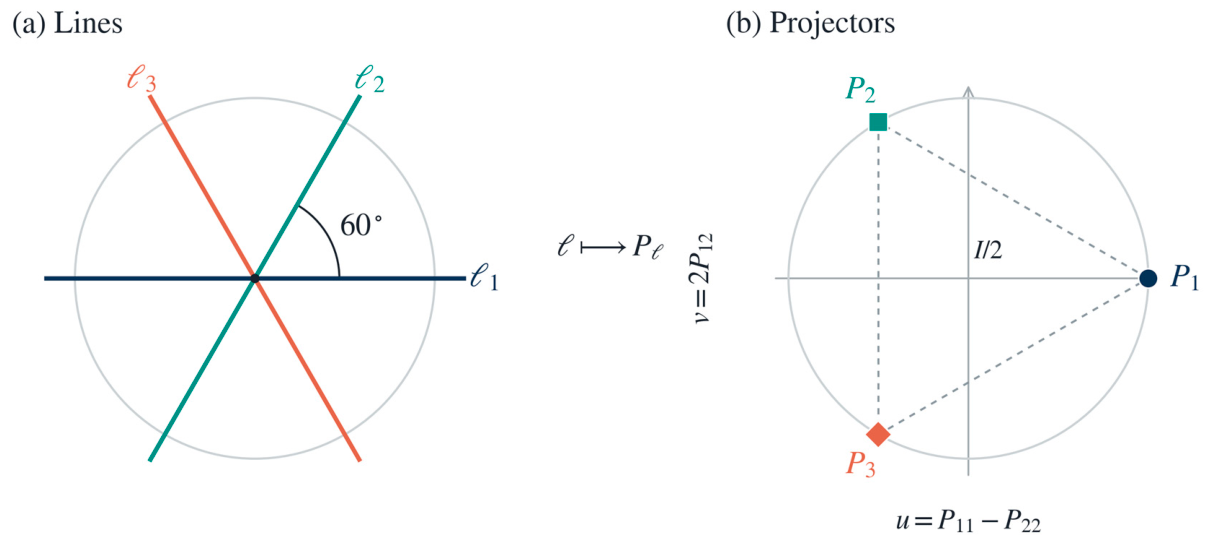
Figure 2.
Frame relations in D4. The twelve lines are ordered by the frames F1 = {ℝ(e1 ± e2),ℝ(e3 ± e4)}, F2 = {ℝ(e1 ± e3),ℝ(e2 ± e4)} and F3 = {ℝ(e1 ± e4),ℝ(e2 ± e3)}. The Gram matrix has diagonal blocks I4 and off-diagonal blocks J4/4. With
Figure 2.
Frame relations in D4. The twelve lines are ordered by the frames F1 = {ℝ(e1 ± e2),ℝ(e3 ± e4)}, F2 = {ℝ(e1 ± e3),ℝ(e2 ± e4)} and F3 = {ℝ(e1 ± e4),ℝ(e2 ± e3)}. The Gram matrix has diagonal blocks I4 and off-diagonal blocks J4/4. With
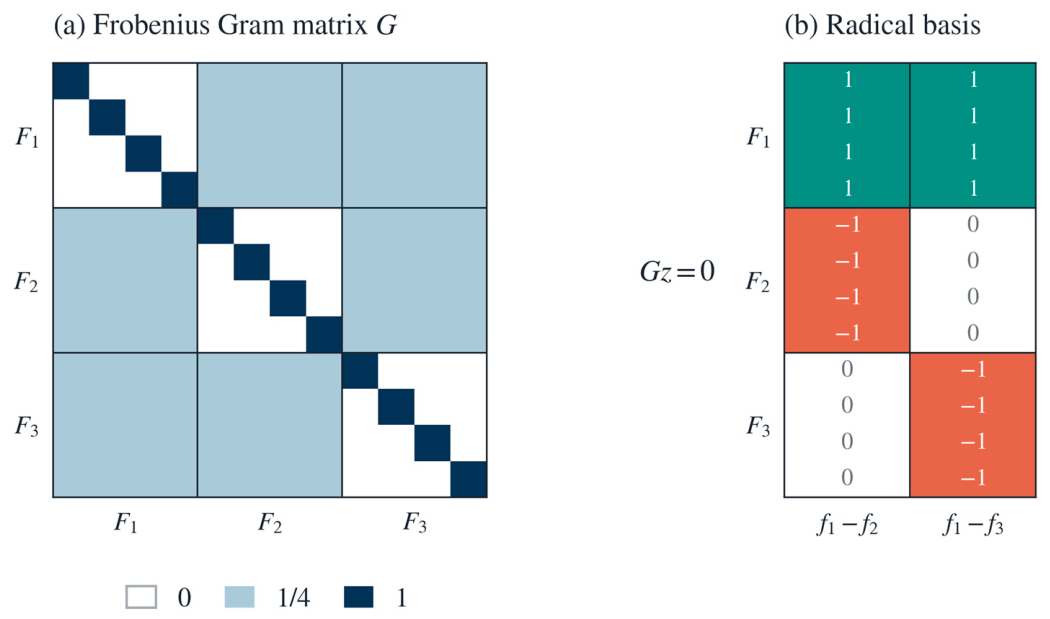
Figure 3.
The four parallel classes of AG(2,3) give the four irreducible two-dimensional summands Rd of the S1 radical. Each point represents an orthogonal frame; each affine line represents a D4 subsystem. Opposite sides of each square are identified.
Figure 3.
The four parallel classes of AG(2,3) give the four irreducible two-dimensional summands Rd of the S1 radical. Each point represents an orthogonal frame; each affine line represents a D4 subsystem. Opposite sides of each square are identified.
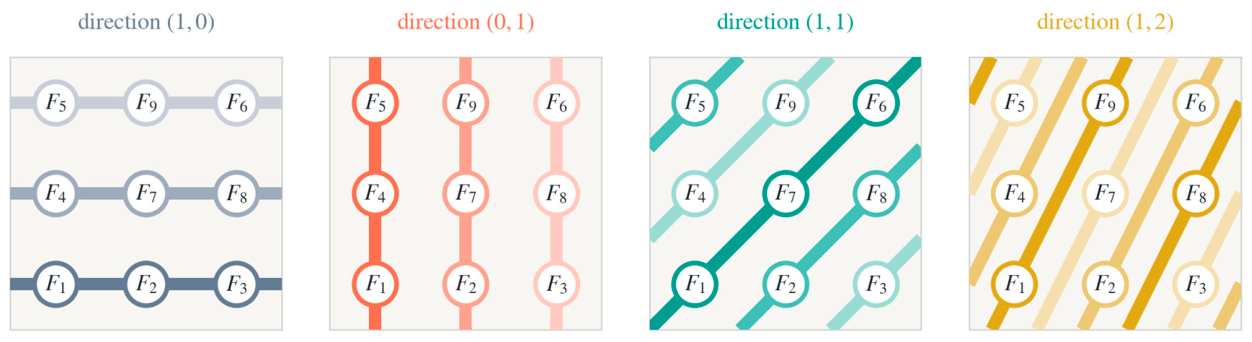
Figure 4.
Reflection closure in Kantor’s two configurations. Each off-diagonal cell represents sixteen pairs of lines, all at 60∘. A dot means that each pair has its third line in the configuration; a cross means that each has its third line outside it. The grey diagonal marks pairs within a frame. Frames are labelled separately in the two panels. The graph joining frame pairs that close is K9 for S1 and 3K3 for the nonclosed configuration.
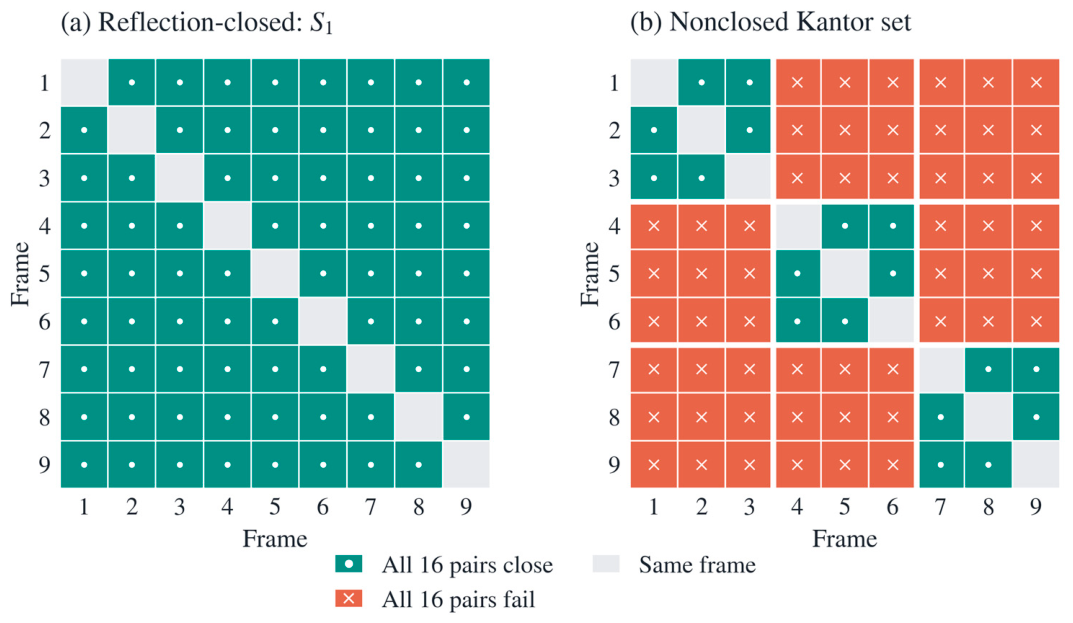
Table 1.
The two families and seven exceptional cases with nonzero radical and Jordan quotient.
| Case | System | N | dimM⊥ | dimJ | h | Factor over ℚ |
| 1 | Dm | m(m − 1) | m − 1 | Symm(ℚ) | ||
| 2 | G(3,3,m) | m2 | 2m − 2 | Hermm(E) | ||
| 3 | E8 | 120 | 84 | 36 | 7 | Sym8(ℚ) |
| 4 | E6 | 36 | 15 | 21 | 5 | Herm6(ℚ,q6) |
| 5 | E7 | 63 | 35 | 28 | 6 | Sym7(ℚ) |
| 6 | K6 | 126 | 90 | 36 | 10 | Herm6(E) |
| 7 | K5 | 45 | 20 | 25 | 8 | Herm5(E) |
| 8 | U | 165 | 120 | 45 | 16 | Herm5(ℍℚ) |
| 9 | S1 | 36 | 8 | 28 | 12 | Herm4(ℍℚ) |
Table 2.
Full orthogonal frames and ranks of their differences.
| System | Full frames | Frames through a line | Rank of differences |
| E7 | 135 | 15 | 35 |
| E8 | 2025 | 135 | 84 |
| K5 | 27 | 3 | 20 |
| K6 | 567 | 27 | 90 |
| U | 297 | 9 | 120 |
| S1 | 9 | 1 | 8 |
Disclaimer/Publisher’s Note: The statements, opinions and data contained in all publications are solely those of the individual author(s) and contributor(s) and not of MDPI and/or the editor(s). MDPI and/or the editor(s) disclaim responsibility for any injury to people or property resulting from any ideas, methods, instructions or products referred to in the content. |
© 2026 by the author. Licensee MDPI, Basel, Switzerland. This article is an open access article distributed under the terms and conditions of the Creative Commons Attribution (CC BY) license.
Copyright: This open access article is published under a Creative Commons CC BY 4.0 license, which permit the free download, distribution, and reuse, provided that the author and preprint are cited in any reuse.