

Submitted:
15 October 2026
Posted:
16 October 2026
You are already at the latest version
Abstract
The incorporation of myelodysplasia-related gene (MRG) mutations into contemporary classifications of acute myeloid leukemia (AML) reshaped the disease stratification. The 2022 International Consensus Classification (ICC) recognizes nine MRG mutations, whereas the fifth World Health Organization classification (WHO-HAEM5) excludes RUNX1. The 2022 European LeukemiaNet (ELN) recommendations classify these mutations as adverse-risk lesions in intensively treated patients. However, emerging evidence challenges their uniform prognostic significance. Large-scale genomic analyses reveal substantial gene-specific heterogeneity, with ASXL1, RUNX1, SF3B1, and U2AF1 generally associated with adverse outcomes, whereas SRSF2 and STAG2 seem to exhibit a more favorable prognostic profile. Importantly, their clinical impact is influenced by co-mutational architecture and treatment context. Venetoclax-based regimens may attenuate the adverse prognostic impact of MRG mutations, while emerging evidence suggests potential benefits from CPX-351 in molecularly defined AML-MR. Allogeneic hematopoietic stem cell transplantation remains crucial for a curative-intent treatment, while post-transplant maintenance represents an evolving strategy. Furthermore, molecular clearance of MRG mutations during remission may provide prognostic information beyond conventional measurable residual disease assessment. This review critically examines the biological and clinical heterogeneity of MRG-mutated AML, differences across classification systems, and contemporary therapeutic approaches, including intensive chemotherapy, CPX-351, venetoclax-based regimens, transplantation, and maintenance strategies. Particular emphasis is placed on gene-specific prognostic differences, co-mutational patterns, and dynamic molecular response. Collectively, available evidence supports moving beyond a binary MRG-positive versus MRG-negative classification toward an integrated, context-dependent framework incorporating molecular characteristics, treatment exposure, and longitudinal response assessment to refine risk stratification and guide personalized therapeutic decisions.
Keywords:
acute myeloid leukemia
; myelodysplasia-related gene mutations
; AML-MR
; secondary-type mutations
; CPX-351
; venetoclax
; measurable residual disease
; allogeneic hematopoietic stem cell transplantation
; molecular classification
1. Introduction
Acute myeloid leukemia (AML) comprises a biologically and clinically heterogeneous group of clonal myeloid malignancies characterized by substantial diversity in genetic architecture, treatment response, and long-term outcome [1,2,3]. Over the past decade, the increasing availability of next-generation sequencing and large molecularly annotated cohorts has progressively shifted AML classification from predominantly morphologic and clinical criteria toward genetically defined disease entities [1,2,3,4]. One of the most relevant consequences of this transition has been the recognition of a molecular signature strongly associated with secondary AML and with leukemic transformation from myelodysplastic neoplasms (MDS) or MDS/myeloproliferative neoplasms (MDS/MPN) [5,6]. Historically, AML with myelodysplasia-related changes (AML-MRC) represented a heterogeneous disease category defined by a previous history of MDS or MDS/MPN, specific myelodysplasia-related cytogenetic abnormalities, and/or multilineage dysplasia [7]. The 2022 classification systems substantially revised this concept. The fifth edition of the World Health Organization Classification of Haematolymphoid Tumours (WHO-HAEM5) introduced AML, myelodysplasia-related (AML-MR), prioritizing molecular and cytogenetic abnormalities over morphologic dysplasia [1]. In parallel, the 2022 International Consensus Classification (ICC) established genetically defined categories of AML with myelodysplasia-related gene mutations and AML with myelodysplasia-related cytogenetic abnormalities [2]. Importantly, WHO-HAEM5 and ICC are not completely concordant in their molecular definitions. WHO-HAEM5 recognizes pathogenic mutations involving eight myelodysplasia-related genes—ASXL1, BCOR, EZH2, SF3B1, SRSF2, STAG2, U2AF1, and ZRSR2—as defining molecular features of AML-MR [1]. The ICC additionally includes RUNX1, resulting in a nine-gene myelodysplasia-related gene (MRG) signature [2]. Consistent with their historical association with secondary AML and unfavorable outcomes, the 2022 European Leukemia Net (ELN) recommendations incorporated mutations in ASXL1, BCOR, EZH2, RUNX1, SF3B1, SRSF2, STAG2, U2AF1, and ZRSR2 into the adverse-risk category in patients without overriding favorable-risk genetic abnormalities [3]. It is worth mentioning that the ELN 2022 risk classification was developed primarily in the context of intensively treated AML and its applicability to patients receiving lower-intensity venetoclax-based therapies remains an area of active investigation [3,8]. The molecular foundation for this classification derives in part from seminal genomic studies demonstrating that mutations involving genes regulating chromatin modification, RNA splicing, transcription, and the cohesin complex are strongly enriched in secondary AML [5,6]. In particular, Lindsley et al. identified a group of mutations highly specific for secondary AML, providing evidence that the ontogeny of AML can be inferred from its mutational architecture even in the absence of a documented antecedent myeloid neoplasm [5]. These observations contributed to the subsequent incorporation of MRG mutations into contemporary AML classification and risk-stratification systems [1,2,3]. However, increasing evidence challenges the assumption that all MRG mutations match an equivalent biological and prognostic phenotype. Large molecularly annotated cohorts have demonstrated substantial heterogeneity in outcomes according to the individual mutated gene and its broader genomic context [9,10]. In a recent European analysis of 4,978 intensively treated patients with AML, 1,698 (34.1%) harbored at least one MRG mutation. MRG-positive AML was associated with a lower complete remission rate than MRG-negative disease (65.7% vs. 77.7%) and with inferior event-free, relapse-free, and overall survival [9]. Nevertheless, gene-specific analyses revealed marked heterogeneity: mutations involving ASXL1, RUNX1, SF3B1, and U2AF1 displayed outcomes more closely resembling conventional adverse-risk AML, whereas SRSF2- and STAG2-mutated AML showed outcomes closer to those observed in intermediate-risk disease [9]. These findings raise the possibility that a binary MRG-positive versus MRG-negative classification may be not appropriate to capture the prognostic complexity of this molecularly heterogeneous group. The clinical significance of MRG mutations is further influenced by co-mutational architecture. Interactions with NPM1, FLT3, TP53, IDH1/2, and other molecular lesions may lead to relevant changes in the phenotype and prognostic effect associated with individual MRG abnormalities [9,10,11,12]. This issue is crucial in NPM1-mutated AML, where the adverse significance of concomitant MRG mutations remains controversial. Recent studies and pooled analyses suggest that at least a subset of MRG mutations may negatively affect outcomes in NPM1-mutated AML, although the magnitude of this effect appears dependent on treatment, co-mutations, and post-remission strategy [10,11]. Treatment itself represents another major modifier of the prognostic effect of MRG mutations. The adverse-risk assignment incorporated into ELN 2022 is based on evidence derived from intensively treated patients [3]. In contrast, MRG-mutated AML appears to retain substantial sensitivity to venetoclax-containing lower-intensity regimens, and emerging studies suggest that the prognostic hierarchy observed following intensive chemotherapy cannot be directly translated to patients treated with hypomethylating agents plus venetoclax [8,12]. Thus, the clinical outcome of a MRG mutation carrying AML is not only influenced by the specific gene and co-mutational context but also the therapeutic backbone. The evolving role of CPX-351 further illustrates the interaction between molecular disease definition and treatment response. CPX-351 demonstrated superior overall survival compared with conventional 7+3 chemotherapy in older patients with newly diagnosed high-risk/secondary AML, leading to its incorporation into the therapeutic landscape of secondary AML [13]. Subsequent molecular reclassification of patients enrolled in the pivotal randomized trial has provided additional insights into its activity within contemporary genetically defined AML-MR. In a recent molecular analysis, patients meeting molecular criteria for AML-MR achieved a median overall survival of 9.7 months with CPX-351 versus 6.8 months with 7+3, whereas a comparable benefit was not evident in TP53-mutated AML [14]. Real-world data have further supported the activity of CPX-351 in molecularly defined AML-MR [15]. Beyond induction therapy, allogeneic hematopoietic stem cell transplantation (allo-HSCT) remains a central component of curative-intent therapy for adverse-risk AML [3]. Nevertheless, the optimal integration of MRG status with transplant decision-making, pre-transplant measurable residual disease (MRD), conditioning strategies, and post-transplant maintenance remains yet to be defined. Recent evidence suggests that post-transplant hypomethylating-agent maintenance may be particularly relevant in patients harboring MRG mutations, although these observations require prospective validation [16]. Finally, the clinical relevance of MRG mutations likely extends beyond their role as static diagnostic and prognostic biomarkers at presentation. Serial next-generation sequencing studies indicate that MRG mutations are still detectable after morphologic remission, raising questions regarding their interpretation as markers of residual leukemic disease versus persistent clonal hematopoiesis [17,18]. Emerging evidence suggests that molecular clearance of MRG mutations during remission provides prognostic information beyond conventional multiparameter flow cytometry-based MRD assessment, supporting the potential value of integrating dynamic molecular response into future risk-adapted strategies [18]. Taken together, these observations indicate that MRG-mutated AML should not necessarily be regarded as a biologically uniform adverse-risk entity. Rather, its clinical behavior appears to emerge from the interaction between the specific MRG lesion, co-mutational architecture, treatment exposure, transplantation strategy, and dynamic molecular response. In this review, we critically examine the evolving biological, prognostic, and therapeutic significance of MRG mutations in AML. Specific emphasis is placed on differences among individual MRGs, their interaction with major co-occurring molecular abnormalities, their predictive and prognostic relevance across intensive chemotherapy, CPX-351 and venetoclax-based approaches, and their emerging role in MRD assessment and post-transplant management. We further discuss ongoing clinical trials and future strategies aimed to move from a binary MRG-positive versus MRG-negative model toward a more individualized molecular framework for therapeutic decision-making.
2. Evolution of the Definition of Myelodysplasia-Related AML: From Morphology to Molecular Genetics
The definition of myelodysplasia-related acute myeloid leukemia (AML) has undergone a profound transformation during the last decade. Historically, the diagnosis of AML with myelodysplasia-related changes (AML-MRC) relied on a combination of clinical history, cytogenetic abnormalities, and morphologic evidence of multilineage dysplasia [7]. However, increasing genomic evidence demonstrated that morphology alone provides an incomplete representation of disease ontogeny and that specific somatic mutations can identify a biologically distinct form of AML associated with previous or occult myelodysplastic disease [4,5]. A pivotal contribution was provided by Lindsley et al., who investigated the genomic architecture of clinically defined secondary AML (sAML) and identified mutations in SRSF2, SF3B1, U2AF1, ZRSR2, ASXL1, EZH2, BCOR, and STAG2 as highly specific for AML arising from an antecedent myeloid neoplasm [5]. The presence of at least one of these mutations showed >95% specificity for secondary AML and identified a molecular phenotype characterized by distinct clinical features and inferior outcomes [5]. Importantly, longitudinal analyses suggested that these abnormalities frequently arise early during leukemogenesis and may precede overt leukemic transformation. These findings provided a major biological foundation for replacing a predominantly morphology-based definition with a molecularly informed classification. Both the fifth edition of the World Health Organization Classification of Haematolymphoid Tumours (WHO-HAEM5) and the 2022 International Consensus Classification (ICC) therefore provided a substantial revision of the definition of myelodysplasia-related AML [1,2].
2.1. WHO-HAEM5 Definition
WHO-HAEM5 recognizes AML, myelodysplasia-related (AML-MR) as a distinct disease entity defined by clinical history and/or specific molecular or cytogenetic abnormalities, in the absence of other AML-defining recurrent genetic abnormalities [1]. A major conceptual change compared with previous WHO classifications is the removal of morphologic multilineage dysplasia as an independent disease-defining criterion. Instead, greater diagnostic weight is assigned to genetic abnormalities associated with myelodysplasia-related disease biology [1]. WHO-HAEM5 recognizes pathogenic variants involving eight genes as molecular criteria for AML-MR: ASXL1, BCOR, EZH2, SF3B1, SRSF2, STAG2, U2AF1, and ZRSR2 [1]. These genes encompass several major biological pathways, including RNA splicing, epigenetic regulation, chromatin modification, transcriptional regulation, and cohesin-mediated chromosomal organization. The WHO classification therefore recognizes that the molecular architecture of AML can provide evidence of myelodysplasia-related disease biology even in patients without morphologic dysplasia or a clinically documented antecedent myeloid neoplasm [1].
2.2. ICC 2022 Definition
The ICC adopted a similar molecular framework but introduced a more granular hierarchical classification [2]. In particular, the ICC distinguishes AML with myelodysplasia-related gene mutations from AML with myelodysplasia-related cytogenetic abnormalities. Importantly, the molecular definitions adopted by WHO-HAEM5 and ICC are not completely concordant. Unlike WHO-HAEM5, the ICC includes RUNX1 among the mutations defining AML with myelodysplasia-related gene mutations. Consequently, the ICC molecular category comprises nine genes: ASXL1, BCOR, EZH2, RUNX1, SF3B1, SRSF2, STAG2, U2AF1, and ZRSR2 [2]. This difference has important implications when interpreting clinical studies because populations defined as “AML-MR”, “AML with MRG mutations”, or “MRG-positive AML” according to WHO and ICC criteria are not necessarily identical. In particular, an AML harboring an isolated RUNX1 mutation may satisfy the ICC molecular definition but does not fulfill the corresponding WHO eight-gene molecular criterion [1,2]. Accordingly, clinical and translational studies investigating MRG-mutated AML should explicitly report which classification system and gene set were applied. This distinction is especially important when comparing the original eight-gene secondary-type mutation signature with contemporary ICC/ELN datasets based on nine MRGs.
2.3. MRG Mutations in the ELN 2022 Risk Classification
The 2022 European Leukemia Net (ELN) recommendations incorporated mutations involving all nine ICC-defined MRGs into the adverse-risk category, in the absence of overriding favorable-risk genetic abnormalities [3]. This represented an important change compared with the previous ELN classification, in which only selected mutations, particularly ASXL1 and RUNX1, were individually recognized as adverse-risk molecular abnormalities. However, the incorporation of the entire MRG group into a single adverse-risk category promptly generated considerable debate. Validation studies of the ELN 2022 classification have suggested that patients assigned to the adverse-risk category mostly due to newly incorporated MRG abnormalities may have outcomes different from those of patients harboring other adverse-risk genotypes [19]. In one large validation study, patients reassigned to adverse risk because of newly included MRG abnormalities achieved a 5-year overall survival of approximately 26%, compared with approximately 12% among patients with other adverse-risk genetic abnormalities [19]. More importantly, updated large molecularly annotated datasets indicate that the prognostic contribution of individual MRG mutations is heterogeneous rather than uniform. In a European cohort comprising 4,978 intensively treated patients with AML, 1,698 patients (34.1%) harbored at least one MRG mutation [20]. Overall, MRG-positive AML was associated with a lower complete remission rate compared with MRG-negative AML (65.7% vs. 77.7%) and with inferior event-free survival, relapse-free survival, and overall survival [20]. However, substantial differences emerged when individual genes were evaluated separately. Mutations involving ASXL1, RUNX1, SF3B1, and U2AF1 displayed outcomes more closely resembling conventional adverse-risk AML, whereas SRSF2 and STAG2 showed outcomes according to intermediate-risk disease [20]. The prognostic position of BCOR, EZH2, and ZRSR2 was less clearly defined [20]. These findings challenge the assumption that all MRG mutations represent interchangeable adverse-risk lesions and provide a strong rationale for gene-specific prognostic assessment.
2.4. Treatment Context Matters: ELN 2022 versus ELN 2024
Another critical consideration is that the ELN 2022 risk classification was developed in the context of patients receiving intensive chemotherapy [3]. The widespread introduction of venetoclax-based lower-intensity therapy has demonstrated that genetic predictors derived from intensively treated populations cannot necessarily be extrapolated to patients receiving hypomethylating agents plus venetoclax. This led to the development of the 2024 ELN genetic risk classification for adults with AML receiving less-intensive therapies [6]. The distinction is of particular relevance for MRG-mutated AML. Emerging evidence indicates that MRG-mutated disease retains substantial sensitivity to venetoclax-containing therapy and that MRG abnormalities do not necessarily confer the same adverse prognostic effect under low-intensity venetoclax-based treatment as that observed following conventional intensive chemotherapy [9,10]. In a cohort of 453 patients with AML harboring MRG mutations, venetoclax significantly improved early remission among patients considered unfit for intensive chemotherapy and treated with low-intensity regimens, whereas its impact was less evident in intensively treated patients [9]. Similarly, molecular analyses of AML treated with venetoclax plus azacitidine have demonstrated that the prognostic significance of MRG mutations differs from that observed under intensive chemotherapy and may be further refined by the persistence or clearance of mutations at remission [10]. Therefore, MRG status should increasingly be interpreted within a treatment-specific rather than treatment-agnostic prognostic framework.
3. Biological Landscape of Myelodysplasia-Related Gene Mutations
MRG mutations affect distinct biological pathways, including RNA splicing (SF3B1, SRSF2, U2AF1, ZRSR2), epigenetic and chromatin regulation (ASXL1, EZH2, BCOR), transcriptional regulation (RUNX1), and cohesin function (STAG2) [5,21]. This functional diversity argues against considering MRG-mutated AML as a homogeneous biological entity.
3.1. Functional and Gene-Specific Heterogeneity
Spliceosome mutations are characteristic of myelodysplastic neoplasms and secondary AML [5,21]. However, their prognostic impact differs: U2AF1 shows an adverse-risk-like phenotype, whereas SRSF2 has been associated with intermediate-risk AML outcomes [20]. Among epigenetic regulators, ASXL1 is a well-established adverse-risk abnormality [3,20], whereas the prognostic impact of EZH2 and BCOR appears less consistent [20]. Similarly, although STAG2 is classified as an adverse-risk MRG by ELN 2022, recent data suggest outcomes more closely resembling intermediate-risk AML [20]. RUNX1 represents a distinct case because it is included among MRGs by ICC but not WHO-HAEM5 [1,2]. Its inclusion therefore distinguishes the historical eight-gene secondary-type signature from the contemporary nine-gene ICC/ELN panel [5].
3.2. Clonal Evolution and Co-Mutational Architecture
Several MRG mutations arise early during leukemogenesis, thus persisting from antecedent myeloid disease into AML [5]. This feature complicates MRD interpretation because persistence during remission may reflect residual preleukemic hematopoiesis rather than active leukemia [22]. The clinical effect of MRG mutations is also strongly influenced by co-occurring abnormalities. Among 862 FLT3-ITD AML patients, MRG mutations adversely affected outcome primarily in NPM1-wild-type disease, whereas their impact was not significant in NPM1-mutated cases [12]. Similarly, a meta-analysis of 4,363 NPM1-mutated AML patients showed an overall adverse association with MRG mutations although with substantial inter-study heterogeneity [11]. The number of MRGs seems also to be relevant, as ≥2 mutations are associated with inferior leukemia-free survival in otherwise favorable-risk AML [23]. Thus, MRG status should be interpreted according to the specific gene, co-mutational context, clonal architecture, and treatment exposure.
4. Are All Myelodysplasia-Related Gene Mutations Equal?
Although ELN 2022 assigns all nine MRGs to the adverse-risk category [3], increasing evidence indicates substantial prognostic heterogeneity. In a European cohort of 4,978 intensively treated AML patients, MRG-positive disease was associated overall with lower remission rates and inferior survival. However, ASXL1, RUNX1, SF3B1, and U2AF1 displayed adverse-risk-like outcomes, whereas SRSF2 and STAG2 were closer to intermediate-risk disease; the impact of BCOR, EZH2, and ZRSR2 was less clear [20]. The number and clonal representation of MRG abnormalities further modify prognosis [7,23]. Importantly, MRG-associated risk is treatment-dependent. ELN 2022 was developed in the context of intensively treated AML [3], whereas ELN 2024 introduced a separate framework for less-intensive therapies [6]. In 453 MRG-mutated patients, venetoclax improved early remission rates among those receiving low-intensity therapy [9]. Similarly, VEN-AZA studies suggest that both baseline genotype and molecular response influence outcome [10]. these observations argue against a simple binary MRG-positive/MRG-negative model and favor a gene-, context-, and treatment-specific interpretation.
5. Intensive Therapy and CPX-351 in MRG-Mutated AML
5.1. CPX-351 and Molecularly Defined AML-MR
MRG-positive AML has historically shown inferior responses to conventional intensive chemotherapy, with CR rates of 65.7% versus 77.7% in MRG-negative AML [20]. In the pivotal randomized phase III trial of 309 older patients with high-risk/secondary AML, CPX-351 improved survival as compared with conventional 7+3 [13]. At 5 years, median OS was 9.33 versus 5.95 months, with 5-year survival rates of 18% versus 8% [24]. Importantly, molecular reanalysis of 184 patients from this trial showed that, among molecularly defined AML-MR, median OS was 9.7 months with CPX-351 versus 6.8 months with 7+3 [14]. A comparable benefit was not observed in TP53-mutated AML. However, this was a retrospective molecular analysis and should not be considered prospective randomized evidence specifically for MRG-AML.
5.2. Transplantation and Real-World Evidence
CPX-351 can be also relevant as a bridge to allo-HSCT. Among transplanted patients from the randomized trial, 3-year post-transplant OS was 56% with CPX-351 versus 23% with 7+3 [25]. The molecular reanalysis suggested that this benefit was largely driven by AML-MR [14]. Real-world data from the MARROW Consortium, including 235 AML-MR patients treated with CPX-351, showed a CR/CRi rate of 52%, increasing to 57% in molecularly defined AML-MR; median OS was 13.8 months [15].
5.3. CPX-351 versus HMA-VEN and Emerging Combinations
A retrospective Mayo Clinic analysis of 600 newly diagnosed AML patients found similar CR/CRi rates with CPX-351 and HMA-VEN in AML-MR (60% vs. 63%) [26]. Exploratory analyses suggested possible gene-specific treatment interactions involving STAG2 and SF3B1, although these findings require prospective validation. CPX-351 is also being explored in combinations. CPX-351 plus venetoclax showed encouraging activity in newly diagnosed high-risk AML [27] and relapsed/refractory disease [28], while the V-FAST platform demonstrated the feasibility of combining CPX-351 with venetoclax or targeted agents [29]. A randomized phase II trial of CPX-351 with or without pomalidomide in newly diagnosed AML-MR was also reported in 2026 [30]. Overall, CPX-351 represents an important option for fit, transplant-eligible, AML-MR patients, but its optimal positioning relative to HMA-VEN remains unresolved.
6. Venetoclax-Based Therapy in MRG-Mutated AML
VEN-AZA has become a standard frontline therapy for older or chemotherapy-ineligible AML following the VIALE-A trial [31]. Importantly, molecular predictors of outcome differ from those established for intensive chemotherapy. In pooled VEN-AZA analyses, ELN 2017/2022 categories showed limited prognostic discrimination, whereas TP53, FLT3-ITD, NRAS, and KRAS were major determinants of outcome [32]. MRG mutations may therefore not retain their conventional adverse significance during venetoclax-based therapy. In 453 MRG-mutated patients, venetoclax improved early composite remission rates with low-intensity therapy (45.9% vs. 30.0%) [9]. Similarly, among 228 patients treated with VEN-AZA, MRG mutations were associated with favorable survival, whereas TP53 and RAS-pathway abnormalities predicted inferior outcomes [10]. Nevertheless, gene-specific differences remain relevant, as SRSF2 mutations have been associated with inferior survival in VEN-AZA-treated patients [33]. Molecular response may further refine prognosis. Among VEN-AZA responders, 76.2% retained at least one detectable mutation, while clearance of non-DNMT3A/TET2/ASXL1 mutations was associated with improved relapse-free survival [10]. Thus, persistent MRG mutations should be interpreted cautiously because they likely reflect preleukemic clones rather than residual AML.
7. CPX-351 Versus HMA-Venetoclax: Can Molecular Genetics Guide Treatment Selection?
No prospective randomized trial has directly compared CPX-351 with HMA-VEN in molecularly defined MRG-AML. In the Mayo Clinic retrospective study of 600 patients, AML-MR CR/CRi rates were similar with CPX-351 and HMA-VEN (60% vs. 63%) [26]. Exploratory analyses suggested higher response rates with HMA-VEN in STAG2-mutated AML, whereas SF3B1-mutated AML showed longer transplant-censored survival with CPX-351 [26]. These observations remain hypothesis-generating. Current evidence therefore supports an individualized approach. CPX-351 is supported by randomized and molecularly reclassified data in fit, particularly transplant-eligible AML-MR patients [13,14], whereas HMA-VEN is highly active in older or unfit patients and may partially overcome the adverse impact of MRG mutations [9,10,31]. TP53-mutated AML should be considered separately, given its poor outcome with both strategies [14]. Until prospective genotype-stratified comparisons become available, treatment selection should integrate fitness, transplant intent, individual MRG identity, TP53 status, co-occurring targetable mutations, previous HMA exposure, and MRD response [6,32].
8. Allogeneic Transplantation and Post-Transplant Strategies
Allogeneic hematopoietic stem cell transplantation (allo-HSCT) remains an important curative strategy for eligible patients with adverse-risk AML, including MRG-mutated disease. However, transplant outcomes vary substantially according to the underlying genetic category. A large EBMT retrospective analysis evaluated 1,152 patients with AML-MR transplanted in first complete remission, including 379 with MRG-defined AML [34]. Outcomes differed according to whether AML-MR was defined by gene mutations, cytogenetic abnormalities, or TP53 alterations, emphasizing that genetically defined AML-MR should not be considered a homogeneous transplant population. The role of CPX-351 as a bridge to transplantation is also relevant. In the molecular reanalysis of the pivotal CPX-351 trial, the survival advantage after transplantation appeared particularly evident in patients with AML-MR [14], supporting the integration of induction strategy and transplant planning. Post-transplant maintenance may further reduce relapse risk. In a multicenter retrospective study of 469 patients with adverse-risk AML, HMA maintenance was associated with improved outcomes, with the greatest benefit observed in patients harboring MRG mutations [16]. Within this subgroup, HMA maintenance was associated with improved event-free survival (HR 0.47) and reduced relapse incidence. Interestingly, patients transplanted in CR1 with undetectable MRD appeared to gain less benefit from maintenance [16]. These findings suggest that post-transplant strategies in MRG-AML may ultimately be guided by both genotype and pre-transplant MRD, although prospective validation is required.
9. Measurable Residual Disease in MRG-Mutated AML
MRD assessment in MRG-AML is challenging because several MRG abnormalities may arise early during leukemogenesis and persist in preleukemic hematopoietic clones after treatment. This distinction was highlighted in a 2026 analysis of 2,684 intensively treated patients, including 436 remission samples [22]. Persistence of secondary-type mutations alone did not significantly predict relapse or survival. In contrast, persistence of non-DTA mutations by NGS was associated with a markedly increased cumulative incidence of relapse (SHR 3.25; P < 0.001) [22]. Similar complexity has been observed following VEN-AZA. Among 228 treated patients, 76.2% of those achieving composite complete remission retained at least one mutation, while clearance of non-DTA mutations was associated with improved relapse-free survival [10]. Therefore, molecular persistence of an MRG mutation should not automatically be considered equivalent to residual leukemia. Its interpretation should depend on the specific gene, clonal dynamics, co-occurring mutations, and complementary MRD assessment. From a clinical perspective, the most informative strategy may therefore combine multiparameter flow cytometry with serial NGS rather than relying on MRG persistence alone. Dynamic molecular response may ultimately help refine transplant and post-transplant decisions, but prospective studies are required before MRG clearance can be used as a standalone therapeutic endpoint.
10. Emerging Therapeutic Strategies
The therapeutic landscape of AML-MR is progressively moving toward molecularly informed combinations rather than uniform treatment based solely on the AML-MR label. CPX-351 is being investigated as a backbone for combination strategies, including venetoclax and targeted agents [27,28,29]. Most recently, a randomized phase II trial evaluated CPX-351 with or without pomalidomide in newly diagnosed AML-MR [30]. Although these studies remain exploratory, they illustrate the transition toward trials specifically designed for genetically defined AML-MR. For patients receiving lower-intensity therapy, VEN-HMA remains a major therapeutic platform [9,31,32]. Future strategies will incorporate targeted agents according to co-occurring mutations, including FLT3, IDH1/2, and NPM1-associated vulnerabilities, rather than MRG status alone. It is worth mentioning that no currently available targeted agent specifically addresses the MRG molecular category as a whole. This further supports considering MRG-AML as a collection of biologically heterogeneous molecular subsets rather than a single therapeutic entity.
11. Future Perspectives and Conclusions
Current evidence suggests that a binary MRG-positive/MRG-negative classification is insufficient for optimal therapeutic decision-making. Future risk models should integrate four principal variables: individual MRG identity, co-mutational architecture, treatment context, and dynamic MRD response. Prospective studies are particularly needed to determine whether individual MRGs predict preferential benefit from CPX-351 or VEN-HMA and whether molecular clearance can guide transplantation or post-transplant maintenance. Ultimately, the clinical relevance of MRG mutations may lie less in their presence alone than in their interaction with the broader leukemic genotype and their evolution during therapy. MRG mutations have radically modified the classification of AML by providing a molecular definition of myelodysplasia-related disease. However, accumulating evidence demonstrates that these abnormalities are neither biologically nor prognostically equivalent. The impact of an MRG mutation depends on the specific gene, co-occurring mutations, treatment received, and depth of response. CPX-351 efficacy seems to be more relevant in molecularly defined AML-MR, whereas VEN-HMA may modify the adverse prognostic effect traditionally associated with several MRG abnormalities. Accordingly, future management should move beyond MRG status as a static adverse-risk marker toward a dynamic, genotype- and treatment-specific model integrating molecular architecture, MRD, and transplantation strategy.
Table 1 Biological and clinical characteristics of myelodysplasia-related gene mutations in AML.
Table 2 Selected studies relevant to treatment selection in MRG-mutated AML.
References
- Khoury, J.D.; Solary, E.; Abla, O.; et al. The 5th edition of the World Health Organization Classification of Haematolymphoid Tumours: Myeloid and Histiocytic/Dendritic Neoplasms. Leukemia 2022, 36, 1703–1719. [Google Scholar] [CrossRef]
- Arber, D.A.; Orazi, A.; Hasserjian, R.P.; et al. International Consensus Classification of Myeloid Neoplasms and Acute Leukemias: integrating morphologic, clinical, and genomic data. Blood 2022, 140, 1200–1228. [Google Scholar] [CrossRef]
- Döhner, H.; Wei, A.H.; Appelbaum, F.R.; et al. Diagnosis and management of AML in adults: 2022 recommendations from an international expert panel on behalf of the ELN. Blood 2022, 140, 1345–1377. [Google Scholar] [CrossRef]
- Papaemmanuil, E.; Gerstung, M.; Bullinger, L.; et al. Genomic classification and prognosis in acute myeloid leukemia. N Engl. J. Med. 2016, 374, 2209–2221. [Google Scholar] [CrossRef]
- Lindsley, R.C.; Mar, B.G.; Mazzola, E.; et al. Acute myeloid leukemia ontogeny is defined by distinct somatic mutations. Blood 2015, 125, 1367–1376. [Google Scholar] [CrossRef]
- Papaemmanuil, E.; Gerstung, M.; Malcovati, L.; et al. Clinical and biological implications of driver mutations in myelodysplastic syndromes. Blood 2013, 122, 3616–3627. [Google Scholar] [CrossRef]
- Arber, D.A.; Orazi, A.; Hasserjian, R.; et al. The 2016 revision to the World Health Organization classification of myeloid neoplasms and acute leukemia. Blood 2016, 127, 2391–2405. [Google Scholar] [CrossRef]
- Döhner, H.; DiNardo, C.D.; Appelbaum, F.R.; et al. Genetic risk classification for adults with AML receiving less-intensive therapies: the 2024 ELN recommendations. Blood 2024. [Google Scholar] [CrossRef]
- Bill, M.; Eckardt, J.N.; Döhner, K.; et al. Differential prognostic impact of myelodysplasia-related gene mutations in a European cohort of 4978 intensively treated AML patients. Leukemia 2026, 40(1), 63–71. [Google Scholar] [CrossRef]
- Mecklenbrauck, R.; Villaverde Ramiro, A.; Sträng, E.; et al. Prognostic impact of myelodysplasia-related gene mutations in FLT3-ITD-mutated acute myeloid leukemia. Leukemia 2026, 40(3), 622–629. [Google Scholar] [CrossRef]
- Chang, Y.S.; Lee, Y.W.; Liu, C.Y.; et al. Prognostic implications of myelodysplasia-related gene mutations in NPM1-mutated acute myeloid leukemia: a systematic review and meta-analysis. Haematologica 2026, 111(9), 2935–2945. [Google Scholar] [CrossRef]
- Jimenez-Chillon, C.; Othman, J.; Taussig, D.; et al. Venetoclax-based low intensity therapy in molecular failure of NPM1-mutated AML. Blood Adv. 2024, 8(2), 343–352. [Google Scholar] [CrossRef]
- Lancet, J.E.; Uy, G.L.; Cortes, J.E.; et al. CPX-351 (cytarabine and daunorubicin) liposome for injection versus conventional cytarabine plus daunorubicin in older patients with newly diagnosed secondary acute myeloid leukemia. J. Clin. Oncol. 2018, 36, 2684–2692. [Google Scholar] [CrossRef]
- Shimony, Shai; Murdock, H. Moses; Keating, Julia; Tsai, Harrison K.; Sasi, Archana; Gibson, Christopher J.; Faderl, Stefan; Wagner, Anthony; Dronamraju, Nalina; Lin, Tara L.; Prebet, Thomas; Cortes, Jorge E.; Uy, Geoffrey L.; Lancet, Jeffrey E.; Reilly, Christopher R.; Neuberg, Donna; Stone, Richard M.; Lindsley, R. Coleman. CPX-351 selectively benefits patients with AML and myelodysplasia-related mutations in the pivotal randomized trial. Blood Adv. 2026, Volume 10(Issue 8). [Google Scholar] [CrossRef]
- Peters, D.T.; Nicolet, D.; Madanat, Y.F.; et al. Real-world analysis of CPX-351 in AML-MR: A multicentre study from the MARROW consortium. Br. J. Haematol. 2026, 208(2), 589–598. [Google Scholar] [CrossRef]
- Thigpen, H.; Diebold, K.; Mudd, T.; et al. Post-transplant hypomethylating agents plus venetoclax maintenance improves survival in high-risk myeloid malignancies: A matched cohort study. Blood Cancer J. 2026, 16(1), 132. [Google Scholar] [CrossRef]
- Chow, R.D.; Velu, P.; Deihimi, S.; et al. Persistent postremission clonal hematopoiesis shapes the relapse trajectories of acute myeloid leukemia. Blood Adv. 2025, 9(8), 1888–1899. [Google Scholar] [CrossRef]
- Heiblig, M.; Gross, Z.; Belhabri, A.; et al. Prognostic impact of measurable residual disease in AML patients treated frontline with azacitidine and venetoclax: results from the French VENAURA registry. Leukemia 2026, 40(10), 2191–2201. [Google Scholar] [CrossRef]
- Lachowiez, C.A.; Long, N.; Saultz, J.; et al. Comparison and validation of the 2022 European LeukemiaNet guidelines in acute myeloid leukemia. Blood Adv. 2023, 7(9), 1899–1909. [Google Scholar] [CrossRef]
- Bill, M.; Eckardt, J.N.; Döhner, K.; et al. Differential prognostic impact of myelodysplasia-related gene mutations in a European cohort of 4978 intensively treated AML patients. Leukemia 2026, 40(1), 63–71. [Google Scholar] [CrossRef]
- Bouligny, I.M.; Maher, K.R.; Grant, S. Secondary-Type Mutations in Acute Myeloid Leukemia: Updates from ELN 2022. Cancers 2023, 15(13), 3292. [Google Scholar] [CrossRef]
- Boertjes, E.L.; Grob, T.; Al Hinai, A.; et al. MDS/AML and AML with myelodysplasia-related gene mutations: clinical and molecular similarities. Blood Adv. 2026, 10(4), 939–950. [Google Scholar] [CrossRef]
- Zhang, L.; Ying, S.; Fang, F.; et al. Prognostic impact of myelodysplasia-related gene mutations in ELN-2022 favorable-risk acute myeloid leukemia subtypes. Ann. Med. 2026, 58(1), 2636337. [Google Scholar] [CrossRef]
- Lancet, J.E.; Uy, G.L.; Newell, L.F.; et al. CPX-351 versus 7+3 cytarabine and daunorubicin chemotherapy in older adults with newly diagnosed high-risk or secondary acute myeloid leukaemia: 5-year results of a randomised, open-label, multicentre, phase 3 trial. Lancet Haematol. 2021, 8(7), e481–e491. [Google Scholar] [CrossRef]
- Uy, G.L.; Newell, L.F.; Lin, T.L.; et al. Transplant outcomes after CPX-351 vs 7 + 3 in older adults with newly diagnosed high-risk and/or secondary AML. Blood Adv. 2022, 6(17), 4989–4993. [Google Scholar] [CrossRef]
- Fathima, S.; Rokach, L.; Ghosoun, N.; et al. CPX-351 (Liposomal Cytarabine and Daunorubicin) versus venetoclax plus hypomethylating agent therapy in newly diagnosed acute myeloid leukemia: a retrospective comparison involving 600 Mayo Clinic patients. Blood Cancer J. 2026, 16(1), 78. [Google Scholar] [CrossRef]
- Jen, W.Y.; Croden, J.; Almanza-Huante, E.; et al. A Phase 2 study of CPX-351 in combination with venetoclax in patients with newly diagnosed high-risk acute myeloid leukemia. Hemasphere Published. 2025, 9(10), e70214. [Google Scholar] [CrossRef]
- Kadia, T.M.; Jen, W.Y.; Bataller, A.; et al. A Phase 2 Trial of CPX-351 Combined With Venetoclax in Relapsed or Refractory Acute Myeloid Leukemia. Am. J. Hematol. 2025, 100(8), 1365–1373. [Google Scholar] [CrossRef]
- Pullarkat, V.A.; Levis, M.; McCloskey, J.; et al. V-FAST: a phase 1b master trial to investigate CPX-351 combined with targeted agents in adults with newly diagnosed AML. Blood Neoplasia Published. 2025, 2(4), 100123. [Google Scholar] [CrossRef]
- Peters, D.T.; Koenig, K.; Ivanova, A.; et al. Randomized phase II trial of liposomal cytarabine and daunorubicin with or without pomalidomide in newly diagnosed acute myeloid leukemia myelodysplasia-related. Haematologica Published online. 2026. [Google Scholar] [CrossRef]
- DiNardo, C.D.; Jonas, B.A.; Pullarkat, V.; et al. Azacitidine and Venetoclax in Previously Untreated Acute Myeloid Leukemia. N Engl. J. Med. 2020, 383(7), 617–629. [Google Scholar] [CrossRef]
- Döhner, H.; Pratz, K.W.; DiNardo, C.D.; et al. Genetic risk stratification and outcomes among treatment-naive patients with AML treated with venetoclax and azacitidine. Blood 2024, 144(21), 2211–2222. [Google Scholar] [CrossRef]
- Berton, Guillaume; Sedaki, Bochra; Collomb, Erwann; Benachour, Sami; Loschi, Michael; Mohty, Bilal; Saillard, Colombe; Hicheri, Yosr; Rouzaud, Camille; Maisano, Valerio; Villetard, Ferdinand; D'Incan Corda, Evelyne; Charbonnier, Aude; Rey, Jerome; Hospital, Marie Anne; Ittel, Antoine; Abbou, Norman; Fanciullino, Raphaelle; Dadone-Montaudié, Bérengère; Vey, Norbert; Venton, Geoffroy; Cluzeau, Thomas; Alary, Anne Sophie; Garciaz, Sylvain. Poor Prognosis of SRSF2 Gene Mutations in Patients Treated with Venetoclax-Azacitidine (VEN-AZA) for Newly Diagnosed Acute Myeloid Leukemia. a Multicentric Real-Life Study of 117 Patients. Blood 2023, 142 (Supplement 1), 2848. [Google Scholar] [CrossRef]
- Esteve, J.; Nagler, A.; Labopin, M.; et al. Allogeneic Hematopoietic Cell Transplantation in Patients With Acute Myeloid Leukemia With Myelodysplasia-Related Genetic Features: Relevance of the Genetic Underlying Category. A Retrospective Analysis on Behalf of the Acute Leukemia Working Party of the EBMT. Am. J. Hematol. 2025, 100(6), 954–962. [Google Scholar] [CrossRef]
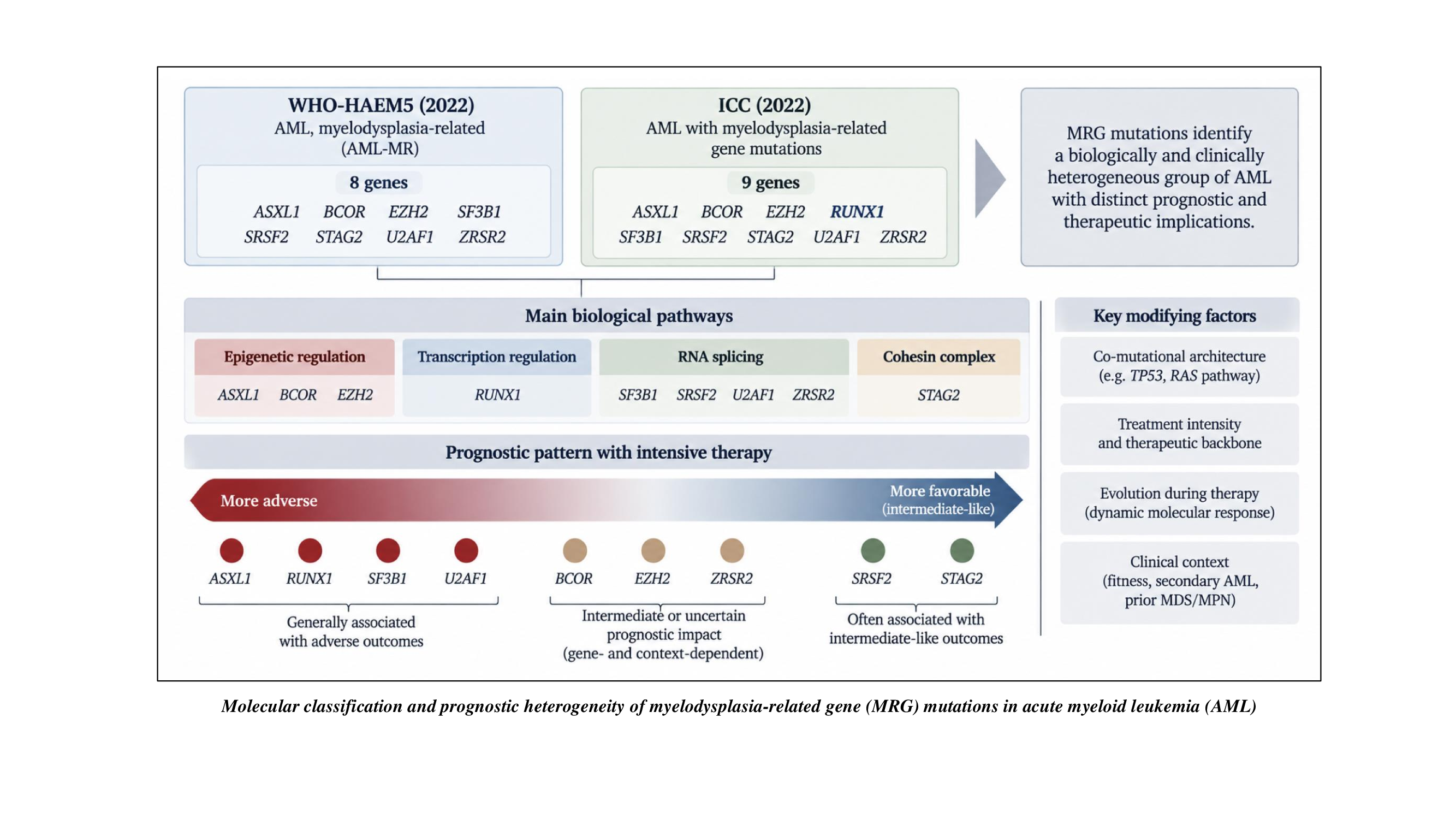
Figure 1.
Molecular classification and prognostic heterogeneity of myelodysplasia-related gene (MRG) mutations in acute myeloid leukemia (AML). The figure illustrates differences between WHO-HAEM5 and ICC 2022 classifications, the main biological pathways affected by MRG mutations, and their heterogeneous prognostic impact in intensively treated AML. Although MRG mutations are collectively classified as adverse-risk abnormalities by ELN 2022, their clinical significance varies according to the specific gene involved and is further influenced by co-mutational architecture, treatment context, and dynamic molecular response. Prognostic groupings are based on emerging evidence and should not be interpreted as definitive gene-specific risk categories.
Figure 1.
Molecular classification and prognostic heterogeneity of myelodysplasia-related gene (MRG) mutations in acute myeloid leukemia (AML). The figure illustrates differences between WHO-HAEM5 and ICC 2022 classifications, the main biological pathways affected by MRG mutations, and their heterogeneous prognostic impact in intensively treated AML. Although MRG mutations are collectively classified as adverse-risk abnormalities by ELN 2022, their clinical significance varies according to the specific gene involved and is further influenced by co-mutational architecture, treatment context, and dynamic molecular response. Prognostic groupings are based on emerging evidence and should not be interpreted as definitive gene-specific risk categories.
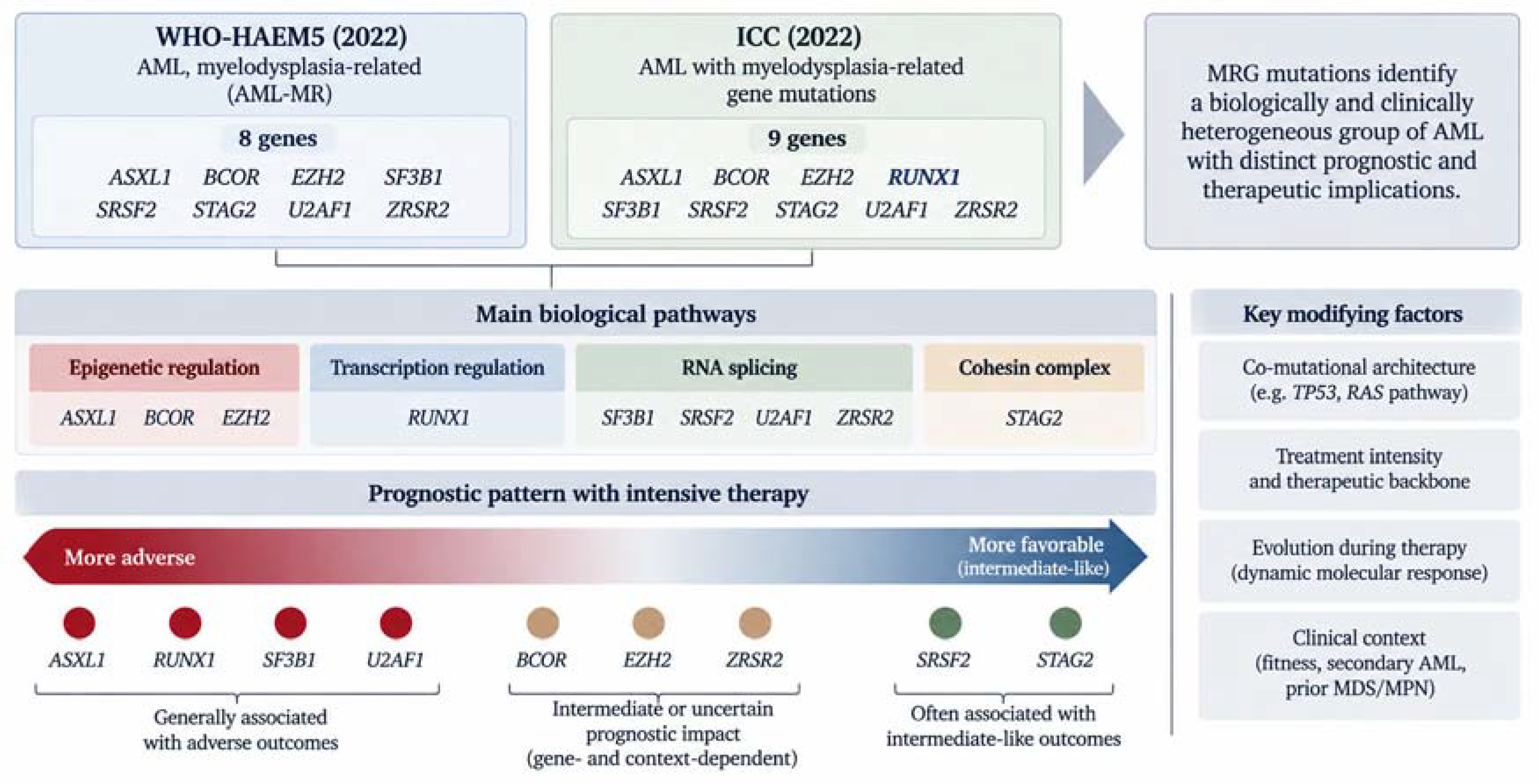
Figure 2.
Proposed framework for individualized management of myelodysplasia-related gene (MRG)-mutated acute myeloid leukemia (AML). Treatment selection integrates molecular characteristics, co-mutational profile, patient fitness, and transplant eligibility. Therapeutic options include intensive chemotherapy, CPX-351, and venetoclax-based regimens. Response assessment combines morphologic evaluation, measurable residual disease (MRD), and molecular monitoring, recognizing that persistent MRG mutations may reflect preleukemic clonal hematopoiesis. Allogeneic transplantation remains a key curative strategy, while post-transplant maintenance represents an emerging approach requiring further validation.
Figure 2.
Proposed framework for individualized management of myelodysplasia-related gene (MRG)-mutated acute myeloid leukemia (AML). Treatment selection integrates molecular characteristics, co-mutational profile, patient fitness, and transplant eligibility. Therapeutic options include intensive chemotherapy, CPX-351, and venetoclax-based regimens. Response assessment combines morphologic evaluation, measurable residual disease (MRD), and molecular monitoring, recognizing that persistent MRG mutations may reflect preleukemic clonal hematopoiesis. Allogeneic transplantation remains a key curative strategy, while post-transplant maintenance represents an emerging approach requiring further validation.
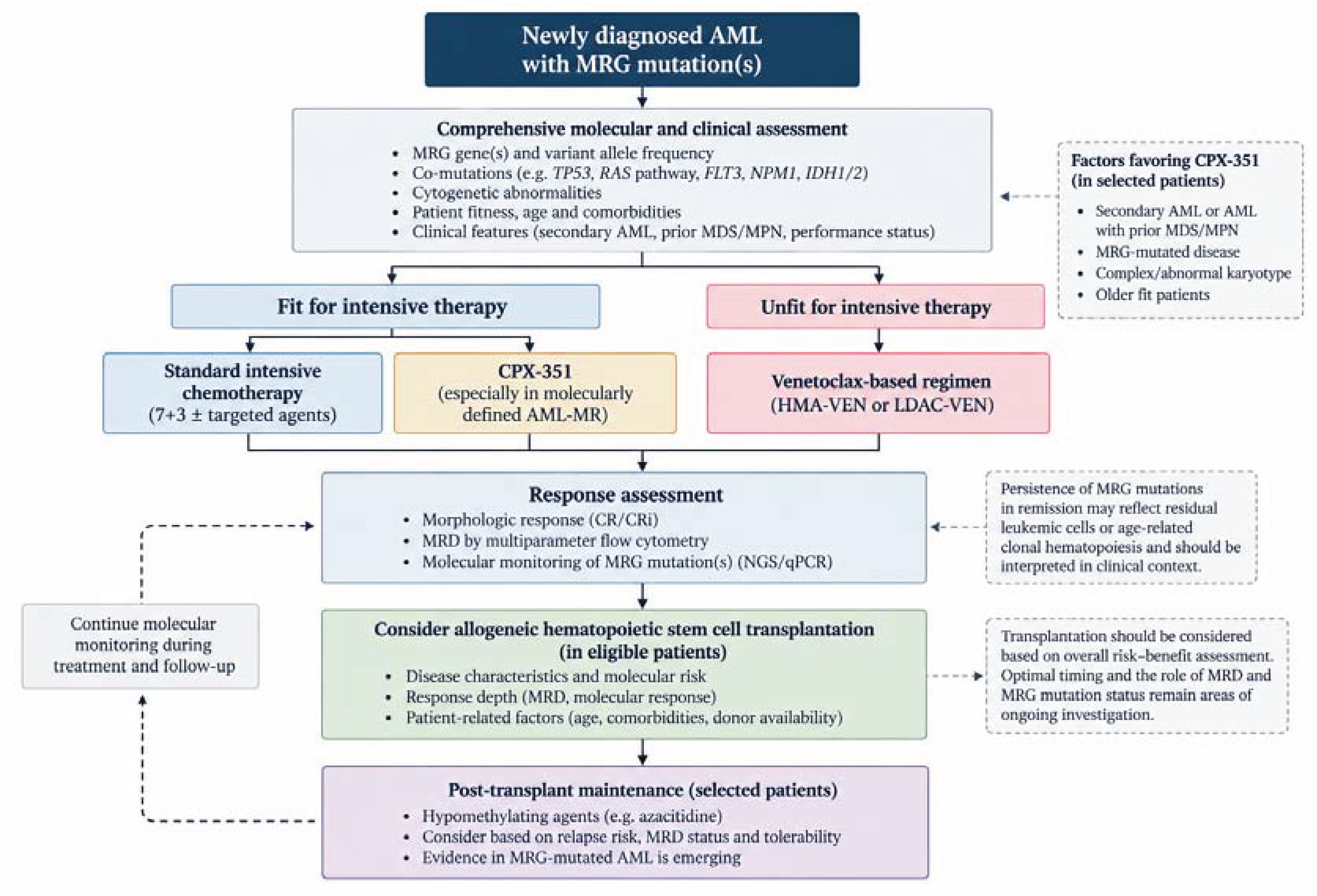

Table 1.
WHO-HAEM5 recognizes eight MRGs, whereas ICC 2022 additionally includes RUNX1. Prognostic patterns summarize contemporary data from intensively treated AML and should not be interpreted as treatment-independent risk categories [1,2,3,20].
| Gene | Main biological function | WHO-HAEM5 | ICC 2022 | Prognostic pattern with intensive therapy | Clinical considerations |
| ASXL1 | Epigenetic/chromatin regulation | Yes | Yes | Adverse-like | Frequently associated with secondary-type biology; may persist during remission |
| BCOR | Transcriptional/epigenetic repression | Yes | Yes | Intermediate/uncertain | Prognostic impact less consistent than ASXL1 |
| EZH2 | PRC2/chromatin regulation | Yes | Yes | Intermediate/uncertain | Often associated with myeloid clonal evolution |
| RUNX1 | Hematopoietic transcription factor | No | Yes | Adverse-like | Major difference between WHO and ICC definitions |
| SF3B1 | RNA splicing | Yes | Yes | Adverse-like | Possible treatment interaction with CPX-351 requires validation |
| SRSF2 | RNA splicing | Yes | Yes | Intermediate-like | Common secondary-type mutation; outcome may depend on treatment context |
| STAG2 | Cohesin complex | Yes | Yes | Intermediate-like | Retrospective data suggest high response rates with HMA-VEN |
| U2AF1 | RNA splicing | Yes | Yes | Adverse-like | Associated with inferior outcomes after intensive therapy |
| ZRSR2 | RNA splicing | Yes | Yes | Uncertain | Limited gene-specific outcome data |
Table 2.
Cross-study comparisons should be interpreted cautiously because populations, AML-MR definitions, treatment fitness, and study designs differ. Retrospective treatment interactions should be considered hypothesis-generating.
Table 2.
Cross-study comparisons should be interpreted cautiously because populations, AML-MR definitions, treatment fitness, and study designs differ. Retrospective treatment interactions should be considered hypothesis-generating.
| Study | Population | Treatment | Findings relevant to MRG-AML |
| Lancet et al. [13,24] | 309 older high-risk/secondary AML | CPX-351 vs 7+3 | CPX-351 improved OS; long-term benefit maintained |
| Shimony et al. [14] | Molecular reanalysis of randomized trial | CPX-351 vs 7+3 | In molecular AML-MR, median OS 9.7 vs 6.8 months; no comparable benefit in TP53-mut AML |
| MARROW Consortium [15] | 235 AML-MR | CPX-351 | CR/CRi 52%; 57% in molecular AML-MR; supports real-world activity |
| Lin et al. [9] | 453 MRG-mut AML | VEN-containing vs non-VEN therapy | VEN improved early remission with low-intensity therapy |
| Ikoma et al. [10] | 228 AML | VEN-AZA | MRG mutations associated with favorable survival; molecular response refined relapse risk |
| Mayo Clinic [26] | 600 ND AML | CPX-351 vs HMA-VEN | AML-MR CR/CRi 60% vs 63%; exploratory gene-specific treatment interactions |
| CPX-351 + VEN [27] | ND high-risk AML | CPX-351 + VEN | High response rates, including MRG-mutated disease; small single-arm study |
| EBMT [34] | 1,152 AML-MR in CR1 | allo-HSCT | Post-transplant outcome differed according to underlying AML-MR genetic category |
| Post-HSCT HMA study [16] | 469 adverse-risk AML | HMA maintenance | MRG subgroup appeared to derive substantial EFS benefit |
Disclaimer/Publisher’s Note: The statements, opinions and data contained in all publications are solely those of the individual author(s) and contributor(s) and not of MDPI and/or the editor(s). MDPI and/or the editor(s) disclaim responsibility for any injury to people or property resulting from any ideas, methods, instructions or products referred to in the content. |
© 2026 by the authors. Licensee MDPI, Basel, Switzerland. This article is an open access article distributed under the terms and conditions of the Creative Commons Attribution (CC BY) license (http://creativecommons.org/licenses/by/4.0/).
Copyright: This open access article is published under a Creative Commons CC BY 4.0 license, which permit the free download, distribution, and reuse, provided that the author and preprint are cited in any reuse.