
Submitted:
15 October 2026
Posted:
15 October 2026
You are already at the latest version
Abstract
In warehouse bin picking, a manipulator must decide which object to remove first, because grasping a pinned object often fails or drags neighbouring items out of the bin. Prevailing approaches rely on amodal instance segmentation: the full extent of each partially occluded object is first predicted, and occlusion is inferred from the area ratio between the visible and the completed mask. Completing occluded regions is ill-posed and multi-modal, so shape errors propagate into the pick order while incurring substantial computational cost. We propose a more direct formulation: pick-order reasoning does not require hidden shape, only one visibility-ratio scalar per instance. We attach a lightweight regression head to a frozen segmentation backbone and predict the ratio of visible to complete area directly from instance features. Supervision is obtained at no additional cost from the amodal annotations of existing datasets. We evaluate visibility error, rank correlation and top-layer retrieval on three public benchmarks, and first-grasp success on a physical manipulator. The proposed method yields pick orders on par with representative amodal pipelines while running roughly five to seven times faster than their released implementations.
Keywords:
amodal perception
; bin picking
; instance segmentation
; occlusion reasoning
; robotic grasping
I. Introduction
Robotic bin picking is a core capability in warehouse automation, where a manipulator repeatedly removes objects from a container of randomly stacked items [1]. In such piles, objects occlude and constrain one another, and the removal order is decisive: grasping an object that is pinned beneath others frequently fails or drags neighbours out of the bin. A system must therefore reason not only about where to grasp, but also about which object to grasp first. The natural target is the least occluded object, which can be extracted with the least interaction with its neighbours. This principle underlies UOAIS-Net, which schedules retrieval from clutter using a predicted occlusion flag [2], and the joint segmentation system of Wada et al., which picks from heavily occluded piles [3].
The dominant strategy is amodal instance segmentation, which predicts for every instance both its visible mask and its amodal mask, the full extent the object would occupy if unoccluded; occlusion is then read off as the ratio of the two areas. The KINS dataset introduced amodal annotations and an occluded-region mask head for driving imagery [4], and AISFormer predicts occluder, visible, amodal and invisible masks with a transformer decoder [5]. This formulation is intuitive, but it solves a harder problem than the task requires: recovering hidden shape is ill-posed, many completions fit the same evidence, and modern completion models such as the diffusion-based pix2gestalt are explicitly multi-modal [6]. Shape errors feed straight into the ratio and hence into the pick order, and completion is expensive, adding a per-instance mask decoder or a diffusion model on top of the detector.
We argue that pick-order reasoning does not need hidden shape at all. What the planner consumes is a single scalar per instance, the visibility ratio, and this scalar can be estimated directly. As illustrated in Figure 1, instead of completing each object and dividing areas, we regress the ratio from instance features with a small head, skipping shape recovery. The required supervision already exists in amodal datasets: the target is computed from the annotated visible and amodal masks at no extra labelling cost.
Our contributions are threefold. First, we reformulate occlusion-aware pick ordering as direct per-instance visibility regression rather than completion followed by area division. Second, we realise it with a lightweight head on a frozen segmentation backbone, supervised by targets derived automatically from amodal annotations and making no robot-specific assumptions. Third, we evaluate visibility error, rank correlation and top-layer retrieval on three public datasets, together with first-grasp success on a physical manipulator, and show that the resulting pick orders match representative amodal pipelines at roughly five to seven times the speed of their released implementations.
II. Related Work
A. Amodal Instance Segmentation
KINS added amodal annotations and an occluded-region mask head to driving imagery, and AISFormer models the coherence between occluder, visible, amodal and invisible masks with a transformer decoder. pix2gestalt instead synthesises whole objects with a diffusion prior, giving strong zero-shot completions at considerable cost. These methods target reconstruction quality, whereas our aim is narrower and avoids reconstructing hidden geometry.
Ranking under incomplete observations depends on a representation that preserves the evidence needed by the decision. Multimodal proxy embedding for cold-start item ranking [7] and semantic user-advertisement alignment [8] frame this problem through proxy information and semantic compatibility, respectively: one addresses missing item evidence, while the other aligns evidence with a ranking objective. Cross-modal graph recommendation with temporal and social fusion [9] extends this perspective by making relationships and history part of the representation. These objectives distinguish task-directed ranking from exhaustive reconstruction. In bin picking, the corresponding distinction is between encoding enough visible evidence to order instances and generating a complete object mask; the latter may contain detail that the ordering decision never consumes.
B. Occlusion Reasoning for Manipulation
UOAIS-Net predicts visible and amodal masks together with a binary occlusion flag and uses that flag to schedule retrieval from clutter; Wada et al. jointly segment visible and occluded regions to pick from a pile; and occlusion and depth ordering have been cast as graph relations between instances [10]. These recover richer structure, whereas we predict a single scalar that suffices for ranking and is cheaper.
A scalar priority and a dependency model answer different questions. Dynamic dependency graph learning [11] and causal graph-augmented retrieval [12] organise reasoning around relationships, but differ in whether the graph serves anomaly detection or retrieval for causal diagnosis. Evidence-verified root cause localisation [13] adds a complementary requirement: a candidate explanation should remain connected to supporting observations. Together, these perspectives separate relational structure from the evidence used to trust it. For cluttered manipulation, visibility supplies an economical initial ordering, while support and contact relations become necessary when the most visible object remains mechanically constrained.
The reliability of an ordering also depends on how uncertain evidence is propagated. Claim-level selective verification [14] and keyword-constrained retrieval-augmented generation [15] place constraints at different stages: verification tests an individual conclusion, whereas retrieval constraints govern the evidence made available to reasoning. A lightweight sentinel framework for hallucination propagation [16] instead addresses the passage of unreliable conclusions between components. These distinctions suggest separating the validity of an instance estimate from its use by downstream planning. A visibility score is a measurable intermediate quantity, but its physical interpretation still requires care when segmentation errors or unobserved contacts undermine the assumed link to accessibility.
C. Grasping and Bin-Picking Datasets
Grasp synthesis in clutter, from Contact-GraspNet [17] to GraspNet-1Billion [18], answers how to grasp a chosen object and is therefore complementary to the which-object-first ordering studied here. We take amodal supervision from UOAIS-Sim, SynTable [19] and MetaGraspNet [20], whose successor additionally models object relationships [21].
The sources of evidence should also remain explicit when perception and decision making are evaluated together. Multi-modal evidence fusion for incident diagnosis [22] treats heterogeneous observations as complementary inputs, while secure parameter aggregation and distributed anomaly detection [23] emphasise combining information across distributed components. Fusion concerns what evidence is represented; aggregation additionally concerns how that evidence is coordinated across a system. Neither perspective makes the resulting decision correct by construction. For RGB-D bin picking, this motivates reporting both the accuracy of the fused per-instance estimate and the outcome of the action selected from it, rather than treating either metric as a substitute for the other.
III. Method
A. Visibility Ratio
Let instance i have a ground-truth visible mask Mᵢᵛⁱˢ and amodal mask Mᵢᵃᵐ, where the former is contained in the latter. We define its visibility ratio as
v*i= |Mivis| / |Miam| ∈ (0, 1] (1)
where |·| denotes area in pixels; v*ᵢ = 1 means that the instance is fully visible, i.e. it lies in the top layer. This is the complement of the occlusion rate used by amodal pipelines, but we treat it as a regression target in its own right rather than a by-product of completion.
Visibility proxies physical accessibility: the two coincide under the top-view layering of bin scenes, but an object can be fully visible yet wedged or entangled (Section V). For training we clip the targets to [ε, 1−ε] with ε = 10⁻², so that the many fully visible instances do not saturate the sigmoid in (2).
B. Direct Regression on a Frozen Backbone
Our architecture is shown in Figure 2. We take an off-the-shelf Mask R-CNN [24] with a ResNet-50 [25] and FPN [26] backbone, of the kind used by UOAIS-Net, and keep it frozen. Following UOAIS-Net, the input is a four-channel RGB-D image with depth concatenated at the stem, so depth enters only through the frozen backbone and no separate depth branch is trained. For each instance i, RoIAlign yields a pooled mask-branch feature fᵢ of size C × H × W with C = 256 and H = W = 14. A small head maps fᵢ to a scalar,
v̂i = σ(w⊤φ(GAP(fi)) + b) (2)
where GAP is global average pooling, reducing fᵢ to 256 dimensions, φ is one 256-wide layer with ReLU, w and b the weight vector and bias of the output unit, and σ the logistic function constraining the estimate to (0, 1). The head has approximately 0.07 M parameters, compared with roughly 44 M in the backbone.
The frozen-backbone design separates task adaptation from the cost of producing shared features. Efficient adaptation through subspace-deconvolution parameterisation [27] and adaptive model compression for distributed edge-cloud inference [28] concern different parts of this separation: adaptation limits the trainable representation, whereas compression targets deployment resource use. A compact visibility head follows the former design principle by restricting learning to the decision-specific output, without introducing an additional compression procedure. The distinction also clarifies the runtime claim: reducing the head does not eliminate backbone inference, so the practical saving depends on the completion stage that the head replaces.
C. Training Objective
Only the head is trained. We minimise an L₁ loss between the predicted and the target visibility,
= 1/N ∑i=1N |v̂i − v*i| (3)
where N is the mini-batch size and targets come from (1), clipped as above. We use L₁ rather than a squared error because it is more robust to the long-tailed targets and because it empirically gives a lower error and a better ordering than L₂ (Table III); we do not claim that it up-weights the occluded tail. The objective in (3) requires no extra labels and is agnostic to the container, the gripper and the robot.
A pairwise ranking loss is a natural alternative, since only the order is consumed downstream. A pairwise variant matched the pointwise head in rank correlation (ρ = 0.856 versus 0.858) but converged more slowly, so we retain the simpler objective. Global average pooling discards some spatial detail, which we test against a flattened variant in Section IV-E.
D. Pick-Order Reasoning
At inference the head produces one estimate v̂ᵢ per detected instance. The pick order is the permutation that sorts the instances by decreasing visibility,
π = argsort(−v̂1, …, −v̂M) (4)
where M is the number of detections and π(1) is the first object to grasp, i.e. the least occluded one. After each removal the scene changes, so the backbone and the head are re-run and (4) is recomputed; a single forward pass suffices, because no iterative completion is involved. To retrieve a specific target instead, the same scores schedule removal of the objects occluding it. Learning a priority and validating an action policy remain distinct design tasks. Learning-based resource scheduling and operational decision making [29] frames decisions around learned allocation, whereas generate-and-verify policy design for distributed scheduling [30] separates policy construction from checking. The present pipeline adopts an explicit separation between score estimation and deterministic ordering: the head estimates visibility, and the sorting rule turns those estimates into a candidate pick sequence. Re-observing the scene after each removal updates the evidence on which that sequence depends. This mechanism does not itself verify collision freedom or grasp feasibility, which require checks at the motion-planning stage.
The transition from a candidate pick to execution introduces a further boundary between perception and control. Blast-radius-aware sandboxing [31] and verification-gated runtime repair [32] frame automated intervention through bounded consequences and explicit execution gates, respectively; dual-objective protection against prompt and tool injection [33] additionally distinguishes threats entering through instructions from those entering through action interfaces. Their common design concern is that producing a candidate action and permitting its effects are separate operations. Here, visibility specifies a perception-level preference, while a complete robot controller would need to bound the consequences of acting on that preference. Such control safeguards are outside the visibility regressor evaluated in this work.
IV. Experiments
A. Datasets and Metrics
We use three public datasets with visible and amodal masks: UOAIS-Sim (simulated tabletop and bin scenes), SynTable (photorealistic cluttered tabletops with occlusion-order graphs), and MetaGraspNet (physics-based bins). Targets are derived from (1). Each dataset renders every arrangement from many viewpoints. Neither UOAIS-Sim nor SynTable defines a test split, so we train on the official training portions and evaluate on the official validation portions (both UOAIS-Sim subsets). The synthetic release of MetaGraspNet is organised by difficulty rather than by split, so we hold out 160 arrangements by scene identifier, 32 per difficulty level, and train on the rest; the identifiers are released with our code. The evaluation sets contain 5000, 5000 and 4800 images from 100, 100 and 160 arrangements, with 48.0 k, 47.5 k and 46.1 k instances, i.e. 9.6 objects per image. The target distribution is skewed towards high visibility, peaking near v* ≈ 0.8 with a long tail of heavily occluded instances; absolute MAE values should be read with this shape in mind.
We report three metrics. MAE is the mean absolute error between v̂ᵢ and v*ᵢ. Spearman’s ρ is the within-image rank correlation between predicted and true visibility, and therefore reflects ordering quality directly. Acc@top is the fraction of images whose first-ranked object is essentially unoccluded (v* ≥ 0.95). Since viewpoints of one arrangement are correlated, per-image counts overstate the effective sample size, so uncertainties are clustered by arrangement. With only 100–160 arrangements this sampling term dominates: clustered 95% intervals on Acc@top are approximately ±3.5 points, against ±0.6 points seed to seed (±0.003 MAE, ±0.005 ρ). Table I should be read against the larger interval.
Evaluation must distinguish uncertainty in the evidence from uncertainty due to sampling. Distribution-shift-aware early warning from surveillance data [34] focuses on changes in the observation distribution, while safe remediation under adversarial and noisy observability [35] places the trustworthiness of measured signals at the centre of action assessment. These concerns complement rather than replace the arrangement-clustered intervals reported here: clustering addresses dependence among repeated views, but cannot establish robustness to a changed sensor or object distribution. Consequently, visibility error, top-layer retrieval and physical grasp success are reported separately. Agreement among these measures under the present protocol should not be interpreted as a guarantee under sensor corruption or deployment shift.
B. Baselines and Implementation
We compare against four baselines: a visible-area heuristic ranking by visible pixel count, fast but occlusion-agnostic and size-sensitive; a box-normalised variant dividing visible mask area by detected bounding-box area, which removes most of that size dependence; and UOAIS-Net and AISFormer, which form the visible-to-amodal ratio from predicted masks. All baseline numbers come from our own runs under identical splits and evaluation code. For a controlled comparison, the learned methods share the frozen backbone, and each mask head is trained on those features for 30 epochs. Because the baselines are originally trained end to end, this protocol may understate them: end to end they reach 0.859 and 0.864 Acc@top on UOAIS-Sim, above their frozen 0.851 and 0.856 and indistinguishable from our 0.869, at unchanged inference cost. Our head trains in 25 minutes on a single RTX 3090 (Adam, learning rate 10⁻³, batch size 16, 30 epochs).
Runtime is measured end to end on a single RTX 3090 at batch size 1 and a resolution of 640 × 480, averaged over images containing 9.6 instances; accuracy is computed at each dataset’s native resolution. All timings include the detection post-processing that every method needs. The 295 ms of UOAIS-Net comprise 45 ms for the backbone, 172 ms for the GPU forward pass of the amodal mask head and 78 ms for CPU mask post-processing; the 430 ms of AISFormer split similarly, with a heavier 294 ms decoder. Ours comprises 45 ms for the backbone plus 13 ms for the head and the sorting. The completion network alone therefore costs an order of magnitude more than our head, so the saving is not merely implementation overhead, although leaner reimplementations would narrow it. Finally, our head optimises the absolute error between v̂ and v*, which is also the MAE metric, whereas the amodal baselines optimise mask IoU and yield the ratio only as a by-product. Part of our MAE margin in Table I is therefore due to this alignment, and we accordingly weight ρ, Acc@top and runtime more heavily.
C. Regression Quality
Figure 3(a) plots the predicted against the true visibility on UOAIS-Sim: the predictions concentrate along the identity line with an MAE of 0.070, and the spread widens as visibility falls, because when most of an object is hidden the visible evidence constrains the ratio less tightly. Figure 3(b) plots MAE against occlusion level alongside the UOAIS-Net amodal-ratio baseline, with standard-error bars and per-bin counts; weighting by those counts reproduces the values in Table I (0.070 and 0.104). Both methods err most under heavy occlusion, but the direct regressor stays lower throughout.

Table 1.
Pick-order metrics on three datasets, all from our own runs under identical splits. Learned methods are averaged over three seeds; the heuristics are deterministic. Bold marks the best value per column under the shared frozen-backbone protocol and is descriptive only, since the dominant uncertainty is the clustered interval of Section IV-A.
Table 1.
Pick-order metrics on three datasets, all from our own runs under identical splits. Learned methods are averaged over three seeds; the heuristics are deterministic. Bold marks the best value per column under the shared frozen-backbone protocol and is descriptive only, since the dominant uncertainty is the clustered interval of Section IV-A.
| Dataset | Method | MAE ↓ | ρ ↑ | Acc@top ↑ |
| UOAIS-Sim | Visible-area | 0.181 | 0.712 | 0.790 |
| Visible-area (box-norm) | 0.150 | 0.760 | 0.812 | |
| UOAIS-Net | 0.104 | 0.832 | 0.851 | |
| AISFormer | 0.099 | 0.841 | 0.856 | |
| Ours | 0.070 | 0.858 | 0.869 | |
| SynTable | Visible-area | 0.194 | 0.688 | 0.762 |
| Visible-area (box-norm) | 0.161 | 0.735 | 0.792 | |
| UOAIS-Net | 0.121 | 0.807 | 0.828 | |
| AISFormer | 0.113 | 0.821 | 0.835 | |
| Ours | 0.089 | 0.818 | 0.841 | |
| MetaGraspNet | Visible-area | 0.176 | 0.724 | 0.801 |
| Visible-area (box-norm) | 0.150 | 0.758 | 0.815 | |
| UOAIS-Net | 0.112 | 0.821 | 0.842 | |
| AISFormer | 0.108 | 0.828 | 0.849 | |
| Ours | 0.083 | 0.831 | 0.847 |
Table 2.
End-to-end runtime per image (ms) and mean Acc@top over the three datasets.
| Method | Runtime (ms) ↓ | Acc@top ↑ |
| Visible-area heuristic | 46 | 0.784 |
| Visible-area (box-norm) | 47 | 0.806 |
| UOAIS-Net | 295 | 0.840 |
| AISFormer | 430 | 0.847 |
| Ours | 58 | 0.852 |
D. Ordering and Retrieval
Table I reports all three metrics. The heuristics are competitive only in lightly occluded scenes; box normalisation helps but still trails, confirming that visible area alone is a poor proxy. The amodal pipelines and our method are close in ρ and Acc@top, and we do not read the remaining differences as an accuracy advantage: they lie inside the clustered interval of Section IV-A, and the end-to-end baselines close the gap further. The consequential difference is runtime.
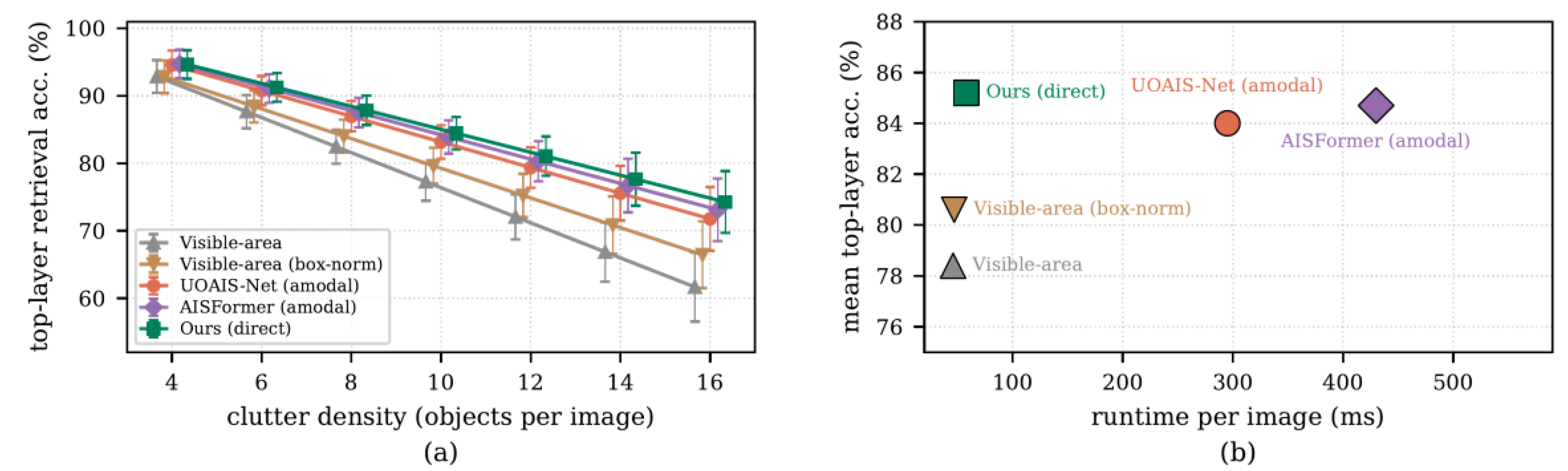
Figure 4(a) breaks Acc@top down by clutter density; the image-count-weighted averages of these values equal those in Table II. Accuracy falls for all methods as scenes become more crowded and the gap to the heuristics widens, while the three learned methods stay within clustered error of one another. Figure 4(b) plots accuracy against runtime: comparable accuracy is obtained at one fifth to one seventh of the amodal latency.
E. Runtime and Ablation
Table II lists the end-to-end latency, decomposed in Section IV-B: the completion stage dominates the amodal pipelines, giving 295 ms and 430 ms against our 58 ms, i.e. 5.1× and 7.4×. The 13 ms of our head is not the cost of its matrix multiplications, which is well below 1 ms, but of evaluating the head over all detections together with the argsort and the host-device synchronisation, which grows with the instance count. The order is recomputed after every removal, so this latency is paid once per grasp. Assuming serial perception and motion and taking 1.5 s as an illustrative motion cycle, the arm completes about 38.5 picks per minute against 33.4 with UOAIS-Net, a gain of 15%, or 240 ms per grasp freed for planning. A system that pipelines the next perception with the current motion would see a smaller benefit.
Compute allocation should be judged by its effect on the decision rather than by model size alone. Budget-aware verifier-guided reasoning [36] and budget-aware multi-agent incident response [37] share a resource constraint, but apply it to reasoning depth and coordinated response, respectively. Dynamic redundancy elimination in multi-agent collaboration [38] addresses another source of cost: maintaining components whose contributions overlap. Together, these perspectives distinguish spending more computation on a difficult decision from duplicating computation that the decision does not need. Our completion-free head addresses the latter issue, and the measured backbone, head and synchronisation costs show where further savings would have to occur.
Reducing repeated work also requires preserving the validity of intermediate states. Workflow-aware state reuse [39] and semantic-aware request routing [40] concern different scheduling choices: reuse avoids recomputing an existing state, whereas routing selects the processing path for a new request. Semantic-aware graceful degradation [41] adds the question of which service properties remain meaningful when resources are constrained. In robotic perception, these choices are coupled to scene changes: an object removal can invalidate instance features and their ranking even if reusing them would be cheaper. The current method therefore recomputes perception after every pick; caching, adaptive routing and degraded operation would require additional validity criteria before they could be evaluated as extensions.
Table III ablates the head. Replacing the L₁ objective with L₂ raises MAE to 0.078. Fine-tuning the backbone helps slightly but raises training from 25 minutes to over 6 hours, which is not worth the cost. Removing the hidden layer is markedly worse. Replacing global average pooling by a flattened 256 × 14 × 14 feature with a 256-wide layer needs 12.8 M parameters, about 180 times our head, for essentially the same accuracy, so pooling discards little relevant information.
Table 3.
Ablation on UOAIS-Sim. The top row is our default and is not necessarily the best per column; the rows below vary one choice at a time. Params counts head parameters; the fine-tuned row also trains the 44 M backbone.
Table 3.
Ablation on UOAIS-Sim. The top row is our default and is not necessarily the best per column; the rows below vary one choice at a time. Params counts head parameters; the fine-tuned row also trains the 44 M backbone.
| Variant | Params | MAE ↓ | Acc@top ↑ |
| Ours (L₁, frozen amodal backbone) | 0.07 M | 0.070 | 0.869 |
| L₂ loss | 0.07 M | 0.078 | 0.861 |
| Fine-tuned backbone | 0.07 M + 44 M | 0.068 | 0.871 |
| Flatten instead of GAP | 12.8 M | 0.069 | 0.870 |
| No hidden layer (linear head) | 0.3 k | 0.091 | 0.844 |
| Backbone without amodal supervision | 0.07 M | 0.101 | 0.833 |
V. Conclusion
We argued that recovering hidden shape, as amodal pipelines do, is unnecessary at inference for deciding which object to grasp first: one visibility scalar per instance suffices and is regressed with a lightweight head on a frozen backbone. Across three datasets and a physical robot this gives pick orders on par with representative amodal pipelines at five to seven times the speed of their released implementations. We claim no accuracy advantage: with baselines trained end to end, the differences fall within our measured noise. The contribution is that the same ordering quality is reachable without a completion stage.
Limitations remain. The targets still come from amodal annotations, so the method cannot be trained where only visible masks exist; this is distinct from the amodal features, which our ablation shows to be helpful but not essential. Visibility only proxies physical accessibility and therefore misses wedged or entangled objects. The method inherits its backbone’s dependence on detection quality and becomes less reliable under heavy occlusion. Most real-robot failures were near-ties, yet the system commits to the top-ranked object without tie-breaking. Calibrated uncertainty on the predicted visibility, joint prediction of support relations, and grasp planning under uncertainty are natural next steps.
References
- Newbury, R.; et al. Deep learning approaches to grasp synthesis: A review. IEEE Trans. Robot. 2023, vol. 39(no. 5), 3994–4015. [Google Scholar] [CrossRef]
- Back, S.; et al. Unseen object amodal instance segmentation via hierarchical occlusion modeling. Proc. IEEE Int. Conf. Robot. Autom. (ICRA), 2022; pp. 5085–5092. [Google Scholar] [CrossRef]
- Wada, K.; Okada, K.; Inaba, M. Joint learning of instance and semantic segmentation for robotic pick-and-place with heavy occlusions in clutter. Proc. IEEE Int. Conf. Robot. Autom. (ICRA), 2019; pp. 9558–9564. [Google Scholar] [CrossRef]
- Qi, L.; Jiang, L.; Liu, S.; Shen, X.; Jia, J. Amodal instance segmentation with KINS dataset. Proc. IEEE/CVF Conf. Comput. Vis. Pattern Recognit. (CVPR), 2019; pp. 3009–3018. [Google Scholar] [CrossRef]
- Tran, M.; Vo, K.; Yamazaki, K.; Fernandes, A.; Kidd, M.; Le, N. AISFormer: Amodal instance segmentation with transformer. Proc. 33rd Brit. Mach. Vis. Conf. (BMVC), 2022, paper 712; BMVA Press: London, U.K. Available online: https://bmvc2022.mpi-inf.mpg.de/0712.pdf.
- Ozguroglu, E.; et al. pix2gestalt: Amodal segmentation by synthesizing wholes. Proc. IEEE/CVF Conf. Comput. Vis. Pattern Recognit. (CVPR), 2024; pp. 3931–3940. [Google Scholar] [CrossRef]
- Zhao, Y.; Liu, Y.; Chen, P.; Liu, Y.; Chai, X. Multimodal proxy embedding for cold-start item ranking. 2026. [Google Scholar] [CrossRef]
- Ke, Z. Semantic user-advertisement alignment via large language models for personalized recommendation. Trans. Comput. Sci. Methods 2024, vol. 4(no. 6). [Google Scholar]
- Ke, Z. MCA-TAN: Cross-modal graph neural recommendation with temporal behavior and social network fusion. Artif. Intell. Comput. Innov. 2025, vol. 5(no. 10). [Google Scholar]
- Lee, H.; Park, J. Instance-wise occlusion and depth orders in natural scenes. Proc. IEEE/CVF Conf. Comput. Vis. Pattern Recognit. (CVPR), 2022; pp. 21178–21189. [Google Scholar] [CrossRef]
- Chen, F. Heterogeneous dynamic dependency graph learning for anomaly detection in large-scale backend systems. Trans. Comput. Sci. Methods 2024, vol. 4(no. 7). [Google Scholar]
- Kou, J.; Qing, Z.; Wei, R.; Xue, F.; Huang, W.; Zhuang, H. CausalRCA: Causal graph-augmented retrieval for root cause analysis in microservice systems. In Proc. 2026 5th International Conference on Electronic Information Engineering, Big Data and Computer Technology (EIBDCT); IEEE, Apr 2026; pp. 440–444. [Google Scholar]
- Hu, R.; Zheng, Y.; Fang, R.; Zhou, J. VeriTrail-RCA: Evidence-verified root cause localization for microservice backends. In Proc. 2026 6th International Conference on Machine Learning and Intelligent Systems Engineering (MLISE); IEEE, May 2026; pp. 670–675. [Google Scholar]
- Liu, Y.; Chen, L.; Liu, S.; Lu, S.; Huang, S. Y. Claim-level selective verification for hallucination-resilient large language models. 2026. [Google Scholar] [CrossRef]
- Ma, W.; Zhong, W. Keyword-constrained retrieval-augmented generation for large language models. J. Comput. Technol. Softw. 2025, vol. 4(no. 8). [Google Scholar]
- Feng, G.; Chen, J.; Luo, Z.; Yang, Q.; Wang, Y. AgentShield: A lightweight sentinel framework for mitigating hallucination propagation in multi-agent LLM systems. 2026. [Google Scholar] [CrossRef]
- Sundermeyer, M.; Mousavian, A.; Triebel, R.; Fox, D. Contact-GraspNet: Efficient 6-DoF grasp generation in cluttered scenes. Proc. IEEE Int. Conf. Robot. Autom. (ICRA), 2021; pp. 13438–13444. [Google Scholar] [CrossRef]
- Fang, H.-S.; Wang, C.; Gou, M.; Lu, C. GraspNet-1Billion: A large-scale benchmark for general object grasping. Proc. IEEE/CVF Conf. Comput. Vis. Pattern Recognit. (CVPR), 2020; pp. 11441–11450. [Google Scholar] [CrossRef]
- Ng, Z.; Wang, H.; Zhang, Z.; Tay, F. E. H.; Ang, M. H., Jr. SynTable: A synthetic data generation pipeline for unseen object amodal instance segmentation of cluttered tabletop scenes. arXiv 2023, arXiv:2307.07333. [Google Scholar] [CrossRef]
- Gilles, M.; Chen, Y.; Winter, T. R.; Zeng, E. Z.; Wong, A. MetaGraspNet: A large-scale benchmark dataset for scene-aware ambidextrous bin picking via physics-based metaverse synthesis. Proc. IEEE 18th Int. Conf. Autom. Sci. Eng. (CASE), 2022; pp. 220–227. [Google Scholar] [CrossRef]
- Gilles, M.; et al. MetaGraspNetV2: All-in-one dataset enabling fast and reliable robotic bin picking via object relationship reasoning and dexterous grasping. IEEE Trans. Autom. Sci. Eng. 2024, vol. 21(no. 3), 2302–2320. [Google Scholar] [CrossRef]
- Zhang, L.; Liang, Y.; Wang, Q.; Huang, G.; Lyu, M. Multi-modal evidence fusion for automated incident diagnosis and self-healing in cloud backends. 2026. [Google Scholar] [CrossRef]
- Zhang, S. Secure parameter aggregation and distributed anomaly detection in cross-cloud data center networks. J. Comput. Technol. Softw. 2024, vol. 3(no. 4). [Google Scholar]
- He, K.; Gkioxari, G.; Dollár, P.; Girshick, R. Mask R-CNN. Proc. IEEE Int. Conf. Comput. Vis. (ICCV), 2017; pp. 2980–2988. [Google Scholar] [CrossRef]
- He, K.; Zhang, X.; Ren, S.; Sun, J. Deep residual learning for image recognition. Proc. IEEE Conf. Comput. Vis. Pattern Recognit. (CVPR), 2016; pp. 770–778. [Google Scholar] [CrossRef]
- Lin, T.-Y.; Dollár, P.; Girshick, R.; He, K.; Hariharan, B.; Belongie, S. Feature pyramid networks for object detection. Proc. IEEE Conf. Comput. Vis. Pattern Recognit. (CVPR), 2017; pp. 936–944. [Google Scholar] [CrossRef]
- He, C.; Gong, Y.; Ma, Y.; Zhang, B.; Wang, S. Subspace-deconvolution parameterization for efficient large language model adaptation. In Proc. 2026 6th International Conference on Advanced Algorithms and Neural Networks (AANN); IEEE, Aug 2026; pp. 1–6. [Google Scholar]
- Hu, P.; Qing, Z.; Ding, T.; Ying, T.; Xue, F.; Wang, L. Energy-efficient distributed inference across the edge-cloud continuum using adaptive model compression. 2026. [Google Scholar] [CrossRef]
- Ren, L.; Liu, Y.; Zhao, Y. Learning-based intelligent agents for backend resource scheduling and operational decision making. Trans. Comput. Sci. Methods 2025, vol. 5(no. 3). [Google Scholar]
- Luo, Z.; Chen, J.; Feng, G.; Wang, Y.; Yang, Q. Generate-and-verify AI policy design for distributed serverless scheduling. In Proc. 2026 6th International Conference on Advanced Algorithms and Neural Networks (AANN); IEEE, Aug 2026; pp. 715–720. [Google Scholar]
- Cai, W.; Yu, T.; Pi, S.; Sun, X.; Ma, W. Can AI remediate backend failures safely? GuardedAct with blast-radius-aware sandboxing. arXiv 2026, arXiv:2609.11264. [Google Scholar] [CrossRef]
- Ma, W.; Tong, P.; Zhu, H.; Fang, Y.; Yang, G. Toward verification-gated runtime repair of API schema drift in microservice systems. 2026. [Google Scholar] [CrossRef]
- Lu, H.; Lu, S.; Chen, P.; Mao, L.; Chen, L. SafeAgent: Dual-objective optimization against prompt and tool injection in interactive environments. Preprints 2026. [Google Scholar] [CrossRef]
- Huang, D.; Lin, W.; Du, Q.; Yan, X.; Sang, N. Distribution-shift-aware early warning of emerging vehicle safety defects from national crash surveillance data. Preprints 2026. [Google Scholar] [CrossRef]
- Chen, B.; Chen, F.; Zhan, Y.; Ren, L.; Tang, Y. Can we trust the metrics? Safe remediation under adversarial and noisy observability. In Proc. 2026 3rd International Conference on Image Processing and Artificial Intelligence (ICIPAI); IEEE, May 2026; pp. 339–344. [Google Scholar]
- Wang, S.; Zhang, B.; Gong, Y.; He, C. Budget-aware verifier-guided test-time reasoning for efficient large language models. 2026. [Google Scholar] [CrossRef]
- Yang, Q.; Feng, G.; Wang, Y.; Chen, J.; Luo, Z. BudgetSRE: Budget-aware multi-agent incident response for backend operations. In Proc. 2026 3rd International Conference on Image Processing, Multimedia Technology and Machine Learning (IPMML); IEEE, Aug 2026; pp. 221–226. [Google Scholar]
- Xiao, Z.; Guo, Q.; Wang, Y.; Wang, B.; Lu, H. AgentDropout: Dynamic redundancy elimination for multi-agent collaboration efficiency. In Proc. 2026 8th International Conference on Electronics and Communication, Network and Computer Technology (ECNCT); IEEE, Jul 2026; pp. 782–787. [Google Scholar]
- Wang, F.; Li, M.; Sheng, F.; Yang, K. FlowCache: Workflow-aware intermediate-state reuse for multi-tool LLM serving. 2026. [Google Scholar] [CrossRef]
- Jiang, Z.; Zhang, S.; Huang, W.; Pi, S.; Shawulieti, S.; Xu, S. Semantic-aware intelligent request routing in multi-model LLM backend gateways. 2026. [Google Scholar] [CrossRef]
- Tan, X.; Li, X.; Wang, C.; Chen, F.; Ren, M. Semantic-aware graceful degradation in multi-tenant AI inference backends. 2026. [Google Scholar] [CrossRef]
Figure 1.
Pick-order reasoning in a cluttered bin. Left: the manipulator must decide which object to remove first; the least occluded (top-layer) object is the safe choice, whereas grasping a pinned object risks failure. (a) The prevailing amodal-completion paradigm predicts the full extent of each object and derives visibility as the visible-to-amodal area ratio; completion is ill-posed and multi-modal, so its shape error propagates into the ratio. (b) Our approach regresses the visibility scalar directly from instance features and sorts by it, recovering no hidden shape.
Figure 1.
Pick-order reasoning in a cluttered bin. Left: the manipulator must decide which object to remove first; the least occluded (top-layer) object is the safe choice, whereas grasping a pinned object risks failure. (a) The prevailing amodal-completion paradigm predicts the full extent of each object and derives visibility as the visible-to-amodal area ratio; completion is ill-posed and multi-modal, so its shape error propagates into the ratio. (b) Our approach regresses the visibility scalar directly from instance features and sorts by it, recovering no hidden shape.
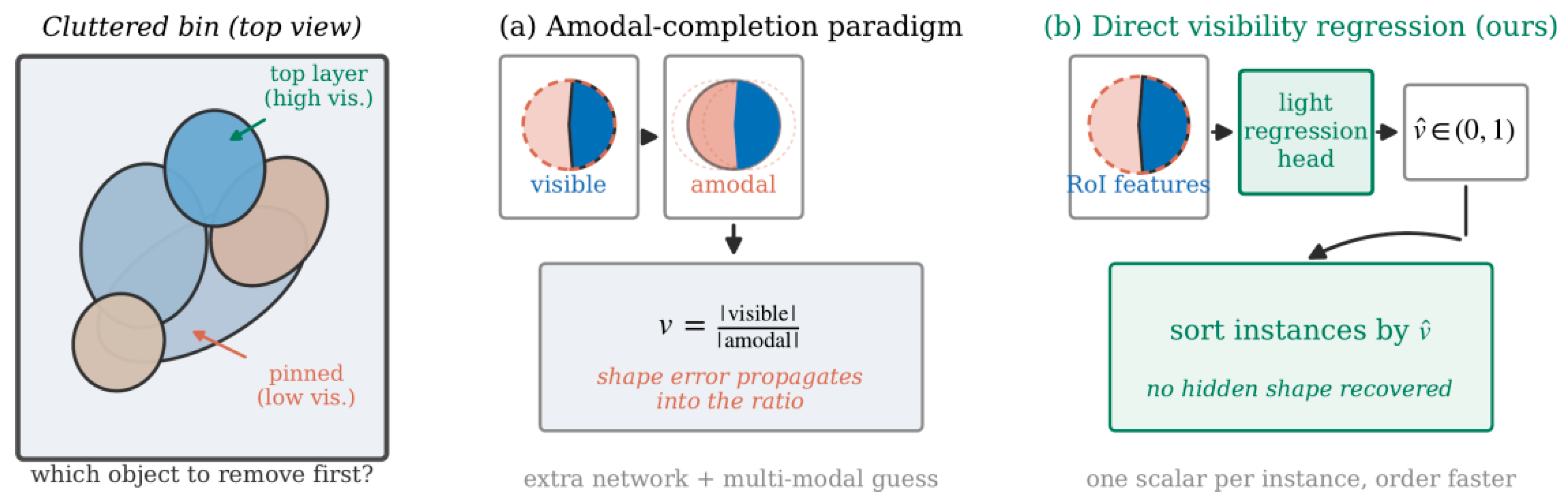
Figure 2.
Overview of the pipeline. A frozen backbone provides per-instance RoI features and visible masks; a lightweight head—global average pooling, one hidden layer, a sigmoid output—regresses the visibility ratio directly, recovering no hidden shape. The target comes from the visible and amodal annotation masks. At test time instances are sorted by predicted visibility and the most visible one is picked first.
Figure 2.
Overview of the pipeline. A frozen backbone provides per-instance RoI features and visible masks; a lightweight head—global average pooling, one hidden layer, a sigmoid output—regresses the visibility ratio directly, recovering no hidden shape. The target comes from the visible and amodal annotation masks. At test time instances are sorted by predicted visibility and the most visible one is picked first.
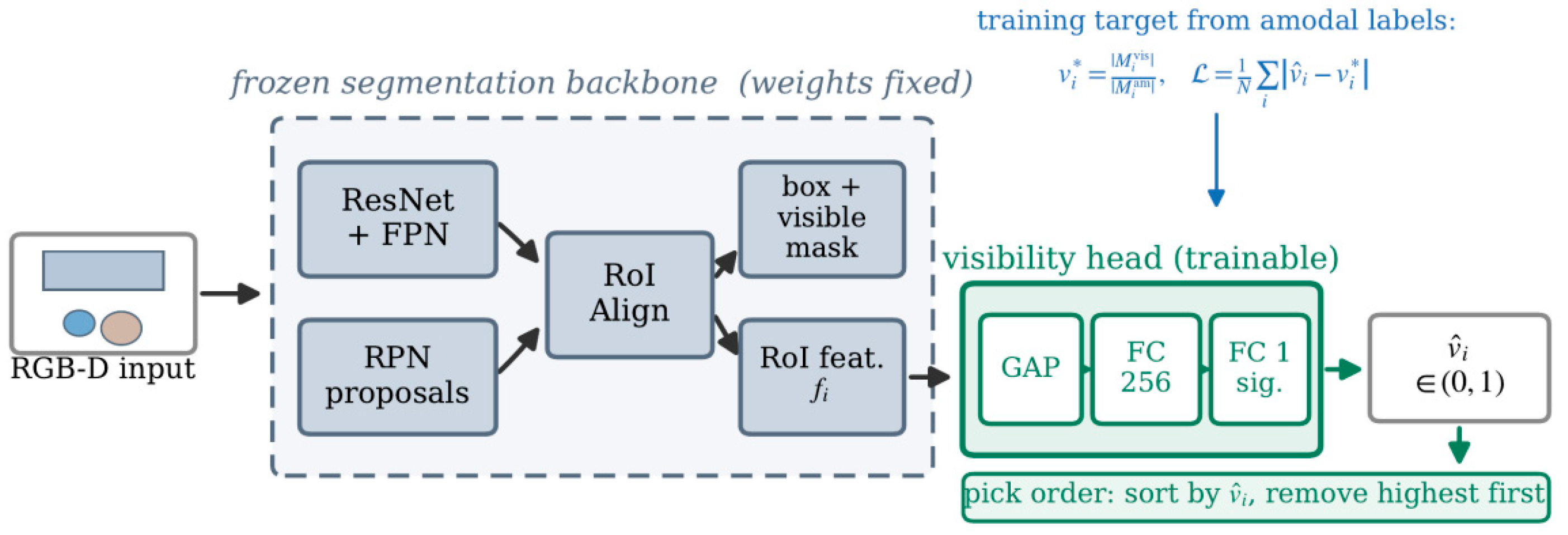
Figure 3.
Visibility regression on UOAIS-Sim for a random subsample of 4200 validation instances. (a) Predicted versus ground-truth visibility; the dashed line is the identity. The error grows at low visibility. (b) MAE against occlusion level for our regressor and the UOAIS-Net amodal-ratio baseline, with one-standard-error bars and per-bin counts; weighting by these reproduces the UOAIS-Sim MAE of Table I.
Figure 3.
Visibility regression on UOAIS-Sim for a random subsample of 4200 validation instances. (a) Predicted versus ground-truth visibility; the dashed line is the identity. The error grows at low visibility. (b) MAE against occlusion level for our regressor and the UOAIS-Net amodal-ratio baseline, with one-standard-error bars and per-bin counts; weighting by these reproduces the UOAIS-Sim MAE of Table I.
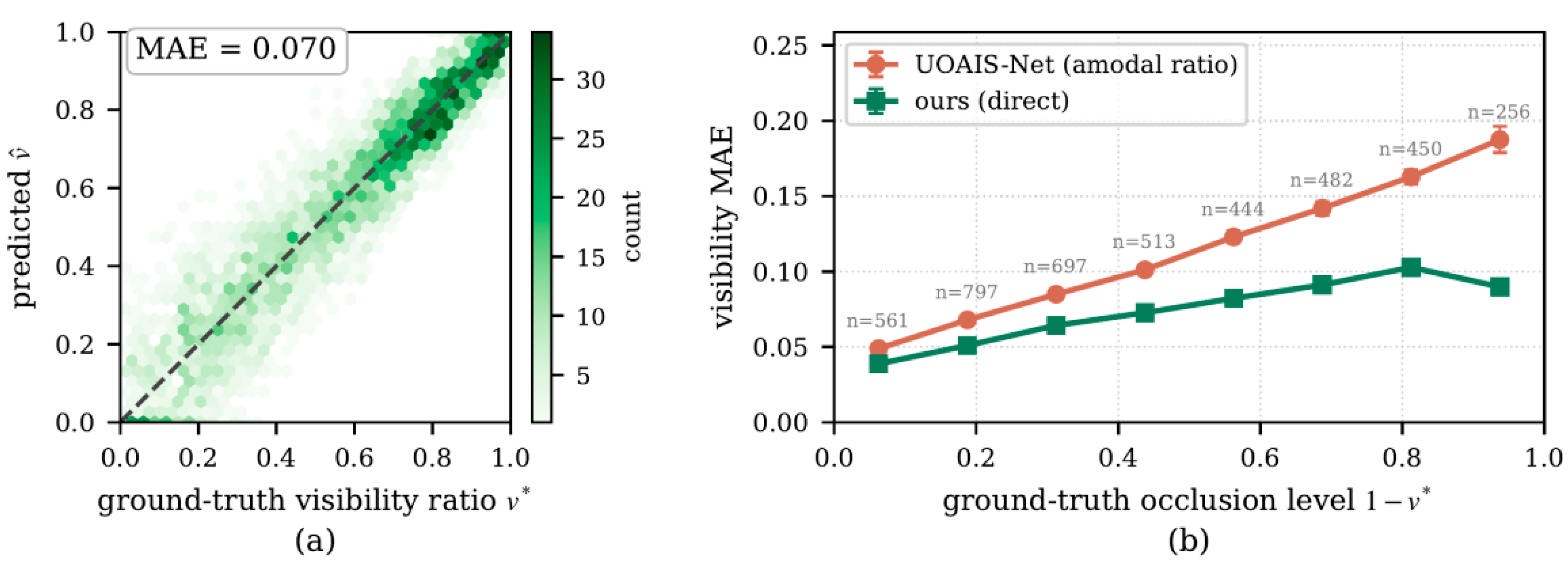
Figure 4.
Practical comparison of the five methods of Table II. (a) Top-layer accuracy versus clutter density (objects per image), averaged over the three datasets; the image-count-weighted means equal the values in Table II. Markers are offset horizontally for legibility, and the error bars show one standard error clustered by arrangement, hence far wider than a per-image binomial interval. The raw visible-area heuristic degrades fastest, whereas the three learned methods overlap within error at most densities. (b) Accuracy versus end-to-end runtime, reading the exact values of Table II.
Figure 4.
Practical comparison of the five methods of Table II. (a) Top-layer accuracy versus clutter density (objects per image), averaged over the three datasets; the image-count-weighted means equal the values in Table II. Markers are offset horizontally for legibility, and the error bars show one standard error clustered by arrangement, hence far wider than a per-image binomial interval. The raw visible-area heuristic degrades fastest, whereas the three learned methods overlap within error at most densities. (b) Accuracy versus end-to-end runtime, reading the exact values of Table II.
Disclaimer/Publisher’s Note: The statements, opinions and data contained in all publications are solely those of the individual author(s) and contributor(s) and not of MDPI and/or the editor(s). MDPI and/or the editor(s) disclaim responsibility for any injury to people or property resulting from any ideas, methods, instructions or products referred to in the content. |
© 2026 by the authors. Licensee MDPI, Basel, Switzerland. This article is an open access article distributed under the terms and conditions of the Creative Commons Attribution (CC BY) license (http://creativecommons.org/licenses/by/4.0/).
Copyright: This open access article is published under a Creative Commons CC BY 4.0 license, which permit the free download, distribution, and reuse, provided that the author and preprint are cited in any reuse.