

Submitted:
14 October 2026
Posted:
15 October 2026
You are already at the latest version
Abstract
Background/Objectives: Drug-free nasal formulations may provide an alternative or adjunct to pharmacological treatment in patients with allergic rhinitis. This study in-vestigated the clinical performance, tolerability, and safety of a hypertonic nasal spray containing hydroxypropyl-β-cyclodextrin (BDNS) compared with 0.9% isotonic saline in adults with pollen-induced allergic rhinitis. Methods: This prospective, randomised, double-blind, controlled, two-period crossover study included 32 adults with pollen-induced allergic rhinitis. Participants were randomised 1:1 to receive BDNS followed by isotonic saline or the reverse sequence, with each treatment administered for 7 days. The primary endpoint was the mean Lebel Symptom Score following standard-ised nasal allergen provocation testing after each treatment period. Secondary out-comes included individual symptom scores, peak nasal inspiratory flow, nasal sensory tolerability, treatment satisfaction and preference, and safety. The primary analysis was conducted in the per-protocol set using a linear mixed-effects model. Results: All 32 randomised participants completed the study, and 30 were included in the per-protocol set. The adjusted least-squares mean Lebel Symptom Score was 3.33 after BDNS and 4.30 after isotonic saline. BDNS met the prespecified criterion for non-inferiority and subsequently demonstrated superiority over isotonic saline, with a mean treatment difference of −0.97 points in the per-protocol population (p = 0.026). The analysis in the randomised set yielded consistent findings (mean difference, −0.87 points; p = 0.033). Treatment satisfaction was significantly higher with BDNS for both perceived effectiveness (difference, 0.69; p = 0.007) and tolerability (difference, 0.81; p < 0.001). Overall, 75% of participants preferred BDNS. No serious treatment-emergent adverse events or serious adverse device effects occurred, and no device deficiencies were reported. Conclusions: In adults with pollen-induced allergic rhinitis, BDNS was non-inferior and, following hierarchical testing, superior to 0.9% isotonic saline with respect to post-provocation symptom severity after 7 days of treatment. BDNS was well tolerated and was associated with greater participant satisfaction and a clear treatment preference. These findings support the favourable short-term clinical per-formance and acceptability of BDNS under controlled allergen-challenge conditions.
Keywords:
allergic rhinitis
; pollen allergy
; hydroxypropyl-β-cyclodextrin
; hypertonic nasal spray
; isotonic saline
; nasal allergen provocation test
; crossover study
; non-inferiority trial
1. Introduction
Allergic rhinitis (AR) is one of the most prevalent chronic inflammatory disorders of the upper airways and represents a substantial public health burden worldwide, with a median prevalence of approximately 18% among adults [1]. In addition to its characteristic nasal symptoms, AR adversely affects quality of life (QoL) and work or academic performance [2] and is frequently associated with impaired sleep [3]. Pollen-induced AR is particularly burdensome because symptom severity varies with environmental pollen exposure and may substantially interfere with daily activities during the pollen season [4].
Current evidence-based guidelines recommend intranasal corticosteroids, intranasal antihistamines, or fixed-dose combinations of these agents as first-line treatment for AR [5]. Although these treatments are effective, satisfactory disease control is not consistently achieved in routine clinical practice. A recent real-world study found that inadequate rhinitis control was common and was associated with factors including suboptimal adherence and incorrect nasal spray technique [6]. Furthermore, a recent systematic review and meta-analysis reported generally low adherence to prescribed intranasal corticosteroids and oral antihistamines in adults with AR [7]. These findings do not diminish the central role of pharmacotherapy but highlight the need for well-tolerated supportive or adjunctive approaches that can be readily incorporated into patient-centred treatment strategies.
Isotonic and hypertonic saline nasal sprays and irrigations are widely used non-pharmacological interventions for AR [8]. Their clinical rationale includes hydration of the nasal mucosa, mechanical removal of allergens and secretions, and support of mucociliary clearance. Mucociliary clearance is an important defence mechanism against inhaled allergens and irritants [9], while adequate mucosal hydration helps preserve nasal function [10]. Epithelial barrier integrity and coordinated ciliary transport also contribute to structural and immune defence [11]. Nasal sprays, gels, and irrigations are routinely used to moisturise and cleanse the nasal mucosa [12,13,14,15]. However, evidence for saline-based interventions remains heterogeneous because of differences in formulation, concentration, delivery method, treatment duration, study population, and outcome assessment [16]. Saline may itself reduce nasal symptoms and should therefore be considered an active comparator rather than an inert placebo [8,16].
Interest has therefore grown in drug-free nasal formulations designed to provide additional local physical effects, such as stabilisation of the mucosal surface, reduced allergen contact, and formation of a protective barrier. Ectoine-containing nasal formulations have been evaluated in a systematic review [17], a meta-analysis [18], and a comparative clinical study alongside established topical treatments [19]. More recently, a randomised clinical trial of the barrier-forming nasal spray AM-301 reported greater improvements in seasonal AR symptoms and quality of life than saline, with similar tolerability [20]. However, physically acting nasal formulations differ substantially in their composition and proposed modes of action, and findings obtained with one formulation cannot necessarily be generalised to another. Direct comparison with an active saline control is therefore important for establishing the clinical performance of each individual formulation.
The investigational product was a drug-free hypertonic nasal spray containing 3.5% hydroxypropyl-β-cyclodextrin (HP-Betadex), 1.4% sodium chloride, and purified water, hereafter referred to as BDNS. HP-Betadex is a highly water-soluble cyclic oligosaccharide with water-binding properties. The formulation is intended to act locally through physical mechanisms that support hydration and cleansing of the nasal mucosa. Hypertonicity may contribute to a transient osmotic reduction in mucosal oedema and support mucociliary clearance, while HP-Betadex may contribute to mucosal hydration and surface cleansing. Whether these properties provide clinically meaningful benefit beyond an active isotonic saline comparator has not yet been established.
Against this background, this prospective, randomised, double-blind, controlled, two-period crossover study compared the clinical performance, safety, and tolerability of BDNS with 0.9% isotonic saline in adults with pollen-induced AR. The primary objective was to determine whether BDNS was non-inferior to isotonic saline in reducing symptom severity following standardised nasal allergen provocation testing (NPT) after 7 days of treatment. Following demonstration of non-inferiority, superiority was subsequently evaluated.
2. Materials and Methods
2.1. Study Design and Ethical Considerations
This prospective, randomised, double-blind, controlled, two-period crossover study was conducted at a single outpatient practice. Participants were randomised in a 1:1 ratio to one of two treatment sequences. Sequence 1 received BDNS during the first 7-day treatment period, followed by 0.9% isotonic saline during the second 7-day treatment period. Sequence 2 received the treatments in the reverse order. Each participant received both study treatments and therefore served as their own control. No washout period was included between the treatment periods because both treatments were intended to exert transient local physical effects. The study design is presented in Figure 1.
An external statistician generated the treatment allocation sequence using a central computer-based block randomisation procedure with a 1:1 allocation ratio. Treatment kits were prepared according to the randomisation list and assigned consecutively to participants at the study site.
The study was conducted in accordance with the Declaration of Helsinki, ISO 14155:2020, the principles of Good Clinical Practice, Regulation (EU) 2017/745, and applicable German regulations. The Ethics Committee of the Hamburg Medical Association issued a favourable opinion on 30 June 2025 (reference no. 2025-101474-MPDG-ff). The clinical investigation was approved by the German Federal Institute for Drugs and Medical Devices (BfArM; reference no. 94.1.02-5660-15569) on 13 October 2025 and commenced only after both approvals had been obtained. Written informed consent was obtained from all participants before any study-related procedures were performed. The study was registered in the German Clinical Trials Register (DRKS00038417).
2.2. Participants
Adults aged 18 to 65 years with a documented history of pollen-induced AR were eligible for participation. Additional inclusion criteria were a positive skin prick test to the relevant pollen allergen and a self-rated Lebel Symptom Score (LSS) of at least 4 following the baseline NPT.
Key exclusion criteria included pregnancy or breastfeeding, non-allergic rhinitis, acute bacterial rhinosinusitis, chronic or recurrent rhinosinusitis, clinically relevant structural abnormalities of the nasal cavity, an acute respiratory infection within 1 week before screening, contraindications to NPT, and recent use of medications that could affect the assessment of AR symptoms. Women of childbearing potential were required to have a negative pregnancy test and to use a highly effective method of contraception throughout the study. The complete inclusion and exclusion criteria are provided in Supplementary Text S1.
2.3. Study Treatments and Procedures
The investigational device, BDNS, was supplied in a 20 mL high-density polyethylene bottle equipped with a 140 mg nasal spray pump. The formulation contained 3.5% hydroxypropyl-β-cyclodextrin (HP-Betadex), 1.4% sodium chloride, and 95.1% purified water. The comparator was a 0.9% isotonic saline nasal spray. Participants used each study treatment for 7 days according to the study-specific instructions for use. The first application of each treatment was performed under the supervision of study personnel, while subsequent applications during the outpatient treatment periods were self-administered.
At Visit 1 (Day 1), baseline assessments included medical and medication history, vital signs, peak nasal inspiratory flow (PNIF), NPT, and assessment of the LSS. After eligibility had been confirmed, participants were randomised and received the first supervised dose of the assigned study treatment. Nasal sensory tolerability was assessed using the Nasal Spray Sensory Scale (NSSS) immediately after administration and again 2 minutes later.
At Visit 2 (Day 8 ± 2 days), assessments were performed after completion of the first 7-day treatment period. These included NPT, the LSS, PNIF, participant satisfaction, concomitant medication, and safety assessments. Participants then received the first supervised dose of the alternate study treatment, followed by assessment with the NSSS immediately after administration and 2 minutes later.
At Visit 3 (Day 15 ± 2 days), efficacy assessments were repeated after completion of the second treatment period, including NPT, the LSS, and PNIF. Participant satisfaction, overall treatment preference, concomitant medication, adverse events (AEs), adverse device effects (ADEs), and device deficiencies were also documented. After 1 more week, an additional post-study telephone follow-up was performed to inquire about potential AEs.
2.4. Endpoints
The primary efficacy endpoint was the mean LSS following NPT after each 7-day treatment period. BDNS and 0.9% isotonic saline were compared irrespective of the order in which the treatments were administered. The LSS ranges from 0 to 11 and includes sneezing, nasal itching, rhinorrhoea, nasal obstruction, and ocular symptoms.
Secondary efficacy endpoints included the individual components of the LSS, PNIF measurements before and after NPT at baseline and after each treatment period, participant satisfaction with treatment effectiveness and tolerability, and overall treatment preference at the final study visit.
Safety endpoints included ADEs, treatment discontinuations due to ADEs, and device deficiencies. Sensory tolerability was assessed using the NSSS after the first supervised dose of each study treatment, including assessments of overall sensory perception and nasal irritation.
A prespecified exploratory endpoint was the superiority of BDNS over 0.9% isotonic saline with respect to the mean LSS.
2.5. Statistical Analysis
Statistical analyses were performed using IBM SPSS Statistics, version 29.0 or higher. Continuous variables were described using the number of observations, mean, standard deviation (SD), median, interquartile range, minimum, and maximum. Categorical variables were presented as frequencies and percentages. Unless otherwise specified, statistical tests were two-sided, and p values below 0.05 were considered statistically significant.
The primary efficacy analysis was performed in the per-protocol set (PPS). A supportive analysis was conducted in the randomised set. Safety and tolerability analyses were based on the safety set, which included all participants who received at least one study treatment.
The mean LSS recorded after each 7-day treatment period was analysed using a linear mixed-effects model with treatment and period as fixed effects and participant as a random effect. Adjusted least-squares means (LS means), treatment differences, standard errors (SEs), and two-sided 90% and 95% confidence intervals (CIs) were estimated. The treatment difference was defined as BDNS minus comparator. Negative values therefore indicated lower symptom scores in favour of BDNS.
Non-inferiority was assessed on the standardised effect-size scale using a prespecified margin of 0.25. The general methodological principles for defining non-inferiority margins have been described previously [21], and a Cohen's d value of 0.25 represents a small, standardised effect [22]. The non-inferiority hypotheses were H0: d > 0.25 and H1: d ≤ 0.25. Non-inferiority was concluded if the upper limit of the two-sided 90% confidence interval for Cohen's d was below 0.25. In accordance with the prespecified hierarchical testing procedure, superiority was evaluated only after non-inferiority had been established. Superiority was concluded if the upper limit of the two-sided 95% confidence interval for Cohen's d was below zero. Cohen's d was calculated by dividing the adjusted least-squares mean difference by the total standard deviation, incorporating both between-participant and within-participant variability.
Individual components of the LSS, participant satisfaction with treatment effectiveness and tolerability, and NSSS outcomes were analysed using linear mixed-effects models with treatment and period as fixed effects and participant as a random effect. Adjusted least-squares means, treatment differences, 95% confidence intervals, p values, and Cohen's d values were reported where applicable. PNIF was analysed descriptively by treatment and assessment time point. Treatment preference and safety outcomes were presented as frequencies and percentages.
Complete LSS data were available for all randomised participants. No imputation of missing data was performed; other outcomes were analysed using the available data.
The sample size was calculated using RStudio with the epiR package, version 2.0.78. Assuming a standard deviation of 1.0, a non-inferiority margin of 0.25, 80% power, equal allocation to the two treatment sequences, and a one-sided significance level of 0.05, 28 evaluable participants were required. No interim analysis was planned.
3. Results
A total of 36 participants were screened for eligibility. Four participants were not randomised because their self-rated LSS following the baseline NPT was below 4. The remaining 32 participants were randomised, with 16 assigned to each treatment sequence. All randomised participants attended Visits 1, 2, and 3, completed the clinical investigation, and were included in the randomised set and the safety set. Thirty participants, 15 in each treatment sequence, were included in the PPS. Two participants, one from each sequence, were excluded from the per-protocol analysis because treatment was not completed as planned.
3.1. Demographic and Baseline Characteristics
The mean age of the randomised participants was 42.97 years (SD 9.65; range, 24 to 62 years). Nineteen participants (59.4%) were female and 13 (40.6%) were male. The mean body mass index (BMI) was 26.80 kg/m² (SD 6.01). All participants had grass pollen-induced AR, and two participants also had birch pollen-induced AR. Allergic asthma was reported in seven participants (21.9%). Demographic and baseline clinical characteristics by treatment sequence are summarised in Table S1.
3.2. Lebel Symptom Score
The primary efficacy analysis was performed in the PPS, which included 30 participants. The mean baseline LSS was 6.9 (SD 1.60). After each 7-day treatment period, the adjusted least-squares mean score was 3.33 following BDNS and 4.30 following the comparator. The adjusted treatment difference, defined as BDNS minus comparator, was −0.97 points (SE 0.41; 95% CI, −1.81 to −0.13; p = 0.026), indicating lower symptom scores following BDNS treatment.
The standardised treatment difference was Cohen's d = −0.397, with a 90% CI of −0.674 to −0.120 and a 95% CI of −0.727 to −0.067. The upper limit of the 90% CI was below the prespecified non-inferiority margin of 0.25, demonstrating non-inferiority of BDNS to the comparator. Following confirmation of non-inferiority, the prespecified superiority analysis was performed. The upper limit of the 95% CI was below zero, demonstrating superiority of BDNS over the comparator. The period effect was not statistically significant (p = 0.233). The primary and supportive analyses are summarised in Table 1.
The supportive analysis in the randomised set was consistent with the primary analysis. The adjusted least-squares mean scores were 3.47 following BDNS and 4.34 following the comparator, corresponding to a treatment difference of −0.87 points (95% CI, −1.68 to −0.07; p = 0.033) and a standardised effect of Cohen's d = −0.351. Non-inferiority and subsequent superiority were also demonstrated in this analysis. No statistically significant period effect was observed in the randomised set (p = 0.161).
The distributions of Lebel Symptom Scores by treatment sequence and after the individual study treatments are shown in Figure 2. Panel A presents scores by randomised treatment sequence across baseline and the two treatment periods, while Panel B presents the pooled distributions at baseline and after BDNS and comparator treatment.
3.3. Individual Symptom Scores (ISS)
Individual components of the LSS were analysed in the randomised set using linear mixed-effects models. Adjusted least-squares mean scores were numerically lower following BDNS than following the comparator for all five symptom domains. The treatment differences, defined as BDNS minus comparator, were −0.22 for sneezing, −0.25 for nasal itching, −0.16 for rhinorrhoea, −0.19 for nasal obstruction, and −0.06 for ocular symptoms. However, the 95% confidence intervals included zero for all individual symptoms, and none of the treatment differences reached statistical significance. The results are summarised in Table 2.
The largest numerical treatment difference was observed for nasal itching, followed by sneezing. However, effect sizes were small across all symptom domains, and these results should be interpreted as descriptive secondary findings.
3.4. Peak Nasal Inspiratory Flow (PNIF)
PNIF data were available for 10 participants and were therefore analysed descriptively. At baseline, the mean PNIF decreased from 110 L/min before NPT to 82 L/min after provocation, corresponding to a mean within-assessment change of −28 L/min (SD 27.41). Following BDNS treatment, mean PNIF decreased from 101 to 86 L/min, corresponding to a mean change of −15 L/min (SD 11.06). Following comparator treatment, mean PNIF decreased from 115.5 to 90 L/min, corresponding to a mean change of −25.5 L/min (SD 41.80). The descriptive PNIF results are summarised in Table 3.
The mean NPT-induced reduction in PNIF was numerically smaller following BDNS than following the comparator. However, variability was substantial and no formal inferential comparison was performed. These findings should therefore be regarded as exploratory and should not be used to draw conclusions regarding treatment efficacy.
3.5. Nasal Sensory Tolerability Assessed Using the Nasal Spray Sensory Scale (NSSS)
Nasal sensory tolerability was assessed in the safety set after the first supervised administration of each study treatment. Higher NSSS scores indicated a more favourable sensory experience and less nasal irritation. The adjusted least-squares mean overall NSSS score was 87.26 following BDNS and 85.81 following the comparator, corresponding to a treatment difference of 1.45 points (95% CI, −1.43 to 4.33; p = 0.312; Cohen's d = 0.136).
Immediately after administration, the adjusted least-squares mean score for lack of nasal irritation was 88.55 following BDNS and 85.80 following the comparator. The treatment difference was 2.75 points (95% CI, −1.54 to 7.04; p = 0.201; Cohen's d = 0.217). At 2 minutes after administration, the corresponding scores were 87.63 and 85.80, respectively, with a treatment difference of 1.82 points (95% CI, −1.07 to 4.72; p = 0.208; Cohen's d = 0.170). The results are shown in Table 4.
A statistically significant period effect was observed for the immediate nasal irritation assessment (p = 0.035), whereas no significant period effect was found for the overall NSSS score (p = 0.686) or the assessment performed 2 minutes after administration (p = 0.230).
3.6. Treatment Satisfaction and Preference
Participant satisfaction was assessed after each 7-day treatment period using a scale ranging from 0 to 3, with higher scores indicating greater satisfaction. In the randomised set, satisfaction with perceived treatment effectiveness was significantly greater following BDNS than following the comparator. The adjusted least-squares mean scores were 1.91 (SE 0.17; 95% CI, 1.57 to 2.25) for BDNS and 1.22 (SE 0.17; 95% CI, 0.88 to 1.56) for the comparator. The adjusted treatment difference was 0.69 points (SE 0.24; 95% CI, 0.21 to 1.17; p = 0.007), corresponding to Cohen's d = 0.730 (95% CI, 0.240 to 1.220). No statistically significant period effect was observed for this assessment (p = 0.793).
Satisfaction with treatment tolerability was also significantly greater following BDNS. The adjusted least-squares mean scores were 2.53 (SE 0.14; 95% CI, 2.24 to 2.82) for BDNS and 1.72 (SE 0.14; 95% CI, 1.43 to 2.01) for the comparator. The adjusted treatment difference was 0.81 points (SE 0.20; 95% CI, 0.40 to 1.22; p < 0.001), with Cohen's d = 1.018 (95% CI, 0.528 to 1.508). The period effect was not statistically significant (p = 0.128) (Table 5).
At the final study visit, 24 of 32 participants (75.0%) preferred BDNS, whereas 7 participants (21.9%) preferred the comparator. Preference for BDNS was reported by 11 of 16 participants (68.8%) in the BDNS-comparator sequence and by 13 of 16 participants (81.3%) in the comparator-BDNS sequence. Preference data were not documented for one participant (3.1%). The distribution of overall treatment preference is presented in Figure 3.
3.7. Safety
The safety set included all 32 randomised participants. Treatment-emergent adverse events (TEAEs) occurred during both treatment periods but were reported more frequently during comparator treatment than during BDNS treatment. The events reported during BDNS treatment included headache and sneezing. Events reported during comparator treatment included eye pruritus, oral pruritus, headache, insomnia, nasal congestion, nasal discomfort, nasal dryness, sinus congestion, and sneezing. Adverse device effects (ADEs) were uncommon with both treatments.
Two participants discontinued comparator treatment following a TEAE, whereas no treatment discontinuation occurred during BDNS treatment. No serious TEAEs or serious ADEs were reported, and no device deficiencies occurred during the study. Overall, the findings indicated a favourable short-term safety and tolerability profile for BDNS under the conditions of this investigation.
4. Discussion
This randomised, double-blind crossover study evaluated the clinical performance, tolerability, and participant acceptability of BDNS against an active isotonic saline comparator under controlled allergen-challenge conditions.
The primary efficacy analysis met the prespecified non-inferiority criterion and, following hierarchical testing, demonstrated statistically significant superiority of BDNS over isotonic saline with respect to the post-treatment LSS after 7 days. The consistency of the findings across the per-protocol and randomised sets supports the robustness of the primary efficacy results despite the relatively small study population.
An important aspect of the present study is the choice of comparator. Isotonic saline is not an inert placebo but an active non-pharmacological treatment that is widely recommended as supportive therapy for AR. Through hydration of the nasal mucosa, mechanical removal of allergens and secretions, and support of mucociliary clearance, saline itself can reduce nasal symptoms. Consequently, the superiority observed for BDNS should be interpreted as an incremental clinical benefit beyond the established physical effects of isotonic saline rather than as a comparison with an inert control.
The present findings are consistent with emerging evidence that non-pharmacological nasal formulations possessing additional physical modes of action may provide greater symptom relief than saline alone. Becker et al. evaluated the barrier-forming nasal spray AM-301 in a randomised clinical trial involving 100 patients with seasonal AR and demonstrated significantly greater reductions in reflective total nasal symptom scores compared with saline after two weeks of treatment, while maintaining a favourable safety profile [20]. Although AM-301 acts primarily by forming a protective barrier on the nasal mucosa, whereas BDNS combines hypertonic saline with HP-Betadex, both studies support the concept that drug-free nasal formulations may provide additional clinical benefit beyond the cleansing and moisturising effects of isotonic saline. These findings are also consistent with an earlier randomised crossover non-inferiority trial conducted under controlled pollen exposure, in which AM-301 demonstrated clinical performance comparable with an established barrier-forming nasal product [23].
Comparable observations have also been reported for ectoine-containing nasal formulations. The available evidence has been summarised in a review of 14 clinical studies [17]. The review concluded that ectoine-containing formulations may represent effective and well-tolerated drug-free treatment options for AR. As monotherapy, ectoine-containing nasal sprays demonstrated clinical performance comparable with established pharmacological therapies in several studies, while add-on use further improved symptom relief in selected patient groups. Although the investigated formulations differ from BDNS and direct comparisons should be interpreted with caution, these findings further support the role of physically acting drug-free nasal formulations in the management of AR.
The superior clinical performance of BDNS compared with isotonic saline may be attributable to the complementary physical properties of its formulation. While isotonic saline primarily hydrates the nasal mucosa and facilitates mechanical clearance of allergens and secretions, BDNS combines a mildly hypertonic saline solution with hydroxypropyl-β-cyclodextrin (HP-Betadex). According to the proposed mode of action, the hypertonic formulation may contribute to a transient osmotic reduction in mucosal oedema, while HP-Betadex may contribute to maintaining hydration of the nasal mucosal surface. The observed clinical findings are therefore consistent with the proposed physical mode of action of BDNS; however, the present study was not designed to investigate the underlying biological mechanisms, and no mechanistic conclusions can be drawn from these clinical data alone.
The present results are also consistent with evidence suggesting that increasing the saline concentration may enhance symptom control in AR. A randomised clinical trial by Sansila et al. demonstrated that hypertonic saline nasal irrigation provided greater improvement in nasal symptoms and QoL than isotonic saline in patients with AR, while maintaining good tolerability [24]. Likewise, a systematic review concluded that hypertonic saline may offer modest additional clinical benefit over isotonic saline, although the magnitude of effect varies across studies because of differences in irrigation techniques, saline concentrations, treatment duration, and study populations [25]. Although BDNS differs from conventional hypertonic saline products through the inclusion of HP-Betadex and was administered as a spray rather than as a high-volume irrigation, these findings support the concept that optimisation of the physical characteristics of saline-based formulations may improve clinical outcomes.
Individual symptom scores followed a pattern similar to that observed for the primary endpoint, with numerically lower scores following BDNS for all five symptom domains. However, none of the differences between treatments reached statistical significance. As the study was powered for the primary endpoint rather than for individual symptom components, these findings should be interpreted as descriptive secondary results.
PNIF provided limited supportive information. PNIF data were available for only 10 participants and were analysed descriptively. The mean reduction in PNIF induced by nasal allergen provocation was numerically smaller following BDNS than following the comparator. However, because of the small number of participants and substantial variability, no formal inferential comparison was performed, and no conclusion regarding an objective treatment effect on nasal airflow can be drawn.
Participant-reported outcomes complemented the primary efficacy findings. Satisfaction with perceived treatment effectiveness and tolerability was significantly greater following BDNS, whereas NSSS scores were numerically higher but did not differ significantly between treatments.
Previous studies by Bergmann et al., Hahn et al., and Gerson et al. have highlighted the importance of sensory perception and user experience in intranasal therapy [26,27,28]. Although the formulations, populations, and assessment methods differed from those used in the present investigation, these findings provide context for the numerically favourable sensory ratings observed with BDNS. More recent real-world evidence also indicates that sensory attributes are important determinants of satisfaction with intranasal treatment. Fifer et al. reported that differences in patient satisfaction between nasal spray formulations were predominantly related to sensory characteristics [29]. Similarly, Mahadevia et al. showed that sensory attributes may influence treatment preference and willingness to adhere to intranasal therapy [30]. Although the present study did not assess long-term adherence, the numerically favourable sensory ratings observed with BDNS may be clinically relevant because patient satisfaction can influence treatment acceptance and persistence.
At the end of both treatment periods, 75% of participants preferred BDNS to isotonic saline. Although treatment preference was a subjective endpoint and the study was not specifically powered for it, this finding was consistent with the greater satisfaction reported for BDNS.
The safety findings indicated a favourable short-term safety and tolerability profile for BDNS. No serious TEAEs or serious ADEs occurred, and no device deficiencies were reported. Together with the sensory tolerability findings, these results support the acceptability of BDNS under the conditions of this investigation.
Limitations
Several limitations should be considered when interpreting the present findings. First, this was a single-centre study involving only 32 randomised participants. Although the sample size was sufficient for the prespecified primary non-inferiority analysis, statistical power was limited for secondary and exploratory endpoints. Second, each treatment was administered for only 7 days. The findings therefore reflect short-term clinical performance and should not be extrapolated to prolonged or repeated seasonal use. Third, treatment efficacy was assessed using standardised nasal allergen provocation rather than under natural seasonal pollen exposure. Although this model permits controlled and reproducible assessment of allergen-specific responses, it does not capture variations in allergen exposure, environmental conditions, medication use, and adherence encountered during a natural pollen season.
Fourth, no washout period was included between the two treatment periods. Although no statistically significant period effect was observed for the primary endpoint, residual treatment, sequence, or carryover effects cannot be completely excluded. Fifth, PNIF measurements were available for only 10 participants and were analysed descriptively. Sixth, adherence during outpatient treatment was not objectively verified by dose counting or device weighing. Finally, the study included only adults with pollen-induced AR and was not designed to investigate the biological mechanisms underlying the observed clinical effects. The results may therefore not be generalisable to other allergic or non-AR phenotypes, and the relative contributions of hypertonicity and HP-Betadex cannot be determined from the present data.
Strengths
The study also has several important strengths. The randomised, double-blind, controlled crossover design allowed each participant to receive both treatments and serve as their own control, thereby reducing the influence of between-participant variability. The use of 0.9% isotonic saline as an active comparator provided a clinically relevant and methodologically demanding assessment of the incremental effect of BDNS. Standardised nasal allergen provocation enabled controlled and reproducible allergen exposure across treatment periods. In addition, the prespecified hierarchical testing procedure ensured that superiority was evaluated only after non-inferiority had been established. The inclusion of symptom scores, objective nasal airflow measurements, sensory tolerability assessments, participant satisfaction, and treatment preference provided a broad evaluation of both clinical performance and participant experience.
5. Conclusions
In adults with pollen-induced AR, BDNS met the primary study objective by demonstrating non-inferiority to 0.9% isotonic saline and, following hierarchical testing, statistically significant superiority with respect to post-provocation symptom severity after 7 days of treatment. The consistency of the findings across the per-protocol and randomised sets, together with significantly greater participant satisfaction with perceived effectiveness and tolerability and a clear preference for BDNS, supports the clinical relevance and acceptability of the treatment. No serious TEAEs or serious ADEs occurred. Overall, BDNS provided an effective, well-accepted, drug-free treatment with an incremental clinical benefit over an active isotonic saline comparator under controlled allergen-challenge conditions.
Eligibility assessment
Eligibility was assessed at Visit 1 before initiation of study treatment.
Inclusion Criteria
Participants were eligible for inclusion if all of the following criteria were met:
- Age between 18 and 65 years.
- A history of allergic rhinitis, defined by the onset of nasal symptoms following nasal allergen challenge.
- A positive skin prick test to the relevant allergen. The negative control was required to be negative, with a wheal diameter of less than 2 mm; the histamine control was required to be positive, with a wheal diameter of at least 3 mm; and the allergen-specific test was required to produce a wheal diameter of at least 3 mm.
- A self-rated Lebel Symptom Score of at least 4 following the baseline nasal allergen provocation test.
- Provision of written informed consent before participation in the clinical investigation.
Exclusion Criteria
Participants were excluded if any of the following criteria applied:
- Pregnancy or breastfeeding. Women of childbearing potential were required to have a negative pregnancy test at screening and to use a highly effective method of contraception throughout the clinical investigation.
- Non-allergic, non-infectious rhinitis, including rhinitis sicca or rhinitis medicamentosa, or acute bacterial rhinosinusitis, as determined by the investigator on the basis of medical history and clinical presentation.
- A history of chronic nasal obstruction, chronic rhinosinusitis, or recurrent acute rhinosinusitis, defined as at least four episodes of post-viral or bacterial rhinosinusitis during the preceding 12 months.
- An acute respiratory infection within 1 week before screening.
- A clinically relevant structural or pathological condition of the nasal cavity, including significant septal deviation or nasal polyps.
- A history of trans-sphenoidal hypophysectomy or any surgical procedure involving exposure of the dura mater.
- Use of any topical or oral nasal decongestant, including antihistamines or corticosteroids, within 24 hours before screening; use of more than three doses in total within 3 days before screening; or use of more than nine doses in total within 2 weeks before screening.
- Administration of mast cell stabilisers within 5 days before screening, or treatment with anti-IgE or anti-interleukin agents within 4 weeks before screening.
- Use of antidepressants with antihistaminic properties within 2 weeks before screening, or use of antipsychotic medication within 5 days before screening.
- Use of analgesic, antipyretic, cold, or influenza medication, including over-the-counter medication or herbal products, within 8 hours before screening.
- Any condition representing a contraindication to nasal allergen provocation testing or to the nasal provocation test solutions used in the study.
- Participation in another clinical investigation within 3 months before screening, within five half-lives of the previously administered investigational product, or within twice the duration of its biological effect, whichever period was longer.
- Any legal restriction prohibiting participation in clinical investigations.
Definitions Related to Reproductive Status and Contraception
A woman was considered to be of childbearing potential from menarche until the postmenopausal state unless she had undergone permanent sterilisation. Permanent sterilisation included hysterectomy, bilateral salpingectomy, or bilateral oophorectomy.
Postmenopausal status was defined as the absence of menstruation for at least 12 months without an alternative medical cause.
Highly effective methods of contraception included combined oestrogen- and progestogen-containing hormonal contraception administered orally, intravaginally, or transdermally; progestogen-only hormonal contraception administered orally, by injection, or by implant; an intrauterine device; an intrauterine hormone-releasing system; bilateral tubal occlusion; or a vasectomised partner, provided that the partner was the participant’s sole sexual partner and the success of the procedure had been medically confirmed.

Table S1.
Demographic and baseline characteristics of the randomised set.
| Characteristic |
BDNS-comparator sequence (N = 16) |
Comparator-BDNS sequence (N = 16) |
Total (N = 32) |
| Age, years, mean (SD) | 42.19 (10.09) | 43.75 (9.44) | 42.97 (9.65) |
| Female, n (%) | 9 (56.3) | 10 (62.5) | 19 (59.4) |
| Male, n (%) | 7 (43.8) | 6 (37.5) | 13 (40.6) |
| BMI, kg/m², mean (SD) | 28.47 (7.21) | 25.13 (4.07) | 26.80 (6.01) |
| Grass pollen-induced allergic rhinitis, n (%) | 16 (100.0) | 16 (100.0) | 32 (100.0) |
| Birch pollen-induced allergic rhinitis, n (%) | 2 (12.5) | 0 (0.0) | 2 (6.3) |
| Allergic asthma, n (%) | 3 (18.8) | 4 (25.0) | 7 (21.9) |
Data are presented as mean (SD) or n (%). Percentages are based on the number of participants in the corresponding sequence or total population. BMI, body mass index.
Supplementary Materials
The following supporting information can be downloaded at: www.mdpi.com/xxx/s1, Supplementary Text S1. Complete inclusion and non-inclusion criteria; Table S1. Demographic and baseline characteristics of the randomised set.Supplementary Text S1.
Author Contributions
Conceptualization, E.C., J.B., S.A., A.B., P.M., N.R., and R.M.; methodology, H.S., C.A., M.M., M.-C.K., C.W., and R.M.; validation, A.R., H.S., M.M., C.W., and N.R.; formal analysis, H.S., C.A., and R.M.; investigation, E.C. and J.B.; resources, S.A., A.B., P.M., and R.M.; data curation, H.C.V., J.U., H.S., and C.A.; writing—original draft preparation, H.C.V., J.U., A.R., and R.M.; writing—review and editing, H.C.V., J.U., E.C., J.B., A.R., S.A., H.S., C.A., A.B., M.M., M.-C.K., C.W., P.M., N.R., and R.M.; visualization, H.C.V., J.U., and A.R.; supervision, E.C., J.B., S.A., A.B., M.-C.K., N.R., and R.M.; project administration, E.C., J.B., M.M., M.-C.K., and C.W.; funding acquisition, S.A. and A.B. All authors have read and agreed to the published version of the manuscript.
Funding
This study was funded by URSATEC GmbH, Germany.
Institutional Review Board Statement
The study was conducted in accordance with the Declaration of Helsinki, ISO 14155:2020, Regulation (EU) 2017/745, and applicable German regulations. Ethical approval was obtained from the Ethics Committee of the Hamburg Medical Association (Ärztekammer Hamburg; reference no. 2025-101474-MPDG-ff; positive opinion dated 30 June 2025). The clinical investigation was approved by the German Federal Institute for Drugs and Medical Devices (BfArM; reference no. 94.1.02-5660-15569) on 13 October 2025.
Informed Consent Statement
Written informed consent was obtained from all participants before any study-related procedures were performed.
Data Availability Statement
The data presented in this study are available from the corresponding author upon reasonable request, subject to applicable data protection and confidentiality requirements.
Acknowledgments
The authors thank all study participants and the clinical staff of Praxis Dr. Daniela Kasche & Kollegen for their contribution to the conduct of the clinical investigation. The authors also gratefully acknowledge Dr. Sabine Mersmann for providing statistical consultation.
Conflicts of Interest
E.C., J.B., S.A., H.S., C.A. and A.R. are employees of ClinCompetence Cologne GmbH, the contract research organisation involved in the conduct of the reported clinical investigation. H.C.V. and J.U. have nothing to disclose. R.M.: reports grants from URSATEC GmbH during the conduct of the study; personal fees from ALK, grants from ASIT biotech, personal fees from Allergopharma, personal fees from Allergy Therapeutics, grants and personal fees from Bencard, grants from Leti, grants, personal fees and non-financial support from Lofarma, non-financial support from Roxall, grants and personal fees from Stallergenes, grants from Optima, personal fees from Friulchem, personal fees from Hexal, personal fees from Servier, personal fees from Klosterfrau, non-financial support from Atmos, personal fees from Bayer, non-financial support from Bionorica, personal fees from FAES, personal fees from GSK, personal fees from MSD, personal fees from Johnson & Johnson, personal fees from Meda, personal fees and non-financial support from Novartis, non-financial support from Otonomy, personal fees from Stada, personal fees from UCB, non-financial support from Ferrero, grants from Hulka, personal fees from Nuvo, grants and personal fees from Inmunotek, grants and personal fees from Ursapharm, personal fees from Menarini, personal fees from Mundipharma, personal fees from Pohl-Boskamp, grants from Cassella-med GmbH & Co. KG, personal fees from Laboratoire de la Mer, personal fees from Sidroga, grants and personal fees from HAL BV, personal fees from Lek, personal fees from PRO-AdWise, personal fees from Angelini Pharma, grants and non-financial support from JGL, grants and personal fees from bitop, and grants from Sanofi, outside the submitted work. A.B. is Managing Director of URSATEC GmbH, the sponsor and legal manufacturer of the investigational device. M.M., M.-C.K., and C.W. are employees of URSATEC GmbH. P.M. and N.R. are affiliated with Aquilon Pharmaceuticals S.A., which was involved in the preclinical development and in vitro evaluation of HP-Betadex and collaborated with URSATEC GmbH in the development of the HP-Betadex-containing nasal spray.
Abbreviations
The following abbreviations are used in this manuscript:
| ADE | Adverse device effect |
| AE | Adverse event |
| AR | Allergic rhinitis |
| BDNS | Nasal spray containing HP-Betadex in a hypertonic saline formulation |
| BfArM | Federal Institute for Drugs and Medical Devices (Bundesinstitut für Arzneimittel und Medizinprodukte) |
| BMI | Body mass index |
| CI | Confidence interval |
| HP-Betadex | Hydroxypropyl-β-cyclodextrin |
| ISS | Individual symptom scores |
| LSS | Lebel Symptom Score |
| LS mean | Least-squares mean |
| NPT | Nasal allergen provocation test |
| NSSS | Nasal Spray Sensory Scale |
| PNIF | Peak nasal inspiratory flow |
| PPS | Per-protocol set |
| QoL | Quality of life |
| SD | Standard deviation |
| SE | Standard error |
| TEAE | Treatment-emergent adverse event |
References
- Savouré, M.; Bousquet, J.; Jaakkola, J.J.K.; et al. Worldwide prevalence of rhinitis in adults: A review of definitions and temporal evolution. Clin. Transl. Allergy 2022, 12, e12130. [Google Scholar] [CrossRef]
- Roger, A.; Arcalá Campillo, E.; Torres, M.C.; et al. Reduced work/academic performance and quality of life in patients with allergic rhinitis and impact of allergen immunotherapy. Allergy Asthma Clin. Immunol. 2016, 12, 40. [Google Scholar] [CrossRef]
- Léger, D.; Annesi-Maesano, I.; Carat, F.; et al. Allergic rhinitis and its consequences on quality of sleep: An unexplored area. Arch. Intern. Med. 2006, 166, 1744–1748. [Google Scholar] [CrossRef]
- van Gaal, N.; Boomsma, C.; Hall, L.F.; et al. Potential of real-time pollen data: Perceived needs and symptom management among seasonal allergic rhinitis patients. Front. Allergy 2026, 7, 1850404. [Google Scholar] [CrossRef]
- Bousquet, J.; Schünemann, H.J.; Sousa-Pinto, B.; et al. Concepts for the development of person-centered, digitally enabled, artificial intelligence-assisted ARIA care pathways (ARIA 2024). J. Allergy Clin. Immunol. Pract. 2024, 12, 2648–2668.e2. [Google Scholar] [CrossRef]
- Scheire, S.; Germonpré, S.; Mehuys, E.; et al. Rhinitis control and medication use in a real-world sample of patients with persistent rhinitis or rhinosinusitis: A community pharmacy study. J. Allergy Clin. Immunol. Pract. 2024, 12, 1865–1876.e6. [Google Scholar] [CrossRef]
- Chua, N.Y.M.; Tay, E.; Chua, R.L.; et al. Pharmacotherapeutic medication adherence in patients with allergic rhinitis: A systematic review and meta-analysis. Curr. Allergy Asthma Rep. 2026, 26, 36. [Google Scholar] [CrossRef]
- Hermelingmeier, K.E.; Weber, R.K.; Hellmich, M.; et al. Nasal irrigation as an adjunctive treatment in allergic rhinitis: A systematic review and meta-analysis. Am. J. Rhinol. Allergy 2012, 26, e119–e125. [Google Scholar] [CrossRef]
- Aukema, A.A.; Fokkens, W.J. Chronic rhinosinusitis: Management for optimal outcomes. Treat. Respir. Med. 2004, 3, 97–105. [Google Scholar] [CrossRef]
- Hildenbrand, T.; Weber, R.K.; Brehmer, D. Rhinitis sicca, dry nose and atrophic rhinitis: A review of the literature. Eur. Arch. Otorhinolaryngol. 2011, 268, 17–26. [Google Scholar] [CrossRef]
- Beule, A.G. Physiology and pathophysiology of respiratory mucosa of the nose and the paranasal sinuses. GMS Curr. Top. Otorhinolaryngol. Head Neck Surg. 2010, 9, Doc07. [Google Scholar] [CrossRef]
- Berger, R. Meerwasser für die Nase. PTA Heute 1998, 12, 1242–1246. [Google Scholar]
- Bootz, F. [Inflammatory diseases of the nose and paranasal sinuses in childhood]. Med. Monatsschr. Pharm. 1994, 17, 299–301. [Google Scholar]
- Heatley, D.G.; McConnell, K.E.; Kille, T.L.; et al. Nasal irrigation for the alleviation of sinonasal symptoms. Otolaryngol. Head Neck Surg. 2001, 125, 44–48. [Google Scholar] [CrossRef]
- Michel, O. Nasal irrigation in case of rhinosinusitis. Laryngorhinootologie 2006, 85, 448–458. [Google Scholar] [CrossRef]
- Head, K.; Snidvongs, K.; Glew, S.; et al. Saline irrigation for allergic rhinitis. Cochrane Database Syst. Rev. 2018, 6, CD012597. [Google Scholar] [CrossRef]
- Bilstein, A.; Werkhäuser, N.; Rybachuk, A.; et al. The effectiveness of the bacteria derived extremolyte ectoine for the treatment of allergic rhinitis. Biomed. Res. Int. 2021, 2021, 5562623. [Google Scholar] [CrossRef]
- Eichel, A.; Bilstein, A.; Werkhäuser, N.; et al. Meta-analysis of the efficacy of ectoine nasal spray in patients with allergic rhinoconjunctivitis. J. Allergy 2014, 2014, 292545. [Google Scholar] [CrossRef]
- Werkhäuser, N.; Bilstein, A.; Sonnemann, U. Treatment of allergic rhinitis with ectoine containing nasal spray and eye drops in comparison with azelastine containing nasal spray and eye drops or with cromoglycic acid containing nasal spray. J. Allergy 2014, 2014, 176597. [Google Scholar] [CrossRef]
- Becker, S.; Deshmukh, S.; De Looze, F.; et al. AM-301, a barrier-forming nasal spray, versus saline spray in seasonal allergic rhinitis: A randomized clinical trial. Allergy 2024, 79, 1858–1867. [Google Scholar] [CrossRef]
- Althunian, T.A.; de Boer, A.; Klungel, O.H.; et al. Methods of defining the non-inferiority margin in randomized, double-blind controlled trials: A systematic review. Trials 2017, 18, 107. [Google Scholar] [CrossRef]
- Magnusson, K. Interpreting Cohen’s d Effect Size: An Interactive Visualization, version 2.6.0. R Psychologist. Available online: https://rpsychologist.com/cohend/ (accessed on 3 August 2026).
- Nehrig, J.; Grosse, N.; Hohenfeld, I.P.; et al. Efficacy and safety of a drug-free, barrier-forming nasal spray for allergic rhinitis: Randomized, open-label, crossover noninferiority trial. Int. Arch. Allergy Immunol. 2023, 184, 111–121. [Google Scholar] [CrossRef]
- Sansila, K.; Eiamprapai, P.; Sawangjit, R. Effects of self-prepared hypertonic nasal saline irrigation in allergic rhinitis: A randomized controlled trial. Asian Pac. J. Allergy Immunol. 2020, 38, 200–207. [Google Scholar] [CrossRef]
- Kanjanawasee, D.; Seresirikachorn, K.; Chitsuthipakorn, W.; et al. Hypertonic saline versus isotonic saline nasal irrigation: Systematic review and meta-analysis. Am. J. Rhinol. Allergy 2018, 32, 269–279. [Google Scholar] [CrossRef]
- Bergmann, C.; Lander, J.; Radtke, L.; et al. The contribution of galenics to patients’ sensory perception of nasal sprays after nasal surgery: Data from a prospective randomised, controlled, double-blind, crossover, multicentre study. Adv. Ther. 2021, 38, 5829–5843. [Google Scholar] [CrossRef]
- Hahn, C.; Böhm, M.; Allekotte, S.; et al. Tolerability and effects on quality of life of liposomal nasal spray treatment compared to nasal ointment containing dexpanthenol or isotonic NaCl spray in patients with rhinitis sicca. Eur. Arch. Otorhinolaryngol. 2013, 270, 2465–2472. [Google Scholar] [CrossRef]
- Gerson, I.; Green, L.; Fishken, D. Patient preference and sensory comparisons of nasal spray allergy medications. J. Sens. Stud. 1999, 14, 491–496. [Google Scholar] [CrossRef]
- Fifer, S.; Toh, L.; Barkate, H.; et al. Patient satisfaction and sensory attributes of nasal spray treatments of olopatadine hydrochloride/mometasone furoate monohydrate and azelastine hydrochloride/fluticasone propionate for allergic rhinitis in Australia: An observational real-world clinical study. Patient Prefer. Adherence 2023, 17, 141–151. [Google Scholar] [CrossRef]
- Mahadevia, P.J.; Shah, S.; Leibman, C.; et al. Patient preferences for sensory attributes of intranasal corticosteroids and willingness to adhere to prescribed therapy for allergic rhinitis: A conjoint analysis. Ann. Allergy Asthma Immunol. 2004, 93, 345–350. [Google Scholar] [CrossRef]
Figure 1.
Study design. Participants were randomised in a 1:1 ratio to receive BDNS during the first 7-day treatment period followed by 0.9% isotonic saline during the second 7-day treatment period (Sequence 1), or the same treatments in the reverse order (Sequence 2). Nasal allergen provocation testing and Lebel Symptom Score assessments were performed at baseline and at the end of each treatment period. BDNS, hypertonic nasal spray containing 3.5% hydroxypropyl-β-cyclodextrin (HP-Betadex) and 1.4% sodium chloride.
Figure 1.
Study design. Participants were randomised in a 1:1 ratio to receive BDNS during the first 7-day treatment period followed by 0.9% isotonic saline during the second 7-day treatment period (Sequence 1), or the same treatments in the reverse order (Sequence 2). Nasal allergen provocation testing and Lebel Symptom Score assessments were performed at baseline and at the end of each treatment period. BDNS, hypertonic nasal spray containing 3.5% hydroxypropyl-β-cyclodextrin (HP-Betadex) and 1.4% sodium chloride.
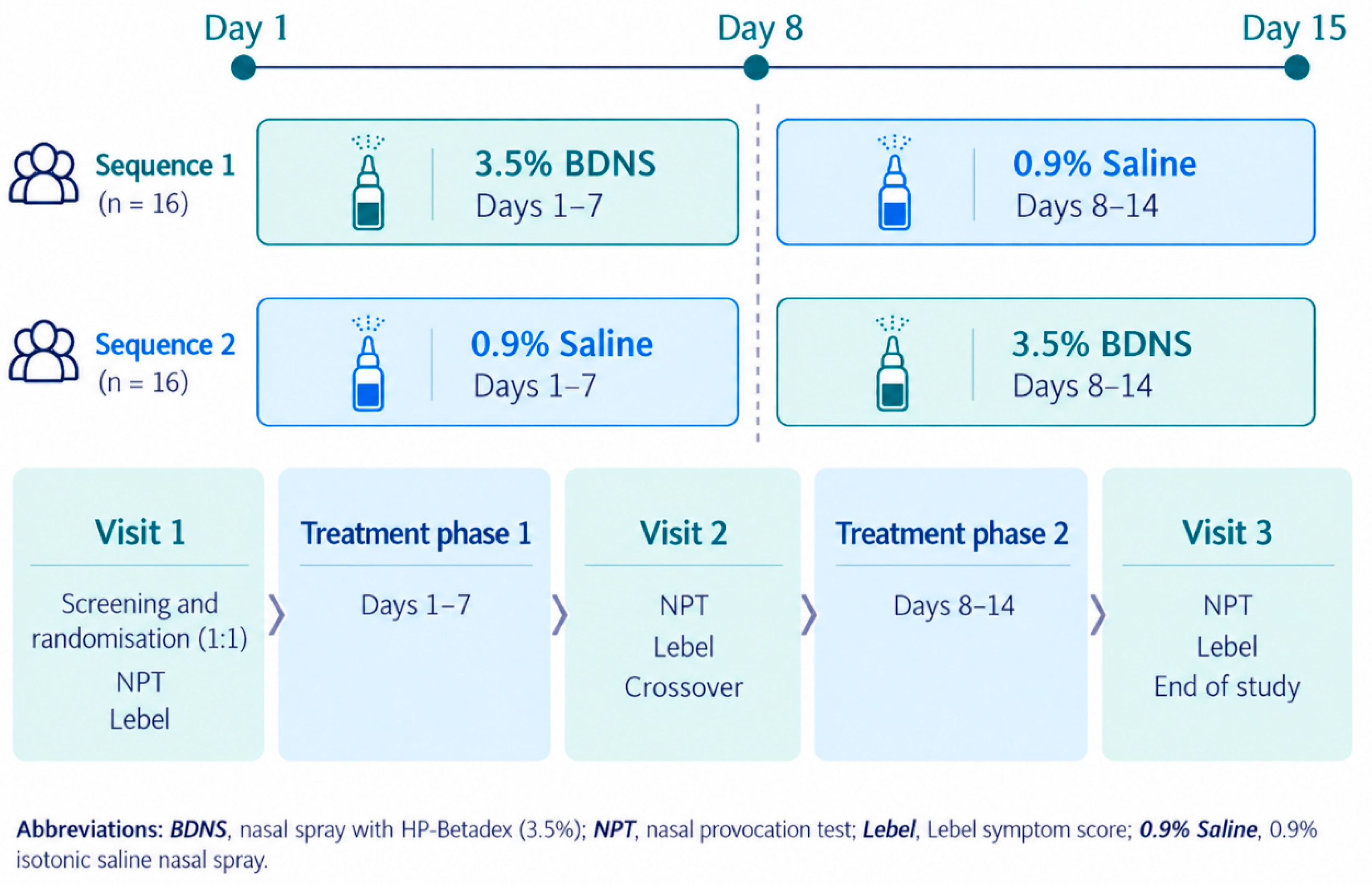
Figure 2.
Distribution of LSS in the PPS. (A) Scores at baseline and after Periods 1 and 2, presented according to randomised treatment sequence. (B) Pooled scores at baseline and after treatment with BDNS and the comparator. Boxes represent the interquartile range, and horizontal lines within the boxes represent the median. Lower scores indicate less severe AR symptoms.
Figure 2.
Distribution of LSS in the PPS. (A) Scores at baseline and after Periods 1 and 2, presented according to randomised treatment sequence. (B) Pooled scores at baseline and after treatment with BDNS and the comparator. Boxes represent the interquartile range, and horizontal lines within the boxes represent the median. Lower scores indicate less severe AR symptoms.
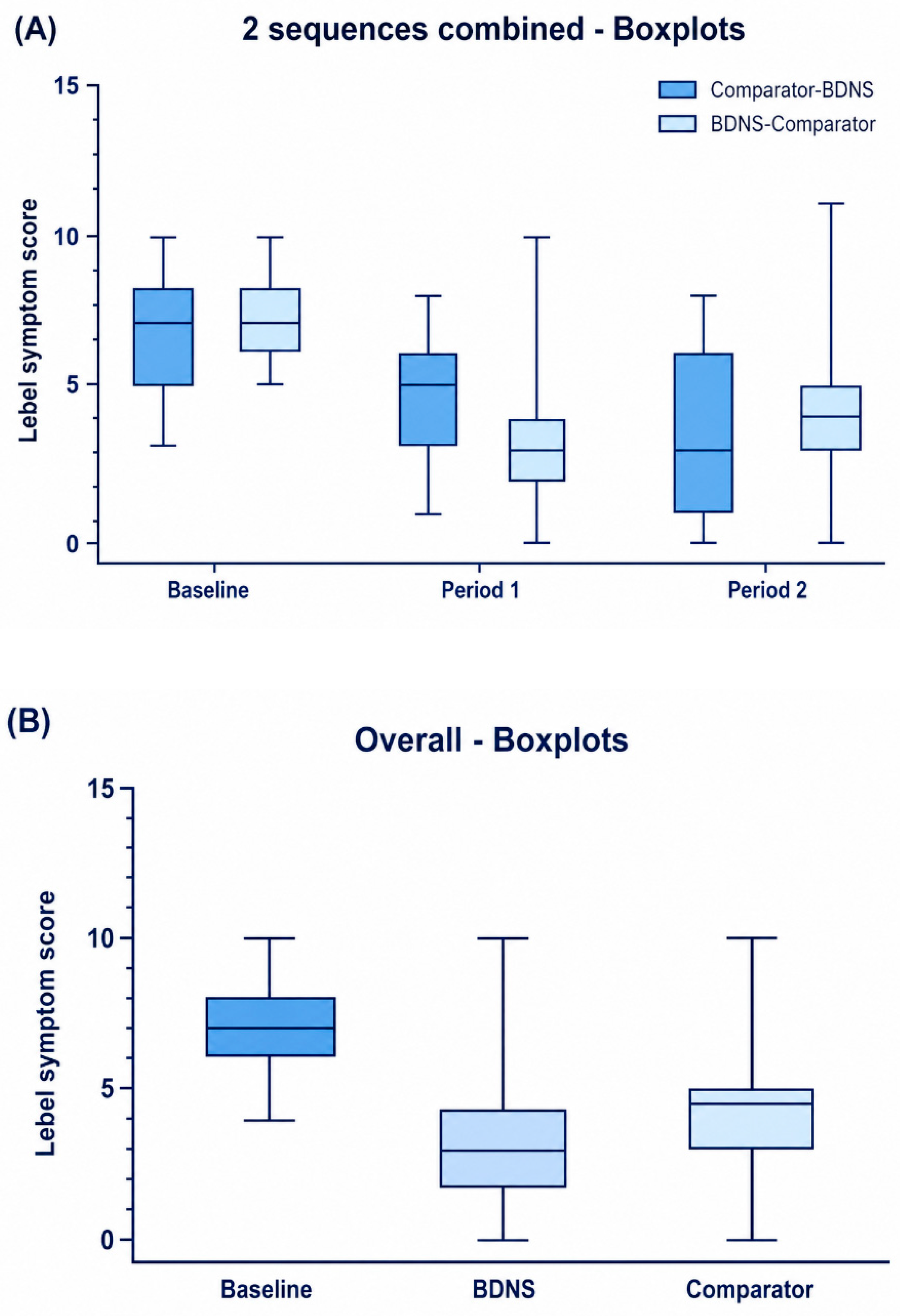
Figure 3.
Overall treatment preference at the final study visit in the randomised set. Preference data were not documented for one participant.
Figure 3.
Overall treatment preference at the final study visit in the randomised set. Preference data were not documented for one participant.
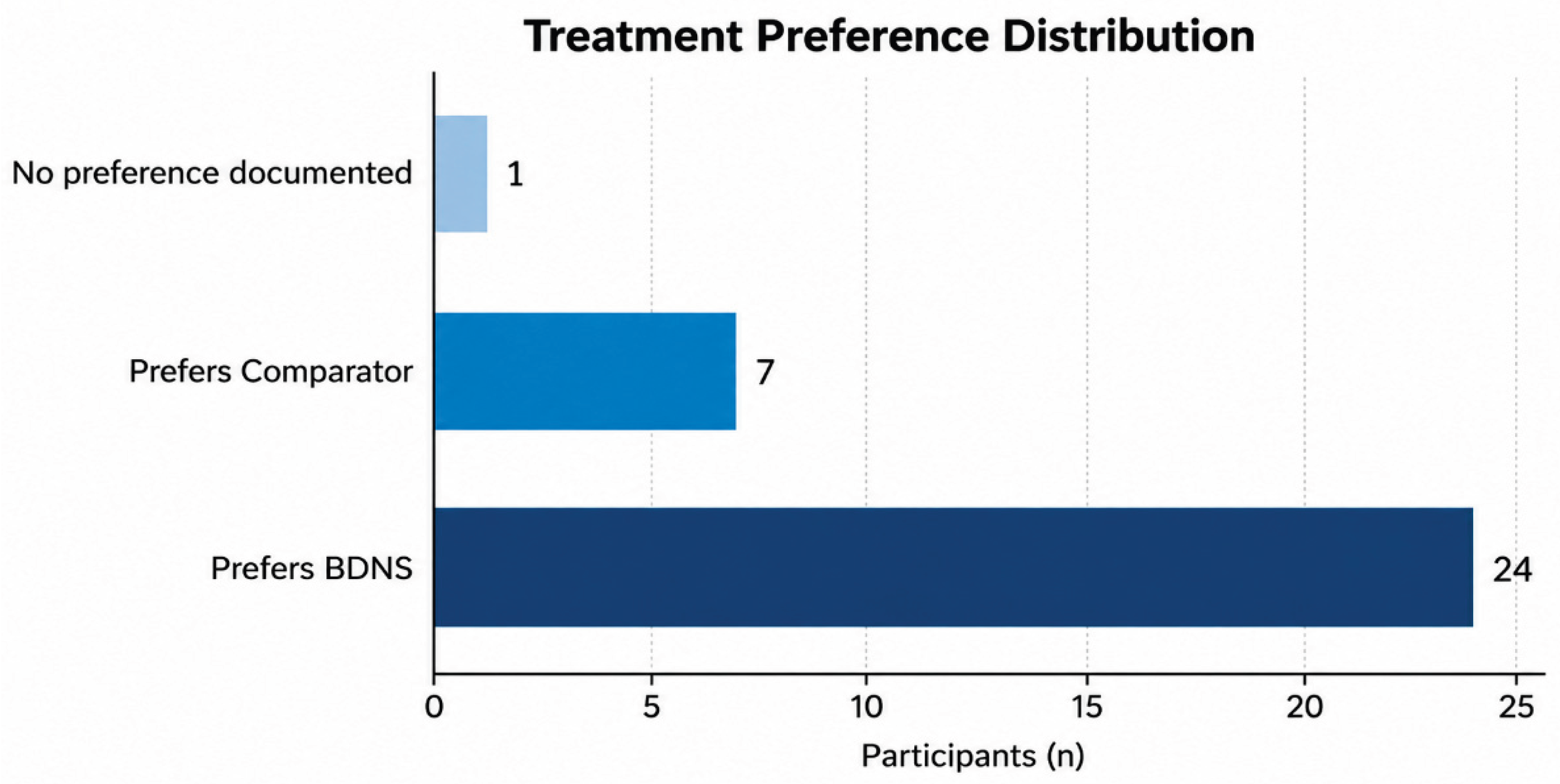
Table 1.
Mixed-model analysis of the Lebel Symptom Score after each 7-day treatment period.
| Analysis set | N | BDNS, LS mean (SE) | Comparator, LS mean (SE) | Treatment difference, BDNS minus comparator (95% CI) | Cohen's d (90% CI) | p value |
| Per-protocol set | 30 | 3.33 (0.44) | 4.30 (0.44) | −0.97 (−1.81 to −0.13) | −0.397 (−0.674 to −0.120) | 0.026 |
| Randomised set | 32 | 3.47 (0.44) | 4.34 (0.44) | −0.87 (−1.68 to −0.07) | −0.351 (−0.610 to −0.093) | 0.033 |
CI, confidence interval; LS mean, least-squares mean; SE, standard error. Negative treatment differences and negative Cohen's d values favour BDNS. Non-inferiority was assessed against a prespecified margin of Cohen's d = 0.25. The p values refer to the treatment effect from the linear mixed-effects model.
Table 2.
Mixed-model analysis of individual symptom scores after each 7-day treatment period in the randomised set.
Table 2.
Mixed-model analysis of individual symptom scores after each 7-day treatment period in the randomised set.
| Symptom | BDNS, LS mean (SE) | Comparator, LS mean (SE) | Treatment difference, BDNS minus comparator (95% CI) | Cohen's d | p value |
| Sneezing | 0.59 (0.21) | 0.81 (0.21) | −0.22 (−0.65 to 0.21) | −0.187 | 0.308 |
| Nasal itching | 0.78 (0.14) | 1.03 (0.14) | −0.25 (−0.57 to 0.07) | −0.320 | 0.124 |
| Rhinorrhoea | 0.66 (0.12) | 0.81 (0.12) | −0.16 (−0.46 to 0.14) | −0.226 | 0.296 |
| Nasal obstruction | 1.22 (0.20) | 1.41 (0.20) | −0.19 (−0.62 to 0.24) | −0.166 | 0.382 |
| Ocular symptoms | 0.22 (0.08) | 0.28 (0.08) | −0.06 (−0.22 to 0.10) | −0.142 | 0.431 |
CI, confidence interval; LS mean, least-squares mean; SE, standard error. Negative treatment differences and negative Cohen's d values favour BDNS. Treatment differences were estimated using linear mixed-effects models with treatment and period as fixed effects and participant as a random effect.
Table 3.
Descriptive PNIF measurements before and after NPT.
| Assessment | n | Before NPT, mean (SD), L/min | After NPT, mean (SD), L/min | Within-assessment change, mean (SD), L/min |
| Baseline, no treatment | 10 | 110.0 (72.69) | 82.0 (51.22) | −28.0 (27.41) |
| After BDNS treatment | 10 | 101.0 (47.48) | 86.0 (42.02) | −15.0 (11.06) |
| After comparator treatment | 10 | 115.5 (73.73) | 90.0 (43.40) | −25.5 (41.80) |
NPT, nasal allergen provocation test; PNIF, peak nasal inspiratory flow; SD, standard deviation. The within-assessment change was calculated as the PNIF value after NPT minus the value before NPT. Negative values indicate a reduction in PNIF following nasal allergen provocation.
Table 4.
Mixed-model analysis of nasal sensory tolerability after the first supervised administration of each study treatment.
Table 4.
Mixed-model analysis of nasal sensory tolerability after the first supervised administration of each study treatment.
| NSSS outcome | BDNS, LS mean (SE) | Comparator, LS mean (SE) | Treatment difference, BDNS minus comparator (95% CI) | Cohen's d | p value |
| Overall NSSS score | 87.26 (1.88) | 85.81 (1.88) | 1.45 (−1.43 to 4.33) | 0.136 | 0.312 |
| Lack of nasal irritation immediately after administration | 88.55 (2.24) | 85.80 (2.24) | 2.75 (−1.54 to 7.04) | 0.217 | 0.201 |
| Lack of nasal irritation 2 minutes after administration | 87.63 (1.89) | 85.80 (1.89) | 1.82 (−1.07 to 4.72) | 0.170 | 0.208 |
CI, confidence interval; LS mean, least-squares mean; NSSS, Nasal Spray Sensory Scale; SE, standard error. Positive treatment differences and positive Cohen's d values favour BDNS. Treatment differences were estimated using linear mixed-effects models with treatment and period as fixed effects and participant as a random effect.
Table 5.
Mixed-model analysis of participant satisfaction with perceived treatment effectiveness and tolerability in the randomised set.
Table 5.
Mixed-model analysis of participant satisfaction with perceived treatment effectiveness and tolerability in the randomised set.
| Satisfaction outcome | BDNS, LS mean (SE) | Comparator, LS mean (SE) | Treatment difference, BDNS minus comparator (95% CI) | Cohen's d (95% CI) | p value |
| Perceived effectiveness | 1.91 (0.17) | 1.22 (0.17) | 0.69 (0.21 to 1.17) | 0.730 (0.240 to 1.220) | 0.007 |
| Tolerability | 2.53 (0.14) | 1.72 (0.14) | 0.81 (0.40 to 1.22) | 1.018 (0.528 to 1.508) | <0.001 |
CI, confidence interval; LS mean, least-squares mean; SE, standard error. Higher scores indicate greater satisfaction. Positive treatment differences and positive Cohen's d values favour BDNS. Treatment differences were estimated using linear mixed-effects models with treatment and period as fixed effects and participant as a random effect.
Disclaimer/Publisher’s Note: The statements, opinions and data contained in all publications are solely those of the individual author(s) and contributor(s) and not of MDPI and/or the editor(s). MDPI and/or the editor(s) disclaim responsibility for any injury to people or property resulting from any ideas, methods, instructions or products referred to in the content. |
© 2026 by the authors. Licensee MDPI, Basel, Switzerland. This article is an open access article distributed under the terms and conditions of the Creative Commons Attribution (CC BY) license (http://creativecommons.org/licenses/by/4.0/).
Copyright: This open access article is published under a Creative Commons CC BY 4.0 license, which permit the free download, distribution, and reuse, provided that the author and preprint are cited in any reuse.