
Submitted:
15 October 2026
Posted:
15 October 2026
You are already at the latest version
Abstract
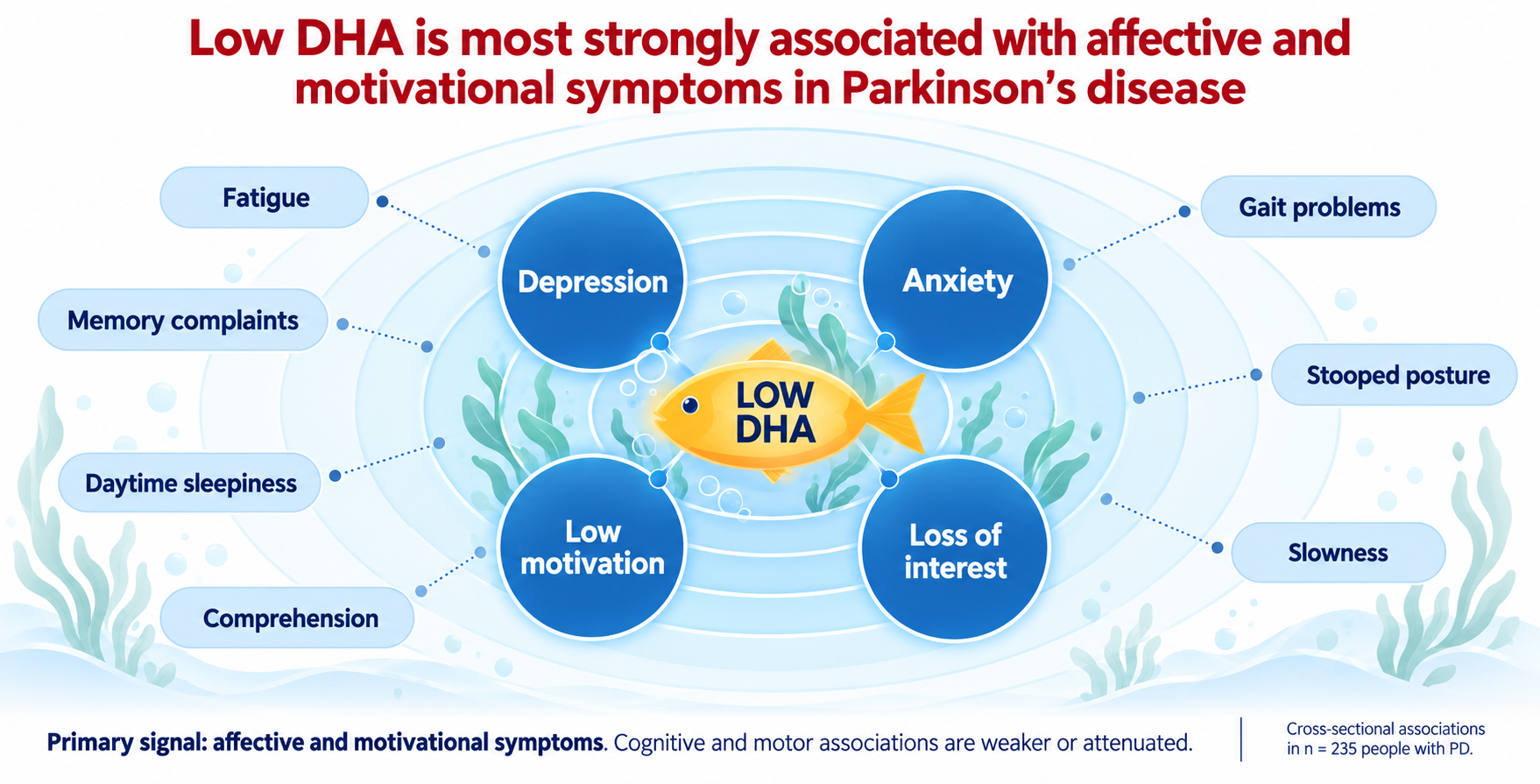
Non-motor symptoms drive much of the disability and quality-of-life loss in Parkinson's disease (PD), yet they remain poorly served by dopaminergic therapy. Omega-3 polyunsaturated fatty acids (n-3 PUFAs), principally eicosapentaenoic acid (EPA) and docosahexaenoic acid (DHA), are biologically plausible modifiers of these symptoms through effects on membrane composition, neurotransmission, and the resolution of inflammation, but the relationship between measured blood n-3 status and the PD symptom profile has not been systematically mapped. Methods: In a retrospective cross-sectional clinic cohort, patients with PD who completed a baseline Patient-Reported Outcomes in Parkinson's Disease (PRO-PD) assessment and a Cleveland HeartLab Parkinson's Disease Panel between 2019 and 2024 were analyzed (n = 235). Analyses proceeded in three tiers: (i) an agnostic correlation screen of the full blood panel against total PRO-PD; (ii) symptom-resolved linear models of each fatty-acid marker against each of the 35 PRO-PD items, adjusted for age, gender, and years since diagnosis; and (iii) categorical below/normal/above models using laboratory reference windows. Results: Omega-3 Total and OmegaCheck were among the strongest negative correlates of total PRO-PD across the entire blood panel (ρ = −0.19, p = 0.01), while the arachidonic acid (AA)/EPA and omega-6: omega-3 ratios were among the strongest positive correlates (ρ = 0.22 and 0.19). Symptom-resolved mapping localized this signal: the largest and most consistent associations fell in the affective (anxiety, depression), motivational (loss of interest, motivation), and cognitive (memory, comprehension) domains, with comparatively sparse associations across cardinal motor items. DHA showed the largest effect estimates (e.g., depression β = −4.82, p = 0.0005; loss of interest β = −5.37, p = 0.0003). Conclusions: In this clinic cohort, low blood n-3 status was associated with greater symptom burden, and that burden was concentrated in neuropsychiatric rather than motor domains. Findings are cross-sectional and do not establish that supplementation improves symptoms; they do identify the endpoints on which interventional trials are most likely to detect an effect.
Keywords:
Parkinson disease
; omega-3 polyunsaturated fatty acids
; eicosapentaenoic acid (EPA)
; docosahexaenoic acid (DHA)
; OmegaCheck
; patient-reported outcomes
; depression
; anxiety
; apathy
; cognition
; neuroinflammation
Copyright: This open access article is published under a Creative Commons CC BY 4.0 license, which permit the free download, distribution, and reuse, provided that the author and preprint are cited in any reuse.