
Submitted:
14 October 2026
Posted:
15 October 2026
You are already at the latest version
Abstract
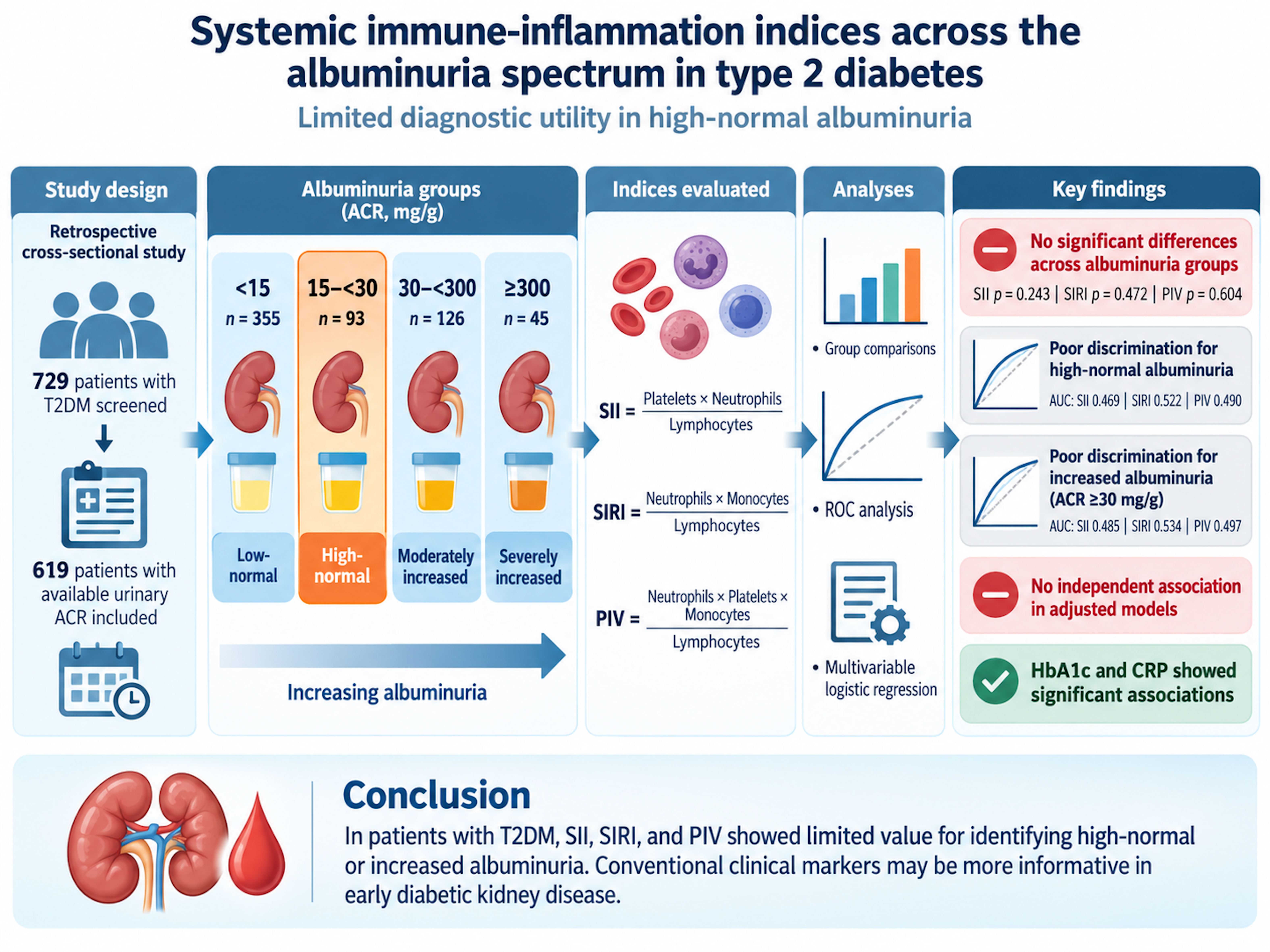
Background and objectives: Systemic inflammation has been implicated in diabetic kidney disease; however, the relationship between composite inflammatory indices and high-normal albuminuria remains unclear. This study investigated the associations of the systemic immune-inflammation index (SII), systemic inflammation response index (SIRI), and pan-immune-inflammation value (PIV) with albuminuria across its spectrum, particularly within the high-normal range, in patients with type 2 diabetes mellitus (T2DM). Methods: This retrospective, cross-sectional study included 619 patients with T2DM and available urinary albumin-to-creatinine ratio (ACR) measurements. Patients were categorized into four groups according to ACR: <15, 15–<30, 30–<300, and ≥300 mg/g. Associations between inflammatory indices and albuminuria were assessed using group comparisons, receiver operating characteristic (ROC) analyses, and multivariable logistic regression adjusted for age, HbA1c, diabetes duration, and C-reactive protein (CRP). Sensitivity analyses excluding CRP were also performed. Results: Of the 619 patients, 355 had ACR <15 mg/g, 93 had high-normal albuminuria, 126 had ACR 30–<300 mg/g, and 45 had ACR ≥300 mg/g. SII, SIRI, and PIV did not differ significantly across albuminuria groups (p=0.243, p=0.472, and p=0.604, respectively). Their discriminatory performance for high-normal albuminuria was poor (AUCs: 0.469, 0.522, and 0.490, respectively). Similarly, discrimination of ACR ≥30 mg/g was limited (AUCs: 0.485, 0.534, and 0.497, respectively). None of the indices was independently associated with increased albuminuria in adjusted models or sensitivity analyses. In contrast, HbA1c and CRP showed significant associations in the primary models. Conclusions: SII, SIRI, and PIV showed limited discriminatory value for high-normal or increased albuminuria in patients with T2DM. Conventional metabolic and inflammatory parameters may provide more relevant information than these composite indices in this setting.
Keywords:
systemic immune-inflammation markers
; diabetic nephropathy
; microvascular complications
; albuminuria
; Urinary albumin-to-creatinine ratio (UACR)
Copyright: This open access article is published under a Creative Commons CC BY 4.0 license, which permit the free download, distribution, and reuse, provided that the author and preprint are cited in any reuse.