

Submitted:
12 October 2026
Posted:
15 October 2026
You are already at the latest version
Abstract
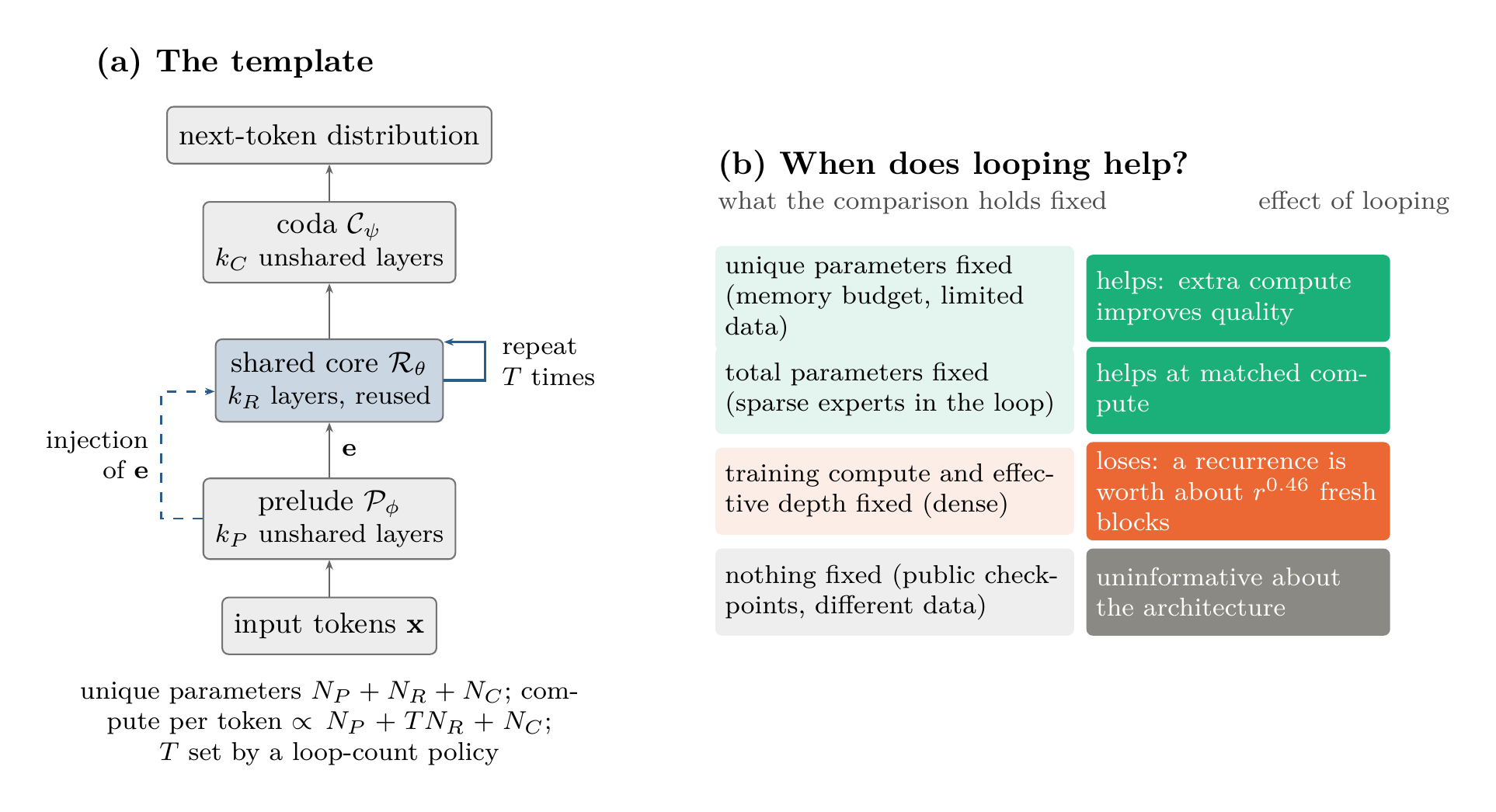
Looped language models apply one shared block of Transformer layers repeatedly to the same tokens. Their effective depth, the number of layer applications per token, can grow without adding parameters and can be chosen at inference time. Recurrent depth is thus a way to scale test-time compute in latent space instead of in generated tokens. The idea appears under many names, including looped Transformers, LoopLMs, recurrent-depth models, Universal Transformers, Mixture-of-Recursions, and recursive reasoning models such as HRM and TRM. In two years it has moved from synthetic tasks to open models such as Huginn and Ouro and to pretraining on up to 28 trillion tokens. According to press reports, it is also used in a frontier-lab model. Its literature has split across architecture, training, systems, theory and safety. We present the first survey dedicated to looped language models, built on a systematic corpus of 557 core papers screened from 7,323 candidates. We introduce a unified prelude–core–coda formalism that makes explicit how parameters, compute, memory and depth are counted. We organize the field from design, training and scaling to inference systems, theory, mechanisms, capabilities, other modalities and safety. A meta-analysis classifies 822 verified empirical claims by comparison regime. It shows that most apparent contradictions about whether “a recurrence is worth a layer” come from comparing parameter-matched with compute-matched results. The evidence fits one reading, in which a recurrence is worth less than a fresh block of parameters. Looping therefore helps when parameters are the limiting resource and hurts when it replaces them at fixed compute. We derive a research agenda from measured gaps, including the absence of work on robustness, alignment and privacy. We release the corpus, the extraction records with verbatim evidence for every number, and the claims ledger.
Keywords:
looped language models
; recurrent depth
; universal transformers
; parameter sharing
; adaptive computation
; test-time compute
; survey
Copyright: This open access article is published under a Creative Commons CC BY 4.0 license, which permit the free download, distribution, and reuse, provided that the author and preprint are cited in any reuse.