
Submitted:
16 October 2026
Posted:
20 October 2026
You are already at the latest version
Abstract
Within the framework of predictive coding, language comprehension is conceptualized as a process of probabilistic inference, wherein comprehenders leverage contextual priors to anticipate upcoming input. However, the extent to which this process is modulated by extralinguistic factors-specifically emotional valence and individual differences in empathy remains a subject of debate. Using eye-tracking, the present study examined the interplay of contextual constraint, target predictability, and verb valence in Chinese sentence reading, with trait empathy modeled as a key moderator. The results demonstrated a robust contextual predictability effect driven predominantly by facilitation, with a notable absence of canonical prediction-error costs for unpredictable words in high-constraint contexts. This pattern lends support to graded pre-activation accounts over rigid lexical prediction mechanisms. Crucially, the findings reveal that emotional valence and empathy modulate reading dynamics via functionally dissociable mechanisms. Emotional valence primarily regulated information-sampling heuristics rather than altering the speed of lexical access per se. In contrast, exploratory analyses suggested that trait empathy may be associated with differences in later eye-movement patterns: high-empathy individuals showed reduced skipping and longer late-stage processing under high uncertainty, whereas low-empathy individuals showed delayed processing costs during late integration. These findings suggest that predictive processing in Chinese is supported by probabilistic semantic constraints and is not a monolithic mechanism, but rather is dynamically shaped by the reader’s socio-cognitive profile and the affective properties of the context.
Keywords:
predictive processing
; contextual predictability
; prediction error
; emotional valence
; empathy
1. Introduction
Within the predictive processing (PP) framework (Clark, 2013; Friston, 2010), language comprehension is conceived as a process of probabilistic inference: readers form expectations about upcoming input on the basis of the current context, linguistic knowledge, and prior experience, and integrate top-down predictions with bottom-up evidence to enhance processing efficiency (Huettig, 2015; Kuperberg & Jaeger, 2016; Pickering & Gambi, 2018). A substantial body of research shows that readers/listeners draw on lexico-syntactic constraints, discourse context, world knowledge, and speaker-related information to generate anticipations about subsequent words and structures at multiple levels (Altmann & Kamide, 1999; Hagoort et al., 2004; Nieuwland & Van Berkum, 2006; Ryskin et al., 2016; Ryskin & Nieuwland, 2023; Van Berkum et al., 2005). In reading research, predictability is typically operationalized as contextual probability (e.g., cloze probability) and reliably modulates eye-movement behavior: compared with low-constraint contexts, target words in high-constraint contexts tend to receive shorter fixation durations and are more likely to be skipped (Ehrlich & Rayner, 1981; Li & Pollatsek, 2020; Rayner & Well, 1996; Rayner et al., 2005; Schotter et al., 2015; Zeng et al., 2025).
Importantly, many predictability effects should not be equated with prediction per se; rather, they are more likely to reflect downstream consequences when predictions are confirmed or disconfirmed (Cheimariou & Morett, 2024; Nieuwland, 2019; Van Petten & Luka, 2012; Xu et al., 2023, 2024). In the present paper, we therefore distinguish predictability-driven facilitation from prediction-error-related costs. The latter is often discussed within predictive-coding accounts in terms of prediction error (PE). From a predictive-coding perspective, when the input mismatches prior expectations, error signals propagate up the hierarchy to update the internal generative model and optimize future predictions (Friston, 2010; Hohwy, 2013). Accordingly, unexpected or anomalous continuations, relative to expected ones, are often accompanied by larger N400 amplitudes, additional late positivities, as well as behavioral indices such as prolonged fixation durations and increased regression rates (DeLong & Kutas, 2020; Van Berkum et al., 2005; Van Petten & Luka, 2012). A key controversy, however, concerns whether readers must necessarily show a robust prediction-error cost when a strongly constraining context supports a particular continuation, yet the encountered word remains semantically integrable but is not the most probable continuation. The lexical-prediction account posits that in highly constraining contexts readers generate an approximately all-or-none prediction for a specific lexical item; when the input deviates from that item, the pre-activated prediction must be suppressed and the actually presented word processed instead, thereby incurring additional costs. By contrast, the semantic-prediction account (Luke & Christianson, 2016; Staub, 2015) proposes that readers are more likely to activate multiple candidate representations or semantic features in parallel with different weights, rather than committing to a single lexical item. On this view, even if the most likely word does not occur, as long as the input falls within the pre-activated semantic space, a high-constraint context may still provide a semantic frame that supports efficient processing, such that a stable PE cost is not obligatory. To put it differently, it remains an open empirical question whether the predictive mechanism in language comprehension is better characterized as a strong, near-deterministic prediction of a single lexical item, or as graded pre-activation over a set of plausible candidates. This distinction needs to be adjudicated using evidence drawn from paradigms that approximate natural reading. The issue is particularly pressing for Chinese, a writing system that differs markedly from alphabetic scripts in visual processing demands and the availability of explicit word-boundary cues, yet for which research on predictive processing remains relatively sparse. To date, only a small number of studies in Chinese have adopted paradigms broadly comparable to that of Frisson et al. (2017), and these studies have not observed reliable prediction-error costs (Chang et al., 2023, 2024; Zhao et al., 2021). Their findings therefore tend to favor accounts in which prediction is implemented primarily at the semantic level and/or via graded pre-activation, rather than via a strong lexical prediction mechanism. It is important to note that the absence of a prediction-error cost can itself be taken as one line of evidence for semantic prediction, while semantic relatedness-based facilitation (Federmeier & Kutas, 1999; Kutas & Hillyard, 1984; Roland et al., 2012) constitutes a central diagnostic signature of this view. Building on this prior work, the present study further tests whether semantic related facilitation emerges in Chinese reading, and characterizes its behavioral manifestations.
Beyond prediction, emotional information is also assumed to systematically shape attentional allocation and language processing (Ding et al., 2019; Fabry, 2021; Fan et al., 2012; Kazanas & Altarriba, 2016; Knickerbocker et al., 2019; Schupp et al., 2007). Previous research indicates that emotion words are more likely than neutral words to capture attention and to influence processing speed and memory performance. This advantage may arise either from prioritized processing driven by emotional salience or from competition for cognitive resources imposed by evaluative systems (Bradley & Lang, 1999; Kissler et al., 2007). At the level of emotion-prediction interactions, the literature has yet to converge on a consistent conclusion. On the one hand, according to the broaden-and-build theory, positive affect may broaden the scope of attention and enhance cognitive flexibility (Fredrickson, 2004). This, in turn, could attenuate strongly constraining expectations for a specific lexical continuation, or facilitate more flexible semantic integration when predictions are violated (see work linking prediction to cognitive flexibility; e.g., Federmeier, 2002). On the other hand, negative affect is often associated with heightened vigilance, risk appraisal, and attentional narrowing (Unkelbach et al., 2008), which may prompt readers to adopt a more conservative processing mode-raising the verification threshold for bottom-up input evidence and relying more heavily on the actual sensory signal (Schacht & Sommer, 2009). Accordingly, the influence of emotional valence is likely not limited to modulating processing speed; more fundamentally, it may shift the allocation of cognitive resources between reliance on prior-based prediction and reliance on sensory input, thereby systematically shaping how predictions are externalized into concrete oculomotor behaviors such as skipping and regressions during reading.
Importantly, prediction-and emotion-related effects are unlikely to be uniform across readers. A growing body of discourse-processing research suggests that reading involves not only maintaining a coherent situation model but also an affect-laden social-cognitive experience in which readers simulate characters’ experiences, adopt perspectives, and generate empathic responses (e.g., SPaCEN; Mar, 2018; see also Tong, Li, & Chen, 2023). Empathy is a multidimensional capacity spanning cognitive components (e.g., perspective taking and mental-state inference) and affective components (e.g., emotional sharing), and it varies both as a stable trait and as a momentary state (Gladstein, 1983; Singer, 2006). From this perspective, empathy may shape how strongly readers attend to contextual cues and how richly they construct context-based priors during comprehension. Mechanistically, empathic engagement can be elicited through multiple routes during reading (e.g., linguistic and rhythm-based foregrounding, scene/event simulation, and self-referential appraisal), which jointly influence attentional allocation and the depth of immersion (Jacobs, 2015; Tong, Li, & Chen, 2023). Empirical support for such modulation comes from recent time–frequency analyses of social information processing. For instance, Proverbio and Scognamiglio (2025) demonstrated that empathic traits distinctively alter EEG oscillatory dynamics during the interpretation of non-verbal social cues. Specifically, they found that compared to low-empathy individuals, those with high trait empathy exhibited increased frontal beta-band activity (linked to top-down attentional control) and reduced occipito-parietal alpha power (reflecting heightened sensory engagement and reduced cortical inhibition). These neural patterns suggest that high-empathy individuals deploy greater attentional and cognitive resources to decode social signals, thereby facilitating superior mental state inference independent of sensorimotor mirroring mechanisms. Consequently, individual differences in empathy may modulate predictive processing not only in overall magnitude but also in its temporal dynamics and behavioral manifestations.
Against this backdrop, the present study employs eye-tracking to investigate these dynamics using a three-condition design comprising high-constraint predictable (HCP), high-constraint unpredictable (HCU), and low-constraint unpredictable (LCU) conditions. Rather than constituting a fully crossed factorial manipulation of contextual constraint and target predictability, the design is evaluated through two theoretically motivated planned contrasts. The first contrast (HCP vs. HCU) examines the effect of target predictability within high-constraint contexts, whereas the second contrast (HCU vs. LCU) examines the effect of contextual constraint for unpredictable targets and tests whether high constraint imposes an additional processing cost when the strongly expected continuation is not encountered. Verb valence is additionally manipulated as an emotional cue, and trait empathy is incorporated as a categorical individual-difference variable. Accordingly, we address three core questions: (1) whether predictable targets exhibit processing facilitation relative to unpredictable targets within high-constraint contexts; (2) whether, among unpredictable targets, high-constraint contexts produce greater processing costs than low-constraint contexts, as would be expected under a strong lexical-prediction account, or instead provide facilitative contextual support consistent with graded pre-activation; and (3) whether verb valence and trait empathy modulate these contrast-specific processing patterns, particularly in terms of information-sampling behavior and the temporal dynamics of integration.
2. Method
Ethics Statement
This study was conducted in accordance with the principles of the Declaration of Helsinki. All participants provided written informed consent prior to their participation.
Participants
A total of 69 native Chinese speakers (M = 20.30, SE = 0.16, range = 18-25, 7 males) were initially recruited from a local university. Six participants (5 females, 1 male) were excluded according to the data-quality criteria described below. The final analytic sample therefore consisted of 63 participants (M = 20.17, SE = 0.15, range = 18-25, 6 males). All participants reported being in good health, with normal or corrected-to-normal vision, no color-vision deficiencies, and no history of language impairment, reading difficulties, or other learning disorders. Participants provided written informed consent prior to the experiment and were compensated 40 CNY for their participation. The sample size was determined based on standard practices in eye-tracking reading research (e.g., Zhao et al., 2021; Chang et al., 2023) and recommendations for sufficient observations in linear mixed-effects models (Brysbaert & Stevens, 2018). We further assessed participants’ empathy using the Chinese version of the Interpersonal Reactivity Index (IRI-C; Zhang et al., 2010). The scale uses a 5-point rating format (0 = strongly disagree, 4 = strongly agree), with higher total scores indicating greater empathic ability, and possesses good psychometric properties in university student populations (Wang et al., 2023). Based on the IRI-C total-score cutoff, participants with IRI-C > 64 were assigned to the high-empathy group, whereas those with IRI-C ≤ 64 were assigned to the low-empathy group. The final analytic sample included 32 participants (2 males) in the high-empathy group (M = 70.06, SE = 0.80) and 31 participants (4 males) in the low-empathy group (M = 52.52, SE = 1.48). A Welch independent-samples t test confirmed that the two groups differed significantly in IRI-C scores, t(46.15) = 10.42, p < .001, Cohen’s d = 2.65, 95% CI [14.16, 20.94].
Stimuli and Design
Participants were required to read experimental materials containing the critical target noun. The stimuli were drawn from the Chinese Affective Words System (CAWS; Wang et al., 2008). In total, 180 two-character verbs were selected, including 90 positive and 90 negative verbs. All sentences followed the same syntactic template to ensure internal consistency across materials. Each sentence consisted of a lead-in context, a verb, and a noun. We constructed 90 item sets for the main experiment. Contextual constraint was manipulated by varying the first clause, and the second clause contained (mid-sentence) either a predictable or an unpredictable target noun together with a verb of either positive or negative valence. Importantly, within each constraint condition (high vs. low), the portion of context preceding the manipulation was held constant. As noted in the Introduction, we implemented two planned contrasts to derive (i) the contextual predictability effect (high-constraint predictable vs. high-constraint unpredictable; HCP-HCU) and (ii) the prediction error cost effect (high-constraint unpredictable vs. low-constraint unpredictable; HCU-LCU). The same target noun was used in the HCU and LCU conditions within each item set, thereby holding the lexical properties of the target noun constant in the prediction-error contrast. The second contrast-comparing unpredictable nouns in high-constraint contexts with unpredictable nouns in low-constraint contexts-was of primary theoretical interest, as it directly tests for a prediction error cost. In addition, by incorporating both verb valence and participants’ empathy, we further examined how emotional valence relates to the putative prediction error cost. In total, 540 sentences were created, corresponding to six versions of each item set: positive-HCP, positive-HCU, positive-LCU, negative-HCP, negative-HCU, and negative-LCU. Example stimuli are provided in Table 1.
A total of 27 undergraduate students who did not take part in the verb affective-rating task or the main experiment completed a noun cloze test (M = 20.11, SE = 0.32, range = 18-23, 3 males). Because the present design jointly manipulated predictability (high vs. low) and verb valence (positive vs. negative), cloze probabilities were computed separately for the two valence versions during materials selection. Target-noun predictability was indexed as the proportion of participants who produced the target noun out of the total sample. According to the selection criteria, predictable nouns had cloze probabilities above 67%, whereas unpredictable nouns had cloze probabilities below 17%. In the final set of 90 noun pairs, the mean cloze probability was 0.828 (SE = 0.025) for predictable nouns and 0.169 (SE = 0.002) for unpredictable nouns. A paired-samples t-test confirmed that the difference between the two noun types was highly significant, t(89) = 42.987, p < .001, Cohen’s d = 4.53, 95% CI [0.629, 0.690]. To rule out lexical-level confounds, we further compared word frequency (Cai & Brysbaert, 2010) between the high-predictability nouns and their matched low-predictability counterparts. This difference was not significant, t(89) = 1.198, p = .234, Cohen’s d = 0.13, 95% CI [-10.29046, 41.54490]. To further characterize the materials, an independent norming study assessed the semantic relatedness between the HCP and HCU target nouns and the contextual fit of the HCU target nouns (Jin et al. 2025). Forty independent raters (16 male; age: M = 20.63 years, SD = 1.41, range = 18-24) completed the semantic-relatedness task, yielding 3,550 valid ratings out of 3,600 responses after attention-check and response-time screening (98.6%). At the item level, the mean semantic-relatedness rating between HCP and HCU target nouns was 4.07 (SD = 0.92), indicating a moderate semantic association between the two target types. Contextual fit was evaluated by 120 independent raters (48 male; age: M = 20.71 years, SD = 1.52, range = 18-25) assigned to four lists, yielding 10,636 valid ratings out of 10,800 responses (98.5%). Using the same HCU target noun within each item set, contextual-fit ratings were higher in HCU contexts (M = 3.68, SD = 0.67) than in LCU contexts (M = 2.56, SD = 0.67). The mean item-level HCU–LCU difference was 1.12 points (SD = 0.36; dz = 3.10), indicating that high-constraint contexts more strongly supported the integration of the HCU target noun than low-constraint contexts. Semantic relatedness was only weakly associated with the item-level HCU–LCU contextual-fit difference (r = .04). Accordingly, semantic relatedness was retained as an item-level characteristic for subsequent eye-movement analyses, while its correlations with cloze probability, contextual fit, and other lexical variables should be examined before simultaneous inclusion in the final model.
Twenty participants (M = 20.4, SE = 0.23, range = 19-23, 5 males) re-rated the verbs for emotional valence and arousal using a 7-point Likert scale (1 = most negative/low arousal, 4 = neutral/moderate arousal, 7 = most positive/high arousal). A one-way ANOVA revealed a significant main effect of word type on valence, F(1, 178) = 609.4, p < 0.001, η2p = 0.77. Post-hoc comparisons showed that positive verbs were rated as significantly more pleasant than negative verbs (positive: M = 5.63, SE = 0.039; negative: M = 2.67, SE = 0.047), 95% CI [-3.197, -2.723], p < .001. For arousal, the main effect of word type was not significant, F(1, 178) = 0.069, p = 0.793, indicating no reliable difference in arousal ratings between positive and negative verbs. We also matched the verbs on lexical frequency (Cai & Brysbaert, 2010), stroke count (whole word, first character, and final character), and total sentence length; the corresponding descriptive statistics are reported in Table 2. One-way ANOVAs indicated no significant group differences on any of these variables (all ps > 0.161). Finally, using a Latin-square design, the 90 item sets were distributed across three lists. Each list contained 180 sentences, with 30 sentences in each of the six Valence × Contextual-Predictability cells. Equivalently, after collapsing across valence, each list contained 60 HCP, 60 HCU, and 60 LCU sentences, ensuring that no more than two sentences from the same item appeared within the same list.
In addition, 15 participants (M = 20.1, SE = 0.19, range = 19-22, all females) rated the acceptability of three versions of the materials (each version was evaluated by five raters). They were instructed to use a 7-point Likert scale to rate the acceptability of all 180 sentences (1 = highly unacceptable, 4 = moderately acceptable, 7 = highly acceptable). A one-way ANOVA revealed a significant effect of condition on acceptability ratings, F(2, 2697) = 42.75, p < .001. Pairwise comparisons showed that HCP sentences (M = 5.60, SD = 1.26) received significantly higher ratings than both HCU sentences (M = 5.14, SD = 1.24), p < .001, and LCU sentences (M = 5.10, SD = 1.34), p < .001. Crucially, acceptability did not differ significantly between the HCU and LCU conditions, p = .511. Thus, although predictable continuations were rated as more acceptable overall, the two conditions involved in the prediction-error contrast were matched on acceptability.
Apparatus
Stimuli were displayed on a 16-inch Lenovo monitor with a resolution of 1920 × 1080 pixels and a refresh rate of 100 Hz. Eye movements were recorded binocularly using a Tobii Pro Fusion eye tracker with a sampling rate of 250 Hz. The experiment was programmed and presented using Tobii Pro Lab, which also managed the synchronization with the eye tracker. To minimize head movement and ensure stable data quality, participants placed their heads on a chin rest adjusted for height. Participants were seated in a quiet, dimly lit room at a viewing distance of approximately 60 cm from the monitor. At this distance, each Chinese character (Song typeface, 36-point font) subtended approximately 1°of visual angle. All stimuli were presented in black ink on a plain white background.
Procedure
Participants were instructed to read the sentences, which were presented one at a time, at a normal pace for comprehension. Prior to beginning the experimental trials, a five-point horizontal calibration was performed along the same line used for sentence presentation. This calibration was accepted only when the spatial accuracy at all points reached ≤ 0.15°, ensuring that measurement error remain smaller than the width of one Chinese character (Inhoff & Radach, 1998). Following successful calibration, six practice trials were administered to familiarize participants with the procedure. During the main experiment, a validation check was conducted before each trial; if spatial accuracy fell below the established criterion, recalibration was performed to maintain high resolution. Each trial commenced with the presentation of a fixation cross (matching the width of one character) at the left margin of the screen. We employed a gaze-contingent display: once the participant maintained stable fixation on this cross for 500 ms, the target sentence was automatically presented, with the first character occupying the location of the fixation cross. After reading the sentence, participants were instructed to look at a termination cross located to the right of the sentence to end the trial. Following the sentence offset, a Yes/No comprehension question appeared in 40% of the trials to ensure attention. Participants responded by pressing the designated keys (F or J) on the keyboard. The experiment was divided into blocks with short breaks provided in between, and the entire session lasted approximately 30 minutes.
Data Pre-Processing
This study followed standard analytic practices in eye-movement research and, with reference to Zhao et al. (2021) regarding measure selection and reporting conventions, examined processing of the target word using multiple eye-movement measures. Gaze Duration (GD; the sum of all first-pass fixations on the target word) and Total Reading Time (TRT; the sum of all fixations on the target word across the entire trial) were specified as the primary dependent measures, capturing first-pass integration and later/global processing, respectively. First Fixation Duration (FFD; the duration of the first fixation landing on the target word during first pass) and Single Fixation Duration (SFD; the duration of the fixation when exactly one fixation occurred on the target word during first pass) were treated as supplementary duration measures. Skipping probability (SKIP; the probability that the target word received no fixation during first pass) and refixation probability (the probability of returning to the target word after leaving it) were treated as auxiliary oculomotor-control measures. The two planned contrasts were treated as confirmatory analyses: the contextual predictability contrast (HCP vs. HCU) and the prediction-error contrast (HCU vs. LCU). Other effects, including interactions involving verb valence and trait empathy, were treated as exploratory unless otherwise specified. All statistical analyses were conducted in R (R Development Core Team, 2016). Linear mixed-effects models (LMMs) and generalized linear mixed-effects models (GLMMs) were used, with crossed random-effects structures for participants and items (Barr et al., 2013). Continuous dependent variables were analyzed with LMMs, whereas binary outcomes were modeled using binomial GLMMs. Fixed-effects structures included predictability, verb valence, and their interactions. All categorical predictors were sum-to-zero coded (e.g., -0.5 vs. 0.5), so that main effects could be interpreted as effects averaged across the levels of the other factors. Model parameters were estimated with the lme4 package (Bates et al., 2015). For LMMs, p values and degrees of freedom were obtained using the lmerTest package with Satterthwaite’s approximation. When significant interactions (or theoretically motivated interaction trends) were observed, estimated marginal means and simple-effects comparisons were conducted using emmeans, with confidence intervals and effect directions reported as appropriate.
For model-fitting, we adopted the maximal random-effects structure approach (Barr et al., 2013). Specifically, the initial model included random intercepts for participants and items and, where possible, random slopes for theoretically relevant predictors. If the maximal model failed to converge, yielded singular fits, or showed clear overparameterization, the random-effects structure was progressively simplified (prioritizing removal of components with near-zero variance or highly correlated terms) until a stable, convergent, and interpretable model was obtained. Model comparison and selection were guided by the Akaike Information Criterion (AIC), with preference given to models with lower AIC and more parsimonious parameterization. To better satisfy model assumptions, given the typical right-skew distribution of fixation-duration measures, all duration-based dependent variables were log-transformed to improve residual normality and homoscedasticity, thereby enhancing the robustness of parameter estimation and significance testing.
3. Results
Accuracy answering the comprehension questions that followed sentences was high for all participants and did not differ across empathy groups (Low Empathy: M = 91.5%, SD = 4.3%; High Empathy: M = 92.1%, SD = 3.9%; t < 1, p > .50), indicating that both groups understood the sentences well.
Before statistical analysis, the data were cleaned and exclusions were applied according to pre-established criteria. Specifically, two participants from the high-empathy group were excluded because their gaze-sample rate was below 65%. An additional four participants from the low-empathy group were excluded because their blink rate exceeded three standard deviations above the sample mean. We also removed fixation records shorter than 80 ms or longer than 1200 ms, which accounted for 4.41% of the total data. Descriptive statistics are reported in Table 3.
Contextual Predictability Facilitation Effect
To examine the influence of contextual predictability on the processing of the target noun, we compared two high-constraint conditions: HCP and HCU. We also tested the main effects of verb valence and empathy, as well as their potential modulation of the contextual predictability effect. The results showed that, under high-constraint contexts, predictability yielded a robust facilitation effect across multiple duration-based measures, including first-fixation duration (FFD: b = 0.06, SE = 0.02, t = 2.70, 95% CI [0.015, 0.099]), single-fixation duration (SFD: b = 0.05, SE = 0.02, t = 2.17, 95% CI [0.004, 0.098]), gaze duration (GD: b = 0.07, SE = 0.03, t = 2.95, 95% CI [0.024, 0.124]), and total reading time (TRT: b = 0.12, SE = 0.02, t = 5.18, 95% CI [0.075, 0.169]). This pattern indicates that, within high-constraint contexts, when the target noun shifts from being predictable to unpredictable, readers incur greater processing costs during first-pass identification and initial integration, as well as in total reading time. With respect to valence, no reliable main effects emerged for the continuous duration measures (|t|s < 1.52), and the interactions between valence and predictability were non-significant across these measures (|t|s < 0.22), indicating that valence did not systematically alter the effect of contextual predictability on reading times. For eye-movement control measures, skipping probability showed significant main effects of both contextual predictability and valence: the main effect of predictability was significant (b = -0.30, SE = 0.11, z = -2.83, 95% CI [-0.507, -0.092]), indicating that, relative to the high-constraint predictable condition, the target word was less likely to be skipped in the high-constraint unpredictable condition; the main effect of valence was also significant (b = 0.23, SE = 0.11, z = 2.08, 95% CI [0.013, 0.452]), with an overall higher skipping probability in the positive-valence condition. The interaction between valence and predictability for skipping probability was not significant (z = -1.54, p = .12). For refixation probability, the main effect of valence was significant (b = -0.30, SE = 0.12, z = -2.42, 95% CI [-0.535, -0.056]), indicating that negative valence was associated with a higher likelihood of refixation; the main effect of predictability was not significant (z = 1.03, p = .30), and the interaction between valence and predictability was also not significant (z = 0.40, p = .69).
We further included empathy in the models to test whether it moderates the contextual predictability effect. The interactions between empathy and predictability were non-significant for all measures (|t/z|s < 1.47), suggesting that empathy did not reliably alter the magnitude of the facilitation associated with contextual predictability. Furthermore, no reliable main effects of empathy were observed for any of the eye-movement measures (|t/z|s < 1.52), indicating that reading behavior did not differ significantly as a function of empathy.
Contextual Constraint Effects on Unpredictable Nouns
To test whether unpredictable nouns elicit a prediction error cost under highly constraining contexts, we compared the low-constraint unpredictable and high-constraint unpredictable conditions, and examined whether this contrast was moderated by verb valence and trait empathy. Following the accounts of Frisson (2017) and Zhao et al. (2021), if a highly constraining context gives rise to a strong, specific lexical prediction, then encountering an unexpected word should disrupt processing. The results revealed significant differences between the two conditions on multiple early duration measures during first-pass processing, but the overall pattern was inconsistent with the prediction that high contextual constraint would yield a larger prediction-error cost. Specifically, processing in the LCU condition was significantly slower than in the HCU condition, as indicated by longer first-fixation duration (b = 0.06, SE = 0.02, t = 3.08, 95% CI [0.022, 0.102]), longer single-fixation duration (b = 0.16, SE = 0.02, t = 6.62, 95% CI [0.111, 0.205]), and longer gaze duration (b = 0.14, SE = 0.02, t = 5.54, 95% CI [0.087, 0.184]). By contrast, no significant difference was observed for total reading time (b = -0.03, SE = 0.02, t = -1.10, 95% CI [-0.070, 0.020]). Oculomotor control measures converged with this pattern: relative to the HCU condition, target words were less likely to be skipped in the LCU condition (b = -0.24, SE = 0.11, z = -2.06, 95% CI [-0.458, -0.012]) and more likely to be refixated (b = 0.34, SE = 0.11, z = 3.17, 95% CI [0.130, 0.551]).
Accordingly, for unpredictable input we did not observe the canonical prediction-error cost pattern in which a highly constraining context amplifies processing costs. Instead, the findings are more consistent with a graded prediction account: a highly constraining context does not necessarily require readers to commit to an all-or-none prediction of a single lexical form, but may instead yield a sharper probabilistic distribution and a more well-specified semantic frame (i.e., a smaller candidate space and lower uncertainty/entropy). Under such circumstances, even when the target noun itself has low cloze probability, it may still be partially pre-activated at the level of semantic features or category membership and receive integrative support, thereby reducing the processing burden associated with early confirmation and initial integration during first pass. By contrast, in low-constraint contexts the weaker constraints and more diffuse candidate space require readers to allocate greater early processing resources to lexical identification and semantic integration, resulting in longer FFD/SFD/GD as well as lower skipping and higher refixation rates. With respect to valence, neither the main effect of verb valence nor its interaction with the contextual contrast reached significance across measures (|t/z|s < 1.35), indicating that this constraint-related facilitation pattern was relatively stable and did not depend on verb valence in the present dataset.
After adding trait empathy to the model, no significant main effects of empathy were observed for any of the duration-based measures (FFD, SFD, GD, TRT: |t|s < 1.28). However, a significant main effect of empathy was found for skipping probability (b = -0.47, SE = 0.15, z = -3.21, p = .001), indicating that high-empathy individuals were generally less likely to skip target words. Crucially, regarding the moderation of the contextual contrast, the interaction between empathy and predictability was not significant for FFD, SFD, or GD (|t|s < 1.65), but it was significant for Total Reading Time (b = 0.11, SE = 0.04, t = 2.87, 95% CI [0.036, 0.191]). Decomposition of this interaction for TRT revealed a distinct pattern: the low-empathy group showed significantly longer TRT in the HCU condition compared to the LCU condition (b = 0.08, SE = 0.03, z = 2.61, p = .009), whereas TRT did not differ significantly between conditions in the high-empathy group (b = -0.03, SE = 0.03, z = -1.09, p = .28). Further examining empathy-group differences within conditions revealed that, in the LCU condition, TRT was significantly longer for the high-empathy than for the low-empathy group (b = 0.08, SE = 0.04, z = 2.33, p = .020), suggesting that under the higher uncertainty characteristic of low-constraint contexts, high-empathy participants may have engaged in more extensive late-stage integrative processing as is shown in Figure 1.
4. Discussion
The present study investigated predictive processing mechanisms in Chinese sentence reading. Specifically, we systematically examined how contextual predictability and emotional valence shape the processing of target nouns, while critically assessing the emergence of prediction-error costs and the modulatory role of trait empathy. Overall, the findings align with graded prediction accounts: the benefits conferred by context were expressed primarily as facilitation, rather than as a robust prediction-error cost. Furthermore, the influence of emotional valence was more evident in the modulation of oculomotor control and information-sampling strategies than in the alteration of lexical processing speed. Crucially, our results suggest that trait empathy may be associated with variation in the temporal dynamics of predictive processing, rather than functioning merely as a background characteristic. High-empathy individuals exhibited sensitivity to contextual cues during specific processing stages, whereas corresponding sensitivity in low-empathy individuals was delayed, manifesting primarily at later integrative stages.
Contextual Facilitation and Graded Pre-Activation
We first examined the effect of contextual predictability (i.e., HCP vs. HCU). The results showed that, relative to unpredictable targets, predictable nouns elicited significantly shorter first-fixation duration, gaze duration, single-fixation duration, and total reading time. This pattern indicates that readers can effectively capitalize on contextual information in highly constraining contexts, pre-activating the representation or semantic features of the upcoming noun and translating predictability differences into facilitation during online processing. This finding converges with previous Chinese eye-tracking evidence (e.g., Chang et al., 2023; Liu et al., 2020; Zhao et al., 2021) showing that high-constraint contexts prompt pre-activation before word onset, such that higher predictability yields faster lexical access and less effortful first-pass integration.
With respect to valence, we did not obtain consistent evidence in continuous duration measures (|t/z|s < 1.52), indicating that emotional valence did not systematically alter the speed of lexical identification or integration per se. In contrast, valence effects were pronounced in oculomotor control measures: the positive-valence condition showed an overall higher skipping probability, whereas negative-valence verbs were more likely to elicit refixations, suggesting an increased propensity to verify. These results imply that valence may primarily modulate readers’ willingness to rely on contextual priors and adjust their sampling strategy, rather than producing a uniform shift in lexical identification speed. This asymmetry can be further interpreted within the density hypothesis (Unkelbach et al., 2008) and Automatic Vigilance Theory (Estes & Adelman, 2008). The density hypothesis proposes that, compared with negative words whose representations are more dispersed, positive words are more clustered in memory and possess denser internal associations (Lench et al., 2011). Automatic Vigilance Theory similarly posits that negative stimuli attract attention more strongly and are harder to disengage from. Accordingly, when context strongly supports a particular target noun, positive-valence verbs may lead readers to perceive lower risk and sufficient certainty, encouraging a more economical first-pass strategy (i.e., skipping); by contrast, negative-valence verbs-given their greater representational dispersion and higher uncertainty-may raise the verification threshold and thereby suppress skipping while increasing refixations. Consistent with this interpretation, Fan et al. (2017), using an affective priming paradigm in Chinese, further showed that arousal influences but does not determine affective priming; priming is not purely an automatic spreading-activation effect, but may depend on task-driven consistency/competition in response tendencies. They also reported faster responses for positive words, possibly because positive affect promotes approach-oriented tendencies that facilitate response continuity (Jiang et al., 2012). Taken together, the present findings support the view that contextual predictability primarily facilitates lexical access and first-pass integration (as reflected in duration measures), whereas emotional valence more selectively shapes control behaviors-such as skipping and refixation-via the modulation of risk evaluation and verification thresholds.
Absence of High-Constraint Prediction-Error Cost
After establishing the facilitatory effect of contextual predictability, we next focused on unpredictable nouns and compared their processing under high- versus low-constraint contexts to test whether prediction error under strong constraint incurs an additional cost. The results indicated that a highly constraining context did not interfere with the processing of the unpredictable word that actually appeared: on early duration measures, unpredictable nouns were processed more slowly in low-constraint contexts, whereas processing was faster in high-constraint contexts. Moreover, this difference was largely confined to the initial integration stage and did not overall reliably spill over into later, global increases in total reading time (though see subsequent section for individual differences related to empathy). Oculomotor control measures showed the same pattern-reduced skipping and increased refixations in low-constraint contexts-suggesting that when contextual priors are insufficient, readers rely on more eye-movement sampling to compensate for missing information (Frisson et al., 2017). By contrast, even when a high-constraint context does not license a specific lexical item, it can still provide early semantic support; part of the required information can be supplied by contextual priors, thereby reducing the need for repeated verification of the target word and resulting in higher skipping rates and lower refixation rates. From the graded pre-activation perspective, readers do not commit to a single most likely lexical item; instead, they use contextual information to activate, in parallel, a set of candidate representations and/or semantic features with different weights (Staub, 2015). Accordingly, what a highly constraining context primarily provides is semantic support and a structured candidate space: it can reduce the computational demands involved in recognizing and initially integrating an unpredictable word, and it can also diminish subsequent verification needs. This pattern should manifest as shorter first-pass durations, higher skipping rates, and lower refixation rates. At the same time, because there is no obligatory process of first suppressing a uniquely predicted item that has been strongly activated, stable interference or processing costs are not necessarily expected. By contrast, under a strict lexical-prediction view, processing costs for unpredictable words should be more readily observed in highly constraining contexts (Chang et al., 2023; Zhao et al., 2021). Consistent with eye-movement evidence from alphabetic scripts (Frisson et al., 2017; Luke & Christianson, 2016), our data likewise did not show a canonical prediction-error cost: even when the target word is not the strongly predicted candidate, a highly constraining context can still supply a rich and coherent situation model and/or activate the relevant semantic field. This pattern suggests that readers’ predictions are more likely to operate via graded pre-activation rather than relying on serial, single-word lexical prediction. Notably, in Chinese this semantic support is reflected earlier, as reductions in early processing measures; by contrast, in alphabetic-script studies comparable contextual facilitation tends to emerge mainly in later, integration-related measures such as total fixation time.
In the analysis of contextual-constraint effects for unpredictable targets, we found no reliable evidence that verb valence stably moderated the constraint-related contrast: neither the main effect of valence nor its interaction with contextual constraint reached significance for any measure. This pattern suggests that the contextual facilitation observed in the present study-namely, the processing advantage under the HCU condition-was stable across the affective dimension. Specifically, it implies that the semantic frame and candidate-space structure provided by highly constraining contexts are relatively robust, and that their facilitating influence on early lexical identification did not vary as a function of verb valence. This finding is partly consistent with the account proposed by Ding et al. (2020). Distinguishing between a prediction stage and an integration stage, Ding et al. reported that emotional arousal primarily affects how pre-activation is deployed during prediction, whereas its modulatory influence is substantially attenuated during subsequent semantic integration (i.e., after noun onset). In other words, although affective cues may alter the allocation of predictive resources at an early stage, once processing enters lexical access and integration for a specific word, the top-down advantage conferred by contextual structure (Contextual Structure Benefit) becomes dominant, and emotional information no longer serves as a significant source of interference. Taken together, our results suggest that, when readers process unpredictable but grammatically licit input, the cognitive system prioritizes context-derived semantic cues to accelerate integration (Schacht & Sommer, 2009); this core mechanism appears relatively independent and is not readily disrupted by bottom-up influences of valence.
It is worth noting that, at the descriptive level (consistent with the pattern reported in Section 4.1), in low-constraint contexts positive (vs. negative) cues were often associated with shorter first-pass durations and a greater tendency to skip. This pattern accords with the Broaden-and-Build Theory (Fredrickson, 2004): when context fails to provide sufficiently strong priors, target-word identification relies more heavily on bottom-up lexical access. Under such circumstances, positive cues may function as safety signals, promoting a more heuristic and effort-saving processing mode, thereby yielding faster identification and higher skipping (Unkelbach et al., 2008). By contrast, negative cues may trigger a more analytic, vigilance-based mode of processing, prolonging fixation durations. In high-constraint contexts, however, even when item-level prediction fails, the semantic frame afforded by strong context still dominates early integration. According to Pessoa’s (2008, 2013) Dual Competition Model, cognitive and emotional processing draw on shared, limited neural resources, and high-intensity cognitive demands often suppress emotion-related processing. In the present study, prediction failure under high constraint likely elicited complex semantic revision and conflict monitoring. This high-load process would consume the majority of attentional resources and may induce load-dependent suppression, such that differences driven purely by lexical valence are weakened or masked by the processing demands of contextual integration.
Taken together, for unpredictable targets we did not find a robust pattern whereby high constraint yields an additional prediction-error cost. Instead, high constraint appears to provide semantic support/compensation for first-pass processing. This pattern is more compatible with graded pre-activation than with strong, single-word lexical prediction: contextual priors primarily reduce early verification demands by increasing the availability of a coherent semantic frame, while valence does not reliably add incremental costs or benefits at this level.
Empathy on Contextual Sensitivity
Building upon the contextual effects, we further explored the role of individual empathy. Contrary to the hypothesis that empathy would modulate early automatic prediction, we found no significant interaction between empathy and contextual constraint on early measures (FFD, SFD, GD). This suggests that the initial activation of semantic features and the early detection of prediction mismatch are relatively automatic processes shared by readers regardless of their empathy levels. However, distinct patterns emerged in oculomotor control and late-stage integration (TRT), indicating that empathy fundamentally alters reading engagement and information-sampling strategies rather than early lexical access speed. First, a robust main effect of empathy was observed on skipping probability: high-empathy individuals were significantly less likely to skip target words than low-empathy individuals. This aligns with the view that high empathy is associated with a tendency toward narrative immersion and simulation (Mar et al., 2011). High-empathy readers may adopt a cautious or deep processing strategy, allocating attention to every word to construct a vivid situation model, rather than employing a heuristic skimming strategy. Crucially, the modulatory effect of empathy on contextual utilization manifested in the late integration stage (Total Reading Time), revealing two distinct processing modes. For the low-empathy group, a delayed cost pattern was observed: while they processed HCU and LCU conditions similarly in early stages, they exhibited significantly longer TRT in the HCU condition compared to the LCU condition. This suggests that low-empathy readers may engage in shallower initial processing; when the unpredictable word appears in a highly constraining context, they might not immediately resolve the conflict. The disruption caused by the mismatch between the strong context and the unpredictable word (prediction error) lingers or is revisited during the wrap-up stage, requiring re-analysis to override the initial strong expectation. This is consistent with a shifting cost interpretation (Zhang et al., 2017), where the cognitive effort of suppressing invalid priors and updating the mental model is delayed until late integration.
In contrast, the high-empathy group showed no significant difference between the HCU and LCU conditions, suggesting that high-constraint mismatch did not produce additional late-stage costs in this group. However, a cross-group comparison revealed that in the LCU condition (where uncertainty is high), high-empathy readers spent significantly more time (longer TRT) than low-empathy readers. This result is particularly illuminating when viewed through the lens of Gernsbacher’s (1996) Structure Building Framework and simulation accounts. In low-constraint contexts (e.g., Some residents, due to a facility malfunction...), the lack of specific semantic cues may increase the need for additional inferential processing. High-empathy individuals, driven by a stronger motivation for coherence and perspective-taking, appear to voluntarily invest more cognitive resources to fill in these gaps, engaging in more extensive inference generation and foundation laying. This increased time investment in the LCU condition represents a strategic orientation toward deep integration-attempting to construct a coherent situational model even when the text is ambiguous-rather than a processing deficit.
In conclusion, the empathy-related findings should be interpreted as exploratory evidence that trait empathy may be associated with differences in late-stage integration and attentional engagement. Specifically, high-empathy readers showed a tendency toward more sustained processing under uncertainty, whereas low-empathy readers showed delayed costs when strong contextual expectations were violated. However, the present eye-movement data alone cannot establish whether these patterns reflect immersive reading strategies, shallow sampling, or other underlying mechanisms.
5. Conclusions
The present study used eye-tracking to investigate contextual predictability, emotional valence, and prediction-error-related processing in Chinese sentence reading, while further testing the moderating role of trait empathy. The results indicate that readers exploit contextual information to pre-activate upcoming semantic features, thereby facilitating lexical access and first-pass integration. High-constraint contexts primarily provide semantic-frame support and structure the candidate space, reducing the need for early confirmation of the target word rather than imposing a systematic penalty on unpredictable input. Furthermore, emotional valence appeared to modulate information-sampling strategies rather than altering the speed of lexical access per se. More broadly, predictive processing is shaped not only by contextual and lexical information but also by reader characteristics, specifically, trait empathy-which modulate strategic engagement and the depth of late-stage integration.
Several limitations should be noted. First, while eye-movement measures are sensitive to online sampling and control during reading, inferences about the precise neural time-course of processing stages remain indirect. Combining eye tracking with time-resolved and physiological measures-such as ERPs, pupillometry, or electrodermal activity-would help align prediction- and integration-related dynamics within the same materials and manipulations, providing a more direct test of stage-specific effects. Second, empathy was assessed using a trait questionnaire and was analyzed via high/low grouping. Given that empathy comprises partially dissociable components (e.g., cognitive vs. affective empathy) that may influence prediction and integration through different pathways, future work should treat empathy as a continuous predictor, report subscale-specific analyses, and incorporate additional individual-difference measures related to attentional control, anxiety/vigilance, and reading strategy. Finally, the final analytic sample was predominantly female, with only six male participants. Therefore, the empathy-related findings should not be generalized to gender-balanced populations without caution, and future studies should recruit a more gender-balanced sample. This would help determine whether the observed moderation primarily reflects social-cognitive modeling tendencies or more general differences in attention allocation and strategic sampling during reading.
Author Contributions
Chenglong Liu: Conceptualization, Methodology, Investigation, Formal analysis, Software, Writing-original draft.
Institutional Review Board Statement
This study was conducted in accordance with the principles of the Declaration of Helsinki. All participants provided written informed consent prior to their participation.
Informed Consent Statement
All participants gave informed written consent and were advised of their right of withdrawal.
Data Availability Statement
The data, analysis code, and models for all experiments are available online via the OSF data repository: https://osf.io/yjw3d/overview?view_only=300980fd99f84230b6b1b88f6f10ffe4. The reported experiment was not preregistered.
Conflicts of Interest
The authors declare that the research was conducted in the absence of any commercial or financial relationships that could be construed as a potential conflict of interest. None of the authors have a conflict of interest or compet-ing interests.
References
- Altmann, G. T., & Kamide, Y. (1999). Incremental interpretation at verbs: Restricting the domain of subsequent reference. Cognition, 73, 247-264. [CrossRef]
- Bar, M. (2007). The proactive brain: using analogies and associations to generate predictions. Trends in Cognitive Sciences, 11, 280-289. [CrossRef]
- Bar, M. (2009). The proactive brain: Memory for predictions. Philosophical Transactions of the Royal Society B: Biological Sciences, 364, 1235–1243. [CrossRef]
- Bar, M. (2011). Predictions in the brain: Using our past to generate a future. Oxford University Press.
- Barr, D. J. (2013). Random effects structure for testing interactions in linear mixed-effects models. Frontiers in Psychology, 4. [CrossRef]
- Barriga-Paulino, C. I., Guerreiro, M., Faísca, L., & Reis, A. (2022). Does emotional valence modulate word recognition? A behavioral study manipulating frequency and arousal. Acta Psychologica, 223, 103484. [CrossRef]
- Bates, D., Mächler, M., Bolker, B., & Walker, S. (2015). Fitting Linear Mixed-Effects Models Using lme4. Journal of Statistical Software, 67. [CrossRef]
- Briesemeister, B. B., Kuchinke, L., & Jacobs, A. M. (2014). Emotion word recognition: discrete information effects first, continuous later?. Brain Research, 1564, 62-71. [CrossRef]
- Brosch, T., Scherer, K., Grandjean, D., & Sander, D. (2013). The impact of emotion on perception, attention, memory, and decision-making. Swiss Medical Weekly, 143, w13786-w13786. [CrossRef]
- Brysbaert, M., & Stevens, M. (2018). Power analysis and effect size in mixed effects models: A tutorial. Journal of cognition, 1, 9. [CrossRef]
- Cai, Q., & Brysbaert, M. (2010). SUBTLEX-CH: Chinese word and character frequencies based on film subtitles. PloS one, 5, e10729. [CrossRef]
- Chang, M., Zhang, K., Sun, Y., Li, S., & Wang, J. (2023). The graded predictive pre-activation in Chinese sentence reading: Evidence from eye movements. Frontiers in Psychology, 14, 1136488. [CrossRef]
- Chang, M., Zhang, K., Sun, Y., Li, S., & Wang, J. (2024). Semantic similarity effects in Chinese reading: Evidence for semantic prediction. Studies of Psychology and Behavior, 22, 442-449. [CrossRef]
- Cheimariou, S., & Morett, L. M. (2024). Beyond the N400: Confirmed and disconfirmed lexical predictions in aging. Communication Disorders Quarterly, 45, 158-169. [CrossRef]
- Chen, P., Lin, J., Chen, B., Lu, C., & Guo, T. (2015). Processing emotional words in two languages with one brain: ERP and fMRI evidence from Chinese–English bilinguals. Cortex, 71, 34-48. [CrossRef]
- Chou, L. C., Pan, Y. L., & Lee, C. L. (2020). Emotion anticipation induces emotion effects in neutral words during sentence reading: Evidence from event-related potentials. Cognitive, Affective, & Behavioral Neuroscience, 20, 1294-1308. [CrossRef]
- Citron, F. M. (2012). Neural correlates of written emotion word processing: A review of recent electrophysiological and hemodynamic neuroimaging studies. Brain and Language, 122, 211-226. [CrossRef]
- Clark, A. (2013). Whatever next? Predictive brains, situated agents, and the future of cognitive science. Behavioral and Brain Sciences, 36, 181–204. [CrossRef]
- De Lange, F. P., Heilbron, M., & Kok, P. (2018). How do expectations shape perception?. Trends in Cognitive Sciences, 22, 764-779. [CrossRef]
- DeLong, K. A., & Kutas, M. (2020). Comprehending surprising sentences: sensitivity of post-N400 positivities to contextual congruity and semantic relatedness. Language, Cognition and Neuroscience, 35, 1044-1063. [CrossRef]
- Ding, J., Wang, L., & Yang, Y. (2020). The influence of emotional words on predictive processing during sentence comprehension. Language, Cognition and Neuroscience, 35, 151-162. [CrossRef]
- Ehrlich, S. F., & Rayner, K. (1981). Contextual effects on word perception and eye movements during reading. Journal of Verbal Learning and Verbal Behavior, 20, 641-655. [CrossRef]
- Estes, Z., & Adelman, J. S. (2008). Automatic vigilance for negative words is categorical and general. Emotion, 8, 453-457. [CrossRef]
- Fabry, R. E. (2021). Getting it: A predictive processing approach to irony comprehension. Synthese, 198, 6455-6489. [CrossRef]
- Fan, L., & Liu, J. (2019). An ERP study of the effects of task type and valence on L2 emotion word processing. Foreign Languages Bimonthly, 1–10.
- Fan, N., Song, Y., & Peng, D. (2012). Effects of different tasks and frequencies on the emotional valence effect of Chinese characters. Journal of Psychological Science, 35, 1026–1030. [CrossRef]
- Fan, N., Xu, X., & Zhou, F. (2017). The influence from arousal to affective priming effect of Chinese emotional words. Psychological Exploration, 37, 23-28.
- Federmeier, K. D., & Kutas, M. (1999). A rose by any other name: Long-term memory structure and sentence processing. Journal of Memory and Language, 41, 469-495. [CrossRef]
- Federmeier, K. D., McLennan, D. B., De Ochoa, E., & Kutas, M. (2002). The impact of semantic memory organization and sentence context information on spoken language processing by younger and older adults: An ERP study. Psychophysiology, 39, 133-146. [CrossRef]
- Fredrickson, B. L. (2004). The broaden-and-build theory of positive emotions. Philosophical Transactions of the Royal Society B-Biological Sciences, 359, 1367-1377. [CrossRef]
- Friston, K. (2010). The free-energy principle: a unified brain theory?. Nature Reviews Neuroscience, 11, 127-138. [CrossRef]
- Frisson, S., Harvey, D. R., & Staub, A. (2017). No prediction error cost in reading: Evidence from eye movements. Journal of Memory and Language, 95, 200-214. [CrossRef]
- Frye, N. G., & Lindquist, K. A. (2025). Language and emotion concepts in the predictive brain. The Cambridge handbook of human affective neuroscience. [CrossRef]
- Gernsbacher, M. A. (1996). The structure building framework: What it is, what it might also be, and why. In B. K. Britton & A. C. Graesser (Eds.), Models of text understanding (pp. 289-311). Erlbaum.
- Gladstein, G. A. (1983). Understanding empathy: Integrating counseling, developmental, and social psychology perspectives. Journal of Counseling Psychology, 30, 467-482. [CrossRef]
- Hagoort, P., Hald, L., Bastiaansen, M., & Petersson, K. M. (2004). Integration of word meaning and world knowledge in language comprehension. Science, 304, 438-441. [CrossRef]
- Hohwy, J. (2013). The predictive mind. OUP Oxford.
- Huettig, F. (2015). Four central questions about prediction in language processing. Brain Research, 1626, 118–135. [CrossRef]
- Inhoff, A. W., & Radach, R. (1998). Definition and computation of oculomotor measures in the study of cognitive processes. Eye Guidance in Reading & Scene Perception, 17, 29-53. [CrossRef]
- Jacobs, A. M. (2015). Towards a neurocognitive poetics model of literary reading. In R. M. Willems (Ed.), Cognitive neuroscience of natural language use (pp. 135–159). Cambridge University Press. [CrossRef]
- Jiang, C., Xiao, Y., Liu, Y., Yang, L., Qu, Y., Tai, Y., & Zhou, Z. (2012). Comparison of affective priming and semantic priming. Advances in Psychological Science, 20, 1920–1925. [CrossRef]
- Jin W, Liu Y and Wang S (2025) The influence of contextual constraint and word length on eye movement control during Chinese reading. Front. Psychol. 16:1652627. [CrossRef]
- Kazanas, S. A., & Altarriba, J. (2016). Emotion word processing: Effects of word type and valence in Spanish–English bilinguals. Journal of Psycholinguistic Research, 45, 395-406. [CrossRef]
- Kissler, J., Herbert, C., Peyk, P., & Junghofer, M. (2007). Buzzwords: early cortical responses to emotional words during reading. Psychological Science, 18, 475-480. [CrossRef]
- Kissler, J., Herbert, C., Winkler, I., & Junghofer, M. (2009). Emotion and attention in visual word processing-An ERP study. Biological Psychology, 80, 75-83. [CrossRef]
- Kissler, J., & Herbert, C. (2013). Emotion, Etmnooi, or Emitoon?–Faster lexical access to emotional than to neutral words during reading. Biological Psychology, 92, 464-479. [CrossRef]
- Knickerbocker, F., Johnson, R. L., Starr, E. L., Hall, A. M., Preti, D. M., Slate, S. R., & Altarriba, J. (2019). The time course of processing emotion-laden words during sentence reading: Evidence from eye movements. Acta Psychologica, 192, 1-10. [CrossRef]
- Kousta, S. T., Vinson, D. P., & Vigliocco, G. (2009). Emotion words, regardless of polarity, have a processing advantage over neutral words. Cognition, 112, 473-481. [CrossRef]
- Kousta, S. T., Vigliocco, G., Vinson, D. P., Andrews, M., & Del Campo, E. (2011). The representation of abstract words: why emotion matters. Journal of Experimental Psychology: General, 140, 14. [CrossRef]
- Kuperberg, G. R., & Jaeger, T. F. (2016). What do we mean by prediction in language comprehension?. Language, Cognition and Neuroscience, 31, 32–59. [CrossRef]
- Kutas, M., & Hillyard, S. A. (1984). Brain potentials during reading reflect word expectancy and semantic association. Nature, 307, 161-163. [CrossRef]
- Kutas, M., DeLong, K. A., & Smith, N. J. (2011). A look around at what lies ahead: Prediction and predictability in language processing. In M. Bar (Ed.), Predictions in the brain: Using our past to generate a future (pp. 190-207). Oxford University Press. [CrossRef]
- Lench, H. C., Flores, S. A., & Bench, S. W. (2011). Discrete emotions predict changes in cognition, judgment, experience, behavior, and physiology: a meta-analysis of experimental emotion elicitations. Psychological Bulletin, 137, 834. [CrossRef]
- Levy, R. (2008). Expectation-based syntactic comprehension. Cognition, 106, 1126-1177. [CrossRef]
- Li, X., & Pollatsek, A. (2020). An integrated model of word processing and eye-movement control during Chinese reading. Psychological Review, 127, 1139. [CrossRef]
- Liu, Z., Tong, W., Zhang, Z., & Zhao, Y. (2020). Predictability impacts word and character processing in Chinese reading: Evidence from eye movements. Acta Psychologica Sinica, 52, 1031-1047. [CrossRef]
- Luke, S. G., & Christianson, K. (2016). Limits on lexical prediction during reading. Cognitive Psychology, 88, 22-60. [CrossRef]
- Mar, R. A. (2018). Evaluating whether stories can promote social cognition: Introducing the Social Processes and Content Entrained by Narrative (SPaCEN) framework. Discourse Processes, 55, 454-479. [CrossRef]
- Narayanan, S., & Jurafsky, D. (2022, May). Bayesian models of human sentence processing. In Proceedings of the twentieth annual conference of the cognitive science society (pp. 752-757). Routledge. [CrossRef]
- Nieuwland, M. S., & Van Berkum, J. J. (2006). When peanuts fall in love: N400 evidence for the power of discourse. Journal of Cognitive Neuroscience, 18, 1098-1111. [CrossRef]
- Nieuwland, M. S. (2019). Do ‘early’ brain responses reveal word form prediction during language comprehension? A critical review. Neuroscience & Biobehavioral Reviews, 96, 367-400. [CrossRef]
- Nieuwland, M. S., Barr, D. J., Bartolozzi, F., Busch-Moreno, S., Darley, E., Donaldson, D. I., ... & Zu Wolfsthurn, S. V. G. (2019). Dissociable effects of prediction and integration during language comprehension: Evidence from a large-scale study using brain potentials. Philosophical Transactions of the Royal Society B: Biological Sciences, 375, 20180522. [CrossRef]
- Norris, D. (2006). The Bayesian reader: explaining word recognition as an optimal Bayesian decision process. Psychological Review, 113, 327. [CrossRef]
- Pessoa, L. (2008). On the relationship between emotion and cognition. Nature Reviews Neuroscience, 9, 148-158. [CrossRef]
- Pessoa, L. (2013). The cognitive-emotional brain: From interactions to integration. MIT Press.
- Pickering, M. J., & Gambi, C. (2018). Predicting while comprehending language: A theory and review. Psychological Bulletin, 144, 1002–1044. [CrossRef]
- Proverbio, A. M., & Scognamiglio, P. (2025). Empathic Traits Modulate Oscillatory Dynamics Revealed by Time–Frequency Analysis During Body Language Reading. Brain Sciences, 15, 673. [CrossRef]
- R Development Core Team (2016). R: a language and environment for statistical computing. Vienna: R Foundation for Statistical Computing.
- Rayner, K., Li, X., Juhasz, B. J., & Yan, G. (2005). The effect of word predictability on the eye movements of Chinese readers. Psychonomic Bulletin & Review, 12(6), 1089-1093. [CrossRef]
- Roland, D., Yun, H., Koenig, J. P., & Mauner, G. (2012). Semantic similarity, predictability, and models of sentence processing. Cognition, 122, 267-279. [CrossRef]
- Ryskin, R. A., Wang, R. F., & Brown-Schmidt, S. (2016). Listeners use speaker identity to access representations of spatial perspective during online language comprehension. Cognition, 147, 75-84. [CrossRef]
- Ryskin, R., & Nieuwland, M. S. (2023). Prediction during language comprehension: what is next?. Trends in Cognitive Sciences, 27, 1032-1052. [CrossRef]
- Schacht, A., & Sommer, W. (2009). Emotions in word and face processing: early and late cortical responses. Brain and Cognition, 69, 538-550. [CrossRef]
- Schindler, S., & Kissler, J. (2016). Selective visual attention to emotional words: Early parallel frontal and visual activations followed by interactive effects in visual cortex. Human Brain Mapping, 37, 3575-3587. [CrossRef]
- Schotter, E. R., Lee, M., Reiderman, M., & Rayner, K. (2015). The effect of contextual constraint on parafoveal processing in reading. Journal of Memory and Language, 83, 118-139. [CrossRef]
- Schupp, H. T., Stockburger, J., Codispoti, M., Junghöfer, M., Weike, A. I., & Hamm, A. O. (2007). Selective visual attention to emotion. Journal of Neuroscience, 27, 1082-1089. [CrossRef]
- Singer, T. (2006). The neuronal basis and ontogeny of empathy and mind reading: Review of literature and implications for future research. Neuroscience and Biobehavioral Reviews, 30, 855-863. [CrossRef]
- Smith, N. J., & Levy, R. (2013). The effect of word predictability on reading time is logarithmic. Cognition, 128, 302-319. [CrossRef]
- Staub, A. (2015). The Effect of Lexical Predictability on Eye Movements in Reading: Critical Review and Theoretical Interpretation. Language and Linguistics Compass, 9, 311–327. [CrossRef]
- Tong, Y., Li, Y., & Chen, J. (2023). Warm reading: Clarifying the mechanisms of empathy in text reading. Advances in Psychological Science, 31, 2025-2039. [CrossRef]
- Unkelbach, C., Fiedler, K., Bayer, M., Stegmüller, M., & Danner, D. (2008). Why positive information is processed faster: the density hypothesis. Journal of Personality and Social Psychology, 95, 36. [CrossRef]
- Van Berkum, J. J., Brown, C. M., Zwitserlood, P., Kooijman, V., & Hagoort, P. (2005). Anticipating upcoming words in discourse: evidence from ERPs and reading times. Journal of Experimental Psychology: Learning, Memory, and Cognition, 31, 443. [CrossRef]
- Van Hooff, J. C., Dietz, K. C., Sharma, D., & Bowman, H. (2008). Neural correlates of intrusion of emotion words in a modified Stroop task. International Journal of Psychophysiology, 67, 23-34. [CrossRef]
- Van Petten, C., & Luka, B. J. (2012). Prediction during language comprehension: Benefits, costs, and ERP components. International Journal of Psychophysiology, 83, 176-190. [CrossRef]
- Walter, H. (2012). Social cognitive neuroscience of empathy: Concepts, circuits, and genes. Emotion Review, 4, 9–17. [CrossRef]
- Wang, Y., Huang, S., & Jin, Y. (2023). Trajectory of altruistic behavior based on latent growth model in college students. Chinese Mental Health Journal, 37, 887-893.
- Wang, Y., Zhou, L., & Luo, Y. (2008). The pilot establishment and evaluation of Chinese affective words system. Chinese Mental Health Journal, 22, 608-612.
- Xu, F., Fan, L., Tian, L., & Cheng, L. (2023). Making and revising predictive inferences during Chinese narrative text reading: Evidence from an electrophysiological study. Frontiers in Psychology, 13, 1061725. [CrossRef]
- Xu, F., Cheng, L., Gong, X., & Liu, C. (2024). Delayed predictive inference integration with and revision by low-competitive inference alternatives in Chinese narrative text reading. Frontiers in Psychology, 15, 1403479. [CrossRef]
- Yiend, J. (2010). The effects of emotion on attention: A review of attentional processing of emotional information. Cognition and Emotion, 24, 3-47. [CrossRef]
- Zeng, T., Lou, L., Liu, Z., & Zhang, Z. (2025). Age-related depreciation in predictive processing during Chinese reading: insights from fixation-related potentials. Current Psychology, 1-11. [CrossRef]
- Zhang, D., He, W., Wang, T., Luo, W., Zhu, X., Gu, R., ... & Luo, Y. J. (2014). Three stages of emotional word processing: an ERP study with rapid serial visual presentation. Social Cognitive and Affective Neuroscience, 9, 1897-1903. [CrossRef]
- Zhang, F., Dong, Y., Wang, K., et al. (2010). Reliability and validity of the Chinese version of the Interpersonal Reactivity Index-C. Chinese Journal of Clinical Psychology, 18, 155-157. [CrossRef]
- Zhang, X., Zhang, Y., Yang, X., & Yang, Y. (2017). Emotion comprehension in discourse and its cognitive neural mechanism. Advances in Psychological Science, 25, 1289-1298. [CrossRef]
- Zhao, S., Li, L., Zhang, L., & Wang, J. (2021). The influence of constrictive context on the processing of unpredictable word in Chinese reading. Studies of Psychology and Behavior, 19, 736–742.
Figure 1.
Modulation of contextual constraint by trait empathy on Total Reading Time (TRT).
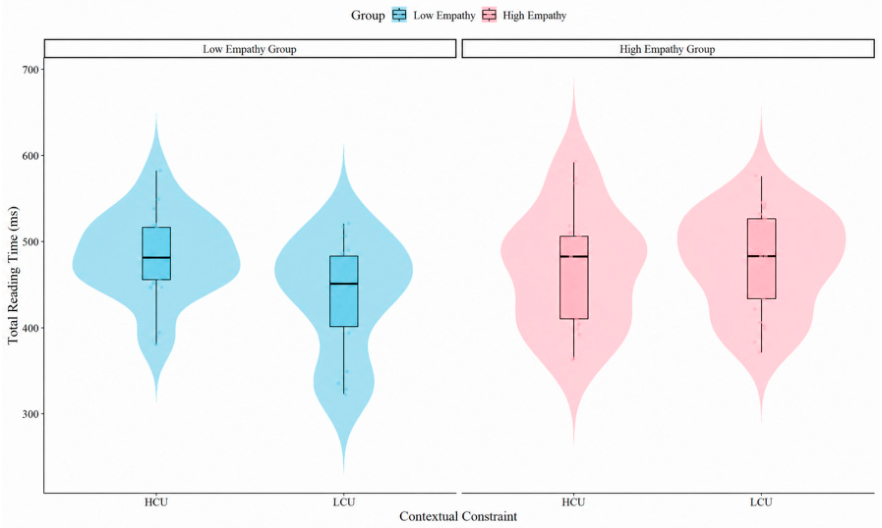

Table 1.
Example materials used in experiment.
| Conditions | Sentence Frame |
|---|---|
| ``Pos_HCP | 租客因房屋漏水问题提醒房东尽快安排修缮。 The tenant, due to a leaking roof, reminded the landlord to arrange repairs as soon as possible. |
| Pos_HCU | 租客因房屋漏水问题提醒物业尽快安排修缮。 The tenant, due to a leaking roof, reminded the property management to arrange repairs as soon as possible. |
| Pos_LCU | 一些民众因设施故障提醒物业尽快安排修缮。 Some residents, due to a facility malfunction, reminded the property management to arrange repairs as soon as possible. |
| Neg_HCP | 租客因房屋漏水问题投诉房东要求尽快维修。 The tenant, due to a leaking roof, complained to the landlord and demanded repairs as soon as possible. |
| Neg_HCU | 租客因房屋漏水问题投诉物业要求尽快维修。 The tenant, due to a leaking roof, complained to the property management and demanded repairs as soon as possible. |
| Neg_LCU | 一些民众因设施故障投诉物业要求尽快维修。 Some residents, due to a facility malfunction, complained to the property management and demanded repairs as soon as possible. |
Note. Pos and Neg indicate the valence of the critical verb (positive vs. negative). Predictability of the target noun was established by the cloze norming procedure. In the sentence frames, critical verbs are italicized and critical target nouns are boldfaced. English sentences are provided as translations of the original Chinese materials.
Table 2.
Descriptive statistics.
| SentLen | VStrokeTot | VStroke1 | VStrokeLast | VFreq_pm | ||||||
|---|---|---|---|---|---|---|---|---|---|---|
| Mean | SD | Mean | SD | Mean | SD | Mean | SD | Mean | SD | |
| Positive | 21.40 | 4.10 | 18.50 | 4.99 | 9.58 | 3.47 | 9.08 | 3.22 | 36.90 | 81.30 |
| Negative | 21.30 | 4.27 | 17.70 | 4.60 | 8.98 | 3.09 | 8.74 | 3.21 | 22.80 | 50.10 |
Note. SentLen = total number of characters in the sentence; VStrokeTot = total stroke count of the verb; VStroke1 = stroke count of the verb’s first character; VStrokeLast = stroke count of the verb’s last character; VFreq_pm = verb frequency per million.
Table 3.
The mean and standard errors of eye tracking measures in the target region.
| Measure | HCP | HCU | LCU | |||
|---|---|---|---|---|---|---|
| Positive | Negative | Positive | Negative | Positive | Negative | |
| Skipping probability | 0.31 (0.01) | 0.23 (0.01) | 0.22 (0.01) | 0.22 (0.01) | 0.20 (0.01) | 0.16 (0.01) |
| Refixation probability | 0.23 (0.01) | 0.30 (0.01) | 0.26 (0.01) | 0.30 (0.01) | 0.35 (0.01) | 0.35 (0.01) |
| First fixation duration | 241 (3.21) | 248 (2.76) | 255 (2.92) | 257 (3.00) | 270 (3.13) | 282 (3.32) |
| Gaze duration | 325 (4.96) | 340 (4.35) | 359 (5.40) | 366 (5.42) | 410 (5.40) | 414 (5.46) |
| Total reading time | 419 (7.17) | 434 (6.60) | 474 (7.07) | 482 (7.26) | 459 (6.54) | 461 (6.43) |
| Single fixation duration | 233 (3.86) | 240 (3.64) | 245 (4.25) | 256 (4.88) | 291 (4.34) | 304 (4.79) |
Note. The standard errors are given in parentheses; fixation time measures are in milliseconds; probability measures are in %.
Disclaimer/Publisher’s Note: The statements, opinions and data contained in all publications are solely those of the individual author(s) and contributor(s) and not of MDPI and/or the editor(s). MDPI and/or the editor(s) disclaim responsibility for any injury to people or property resulting from any ideas, methods, instructions or products referred to in the content. |
© 2026 by the authors. Licensee MDPI, Basel, Switzerland. This article is an open access article distributed under the terms and conditions of the Creative Commons Attribution (CC BY) license (http://creativecommons.org/licenses/by/4.0/).
Copyright: This open access article is published under a Creative Commons CC BY 4.0 license, which permit the free download, distribution, and reuse, provided that the author and preprint are cited in any reuse.