
Submitted:
13 October 2026
Posted:
14 October 2026
You are already at the latest version
Abstract
The Al-Refai--Darus criterion guarantees univalence of a normalized function \( f \) when a weighted sum of \( |(z/f)^{(k)}(0)| \), \( 2\le k\le n-1 \), and of \( \sup|(z/f)^{(n)}| \) does not exceed \( 1 \). For \( n\ge3 \) we study the subclass \( \mathcal C_n \) with \( a_2=\dots=a_n=0 \), in which the whole allowance goes to the \( n \) th derivative. The map \( f\mapsto(z/f)^{(n)} \) is a bijection of \( \mathcal C_n \) onto a closed ball of \( H^\infty \), which turns extremal problems into problems for bounded analytic functions. We prove sharp growth, distortion, covering-radius and coefficient bounds with the \( (n+j) \)-fold symmetric extremal functions \( z/(1+cz^{n+j}) \); the exact region of \( (a_{n+1},a_{n+2}) \), whose boundary is attained by M\"obius parameters written in closed form; and an exact radius for dilations of products \( f_1f_2/z \), sharp both for Aksentev's inequality and for univalence. The \( n \)-fold symmetric members of \( \mathcal C_n \) correspond to \( g(z^n) \) with \( g \) in the same ball, which gives the exact region of \( (a_{n+1},a_{2n+1}) \). For the larger class defined by \( a_2=0 \) and the criterion we obtain sharp bounds as well. The comparison with \( n \)-fold symmetric univalent functions records a gap; it is not a sharpening of known results.
Keywords:
univalent functions
; n-fold symmetry
; symmetric subclasses
; higher-order derivative criterion
; growth and distortion
; covering radius
; Aksentev’s class
; products of univalent functions
MSC: 30C45; 30C50; 30C55
1. Introduction
Let be the family of functions analytic in the disk , and let consist of the univalent ones; [1] is the standard reference. The Koebe function is the extremal function of many problems in . If has no zeros in , the quotient
extends analytically across the origin with .
A number of sufficient conditions for univalence are phrased through derivatives of . Aksentev [2] proved in 1958 that
guarantees ; the same sufficient condition was proved again, in 1972, by Ozaki and Nunokawa [3]. We call the set of that are zero-free in and satisfy (1) Aksentev’s class; it is denoted in [4]. Nunokawa, Obradović and Owa [5] observed that implies , and Yang and Liu [6] found that the weaker hypothesis still yields univalence. After a change of normalization, the Aksentev-type condition defines the class of Fournier and Ponnusamy [7], for which coefficient characterizations and sections [8], logarithmic coefficients [9], growth and distortion [10,11] and further geometric properties [12] are available.
Al-Refai and Darus [13] replaced the second derivative by a derivative of arbitrary order. For an integer , a function with in is univalent whenever
where (; the criterion uses ), and the constant 1 is best possible: it is attained by the Koebe function, by the functions with , and by the functions (for these are the Koebe function and its rotation by ; in general , so they are not in the class introduced below). Putting in (2) gives back the Yang–Liu bound. Obradović and Ponnusamy [4] proved that (2) implies by a different argument. Writing
condition (2) is the same as , and this is the form we shall use. Further criteria and geometric properties for bounded univalent functions are given in [14]. A meromorphic analogue of (2), in terms of the nth derivative of , together with growth and distortion estimates, is treated in [15].
The paper [13] establishes the criterion (2) and its sharpness. To the best of our knowledge, quantitative information about the class (2) itself, such as growth, distortion or coefficient estimates and statements on products, has not been published; the aim of this paper is to supply it.
Since (2) couples the numbers with the size of , the sharpest statements are obtained when every vanishes and the whole allowance in (2) is given to . This is the class of Definition 1 below: the zero-free normalized functions with for which the nth derivative of is bounded by in . The vanishing of is equivalent to that of (Lemma 4), and members of are univalent because they satisfy (2) (Remark 1). The restriction is a choice, not a consequence of the criterion; Section 3.4 treats the larger class in which only is imposed and shows exactly how much of the strength of the estimates for is due to the extra conditions. Moreover, every begins like an n-fold symmetric function, , which is why symmetric subclasses and symmetric extremal functions occur naturally (Section 6).
The paper is organized as follows. Section 2 gives an exact integral representation of with estimates for its remainder, the formulas relating the Taylor coefficients of f and of , and the parametrization of by a ball of . Section 3 contains the estimates: a pointwise majorant for Aksentev’s quantity on the whole class (2); growth, distortion and covering radius; coefficient bounds and the exact region of ; and sharp bounds on the larger class defined by , together with the case . Section 4 gives the product theorem with an exact radius. Section 5 compares the estimates with classical ones for and for n-fold symmetric univalent functions. Section 6 describes the symmetric members of , and Section 7 summarizes the results.
2. Preliminaries
Everything in the later sections is derived from a handful of exact formulas for the function . This section establishes them in the form needed, with complete proofs. Throughout, is fixed, has no zero in , we write and for , and we assume (which is automatic under (2)). For a function analytic and bounded in we write , and denotes the Banach space of all such functions with this norm. The nth derivative of u is denoted
Lemma 1
(Splitting of u). For every ,
Moreover Ω is analytic in and as .
Proof.
Step 0: u is analytic in . Since , we have , which is analytic in and equals at . By hypothesis f has no zero in , so has no zero in at all, and therefore is analytic in , with . In particular all derivatives exist in , so and are well defined, and is analytic in .
Step 1: Taylor’s formula with integral remainder. For with n continuous derivatives,
this is the standard Taylor formula, obtained by induction on n and integration by parts.
Step 2: the choice . Fix . For we have , so is defined, and it is infinitely differentiable in the real variable s because u is analytic. Since u is complex differentiable, , and by induction
Step 3: Ω is analytic and . By (3), is a difference of analytic functions, hence analytic in . On the compact disk the continuous function is bounded, say by C; for the points lie in that disk, so . Thus . □
Lemma 2
(Size of and of ). For all ,
Proof.
Fix . For every the point lies in , so .
Step 2: a formula for . Because is analytic with and (Lemma 1), the quotient is analytic in . By (3),
Differentiation under the integral sign is permitted (the integrand and its z-derivative are continuous on ), so J is analytic in and . The product rule gives
To rewrite the second term, put and ; then , so
Integrating by parts,
because (factor s) and (factor with ). Here . Therefore
Inserting this in (6) and collecting the terms with ,
The bracket equals , so
With we have , hence
Therefore , since . □
The first estimate in (5) is used in the growth, distortion, covering and product theorems (Theorems 2, 3, 7) and in the proof of Proposition 1; the second is used only in Theorems 1, 3 and 7, where the quantity appears.
Lemma 3
(Coefficients of ). Writing , one has
and for every . The identity (8) uses only that η is analytic in .
Proof.
The formula for . Fix . The Taylor series of the analytic function has radius of convergence at least 1, so it converges uniformly on the closed disk . For and we have ; hence with uniform convergence in , and the series may be integrated termwise in (3):
The integral is a Beta integral, . Therefore
As was arbitrary this holds in , and by uniqueness of Taylor coefficients the coefficient of is .
The bound is Cauchy’s estimate for the Taylor coefficients of a function bounded by in (apply the Cauchy integral formula on and let ). □
For the bound is not sharp in general (Wiener’s inequality [17,18] gives for ). The improvement is needed only for , in the proof of Theorem 5(b), where it is proved.
We now single out the family studied in the rest of the paper.
Definition 1
(The class ). For an integer ,
Equivalently, consists of the without zeros in for which and . We write .
Lemma 4
(Identification of and the tail identity). Let have no zero in .
(a) if and only if .
(b)If these conditions hold, then
(c)Identity (9) fails for : under the same conditions,
Proof.(a), “if”. Suppose . Then with analytic in and . Since , the function is analytic near 0, and for it equals the geometric series , each term beyond the first being . Hence near 0, i.e. the Taylor coefficients of u vanish for .
Write with , and (Lemma 3). The coefficient of in the product is the sum of over all pairs with , and , that is, over with , taking . Comparing the coefficients of on both sides of (11), for every (where the right side contributes 0),
Range . The sum in (12) is empty, because it would require with . Hence for . This proves “only if” in (a).
Remark 1.
By Lemma 4(a), every has , hence , and (2) reduces to , which is precisely the last requirement in Definition 1. So lies inside the class defined by (2) and its members are univalent [13]. It is the part of that class where the whole allowance in (2) is spent on and none on the ; this is what makes (9) a one-to-one dictionary between the first n non-trivial coefficients of f and the first n Taylor coefficients of η, with no cross terms. Note that (2) says nothing about , so is a genuine extra requirement in . Univalence of the members of is used in this paper only in the sharpness part of Corollary 1; the univalence of in Theorem 7 comes from Aksentev’s theorem, and none of the estimates of Section 3 needs univalence.
Lemma 5
(Monomial test functions). Let be an integer, , and . Then , f has no zero in , and . Moreover:
(a)if , then , , and for all other ;
(b)if , then for , , , and .
Proof.
Since in , the denominator does not vanish there; the expansion shows , for and . Obviously , so for and 0 for the other . Finally if , while for it equals , whose supremum over is . □
The next proposition says that is as large as a ball of , and it turns every sharpness question about into a question about bounded analytic functions.
Proposition 1
(Parametrization of ). Let be the closed ball of radius in . The map
is a bijection. Its inverse is , where .
Proof.
If and , then by definition, and Lemma 1 with gives . Hence is injective and its inverse has the stated form.
Conversely let and define as above; it is analytic in . The first estimate in (5) (whose proof only uses ) gives , because . Hence has no zeros, and has no zeros in . Since , we get and so by Lemma 4(a). By termwise integration (Lemma 3), , and differentiating n times gives . Thus , and . □
3. Estimates for the Class
Several results of this section are short consequences of the representation of Section 2: Theorems 2 and 4 and Corollary 2 follow from the first estimate in (5) and Cauchy’s estimate for the coefficients of , and are recorded because their extremal functions are explicit. The substantial results are the distortion theorem, which needs the derivative estimate of Lemma 2, Theorem 5, which needs the Schwarz–Pick and Wiener inequalities, and the product theorem (Theorem 7).
3.1. A Pointwise Majorant for Aksentev’s Quantity
Every function satisfying (2) also lies in Aksentev’s class ; this inclusion is due to Obradović and Ponnusamy [4]. For one has the general bound on all of (Remark 2). What the criterion adds is an intermediate majorant in terms of the two quantities and that enter (2); it is attained, and it is much smaller than on .
Theorem 1.
Let and let , with for , satisfy (2). Then for all
In particular . Both inequalities are sharp: for (here ) equality holds in the first one at every , and for equality holds in the second one at every .
Proof.
Differentiate : , so , that is
With one has . Split at . Since every term of has and ,
By Lemma 1, , so . The second estimate in (5) gives . Adding the two bounds proves the first inequality in (13). For the second, and (2) give . Since , (1) holds.
For , and , while and (Lemma 5(b)); so the right-hand side of the first inequality is . For one has , , , , (Lemma 5(a)), and the right-hand side of the second inequality is . □
Remark 2.
Let , that is, in . As in the proof, is analytic in with . Schwarz’s lemma applied to and then to gives forevery, with equality at one point only for (e.g. ). Hence the second inequality in (13) and its sharpness are the Schwarz bound for ; together with the inclusion (2) of [4] it is known in substance. The new content of Theorem 1 is the first inequality, in terms of and , and its sharpness through . For the same computation gives under .
The classes cut out by (2) for different values of n do not form a chain, as two explicit functions show; neither lies in (Example 1 has , and Example 2 violates (2) for ). Example 1 satisfies (2) for but not the Yang–Liu condition, and Example 2 does the reverse.
Example 1.
Example 2.
Let . Then , so and the Yang–Liu condition holds. For , however, and , giving , so (2) fails.
Consequently the classes for different n share the ceiling of rather than forming an increasing chain.
3.2. Growth, Distortion and Covering Radius
Theorem 2
(Growth). Let and . Then
Both bounds on are sharp for every : equality holds at every fixed r for
at for the lower bound and at for the upper bound.
Proof.
For we have (Lemma 4), so , and the first estimate in (5) with gives . As , , hence
and inverting yields the bounds for .
For sharpness apply Lemma 5(b) with and : the function lies in , has no zero in , satisfies , and , so (on the boundary of the family). For we get , the lower bound; for we have and , the upper bound. This holds for each and each . □
The first inequality in (14) is also sharp (equality for at every z). Letting gives , sharp by at , ; so consists of bounded univalent functions (compare [14]).
Figure 1 shows, for several n, the image of a circle close to under ; the curves are simple, as expected for a univalent map.
Example 3.
Take and . Then , , , so . For the bounds in (14) are and ; direct evaluation gives and .
The growth theorem is a direct consequence of (5). The distortion theorem below needs the derivative estimate in an essential way.
Theorem 3
(Distortion). Let and . Then
Both bounds are sharp: for equality holds at every r, at in the lower bound and at in the upper one.
Proof.
Let . From we get , and . By the second estimate in (5) and , , hence . By the first estimate, , which gives (15).
For we have and , so . At this is the lower bound and at (where ) the upper bound. □
Corollary 1
(Covering radius). Every satisfies , and the radius cannot be increased: does not contain .
Proof.
Fix and let by Theorem 2. The set , , is open (open mapping theorem) and contains 0, and its boundary lies in , because . If some w with were not in , the segment from 0 to w would meet at a point of modulus , which is impossible. Hence , and letting gives the radius .
The first part used only the open mapping theorem; univalence enters only in the sharpness part. For sharpness note that is univalent in (Remark 1), extends continuously to (the denominator does not vanish on since ), and . Suppose with . As (note that exactly when , so is not locally univalent at the boundary point , which is why a limiting argument is used instead of univalence on a larger disk), maps a neighborhood of onto a neighborhood of . For r close to 1 the point lies in that neighborhood, so with , and univalence gives , which is false for r close to 1. Therefore . □
3.3. Coefficient Bounds
For identity (9) makes the first n non-trivial coefficients proportional to , and Lemma 3 bounds each . The next two theorems are direct consequences.
Theorem 4.
Let . For every ,
and equality holds for
For , for and for , and .
Proof.
By (9), Lemma 3 and the definition of ,
because .
For sharpness let and in Lemma 5(b). Then , so , and . Since and , we have , so the geometric series converges, and
with . Thus the only non-zero coefficients of are (); in particular for and for , and . □
For the logarithmic coefficients write ; the branch is fixed by at , and it exists because is analytic and zero-free in .
Corollary 2.
Proof.
Example 4.
Table 1 lists the numerical values of the bounds in Theorem 4 and Corollary 2 for .
The following theorem goes beyond the diagonal bounds of Theorem 4: it uses the parametrization of Proposition 1, and treats , the first coefficient at which the identity (9) breaks down.
Theorem 5.
Let .
(a)For , and
Conversely, every pair with and equals for some .
(b)For , , with equality for .
Proof.
Preliminaries. Let and . By Proposition 1, , so is analytic in with , and . Since (Lemma 4(a)), the identity (9) applies, and with ,
We shall use the following form of the Schwarz–Pick inequality: if is analytic in with , then
Indeed, if then is constant by the maximum modulus principle and . Otherwise put , , and , a Möbius automorphism of the unit disk with . Then maps into the closed unit disk and vanishes at 0, so Schwarz’s lemma gives . Since , we get and , which is (21).
(a), sufficiency. Let satisfy and , and put , so . If , the hypothesis on forces ; take , so and . If , put
and define . This is with , a Möbius automorphism of the unit disk (because ); since , we have in . Moreover , and since , . In both cases is analytic with , so , and by Proposition 1. By (20), and .
(b). By (10) and (8), with
because . We need . Let and . As an average of values of , . Since equals n if and 0 otherwise, . Put ; this series converges for (take z with in the series of ), so is analytic in , and for any z with , whence . Now and , so (21) for gives . With we obtain
This is a convex combination, with weights and , of and . Since we have , so the combination is at most A, i.e. .
For equality, the function (geometric series, ) has, as the coefficient of (the term ) equal to . □
(a)).Remark 3 (Closed form of the extremal functions of The region in (a) depends only on and . By Schwarz–Pick equality, a pair on the boundary with arises exactly from a Möbius parameter , , , that is, . For write with . Then can be integrated in elementary terms:
where (substitute ) and the principal logarithm is used (). The extremal function is . We checked (22) against numerical integration for (05_verify_revision.py). So the extremal functions of(a)are explicit, involving a logarithm and a polynomial in z; those of all other results are the monomial functions and .
Remark 4
(Bounds for on the whole class). On the whole class (2) one has, for , , because every summand of is non-negative and . This is an immediate restatement of the criterion, and it is sharp: satisfies (2) with equality and by Lemma 5(a). For , since , it reads . This inequality is not specific to the class (2): it holds for every univalent function, because belongs to the class Σ and the area theorem bounds its coefficient of by 1 [1]. The case is therefore classical (the Koebe function gives equality), and we do not present it as a Fekete–Szego-type result.
3.4. A Larger Class: and the Criterion Itself
Condition (2) does not force to vanish, and the restriction defining is a choice, not a consequence of the criterion. To measure what it buys, let be the set of zero-free with (equivalently , because ) that satisfy (2). Then .
Theorem 6.
Let , and . Then ,
and . All these estimates are sharp, with extremal function , and cannot be replaced by a larger number.
Proof.
This gives the bounds for . By Theorem 1, , and gives those for . For we have , , , , so (2) holds with equality and ; , , and equals the lower bound at and the upper bound at . The covering statement follows as in Corollary 1 from . Finally iff , so . □
The covering radius is smaller than for every , and replaces : the strength of the estimates of comes precisely from the vanishing of , and Theorem 6 shows that nothing better than the values survives without it.
Remark 5
(The case ). For the class is the Yang–Liu class with , and . The proofs of Sections 2–4 go through for with three changes: in Proposition 1 the bound is replaced by ; the restriction in Lemma 5 and Theorem 4 becomes ; and in Corollary 1 the function has poles at on the boundary of the disk of convergence of the series, so the sharpness of is read off from . Univalence of is the theorem of Yang and Liu [6]. Thus the formulas of Theorems 2 and 3 and Corollary 1 for are those of Theorem 6, with in Theorem 7. The comparisons of Section 5 with n-fold symmetric functions degenerate for and are stated for .
4. A Product Theorem
Obradović and Ponnusamy [4] proved that if and , then belongs to Aksentev’s class (their , defined by (1)) for every , where is the radius reported there. We prove the corresponding statement for , with a radius that is sharp.
Theorem 7.
Let , let , and put and for . Then , has no zero in , and for all
Consequently, if
then , and in particular is univalent in . The radius cannot be enlarged, not even for univalence: for every the pair gives , and is not univalent in .
Proof.
Write (). Then with , and . Let . As in the proof of Theorem 1, , and with this equals . Now
Put . For the right-hand side of (24) is , and
(The positive root of is , because the discriminant equals .) Thus gives (1) for . It is univalent by Aksentev’s theorem, and without zeros in is clear from the definition.
For sharpness take . Then with , and a direct computation gives . For this is , whose modulus tends to as , and this exceeds 1 when .
Finally we show that is not univalent for . For and we have , and differentiation gives
Since , vanishes at every z with , in particular at the positive number (because ). As , for the point lies in and . A non-constant analytic function whose derivative vanishes at is not injective in any neighborhood of , so is not univalent in . □
Remark 6.
(a)Limit.Since , we have
so and .
(b)Interpretation.Over the class the radius is exact both for Aksentev’s inequality and for univalence of the dilated product, and this exact value gives the relative size of the room that remains, . (How this limit should be read is discussed at the start of Section 5.)
Table 2 lists the radius for small n.
5. Comparison with Classical Results
The class is contained in , so every classical bound for [1] holds on , and the bounds proved here are smaller or equal for the trivial reason that the class is smaller. Table 3 therefore carries no information beyond the size of the gap; none of its rows is a sharpening of a known theorem, and the rows about coefficients and products compare statements on classes of very different size. The same reading applies to the radius : that only reflects that becomes a trivial restriction as n grows, and the informative statement is the exactness of in Theorem 7 for each fixed n. The theorems of this paper assume ; the case is covered by Remark 5. What is known for concerns the criterion itself (Yang–Liu, Nunokawa–Obradović–Owa) and, for the related class , other quantities [7,8,9,10,12].
Since every member of is , the class of n-fold symmetric univalent functions, with the same kind of expansion, is the closer reference.
Definition 2
(The class ). For an integer let (, and is the class of odd univalent functions). Every has the form with [1], hence only the powers occur in f.
Applying the classical bounds for [1] to g gives the left column of Table 4, attained by the n-fold Koebe function . Neither nor contains the other: on , so the n-fold Koebe function is not in , while members of with are not n-fold symmetric. Consequently the table compares extremal values, not classes.
Proposition 2.
For every integer and :
Proof.
Put and .
(ii) The function is concave, hence lies below its tangent at 0: , the last step because . Inverting gives (ii), since .
(i) The function is concave, hence lies above its chord on : for . It suffices to have . For , and , which holds for since . For , . Inverting gives (i).
(iii) The claim is . For , and , so the product is . For , .
(iv) is equivalent to , i.e. . □
6. Symmetric Members of
Each begins like an n-fold symmetric function, , and differs from one first at the coefficients (Theorem 5). Which members are actually symmetric is answered by the parametrization of Proposition 1. Here .
Proposition 3
(Symmetric members and ). Let , and . Then for all if and only if unless . In particular, f is n-fold symmetric if and only if with g analytic in , ; and is a bijection of the closed ball of radius in onto .
Proof.
Since , . By Lemma 1 (with ) and Lemma 3, with , so . Comparing coefficients, iff for all j, which is the stated condition. For it reads unless , i.e. with , and whenever , so . Conversely, for the function lies in , so by Proposition 1; it is n-fold symmetric by the first part and univalent by Remark 1, hence . Injectivity comes from that of . □
The extremal functions are symmetric: , so is -fold symmetric, and among them only is n-fold symmetric. Since attains the bounds of Theorems 2, 3 and 5(b) and the covering radius, these remain sharp on .
Theorem 8
(The pair on ). Let . For ,
and every pair with and is attained by some . For , equality in the second relation holds exactly for , , .
Proof.
By Proposition 3, with analytic and in ; so , . By (9) and (10),
since . Now (25) follows from and (21), . Conversely, given put and choose with and as in the sufficiency part of Theorem 5(a); then is in by Proposition 3 and has the given pair. Equality in (21) with holds iff is a Möbius automorphism of . □
For fixed the admissible fill a disk centered at ; its largest modulus over the region is , reached at , by and its rotations, so Theorem 5(b) is sharp already on .
Remark 7.
If are n-fold symmetric, so are and its dilations . The extremal pair of Theorem 7 is of this kind, hence the radius is exact already for products of n-fold symmetric members of , and for the derivative of the symmetric function vanishes at the n points .
7. Conclusions
We studied the subclass of the Al-Refai–Darus class (2), in which the whole allowance of the criterion is spent on the nth derivative of . The central fact is that is a bijection of onto the closed ball of radius in (Proposition 1), which rests on the integral representation of and the estimates for its remainder (Lemmas 1–4). It gives sharp growth, distortion and covering-radius estimates, with the covering radius (Theorems 2, 3, Corollary 1); sharp bounds for and (Theorem 4, Corollary 2); the exact region of , with extremal functions written in closed form (Theorem 5, Remark 3); and a product theorem whose radius is exact both for Aksentev’s inequality and for univalence (Theorem 7). The majorant of Theorem 1 for Aksentev’s quantity holds on the whole class (2); its upper bound is the Schwarz-lemma bound valid for all of Aksentev’s class, and the new information is the intermediate bound with and . Theorem 6 shows what is lost when are allowed to be non-zero: the estimates of degrade to those with in place of .
As for symmetry, the extremal functions are -fold symmetric, the n-fold symmetric members of are in bijection with the same ball of through , and the exact region of on them is (25) (Proposition 3, Theorem 8). The comparison with n-fold symmetric univalent functions (Proposition 2) shows that every extremal value for in Table 4 lies strictly inside the corresponding value for ; since the classes are not nested, this records a gap and is not an improvement of a known result.
Author Contributions
Conceptualization, O.A.-R. and J.S.; methodology, O.A.-R. and M.A.; software, O.A.-R. and H.U.R.; validation, O.A.-R., M.A. and K.A.-S.; formal analysis, O.A.-R. and M.A.; investigation, O.A.-R., J.S. and A.A.A.; resources, O.A.-R. and K.A.-S.; data curation, O.A.-R. and H.U.R.; writing—original draft preparation, O.A.-R.; writing—review and editing, O.A.-R., J.S., M.A., K.A.-S., H.U.R. and A.A.A.; visualization, O.A.-R. and A.A.A.; supervision, O.A.-R. and M.A.; project administration, O.A.-R. and M.A. All authors have read and agreed to the published version of the manuscript.
Funding
This research received no external funding.
Institutional Review Board Statement
Not applicable.
Informed Consent Statement
Not applicable.
Data Availability Statement
The scripts that verify the lemmas, the extremal functions, the closed forms and the symmetric regions, and that produce the figures (folder codes of the submission, including 05_verify_revision.py), are provided as Supplementary Material.
Conflicts of Interest
The authors declare no conflicts of interest.
References
- Duren, P.L. Univalent Functions. In Grundlehren der Mathematischen Wissenschaften; Springer: New York, NY, USA, 1983; Vol. 259. [Google Scholar]
- Aksentev, L.A. Sufficient Conditions for Univalence of Regular Functions. Izv. Vyss. Uchebn. Zaved. Mat. (In Russian) 1958, no. 3 (4), 3–7. [Google Scholar]
- Ozaki, S.; Nunokawa, M. The Schwarzian Derivative and Univalent Functions. Proc. Am. Math. Soc. 1972, 33, 392–394. [Google Scholar] [CrossRef]
- Obradović, M.; Ponnusamy, S. Criteria for Univalent Functions in the Unit Disk. Arch. Math. 2013, 100, 149–157. [Google Scholar] [CrossRef]
- Nunokawa, M.; Obradović, M.; Owa, S. One Criterion for Univalency. Proc. Am. Math. Soc. 1989, 106, 1035–1037. [Google Scholar] [CrossRef]
- Yang, D.; Liu, J. On a Class of Univalent Functions. Int. J. Math. Math. Sci. 1999, 22, 605–610. [Google Scholar] [CrossRef]
- Fournier, R.; Ponnusamy, S. A Class of Locally Univalent Functions Defined by a Differential Inequality. Complex Var. Elliptic Equ. 2007, 52, 1–8. [Google Scholar] [CrossRef]
- Obradović, M.; Ponnusamy, S.; Wirths, K.-J. Coefficient Characterizations and Sections for Some Univalent Functions. Sib. Math. J. 2013, 54, 679–696. [Google Scholar] [CrossRef]
- Obradović, M.; Ponnusamy, S.; Wirths, K.-J. Logarithmic Coefficients and a Coefficient Conjecture for Univalent Functions. Monatsh. Math. 2018, 185, 489–501. [Google Scholar] [CrossRef]
- Vasudevarao, A.; Yanagihara, H. On the Growth of Analytic Functions in the Class U(λ). Comput. Methods Funct. Theory 2013, 13, 613–634. [Google Scholar] [CrossRef]
- Obradović, M.; Ponnusamy, S. New Criteria and Distortion Theorems for Univalent Functions. Complex Var. Theory Appl. 2001, 44, 173–191. [Google Scholar] [CrossRef]
- Obradović, M.; Ponnusamy, S.; Wirths, K.-J. Geometric Studies on the Class U(λ). Bull. Malays. Math. Sci. Soc. 2016, 39, 1259–1284. [Google Scholar] [CrossRef]
- Al-Refai, O.; Darus, M. General Univalence Criterion Associated with the nth Derivative. Abstr. Appl. Anal. 2012, 2012, 307526. [Google Scholar] [CrossRef]
- Al-Refai, O. Criteria and Geometric Properties for Bounded Univalent Functions in the Unit Disk. Ital. J. Pure Appl. Math. 2020, 43, 828–841. [Google Scholar]
- Al-Refai, O. Sharp Inequalities for Univalence of Meromorphic Functions in the Punctured Unit Disk. TWMS J. Appl. Eng. Math. 2021, 11, 250–261. [Google Scholar]
- de Branges, L. A Proof of the Bieberbach Conjecture. Acta Math. 1985, 154, 137–152. [Google Scholar] [CrossRef]
- Bohr, H. A Theorem Concerning Power Series. Proc. Lond. Math. Soc. 1914, s2-13, 1–5. [Google Scholar] [CrossRef]
- Garnett, J.B. Bounded Analytic Functions, revised. In Graduate Texts in Mathematics, 1st ed.; Springer: New York, NY, USA, 2007; Vol. 236. [Google Scholar]
Figure 1.
Images of the circle under for . None of the curves has a self-intersection.
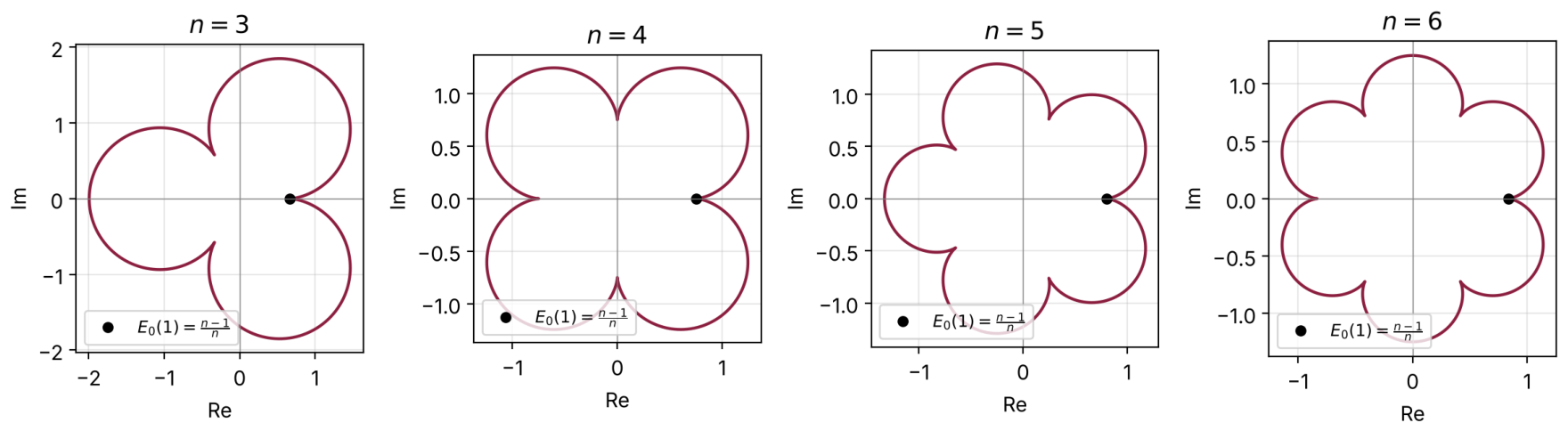
Figure 2.
for at and . The lower bound in (14) is touched at and the upper bound at .
Figure 2.
for at and . The lower bound in (14) is touched at and the upper bound at .
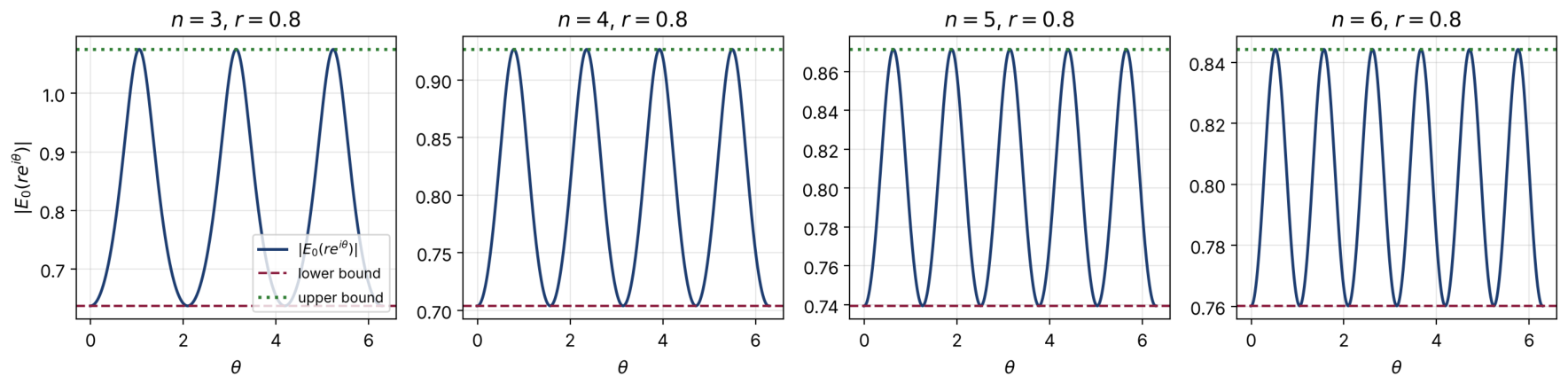
Figure 3.
The bounds in (14) as functions of for .
Figure 3.
The bounds in (14) as functions of for .
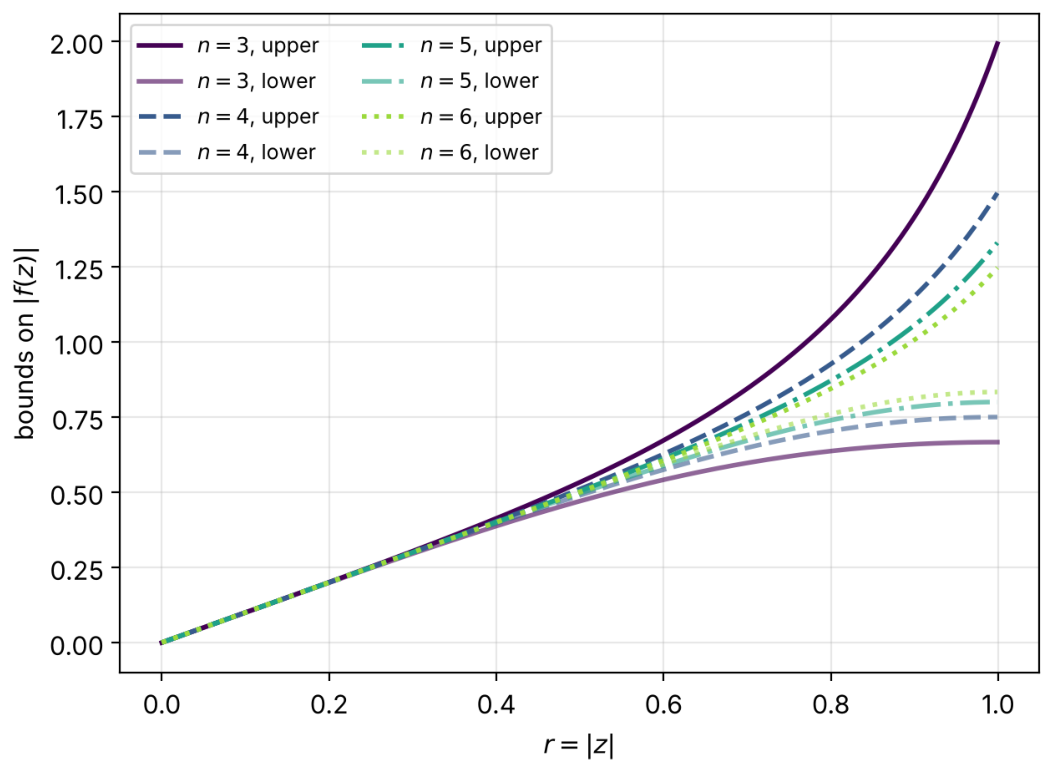

Table 1.
Values of the sharp bounds in Theorem 4 (upper block) and Corollary 2 (lower block). Only is covered by the theorems, hence the dashes.
Table 1.
Values of the sharp bounds in Theorem 4 (upper block) and Corollary 2 (lower block). Only is covered by the theorems, hence the dashes.
| bound for | ||||||
| 0.5000 | 0.1250 | 0.0500 | – | – | – | |
| 0.3333 | 0.0667 | 0.0222 | 0.0095 | – | – | |
| 0.2500 | 0.0417 | 0.0119 | 0.0045 | 0.0020 | – | |
| 0.2000 | 0.0286 | 0.0071 | 0.0024 | 0.0010 | 0.0004 | |
| bound for | ||||||
| 0.2500 | 0.0625 | 0.0250 | – | – | – | |
| 0.1667 | 0.0333 | 0.0111 | 0.0048 | – | – | |
| 0.1250 | 0.0208 | 0.0060 | 0.0022 | 0.0010 | – | |
| 0.1000 | 0.0143 | 0.0036 | 0.0012 | 0.0005 | 0.0002 | |
Table 2.
The radius of Theorem 7.
| n | 3 | 4 | 5 | 6 | 8 | 10 |
|---|---|---|---|---|---|---|
| 0.7368 | 0.8091 | 0.8503 | 0.8769 | 0.9091 | 0.9280 |
Table 3.
Classical estimates for (sharp for ) set beside the estimates of this paper on the much smaller class (, ; sharp for ). The table records the size of the gap only.
Table 3.
Classical estimates for (sharp for ) set beside the estimates of this paper on the much smaller class (, ; sharp for ). The table records the size of the gap only.
| Quantity | Classical, class (sharp) | This paper, class (sharp) | Result |
|---|---|---|---|
| Thm. 2 | |||
| Thm. 3 | |||
| Covering radius of | (Koebe) | Cor. 1 | |
| Coefficients | [16] | , ; | Thms. 4, 5 |
| Aksentev’s inequality | [5]; [6] | (2) ; the bound holds on all of (Schwarz) | Thm. 1 |
| Products | for [4] | (so univalent) for ; for larger s, can fail to be univalent | Thm. 7 |
Table 4.
Sharp values on (classical) and on (this paper), , . By Proposition 2 each value for lies strictly inside the one for .
Table 4.
Sharp values on (classical) and on (this paper), , . By Proposition 2 each value for lies strictly inside the one for .
| Quantity | Class | Class |
|---|---|---|
| Covering radius | ||
Disclaimer/Publisher’s Note: The statements, opinions and data contained in all publications are solely those of the individual author(s) and contributor(s) and not of MDPI and/or the editor(s). MDPI and/or the editor(s) disclaim responsibility for any injury to people or property resulting from any ideas, methods, instructions or products referred to in the content. |
© 2026 by the authors. Licensee MDPI, Basel, Switzerland. This article is an open access article distributed under the terms and conditions of the Creative Commons Attribution (CC BY) license (http://creativecommons.org/licenses/by/4.0/).
Copyright: This open access article is published under a Creative Commons CC BY 4.0 license, which permit the free download, distribution, and reuse, provided that the author and preprint are cited in any reuse.