
Submitted:
12 October 2026
Posted:
14 October 2026
You are already at the latest version
Abstract
Chronic obstructive pulmonary disease (COPD) is a heterogeneous condition arising from interactions among genetic susceptibility, environmental exposures, altered cellular responses and progressive lung injury. This complexity limits the ability of conventional clinical measures or any single molecular layer to explain differences in disease development, progression and treatment response. This review examines how artificial intelligence (AI)-mediated integration of selected omics including genomics, epigenomics, transcriptomics, single-cell and spatial omics, proteomics, metabolomics, lipidomics and microbiomics could provide a more connected understanding of COPD biology. These complementary layers capture inherited susceptibility, exposure-related regulation, cell-specific dysfunction, active molecular pathways, metabolic alterations and host-microbial interactions. Although previous publications have examined COPD multi-omics, computational integration or AI applications, this review proposes a conceptual, hypothesis-generating framework linking selected omics across disease development and biological mechanisms to potential biomarkers and therapeutic opportunities. Such integration may generate testable hypotheses, identify patient subgroups with biologically meaningful characteristics and help in biomarker development, therapeutic-target identification, drug repurposing, treatment-response prediction and clinical-trial design. However, direct evidence demonstrating the clinical value of AI-integrated COPD omics is warranted. Translation could be further constrained by small and selected cohorts, technical heterogeneity, confounding factors like smoking, treatments, limited population diversity and insufficient independent and prospective validation. By focusing on selected omics layers that are among the most relevant to COPD biology and clinical heterogeneity, this framework identifies timely opportunities for integrative research that could lay the groundwork for developing and testing biomarkers and therapeutic strategies. Progress will require longitudinal multicenter studies, standardized measurements, interpretable and biologically informed AI methods, experimental confirmation and prospective evidence that resulting approaches improve clinical decisions or patient outcomes.
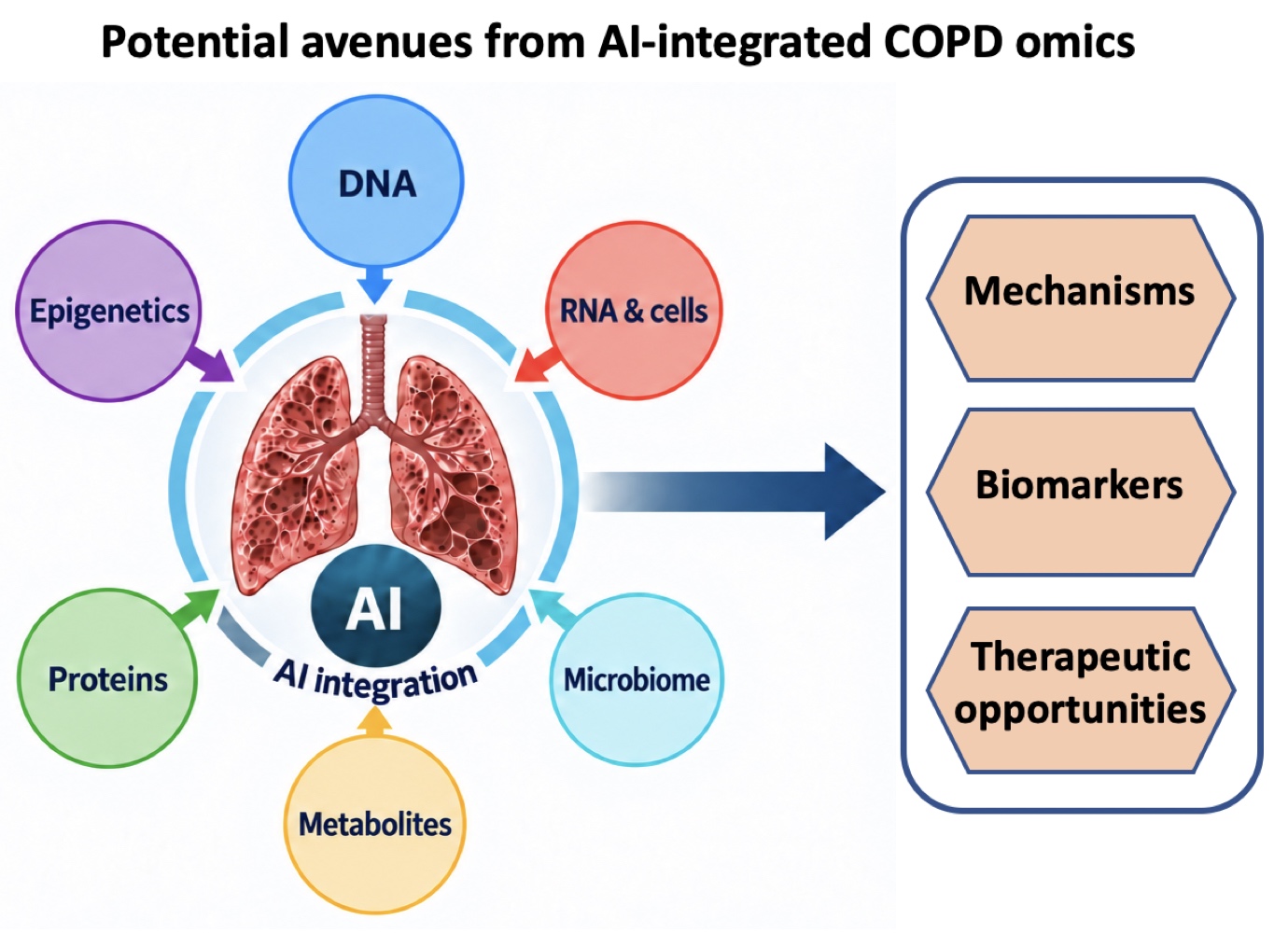
Keywords:
chronic obstructive pulmonary disease
; artificial intelligence
; machine learning
; multi-omics
; biomarkers
; disease mechanisms
; therapeutic discove
1. COPD: Definition, Heterogeneity and Unmet Need
Chronic obstructive pulmonary disease (COPD) is a complex lung condition characterized by persistent respiratory symptoms and airflow obstruction. COPD common features include with shortness of breath, chronic cough, and sputum production. Structural damage to the small airways, alveoli, or both results in persistent airflow limitation that may progressively worsen over time. Diagnosis is confirmed by post-bronchodilator spirometry. Cigarette smoking is a major cause, but it is not the only one. Air pollution, occupational exposure to dust or chemicals, respiratory infections, impaired lung development and genetic susceptibility can also contribute. COPD should therefore be viewed as a condition that can develop through several biological and environmental pathways rather than simply as a smoking-related disease [1,2,3].
The lung abnormalities underlying COPD also differ among patients. Some patients mainly have narrowing and remodeling of the small airways, whereas others have excessive mucus production or emphysema, which involves destruction of the alveoli. Changes in the pulmonary blood vessels may also occur. These abnormalities result from several interacting processes, including oxidative stress, an imbalance between enzymes that damage lung tissue and the mechanisms that protect it, abnormal immune responses, dysfunction of the airway lining, premature aging of lung cells and inadequate tissue repair. Microbiota dysbiosis has also been observed, particularly during COPD exacerbations [4,5]. Exacerbations and other diseases occurring alongside COPD can further modify the course of the condition. As a result, two patients with similar spirometry results may have different underlying mechanisms, risks of progression and responses to treatment. Identifying these biological subtypes, known as endotypes, may help researchers and clinicians select treatments that target the main disease process in each patient [2,3].
2. Review Scope and Conceptual Framework
This review explores whether integrating selected omics datasets relevant to COPD could help better understand disease mechanisms and help create testable ideas for biomarkers and the formulation of therapeutic hypotheses. Rather than treating each omics layer separately, the concept is to consider the type of biological information provided by each and examine how AI-based analytical approaches could be used to identify relationships across generated datasets. Focus is given to the level of experimental and clinical evidence needed before such findings can be considered biologically meaningful or potentially useful in practice.
No single data type captures the full biological complexity of COPD. Integrating complementary information may support a more coherent investigation of disease development, progression and treatment response, but the added value of this approach has not yet been established. Previous publications have examined COPD biomarkers and individual omics fields, next-generation sequencing and multi-omics, clinical applications of AI, and computational multi-omics integration in COPD or obstructive lung diseases [6,7,8,9,10,11]. Building on these advances, this review focuses on genomics, epigenomics, transcriptomics, single-cell and spatial omics, proteomics, metabolomics, lipidomics, and microbiomics. Together, these layers provide complementary information on COPD susceptibility, exposure-related molecular regulation, cell-specific dysfunction, tissue damage, metabolic disturbance, and host-microbial interactions. The review is therefore intentionally focused rather than exhaustive. Their AI-mediated integration offers a hypothesis-generating framework for examining biological convergence across COPD development and progression.
For each selected omics layer, the discussion follows a consistent pathway from COPD-related abnormalities and biological mechanisms to relevant AI applications, candidate biomarkers or therapeutic targets, clinical relevance and evidence gaps. By organizing these layers along a common pathway from disease development to therapeutic opportunities, the framework could identify testable points of convergence and highlights priorities for experimental, independent and prospective evaluation. Previous reviews of AI, multi-omics and individual omics applications in COPD and related obstructive lung diseases provide important foundations for the present COPD-specific framework [6,7,8,9,10,11]. Table 1 summarizes the main distinctions between the existing literature and the framework developed her.
This article is presented as a structured narrative review because it organizes and critically interprets selected evidence within a predefined conceptual framework. It is not intended to provide an exhaustive or formally systematic assessment of all published studies.
3. Artificial Intelligence: A Working Definition
AI is a broad term for computer-based methods that can recognize patterns, classify information, make predictions and support decisions. Machine learning is a form of AI in which a computer learns patterns from examples instead of following only fixed instructions. In supervised learning, the computer is trained using examples with known outcomes, such as patients with or without COPD. In unsupervised learning, it searches for natural groups or patterns without being given the outcome in advance. Deep learning is a more complex form of machine learning that uses networks with many processing layers and is particularly useful for analyzing images and large datasets. Natural-language processing enables computers to analyze written information, such as clinical notes or scientific publications [12,13].
In biomedical research, AI is an analytical tool rather than a method that directly measures biological changes. It can combine information from clinical records, medical images and omics studies to identify patterns that may be difficult to detect using conventional methods. However, the results produced by AI are predictions or estimates. They must be confirmed in other patient groups and interpreted in their clinical and biological context before they can be used in patient care [12,13].
Omics studies measure thousands of biological features simultaneously, such as genes, RNA molecules, proteins or metabolites. These features often interact in complex ways, making AI useful for identifying relationships among them. However, most COPD omics studies include many more measured features than patients. Under these conditions, an AI system may fit the original data very well but fail when applied to new patients. This problem is known as overfitting.
AI may also mistake technical differences for true COPD biology. Differences in sample collection, laboratory procedures, study centers or treatments may influence the data. Reliable analysis therefore requires careful selection of relevant biological features and repeated testing on data that were not used to develop the system. Cross-validation tests the system on different subsets of the original dataset, whereas external validation evaluates it in a completely independent group of patients. Researchers should also determine whether predicted risks agree with the outcomes actually observed. Figure 1 illustrates how AI can connect environmental exposures, molecular changes and lung injury to clinically relevant forms of COPD.
4. How AI Can Help Interpret Individual Omics Layers
Each omics field examines a different part of COPD biology. Genomics studies inherited differences in DNA, whereas epigenomics examines changes in gene regulation that may result from environmental exposures. Transcriptomics measures gene activity, proteomics measures proteins, metabolomics and lipidomics assess small molecules involved in cell function, and microbiomics examines microorganisms in the respiratory tract. AI can analyze these large datasets, identify patterns and connect molecular changes with COPD features and outcomes.
4.1. Genomics
Genomics examines differences in DNA that may influence the risk of developing COPD. Genome-wide association studies, commonly called GWAS, compare genetic variants across large populations to identify regions of the genome associated with disease. These regions are known as risk loci. COPD-associated loci have been identified near several genes, including HHIP, FAM13A, CHRNA3/CHRNA5 and IREB2. Rare harmful variants in SERPINA1 cause alpha-1 antitrypsin deficiency, a well-established genetic cause of COPD.
Large studies have shown that some genetic variants linked to COPD are also associated with lung function, emphysema, airway abnormalities or smoking behavior. However, most common variants have only a small individual effect. A polygenic risk score combines information from many variants to estimate a person’s overall genetic susceptibility. AI can also combine genetic data with environmental exposures and clinical information to estimate the risk of developing COPD or experiencing disease progression [14,15,16].
Genetic information may help identify biological pathways involved in COPD, support the search for therapeutic targets and identify people who could benefit from prevention or screening programs. AI can combine genetic associations with information about gene activity, gene regulation and the cell types in which genes are active. This may help determine which genes are most likely to contribute to COPD and which pathways could be targeted by treatment.
However, most common genetic variants have only a small effect on COPD risk. Genetic scores developed in one ancestral population may also be less accurate in other populations. In addition, finding a variant near a gene does not necessarily prove that the gene causes COPD. Genetic findings therefore require biological confirmation and cannot currently replace spirometry or guide routine treatment selection.
4.2. Epigenomics
Epigenomics examines changes that affect whether genes are switched on or off without changing the underlying DNA sequence. These include DNA methylation, modifications of the proteins around which DNA is packaged, and changes in how easily a DNA region can be accessed by the cell. Smoking, air pollution, aging and inflammation can influence these processes. Epigenetic changes may therefore provide a biological record of a person’s exposures.
Studies of COPD lung tissue have identified changes in DNA methylation in genes involved in immune responses, maintenance of lung structure and the function of the airway lining. AI can identify combinations of epigenetic changes associated with smoking exposure or COPD. It can also combine epigenetic and genetic information to help distinguish inherited effects from changes related to environmental exposures [17].
Some epigenetic changes may be reversible, making them potentially useful for monitoring smoking cessation, recovery after an exacerbation or biological responses to treatment. They may also help identify disease pathways that could be modified by therapy.
However, epigenetic patterns differ among tissues and cell types. A signal measured in blood may not represent changes occurring in the lungs. Smoking, age, medications and differences in blood-cell composition can also influence the results. These factors must be considered before an epigenetic change can be accepted as a reliable biomarker or treatment target.
4.3. Transcriptomics and single-cell or spatial omics
Transcriptomics measures RNA, which indicates which genes are active at a particular time. Conventional, or bulk, RNA sequencing measures average gene activity across all cells in a sample. This average can hide important differences between cell types. Single-cell RNA sequencing examines individual cells and can therefore identify changes in epithelial, endothelial, immune and structural cells within the lung.
Single-cell studies have shown that COPD alters the cells responsible for maintaining the alveoli. They have also identified abnormal activity in epithelial, endothelial and immune cells. Spatial omics adds information about where these cells and molecular changes are located within lung tissue. This is important because COPD damage is not evenly distributed. Some changes occur around the small airways, whereas others are concentrated in areas of emphysema or immune-cell accumulation [18,19,20].
AI helps researchers identify cell types, group cells with similar activity and detect sets of genes that work together. It can compare healthy and diseased tissue to identify pathways associated with emphysema, exacerbations or loss of lung function. These findings may pave the way for further studies and generate therapeutic hypotheses, but they do not establish concrete treatment targets or validate clinical efficacy.
A major bottleneck is sourcing lung tissues, particularly in early or mild COPD. Additionally, cells and RNA may also be altered or lost during sample collection and processing, leading to loss of relevant biological information. Because gene-expression profiles capture only static molecular snapshots at the time of sampling, any observed associations do not necessarily indicate a causal role in COPD. Experimental studies are therefore needed to confirm whether an identified pathway is a true therapeutic target.
4.4. Proteomics
Proteomics measures proteins present in blood, airway samples or lung tissue. Proteins perform many cellular functions and include enzymes, receptors, inflammatory signals and structural components. Because many medicines act directly on proteins, proteomics can provide information closely related to disease activity and potential drug targets.
COPD studies have linked several blood proteins to specific disease features. Low levels of soluble receptor for advanced glycation end-products, known as sRAGE, have been associated with emphysema. Fibrinogen and other inflammatory proteins have been associated with inflammation, exacerbations and disease progression. Larger protein panels can be measured using mass spectrometry or laboratory methods based on molecules that bind specifically to selected proteins. AI can identify a smaller group of informative proteins, estimate disease risk and identify patients who share similar molecular characteristics [6,21].
A 2023 study combining proteomic and metabolomic data identified a four-molecule panel that appeared able to distinguish advanced COPD. It also suggested molecular groups associated with bronchiectasis and metabolic diseases. However, the study involved small and selected patient groups, and some markers were less informative in milder COPD [22].
Protein measurements may support biomarker development, prediction of disease progression and identification of therapeutic targets. However, results can vary according to the type of sample, laboratory method and technology used. Protein levels may also be influenced by infections, medications, other diseases and inflammation outside the lungs. Findings must therefore be confirmed using standardized methods in larger independent populations before protein panels can guide patient care.
4.5. Metabolomics and Lipidomics
Metabolomics measures small molecules produced or used during normal cell activity, whereas lipidomics focuses specifically on fats and fat-related molecules. These molecules reflect the combined effects of genes, diet, microorganisms, medications, physical activity and disease. They can therefore provide a useful snapshot of how COPD affects the body when a sample is collected.
COPD studies have identified changes in several metabolic pathways. These include pathways involving sphingolipids and glycerophospholipids, which are important components of cell membranes; purines, which participate in energy use and cell signaling; amino acids; and oxidative phosphorylation, the process by which cells produce energy. Studies combining gene-activity and metabolite data have linked some of these pathways to airflow obstruction, exacerbations, reduced lung function and emphysema [23,24].
AI can analyze patterns involving many metabolites rather than examining each molecule separately. These patterns may help identify biological groups of COPD or explain features such as muscle loss, low blood oxygen and differences in treatment response. Metabolic profiles measured before or during treatment may eventually help predict whether a patient will benefit from a drug or experience harmful effects.
However, metabolite levels can change rapidly and are strongly influenced by diet, fasting, exercise, kidney function, medications and sample handling. It can therefore be difficult to determine whether a metabolic change is caused by COPD or another factor. Standardized sample collection, repeated measurements and confirmation in independent patient groups are necessary before metabolic profiles can be used clinically.
4.3. Microbiomics
The respiratory microbiome is the community of microorganisms present in the airways. Its composition can change over time, particularly during COPD exacerbations. An imbalance in this microbial community is known as dysbiosis.
Studies following patients over time have shown that some exacerbations are associated with repeated changes in the airway microbiome. Patterns may differ between exacerbations associated mainly with bacterial infection and those associated with eosinophilic inflammation. Antibiotics and corticosteroids can also alter the microbiome [4,5].
AI can combine information about the microorganisms present, their biological functions and the patient’s immune response. This may help characterize exacerbation patterns, identify associations with frequent exacerbations and generate hypotheses about when antibiotics or future microbiome-directed approaches warrant further study. These possibilities require clinical and experimental confirmation.
The main limitation is that the lungs contain relatively few microorganisms, making results particularly sensitive to contamination. Sputum samples may not accurately represent all areas of the lungs, and different laboratory methods may produce different findings. It is also difficult to determine whether a microorganism contributes to COPD or appears because the lung environment has already changed. Clinical and experimental confirmation is therefore essential before microbiome findings can guide treatment.
5. Why Combining the Omics Layers Is Important?
Each omics approach provides useful but incomplete information: Genomics reveals inherited risk; epigenomics tracks environmental influences; transcriptomics and proteomics identify active genes and functional proteins; while metabolomics/lipidomics, and microbiomics capture metabolic shifts and microbial communities and their interactions with the host.
These omics layers are interconnected. A genetic variant may influence gene regulation altering cell-specific gene expression in the lungs. This may then affect protein production, metabolism, tissue function and interactions with microorganisms. Examining only one layer may identify an abnormality without explaining where it originated or how it contributes to COPD.
Combining omics layers may provide a more integrated framework for investigating how COPD begins, progresses and differs among patients. AI may help explore relationships that are not apparent when each layer is analyzed separately. In principle, this could generate candidate biomarkers, biologically defined patient groups and therapeutic hypotheses, and could inform studies of progression or treatment response. None of these benefits has yet been demonstrated for AI-mediated integration of COPD omics, and they should be treated as research objectives rather than expected outcomes.
These potential benefits must be confirmed in large and diverse populations. The most useful findings will be those that can be measured reliably, explain an important aspect of COPD biology and improve diagnosis, prognosis or treatment beyond the information already provided by clinical assessment and spirometry. The proposed AI-mediated integration framework is presented in Figure 2.
6. Combining Omics to Investigate COPD and Therapeutic Hypotheses
As alluded to above, no single omics layer can provide a complete explanation of COPD. Genomics identifies inherited susceptibility but provides limited information about current disease activity. Epigenomics and transcriptomics show how exposures may influence gene regulation and gene activity. Proteomics measures proteins involved in inflammation, injury and repair, while metabolomics and lipidomics reflect cell function and energy use. Microbiomics adds information about host-microbial interactions. Combining selected layers may therefore support a more integrated investigation of COPD, although whether it provides information beyond individual layers remains to be established [25,26].
AI can combine omics data in several ways. Molecular measurements can be analyzed together from the beginning; each layer can first be analyzed separately before the main patterns are combined; or separate predictions can be produced and subsequently brought together. The best approach depends on the number of patients, the types of data available and the clinical question being addressed.
COPD studies have shown that these methods can identify molecular patterns and groups of patients with shared biological features. However, many studies have included relatively small or highly selected populations. A system may classify patients in its original dataset very accurately but perform less well in a new population. Strong results within the original study should therefore be considered promising early findings until they are confirmed independently [25,26,27,28,29].
The proposed value of multi-omics is that it may help investigate relationships across different stages of disease development. A genetic variant may increase susceptibility to COPD; an exposure may alter regulation of the associated gene; and subsequent changes in cell activity, proteins, metabolites or host-microbial interactions may contribute to lung injury or exacerbations. Combining omics with CT imaging, spirometry, symptoms, exposures and follow-up data could test whether molecular changes are consistently related to visible lung damage and clinical course [4,18,20,23,25,26,28,30]. These relationships remain to be demonstrated rather than assumed.
AI can help identify groups of related changes across these layers. For example, it may connect a genetic risk region with altered gene regulation, abnormal gene activity in a specific lung cell, changes in circulating proteins and a related metabolic pattern. If the same biological pathway appears at several levels, it may be more credible than a finding observed in only one dataset. Following patients over time can also help distinguish stable markers of inherited risk from temporary changes caused by active disease, exacerbation or treatment.
Some AI methods can explore which molecular changes may occur earlier in the disease pathway and which may be downstream consequences. Other methods can organize known relationships among genes, proteins, metabolites, drugs and clinical features. Together, these approaches can reduce a large list of associated molecules to a smaller number of possible disease drivers. However, AI cannot establish biological cause by itself. Laboratory experiments and independent confirmation remain necessary [25,26,27,28,29,31].
Multi-omics integration may generate hypotheses relevant to therapeutic development. Concordant genetic, transcriptomic, protein and metabolic evidence could provide a stronger rationale for investigating a pathway, but would not establish it as a treatment target. AI may also compare COPD-related molecular patterns with drug-associated changes or explore whether particular biological profiles are associated with treatment response. Such analyses identify candidates for experimental and clinical testing rather than treatments or responsive patient groups.
Measurements collected before and after treatment could identify biomarkers that indicate whether a drug produces the expected biological effect. Integrated analysis may also reveal that several pathways contribute to disease in the same patient. This could support combination treatments that for instance reduce harmful inflammation while improving tissue repair or correcting abnormal metabolism. Host-microbiome interactions may suggest more selective use of antibiotics or future treatments directed at microbial products or immune responses. These options are therapeutic hypotheses and should not be considered treatment recommendations until they are proven experimentally and prospectively [26,32,33].
A clinically useful approach must provide more than an accurate molecular classification. It should identify a reproducible biological group of patients, explain the pathway that may drive their disease, connect that pathway to a possible intervention and predict an outcome that matters to patients. Studies should include diverse populations, standardized measurements and samples collected over time, including before and after exacerbations or treatment. The final test is whether combined omics and AI improve prevention, diagnosis, clinical-trial design or treatment outcomes beyond clinical assessment, spirometry and any individual omics layer [8,9,30,31,34]. The contributions of the selected omics layers to this integrated model are summarized in Table 2.
7. Connecting Molecular Biology with Clinical COPD Through AI
Omics data can help explain the biological processes underlying COPD, while clinical tests show how disease affects the patient. AI can connect these two types of information. For example, it can assist with interpretation of pulmonary-function tests. In selected studies, AI systems identified patterns in these tests as accurately as, or more accurately than, specialists. Deep-learning methods can also analyze the complete shape of a spirometry curve instead of relying only on selected measurements. This may provide information about lung structure, COPD severity and mortality risk [35,36].
AI can also analyze chest CT images. It can measure the extent and distribution of emphysema, identify airway abnormalities and detect different structural forms of COPD. When CT information is combined with symptoms, pulmonary-function results and clinical history, AI may help predict disease progression, exacerbations or mortality [37,38].
A research priority is to combine several types of clinical and biological information within a single analysis. For example, AI could examine an emphysema pattern on CT alongside genetic susceptibility, a protein such as sRAGE, repair-related activity in lung cells and exacerbation history. Together, these data might generate a more integrated biological hypothesis and a candidate estimate of future risk, but their added predictive or clinical value would require independent and prospective evaluation [21].
More data do not automatically produce a better result. Each additional type of information should contribute knowledge that is not already provided by the other measurements. The required data must also be available when a clinical decision is made. Omics tests, advanced imaging and repeated measurements may be expensive, incomplete or difficult to incorporate into routine care. Multimodal AI systems must therefore be tested in independent and diverse populations and evaluated for cost, practicality and whether they improve decisions compared with standard care.
8. Emerging Methods for Integrating COPD Data
Spatial omics preserves the location of cells and molecules within tissue. It can show whether a molecular change occurs around a damaged small airway, within an emphysematous area or near a group of immune cells. This may help connect molecular abnormalities with the specific lung structures affected by COPD [19,20].
Another important goal is to distinguish changes that may contribute to COPD from those that occur as consequences of disease. Causal analyses can combine genetic evidence, intermediate molecular changes and laboratory experiments to explore this question. These approaches may help move from biomarkers that predict disease toward biological pathways that could be targeted by treatment. However, AI alone cannot prove that a molecular change causes COPD.
Knowledge graphs organize genes, proteins, metabolites, microorganisms, drugs and clinical characteristics as connected elements within a network. AI can search these networks for pathways linking a molecular abnormality to COPD or to an existing medicine. This may help researchers select treatment targets and identify possible new uses for approved drugs. These results remain starting points for further investigation and require experimental confirmation [27,33].
Foundation models are AI systems trained on large and diverse datasets that can later be adapted to specific tasks. A future COPD foundation model might combine omics data, CT images, spirometry, clinical records and follow-up information. By learning relationships across these data types, it could potentially support prediction of progression, exacerbations or treatment response. However, these systems require large, representative datasets and careful evaluation for bias, accuracy and clinical relevance. Their use in COPD remains preliminary and should currently be considered a research direction rather than an established clinical application [39].
Federated learning may allow several hospitals to develop a shared AI system without transferring all patient-level data to a central location. Instead, the system is trained locally at each participating center, and selected updates are combined. This approach may improve access to larger and more diverse populations while reducing some data-sharing concerns. However, it does not eliminate privacy risks, and differences in populations, laboratory methods and data quality among hospitals can still reduce reliability. Clear governance and independent evaluation remain necessary [40].
A COPD digital twin is a future computer-based representation of an individual patient that would be updated as new clinical, imaging and molecular information becomes available. In principle, it could estimate how disease might progress or how the patient might respond to different treatments. Digital twins are not currently validated for COPD care. Before clinical use, they would need to predict treatment responses accurately and demonstrate prospectively that their use improves clinical decisions or patient outcomes [41,42].
Together, these emerging approaches could help connect the location, timing and possible causes of molecular changes in COPD. Their value will depend on the quality and diversity of the data, clear biological interpretation, protection of patient information and confirmation that their use provides benefits beyond existing clinical methods.
9. From AI-Omics Findings to Clinical Translation and Therapeutic Applications
AI and omics may generate therapeutic hypotheses in four main areas. The first is target prioritization. When genetics, gene activity, proteins and metabolites implicate the same pathway, this convergence may provide a stronger rationale for experimental investigation, but it does not establish that the pathway causes COPD or can be modified successfully by treatment.
The second is finding new uses for existing medicines. AI can compare molecular changes observed in COPD with those produced by different drugs. A medicine that reverses a COPD-related molecular pattern may be considered for further laboratory and clinical testing. A recent analysis combining several omics layers identified COPD-related genes that may be targeted by existing or future drugs. These findings are promising but do not demonstrate that the proposed treatments will benefit patients [26,32,33].
The third application is selecting patients for clinical trials. A treatment directed at a particular biological pathway may only benefit patients in whom that pathway is active. AI could identify these patients by combining omics findings with clinical information, potentially improving the ability of a trial to determine whether an investigational treatment is effective.
The fourth application is monitoring biological treatment effects. A small group of genes, proteins or metabolites could be measured before and after therapy to determine whether the drug is affecting its intended pathway. These measurements may help researchers understand why a treatment succeeds or fails.
Some component technologies already have clinical relevance, although this does not validate AI-mediated omics integration. Genetic testing can identify alpha-1 antitrypsin deficiency, an inherited cause of COPD [3,14,15,16]. Molecular and clinical data may also help characterize eosinophilic and infection-associated exacerbations [4,5]. Whether integrated AI-omics can improve trial selection or response monitoring remains to be tested prospectively.
However, treatment recommendations based on integrated omics remain largely experimental. An AI system is clinically valuable only when it identifies a biological difference that can be matched to an effective and accessible treatment. It must also provide information that improves decisions beyond standard clinical assessment. Prospective studies are needed to demonstrate that AI-guided treatment improves outcomes before it can be recommended for routine COPD care. Table 3 depicts the principal requirements for clinical translation.
10. Evidence, Reliable Methods, Ethics and Regulation
The strength of evidence supporting an AI-omics finding should be stated clearly. An early finding is produced when researchers develop an AI system using one dataset and test it using separate parts of that same dataset. A confirmed finding requires the unchanged system to work in an independent population. Clinical usefulness requires stronger evidence: a prospective study must show that using the AI result improves a treatment decision or an outcome that matters to patients compared with usual care. Most AI-omics research in COPD remains at the early stage. Some findings have been confirmed in other populations, but evidence that omics-guided treatment improves patient care remains limited [8,9,30]. The pathway from candidate findings to demonstrated clinical benefit is shown in figure 3.
A major challenge in omics research is the imbalance between the massive sets of biological features and the patient sample size. Under these conditions, AI models may overfit the development dataset by learning pattern unique to that specific data rather than identifying true COPD signals. As a result, a model may perform well during development, but its accuracy drops when applied to independent patient cohorts.
Results may also be misleading if data from test patients are inadvertently used during model development, a problem known as data leakage. Differences in sample collection, laboratory methods or hospitals may also be mistaken for biological differences. Other problems include having too few patients with a particular outcome, treating repeated samples from the same patient as independent observations and filling in missing information in ways that influence the results.
To reduce these risks, data from the same patient should remain within the same development or test group. All steps used to prepare the data and select biological features should be performed without access to the test data. The final AI system should then be evaluated unchanged in patients from different hospitals and populations. Researchers should report how missing information was handled and determine whether predicted risks agree with the outcomes actually observed [31,34].
An AI prediction should also be biologically understandable. A list of genes or proteins contributing to a prediction does not by itself explain disease pathogenesis. Stronger evidence is obtained when several omics layers converge to a unified pathway, the finding is observed at different stages of disease, and functional laboratory validation showing that altering the pathway changes a relevant biological process. AI can guide this investigation, but it cannot prove biological cause on its own.
The reliability of an AI system may change over time. Smoking patterns, treatments, patient populations, laboratory technologies and clinical practice can all evolve. A system that performed well when developed may consequently become less reliable. Its results and errors should be monitored after implementation, and any updated version should be tested before use. The exact version used for each patient should also be recorded [31,34].
Fairness is essential. Studies should include patients with different ancestries, sexes, ages, socioeconomic backgrounds, exposures and levels of disease severity. Genetic scores developed mainly in populations of European ancestry may be less reliable in other populations. Similarly, biomarkers identified in highly selected groups of smokers may not apply to the broader COPD population. If these differences are not examined, AI systems could increase existing inequalities in diagnosis and treatment.
Privacy is another concern because genetic information is highly personal and may remain identifiable even after names are removed. Linking genomic information with imaging, clinical records and long-term follow-up increases this risk. Strong data protection, clear access rules and meaningful patient involvement are therefore required. Federated approaches may reduce some data-sharing risks, but they do not remove the need for secure systems and responsible governance [40].
AI-omics systems intended for clinical use should be treated as medical tools rather than research software. Their intended use, responsible users, limitations and required clinical actions must be clearly defined. Regulatory and clinical oversight should address data quality, safety, fairness, privacy, system updates and responsibility when errors occur. Most importantly, final decisions should remain clinically informed, and healthcare professionals should understand when an AI result can be trusted and when it should be questioned.
Figure 3.
Required validation pathway from candidate findings to clinical benefit. Candidate biomarkers, biologically defined patient groups and therapeutic hypotheses generated through AI-mediated integration must first be reproduced in independent and diverse populations. Prospective studies should then determine whether their use provides clinically meaningful benefit beyond standard care, including improved clinical decisions or patient outcomes. Advancing through these stages requires rigorous biological confirmation, methodological reliability and clinically relevant evidence.

11. Conclusions and Priorities for Future Research
AI facilitates the analysis of large and complex datasets produced by COPD omics studies. Hence, the selected omics layers provide complementary views of COPD biology. Again, genomics identifies inherited susceptibility and disease-associated genes; epigenomics captures exposure-related regulatory changes; and transcriptomic, single-cell, and spatial approaches reveal active pathways, affected cell types, and tissue context. Proteomics, metabolomics, and lipidomics characterize downstream molecular and metabolic changes, while microbiomics examines host-microbial interactions.
By bringing selected COPD-relevant omics into a common framework, AI may help examine relationships from susceptibility and environmental exposures to molecular changes, lung damage and clinical COPD. This integration may generate candidate patient groups, biomarkers and therapeutic hypotheses that would be difficult to derive from one layer alone. The framework therefore provides a timely basis for formulating testable research questions and developing clinically relevant ideas, while their reproducibility, biological validity and clinical value remain to be established.
Future studies should follow patients over time and include several hospitals, diverse populations and standardized methods for collecting and analyzing samples. Outcomes should be defined before analysis and should reflect meaningful changes in progression, exacerbations, treatment response or quality of life. Studies of early COPD and spatial maps showing where cells and molecules are located in the lungs may help identify disease before extensive damage has occurred. However, these findings must be confirmed in patients with different ancestries and exposure histories [20,30].
Promising molecular patterns should be reduced to practical and reliable clinical tests and evaluated prospectively against current clinical assessment and spirometry. The value of AI-mediated integration of selected COPD omics will ultimately depend on whether the resulting biological insights can support better prevention, diagnosis, clinical-trial design, treatment selection or patient outcomes.
Funding
This research received no external funding.
Conflicts of Interest
The author declares no conflict of interest.
References
- Vogelmeier, C.F.; Criner, G.J.; Martinez, F.J.; Anzueto, A.; Barnes, P.J.; Bourbeau, J.; Celli, B.R.; Chen, R.; Decramer, M.; Fabbri, L.M.; et al. Global Strategy for the Diagnosis, Management, and Prevention of Chronic Obstructive Lung Disease 2017 Report. GOLD Executive Summary. Am. J. Respir. Crit. Care Med. 2017, 195, 557–582. [Google Scholar] [CrossRef] [PubMed]
- Celli, B.; Fabbri, L.; Criner, G.; Martinez, F.J.; Mannino, D.; Vogelmeier, C.; de Oca, M.M.; Papi, A.; Sin, D.D.; Han, M.K.; et al. Definition and Nomenclature of Chronic Obstructive Pulmonary Disease: Time for Its Revision. Am. J. Respir. Crit. Care Med. 2022, 206, 1317–1325. [Google Scholar] [CrossRef] [PubMed]
- Agustí, A.; Celli, B.R.; Criner, G.J.; Halpin, D.; Anzueto, A.; Barnes, P.; Bourbeau, J.; Han, M.K.; Martinez, F.J.; de Oca, M.M.; et al. Global Initiative for Chronic Obstructive Lung Disease 2023 Report: GOLD Executive Summary. Eur. Respir. J. 2023, 61, 2300239. [Google Scholar] [CrossRef] [PubMed]
- Mayhew, D.; Devos, N.; Lambert, C.; Brown, J.R.; Clarke, S.C.; Kim, V.L.; Magid-Slav, M.; E Miller, B.; Ostridge, K.K.; Patel, R.; et al. Longitudinal profiling of the lung microbiome in the AERIS study demonstrates repeatability of bacterial and eosinophilic COPD exacerbations. Thorax 2018, 73, 422–430. [Google Scholar] [CrossRef] [PubMed]
- Wang, Z.; Bafadhel, M.; Haldar, K.; Spivak, A.; Mayhew, D.; Miller, B.E.; Tal-Singer, R.; Johnston, S.L.; Ramsheh, M.Y.; Barer, M.R.; et al. Lung microbiome dynamics in COPD exacerbations. Eur. Respir. J. 2016, 47, 1082–1092. [Google Scholar] [CrossRef] [PubMed]
- Regan, E.A.; Hersh, C.P.; Castaldi, P.J.; DeMeo, D.L.; Silverman, E.K.; Crapo, J.D.; Bowler, R.P. Omics and the Search for Blood Biomarkers in Chronic Obstructive Pulmonary Disease. Insights from COPDGene. Am. J. Respir. Cell Mol. Biol. 2019, 61, 143–149. [Google Scholar] [CrossRef] [PubMed]
- Tiew, P.Y.; Meldrum, O.W.; Chotirmall, S.H. Applying Next-Generation Sequencing and Multi-Omics in Chronic Obstructive Pulmonary Disease. Int. J. Mol. Sci. 2023, 24, 2955. [Google Scholar] [CrossRef] [PubMed]
- Chen, Z.; Hao, J.; Sun, H.; Li, M.; Zhang, Y.; Qian, Q. Applications of digital health technologies and artificial intelligence algorithms in COPD: systematic review. BMC Med. Inform. Decis. Mak. 2025, 25, 1–16. [Google Scholar] [CrossRef] [PubMed]
- Abulizi, A.; Zhou, J.; Abudukelimu, N.; Yehaiya, G.; Abudukelimu, M.; Abudukelimu, H. A review of artificial intelligence-based research on chronic obstructive pulmonary disease. Respir. Med. 2026, 255, 108778. [Google Scholar] [CrossRef] [PubMed]
- Alahmari, M. Systems Biology and Multi-Omics in Asthma and COPD: A Systematic Review of Computational Approaches (2010–2024). J. Asthma Allergy 2026, ume 19, 1–18. [Google Scholar] [CrossRef] [PubMed]
- Roy, P.; Saha, S. AI in multi-omics analysis in obstructive lung diseases. Elsevier 2026, 165–206. [CrossRef] [PubMed]
- Davenport, T.; Kalakota, R. The potential for artificial intelligence in healthcare. Future Healthc. J. 2019, 6, 94–98. [Google Scholar] [CrossRef] [PubMed]
- Rajkomar, A.; Dean, J.; Kohane, I. Machine Learning in Medicine. New Engl. J. Med. 2019, 380, 1347–1358. [Google Scholar] [CrossRef] [PubMed]
- COPDGene Investigators; Hobbs, B.D.; ECLIPSE Investigators; LifeLines Investigators; SPIROMICS Research Group; International COPD Genetics Network Investigators; UK BiLEVE Investigators; International COPD Genetics Consortium; de Jong, K.; Lamontagne, M.; et al. Genetic loci associated with chronic obstructive pulmonary disease overlap with loci for lung function and pulmonary fibrosis. Nat. Genet. 2017, 49, 426–432. [Google Scholar] [CrossRef] [PubMed]
- Sakornsakolpat, P.; Prokopenko, D.; Lamontagne, M.; Reeve, N.F.; Guyatt, A.L.; Jackson, V.E.; Shrine, N.; Qiao, D.; Bartz, T.M.; Kim, D.K.; et al. Genetic landscape of chronic obstructive pulmonary disease identifies heterogeneous cell-type and phenotype associations. Nat. Genet. 2019, 51, 494–505. [Google Scholar] [CrossRef] [PubMed]
- Cho, M.H.; McDonald, M.-L.N.; Zhou, X.; Mattheisen, M.; Castaldi, P.J.; Hersh, C.P.; DeMeo, D.L.; Sylvia, J.S.; Ziniti, J.; Laird, N.M.; et al. Risk loci for chronic obstructive pulmonary disease: a genome-wide association study and meta-analysis. Lancet Respir. Med. 2014, 2, 214–225. [Google Scholar] [CrossRef] [PubMed]
- Morrow, J.D.; Cho, M.H.; Hersh, C.P.; Pinto-Plata, V.; Celli, B.; Marchetti, N.; Criner, G.; Bueno, R.; Washko, G.; Glass, K.; et al. DNA methylation profiling in human lung tissue identifies genes associated with COPD. Epigenetics 2016, 11, 730–739. [Google Scholar] [CrossRef] [PubMed]
- Sauler, M.; McDonough, J.E.; Adams, T.S.; Kothapalli, N.; Barnthaler, T.; Werder, R.B.; Schupp, J.C.; Nouws, J.; Robertson, M.J.; Coarfa, C.; et al. Characterization of the COPD alveolar niche using single-cell RNA sequencing. Nat. Commun. 2022, 13, 1–17. [Google Scholar] [CrossRef] [PubMed]
- Rojas-Quintero, J.; Ochsner, S.A.; New, F.; Divakar, P.; Yang, C.X.; Wu, T.D.; Robinson, J.; Chandrashekar, D.S.; Banovich, N.E.; Rosas, I.O.; et al. Spatial Transcriptomics Resolve an Emphysema-Specific Lymphoid Follicle B Cell Signature in Chronic Obstructive Pulmonary Disease. Am. J. Respir. Crit. Care Med. 2024, 209, 48–58. [Google Scholar] [CrossRef] [PubMed]
- Firsova, A.B.; Salas, S.M.; Kuemmerle, L.B.; Abalo, X.M.; Sountoulidis, A.; Larsson, L.; Mahbubani, K.T.; Theelke, J.; Andrusivova, Z.; Galicia, L.A.; et al. Spatial single-cell atlas reveals regional variations in healthy and diseased human lung. Nat. Commun. 2025, 16, 1–17. [Google Scholar] [CrossRef] [PubMed]
- Carolan, B.J.; Hughes, G.; Morrow, J.; Hersh, C.P.; O’neal, W.K.; Rennard, S.; Pillai, S.G.; Belloni, P.; A Cockayne, D.; Comellas, A.P.; et al. The association of plasma biomarkers with computed tomography-assessed emphysema phenotypes. Respir. Res. 2014, 15, 127–127. [Google Scholar] [CrossRef] [PubMed]
- Zhang, Z.; Wang, J.; Li, Y.; Liu, F.; Chen, L.; He, S.; Lin, F.; Wei, X.; Fang, Y.; Li, Q.; et al. Proteomics and metabolomics profiling reveal panels of circulating diagnostic biomarkers and molecular subtypes in stable COPD. Respir. Res. 2023, 24, 1–17. [Google Scholar] [CrossRef] [PubMed]
- Cruickshank-Quinn, C.I.; Jacobson, S.; Hughes, G.; Powell, R.L.; Petrache, I.; Kechris, K.; Bowler, R.; Reisdorph, N. Metabolomics and transcriptomics pathway approach reveals outcome-specific perturbations in COPD. Sci. Rep. 2018, 8, 1–18. [Google Scholar] [CrossRef] [PubMed]
- Bowler, R.P.; Jacobson, S.; Cruickshank, C.; Hughes, G.J.; Siska, C.; Ory, D.S.; Petrache, I.; Schaffer, J.E.; Reisdorph, N.; Kechris, K. Plasma Sphingolipids Associated with Chronic Obstructive Pulmonary Disease Phenotypes. Am. J. Respir. Crit. Care Med. 2015, 191, 275–284. [Google Scholar] [CrossRef] [PubMed]
- Hasin, Y.; Seldin, M.; Lusis, A. Multi-omics approaches to disease. Genome Biol. 2017, 18, 1–15. [Google Scholar] [CrossRef] [PubMed]
- Karczewski, K.J.; Snyder, M.P. Integrative omics for health and disease. Nat. Rev. Genet. 2018, 19, 299–310. [Google Scholar] [CrossRef] [PubMed]
- Zhuang, Y.; Xing, F.; Ghosh, D.; Hobbs, B.D.; Hersh, C.P.; Banaei-Kashani, F.; Bowler, R.P.; Kechris, K. Deep learning on graphs for multi-omics classification of COPD. PLoS ONE 2023, 18, e0284563. [Google Scholar] [CrossRef] [PubMed]
- Li, C.-X.; Wheelock, C.E.; Sköld, C.M.; Wheelock, Å.M. Integration of multi-omics datasets enables molecular classification of COPD. Eur. Respir. J. 2018, 51, 1701930. [Google Scholar] [CrossRef] [PubMed]
- Gillenwater, L.A.; Helmi, S.; Stene, E.; Pratte, K.A.; Zhuang, Y.; Schuyler, R.P.; Lange, L.; Castaldi, P.J.; Hersh, C.P.; Banaei-Kashani, F.; et al. Multi-omics subtyping pipeline for chronic obstructive pulmonary disease. PLoS ONE 2021, 16, e0255337. [Google Scholar] [CrossRef] [PubMed]
- Li, B.; Liu, J.; Cao, Y.; Wang, Y.; Wu, S.; Hu, H.; Xiao, X.; Hu, J.; Wang, Q.; Wu, J.; et al. Multi-omics characterization of early chronic obstructive pulmonary disease. Respir. Res. 2025, 26, 1–12. [Google Scholar] [CrossRef] [PubMed]
- Wiens, J.; Saria, S.; Sendak, M.; Ghassemi, M.; Liu, V.X.; Doshi-Velez, F.; Jung, K.; Heller, K.; Kale, D.; Saeed, M.; et al. Do no harm: a roadmap for responsible machine learning for health care. Nat. Med. 2019, 25, 1337–1340. [Google Scholar] [CrossRef] [PubMed]
- Collins, F.S.; Varmus, H. A New Initiative on Precision Medicine. New Engl. J. Med. 2015, 372, 793–795. [Google Scholar] [CrossRef] [PubMed]
- Wang, F.; Barrero, C.A. Multi-Omics Analysis Identified Drug Repurposing Targets for Chronic Obstructive Pulmonary Disease. Int. J. Mol. Sci. 2024, 25, 11106. [Google Scholar] [CrossRef] [PubMed]
- Liu, X.; Rivera, S.C.; Moher, D.; Calvert, M.J.; Denniston, A.K. Reporting guidelines for clinical trial reports for interventions involving artificial intelligence: the CONSORT-AI extension. Nat. Med. 2020, 26, 1364–1374. [Google Scholar] [CrossRef] [PubMed]
- Topalovic, M.; Das, N.; Burgel, P.-R.; Daenen, M.; Derom, E.; Haenebalcke, C.; Janssen, R.; Kerstjens, H.A.; Liistro, G.; Louis, R.; et al. Artificial intelligence outperforms pulmonologists in the interpretation of pulmonary function tests. Eur. Respir. J. 2019, 53, 1801660. [Google Scholar] [CrossRef] [PubMed]
- Bodduluri, S.; Nakhmani, A.; Reinhardt, J.M.; Wilson, C.G.; McDonald, M.-L.; Rudraraju, R.; Jaeger, B.C.; Bhakta, N.R.; Castaldi, P.J.; Sciurba, F.C.; et al. Deep neural network analyses of spirometry for structural phenotyping of chronic obstructive pulmonary disease. J. Clin. Investig. 2020, 5. [Google Scholar] [CrossRef] [PubMed]
- González, G.; Ash, S.Y.; Vegas-Sánchez-Ferrero, G.; Onieva, J.O.; Rahaghi, F.N.; Ross, J.C.; Díaz, A.; Estépar, R.S.J.; Washko, G.R.; Copdgene, F.T. Disease Staging and Prognosis in Smokers Using Deep Learning in Chest Computed Tomography. Am. J. Respir. Crit. Care Med. 2018, 197, 193–203. [Google Scholar] [CrossRef] [PubMed]
- Moll, M.; Qiao, D.; Regan, E.A.; Hunninghake, G.M.; Make, B.J.; Tal-Singer, R.; McGeachie, M.; Castaldi, P.J.; Estepar, R.S.J.; Washko, G.R.; et al. Machine Learning and Prediction of All-Cause Mortality in COPD. Chest 2020, 158, 952–964. [Google Scholar] [CrossRef] [PubMed]
- Moor, M.; Banerjee, O.; Abad, Z.S.H.; Krumholz, H.M.; Leskovec, J.; Topol, E.J.; Rajpurkar, P. Foundation models for generalist medical artificial intelligence. Nature 2023, 616, 259–265. [Google Scholar] [CrossRef] [PubMed]
- Rieke, N.; Hancox, J.; Li, W.; Milletarì, F.; Roth, H.R.; Albarqouni, S.; Bakas, S.; Galtier, M.N.; Landman, B.A.; Maier-Hein, K.; et al. The future of digital health with federated learning. npj Digit. Med. 2020, 3, 1–7. [Google Scholar] [CrossRef] [PubMed]
- on behalf of the Swedish Digital Twin Consortium; Björnsson, B.; Borrebaeck, C.; Elander, N.; Gasslander, T.; Gawel, D.R.; Gustafsson, M.; Jörnsten, R.; Lee, E.J.; Li, X.; et al. Digital twins to personalize medicine. Genome Med. 2019, 12, 1–4. [Google Scholar] [CrossRef] [PubMed]
- Katsoulakis, E.; Wang, Q.; Wu, H.; Shahriyari, L.; Fletcher, R.; Liu, J.; Achenie, L.; Liu, H.; Jackson, P.; Xiao, Y.; et al. Digital twins for health: a scoping review. npj Digit. Med. 2024, 7, 1–11. [Google Scholar] [CrossRef] [PubMed]
Figure 1.
Conceptual framework of AI-mediated integration across the COPD exposure-to-disease pathway. Environmental exposures initiate molecular and cellular responses that contribute to lung injury, remodeling and clinically recognizable COPD. Each omics layer captures a different part of this process, while genomics identifies inherited susceptibility that may modify the response to exposure. AI could integrate these complementary data to connect biological mechanisms with patient groups, biomarkers, disease risk and potential therapeutic targets.
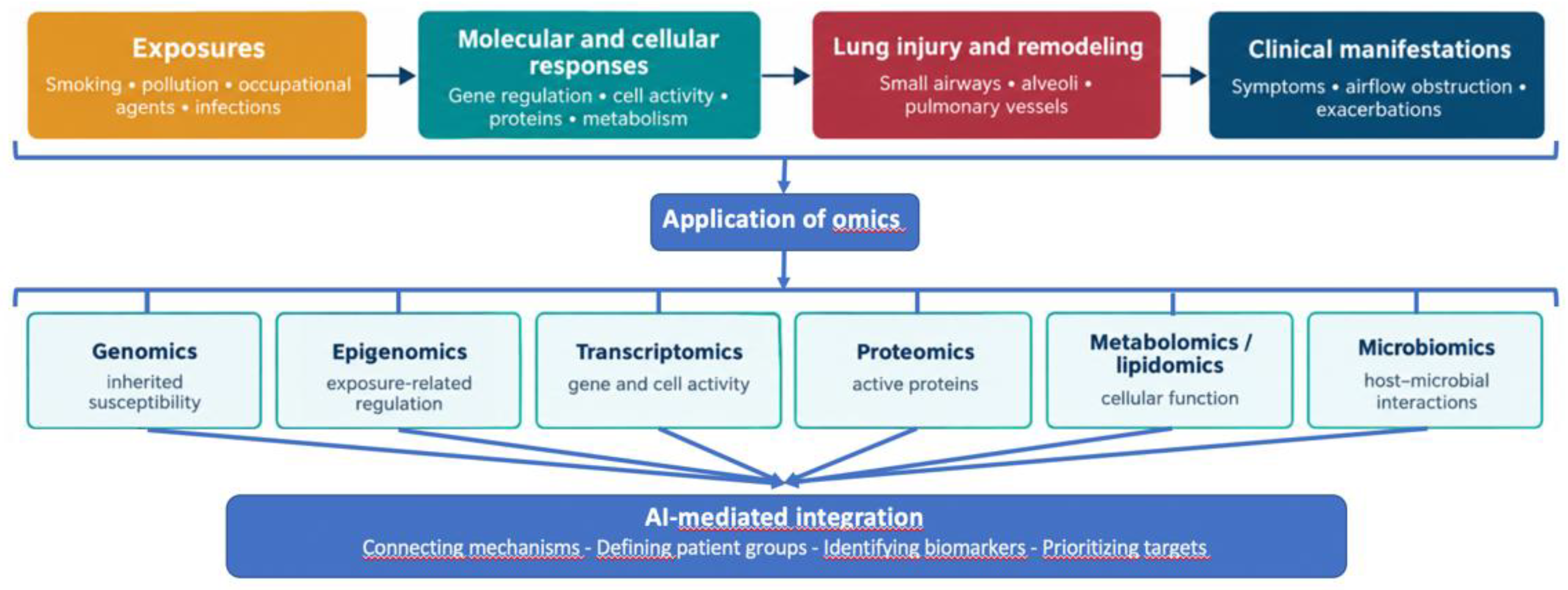
Figure 2.
Proposed AI-mediated integration framework and its hypothesis-generating potential insights. AI may integrate complementary information from selected omics layers together with clinical and imaging data to generate hypotheses about disease mechanisms and biologically defined patient groups and to identify candidate biomarkers, therapeutic targets and treatment strategies.
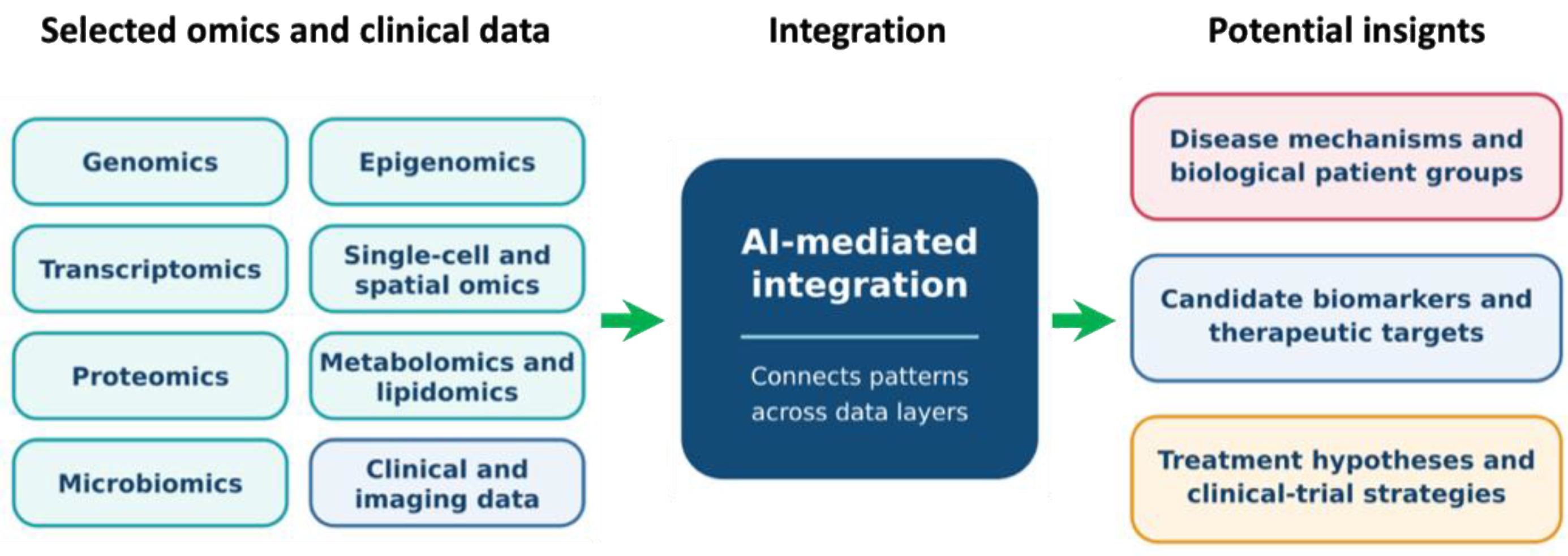

Table 1.
Literature context and perspective of the proposed COPD omics framework.
| Area of emphasis | Common focus in the literature | Perspective developed in this review |
|---|---|---|
| Clinical applications of AI | Detection, imaging, severity, prognosis and decision support | Links clinical findings to underlying molecular processes |
| Individual omics fields | Omics layers examined separately | Clarifies each layer’s contribution to mechanisms, biomarkers and therapies |
| Multi-omics integration | Molecular data combined to identify biomarkers or patient groups | Uses AI to connect susceptibility, exposures, cellular changes and host-microbial interactions |
| Precision medicine | Classification by clinical features, biomarkers or treatment response | Relates biological differences to progression and treatment response |
| Therapeutic development | Biomarkers, pathways and drug targets | Considers target prioritization, drug repurposing, trial enrolment and combination therapies |
| Strength of evidence and clinical use | Reliability and usefulness of reported findings | Distinguishes preliminary, independently validated and clinically relevant evidence |
Table 2.
Potential contributions of selected COPD omics to AI-mediated integration.
| Omics layer | What AI does | Role in the integrated model | Potential impact |
|---|---|---|---|
| Genomics | Detects combinations of COPD-associated variants | Links inherited susceptibility to downstream changes | Risk assessment and target prioritization |
| Epigenomics | Detects altered gene-regulation patterns | Links exposures and aging to changes in gene activity | Biomarkers of exposure, disease activity and treatment response |
| Transcriptomics and single-cell or spatial omics | Identifies affected cells, gene activity and pathways | Shows where and when molecular changes become active | Cell-specific targets and pathway-based therapies |
| Proteomics | Identifies protein patterns associated with disease and outcomes | Connects upstream changes to disease-related proteins | Biomarkers, drug targets and treatment monitoring |
| Metabolomics and lipidomics | Relates metabolite and lipid patterns to COPD features and outcomes | Reflects changes in cellular function, energy use and metabolism | Prediction of progression, treatment response and adverse effects |
| Microbiomics | Links airway microbial patterns to immunity and exacerbations | Incorporates host-microbial interactions | Support for antibiotic selection and identification of microbial or immune targets |
| Selected layers integrated through AI | Connects molecular layers with clinical and imaging data | Models relationships among susceptibility, exposures, molecular changes and COPD phenotypes | Candidate biomarkers, patient groups and targets, and hypotheses for repurposing, combination therapy and response prediction |
Table note: The applications listed remain primarily at the research or early-validation stage and require confirmation in independent populations and prospective clinical studies.
Table 3.
Requirements for clinical translation of AI-integrated COPD omics.
| Key question | What must be shown | How it can be tested | Finding that would limit clinical use |
|---|---|---|---|
| Does it work in other patients? | Reliable performance in independent populations | External evaluation of accuracy and risk calibration | Performance declines across hospitals or patient groups |
| Is the biology credible? | Multiple lines of evidence support the same pathway | Cross-omics confirmation and laboratory experiments | Findings mainly reflect laboratory or hospital differences |
| Does it improve care? | Results lead to beneficial clinical action | Prospective comparison with standard care | No improvement in decisions or patient outcomes |
| Is it safe and fair? | Acceptable performance across patient groups | Evaluation by ancestry, sex, age and other relevant factors | Particular groups experience more frequent or harmful errors |
| Is it practical? | Reliable, timely, affordable and usable testing | Assessment of reproducibility, cost and clinical usability | Missing data, delays or workload prevent effective use |
Table note: These requirements apply before and after clinical implementation.
Disclaimer/Publisher’s Note: The statements, opinions and data contained in all publications are solely those of the individual author(s) and contributor(s) and not of MDPI and/or the editor(s). MDPI and/or the editor(s) disclaim responsibility for any injury to people or property resulting from any ideas, methods, instructions or products referred to in the content. |
© 2026 by the authors. Licensee MDPI, Basel, Switzerland. This article is an open access article distributed under the terms and conditions of the Creative Commons Attribution (CC BY) license (http://creativecommons.org/licenses/by/4.0/).
Copyright: This open access article is published under a Creative Commons CC BY 4.0 license, which permit the free download, distribution, and reuse, provided that the author and preprint are cited in any reuse.