

Submitted:
13 October 2026
Posted:
13 October 2026
You are already at the latest version
Abstract
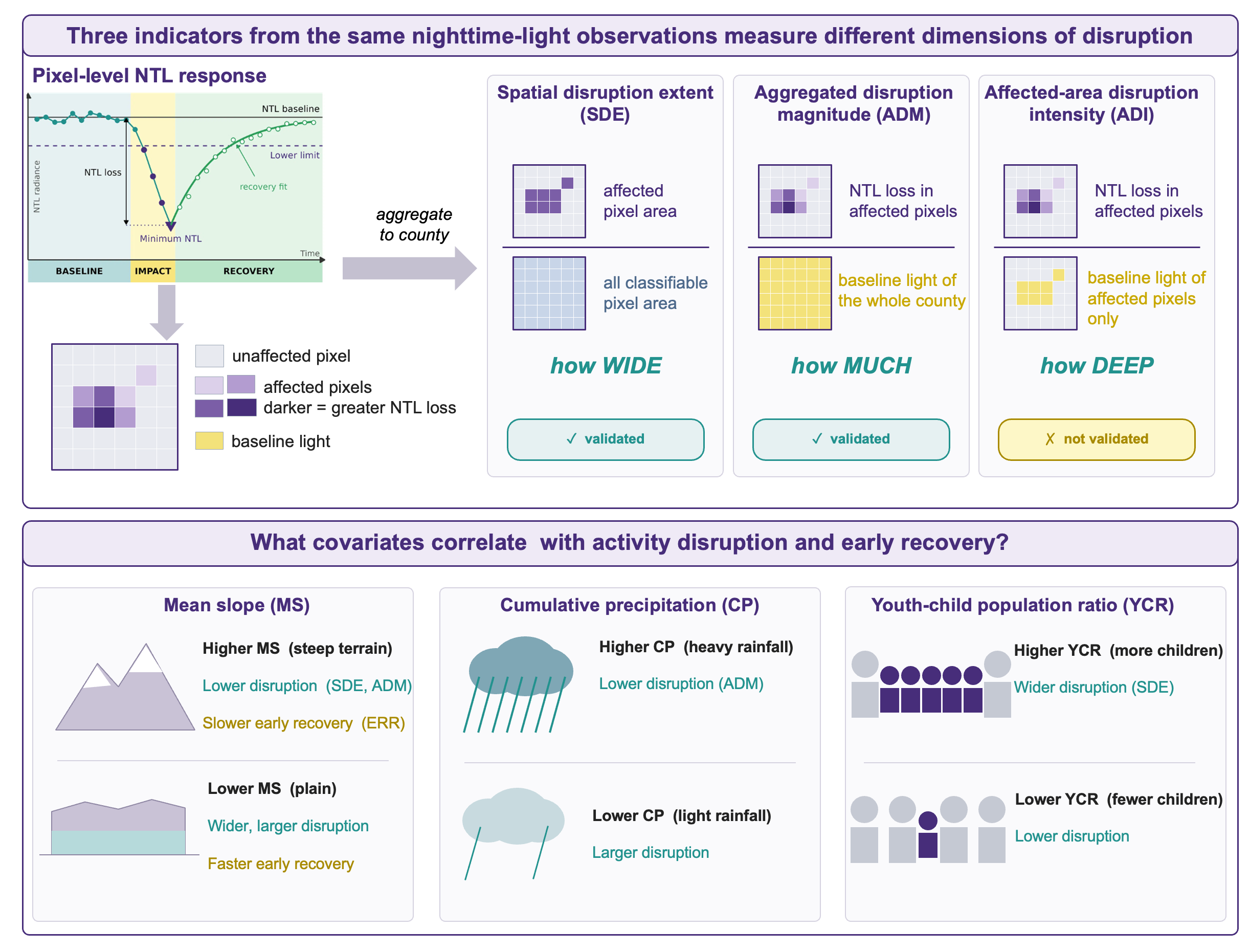
While nighttime-light (NTL) data are increasingly used for disaster assessment, different indicator formulations may represent distinct dimensions of disruption and are rarely validated before cross-area comparison and spatial modeling. This study aimed to establish whether alternative NTL indicators derived from the same observations measure the same dimension of disruption, and then to identify the spatial correlates of flood-induced activity disruption and early recovery using the indicators that proved valid. This study examined county-level flood disruption and early recovery during the 2023 Haihe River Basin flood using daily Visible Infrared Imaging Radiometer Suite observations across the Beijing–Tianjin–Hebei region. Three disruption indicators were evaluated against official disaster records, and the retained indicators alongside an early recovery ratio (ERR) were subsequently analyzed using multiscale geographically weighted regression. Spatial disruption extent (SDE) and aggregated disruption magnitude (ADM) strongly discriminated documented flood impacts (area under the curve [AUC] = 0.931 and 0.865, respectively), whereas affected-area disruption intensity performed poorly (AUC = 0.623) and was excluded from spatial modeling. After controlling for baseline luminance and screening spatial associations for robustness, young-child population ratio was positively associated with SDE, mean slope (MS) was negatively associated with SDE and ADM, and cumulative precipitation was negatively associated with ADM. MS was the only retained correlate of early recovery, with steeper terrain associated with lower ERR regionwide. These findings show that NTL indicators derived from the same observations measure distinct dimensions of disaster response and are not interchangeable; each should be interpreted based on the dimension it measures in NTL-based disaster assessment.
Keywords:
Black Marble
; indicator validation
; multiscale geographically weighted regression (MGWR)
; Beijing–Tianjin–Hebei region
; county-level
Copyright: This open access article is published under a Creative Commons CC BY 4.0 license, which permit the free download, distribution, and reuse, provided that the author and preprint are cited in any reuse.