

Submitted:
12 October 2026
Posted:
13 October 2026
You are already at the latest version
Abstract
Understanding the epidemiology of common causes of fever is important for effective case management, infectious disease control and for pandemic preparedness. Yellow fever (YF), a mosquito-borne viral disease endemic in Guinea, represents one such cause of AFI and remains a priority epidemic-prone disease. We analysed routine YF surveillance data from Guinea's national DHIS2 platform between 2019 and 2023 to describe temporal trends and seasonality. National and subnational notification data were examined using time-series methods, including linear and negative binomial regression, supplemented by multilevel modelling across administrative regions. During the study period, 712 suspected YF cases were reported. The median age was 17 years and 59% of cases were male. Suspected cases were reported from all administrative regions, with the highest numbers recorded in Labé and Faranah. Two notable clusters were identified: one in Labé in November 2020 and one in Faranah in December 2022, corresponding to recognised outbreak events. No significant seasonal variation was observed at national or subnational level, and no significant temporal trend in notifications was identified. These findings suggest continued endemic transmission without evidence of sustained increase or decline during the study period. The ability of routine surveillance systems to detect recognised outbreaks indicates that recent investments in surveillance infrastructure have strengthened monitoring capacity. More broadly, the findings highlight how endemic febrile illnesses such as YF form part of the epidemiological background against which emerging pathogens must be detected, reinforcing the close relationship between routine infectious disease control and pandemic preparedness.
Keywords:
yellow fever
; disease outbreaks
; communicable disease surveillance
; Guinea
Introduction
The majority of diseases of pandemic potential initially present as acute febrile illness (AFI), making it challenging to distinguish between routine causes of AFI and those representing threats to global health security. Because these diseases often share the same initial presentation consisting or fever, malaise, and other non-specific symptoms there is a risk that early cases of infection with a novel or high-consequence pathogen go unrecognised or are misclassified as common febrile illnesses. This broad and overlapping clinical presentation poses a fundamental challenge: in low-resource settings, where diagnostic capacity is limited, it is often impossible on clinical grounds alone to distinguish between ‘routine’ endemic illnesses and emerging and re-emerging pathogens with epidemic or pandemic potential. The considerable etiologic diversity underlying AFI has been documented across multiple settings. For example, a study in Nigeria of symptomatic patients presenting with acute febrile illness using a multi-pathogen detection methodology identified both common pathogens such as Plasmodium (malaria) as well as pathogens of epidemic significance including haemorrhagic fever viruses and rickettsiae (1); similarly, a study in South and Southeast Asian countries revealed a wide diversity of pathogens in patients seeking care for undifferentiated AFI, ranging from arboviruses and enteric bacteria to zoonotic rickettsiae, highlighting the considerable etiologic heterogeneity across the region(2). This problem has also been highlighted in the context of the COVID-19 pandemic when integrating COVID-19 into established AFI systems demonstrated that patients meeting broad febrile case definitions could include previously unrecognized COVID-19 cases, underscoring both the nonspecific clinical presentation of SARS-CoV-2 infection and the value of flexible, multi-pathogen surveillance systems during emerging health threats (3).
One cause of AFI that can be difficult to differentiate based on early-stage clinical presentation alone is yellow fever (YF). The disease is caused by the yellow fever virus, a member of the Flaviviridae family, and is characterized by a spectrum of clinical manifestations ranging from mild febrile illness to jaundice to severe haemorrhagic disease with high mortality rates. YF is a mosquito-borne spread predominantly by day-biting Aedes aegypti in Africa(4). Transmission of YF may occur via distinct ecological cycles: a “sylvatic” (or jungle) cycle involving non-human primates and forest mosquitoes; an “intermediate” (or savannah/semi-domestic) cycle involving semi-domestic mosquitoes biting both primates and humans; and an “urban” cycle in which mosquitoes transmit the virus directly among humans in densely populated areas with poor immunity and abundant suitable breeding sites (5, 6).
While endemic across environments in Africa and South America, YF also has the potential for large and sustained outbreaks (7). Combinations of high vector density, immunologically susceptible populations, and limited healthcare infrastructure increase the potential for rapid outbreak amplification and severe public health impact. Additionally, YF can be classified as a climate-sensitive diseases with transmission dynamics as well as severity of outcomes influenced by environmental factors such as temperature, rainfall, and humidity, which affect mosquito abundance, biting behaviours, and viral replication (8).
A safe, effective vaccine exists: a single dose generally provides long-lasting (lifelong) immunity, with ~80–100% of vaccinated individuals protected within 10 days and over 99% within 30 days (5, 6). Importantly, despite this efficacy, coverage remains suboptimal in many countries at risk with estimated routine yellow fever vaccine coverage averaging around 52% across countries at risk globally, well below the ≥80% needed to confer population immunity and prevent outbreaks (9). In the African Region, where most yellow fever transmission occurs, routine immunization coverage was estimated at around 48% in 2021, with country-level estimates ranging from as low as 7% in Kenya to much higher levels in others, highlighting marked heterogeneity in uptake (10). Coverage gaps are driven by multiple factors, including delays in vaccine introduction or scheduled campaigns, diversion of health system resources during competing emergencies such as COVID-19, and persistent challenges in delivering services to remote or underserved populations, all of which contribute to susceptibility and ongoing outbreaks (10).
Guinea is a high-risk endemic country according to the EYE (Eliminate Yellow fever Epidemics) global strategy classification and YF is considered a priority epidemic-prone disease (11). Vaccination coverage over the study period has rien from 45% in 2019 to 52% in 2023 according to joint WHO-UNICEF estimates(12). More broadly, Guinea has been a site of heightened public health research interest in the years following the 2013-2016 West Africa Ebola outbreak. A 2016 assessment of the surveillance system found significant shortcomings (13). In 2017, surveillance data for yellow fever and other diseases of epidemic potential transferred to the DHIS2 platform in two pilot regions, expanding to national aggregate surveillance in 2018 and full case-based surveillance in DHIS2 nation-wide by 2019 (14). No formal assessment or analysis of surveillance data for yellow fever has been conducted since this expansion of surveillance activities. A recent assessment of Guinea’s epidemic-prone disease management systems found average overall performance with a gradual upward trend, with strengths particularly noted in the surveillance domain, where self-assessments using standardized questionnaires measured indicators such as timely case reporting, data completeness, and outbreak detection capacity, suggesting that the country’s surveillance infrastructure is comparatively robust and improving over time(15).
In this study we used surveillance data to describe the trends and seasonality of a YF in Guinea to better understand the background of acute fevers against which pandemics have to be detected. The study was conducted as part of a larger study on causes of AFI in Guinea consisting of both analysis of routine surveillance data as well as primary data collection in humans, domestic, and peri-domestic animals.
Methods
Guinea relies on laboratory notification for yellow fever surveillance, with cases recorded in a national DHIS2 system (14). The Agence Nationale de Sécurité Sanitaire is responsible for collating weekly surveillance data on priority diseases, integrating laboratory and field reports. Using thresholds defined under the national Integrated Disease Surveillance and Response (SIMR) guidelines, the agency identifies potential outbreaks or disease clusters and coordinates rapid public health responses, ensuring that signals detected through routine surveillance trigger timely interventions.
We retrieved YF surveillance data for all Guinea from DHIS2 for 2019 to 2023. We investigated trends and seasonality in the national and sub-national (eight administrative regions divided into 33 prefectures, plus the capital of Conakry) notification data from 2019 to 2023. We performed time series analysis using linear and negative binomial regression modelling augmented by multi-level modelling of cases by administrative region using a negative binomial model to identify seasonality and trends. Analyses were performed in R using RStudio.
This study was conducted using de-identified national surveillance data and did not require stand-alone ethical approval. It was conducted as part of the larger Fever Project, which was approved by Georgetown University’s Institutional Review Board (STUDY00002481), the Guinean National Committee for Ethics in Health Research (No. 040/CNERS/22), and the Defense Health Agency Research and Development Office of Human Research Oversight (OHRO) (E02977.1a and E02977.1b).
Results
Between 2019 and 2023, 712 suspected cases of YF were notified via DHIS2 to the national surveillance authorities. The median age of cases was 17 years (IQR 22), with an age range of 0-94 years. 59% of cases were male (Figure 1).
All eight administrative regions reported suspected cases of YF during the study period. Labé and Faranah reported the most cases with 154 and 140 cases reported respectively (see Table 1).
We identified unusually large clusters of suspected cases (Figure 2) in November 2020 in Labé (39 cases, 33 in the Préfecture of Koundara) and in December 2022 in Faranah (33 cases, 30 in the Préfecture of Dabola).
Significant seasonal variation was not present at either the national or the subnational level during our study period. Cases remained stable nationally with no significant trend (p=0.33). Multi-level multilevel logistic regression modelling identified neither trend nor seasonality.
Discussion
Contextualisation of Results
YF remains endemic in Guinea with no identifiable seasonal variation at national or sub-national level. The lack of a downward trend would suggest that current control strategies consisting of vaccination and vector-control are insufficient to reduce the number of annual cases and therefore sustainably interrupt endemic transmission. However, this has to be seen in the context of which is expected to influence mosquito ecology, virus transmission dynamics, and the geographic distribution of vector populations. Under such conditions, an upward trend in YF cases would have been plausible even if control measures were maintained at current levels. Additionally, apparent trends in case data may also reflect underlying surveillance artifacts. The recent shift toward more systematic, standardized surveillance, including the adoption of DHIS2 for case reporting, likely improved case detection and reporting completeness, potentially inflating apparent incidence relative to previous periods. The absence of a significant upward trend under these circumstances can therefore be interpreted as generally positive, suggesting that despite environmental pressures and enhanced detection, the outbreak burden has not substantially increased. Importantly, current surveillance approaches using DHIS2 were able to identify both outbreaks during the time period studied, these were outbreaks that were at the time reported to the World Health Organization and to the best of our knowledge the only YF outbreaks in Guinea in the study period and, to the best of our knowledge, represent all confirmed YF outbreaks in Guinea within this timeframe. This indicates that strengthened routine surveillance, combined with outbreak reporting protocols, provides a credible system for monitoring YF dynamics in Guinea and assessing the impact of ongoing control interventions.
Limitations
This analysis relies on routine surveillance data, which can be incomplete or variable in quality due to underreporting, delayed notifications, or inconsistencies in data entry; however, such data still provide valuable insight into real-world disease patterns. Case detection is primarily passive rather than actively screened, meaning that mild or asymptomatic cases may go undetected, potentially underestimating the true incidence. The findings describe epidemiological patterns of suspected cases, while this does not necessarily fully correspond to confirmed cases if such confirmation had been available, the case definition remained stable over the period as did therefore the cross-season and cross-year comparison. Additionally, no testing was conducted for other pathogens, limiting understanding of the full spectrum of infectious agents circulating in the population. Despite these limitations, analysis of trends and seasonality in surveillance data can reveal important patterns in disease transmission, identify periods of increased risk, and inform targeted public health interventions. This also has implications for pandemic preparedness beyond the individual pathogen under study.
Implications for Pandemic Preparedness
While the risk of YF remains a health risk to the population, there are also further considerations to be made in a country context that is a zoonotic disease emergence area. There is a non-trivial risk that YF as well as other causes of AFI continue to hamper pandemic early detection. Therefore, both routine and outbreak response vaccination as well as mosquito control remain essential measures to reduce the burden of YF in Guinea and to thereby increase the detectability of pathogens of pandemic-potential early. This non-specific presentation of AFIs such as YF complicates early identification, as it overlaps extensively with common endemic infections such as malaria, dengue, bacterial sepsis, or influenza. Consequently, distinguishing routine causes of AFI from pathogens that pose significant epidemic or pandemic threats is challenging, particularly in the early stages of infection when clinical features alone are insufficient for differentiation. This presents critical challenges for global health security, as early cases of emerging pathogens may go undetected or be misclassified as common febrile illnesses, delaying outbreak recognition and response.
There is also increasing interest in other Aedes-borne viruses in Guinea. In October 2023, the first ever molecularly confirmed case of chikungunya virus (CHIKV) was identified in the country through the Fever Project; this infection was considered autochthonous, as the patient reported no recent travel history, underscoring the potential for local transmission of additional arboviruses in a setting already facing overlapping febrile illness burdens (16).
This study was conducted in the context of a wider study of causes of AFI of unclear aetiology consisting of both a repeat cross-sectional community study enrolling humans and domestic and peri-domestic animals as well as a hospital-based cohort study. In the community context we found a high prevalence of asymptomatic malaria in forest Guinea, another AFI presentation potentially masking emerging and pandemic-potential outbreaks in this setting (14). Early detection of emerging, novel, and pandemic-prone diseases always occurs against the backdrop of these endemic and common causes of fever, giving rise to the suggestion that pandemic preparedness and more routine infectious disease control are in fact closely linked and the reduction of common causes of fever and neglected tropical diseases should be a priority for pandemic preparedness. Integrating robust and broad-spectrum AFI surveillance, including molecular diagnostics and multi-pathogen panels, therefore, emerges as a critical strategy for early detection of emerging threats before they escalate into large outbreaks. Moreover, AFI-based surveillance is particularly important in endemic regions where ecological, demographic, and socioeconomic factors may amplify the risk of pathogen spillover from animal reservoirs to humans. By prioritising early recognition of unusual AFI patterns, health systems can improve outbreak preparedness, target vaccination campaigns, and implement vector or infection control measures before wider transmission occurs.
References
- Courtney, L.P.; Kwaghe, V.; Erameh, C.; Samuels, J.O.; Quiner, C.A.; Kim, J.H.; et al. Descriptive Epidemiology of Acute Febrile Illness Patients in Nigeria: Pathogens of Global Public Health Significance Detected Using a Multi-Pathogen Detection Tool. Clin. Infect. Dis. 2025, 81 (Supplement_4), S147–S59. [Google Scholar] [CrossRef]
- Wangdi, K.; Kasturiaratchi, K.; Nery, S.V.; Lau, C.L.; Gray, D.J.; Clements, A.C.A. Diversity of Infectious Aetiologies of Acute Undifferentiated Febrile Illnesses in South and Southeast Asia: A Systematic Review. BMC Infect. Dis. 2019, 19(1), 577. [Google Scholar] [CrossRef]
- Shih, D.C.; Silver, R.; Henao, O.L.; Alemu, A.; Audi, A.; Bigogo, G.; et al. Incorporating Covid-19 into Acute Febrile Illness Surveillance Systems, Belize, Kenya, Ethiopia, Peru, and Liberia, 2020-2021. Emerg. Infect. Dis. 2022, 28(13), S34–s41. [Google Scholar] [CrossRef]
- Kwallah, A.; Inoue, S.; Thairu-Muigai, A.W.; Kuttoh, N.; Morita, K.; Mwau, M. Seroprevalence of Yellow Fever Virus in Selected Health Facilities in Western Kenya from 2010 to 2012. Jpn. J. Infect. Dis. 2015, 68(3), 230–4. [Google Scholar] [CrossRef]
- World Health Organization. Yellow Fever. Health Topics 2025. Available online: https://www.who.int/health-topics/yellow-fever#tab=tab_1 (accessed on 26.11.2025).
- World Health Organization. Yellow Fever. Fact sheets 2025. Available online: https://www.who.int/news-room/fact-sheets/detail/yellow-fever (accessed on 26.12.2025).
- Fraser, K.; Hamlet, A.; Jean, K.; Ramos, D.G.; Romano, A.; Horton, J.; et al. Assessing Yellow Fever Outbreak Potential and Implications for Vaccine Strategy. PLoS Glob. Public Health 2024, 4(11), e0003781. [Google Scholar] [CrossRef]
- Gaythorpe, K.A.M.; Hamlet, A.; Cibrelus, L.; Garske, T.; Ferguson, N.M. The Effect of Climate Change on Yellow Fever Disease Burden in Africa. eLife 2020, 9, e55619. [Google Scholar] [CrossRef]
- World Health Organization. Immunization Coverage. 2026. Available online: https://www.who.int/news-room/fact-sheets/detail/immunization-coverage (accessed on 24.07.2026).
- WHO Regional Office for Africa. Responding to Communicable and Noncommunicable Diseases: Progress Report 2020-2022; WHO Regional Office for Africa: Brazzaville.
- World Health Organization. Mid-Term Evaluation of the Global Strategy to Eliminate Yellow Fever Epidemics (Eye) 2017–2026; World Health Organization: Geneva, 2023. [Google Scholar]
- World Health Organization; United Nations Children’s Fund. Guinea: Who and Unicef Estimates of Immunization Coverage: 2025 Revision; WHO and UNICEF: Geneva, 2026. [Google Scholar]
- Collins, D.; Rhea, S.; Diallo, B.I.; Bah, M.B.; Yattara, F.; Keleba, R.G.; et al. Surveillance System Assessment in Guinea: Training Needed to Strengthen Data Quality and Analysis, 2016. PLoS ONE 2020, 15(6), e0234796. [Google Scholar] [CrossRef]
- Reynolds, E.; Martel, L.D.; Bah, M.O.; Bah, M.; Bah, M.B.; Boubacar, B.; et al. Implementation of Dhis2 for Disease Surveillance in Guinea: 2015-2020. Front Public Health 2021, 9, 761196. [Google Scholar] [CrossRef]
- Kpamy, D.O.; Delamou, A.; Traore, F.A.; Doumbia, S.; Peter, J.W.; Toure, A.; et al. Evaluation of the Performance of Epidemic-Prone Disease Management Systems in Guinea. Clin. Epidemiol. Glob. Health 2025, 35, 102120. [Google Scholar] [CrossRef]
- Keita, M.B.; Faye, M.; Traoré, B.; Cherif, M.S.; Sampou, M.A.; Barry, A.M.; et al. First Identification of an Autochthonous Case of Chikungunya in Guinea. Am. J. Trop. Med. Hyg. 2026. [Google Scholar] [CrossRef]
Figure 1.
Demographic pyramid of yellow fever cases in Guinea 2019-2023 by age and sex.
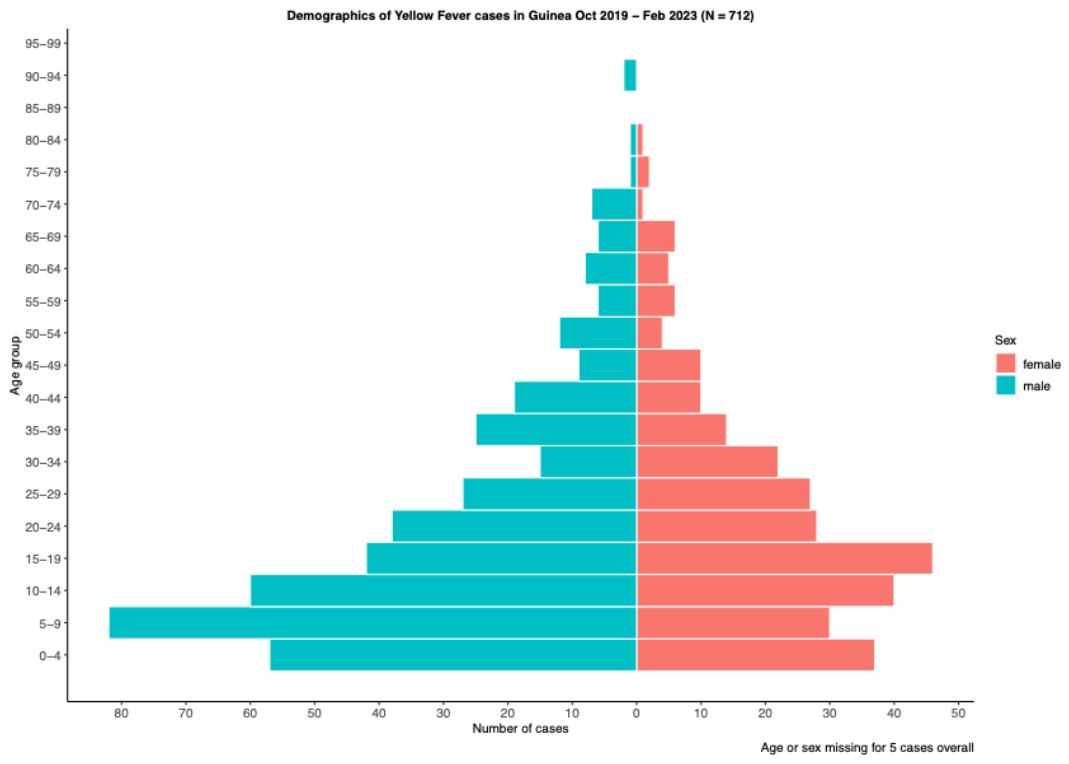
Figure 2.
Epidemic curve of cases of yellow fever in Guinea 2019-2023 by date of report and administrative region.
Figure 2.
Epidemic curve of cases of yellow fever in Guinea 2019-2023 by date of report and administrative region.
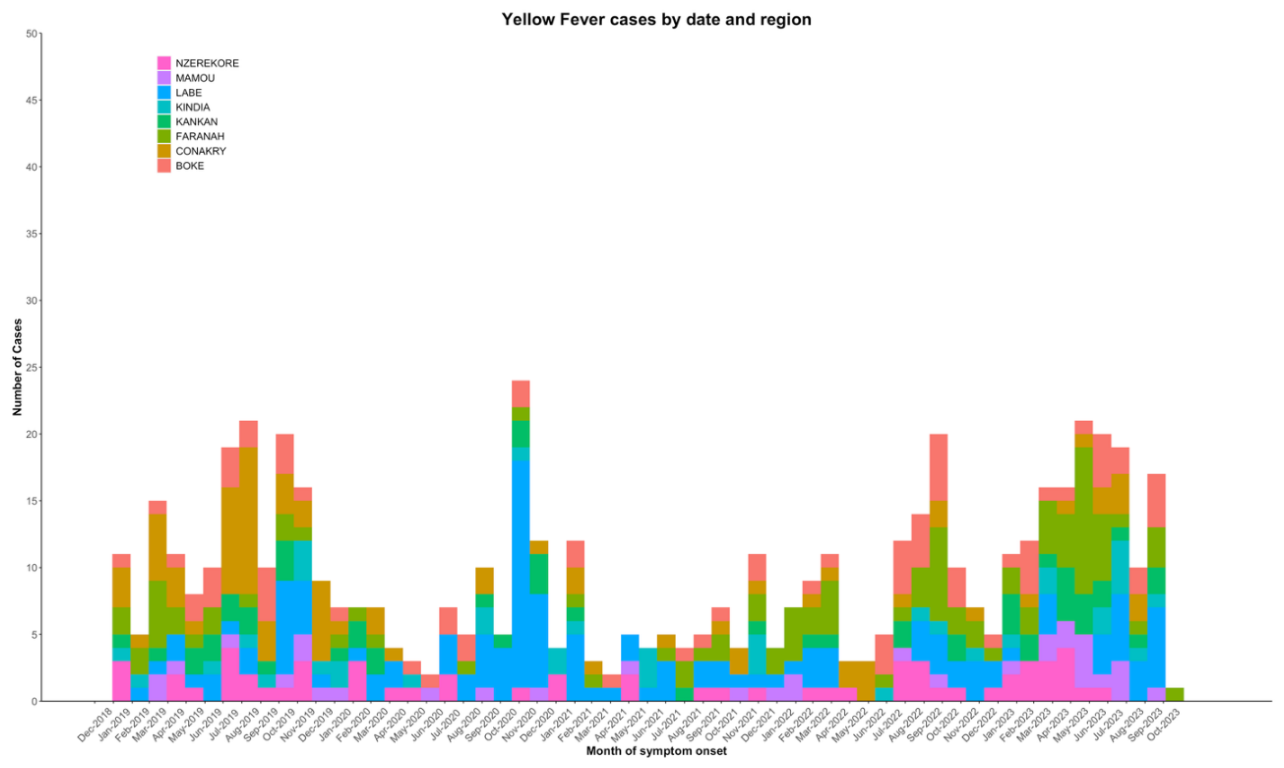

Table 1.
Yellow fever cases 2019-2023 by administrative region.
| Administrative Region | Cases 2019-2023 |
|---|---|
| Labé | 154 |
| Faranah | 140 |
| Conakry | 93 |
| Boké | 88 |
| Kankan | 84 |
| Nzérekoré | 67 |
| Kindia | 48 |
| Mamou | 38 |
Disclaimer/Publisher’s Note: The statements, opinions and data contained in all publications are solely those of the individual author(s) and contributor(s) and not of MDPI and/or the editor(s). MDPI and/or the editor(s) disclaim responsibility for any injury to people or property resulting from any ideas, methods, instructions or products referred to in the content. |
© 2026 by the authors. Licensee MDPI, Basel, Switzerland. This article is an open access article distributed under the terms and conditions of the Creative Commons Attribution (CC BY) license (http://creativecommons.org/licenses/by/4.0/).
Copyright: This open access article is published under a Creative Commons CC BY 4.0 license, which permit the free download, distribution, and reuse, provided that the author and preprint are cited in any reuse.