

Submitted:
12 October 2026
Posted:
13 October 2026
You are already at the latest version
Abstract
Multi-Agent Path Finding (MAPF) computes collision-free trajectories for robot teams. Conventional 4-connected cardinal-move MAPF restricts agents to axis-aligned moves, which produces unnecessarily long paths. Any-angle MAPF (AA-MAPF) can generate shorter line-segment trajectories, yet state-of-the-\art AA-MAPF solvers such as CCBS (Continuous-time Conflict-Based Search) suffer from heavy computational overhead: they rely on numerical iterative minimal safe waiting-time computation, enumerate similar constraints near current constraint for MC (Multi-Constraints) acceleration. This paper presents a bounded-suboptimal any-angle planner built upon the ECBS (Enhanced Conflict-Based Search) framework: AA-ECBS (Any-Angle ECBS). We redefine constraints as part of agent trajectories, avoid enumerate similar constraint for MC acceleration, derive analytic solutions for minimal safe waiting-time. The approach retains completeness and bounded suboptimality. Evaluated on standard benchmarks, our method achieves better runtime and success rate compared to existing solvers, and keep the same solution quality.
Keywords:
Multi-Agent Path-Finding (MAPF)
; Any Angle Multi-Agent Path-Finding (AA-MAPF)
1. Introduction
Multi-agent path finding (MAPF) aims to compute collision-free trajectories for a team of robots sharing a common environment, and underpins a wide range of applications from automated warehouses to inspection and surveillance fleets. The dominant family of solvers, rooted in Conflict-Based Search (CBS), resolves inter-agent conflicts through a tree of spatio-temporal constraints and has been shown to scale to large teams. However, most classical MAPF formulations restrict each agent to four cardinal moves on a 4-connected grid. While efficient, this discretization forces paths to be composed of axis-aligned segments that unnecessarily detour around obstacles, producing longer trajectories than a robot could physically execute.
Any-angle MAPF addresses this limitation by allowing agents to move along any-angle segments, yielding significantly shorter paths, as shown in Figure 1. A key challenge in this setting is that conflicts can no longer be represented as discrete vertex or edge occupancies on a grid: agents traveling along continuous segments may collide at arbitrary points and at arbitrary times. Continuous-time conflict-based search (CCBS) was proposed to handle such continuous collisions, but it resolves each conflict by enumerating a set of edge-level constraints and then invoking a numerical, iterative computation of the required waiting time. This incurs substantial time cost overhead as the length of path grows.
In this paper we present an any-angle, bounded-suboptimal multi-agent path finder built upon the ECBS[1] framework. Rather than forbid agent pass edges, we redefine constraint as part of agent trajectories, and derive analytic solutions for the minimal safe waiting time needed to resolve a spatio-temporal collision, respecting both lower and upper temporal bounds. Expensive line-of-sight (LOS) checks, which dominate runtime in any-angle path plannings, are moved offline and accelerated with JOB (Jump Over Block [2]) procedure. Because our design inherits the ECBS search structure, the planner remains complete and retains provable bounded-suboptimality.
We evaluate our approach on standard MAPF benchmarks. Compared with state-of-the-art continuous-time solvers CCBS, our method avoid emumerate of similar constraint and numerical iterative, and achieves higher success rates and lower runtime at scale.
The main contributions are: (i) a trajectory-level constraint definition that avoids enumerating multiple edge constraints for MC acceleration; (ii) analytic safe waiting-time interval resolution that is more precise and incurs lower runtime compared with numeric iteration; and (iii) an offline line-of-sight check accelerated by JOB. Combined with the above components, this yields an efficient, complete, bounded-suboptimal any-angle multi-agent path planner.
2. Related Work
Multi-agent pathfinding (MAPF)[3,4] aims to compute collision-free trajectories for multiple agents while minimizing the sum of individual travel costs. The classical Conflict-Based Search (CBS)[4,5,6] is a well-known optimal MAPF solver built on a two-level search framework. Its high-level constraint tree (CT) resolves pairwise conflicts by branching and adding one constraint per child node, while the low-level planner computes single-agent paths under given constraints. However, vanilla CBS is designed for discrete time and grid four-neighbor movement, which restricts agents to move only to adjacent grid vertices in synchronized time steps. This discrete abstraction yields longer paths than geometrically feasible straight-line trajectories and cannot naturally handle agents moving at variable speeds with asynchronous actions.
To lift the discrete-time and synchronized-action assumptions, Continuous-time Conflict-Based Search (CCBS) was proposed in Andreychuk[7]. CCBS combines CBS with Safe Interval Path Planning (SIPP)[8,9,10] for the low-level search. It models agent movements as timed line segments and detects continuous-time geometric collisions between moving agents, rather than discrete vertex/time conflicts. Instead of point constraints, CCBS generates time-interval negative constraints that forbid an agent from executing a specific edge within a certain time window. Later, Andreychuk[11] introduced two acceleration techniques: Disjoint Splitting (DS) and Multi-Constraint (MC). DS replaces pure negative constraints with a positive-constraint / negative-constraint split pair, while MC is a lookahead pruning mechanism: when resolving one primary conflict, MC enumerates temporally related moves of conflicting agents and attaches multiple sound constraints in a single constraint tree (CT) split. MC reduces the number of CT nodes and improves scalability, though it shrinks the feasible space for low-level planning and increases the chance of low-level planner failures. Nevertheless, CCBS still operates on grid graphs, where agents can only traverse pre-defined graph edges, so it cannot produce arbitrary-angle straight-line paths.
The limitation of grid-based movement is addressed by AA-CCBS, introduced in Yakovlev[12]. AA-CCBS is the first optimal any-angle MAPF algorithm. It replaces CCBS’s low-level SIPP with Time-Optimal Any-Angle SIPP (TO-AA-SIPP), which searches for optimal straight-line trajectories between any two vertices with line-of-sight checks, not limited to grid neighbors. AA-CCBS successfully migrates MC and DS to the any-angle continuous-time setting, proposing MC1/MC2/MC3 variants for selecting related moves for multi-constraint generation. Furthermore, AA-CCBS supports bounded-suboptimal search by introducing a focal-list mechanism inherited from ECBS, allowing controlled trade-off between runtime and solution quality. Still, AA-CCBS suffers from a known search inefficiency: when high-level constraints raise the earliest arrival time (EAT) of nodes that are geometrically close to the goal, their values increase. The open list prioritizes nodes with smaller f, which may correspond to paths farther from the goal but free from constraints, leading to excessive expansion of unpromising branches in the low-level TO-AA-SIPP search.
For any-angle path planning, line-of-sight (LOS) checking dominates the runtime of Theta*, TO-AA-SIPP and other visibility-based planners. Jump Over Block (JOB)[2] was proposed to accelerate LOS computation on grid maps with sparse obstacles. JOB partitions the environment into spatial blocks. During ray casting for LOS verification, the algorithm jumps directly across passable blocks instead of checking every grid cell along the ray, preserving the exact LOS result while drastically reducing the number of cell queries. It is noteworthy that, JOB focus purely on geometric LOS acceleration and do not modify the order of state expansion in the low-level search.
3. Methodology
Unlike vanilla MAPF with four-neighbor node expansion, AA-MAPF uses any-angle node expansion to produce shorter solution paths. To guarantee practical effectiveness, a valid AA-MAPF algorithm must guarantee bounded suboptimality or optimality. Otherwise, its solutions may be inferior to those of standard MAPF, rendering any-angle node expansion meaningless. However, computing optimal solutions for AA-MAPF suffers from prohibitive computational overhead. Unlike 2D MAPF with approximately edges for four-neighbor connectivity, the AA-MAPF graph contains a drastically increased number of edges, reaching in the worst case where all nodes are mutually visible (with n denoting the total number of nodes). Such a dense graph structure renders optimal AA-MAPF solving extremely time-consuming.
To balance optimality, completeness, and computational efficiency, this work develops a novel complete and bounded-suboptimal AA-MAPF algorithm based on the ECBS framework. The state-of-the-art ECBS-based AA-MAPF method (AA-CCBS) relies on numerical iteration for conflict resolution, which incurs substantial time costs in large-scale scenarios with long agent paths, as the iteration steps grow with path length. Moreover, AA-CCBS adopts the multi-constraint (MC) acceleration strategy, which enumerates multiple similar conflicting constraints to strengthen pruning capability but introduces redundant computational overhead. Additionally, the runtime of AA-MAPF is highly dominated by online line-of-sight (LOS) check, which is a fundamental bottleneck of any-angle path planning.
Targeting the aforementioned limitations, we propose three improvements in this work. First, we replace the numerical iterative conflict resolution with an analytical solution to eliminate iterative computation overhead. Second, we redefine the AA-MAPF constraint to retain the full pruning effectiveness of MC while avoiding extra computational costs. Third, we migrate LOS checks from online real-time computation to offline preprocessing and adopt the precise JOB to further accelerate the low-level planning efficiency. The detailed design and theoretical analysis of the proposed algorithm are presented in the following sections, and the technical background of JOB is illustrated in Section 2.
3.1. Problem Statement
Consider a set of vertices V defined in a metric space, e.g., a grid map where vertices correspond to grid cell centers. We consider N agents, each assigned a unique start vertex and a goal vertex. All agents are initially placed at their respective start vertices and modeled as circular bodies with identical radius R. Each agent can perform two types of actions: waiting at the current vertex for an arbitrary duration or moving between two vertices.
An individual agent path is a sequence of timed states , where denotes a vertex location and represents the arrival time at . Two consecutive vertices correspond to a move. Consecutive identical vertices () correspond to a waiting action, while distinct vertices correspond to a movement action. The cost of each action is equal to its time duration. For move actions, this duration equals the Euclidean length of the traversed edge; for wait actions, the duration corresponds to the waiting time. The waiting duration is arbitrary, whereas the movement duration equals the Euclidean distance between the two vertices. This definition assumes unit-speed motion and instantaneous acceleration/deceleration of agents. A movement action is valid only if the agent’s entire traversal along the connecting segment is collision-free with all obstacles. A conflict occurs between two agent paths if the pairwise Euclidean distance between the agents is smaller than the sum of their radii at any shared time instant.
The AA-MAPF problem aims to compute a set of collision-free paths that transfer all agents from their start vertices to their respective goal vertices. The quality of individual path is defined as its completion time . Consistent with conventional MAPF evaluations, we adopt two standard optimization metrics: makespan and sum-of-costs (SOC), formulated as
Both metrics are valid optimization objectives. In this work, we select SOC as our primary optimization criterion.
3.2. Redefinition of Constraints
Existing multi-constraint (MC) acceleration in AA-CCBS improves high-level pruning by enumerating multiple similar conflicting constraints for a single conflict event. However, this mechanism suffers from two inherent drawbacks: (1) intersecting numerous unsafe intervals excessively trims the final constrained region and degrades pruning power; (2) exhaustive enumeration of similar constraints introduces non-negligible computational overhead. To address these issues while retaining strong pruning capability, we propose a novel segment-level continuous constraint tailored for any-angle MAPF.
In AA MAPF, agent conflicts originate from the spatiotemporal overlap between two agent moves. We define a conflict as a tuple , where and denote two distinct agents. and are the start and end vertices of the move performed by and , respectively, and , represent the time intervals of the two moves. Instead of imposing edge-based constraints, we encode the opponent’s entire move as a constraint. Specifically, we define constraints and . During low-level path search, agent ’s replanned move must avoid conflict with ’s move over , and agent ’s replanned move must avoid conflict with ’s move over .
Different from the enumeration strategy adopted by the MC mechanism, our method constructs a single geometry-driven constraint derived from the segment of the conflicting agent. This design abandons the discrete point-constraint approximation and constraint superposition used in existing AA-MAPF solvers. It naturally matches the continuous spatiotemporal conflict characteristics of any-angle paths, yields pruning performance comparable to MC, and fully removes the extra computation required for redundant constraint generation and unsafe interval intersection. Furthermore, the proposed continuous constraint circumvents the interval trimming deficiency of MC and prevents degradation of pruning effectiveness caused by over-compressed constraint intervals.
Large-scale experiments verify that the proposed segment-level constraint achieves MC-level acceleration with lower computational cost, forming a lightweight and robust constraint strategy for any-angle multi-agent path finding.
3.3. Analytic Resolution of Safe Wait Time Intervals
As mentioned above, we define a constraint as a move belonging to another agent that conflicts with the current agent’s path. In the low-level search, we require that an agent’s moves satisfy all constraints (i.e., the agent’s moves do not conflict with any move specified in the constraints). When two moves from different agents collide, we can resolve this conflict by inserting a wait action for one of the conflicting agents. For example, consider circular agents with radius . The move and the move collide at at position . If is delayed by one time unit via a wait action at , i.e., , then the two moves no longer conflict.
In this section, we introduce how we get the safe wait time interval for a move and a constraint .
We derive the minimal Euclidean distance between two moves (line segments in spacetime) with a time delay s, evaluated at the t. The first move is parameterized by arc length t, while the second move has a time delay s in its parameterization.
The position on move at time t is
where , with component-wise expressions
The position on the delayed move is
where , with components
The squared Euclidean distance between and is
Expanding the coordinate differences:
Denote
Then the coordinate differences simplify to
Substituting into squared distance yields a quadratic function in t:
Since , is convex in t for fixed s, when , is strictly convex and U-shaped: it decreases monotonically to its global minimum and then increases monotonically. And its unconstrained minimizer is
Substituting and grouping terms linear in s:
Define the slope k and intercept b:
The minimizer becomes a linear function of delay s:
The unsafe interval for collision is determined by checking whether the unconstrained minimizer lies within the feasible common time interval of the two moves, .
(1)When is in the common time interval
We impose four constraints on and solve for the corresponding values of s such that lies within the common time interval of the two moves, :
- 1.
-
: for , ,denote ;
- 2.
-
: for , ,denote ;
- 3.
-
: for , ,denote ;
- 4.
-
: for , ,denote
We now prove , which would help we aovid considering what if . Substitute into k:
For non-parallel moves, the denominator , so only the numerator affects the sign of k. Expanding:
Define unit direction vectors
By construction , , and By the Cauchy–Schwarz inequality, , hence , which yields .
A special case is , which makes if , and otherwise; similarly, if , and otherwise.
We then obtain the interval of s such that lies within the common time interval, denoted as . Next, we solve , which is a quadratic inequality in s. As a conflict occurs if the minimal distance between the two moves evaluated at the same time instant is less than . Solving this quadratic inequality yields the s-interval for which a conflict occurs. The unsafe s-interval where the minimum distance is attained at is then given by .
(2)When is not in the common time interval
Then we discuss when is not in the common time interval. Subject to the length constraints of segments and , s is bounded within . Outside this range, the two moves share no common time window. We denote the s interval when is not in the the common time interval is .
When , the minimal distance point may occur on one end of the common time part. Considering s determine the common time interval of two move. We consider all four cases of common time interval, and related s interval.
1) common time interval is , denote
2) common time interval is , denote
3) common time interval is , denote
4) common time interval is , denote
Then, we obtain the unsafe s set for the case where the unconstrained minimizer lies outside the common time interval:
Finally, we obtain the safe set
where , with .
3.4. Line-of-Sight Check Precomputation with Jump Over Block
AA-MAPF generates any-angle, non-grid-aligned solutions by continuously performing LOS checks during low-level search. However, exhaustive online LOS checks between arbitrary pairs of free grid cells incurs substantial computational overhead, as each check requires iterating numerous intermediate grids to confirm obstacle-free straight-line traversal. Repeated online LOS evaluations significantly degrade the real-time efficiency of AA-MAPF planners, especially in large scale environments.
To alleviate the heavy online computational burden, we shift the full pairwise visibility verification of all passable grid cells from the online planning stage to an offline preprocessing stage. Instead of executing LOS check on-the-fly for each agent expansion, we precompute and cache all valid visibility pairs once for the static environment. This strategy eliminates redundant repeated LOS checks during online multi-agent path searching and drastically reduces per-iteration planning cost.
Furthermore, we adopt JOB’s partitioning mechanism to accelerate the offline visibility precomputation. Traditional full-grid traversal examines every intermediate cell between two query points, resulting in redundant inspection of contiguous obstacle-free regions. JOB partitions the entire free space into independent obstacle-free blocks and skips passable regions in a jump manner during LOS detection. Instead of traversing each grid sequentially, the algorithm directly jumps over continuous passable blocks and only verifies critical boundary cells and potential obstacle intersections. This mechanism effectively prunes massive unnecessary grid traversals and avoids redundant validation within fully visible regions.
Benefiting from the offline precomputation and JOB acceleration, our AA-MAPF framework removes the majority of time-consuming online LOS calculations during agent path expansion. The planner only queries pre-cached visibility results at runtime, which significantly improves the overall search efficiency and accelerates the generation of conflict-free any-angle trajectories for multiple agents.
It is noteworthy that JOB is well suited for maps with large dimensions or extensive passable space. It may yield only marginal improvements for maps with dense obstacles. Table 1 presents the precomputation runtime of LOS checks with and without JOB acceleration on several representative maps.
4. Results
In this section, we evaluate the performance of our method, AA-ECBS, on a classical MAPF dataset[3,13]. We compare AA-ECBS against AA-CCBS, which is, to our best knowledge, the state-of-the-art AA-MAPF algorithm. The comparison metrics include runtime, success rate, makespan, and sum of costs to assess overall performance. As a common practice in solving MAPF problems, we set an upper bound of 60 seconds on the time cost. Methods that are complete but fail to find a solution within the given time limit are considered failures.
We also conduct an ablation study to examine how each component contributes to AA-ECBS. Since AA-CCBS also implements offline line-of-sight (LOS) checking, we do not evaluate the variant of AA-ECBS without offline LOS checks. Instead, we test a variant named AA-ECBS-N, which removes our analytic conflict resolution and adopts numeric iteration for conflict resolution. All results are presented in Figure 2. In the experiments, all three methods perform offline precomputation for LOS checks.
All experiments were conducted on a workstation running Ubuntu 24.04, equipped with a 2.4 GHz CPU and 64 GB of RAM. All implementations are written in C++. To facilitate further research, we will release our source code publicly upon acceptance at release.after.the.review.process.
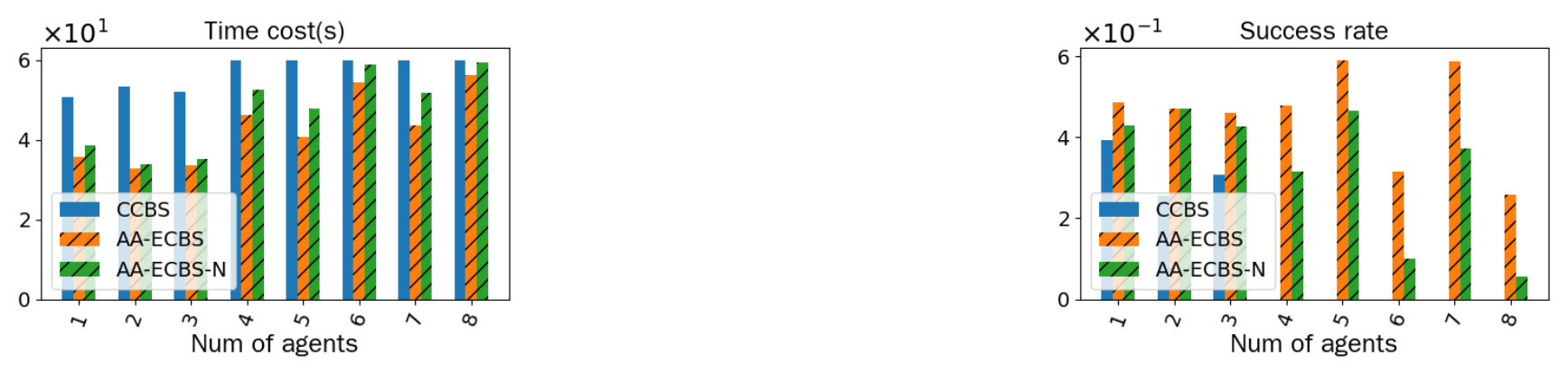
Figure 3.
These figures illustrate summary of the performance of AA-ECBS (our method) and AA-CCBS across various maps, including time cost and success rate.
Figure 3.
These figures illustrate summary of the performance of AA-ECBS (our method) and AA-CCBS across various maps, including time cost and success rate.
4.1. Comparing with AA-CCBS
We compare our proposed AA-ECBS against AA-CCBS, the state-of-the-art any-angle MAPF planner, across eight benchmark maps with varying sizes and obstacle densities, covering small empty grids, random grids, mazes, and real-world warehouse layouts.
In terms of time cost, AA-ECBS consistently reduces the computation time compared with AA-CCBS on all test instances. The advantage becomes more pronounced on larger maps: as the number of agents grows, AA-CCBS suffers from rapidly rising runtime, while AA-ECBS maintains a much slower growth trend. For success rate, AA-ECBS achieves equal or higher success rates than AA-CCBS for all agent counts.
On dense or large-scale maps, AA-CCBS quickly loses feasibility as agent number increases, whereas AA-ECBS retains valid solutions for more agents. Regarding path quality metrics including makespan and sum-of-costs, AA-ECBS yields nearly identical solution quality to AA-CCBS. This demonstrates that our analytic conflict resolution and JOB-accelerated offline LOS precomputation bring substantial computational gains without sacrificing path optimality bounds.
4.2. Ablation Study
We conduct an ablation study using AA-ECBS-N, which replaces our analytic safe waiting-time interval solver with numeric iteration for conflict resolution, while keeping all other components unchanged.
AA-ECBS outperforms AA-ECBS-N on both time cost and success rate over all test cases. The performance gap grows as the map scale increases. On small maps, the difference between AA-ECBS and AA-ECBS-N is relatively modest. Since small environments contain fewer conflicts, the overhead of numeric iteration for conflict resolution remains low, so the benefit of analytic formulation is limited.
For large maps with extensive passable space, the gap becomes prominent. Numeric iteration repeatedly samples time points to find feasible waiting intervals, which incurs heavy computational overhead when many pairwise conflicts exist. Our analytic method directly computes the exact safe time intervals in closed form without iterative sampling, eliminating repeated numerical evaluation. This closed-form computation becomes increasingly valuable when the number of agent conflicts scales up in large maps. Meanwhile, the path quality (makespan and sum of costs) of AA-ECBS and AA-ECBS-N remains nearly identical, confirming that our analytic solver accelerates planning without changing the quality of the resulting paths.
5. Conclusion
This paper proposes an efficient bounded-suboptimal any-angle multi-agent path finding (AA-MAPF) solver, named AA-ECBS, which addresses the low computational efficiency of state-of-the-art any-angle MAPF algorithms caused by redundant constraint enumeration and iterative conflict resolution. We first design a novel segment-level constraint definition, which avoids the exhaustive enumeration of numerous edge-level constraints and significantly reduces the high-level search overhead of conflict-based frameworks. Furthermore, we replace traditional numeric iterative conflict resolution with an analytic safe waiting-time interval solving strategy, enabling accurate and low-cost conflict interval calculation without repeated sampling. Combined with the Jump Over Block (JOB) accelerated offline line-of-sight (LOS) precomputation, our method effectively optimizes the overall pipeline of any-angle MAPF planning.
Extensive experiments on classic MAPF benchmarks verify the advantages and effectiveness of our method. Compared with the baseline AA-CCBS, AA-ECBS achieves consistently lower planning time cost and higher planning success rates across different map scales and agent densities, while maintaining nearly identical path quality in terms of makespan and sum of costs. Specifically, the performance advantage of AA-ECBS is more prominent on large-scale maps with extensive passable space, where massive agent conflicts impose heavy computational overhead for AA-CCBS. The ablation study further demonstrates the effectiveness of the analytic conflict resolution module. Compared with the numeric iteration-based variant AA-ECBS-N, our analytic solver exhibits growing performance gains as map size increases, validating its strong adaptability for complex large-scale planning scenarios. In addition, the JOB acceleration module substantially optimizes offline LOS precomputation, further improving the practical efficiency of the proposed planner without sacrificing planning completeness and bounded suboptimality.
Despite the promising performance of AA-ECBS, there remains room for further optimization and extension in complex MAPF scenarios. This work considers ideal circular agents, and future research will extend AA-ECBS to large-agent AA-MAPF, supporting robots with arbitrary physical shapes. We will adapt our segment-level constraint formulation and analytic conflict resolution to MAPF for Large Agents (LA-MAPF[14]). Moreover, we will generalize our acceleration modules to more practical MAPF variants with dynamic obstacles and kinodynamic constraints, and explore learning-based conflict prediction to further eliminate redundant search iterations toward more robust and efficient real-world multi-robot planning.
References
- Barer, M.; Sharon, G.; Stern, R.; Felner, A. Suboptimal variants of the conflict-based search algorithm for the multi-agent pathfinding problem. In Proceedings of the Proceedings of the international symposium on combinatorial Search, 2014, Vol. 5, pp. 19–27. [CrossRef]
- Yao, Z.; Wang, W.; Zhang, J.; Wang, Y.; Li, J. Jump Over Block (JOB): An Efficient Line-of-Sight Checker for Grid/Voxel Maps With Sparse Obstacles. IEEE Robot. Autom. Lett. 2023, 8, 7575–7582. [Google Scholar] [CrossRef]
- Stern, R.; Sturtevant, N.R.; Felner, A.; Koenig, S.; Ma, H.; Walker, T.T.; Li, J.; Atzmon, D.; Cohen, L.; Kumar, T.K.S.; et al. Multi-Agent Pathfinding: Definitions, Variants, and Benchmarks. In Proceedings of the Proceedings of the Twelfth Symposium on Combinatorial Search, 2019, Vol. 10, pp. 151–158 [CrossRef]
- Li, J.; Ruml, W.; Koenig, S. EECBS: A Bounded-Suboptimal Search for Multi-Agent Path Finding. In Proceedings of the Proceedings of the AAAI Conference on Artificial Intelligence, 2021, Vol. 35, pp. 12353– 12362. [CrossRef]
- Sharon, G.; Stern, R.; Felner, A.; Sturtevant, N.R. Conflict-Based Search for Optimal Multi-Agent Pathfinding. Artif. Intell. 2015, 219, 40–66. [Google Scholar] [CrossRef]
- Barer, M.; Sharon, G.; Stern, R.; Felner, A. Suboptimal variants of the conflict-based search algorithm for the multi-agent pathfinding problem. In Proceedings of the Proceedings of the Twenty-First European Conference on Artificial Intelligence, NLD, 2014; ECAI’14, p. 961–962.
- Andreychuk, A.; Yakovlev, K.; Surynek, P.; Atzmon, D.; Stern, R. Multi-agent pathfinding with continuous time. Artif. Intell. 2022, 305, 103662. [Google Scholar] [CrossRef]
- Phillips, M.; Likhachev, M. SIPP: Safe interval path planning for dynamic environments. In Proceedings of the 2011 IEEE International Conference on Robotics and Automation, 2011; pp. 5628–5635. [Google Scholar] [CrossRef]
- Yakovlev, K.S.; Andreychuk, A. Any-Angle Pathfinding for Multiple Agents Based on SIPP Algorithm. In Proceedings of the International Conference on Automated Planning and Scheduling, 2017.
- Yakovlev, K.; Andreychuk, A.; Stern, R. Revisiting Bounded-Suboptimal Safe Interval Path Planning. In Proceedings of the Proceedings of the 30th International Conference on Automated Planning and Scheduling (ICAPS), 2020, Vol. 30, pp. 300–304. [CrossRef]
- Andreychuk, A.; Yakovlev, K.S.; Boyarski, E.; Stern, R. Improving Continuous-time Conflict Based Search. In Proceedings of the Thirty-Fifth AAAI Conference on Artificial Intelligence, AAAI, 2021. AAAI Press, 2021, pp. 11220–11227. [CrossRef]
- Yakovlev, K.; Andreychuk, A.; Stern, R. Optimal and Bounded Suboptimal Any-Angle Multi-agent Pathfinding. In Proceedings of the 2024 IEEE/RSJ International Conference on Intelligent Robots and Systems (IROS), 2024, pp. 7996–8001. [CrossRef]
- Sturtevant, N.R. Benchmarks for Grid-Based Pathfinding. IEEE Trans. Comput. Intell. AI Games 2012, 4, 144–148. [Google Scholar] [CrossRef]
- Li, J.; Surynek, P.; Felner, A.; Ma, H.; Kumar, T.K.S.; Koenig, S. Multi-Agent Path Finding for Large Agents. In Proceedings of the Proceedings of the AAAI Conference on Artificial Intelligence, 2019, Vol. 33, pp. 7627–7634. [CrossRef]
Figure 1.
These figures show examples of the MAPF and AA-MAPF solutions on the same instances. It can be observed that the AA-MAPF solution yields shorter paths.
Figure 1.
These figures show examples of the MAPF and AA-MAPF solutions on the same instances. It can be observed that the AA-MAPF solution yields shorter paths.
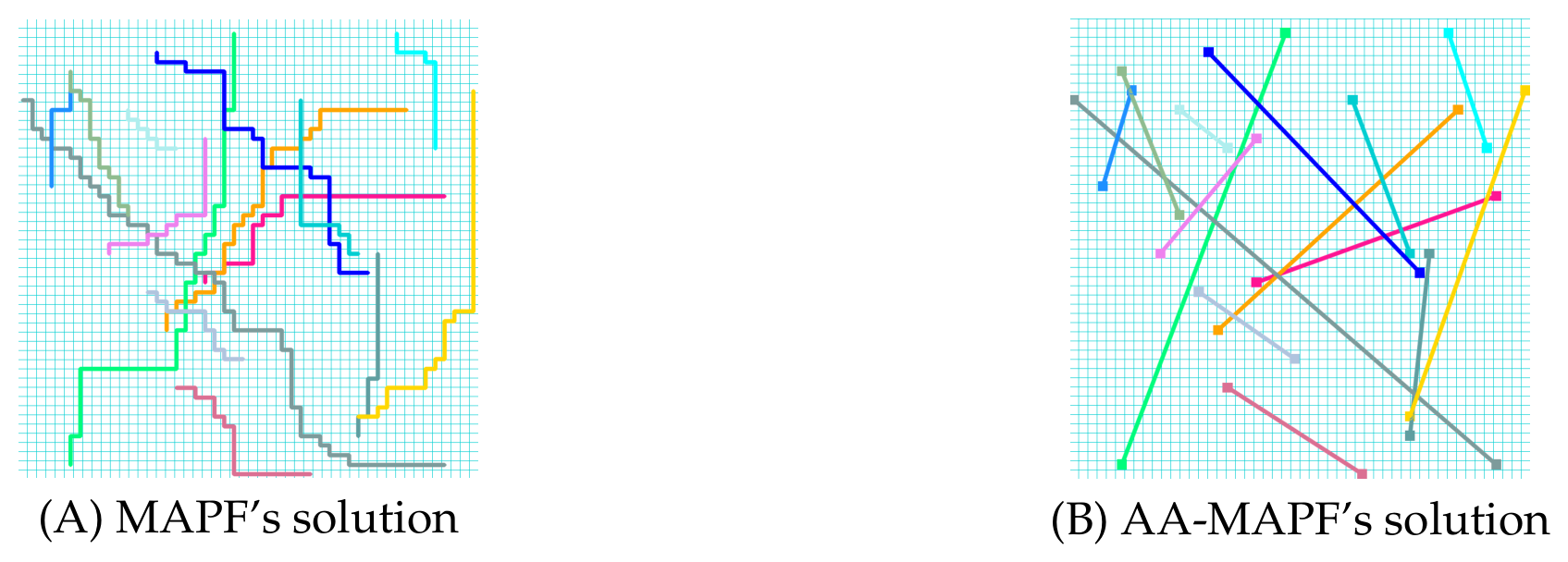
Figure 2.
These figures illustrate the performance of AA-ECBS (our method) and AA-CCBS across various maps. The performance of these methods is evaluated in terms of time costs, success rate, makespan, sum of cost. Additionally, we provide information on the scale and the number of passable cells (in brackets).
Figure 2.
These figures illustrate the performance of AA-ECBS (our method) and AA-CCBS across various maps. The performance of these methods is evaluated in terms of time costs, success rate, makespan, sum of cost. Additionally, we provide information on the scale and the number of passable cells (in brackets).
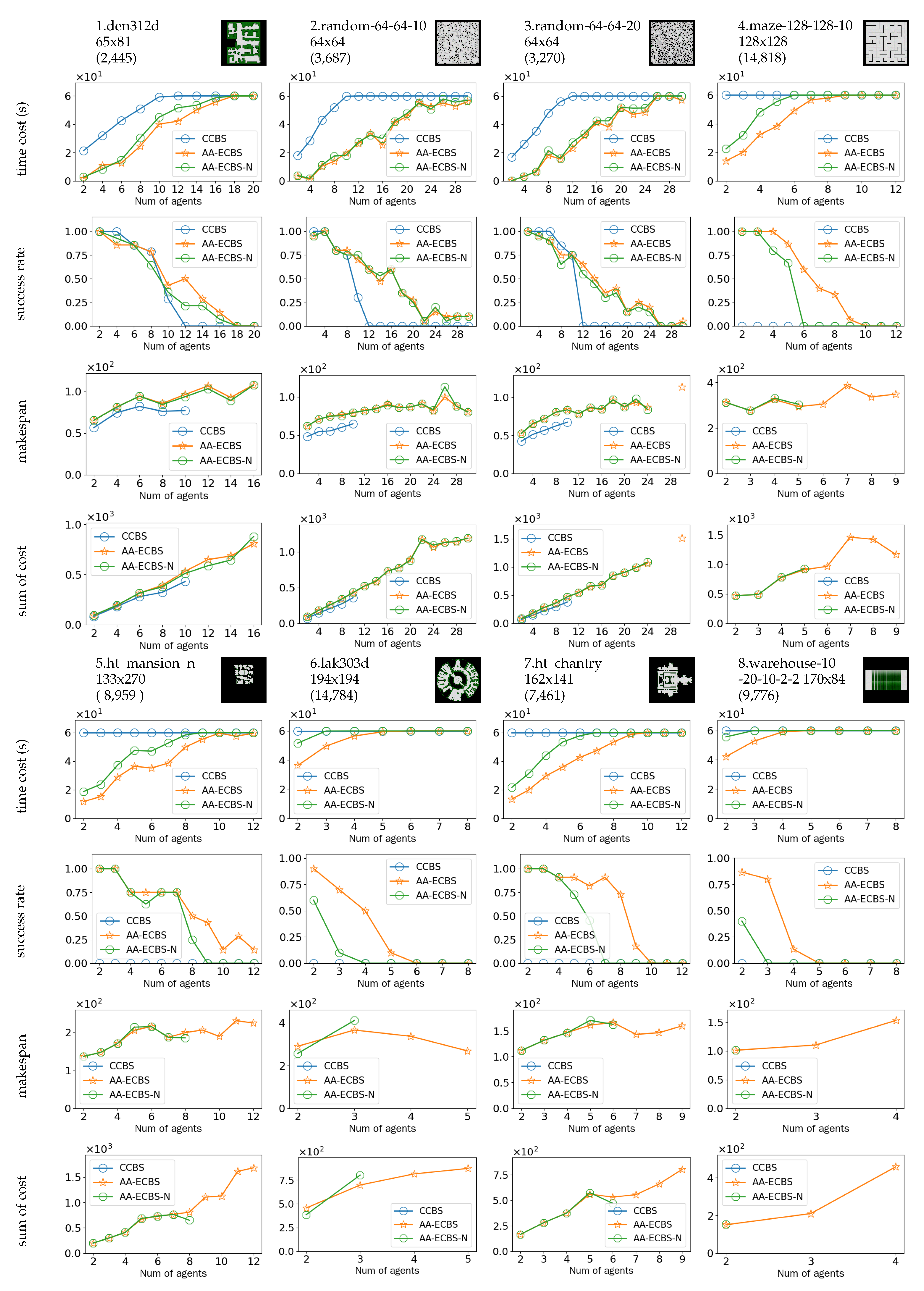

Table 1.
Precomputation Runtime (s) of LOS Checks (with/without JOB)
| Map | empty-32-32 | empty-48-48 | warehouse_10 _20_10_2_1 |
warehouse_10 _20_10_2_2 |
|---|---|---|---|---|
| Scale | 32*32 | 48*48 | 63*161 | 84*170 |
| RAW | 0.68 | 4.79 | 29.66 | 80.82 |
| JOB | 0.31 | 1.60 | 24.37 | 68.54 |
Disclaimer/Publisher’s Note: The statements, opinions and data contained in all publications are solely those of the individual author(s) and contributor(s) and not of MDPI and/or the editor(s). MDPI and/or the editor(s) disclaim responsibility for any injury to people or property resulting from any ideas, methods, instructions or products referred to in the content. |
© 2026 by the author. Licensee MDPI, Basel, Switzerland. This article is an open access article distributed under the terms and conditions of the Creative Commons Attribution (CC BY) license.
Copyright: This open access article is published under a Creative Commons CC BY 4.0 license, which permit the free download, distribution, and reuse, provided that the author and preprint are cited in any reuse.