
Submitted:
09 October 2026
Posted:
13 October 2026
You are already at the latest version
Abstract
Goldbach’s original conjecture was posed more than two centuries ago. Is it true that: all positive even integers (≥4) can be stated as the sum of two prime numbers? Based on asymmetry of occurrences of prime and composite numbers under some even integer N≥4, here of Goldbach Conjecture (GC) is analyzed and then a proof is outlined.
Keywords:
Goldbach conjecture
; asymmetry
; prime numbers
; composite numbers
1. Introduction
The origin of GC go back to more than two centuries ago: “Goldbach’s original conjecture (sometimes called the ”ternary” Goldbach conjecture), written in a June 7, 1742 letter to Euler, states that every integer is the sum of three primes (Dickson 1957, p. 421).” (extracted from [6]).
There are variants of GC, for instance the ternary Goldbach conjecture is also called the weak Goldbach conjecture and stated as:
Ternary Goldbach Conjecture: Every odd number greater than 5 can be written as the sum of three prime numbers [4].
According to Weisstein [6], the weak version of GC was re-expressed by Euler in the so called “strong” version of GC, as follows:
Goldbach conjecture (GC): asserts that all positive even integers ≥4 can be stated as the sum of two prime numbers.
It is this strong version of GC that proof of is detailed here.
The aim of this paper is to offer an account of Goldbach Conjecture (GC), based on the asymmetry of occurrences of prime and composite numbers under any given even integer N≥4. The account of GC presented here is rather simple and is based on analysis of both behavior of sums of integers and the asymmetric occurrence of prime and composite numbers under any even integer N≥4, where this asymmetry ensures the existence of couples of prime numbers that account for GC.
2. Materials and Methods
The main method consists in analyzing the behavior of additions of integers under an even integer N≥4. Then based on observations drawn from this analysis such that positional symmetry between the addends of each sum, see whether is possible to find pairs of prime numbers as addends such that the GC holds.
2.1. Possible Sums Under N
Given an even integer N≥4, according to GC, N = pi + pj for some prime numbers pi and pj. An addition of integer numbers is involved (subtraction is not considered here), thus to start with, it seems to be convenient to analyze the behavior of all possible sums of two positive integers (ki, kj) both less than N such that N = ki + kj and determinate whether or not ki and kj can be prime numbers.
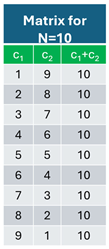
For instance, consider N= 10, the possible sums under 10 can be obtained by writing together two columns of consecutive integers (c1, c2), one in ascending order from 1 to N-1 (9) and the other in descendent order from N-1 to 1 (see Table 1). Thus, any the two integer numbers (ki, kj) where i, j ∈{1, … N-1}, in any row in this matrix (N-1 x 2) built by c1 and c2, add N. That is, these two columns under any N provide all possible additions of two positive integers (< N) whose result is N.
Following this idea, Figure 1 includes some matrices (from 4 to 30) headed by even integers N and two columns (c1, c2) each one, as described above, but this time prime numbers are highlighted (in green and blue respectively) in both columns for each N and a red line indicates the middle location (N/2) of all matrices. See for instance the matrix in Table 1.
2.2. Observations and Definitions
To carry on with this analysis some definitions and observations are drawn by breaking down the parts and the behavior of the sums under N (see Figure 1).
Definition 2.1 (Matrix).
A matrix (A) is a couple of columns (c1, c2), such that A = (c1, c2) for some even integer N≥4. Column c1 is a sequence of consecutive integers in ascending order from 1 to N-1 and c2 is a sequence of consecutive integers in descendent order from N-1 to 1, where ki + kj = N being ki and kj the two integers in any row of the matrix (Table 1 shows a Matrix for N = 10).
Figure 1 show matrices from N = 4 to N = 30, and a red line indicating the middle location(N/2) of each matrix for N.
Definition 2.2 (Symmetry in a Matrix).
Matrix A for some even integer N is symmetrical in the sense that all of its couples (ki, kj) (rows in the Matrix) add N (N = ki + kj) and all ki and kj are located symmetrically in A, that is to say, ki and kj are equidistantly located from location N/2 in the middle of the matrix (Figure 2 illustrates the symmetry of a Matrix for N=24).
For instance, in Figure 2, for matrix N = 24, the pairs (1, 23), (2, 22), (3, 21), …, (11, 13), (12, 12) are examples of couples of values located in symmetric places with respect to N/2 = 24/2 = 12.
2.3. Symmetry as a Function
A Matrix A is generated by an addition function that relates couples of values located in symmetric places. Given and matrix A = (c1, c2) defined by an even integer N≥4, A in turn defines a function f: {c1}→{c2} as follows:
f(x) = N − x
Relevant here is that f(x) not only provides the difference between N and any x in column c1 (or sums N = x + f(x)), but also relates couples of values (x, f(x)) that are located symmetrically with respect to N/2.
It can be observed that this is the case of any row of Matrix A, each row is composed by a couple of values (k1, k2), where they not only add N but also are located in symmetric places with respect to N/2. Some examples were provided in Figure 2.
Note that in Figure 1 and Figure 2, there are cases where x and f(x) are prime numbers located symmetrically with respect to N/2 and that add N, that is, in those cases GC holds. In Figure 2, the pairs of primes (5, 19), (7, 17), (11, 13) are examples. From now on all couples of primes that add N in some array A, will be called Goldbach pairs or Goldbach primes (GP).
It is worth mentioning that since {c1} = {c2}, then f: {c1}→{c2} is equivalent to f: {c1}→{c2}.
The account of GC demands distinguishing between two sets.
Definition 3.1 (Sets of composed and prime numbers under N).
Given any even integer N≥4, the following sets can be defined:
- Let P be the set of prime numbers less than N.
P = {pk / pk is a prime number, 0 < pk < N}
- b.
- Let C be the set of composed odd numbers less than N.
C = {ck / ck is a composed odd number, 0 < ck <N}
The set C considers odd composite numbers because excepting number 2, all components of symmetrical couples (pi, di) of a Matrix A, where a prime number (pi) is considered, the other number (di) is an odd number.
Definition 3.2 (Symmetry of a set in a Matrix A).
For some property X of some subset S of couples (rows) of integers (ai, bi) taken from a Matrix A for some even N integer greater than 4, if the property X holds for both integers in all couples (ai, bi) in S, then S is a symmetrical set with respect to property X.
It would be useful to know whether these two sets (P and C) are symmetrical or asymmetrical. Symmetry of a set in a Matrix for some N even, refers to symmetrical occurrences in both cases. That is, for every prime number pi under an even integer N, is there another prime number pj such that f(pi) = pj? or for every composed number ci under an even integer N, is there another composed number cj such that f(ci) = cj?
Now, the interest is to find out whether the occurrence of prime and composite numbers under some even N are symmetrical by introducing two lemmas, then a proof of Goldbach Conjecture (GC) can be outlined. According to Definition 3.2 here X would be the property of being prime and in the other case X is the property of being composite.
4. Lemmas
The proof of GC is based on the asymmetry of occurrences of prime and composite numbers under some N. The two lemmas below seem to be obvious, but proof is offered in order to support the proof of GC.
Lemma 4.1. Asymmetry of the set of prime numbers (P).
Given any even number N≥4, the occurrence of prime numbers less than N are asymmetric with respect to N/2.
Proof.
By contradiction.
Let us assume that the occurrence of prime numbers under any even number N≥4, are symmetric.
Then, let be the occurrence of pi and pj = f(pi) (pi < pj) and pi + pj = N, symmetric primes numbers with respect to N/2 for a given even N≥4.
Then there must be a prime number pj+2 (pj+2< N+2), such that pi and pj + 2 are symmetric with respect to (N+2)/2.
There must be a prime pj + 4 (pj+4< N+4), such that pi and pj + 4 are symmetric with respect to (N+4)/2, and so on and so forth.
This means that we can find an arbitrary length sequence of consecutive prime numbers, which is not true. In the sequence:
some might be prime, but others would be composite numbers.
pj , pj + 2, pj + 4, pj + 6, pj + 8, pj + 10, . . .
Therefore, it can be concluded that the sequence of occurrences of prime numbers (P) under an even integer N≥4 is not symmetrical with respect to N/2 ■
For instance, for N = 10, the occurrence of the primes 3 and 7 are symmetric with respect to N/2 = 5. However, for N + 2 = 12, the symmetric occurrence of 3 and 9 with respect to (N + 2)/2 = 6, does not mean that also 3 and 9 are both prime numbers. See other examples in Figure 2.
Since the sequence of consecutive numbers less than some even integer N≥4, integrates both the sequence of prime numbers and the sequence of composed odd numbers less than N, then if the sequence of prime numbers is asymmetric (it does not hold the closure of P with respect to f(x)), we can expect that the sequence of composed odd numbers is also asymmetric.
Lemma 4.2. Asymmetry of the set of composed odd numbers (C).
Given any even number N≥4, the occurrence of compose odd numbers are not symmetric with respect to N/2.
Proof.
By contradiction.
Let us assume that the occurrence of composed odd numbers under any even N≥4, are symmetric.
Then, let be the occurrence of ci and cj = f(ci), (ci < cj) symmetric composed odd numbers with respect to N/2 for a given even N.
Then there must be a composed odd number cj+2 (cj+2< N+2), such that ci and cj+2 are symmetric with respect to (N+2)/2.
There must be a composed odd number cj+4 (cj+4< N+4), such that ci and cj+4 are symmetric with respect to (N+4)/2, and so on and so forth.
This means that we can find an arbitrary length sequence of consecutive composed odd numbers for any even integer N, which is not true. In the sequence:
some might be composed but others would be prime numbers. The difference of this proof with the gap theorem is that here gaps can start in any ci, while in the gap theorem the gaps start in the n! for some n.
cj, cj + 2, cj + 4, cj + 6, cj + 8, cj + 10, . . .
Therefore, it can be concluded that the sequence of occurrences of composed odd numbers (C) under any even N≥4 is not symmetrical with respect to N/2 ■
3. Results
3.1. Proof of GC
Based on Lemma 4.1 and Lemma 4.2, proof of GC is outlined below.
Proof.
In order to offer an account for GC, it is necessary to take into account two sets: the set of prime numbers (P) under some even integer N≥4 and the set (Δ) of their differences with respect to N, namely between each prime in P and N, defined in terms of f(x) as in equation (1) as follows:
Δ = { di / di = f(pi) = N– pi, where pi is a prime number such that pi <N}
Since Δ is the set of values generated by f(pi), where pi is a prime number, then any pair (pi, di) includes values located symmetrically. Furthermore N = pi + di (4)
Figure 3.
Function f: P→ Δ, where P = {pk / pk is a prime number, 0 < pk < N} and Δ = {di / di = f(pi) = N– pi}.
Figure 3.
Function f: P→ Δ, where P = {pk / pk is a prime number, 0 < pk < N} and Δ = {di / di = f(pi) = N– pi}.
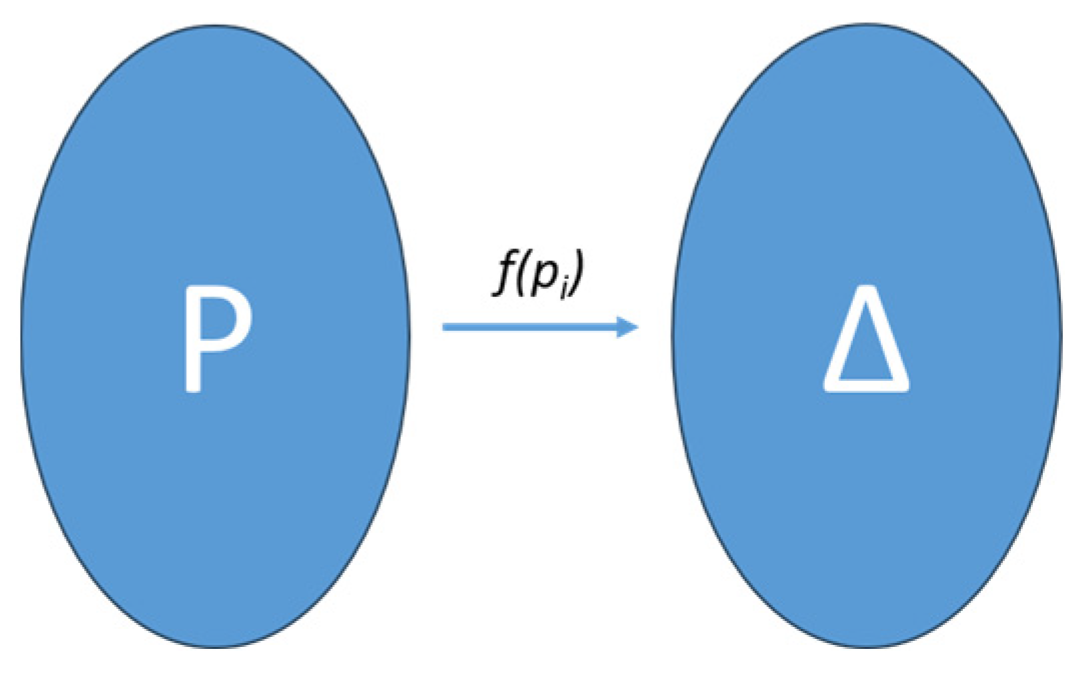
Since the set P includes only prime numbers under some even N, now, the main interest is to see whether there exists at least one prime number (di) in Δ mapped by f(pi) for any even N≥4, since this would proof GC.
But now this is clear, given that P is asymmetrical (by Lemma 1), it means that any di in Δ (f(pi) = di), both not necessarily is a prime number and not necessarily composed number.
That is, Δ is not a set of only prime numbers nor a set of only composite numbers. This means that, {Δ ∩ C}≠ ϕ and {Δ ∩ P}≠ϕ, where ϕ denotes the empty set.
Thus, for any even integer N≥4, Δ must integrate both composed and prime numbers, that is, Δ ⊂ {P ∪ C} for any N. Then, there must exists some prime number in Δ, that is, f(x) must generate at least a couple of prime numbers (pi, pj=f(pi)) such that pi = N - pj and pj = N - pi and then N = pi + pj. Therefore, GC holds for any even integer N≥4. This proves Goldbach Conjecture. ■
Observe that, in case that some di is a composed number, of Δ, there must exists some pi in P, such that f(di) = pi, as pointed out by Lemma 2.
This proof is not touched by the gap theorem for prime numbers, which claims that there are arbitrary sequences of composite numbers (m! + 2, m! + 3, m! + 4, …, m!+ m). An arbitrary sequence of m-2 composites begins in the integer m!+2. The proof of GC above is based on matrices of integers under any even N≥4. Thus, when N = m! + 2 then N>(m-2) (the length of the sequence of composite numbers), and also N/2>(m-2), in this way, any gap of (m-2) composite numbers would be absorbed by a Matrix for N= m! + 2.
4. Conclusions
A simple proof of GC is outlined above. It is based on visualization of behavior of sums of primes and a definition of symmetry (Definition 2.2), which is described by the function f: {c1}→{c2} (f(x) = N-x), that defines all sums of N and all differences among x and N. Then Δ is introduced to focus the attention on both the values of f(x) where x takes values of prime numbers, and the differences described by N-x. Therefore, asymmetry of composed and prime numbers ensures that the set of differences Δ includes both prime and composite numbers (always for any even integer N greater or equal than 4) and therefore GC holds.
As stated, and shown by Lamb, once GC is proven, you get the ternary or weak Goldbach Conjecture for free [4].
References
- Bonaya Buya, S. Academia. Available in November de 2022, from An elegant and short proof of Goldbach conjecture. 2018. Available online: https://www.academia.edu/36521571/AnelegantandshortproofofGoldbachconjecture.
- Caldwell, C. The Gaps Between Primes. 2021. Available online: https://t5k.org/notes/gaps.html.
- Idriss Olivier, B. SSRN. Avalilable in November 2022, in Goldbach’s conjecture. 2018. Available online: https://ssrn.com/abstract=3093808.
- Lamb, E. Scientific American. Available in November 2022, the 15th May 2013.
- in Goldbach Variations. Available online: https://blogs.scientificamerican.com/roots-of-unity/goldbachvariations/##::text=The%20ternary%20Goldbach%20conjecture%20is,in%201742%2C%20hence%20the%20name.
- South, J. R. Available in November, 2022, from An Algebraic Approach to the Goldbach Conjecture. arXiv A. 2022, arXiv:2206.01179. [Google Scholar]
- Weisstein, E. W. MathWorld–A Wolfram Web Resource. Available in November, 2022, from Goldbach Conjecture. July 2019. Available online: https://mathworld.wolfram.com/GoldbachConjecture.html.
Figure 1.
Prime numbers (green and blue) under some even N, in matrices from 4 to 30.
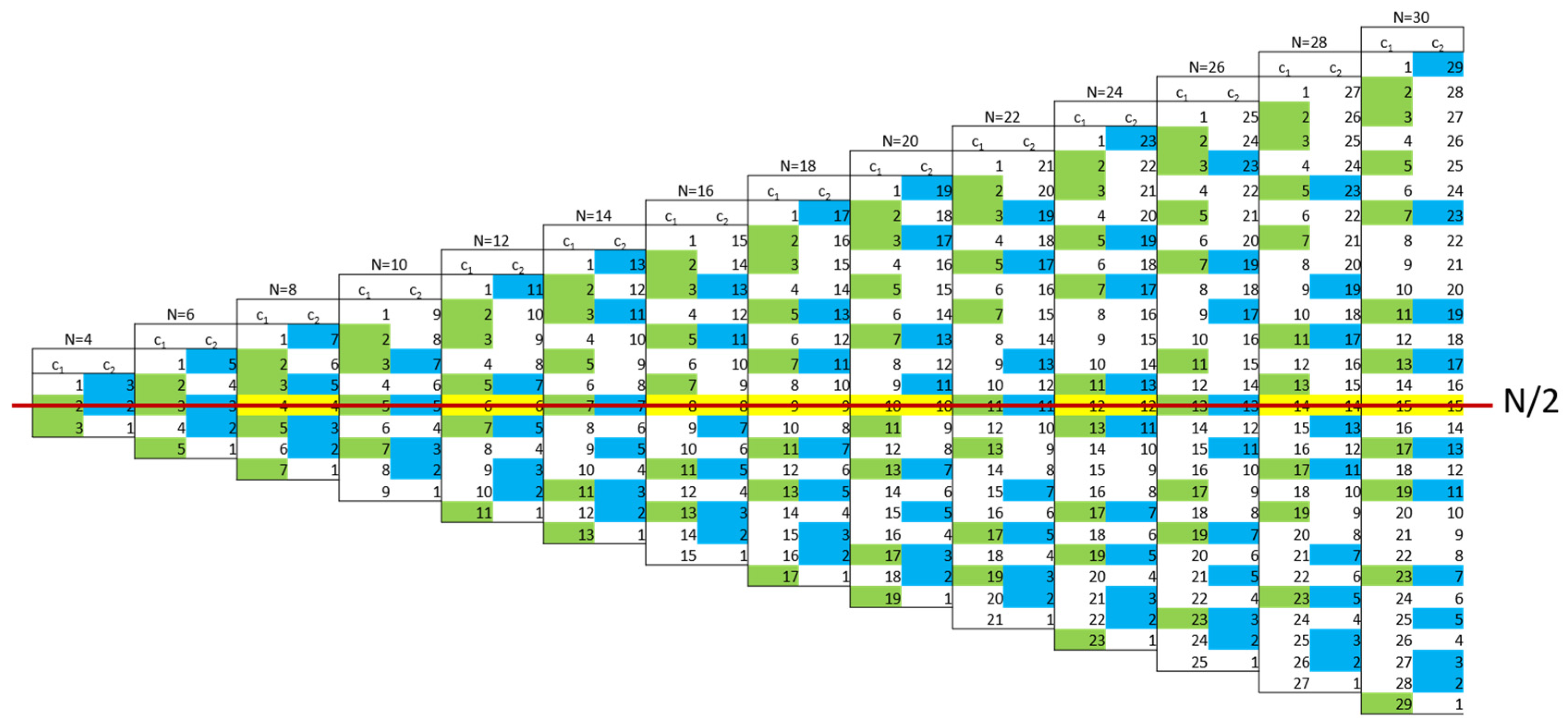
Figure 2.
Matrix A(c1, c2) for N = 24, matching all couples of integers (in c1) located to an equidistant distance from the middle point N/2=12. Ex. (1, 23), (2, 22), (3, 21), …, (11, 13), (12, 12).
Figure 2.
Matrix A(c1, c2) for N = 24, matching all couples of integers (in c1) located to an equidistant distance from the middle point N/2=12. Ex. (1, 23), (2, 22), (3, 21), …, (11, 13), (12, 12).
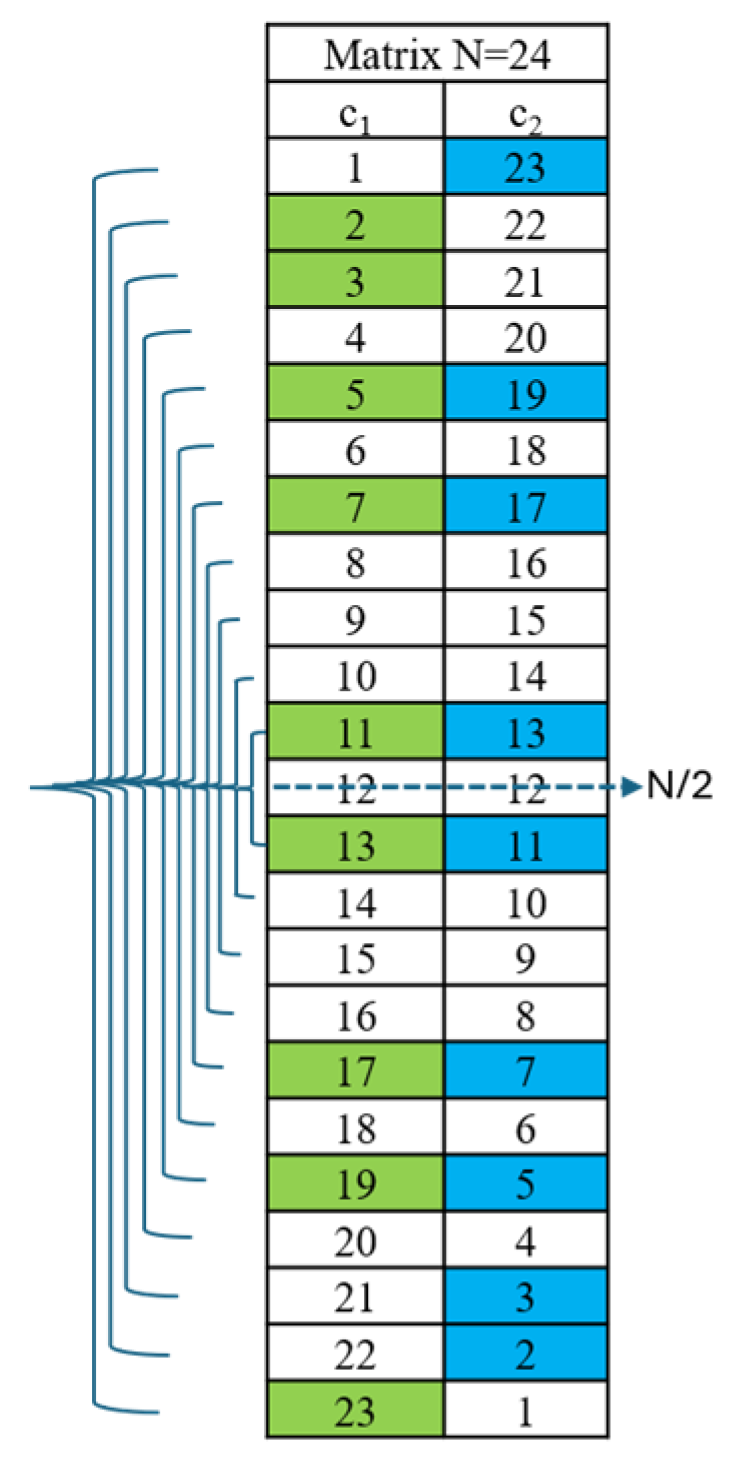

Table 1.
Matrix with all combinations of addends under N=10 (columns c1 and c2) that add 10 = N (c1+c2).
Table 1.
Matrix with all combinations of addends under N=10 (columns c1 and c2) that add 10 = N (c1+c2).
Disclaimer/Publisher’s Note: The statements, opinions and data contained in all publications are solely those of the individual author(s) and contributor(s) and not of MDPI and/or the editor(s). MDPI and/or the editor(s) disclaim responsibility for any injury to people or property resulting from any ideas, methods, instructions or products referred to in the content. |
© 2026 by the authors. Licensee MDPI, Basel, Switzerland. This article is an open access article distributed under the terms and conditions of the Creative Commons Attribution (CC BY) license (http://creativecommons.org/licenses/by/4.0/).
Copyright: This open access article is published under a Creative Commons CC BY 4.0 license, which permit the free download, distribution, and reuse, provided that the author and preprint are cited in any reuse.