

Submitted:
10 October 2026
Posted:
13 October 2026
You are already at the latest version
Abstract
Depression among Black patients is shaped by the interaction of clinical symptoms, cultural meanings, social conditions, and experiences of care. This narrative review examines evidence among African American and other Black populations, including Black–White comparisons and within-Black differences, on symptom presentation, measurement, persistence, disability, comorbidity, and social and cultural correlates, across the United States and selected Canadian, European, and African settings. Targeted searches identified population surveys, clinical studies, psychometric investigations, qualitative research, intervention trials, and relevant reviews. James S. Jackson's research agenda provides a starting point: understanding comparatively favorable findings in the context of historical and continuing adversity. Several United States surveys report lower lifetime prevalence of interview-defined major depression among Black than White adults, while symptom scales often indicate greater depressive burden among Black adults. This Black–White mental health paradox varies by outcome and population; some studies identify greater persistence and disability among Black adults with depression. Studies of hope, positive affect, coping resources, and physical health suggest that the correlates of depression may also differ across groups, although no single mechanism explains the pattern. Evidence on distinctive symptom presentation is mixed. Some studies identify Black–White differences or within-Black variation in bodily symptoms, self-criticism, or interpersonal experiences, whereas others find substantial similarity after accounting for severity and social or medical conditions. Psychiatric and physical comorbidity among Black adults with depression varies across samples, including in comparisons with White adults. Associations of depressive symptoms or MDD with smoking, disease self-management, self-rated health, inflammation, and mortality differ across studies and populations; colorism, trauma, sexuality, gender, and migration further identify within-Black heterogeneity. The review examines associations of discrimination, financial strain, employment conditions, family relationships, and gendered expectations with depressive symptoms, MDD, and treatment use among Black populations. Studies of Black populations also examine political representation and insurance expansion in relation to self-reported mental health, and loneliness, personality, and distinct church-based relationships in relation to depressive symptoms or MDD. Social support, religious involvement, mastery, and socioeconomic resources are associated with depressive symptoms or MDD in several studies, with variation across measures, social positions, and national settings. Studies also identify disparities in medication initiation and selection, communication, continuity, and care quality; stigma, discrimination in care, and medical debt are relevant to treatment access and experience. Cultural assessment and accessible, sustained depression care may improve recognition and engagement. Future research should distinguish symptom burden from diagnosed disorder, assess longitudinal course directly, and avoid treating Black identity as a single cultural or biological category.
Keywords:
cultural psychiatry
; black patients
; African Americans
; depression
; chronicity
; comorbidity
; racism
; health inequalities
1. About this paper
This paper reviews what epidemiological studies have reported about depression among African American and other Black populations. Readers should expect a narrative synthesis of Black–White comparisons and variation within Black populations, rather than one prevalence estimate or a single explanation for Black mental health. The review brings together evidence on resilience, symptom presentation, measurement, course, comorbidity, social and structural correlates, and experiences of depression care. Evidence from the United States receives the most attention, with selected studies from Canada, Europe, and African settings providing additional perspectives.
The central question is how comparatively low lifetime prevalence of interview-defined major depressive disorder can coexist with elevated depressive symptoms, greater persistence among some Black adults with depression, and unequal access to effective care. The paper also examines why socioeconomic resources, supportive relationships, and other assets may have different associations with depression within Black populations and in comparisons with White populations. Race is treated as a social position shaped by history, institutions, and interpersonal treatment.
The sections move from survey foundations and measurement to developmental, cultural, relational, and structural patterns, followed by treatment and implications. Tables summarize selected studies, their populations, measures, designs, and findings; the conceptual model connects the major themes. Depressive symptoms, major depressive disorder, major depressive episodes, and psychological distress remain distinct outcomes. Proposed explanations are identified as interpretations, while reported findings are described as associations or treatment comparisons appropriate to the study. The review is intended for researchers, clinicians, and policy readers seeking an integrated account of depression among Black populations.
2. Introduction
Among African American and other Black populations, depression is both a clinically defined disorder and a lived experience whose recognition depends partly on how suffering is understood and communicated. Cultural psychiatry attends to patients' accounts of distress, explanations of illness, sources of support, and expectations of care. The Cultural Formulation Interview provides one approach to collecting this information; its international field trial supported feasibility, acceptability, and perceived clinical usefulness, rather than demonstrating a depression-specific treatment effect [1]. For Black patients, this perspective should include the culture of clinical institutions and the social organization of racial inequality alongside patients' beliefs and practices.
The literature raises an apparent tension. Some surveys report lower lifetime prevalence of major depressive disorder (MDD) among Black than White adults, yet Black adults with MDD may experience substantial persistence, impairment, and unmet treatment need [2,3,4]. Clinical studies also suggest that the meaning and expression of symptoms may differ across settings, although evidence for a uniform racial difference in depressive presentation is weak [5,6,7,8,9]. These findings call for a review that separates occurrence from course, symptoms from diagnosis, and between-group comparisons from variation within Black populations.
This review addresses five questions: How is depression presented and measured? What is known about persistence and disability? Which psychiatric and physical conditions co-occur? Which social and cultural exposures are associated with depressive symptoms, MDD, and care use? What are the implications for assessment and care? The term Black refers to a socially defined racial category, not a biological explanation for depression. African American and Caribbean Black are retained when they identify specific study populations. Evidence concerning African immigrants, adolescents, mothers, and older adults is considered separately where possible. Table 1 summarizes selected studies that anchor these themes, with their populations, outcomes, and key findings.
3. Review Approach and Scope
This is a narrative synthesis based on targeted English-language web searches of PubMed-indexed records, PubMed Central, journal websites, and university research sources conducted on October 8–9, 2026. Searches combined Black, African American, Caribbean Black, and African immigrant with depression, symptom presentation, somatic symptoms, measurement invariance, chronicity, comorbidity, discrimination, social support, stigma, socioeconomic status, and treatment. Supplementary searches also addressed qualitative interviews, focus groups, Delphi consensus methods, and Black-specific practice guidance. Supplementary searches addressed tobacco, alcohol, disease management, mortality, self-rated health, inflammation, colorism, trauma, developmental transitions, gender, sexual orientation, region, and migration. Additional searches addressed familial aggregation, intergenerational symptoms, suicidal ideation, policing, recorded crime, neighborhood conditions, mediation pathways, treatment discontinuation, adherence, response, remission, instrument versions, and National Institutes of Health (NIH)-funded projects in Research Portfolio Online Reporting Tools Expenditures and Results (RePORTER), and checked authors, titles, and bibliographic details of relevant studies. The review emphasizes direct empirical evidence, supplemented by cultural-assessment research and selected reviews. Additional searches addressed political representation, insurance expansion, loneliness, social isolation, living alone, personality, church-support exchanges, medication selection and dosing, side effects, patient-centered communication, discrimination during care, medical debt, primary care, clergy, and traditional healing. Studies published through 2026 were considered.
This narrative review draws on targeted searches and checks of accessible abstracts and full texts. It combines population surveys, clinical samples, psychometric studies, qualitative research, and interventions. MDD, depressive symptom scores, and general psychological distress are treated as distinct outcomes. Evidence from Canada, Europe, and sub-Saharan Africa adds local perspectives on prevalence, meanings, and care.
Table 2 illustrates variation in sample size, from small clinical or matched samples to large population surveys. Sample sizes and Black-specific denominators describe the scale of each analysis. These six examples illustrate the range of study sizes. Counts describe the cited analysis or qualitative study, not necessarily the parent cohort. Small studies provide depth, while large studies improve precision.
The studies summarized above also differ in whom they observe. Focus groups examine participants’ accounts of distress and care, matched comparisons examine people selected for similarity on measured characteristics, and clinical samples examine patients who have reached services [28,90,123]. Population surveys and health-system records contribute a broader view of variation across social groups and care settings [92,121]. The Black-specific denominator is especially useful for understanding how much of a study directly concerns Black participants. A large overall sample may contain a much smaller Black subgroup, and an exclusively Black sample may address ethnic, gender, or socioeconomic differences within Black populations. These features help connect each study’s findings to the population described in the narrative.
Table 3 summarizes statistical approaches used to estimate prevalence, compare associations, examine measurement properties, and evaluate treatment. Their assumptions and limits determine how each result should be interpreted.
These statistical approaches address several levels of the review’s central question. Survey models describe how often depression occurs and how it is associated with social conditions. Interaction and intersectional models examine whether those associations differ across social positions, while repeated-measure models examine changes over time. Matching offers a comparison among participants with similar measured characteristics; symptom-profile and measurement models examine variation in what depression scores represent [28,40,43,92]. Treatment analyses add questions about response, remission, and continuation in care [47,115,121]. Keeping these questions visible makes the methodological diversity useful: each analysis contributes a particular part of the account of depression among Black populations.
Table 4 distinguishes study designs represented in this literature, including retrospective histories, longitudinal observation, clinical illustration, and intervention comparisons. These designs contribute complementary forms of evidence. Design labels describe different features of a study and may overlap: a case–control study can collect retrospective histories, and an intervention can be longitudinal without being randomized. The examples below distinguish population estimation, temporal associations, clinical illustration, and treatment comparisons.
4. James S. Jackson’s Legacy: Explaining Relative Advantage Alongside Adversity
James S. Jackson's work helped move the study of Black mental health beyond an exclusive focus on disadvantage. The National Survey of Black Americans (NSBA), developed through the Program for Research on Black Americans, placed Black experience at the center of survey design. Its national sample and subsequent waves made it possible to examine variation in relationships, religion, employment, neighborhoods, and psychological functioning within Black populations [10]. The later National Survey of American Life expanded this agenda through detailed psychiatric assessment and explicit attention to African American and Caribbean Black populations [11]. Chatters, Taylor, and Neighbors describe these contributions to psychology and Black social research [12].
An interpretive question arising from this program is how Black Americans may show comparatively favorable mental health on some measures despite a history of enslavement, segregation, exclusion, and continuing racial adversity. It asks which social, cultural, relational, and psychological resources may help explain relative advantage, and which aspects of the apparent advantage reflect the way mental health is measured. Jackson's work on stress, coping, and physical–mental health patterns adds another possibility: some responses to adversity may have different implications for psychiatric symptoms and physical health [13].
Positive mental health among Black populations also deserves attention, including its coexistence with depressive symptoms and its comparison with positive mental health among White populations. Keyes's Midlife in the United States (MIDUS) analyses identified greater flourishing among Black than White respondents alongside lower prevalence of several common disorders [14]. Flourishing is not merely absence of depression. It includes aspects of emotional, psychological, and social well-being. These findings support studying sources of meaning, belonging, and agency directly rather than defining Black mental health solely through disorder.
Barnes and Bates's systematic review showed that Black–White patterns in depressive symptoms and nonspecific psychological distress frequently run in the opposite direction from patterns in MDD [15]. Thus, lower estimated disorder prevalence, greater distress, and strong positive mental health can coexist in a population. Different dimensions should be measured together rather than forced into one favorable or unfavorable ranking. The central cultural-psychiatric task is to understand this combination without romanticizing resilience or dismissing measurement and access inequalities.
5. The Black–White Mental Health Paradox: More Symptoms, Fewer Disorders?
5.1. Why the Outcome Changes the Comparison
The Black–White mental health paradox is not adequately described as lower depression among Black Americans. It involves at least two observations: lower or similar prevalence of interview-defined MDD despite greater exposure to adversity, and often higher levels of depressive symptoms or psychological distress. Barnes and Bates reviewed 34 articles with 54 relevant comparisons. Black participants had lower MDD prevalence in 8 of 9 comparisons but higher distress in 42 of 45 comparisons [15]. These counts summarize several symptom and distress measures; they are not 45 independent Center for Epidemiologic Studies Depression Scale (CES-D) studies. The findings nevertheless make the symptom–disorder distinction central to interpretation.
Primary studies illustrate why average differences should be examined with their population and outcome. Jones-Webb and Snowden used a CES-D threshold in a national probability sample and identified shared and group-specific associations of age, marital status, employment, and region with elevated CES-D depressive symptoms [16]. In the Health, Aging, and Body Composition study, Barry and colleagues followed 3,075 adults aged 70–79 at baseline, assessing CES-D symptoms at eight time points over ten years. A greater proportion of Black than White participants exceeded the symptom threshold at nearly every assessment [17]. These findings concern elevated symptoms, rather than a clinical interview diagnosis of MDD. They also show that longitudinal symptom burden can be substantial when lifetime diagnostic prevalence appears comparatively low.
The CES-D assesses recent symptom frequency, including emotional, somatic, interpersonal, and positive-affect items. Comparing a past-week symptom scale with a lifetime disorder also changes the reference period.
The direction is not uniform across samples. Assari and Moazen-Zadeh's National Survey of American Life (NSAL) analysis found lower CES-D total scores as well as lower diagnostic prevalence among African American than White participants. Higher negative-affect and interpersonal-problem domain scores were more strongly associated with Composite International Diagnostic Interview (CIDI)-defined depressive disorders or episodes among African American than White participants. The assessed outcomes included lifetime MDD and depressive episodes over lifetime, 12-month, and 30-day periods; racial interactions for the CES-D total score and positive-affect domain were not supported [18]. Many symptom studies show a Black disadvantage, with variation across populations and measures. Sampling, age, ethnicity, social conditions, and symptom domains matter. Thomas Tobin and colleagues' Nashville study similarly found that the correlates of CES-D distress and CIDI-defined MDD differed by outcome and race [19].
Prospective evidence raises a related question about the correspondence between symptoms and later disorder. Moazen-Zadeh and Assari found that baseline CES-D symptoms in the Americans' Changing Lives study were more strongly associated with CIDI-defined 12-month MDD assessed 15 years later among White than Black respondents; the racial interaction remained after adjustment for baseline social and health characteristics [20]. This supports studying the symptom–disorder relationship directly. The study did not continuously observe disorder onset across the interval.
5.2. Mechanisms: Hypotheses and Tests
Explanations for the Black–White depression paradox fall into two broad, overlapping groups. Measurement and selection explanations ask whether the observed diagnostic difference reflects symptom reporting, interview screening, recall, participation, or diagnostic thresholds. Social and cultural explanations ask whether resources, cognitive patterns, coping, relationships, and exposure histories are associated with depressive symptoms, MDD, or the physical and behavioral consequences of distress. Pamplin and Bates's critical review found that the available evidence did not establish a single convincing explanation [21]. Both genuine differences and measurement limitations may contribute; neither should be assumed from prevalence alone.
Somatization has been tested as an explanation for Black–White differences in depression estimates. Barnes and Bates used National Longitudinal Alcohol Epidemiologic Survey data and found a small racial difference in somatic relative to psychological symptoms. It did not reduce Black participants' endorsement of the depression screening symptoms, providing little support for somatization as an explanation of the paradox [22]. This finding complements item-response studies [8,9] and cautions against assuming that diagnostic surveys miss Black depression mainly because patients describe bodily complaints.
Social relationships have also been examined as explanations for Black–White differences in depression and other mental health outcomes. In NSAL analyses, Mouzon found that differences in family relationships did not explain the lower prevalence of psychiatric disorders among Black than White adults; a subsequent analysis of friendships and fictive kin relationships likewise did not account for that Black–White prevalence difference [23,24]. A resource can be associated with fewer depressive symptoms or lower psychiatric-disorder prevalence within a group without explaining the Black–White difference in those outcomes. More recent Nashville Stress and Health Study analyses by Louie and colleagues examined self-esteem, family support, religious attendance, and beliefs in divine control together. Among 1,186 participants, self-esteem contributed most to the statistical explanation of differences in depressive symptoms, while divine control contributed most to differences in any Diagnostic and Statistical Manual of Mental Disorders, fourth edition (DSM-IV) disorder [25]. The analysis considered depressive symptoms and a broader psychiatric-disorder outcome. These findings suggest that self-esteem and divine-control beliefs make different statistical contributions to Black–White differences in depressive symptoms and psychiatric-disorder prevalence.
Jackson's stress and health-behavior hypothesis [13], later developed as the Environmental Affordances model, proposes that constrained coping opportunities may connect relatively low depression with poor physical health. Empirical support has been mixed. Pamplin and colleagues tested two proposed pathways in 559 Black and White participants in an adult follow-up of the Child Health and Development Study; neither proposed stress–health-behavior pathway accounted for the Black–White depression difference [26]. These studies connect environmental constraints and coping opportunities with empirical tests of the paradox.
Pamplin and colleagues subsequently compared alternative models in 26,960 National Epidemiologic Survey on Alcohol and Related Conditions, third wave (NESARC-III) participants. They found little evidence that race modified the association between measured major life stressors and past-year MDD. Their estimates were more consistent with opposing pathways, with lower odds of past-year MDD associated with Black group membership through pathways not captured by the measured stressors [27]. They suggest that explanations should extend beyond a general claim that Black people cope better with the same stressors.
Table 5 specifies the exposure, proposed mediator, and outcome in selected mediation analyses. These models examine pathways linking coping resources, discrimination, physical disease, and depression.
5.3. What 1:1 matching adds
Coman, Wu, and Assari compared Black and White young women using 1:1 propensity-score matching on age, employment, education, and marital status, producing 61 matched pairs [28]. The overall lower diagnostic prevalence among Black women persisted, but pair-level comparisons showed substantial variation: in approximately 27% of pairs only the White woman had depression, whereas in approximately 15% only the Black woman had depression. Differences in perceived neighborhood disorder did not explain the paired depression differences, although they were associated with paired anxiety differences. This approach makes heterogeneity in the disparity visible instead of reducing the comparison to one population mean.
The small selected sample limits generalization. Matching on social conditions that themselves reflect structural racism also changes the question: it estimates differences among people with similar measured conditions, rather than the full disparity produced through those conditions. The study is useful as a method for examining possible mechanisms, rather than proof that race itself protects against depression.
6. The Survey Tradition and Longitudinal Cohorts
The NSBA is especially important because it was designed around Black social experience and contains a longitudinal component spanning 1979–1980, 1987–1988, 1988–1989, and 1992 [10]. Brown and colleagues found that reported discrimination predicted later psychological distress in NSBA panel analyses, while baseline poor mental health did not predict later reports of discrimination [29]. Other NSBA analyses examined religious guidance in relation to major depression at follow-up [30].
The original National Comorbidity Survey (NCS) supplied national psychiatric data in a younger-to-midlife household population. Breslau and colleagues' NCS analysis separated lower lifetime risk from greater persistence among some minority groups [31]. The National Comorbidity Survey Replication (NCS-R) subsequently supported analyses of race–ethnicity differences by disorder, age of onset, cohort, and education [3]. The NCS-R is a new national survey, not a longitudinal follow-up of the original NCS participants.
The NSAL provided a much larger Black sample and explicitly distinguished African American and Caribbean Black adults [2,11]. Its adolescent supplement allowed within-Black analyses across ethnicity, gender, and age [32,33]. The Collaborative Psychiatric Epidemiology Surveys (CPES) coordinated the NCS-R, NSAL, and National Latino and Asian American Survey (NLAAS), permitting broader cross-group analyses [34]. CPES should therefore not be counted as a fourth independent replication of results obtained from its component surveys. An NSAL result and a CPES result may partly concern the same participants. Table 6 summarizes the main survey and cohort foundations and their sampling and measurement features.
The survey tradition provides the basis for two related lines of inquiry. National psychiatric surveys describe the distribution of interview-defined depression across racial and ethnic groups, while follow-up studies examine symptom changes, new episodes, and subsequent health measures. Within-Black comparisons are central to both: the National Survey of American Life distinguishes African American and Caribbean Black adults and adolescents, and Black youth cohorts examine developmental changes in the association between discrimination and depressive symptoms [2,32,36]. Longitudinal cohorts also extend the inquiry beyond diagnosis to religious guidance, inflammation, and mortality [30,55,78]. The next set of studies brings the observation period into view so that the reader can connect the reported association with the time scale on which it was assessed.
Table 7 compares longitudinal studies over shorter and longer observation periods. Follow-up ranges from months to decades, but repeated symptoms, recalled diagnoses, biomarkers, and mortality endpoints answer different questions; none should be taken as continuous observation of every depressive episode.
7. Cultural Meanings and Variation in Presentation
7.1. Bodily, Emotional, and Interpersonal Symptoms
An early primary-care comparison by Brown and colleagues included 119 African American and 153 White patients with major depression. The groups had similar overall depression severity, psychosocial functioning, and medical illness severity, but differed on somatic symptoms, psychiatric comorbidity, life stress, physical functioning, and health beliefs [5]. Thus, similarities in diagnostic severity can coexist with differences in the broader clinical picture.
Studies comparing Black and White older adults complicate that interpretation. Among community-dwelling older adults, Blazer and colleagues found that racial differences in somatic complaints and life satisfaction disappeared after adjustment for social, cognitive, and health characteristics, although interpersonal differences remained [6]. Ayalon and Young compared 278 African American with 278 White psychotherapy clients and identified item-specific differences on the Beck Depression Inventory. Sleep, appetite, and libido items were more strongly related to depression among African American clients, while several raw endorsement differences were not attributable to depression itself [7]. The distinction between how often an item is endorsed and how strongly it indicates depression is therefore important.
Uebelacker and colleagues used item response theory to examine demographic differences, including Black–White differences, in a large National Epidemiologic Survey on Alcohol and Related Conditions (NESARC) sample. Most DSM-IV depressive criteria functioned similarly across demographic groups. The differences did not consistently support a general tendency for one racial group to somatize more than another [8]. Taken together, these studies support attention to bodily complaints without treating somatization as an inherent Black trait. Differences may reflect symptom severity, physical illness, recruitment setting, life circumstances, or the properties of the instrument.
Recent within-group research adds another perspective. Perez and colleagues examined depressive symptom patterns among 227 Black/African American mothers and identified heterogeneous profiles involving somatic and self-critical symptoms [40]. The study identifies variation in symptom profiles within Black women. Likewise, adolescent findings from the Treatment for Adolescents with Depression Study show the value of examining symptom and cognitive patterns in youth directly, rather than transferring adult assumptions to younger patients [41].
Clinically, a Black patient may describe exhaustion, poor sleep, reduced pleasure, interpersonal withdrawal, or difficulty fulfilling expected roles before using the word depression. These complaints warrant exploration alongside mood, cognition, duration, and impairment. They also require a medical assessment when appropriate. Irritability or anger can prompt questions about distress, but neither is sufficient to establish depression or a culturally distinct depressive syndrome.
7.2. Measurement and Diagnostic Interpretation
Measurement studies in Black samples and Black–White comparisons address whether depression scores represent comparable constructs. Breslau and colleagues identified differential functioning of some depression items across ethnic groups in the National Comorbidity Survey [9]. Huang and colleagues found that the nine-item Patient Health Questionnaire (PHQ-9) measured a shared depression construct across racially and ethnically diverse primary-care groups, while some items showed differential functioning [42]. Patel and colleagues examined 31,366 National Health and Nutrition Examination Survey (NHANES) respondents and supported measurement invariance across major demographic groups [43]. These results argue against assuming that standard screening measures are broadly invalid for Black patients, while supporting further validation in specific populations and languages. Table 8 distinguishes evidence of invariance from item-specific differences and from comparisons that tested classification agreement rather than invariance.
For depression assessment among Black patients, measurement research addresses score comparability within Black populations and across racial groups, while cultural assessment addresses patients' descriptions and meanings. A measure may support group comparisons yet leave important concerns outside its item set. Cultural assessment can clarify what a symptom means, whether it reflects a change from the patient's usual experience, and how it affects daily life [1,42,43].
Racial differences in the clinical interpretation of depression deserve similar attention. Neighbors and colleagues found racial differences in psychiatric diagnoses among 665 inpatients despite the use of a semi-structured instrument [44]. Counterevidence also matters: in a standardized-vignette study of 329 psychiatrists, Kales and colleagues did not find a simple patient-race effect on depression diagnosis or treatment recommendations [45]. Structured assessment can support recognition and treatment planning.
7.3. Instrument Versions and the Outcome Being Measured
Table 9 separates instruments and versions rather than treating every depression score as interchangeable. Grothe and colleagues supported the reliability and validity of the Beck Depression Inventory-II (BDI-II) among 220 low-income African American medical outpatients [123]. Canady and colleagues examined the full 20-item CES-D in matched samples of Black and White pregnant women and found broad measurement comparability with some item-level differences [124]. In contrast, Torres's NSAL analysis of the 12-item version raised specific concerns about validity among men and about particular items [125]. Versions differ in items, scoring, reference period, and construct. Screening measures and diagnostic interviews capture different aspects of depression. The table includes Black-population studies and multi-racial comparisons.
Berg and colleagues directly compared the two-item Patient Health Questionnaire (PHQ-2) with the 10-item Center for Epidemiologic Studies Depression Scale (CES-D-10) among 539 African American light smokers [126]. Elevated symptoms were identified in 21.3% using PHQ-2 and 31.0% using CES-D-10; 15.6% screened positive on both. These differences illustrate classification variation within the same Black sample, rather than a racial comparison. In the Health and Retirement Study (HRS), Dang, Dong, and Mezuk compared the eight-item Center for Epidemiologic Studies Depression Scale (CES-D-8) with the short-form Composite International Diagnostic Interview (CIDI-SF) among 17,613 older respondents, including 3,483 Black participants [127].
The eight-item Patient Health Questionnaire (PHQ-8) also contributes a different kind of evidence. A Centers for Disease Control and Prevention (CDC) report used the Behavioral Risk Factor Surveillance System (BRFSS) to compare recent algorithm-defined depression across race and other characteristics [128]. These estimates differ from lifetime interview-defined MDD and from a reported previous clinical diagnosis. PHQ-8 omits PHQ-9's death or self-harm item. The six-item Kessler Psychological Distress Scale (K6) measures nonspecific distress, including anxiety-related experiences, rather than depression alone. Kim and colleagues studied its measurement equivalence across racial and language groups; item functioning varied, with language contributing to nonequivalence [129].
8. Prevalence, Persistence, Severity, and Disability
The National Survey of American Life (NSAL) is central to this literature. Williams and colleagues reported lifetime MDD prevalence of 10.4% among African Americans, 12.9% among Caribbean Blacks, and 17.9% among White participants. Twelve-month estimates were similar. The ratio of 12-month to lifetime MDD prevalence was higher in both Black groups than in White participants, and Black participants with MDD reported greater depression severity and disability [2]. An important qualification is that persistence was estimated using the relationship between recent and lifetime disorder, rather than a prospective observation of continuously active symptoms. The NSAL White sample also had a specific sampling context rather than representing all United States White adults.
Breslau and colleagues' national analyses similarly emphasize the distinction between lifetime risk and persistence [3]. NESARC analyses by Gibbs and colleagues found equal or lower prevalence of several psychiatric disorders in African American and Caribbean Black adults compared with White adults [4]. The result depends on the outcome, reference period, interview, and population. Symptom-screening studies, institutional samples, and surveys of general distress may produce different patterns.
The course of depression among Black populations also needs to be distinguished from Black–White differences in treatment response. In Sequenced Treatment Alternatives to Relieve Depression (STAR*D), Lesser and colleagues reported lower unadjusted citalopram response and remission among Black than White participants; several response and remission differences were attenuated after adjustment for baseline social and clinical characteristics [46]. In Combining Medications to Enhance Depression Outcomes (CO-MED), depressive-symptom response and remission were similar across racial and ethnic groups after adjustment for baseline social and clinical differences [47].
Murphy and colleagues examined self-reported race and genetic ancestry in a STAR*D subsample and found an association between greater African genetic ancestry and lower citalopram symptom response after adjustment for measured social and clinical characteristics [48]. Social race, ancestry, and an individual's medication response are distinct concepts.
Here, diagnosed depression generally means meeting structured-interview criteria, rather than necessarily receiving a diagnosis from a treating clinician. Clinical records depend heavily on access and recognition; interview-based prevalence reduces that dependence but remains sensitive to recall, wording, thresholds, and exclusions. This distinction is important when interpreting lower lifetime prevalence as either resilience or underdiagnosis.
Lower estimated lifetime depression prevalence among Black than White adults can coexist with substantial burden among Black adults who develop depression. Future studies need repeated clinical assessments of episode duration, remission, recurrence, residual symptoms, and functioning. Retrospective persistence estimates, service-use records, and short-term treatment outcomes each answer different questions.
9. Psychiatric and Physical Comorbidity
9.1. Psychiatric Comorbidity
Studies of African American and other Black populations examine depression alongside anxiety, trauma-related symptoms, substance use, and bipolar-spectrum illness. Brown and colleagues identified psychiatric-comorbidity differences in their primary-care comparison [5]. STAR*D-related analyses also draw attention to anxiety and the clinical complexity of treatment-seeking samples [46,48]. These samples are selected through care access and trial eligibility, so their patterns may differ from community surveys.
Among adults aged 50 years and older in the NSAL, Woodward and colleagues found high psychiatric and physical comorbidity among those with MDD, with co-occurring conditions broadly similar across African American, Caribbean Black, and White groups [49]. NESARC findings likewise demonstrate that prevalence patterns differ by diagnostic category [4]. The prevalence of a condition in the entire population must also be distinguished from its prevalence among people already diagnosed with depression.
Trauma and racism-related distress are clinically relevant to depression assessment among Black patients. Patients may have depression, trauma-related symptoms, both, or neither. A careful assessment asks about exposure, symptom timing, avoidance, arousal, substance use, and functional consequences without prematurely assigning a diagnosis. Social explanations of distress and psychiatric diagnoses can both be relevant.
9.2. Trauma Exposure, Posttraumatic Stress, and Depression
Trauma exposure and trauma-related psychopathology should be distinguished from each other and from everyday discrimination. Alim and colleagues surveyed 617 primary-care patients, 96% of whom were African American; 65% reported at least one clearly traumatic event [50]. Among the 279 trauma-exposed participants who completed a research interview, lifetime posttraumatic stress disorder (PTSD) and major depressive episode prevalence were 51% and 35%, respectively. Almost half of those with lifetime PTSD also had a lifetime depressive episode. These percentages describe a selected trauma-exposed clinical sample, not the prevalence among Black Americans generally. Lifetime PTSD and depression were approximately twice as common among women as men in that sample, illustrating a gender difference in occurrence rather than demonstrating gender modification of every exposure association.
Trauma remains relevant to depression and well-being among older Black adults. Brooks, Taylor, and Chatters analyzed NSAL data from 1,135 African American and 426 Black Caribbean adults aged 50 or older [51]. Approximately four fifths reported a lifetime traumatic event. Assaultive violence was associated with more depressive symptoms and lower happiness and life satisfaction among African Americans; the associations of assaultive violence with depressive symptoms, happiness, and life satisfaction were not statistically supported among Black Caribbeans. The study therefore connects trauma with both distress and positive well-being while retaining ethnic heterogeneity. Lifetime retrospective reports also leave uncertainty about timing, cumulative exposure, and recovery.
These studies suggest that a depression history among Black patients can be incomplete without attention to violence, sudden loss, sexual assault, and other traumatic experiences. Research should distinguish exposure type, developmental timing, repeated exposure, PTSD symptoms, depressive symptoms, and diagnosed episodes.
9.3. Physical Illness and Functioning
Among Black patients with depression, physical comorbidity can affect symptom interpretation and the practical demands of care. Shim and colleagues studied 507 African American women in an urban primary-care setting. Depression was associated with substantial impairment in physical and emotional roles; women with both hypertension and depression had greater physical-role impairment than those with hypertension alone [52]. Importantly, the sample included many insured, employed, and well-educated women. Clinically important depressive burden is not confined to those with low measured socioeconomic status.
Woodward and colleagues also documented common physical conditions among older adults with depression [49]. These findings support integrated assessment of mood, pain, sleep, medication effects, and chronic illness. Disability may contribute to distress, depression may complicate self-management, and both may share social or clinical correlates.
Jackson, Knight, and Rafferty proposed and examined whether health-damaging coping behaviors could partly account for the coexistence of lower diagnosed depression and poorer physical health in some Black populations [13]. This hypothesis offers a possible explanation, rather than a settled account of the apparent mental–physical health paradox. Replication and careful measurement of behavior, stress, and illness remain necessary.
9.4. Disease Management, Adherence, and Everyday Functioning
For Black patients with depression, physical comorbidity also concerns functioning and daily management, beyond a count of diagnoses. Depression may also be associated with the practical work of managing illness. Hernandez and colleagues studied baseline data from 250 patients with type 2 diabetes, 54% African American and 74% reporting income below $20,000 [53]. Within the African American subgroup, higher PHQ-9 symptom scores were associated with less engagement in general and specific dietary self-care, physical activity, and glucose monitoring. Higher depressive symptom scores were indirectly associated with poorer foot-care behavior through lower diabetes-related self-efficacy.
Rovner and colleagues' report on African Americans with diabetic retinopathy likewise found poorer diabetes self-management among participants with depression [54]. Its selected clinical population and cross-sectional comparison limit generalization, but the finding extends the review beyond disease occurrence to disease management. Diabetes distress, which concerns the burden of living with and managing diabetes, should also be distinguished from MDD and general depressive symptoms. The measures may overlap without representing the same condition.
For cultural psychiatry, these findings connect emotional distress to daily routines, beliefs, cognitive demands, and the resources needed to follow a treatment plan. A reasonable implication is to assess mood alongside medication use, food access, physical activity opportunities, monitoring demands, and support. Describing difficulties only as patient nonadherence can obscure the conditions under which illness must be managed. Epidemiological studies should examine whether depression associations with specific behaviors, clinical biomarkers, complications, and service use differ by race, gender, income, and disease stage, rather than assuming that one association covers all aspects of self-management.
9.5. Inflammation: An Exception and Questions of Generalizability
Several studies reviewed here report weaker associations of depressive symptoms with chronic-condition counts or all-cause mortality among Black than White adults. Coronary Artery Risk Development in Young Adults (CARDIA) provides an exception for a prospective inflammation outcome; it should be interpreted within its particular sampling and analytic conditions rather than generalized to all Black adults. Janicki Deverts and colleagues examined 2,544 CARDIA participants, including 1,063 Black adults, with depressive symptoms and C-reactive protein (CRP) assessed five years apart [55]. Higher baseline CES-D scores predicted higher later CRP after accounting for baseline CRP and multiple demographic, medical, and behavioral characteristics. A race interaction indicated that this prospective association was present among Black participants but not White participants. Baseline CRP did not predict later depressive symptoms in either group. Among Black participants, somatic symptoms and lower positive affect independently predicted later CRP when CES-D domains were modeled together. Thus, positive affect may coexist with distress, while lower positive affect was associated with higher subsequent CRP among Black CARDIA participants.
CARDIA began in 1985–1986 with 5,115 Black and White adults aged 18–30 recruited from Birmingham, Chicago, Minneapolis, and Oakland, with approximate balance across race, sex, age, and education strata [56]. The cohort was recruited in four cities. The inflammation analysis used a retained analytic subset and excluded participants with missing data or CRP above 10 mg/L [55]. The recruitment age, geographic coverage, stratified recruitment, attrition, and exclusions may limit transportability or contribute to differences from other studies. Sampling and selection are plausible explanations for discrepant results, not mechanisms tested or established by this study. A study can have useful internal comparisons despite limited population representativeness.
The cross-sectional Morehouse and Emory Team up to Eliminate Health Disparities (META-Health) study provides a different pattern. Morris and colleagues examined depressive symptoms and CRP in 512 African American and White adults [57]. The positive association between depressive symptoms and CRP was concentrated among White women and was attenuated by accounting for waist circumference and smoking. The contrast with CARDIA may reflect study design, age, sample composition, symptom instruments, covariate choices, and the timing of inflammation assessment. It cautions against assigning a single racial direction to depression–inflammation associations.
These studies suggest that associations of depressive symptoms with physiological measures vary by study context. Stronger associations of depressive symptoms with CRP or smoking in some Black samples can coexist with weaker associations of depressive symptoms with chronic-condition counts or mortality in other samples.
10. Social and Structural Correlates of Depression
10.1. Discrimination, Vigilance, and Broader Racial Conditions
Discrimination is among the most studied social correlates of depressive symptoms in African American and other Black populations. In a longitudinal study of African American women in Detroit, Schulz and colleagues found that changes in everyday discrimination were associated with changes in depressive symptoms after adjustment for demographic characteristics [35]. In 889 Black youth followed across adolescence, Lavner and colleagues found that discrimination preceded increases in depressive symptoms in between-person and within-person analyses [36]. These designs strengthen temporal interpretation, although observational associations remain vulnerable to unmeasured influences.
Arnold and colleagues examined discrimination and vigilance among older Black adults, illustrating that responses to anticipated discrimination also deserve attention [58]. A clinical history limited to major life events may miss repeated interpersonal experiences and the effort involved in anticipating unfair treatment. Their relevance should be explored in the patient's own account rather than inferred from race alone.
Broader racial conditions may matter beyond direct personal encounters. Bor and colleagues' quasi-experimental study linked police killings of unarmed Black Americans to poorer self-reported mental health among other Black adults [59]. The outcome was poor mental health days, not diagnosed MDD. Paradies and colleagues' systematic review and meta-analysis found associations between reported racism and adverse mental health across diverse populations [60]. These sources support attention to racism as part of the context of distress, while keeping general mental health findings distinct from depression-specific evidence.
Structural measures include segregation, wealth inequalities, employment conditions, and health services. A cultural formulation that focuses only on beliefs or coping may therefore overlook the conditions under which those practices develop. Clinicians can recognize these conditions while retaining a careful differential diagnosis.
10.2. Political Representation, Insurance Coverage, and Policy Context
Black political representation has been studied in relation to Black adults’ self-reported mental health. Brown and colleagues examined Barack Obama's 2008 election using the Behavioral Risk Factor Surveillance System (BRFSS). Among Black adults, the overall change in poor mental health days was small, but men reported 1.01 fewer days and women 0.45 more days after the election [160]. Their study of the 2012 re-election identified educational differences among Black men: men with a college degree reported 2.93 fewer poor mental health days, whereas men without a college degree reported 1.11 more days; the education pattern was not observed among Black women [179]. These studies connect political representation with symbolic empowerment and unequal experiences of social progress. Table 10 places these findings alongside insurance-policy evidence.
The Affordable Care Act (ACA), especially Medicaid expansion, offers an opportunity to examine insurance coverage and mental health among Black adults and whether Black–White inequalities in access and treatment narrow. Lieff and colleagues found that expansion increased coverage among low-income adults with probable mental illness but did not eliminate racial disparities in treatment [161]. Findings for mental health days differ across periods: Lai and colleagues reported a small increase among Black adults in 2011–2019, whereas Brown and colleagues estimated fewer days among Black adults using observations through 2022 [162,163]. Oyeka and Wehby also reported an association between Medicaid expansion and better self-reported mental health among Black adults during the pandemic [164]. For Black adults seeking depression care, insurance coverage, affordability, availability of clinicians, and receipt of treatment are distinct aspects of access; comparisons with White adults can identify where inequalities persist.
10.3. Skin Color, Colorism, and Within-Black Stratification
Colorism concerns social valuation and unequal treatment associated with skin shade, including processes within and across racial groups. Skin color should therefore be studied as a socially interpreted characteristic rather than a biological explanation for depression. Keith and colleagues analyzed NSAL data from 2,299 African American women aged 18–98 [61]. Discrimination was associated with depressive symptoms, with mastery contributing to the statistical explanation of the discrimination–depressive-symptom association. Reported discriminatory experiences did not differ by complexion in their analysis.
Monk's nationally representative analysis of African Americans examined self-reported and interviewer-rated skin tone, several forms of perceived discrimination, and health [62]. Skin tone was associated with discrimination, including perceived color discrimination from Black and White people; discrimination was in turn associated with depression and self-rated mental and physical health. Self-reported tone was more strongly associated with discrimination than interviewer ratings. This difference is relevant to measurement: how people understand their embodied social position may not be captured fully by an observer's classification.
Bijou and Colen further examined 3,393 African American and 1,378 Caribbean Black NSAL participants [63]. Contrary to a simple assumption that darker skin always corresponds to worse mental health, the lightest complexions were associated with worse psychological functioning. The skin-tone associations with psychiatric disorders varied by ethnicity and diagnostic category: the Caribbean Black pattern was linear for mood and any mental disorders but curvilinear for anxiety, whereas elevated risk among African Americans was concentrated in the lightest category.
Two complementary explanations may help interpret the finding among the lightest-complexioned African Americans. The first concerns socioeconomic position and unequal returns. Monk’s analysis of NSAL data documented associations of lighter skin with greater educational attainment and household income [213]. Greater socioeconomic resources do not consistently correspond to less depression among African Americans, and higher income has been associated with greater odds of depression in specific subgroups, including African American boys and men [68,70]. Taken together, these findings suggest a possible pathway connecting lighter skin, socioeconomic advantage, and the social demands or exposures accompanying that advantage. The relevant proposition is that the association between socioeconomic resources and depression depends on racialized social conditions, rather than that higher socioeconomic status is uniformly associated with more depression among all African Americans.
A related pathway concerns exposure to predominantly White settings. Assari and Lankarani examined 1,775 employed African American adults, including 676 men and 1,099 women. Higher education and household income were associated with working in a predominantly White work group, which was associated with more perceived everyday discrimination; the study did not identify gender differences in these associations [214]. Assari’s school analysis included 810 African American and 360 Caribbean Black adolescents. Among African American boys, greater household income relative to needs was associated with school racial composition, and school racial composition statistically mediated the association between income and perceived everyday discrimination. That mediation pattern was not supported among African American girls or Caribbean Black boys and girls [215]. These studies support considering the racial composition of work and school environments when examining the psychological experience of socioeconomic advantage. Their discrimination outcome concerned everyday treatment, rather than exclusively discrimination attributed to the workplace or school.
The second explanation concerns belonging and treatment within Black communities. Lighter-complexioned African Americans may encounter questions about racial authenticity, be treated as outsiders, or experience color-based rejection despite advantages in some White-dominated institutions. Bijou and Colen discuss intragroup stigmatization as a possible explanation for their findings, drawing on the skin-tone trauma literature [63,216]. Such experiences may be associated with reduced belonging and support, while greater exposure to White settings may add discriminatory experiences across racial boundaries. These proposed explanations connect colorism with class, social context, and identity. The school and workplace studies document the socioeconomic-position–racial-composition–discrimination associations; the broader connection of these associations to the lightest-skin depression pattern remains a proposed synthesis. In a separate analysis of African American men, Assari and colleagues found that adjusting for perceived discrimination did not explain the positive association between income and odds of 12-month major depressive episode [70]. This finding points to additional pathways involving belonging, social relationships, and the demands of upward mobility.
Together, the studies support attention to colorism while showing that associations of skin shade with depressive symptoms and psychiatric disorders are neither uniformly linear nor identical across Black populations. Exposure to color-based treatment, self-identification, interviewer ratings, gender, ethnicity, and local racial hierarchies may capture different dimensions. Future work should measure color-based treatment directly and investigate its relation to depressive symptoms, episodes, care, and functioning across developmental periods and national contexts.
10.4. Depression and Adverse Outcomes Across Designs
Among Black populations, depressive symptoms can be examined as a precursor to later outcomes as well as an outcome of adversity; Black–White comparisons assess whether these associations differ by race. Table 11 separates prospective risk analyses from concurrent correlates. Whipple and colleagues followed African American adolescents at six-month intervals over 18 months; depression and hopelessness were associated with high suicidal-ideation class membership [140]. The analytic sample included 99 adolescents completing every assessment, from 160 initially recruited. This is evidence about ideation patterns and their measured predictors, not completed suicide. Nor should an ideation-class predictor be assumed to estimate the future incidence of attempts without direct analysis.
For physical and behavioral outcomes, the studies show different associations of depressive symptoms with later cigarette use [79], later CRP [55], chronic-condition counts, and mortality [74,75,78]. Other studies examine depression in relation to self-rated health and diabetes self-care [53,77]. A broad adverse-outcome table should therefore not imply that every listed association is a prospective risk estimate or that depression has one uniform implication across Black populations.
10.5. Socioeconomic Position and Diminished Returns
Financial strain, employment, and education have been examined in relation to depression among Black populations, with variation within Black samples and in comparisons with White populations. Lincoln and colleagues identified variation in depressive symptoms, psychological distress, and MDD across demographic groups of African American men [64]. Different outcomes can have different correlates even within the same sample. A symptom score, a recent diagnosis, and a lifetime diagnosis should therefore not be treated as equivalent indicators of disadvantage.
Minorities' Diminished Returns (MDRs) provides a framework for understanding why resources may be associated with smaller health benefits in racialized populations. Assari found that higher household income was more strongly associated with lower odds of MDD among White than African American adults [65]. Another study found that higher education was less strongly associated with lower depressive symptoms and psychological distress among African American men than women [66]. Research on Black youth found that the association between household income and depression varied by neighborhood racial composition [67]. NSAL adolescent research also found that higher income was associated with greater odds of MDD among African American boys, while the household-income–MDD association differed among Caribbean Black youth [68]. A 10-year cohort study examined baseline education and income in relation to subsequent positive and negative affect and found stronger associations among White than Black adults [69]. This latter outcome is broader than depression. These findings indicate contextual variation in the mental health benefits of resources, rather than an inherent vulnerability associated with Black identity.
Possible explanations include unequal wealth at comparable income, occupational conditions, exposure to discrimination, and the demands of navigating predominantly White environments. These remain hypotheses unless directly measured. In an analysis of high-income African American men, Assari and colleagues found that measured discrimination did not explain the higher odds of depression associated with higher income [70].
These MDR findings suggest that the context and quality of income and education matter for their associations with depression, and that economic policies may need to address racial inequalities in how resources translate into security and opportunity.
10.6. Neighborhood Conditions, Racial Composition, and Place
Among Black populations, the association between personal resources and depression may vary with neighborhood context. In a Detroit study, Schulz and colleagues distinguished financial strain, neighborhood disorder, discrimination, and support. Neighborhood and discrimination-related stressors were associated with depressive symptoms beyond household income [71]. This indicates why individual income alone may not adequately describe the conditions under which a patient lives.
Racial composition is particularly complex. In the Multi-Ethnic Study of Atherosclerosis, Mair and colleagues reported that a higher proportion of same-race residents was associated with higher depressive symptom scores among African American men [72]. England's ethnic-density research found an inverse association between own-group density and common mental disorders in the pooled minority sample, with variation across ethnic groups [73]. Own-group density, supportive community ties, concentrated deprivation, and racial segregation are related but different features.
Assari and colleagues' research on class and place among Black youth further suggests that the household-income–depression association may differ by neighborhood racial composition [67]. Racial composition can index support, discrimination exposure, historical exclusion, neighborhood investment, or several of these simultaneously. Better analyses need to measure those features directly and examine gender, life stage, and residential selection.
10.7. Racial Differences in Depression Associations with Physical Health and Mastery
Between-group differences concern relationships as well as average symptom levels. In a 25-year Americans' Changing Lives analysis of 1,034 surviving respondents, Assari, Burgard, and Zivin found weaker reciprocal associations between CES-D symptoms and chronic-condition counts among Black than White adults [74]. This addresses the coupling of emotional and physical health, rather than demonstrating that Black adults with depression have fewer medical conditions at a given symptom level. Long follow-up, survival selection, and self-reported diagnoses warrant consideration. Assari and Lankarani's 10-year longitudinal analysis found stronger reciprocal associations between chronic medical conditions and negative affect among White than Black adults [39]. They suggest that a model estimated in a pooled sample may obscure group variation in the coupling of physical and emotional health.
Similarly, Assari found that higher depressive symptoms were associated with higher subsequent all-cause mortality among White older adults, while that positive association was not supported among Black older adults [75].
Mastery provides another example. Assari and Caldwell examined MDD and mastery among 1,170 African American and Caribbean Black adolescents, with attention to ethnicity and gender. Higher mastery was associated with lower MDD odds among African American youth, while the association was not statistically supported among Caribbean Black youth [33]. In Europe, the Healthy Life in an Urban Setting (HELIUS) study examined mastery in the association between perceived discrimination and depressive symptoms across several migrant groups. Mastery moderated and statistically partly mediated the association between perceived discrimination and depressive symptoms [76]. These analyses encourage clinicians and researchers to examine the relevance of a proposed protective resource within a population, rather than assuming that its association is constant across race, ethnicity, gender, or national context.
10.8. Depression Associations with Self-Rated Health and Mortality
Studies of Black populations and Black–White comparisons distinguish self-rated physical health (SRH), self-rated mental health, depressive symptoms, and medical diagnoses as related but separate outcomes. In a South Los Angeles sample of 740 economically disadvantaged African American adults aged 55 or older, Assari, Smith, and Bazargan examined multimorbidity, depression, and SRH [77]. Their gender-specific structural equation models described depression as statistically fully mediating the multimorbidity–SRH association among men and partially accounting for it among women.
Black–White comparisons of the association between depressive symptoms and mortality also depend on adjustment and outcome definition. Assari and colleagues followed 3,361 Black and White Americans' Changing Lives participants for up to 25 years [78]. Depressive symptoms were associated with higher mortality among White participants before physical-health adjustment, with attenuation after SRH, chronic conditions, and body mass index (BMI) were included. Among Black participants, the depressive-symptom–mortality association was not supported before that physical-health adjustment and became inverse afterward. A race interaction for the association of depressive symptoms with all-cause mortality was reported in the health-adjusted model. This pattern complements the older-adult mortality analysis [75].
The Americans' Changing Lives (ACL) findings suggest variation in the predictive association between depressive symptoms and mortality across populations and adjustment models. All-cause mortality, suicide, disease incidence, and disability represent distinct outcomes.
10.9. Tobacco and Alcohol: Behavior-Specific Associations
Studies of Black youth suggest that depressive symptoms and tobacco use may become linked across developmental transitions. Repetto, Caldwell, and Zimmerman followed 623 African American adolescents on six occasions over eight years [79]. Depressive symptoms predicted later cigarette use as participants moved toward adulthood.
Assari, Pallera, and Najand analyzed Health Information National Trends Survey (HINTS) 2022 data and reported that a positive screen on the four-item Patient Health Questionnaire (PHQ-4), which combines depression and anxiety symptoms, was associated with higher odds of ever and current conventional cigarette smoking; these positive associations were stronger among Black than White adults [80]. Race interactions for the associations of the PHQ-4 screening classification with e-cigarette use were not supported.
Alcohol evidence likewise requires distinctions between consumption, problematic use, and alcohol use disorder. Su and colleagues analyzed two independent samples of Black American young adults, with 383 and 165 participants [81]. Racial discrimination was indirectly associated with alcohol consumption and problems through depressive symptoms. In one sample, positive feelings about Black identity buffered the discrimination–consumption association, whereas believing that others viewed Black people positively intensified the discrimination–symptom association. The findings show that different identity dimensions need not have the same role.
Jackson's Environmental Affordances model [13] helped draw attention to constrained coping opportunities, but evidence of depression–substance associations is not itself a test of the full model. The negative mechanism tests described earlier [26] remain relevant. Epidemiological reviews should report the direction, time frame, substance, and comparison group for each finding. A lower population prevalence of drinking or smoking can coexist with a stronger within-group association with depression or a greater burden of consequences. Prevention and care can reasonably address mood symptoms, tobacco, alcohol, and the social conditions surrounding them together without assuming that all Black patients follow one coping pathway.
10.10. Hope and Positive Emotions can Coexist with Depressive Symptoms
Assari and Lankarani found a weaker association between CES-D depressive symptoms and hopelessness among Black than White older adults in the Religion, Aging, and Health Survey. Their cross-sectional models included a statistically supported racial interaction [82]. The result suggests that a similar symptom burden may be accompanied by less hopelessness among Black respondents in this population.
Lankarani and Assari's MIDUS analysis found weaker inverse associations between positive and negative affect among Black than White adults at baseline and across approximately ten years [83]. In other words, high negative affect was more compatible with retained positive affect among Black participants. These results describe the coexistence of positive and negative affect. The study examined positive and negative affect dimensions.
These findings have practical implications for cultural assessment. Positive and negative experiences can be assessed separately, alongside duration and impairment. Assari and Moazen-Zadeh's confirmatory factor analysis of the 12-item CES-D also identified racial differences in item functioning and loading [84]. This supports attention to symptom domains and instrument versions, while the broader psychometric evidence [42,43,85] argues against declaring all depression measures invalid for Black populations.
11. Cultural, Relational, and Gendered Correlates of Depression
11.1. Loneliness, Isolation, Living Alone, and Personality
Studies of Black adults and Black–White comparisons have examined loneliness and social isolation separately in relation to depressive symptoms, MDD, and psychological distress. Taylor and colleagues found that infrequent contact and limited emotional closeness with family and friends were associated with depressive symptoms and psychological distress among African American and Caribbean Black adults; emotional closeness accounted for part of the association between infrequent contact and depressive symptoms or psychological distress [166]. Nguyen and colleagues linked subjective isolation from family and friends with major depressive disorder among African Americans [178]. Table 12 summarizes this evidence alongside research on living arrangements, longitudinal support pathways, and personality.
In the Health and Retirement Study, Taylor and Nguyen found that greater loneliness was associated with more depressive symptoms among both Black and White older adults, with a weaker loneliness–depressive-symptom association among Black participants. Their models included living alone, contact with family and friends, and religious attendance [167]. Thus, research has considered household composition alongside subjective feelings and the quality and frequency of relationships. Hsu and Ransome followed 592 Black adults from midlife into a later assessment. In their longitudinal models, loneliness was associated with psychological distress and a binary depression outcome, while family support was associated with lower distress and lower odds of depression partly through lower loneliness [168]. The depression outcome used a seven-item binary measure of depressive symptoms over a two-week period.
Personality is another source of within-Black variation. Clark and colleagues examined 803 African American adults and found fewer depressive symptoms with greater conscientiousness, openness, and extraversion, and more symptoms with greater neuroticism. The association between greater social capital and fewer depressive symptoms was stronger among people with lower conscientiousness, lower extraversion, or higher neuroticism [165]. These findings connect dispositions with social resources: community involvement and support may have different associations with depression depending on how individuals experience and engage with their environments.
11.2. Family, Community, and Spirituality
Black communities contain substantial relational resources, but support is not uniformly beneficial. Lincoln and Chae found that emotional support was associated with lower odds of MDD, while negative family interactions were associated with greater MDD odds among African American and Caribbean Black adults. Emotional support moderated the association between negative family interactions and MDD among Caribbean Blacks but not African Americans [86]. Chatters and colleagues also examined the distinct contributions of church and family support to depressive symptoms among older African Americans [87]. The quality of relationships matters alongside their availability.
Prospective NSBA evidence adds to this account. Among 607 African American adults, Ellison and Flannelly found that strong reported religious guidance was associated with lower odds of depression at follow-up after adjustment for baseline depression and other factors [30]. This finding identifies religious guidance as a prospective correlate of lower depression odds. Religious involvement may offer meaning, belonging, and practical help. It may also interact with beliefs about illness and formal treatment. Ward and Heidrich documented African American women's beliefs about mental illness and coping preferences [88], while Ward and colleagues identified age and gender variation in attitudes and preferred coping [89]. Religious coping and professional treatment are not necessarily competing choices. A useful assessment asks whether the patient's spiritual community supports care, whether any beliefs create concern about treatment, and whether the patient wants spiritual resources incorporated.
These studies frequently address mental illness broadly rather than depression alone. Patients differ in religious identity, involvement, and experiences of inclusion. Family or clergy involvement requires the patient's agreement and attention to confidentiality.
11.3. Religious Involvement and Distinct Church-Based Relationships
Linda M. Chatters, Robert Joseph Taylor, and colleagues have established a substantial research program separating attendance, religious coping, emotional closeness, contact, support exchanges, and negative interactions. Their findings show why each variable deserves separate attention. Among African Americans, greater religious attendance was associated with lower odds of both 12-month and lifetime MDD, religious coping with lower odds of 12-month MDD, and reading religious materials with higher odds of both 12-month and lifetime MDD [173]. Among Caribbean Blacks, religious coping was associated with lower prevalence of 12-month and lifetime MDD, and self-rated religiosity with lower lifetime MDD prevalence. Attendance had a nonlinear association with both 12-month and lifetime MDD: weekly attenders had lower MDD prevalence than people attending more or less often [174]. Table 13 differentiates the religious and church-network measures rather than combining them into a single category of spirituality.
Among Black populations, church relationships and attendance represent different dimensions of religious involvement. Chatters and colleagues found an inverse association between church emotional support and depressive symptoms among older African Americans, even with family support included [87]. In their broader adult sample, church and family contact and family emotional support were associated with fewer depressive symptoms, while negative interactions in both networks were associated with more depressive symptoms; church emotional support was not independently associated with depressive symptoms [169]. The contrast identifies variation across samples in the association between church emotional support and depressive symptoms.
Giving support also deserves attention in studies of Black church networks and depressive symptoms. Studies of African American and Caribbean Black church networks distinguish support provided from support received and distinguish emotional from practical assistance [170,172,176]. In the National Survey of American Life reinterview, assistance during illness was the most common exchange, and participants reported more giving than receiving across illness, transport, financial help, and chores [176]. Frierson and Erving found that emotional support received from church, family, and friends was associated with fewer depressive symptoms, whereas instrumental help received from church and provided to friends was associated with more depressive symptoms. Educational attainment modified the associations of five social-support indicators with depressive symptoms [177]. Practical help may therefore accompany need and burden as well as resources.
Other outcomes add to this account. Church emotional closeness was associated with less suicidal ideation, while contact frequency was associated with more reported suicide attempts [171]. Among African American men, church emotional support did not show a uniform buffering pattern for discrimination-related distress; the investigators interpreted the stronger discrimination–psychological-distress association at higher church support among younger and older men as support mobilization [175]. Clinical assessment can ask about belonging, emotional support, responsibilities to others, conflict, and whether religious relationships help the patient engage with treatment.
11.4. Strength, Emotional Expression, and Gender
Woods-Giscombé's qualitative work on the Superwoman Schema described expectations to demonstrate strength, suppress emotion, resist dependence, succeed despite limited resources, and prioritize caregiving [90]. Later work linked these expectations, stigma, spirituality, and preferences for culturally sensitive providers to women's accounts of service use [91]. This framework helps connect cultural expectations with historically shaped social demands.
Expectations of strength may carry both benefits and costs for Black women experiencing depressive symptoms. It can sustain valued roles and a sense of agency, while expectations of constant self-reliance may make disclosure or receiving help difficult. Clinical conversations can explore these tensions without treating resilience as a symptom. Within-group symptom research among Black mothers further reinforces the need to assess actual experiences rather than assume a standard presentation [40].
Research on African American men likewise supports attention to employment, social relationships, and barriers to recognizing or discussing distress [64,89]. Gendered expectations are possible influences, not diagnostic substitutes. Many studies use binary sex or gender categories and provide limited evidence about Black transgender, nonbinary, or sexual-minority patients. Intersectional research is needed to understand how overlapping social positions relate to symptoms and care.
11.5. Gender Main Effects Versus Gender Differences in Correlates
Within Black populations, gender differences in depression occurrence and gender differences in exposure–depression associations answer separate questions. The NSAL depression study examined sex-specific prevalence within racial and ethnic groups [2], while the trauma-exposed primary-care study found higher lifetime depression occurrence among women than men [50]. Such comparisons concern average burden in the population sampled.
McGuire and colleagues' corrected intersectional analysis of 2015–2020 National Survey on Drug Use and Health (NSDUH) data included 234,722 adults and 42 groups defined by race/ethnicity, sex/gender, and sexual orientation [92]. On average, women had higher major depressive episode (MDE) odds in the main-effects model. Intersectional interactions identified variation in MDE odds beyond the average associations of race/ethnicity, sex/gender, and sexual orientation with MDE. The corrected replacement was published in 2026; its results supersede the retracted-and-replaced 2024 version. The study illustrates variation in MDE odds across combinations of gender, race/ethnicity, and sexual orientation.
The review's studies of education [66], income [68,70], discrimination [36,93], mastery [33], obesity [94], and multimorbidity–SRH pathways [77] examine a different issue: whether associations of these exposures with depressive symptoms, MDD, or self-rated health vary by gender, sometimes together with ethnicity or social position.
11.6. Sexual Orientation and Intersecting Inequalities
Sexual orientation adds another dimension that Black–White averages can conceal. Rodriguez-Seijas, Eaton, and Pachankis analyzed NESARC-III data from 36,309 adults [95]. Sexual-minority participants had higher psychiatric-disorder prevalence than same-race heterosexual participants, while Black sexual-minority participants had lower disorder prevalence than White sexual-minority participants. Adjustment for sexual-orientation-related discrimination partly accounted for sexual-orientation differences in psychiatric-disorder prevalence. Importantly, a relative Black–White advantage can coexist with a sexual-orientation disparity within Black populations.
The corrected NSDUH study specifically examined past-year and lifetime MDE [92]. Its main effects indicated higher average odds among gay/lesbian and bisexual participants, while intersectional interactions identified variation in MDE odds beyond the separate associations of race, sex/gender, and sexual orientation with MDE. Together, these studies argue against treating sexual-minority status as either uniformly protective or uniformly harmful in Black–White comparisons. Discrimination, support, identity, and care should be examined within the relevant comparison rather than inferred from the number of minoritized identities someone holds.
Neither a same-sex behavior measure nor a gay/lesbian/bisexual identity category adequately captures the experiences of Black transgender or nonbinary people. Surveys that omit these identities, have small subgroup samples, or require disclosure may miss clinically important heterogeneity. Cultural assessment should permit discussion of both racial and sexuality-related experiences, including supportive relationships and stigma, without assuming their meaning for a particular patient.
11.7. Intersectionality as an Explanation of Heterogeneity
Intersectionality concerns how social positions and systems of power operate together; it is more than listing race, gender, and income as separate covariates. Seaton, Caldwell, Sellers, and Jackson applied an intersectional approach to perceived discrimination and psychological well-being among African American and Caribbean Black youth [32]. Their work examines whether associations of perceived discrimination with psychological well-being vary by ethnicity, gender, and age.
Longitudinal findings also vary. Assari and colleagues found gender differences in the association between adolescent discrimination and later depressive or anxiety symptoms [93]. Lavner and colleagues found few gender differences in the lagged association of discrimination with later depressive symptoms in a different cohort [36]. These results need not contradict one another: populations, historical periods, exposure measures, symptom measures, and assessment intervals differ. The synthesis should retain this heterogeneity rather than declare that one gender is universally more vulnerable.
Minorities' Diminished Returns (MDRs) and intersectionality are complementary. MDRs asks whether resources show unequal associations with outcomes; intersectionality asks which combinations of social position and unequal conditions organize those associations. Together, they direct attention to why income or education may have different implications for an African American man, a Caribbean Black woman, a recently arrived African immigrant, or a young Black parent. These are empirical questions, not profiles to assign to patients before assessment.
11.8. Family Clustering and Intergenerational Patterns
Among African American families, familial aggregation of diagnosed depression, parent–child symptom associations, and shared social conditions are related but different questions. Murphy's systematic review documented substantial African American underrepresentation in family and twin studies of mood and anxiety disorders [137].
Murphy and colleagues compared relatives of 63 African American participants with MDD and 33 nondepressed controls [136]. The difference in MDD prevalence between relatives of depressed cases and relatives of nondepressed controls was not statistically supported; the estimated relative risk was 1.5, with a 95% confidence interval of 0.8–2.5. High trauma exposure was associated with greater odds of MDD among probands, and the combined association of trauma and family MDD history with probands' MDD exceeded that expected under an additive model. The published study also connects to the NIH-funded familiality project discussed below [130].
Jones, Forehand, and Neary examined longitudinal associations between maternal and child depressive symptoms in African American and White dyads [138]. Maternal depressive symptoms were similarly associated with child depressive symptoms across the African American and White samples, but mother–child relationship quality received little support as a mediator of that symptom association. Mekawi and colleagues subsequently studied 148 Black mother–child dyads and found an indirect association from maternal experiences of racism to child depressive symptoms through maternal depression, conditional on maternal trauma exposure [139]. Table 14 separates these intergenerational findings from diagnosed-disorder aggregation and from an inference based only on a grant's proposed aims.
Taken together, the family studies connect depression with relationships and exposures shared across generations. Their findings concern different forms of clustering: a relative’s diagnosis, a mother’s depressive symptoms, a child’s depressive symptoms, or family experiences of trauma and racism [136,138,139]. This distinction also links the family section to the structural evidence that follows. Family members live within neighborhoods, institutions, and social conditions that may shape both exposure to adversity and access to support. Examining these settings alongside family relationships broadens the account of intergenerational depression beyond the presence or absence of a family history.
11.9. Policing, Neighborhood Violence, Crime, and Structural Conditions
Studies of depression among Black populations should measure structural correlates directly when possible. Neighborhood poverty, segregation, recorded crime, experienced violence, perceived disorder, and perceived safety are distinct exposures. Table 15 describes the level of each measure and the outcome actually assessed.
Assari and Caldwell's NSAL youth analysis found that perceived neighborhood unsafety was associated with higher MDD odds in the pooled Black sample and among African American boys; subgroup patterns differed, with less precision in Caribbean Black groups [143]. Curry, Latkin, and Davey-Rothwell linked block-group crime, experienced violence, perceived disorder, and depressive symptoms among 786 current or former drug users in Baltimore [142]. Their pathway analysis concerns a selected urban sample, not all Black residents. English and colleagues examined 505 African American adults and found that neighborhood White composition was associated with reported discrimination, which was associated with later depressive symptoms [144].
Martz and colleagues combined census-tract typologies and perceived disorder among 438 Black women with lupus [146]. Segregated census-tract typologies were indirectly associated with more depressive symptoms through greater perceived neighborhood disorder in their statistical model. Hines and colleagues studied depressive symptoms in two low-income African American communities around Baltimore's 2015 unrest following Freddie Gray's death in police custody [145]. Higher symptom burden near the unrest's epicenter was observed after the event in repeated community surveys.
Policing evidence also extends beyond depressive symptom scales. Bor and colleagues used a quasi-experimental analysis of 103,710 Black adults' survey responses and police killings of unarmed Black Americans [141]. Additional killings in respondents' states were associated with more poor mental health days. The outcome was general self-reported mental health, not MDD or a depression scale, and the exposure was state-level spillover rather than each respondent's direct police contact. The design strengthens temporal and contextual interpretation but rests on its identification assumptions. These distinctions permit discussion of structural conditions without relabeling every mental health outcome as depression.
12. Heterogeneity Across Age, Ethnicity, and Migration
Age changes the context in which depression is recognized among Black populations. Adolescent research should consider development, family relationships, schooling, and discrimination [36,41]. Older-adult research requires attention to disability, bereavement, physical illness, and support networks [6,49,87]. A 2026 review of interventions for African American male youth underscores the need to address internalizing symptoms directly and expand culturally relevant intervention evidence [96].
Migration history and ethnicity are also relevant to depression prevalence and mental health service use. NSAL and NESARC explicitly distinguished African American and Caribbean Black participants, showing the value of disaggregation [2,4]. Mays and colleagues examined chronicity and service use among Black men by ethnicity and nativity, further showing why these distinctions should be retained [97]. These categories still contain variation by birthplace, generation, language, and national heritage.
A 2026 scoping review by Iheduru-Anderson and colleagues synthesized 19 studies concerning Black sub-Saharan African immigrants in the United States. It identified cultural and linguistic barriers to recognizing and disclosing depression, bodily expressions of distress, stigma, and limited formal service use [98]. These findings broaden the review beyond African American populations. However, heterogeneous samples, countries of origin, and measures prevent a single prevalence estimate or universal description.
12.1. Developmental Phases and Transitions
Across developmental phases in Black populations, the context and measurement of depression change. The strongest directly relevant youth evidence in this review concerns adolescence [32,33,36,41], rather than early childhood. Family, school, and peer environments may be important in adolescence, while longitudinal studies can examine whether their associations extend into emerging adulthood. Repetto and colleagues' smoking study explicitly followed that transition [79]; the discrimination cohorts examined later depressive or anxiety symptoms [36,93]. These designs improve understanding of timing without proving that every observed association persists across the entire life course.
School context provides another longitudinal example. Walsemann, Bell, and Goosby analyzed four Add Health waves from 10,350 participants, including 2,030 Black respondents [99]. Attending a high school with a higher proportion of White students was associated with more depressive symptoms among Black participants from adolescence into early adulthood. The pattern differed for other racial and ethnic groups. Residential and school selection, unequal opportunity, and later socioeconomic conditions remain relevant to interpretation.
Pregnancy, childbirth, and early parenting merit separate attention in studies of depression among Black women. The perinatal treatment trials discussed below [100,101] address depression within periods of changing care needs and responsibilities. The studies examined organized treatment for disadvantaged women in racially diverse samples. Adult work and caregiving contexts differ again from late-life bereavement, disability, and multimorbidity. The Health, Aging, and Body Composition (Health ABC) symptom cohort [17], older-adult NSAL study [49], trauma analysis [51], and Ibadan incidence study [38] address different aspects of later life.
Age differences in a cross-sectional survey can reflect aging, birth cohort, or period conditions. Even prospective studies may use changing symptom scales, have selective attrition, or observe only a small part of the life course. A developmental account should therefore combine evidence across phases while specifying where the same people were followed and where different samples were compared. The evidence is strongest when it distinguishes symptom onset, recurrence, persistence, and recovery, rather than treating chronological age alone as a developmental mechanism.
12.2. Region, National Setting, and Black Immigration to the United States
Place is relevant at several scales. Jones-Webb and Snowden identified regional variation in demographic and socioeconomic associations with elevated CES-D depressive symptoms [16], while the Detroit studies [35,71], South Los Angeles SRH study [77], and school-context analysis [99] concern specific local environments. The studies span regions, ages, socioeconomic conditions, and instruments. Regional categories may summarize policy, segregation, employment, services, and community resources, but direct measures of those conditions are needed to identify which features are associated with depression.
National comparisons require even greater care. The United States Black–White paradox, Canadian discrimination–symptom findings [102], European migrant-group analyses [76,85,103], South African survey [104], and Nigerian incidence data [38,105] operate within different racial histories and health systems. Black may denote a racial minority in one setting and a national majority or several locally distinct populations in another. Country and region are contexts to investigate, not substitutes for measuring the conditions in which people live.
Within the United States, Black immigrants should be distinguished by origin, nativity, age at migration, generation, and time since arrival where data permit. NSAL Caribbean immigrant findings [106] and the African immigrant scoping review [98] address different populations. Nadeem and colleagues screened 15,383 low-income women in county entitlement services and compared immigrant African, immigrant Caribbean, United States-born Black, Latina, and White groups [107]. Stigma concerns and wanting or receiving care varied across these groups. The study adds a comparison of African and Caribbean immigrant women receiving services.
Migration can involve both resources and burdens, including family networks, education, disrupted social ties, language barriers, and experiences of racialization. These are candidate explanatory conditions rather than effects demonstrated merely by an immigrant–United States-born comparison. Selection into migration and return migration also matter. Origin, generation, gender, and socioeconomic position can condition both depression and access to recognition and treatment.
12.3. Within-Black Variation in the NSAL
NSAL findings show why Black–White comparisons should be accompanied by analyses within Black populations. Williams and colleagues identified psychiatric-disorder differences by Caribbean ethnicity, nativity, immigration history, and generation [106]. Nevertheless, they make clear that a pooled Black category can conceal different exposure histories and patterns of risk. African American–Caribbean differences in MDD prevalence [2], emotional-support–MDD associations [86], mastery–MDD associations [33], and household-income–MDD associations among adolescents [68] reinforce this point.
An additional NSAL adolescent analysis by Assari and Caldwell illustrates how a pooled association can miss a subgroup pattern. Among 1,170 Black adolescents, the overall obesity–MDD association was not supported, but an ethnicity interaction was identified. A positive association was observed among Caribbean Black girls, with no statistically supported association in the other ethnicity-by-gender groups [94]. Such patterns also caution against describing depression–physical health associations as uniformly weaker among all Black people.
13. Evidence from Canada, Europe, and Sub-Saharan Africa
13.1. Black Populations in Canada
Cénat and colleagues documented depressive symptoms and the positive association between everyday racial discrimination and depressive symptoms in a sample of Black individuals in Canada [102]. Their reported high rate of severe depressive symptoms indicates substantial burden in the recruited sample.
Black Canadians differ by migration history, language, national origin, and generation, and encounter a distinct service and policy environment. Cénat and colleagues' research on intergenerational perceptions of mental health identifies differences between youth and parents, with implications for disclosure and help-seeking [108]. Stigma is therefore not necessarily a stable community-level trait. It can change across generations and interact with experiences of racism and services.
13.2. Black Caribbean and African-Origin Populations in Europe
England's EMPIRIC survey included Black Caribbean participants and offers evidence on cross-cultural measurement of common mental disorders. Das-Munshi and colleagues found that a shared depression–anxiety construct could coexist with variation in somatic symptoms across ethnic groups [103].
In Amsterdam, HELIUS includes Ghanaian and African Surinamese populations alongside other ethnic groups. Galenkamp and colleagues supported PHQ-9 measurement invariance across the study's ethnic groups [85]. Slotman and colleagues examined perceived discrimination, mastery, and depressive symptoms in HELIUS migrant populations [76]. These studies expand the evidence beyond English-speaking United States samples, while their mixed-group results require subgroup interpretation before being described as specifically Black findings.
Longitudinal United Kingdom evidence also draws attention to policy. Jeffery and colleagues used an interrupted time-series analysis of the United Kingdom Household Longitudinal Study to examine immigration-policy reform and the Windrush scandal. They found increased psychological distress in Black Caribbean populations at relevant policy and publicity periods [37]. The outcome combines aspects of depression and anxiety rather than diagnosing MDD. Nevertheless, it illustrates how institutional exclusion and threats to belonging can matter even for people who are not individually subject to deportation or immigration enforcement.
These findings suggest that racialization, migration, and belonging should be included in cultural assessment. England, the Netherlands, and other European countries differ in colonial histories, migration patterns, classification practices, and health services.
13.3. African Settings: Local Meanings, Disability, Incidence, and Care
Racial identity has different meanings across settings, and language, ethnicity, conflict, urbanization, and service access may be more informative than a racial comparison. Studies conducted in South Africa, Nigeria, Zimbabwe, and Uganda address specific populations and clinical questions.
The South African Stress and Health (SASH) study provides a national psychiatric survey in a society shaped by apartheid. Tomlinson and colleagues estimated lifetime and 12-month major-depression prevalence of 9.7% and 4.9%, respectively, across the full multi-racial sample [104]. These are not Black-only estimates. Williams and colleagues' SASH analysis linked perceived discrimination with physical and mental health, emphasizing the relevance of both racial and nonracial unfair treatment [109]. Neither study permits direct transfer of a United States Black–White contrast to South Africa.
Nigeria's Ibadan Study of Ageing provides important older-adult evidence. Gureje and colleagues studied 2,152 people aged 65 years or older in Yoruba-speaking areas and documented depression, disability, and substantial unmet treatment need [105]. A companion analysis compared depression-related disability with common physical conditions [110]. A prospective study subsequently assessed incident MDD over roughly three years, demonstrating that African evidence is not limited to cross-sectional prevalence [38]. These findings concern a regional older population, rather than all Nigerians or all Africans.
Intervention studies also demonstrate the value of locally grounded care. In Zimbabwe, Chibanda and colleagues' Friendship Bench randomized trial found better common-mental-disorder symptom outcomes following lay-worker-delivered problem-solving treatment than the comparison condition [111]. Its implementation links accessible primary care, local communication, and practical problem solving.
In Uganda, Nakimuli-Mpungu and colleagues tested group support psychotherapy delivered by trained lay health workers among people with human immunodeficiency virus (HIV) and depression, assessing depression treatment outcomes [112]. This evidence connects physical comorbidity, social support, and locally deliverable depression treatment. Its application to patients without HIV or to other countries needs separate evaluation. Together, the African studies suggest that cultural responsiveness can be built into evidence-based care through language, trusted providers, social relationships, and practical support; it need not replace clinical assessment.
13.4. International Patterns and Local Context
The international literature shows shared themes—distress under unequal conditions, variable symptom expression, social resources, and gaps in care—but not a universal Black depression paradox. Minority status, racialization, migration, and local histories differ. Cross-national research needs harmonized measures, local validation, and explicit comparisons of diagnostic prevalence, symptoms, positive mental health, and clinical course.
14. Qualitative Evidence on Depression, Meanings, and Experiences of Care
Qualitative studies among Black participants help explain how distress is described, what Black patients expect from care, and why an available service may remain difficult to use. Important examples span women, men, adults discussing adolescent care, and older adults. Table 16 brings together individual interviews, focus groups (FGs), and a modified Delphi study with qualitative contributions. These methods address different questions: interviews can explore personal histories, FGs reveal shared and contested accounts, and Delphi rounds seek agreement among a selected panel.
14.1. Racism, Trust, Strength Expectations, and Treatment Preferences
Nicolaidis and colleagues' community-partnered research connected women's accounts of depression care with violence, substance use, and perceived racism in healthcare [149]. Their findings suggest that apparent reluctance to use care can reflect what services offer and how patients expect to be treated, rather than simply an individual deficit in knowledge. Ward and colleagues' interviews likewise identified access barriers and medication ambivalence alongside prayer and counseling [150]. Spiritual coping therefore need not imply rejection of professional care. The studies support asking about preferences and prior experiences rather than assigning a single explanation to nonuse.
Hudson and colleagues found that men recognized distress and often supported treatment while describing masculinity, mistrust, and affordability as barriers [151]. Their interest in nonjudgmental groups suggests an engagement strategy. Conner and colleagues' older-adult work showed the importance of stigma and culturally meaningful coping [153]. Breland-Noble and colleagues demonstrated that adult beliefs and logistical constraints can shape the context of adolescent research and care [152]. Across developmental phases, the relevant unit may include the patient, family, community, and service organization; their views may differ.
Woods-Giscombé's framework treated strength expectations as potentially sustaining family and community while also carrying personal burdens [90,91]. This helps interpret emotional restraint without assuming that every Black woman identifies with a strength ideal or that the ideal inevitably produces depression. The secondary analysis should be read as further examination of the same accounts, rather than a separate confirmation.
14.2. Consensus Methods and Their Limits
Stepanova and colleagues extended service users' and professionals' contributions through a modified Delphi process in the United Kingdom [154]. The Black participants were part of a broader ethnic-minority panel, and the recommendations concerned mental health services generally. Future consensus studies could focus specifically on Black patients with depression, report subgroup representation and disagreement, and test whether resulting service changes improve engagement, functioning, or recovery.
Qualitative quality should be judged through transparent recruitment, researcher reflexivity, analytic procedures, attention to divergent accounts, and the fit between claims and data. FGs may reveal community norms while discouraging disclosure of sensitive experiences, and interview accounts remain shaped by setting and interviewer relationships. Combining these studies with epidemiological evidence connects lived experience with population patterns.
15. Conceptual model: depression within racialized conditions and unequal returns
Figure 1 integrates the review around three related processes: stress and embodied burden; resources and resilience; and recognition and care. Racialized institutions and material conditions may shape all three. Their associations with symptoms, episodes, course, and functioning may vary across intersecting social positions, developmental phases, and national settings. This framework treats resilience as compatible with distress and disability, rather than as their absence. It also distinguishes having a resource from the benefit associated with that resource, the central question of MDRs [13,15,21,65,66,67,68,69,70,92].
Within the recognition-and-care pathway for Black patients, insurance and financial protection, clinician communication, treatment selection, follow-up, and relationships with community sources of help may shape the opportunity to benefit from depression care.
The observation layer helps explain why elevated symptom burden can coexist with lower lifetime interview-defined MDD prevalence [2,15]. Measurement and sampling contribute to the comparison without being assumed to explain it completely. The outcome box represents variation in the associations of depressive symptoms or MDD with chronic disease, mortality, smoking, disease self-management, and inflammation [53,54,55,56,57,74,75,78,80]. CARDIA remains an exception requiring attention to its four-city recruitment and retained analytic sample [55,56]. The framework suggests testing each connection with repeated measures, explicit interaction estimates, and designs appropriate to the proposed temporal relationships.
16. Recognition, Engagement, and Treatment
Black–White inequalities in recognition, access, and treatment are central to interpreting depression burden among Black populations. González and colleagues found substantial gaps in depression care and guideline-consistent treatment in the United States [113]. Alegría and colleagues likewise documented racial and ethnic disparities in depression treatment [114]. Lower service use can reflect affordability, availability, transportation, scheduling, trust, communication, prior experiences, and treatment preferences. Labeling it as cultural reluctance alone risks placing responsibility on patients while overlooking service conditions.
16.1. Guidelines and Black-Specific Practice Guidance
Black-specific practice guidance addresses assessment, engagement, and experiences of care. The American Psychiatric Association provides best-practice highlights for working with African American/Black patients, including attention to discrimination, clinician bias, local community context, the therapeutic relationship, and assessment quality [156]. The resource provides professional educational guidance across mental health care. A published synthesis by Cruser and colleagues offers culturally sensitive assessment and intervention guidance for perinatal depression in Black American women [155]. The synthesis focuses on culturally responsive perinatal care.
The targeted search for this review did not identify a comprehensive, formally graded depression treatment guideline exclusively for Black patients. The American Psychological Association's clinical practice guideline addresses depression across three age cohorts and considers applicability across demographic groups [157]. Its separate Race and Ethnicity Guidelines concern responsiveness and equity across psychological practice rather than depression alone [158]. The National Institute for Health and Care Excellence guideline on adult depression also addresses cultural, language, and communication needs within general depression care [159]. These resources can inform individualized cultural formulation, attention to racism and practical barriers, and shared treatment decisions.
16.2. Medication Selection, Initiation, Dose Adjustment, and Adverse Effects
Black–White prescribing disparities concern both whether depression treatment begins and which medication is selected. Historical Medicaid studies found greater use of tricyclic antidepressants (TCAs) and less use of selective serotonin reuptake inhibitors (SSRIs) among Black patients. Sclar and colleagues studied 8,596 beneficiaries initiating treatment in South Carolina during 1990–1994; Black patients had higher odds of starting a TCA and lower rates of obtaining three- and six-month medication supplies [181]. Melfi and colleagues found antidepressant initiation in 27.2% of African American versus 44.0% of White Medicaid patients with depression, with White recipients more likely to receive an SSRI [182]. Table 17 summarizes prescribing and medication-outcome evidence across settings and periods.
Older adults show a related pattern. Blazer and colleagues found a widening Black–White difference in antidepressant use over ten years [183]. Strothers and colleagues reported that 37.1% of older African American Medicaid patients with a depression diagnosis had no antidepressant claim, compared with 22.4% of White patients [180]. More recently, Remmert and colleagues found lower prescribing among Black veterans referred from primary care to behavioral health, including those with severe symptoms [195]. Together, these studies locate disparities at the point of treatment initiation as well as in continuity and medication selection.
Direct comparisons that count each dose adjustment in routine care are less developed than studies of initiation, medication supply, and treatment adequacy. In CO-MED, final doses were generally similar, but Black participants less often reached the highest doses of bupropion and escitalopram; earlier withdrawal accompanied this pattern [47]. McGuire and colleagues followed primary care patients for two years and found that changes in depression severity were less closely associated with changes in treatment intensity among minority patients than White patients. Specialist service use accounted for this difference [212]. This provides evidence on responsiveness of treatment to changing need, although treatment intensity was measured through service and medication expenditures rather than counts of dose changes.
16.3. Response, Remission, and Medication Side Effects
Medication-response studies do not show a single racial pattern. STAR*D reported lower unadjusted citalopram response and remission among Black than White participants, with those differences reduced after accounting for baseline clinical and social conditions [46]. In CO-MED, Black participants had unadjusted 12-week remission and response rates of 28% and 41%; adjusted racial differences in these outcomes were not supported [47]. Lesser and colleagues' separate eight-week citalopram study found similar depression remission, depressive-symptom response, and treatment retention among 169 African American and 132 White participants, along with similar final doses, numbers of visits, and side-effect profiles [184]. Murphy and colleagues' STAR*D genetic analysis associated greater African ancestry with lower citalopram response [48]. These findings support attention to both within-Black variation and the conditions under which treatment is delivered.
The available comparisons do not indicate uniformly greater antidepressant side effects among Black patients. The citalopram trial found similar antidepressant side-effect profiles among African American and White participants, and CO-MED reported similar continuation-phase side effects across racial and ethnic groups [47,184]. Patients' concerns about side effects remain relevant even when measured group differences are small. In qualitative work with African American men, concerns about medication effects and mistrust were prominent barriers to treatment [151]. During STAR*D, medication benefit and adverse effects became more prominent reasons for leaving treatment later in the course [119]. Monitoring should therefore include the patient's experience of adverse effects, perceived benefit, and preferences alongside symptom severity.
16.4. Treatment Discontinuation and Retention
For Black–White comparisons of depression care, treatment initiation, attendance, medication continuation, symptom response, and remission describe different stages of care. These distinctions matter when asking whether Black patients experience unequal opportunities to benefit from depression treatment.
In the initial STAR*D citalopram phase, Warden and colleagues studied 4,041 outpatients. Overall, 26% left acute treatment for nonmedical reasons; African American race was associated with greater attrition later in the initial citalopram treatment phase, whereas the predictors of immediate attrition differed [117]. In second-step treatment, Black group membership was associated with greater attrition during second-step medication augmentation, alongside clinical and socioeconomic factors [118].
Murphy and colleagues examined 673 African American and 2,549 White STAR*D participants, including within-Black predictors of leaving [119]. Treatment satisfaction was associated with the likelihood of leaving STAR*D among African American participants after accounting for measured social and clinical characteristics. Reasons for exit changed across phases, with medication benefit and side effects becoming more prominent later.
Population and routine-care studies extend these findings. Fortuna, Alegría, and Gao used CPES data from 564 respondents with a recent depressive disorder who had received formal treatment. African Americans had lower retention in depression treatment, and specialty mental health care and medication receipt were associated with greater depression-treatment retention in the pooled sample [120]. Zeber and colleagues examined 242,765 adults starting psychotherapy for depression across six healthcare systems; minority patients were less likely than White patients to return for a second psychotherapy visit for depression, and return rates also varied by provider and health system [121]. Rossom and colleagues found lower early antidepressant refill adherence among Black and several other minority groups than among White patients after adjustment for measured patient characteristics [122].
16.5. Patient-Centered Care, Communication, Discrimination, and Treatment Quality
Observed care encounters provide evidence on the interpersonal quality of depression treatment for Black patients and on Black–White differences in communication. Ghods and colleagues studied 108 primary care patients with high levels of depressive symptoms. Visits involving African American patients contained fewer depression-related statements and less rapport building than those involving White patients [196]. Hines and colleagues examined 76 African American patients' encounters: approximately one-quarter of medication and counseling decisions included essential elements of informed decision-making, and 40% included a patient-centered element [185]. Table 18 brings together studies of care experience, stigma, continuity, and financial barriers.
Studies of patient-centered depression care for Black patients examine whether clinicians invite concerns, discuss alternatives, consider daily circumstances, and negotiate treatment goals. O'Malley and colleagues found that perceived respect and comprehensive primary care were associated with more depression inquiry and treatment among low-income African American women [197]. In BRIDGE, patient-centered and standard collaborative care produced similar depressive-symptom improvement, while the patient-centered approach produced better patient ratings of depression care than standard collaborative care [115]. These findings link interpersonal quality with recognition, engagement, and Black patients' experience of depression services.
Discrimination experienced by Black patients during mental health care has been studied directly. Cooper and colleagues associated clinicians' implicit racial bias with verbal dominance and poorer interpersonal ratings among Black patients; race-based compliance stereotypes accompanied less patient-centered communication [204]. Mays and colleagues found that perceived discrimination during mental health or substance-use visits was associated with early treatment termination among Black respondents [188]. Sonik and colleagues also linked previous healthcare discrimination with current depression-treatment preferences, particularly a stronger preference for medication over talk therapy among Black respondents [193]. Experiences of care may therefore shape both continuation and the options patients consider acceptable.
Black–White comparisons of depression care concern both technical quality and interpersonal quality. Population studies document lower receipt of depression treatment and guideline-concordant care [113,114]. In a study of 402 Black adults with lifetime major depression, Agyemang and colleagues found low guideline-concordant treatment rates with and without diabetes or hypertension [210]. National outpatient analyses found persisting disparities in depression and anxiety care in primary care even after accounting for the racial composition of practices [209]. Repeated visits offer an opportunity for reassessment, treatment adjustment, and follow-up; care quality depends on what occurs during those visits as well as their number.
16.6. Stigma, Treatment Beliefs, and Acceptability
Studies of stigma among Black populations examine anticipated judgment, public attitudes, shame, secrecy, and negative beliefs about depression treatment, including comparisons with White populations. Menke and Flynn found greater mental health stigma among African American primary care patients, including greater stigma among African American than White women [206]. Subica and Link's national panel study found stronger mental illness stigma in Black, Latina/o, and Asian samples than in a national public comparison sample, including beliefs about major depression's treatability and dangerousness [208]. Brown and colleagues found that greater internalized depression stigma was associated with less favorable attitudes toward mental health treatment among African Americans [207].
Treatment-specific results add variation. Givens and colleagues found higher stigma among White than African American patients for prescription medication, mental health counseling, herbal remedies, and spiritual counseling. Stigma was associated with lower acceptability of mental health counseling but did not explain Black patients' lower medication acceptability [186]. Cooper and colleagues found substantially lower antidepressant acceptability among African American than White primary care patients [187]. In contrast, Sonik and colleagues' choice experiment, which included access and provider characteristics, found no overall Black preference for medication over talk therapy or the reverse [193]. Preferences depend on the options offered and the experiences attached to them.
Qualitative research among Black participants connects depression stigma with community expectations, mistrust, limited resources, and spiritual beliefs. Bryant and colleagues identified these concerns in rural African American faith communities [192]. Hudson and colleagues documented concerns about side effects and mistrust among African American men [151]. These accounts suggest asking what depression and treatment mean to the patient and what consequences the patient expects from disclosure or help-seeking.
16.7. Adherence, Missed Visits, Delayed Treatment, and Continuation
Routine-care studies reported lower antidepressant refill adherence or lower continuation of depression treatment among Black than White patients [120,121,122]. The historical South Carolina Medicaid study also found fewer Black than White recipients obtaining sustained medication supplies for either antidepressant class [181]. Enslow and colleagues found longer delays to antidepressant treatment among Black than White participants recruited to a depression research clinic [194]. Treatment engagement thus includes the interval before initiation, medication continuity, follow-up attendance, and persistence over time.
Black–White differences in missed visits have also been examined outside depression-specific samples. Shimotsu and colleagues found higher odds of missed appointments among Black than White non-Hispanic patients in a large safety-net system; medical complexity and major mental illness were also associated with missed visits [199]. Depression-specific evidence includes lower return for a second psychotherapy visit [121] and greater attrition at some stages of STAR*D [117,118,119]. Conversely, the structured citalopram trial found similar visit counts and dropout among African American and White participants [184]. Black–White differences in attendance vary with clinical setting, treatment structure, and the supports available for continued depression care.
16.8. Medical Debt, Affordability, and the Treatment Gap
Racial inequalities in medical debt are relevant to the financial context of depression care for Black adults. Adia and colleagues' credit-report study found the highest medical-debt burden among Black borrowers: in 2022, 24% had outstanding medical debt in collections, and 11.2% had new medical debt entering collections during the preceding year. Racial gaps were smaller in Medicaid-expansion states [198]. These racial comparisons identify unequal financial exposure that may be relevant to depression-care affordability among Black adults.
For Black adults seeking depression care, out-of-pocket costs, insurance limits, medication costs, and debt may affect initiation and continuity even when some coverage is available. The Medicaid-expansion studies reviewed earlier examine coverage among Black adults and racial inequalities in mental health treatment [161,163]. Financial protection and accessible follow-up are therefore relevant to sustained depression care for Black patients, alongside symptom monitoring and treatment choice.
16.9. Primary Care, Specialty Services, Clergy, and Traditional Healers
Black patients seek help through multiple settings, including family physicians and other primary care clinicians, psychiatrists, therapists, clergy, and informal networks. Neighbors and colleagues' NSAL analysis separated specialty mental health, general medical, human service, and complementary treatment sectors. Service use varied by disorder severity, age, gender, and education; African American women were more likely than men to use general medical care [200]. National outpatient studies found that disparities in depression and anxiety care narrowed more in psychiatric visits than in primary care visits [211]. The evidence gives primary care a central role in recognition and follow-up, while also identifying the importance of access to specialists.
Among Black populations, spiritual resources may accompany professional depression care, with ethnic variation and differences from White populations. Cooper and colleagues found greater importance assigned to intrinsic spirituality among African American than White primary care patients [189]. Woodward and colleagues found that Black respondents used prayer and spiritual practices more often than White respondents, while Whites more often used complementary and alternative medicine overall. Among people with mood disorders, Caribbean Blacks used these approaches less often than African Americans [190]. Chatters and colleagues found that ministerial help-seeking varied with religious involvement and the type of problem, particularly bereavement [201]. Hankerson and colleagues' qualitative case study described mistrust, depression stigma, and interest in training clergy in interpersonal counseling [191].
Traditional healing has a different place across African settings. Sorsdahl and colleagues used depression and other clinical vignettes with South African healers and documented multiple explanatory models and treatment practices [202]. Among 2,002 South African primary care patients receiving antiretroviral treatment and reporting depressive symptoms, Zani and colleagues found uncommon receipt of depression diagnosis, referral, and counseling; greater stigma was associated with less counseling [203]. These studies show how biomedical, spiritual, and traditional understandings may meet along the route to care. Clinicians can ask about concurrent sources of help, discuss treatment concerns, and coordinate support according to the patient's preferences.
16.10. Organized and Culturally Responsive Care
Collaborative-care trials including Black patients examine whether organized follow-up and coordinated treatment improve depressive symptoms, functioning, and receipt of depression care, and whether Black and White patients benefit similarly. In a randomized study of 1,801 older adults, including 222 Black participants, Areán and colleagues found that collaborative care, compared with usual care, increased receipt of depression treatment and improved depressive symptoms and functioning among minority and White participants [205]. The Blacks Receiving Interventions for Depression and Gaining Empowerment (BRIDGE) study compared standard collaborative care with a patient-centered, culturally tailored approach for African American primary care patients. Depressive-symptom improvement was similar in the two groups, while the patient-centered approach produced better patient ratings of depression care [115].
Ward and colleagues' Oh Happy Day Class trial included 132 African American participants with mild to moderate depressive symptoms. Both the culturally adapted intervention and the active comparison course reduced depressive symptoms; greater exposure to the adapted program was associated with greater depressive-symptom improvement [116]. Perinatal trials tested culturally relevant interpersonal psychotherapy and collaborative care among socioeconomically disadvantaged women [100,101]. Together, these interventions connect treatment content with practical support, follow-up, and engagement.
For Black patients, assessment can combine a validated depression measure with open questions about perceived causes, daily burdens, supports, stigma, treatment concerns, costs, and prior care experiences. The Cultural Formulation Interview offers a structure for this conversation [1]. Follow-up can address symptom change, functioning, adverse effects, adherence, missed visits, and continuing social stressors, including an individualized assessment of suicidality.
17. Limitations of the Evidence and Research Priorities
The evidence on depression among Black populations spans different periods, instruments, and study designs, including Black–White comparisons and analyses of variation within Black populations. Household surveys and clinical cohorts offer complementary views, while repeated analyses of major datasets deepen understanding of particular samples. Much of the correlational evidence is observational; the review therefore describes associations and statistical pathways. Contemporary cohorts with repeated assessments can extend this literature and clarify changes in symptoms, diagnosed episodes, functioning, and care [35,36].
Priorities for research on depression among Black populations include contemporary cohorts with repeated diagnostic and symptom assessments; direct measures of remission, recurrence, and functioning; validation across languages and migration groups; and larger treatment studies that examine sustained engagement. Research should measure structural conditions rather than rely on race as their proxy. It should also test whether improved access, reduced financial and logistical barriers, and culturally responsive communication narrow inequalities. Within-group analyses of age, gender, sexuality, ethnicity, and social position are needed alongside Black–White comparisons.
Table 19 lists selected NIH-funded projects addressing familial depression, youth engagement, discrimination-related coping, stigma, and treatment inequalities. Funding records identify research aims and historical award periods, rather than completed findings or evidence of current funding. National Institutes of Health (NIH) RePORTER documents funded research projects. Six illustrative records were checked against the public RePORTER project-search interface and its application programming interface on October 9, 2026. National Institute of Mental Health (NIMH) and National Institute on Minority Health and Health Disparities (NIMHD) funding are identified below. Fiscal year refers to the selected award record; dates are the project periods reported in that record. These are selected historical award records. Titles and aims are summarized independently of the review's study findings.
The funded portfolio illustrates attention to depression among Black populations through studies of family context, youth engagement, discrimination-related coping, stigma, communities, and late-life treatment. A future grant review could search all fiscal years systematically, deduplicate repeated annual awards, and link each core project to its resulting publications.
18. Policy Clinical and Research Implications
18.1. Policy Implications
The evidence suggests that policies addressing depression among Black populations should attend to both exposure to adversity and opportunities to receive sustained care. Studies of discrimination, policing, neighborhood conditions, and racialized school and workplace settings connect Black mental health with institutional conditions beyond individual coping [35,36,59,142,143,144,145,214,215]. Policy responses may therefore include stronger enforcement of protections against discrimination, safer and better-resourced neighborhoods and schools, and accountability for institutional practices that expose Black communities to violence or unfair treatment. These actions address conditions identified in the review; their depression-specific benefits should be evaluated directly.
Insurance expansion is relevant to Black adults’ access to mental health services, but coverage and treatment receipt are separate policy outcomes. The reviewed studies identify gains in coverage alongside persistent racial inequalities in treatment and differing estimates of changes in poor mental health days [161,162,163,164]. Policies may need to combine affordable coverage with an adequate supply of clinicians, accessible appointments, financial protection, and support for continued treatment. Evaluation should report Black-specific estimates and Black–White differences in treatment initiation, continuity, quality, and symptom improvement.
Minorities’ Diminished Returns also suggests that increasing income or education alone may leave important inequalities in depression unresolved. Black–White differences in the associations of resources with mental health, and within-Black associations of socioeconomic position with discrimination, direct attention to the environments in which resources are used [65,66,67,68,69,70,214,215]. Policies supporting economic opportunity may be more useful when accompanied by changes in discriminatory school, workplace, housing, and healthcare conditions. Community and faith organizations may contribute to outreach and support when partnerships also provide clear routes to professional depression care.
18.2. Clinical Implications
For Black patients, assessment should combine a validated depression measure with a history of symptoms, duration, impairment, physical illness, trauma, substance use, and prior treatment. Black–White averages do not describe every Black patient, and lower population lifetime prevalence should not discourage assessment when symptoms or functional changes are present. Measurement studies and within-Black symptom-profile research support attention to bodily, emotional, and interpersonal complaints while avoiding assumptions about a uniform Black presentation [5,7,40,42,43]. Clinicians should assess suicidality directly and consider both current distress and sources of hope or support.
Patient-centered care includes asking Black patients about perceived causes of distress, experiences of discrimination, treatment concerns, costs, family relationships, spirituality, and preferred sources of help. Church attendance, emotional support, support exchanges, and negative interactions represent different experiences and should be explored separately. Studies of communication and care quality identify opportunities to improve depression discussion, shared decisions, respect, and follow-up for Black patients [115,185,196,197,204]. Family, clergy, and community support can be included according to the patient’s preferences and consent.
Medication and psychotherapy decisions should be individualized. The review does not support assuming a uniform medication response or side-effect pattern among Black patients: racial comparisons vary across trials, adjustment, and treatment settings [46,47,184]. Regular review of symptoms, remission, adverse effects, medication use, missed visits, and practical barriers may support continued care. Collaborative-care and culturally responsive intervention studies suggest useful approaches to coordinated follow-up and engagement, with attention to Black patients’ reported experience of care as well as symptom change [115,116,205].
18.3. Research Implications
Research should distinguish interview-defined disorders, symptom scales, distress, clinical diagnoses, and treatment outcomes when describing depression among Black populations. Future cohorts could combine repeated diagnostic assessments with symptom measures to examine onset, persistence, remission, recurrence, functioning, and care over time. Black–White comparisons should be accompanied by analyses within Black populations across ethnicity, migration, gender, sexuality, age, skin tone, socioeconomic position, and national context. Measurement validation should examine both group comparability and the meanings patients attach to symptoms [9,40,43,124,125,127].
Mechanism studies could jointly measure socioeconomic resources, school and workplace racial composition, discrimination, belonging, family and church relationships, neighborhood conditions, and depressive symptoms or episodes. The colorism and unequal-returns findings suggest particular value in examining how material advantage and racialized social exposure coexist [61,62,63,65,68,70,213,214,215,216]. Repeated observations could clarify the ordering of these associations and whether the same pathways operate across Black subgroups and developmental phases. Qualitative work can inform the selection and interpretation of these measures.
Treatment research should include sufficient Black participation to examine medication selection, dose adjustment, response, remission, adverse effects, psychotherapy continuation, shared decisions, financial barriers, and perceived discrimination during care. Studies could compare usual care with coordinated or culturally responsive approaches using both clinical and patient-reported outcomes. Policy evaluations should likewise examine whether improvements in coverage or resources are accompanied by narrower Black–White inequalities in access, quality, and recovery. Partnerships with Black patients, families, and community organizations can help define outcomes that reflect daily functioning and priorities for care.
19. Conclusion
Depression among Black patients reflects substantial variation in presentation, social context, comorbidity, and experiences of care. Some evidence identifies lower lifetime MDD prevalence alongside greater persistence and impairment, while symptom studies show both differences and broad similarities. Cultural psychiatry can help interpret these patterns by attending to patients' meanings and relationships, the social conditions of distress, and the culture of healthcare. Jackson's question about relative mental health advantages under historical adversity remains productive when examined alongside distress, disability, and inequalities in recovery. MDRs and intersectionality further suggest that the availability of a resource and its association with depressive symptoms, MDD, or positive mental health are separate questions. Evidence on inflammation, tobacco, self-rated health, and disease management also cautions against a uniform claim of weaker depression–physical health associations among Black people. Colorism, trauma, sexual orientation, gender, developmental transitions, and migration identify further dimensions of within-Black variation. International evidence cautions against assuming that a United States prevalence pattern applies to all Black populations. The evidence supports individualized assessment and sustained, accessible depression care for Black patients. A stronger research base will require direct longitudinal measurement and closer attention to how racism and material conditions shape both distress and the opportunity to recover.
Abbreviation
| ACA | Affordable Care Act |
| SSRI; SSRIs | Selective serotonin reuptake inhibitor; inhibitors |
| TCA; TCAs | Tricyclic antidepressant; antidepressants |
| RCT | Randomized controlled trial |
| FG; FGs | Focus group; focus groups |
| ACL | Americans' Changing Lives |
| BDI-II | Beck Depression Inventory-II |
| BMI | body mass index |
| BRFSS | Behavioral Risk Factor Surveillance System |
| BRIDGE | Blacks Receiving Interventions for Depression and Gaining Empowerment |
| CARDIA | Coronary Artery Risk Development in Young Adults |
| CDC | Centers for Disease Control and Prevention |
| CES-D | Center for Epidemiologic Studies Depression Scale |
| CIDI | Composite International Diagnostic Interview |
| CIDI-SF | short-form Composite International Diagnostic Interview |
| CO-MED | Combining Medications to Enhance Depression Outcomes |
| CPES | Collaborative Psychiatric Epidemiology Surveys |
| CRP | C-reactive protein |
| DSM-IV | Diagnostic and Statistical Manual of Mental Disorders, fourth edition |
| Health ABC | Health, Aging, and Body Composition study |
| HELIUS | Healthy Life in an Urban Setting |
| HINTS | Health Information National Trends Survey |
| HIV | human immunodeficiency virus |
| HRS | Health and Retirement Study |
| K6 | six-item Kessler Psychological Distress Scale |
| MAIHDA | Multilevel Analysis of Individual Heterogeneity and Discriminatory Accuracy |
| MDD | major depressive disorder |
| MDE | major depressive episode |
| MDRs | Minorities' Diminished Returns |
| META-Health | Morehouse and Emory Team up to Eliminate Health Disparities |
| MIDUS | Midlife in the United States |
| NCS | National Comorbidity Survey |
| NCS-R | National Comorbidity Survey Replication |
| NESARC | National Epidemiologic Survey on Alcohol and Related Conditions |
| NHANES | National Health and Nutrition Examination Survey |
| NIH | National Institutes of Health |
| NIMH | National Institute of Mental Health |
| NIMHD | National Institute on Minority Health and Health Disparities |
| NLAAS | National Latino and Asian American Survey |
| NSAL | National Survey of American Life |
| NSBA | National Survey of Black Americans |
| NSDUH | National Survey on Drug Use and Health |
| PHQ | Patient Health Questionnaire |
| PTSD | posttraumatic stress disorder |
| RePORTER | Research Portfolio Online Reporting Tools Expenditures and Results |
| SASH | South African Stress and Health |
| SRH | self-rated health |
| STAR*D | Sequenced Treatment Alternatives to Relieve Depression |
Note: Definitions apply to the narrative, figure, and tables. Instrument suffixes identify item counts or versions; they do not indicate interchangeable scores.
References
- Lewis-Fernández, R.; Aggarwal, N.K.; Lam, P.C.; et al. Feasibility, acceptability and clinical utility of the Cultural Formulation Interview: mixed-methods results from the DSM-5 international field trial. Br. J. Psychiatry 2017, 210(4), 290–297. Available online: https://pubmed.ncbi.nlm.nih.gov/28104738/. [CrossRef]
- Williams, D.R.; González, H.M.; Neighbors, H.; et al. Prevalence and distribution of major depressive disorder in African Americans, Caribbean blacks, and non-Hispanic whites: results from the National Survey of American Life. Arch. General. Psychiatry 2007, 64(3), 305–315. [Google Scholar] [CrossRef]
- Breslau, J.; Aguilar-Gaxiola, S.; Kendler, K.S.; et al. Specifying race-ethnic differences in risk for psychiatric disorder in a US national sample. Psychol. Med. 2006, 36(1), 57–68. [Google Scholar] [CrossRef]
- Gibbs, T.A.; Okuda, M.; Oquendo, M.A.; et al. Mental health of African Americans and Caribbean blacks in the United States: results from the National Epidemiological Survey on Alcohol and Related Conditions. Am. J. Public Health 2013, 103(2), 330–338. [Google Scholar] [CrossRef]
- Brown, C.; Schulberg, H.C.; Madonia, M.J. Clinical presentations of major depression by African Americans and whites in primary medical care practice. J. Affect. Disord. 1996, 41(3), 181–191. [Google Scholar] [CrossRef]
- Blazer, D.G.; Landerman, L.R.; Hays, J.C.; Simonsick, E.M.; Saunders, W.B. Symptoms of depression among community-dwelling elderly African-American and white older adults. Psychol. Med. 1998, 28(6), 1311–1320. [Google Scholar] [CrossRef]
- Ayalon, L.; Young, M.A. A comparison of depressive symptoms in African Americans and Caucasian Americans. J. Cross-Cult. Psychol. 2003, 34(1), 111–124. [Google Scholar] [CrossRef]
- Uebelacker, L.A.; Strong, D.; Weinstock, L.M.; Miller, I.W. Use of item response theory to understand differential functioning of DSM-IV major depression symptoms by race, ethnicity and gender. Psychol. Med. 2009, 39(4), 591–601. [Google Scholar] [CrossRef]
- Breslau, J.; Javaras, K.N.; Blacker, D.; Murphy, J.M.; Normand, S.L.T. Differential item functioning between ethnic groups in the epidemiological assessment of depression. J. Nerv. Ment. Dis. 2008, 196(4), 297–306. Available online: https://pubmed.ncbi.nlm.nih.gov/18414124/. [CrossRef]
- Inter-university Consortium for Political and Social Research. National Survey of Black Americans Series Dataset and collection documentation. Jackson, J.S., Neighbors, H.W., Gurin, G., Eds.; Available online: https://www.icpsr.umich.edu/sites/nacda/view/collections/164.
- Jackson, J.S.; Torres, M.; Caldwell, C.H.; et al. The National Survey of American Life: a study of racial, ethnic and cultural influences on mental disorders and mental health. Int. J. Methods Psychiatr. Res. 2004, 13(4), 196–207. [Google Scholar] [CrossRef]
- Chatters, L.M.; Taylor, R.J.; Neighbors, H.W. James S. Jackson and the Program for Research on Black Americans: contributions to psychology and the social sciences. Am. Psychol. 2023, 78(4), 413–427. Available online: https://pmc.ncbi.nlm.nih.gov/articles/PMC10313130/. [CrossRef]
- Jackson, J.S.; Knight, K.M.; Rafferty, J.A. Race and unhealthy behaviors: chronic stress, the HPA axis, and physical and mental health disparities over the life course. Am. J. Public Health 2010, 100(5), 933–939. [Google Scholar] [CrossRef]
- Keyes, C.L.M. The Black-White paradox in health: flourishing in the face of social inequality and discrimination. J. Personal. 2009, 77(6), 1677–1706. [Google Scholar] [CrossRef]
- Barnes, D.M.; Bates, L.M. Do racial patterns in psychological distress shed light on the Black-White depression paradox? A systematic review. Soc. Psychiatry Psychiatr. Epidemiol. 2017, 52(8), 913–928. [Google Scholar] [CrossRef]
- Jones-Webb, R.J.; Snowden, L.R. Symptoms of depression among Blacks and Whites. Am. J. Public Health 1993, 83(2), 240–244. [Google Scholar] [CrossRef]
- Barry, L.C.; Thorpe, R.J., Jr.; Penninx, B.W.J.H.; et al. Race-related differences in depression onset and recovery in older persons over time: the Health, Aging, and Body Composition study. Am. J. Geriatr. Psychiatry 2014, 22(7), 682–691. [Google Scholar] [CrossRef]
- Assari, S.; Moazen-Zadeh, E. Ethnic variation in the cross-sectional association between domains of depressive symptoms and clinical depression. Front. Psychiatry 2016, 7, 53. [Google Scholar] [CrossRef]
- Thomas Tobin, C.S.; Erving, C.L.; Hargrove, T.W.; Satcher, L.A. Distinguishing distress from disorder: Black-white patterns in the determinants of and links between depressive symptoms and major depression. J. Affect. Disord. 2021, 279, 510–517. [Google Scholar] [CrossRef]
- Moazen-Zadeh, E.; Assari, S. Depressive symptoms predict major depressive disorder after 15 years among Whites but not Blacks. Front. Public Health 2016, 4, 13. [Google Scholar] [CrossRef]
- Pamplin, J.R., II; Bates, L.M. Evaluating hypothesized explanations for the Black-white depression paradox: a critical review of the extant evidence. Soc. Sci. Med. 2021, 281, 114085. [Google Scholar] [CrossRef]
- Barnes, D.M.; Bates, L.M. Testing a somatization hypothesis to explain the Black–White depression paradox. Soc. Psychiatry Psychiatr. Epidemiol. 2019, 54(10), 1255–1263. [Google Scholar] [CrossRef]
- Mouzon, D.M. Can family relationships explain the race paradox in mental health? J. Marriage Fam. 2013, 75(2), 470–485. [Google Scholar] [CrossRef]
- Mouzon, D.M. Relationships of choice: can friendships or fictive kinships explain the race paradox in mental health? Soc. Sci. Res. 2014, 44, 32–43. [Google Scholar] [CrossRef]
- Louie, P.; Upenieks, L.; Erving, C.L.; Thomas Tobin, C.S. Do racial differences in coping resources explain the Black–White paradox in mental health? A test of multiple mechanisms. J. Health Soc. Behav. 2022, 63(1). [Google Scholar] [CrossRef]
- Pamplin, J.R., II; Kezios, K.L.; Hayes-Larson, E.; et al. Explaining the Black-white depression paradox: interrogating the Environmental Affordances Model. Soc. Sci. Med. 2021, 277, 113869. [Google Scholar] [CrossRef]
- Pamplin, J.R., II; Rudolph, K.E.; Keyes, K.M.; Susser, E.S.; Bates, L.M. Investigating a paradox: toward a better understanding of the relationships between racial group membership, stress, and major depressive disorder. Am. J. Epidemiol. 2023, 192(11), 1845–1853. [Google Scholar] [CrossRef]
- Coman, E.N.; Wu, H.Z.; Assari, S. Exploring causes of depression and anxiety health disparities (HD) by examining differences between 1:1 matched individuals. Brain Sci. 2018, 8(12), 207. [Google Scholar] [CrossRef]
- Brown, T.N.; Williams, D.R.; Jackson, J.S.; et al. Being Black and feeling blue: the mental health consequences of racial discrimination. Race Soc. 2000, 2(2), 117–131. [Google Scholar] [CrossRef]
- Ellison, C.G.; Flannelly, K.J. Religious involvement and risk of major depression in a prospective nationwide study of African American adults. J. Nerv. Ment. Dis. 2009, 197(8), 568–573. [Google Scholar] [CrossRef]
- Breslau, J.; Kendler, K.S.; Su, M.; Gaxiola-Aguilar, S.; Kessler, R.C. Lifetime risk and persistence of psychiatric disorders across ethnic groups in the United States. Psychol. Med. 2005, 35(3), 317–327. [Google Scholar] [CrossRef]
- Seaton, E.K.; Caldwell, C.H.; Sellers, R.M.; Jackson, J.S. An intersectional approach for understanding perceived discrimination and psychological well-being among African American and Caribbean Black youth. Dev. Psychol. 2010, 46(5), 1372–1379. [Google Scholar] [CrossRef]
- Assari, S.; Caldwell, C.H. The link between mastery and depression among Black adolescents; ethnic and gender differences. Behav. Sci. 2017, 7(2), 32. [Google Scholar] [CrossRef]
- Pennell, B.E.; et al. The development and implementation of the National Comorbidity Survey Replication, the National Survey of American Life, and the National Latino and Asian American Survey. Int. J. Methods Psychiatr. Res. 2004, 13(4), 241–269. [Google Scholar] [CrossRef]
- Schulz, A.J.; Gravlee, C.C.; Williams, D.R.; Israel, B.A.; Mentz, G.; Rowe, Z. Discrimination, symptoms of depression, and self-rated health among African American women in Detroit: results from a longitudinal analysis. Am. J. Public Health 2006, 96(7), 1265–1270. [Google Scholar] [CrossRef]
- Lavner, J.A.; Ong, M.L.; Carter, S.E.; Hart, A.R.; Beach, S.R.H. Racial discrimination predicts depressive symptoms throughout adolescence among Black youth. Dev. Psychol. 2023, 59(1), 7–14. [Google Scholar] [CrossRef]
- Jeffery, A.; Gascoigne, C.; Dykxhoorn, J.; et al. The effect of immigration policy reform on mental health in people from minoritised ethnic groups in England: an interrupted time series analysis of longitudinal data from the UK Household Longitudinal Study cohort. Lancet Psychiatry 2024, 11(3), 183–192. [Google Scholar] [CrossRef]
- Gureje, O.; Oladeji, B.; Abiona, T. Incidence and risk factors for late-life depression in the Ibadan Study of Ageing. Psychol. Med. 2011, 41(9), 1897–1906. [Google Scholar] [CrossRef]
- Assari, S.; Lankarani, M.M. Chronic medical conditions and negative affect; racial variation in reciprocal associations over time. Front. Psychiatry 2016, 7, 140. [Google Scholar] [CrossRef]
- Perez, N.B.; Melkus, G.D.; Wright, F.; et al. Latent class analysis of depressive symptom phenotypes among Black/African American mothers. Nurs. Res. 2023, 72(2), 93–102. [Google Scholar] [CrossRef]
- Stein, G.L.; Curry, J.F.; Hersh, J.; et al. Ethnic differences among adolescents beginning treatment for depression. Cult. Divers. Ethn. Minor. Psychol. 2010, 16(2), 152–158. [Google Scholar] [CrossRef]
- Huang, F.Y.; Chung, H.; Kroenke, K.; Delucchi, K.L.; Spitzer, R.L. Using the Patient Health Questionnaire-9 to measure depression among racially and ethnically diverse primary care patients. J. General. Intern. Med. 2006, 21(6), 547–552. [Google Scholar] [CrossRef]
- Patel, J.S.; Oh, Y.; Rand, K.L.; et al. Measurement invariance of the Patient Health Questionnaire-9 (PHQ-9) depression screener in U.S. adults across sex, race/ethnicity, and education level: NHANES 2005–Depression and Anxiety. 2019, 36(9), 813–823. [Google Scholar] [CrossRef]
- Neighbors, H.W.; Trierweiler, S.J.; Ford, B.C.; Muroff, J.R. Racial differences in DSM diagnosis using a semi-structured instrument: the importance of clinical judgment in the diagnosis of African Americans. J. Health Soc. Behav. 2003, 44(3), 237–256. Available online: https://pubmed.ncbi.nlm.nih.gov/14582306/. [CrossRef]
- Kales, H.C.; Neighbors, H.W.; Blow, F.C.; et al. Race, gender, and psychiatrists' diagnosis and treatment of major depression among elderly patients. Psychiatr. Serv. 2005, 56(6), 721–728. [Google Scholar] [CrossRef]
- Lesser, I.M.; Castro, D.B.; Gaynes, B.N.; et al. Ethnicity/race and outcome in the treatment of depression: results from STAR*D. Med. Care 2007, 45(11), 1043–1051. [Google Scholar] [CrossRef]
- Lesser, I.M.; Zisook, S.; et al. Effects of race and ethnicity on depression treatment outcomes: the CO-MED trial. Psychiatr. Serv. 2011, 62(10), 1167–1179. [Google Scholar] [CrossRef]
- Murphy, E.; Hou, L.; Maher, B.S.; Woldehawariat, G.; Kassem, L.; Akula, N.; Laje, G.; McMahon, F.J. Race, genetic ancestry and response to antidepressant treatment for major depression. Neuropsychopharmacol. Off. Publ. Am. Coll. Neuropsychopharmacol. 2013, 38(13), 2598–2606. [Google Scholar] [CrossRef]
- Woodward, A.T.; Taylor, R.J.; Abelson, J.M.; Matusko, N. Major depressive disorder among older African Americans, Caribbean blacks, and non-Hispanic whites: secondary analysis of the National Survey of American Life. Depress. Anxiety 2013, 30(6), 589–597. [Google Scholar] [CrossRef]
- Alim, T.N.; Graves, E.; Mellman, T.A.; et al. Trauma exposure, posttraumatic stress disorder and depression in an African-American primary care population. J. Natl. Med. Assoc. 2006, 98(10), 1630–1636. Available online: https://pmc.ncbi.nlm.nih.gov/articles/PMC2569763/.
- Brooks, J.R.; Taylor, R.J.; Chatters, L.M. The impact of traumatic events on mental health among older African American and Black Caribbean adults. J. Aging Health 2022, 34(3). [Google Scholar] [CrossRef]
- Shim, R.S.; Baltrus, P.; Bradford, L.D.; Holden, K.B.; Fresh, E.; Fuller, L.E., Sr. Characterizing depression and comorbid medical conditions in African American women in a primary care setting. J. Natl. Med. Assoc. 2013, 105(2), 183–191. [Google Scholar] [CrossRef]
- Hernandez, R.; Ruggiero, L.; Prohaska, T.R.; et al. A cross-sectional study of depressive symptoms and diabetes self-care in African Americans and Hispanics/Latinos with diabetes: the role of self-efficacy. Diabetes Educ. 2016, 42(4), 452–461. [Google Scholar] [CrossRef]
- Rovner, B.W.; Casten, R.J.; Murchison, A.P.; Ho, A.C.; Henderer, J.; Haller, J.A. Depression and memory loss in African Americans with diabetic retinopathy. J. Am. Geriatr. Soc. 2015, 63(6), 1249–1251. [Google Scholar] [CrossRef]
- Janicki Deverts, D.; Cohen, S.; DiLillo, V.G.; et al. Depressive symptoms, race, and circulating C-reactive protein: the Coronary Artery Risk Development in Young Adults (CARDIA) study. Psychosom. Med. 2010, 72(8), 734–741. [Google Scholar] [CrossRef]
- National Heart; Lung; and Blood Institute. Coronary Artery Risk Development in Young Adults Study (CARDIA). Study design and cohort description. Available online: https://www.nhlbi.nih.gov/science/coronary-artery-risk-development-young-adults-study-cardia.
- Morris, A.A.; Zhao, L.; Ahmed, Y.; et al. Association between depression and inflammation—differences by race and sex: the META-Health study. Psychosom. Med. 2011, 73(6), 462–468. [Google Scholar] [CrossRef]
- Arnold, T.D.; Polenick, C.A.; et al. Interpersonal discrimination and depressive symptoms among older Black and African American adults. PLoS ONE 2024, 19(6), e0304168. [Google Scholar] [CrossRef]
- Bor, J.; Venkataramani, A.S.; Williams, D.R.; Tsai, A.C. Police killings and their spillover effects on the mental health of black Americans: a population-based, quasi-experimental study. The Lancet 2018, 392(10144), 302–310. Available online: https://pubmed.ncbi.nlm.nih.gov/29937193/. [CrossRef]
- Paradies, Y.; Ben, J.; Denson, N.; et al. Racism as a determinant of health: a systematic review and meta-analysis. PLoS ONE 2015, 10(9), e0138511. [Google Scholar] [CrossRef]
- Keith, V.M.; Lincoln, K.D.; Taylor, R.J.; Jackson, J.S. Discriminatory experiences and depressive symptoms among African American women: do skin tone and mastery matter? Sex. Roles 2010, 62(1–2), 48–59. [Google Scholar] [CrossRef]
- Monk, E.P. The cost of color: skin color, discrimination, and health among African-Americans. Am. J. Sociol. 2015, 121(2), 396–444. [Google Scholar] [CrossRef]
- Bijou, C.; Colen, C.G. Shades of health: skin color, ethnicity, and mental health among Black Americans. Soc. Sci. Med. 2022, 313, 115387. [Google Scholar] [CrossRef]
- Lincoln, K.D.; Taylor, R.J.; Watkins, D.C.; Chatters, L.M. Correlates of psychological distress and major depressive disorder among African American men. Res. Soc. Work Pract. 2011, 21(3), 278–288. [Google Scholar] [CrossRef]
- Assari, S. High income protects whites but not African Americans against risk of depression. Healthcare 2018, 6(2), 37. [Google Scholar] [CrossRef]
- Assari, S. Educational attainment better protects African American women than African American men against depressive symptoms and psychological distress. Brain Sci. 2018, 8(10), 182. [Google Scholar] [CrossRef]
- Assari, S.; et al. Depression among Black youth; interaction of class and place. Brain Sci. 2018, 8(6), 108. [Google Scholar] [CrossRef]
- Assari, S.; Caldwell, C.H. High risk of depression in high-income African American boys. J. Racial Ethn. Health Disparities 2018, 5(4), 808–819. [Google Scholar] [CrossRef]
- Assari, S.; Preiser, B.; Kelly, M. Education and income predict future emotional well-being of Whites but not Blacks: a ten-year cohort. Brain Sci. 2018, 8(7), 122. [Google Scholar] [CrossRef]
- Assari, S.; Lankarani, M.M.; Caldwell, C.H. Does discrimination explain high risk of depression among high-income African American men? Behav. Sci. 2018, 8(4), 40. [Google Scholar] [CrossRef]
- Schulz, A.J.; Israel, B.A.; Zenk, S.N.; et al. Psychosocial stress and social support as mediators of relationships between income, length of residence and depressive symptoms among African American women on Detroit's eastside. Soc. Sci. Med. 2006, 62(2), 510–522. Available online: https://ideas.repec.org/a/eee/socmed/v62y2006i2p510-522.html. [CrossRef]
- Mair, C.; Diez Roux, A.V.; Osypuk, T.L.; Rapp, S.R.; Seeman, T.; Watson, K.E. Is neighborhood racial/ethnic composition associated with depressive symptoms? The Multi-Ethnic Study of Atherosclerosis. Soc. Sci. Med. 2010, 71(3), 541–550. [Google Scholar] [CrossRef]
- Das-Munshi, J.; et al. Understanding the effect of ethnic density on mental health: multi-level investigation of survey data from England. BMJ 2010, 341, c5367. [Google Scholar] [CrossRef]
- Assari, S.; Burgard, S.; Zivin, K. Long-term reciprocal associations between depressive symptoms and number of chronic medical conditions: longitudinal support for Black–White health paradox. J. Racial Ethn. Health Disparities 2015, 2, 589–597. [Google Scholar] [CrossRef]
- Assari, S. Depressive symptoms increase the risk of mortality for White but not Black older adults. Healthcare 2018, 6(2), 36. [Google Scholar] [CrossRef]
- Slotman, A.; Snijder, M.B.; Ikram, U.Z.; Schene, A.H.; Stevens, G.W.J.M. The role of mastery in the relationship between perceived ethnic discrimination and depression: the HELIUS study. Cult. Divers. Ethn. Minor. Psychol. 2017, 23(2), 200–208. [Google Scholar] [CrossRef]
- Assari, S.; Smith, J.; Bazargan, M. Depression fully mediates the effect of multimorbidity on self-rated health for economically disadvantaged African American men but not women. Int. J. Environ. Res. Public Health 2019, 16(10), 1670. [Google Scholar] [CrossRef]
- Assari, S.; Moazen-Zadeh, E.; Lankarani, M.M.; Micol-Foster, V. Race, depressive symptoms, and all-cause mortality in the United States. Front. Public Health 2016, 4, 40. [Google Scholar] [CrossRef]
- Repetto, P.B.; Caldwell, C.H.; Zimmerman, M.A. A longitudinal study of the relationship between depressive symptoms and cigarette use among African American adolescents. Health Psychol. 2005, 24(2), 209–219. [Google Scholar] [CrossRef]
- Assari, S.; Pallera, J.A.; Najand, B. E-Cigarette, conventional cigarette, and depression: role of race/ethnicity in the Health Information National Trends Survey (HINTS) Journal of Lung Health and Diseases. 2023. Available online: https://www.lungdiseasesjournal.com/articles/e-cigarette-conventional-cigarette-and-depression-role-of-raceethnicity-in-the-health-information-national-trends-survey-hints-2022.html.
- Su, J.; Seaton, E.K.; Williams, C.D.; Spit for Science Working Group; Dick, D.M. Racial discrimination, depressive symptoms, ethnic-racial identity, and alcohol use among Black American college students. Psychol. Addctv. Behav. 2021, 35(5), 523–535. [Google Scholar] [CrossRef]
- Assari, S.; Lankarani, M.M. Depressive symptoms are associated with more hopelessness among White than Black older adults. Front. Public Health 2016, 4, 82. [Google Scholar] [CrossRef]
- Lankarani, M.M.; Assari, S. Positive and negative affect more concurrent among Blacks than Whites. Behav. Sci. 2017, 7(3), 48. [Google Scholar] [CrossRef]
- Assari, S.; Moazen-Zadeh, E. Confirmatory factor analysis of the 12-item Center for Epidemiologic Studies Depression Scale among Blacks and Whites. Front. Psychiatry 2016, 7, 178. [Google Scholar] [CrossRef]
- Galenkamp, H.; Stronks, K.; Snijder, M.B.; Derks, E.M. Measurement invariance testing of the PHQ-9 in a multi-ethnic population in Europe: the HELIUS study. BMC Psychiatry 2017, 17, 349. [Google Scholar] [CrossRef]
- Lincoln, K.D.; Chae, D.H. Emotional support, negative interaction and major depressive disorder among African Americans and Caribbean Blacks: findings from the National Survey of American Life. Soc. Psychiatry Psychiatr. Epidemiol. 2012, 47(3), 361–372. [Google Scholar] [CrossRef]
- Chatters, L.M.; Taylor, R.J.; Woodward, A.T.; Nicklett, E.J. Social support from church and family members and depressive symptoms among older African Americans. Am. J. Geriatr. Psychiatry 2015, 23(6), 559–567. [Google Scholar] [CrossRef]
- Ward, E.C.; Heidrich, S.M. African American women's beliefs about mental illness, stigma, and preferred coping behaviors. Res. Nurs. Health 2009, 32, 480–492. [Google Scholar] [CrossRef]
- Ward, E.C.; Wiltshire, J.C.; Detry, M.A.; Brown, R.L. African American men and women's attitude toward mental illness, perceptions of stigma, and preferred coping behaviors. Nurs. Res. 2013, 62(3), 185–194. [Google Scholar] [CrossRef]
- Woods-Giscombé, C.L. Superwoman schema: African American women's views on stress, strength, and health. Qual. Health Res. 2010, 20(5), 668–683. [Google Scholar] [CrossRef]
- Woods-Giscombe, C.; Robinson, M.N.; Carthon, D.; Devane-Johnson, S.; Corbie-Smith, G. Superwoman schema, stigma, spirituality, and culturally sensitive providers: factors influencing African American women's use of mental health services. J. Best Pract. Health Prof. Divers. 2016, 9(1), 1124–1144. Available online: https://pmc.ncbi.nlm.nih.gov/articles/PMC7544187/.
- McGuire, F.H.; Beccia, A.L.; Peoples, J.N.; Williams, M.R.; Schuler, M.S.; Duncan, A.E. Depression at the intersection of race/ethnicity, sex/gender, and sexual orientation in a nationally representative sample of US adults: a design-weighted intersectional MAIHDA. Am. J. Epidemiol. kwagCorrected replacement of the 2024 article. 2026. [Google Scholar] [CrossRef]
- Assari, S.; Moazen-Zadeh, E.; Caldwell, C.H.; Zimmerman, M.A. Racial discrimination during adolescence predicts mental health deterioration in adulthood: gender differences among Blacks. Front. Public Health 2017, 5, 104. [Google Scholar] [CrossRef]
- Assari, S.; Caldwell, C.H. Gender and ethnic differences in the association between obesity and depression among Black adolescents. J. Racial Ethn. Health Disparities 2015, 2, 481–493. [Google Scholar] [CrossRef]
- Rodriguez-Seijas, C.; Eaton, N.R.; Pachankis, J.E. Prevalence of psychiatric disorders at the intersection of race and sexual orientation: results from the National Epidemiologic Survey of Alcohol and Related Conditions-III. J. Consult. Clin. Psychol. 2019, 87(4), 321–331. [Google Scholar] [CrossRef]
- Barrie, R.E.; Wade, S.H.; Obioha, C.U.; Tchangalova, N.; Whitaker, N.M. Interventions for African American male youth with internalizing symptoms of depression, anxiety and traumatic stress: a comprehensive review. Clin. Psychol. Psychother. 2026, 33(3), e70290. [Google Scholar] [CrossRef]
- Mays, V.M.; et al. Chronicity and mental health service utilization for anxiety, mood, and substance use disorders among Black men in the United States; ethnicity and nativity differences. Healthcare 2018, 6(2), 53. [Google Scholar] [CrossRef]
- Iheduru-Anderson, K.; Akanegbu, C.O.; Agomoh, C.J.; Jayaraman, R.C. Perceptions, reporting, and responses to depression among Black sub-Saharan African immigrant adults in the United States: a scoping review. Nurs. Rep. 2026, 16(6), 196. [Google Scholar] [CrossRef]
- Walsemann, K.M.; Bell, B.A.; Goosby, B.J. Effect of school racial composition on trajectories of depressive symptoms from adolescence through early adulthood. Race Soc. Probl. 2011, 3, 131–145. [Google Scholar] [CrossRef]
- Grote, N.K.; Swartz, H.A.; Geibel, S.L.; Zuckoff, A.; Houck, P.R.; Frank, E. A randomized controlled trial of culturally relevant, brief interpersonal psychotherapy for perinatal depression. Psychiatr. Serv. 2009, 60(3), 313–321. Available online: https://pubmed.ncbi.nlm.nih.gov/19252043/. [CrossRef]
- Grote, N.K.; et al. Collaborative care for perinatal depression in socio-economically disadvantaged women: a randomized trial. Depress. Anxiety 2015, 32(11), 821–834. [Google Scholar] [CrossRef]
- Cénat, J.M.; Kogan, C.; Noorishad, P.G.; et al. Prevalence and correlates of depression among Black individuals in Canada: the major role of everyday racial discrimination. Depress. Anxiety 2021, 38(9), 886–895. [Google Scholar] [CrossRef]
- Das-Munshi, J.; Castro-Costa, E.; Dewey, M.E.; Nazroo, J.; Prince, M. Cross-cultural factorial validation of the Clinical Interview Schedule–Revised (CIS-R); findings from a nationally representative survey (EMPIRIC). Int. J. Methods Psychiatr. Res. 2014, 23(2), 229–244. [Google Scholar] [CrossRef]
- Tomlinson, M.; Grimsrud, A.T.; Stein, D.J.; Williams, D.R.; Myer, L. The epidemiology of major depression in South Africa: results from the South African Stress and Health study. South Afr. Med. J. 2009, 99 5 Pt 2, 367–373. Available online: https://pubmed.ncbi.nlm.nih.gov/19588800/.
- Gureje, O.; et al. Epidemiology of major depressive disorder in elderly Nigerians in the Ibadan Study of Ageing: a community-based survey. The Lancet 2007, 370(9591), 957–964. [Google Scholar] [CrossRef]
- Williams, D.R.; Haile, R.; González, H.M.; Neighbors, H.; Baser, R.; Jackson, J.S. The mental health of Black Caribbean immigrants: results from the National Survey of American Life. Am. J. Public Health 2007, 97(1), 52–59. [Google Scholar] [CrossRef]
- Nadeem, E.; Lange, J.M.; Edge, D.; Fongwa, M.; Belin, T.; Miranda, J. Does stigma keep poor young immigrant and U.S.-born Black and Latina women from seeking mental health care? Psychiatr. Serv. 2007, 58(12), 1547–1554. [Google Scholar] [CrossRef]
- Cénat, J.M.; Manoni-Millar, S.; David, A.; Darius, W.P.; Ndengeyingoma, A.; Dalexis, R.D. Mental health perception in Black communities in Canada: the intergenerational differences between youth and parents. J. Cross-Cult. Psychol. 2025. [Google Scholar] [CrossRef]
- Williams, D.R.; González, H.M.; Williams, S.; Mohammed, S.A.; Moomal, H.; Stein, D.J. Perceived discrimination, race and health in South Africa. Soc. Sci. Med. 2008, 67(3), 441–452. [Google Scholar] [CrossRef]
- Gureje, O.; Ademola, A.; Olley, B.O. Depression and disability: comparisons with common physical conditions in the Ibadan Study of Ageing. J. Am. Geriatr. Soc. 2008, 56(11), 2033–2038. [Google Scholar] [CrossRef]
- Chibanda, D.; Weiss, H.A.; Verhey, R.; et al. Effect of a primary care-based psychological intervention on symptoms of common mental disorders in Zimbabwe: a randomized clinical trial. JAMA 2016, 316(24), 2618–2626. [Google Scholar] [CrossRef]
- Nakimuli-Mpungu, E.; Musisi, S.; Wamala, K.; et al. Effectiveness and cost-effectiveness of group support psychotherapy delivered by trained lay health workers for depression treatment among people with HIV in Uganda: a cluster-randomised trial. Lancet Glob. Health 2020, 8(3), e387–e398. [Google Scholar] [CrossRef]
- González, H.M.; Vega, W.A.; Williams, D.R.; Tarraf, W.; West, B.T.; Neighbors, H.W. Depression care in the United States: too little for too few. Arch. General. Psychiatry 2010, 67(1), 37–46. [Google Scholar] [CrossRef]
- Alegría, M.; Chatterji, P.; Wells, K.; et al. Disparity in depression treatment among racial and ethnic minority populations in the United States. Psychiatr. Serv. 2008, 59(11), 1264–1272. [Google Scholar] [CrossRef]
- Cooper, L.A.; Ghods Dinoso, B.K.; Ford, D.E.; et al. Comparative effectiveness of standard versus patient-centered collaborative care interventions for depression among African Americans in primary care settings: the BRIDGE study. Health Serv. Res. 2013, 48(1), 150–174. [Google Scholar] [CrossRef]
- Ward, E.C.; Brown, R.L.; Sullivan-Wade, L.; et al. A culturally adapted depression intervention for African American adults: an efficacy trial. Wis. Med. J. 2021, 120(4), 273–280. Available online: https://pubmed.ncbi.nlm.nih.gov/35025174/.
- Warden, D.; Trivedi, M.H.; Wisniewski, S.R.; et al. Predictors of attrition during initial (citalopram) treatment for depression: a STAR*D report. Am. J. Psychiatry 2007, 164(8), 1189–1197. [Google Scholar] [CrossRef]
- Warden, D.; Rush, A.J.; Wisniewski, S.R.; et al. What predicts attrition in second step medication treatments for depression?: a STAR*D report. Int. J. Neuropsychopharmacol. 2009, 12(4), 459–473. Available online: https://pubmed.ncbi.nlm.nih.gov/18611293/. [CrossRef]
- Murphy, E.J.; Kassem, L.; Chemerinski, A.; Rush, A.J.; Laje, G.; McMahon, F.J. Retention and attrition among African Americans in the STAR*D study: what causes research volunteers to stay or stray? Depress. Anxiety 2013, 30(11), 1137–1144. [Google Scholar] [CrossRef]
- Fortuna, L.R.; Alegría, M.; Gao, S. Retention in depression treatment among ethnic and racial minority groups in the United States. Depress. Anxiety 2010, 27(5), 485–494. [Google Scholar] [CrossRef]
- Zeber, J.E.; Coleman, K.J.; Fischer, H.; et al. The impact of race and ethnicity on rates of return to psychotherapy for depression. Depress. Anxiety 2017, 34(12), 1157–1163. [Google Scholar] [CrossRef]
- Rossom, R.C.; Shortreed, S.; Coleman, K.J.; et al. Antidepressant adherence across diverse populations and healthcare settings. Depress. Anxiety 2016, 33(8), 765–774. [Google Scholar] [CrossRef]
- Grothe, K.B.; Dutton, G.R.; Jones, G.N.; Bodenlos, J.; Ancona, M.; Brantley, P.J. Validation of the Beck Depression Inventory-II in a low-income African American sample of medical outpatients. Psychol. Assess. 2005, 17(1), 110–114. [Google Scholar] [CrossRef]
- Canady, R.B.; Stommel, M.; Holzman, C. Measurement properties of the Centers for Epidemiological Studies Depression Scale (CES-D) in a sample of African American and non-Hispanic White pregnant women. J. Nurs. Meas. 2009, 17(2), 91–104. [Google Scholar] [CrossRef]
- Torres, E. Psychometric properties of the Center for Epidemiologic Studies Depression Scale in African American and Black Caribbean US adults. Issues Ment. Health Nurs. 2012, 33(10), 687–696. [Google Scholar] [CrossRef]
- Berg, C.J.; Cox, L.S.; Choi, W.S.; et al. Assessment of depression among African American light smokers. J. Health Psychol. 2012, 17(2), 197–206. [Google Scholar] [CrossRef]
- Dang, L.; Dong, L.; Mezuk, B. Shades of Blue and Gray: a comparison of the Center for Epidemiologic Studies Depression Scale and the Composite International Diagnostic Interview for assessment of depression syndrome in later life. The Gerontologist 2020, 60(4), e242–e253. [Google Scholar] [CrossRef]
- Centers for Disease Control and Prevention. Current depression among adults—United States, 2006 and Morbidity and Mortality Weekly Report. 2010, 59(38), 1229–1235. Available online: https://www.cdc.gov/mmwr/preview/mmwrhtml/mm5938a2.htm.
- Kim, G.; DeCoster, J.; Bryant, A.N.; Ford, K.L. Measurement equivalence of the K6 Scale: the effects of race/ethnicity and language. Assessment 2016, 23(6), 758–768. [Google Scholar] [CrossRef]
- National Institutes of Health. Influences on the familiality of Major Depression among African-Americans. RePORTER award 5K22MD006140-03, fiscal year. Available online: https://reporter.nih.gov/project-details/8989007 (accessed on 9 October 2026).
- National Institutes of Health. Pathways to Reducing Disparities in Depression Outcomes. RePORTER award 5R01MD007721-02, fiscal year. Available online: https://reporter.nih.gov/project-details/8890204 (accessed on 9 October 2026).
- National Institutes of Health. Engaging Black Youth in Depression and Suicide Prevention Treatment within Urban Schools: A Preliminary Study. RePORTER award 5R34MH119290-02, fiscal year Accessed October 9, 2026. https://reporter.nih.gov/project-details/9881355.
- National Institutes of Health. A Physiological Approach to Examining the Role of Racial Coping on Mental Health Among Black Adolescents. RePORTER award 5F31MD018934-02, fiscal year Accessed October 9, 2026. https://reporter.nih.gov/project-details/10910876.
- National Institutes of Health. Social Inequalities in Outcomes for Treatment of Late-Life Depression. RePORTER award 7R03MH083335-02, fiscal year Accessed October 9, 2026. hps://reporter.nih.gov/project-details/7696665.
- National Institutes of Health. Clinical Implications of Depression-Based Stigma. RePORTER award 5R01MH070260-02, fiscal year Accessed October 9, 2026. hps://reporter.nih.gov/project-details/6794699.
- Murphy, E.; Gangwisch, J.E.; Matsunaga, J.T.; Ottman, R. Familial aggregation of major depressive disorder in an African-American community. Depress. Anxiety 2018, 35(7), 674–684. [Google Scholar] [CrossRef]
- Murphy, E. African-American representation in family and twin studies of mood and anxiety disorders: A systematic review. J. Affect. Disord. 2016, 205, 311–318. [Google Scholar] [CrossRef]
- Jones, D.J.; Forehand, R.; Neary, E.M. Family transmission of depressive symptoms: replication across Caucasian and African American mother-child dyads. Behav. Ther. 2001, 32(1), 123–138. [Google Scholar] [CrossRef]
- Mekawi, Y.; Ishiekwene, M.N.; Jimenez, A.N.; Ware, M.; Carter, S.E.; Stenson, A.F.; Jovanovic, T.; Bradley-Davino, B.; Powers, A. Intergenerational Transmission of Depression: Examining the Roles of Racism and Trauma Among Black Mothers and Youth. J. Am. Acad. Child Adolesc. Psychiatry 2023, 62(10), 1147–1156. [Google Scholar] [CrossRef]
- Whipple, C.R.; Robinson, W.L.; Flack, C.E.; Jason, L.A.; Keenan, K. Longitudinal patterns and predictors of suicidal ideation in African American adolescents. Am. J. Community Psychol. 2023, 71(3-4), 453–464. [Google Scholar] [CrossRef]
- Bor, J.; Venkataramani, A.S.; Williams, D.R.; Tsai, A.C. Police killings and their spillover effects on the mental health of black Americans: a population-based, quasi-experimental study. Lancet 2018, 392(10144), 302–310. [Google Scholar] [CrossRef]
- Curry, A.; Latkin, C.; Davey-Rothwell, M. Pathways to depression: the impact of neighborhood violent crime on inner-city residents in Baltimore, Maryland, USA. Soc. Sci. Med. (1982) 2008, 67(1), 23–30. [Google Scholar] [CrossRef]
- Assari, S.; Caldwell, C.H. Neighborhood Safety and Major Depressive Disorder in a National Sample of Black Youth; Gender by Ethnic Differences. Children 2017, 4(2), E14. [Google Scholar] [CrossRef]
- English, D.; Lambert, S.F.; Evans, M.K.; Zonderman, A.B. Neighborhood racial composition, racial discrimination, and depressive symptoms in African Americans. Am. J. Community Psychol. 2014, 54(3-4), 219–228. [Google Scholar] [CrossRef]
- Hines, A.L.; Yeh, H.C.; Gudzune, K.A. Stress-Related Outcomes after a Period of Unrest in Two Low-Income African American Communities. J. Health Care Poor Underserved 2020, 31(1), 287–300. [Google Scholar] [CrossRef]
- Martz, C.D.; Hunter, E.A.; Kramer, M.R.; Wang, Y.; Chung, K.; Brown, M.; Drenkard, C.; Lim, S.S.; Chae, D.H. Pathways linking census tract typologies with subjective neighborhood disorder and depressive symptoms in the Black Women's Experiences Living with Lupus (BeWELL) Study. Health Place 2021, 70, 102587. [Google Scholar] [CrossRef]
- Hankerson, S.H.; Moise, N.; Wilson, D.; et al. The Intergenerational Impact of Structural Racism and Cumulative Trauma on Depression. Am. J. Psychiatry 2022, 179(6), 434–440. [Google Scholar] [CrossRef]
- Uzoma, H.N.; Reeves, G.M.; Langenberg, P.; et al. Light treatment for seasonal Winter depression in African-American vs Caucasian outpatients. World J. Psychiatry 2015, 5(1), 138–146. [Google Scholar] [CrossRef]
- Nicolaidis, C.; Timmons, V.; Thomas, M.J.; Waters, A.S.; Wahab, S.; Mejia, A.; Mitchell, S.R. You don't go tell White people nothing": African American women's perspectives on the influence of violence and race on depression and depression care. Am. J. Public Health 2010, 100(8), 1470–1476. [Google Scholar] [CrossRef]
- Ward, E.C.; Clark le, O.; Heidrich, S. African American Women's beliefs, coping behaviors, and barriers to seeking mental health services. Qual. Health Res. 2009, 19(11), 1589–1601. [Google Scholar] [CrossRef]
- Hudson, D.L.; Eaton, J.; Banks, A.; Sewell, W.; Neighbors, H. Down in the Sewers": Perceptions of Depression and Depression Care Among African American Men. Am. J. Men's Health 2018, 12(1), 126–137. [Google Scholar] [CrossRef]
- Breland-Noble, A.M.; Bell, C.C.; Burriss, A.; AAKOMA Project Adult Advisory Board. Mama just won't accept this": adult perspectives on engaging depressed African American teens in clinical research and treatment. J. Clin. Psychol. Med. Settings 2011, 18(3), 225–234. [Google Scholar] [CrossRef]
- Conner, K.O.; Lee, B.; Mayers, V.; Robinson, D.; Reynolds, C.F.; Albert, S.; Brown, C. Attitudes and beliefs about mental health among African American older adults suffering from depression. J. Aging Stud. 2010, 24(4), 266–277. [Google Scholar] [CrossRef]
- Stepanova, E.; Croke, S.; Panagioti, M.; Yu, G.; Fu, Y. Consensus on Culturally Competent Mental Health Services Recommendations: A Modified Delphi Consensus Study With Ethnic Minorities, Carers, Public Advisors and Health Professionals. Health expectations: an international journal of public participation in health care and health policy 2026, 29(1), e70567. [Google Scholar] [CrossRef]
- Cruser, dA; Asante-Ackuayi, L.; Brown, S.; Cardenas, E.; Lee, D. Evidence-based guidance for culturally sensitive assessment and interventions for perinatal depression in black american women: a synthesis of published research, 2008-Journal of primary care & community health. 2012, 3(4), 278–284. [Google Scholar] [CrossRef]
- American Psychiatric Association. Working with African American/Black Patients. Best Practice Highlights for Treating Diverse Patient Populations. Available online: https://www.psychiatry.org/psychiatrists/diversity/education/best-practice-highlights/working-with-african-american-patients (accessed on 9 October 2026).
- American Psychological Association. Clinical Practice Guideline for the Treatment of Depression Across Three Age Cohorts. Guideline webpage updated June 2025. Available online: https://www.apa.org/depression-guideline (accessed on 9 October 2026).
- American Psychological Association. Race and Ethnicity Guidelines in Psychology: Promoting Responsiveness and Equity. 2019. Available online: https://www.apa.org/about/policy/guidelines-race-ethnicity.pdf.
- National Institute for Health and Care Excellence. Depression in adults: treatment and management. Guideline NG222. Recommendations. Available online: https://www.nice.org.uk/guidance/ng222/chapter/recommendations (accessed on 9 October 2026).
- Brown, T.N.; Solazzo, A.; Gorman, B.K. Yes We Can!" The Mental Health Significance for U.S. Black Adults of Barack Obama's 2008 Presidential Election. Sociol. Race Ethn. (Thousand Oaks, Calif.) . 2021, 7(1), 101–115. [Google Scholar] [CrossRef]
- Lieff, S.A.; Mijanovich, T.; Yang, L.; Silver, D. Impacts of the Affordable Care Act Medicaid Expansion on Mental Health Treatment Among Low-income Adults Across Racial/Ethnic Subgroups, 2010-The journal of behavioral health services & research. 2024, 51(1), 57–73. [Google Scholar] [CrossRef]
- Lai, T.C.; McDaniel, C.C.; Zou, C.; Turner, D.; Chou, C. Associations Between Medicaid Expansion and Mental Health Among U.S. Racial and Ethnic Groups. Psychiatr. Serv. . 2023, 74(11), 1137–1145. [Google Scholar] [CrossRef]
- Brown, T.; Cuellar, A.; Graaf, G.; Green, V.R.; Morales Alfaro, J.A.; Snowden, L.R. The Effects of Medicaid Expansion on Mental Health for White, Black, and Hispanic Americans: Estimates for 2014-The journal of mental health policy and economics. 2026, 29(2), 41–56. Available online: https://pubmed.ncbi.nlm.nih.gov/42287630/.
- Oyeka, O.; Wehby, G.L. Effects of the Affordable Care Act Medicaid Expansions on Mental Health During the COVID-19 Pandemic in 2020-Inquiry: a journal of medical care organization, provision and financing. 2023, 60, 469580231166738. [Google Scholar] [CrossRef]
- Clark, E.M.; Williams, R.M.; Schulz, E.; Williams, B.R.; Holt, C.L. Personality, Social Capital, and Depressive Symptomatology Among African Americans. J. Black Psychol. 2018, 44(5), 422–449. [Google Scholar] [CrossRef]
- Taylor, R.J.; Taylor, H.O.; Nguyen, A.W.; Chatters, L.M. Social isolation from family and friends and mental health among African Americans and Black Caribbeans. Am. J. Orthopsychiatry 2020, 90(4), 468–478. [Google Scholar] [CrossRef]
- Taylor, H.O.; Nguyen, A.W. Depressive Symptoms and Loneliness Among Black and White Older Adults: The Moderating Effects of Race. Innov. Aging 2020, 4(5), igaa048. [Google Scholar] [CrossRef]
- Hsu, Y.T.; Ransome, Y. Family support is important for mitigating the mental health consequences of loneliness among Black Americans at midlife: Results from a longitudinal mediation analysis. J. Psychiatr. Res. 2026, 202, 166–175. [Google Scholar] [CrossRef]
- Chatters, L.M.; Nguyen, A.W.; Taylor, R.J.; Hope, M.O. Church and Family Support Networks and Depressive Symptoms among African Americans: Findings from the National Survey of American Life. J. Community Psychol. 2018, 46(4), 403–417. [Google Scholar] [CrossRef]
- Nguyen, A.W.; Taylor, R.J.; Chatters, L.M. Church-Based Social Support Among Caribbean Blacks in the United States. Rev. Relig. Res. 2016, 58(3), 385–406. [Google Scholar] [CrossRef]
- Chatters, L.M.; Taylor, R.J.; Lincoln, K.D.; Nguyen, A.; Joe, S. Church-based social support and suicidality among African Americans and Black Caribbeans. Arch. Suicide Res. Off. J. Int. Acad. Suicide Res. 2011, 15(4), 337–353. [Google Scholar] [CrossRef]
- Nguyen, A.W.; Taylor, R.J.; Chatters, L.M.; Hope, M.O. Church support networks of African Americans: The impact of gender and religious involvement. J. Community Psychol. 2019, 47(5), 1043–1063. [Google Scholar] [CrossRef]
- Taylor, R.J.; Chatters, L.M.; Abelson, J.M. Religious involvement and DSM-IV 12-month and lifetime major depressive disorder among African Americans. J. Nerv. Ment. Dis. 2012, 200(10), 856–862. [Google Scholar] [CrossRef]
- Taylor, R.J.; Chatters, L.M.; Nguyen, A.W. Religious participation and DSM IV major depressive disorder among Black Caribbeans in the United States. J. Immigr. Minor. Health 2013, 15(5), 903–909. [Google Scholar] [CrossRef]
- Nguyen, A.W.; Chatters, L.M.; Taylor, R.J.; Aranda, M.P.; Lincoln, K.D.; Thomas, C.S. Discrimination, Serious Psychological Distress, and Church-Based Emotional Support Among African American Men Across the Life Span. J. Gerontol. Ser. B Psychol. Sci. Soc. Sci. 2018, 73(2), 198–207. [Google Scholar] [CrossRef]
- Taylor, R.J.; Chatters, L.M.; Lincoln, K.; Woodward, A.T. Church-Based Exchanges of Informal Social Support among African Americans. Race Soc. Probl. 2017, 9(1), 53–62. [Google Scholar] [CrossRef]
- Frierson, W.; Erving, C.L. The Moderating Role of Educational Attainment in the Association between Social Support and Depressive Symptoms among African Americans. Sociol. Focus 2025, 58(1), 51–77. [Google Scholar] [CrossRef]
- Nguyen, A.W.; Taylor, R.J.; Taylor, H.O.; Chatters, L.M. Objective and Subjective Social Isolation and Psychiatric Disorders among African Americans. Clin. Soc. Work J. 2020, 48(1), 87–98. [Google Scholar] [CrossRef]
- Brown, T.N.; Gorman, Q., Jr.; Culver, J.; Bento, A. Four More Years! or So What?: The Mental Health Significance of Barack Obama’s 2012 Presidential Re-Election among Black Adults. Du. Bois Rev. 2024, 21(2), 201–222. [Google Scholar] [CrossRef]
- Strothers, H.S.; Rust, G.; Minor, P.; Fresh, E.; Druss, B.; Satcher, D. Disparities in antidepressant treatment in Medicaid elderly diagnosed with depression. J. Am. Geriatr. Soc. 2005, 53(3), 456–461. [Google Scholar] [CrossRef]
- Sclar, D.A.; Robison, L.M.; Skaer, T.L.; Dickson, W.M.; Kozma, C.M.; Reeder, C.E. Antidepressant prescribing patterns: a comparison of blacks and whites in a medicaid population. Clin. Drug Investig. 1998, 16(2), 135–140. [Google Scholar] [CrossRef]
- Melfi, C.A.; Croghan, T.W.; Hanna, M.P.; Robinson, R.L. Racial variation in antidepressant treatment in a Medicaid population. J. Clin. Psychiatry 2000, 61(1), 16–21. [Google Scholar] [CrossRef]
- Blazer, D.G.; Hybels, C.F.; Simonsick, E.M.; Hanlon, J.T. Marked differences in antidepressant use by race in an elderly community sample: 1986-The American journal of psychiatry. 2000, 157(7), 1089–1094. [Google Scholar] [CrossRef]
- Lesser, I.M.; Myers, H.F.; Lin, K.M.; Bingham Mira, C.; Joseph, N.T.; Olmos, N.T.; Schettino, J.; Poland, R.E. Ethnic differences in antidepressant response: a prospective multi-site clinical trial. Depress. Anxiety 2010, 27(1), 56–62. [Google Scholar] [CrossRef]
- Hines, A.L.; Roter, D.; Ghods Dinoso, B.K.; Carson, K.A.; Daumit, G.L.; Cooper, L.A. Informed and patient-centered decision-making in the primary care visits of African Americans with depression. Patient Educ. Couns. 2018, 101(2), 233–240. [Google Scholar] [CrossRef]
- Givens, J.L.; Katz, I.R.; Bellamy, S.; Holmes, W.C. Stigma and the acceptability of depression treatments among african americans and whites. J. General. Intern. Med. 2007, 22(9), 1292–1297. [Google Scholar] [CrossRef]
- Cooper, L.A.; Gonzales, J.J.; Gallo, J.J.; Rost, K.M.; Meredith, L.S.; Rubenstein, L.V.; Wang, N.Y.; Ford, D.E. The acceptability of treatment for depression among African-American, Hispanic, and white primary care patients. Med. Care 2003, 41(4), 479–489. [Google Scholar] [CrossRef]
- Mays, V.M.; Jones, A.L.; Delany-Brumsey, A.; Coles, C.; Cochran, S.D. Perceived Discrimination in Health Care and Mental Health/Substance Abuse Treatment Among Blacks, Latinos, and Whites. Med. Care 2017, 55(2), 173–181. [Google Scholar] [CrossRef]
- Cooper, L.A.; Brown, C.; Vu, H.T.; Ford, D.E.; Powe, N.R. How important is intrinsic spirituality in depression care? A comparison of white and African-American primary care patients. J. General. Intern. Med. 2001, 16(9), 634–638. [Google Scholar] [CrossRef]
- Woodward, A.T.; Bullard, K.M.; Taylor, R.J.; Chatters, L.M.; Baser, R.E.; Perron, B.E.; Jackson, J.S. Complementary and alternative medicine for mental disorders among African Americans, black Caribbeans, and whites. Psychiatr. Serv. . 2009, 60(10), 1342–1349. [Google Scholar] [CrossRef]
- Hankerson, S.H.; Crayton, L.S.; Duenas, S.C. Engaging African American Clergy and Community Members to Increase Access to Evidence-Based Practices for Depression. Psychiatr. Serv. . 2021, 72(8), 974–977. [Google Scholar] [CrossRef]
- Bryant, K.; Greer-Williams, N.; Willis, N.; Hartwig, M. Barriers to diagnosis and treatment of depression: voices from a rural African-American faith community. J. Natl. Black Nurses' Assoc. JNBNA 2013, 24(1), 31–38. Available online: https://pubmed.ncbi.nlm.nih.gov/24218871/.
- Sonik, R.A.; Creedon, T.B.; Progovac, A.M.; Carson, N.; Delman, J.; Delman, D.; Lê Cook, B.; Health Equity Consortium. Depression treatment preferences by race/ethnicity and gender and associations between past healthcare discrimination experiences and present preferences in a nationally representative sample. Soc. Sci. Med. (1982) 2020, 253, 112939. [Google Scholar] [CrossRef]
- Enslow, M.R.; Galfalvy, H.C.; Sajid, S.; Pember, R.S.; Mann, J.J.; Grunebaum, M.F. Racial and ethnic disparities in time to first antidepressant medication or psychotherapy. Psychiatry Res. 2023, 326, 115324. [Google Scholar] [CrossRef]
- Remmert, J.E.; Guzman, G.; Mavandadi, S.; Oslin, D. Racial Disparities in Prescription of Antidepressants Among U.S. Veterans Referred to Behavioral Health Care. Psychiatr. Serv. . 2022, 73(9), 984–990. [Google Scholar] [CrossRef]
- Ghods, B.K.; Roter, D.L.; Ford, D.E.; Larson, S.; Arbelaez, J.J.; Cooper, L.A. Patient-physician communication in the primary care visits of African Americans and whites with depression. J. General. Intern. Med. 2008, 23(5), 600–606. [Google Scholar] [CrossRef]
- O'Malley, A.S.; Forrest, C.B.; Miranda, J. Primary care attributes and care for depression among low-income African American women. Am. J. Public Health 2003, 93(8), 1328–1334. [Google Scholar] [CrossRef]
- Adia, A.C.; Guadamuz, J.S.; Hsuan, C.; Rodriguez, H.P. Trends in medical debt in the United States by imputed borrower race and ethnicity, 2016-Health affairs scholar. 2026, 4(5), qxag091. [Google Scholar] [CrossRef]
- Shimotsu, S.; Roehrl, A.; McCarty, M.; Vickery, K.; Guzman-Corrales, L.; Linzer, M.; Garrett, N. Increased Likelihood of Missed Appointments ("No Shows") for Racial/Ethnic Minorities in a Safety Net Health System. J. Prim. Care Community Health 2016, 7(1), 38–40. [Google Scholar] [CrossRef]
- Neighbors, H.W.; Caldwell, C.; Williams, D.R.; Nesse, R.; Taylor, R.J.; Bullard, K.M.; Torres, M.; Jackson, J.S. Race, ethnicity, and the use of services for mental disorders: results from the National Survey of American Life. Arch. General. Psychiatry 2007, 64(4), 485–494. [Google Scholar] [CrossRef]
- Chatters, L.M.; Mattis, J.S.; Woodward, A.T.; Taylor, R.J.; Neighbors, H.W.; Grayman, N.A. Use of ministers for a serious personal problem among African Americans: findings from the national survey of American life. Am. J. Orthopsychiatry 2011, 81(1), 118–127. [Google Scholar] [CrossRef]
- Sorsdahl, K.R.; Flisher, A.J.; Wilson, Z.; Stein, D.J. Explanatory models of mental disorders and treatment practices among traditional healers in Mpumulanga, South Africa. Afr. J. Psychiatry 2010, 13(4), 284–290. [Google Scholar] [CrossRef]
- Zani, B.; Fairall, L.; Petersen, I.; Folb, N.; Bhana, A.; Thornicroft, G.; Hanass-Hancock, J.; Lund, C.; Bachmann, M.; CobALT Research Team. Predictors of receiving a diagnosis, referral and treatment of depression in people on antiretroviral therapy in South African primary care: a secondary analysis of data from a randomised trial. Trop. Med. Int. Health TM IH 2020, 25(12), 1450–1466. [Google Scholar] [CrossRef]
- Cooper, L.A.; Roter, D.L.; Carson, K.A.; Beach, M.C.; Sabin, J.A.; Greenwald, A.G.; Inui, T.S. The associations of clinicians' implicit attitudes about race with medical visit communication and patient ratings of interpersonal care. Am. J. Public Health 2012, 102(5), 979–987. [Google Scholar] [CrossRef]
- Areán, P.A.; Ayalon, L.; Hunkeler, E.; Lin, E.H.; Tang, L.; Harpole, L.; Hendrie, H.; Williams, J.W.; Unützer, J.; IMPACT Investigators. Improving depression care for older, minority patients in primary care. Med. Care 2005, 43(4), 381–390. [Google Scholar] [CrossRef]
- Menke, R.; Flynn, H. Relationships between stigma, depression, and treatment in white and African American primary care patients. J. Nerv. Ment. Dis. 2009, 197(6), 407–411. [Google Scholar] [CrossRef]
- Brown, C.; Conner, K.O.; Copeland, V.C.; Grote, N.; Beach, S.; Battista, D.; Reynolds, C.F. Depression stigma, race, and treatment seeking behavior and attitudes. J. Community Psychol. 2010, 38(3), 350–368. [Google Scholar] [CrossRef]
- Subica, A.M.; Link, B.G. Mental Illness Stigma in Black, Latina/o, and Asian Americans. J. Racial Ethn. Health Disparities 2026, 13(1), 463–474. [Google Scholar] [CrossRef]
- Lagomasino, I.T.; Stockdale, S.E.; Miranda, J. Racial-ethnic composition of provider practices and disparities in treatment of depression and anxiety, 2003-Psychiatric services (Washington, D.C.). 2011, 62(9), 1019–1025. [Google Scholar] [CrossRef]
- Agyemang, A.A.; Mezuk, B.; Perrin, P.; Rybarczyk, B. Quality of depression treatment in Black Americans with major depression and comorbid medical illness. General. Hosp. Psychiatry 2014, 36(4), 431–436. [Google Scholar] [CrossRef]
- Stockdale, S.E.; Lagomasino, I.T.; Siddique, J.; McGuire, T.; Miranda, J. Racial and ethnic disparities in detection and treatment of depression and anxiety among psychiatric and primary health care visits, 1995-Medical care. 2008, 46(7), 668–677. [Google Scholar] [CrossRef]
- McGuire, T.G.; Ayanian, J.Z.; Ford, D.E.; Henke, R.E.; Rost, K.M.; Zaslavsky, A.M. Testing for statistical discrimination by race/ethnicity in panel data for depression treatment in primary care. Health Serv. Res. 2008, 43(2), 531–551. [Google Scholar] [CrossRef]
- Monk, E.P., Jr. Skin tone stratification among Black Americans, 2001–Social Forces. 2014, 92(4), 1313–1337. [Google Scholar] [CrossRef]
- Assari, S.; Lankarani, M.M. Workplace racial composition explains high perceived discrimination of high socioeconomic status African American men. Brain Sci. 2018, 8(8), 139. [Google Scholar] [CrossRef]
- Assari, S. Does school racial composition explain why high income Black youth perceive more discrimination? A gender analysis. Brain Sci. 2018, 8(8), 140. [Google Scholar] [CrossRef]
- Landor, A.M.; McNeil Smith, S. Skin-tone trauma: historical and contemporary influences on the health and interpersonal outcomes of African Americans. Perspect. Psychol. Sci. 2019, 14(5), 797–815. [Google Scholar] [CrossRef]
Figure 1.
Proposed conceptual model of depression among Black populations. Arrows indicate proposed relationships and possible feedback. Dashed arrows indicate contextual conditioning or the translation of underlying experiences into observed estimates. The bottom box represents how measurement and sampling shape observed epidemiological patterns. Race is understood as a social position rather than a biological cause.
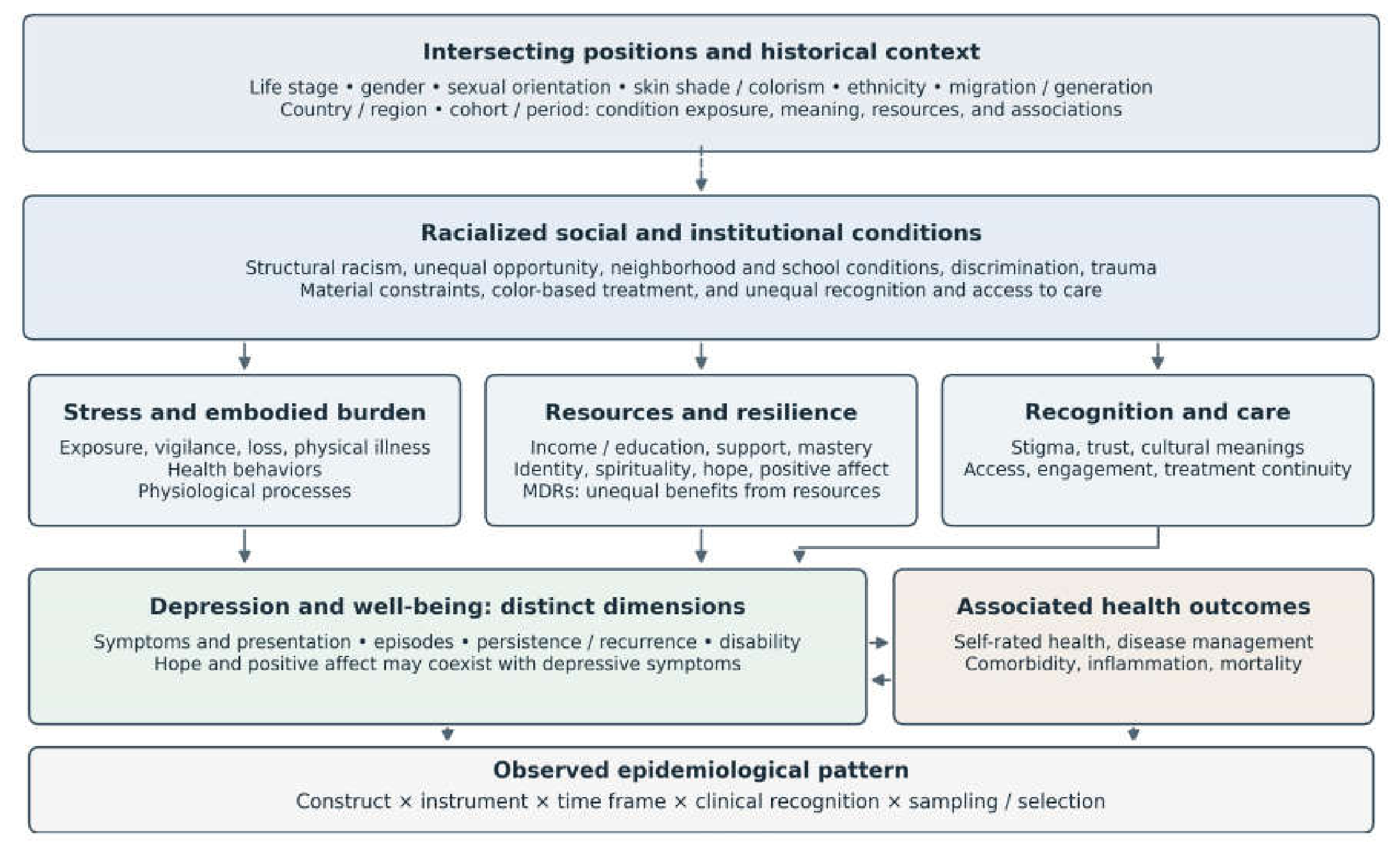

Table 1.
Selected studies anchoring the narrative synthesis.
| Domain | Study and population | Main contribution |
| Prevalence and course | Williams et al. [2]; NSAL adults | Separates lifetime occurrence from persistence and impairment |
| Symptom presentation | Brown et al. [5]; depressed primary-care patients | Similar overall depression severity with differences in somatic symptoms, comorbidity, stress, functioning, and health beliefs |
| Older-adult symptoms | Blazer et al. [6]; community-dwelling older adults | Some Black–White differences in somatic depressive symptoms and life satisfaction attenuate after adjustment |
| Item functioning | Uebelacker et al. [8]; NESARC | Little support for a uniform racial somatization pattern |
| Screening comparability | Huang et al. [42]; diverse primary-care patients | Shared PHQ-9 construct with some item differences |
| Within-group profiles | Perez et al. [40]; Black mothers | Heterogeneous depressive-symptom profiles among Black mothers |
| Comorbidity | Woodward et al. [49]; NSAL adults aged 50+ | High prevalence of psychiatric and physical comorbidity among older adults with MDD |
| Physical functioning | Shim et al. [52]; Black women in primary care | Substantial depression-associated role impairment |
| Treatment response | Lesser et al. [46]; STAR*D | Adjustment for baseline social and clinical characteristics changes Black–White comparisons of citalopram response and remission |
| Discrimination | Schulz et al. [35]; Detroit women; Lavner et al. [36]; Black youth | Reported discrimination was associated with subsequent depressive symptoms or changes in depressive symptoms |
| Socioeconomic resources | Assari [65,66]; Assari et al. [67,70] | Income–MDD and education–depressive-symptom associations differ by race, gender, or neighborhood racial composition |
| Relationships | Lincoln and Chae [86]; Chatters et al. [87] | Emotional support and negative interactions have different associations with MDD or depressive symptoms |
| Gendered expectations | Woods-Giscombé [90]; Woods-Giscombe et al. [91] | Strength, disclosure, and care preferences in women's accounts |
| Collaborative care | Cooper et al. [115]; BRIDGE | Similar depressive-symptom improvement with standard and patient-centered collaborative care |
| Cultural adaptation | Ward et al. [116]; Oh Happy Day Class | Both active depression courses reduced depressive symptoms |
| Symptom–disorder contrast | Barnes and Bates [15]; Barry et al. [17] | Higher symptom or distress burden can coexist with lower MDD prevalence |
| Matched comparisons | Coman, Wu, and Assari [28]; 61 pairs | Lower average depression prevalence among Black women coexists with matched pairs in which only the Black woman or only the White woman had depression |
| Hope and affect | Assari and Lankarani [82]; Lankarani and Assari [83] | Depressive symptoms were less strongly associated with hopelessness, and negative affect was less inversely associated with positive affect, among Black than White adults |
| Mechanism tests | Mouzon [23,24]; Louie et al. [25]; Pamplin et al. [26,27] | Family ties, coping resources, and health behaviors differed in their statistical contribution to Black–White differences in depressive symptoms or psychiatric disorders |
| Within-Black heterogeneity | Williams et al. [106]; Assari and Caldwell [94] | Psychiatric-disorder prevalence varies by Caribbean ethnicity and migration history; obesity–MDD associations vary by ethnicity and gender |
| Immigration | Iheduru-Anderson et al. [98]; scoping review | Linguistic, cultural, and service barriers among African immigrants |
Note: BRIDGE = Blacks Receiving Interventions for Depression and Gaining Empowerment; MDD = major depressive disorder; NESARC = National Epidemiologic Survey on Alcohol and Related Conditions; NSAL = National Survey of American Life; PHQ-9 = nine-item Patient Health Questionnaire; STAR*D = Sequenced Treatment Alternatives to Relieve Depression. Rows summarize selected studies discussed in the narrative.
Table 2.
Examples spanning small and large study samples.
| Study and design | Reported sample | Black-specific denominator |
| Woods-Giscombé [90]; qualitative focus groups | 48 women in eight groups | 48 African American women |
| Coman, Wu, and Assari [28]; matched comparison | 122 people in 61 pairs | 61 Black participants |
| Grothe et al. [123]; psychometric study | 220 medical outpatients | 220 African American patients |
| Janicki Deverts et al. [55]; CARDIA analysis | 2,544 participants | 1,063 Black participants |
| McGuire et al. [92]; pooled intersectional survey analysis | 234,722 adults across 42 intersectional groups | Black subgroup counts vary across sex/gender and sexual orientation |
| Zeber et al. [121]; six-system psychotherapy study | 242,765 adults | Multi-racial total; Black-specific count not reported here |
Note: CARDIA = Coronary Artery Risk Development in Young Adults. All counts are unweighted people, not weighted population estimates; total and Black-specific denominators are distinguished. Examples are illustrative, not an exhaustive ranking.
Table 3.
Statistical approaches and the questions they address.
| Approach | Examples in this review | What it can show |
| Survey-weighted prevalence and regression | Williams et al. [2]; CPES care analyses [114,120] | Population estimates and adjusted associations under the sampling design |
| Interaction tests and stratified models | Assari [65,68,94]; Lavner et al. [36] | Whether a measured association differs across race, gender, ethnicity, or their combinations |
| Individual matching | Coman, Wu, and Assari [28]; 61 Black–White pairs | Comparison among people similar on selected measured attributes |
| Repeated-measure and lagged models | NSBA [29]; youth discrimination [36]; CARDIA [55] | Temporal ordering and symptom or biomarker trajectories |
| Measurement invariance and item-response analyses | Breslau et al. [9]; Patel et al. [43]; Canady et al. [124]; Kim et al. [129] | Whether items and latent constructs operate comparably across groups |
| Latent class analysis | Perez et al. [40] | Unobserved symptom-profile groupings within Black mothers |
| Multilevel intersectional models | McGuire et al. [92] | Differences across intersecting social-position groups beyond average main effects |
| Mediation and competing-mechanism models | Louie et al. [25]; Pamplin et al. [26,27] | Whether data are consistent with a specified explanatory pathway |
| Trial comparisons and secondary subgroup analyses | CO-MED [47]; BRIDGE [115]; Oh Happy Day Class [116] | Comparisons of depressive-symptom improvement, response, remission, and care experiences across treatment groups |
| Multilevel routine-care analyses | Zeber et al. [121] | Patient, provider, and system variation in early psychotherapy continuation |
Note: BRIDGE = Blacks Receiving Interventions for Depression and Gaining Empowerment; CARDIA = Coronary Artery Risk Development in Young Adults; CO-MED = Combining Medications to Enhance Depression Outcomes; CPES = Collaborative Psychiatric Epidemiology Surveys; NSBA = National Survey of Black Americans. Examples refer to analyses described in the cited papers.
Table 4.
Study designs used to investigate depression among Black populations: definitions, examples, and contributions.
Table 4.
Study designs used to investigate depression among Black populations: definitions, examples, and contributions.
| Design | Definition and relevant example | What it can contribute |
| Case–control | Participants selected by depression status, followed by comparison of prior exposures or family histories. Murphy et al. compared 63 African American depression cases with 33 controls and examined their relatives [136]. | Associations of depression with trauma and familial history; efficient investigation of relatively uncommon outcomes. |
| Retrospective | Past symptoms, episodes, or exposures reconstructed from interviews or records. National psychiatric survey analyses of lifetime depression used recalled histories within cross-sectional population surveys [3]. | Lifetime prevalence, recalled onset, and prior course; comparison across ethnic and demographic groups. |
| Longitudinal | Repeated measurements or follow-up after baseline. CARDIA examined depressive symptoms in relation to later inflammation [55]; Lavner et al. followed Black youth across four waves [36]. | Temporal ordering, changes, trajectories, and potentially reciprocal associations. |
| Case report / clinical vignette | Detailed account of one patient or family. Hankerson et al. use clinical illustration in a conceptual review of structural racism, cumulative trauma, and intergenerational depression [147]. | Cultural formulation, neglected exposures, clinical complexity, and hypothesis generation. |
| Case series / uncontrolled treatment series | Description or follow-up of several clinically selected patients without randomized allocation. Uzoma et al.'s open-label light-treatment cohort included 78 patients, 51 African American, with seasonal mood disorders [148]. | Feasibility, adherence, symptom patterns, and signals for further study. |
| Intervention, nonrandomized | Investigators deliver treatment, but assignment is not randomized. Uzoma et al. provided six weeks of bright-light treatment and compared depression response and remission across racial groups [148]. | Practical treatment delivery and changes during exposure; preliminary response or remission differences. |
| Randomized controlled trial (RCT) | Participants or groups randomly assigned to treatment alternatives. Ward et al. compared a culturally adapted depression course with an active control among 132 African American adults [116]. | Stronger evidence for the assigned treatment comparison when allocation, follow-up, and analysis are appropriate. |
| Quasi-experimental | Uses policy, timing, or exposure variation without investigator randomization. Bor et al. used a difference-in-differences framework to examine police killings and subsequent poor mental health days among Black adults [141]. | Evidence concerning contextual exposures under explicit identification assumptions. |
Note: CARDIA = Coronary Artery Risk Development in Young Adults; NSAL = National Survey of American Life; RCT = randomized controlled trial. Rows summarize selected studies discussed in the narrative.
Table 5.
Mediation models specifying what may mediate what.
| Study and population | Proposed exposure → mediator → outcome | Reported statistical finding | Study design |
| Hernandez et al. [53]; African American patients with diabetes | Depressive symptoms → diabetes self-efficacy → foot-care behavior | Greater depressive symptoms were indirectly associated with poorer foot-care behavior through lower diabetes self-efficacy in the African American subgroup | Cross-sectional analysis |
| Assari, Smith, and Bazargan [77]; African American older adults | Multimorbidity → depression → poorer SRH | Statistical full mediation among men and partial mediation among women | Cross-sectional analysis |
| Su et al. [81]; Black young adults | Racial discrimination → depressive symptoms → alcohol use/problems | Racial discrimination was indirectly associated with alcohol consumption or alcohol-related problems through depressive symptoms; moderation differed by racial-identity dimension | Observational mediation analysis |
| Louie et al. [25]; Black and White Nashville adults | Racial group comparison → coping resources → symptoms or any DSM-IV disorder | Self-esteem contributed most to the Black–White depressive-symptom difference; divine-control beliefs to the difference in any DSM-IV disorder | Cross-sectional disparity decomposition; race labels are not randomized causes |
| Mekawi et al. [139]; 148 Black mother–child dyads | Maternal racism experiences → maternal depressive symptoms → child depressive symptoms | Maternal racism experiences were indirectly associated with child depressive symptoms through maternal depressive symptoms; this pathway varied with maternal trauma exposure | Cross-sectional moderated mediation |
| English et al. [144]; 505 African American adults | Neighborhood White composition → experienced discrimination → later depressive symptoms | Pathway model linked composition with discrimination and discrimination with subsequent symptoms | Longitudinal structural model |
| Curry et al. [142]; selected Baltimore residents | Recorded violent crime → perceived disorder/experienced violence → depressive symptoms | Indirect pathways through perceptions and violence experiences supported | Observational neighborhood study |
| Martz et al. [146]; Black women with lupus | Census-tract typology → perceived neighborhood disorder → depressive symptoms | Segregated census-tract typologies were indirectly associated with greater depressive symptoms through greater perceived neighborhood disorder | Cross-sectional structural model; poverty and segregation were combined in typologies |
| Jones et al. [138]; African American and White mother–child dyads | Maternal symptoms → mother–child relationship quality → child symptoms | Little support for relationship quality as the mediator | Longitudinal mediation analysis |
| Pamplin et al. [26]; Black and White adult follow-up sample | Stress and health-behavior pathways specified by the Environmental Affordances model → Black–White depression difference | Neither tested stress–health-behavior pathway explained the Black–White depression difference | Competing-pathway analysis |
Note: DSM-IV = Diagnostic and Statistical Manual of Mental Disorders, fourth edition; SRH = self-rated health. Rows summarize selected studies discussed in the narrative.
Table 6.
Survey and cohort foundations of the review.
| Survey or cohort | Design and population | Contribution to this review |
| NSBA | National Black adult survey with four waves through 1992 [10] | Within-group social context; discrimination; prospective religion–depression analysis [29,30] |
| NCS | National household psychiatric survey, 1990–1992 [31] | Lifetime risk versus persistence |
| NCS-R | New national adult survey in the early 2000s [3,34] | Disorder-specific, cohort, and education variation |
| NSAL | National African American and Caribbean Black adult samples with a White comparison [2,11] | MDD, impairment, ethnic variation, care use |
| NSAL adolescent supplement | African American and Caribbean Black youth [32,33] | Ethnicity-by-gender variation in discrimination–well-being and mastery–MDD associations |
| CPES | Coordinated NCS-R, NSAL, and NLAAS [34] | Cross-group diagnosis and treatment analyses |
| National Epidemiologic Survey on Alcohol and Related Conditions (NESARC) | National adult survey with large Black samples [4,8] | Psychiatric prevalence and symptom functioning |
| Longitudinal cohorts | NSBA; Americans' Changing Lives; MIDUS; Black youth cohorts; Ibadan; United Kingdom household panel [13,30,35,36,37,38,39] | Discrimination–depressive-symptom associations, religious guidance–depression associations, MDD incidence, policy–distress associations, and chronic-illness–negative-affect associations |
Note: CPES = Collaborative Psychiatric Epidemiology Surveys; MDD = major depressive disorder; MIDUS = Midlife in the United States; NCS = National Comorbidity Survey; NCS-R = National Comorbidity Survey Replication; NESARC = National Epidemiologic Survey on Alcohol and Related Conditions; NLAAS = National Latino and Asian American Survey; NSAL = National Survey of American Life; NSBA = National Survey of Black Americans. Rows summarize selected studies discussed in the narrative.
Table 7.
Longitudinal analyses with shorter and longer observation periods.
| Study and population | Observation interval and assessments | Exposure and outcome | Longitudinal contribution |
| Whipple et al. [140]; Black adolescents | 18 months; baseline, 6, 12, and 18 months | Depression/hopelessness and suicidal-ideation classes | Shows class transitions over short intervals; complete-case retention selects the analytic sample |
| Assari [75]; Black and White older adults | Three years, 2001–2004 | Baseline depressive symptoms and subsequent all-cause mortality | Examines the association of baseline depressive symptoms with subsequent all-cause mortality |
| Schulz et al. [35]; 343 African American women | Five years; 1996 and 2001 | Changes in reported discrimination, depressive symptoms, and self-rated health | Examines change across waves; two observations incompletely resolve direction and intervening events |
| Janicki Deverts et al. [55]; CARDIA | Five years; depressive symptoms and CRP at two assessments | Baseline depressive symptoms and later CRP | Adjusts for earlier inflammation; selected recruitment and analytic retention remain relevant |
| Repetto et al. [79]; African American youth | Eight years; six occasions | Depressive symptoms and cigarette-use trajectories | Addresses transition into adulthood; observational behavioral pathways remain potentially confounded |
| Lavner et al. [36]; 889 Black youth initially | About 8.2 years; mean ages 10.6, 12.5, 15.7, and 18.8 | Discrimination and depressive symptoms, tested bidirectionally | Within- and between-person models support lagged discrimination–symptom associations; no randomized exposure |
| Barry et al. [17]; Black and White older adults | Ten years; eight symptom assessments | Race and elevated CES-D symptom burden | Describes persistent population differences in symptom trajectories; not diagnostic MDD incidence |
| Moazen-Zadeh and Assari [20]; ACL | 15 years from baseline symptoms to later diagnosis assessment | CES-D symptoms and 12-month CIDI MDD at follow-up | Racial variation in symptom–disorder correspondence; disorder onset was not continuously observed |
| Assari et al. [74,78]; ACL | 25 years, 1986–2011 | Reciprocal depressive-symptom/chronic-condition associations or baseline depressive symptoms and all-cause mortality | Tests depressive-symptom/chronic-condition associations over 25 years and baseline depressive-symptom associations with all-cause mortality |
Note: ACL = Americans' Changing Lives; CARDIA = Coronary Artery Risk Development in Young Adults; CES-D = Center for Epidemiologic Studies Depression Scale; CIDI = Composite International Diagnostic Interview; CRP = C-reactive protein; MDD = major depressive disorder; SRH = self-rated health. Rows summarize selected studies discussed in the narrative.
Table 8.
Evidence for measurement invariance and noninvariance.
| Study and groups | Instrument and variant | Invariant or broadly comparable findings | Item differences and version-specific findings |
| Patel et al. [43]; United States race/ethnicity, sex, and education groups | PHQ-9; cognitive/affective and somatic factors | Supported configural, scalar, and strict invariance in NHANES analysis | Supported invariance across the studied demographic groups |
| Huang et al. [42]; racially diverse primary-care patients | PHQ-9 | Shared depression construct | Some differential item functioning |
| Galenkamp et al. [85]; HELIUS ethnic groups, including Ghanaian and African Surinamese participants | PHQ-9 | Measurement invariance supported across studied ethnic groups | Multi-ethnic European urban sample |
| Canady et al. [124]; 375 Black and 375 White pregnant women | Original CES-D-20; modeled 19- and 18-item alternatives | Broad cross-group factor comparability and very similar alternative total scores | Effort item removed; happy item showed a small loading difference |
| Torres [125]; African American and Caribbean Black adults | CES-D-12; exploratory reduced 11-/10-item scores | Internal consistency improved after selected item removal | Construct-validity concerns in male subgroups; improved reliability in reduced versions |
| Uebelacker et al. [8]; racial/ethnic and gender groups | DSM-IV depression interview criteria | Most criteria functioned similarly | Some item differences; no consistent uniform racial somatization pattern |
| Breslau et al. [9]; ethnic groups | NCS depression interview items | Examination supports item-specific rather than blanket conclusions | Identified differential item functioning; instrument-level consequences require separate assessment |
| Kim et al. [129]; racial/ethnic and language groups | K6 | Internal reliability examined | Several items varied; language contributed to nonequivalence |
| Berg et al. [126]; African American smokers | PHQ-2 versus CES-D-10 | PHQ-2 and CES-D-10 depressive-symptom scores were correlated | Different positive-screen proportions |
| Dang et al. [127]; HRS older adults across race/ethnicity | CES-D-8 versus CIDI-SF | Both capture aspects of depression-related experience | Classification disagreement; diagnostic agreement is a different question from factorial invariance |
Note: CES-D-10 = 10-item Center for Epidemiologic Studies Depression Scale; CES-D-12 = 12-item Center for Epidemiologic Studies Depression Scale; CES-D-20 = 20-item Center for Epidemiologic Studies Depression Scale; CES-D-8 = eight-item Center for Epidemiologic Studies Depression Scale; CIDI-SF = short-form Composite International Diagnostic Interview; DSM-IV = Diagnostic and Statistical Manual of Mental Disorders, fourth edition; HELIUS = Healthy Life in an Urban Setting; HRS = Health and Retirement Study; K6 = six-item Kessler Psychological Distress Scale; NCS = National Comorbidity Survey; NHANES = National Health and Nutrition Examination Survey; PHQ-2 = two-item Patient Health Questionnaire; PHQ-9 = nine-item Patient Health Questionnaire. Rows summarize selected studies discussed in the narrative.
Table 9.
Depression and distress instruments and their versions.
| Instrument or version | Construct and usual reference period | Example and population | Meaning for interpretation |
| BDI-II; 21 items | Depressive symptom severity; preceding two weeks | Grothe et al. [123]; African American medical outpatients | Supported reliability and validity |
| PHQ-2; two items | Depressed mood and low interest; preceding two weeks | Berg et al. [126]; 539 African American light smokers | Brief screen; identified fewer elevated cases than CES-D-10 in the same sample |
| PHQ-4; four items | Combined depression and anxiety screen; preceding two weeks | Assari et al. [80]; HINTS multi-racial sample | Includes two depression and two anxiety items; pooled distress classification is not MDD |
| PHQ-8; eight items | Recent depression symptoms; preceding two weeks | CDC [128]; 235,067 BRFSS respondents | Algorithm-defined recent depression differs from lifetime diagnosis; omits death/self-harm item |
| PHQ-9; nine items | Depression symptoms; preceding two weeks | Huang et al. [42]; Patel et al. [43]; Galenkamp et al. [85] | Comparability generally supported in studied groups, with setting-specific item qualifications |
| CES-D; original 20 items | Depressive symptoms; preceding week | Canady et al. [124]; matched Black and White pregnant women | Broad comparability with specific item differences; results concern the full version and this setting |
| 12-item Center for Epidemiologic Studies Depression Scale (CES-D-12) | Abbreviated depressive symptoms; preceding week | Torres [125]; 4,815 African American and Caribbean Black NSAL adults | Some sex-by-ethnicity validity concerns |
| CES-D-10; 10 items | Abbreviated depressive symptoms; preceding week | Berg et al. [126]; African American smokers | Classification differed from PHQ-2 despite moderate score correlation |
| CES-D-8; eight items | Abbreviated depressive symptoms; preceding week | Dang et al. [127]; HRS older adults, including 3,483 Black respondents | HRS scoring and thresholds differ from the original scale; limited diagnostic agreement |
| CES-D-11; 11 items | Abbreviated depressive symptoms; preceding week | Assari et al. [78]; ACL mortality analysis | 11-item version; the analysis in [74] used 10 items |
| K6; six items | Nonspecific psychological distress; preceding 30 days in the cited study | Kim et al. [129]; 44,846 California survey respondents across race and language | Measures distress rather than depression alone; item and language comparability need attention |
| CIDI and CIDI-SF | Interview-defined syndromes; module-specific lifetime or recent periods | NSAL [2]; HRS comparison [127] | Interview algorithms differ from symptom thresholds; short and full interviews are not interchangeable |
Note: ACL = Americans' Changing Lives; BDI-II = Beck Depression Inventory-II; BRFSS = Behavioral Risk Factor Surveillance System; CDC = Centers for Disease Control and Prevention; CES-D = Center for Epidemiologic Studies Depression Scale; CES-D-10 = 10-item Center for Epidemiologic Studies Depression Scale; CES-D-11 = 11-item Center for Epidemiologic Studies Depression Scale; CES-D-12 = 12-item Center for Epidemiologic Studies Depression Scale; CES-D-8 = eight-item Center for Epidemiologic Studies Depression Scale; CIDI = Composite International Diagnostic Interview; CIDI-SF = short-form Composite International Diagnostic Interview; HINTS = Health Information National Trends Survey; HRS = Health and Retirement Study; K6 = six-item Kessler Psychological Distress Scale; MDD = major depressive disorder; NSAL = National Survey of American Life; PHQ-2 = two-item Patient Health Questionnaire; PHQ-4 = four-item Patient Health Questionnaire; PHQ-8 = eight-item Patient Health Questionnaire; PHQ-9 = nine-item Patient Health Questionnaire. Reference periods are those customary for the named version or specified in the cited analysis. Screening scores, algorithm-defined syndromes, and interview diagnoses are distinct outcomes.
Table 10.
Political representation and insurance-policy studies relevant to Black depression and mental health.
Table 10.
Political representation and insurance-policy studies relevant to Black depression and mental health.
| Study and population | Exposure and approach | Outcome | Main finding |
| Brown et al., 2021; Black adults [160] | Before and after the 2008 Obama election; BRFSS | Poor mental health days in the preceding 30 days | Fewer days among men, more among women; little overall change. |
| Brown et al., 2024; 3,807 Black adults [179] | Before and after the 2012 re-election; BRFSS | Poor mental health days | Fewer days among college-educated men and more among men without a degree. |
| Lieff et al., 2024; low-income adults with probable mental illness [161] | Medicaid expansion, 2010–2017; difference-in-differences | Insurance and mental health treatment needs | Coverage increased; racial and ethnic disparities in treatment were not reduced. |
| Lai et al., 2023; 327,248 low-income childless adults [162] | Medicaid expansion, 2011–2019; difference-in-differences | Poor mental health days | Black adults had an estimated increase of 0.27 days; White adults had a decrease of 0.18 days. |
| Brown et al., 2026; 474,801 expansion-eligible adults [163] | Medicaid expansion, 2014–2022; staggered-adoption analysis | Insurance and mental health days | Among Black adults, coverage increased 6.5 percentage points and poor mental health days declined an estimated 0.7 days. |
| Oyeka and Wehby, 2023; low-income adults aged 18–64 [164] | Medicaid expansion during 2020–2021 | Self-reported mental health | Medicaid expansion was associated with better self-reported mental health during the pandemic among Black adults, women, and adults younger than 45. |
Note: BRFSS = Behavioral Risk Factor Surveillance System. Poor mental health days include stress, depression, and emotional problems. Rows identify Black subgroup findings or comparisons of racial and ethnic inequalities. Percentage points describe absolute differences in proportions.
Table 11.
Depression as a predictor or correlate of adverse outcomes.
| Study and population | Depression measure and adverse outcome | Design and ordering | Black-specific finding |
| Whipple et al. [140]; African American adolescents | Depressive symptoms and hopelessness; suicidal-ideation class | Four assessments, baseline through 18 months; 99 complete cases from 160 recruited | Depression predicted high-ideation class membership |
| Repetto et al. [79]; 623 African American youth | Depressive symptoms; later cigarette use | Six assessments over eight years | Symptoms predicted later use; no White comparison and shared causes remain possible |
| Janicki Deverts et al. [55]; CARDIA, 1,063 Black participants in 2,544-person analysis | CES-D symptoms; later CRP | Five-year prospective interval with baseline CRP considered | Higher baseline depressive symptoms predicted higher later CRP among Black participants |
| Assari et al. [74]; surviving Black and White ACL adults | Depressive symptoms; number of chronic conditions | Baseline and 25-year follow-up; reciprocal models | The association of baseline depressive symptoms with later chronic-condition counts was weaker or not supported among Black respondents |
| Assari [75]; 734 Black and 759 White older adults | Baseline depressive symptoms; all-cause mortality | Three-year prospective mortality follow-up | Association supported among White but not Black adults, with race interaction |
| Assari et al. [78]; Black and White ACL adults | Baseline depressive symptoms; all-cause mortality | Up to 25 years | Race-specific mortality associations varied with health adjustment; overlapping ACL analyses are not independent replications |
| Hernandez et al. [53]; African American subgroup with diabetes | PHQ-9 symptoms; diet, activity, monitoring, and foot care | Cross-sectional baseline analysis | Higher depressive symptoms were associated with poorer diabetes self-care and indirectly with poorer foot care through lower diabetes self-efficacy |
| Assari, Smith, and Bazargan [77]; 740 African American older adults | Depression; poorer SRH in multimorbidity models | Cross-sectional structural equation model | Depression statistically mediated the association of multimorbidity with poorer SRH fully among men and partly among women |
Note: ACL = Americans' Changing Lives; CARDIA = Coronary Artery Risk Development in Young Adults; CES-D = Center for Epidemiologic Studies Depression Scale; CRP = C-reactive protein; PHQ-9 = nine-item Patient Health Questionnaire; SRH = self-rated health. Rows summarize selected studies discussed in the narrative.
Table 12.
Loneliness, social isolation, living arrangements, and personality in studies including Black adults.
Table 12.
Loneliness, social isolation, living arrangements, and personality in studies including Black adults.
| Study and population | Dimensions examined | Depression-related finding |
| Taylor et al., 2020; African American and Caribbean Black adults [166] | Frequency of contact and emotional closeness with family and friends | Infrequent contact and low emotional closeness were associated with greater depressive symptoms and psychological distress; subjective isolation accounted for part of the objective-isolation associations with these outcomes. |
| Nguyen et al., 2020; 3,570 African Americans [178] | Objective and subjective isolation | Subjective isolation from family and friends was associated with 12-month major depressive disorder and broader psychiatric morbidity. |
| Taylor and Nguyen, 2020; 6,469 Black and White older adults [167] | Loneliness; living alone, family and friend contact, and attendance included in adjustment | Loneliness was associated with greater depressive symptoms among both Black and White older adults, with a weaker loneliness–symptom association among Black adults. |
| Hsu and Ransome, 2026; 592 Black adults at midlife [168] | Longitudinal loneliness, family and friend support, neighborhood cohesion, and social integration | Loneliness was associated with psychological distress and a binary depression outcome; family support was associated with lower levels of these outcomes partly through lower loneliness. |
| Clark et al., 2018; 803 African American adults [165] | Big Five personality traits and social capital | Conscientiousness, openness, and extraversion were associated with fewer depressive symptoms; neuroticism with more depressive symptoms. Personality modified the social-capital–depressive-symptom association. |
Note: Objective isolation refers to limited social contact; subjective isolation refers to limited emotional closeness. Loneliness refers to perceived inadequacy of social connection. Living alone is a household characteristic. Big Five traits are conscientiousness, openness to experience, extraversion, agreeableness, and neuroticism. Social capital includes community participation, interconnection, and support.
Table 13.
Distinct religious and church-network variables examined in Black populations.
| Study and population | Religious or church variable | Outcome and reported association |
| Ellison and Flannelly, 2009; 607 African Americans [30] | Religious guidance | Strong guidance was associated with lower odds of depression at follow-up. |
| Taylor, Chatters, and Abelson, 2012; 3,570 African Americans [173] | Attendance, religious coping, and reading religious materials | Attendance was inversely associated with 12-month and lifetime MDD; religious coping with 12-month MDD. Reading religious materials was positively associated with 12-month and lifetime MDD. |
| Taylor, Chatters, and Nguyen, 2013; Caribbean Black adults [174] | Attendance, coping, self-rated religiosity, and religious radio | Religious coping was associated with lower 12-month and lifetime MDD prevalence; self-rated religiosity with lower lifetime MDD prevalence. Weekly attenders had lower MDD prevalence than more- or less-frequent attenders; religious-radio listening was associated with higher lifetime MDD prevalence. |
| Chatters et al., 2015; 686 African Americans aged 55 or older [87] | Emotional support received and negative interactions from church and family | Church emotional support was associated with fewer depressive symptoms and less psychological distress after adjustment for family support. |
| Chatters et al., 2018; African American adults [169] | Church and family contact, emotional support, and negative interactions | Church and family contact and family emotional support were associated with fewer depressive symptoms; negative interactions with more depressive symptoms. Church emotional support was not independently associated with depressive symptoms. |
| Nguyen, Taylor, and Chatters, 2016; Caribbean Blacks [170] | Attendance and contact in relation to giving, receiving, and negative interactions | Religious attendance was associated with more church support given and received. More church-member contact was associated with more support exchanges and more negative church interactions; the outcomes were network measures. |
| Nguyen et al., 2019; African Americans [172] | Giving support, receiving support, emotional support, closeness, and contact | Religious involvement and sociodemographic characteristics were examined in relation to church contact, closeness, support given and received, emotional support, and negative interactions; the outcomes were church-network characteristics. |
| Taylor et al., 2017; African Americans [176] | Giving and receiving help with illness, transport, finances, and chores | Illness-related help was most common; respondents reported giving more than receiving in each domain. Greater religious attendance was associated with more instrumental support given and received. |
| Nguyen et al., 2018; 1,271 African American men [175] | Church emotional support and discrimination across age groups | Discrimination was associated with greater psychological distress across age groups. The discrimination–distress association was stronger at higher church emotional support in younger and older men, a pattern interpreted as support mobilization. |
| Chatters et al., 2011; African American and Caribbean Black adults [171] | Church closeness, contact, attendance, emotional support, and negative interactions | Closeness was associated with less suicidal ideation; contact with more suicide attempts; other church variables were not associated with these outcomes. |
| Frierson and Erving, 2025; 3,278 African Americans [177] | Receiving emotional and instrumental support; providing instrumental support; educational attainment | Emotional support received from family, friends, and church was associated with fewer depressive symptoms. Church instrumental support received and friend instrumental support provided were associated with more depressive symptoms; education modified several support–depressive-symptom associations. |
Note: Emotional support includes caring, listening, and reassurance. Instrumental support includes practical or material assistance. Support given and support received are separate measures. Negative interactions include criticism, conflict, or excessive demands. Rows explicitly labeled as network outcomes describe the organization of support rather than a depression estimate. Major depression, depressive symptoms, psychological distress, and suicidality are separate outcomes.
Table 14.
Family clustering and intergenerational depression studies.
| Study and family population | What was measured | Main finding |
| Murphy et al. [136]; African American community case–control family study | 63 depressed cases, 33 controls; histories for 435 versus 222 relatives | The difference in relatives' MDD prevalence between case and control families was not supported; high trauma exposure was associated with greater proband MDD odds, with a greater-than-additive joint association of trauma and family MDD history with proband MDD |
| Jones et al. [138]; African American and White mother–child dyads | Repeated maternal and child depressive symptoms; relationship quality | Mother–child symptom association observed across samples; proposed relationship-quality mediation received little support |
| Mekawi et al. [139]; 148 Black mother–child dyads | Maternal racism, trauma, and maternal/child depression symptoms | Indirect racism–child-symptom association through maternal depression varied with maternal trauma |
| Murphy [137]; systematic review of 209 family/twin studies published 1980–2015 | African American representation in mood/anxiety family and twin research | Substantial underrepresentation and incomplete race reporting |
| NIH familiality project [130]; funded research plan | Proposed African American probands, controls, relatives, and environmental/genetic measures | Documents a funded family-research agenda; linked empirical paper is [136] |
Note: MDD = major depressive disorder; NIH = National Institutes of Health. Rows summarize selected studies discussed in the narrative.
Table 15.
Structural and neighborhood correlates of depression or distress.
| Study and Black population | Structural/contextual exposure and level | Outcome and finding | Study design and setting |
| Schulz et al. [71]; Detroit African American women | Neighborhood disorder, financial strain, discrimination, and support; reported contextual stress | Depressive symptoms associated with neighborhood and discrimination stressors beyond income | Neighborhood and individual stress measures |
| Assari and Caldwell [143]; 1,170 Black adolescents | Perceived neighborhood safety; individual report | Perceived neighborhood unsafety was associated with higher MDD odds in the pooled Black sample and among African American boys | Cross-sectional analysis |
| Curry et al. [142]; selected Baltimore residents, including Black participants | Police-recorded block-group crime, experienced violence, and perceived disorder | Depressive symptom pathways through disorder and experienced violence | Not a Black-only probability sample; objective crime and perceptions measured separately |
| English et al. [144]; 505 African American adults | Census/geocoded neighborhood White composition; reported discrimination | Discrimination associated with later depressive symptoms in structural pathway model | Composition is not itself a complete measure of structural racism |
| Martz et al. [146]; 438 Black women with lupus | Census-tract segregation/socioeconomic typologies and perceived disorder | Segregated census-tract typologies were indirectly associated with greater depressive symptoms through greater perceived neighborhood disorder | Selected disease population; typologies combine poverty and segregation |
| Mair et al. [72]; African American adults in multi-ethnic cohort | Same-race neighborhood composition | Higher same-race neighborhood composition was associated with more depressive symptoms among African American men | Racial composition may reflect deprivation, segregation, or support; no universally protective pattern |
| Walsemann et al. [99]; Black Add Health subgroup | High-school proportion White; institutional racial composition | Attending schools with a higher proportion of White students was associated with more depressive symptoms among Black participants into early adulthood | Longitudinal school-context analysis |
| Bor et al. [141]; 103,710 Black adult responses | State-level police killings of unarmed Black people in previous three months | More poor mental health days following additional killings | Quasi-experimental repeated surveys; general mental health, not depression-specific diagnosis |
| Hines et al. [145]; two low-income African American communities | Proximity and interview timing around unrest after Freddie Gray's death | Higher depressive symptoms near epicenter after unrest | Repeated cross-sectional survey; not direct individual police exposure or person-level follow-up |
Note: MDD = major depressive disorder. Rows summarize selected studies discussed in the narrative.
Table 16.
Selected qualitative and consensus studies relevant to depression and care among Black populations.
Table 16.
Selected qualitative and consensus studies relevant to depression and care among Black populations.
| Study and population | Method and sample | Main contribution |
| Ward, Clark, and Heidrich [150]; community-dwelling African American women | Individual interviews; 15 women; dimensional analysis guided by an illness-beliefs framework | Prayer and counseling as coping resources; medication ambivalence, stigma, limited access, and limited awareness |
| Nicolaidis et al. [149]; low-income African American women with depressive symptoms and violence histories in Portland | Community-partnered FGs; 30 women in four groups | Racism and healthcare mistrust shaped views of care; participants wanted services addressing violence and substance use |
| Hudson et al. [151]; African American men in St. Louis | Four FGs; 26 men | Depression described through stress, isolation, and low mood; masculinity, affordability, mistrust, and interest in supportive groups |
| Breland-Noble et al. [152]; adults discussing depressed African American adolescents and families | Four FGs; 24 adults; community-partnered engagement research | Family beliefs, perceived cultural insensitivity, practical barriers, and community partnership informed engagement strategies |
| Conner et al. [153]; older African Americans with a recent major depressive episode | FGs; 42 older adults; thematic analysis | Stigma, treatment as a last resort, beliefs about treatment, and culturally meaningful coping |
| Woods-Giscombé [90]; African American women with varied ages and educational backgrounds | Eight FGs; 48 women; framework development | Strength obligations were described as having protective functions and burdens involving emotional restraint, relationships, and health behaviors |
| Woods-Giscombé et al. [91]; same focus-group dataset | Secondary qualitative analysis of eight FGs with 48 women | Examined strength expectations, stigma, spirituality, and expectations of culturally sensitive clinicians in service use |
| Stepanova et al. [154]; ethnic-minority service users, carers, public advisors, and clinicians in the United Kingdom | Modified Delphi: two rating rounds and an online workshop, with free-text input; 66 participants, including 19 Black participants among the service-user/carer/public panel | Consensus priorities concerned stigma, cultural context, community engagement, interpreters, professional preparation, and service continuity |
Note: FG = focus group; FGs = focus groups. Counts refer to participants or groups reported in the cited study; the two Woods-Giscombé papers use the same dataset. A Delphi study is a structured consensus method and may combine quantitative ratings with qualitative responses and discussion.
Table 17.
Antidepressant prescribing, dosing, response, and tolerability in studies comparing Black and White patients.
Table 17.
Antidepressant prescribing, dosing, response, and tolerability in studies comparing Black and White patients.
| Study and population | Medication question | Main finding |
| Sclar et al., 1998; 8,596 Medicaid beneficiaries [181] | TCA versus SSRI initiation; medication supply | Black patients had higher odds of TCA initiation and lower rates of obtaining three- and six-month supplies of either class. |
| Melfi et al., 2000; 13,065 Medicaid patients with depression [182] | Initiation and drug class | Initiation was 27.2% among African Americans versus 44.0% among Whites; Whites more often received an SSRI. |
| Blazer et al., 2000; 4,162 older community residents [183] | Antidepressant use, 1986–1996 | Use increased from 2.3% to 5.0% among African Americans and from 4.6% to 14.3% among Whites. |
| Strothers et al., 2005; 7,339 older Medicaid patients [180] | Receipt of antidepressants after a depression diagnosis | No antidepressant was recorded for 37.1% of African Americans versus 22.4% of Whites. |
| Remmert et al., 2022; 4,120 Black and 4,372 White veterans [195] | Primary care antidepressant prescription | Whites had nearly twice the adjusted odds of a prescription; disparities were also present among patients with severe symptoms. |
| Lesser et al., 2007; STAR*D [46] | Citalopram response and remission | Black participants had lower unadjusted citalopram response and remission than White participants; adjusted remission comparisons varied by symptom measure. |
| Lesser et al., 2010; 169 African American and 132 White participants [184] | Citalopram response, dosing, visits, and side effects | Remission was approximately 50% in each group; final doses, visit counts, dropout, and side-effect profiles were similar. |
| Lesser et al., 2011; CO-MED [47] | Single and combination regimens; attained dose and side effects | Black participants less often reached the highest doses of bupropion and escitalopram; final doses were generally similar. Continuation-phase side effects were similar across groups. |
| Murphy et al., 2013; 1,877 STAR*D participants with genetic data [48] | Genetic ancestry and citalopram response | Greater African ancestry was associated with lower response in the study's models; self-reported race and ancestry were examined separately. |
Note: TCA = tricyclic antidepressant; SSRI = selective serotonin reuptake inhibitor; STAR*D = Sequenced Treatment Alternatives to Relieve Depression; CO-MED = Combining Medications to Enhance Depression Outcomes. Initiation, medication supply, dose attained, symptom response, remission, and adverse effects are separate outcomes. The older Medicaid studies describe prescribing in their stated historical periods.
Table 18.
Care experience, stigma, attendance, continuity, and financial barriers relevant to Black depression treatment.
Table 18.
Care experience, stigma, attendance, continuity, and financial barriers relevant to Black depression treatment.
| Study and population | Dimension of care | Main finding |
| Ghods et al., 2008; 108 primary care patients with elevated depressive symptoms [196] | Depression discussion and rapport | African American patients' visits contained fewer depression-related statements and less rapport building. |
| Hines et al., 2018; 76 African American patients [185] | Informed and patient-centered decisions | Essential informed-decision elements appeared in about one-quarter of depression medication or counseling decisions; 40% included a patient-centered element. |
| Cooper et al., 2012; 40 clinicians and 269 primary care patients [204] | Clinician implicit bias and compliance stereotypes | Among Black patients, clinician implicit racial bias was associated with more clinician verbal dominance and poorer ratings of interpersonal care; race-based compliance stereotypes were associated with less patient-centered dialogue. |
| Mays et al., 2017; 1,099 mental health or substance-use service users [188] | Discrimination experienced during care | Discrimination in these visits was associated with early treatment termination among Black respondents. |
| O'Malley et al., 2003; 1,202 predominantly low-income African American women [197] | Comprehensive primary care and respect | Greater comprehensiveness and perceived respect were associated with inquiry about and treatment for depression. |
| Cooper et al., 2003; 829 primary care patients [187] | Medication and counseling acceptability | African Americans had lower odds of finding antidepressant medication acceptable for depression treatment than White patients. |
| Menke and Flynn, 2009; 1,103 primary care patients [206] | General mental health stigma | African Americans, including African American women compared with White women, reported greater stigma. |
| Givens et al., 2007; 490 primary care patients [186] | Treatment-specific stigma | Whites reported higher stigma for medication, mental health counseling, herbal remedies, and spiritual counseling; greater stigma was associated with lower acceptability of mental health counseling. |
| Brown et al., 2010; 449 Black and White adults [207] | Public and internalized stigma | Among African Americans, greater internalized depression stigma was associated with less favorable attitudes toward mental health treatment. |
| Subica and Link, 2026; 613 Black, Latina/o, and Asian adults [208] | Perceived treatability, dangerousness, and social distance | Minority samples showed greater stigma than a national public comparison sample; associations of specific stigma components with willingness to seek mental health treatment differed by racial/ethnic group. |
| Sonik et al., 2020; national sample with depression [193] | Treatment preferences and previous discrimination | Black respondents showed no overall preference between depression medication and talk therapy; prior healthcare discrimination was associated with greater preference for medication over talk therapy. |
| Enslow et al., 2023; 260 depression-research clinic participants [194] | Delay from first episode to treatment | Black participants had lower rates of antidepressant treatment and psychotherapy and longer delays to antidepressant initiation than White participants. |
| Rossom et al., 2016; multiple healthcare systems [122] | Early antidepressant refill adherence | Black patients had lower early antidepressant refill adherence than White patients after adjustment for measured characteristics. |
| Zeber et al., 2017; 242,765 psychotherapy initiators [121] | Return after the first depression-therapy visit | Minority patients were less likely than White patients to return for a second psychotherapy visit for depression; return also varied by provider and health system. |
| Shimotsu et al., 2016; 161,350 safety-net patients [199] | Missed scheduled appointments | Black patients had higher odds of missed scheduled appointments than White non-Hispanic patients. This was a general healthcare sample that included major mental illness. |
| Agyemang et al., 2014; 402 Black adults with lifetime major depression [210] | Guideline-concordant care and medical comorbidity | Guideline-concordant care was uncommon, including among participants with diabetes or hypertension. |
| Lagomasino et al., 2011; 58,826 outpatient visits [209] | Provider-practice composition and care | Depression and anxiety care disparities persisted in primary care after practice racial composition was included. |
| Adia et al., 2026; 23,093,888 credit-report borrowers [198] | Medical debt in collections | Black borrowers had the highest prevalence; 24% had outstanding medical debt in collections in 2022. This was a general borrower sample. |
Note: Patient-centered care includes discussion of the patient's beliefs, concerns, circumstances, and preferences. Informed decisions include the decision's nature, alternatives, and advantages and disadvantages. Public stigma concerns perceived social judgments; internalized stigma concerns their incorporation into one's self-view. Medication refill adherence, attendance, treatment continuation, and care quality are distinct measures. General healthcare and borrower studies are labeled to distinguish them from depression-specific samples. Percentages refer to the populations and outcomes stated in each row.
Table 19.
Selected NIH-funded projects identified in RePORTER.
| Project and investigator(s) | Award and selected fiscal year | Population and proposed work | RePORTER record |
| Influences on the familiality of Major Depression among African-Americans; Eleanor Murphy | 5K22MD006140-03; NIMHD; fiscal year 2016; 2014-01-29 to 2017-08-31 | African American adults and relatives; family aggregation of MDD with environmental and genetic data | [130] Project link |
| Pathways to Reducing Disparities in Depression Outcomes; Kenneth B. Wells; Jeanne Miranda | 5R01MD007721-02; NIMHD; fiscal year 2015; 2014-07-10 to 2018-03-31 | Los Angeles communities; community-partnered depression care, including African American subgroup analyses | [131] Project link |
| Engaging Black Youth in Depression and Suicide Prevention Treatment within Urban Schools: A Preliminary Study; Michael A. Lindsey | 5R34MH119290-02; NIMH; fiscal year 2020; 2019-03-01 to 2021-12-31 | Black students; engagement intervention added to school-based depression treatment | [132] Project link |
| A Physiological Approach to Examining the Role of Racial Coping on Mental Health Among Black Adolescents; Rachel J. Davis | 5F31MD018934-02; NIMHD; fiscal year 2024; 2023-08-25 to 2025-05-16 | Black adolescents; racial coping, parenting, physiological regulation, and depressive symptoms | [133] Project link |
| Social Inequalities in Outcomes for Treatment of Late-Life Depression; Stephen E. Gilman | 7R03MH083335-02; NIMH; fiscal year 2008; 2008-04-01 to 2009-12-31 | Older adults; racial/ethnic and socioeconomic variation in depression treatment outcomes | [134] Project link |
| Clinical Implications of Depression-Based Stigma; Jeanne Miranda | 5R01MH070260-02; NIMH; fiscal year 2004; 2003-09-01 to 2006-08-31 | Diverse and disadvantaged populations; stigma, treatment acceptance, and depression-care outcomes | [135] Project link |
Note: MDD = major depressive disorder; NIMH = National Institute of Mental Health; NIMHD = National Institute on Minority Health and Health Disparities; RePORTER = Research Portfolio Online Reporting Tools Expenditures and Results. Award identifiers are funding codes, not additional study acronyms. Each row describes one selected annual record; dates and aims refer to the selected funding record.
Disclaimer/Publisher’s Note: The statements, opinions and data contained in all publications are solely those of the individual author(s) and contributor(s) and not of MDPI and/or the editor(s). MDPI and/or the editor(s) disclaim responsibility for any injury to people or property resulting from any ideas, methods, instructions or products referred to in the content. |
© 2026 by the authors. Licensee MDPI, Basel, Switzerland. This article is an open access article distributed under the terms and conditions of the Creative Commons Attribution (CC BY) license.
Copyright: This open access article is published under a Creative Commons CC BY 4.0 license, which permit the free download, distribution, and reuse, provided that the author and preprint are cited in any reuse.