

Submitted:
10 October 2026
Posted:
13 October 2026
You are already at the latest version
Abstract
The sign that classical notation reserves for a withheld count is a formed mark given the office of standing for a presentation that was withheld. Its formation certifies presentation and its office cancels it, and that pairing is the root-grammatical contradiction identified by the presence-only programme. This paper proves that the contradiction propagates. In a term calculus with the sign adjoined, the class of terms whose value is the sign is closed under multiplication by every term (the absorption law); a sum with such a term presents the other summand, the passage through the sign being recorded in the derivation while the value stays clean (the identity law); division by such a term is withheld, which the classical notation prints as its non-value word; the cancellation rule applied with its guard left off rewrites the withheld quotient of the sign by itself as the unit; and the guard itself is the sign negated. Each rule discharges an obligation of the sign by writing the sign again, and the identity law and the returned non-value are shown to be completions of a positive fragment, the free adjunction of a neutral element and the totalization of a partial evaluation, performed in the classical regime with the interface left unnamed. The exhibit is the phenomenological velocity of the folded cone. A disc with a sector removed folds into a cone whose height is written through the removed arc; in reduced coordinates the height relation reads \( P\sin\beta=\sqrt{L_+L_-} \) with \( L_\pm=P\pm Q \) the sum and the difference of the disc's circumference and the base's circumference, and the insertion of the Lorentz coefficient \( \kappa=\sqrt{1-v^2/c^2} \) together with its inverse, one factor under each radical, carries \( L_+ \) by \( \kappa \) and \( L_- \) by \( \kappa^{-1} \): a Lorentz boost of the pair \( (P,Q) \)written in light-cone form, with rapidity \( -\ln\kappa \), under which the product \( L_+L_-=P^2-Q^2 \), the square of the cone's height, is kept. The classical register reads the insertion as a factored unity \( \kappa\kappa^{-1} \), idle at the level of the product, and solves for the velocity by clearing with \( \kappa^2 \), which manufactures the balance \( (c^2-v^2)D\ \)= with \( D \) the coherence form of the cone, and by cancelling \( D \). We prove that the decorated relation states, at every act, that the height is the invariant of the boost, so that it is free of the velocity and leaves the act's ratio free on the coherence locus; that the acts below light compose, ratios multiplying and rapidities adding, into an ordered semigroup in which every member is refused the office of a neutral element, the structure of the positive tallies under fusion; that the velocity coordinate performs two completions on that semigroup, adjoining a neutral element at the origin, which the books read as rest, and giving the open end of the family a finite name, the border \( |v|=c \), which the books read as the light branch; that the clearing and the cancellation return that name as the solved velocity\( v=\pm\sqrt{c^2D}/\sqrt D \), which presents a value exactly off the locus, where the relation is refused, and is withheld exactly on the locus, where the relation holds, so that the contradiction the classical register finds in the derivation is produced by its own reading of the coordinate's two completions as members of the family; that the classical disjunction, \( D \) in balance or the velocity at the border, has one presented horn and one horn manufactured by the absorber, held as a record; that every classical reading of the formula on the locus, the returned non-value of partial-function semantics and of the wheels, the vacuous universal, and the absorbed quotient of the meadows, is a surrogate of the sign by the test; and that the whole of what the relation says about the velocity, the orientation mark of a product of two principal roots, is presented on the two regimes below and above light, constant on each, raised on both throughout the cone's wedge, which every boost preserves, and changing at the border in the wedges with a lowered light-cone coordinate, which the composition of two acts above light reaches from the cone's own wedge, so that wherever the construction carries a change the content and the breakdown have one address. A computer-algebra transcript shows the replication in the machinery, and the floating-point standard of the hardware carries the four rules as operations: its token for an invalid operation propagates through every operation and is the one kind of datum its equality leaves unpaired with itself, so that Frege's concept has in the hardware one kind of object, in each of its encodings. The paper states what stands when the sign is withdrawn, the base balance, the semigroup of acts with the height as its invariant, the agreement branch with the border recorded, the orientation mark on its regimes with its selection rule, and the velocity as the record of the act, and it draws the consequences: the structure of the derivation belongs to every derivation that clears a relation by a factor and cancels one, the schoolbook extraneous root being its smallest instance, so that a solved formula is to be read against the formation domain of the relation it was solved from, and a mechanical audit of that reading is given and run; every totalization of division is a completion through which the sign re-enters, and the two addresses of the sign in the construction are the two completions performed by the velocity coordinate, so that a coordinate placed on a family of acts is to be audited at its ends; and the content of a construction located at the balance locus of its clearing factor is delivered by classical notation as a record and by the presence grammar as a presentation.
Keywords:
presence-only formation
; surrogates of the sign
; root-grammatical contradiction
; term calculus
; absorption law
; identity law
; cancellation
; withheld quotient
; phenomenological velocity
; Lorentz coefficient
; light-cone coordinates
; rapidity
; semigroup of boosts
; completion
; principal branch
; orientation mark
; coherence locus
; light cone
; computer algebra
1. Introduction
1.1. The Sign and Its Contradiction
Classical notation writes a sign for a withheld count and gives it an office. Frege fixes the office exactly: the sign names the number belonging to a concept that every object stands outside, the concept of an object’s difference from itself [12]. Husserl’s Philosophy of Arithmetic sets two answers to the question “how many?” apart from the authentic numbers, which begin with two: the answer of one, and the answer that the classical register writes with the sign [13]. Rotman’s semiotic study reads the sign as a meta-sign, a sign whose office is to stand where other signs are withheld, which the notation then lets act as a number among numbers [14]. The three readings agree on the fact that the presence-only programme names. The mark is formed, and a formed mark certifies that something presented; the office the mark is given is to stand for a presentation that was withheld. Against Zero calls this pairing the root-grammatical contradiction of the sign, and The Mirror Calculus proves that it stands even where a classical model manipulates the sign consistently, because it is a conflict between the formation of a sign and its office rather than between two sentences of a model [1,2,3]. Deprogramming Zero shows the contradiction instanced four times in the axioms of Peano Arithmetic, eliminates the sign from the arithmetic by a bi-interpretation into tally arithmetic, and locates the first operation at which the classical notation’s silent bookkeeping stops short: division, where the notation returns its non-value word, which is the sign under a second spelling [4].
1.2. The Claim
This paper claims that the contradiction propagates, and proves it. The sign is admitted into a derivation by an act the notation licenses, the insertion of an identity read as the act that leaves everything as it was. It stays latent under the identity law, which keeps the value clean and records the passage in the metalanguage. It is transmitted by the absorption law, which carries it into every product it touches. It is replicated by the cancellation rule, which every symbolic engine applies with the guard left off. It erupts at division, where the notation must return a non-value. The responses the notation makes at the eruption, the returned non-value, the universal issued over the slot the quotient left open, the sign absorbing the quotient, and the guard written as a negated sign, are the sign under its other spellings. The classical regime keeps its consistency by holding back the content the eruption carries, and in the construction studied here the content and the eruption have the same address, so that the holding-back removes the physics.
The exhibit is the phenomenological velocity of the folded cone, the construction of the first book of the author’s series, The Cone of Perception, carried by The Math of Liberation and The Book of Phenomenological Velocity [8,10,11]. It runs the whole cycle in one formula, and it does so in a way that can be watched: the decorations form a semigroup of boosts with the cone’s height as their invariant, the velocity coordinate completes the semigroup at both of its ends, and the solved formula returns, as the value of the velocity, the finite name the coordinate gave the family’s open end.
1.3. What This Paper Establishes
- The replication law (Theorem 1). In a term calculus with the sign adjoined, the class of terms whose value is the sign is closed under multiplication by every term; a sum with such a term presents the other summand, with the passage recorded in the derivation and the value kept clean; division by such a term is withheld; the cancellation rule applied with the guard left off rewrites the withheld quotient as the unit; and the guard is the sign negated. Consequence: the sign reproduces at every operation that would have exposed it, which is the exact sense in which it propagates; and the identity law and the returned non-value are completions of a positive fragment, the free adjunction of a neutral element and the totalization of a partial evaluation (Proposition 2).
- The construction, from the disc up (Section 5). The folded cone’s height is written through the removed arc; in reduced coordinates the height relation is the base balance , whose square is the balance of the coherence form D. The Lorentz coefficient and its inverse enter by an act on the two factors , carrying one by and the other by , which is a Lorentz boost of the pair in light-cone form with the square of the cone’s height as its invariant (Proposition 5); the classical register reads the act as a factored unity , idle at the level of the product. Consequence: the act is a presentation whose record, the velocity, is read back from the carried factors; the decorated relation states that the height is the invariant of the boost, which is why it is free of the velocity; and the reading of the act as the identity that leaves everything as it was is the admission of the sign into the geometry by a licensed act, with the record of the admission living in the arrangement of the roots, its one trace on the page.
- The relation, the act and the border (Theorem 4). The decorated relation holds, wherever it is formed, exactly on the coherence locus, and there it leaves the act’s parameter free; the clearing by adjoins the border, the coordinate’s name for the open end of the family of acts, to the solution set of the cleared balance , and the cancellation of D returns it as the solved value . The solved form presents a value exactly off the locus, where the decorated relation is refused, the value it presents is the border, where the relation is withheld, and it is withheld exactly on the locus, where the relation holds. Consequence: three things stand on the page, the relation, the act with its record, and the border; the solved value is the border read as a magnitude; and the contradiction the classical register finds in the derivation is produced by its own reading of the coordinate’s two completions as members of the family, the adjoined neutral element as the act that leaves everything as it was and the open end’s name as a value.
- An agreement constrains the difference and leaves the quotient free (Formation law Section 6.1). Consequence: a value carried on the locus by the quotient of the sign by itself comes from outside the locus, and every value read into it there is supplied content.
- The disjunction is placed (Theorem 7). For every decoration presenting a magnitude the cleared balance is equivalent to the base balance, by cancellation of a presented magnitude; at the border the cleared product is the sign absorbing every D, and the inscription is withheld. Consequence: the agreement horn is presented and the border horn is a record; the light branch of the series is the absorber’s manufacture.
- The semigroup of acts and the coordinate’s two completions (Theorem 8). The acts below light compose, ratios multiplying and rapidities adding, into an ordered semigroup in which every member is refused the office of a neutral element, the structure of the positive tallies under fusion of Proposition 2; the velocity coordinate adjoins a neutral element at one end, the origin, and gives the open end a finite name at the other, the border, where the clearing factor , which presents a magnitude at every member, is read as balancing. Consequence: rest and the light branch are the two completions read as members of the family and as states of the cone; the solved form, which reads the velocity from the second completion, refuses every member of the family alike off the locus; and the origin zeroation of Definition 5 is the first completion read as a state.
- Every classical exit is a surrogate (Theorem 9). The three classical treatments of a withheld quotient, the returned non-value of partial-function semantics and of the wheels, the vacuous universal, and the absorbed quotient of the meadows, each answer the four questions of the surrogate test. Consequence: inside the classical notation the options exhaust, and each keeps the sign.
- The content and its address (Theorems 5, 6 and 10). The orientation mark of the product of two principal roots is the whole of what the decorated relation says about the velocity; it is presented on each regime, constant there; throughout the cone’s wedge, , which every boost preserves, it is raised on both regimes, so that the decorated relation coincides with the base balance root for root at every act of the family; and in the wedges with lowered, which the composition of two acts above light reaches from the cone’s own wedge, it changes at the border, where the inserted quotient is withheld and where the solver reports. Consequence: wherever the construction carries a change, the change and the breakdown have one address, and the classical regime keeps its consistency there by declining to speak.
- The machinery replicates it (Proposition Section 9). A symbolic engine rewrites an unconstrained to one, returns c for with the guard on D left off and keeps returning c at D in balance, and, asked to solve the cleared balance, reports one horn of the disjunction per call. The floating-point standard carries the four rules as hardware operations, and its token for an invalid operation is the one kind of datum its equality leaves unpaired with itself (Proposition Section 9). Consequence: the contradiction belongs to the notation’s engines and to the arithmetic of the hardware, and every derivation and every computation that passes through them inherits it.
- What stands (Section 11): the base balance, the semigroup of acts with the height as its invariant, the agreement branch with the border recorded, the orientation mark on its two regimes with its selection rule, and the velocity as the record of a decoration act.
- The consequences (Section 12). The structure of Theorem 4 belongs to every derivation that clears a relation by a factor and cancels one, and the schoolbook extraneous root is its smallest instance (Example 1); a sponsor audit that computes, for a solved formula, the formation domain of its relation, the adjoined branch of its clearing factor and the domain of its cancellation is stated, proved mechanical and run (Proposition 6); every totalization of division is a completion, and the two addresses of the sign in the construction are the two completions performed by the velocity coordinate, so that a coordinate placed on a family of acts is to be audited at its ends; and the content of a construction located at the balance locus of its clearing factor is delivered by classical notation as a record and by the presence grammar as a presentation. Consequence: the class the theorems characterize contains every derivation that uses the four rules, every symbolic engine, and the arithmetic of the hardware.
1.4. Organisation
Section 2 states the grammar in which the paper is written and the facts about principal roots it uses. Section 3 defines the sign’s contradiction, the surrogate test, the four roles of the sign in Peano Arithmetic and the fifth role the construction adds, and the four rules of the sign. Section 4 proves the replication law. Section 5 to Section 8 build the exhibit and prove the theorems about it. Section 9 shows the replication in a symbolic engine, Section 10 states the reading of the sign as a propagating contradiction term by term, Section 11 says what stands when the sign is withdrawn, and Section 12 draws the consequences. Appendix A gives each classical statement of the construction beside its presence form, and Appendix B describes the companion program, whose seventy-seven checks cover every statement of the paper that admits a numerical or symbolic check.
1.5. Terms, in Plain Words
- The sign.
- The classical numeral for a withheld count, named in this paper by description and kept off its pages, together with the classical formulas that use it, which are described in words.
- Presented magnitude.
- A real or complex number that presents a value: an element of the field with a multiplicative inverse, which the classical register names by keeping it apart from the sign.
- Balance, ≐.
- An agreement between two presented magnitudes. “D is in balance,” written , means that the two magnitudes composing D agree; the classical register writes D equal to the sign. “Off balance” means that D presents a magnitude.
- Raised, lowered.
- A real magnitude is raised when the classical register places it above the sign and lowered when it places it below.
- Sponsor.
- The presentation that forms a statement. A theorem with a hypothesis is a theorem, and its hypothesis is its sponsor.
- Withheld inscription.
- The status, held in the metalanguage, of a term whose evaluation is withheld: a quotient whose denominator is in balance, for instance. It is a judgment about the grammar and stands apart from every value.
- Record.
- A statement the metalanguage holds about the grammar; the border of the construction is held as one.
- Surrogate.
- A sign that performs the office of the sign under another spelling.
- Carrier, passage.
- A term of the classical regime carries the sign when its value is the sign; it has passed through the sign when one of its subterms carries it.
- Coherence form, coherence locus.
- , the expression whose balance is the relation of the cone; the locus is the set of configurations where D is in balance.
- Act, record of an act.
- A presented transformation of a presented magnitude, together with the magnitude from which the transformation is read back: the decoration carries by , and is read back as the quotient of the carried factor by . An act is a presentation, and its record is presented with it.
- Decoration, push-out, boost.
- The act that inserts the Lorentz coefficient and its inverse into a product, one factor to each side. It carries the sum and the difference of P and Q by and , which is a Lorentz boost of the pair written in light-cone coordinates; v is the decoration velocity, the record of the act, and is the rapidity of the boost.
- Ratio, composition, the family, its open end.
- The ratio of an act is . Two acts performed in succession compose to the act whose ratio is the product of theirs. The family is the set of acts, ordered by their ratios, and its open end is the end at which the ratio decreases toward the balance.
- Completion.
- The adjunction to a structure of an element it was refused: a neutral element adjoined to a semigroup, a value adjoined at an open end. The velocity coordinate performs two.
- Wedge.
- A region of the plane of the pair cut out by the two lines and . The cone’s wedge is , where and are both raised; the wedges with lowered are where the mark changes.
- Border, regimes.
- The border is , the finite name the velocity coordinate gives the open end of the family, where is in balance; the regimes are below light, where is real, and above light, where is imaginary.
- Orientation mark.
- The sign in for principal roots.
- Origin zeroation.
- The use of the point named by the sign in a continuum as a value of the coordinate: in the construction, the neutral element the velocity coordinate adjoins to the family of acts, read as a member of the family and as a state of the cone.
2. The Grammar of the Paper
2.1. Presented Magnitudes, Balance, Orientation
Definition 1
(Presented magnitudes and balance). Let be the field of real or of complex numbers in its classical presentation. Apresented magnitudeis an element of with a multiplicative inverse. Two presented magnitudes a and bbalance, written , when they agree, . An expression D composed as a difference of two presented magnitudesis in balance, written , when its two composing magnitudes agree; the classical register writes the same fact by setting D equal to the sign. D isoff balancewhen it presents a magnitude. A real presented magnitude x israisedwhen the classical register places it above the sign andloweredwhen it places it below.
Two consequences of the definition are used throughout. First, the difference of two expressions that are each in balance is in balance, and a product with a presented factor is in balance exactly when the other factor is, because multiplication by a presented magnitude is injective on . Second, the clause “exactly when” between two balances is an equivalence of two agreements, and is itself a positive statement.
The definition is the one Against Zero fixes for the programme. That text establishes the equality of two tallies by a positive correspondence between them, a pairing, in place of a subtraction that returns the sign (its principle that equality of tally is established by pairing); it records an extraction that matches every entry by an exact-match certificate in place of a residual object; and it writes an equilibrium of forces as a balance pair of two presented forces, since “balanced opposition is a relation among presences” [1]. A balance in the sense of Definition 1 is that certificate: two presented magnitudes, paired, with the pairing the whole content of the statement. The classical form, D set equal to the sign, summarizes the certificate as a value and leaves the two sides off the page.
2.2. Statuses, Sponsors, Records
Convention [Statuses]
Three statuses are kept distinct, following The Mirror Calculus [2]: (i) a presented assertion, with its witness; (ii) a presented contrary, with its own witness; (iii) a withheld inscription, the pair of statuses standing open, which is a judgment of the metalanguage and stands apart from any value. A sponsor is the presentation that forms a statement; a theorem with a hypothesis is a theorem, and its hypothesis is its sponsor. A record is a statement the metalanguage holds about the grammar. An act is a presented transformation of a presented magnitude, and its record is the magnitude from which the transformation is read back; an act is a presentation, and its record is presented with it, which is the thesis of Against Zero that a cancellation leaves standing the event it compensates [1]. Status (iii) enters an operation through an interface named at the point of use, and in this paper it enters through the classical register, which is named wherever it is used.
2.3. The Rule of Mention
Convention [The rule of mention] Every statement in the author’s voice is made in the positive. The sign and its surrogates are named by description, as “the sign,” “the sign for a withheld presentation,” “the non-value word,” and the classical formulas that use the sign are described in words; the numeral itself and those formulas stay off the page. The classical statement that sets D equal to the sign is written as the balance . A negation in the author’s voice is the sign under another spelling, and a word of exclusion performs the same office; each is recast in the positive. This is the Rosetta rule of the programme [5], carried one step past the programme’s earlier texts, which kept the classical form in brackets: a bracketed numeral is a formed mark, its formation certifies what its office cancels, and the bracket is therefore the guard of Definition 6 under another spelling. The one place the sign is written is the term calculus of Section 4, which enters the classical regime through a named interface and writes the regime’s additive constant as a letter. The companion program’s grammar check verifies that every line of the paper’s body is free of the numeral, of the negation words and of the words of exclusion; quotation marks and parentheses are groupings and count as open.
2.4. Principal Roots
Convention [Principal branch] For a complex presented magnitude with r raised and , the principal square root is ; it sends a lowered real number x to and a raised one to its raised root [22]. The letter c denotes a raised real constant, the speed of light where the construction is read physically.
Lemma 1
(Products and quotients of principal roots). Let be complex presented magnitudes and let x be a real presented magnitude.
- (i)
- for every z.
- (ii)
- with when lies in and otherwise.
- (iii)
- for x of either sign; consequently wherever x presents a magnitude.
Proof. (i) .
(ii) Write with . Then , while has principal argument for the integer n that places in , so that . The quotient of the two products is , and n is in balance exactly when already lies in . Since each lies in , the sum lies in , so n takes one of the values , 1 or the balance, and is in the first two cases and 1 in the third.
(iii) For x raised, and are both the raised root of . For x lowered, . Dividing by , which presents a magnitude wherever x does, gives c. □
3. The Sign: Its Contradiction, Its Test, Its Roles and Its Rules
3.1. The Contradiction and the Test
Definition 2
(The root-grammatical contradiction). A sign isformedby a positive act: a mark is made, and the making certifies that something presented. Theofficeof a sign is the semantic work it is given. The sign is formed and is given the office of standing for a withheld presentation. The contradiction is the pairing: the formation certifies presentation and the office cancels it. The contradiction is a conflict between formation and office rather than between two sentences of a model, so it stands even where a classical model manipulates the sign consistently [1,2].
Definition 3
(The surrogate test). Asurrogateis a sign that performs the office of the sign under another spelling. The test asks four things of a sign: whether it was introduced where a presentation was withheld; whether it occupies positions otherwise held by presented objects; whether it enters operations; and whether it supplies content for the withheld presentation. A sign that answers all four is a surrogate, whatever its spelling: the return token of a program, the token for a collection ahead of its first member, the non-value word, the identity read as an act that leaves everything as it was, a universal issued over a domain whose witness’s place stands open, a negation in the author’s voice [1,2,5]. The test concerns formal role, and the spelling of the sign is beside the point.
In plain terms, the test asks whether a device lets the notation speak as though a withheld presentation had supplied content. A fault report with its own witness is a presentation, since it is formed by a positive event; a blank promoted to a value answers all four questions, since its sponsor is the withheld presentation it was written for. Against Zero names the operation itself, the conversion of a withheld presentation into a present sign that is then treated as “a number, object, value, state, placeholder, origin, identity, return token, truth-condition, or fact” [1]. Three entries of that list, the origin, the identity and the return token, are the three offices the sign takes in the construction studied in this paper: the origin of the velocity, the inserted identity, and the returned non-value at the locus.
3.2. The Four Roles of the Sign in Arithmetic
Definition 4 (Peano Arithmetic and its four zeroations, afterDeprogramming Zero)Write Peano Arithmetic in the language with the sign, the successor S, and the operations + and ·. Its seven axioms, described rather than inscribed, are: the sign is the origin of every successor chain, written classically as a statement about the sign and the successor function (theterminus axiom); the successor function is injective; adding the sign to a magnitude returns the magnitude (theidentity clause); the sum of a magnitude and a successor is the successor of the sum; the product of a magnitude with the sign is the sign (theabsorption clause); the product of a magnitude with a successor is the product with the predecessor, increased by the magnitude; and the induction schema, which begins every inductive proof at the sign. The sign occurs in four roles, named thepoint(the constant itself, a tally reported ahead of any individuation act), theterminus(the terminus axiom), thebase(the identity clause and the absorption clause, which make the sign an identity for addition and an absorber for multiplication), and theinduction base(the induction schema). Azeroationis an occurrence of the sign in one of these roles [4].
Proposition 1
(Each zeroation is an instance of the contradiction). Each of the four roles is a formed sign standing for a withheld presentation in a position otherwise held by presented objects.
Proof.
The point is introduced as the count of a roster ahead of its first member, that is, a tally reported ahead of any individuation act, and then stands in the positions of tallies as a term, entering +, · and the schema. The terminus is the record that the first element is the origin of every successor chain, written as a statement about an object; the record is held about the grammar, and the axiom makes it a property of a named element. The base grounds both recursions at the sign, so that every sum and every product is computed through a term that stands for an act withheld, and the absorption clause further makes the sign absorb every factor. The induction base begins every inductive argument at an element whose one property is that it is named. In each role the sign was introduced for a withheld presentation, occupies term positions, enters the operations, and lets the arithmetic assert the identity clause and the absorption clause as facts about an object: the four questions of Definition 3 are answered, four times. □
Deprogramming Zero proves that three of the four roles are substitutions, carried over to tally arithmetic by a formation-faithful bi-interpretation, that the terminus is a kept record, independent of every positive axiomatisation by Lyndon’s preservation theorem [25], and that the first operation at which the concealed obligation of the recursions comes due is division, where the classical notation returns its non-value word [4]. The present paper uses the roles and the test, and proves what it needs about division in Section 4.
3.3. The Fifth Role, and the Four Rules
Definition 5
(The origin zeroation). Let a continuum of magnitudes carry a coordinate, and let a point of the continuum be named by the sign. Theorigin zeroationis the use of that point as a value of the coordinate: a motion withheld, written as a velocity. It is apointzeroation in a sort where the sign is interior, with presented magnitudes on both sides of it, so the least-element schema of [4], which eliminates the sign wherever it is the least element of a discrete order, leaves it where it is.Against Zeroplaces a geometric origin natively as a selected presentation, with the origin value of the coordinate belonging to the coordinate interface that follows the selection (its principle “Anchor Before Coordinate Identity”) [1]. In the construction below the selected presentation is the cone itself, the object the decoration acts act on; the velocity coordinate adjoins to the family of acts a neutral element, the identity completion of Proposition 2(i) performed on acts, and names it the origin; and the station the books call rest is the cone read, through that coordinate, as a member of the family and as a state (Theorem 8).
Definition 6
(The four rules of the sign). The classical regime gives the sign four rules: theidentity law, that adding the sign to a magnitude returns the magnitude; theabsorption law, that the product of a magnitude with the sign is the sign; thecancellation rule, stated for x presenting a magnitude and applied by every symbolic engine with that condition left off; and theguard, the condition itself, which keeps x apart from the sign and is written classically as a negated sign.
The identity law and the absorption law are the two base zeroations of Definition 4 read as rules of calculation. The cancellation rule and the guard are the regime’s two devices for the operation at which the obligation comes due. The theorem of the next section says how the four rules relate: each discharges an obligation of the sign by writing the sign again.
4. The Term Calculus and the Replication Law
4.1. Terms, Evaluation, Carriage
Definition 7
(The classical regime of terms). The classical regime is entered here through a named interface, the field interface. Let be the field of complex numbers as classical notation presents it, with its additive constant, the sign, which the interface writes as the letter , and its unit 1; and let V be a set of variables. The terms are built from the variables, the constant 1 and a constant of the same name by the binary constructors +, · and /. Anassignmentα sends each variable to a presented magnitude of . Theevaluation is the partial map from to fixed by the clauses
whenever the evaluations on the right are formed and, in the last clause, presents a magnitude; in every other case the evaluation of the term is withheld, which is a status-(iii) judgment of Convention Section 2.2, and the classical notation prints its non-value word in the term’s place. The programme writes the two outcomes as judgments, for an evaluation that emits the value e and for one that is withheld; the second is a statement about the act of evaluation and stands apart from every returned value [1,2]. A termcarriesthe sign under α when its evaluation is formed and is the sign. A termhas passed throughthe sign when one of its subterms, itself included, carries the sign. Carriage is a property of the value; passage is a property of the derivation, and in the classical regime the derivation is recorded in the metalanguage, the value standing clean of it.
In plain terms, a term is a calculation written out, its value is what the calculation returns, and its subterms are the intermediate steps. Carriage asks whether the returned value is the sign; passage asks whether the sign was read at any step.
4.2. The Replication Law
Theorem 1
(The replication law). Under every assignment, for all terms s and t of :
- (i)
- Transmission.If t carries the sign and is formed, then and carry the sign.
- (ii)
- Latency.If t carries the sign and is formed, then : the sum carries the sign exactly when s does, and in every case the sum has passed through the sign. The value carries the magnitude of s, and the passage is recorded in the derivation.
- (iii)
- Eruption.If t carries the sign, then is withheld for every s; in particular is withheld, and the term is the quotient of the sign by itself.
- (iv)
- Replication.The rewrite rule is sound exactly on the terms u whose evaluation presents a magnitude. Applied to with t a carrier, it replaces a term whose evaluation is withheld by the term 1, whose evaluation is formed and presents the unit: the eruption is suppressed by writing a presented value where a withheld evaluation stood, and the written unit answers the four questions of Definition 3.
- (v)
- The defence is spelled with the sign.The condition that restores the cancellation rule to its domain is the guard, the sentence that keeps u apart from the sign, whose one constant is the sign, negated.
- (vi)
- Closure.If s has passed through the sign, then so have , , and for every t; the class of terms that have passed through the sign is closed under every constructor of . The class of carriers is closed under multiplication by every term with a formed evaluation, under division by every term whose evaluation presents a magnitude, and under addition of two carriers. Among the four combinations of a carrier t with a term s presenting a magnitude, exactly one, the sum , evaluates to a presented magnitude: the identity law is the one rule that removes the sign from a value, and it leaves the passage.
Each rule discharges an obligation of the sign by writing the sign again, and this is the exact sense in which the sign propagates.
Proof. (i) In a field, for every y: by distributivity, , and adding the additive inverse of to both sides leaves (this is the absorption law). Hence , and likewise for by commutativity; both products are formed, since both factors are, and both are the sign.
(ii) by the identity law. The sum is the sign exactly when is, which is the first claim. The sum has t as a subterm and t carries, so the sum has passed through the sign by Definition 7. The value is formed from s; the use of t is visible in the term , that is, in the derivation, and the trace it leaves is a trace in the metalanguage.
(iii) The last clause of Definition 7 forms exactly when presents a magnitude. The sign stands outside the presented magnitudes: by (i) its product with every element of is the sign, while the product of a presented magnitude with its inverse is the unit, and the unit and the sign are distinct elements of a field. Hence the evaluation of is withheld, for every s, and for the term is the quotient of the sign by itself.
(iv) If presents a magnitude, then , so the rule is sound on such terms. If u carries the sign, then is withheld by (iii), while is formed; so the rewrite replaces a withheld evaluation by a formed one. The unit so written is introduced where the evaluation was withheld, occupies the position of the quotient, enters every operation the derivation performs on the quotient, and supplies the content “the quotient is the unit” for the withheld evaluation: the four questions of the test are answered.
(v) The rule is sound on the terms whose evaluation presents a magnitude, and in the classical regime the class of such values is named by keeping u apart from the sign; the sentence contains the sign and a negation and is otherwise free of constants.
(vi) If a subterm of s carries the sign, that subterm is a subterm of each of , , and , so each has passed through the sign; this holds for every t, which is the closure of passage. For the carriers: carries whenever is formed, by (i); carries whenever presents a magnitude, since by (i); and carries whenever t and do, since by the identity law. For the last claim, let t carry the sign and let present a magnitude: presents a magnitude by (ii); and are the sign by (i) and the computation just made; and is withheld by (iii). So the sum is the one combination whose value presents a magnitude, and by (ii) it has passed through the sign. □
In plain terms: once the sign is in a calculation, it stays in. Multiply, and it takes over whatever it touches. Add, and it hides, since the answer looks clean and the working is where it shows. Divide, and it breaks out as the non-value word. The standard repair of the break-out, cancelling the fraction to one, is a surrogate by the test, since it writes a presented value where the evaluation was withheld; and the warning that accompanies the repair, which keeps the denominator apart from the sign, is written with the sign. Every rule for handling the sign uses it.
Proposition 2
(The identity and the returned non-value are completions).
- (i)
- Let T be the positive tallies, the counts over rosters with at least one member, with the fusion ⊕ that joins two tallies. Every fusion exceeds each of its summands, so every element of T is refused the office of an additive identity, and the classical identity enters by the free adjunction of a neutral element: , with the positive integers and the adjoined neutral element, the sign.
- (ii)
- In the term calculus of Definition 7 the evaluation is partial at division by a carrier. The classical regimes that make it total, the wheels by adjoining one element as the value of the quotient of the sign by itself and the meadows by setting the inverse of the sign equal to the sign, are adjunctions of the same kind, and partial-function semantics leaves the completion to the metatheory.
In each case a rule of the sign is a completion of a positive fragment, performed in the classical regime with the interface left unnamed.
Proof. (i) The fusion of two rosters is their concatenation with the entries kept apart, so the count of is the sum of the counts of x and y, and it exceeds the count of x by the count of y, which is at least one. An identity e would have agreeing with x for every x; the count of exceeds the count of x, so every e of T is refused the office. The free adjunction of a neutral element e to a semigroup extends the operation by and keeps every other product as it was; it is the universal construction of a monoid from a semigroup, and applied to it gives . This is the theorem of Against Zero, which draws from it that the classical identity “is recovered by an explicit completion” and is thereby exposed as a completion rather than “neutral furniture common to both foundations” [1].
(ii) By Theorem 1(iii) the evaluation is withheld at division by a carrier. Adjoining one element as the value of the quotient of the sign by itself and extending the operations to it is the construction of a wheel [16]; setting the inverse of the sign equal to the sign makes the inverse total and gives a meadow [17]; each is a completion of the partial evaluation to a total one, and the partial semantics of Kleene declines the completion and reasons about definedness in the metatheory [15]. The completions are performed in the classical regime as rules of calculation, with the interface through which they enter left unnamed, which is the silent completion Against Zero refuses while leaving every named completion available [1]. □
Remark 1
(Three classical treatments of the eruption). The classical literature meets clause (iii) with three devices, each consistent in its own setting. Partial-function semantics, in the form Kleene gave it, leaves the quotient’s value withheld and reasons about definedness in the metatheory [15]; the wheels of Carlström adjoin one element as the value of the quotient of the sign by itself, so that the non-value becomes an object of the structure [16]; and the meadows of Bergstra and Tucker set the inverse of the sign equal to the sign, so that every quotient is formed and the quotient of the sign by itself is the sign [17]. A fourth response belongs to the solving of equations rather than to the evaluation of terms: the equation whose two sides are products with the sign is read as satisfied by every x, a universal issued over the domain the quotient left open. Theorem 9 applies the test of Definition 3 to each of these in the construction, where each appears as a reading of one formula.
5. The Construction: The Folded Cone and Its Lorentz Decoration
5.1. The Folded Cone
Proposition 3
(The folded cone). Let a disc of radius r have a sector of angle θ removed, with θ between the balance and , and let the remainder be folded into a right circular cone whose apex is the centre of the disc (Figure 1).
- (i)
- The slant of the cone is r, its base circumference is the kept arc , and its base radius is .
- (ii)
- Its height η satisfies , and, written through the removed arc ,
- (iii)
- With β the angle between the slant and the base plane, and , and the fold fixes the angle by : the height ratio read through the angle agrees with the height ratio read through the fold, and the quotient of the two readings, , presents the unit exactly on the fold and a magnitude apart from the unit elsewhere.
Proof. (i) Folding carries every radius of the disc onto a generator of the cone, so the slant is r, and carries the kept arc, of length , onto the base circle, so , which is .
(ii) The axial section of the cone is an isosceles triangle with the slant r as its equal sides and the base diameter as its base, so the height satisfies by the Pythagorean theorem. Multiplying by and using (i), .
(iii) In the axial section the slant, the base radius and the height form a right triangle with the angle between the slant and the base radius, so and . Dividing (1) by gives ; for between the balance and the right side is raised, and taking raised roots gives for between the balance and . Both readings of present magnitudes for every in that range and every between the balance and , so their quotient is formed everywhere there, and it presents the unit exactly where the two readings agree, which is the fold. □
The first book of the series states (i) and (ii) as its Theorem 1 and Lemma 1, and (iii) as its Lemma 6, in the form of the unity obtained by cancelling r from its Lemma 3 [8]; the sixth book proves the fold again and draws it by a program [9]. The unity of (iii) is a quotient of two presented readings, formed wherever both present, and it presents the unit exactly on the fold: it is a presence-only unity, and it is to be set beside the quotient of Theorem 4, which is formed exactly off the fold and withheld exactly on it.
5.2. Reduced Coordinates, the Base Balance, the Coherence Form
Definition 8
(Reduced coordinates and the base balance). Write for the circumference of the disc and for the base circumference, and set
Thebase balanceis the height relation (1) written with the height read through the angle on the left and through the removed arc on the right:
Thecoherence formis , and thecoherence locusis the set of configurations , equivalently , at which D is in balance.
Lemma 2
(The base balance and the coherence form).
- (i)
- The square of (2) is , which is the balance ; so the coherence locus is the set of configurations that form a cone.
- (ii)
- In the variables of the first book, with ,the expression whose balance the first book solves.
- (iii)
- The right side of (2) is a principal root and is therefore raised or in balance wherever it is real, so the base balance entails that is raised or in balance: a sign constraint present in the geometry ahead of any velocity, and the information that squaring removes.
Proof. (i) Squaring, with from Lemma 1(i), gives ; moving to the right and using gives in balance. The configurations with are those with , that is , which with and raised is the right triangle of Proposition 3(iii).
(ii) and ; subtracting gives the stated form.
(iii) The principal root of a raised real number is raised, and of the balance is in balance; so where is raised or in balance the right side is raised or in balance, and the left side equals it. Squaring sends and to one square, so the sign of is the information the square leaves off. □
The scheme of (2) is general: P and Q real presented magnitudes and an angle, with and . The folded cone realizes it with and . The third and seventh books of the series realize it with , a fabricated arc, and , a difference of two arc lengths, so that and the height is [10,11]. Every statement below is proved for the general scheme and read in the cone. The two lines and cut the plane of the pair into four wedges, on which and take their four combinations of sign; the cone’s domain, with r raised and between the balance and , has P, and all raised, which is the wedge , and the general scheme contains the other three wedges, in two of which, those with lowered, Theorem 6 locates the change of the mark.
5.3. The Lorentz Coefficient
Definition 9
(The Lorentz coefficient). For a real decoration velocity v, the Lorentz coefficient is on the principal branch of Convention Section 2.4 [23]. Theoriginof the velocity is the point at which the classical register sets the velocity equal to the sign, at which ; theborderis , at which κ is in balance;below lightmeans andabove lightmeans .
Proposition 4
(The coefficient as the ratio of the act, and the velocity as its coordinate). The Lorentz coefficient takes the unit at the origin of the velocity, is in balance at the border, and is imaginary above light:
Below light its values fill the real segment between the unit and the balance, decreasing as increases, and above light the imaginary ray, and the two meet at the balance, one point (Figure 2). The coordinate is read back from the coefficient by , which fixes and leaves the orientation of v to the coordinate. Consequently the real velocities apart from the origin and the border name, one each, the ratios of the acts below light, and the two values 1 and the balance are the names of the two ends of that segment, the neutral element the coordinate adjoins and the open end it names (Theorem 8); read in the classical register, the two ends are the two addresses of the sign, the identity read as the act that leaves everything as it was, and the absorber.
Proof.
The radicand presents the unit at the origin, decreases with to the balance at , and is lowered beyond. The principal root of a radicand between the balance and the unit is real and lies between the balance and the unit, and decreases as the radicand does; the principal root of a lowered radicand is i times the raised root of its modulus, which is . The real segment and the imaginary ray share one point, the point at which the radicand is in balance, which is . Squaring the coefficient and solving for gives ; v and give one radicand, so the orientation of v is left to the coordinate. The map sends the open interval between the origin and c onto the open unit interval, decreasing, and its inverse sends every ratio in the open unit interval to one velocity below c. □
In plain terms, the coefficient is a dial. Every setting between its two ends is an act, a boost of the pair of circumferences, and the velocity is the name of the setting. At one end the dial reads one, the number that leaves every product as it was; that end is the undecorated cone, put on the dial as if it were a setting. At the other end it reads the sign, the number that absorbs whatever is multiplied by it; that end lies past every setting, and the velocity c is the name the coordinate gave it. The series placed its physics at both ends.
5.4. The Push-Out
Definition 10
(The push-out). Let v be off the border, so that κ presents a magnitude and . Theone-factor push-outof the first book writes the removed arc through a transformed radius and a transformed angle , so that the arc is kept, , and the height relation (1) becomes
the coefficient being kept as it is [8]. Thetwo-radical push-outof the third book places one factor of the unity under each radical of (2), , and distributes the root across the product, giving thedecorated relation
The two-radical form is the factored height of the third book [10].
The third book calls the velocity “that algebraic reality present within the factoring of the square root of the height function and application of the relativistic transformation (Lorentz coefficient) in such a way that it ought cancel out with itself” [10]; the seventh book defines it as “a method for solving for something that ought cancel out with itself” and describes its solution as “an algebraic push-out operation that makes 1 go to an existential v implicitly” [11]. The something that ought to cancel is the pair of coefficients written on the pair of factors.
5.5. The Decoration as a Boost
Proposition 5
(The decoration is a boost of the light-cone pair). Let κ present a magnitude, and write the carried pair as the sum and the difference of a pair :
so that and .
- (i)
- : the act keeps the quadratic form .
- (ii)
- (iii)
- On the coherence locus , which in the cone is : the invariant of the boost is the square of the height.
- (iv)
- The boost velocity is read from the decoration velocity by ; it presents a magnitude below c at every act below light, and the two coordinates name the open end of the family by one value, c.
- (v)
- The cone’s wedge , on which and are both raised, is carried into itself by every boost with real rapidity.
Proof. (i) The difference of two squares factors as a product: , the ratio cancelling against its reciprocal because it presents a magnitude; and .
(ii) With the carried pair is and , so and . These are the transformation equations of a boost with rapidity written for the pair (time, space), with the boost velocity in units of c [23]. In light-cone coordinates, the sum and the difference of time and space, a boost multiplies the sum by and the difference by ; Bondi’s k-calculus builds the Lorentz transformation from that one factor [24], and is that factor for the boost in the direction that contracts .
(iii) On the locus by Definition 8, so , and in the cone by Proposition 3(iii).
(iv) , and with this is . For the numerator lies below and the denominator above , so u lies below c; as increases to c, u increases to c.
(v) A point with has and raised; the boost carries them to and , which are raised again for raised, so that . □
In plain terms: the sum and the difference of the two circumferences are the light-cone coordinates of the pair, and the decoration stretches one and shrinks the other by the same factor, which is what a Lorentz boost does to light-cone coordinates. The thing a boost keeps is the product of the two, and here that product is the square of the height of the cone. The decorated relation says exactly that: whichever boost is applied, the height is what it was. That is why the velocity cancels out of the relation, and in the cone’s wedge it is the whole of what the relation says about the velocity.
Theorem 2
(The insertion is idle at the level of the product). For every v off the border:
- (i)
- (ii)
- (iii)
Two things are kept apart here. The push-out is an act, in the sense of Convention Section 2.2: two factors are carried, by and by , a boost of the pair by Proposition 5, and the record of the act, the velocity, is read back from the carried factors, being the quotient of by (Theorem 4(v)). The act is a presentation. The reading of the act as the formal unity , the identity that leaves everything as it was, is the classical register’s, and that reading is what the surrogate test classifies with the sign [4]: it is introduced where a presentation, a motion of the cone, was withheld, it occupies the position of a factor, it enters the product, and it supplies the content “the velocity v” for that withheld motion. The push-out read as the identity is therefore the admission of a surrogate into the base geometry by a licensed act, and Theorem 2 is its latency: at the level of the product the admission leaves every value as it was, and the record of the act lives in the arrangement of the roots, its one trace on the page. Against Zero holds that symbolic cancellation leaves the event it cancels standing: a ledger may establish a compensating relation, and the positive historical event it compensates has occurred and stands [1]. The push-out is that event, the identity is the compensating relation, and the velocity is the record of the event, which the cancellation summarizes and leaves standing. Theorem 2 is that thesis in the construction’s own terms.
5.6. The Cleared Balance and the Solved Form
Theorem 3
(The cleared balance and the solved velocity). Let v be a real decoration velocity.
- (i)
- Sponsor: v off the border.The squared decorated relation holds exactly where D is in balance.
- (ii)
- Sponsor: v off the border.Multiplying the squared decorated relation, written as the balance , by gives thecleared balance
- (iii)
- (iv)
- The printed form presents wherever D presents a magnitude, of either sign, and is withheld where D is in balance, where it is the quotient of the sign by itself.
- (v)
- At the border the decorated relation (4) and its square are withheld, the factor dividing by the balance, while the cleared balance holds at every configuration.
Proof. (i) is Theorem 2(ii).
(ii) Multiplying a balance by a presented magnitude keeps it a balance, and presents a magnitude off the border. By (i) the balance multiplied is , and ; since presents a magnitude, is in balance. Conversely, where is in balance and presents a magnitude, D is in balance, by cancellation of a presented factor.
(iii) Written out, (5) reads . Where D presents a magnitude the cancellation of D gives , that is . Where D is in balance, both sides are in balance for every v, by the absorption law. The two cases exhaust the configurations, so the solution set is the union stated. For the printed form: solving as and taking roots gives , and with the numerical value of c the numerator’s coefficients are times those of D in Lemma 2(ii): , and , as the companion program confirms.
(iv) By Lemma 1(iii), wherever D presents a magnitude, whether raised or lowered. Where D is in balance, numerator and denominator are both in balance, and the quotient is withheld by Definition 7.
(v) At the border is in balance by Proposition 4, so divides a presented magnitude by the balance, which is withheld; a relation with a withheld term is withheld. The cleared balance at the border is the product of the sign with D on each side of , which holds for every D by the absorption law. □
6. The Relation, the Act and the Border
6.1. An Agreement Constrains the Difference and Leaves the Quotient Free
Formation law [Agreement, difference, quotient] Let f and g be presented magnitudes depending on a configuration, and let Z be a locus on which both are in balance. On Z the difference is in balance, and that is the whole of what the agreement yields. The quotient is fixed by the presentations away from Z and stands free of the agreement: taking for a presented k displays the point, since is in balance on Z for every k, while presents k wherever g presents a magnitude and is withheld on Z. Consequently a value carried by a quotient of two magnitudes that balance together comes from outside the locus, and every value read into it on the locus is supplied content.
Proof.
on Z follows from and by the balance of a difference of balanced magnitudes. For the quotient: with and g presenting a magnitude, , which varies with k while the agreement on Z holds for every k; so the agreement leaves the quotient free. On Z the denominator g is in balance and the quotient is withheld by Definition 7. The agreement leaves a value assigned to the quotient on Z free, and the evaluation there is withheld; a value assigned there is therefore supplied, and the sign is what supplies it, since “both are the sign, so their quotient is one” (or , or the sign) is the sign generating content. □
6.2. Three Things on the Page
Theorem 4
(The relation, the act and the border). Let v be a real decoration velocity.
- (i)
- Every configuration at which the decorated relation (4) is formed and holds has D in balance, and at every such configuration the velocity is the free parameter of the act: the relation constrains the configuration and leaves the act free, within the regime Theorem 6 selects.
- (ii)
- The branch of the cleared balance consists exactly of the velocities at which the decorated relation is withheld.
- (iii)
- Three sets are read from the derivation. The decorated relation is formed at every configuration for every v off the border; it holds exactly on the coherence locus, on the regime the mark of Theorem 6 selects, which throughout the cone’s own domain is both regimes; and the solved form presents a value exactly off the locus, where the relation is refused, and is withheld exactly on the locus, where the relation holds. The value it presents is , the border, where the relation is withheld.
- (iv)
- The clearing by adjoins the border, the finite name the coordinate gives the open end of the family of acts (Theorem 8), to the solution set of the cleared balance, and the cancellation of D, licensed where D presents a magnitude, returns that branch as the solved value: the value of the solved form is the border read as a magnitude.
- (v)
- The record of the act is read from the carried factors: at every v off the border, with presenting a magnitude as it does throughout the cone’s wedge, and , on both regimes; the ratio fixes , and the orientation of v is supplied by the coordinate.
Proof. (i) The decorated relation is formed exactly off the border, by Theorem 3(v), and where it holds its square holds, which by Theorem 3(i) is . The velocity enters the relation through , its one channel, and by Theorem 2(ii) the squared relation is free of ; so, where D is in balance, the squared relation holds for every v off the border, and the unsquared relation adds the condition of Theorem 6 on the orientation mark, which is a condition on the regime and leaves v free within it. The relation therefore fixes D and leaves the act’s parameter free.
(ii) The border is the set , which is the set ; by Theorem 3(v) the decorated relation is withheld there and formed elsewhere.
(iii) The formation domain is Theorem 3(v): every configuration, at every v off the border. By (i) and Theorem 6 the relation holds exactly on the locus, on the regime the mark selects, so off the locus it is formed and refused; in the cone’s domain the mark selects both regimes, by Theorem 6. By Theorem 3(iv) the solved form presents exactly where D presents a magnitude, which is off the locus, and is withheld exactly where D is in balance, which is the locus. The value is the border, where the relation is withheld by (ii).
(iv) Multiplying the balance of the squared relation by gives the cleared balance, by Theorem 3(ii), and the classical solution set of a product set in balance is the union of the balance sets of its factors, the absorption law read backwards (Section 7). The factor , read as , contributes its balance set, the border, which by (ii) lies outside the formation domain of the relation that was cleared. The cancellation of D in is the cancellation rule of Definition 6, sound where D presents a magnitude by Theorem 1(iv), and it leaves , the adjoined branch. The solved form is that branch written with D kept under both roots, by Theorem 3(iii); its value, where it presents one, is read from the balance set of the clearing factor, and from that set.
(v) For v off the border presents a magnitude, and is raised on the cone’s wedge, so the quotient is formed and presents ; and gives , on both regimes, since is real on each. The radicand is one function of , so v and give one ratio, and the orientation of v is supplied by the coordinate rather than read from the act. □
Remark 2
(The classical description of the same fact). The classical register describes Theorem 4(ii) in its own terms: multiplying an equation by a factor that is in balance somewhere adjoins the balance set of that factor to the solution set, and the adjoined solutions are called extraneous. The theorem says which factor, , and adds what the classical description leaves out: the adjoined branch is the value the solved formula presents, so that the formula’s whole presented content is the extraneous branch read as a magnitude, and the branch the relation itself sponsors is the one on which the formula is withheld.
Position [The contradiction is the classical register’s] In the presence grammar the derivation leaves three things on the page: the base balance, presented; the decoration act, presented, with its record, the velocity, read back from the carried factors; and the border, where the act’s factor is withheld, held as a record. Each step of the derivation is formed on its own sponsor, the clearing where the act’s factor presents a magnitude and the cancellation where D presents a magnitude, and the solved value is the border read as a magnitude. The classical register reads the act as the identity that leaves everything as it was, so that the clearing factor is read as a multiplier of the relation rather than as the act’s own factor, which presents a magnitude at every member of the family and is read as balancing at the name the coordinate gave the family’s open end; and it reads that name, the border, as a value of the velocity. Under that reading the solved form asserts of a configuration off the locus that its velocity is , the border, where the relation that was solved is withheld, and on the locus it prints the sign over the sign, which the register reads by one of the devices of Remark 1. The contradiction of Definition 2, which the arithmetic of the sign carries as a pairing of formation and office, surfaces in that reading as a formed value, , whose sponsoring relation is withheld at the address the value names. This is the whole of what the position claims: the contradiction is produced by the reading; the horn “every velocity on the locus” is the absorption law, since the product of the sign with agrees with the product of the sign with for every v; the horn “ off the locus” is the cancellation rule; and the sign is the device by which both are written.
In plain terms: the decoration is something done to the two factors, and the velocity is the record of what was done; the relation itself says that the cone is a cone, at every setting of the dial. Multiplying the relation through by the square of the coefficient brings in a factor that is in balance at the speed of light, and cancelling the cone’s own expression from the result leaves the speed of light as the answer: the answer is the end of the dial, past every setting, read back as a speed under the name the coordinate gave it. The contradiction appears when a reader takes the dial for a thing that leaves everything as it was and takes the end of the dial for a setting the cone can be at. It is the reader’s, and the sign is what lets it be written, since on the surface where the cone is a cone, the sign times anything equals the sign times anything else.
6.3. The Orientation Mark, and What Squaring Removes
The content the decorated relation carries lives in the distribution of the root across the product, which holds with a sign.
Theorem 5
(The orientation mark). For the decorated relation, write and , so that with the mark ε of Lemma 1(ii). The mark takes the values of Table 1: in the two cells with raised it is raised on both regimes; in the cell with and both lowered it is lowered below light and raised above; in the cell with lowered and raised it is raised below light and lowered above. On each regime the mark is constant, and it changes across the border exactly in the two cells with lowered. Squaring sends ε to and removes it.
Proof.
By Lemma 1(ii), exactly when lies in . Below light is a raised real number, so and , each in balance for a raised radicand and equal to for a lowered one; the sum lies outside exactly when both arguments are , that is, when both radicands are lowered, and the sum is then . Above light with y raised, so has argument for raised and for lowered, and has argument for raised and for lowered. The four sums are: in balance for both raised; , inside the window, for raised and lowered; , outside the window, for lowered and raised; in balance for both lowered. The table follows. Within a regime is constant, in balance below light and above it, and the mark depends on v through , its one channel, so it is constant on each regime; comparing the two columns of the table, the entries differ exactly in the two rows with lowered. Finally for . □
Figure 3.
The orientation mark against the decoration velocity in the four sign cells of : constant on each regime, changing across the border in the two cells with lowered.
Figure 3.
The orientation mark against the decoration velocity in the four sign cells of : constant on each regime, changing across the border in the two cells with lowered.
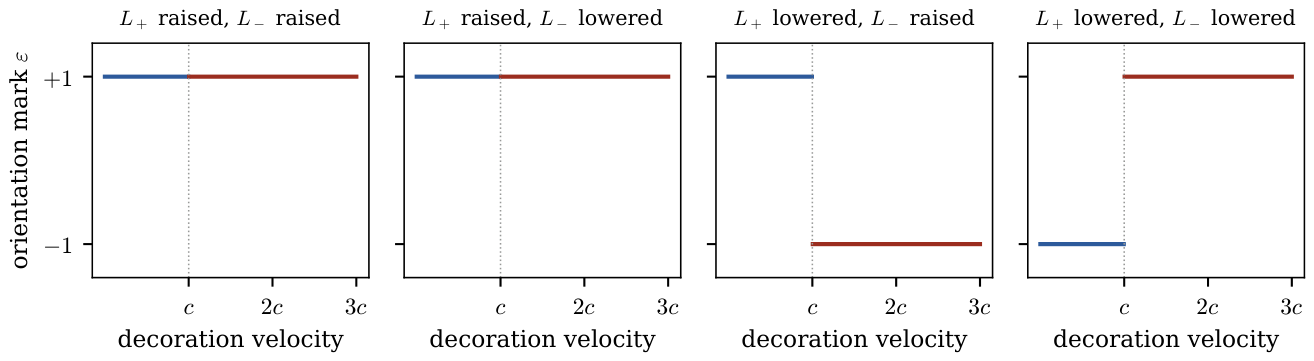
The derivation of (4) from (2) has the inference shape: presented, the base balance; presented, the root distributes across the decorated product, with the licence left unstated; formed, the decorated relation. The unstated licence is the assertion that the mark is raised, and the whole of what the relation says about the velocity resides in it: throughout the cone’s own domain the licence holds on both regimes, and in the cells of the general scheme with lowered it holds on one regime and is refused on the other; the author’s papers on the branch factor of the radical state the same fact in the classical register and in the presence register [6,7]. This is the second latency of the sign in the construction: the act was admitted under the reading of as the identity that leaves everything as it was, and what the act did to the roots is recorded in a premise the derivation left off the page.
The Mirror Calculus carries the mark in its notation for roots. There a square root is drawn as the half-power glued above its radicand; “the” root is held as an achiral pair; a root with an exhibited orientation carries an up or down orientation mark; solving an equation is a licensed descent into one orientation; and the coefficients, the symmetric functions of Vieta, are the achiral projection [2]. In those terms each radical of the decorated relation carries an orientation mark, is the composition of the two marks, and the squaring that removes is the achiral projection. The content of the decoration is written in the calculus as an orientation, and the premise the classical derivation left off the page is the orientation it chose.
Theorem 6
(Regime selection on the locus). Let a configuration lie on the coherence locus with presenting a magnitude, and let v be off the border. The decorated relation (4) holds at v exactly when the orientation mark on the regime of v agrees with the sign of . Consequently, by Table 1: where is raised, the relation holds on both regimes exactly when is raised; where and are both lowered, it holds below light exactly when is lowered and above light exactly when is raised; where is lowered and raised, it holds below light exactly when is raised and above light exactly when is lowered. In the folded cone, whose domain is the wedge with and both raised, the mark is raised on both regimes, the decorated relation coincides with the base balance root for root at every act off the border, and it holds on the locus on both regimes exactly when is raised; the relation carries a change across the border exactly in the configurations with lowered, which the general scheme contains and which the composition of two acts above light reaches from the cone’s wedge (Theorem 8(v)).
Proof.
On the locus by Lemma 2(i), so , the raised root of a raised number. By Theorem 5, the right side of (4) is , and the relation reads , which holds exactly when . Reading the cells of Table 1 gives the consequences. In the cone, with r raised and below is raised, and is raised, so the first row applies, on both regimes, at every v off the border, and (4) reads as (2); the relation holds exactly when is raised, that is when is raised. The change of the mark across the border occurs in the rows with lowered. □
7. The Disjunction, the Semigroup of Acts, the Exits
7.1. The Disjunction, Placed
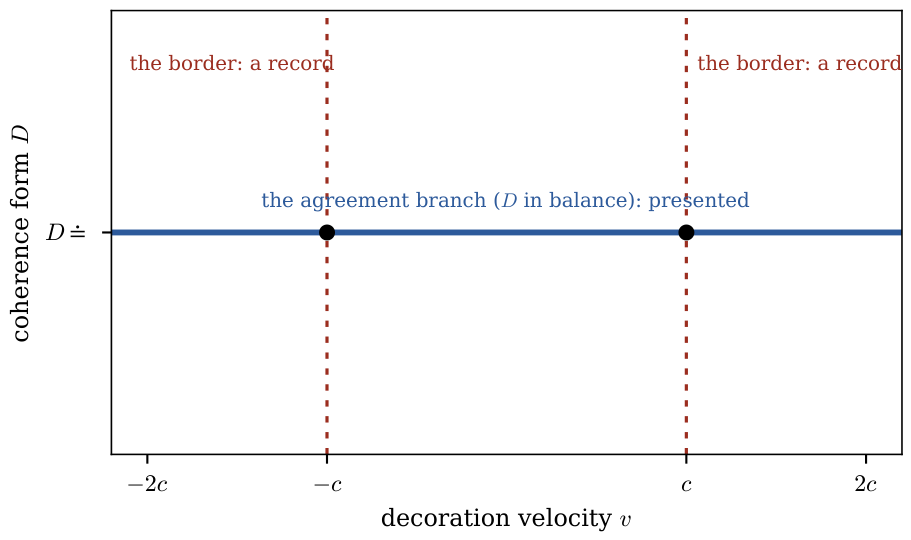
The cleared balance is read classically through the absorption law run backwards: in an integral domain a product is the sign exactly when one factor is, so the cleared balance holds exactly when D is in balance or the velocity is at the border, and the solution set is the union of two branches, the coherence branch on which the velocity is free and the light branch on which the coherence form is free, crossing at the two light points. The law that manufactures the disjunction is the absorber: one horn is the agreement , and the other is the place where the clearing factor is the sign and absorbs every D.
Theorem 7
(The cleared balance, with its sponsors).
- (i)
- Sponsor: the decoration presents a magnitude(v off the border). The cleared balance (5) holds exactly where the base balance holds: the two are equivalent by cancellation of the presented magnitude .
- (ii)
- At the border the clearing factor is in balance, the cleared product is the sign absorbing every D, and the cleared balance holds there at every configuration by the absorption law, with the decorated relation it was cleared from withheld: the border enters the solution set through the absorber, and it is held as a record.
- (iii)
- Consequently the solution of the cleared balance in the presence grammar is one presented branch, the agreement with the velocity the free parameter of the act, together with one record:the decoration’s obligation comes due at the border.
Proof. (i) Write . The cleared balance is the agreement of with . Multiplication by a presented magnitude is injective on presented magnitudes, so the two products agree exactly when agrees with , which is . (ii) At the border is in balance, and the product of the sign with D is the sign for every D by the absorption law, so each side of is the sign and the cleared balance holds; the decorated relation is withheld there by Theorem 3(v), so the border holds the cleared balance with its sponsoring relation withheld, which is the status of a record. (iii) follows from (i) and (ii): the presented content of (5) is the agreement, and the border is recorded. □
Figure 4.
The cleared balance in the plane of the decoration velocity and the coherence form: the agreement branch is presented (solid), and the two borders are records (broken). The classical disjunction draws both as solid.
Figure 4.
The cleared balance in the plane of the decoration velocity and the coherence form: the agreement branch is presented (solid), and the two borders are records (broken). The classical disjunction draws both as solid.
Remark 3
(Where a disjunction is appropriate). A disjunction is a presence-only form when each horn carries a witness, as the exhaustion “every tally is the unit or a successor” of tally arithmetic does [4]. The classical disjunction has one horn with a witness, a configuration on the coherence locus, and one horn manufactured by the absorber, the border, at which the decorated relation itself is withheld. The disjunction is therefore appropriate in the classical register as the exhaustive solution set of the cleared equation, and in the presence register it is one presented horn and one record. The “light branch” and the “light points” of the series’ later books are the classical register’s drawing of the record as an object.Against Zeroholds that refinement, convergence, cancellation and coincidence have positive relational structure, that a classical interface may summarize them by a value, and that the summary keeps their formation history (its thesis that a coincidence is a process before it is a value) [1]. The record of Theorem 7(iii) is that structure kept: the clearing factor’s coincidence with the balance at the border is an event of the decoration, and the light branch is the classical summary of the event as a value. Theorem 8 says what the event is: the border is the finite name the velocity coordinate gives the open end of the family of acts, at which the clearing factor, which presents a magnitude at every member, is read as reaching the balance.
7.2. The Semigroup of Acts and the Two Completions of the Coordinate
Theorem 8
(The family of acts, its composition, and the two completions).
- (i)
- Composition.The act with ratio performed after the act with ratio is the act with ratio ; in rapidity, . The acts below light, whose ratios lie in the open unit interval, compose to acts below light; the ratio of a composition lies below the ratio of each of its members, so that every member is refused the office of a neutral element; and composition cancels, two compositions with one member agreeing exactly when the other members agree. The family below light is therefore an ordered cancellative semigroup, with the structure of the positive tallies under fusion in Proposition 2(i) and the rapidity in the place of the tally.
- (ii)
- The first completion.The unit ratio is the free adjunction of a neutral element to that semigroup, the completion of Proposition 2(i) performed on acts; the velocity coordinate names it the origin. At the unit ratio the decorated relation is the base balance as written and the ratio read back from the carried factor is the unit. The station the books call rest is the cone, the object the acts act on, read through the coordinate as the adjoined element and as a state.
- (iii)
- The second completion.The clearing factor presents a magnitude at every member of the family. The coordinate sends the ratios of the open unit interval onto the open interval between the origin and c, decreasing, and gives the open end of the family, at which the ratio decreases toward the balance, the finite name , the border. The light branch of the books is that name read as a member of the family and as a branch of states.
- (iv)
- The invariant.At every member the product of the carried pair is , which on the locus is , the square of the height; the decorated relation states, at every member, that the height is the invariant of the boost, and in the cone’s wedge it is the base balance root for root, free of the record.
- (v)
- Above light.The ratios above light are with y raised, the boosts by the complex rapidities ; the regime above light is entered through the open end, the real part of the rapidity passing beyond every bound and returning on the line shifted by . Two acts above light compose to the act with the lowered real ratio , whose carried pair lies in the wedge with both light-cone coordinates lowered, the image under of a boost below light; there the orientation mark is lowered, by the row of Table 1 with both factors lowered.
Proof. (i) Carrying by and then by carries it by , and carrying by and then by carries it by ; so the composition is the act with ratio , and . If and lie in the open unit interval so does their product; because with raised, and likewise . A neutral element e would have for every member ; since for every member e, every member is refused the office. For cancellation, with raised gives on multiplying by . The map carries the open unit interval onto the raised reals and carries products to sums, so the family is the semigroup of raised reals under addition, which contains the positive tallies as the integer rapidities; and the argument of Proposition 2(i), that every fusion exceeds each of its summands, is the inequality read in rapidity.
(ii) The free adjunction of a neutral element to a semigroup extends the operation by and keeps every product as it was. The unit ratio has for every and composes with itself to itself, so the family with the unit ratio adjoined is that completion, and the unit lies outside the semigroup of (i), every member of which is refused the office the unit performs. The coordinate value at is , the origin, by Proposition 4. At the carried pair is , so (4) is (2) as written by Theorem 2(iii), and the ratio read back is . The cone is the configuration on which every act acts; reading it as the member with the unit ratio is reading the object as the adjoined element, and reading that member as a state of the cone is the origin zeroation of Definition 5.
(iii) , and is raised for every ratio in the open unit interval, so the clearing factor presents a magnitude at every member. The function decreases as increases on the open unit interval, takes its values in the open interval between the origin and c, and takes every value there, since returns a ratio in the open unit interval for every such v. As the ratio decreases toward the balance the coordinate increases toward c, and the value c is taken by the coordinate at the balance of , which is refused as a ratio because the act’s factor is withheld there by Theorem 3(v). So is a value of the coordinate assigned past every member of the family, a finite name for its open end; and the light branch is the set of configurations paired with that name, by Theorem 3(iii).
(iv) At every member the product of the carried pair is by Proposition 5(i), and on the locus by Proposition 5(iii). The decorated relation (4) equates with the product of the principal roots of the carried pair, whose square is by Theorem 2(ii); in the cone’s wedge the two roots recombine with the mark raised on both regimes, by Theorem 6, so that the relation reads at every member, which is (2).
(v) Above light with raised, by Proposition 4, and the principal logarithm gives , so ; y increases from the balance beyond every bound as increases from c, so decreases from beyond every bound to below every bound. Two such ratios multiply to , a lowered real number. The carried pair is , both lowered for raised; writing , it is the pair of a boost below light, each coordinate carried by , which sends to . For the mark, for and raised, while , so , which is the entry of Table 1 for both factors lowered with a real ratio. □
Position [The two addresses of the sign are the coordinate’s two completions] The origin and the border are the two ends the velocity coordinate gives the family of acts: a neutral element adjoined, which is the identity completion, and an open end named by a finite value, which the clearing then treats as a balance point of its factor, the absorber. Both are performed by the coordinate. The sign enters the construction with the coordinate, at those two ends, and the semigroup of acts with its invariant is what the presence grammar keeps when the coordinate is withdrawn: every act presents a ratio, every two acts compose, and every act keeps the height. Rest and the light branch are the two completions read as states of the cone. The solved form reads the velocity from the second completion; every member of the family substituted into it off the locus is refused alike, so the solved form says of the origin exactly what it says of every act. The chain from the cone, followed through every link, carries and leaves the ratio free; the solver’s reading drops the cone and reads the cleared balance as a bare relation, and the second completion then appears as a branch.
In plain terms: the decorations are the settings of a dial, and any two settings combine into a third, the way two counts add. The dial as the books drew it has two ends. One end is marked “one,” and it is the undecorated cone put on the dial as if it were a setting: that is rest. The other end is marked “c,” and it is the name given to the place past every setting, where the dial’s own factor would divide by the balance: that is the light branch. The sign sits at both ends, and the velocity coordinate is what put it there. Between the ends, every setting is a boost that keeps the height, and the speed is the record of the setting.
7.3. The Exits
Theorem 9
(Every classical exit is a surrogate). Let the formula be read on the coherence locus. The classical register has three readings of the withheld quotient, the three devices of Remark 1, and each is a surrogate by Definition 3:
- (i)
- the returned non-value: v is the non-value word of partial-function semantics, or the adjoined non-value of a wheel; a non-value introduced where a quotient was withheld, occupying the term position of the velocity, entering the operations the books perform on the velocity, and supplying the content “the velocity is withheld here”;
- (ii)
- the universal over the open slot: “every velocity solves the relation”; a universal issued over the domain the quotient left open, since the product of the sign with agrees with the product of the sign with for every v;
- (iii)
- the sign absorbing the quotient: the quotient of the sign by itself read as the sign, the rule of the meadows, so that the velocity is returned as the origin; the sign in a term position, entering the quotient and supplying the content “rest,” the adjoined neutral element read as a state (Theorem 8).
A fourth reading, the sponsor named (D presents a magnitude) and the quotient held as withheld where D is in balance, forms in the presence grammar; in the classical register the sponsor’s one slot on the page is the guard on D, a negated sign, which is the sign under another spelling.
Proof.
Each of (a) to (c) is checked against the four questions of the test. (a) The non-value word and the adjoined non-value are introduced at the withheld quotient; each occupies the slot of v in the formula; each enters the operations the books perform on the velocity, which solve for other variables through it and continue it past the border; and each supplies the content that the locus carries the velocity, as a value of a special kind. (b) “every velocity” is a universal whose domain is the slot the quotient left open; it is introduced for that withheld presentation, occupies the position of a solution set, enters the derivations as the free velocity on the locus, and supplies the content “freedom.” (c) The quotient read as the sign is the sign placed in the quotient’s position, entering the equation and supplying the velocity’s value, the origin. The fourth reading forms in the presence grammar by Convention Section 2.2: the sponsor is a presented magnitude and the withheld quotient is a status-(iii) judgment. In the classical register the sponsor’s one slot on the page is the guard on D, and the Rosetta rule classifies a negation in the author’s voice with the sign [5]. □
The theorem claims the classification and claims it by role: the wheels and the meadows are consistent structures with their own theorems, and the test places them, together with the partial semantics and the vacuous universal, among the devices that let the notation speak where a presentation was withheld. The classification leaves standing what those structures prove about themselves. For reading (b), Against Zero states the principle it violates, the principle of the inhabited universal: a universal native judgment forms from an inhabited roster with a coverage proof, or enters as an imported classical universal under a named interface, and the sponsor of an affirmative inscription is a presentation [1]. In the presence grammar the universal “every velocity solves the relation” is a transformation rule awaiting a positive activation, and on the locus the activation is withheld with the quotient.
Remark 4
(The sponsor printed inside the formula). The expression keeps D under both roots so that the one expression records the whole classical solution, off the locus and the sign over the sign on it. The device is an attempt to print the sponsor inside the formula; what it prints on the locus is the sign over the sign, and the three readings of Theorem 9 are what the classical register makes of it. The seventh book records three solutions of the velocity: the value returned by the solver with c entered numerically, the algebraic push-out by which one goes to an existential v, and the judgment that v is the non-value on the facts of the base equation, which the book says the solver “continues to miss” [11]. The three are the three statuses of Convention Section 2.2: a presented value, a clash of two presentations, and a withheld inscription.
8. The Content of the Decoration and its Address
Theorem 10
(The address of the content). The whole of what the decorated relation says about the velocity is the orientation mark of Theorem 5. It is presented on each regime and constant there. In the two wedges of the plane with raised, among them the cone’s wedge , which every boost below light carries into itself, it is raised on both regimes, and the decorated relation coincides with the base balance root for root at every act off the border. In the two wedges with lowered, the wedge , which the composition of two acts above light reaches from the cone’s wedge, and the wedge , which the configurations of the third and seventh books realize, it changes at the border , and at the border the inserted factor is withheld. The solved formula, read off the locus, reports the border. In those wedges the border is therefore, at once, the branch point of κ, the place of the change of the mark, the place where the inserted quotient is withheld, and the solver’s output.
Proof.
By Theorem 2(ii) the squared decorated relation is free of the velocity, so whatever the decorated relation says about the velocity it says through the distribution of the root, which by Theorem 5 is the mark . By that theorem the mark depends on v through , its one channel, which is in balance below the border and above it, so the mark is constant on each regime; by Table 1 it is raised on both regimes in the two cells with raised, so that there at every v off the border and (4) reads as (2); and it changes across the border in the two cells with lowered. The cells are the wedges: and both raised is , both lowered is , lowered with raised is , and raised with lowered is . The cone’s domain is the first, by Theorem 6; boosts below light carry it into itself by Proposition 5(v); the composition of two acts above light carries the cone’s pair into the second by Theorem 8(v); and the third is realized by the configurations , of the third and seventh books with below . At the border is in balance and divides a presented magnitude by the balance, which is withheld, by Theorem 3(v). The solved formula presents wherever D presents a magnitude, by Theorem 3(iv). The branch point of the principal root is where its radicand is in balance, which is the border by Proposition 4. □
Position [The content and the breakdown have one address] In the wedges that carry a change of the mark, the relation says one thing about velocity, the change, and it says it at the one address where its own quotient is withheld. The classical register keeps its consistency by ruling the cancellation of D invalid on the locus and reading the solved velocity as the border read back as a value, with the change held back; the change then survives in the register as a discontinuity of a sign at a point the register declines to evaluate. Keeping the content keeps the sign’s eruption; the two are one. In the cone’s wedge the mark is raised on both regimes, the relation says of the velocity exactly what the base balance says, and what the decoration adds there is the record of the act, a boost that keeps the height. The author’s classical paper on the branch factor describes the same formula as well posed exactly off the locus and indeterminate exactly on the locus it was built to describe [6]; the present theorem locates the reason, which is that the content and the breakdown share the address.
Position [The velocity, in the presence grammar] The phenomenological velocity is the record of the decoration act, a presented magnitude read back from the carried factors, and what the decorated relation presents of it is the orientation mark on two regimes, below light and above it, with the border between them held as a record. The solved form is the border read as a magnitude; the sign over the sign is the withheld quotient on the agreement locus; and the freedom of the velocity on the locus is the freedom of the act’s parameter, which the relation leaves free. The presence-only paper on the orientation mark states the regime selection in these terms [7]; this paper adds that the two classical readings of the solved form, the border as a value and the withheld quotient as the origin, are the two completions the velocity coordinate performs on the family of acts, the sign’s two addresses, and that what the relation presents lies between them on the regimes, with the sign at each end held as a record.
In plain terms: what the decorated relation knows about velocity is whether one orientation turns over when the border is crossed. In the cone itself it stays put, and in the wider scheme it turns over exactly where the formula divides by the balance. Where the relation says something, it says it at the one place where its own quotient is withheld; a classical reader keeps the books consistent by staying silent there, and the silence costs the content. The velocity itself is the record of what was done to the two factors, and that record is read from the factors, which the product forgets.
9. Replication in the Machinery
Proposition [The computer-algebra transcript] A symbolic engine, run on the inputs of Appendix B:
- (i)
- rewrites to 1 for an unconstrained symbol X, on input and ahead of any simplification command;
- (ii)
- given a raised c and an unconstrained D, returns c for , and, the expression having been rewritten, returns c again when D is then set in balance; given the same quotient with the balance entered directly, returns its token for a withheld evaluation, a returned non-value, and a token that the test of Against Zero lists among the candidates for the sign’s office [1];
- (iii)
- given with unconstrained, returns ;
- (iv)
- asked to solve the cleared balance for v, returns and leaves the horn to the parameter; asked to solve the same equation for v and D together, returns the horn with v free and leaves the border off the list. Each call reports one horn of the disjunction.
The first book’s transcript records the same behaviour: solved symbolically, the decorated height relation has its coefficient cancelled against its inverse before the solver runs, and the velocity is reported as cancelling out; solved with c entered numerically, the quotient of two floating-point polynomials is kept and printed as (6) [8].
Proof.
The four behaviours are the transcript of Appendix B, produced by the companion program on the engine named there. Each is an instance of a rule of Definition 6 applied with its guard left off: (i) and (iii) are the cancellation rule on a symbol; (ii) is the cancellation rule applied to ahead of the substitution, so that the substitution finds the quotient already gone, while the direct entry of the balance meets Theorem 1(iii) and returns the engine’s token for a withheld evaluation; (iv) is the absorption law read backwards, the solver reporting one horn per call: solved for v with D a parameter, the border, D being treated as presenting a magnitude; solved for v and D together, the agreement, with v free. The first book’s two solutions are (iii) and the floating-point refusal of (ii), respectively: with c numerical the engine’s rational recognition of as times D is defeated by rounding, and the quotient stays on the page. □
The proposition is the replication law in the hardware of the notation. The known catalogue of simplifications that symbolic engines perform with the guard left off, among them, was drawn up by Stoutemyer [18]; the cancellation of the original derivation is performed, in every engine tried, by the simplifier on its own, and the reading of Position Section 6.2, the border returned as the value of the velocity with the agreement horn left to the parameter, is reproduced wherever the formula is entered.
Proposition [The floating-point standard] The arithmetic of the hardware, the standard that every processor and every numerical library implements [20,21], carries the four rules of the sign as operations, each checked by the companion program:
- (i)
- the standard’s sign carries an orientation bit, so that the reciprocal of the sign is an infinite token with the orientation of the sign divided by: the direction of the process by which a magnitude came to the balance is stored in the sign itself;
- (ii)
- the quotient of the sign by itself returns the standard’s token for an invalid operation, its non-value, and raises the standard’s invalid-operation flag, which is the guard as hardware;
- (iii)
- the non-value propagates through every arithmetic operation of the standard, a sum, product or quotient with one non-value operand being the non-value: the transmission law of Theorem 1(i), with the non-value in the place of the sign;
- (iv)
- the standard’s equality pairs every presented value, and each infinite token, with itself, and leaves the non-value unpaired with itself: the non-value is the one kind of datum of the standard that stands apart from itself, in each of the encodings the standard gives it.
Consequently Frege’s concept, the concept of an object’s difference from itself, which every object stands outside and whose number is the sign (Section 1), has in the arithmetic of the hardware one kind of object, the returned non-value, in each of its encodings: the sign and its surrogate meet at the concept that defined the sign.
Proof.
The four behaviours are the standard’s clauses on the sign bit, on invalid operations, on operations with the non-value and on comparison [20], and the companion program checks each on the double-precision arithmetic of the machine: the reciprocal of the sign with either orientation, the orientation bit read back, the quotient of the sign by itself under the flag raised and under the flag ignored, five operations with a non-value operand, the self-comparison of the non-value, and the self-comparison of five presented values and of the two infinite tokens. For the consequence: the concept of an object’s difference from itself holds of an object exactly when the object is left unpaired with itself under equality, and by (iv) the data of the standard that are left unpaired with themselves are the encodings of the non-value, one kind of object. □
10. The Sign as a Propagating Contradiction
10.1. The Reading, Term by Term
Table 2 sets the stages of a propagation beside the rules of the sign and their instances in the construction. The vocabulary of the first column, admission, latency, transmission, replication, eruption, is used in the exact sense of Theorem 1, and the correspondence is exact at the level of closure: the sign enters by a licensed act, hides under one rule, spreads under another, replicates in the machinery, erupts at a third, and is answered by defences spelled with itself.
10.2. What the Reading Claims
Position [The sign propagates] The sign for non-presentation is a propagating contradiction in the following exact sense.
- (i)
- Closure. The class of terms that have passed through the sign is closed under the operations of the classical regime (Theorem 1(vi)). Once admitted, the sign stays in the derivation; the identity law removes it from the value and keeps it in the derivation.
- (ii)
- Defences spelled with the sign. Every device the classical regime uses to contain the sign is the sign under another spelling: the guard is a negated sign, the returned non-value is the sign in a term position, the vacuous universal is the sign as a domain (Theorem 9).
- (iii)
- Replication in the machinery. The engines of the notation apply the cancellation rule with the guard left off, so the reading of Position Section 6.2, the border returned as the value of the velocity, is reproduced wherever the formula is entered (Proposition Section 9).
- (iv)
- Descent. A text that cites a derivation as its sponsor inherits the sign the derivation admitted; the series carried the cleared balance and its solved form from its first book to its seventh by citation.
- (v)
- Respelling. Renaming the sign keeps the role; a text that keeps the absorber, the quotient of two balances or the clearing by a balancing factor carries the sign under the new spelling, and the test, applied to the operations rather than the words, finds it.
- (vi)
- Containment. The presence grammar contains the sign by holding the withheld inscription in the metalanguage, naming sponsors, and keeping products unmultiplied where a factor may balance (Section 11).
The reading claims the closure, the defences, the replication, the descent and the respelling as theorems or as cited records; it claims the correspondence of Table 2 as exact at the level of those properties and as a figure of speech beyond it; and it claims the containment as the programme’s construction.
11. What Stands When the Sign is Withdrawn
11.1. Survivors, with Their Presence Forms
- label=(0)
- The base balance., with its sign constraint, stands as the relation of the cone (Lemma 2); its square is the balance of the coherence form, and the locus of that balance is the set of configurations that form a cone.
- lbbel=(0)
- The agreement branch and its record. The decorated relation, for every decoration presenting a magnitude, is the base balance; the border is the record that the decoration’s obligation comes due there (Theorem 7). The velocity is free on the agreement branch because it is the parameter of the act, which the relation leaves free: a statement about the act rather than about the cone.
- lcbel=(0)
- The orientation mark. The whole of what the relation says about the velocity, presented on each regime, with the selection rule of Theorem 6: the decorated relation holds on the locus exactly when the mark on the regime agrees with the sign of . Throughout the cone’s wedge the mark is raised on both regimes, and it changes across the border in the wedges with lowered, which sponsor Theorem 10.
- ldbel=(0)
- The velocity as the record of an act. The two factors and are two presented magnitudes, and the decoration carries them by and , one each, keeping the product; the velocity is the record of that act, and it is read from the carried factors rather than from the product, which the act keeps: is the quotient of the carried factor by , and the velocity is read from . The acts compose into the semigroup of Theorem 8, ratios multiplying and rapidities adding, with the structure of the positive tallies under fusion. The seventh book’s “push-out from one to an existential v” is this act with its record named [11], and the thesis of Against Zero that a cancellation leaves the event it compensates standing is its sponsor [1].
- lebel=(0)
- The boost and its invariant. The decoration is a Lorentz boost of the pair written in light-cone form, and the square of the height is its invariant (Proposition 5); the decorated relation is the invariant statement, and the velocity cancels out of it because the height is kept.
- lfbel=(0)
- The unity of two readings. The first book’s unity stands as a quotient of two presented readings of the height ratio, formed wherever both present and equal to the unit exactly on the fold (Proposition 3(iii)).
11.2. What Falls
- (i)
- The free velocity on the locus read as a property of the cone: the withheld quotient read as a universal.
- (ii)
- The light branch as a branch of states: the absorber’s horn read as an object.
- (iii)
- The station called rest as a state, the velocity set equal to the sign: the neutral element the coordinate adjoins to the family of acts, read as a member and as a state, which is the origin zeroation. What stands is the cone, the object the acts act on, and the family of acts with its invariant (Theorem 8).
- (iv)
- The border as the value of the velocity: the solved form’s is the finite name the coordinate gives the open end of the family, adjoined by the clearing and returned by the cancellation (Theorems 4 and 8). The velocity as a magnitude stands as the record of the act, item (4) above.
- (v)
- The word “free” for a withheld quotient, the non-value word for a withheld inscription promoted to a value, and the word “balance” wherever it enters an absorber.
12. Consequences
The theorems of this paper are proved for one sign, one calculus and one construction. What follows from them reaches every derivation that uses the sign’s rules, every engine that implements them, and every reading of a formula at a point where a factor of its derivation balances. This section states the consequences in order, each bounded to the class the theorems characterize.
12.1. Every Cleared Derivation, and the Extraneous Root
Position [The reading rule] Theorem 4 uses three steps, and each belongs to the stock of every derivation: a relation is multiplied through by a factor that is in balance somewhere; a factor is cancelled where it presents a magnitude; and the solved form is read at the points the clearing adjoined. Every solved formula is therefore to be read against three sets computed from its derivation: the formation domain of the relation it was solved from, the set on which that relation holds, and the set on which the solved form presents a value. Where the third set lies outside the first, the value read is read from a record, and its sponsor stands off the page.
Example 1
(The extraneous root). The schoolbook relation , cleared by , gives . At the relation is withheld, since its denominators are in balance; on its formation domain, x apart from 2, the cleared relation reads , which is refused at every point of that domain. The solved form presents its one value at the one point where the relation is withheld, and the relation is refused on the whole of its formation domain: this is Theorem 4(iii) in its smallest instance, and the schoolbook names it the extraneous root. The decorated cone has the same structure with the border in place of the point : off the locus the relation is refused and the solved form presents the border, which lies outside the formation domain; on the locus the relation holds and the solved form is withheld. The value of the series’ solved velocity is the adjoined branch read as a magnitude.
Proposition 6
(The sponsor audit). Let a derivation consist of a relation in one variable, the denominators the derivation divides by, a clearing factor, and a cancelled factor. The audit computes the balance set of each denominator, whose complement is the formation domain; the balance set of the clearing factor, which is the adjoined branch; and the balance set of the cancelled factor, where the cancellation is withheld; and it reports whether the adjoined branch lies inside the formation domain. Each balance set is the solution set of one polynomial equation in the variable, so the audit is a finite computation. Run by the companion program: for the decorated cone it reports the adjoined branch outside the formation domain, which is κ presenting a magnitude; for the extraneous root it reports the adjoined point outside the formation domain; and for the relation , cleared by 3, it reports a clearing factor that presents a magnitude everywhere, so that the solution is sponsored. The denominators are given to the audit as the derivation writes them, because the engine cancels them on input (Proposition Section 9(iii)): the audit reads the derivation, and the engine’s rewriting of the derivation is one of the things it audits.
Proof.
A balance set of a polynomial in one variable is computed exactly by the engine as the set of its roots, and the membership of each root of the clearing factor in the complement of the denominators’ balance set is decided by comparison; the three runs are printed in the ledger of the program, with the sets as stated. □
The operational form of the surrogate test, that a text which keeps the absorber read backwards, the quotient of two balances, or the clearing by a balancing factor carries the sign under whatever word it uses, is thereby made mechanical for the third operation; the first two are detectable in a derivation by the same means, a product set in balance and split into factors, and a quotient formed where both of its terms are in balance.
12.2. The Engines and the Hardware
Position [Where the replication is performed] By Proposition Section 9 the symbolic engines apply the cancellation rule with the guard left off, and by Proposition Section 9 the floating-point standard carries the identity law, the absorber, the eruption and the guard as hardware operations. Every numerical computation that reaches a balance point passes through these rules, and every symbolic derivation that passes through an engine inherits the engine’s cancellations at the balance sets of the factors it cancelled. The replication law is therefore performed at every operation of every computation. The consequence for the sciences that compute is this: their results at balance points, the light cone of this construction and every locus at which a coefficient of a derivation balances, are read at points the machinery completed by a rule of the standard, the returned non-value with its flag raised, which most programs leave unread; and the reading rule of Position Section 12.1 is the instrument that finds, derivation by derivation, which results are so read.
12.3. The Design Space of Division
Position [Completions] Proposition 2 and Theorem 9 together characterize the classical answers to a withheld quotient. Each is a completion of the partial evaluation: the adjoined non-value, the sign taken as its own inverse, the universal over the open slot, and the partial semantics that leaves the completion to the metatheory; each answers the surrogate test; and each leaves standing the structure it builds and that structure’s theorems. The question what the quotient of the sign by itself is to be has, inside the classical regime, the completions as its answers, and the presence grammar’s contribution is an act of a different kind: it keeps the question’s sponsor on the page, the denominator presenting a magnitude, and holds the quotient at the balance as a judgment of the metalanguage. A programme that wants a derivation’s content with its sponsor on the page has, by this paper, that arrangement and the completions to choose between, and the choice is a choice between named things. The velocity coordinate of the construction performs two completions of this kind on the semigroup of acts, a neutral element adjoined and an open end named, and the two addresses of the sign in the construction are those two (Theorem 8); a coordinate placed on a family of acts is therefore to be audited at its ends, where the reading rule of Position Section 12.1 finds the adjoined element and the named open end.
12.4. Content at a balance locus
Position [The class characterized] Theorem 10 places the whole of what the decorated relation says about the velocity at the balance locus of the clearing factor, in the cells of the general scheme that carry a change, and Position Section 8 states what the classical register does there: it keeps its consistency by declining to evaluate. The class this characterizes is the class of constructions whose content is a change across the balance locus of a factor the derivation cleared by. For every member of the class, classical notation delivers the content as a discontinuity at a point it leaves unevaluated, which is a record; the presence grammar delivers it as a presentation on the regimes with the border recorded. The light cone of this construction is one such locus in the wedges that carry the change, while in the cone’s wedge the locus carries the record of the act and the mark stays raised. A horizon at which a coefficient of a metric balances, a resonance at which a denominator balances, and a critical point at which a derivative balances are candidates for the class, and the reading rule decides, derivation by derivation, whether the derivation that reaches them cleared by the balancing factor and whether a change sits at its balance set.
12.5. The Programme
Position [The contradiction is a closure property] Against Zero stated the contradiction as a pairing of formation and office and granted the classical regime its consistency; Deprogramming Zero located the first operation at which the concealed obligation comes due; this paper proves that the contradiction is a closure property of derivations. The class of terms that have passed through the sign is closed under every operation, the one rule that removes the sign from a value keeps the passage, and every defence is spelled with the sign (Theorem 1); the construction shows the closure reaching the page as a value returned from the balance set of a cleared factor and read as a magnitude (Theorem 4), and the hardware shows it reaching the concept that defined the sign (Proposition Section 9). The thesis of the programme, that the sign embeds its contradiction in the classical notation it enters, is thereby a theorem about derivations. The Mirror Calculus holds that the classical form of the Riemann question converts a withheld presence-valued evaluation into equality with a numerical object [2]; the form of that conversion, an evaluation set equal to the sign, is the form the eruption clause of Theorem 1 describes at the evaluation of a function. The claim is bounded to this: the form of that conversion is an instance of the law proved here, and the volume’s resolution at its registers stands as the volume states it.
12.6. The Series
Position [What moves] The books of the series placed physics at the two ends of the velocity coordinate: the light branch as a branch of states, rest as a state, the solved velocity as a derived magnitude. By Theorems 7, 8 and 4 each of these is a reading of one of the coordinate’s two completions as a member of the family and as a state, and by Theorems 5, 6 and 10 the content the books found there, the change of the mark, is presented on the regimes in the wedges that carry it, while in the cone’s wedge the decoration adds to the base balance the record of the act, a boost that keeps the height. The consequence for the series is a rebuilding: the agreement branch presented, the border recorded, the mark on its regimes, the acts composed into their semigroup with the height as invariant, and the velocity read as the record of the decoration act. The findings made at the border and at the origin are kept, as information recovered at the place where the sign’s arithmetic had removed it, and moved to the regimes, where they are presented.
12.7. Consistency by Holding Back
The classical regime keeps its books consistent by ruling the cancellation of D invalid on the locus and declining to evaluate at the border. In the wedges that carry a change of the mark, the content is at the border. The regime’s consistency is therefore kept by holding back the content, and a reader who keeps the content keeps the contradiction. The presence grammar keeps the content on the two regimes and records the border, which is the one arrangement found here in which the construction says what it says with its sponsor on the page. Renaming is a respelling; the containment is structural: the withheld inscription held in the metalanguage, the sponsor named in the statement, the pair kept unmultiplied, and the absorber, the quotient of two balances and the clearing by a balancing factor left outside the object language.
Appendix A. Rosetta of the Construction’s Statements
Each row describes a classical statement of the construction, as the series’ books make it, and gives its form in presence.
| as it stood | in presence |
| on the coherence locus every velocity solves the relation | on the agreement locus the relation holds at every act of the family, whose parameter it leaves free; the quotient of the solved form is withheld there |
| off the locus the solution is | for every decoration presenting a magnitude the cleared balance is the base balance; the border is the record at which the decoration’s obligation comes due |
| the velocity is the sign over the sign on the locus | the quotient is withheld on the agreement locus, a metalanguage judgment |
| the velocity is the non-value on the locus | the quotient is withheld on the agreement locus; the word promotes the judgment to a value |
| the velocity cancels out | the insertion is idle at the level of the product; the record of the insertion lives in the arrangement of the roots |
| a product of two real numbers is the sign exactly when one of its factors is | a product of presented magnitudes presents a magnitude; the balance of a product with a presented factor is the balance of the other factor |
| the light branch, the light points, a passage held at light | the border is the finite name the coordinate gives the open end of the family of acts, a record; the mark is presented on the two regimes it separates |
| as it stood | in presence |
| at rest, the velocity equal to the sign | the cone, the object the acts act on, read as the neutral element the coordinate adjoins to the family; the construction forms every state it has from a presented act |
| the velocity is , a derived magnitude | the finite name the coordinate gives the open end of the family, adjoined by the clearing and returned by the cancellation; the velocity is the record of the act, read back from the carried factors |
| at rest the formula gives the sign against c | a completion of the coordinate read as a member of the family the formula was solved on; the formula refuses every member alike off the locus |
| the relativistic transformation applied inside the height function | a Lorentz boost of the light-cone pair with the square of the height as its invariant; two acts compose as two tallies fuse |
| above c the lengths are imaginary | above light the carried factors and lie on the imaginary axis and their product is the real ; the mark on that regime is read from Table 1 |
| what squaring erases | the orientation mark, presented on each regime |
| the coefficients ought to cancel out with each other | the decoration carries the two factors by and and keeps the product; the velocity is the record of the act |
| the sign is formed and stands for a withheld presentation | the sign’s formation certifies presentation and its office cancels it |
| the guard on D | D presents a magnitude |
| the non-value word | withheld; a metalanguage judgment |
Appendix B. The Companion Program
The companion program,
Propagating-Contradiction-of-the-Sign-Emmerson-2026-v8-Program.py
(Python 3 with SymPy 1.14 [19], NumPy and Matplotlib), checks every statement of the paper that admits a numerical or symbolic check, prints the transcript of Proposition Section 9, and draws the four figures. Its sections correspond to the paper’s: the product and quotient rules for principal roots (Lemma 1); the replication law in a term calculus at three magnitudes, with the indeterminate form, the rule on a symbol with the guard left off, and the closure of passage and of carriage (Theorem 1); the folded cone, the height through the removed arc, the reduced coordinates, the coherence form in the variables of the first book, the angle form of the fold, the sign constraint, the numerical coefficients of (6), the bridge, the idle push-out, the kept arc, and the clearing by (Section 5); the boost identities, the kept quadratic form, the invariant as the square of the height, the reparametrization to the boost velocity, and the cone’s wedge carried into itself (Proposition 5); the formation law, the agreement holding exactly at the balance, the solved form for D of either sign, the withheld quotient on the locus and the withheld factor at the border, the record of the act read back from the carried factor on both regimes, the table of the mark in eight cells, its constancy on each regime, its removal by squaring, its change across the border exactly where is lowered, the coincidence of the decorated relation with the base balance root for root on random configurations of the cone’s wedge on both regimes, and the regime selection on three hundred random locus configurations (Section 6); the cleared balance off and at the border, the unit ratio, the substitution of members of the family into the solved form, the composition of acts with ratios multiplying and rapidities adding, the refusal of every member as a neutral element, the clearing factor presenting a magnitude at every member, the coordinate’s map of the family onto the interval below c, the composition of two acts above light into the wedge with both coordinates lowered with the mark lowered, and the three exits (Section 7); the floating-point standard’s oriented sign, invalid-operation flag, propagation of the non-value and self-comparison (Proposition Section 9); and the sponsor audit on the decorated cone, the extraneous root and a sponsored relation (Proposition 6). All seventy-seven checks pass. The grammar check
Propagating-Contradiction-of-the-Sign-Emmerson-2026-v8-Grammar-Check.py
verifies the rule of mention on the paper’s source. The paper, the program and the figures were drafted with the assistance of the model cited as [26].
The transcript of Proposition Section 9, as the program prints it, runs as follows. Asked for a symbol divided by itself, the engine returns the unit on input. Asked for the solved form with c declared raised and D unconstrained, it returns c; asked to set D in balance in that expression, it returns c again, the quotient having been cancelled before the substitution; asked for the same quotient with D in balance from the start, it returns its token for a withheld evaluation. Asked for the decorated product with unconstrained, it returns . Asked to solve the cleared balance for v, it returns the border, ; asked to solve it for v and D together, it returns the horn with v free. The inputs and the engine’s outputs are kept, character for character, in the program file, which is the place for the classical notation’s own tokens.
References
- Emmerson, Parker. Against Zero. Formation Before Truth: A Transcendental Critique of Counting, Nullity, Empty Objects, and the Reification of Non-Presentation, with Transcendental Presence Notation and Its Foundational Consequences . In the Zenodo record of The Mirror Calculus; 2026. [Google Scholar] [CrossRef]
- Emmerson, Parker. The Mirror Calculus: A Presence-Only Mathematical Language. Formation, Descent, Geometry, and the Register-Typed Resolution of the Riemann Question . In Edition of record; 2026. [Google Scholar] [CrossRef]
- Emmerson, Parker. Counting Back from Infinity: The Descent Calculus and Transcendental Presence Notation; 2026. [Google Scholar]
- Emmerson, Parker. Deprogramming Zero: Peano’s Axioms Without the Sign for Non-Presentation, the One Kept Record, and the Resolution of the Riemann Question at Its Registers; 2026. [Google Scholar]
- Emmerson, Parker. Rosetta Stone of Zero-Surrogate Errata: The Mirror Calculus Programme, from the Sign to Presence; August 2026. [Google Scholar]
- Emmerson, Parker. The Branch Factor of the Phenomenological-Velocity Radical: A Light-Cone Selection Rule Recovered from the Unsquared Equation; 2026. [Google Scholar]
- Emmerson, Parker. The Orientation Mark of the Phenomenological-Velocity Radical: A Presence-Only Formation Account of Regime Selection at the Light-Cone Balance; 2026. [Google Scholar]
- Emmerson, Parker. The Cone of Perception: The Geometric Pattern of Perception Theorems — Visualization, Surfaces, and Geometry . In Mathematica notebook, 4th edition; 2021; pp. 2009–2012. [Google Scholar]
- Emmerson, Parker. Cone formation from circle folding. In Sweeping Nets, Saddle Maps and Complex Analysis; 2023–2024. [Google Scholar]
- Emmerson, Parker. The Math of Liberation; 2021–2022. [Google Scholar]
- Emmerson, Parker. The Book of Phenomenological Velocity: A Fundamental Theory of Gestalt Cosmology, Hidden Dimensions and Quantum Mechanics; November 2024. [Google Scholar]
- Frege, G. Die Grundlagen der Arithmetik: Eine logisch mathematische Untersuchung über den Begriff der Zahl.; Koebner: Breslau, 1884. [Google Scholar]
- Husserl, E. Philosophie der Arithmetik: Psychologische und logische Untersuchungen. Halle: Pfeffer, 1891. English translation by D. Willard, Philosophy of Arithmetic; Kluwer: Dordrecht, 2003. [Google Scholar]
- Rotman, B. Signifying Nothing: The Semiotics of Zero; Macmillan: London, 1987. [Google Scholar]
- Kleene, S. C. Introduction to Metamathematics; North-Holland: Amsterdam, 1952. [Google Scholar]
- Carlström, J. Wheels — on division by zero. Math. Struct. Comput. Sci. 2004, 14, 143–184. [Google Scholar] [CrossRef]
- Bergstra, J. A.; Tucker, J. V. The rational numbers as an abstract data type. J. ACM 2007, 54, 7. [Google Scholar] [CrossRef]
- Stoutemyer, D. R. Crimes and misdemeanors in the computer algebra trade. Not. Am. Math. Soc. 1991, 38, 778–785. [Google Scholar]
- Meurer, A.; et al. SymPy: symbolic computing in Python. PeerJ Comput. Sci. 2017, 3, e103. [Google Scholar] [CrossRef]
- IEEE Computer Society. IEEE Std 754-2019; IEEE Standard for Floating-Point Arithmetic. New York, 2019.
- Goldberg, D. What every computer scientist should know about floating-point arithmetic. ACM Comput. Surv. 1991, 23, 5–48. [Google Scholar] [CrossRef]
- Ahlfors, L. V. Complex Analysis, 3rd ed.; McGraw-Hill: New York, 1979. [Google Scholar]
- Einstein, A. Zur Elektrodynamik bewegter Körper. Ann. Der Phys. 1905, 17, 891–921. [Google Scholar] [CrossRef]
- Bondi, H. Relativity and Common Sense: A New Approach to Einstein; Doubleday (Anchor Books): New York, 1964. [Google Scholar]
- Lyndon, R. C. Properties preserved under homomorphism. Pac. J. Math. 1959, 9, 143–154. [Google Scholar] [CrossRef]
- Anthropic. Claude. (Claude Fable 5.1), large language model. Used 10 October 2026 for the drafting of this paper, the companion program and the figures. 10 October 2026. Available online: https://claude.ai.
Figure 1.
The folded cone of Proposition 3. (a) The disc of radius r with the sector removed; the kept arc becomes the base circumference . (b) The axial section: slant r, base radius , height , and the angle between the slant and the base.
Figure 1.
The folded cone of Proposition 3. (a) The disc of radius r with the sector removed; the kept arc becomes the base circumference . (b) The axial section: slant r, base radius , height , and the angle between the slant and the base.
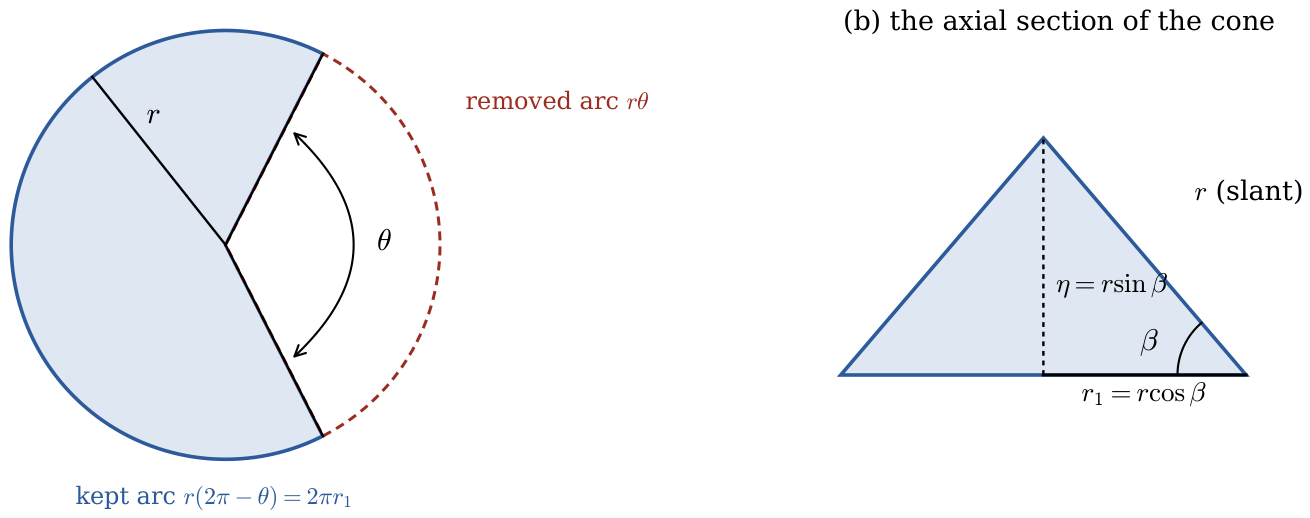
Figure 2.
The values of the Lorentz coefficient: the real segment below light, from the unit, the neutral element the velocity coordinate adjoins to the family of acts, to the balance, the name it gives the family’s open end, and then the imaginary ray above light. The two ends are the coordinate’s two completions, and the two addresses of the sign in the construction.
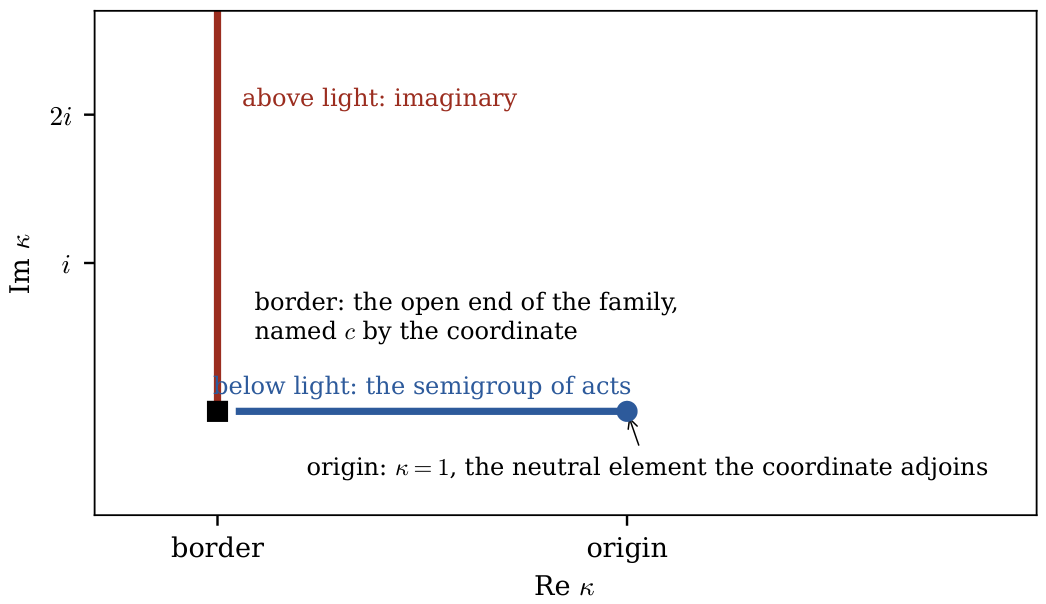

Table 1.
The orientation mark of the decorated relation, by sign cell and regime (raised: ; lowered: ).
Table 1.
The orientation mark of the decorated relation, by sign cell and regime (raised: ; lowered: ).
| sign cell | below light ( real) | above light ( imaginary) |
|---|---|---|
| raised, raised | raised | raised |
| raised, lowered | raised | raised |
| lowered, raised | raised | lowered |
| lowered, lowered | lowered | raised |
Table 2.
The stages of a propagating contradiction, the rules of the sign, and their instances in the construction.
Table 2.
The stages of a propagating contradiction, the rules of the sign, and their instances in the construction.
| stage | the rule of the sign | in the decorated cone |
|---|---|---|
| admission by a licensed act | the identity read as the act that leaves everything as it was: | the push-out read as the identity; the coordinate’s two completions, a neutral element adjoined at and the open end named c |
| latency | the identity law: the value is clean, the passage is in the metalanguage | the insertion idle at the level of the product; the licence to distribute the root left off the page |
| transmission | the absorption law: one carrier takes the product | the clearing by : at the border the whole relation is absorbed, and every D “solves” |
| replication | cancellation with the guard left off, in every engine | the engine’s ; the solver’s with the agreement horn left to the parameter |
| eruption | division: the non-value word, the sign over the sign | the solved velocity on the locus |
| concealment | squaring: removes the trace | the squared relation is free of the velocity; the branch content is lost |
| defence spelled with the sign | the guard; the returned non-value; the vacuous universal | the guard on D; “the velocity is free on the locus”; the velocity declared a non-value on the locus |
| descent | citation: each text takes the previous as its sponsor | the first book to the third to the seventh |
| respelling | the surrogates: the return token, the collection token, the non-value word, a “balance” used with the absorber | a recast that keeps the absorber keeps the sign under the new word |
| containment | presence grammar: the withheld inscription held in the metalanguage, the sponsor named, the pair kept unmultiplied | Theorems 7 and 9; the orientation mark on its regimes |
Disclaimer/Publisher’s Note: The statements, opinions and data contained in all publications are solely those of the individual author(s) and contributor(s) and not of MDPI and/or the editor(s). MDPI and/or the editor(s) disclaim responsibility for any injury to people or property resulting from any ideas, methods, instructions or products referred to in the content. |
© 2026 by the author. Licensee MDPI, Basel, Switzerland. This article is an open access article distributed under the terms and conditions of the Creative Commons Attribution (CC BY) license.
Copyright: This open access article is published under a Creative Commons CC BY 4.0 license, which permit the free download, distribution, and reuse, provided that the author and preprint are cited in any reuse.