

Submitted:
12 October 2026
Posted:
12 October 2026
You are already at the latest version
Abstract
Major depressive disorder is one of the most prevalent and disabling conditions worldwide, yet fewer than one-third of patients achieve remission with the first antidepressant prescribed. The clinical phenotypes codified across successive editions of the Diagnostic and Statistical Manual of Mental Disorders (DSM) — melancholic, atypical, anxious, and psychotic forms of depression — were proposed, in part, because they were thought to predict differential response to specific drug classes. This narrative review evaluates the evidence for phenotype-specific antidepressant efficacy across the full depressive spectrum, including treatment-resistant depression as a longitudinal phenotype and the transdiagnostic reformulations advanced by the Research Domain Criteria initiative. Historical controlled trials demonstrated genuine but circumscribed phenotype–drug interactions, most notably the preferential response of atypical depression to monoamine oxidase inhibitors relative to tricyclic antidepressants. However, contemporary large-scale effectiveness data from the Sequenced Treatment Alternatives to Relieve Depression (STAR*D) and the International Study to Predict Optimized Treatment in Depression (iSPOT-D) trials do not support subtype-based antidepressant selection. Much of the apparent predictive value of melancholic status is confounded by illness severity and placebo responsiveness, while data-driven re-analyses have failed to biologically validate the DSM-defined subtypes. Anxious depression and treatment-resistant depression robustly identify poorer outcomes but do not yet point clinicians toward specific drug classes. Weighing the totality of evidence, categorical depression phenotypes have limited utility in predicting antidepressant response; the most clinically reproducible signal is severity-dependent drug–placebo separation, and the most promising route to precision prescribing lies in transdiagnostic, multimodal biosignatures and machine-learning approaches.
Keywords:
depressive disorder
; major
; antidepressive agents
; treatment-resistant
; precision medicine
; research domain criteria
; treatment outcome
1. Introduction: The Heterogeneity Problem and the Case for Phenotype-Based Prescribing
Depression is a leading cause of disability worldwide, with World Health Organization estimates of more than 264 million affected people [1]. The clinical reality of MDD is one of profound heterogeneity: patients vary in symptom profiles, illness course, comorbidity, and — critically — in their response to pharmacological treatment. Even under optimized, measurement-based care in the largest effectiveness trial ever conducted, only about a third of patients achieve remission with an initial selective serotonin reuptake inhibitor, and remission rates decline sharply with each successive treatment step [2,3]. As a consequence, treatment selection remains an iterative process of trial and error, exposing patients to delayed remission and avoidable adverse effects [4].
The ambition to do better has a long history. Since the mid-twentieth century, clinicians and researchers have attempted to parse the syndromal label of depression into subtypes — melancholic, atypical, anxious, psychotic — with the hope that each would map onto a differential treatment strategy [5,6]. This logic is pharmacologically appealing: if distinct phenotypes index distinct neurobiological dysfunctions, then mechanism-specific treatments ought to show phenotype-specific efficacy. The most comprehensive evidence base for antidepressant efficacy — a network meta-analysis of 522 trials involving more than 116,000 patients and 21 antidepressants — confirms that all of these drugs outperform placebo but that differences between individual agents are modest [7,8]. Against that backdrop of broadly similar average drug performance, even a moderately predictive clinical phenotype would be enormously valuable.
The promise of precision medicine in depression therefore rests on identifying moderators — pretreatment characteristics that predict differential response to different treatments — rather than mere predictors of outcome independent of treatment [4,9]. Depression phenotypes are among the most intuitive candidate moderators. This review examines the evidence for each major phenotype in turn, tests that evidence against modern effectiveness studies, and situates the findings within the transdiagnostic reappraisal of psychiatric classification that has gathered force since the launch of RDoC.
2. Methods
This is a narrative, non-systematic review. Relevant literature was identified through structured searches of PubMed/MEDLINE (inception to August 2026) using combinations of the terms depression, major depressive disorder, antidepressant, phenotype, subtype, melancholic, atypical, anxious distress, psychotic depression, treatment-resistant depression, Research Domain Criteria, biotype, machine learning, and ketamine, supplemented by hand-searching the reference lists of key trials, systematic reviews, and meta-analyses identified through this process. Priority was given to randomized controlled trials, large prospective effectiveness studies — including the Sequenced Treatment Alternatives to Relieve Depression (STAR*D) trial, the International Study to Predict Optimized Treatment in Depression (iSPOT-D) trial, and the Establishing Moderators and Biosignatures of Antidepressant Response in Clinical Care (EMBARC) initiative — systematic reviews and meta-analyses, and position statements from major professional and regulatory bodies. Case reports, non-English-language sources, and conference abstracts without accessible full text were excluded. Because this is a narrative rather than a systematic review, study identification and selection were not exhaustive and were not governed by a pre-registered protocol or PRISMA methodology; the objective was to critically synthesize the most methodologically rigorous and clinically influential evidence bearing on phenotype-specific antidepressant response, organized around each major depression phenotype in turn, rather than to catalogue every publication on the topic.
3. Results
3.1. The Classical Phenotypes: Psychopathology, Pharmacological Claims, and Their Evidence Base
3.1.1. Melancholic Depression
Melancholic depression, also termed endogenous or endogenomorphic depression, is the most extensively studied subtype of major depression. It affects an estimated 25–30% of depressive populations and is clinically characterized by a distinct quality of mood, non-reactivity of mood to circumstances, anhedonia, psychomotor disturbance, cognitive impairment, and vegetative dysfunction including terminal insomnia, diurnal mood variation with worsening in the morning, and weight loss [6]. Biologically, hypercortisolemia, abnormalities of sleep architecture, and distinctive neuroimaging features have been associated with melancholia [6], and melancholic MDD was long thought to represent an endogenous syndrome with hypothalamic–pituitary–adrenal axis dysregulation at its core — though reliable diagnostic biomarkers have never emerged [10].
The therapeutic claim attached to melancholia has been equally specific: melancholic patients were held to respond preferentially to electroconvulsive therapy and to TCAs rather than to SSRIs [6]. Supporting data proved inconsistent. Head-to-head trials comparing TCAs and SSRIs in melancholic samples yielded conflicting results, and the eventual consensus was that the two classes demonstrate comparable efficacy in melancholic depression, with SSRIs preferred on safety and tolerability grounds because they lack the anticholinergic, antihistaminergic, and cardiotoxic effects of TCAs [11]. A quantitative review of outcome-to-antidepressants in melancholic unipolar depression likewise concluded that comparisons between melancholic and non-melancholic patients produced controversial results with only small effect-size differences [12].
Two observations explain much of the historical confusion. First, melancholic status is highly correlated with overall depression severity, and it is severity — not melancholia per se — that is associated with poorer outcomes and greater placebo non-responsiveness [13]. When melancholic and non-melancholic samples are compared, the drug response is usually of similar magnitude in both groups; the apparent advantage of antidepressants in melancholia frequently traces to a significantly lower placebo response among melancholic patients [11]. Second, in direct comparisons, antidepressant responses are similar in melancholic and non-melancholic patients after accounting for baseline severity; melancholic subjects responded approximately 25% less to placebo but were more severely depressed initially [14]. In both STAR*D and iSPOT-D, unadjusted analyses found lower remission rates in melancholic than non-melancholic participants, but these differences became non-significant after adjusting for baseline characteristics [15].
3.1.2. Atypical Depression
Atypical depression is defined by mood reactivity together with at least two of four associated features: hyperphagia, hypersomnia, severe fatigue or leaden paralysis, and a longstanding pattern of rejection sensitivity [5,16]. It is common in outpatient populations, although its status as a stable subtype — as opposed to one of several forms of depression an individual may express across a lifetime of recurrent episodes — has never been settled [17].
The atypical phenotype carries the strongest historical claim to phenotype-specific pharmacotherapy. The concept was first postulated on the basis of presumed preferential response to MAOI treatment, and subsequent studies repeatedly showed atypical depression to respond more robustly to phenelzine or tranylcypromine than to imipramine or amitriptyline [5]. In the landmark double-blind trial by Liebowitz and colleagues, 119 patients meeting specific criteria for atypical depression were randomized to phenelzine, imipramine, or placebo for six weeks: overall response rates were 71% with phenelzine, 50% with imipramine, and 28% with placebo, with phenelzine showing both superiority to placebo and to imipramine [18]. Quitkin and colleagues independently found phenelzine superior to imipramine and placebo in 60 patients with probable atypical depression, with comparable drug effects in patients with full versus partial atypical syndromes [19].
The clinical translation of this finding, however, has always been constrained. Modern prescribers rarely use MAOIs because of dietary restrictions and safety concerns, and the efficacy of newer agents — SSRIs, bupropion, venlafaxine, nefazodone, and mirtazapine — relative to MAOIs and TCAs in atypical depression remains poorly characterized [16,17]. Where newer drugs have been tested, the signal has been modest. In the STAR*D cohort, 541 of 2,876 evaluable participants (19%) had atypical features; these patients had significantly lower remission rates with citalopram, but the difference was no longer present after adjustment for baseline sociodemographic and clinical differences [20]. More fundamentally, the subtype itself has proven psychometrically unstable: reversed neurovegetative signs such as hypersomnia and hyperphagia are common in depressed patients generally, do not necessarily aggregate into a distinct subgroup, and fluctuate over time and across episodes, such that whether a patient meets criteria for atypical depression depends on when in the course of illness they are assessed [13].
3.1.3. Anxious Depression and the DSM-5 Anxious Distress Specifier
Anxious depression — operationalized as MDD with a Hamilton Depression Rating Scale anxiety/somatization factor score of 7 or higher — is a dimensional phenotype with strong and replicable outcome associations [21]. In STAR*D, anxious depression was associated with poorer acute outcomes than non-anxious depression following antidepressant treatment [22]; anxious patients showed lower remission and response rates, kept fewer appointments, spent less time in treatment, and reported a greater frequency, intensity, and burden of side effects [21].
Longitudinal data from the Netherlands Study of Depression and Anxiety extended these findings to the DSM-5 anxious distress specifier: patients with the specifier experienced significantly poorer outcomes with adequate antidepressant treatment, including higher depression severity at one- and two-year follow-up, lower remission rates at two-year follow-up, and a greater burden of antidepressant side effects [15]. Notably, the short anxious distress specifier outperformed DSM-IV-based anxiety disorder diagnoses as a longitudinal predictor of clinical outcomes in MDD [23]. Yet across all studies, no evidence emerged of preferential response of anxious-depressed patients to any specific antidepressant class or compound [15]. The clinical value of this phenotype is therefore prognostic rather than prescriptive: it identifies patients who need closer monitoring, more aggressive management, and greater attention to tolerability — but it does not currently inform drug selection [15,22].
3.1.4. Psychotic Depression
Psychotic (delusional) depression is arguably the strongest categorical exception to the general pattern of phenotype irrelevance. It is a severe form of depression characterized by hallucinations and/or delusions in the context of a major depressive episode, occurring in both MDD and bipolar disorder [24]. Its treatment response profile differs qualitatively from non-psychotic depression: the combination of an antidepressant with an antipsychotic, or ECT, is regarded as the standard of care [25]. A Cochrane review found that antidepressant–antipsychotic cotreatment increased clinical response relative to placebo plus the same antidepressant (risk ratio 1.70, 95% CI 1.19–2.43, across 3 randomized trials with 157 participants), while a broader meta-analysis of 8 randomized placebo-controlled studies (n = 762) likewise supported combination therapy over monotherapy [26,27]. Very few controlled trials exist, the evidence quality is low, and modern network meta-analyses confirm that combination therapy remains the best-supported pharmacological approach [24,27]. Psychotic depression thus stands as the one phenotype in which the evidence genuinely supports phenotype-specific treatment selection — although even here, the distinction may be better understood as a marker of illness severity and neurobiological distinctiveness than as a response moderator between equally reasonable alternatives [25].
3.2. Large-Scale Effectiveness Tests: STAR*D and iSPOT-D
The definitive tests of phenotype-based prescribing are the large, broadly inclusive effectiveness trials that enrolled patients across the full range of depressive presentations. STAR*D enrolled 4,041 outpatients aged 18–75 years from primary and psychiatric care settings with minimal exclusions [28]. All participants initially received citalopram under measurement-based care, and non-remitters were offered sequential switch or augmentation strategies across up to four levels [3,29]. Remission rates based on the Hamilton Rating Scale for Depression were 28% at Level 1 (citalopram), 17–30% at Level 2, 12–25% at Level 3, and 7–14% at Level 4 [2]. Crucially, there was no clear medication “winner” for patients whose depression did not remit after one or more aggressive medication trials; both switching and augmentation were reasonable options, and the likelihood of remission declined substantially after two vigorous trials [29].
Within STAR*D, the phenotype analyses were consistently negative. Atypical features did not independently predict differential response to citalopram once baseline differences were controlled [20]; melancholic status lost its association with remission after multivariable adjustment [15]; and anxious depression predicted generally poorer outcomes without suggesting a superior alternative treatment [22]. Even among remitters, the burden of residual symptoms was striking: 90% of participants who reached remission experienced at least one residual symptom, with over 70% reporting at least moderate sleep disturbance and over 35% at least moderate appetite/weight disturbance [28].
The prospective iSPOT-D trial — which randomized 1,008 depressed outpatients across primary care and specialty settings to escitalopram, sertraline, or venlafaxine-XR — reached the same conclusion by a different route. Classifying patients into melancholic, atypical, and anxious subtypes, the investigators found substantial overlap of the three subtypes, with individuals in all subtype groups responding similarly to all three antidepressants [30]. The consistency of these findings with STAR*D led the authors to conclude that depressive subtypes may be of minimal value in antidepressant selection [30].
3.3. The Severity Confound: Phenotype, Placebo, and the Drug–Placebo Gradient
If phenotypes do not index differential drug response, what does explain the historical observations? The strongest and most reproducible answer is illness severity, operating through the placebo response. Meta-analyses of data submitted to the US Food and Drug Administration — spanning fluoxetine, venlafaxine, nefazodone, and paroxetine trials — showed that drug–placebo differences grow as a function of baseline severity [31]. An influential patient-level (mega-analytic) reanalysis of six studies confirmed a significant interaction between baseline severity and treatment, largely driven by markedly poorer response to placebo in the most severely depressed patients [32]. This finding — widely interpreted as evidence that antidepressants work best in severe depression — has itself been contested: re-analyses of the same datasets using different model specifications found no role of initial severity after partially controlling for structural (mathematical) coupling [33], and a more recent analysis of the combined dataset did not reproduce the severity–response interaction [34].
What is not contested is that the melancholia–outcome association largely dissolves when severity is taken into account [13,14,15]. Melancholia is better understood as a severity marker than a response moderator: melancholic patients show lower placebo responses but drug responses of comparable magnitude to non-melancholic patients [11,14]. The practical implication is that putative predictors must be shown to add information beyond total severity — a standard most phenotype claims fail [13].
A further caution comes from variability analyses. In a study of 91 double-blind placebo-controlled trials comprising 18,965 participants, variability in response did not differ significantly between antidepressants and placebo (variability ratio 1.02; 95% CI 0.99–1.05), and variability was not associated with baseline MDD severity or publication year [35]. Only noradrenergic agents showed 11% greater response variability than SSRIs. The authors concluded that the data provide no empirical support for personalizing antidepressant treatment based on total depression scores — while leaving open the possibility that individual symptom scores or biomarkers might carry predictive signal [35].
3.4. Treatment-Resistant Depression: A Longitudinal Phenotype Without a Class-Specific Signal
Treatment-resistant depression can be conceptualized as a longitudinal phenotype defined by the failure of sequential adequate trials. The most widely used regulatory definition — adopted by the US Food and Drug Administration and the European Medicines Agency — is inadequate response to a minimum of two antidepressants despite adequacy of dose, duration, and adherence [36]. Prevalence estimates vary enormously with the definition employed, ranging from 20% to 60% of depression populations [37], with a commonly cited figure of at least 30% of persons with depression [36]; estimates derived from STAR*D imply that more than 30% of all MDD episodes could be classified as TRD [38]. Registry-based studies in Sweden found that patients with TRD have residual depressive symptoms that affect functional impairment, increase use of health care resources, and increase all-cause mortality, including suicide risk [38], and direct medical costs for TRD are estimated at 2–6 times those of other patients with MDD [37].
As a predictor of outcome, TRD is robust: each additional failed trial lowers the probability of remission, as STARD demonstrated across its four levels [2]. As a moderator of differential treatment response, however, it has contributed little. STARD found no clearly superior switch or augmentation strategy among the options tested [29]. A sizable proportion of so-called resistant cases are in fact pseudo-resistant — attributable to inadequate trial duration, subtherapeutic dosing, or non-adherence — underscoring the importance of verifying treatment adequacy before labeling a patient resistant [36]. The absence of a consensus definition has hampered precise prevalence estimates, risk-factor identification, and cross-study comparability [36,37].
The principal clinical dividend of the TRD phenotype has been the development of treatments specifically studied in resistant populations, most notably ketamine and esketamine, which we discuss in Section 9. Notably, TRD is defined by treatment history rather than by symptom presentation; no symptomatic phenotype has yet been shown to predict which resistant patients will respond to which intervention [29,36].
3.5. The Transdiagnostic Turn: RDoC and Dimensional Psychiatry
The repeated failure of categorical phenotypes to predict treatment response converges with a broader movement in psychiatric nosology. In 2008, the US National Institute of Mental Health included in its Strategic Plan an aim to develop new ways of classifying mental disorders based on dimensions of observable behavior and neurobiological measures; the resulting Research Domain Criteria project, launched in 2009, reframes psychopathology in terms of fundamental circuit-based behavioral dimensions that cut across traditional diagnostic categories [39,40]. RDoC departs markedly from DSM/ICD processes by organizing research around constructs — such as threat, loss, and reward responsiveness — defined across multiple units of analysis from genes to behavior [39,40].
For depression, the transdiagnostic relevance is immediate. Depression as currently defined spans at least two RDoC domains: the Loss construct within the Negative Valence Systems domain and various Reward constructs within the Positive Valence Systems domain [41]. Anhedonia — a core symptom of the melancholic phenotype — and the rejection sensitivity of atypical depression can be reframed as perturbations of reward processing that occur across diagnostic boundaries, including in schizophrenia, bipolar disorder, and anxiety disorders [41]. This reframing shifts the clinical question from “which DSM subtype does this patient have?” to “which dimensional dysfunction — reward processing, threat reactivity, sleep–wake regulation — is driving this patient’s presentation, and which treatment engages it?” [9,41].
The RDoC framework has not been without criticism. Some have argued that it lacks the conceptual component needed to distinguish disorder from normal variation, that it pays inadequate attention to context, and that valid disorder cut-points may not emerge from dimensional empiricism alone [42]. Others caution that the framework’s pursuit of cross-cutting dimensions risks discarding the genuinely treatment-relevant information carried by diagnosis — pointing out, for example, that lithium is as miraculous a treatment as any in psychiatry for bipolar disorder while being entirely without antipsychotic effects in schizophrenia, despite the phenomenal and genetic overlap between the two conditions [43]. For the purposes of this review, the relevant lesson is twofold: dimensions that cut across diagnoses may capture treatment-relevant biology that DSM subtypes miss, but the abandonment of categorical information is not itself a solution [42,43].
3.6. Data-Driven Redefinition: Symptom Clusters and Neural Biotypes
In parallel with the transdiagnostic turn, computational psychiatry has attempted to derive phenotypes empirically rather than a priori. Applying hierarchical clustering to the symptom data of more than 7,000 depressed patients across multiple randomized trials, Chekroud and colleagues identified three statistically robust and replicable symptom clusters — a mood/emotional cluster, a sleep/insomnia cluster, and an atypical symptom cluster — that differed in their responsiveness to antidepressants, suggesting that treatment might be targeted on symptom-level profiles [44]. Drysdale and colleagues employed a similar clustering logic at the level of brain function: using whole-brain patterns of abnormal resting-state functional connectivity in a large multisite dataset, they defined four neurophysiological subtypes (“biotypes”) of depression with distinct clinical correlates, and these subtypes predicted response to repetitive transcranial magnetic stimulation [45,46].
The reproducibility of these provocative findings, however, has been disappointing. Attempted replication of the Drysdale procedure in an independent sample failed to find statistically significant relationships between brain connectivity and clinical symptoms, failed to identify clearly distinct subtypes, and concluded that the evidence for distinct resting-state-connectivity-based subtypes of depression is weak and should be interpreted with caution [45]. A systematic review of data-driven biological approaches to depression subtyping reached similarly sobering conclusions: across studies, subgroups were largely distinguished by symptom severity, appetite/weight change, and associated biomarkers rather than by DSM-defined melancholic or atypical categories, and the authors judged that the available analyses provide no conclusive evidence for the actual existence of DSM-defined subtypes [47]. Even at the level of reward dysfunction — among the best-studied transdiagnostic constructs — a multimodal neuroimaging study of 481 patients found that MDD subtype did not predict treatment response [10].
None of this invalidates the search for biologically meaningful subgroups; it does argue strongly that such subgroups are unlikely to coincide with DSM subtypes and that their identification requires rigorous, pre-registered, cross-validated methodology [45,47]. The field’s most deliberate attempt to build this evidence base — the EMBARC study — was designed specifically to establish moderators and biosignatures of antidepressant response using multimodal clinical, EEG, neuroimaging, and genomic assessment [9]. Its design embodies the shift from phenotype-based to biosignature-based prediction: the goal is a comprehensive panel of variables spanning clinical characteristics and biological factors that can identify the right treatment for the right patient [4,9].
3.7. Machine Learning: From Phenotype to Prediction
Machine-learning approaches represent the most recent stage in the evolution from clinical intuition to quantitative prediction. Reviews of the field note a paradigm shift from hypothesis-driven experimental studies toward the assessment of overall explanatory power of predictive models on unseen data, with external validation increasingly recognized as the decisive test [48]. Encouraging results have been reported: models incorporating pretreatment symptom scores and electroencephalographic measures predicted acute improvement for individual depressive symptoms in a large trial cohort [49], and neural biotypes and symptom clusters have been shown to carry treatment-relevant signal beyond total severity [44,46].
But the same literature documents a consistent pattern of performance decay from training to external datasets. Where models reach roughly 80% accuracy internally, independent validation has been associated with declines to approximately 60% accuracy; the well-known Chekroud gradient-boosting model achieved 64.6% accuracy during cross-validation but only 59.6% on external data [50]. Relatively few retrospective studies to date include adequate external validation procedures, and prospective studies testing clinical feasibility and effectiveness are rarer still [48]. The variability analyses reviewed in Section 4 add a further constraint: if antidepressant response is not systematically more variable than placebo response at the level of total scores, the upper bound on what simple clinical predictors can achieve is limited [35]. Taken together, the machine-learning evidence suggests that symptom-level and multimodal data may outperform categorical phenotypes — but that the gap between demonstrated and deployed predictive accuracy remains the central obstacle [48,50].
3.8. Novel Pharmacology Across Phenotypes: Ketamine and Esketamine
The glutamate-based rapid-acting antidepressants provide a natural experiment in phenotype-dependence. Proof-of-concept studies demonstrated that a single intravenous dose of ketamine (0.5 mg/kg over 40 minutes) produces rapid, robust, and relatively sustained antidepressant effects in treatment-resistant depression: more than 70% of patients met response criteria (50% improvement) at 24 hours after infusion, with 35% showing a sustained response after one week [51]. These findings were confirmed in a two-site randomized controlled trial of 73 patients with treatment-resistant MDD, in which ketamine produced greater improvement on the Montgomery–Åsberg Depression Rating Scale than the active placebo midazolam at 24 hours, differing by 7.95 points (95% CI 3.20–12.71) after adjustment [52]. Repeated administration sustains the effect [53]; a meta-analysis of randomized trials in unipolar and bipolar depression found significant reduction of depression severity at 2–3 weeks of repeated treatment (SMD −0.70; 95% CI −1.15 to −0.25, depending on regimen) [1].
Strikingly, ketamine’s efficacy has been demonstrated in the most heterogeneous, most treatment-resistant populations — exactly the populations in which categorical phenotypes have the least predictive value [54,55]. It is effective in both MDD and bipolar depression [1,56], and esketamine, the S-enantiomer administered intranasally, received FDA approval for TRD on the strength of short- and longer-term trials showing rapid, dose-related antidepressant effects [57,58]. Expert consensus has characterized ketamine and esketamine as the first non-monoaminergic agents with proven rapid-onset efficacy in MDD [55], and there is accumulating evidence of rapid and sustained antisuicidal effects [58]. No melancholic, atypical, or anxious phenotype has been shown to moderate ketamine response; its mechanism — glutamatergic modulation and consequent synaptogenesis — is phenotype-agnostic [54,58].
The ketamine story is instructive for the central question of this review. A treatment that acts through a fundamentally different mechanism than monoaminergic drugs succeeds in precisely the patients in whom phenotype-guided monoaminergic prescribing has failed [36,55]. This suggests that the clinical variable that matters most is not the symptomatic phenotype but the treatment history and neurobiological state of the patient — a formulation much closer to the transdiagnostic, biosignature framework than to the DSM subtype tradition [13,59].
4. Discussion
Does depression phenotype predict antidepressant response? Table 1 and Figure 1 summarize the evidence assembled in this review across the five phenotypes and constructs examined above. Assembling the evidence phenotype by phenotype yields a consistent picture.
Atypical depression carries the best-documented historical claim to phenotype-specific efficacy, with replicated superiority of MAOIs over TCAs [5,18,19]. However, this claim has never been adequately translated to modern agents [16,17], the subtype is psychometrically unstable [13], and data-driven analyses do not validate it as a discrete biological entity [47].
Melancholic depression was long believed to respond preferentially to TCAs and ECT [6], but direct comparisons show comparable antidepressant responses across melancholic and non-melancholic status after severity adjustment [14,15], with the apparent advantage attributable to diminished placebo responsivity [11,13].
Anxious depression and the DSM-5 anxious distress specifier robustly predict poorer outcomes, lower remission rates, and greater side-effect burden — but carry no signal for differential drug selection [15,22,23].
Psychotic depression is the clearest exception: combination antidepressant–antipsychotic treatment (or ECT) is supported by randomized and meta-analytic evidence as superior to monotherapy [25,26,27].
Treatment resistance is a powerful longitudinal predictor of poor outcome but not a moderator of differential response among available strategies [2,29,36].
Severity is the most reproducible moderator in the antidepressant literature, operating through placebo responsiveness rather than through enhanced drug effects [31,33,34].
The overarching conclusion is that categorical depression phenotypes, as currently defined, do not reliably predict differential antidepressant response. The historical successes — atypical depression and MAOIs, psychotic depression and combination treatment — were established in an era of broad drug-class differences that no longer characterize the modern pharmacopoeia [8,18,27]. Where large, well-designed modern trials have tested subtype-based prescribing head-to-head, the results have been negative [15,20,30]. The most defensible clinical stance is therefore that phenotypes remain useful for prognosis and monitoring but not yet for drug selection [13,22].
5. Conclusions and Future Directions
This review set out to answer a deceptively simple question: does depression phenotype predict antidepressant response? The evidence assembled here supports a three-part answer. First, with the notable exception of psychotic depression, DSM-defined phenotypes do not reliably moderate treatment response in modern effectiveness trials [29,30]. Second, the strongest reproducible modifiers of drug–placebo separation are severity, treatment history, and placebo responsiveness — variables that cut across phenotypes [2,13,34]. Third, the most productive direction for precision psychiatry lies not in refining categorical subtypes but in combining symptom-level, neurophysiological, and molecular measures into multimodal biosignatures analyzed with rigorous predictive methodology [9,49,60].
The implications for research are concrete. Prospective, externally validated prediction studies — of the kind represented by EMBARC and successor initiatives — should take priority over further attempts to validate DSM subtypes [9]. Biotype claims require independent replication before clinical translation, and the failure of the most prominent neuroimaging subtyping study to replicate should discipline enthusiasm [45,47]. Symptom clusters and reward-related dimensions should be tested as moderators in comparative trials rather than as predictors in single-drug studies [10,44]. Regulatory and trial designs should incorporate treatment-history phenotypes such as TRD as stratification variables, while recognizing that no symptomatic moderator has yet emerged within resistant populations [29,36].
For the clinician, the message is more pragmatic. The assessment of melancholic, atypical, anxious, and psychotic features retains value — for prognosis, for safety monitoring, for the choice of ECT or combination treatment in psychotic depression, and for setting expectations about the pace and probability of remission [6,22,27]. What the evidence no longer supports is the belief that these phenotypes will tell us which of the modern antidepressants to prescribe. The future of phenotype-specific antidepressant efficacy lies not in the DSM’s subtypes but in the empirically derived, transdiagnostic, and multimodal signatures now under construction [4,9,49].
Conflicts of Interest
The author declares no potential conflicts of interest with respect to the research, authorship, and/or publication of this article.
Author Contributions
Sushil Kumar Sompur Vasanthkumar is the sole author of this work and was solely responsible for all aspects of the manuscript, including: Conceptualization; Data acquisition (literature identification and curation); Formal analysis (critical appraisal and synthesis of the evidence); Writing — original draft ; Writing — review & editing. No dedicated funding was sought or obtained for this work. The author takes full responsibility for the accuracy and integrity of all aspects of the work.
Funding
This research received no specific grant from any funding agency in the public, commercial, or not-for-profit sectors.
Ethical Statement
This article is a narrative review of previously published, publicly available peer-reviewed studies and did not involve any new research with human participants or animals performed by the author. Accordingly, no institutional review board or ethics committee approval was required, and no informed consent was applicable.
Use of Artificial Intelligence
An AI-based large language model tool was used during manuscript preparation in two stages. During initial drafting, it assisted with bibliographic formatting and language and formatting checks. During preparation of this submission for Clinical Psychopharmacology and Neuroscience, it additionally assisted with: reformatting the manuscript into the journal’s required structure and reference style (conversion of in-text citations and the reference list from APA to Vancouver numbered style, including determination of citation order and journal-name abbreviation); that visually organize the phenotype-by-phenotype conclusions already stated in the manuscript text. The AI tool was not used to design the review question, conduct the literature search or study selection, interpret the primary evidence, or generate the scientific conclusions presented in this manuscript; all interpretive and substantive scientific content originates from the author’s own analysis. The author reviewed, verified, and takes full responsibility for the accuracy, integrity, and originality of all content, including the table, figure, and reference list.
Data Availability Statement
Data sharing is not applicable to this article as no new data were created or analysed. All studies discussed are available in the cited published sources.
References
- Kryst, J.; Kawalec, P.; Mitoraj, A.M.; Pilc, A.; Lasoń, W.; Brzostek, T. Efficacy of single and repeated administration of ketamine in unipolar and bipolar depression: a meta-analysis of randomized clinical trials. Pharmacol. Rep. 2020, 72, 543–62. [Google Scholar] [CrossRef]
- Howland, R.H. Sequenced Treatment Alternatives to Relieve Depression (STAR*D): part 2: study outcomes. J. Psychosoc. Nurs. Ment. Health Serv. 2008, 46, 21–4. [Google Scholar] [CrossRef]
- Trivedi, M.H.; Rush, A.J.; Wisniewski, S.R.; Nierenberg, A.A.; Warden, D.; Ritz, L.; et al. Evaluation of outcomes with citalopram for depression using measurement-based care in STAR*D: implications for clinical practice. Am. J. Psychiatry 2006, 163, 28–40. [Google Scholar] [CrossRef]
- Trivedi, M.H. Right patient, right treatment, right time: biosignatures and precision medicine in depression. World Psychiatry 2016, 15, 237–8. [Google Scholar] [CrossRef]
- Davidson, J.; Thase, M.E. A history of the concept of atypical depression. J. Clin. Psychiatry 2007, 68(2). [Google Scholar] [CrossRef]
- Gili, M.; Roca, M.; Armengol, S.; Tarragó, D.; García-Campayo, J.; Parker, G. Clinical patterns and treatment outcome in patients with melancholic, atypical and non-melancholic depressions. PLoS ONE 2012, 7(10), e48200. [Google Scholar] [CrossRef]
- Cipriani, A.; Salanti, G.; Furukawa, T.A.; Egger, M.; Leucht, S.; Ruhe, H.G.; et al. Antidepressants might work for people with major depression: where do we go from here? Lancet Psychiatry 2018, 5, 461–3. [Google Scholar] [CrossRef]
- Cipriani, A.; Furukawa, T.A.; Salanti, G.; Chaimani, A.; Atkinson, L.Z.; Ogawa, Y.; et al. Comparative efficacy and acceptability of 21 antidepressant drugs for the acute treatment of adults with major depressive disorder: a systematic review and network meta-analysis. Focus (Am Psychiatr Publ) 2018, 16, 420–9. [Google Scholar] [CrossRef]
- Trivedi, M.H.; McGrath, P.J.; Fava, M.; Parsey, R.V.; Kurian, B.T.; Phillips, M.L.; et al. Establishing moderators and biosignatures of antidepressant response in clinical care (EMBARC): rationale and design. J. Psychiatr. Res. 2016, 78, 11–23. [Google Scholar] [CrossRef]
- Foti, D.; Carlson, J.M.; Sauder, C.; Hajcak, G. Reward dysfunction in major depression: multimodal neuroimaging evidence for refining the melancholic phenotype. Neuroimage 2014, 101, 50–8. [Google Scholar] [CrossRef]
- Mallinckrodt, C.; Watkin, J.G.; Liu, C.; Wohlreich, M.M.; Raskin, J. Duloxetine in the treatment of major depressive disorder: a comparison of efficacy in patients with and without melancholic features. BMC Psychiatry 2005, 5, 1. [Google Scholar] [CrossRef]
- Valerio, M.P.; Szmulewicz, A.; Martino, D.J. A quantitative review on outcome-to-antidepressants in melancholic unipolar depression. Psychiatry Res. 2018, 265, 100–10. [Google Scholar] [CrossRef]
- Perlis, R.H. Abandoning personalization to get to precision in the pharmacotherapy of depression. World Psychiatry 2016, 15, 228–35. [Google Scholar] [CrossRef]
- Undurraga, J.; Vázquez, G.; Tondo, L.; Baldessarini, R.J. Antidepressant responses in direct comparisons of melancholic and non-melancholic depression. J. Psychopharmacol. 2020, 34, 1335–41. [Google Scholar] [CrossRef]
- Perna, G.; Alciati, A.; Daccò, S.; Grassi, M.; Caldirola, D. Personalized psychiatry and depression: the role of sociodemographic and clinical variables. Psychiatry Investig. 2020, 17, 193–206. [Google Scholar] [CrossRef]
- Stewart, J.W.; Thase, M.E. Treating DSM-IV depression with atypical features. J. Clin. Psychiatry 2007, 68(4). [Google Scholar] [CrossRef]
- Nierenberg, A.A.; Alpert, J.E.; Pava, J.A.; Rosenbaum, J.F.; Fava, M. Course and treatment of atypical depression. J. Clin. Psychiatry 1998, 59 Suppl 18, 5–9. [Google Scholar]
- Liebowitz, M.R. Antidepressant specificity in atypical depression. Arch. Gen. Psychiatry 1988, 45, 129. [Google Scholar] [CrossRef]
- Quitkin, F.M.; Stewart, J.W.; McGrath, P.J.; Liebowitz, M.R.; Harrison, W.M.; Tricamo, E.; et al. Phenelzine versus imipramine in the treatment of probable atypical depression: defining syndrome boundaries of selective MAOI responders. Am. J. Psychiatry 1988, 145, 306–11. [Google Scholar] [CrossRef]
- Stewart, J.W.; McGrath, P.J.; Fava, M.; Wisniewski, S.R.; Zisook, S.; Cook, I.; et al. Do atypical features affect outcome in depressed outpatients treated with citalopram? Int. J. Neuropsychopharmacol. 2010, 13, 15–30. [Google Scholar] [CrossRef]
- Ionescu, D.F.; Niciu, M.J.; Henter, I.D.; Zarate, C.A. Defining anxious depression: a review of the literature. CNS Spectr. 2013, 18, 252–60. [Google Scholar] [CrossRef]
- Fava, M.; Rush, A.J.; Alpert, J.E.; Balasubramani, G.K.; Wisniewski, S.R.; Carmin, C.N.; et al. Difference in treatment outcome in outpatients with anxious versus nonanxious depression: a STAR*D report. Am. J. Psychiatry 2008, 165, 342–51. [Google Scholar] [CrossRef]
- Gaspersz, R.; Lamers, F.; Kent, J.M.; Beekman, A.T.F.; Smit, J.H.; van Hemert, A.M.; et al. Longitudinal predictive validity of the DSM-5 anxious distress specifier for clinical outcomes in a large cohort of patients with major depressive disorder. J. Clin. Psychiatry 2017, 78, 207–13. [Google Scholar] [CrossRef]
- Oliva, V.; Possidente, C.; De Prisco, M.; Fico, G.; Anmella, G.; Hidalgo-Mazzei, D.; et al. Pharmacological treatments for psychotic depression: a systematic review and network meta-analysis. Lancet Psychiatry 2024, 11, 210–20. [Google Scholar] [CrossRef]
- Dubovsky, S.; Ghosh, B.; Serotte, J.C.; Cranwell, V. Psychotic depression: diagnosis, differential diagnosis, and treatment. Psychother. Psychosom. 2020, 90, 160–77. [Google Scholar] [CrossRef]
- Farahani, A.; Correll, C.U. Are antipsychotics or antidepressants needed for psychotic depression? J. Clin. Psychiatry 2012, 73, 486–96. [Google Scholar] [CrossRef]
- Wijkstra, J.; Lijmer, J.G.; Balk, F.; Geddes, J.; Nolen, W.A. Pharmacological treatment for psychotic depression. Cochrane Database Syst. Rev. 2005, CD004044. [Google Scholar] [CrossRef]
- Nierenberg, A.A.; Husain, M.M.; Trivedi, M.H.; Fava, M.; Warden, D.; Wisniewski, S.R.; et al. Residual symptoms after remission of major depressive disorder with citalopram and risk of relapse: a STAR*D report. Psychol. Med. 2010, 40, 41–50. [Google Scholar] [CrossRef]
- Gaynes, B.N.; Warden, D.; Trivedi, M.H.; Wisniewski, S.R.; Fava, M.; Rush, A.J. What did STAR*D teach us? Results from a large-scale, practical, clinical trial for patients with depression. Psychiatr. Serv. 2009, 60, 1439–45. [Google Scholar] [CrossRef]
- Arnow, B.A.; Blasey, C.; Williams, L.M.; Palmer, D.M.; Rekshan, W.; Schatzberg, A.F.; et al. Depression subtypes in predicting antidepressant response: a report from the iSPOT-D trial. Am. J. Psychiatry 2015, 172, 743–50. [Google Scholar] [CrossRef]
- Kirsch, I.; Deacon, B.J.; Huedo-Medina, T.B.; Scoboria, A.; Moore, T.J.; Johnson, B.T. Initial severity and antidepressant benefits: a meta-analysis of data submitted to the Food and Drug Administration. PLoS Med. 2008, 5, e45. [Google Scholar] [CrossRef]
- Fournier, J.C.; DeRubeis, R.J.; Hollon, S.D.; Dimidjian, S.; Amsterdam, J.D.; Shelton, R.C.; et al. Antidepressant drug effects and depression severity. JAMA 2010, 303, 47–53. [Google Scholar] [CrossRef]
- Fountoulakis, K.N.; Veroniki, A.A.; Siamouli, M.; Möller, H. No role for initial severity on the efficacy of antidepressants: results of a multi-meta-analysis. Ann. Gen. Psychiatry 2013, 12, 26. [Google Scholar] [CrossRef]
- Rabinowitz, J.; Werbeloff, N.; Mandel, F.S.; Ménard, F.; Marangell, L.B.; Kapur, S. Initial depression severity and response to antidepressants v. placebo: patient-level data analysis from 34 randomised controlled trials. Br. J. Psychiatry 2016, 209, 427–8. [Google Scholar] [CrossRef]
- Maslej, M.M.; Furukawa, T.A.; Cipriani, A.; Andrews, P.W.; Sanches, M.; Tomlinson, A.; et al. Individual differences in response to antidepressants. JAMA Psychiatry 2021, 78, 490–7. [Google Scholar] [CrossRef]
- McIntyre, R.S.; Alsuwaidan, M.; Baune, B.T.; Berk, M.; Demyttenaere, K.; Goldberg, J.F.; et al. Treatment-resistant depression: definition, prevalence, detection, management, and investigational interventions. World Psychiatry 2023, 22, 394–412. [Google Scholar] [CrossRef]
- Howes, O.; Thase, M.E.; Pillinger, T. Treatment resistance in psychiatry: state of the art and new directions. Mol. Psychiatry 2021, 27, 58–72. [Google Scholar] [CrossRef]
- Lundberg, J.; Cars, T.; Lööv, S.Å.; Söderling, J.; Sundström, J.; Tiihonen, J.; et al. Association of treatment-resistant depression with patient outcomes and health care resource utilization in a population-wide study. JAMA Psychiatry 2023, 80, 167–75. [Google Scholar] [CrossRef]
- Cuthbert, B.N.; Insel, T.R. Toward the future of psychiatric diagnosis: the seven pillars of RDoC. BMC Med. 2013, 11, 126. [Google Scholar] [CrossRef]
- Cuthbert, B.N. The RDoC framework: facilitating transition from ICD/DSM to dimensional approaches that integrate neuroscience and psychopathology. World Psychiatry 2014, 13, 28–35. [Google Scholar] [CrossRef]
- Woody, M.L.; Gibb, B.E. Integrating NIMH Research Domain Criteria (RDoC) into depression research. Curr. Opin. Psychol. 2015, 4, 6–12. [Google Scholar] [CrossRef]
- Wakefield, J.C. Wittgenstein’s nightmare: why the RDoC grid needs a conceptual dimension. World Psychiatry 2014, 13, 38–40. [Google Scholar] [CrossRef]
- Weinberger, D.R.; Goldberg, T.E. RDoCs redux. World Psychiatry 2014, 13, 36–8. [Google Scholar] [CrossRef]
- Rutledge, R.B.; Chekroud, A.M.; Huys, Q.J.M. Machine learning and big data in psychiatry: toward clinical applications. Curr. Opin. Neurobiol. 2019, 55, 152–9. [Google Scholar] [CrossRef]
- Dinga, R.; Schmaal, L.; Penninx, B.W.J.H.; van Tol, M.J.; Veltman, D.J.; van Velzen, L.; et al. Evaluating the evidence for biotypes of depression: attempted replication of Drysdale et al. (2017). bioRxiv 2018. [Google Scholar] [CrossRef]
- Drysdale, A.T.; Grosenick, L.; Downar, J.; Dunlop, K.; Mansouri, F.; Meng, Y.; et al. Resting-state connectivity biomarkers define neurophysiological subtypes of depression. Nat. Med. 2017, 23, 28–38. [Google Scholar] [CrossRef]
- Beijers, L.; Wardenaar, K.J.; van Loo, H.M.; Schoevers, R.A. Data-driven biological subtypes of depression: systematic review of biological approaches to depression subtyping. Mol. Psychiatry 2019, 24, 888–900. [Google Scholar] [CrossRef]
- Chekroud, A.M.; Bondar, J.; Delgadillo, J.; Doherty, G.; Wasil, A.; Fokkema, M.; et al. The promise of machine learning in predicting treatment outcomes in psychiatry. World Psychiatry 2021, 20, 154–70. [Google Scholar] [CrossRef]
- Rajpurkar, P.; Yang, J.; Dass, N.; Vale, V.; Keller, A.S.; Irvin, J.; et al. Evaluation of a machine learning model based on pretreatment symptoms and electroencephalographic features to predict outcomes of antidepressant treatment in adults with depression. JAMA Netw. Open 2020, 3, e206653. [Google Scholar] [CrossRef]
- Squires, M.; Tao, X.; Elangovan, S.; Gururajan, R.; Zhou, X.; Acharya, U.R.; et al. Deep learning and machine learning in psychiatry: a survey of current progress in depression detection, diagnosis and treatment. Brain Inf. 2023, 10, 10. [Google Scholar] [CrossRef]
- Machado-Vieira, R.; Salvadore, G.; Diazgranados, N.; Zarate, C.A. Ketamine and the next generation of antidepressants with a rapid onset of action. Pharmacol. Ther. 2009, 123, 143–50. [Google Scholar] [CrossRef]
- Murrough, J.W.; Iosifescu, D.V.; Chang, L.C.; Al Jurdi, R.K.; Green, C.E.; Perez, A.M.; et al. Antidepressant efficacy of ketamine in treatment-resistant major depression: a two-site randomized controlled trial. Am. J. Psychiatry 2013, 170, 1134–42. [Google Scholar] [CrossRef]
- Singh, J.B.; Fedgchin, M.; Daly, E.J.; De Boer, P.; Cooper, K.; Lim, P.; et al. A double-blind, randomized, placebo-controlled, dose-frequency study of intravenous ketamine in patients with treatment-resistant depression. Am. J. Psychiatry 2016, 173, 816–26. [Google Scholar] [CrossRef]
- Abdallah, C.G.; Sanacora, G.; Duman, R.S.; Krystal, J.H. Ketamine and rapid-acting antidepressants: a window into a new neurobiology for mood disorder therapeutics. Annu Rev. Med. 2014, 66, 509–23. [Google Scholar] [CrossRef]
- McIntyre, R.S.; Rosenblat, J.D.; Nemeroff, C.B.; Sanacora, G.; Murrough, J.W.; Berk, M.; et al. Synthesizing the evidence for ketamine and esketamine in treatment-resistant depression: an international expert opinion on the available evidence and implementation. Am. J. Psychiatry 2021, 178, 383–99. [Google Scholar] [CrossRef]
- Zarate, C.A.; Niciu, M.J. Ketamine for depression: evidence, challenges and promise. World Psychiatry 2015, 14, 348–50. [Google Scholar] [CrossRef]
- Cui, L.; Li, S.; Wang, S.; Wu, X.; Liu, Y.; Yu, W.; et al. Major depressive disorder: hypothesis, mechanism, prevention and treatment. Signal Transduct. Target Ther. 2024, 9, 30. [Google Scholar] [CrossRef]
- Kraus, C.; Kadriu, B.; Lanzenberger, R.; Zarate, C.A.; Kasper, S. Prognosis and improved outcomes in major depression: a review. Transl. Psychiatry 2019, 9, 127. [Google Scholar] [CrossRef]
- Mayberg, H.S.; Dunlop, B.W. Balancing the beautiful and the good in pursuit of biomarkers for depression. World Psychiatry 2023, 22, 265–7. [Google Scholar] [CrossRef]
- Dunlop, K.; Talishinsky, A.; Liston, C. Intrinsic brain network biomarkers of antidepressant response: a review. Curr. Psychiatry Rep. 2019, 21, 87. [Google Scholar] [CrossRef]
Figure 1.
Schematic evidence grid summarizing, for each depression phenotype or construct, whether it predicts differential antidepressant selection and whether it retains clinical utility for prognosis or monitoring, based on the evidence synthesized in this review.
Figure 1.
Schematic evidence grid summarizing, for each depression phenotype or construct, whether it predicts differential antidepressant selection and whether it retains clinical utility for prognosis or monitoring, based on the evidence synthesized in this review.
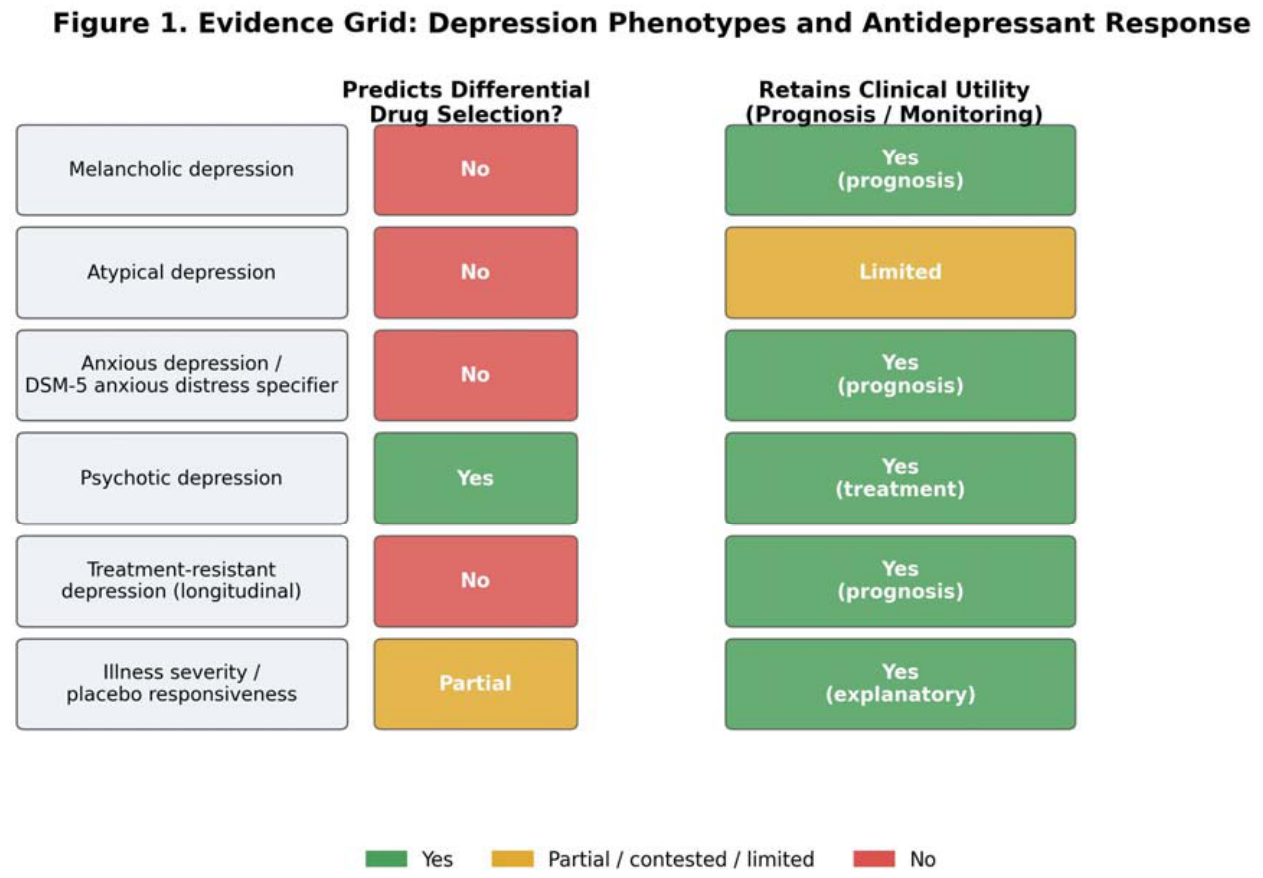

Table 1.
Summary of evidence for phenotype-specific antidepressant response across major depression phenotypes and related constructs.
Table 1.
Summary of evidence for phenotype-specific antidepressant response across major depression phenotypes and related constructs.
| Phenotype / Construct | Historical Pharmacological Claim | Contemporary Evidence | Predicts Differential Drug Selection? | Retained Clinical Utility | Key References |
|---|---|---|---|---|---|
| Melancholic depression | Preferential response to TCAs / ECT over SSRIs | Comparable drug response after severity adjustment; apparent advantage reflects lower placebo response | No | Severity / prognostic marker | 6,11,13–15 |
| Atypical depression | Preferential response to MAOIs (phenelzine) over TCAs | Signal not replicated with modern agents; subtype psychometrically unstable | No (modern agents) | Historical interest | 5,13,16–20 |
| Anxious depression (DSM-5 anxious distress specifier) | None specific | Predicts poorer remission and greater side-effect burden; no drug-class signal | No | Prognostic – monitoring | 15,21–23 |
| Psychotic depression | Antidepressant + antipsychotic, or ECT, superior to monotherapy | Confirmed by RCTs / meta-analyses (Cochrane RR 1.70, 95% CI 1.19–2.43) | Yes | Treatment-selection relevant | 24–27 |
| Treatment-resistant depression (longitudinal) | None specific among switch / augmentation strategies | No superior strategy identified in STAR*D; ketamine/esketamine effective regardless of phenotype | No (conventional agents) | Prognostic; guides use of ketamine/esketamine | 2,29,36–38,51–58 |
| Illness severity / placebo responsiveness | Not a categorical phenotype | Most reproducible moderator of drug–placebo separation (contested) | Partial / contested | Explains much apparent phenotype signal | 31–35 |
Abbreviations: TCA, tricyclic antidepressant; SSRI, selective serotonin reuptake inhibitor; MAOI, monoamine oxidase inhibitor; ECT, electroconvulsive therapy; RCT, randomized controlled trial; RR, risk ratio; CI, confidence interval; STAR*D, Sequenced Treatment Alternatives to Relieve Depression; DSM-5, Diagnostic and Statistical Manual of Mental Disorders, 5th edition.
Disclaimer/Publisher’s Note: The statements, opinions and data contained in all publications are solely those of the individual author(s) and contributor(s) and not of MDPI and/or the editor(s). MDPI and/or the editor(s) disclaim responsibility for any injury to people or property resulting from any ideas, methods, instructions or products referred to in the content. |
© 2026 by the authors. Licensee MDPI, Basel, Switzerland. This article is an open access article distributed under the terms and conditions of the Creative Commons Attribution (CC BY) license (http://creativecommons.org/licenses/by/4.0/).
Copyright: This open access article is published under a Creative Commons CC BY 4.0 license, which permit the free download, distribution, and reuse, provided that the author and preprint are cited in any reuse.