

Submitted:
10 October 2026
Posted:
12 October 2026
You are already at the latest version
Abstract
The study aimed to examine the effect of a mindful parenting intervention on parents of adolescents exhibiting non-suicidal self-injury (NSSI). Families meeting the specified criteria voluntarily participated, resulting in 23 families in the intervention group and 18 families in the waitlisted treatment group. Both groups were carefully matched in demographic variables. Only the parents in the intervention group received mindfulness parenting intervention, while other participants did not receive any intervention. Prior to and following the intervention, parents and adolescents with NSSI in both groups underwent assessments using a series of scales. Compared to the waitlisted treatment group, adolescents with NSSI in the intervention group exhibited significant reductions in impulsivity, depression, and anxiety scores following the intervention, parents in the intervention group demonstrated a significant reduction in depression and anxiety scores, along with a notable increase in mindful parenting scores after the intervention. Additionally, adolescents with NSSI in the intervention group showed significant improvements in depression and anxiety from pre- to post-intervention. Parents in the intervention group also showed improvements in depression and increases in mindful parenting levels from pre- to post-intervention. The mindful parenting intervention positively impacts both adolescents with NSSI and their parents.
Keywords:
mindful parenting
; parents of adolescents with non-suicidal self injury
; impulsivity
; depression
; anxiety
1. Introduction
Non-suicidal self-injury (NSSI) refers to the intentional, self-directed, and non-culturally sanctioned damage to the body, occurring without the conscious intent of suicide. This behavior frequently includes skin-cutting and scratching (Nixon et al., 2008). NSSI is often associated with disturbing behavior and suicide attempts (Halicka & Kiejna, 2018), as well as an increased risk of suicide among individuals who have a conscious intent to end their lives (Mars et al., 2019). Several interventions, such as cognitive behavioral therapy (Labelle et al., 2015) and dialectical behavior therapy (Pochyly & Walkup, 2021) have been shown to effectively reduce self-harm behaviors in adolescents. However, these individuals frequently demonstrate strong resistance and reluctance toward treatment (Lang et al., 2018), they were unwilling to seek professional help (Lustig et al., 2021), and the proportion of those receiving professional treatment remained low (Kaess et al., 2020). Consequently, treatment challenges for adolescents with NSSI persist. Current interventions must address the factors that impede adolescents’ access to treatment, particularly their relationship with parents, who play a crucial role in adolescent care (Wamser-Nanney & Steinzor, 2016). Parenting styles also exert a direct influence on adolescents’ psychological well-being and behavioral patterns. Positive parenting styles can effectively reduce the incidence of problematic behaviors, while negative parenting styles increase the risk of NSSI (Liu et al., 2024). As a result, adolescents’ NSSI can adversely affect their parents’ mental health. These parents often experience heightened parenting stress (Fu et al., 2020) and express a strong desire for support (Kelada et al., 2017).
Mindful parenting is defined as “paying attention to children and parenting in a deliberate, present-moment, and nonjudgmental manner” (Kabat-Zinn & Kabat-Zinn, 1997). This approach alleviates parental stress in childcare, enhances emotional regulation abilities (Parent & DiMarzio, 2021), improves family functioning, and promotes children’s mental health (Bögels et al., 2010). The primary focus of mindful parenting interventions is not on the child’s behavioral issues but rather on addressing the parents’ own stress and distress. Notably, even when adolescents do not participate in the intervention, the benefits that parents derive can extend to the adolescents (Burgdorf et al., 2019). Following the intervention, parents exhibiting higher levels of mindful parenting showed clearer recognition of their parenting abilities and reduced self-blame. Additionally, they positively influenced the frequency of parent-child communication during early adolescence, thereby optimizing family functioning (Lippold et al., 2019). A systematic review indicated that after mindful parenting interventions, parents exhibited varying degrees of positive change in the application of parenting skills, reduction of psychological stress, and development of positive traits, although these improvements were relatively modest(Donovan et al., 2022).
Parents of adolescents with NSSI who decline psychological intervention experience considerable psychological stress and express a strong desire for mental health support. Mindful parenting interventions have been shown to reduce parental stress and enhance family functioning, while also decreasing externalizing problem behaviors in children. Consequently, this study seeks to determine whether enhancing the levels of mindful parenting among parents of adolescents with NSSI can directly improve the parents’ negative emotions and indirectly mitigate the adolescents’ impulsive behaviors and distressing emotions, specifically depression and anxiety. We hypothesize that both before and after the mindful parenting intervention, parents will exhibit significant improvements in their own psychopathological symptoms, including depression and anxiety, alongside a notable increase in positive parenting behaviors. Additionally, we anticipate that changes in parenting factors will significantly predict improvements in psychopathological symptoms related to adolescent NSSI behaviors, including self-injury, impulsivity, depression, and anxiety.
2. Materials and Methods
Participants
Using G-Power 3.1 software to determine the sample size, with an effect size of f = 0.25, a significance level of α = 0.05, and a statistical power of β = 0.8, the analysis indicates that a minimum of 34 parents of adolescents with NSSI must be recruited for both the intervention and waitlisted treatment groups. This study successfully recruited 41 parents of adolescents with NSSI. Following voluntary participation, these parents were assigned to either the intervention group (N = 23) or the waitlisted treatment group (N = 18). Parents in the intervention group received a mindful parenting intervention, while those in the waitlisted treatment group received no intervention. Adolescents in both groups who engaged in NSSI did not receive any intervention.
During the intervention period, five adolescents with NSSI and their parents in the intervention group dropped out of the study, Additionally, one adolescent with NSSI in the intervention group declined to complete the pre-intervention questionnaire. As a result, the final dataset comprised 18 parents from both the intervention and waitlist treatment groups, along with 17 adolescents with NSSI in the intervention group and 18 in the control group, See Figure 1.
Inclusion criteria for adolescents with NSSI are as follows: aged 12 to 18 years; diagnosed with NSSI or NSSI accompanied by comorbid mild depressive disorder, as determined by a psychiatrist using the DSM-5 Structured Clinical Interview; provision of signed informed consent and voluntary participation.
Exclusion criteria for adolescents with NSSI in this study include: a diagnosis of attention-deficit/hyperactivity disorder (with or without hyperactivity) according to DSM-5; Presence of severe psychiatric disorders; diagnosis of substance-related and addictive disorders.
Inclusion criteria for parents of adolescents with NSSI included: parents of adolescents exhibiting self-injurious behaviors; literate individuals able to complete the questionnaire.
Exclusion criteria consisted of a history of severe mental illness; an inability to sustain mindfulness meditation practice due to significant physical illness.
This study was approved by the Medical Ethics Committee of Guizhou Provincial People’s Hospital (Approval number: Lun Audit [Scientific Research] No. 2023-124) and all research were performed in accordance with relevant guidelines and regulations.
Procedure
Before the formal implementation of the intervention measures, an informational session for parents must be organized. This session aims to ensure that participants fully comprehend the content of the mindful parenting intervention, allowing them to assess whether the intervention plan aligns with their individual circumstances and needs. Mindful Parenting Training retains the essential framework of Mindfulness-based intervention programs, which are designed to deliver an eight-week mindful parenting intervention for parents. The course schedule consists of one 2-hour session per week, addressing eight core themes: automatic parenting , beginner’s mind parenting , reconnecting with our body as a parent, responding rather than reacting to parenting stress, parenting patterns and schemas, conflict and parenting, love and limits, a mindful path through parenting . A day of Mindfulness would be scheduled between the sixth and seventh weeks (Bögels & Restifo, 2014). After each intervention session, assignments and reading materials would be distributed in the WeChat group of intervention to reinforce learning outcomes.
Both groups of adolescents with NSSI and their parents completed measures at two time points: before and after the intervention.
Measures
Demographics Information
Parents responded to demographic questions about themselves (age, gender, educational background) and about the target child (gender, age,grade).
Adolescent Impulsivity
Impulsivity was assessed using the Barratt Impulsiveness Scale, 11th Edition (BIS-11), as revised by Zhou et al.(Zhou et al., 2006). this 26-item instrument utilizes a 4-point rating scale: Rarely, Sometimes, Often, and Always. The scale encompasses three dimensions: attentional impulsivity, motor impulsivity, and non-planning impulsivity. The overall Cronbach’s α coefficient for the scale was 0.76, with the corresponding α coefficients for each dimension being 0.56, 0.66, and 0.69, respectively.
NSSI Behavior
NSSI behavior was evaluated using the Adolescent Self-harm Scale, revised by Feng (Feng, 2008). This questionnaire consists of 19 items, including 18 closed-ended questions and 1 open-ended question. It primarily examines methods of self-injury, as well as their frequency and severity. The frequency of self-injury is rated on a scale from 0 to 3, while severity is assessed on a scale from 0 to 4. Each item’s score is determined by multiplying its frequency and severity ratings. The total score of self-harm is derived from the sum of the scores across all 19 items, with a higher total score indicating more severe self-harm behavior. The overall Cronbach’s α coefficient for this scale is 0.92.
Anxiety and Depression Among Adolescents and Parents
Adolescents’ and parents’ emotional states were evaluated using the Self-Assessment Anxiety Scale (SAS), and Self-Assessment Depression Scale (SDS). The Chinese iteration of the SAS was translated by Wang and Chi in 1984 (Wang & Chi, 1984). Respondents completed the survey reflecting their emotional well-being in the preceding week to gauge the intensity of individual anxiety symptoms. The scale consists of 20 items rated on a 1–4 scale: none or rarely, sometimes, often, always. A standard score threshold of 50 is utilized by the scale; scores under 50 suggest an absence of anxiety symptoms. The scale demonstrates an overall Cronbach’s α coefficient of 0.852. The SDS scale was translated into Chinese by Liang et al. (Liang et al., 2022). Participants completed the questionnaire to evaluate the severity of depressive symptoms based on their emotional state over the past week. The scale consists of 20 items, each scored on a 1-4 scale: not at all or rarely, sometimes, often, and always. The standardized score is derived by multiplying the raw total score by 1.25. A cutoff point of 50 is established, with scores below this threshold indicating the absence of depressive symptoms. The overall Cronbach’s α coefficient for the scale is 0.895.
Interpersonal Mindfulness in Parenting Scale (IM-P)
Mindful parenting was evaluated using the Chinese version of the IM-P, as revised by An et al. (An et al., 2020) . This scale is an adaptation of the version created by Lo et al.(Lo et al., 2018) and consists of 23 items categorized into four dimensions: self-compassion and compassion toward children, attentive listening, emotional awareness, and nonjudgmental acceptance. A 5-point Likert scale (1 = never, 5 = always) was employed, with higher scores reflecting increased mindfulness in parenting. The scale exhibited an overall Cronbach’s α coefficient of 0.80.
Data Analyses
Statistical analyses utilized SPSS software (version 22.0). Categorical variables were expressed as numbers and percentages for descriptive purposes. Fisher’s exact test was employed to compare baseline characteristics between the intervention and waitlisted treatment groups to ensure group homogeneity. The primary analysis involved a 2 (group: intervention vs. waitlisted treatment) × 2 (time: pre-test vs. Post-test) repeated measures analysis of variance (RM-ANOVA) to evaluate the intervention’s impact on outcome measures. Subsequent simple effects analyses were performed to elucidate significant interactions. Statistical significance was established at p < 0.05.
3. Results
Baseline Characteristics
Prior to the intervention, Fisher’s test was applied to the demographic variables of adolescents with NSSI and their parents in both the intervention and waitlisted treatment groups. Additionally, a t-test was conducted on the psychological variables. The findings indicated no significant differences in demographic and psychological variables between adolescents or their parents in the intervention group and those in the waiting treatment group (all P > 0.05). Detailed results are presented in Table 1 and Table 2.
Self-Harm, Impulsivity, Depression, and Anxiety of NSSI Adolescents
This study utilized a 2 (group) × 2 (time) mixed factorial design. A repeated measures analysis of variance was performed on pre-intervention and post-intervention scores for self-harm, impulsivity, anxiety, and depression among adolescents in both the intervention and waitlisted treatment groups. The findings are summarized in Table 3.
Due to the significant interaction between time and group regarding impulsivity, anxiety, and depression scores, simple effects analyses were conducted for each of these three variables. Detailed results are presented in Table 4.
Mindful Parenting, Depression, and Anxiety of NSSI Adolescents’s Parents
This study utilized a 2 (group) × 2 (time) mixed factorial design. A repeated measures analysis of variance was performed on pre- and post-intervention scores for mindful parenting, anxiety, and depression among parents of adolescents with NSSI in both the intervention and waitlisted treatment groups. At the same time, due to the significant interaction between time and group regarding mindful parenting, anxiety, and depression scores, simple effects analyses were performed for each of the three variables.The findings are summarized in Table 5 and Table 6.
4. Discussion
The study demonstrates that mindful parenting interventions can significantly and effectively reduce impulsivity, anxiety, and depression of adolescents with NSSI. Importantly, it is further confirmed of time through a simple effects analyses that these improvements cannot be ascribed to the natural passage.
This study found that NSSI behaviors did not exhibit significant changes before and after the intervention or between groups. This outcome is likely attributable to the collection of post-test data immediately following the eight-week intervention. Given that the “Adolescent Self-harm Scale” assesses self-injury behaviors over the past year, the short-term effects of the intervention may not have been fully realized. To more accurately evaluate the intervention’s effects, this project plans to conduct follow-up assessments and collect data on adolescent self-harm behaviors after one year of the eight-week.
Previous studies assessing state impulsivity through delayed discounting tasks, GO/NO-GO tasks, or stop-signal tasks have shown that brief mindful training significantly reduces state impulsivity in adolescents with NSSI under acute stress (Zhong, 2023). In contrast, the simple effect of impulsivity scores reveals that post-intervention scores for adolescents in the intervention group were lower than their pre-intervention scores in this study; however, no statistically significant difference was observed. This lack of significance may be attributed to the use of a trait impulsivity questionnaire in this investigation. Trait impulsivity is a relatively stable personality characteristic, and any changes typically exhibit a temporal lag. Further confirmation is necessary through future longitudinal studies that track the effects of mindful parenting interventions.
In comparing the post-intervention impulsivity scores of adolescents with NSSI in the parent intervention group to those in the parent waitlisted treatment group, the intervention group exhibited lower scores than the waitlisted treatment group, indicating a statistically significant difference. This finding suggests that adolescents with NSSI in the waitlisted treatment group, whose risk factors for self-harm behaviors remained unaddressed, may experience an escalation in impulsivity as their history of self-harm extends. The observed improvement in impulsivity among adolescents in the intervention group, coupled with the increase in impulsivity among those in the waitlisted group, resulted in a statistically significant difference in impulsivity between the two groups following the intervention.
The assessment results of the anxiety and depression indicate that adolescents in the parents intervention group exhibited significantly lower scores for depression and anxiety after the intervention compared to their pre-intervention levels, as well as significantly lower scores than those in the waitlisted treatment group. This finding suggests that the mindful parenting intervention indirectly mitigated adolescents’ negative emotions by affecting their parents.
The results of this study, which analyzed data on mindful parenting scales, anxiety, and depression among parents of adolescents with NSSI, revealed a significant interaction effect between group and time. First, through the simple effects analysis of anxiety, we found that anxiety scores in the parent intervention group were lower than pre-test levels, but this difference was not statistically significant. Previous research suggests that mindful parenting significantly reduces parental anxiety (Nurinayah & Rinaldi, 2023). This discrepancy may arise from the relatively low baseline anxiety levels among parents of adolescents with NSSI in this study. Consequently, while the intervention resulted in some alleviation, the change did not achieve statistical significance.
Post-intervention anxiety scores were significantly lower in the intervention group than in the waitlisted treatment group. It is speculated that parents in the waitlisted treatment group, upon discovering their child’s self-harming behavior and lacking effective coping strategies or resorting to inappropriate ones, may experience a gradual increase in anxiety over time. In contrast, anxiety levels improved in the intervention group while deteriorating in the waitlisted treatment group, leading to a statistically significant difference in anxiety levels between the two groups after the intervention.
The depression levels of parents in the intervention group were affected by group assignment and the time × group interaction effect. Following the mindful intervention, the depression levels of parents of adolescents with NSSI significantly decreased. Furthermore, the post-intervention depression scores of parents in the intervention group were markedly lower than those of parents in the waitlisted treatment group. This finding indicates that mindful parenting interventions can directly alleviate depressive symptoms in parents of adolescents with NSSI. These results imply that mindful parenting practices—such as compassion meditation and the establishment of personal boundaries—may help mitigate negative cognitions closely associated with depressive mood. Additionally, nonjudgmental awareness of the present moment and mindfulness of thoughts may diminish rumination, a cognitive pattern strongly linked to depression.
Mindfulness serves as both a trainable state of awareness through an intervention techniques and a personality trait(Firth et al., 2023; Zainal & Newman, 2024). Findings from the Mindful Parenting Scale reveal that the mindful parenting levels of parents in the intervention group were significantly influenced by a time × group interaction effect, with post-intervention scores markedly higher than pre-intervention scores. Furthermore, post-intervention mindful parenting scores among parents in the intervention group surpassed those of parents in the waitlisted treatment group. This evidence underscores the potential of mindful parenting interventions to enhance the mindful parenting levels of parents with adolescents exhibiting NSSI. Mindful parenting fosters four essential qualities in parents: self-compassion, compassionate listening, emotional awareness, and nonjudgmental acceptance. These attributes enable parents to better recognize their own emotions, sustain compassion, and accept both themselves and their children. Consequently, parents are equipped to address their children’s challenging behaviors with calmness and patience, thereby promoting a harmonious and stable family environment. This approach strengthens familial bonds and intimacy while enhancing parents’ capacity to understand and respond to their children’s emotions and behaviors.
5. Conclusions
The mindful parenting intervention significantly reduced impulsivity, anxiety, and depression in adolescents with NSSI, while also alleviating parents’ anxiety and depression and increasing their mindful parenting levels. These findings indicate that targeting parents alone can yield measurable improvements in both adolescent and parental mental health, supporting mindful parenting as an effective and feasible family-based approach for adolescents with NSSI.
Supplementary Materials
no supplementary materials.
Author Contributions
Hong Chen: Conceptualization, Data curation, Formal analysis, Writing – original draft. Yuyu Gu: Investigation, Data curation, Visualization, Validation, Writing – review & editing. Ziyu Wang: Methodology, Formal analysis, Writing – review & editing. Congwen Yang: Methodology, Data curation, Formal analysis. Hui Xiang: Supervision, Project administration, Funding acquisition, Resources, Writing – review & editing. All authors have read and agreed to the published version of the manuscript.
Funding
This research was supported in part by the National Natural Science Foundation of China (Grant No. 72464039) and the Science and Technology Fund Project of Guizhou Provincial Health Commission (Grant No. gzwkj2025-288).
Institutional Review Board Statement
This study was approved by the Medical Ethics Committee of Guizhou Provincial People’s Hospital (Approval number: Lun Audit [Scientific Research] No. 2023-124) and all research were performed in accordance with relevant guidelines and regulations.
Informed Consent Statement
Informed consent was obtained from all subjects involved in the study. Written informed consent has been obtained from the patients to publish this paper.
Data Availability Statement
The datasets generated during this study is available in the Figshare repository via the following direct URI: https://figshare.com/articles/dataset/The_changes_of_NSSI_adolescents_and_their_parents_before_and_after_mindful_parenting_intervention/30879194.
Acknowledgments
The authors thank all participating families and the staff of Guizhou Provincial People’s Hospital for their support.
Conflicts of Interest
The authors declare no conflicts of interest. The funders had no role in the design of the study; in the collection, analyses, or interpretation of data; in the writing of the manuscript; or in the decision to publish the results.
Abbreviations
The following abbreviations are used in this manuscript:
| BIS-11 | Barratt Impulsiveness Scale, 11th Edition |
| DSM-5 | Diagnostic and Statistical Manual of Mental Disorders, Fifth Edition |
| IM-P | Interpersonal Mindfulness in Parenting scale |
| NSSI | Non-suicidal self-injury |
| RM-ANOVA | Repeated-measures analysis of variance |
| SAS | Self-Assessment Anxiety Scale |
| SDS | Self-Assessment Depression Scale |
References
- An, Y.; Zang, X.; Yin; Yue, Z.; Zhang, Y. The influence of mindful parenting on parenting styles and marital satisfaction: the mediating role of parenting stress. Chin. J. Clin. Psychol. 2020, 28(06), 1215–1220. [Google Scholar]
- Bögels, S. M.; Lehtonen, A.; Restifo, K. Mindful parenting in mental health care. Mindfulness 2010, 1(2), 107–120. [Google Scholar] [CrossRef] [PubMed]
- Bögels, S.; Restifo, K. Mindful Parenting: A Guide for Mental Health Practitioners; Springer, 2014. [Google Scholar] [CrossRef]
- Burgdorf, V.; Szabó, M.; Abbott, M. J. The effect of mindfulness interventions for parents on parenting stress and youth psychological outcomes: a systematic review and meta-analysis. Front. Psychol. 2019, 10. [Google Scholar]
- Donovan, M. O.; Pickard, J. A.; Herbert, J. S.; Barkus, E. Mindful parent training for parents of children aged 3–12 years with behavioral problems: a scoping review. Mindfulness 2022, 13, 801–820. [Google Scholar] [CrossRef] [PubMed]
- Feng, Y. The relationship between adolescent self-Injury behavior and individual emotional factors and family environment factors. master’s thesis, Central China Normal University, 2008. [Google Scholar]
- Firth, A.; Sütterlin, S.; Lugo, R. The role of trait and state mindfulness in cognitive performance of male adolescents. Psychol. Res. Behav. Manag. 2023. [Google Scholar] [CrossRef] [PubMed]
- Fu, X.; et al. Parents’ attitudes toward and experience of non-suicidal self-Injury in adolescents: a qualitative study. Front. Psychiatry 2020, 11. [Google Scholar] [CrossRef] [PubMed]
- Halicka, J.; Kiejna, A. Non-suicidal self-injury (NSSI) and suicidal: criteria differentiation. Adv. Clin. Exp. Med. 2018, 10. [Google Scholar]
- Kabat-Zinn, J.; Kabat-Zinn, M. Everyday Blessings: The Inner Work of Mindful Parenting; 1997. [Google Scholar]
- Kaess, M.; et al. Twelve-month service use, suicidality and mental health problems of European adolescents after a school-based screening for current suicidality. Eur. Child Adolesc. Psychiatry 2022, 31, 229–238. [Google Scholar] [CrossRef] [PubMed]
- Kelada, L.; Hasking, P.; Melvin, G. A. School response to self-injury: concerns of mental health staff and parents. Sch. Psychol. Q. 2017, 32(2), 173–187. [Google Scholar] [CrossRef] [PubMed]
- Labelle, R.; Pouliot, L.; Janelle, A. A systematic review and meta-analysis of cognitive behavioural treatments for suicidal and self-harm behaviours in adolescents. Can. Psychol. Psychol. Can. 2015, 56(4), 368–378. [Google Scholar] [CrossRef]
- Lang, C. M.; Edwards, A. J.; Mittler, M. A.; Bonavitacola, L. Dialectical behavior therapy with prolonged exposure for adolescents: rationale and review of the research. Cogn. Behav. Pract. 2018, 25(3), 416–426. [Google Scholar] [CrossRef]
- Liang, L.; Li, L.; Ye, E. The use of “emotional catharsis workshop”as a combined bereavement support psychosocial intervention in adolescent depression. Qilu Nurs. J. 2022. [Google Scholar]
- Lippold, M.; et al. Mindful parenting, parenting cognitions, and parent-youth communication: bidirectional linkages and mediational processes. Mindfulness 2019, 15. [Google Scholar] [CrossRef] [PubMed]
- Liu, P.; Liu, J.; Li, Y.; Lu, J. Effect of parenting style, attachment to parents and self-compassion on the occurrence and recovery motivation for non-suicidal self-injury in adolescents. Front. Psychol. 2024, 15. [Google Scholar] [CrossRef] [PubMed]
- Lo, H. H. M.; et al. Validating of the interpersonal mindfulness in parenting scale in hong kong chinese. Mindfulness 2018, 9(5), 1390–1401. [Google Scholar] [CrossRef]
- Lustig, S.; Koenig, J.; Resch, F.; Kaess, M. Help-seeking duration in adolescents with suicidal behavior and non-suicidal self-injury. J. Psychiatr. Res. 2021, 140, 60–67. [Google Scholar] [CrossRef] [PubMed]
- Mars, B.; et al. Predictors of future suicide attempt among adolescents with suicidal thoughts or non-suicidal self-harm: a population-based birth cohort study. Lancet Psychiatry 2019, 6(4), 327–337. [Google Scholar] [CrossRef] [PubMed]
- Nixon, M. K.; Cloutier, P.; Jansson, S. M. Nonsuicidal self-harm in youth: a population-based survey. Can. Med. Assoc. J. 2008, 178(3), 306–312. [Google Scholar] [CrossRef] [PubMed]
- Nurinayah, A.; Rinaldi, M. R. Mindful parenting and anxiety in full-time working mothers. J. Psikol. Integr. 2023, 11(2). [Google Scholar] [CrossRef]
- Parent, J.; DiMarzio, K. Advancing mindful parenting research: an introduction. Mindfulness 2021, 12(2), 261–265. [Google Scholar] [CrossRef]
- Pochyly, J.; Walkup, J. T. Editorial: Dialectical behavior therapy and the function of self-injury. J. Am. Acad. Child Adolesc. Psychiatry 2021, 60(9), 1062–1063. [Google Scholar] [CrossRef] [PubMed]
- Wamser-Nanney, R.; Steinzor, C. E. Characteristics of attrition among children receiving trauma-focused treatment. Psychol. Trauma Theory Res. Pract. Policy 2016, 8(6), 745–754. [Google Scholar] [CrossRef] [PubMed]
- Wang, Z.; Chi, Y. Self-Rating anxiety scale (SAS). Shanghai Arch. Psychiatry 1984, (02), 73–74. [Google Scholar]
- Zainal, N. H.; Newman, M. G. Treatment condition as a moderator and change in trait mindfulness as a mediator of a brief mindfulness ecological momentary intervention for generalized anxiety disorder. Eur. Psychiatry 2024, 67(1), e40. [Google Scholar] [CrossRef] [PubMed]
- Zhong, H. A Study on the Effects of Simple Mindfulness Training on Impulsive Decision-Making and Reactions in Self-Injurers Under Stressful Conditions. 2023. [Google Scholar] [CrossRef]
- Zhou, L.; Xiao, S.; He, X.; Li, J.; Liu, H. Reliability and validity of Chinese version of barratt impulsiveness scale-11. Chin. J. Clin. Psychol. 2006, (04), 343–344. [Google Scholar]
Figure 1.
Retention of participants after the project.
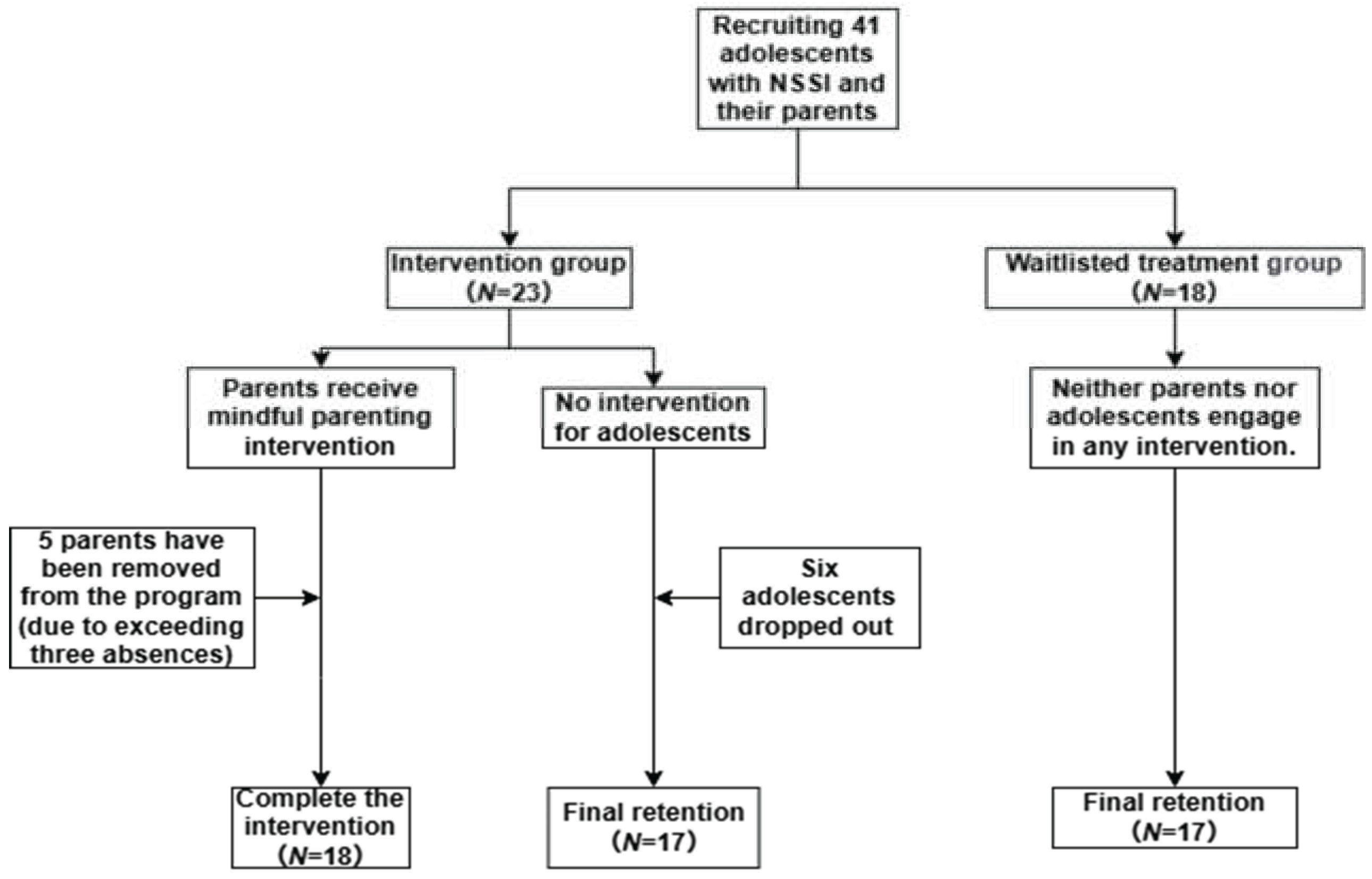

Table 1.
Demographics at baseline.
| Variable | Intervention | Control | Fisher | P | |
| Number (adolescent) | 17 | 18 | |||
| Age (adolescent) | 14.24±1.3 | 14.06±1.66 | |||
| Gender (adolescent) | Male | 7 | 6 | 0.73 | 0.45 |
| female | 10 | 12 | |||
| Grade (adolescent) | Junior high school | 10 | 14 | 0.29 | 0.2 |
| High school | 7 | 4 | |||
| Number (parent) | 18 | 18 | |||
| Age (parent) | 42.56±1.72 | 42.44±4.34 | |||
| Gender (parent) | male | 4 | 3 | 1 | 0.5 |
| female | 14 | 15 | |||
| educational background (parent) | High school or below | 4 | 5 | 1 | 0.5 |
| University degree or above | 14 | 13 |
Table 2.
Psychological variables at baseline.
| Variable | Intervention | Control | t | p | Cohen’s d |
| NSSI (adolescent) | 14.29±13.62 | 21.11±17.81 | 1.27 | 0.21 | 0.4 |
| Impulsivity (adolescent) | 75.47±10.9 | 79.67±8.9 | 1.25 | 0.22 | 0.42 |
| Anxiety (adolescent) | 60.76±13.95 | 61.11±10.42 | 0.09 | 0.93 | 0.03 |
| Depression (adolescent) | 67.59±10.09 | 71.25±11.54 | 1 | 0.33 | 0.34 |
| Mindful parenting (parent) | 72.83±8. 38 | 74.83±8 | 0.73 | 0.47 | 0.24 |
| Anxiety (parent) | 40.07±7.98 | 39.79±9.82 | -0.09 | 0.93 | 0.03 |
| Depression (parent) | 43.89±10.25 | 40.97±13.48 | -0.77 | 0.45 | 0.25 |
Table 3.
Mixed-model analysis of variance results for psychological outcomes of NSSI adolecents.
| Variable | Time | Intervention | Waitlisted treatment | Group | Time | Group × Time Interaction | |||
| (M±SD) | (M±SD) | F | η2p | F | η2p | F | η2p | ||
| NSSI | T0 | 14.29±13.62 | 21.11±17.81 | 4.149 | 0.112 | 0.922 | 0.027 | 0.552 | 0.016 |
| T1 | 15.12±13.9 | 27.56±23.89 | |||||||
| Impulsivity | T0 | 75.47±10.95 | 79.67±8.9 | 19.839*** | 0.375 | 0.012 | 0.000 | 6.393* | 0.162 |
| T1 | 70.18±6.88 | 85.44±9.39 | |||||||
| Anxiety | T0 | 60.76±12.95 | 61.11±10.42 | 5.463* | 0.142 | 1.593 | 0.046 | 4.801* | 0.127 |
| T1 | 50.96±11.62 | 63.75±12.19 | |||||||
| Depression | T0 | 67.59±10.09 | 71.25±11.54 | 13.789** | 0.295 | 3.760 | 0.102 | 4.970* | 0.131 |
| T1 | 56.62±9.3 | 72.01±11.7 | |||||||
Note: *p<0.05; **p<0.01; ***p<0.001.
Table 4.
Pairwise comparisons of outcomes of NSSI adolecents between and within groups across time points.
Table 4.
Pairwise comparisons of outcomes of NSSI adolecents between and within groups across time points.
| Variable |
Intergroup comparison before Intervention |
Intergroup comparison after Intervention |
Intervention group pre-post Test | Waitlisted treatment group pre-post Test |
| F | F | F | F | |
| Impulsivity | 1.556 | 29.800*** | 2.842 | 3.584 |
| Anxiety | 0.008 | 10.078** | 5.797* | 0.444 |
| Depression | 0.994 | 17.509*** | 8.447** | 0.043 |
Note: *p<0.05; **p<0.01; ***p<0.001.
Table 5.
Mixed-model analysis of variance results for psychological outcomes of NSSI adolescents parents.
Table 5.
Mixed-model analysis of variance results for psychological outcomes of NSSI adolescents parents.
| Variable | Time | Intervention | Waitlisted treatment | Group | Time Effect | Group × Time Interaction | |||
| (M±SD) | (M±SD) | F | η2p | F | η2p | F | η2p | ||
| Mindful parenting | T0 | 72.83±8.38 | 74.83±7.98 | 1.511 | 0.043 | 0.238 | 0.007 | 7.203* | 0.175 |
| T1 | 77.89±5.03 | 71.33±7.46 | |||||||
| Anxiety | T0 | 40.07±7.98 | 39.79±9.82 | 3.820 | 0.101 | 0.158 | 0.005 | 4.220* | 0.110 |
| T1 | 35.14±4.11 | 43.13±10.43 | |||||||
| Depression | T0 | 43.89±10.25 | 40.97±12.48 | 1.365 | 0.039 | 0.058 | 0.002 | 8.145* | 0.193 |
| T1 | 36.74±5.08 | 47.01±16.22 | |||||||
Note: *p<0.05.
Table 6.
Pairwise comparisons of outcomes of parents between and within groups across time points.
| Variable |
Intergroup Comparison before Intervention |
Intergroup Comparison after Intervention |
Intervention group pre-post test | Waitlisted treatment group pre-post test |
| F | F | F | F | |
| Mindful parenting | 0.538 | 9.531** | 5.030* | 2.411 |
| Anxiety | 0.009 | 9.142** | 3.005 | 1.373 |
| Depression | 0.587 | 6.583* | 4.787* | 3.415 |
Note: *p<0.05; **p<0.01.
Disclaimer/Publisher’s Note: The statements, opinions and data contained in all publications are solely those of the individual author(s) and contributor(s) and not of MDPI and/or the editor(s). MDPI and/or the editor(s) disclaim responsibility for any injury to people or property resulting from any ideas, methods, instructions or products referred to in the content. |
© 2026 by the authors. Licensee MDPI, Basel, Switzerland. This article is an open access article distributed under the terms and conditions of the Creative Commons Attribution (CC BY) license (http://creativecommons.org/licenses/by/4.0/).
Copyright: This open access article is published under a Creative Commons CC BY 4.0 license, which permit the free download, distribution, and reuse, provided that the author and preprint are cited in any reuse.