

Submitted:
09 October 2026
Posted:
10 October 2026
You are already at the latest version
Abstract
Development of opioid vaccines to prevent overdose is an active area of research. The protective efficacy of these vaccines depends on vaccine-induced antibodies (Ab) that bind to opioids with high affinity and targeted specificity. Because Ab performance is ultimately constrained by the in vivo behavior of the drug, and clinically relevant peak blood concentrations Cmax associated with lethal opioid overdose are undefined, a clear understanding of opioid pharmacokinetics in humans is essential for rational vaccine design, preclinical modeling, and interpretation of clinical results. The purpose of this review is to summarize available data on key PK parameters of opioid analogues in humans to a) facilitate establishment of Ab correlates of protection during opioid vaccine development and testing and b) assess Ab cross-reactivity to off-target opioid agonists and antagonists. Lastly, we discuss their utility in informing design and interpretation of preclinical and clinical studies of opioid vaccines and protective therapeutics.
Keywords:
antibody
; competitive ELISA
; cross-reactivity
; drug
; opioid
; pharmacokinetic
; vaccine
1. Introduction
More than 70,000 Americans still die from drug overdoses each year, and since 2000, over 850,000 people have fatally overdosed on opioids [1]. The only Food and Drug Administration (FDA)-approved rescue medications to acutely treat respiratory depression from opioid overdose are nalmefene and naloxone. Both must be given within minutes of an opioid overdose and require availability of a prepared and willing bystander who can administer them. Harm reduction strategies such as programs for education of the public and distribution of fentanyl test strips have limited utility during impulsive and/or opportunistic opioid exposure [2]. Given the limitations of existing strategies to prevent opioid overdose deaths, new approaches for preventing fatal overdoses are needed. Protective immune therapeutics, such as monoclonal antibodies (Ab) and vaccines have shown promise in animal models [3]. Translational development of vaccines is currently underway [4,5]. The diverse clinical uses of opioids—including anesthesia, pain management, treatment of opioid use disorder (OUD) (i.e., methadone, buprenorphine, naltrexone), and overdose reversal (i.e., naloxone, nalmefene)—complicate the development of immunotherapeutic strategies. A thorough understanding of the pharmacokinetics (PK) of individual opioids, including both the primary vaccine target and potential cross-reactive opioids, is essential for the development of safe and effective opioid vaccines.
Clinically relevant peak blood concentrations (Cmax) associated with lethal opioid overdose are difficult to define. Overdose events typically occur outside healthcare settings, precluding prospective PK studies with standardized blood sampling. Even when blood specimens are obtained, the timing and circumstances of sample collection relative to drug administration is highly variable, and the risk of overdose is influenced by factors beyond blood opioid concentration, including multi-substance exposure, individual tolerance, genetic influences on metabolism and other co-occurring disorders. Consequently, no universal Cmax threshold reliably defines safe opioid exposure. While not a perfect surrogate, serum or plasma concentrations following well-characterized therapeutic opioid dosing regimens provide reproducible benchmarks that can serve as practical target concentrations for the development and evaluation of Ab-inducing opioid vaccines and immunotherapeutics [6,7,8], with the eventual goal of establishing Ab correlates of protection for the target opioids.
Assessing Ab cross-reactivity is a critical step in developing immune therapeutics. Cross-reactivity may confer broader protection against overdose or, conversely, reduce the pharmacologic efficacy of therapeutic opioids, including analgesics and medications used to treat acute pain and OUD. Estimated serum or plasma Cmax values are needed to interpret assay data, as they define the clinically relevant concentration range used to generate inhibitory concentration curves for individual opioids [9,10] (Figure 1). This would include matching the putative, yet currently unknown, protective anti-opioid Ab levels with definable plasma/serum Cmax with the maximum clinically observed dose of known opioid in a specific clinical setting. As a first step, here we collected and summarized existing knowledge on select opioid-specific PK variables in humans and, where not available, laboratory animals.
2. Methods
We conducted a literature search in PubMed to compile PK and select pharmacodynamic (PD) and chemical information for ten opioid compounds (fentanyl, buprenorphine, morphine, oxycodone, methadone, naloxone, naltrexone, remifentanil, sufentanil, alfentanil). We excluded combination products (i.e., suboxone) and formulations used almost exclusively in combination products (i.e., hydrocodone). Information of interest included typical opioid dosing for adults, serum and plasma Cmax, mean dose response for analgesia and anesthesia (respiratory suppression) in humans under various conditions and by study participant pre-exposure status (opioid exposed vs naïve), and LD50, the lethal dose required to kill 50% of a test rodent population. This is not an exhaustive systematic review, but we included the most commonly used opioid medications for which there is available published PK data.
3. Results
The pharmacological properties of the opioids of interest are presented in Table 1. These properties are influenced by product-specific characteristics such as drug structure, formulation (i.e., immediate vs. extended release), number of doses administered, and routes of administration (subcutaneous, oral, IV) [5], which in turn drive effective drug concentrations in serum/plasma. Peak plasma concentrations of unbound drug (Cmax) were derived from the most commonly prescribed doses in adults with normal liver and kidney function. Drug intake patterns and dosing depend on context and vary widely based on the recipient’s opioid exposure history, dosing regimen, and the clinical indication for opioid administration. For example, methadone is typically prescribed at lower doses for pain management than for the treatment of OUD, where substantially higher doses are often required. Similarly, buprenorphine dosing varies considerably by indication, formulation, and route of administration. For analgesia with fentanyl in opioid naïve awake adult patients, typical intravenous dosing is in the range of 50 – 100 mcg. Patients undergoing general anesthesia, patients receiving prolonged infusions during mechanical ventilation, and patients with advanced cancer and opioid tolerance often receive much higher doses. Opioid PK also differ between single doses and repeated doses or infusions. This is due in part to accumulation of opioids in body compartments. With a prolonged infusion, the term context-sensitive half-life refers to the time for blood/serum concentration to decrease by 50% if the infusion is suddenly stopped. This half-life varies as a function of the duration of the infusion [11]. Therefore, information from this table should be used as a rough guide acknowledging that opioid vaccine researchers and vaccine developers should anticipate and account for broad opioid dose ranges used by different populations. The results shown primarily focus on analgesic doses/concentrations in opioid naïve adults and where applicable or known, doses/concentrations for acute use, anesthesia or OUD were added.
Although in PK terms the relationship between drug concentration and drug-specific Ab binding is not linear, using mathematical models accounting for hillslope and top/bottom optical density (=strength of the binding between drug and inhibitor compound representing no/complete Ab inhibition) (Figure 1B), researchers could use the half-maximal inhibitory concentration (IC50) to infer the amount of the target drug needed to inhibit half of the available vaccine-induced Abs in serum of vaccinated subjects, as well as the amount of any non-vaccine targeted opioids required to maintain their efficacy in presence of opioid-specific vaccination.
4. Discussion
Characterization of Ab specificity is essential to ensure that opioid vaccines achieve their intended effects while minimizing unintended interference with opioid pharmacotherapy. Incorporation of human serology modeling in human clinical studies requires reliable estimates of key PK parameters including Cmax and maximum clinically recommended dose for the drugs of interest. Vaccine developers must evaluate Ab activity against different opioids to assess the potential for clinically meaningful interference with opioid therapy. Cross-reacting Ab might be expected in vaccinated individuals and their quantitative (concentration) and qualitative (binding affinity, avidity, specificity) properties are critical parameters to study in PK/PD preclinical studies. In fact, Ab affinity is critical for prediction of potential opioid vaccine interference. For example, an individual receiving low-dose methadone for pain management may tolerate vaccine-induced Ab binding without significant impact on analgesia if affinity of the vaccine-induced Ab to methadone is low, whereas the same Ab concentrations could compromise treatment efficacy in an individual receiving higher-dose methadone for OUD if Ab affinity to methadone is high. Competitive ELISA assays provide an in vitro approach for evaluating the ability of off target opioids to interfere with vaccine-induced Ab binding (Figure 1).
Currently, two active human trials of opioid vaccines are underway. A Phase 1a/1b multi-site (New York State Psychiatric Institute and the Clinilabs clinical research unit in Eatontown, New Jersey) triple blind randomized clinical trial of an oxycodone vaccine (Oxy(Gly)4-sKLH Conjugate Vaccine, adsorbed to the aluminum adjuvant Alhydrogel) is testing safety, tolerability, Ab production and efficacy which is operationally defined as self-reported drug “liking” following opioid administration measured using a visual analog scale (0-100) (NCT04458545) [52]. This trial was initiated in 2023 with a recruitment goal of forty-five healthy adults, aged 18 to 59 years, who meet Diagnostic and Statistical Manual of Mental Disorders, 5th Edition (DSM-5) criteria for OUD but are not seeking treatment to reduce their drug use. Participants are randomized to placebo, low dose experimental vaccine or high dose experimental vaccine delivered at weeks 0, 3, 6 and 18 and followed for 42 weeks. Ab titers, concentrations, affinity for oxycodone, cross-reactivity to off-target opioid agonists and antagonists (including endogenous opioid neuropeptides), and subclasses of the serum IgG Ab are measured at baseline and repeatedly over the course of the study period to characterize the magnitude and duration of the Ab response to vaccination.
The second trial is a phase 1/2 clinical trial of an adjuvanted anti-fentanyl vaccine (ARMR-100) to test its safety, tolerability and immunogenicity, defined as its ability to induce an Ab that binds to fentanyl and prevents its penetration of the blood-brain-barrier. Initiated in early 2026, this study will enroll 40-60 healthy adults at the Center for Human Drug Research in the Netherlands and include a human fentanyl challenge phase. As of June 17, 2026, the vaccine has shown favorable preliminary safety results among 24 study participants along with encouraging early immunogenicity results, with further efficacy data being forthcoming [53,54].
Inimmune in collaboration with the University of Montana, University of Minnesota, and Columbia University have an Investigational New Drug (IND) approved for an anti-heroin vaccine including the Inimmune / University of Montana Opioid Vaccine custom toll-like receptor adjuvant (INI-4001). A phase 1 clinical trial funded by the National Institutes of Health (NIH) Helping to End Addiction Longterm (HEAL) Initiative is currently undergoing site initiation activities (personal communication, Jay Evans). There is also an INI-4001 adjuvanted anti-fentanyl vaccine that has demonstrated pre-clinical efficacy in fentanyl challenge models in a number of different species and has advanced to IND preparations and current Good Manufacturing Practice (cGMP) manufacturing with the first Phase I trial expected to begin in 2027 [55,56].
As the field of opioid vaccine development matures and precision formulations with sophisticated antigen-adjuvant combinations advance through the FDA IND processes, we anticipate initiation of additional human clinical trials of mono- and multi-valent opioid vaccines and immunotherapeutics soon. We believe the information in this review will help opioid vaccine researchers and vaccine developers in assessing and de-risking their formulations ahead of use in safety and efficacy clinical trials. Of note, PK and PD parameters for potential antibody transmission to neonates from vaccinated mothers and those who receive blood or organ donations from vaccinated individuals are not covered in this review and will require further research.
5. Conclusion
We present PK information about molecules that bind to the µ-opioid receptor that help guide development of a vaccine to prevent opioid overdose. The data collated here may assist investigators in establishing PK parameters for reliable in vitro/ex vivo testing to measure opioid vaccine effectiveness, safety and cross-reactivity, and ultimately help guide efforts towards defining opioid vaccine correlates of protection. We hope this work will inform future discovery and development of opioid vaccines and preventative therapeutics, as well as vaccine or drug compound dosing decisions in future human challenge studies.
Author Contributions
Conceptualization, A.A., P.L. and S.L.; writing—original draft preparation, A.A.; writing—review and editing, J.A.K., C.M., P.L., J.R., M.B., E.R.W, C.B, S.M., D.J.D, O.L.; supervision, S.L.; project administration, C.M.; funding acquisition, D.J.D. and O.L. All authors have read and agreed to the published version of the manuscript.
Data Availability Statement
This study did not generate any new data. Accordingly, data sharing is not applicable to this article.
Acknowledgments
Research reported in this publication was supported in part by the US National Institutes of Health (NIH), National Institute of Allergy and Infectious Diseases (NIAID) ‘Development of Vaccines for the Treatment of Opioid Use Disorder’ Contract #75N93020C00038 to DJD and OL. The funder played no role in study design, data collection, analysis and interpretation of data, or the writing of this manuscript. The Angelidou Lab is supported in part by a Mentored Clinical Scientist Development Award (K08AI168487). We thank Dr. Wendy Chung, Chair of the Department of Pediatrics at Boston Children’s Hospital for her support for the Division of Addiction Medicine and the Precision Vaccines Program.
Conflicts of Interest
DJD, OL and SL are inventors on patents held by BCH relating to vaccine adjuvants. OL is an advisor to and his laboratory receives sponsored research from GlaxoSmithKline (GSK). DJD has served as a consultant for Merck Research Laboratories/Merck Sharp & Dohme Corp. (a Merck & Co. Inc. subsidiary) and is on EdJen BioTech’s scientific advisory board. OL’s laboratory is supported in part by sponsored research from GSK. All other authors declare no competing interests. DJD, EW, SL & OL are advisors to ARMR Sciences.
Abbreviations
The following abbreviations are used in this manuscript.
| Ab | Antibody |
| BSA-FEN | Fentanyl-Bovine Serum Albumin Conjugate |
| cGMP | current Good Manufacturing Practice |
| Cmax | Maximum Concentration |
| DSM-5 | Diagnostic and Statistical Manual of Mental Disorders, 5th Edition |
| ELISA | Enzyme-Linked Immunosorbent Assay |
| FDA | Food & Drug Administration |
| HRP | Horseradish Peroxidase |
| IC50 | Half-maximal Inhibitory Concentration |
| IND | Investigational New Drug |
| LD50 | Lethal dose required to kill 50% of a test population |
| MPE | Maximum Possible Effect |
| NIH HEAL | National Institutes of Health Helping to End Addiction Longterm |
| OUD | Opioid Use Disorder |
| PD | Pharmacodynamic |
| PK | Pharmacokinetic |
References
- Office, C.B. The Opioid Crisis: Federal Policy Approaches to Reduce Supply, Demand, and Harm. Available online: https://www.cbo.gov/publication/62009?utm (accessed on 25 July 2026).
- Smolina, K.; Crabtree, A.; Chong, M.; Park, M.; Mill, C.; Zhao, B.; Schütz, C.G. Prescription-Related Risk Factors for Opioid-Related Overdoses in the Era of Fentanyl Contamination of Illicit Drug Supply: A Retrospective Case-Control Study. Subst. Abus. 2022, 43, 92–98. [Google Scholar] [CrossRef]
- Martinez, S.; Harris, H.; Chao, T.; Luba, R.; Pravetoni, M.; Comer, S.D.; Jones, J.D. The Potential Role of Opioid Vaccines and Monoclonal Antibodies in the Opioid Overdose Crisis. Expert Opin. Investig. Drugs 2023, 32, 181–185. [Google Scholar] [CrossRef]
- Pravetoni, M.; Comer, S.D. Development of Vaccines to Treat Opioid Use Disorders and Reduce Incidence of Overdose. Neuropharmacology 2019, 158, 107662. [Google Scholar] [CrossRef]
- Angelidou, A.; Koster, J.A.; Sherman, A.C.; McLoughlin, C.; Lalwani, P.; Kelly, A.; Saeed, A.; McEnaney, K.; Baden, L.R.; Brogna, M.; et al. Product and Trial Design Considerations on the Path towards a Vaccine to Combat Opioid Overdose. npj Vaccines 2025, 10, 35. [Google Scholar] [CrossRef]
- Pravetoni, M.; Naour, M.L.; Harmon, T.M.; Tucker, A.M.; Portoghese, P.S.; Pentel, P.R. An Oxycodone Conjugate Vaccine Elicits Drug-Specific Antibodies That Reduce Oxycodone Distribution to Brain and Hot-Plate Analgesia. J. Pharmacol. Exp. Ther. 2012, 341, 225–232. [Google Scholar] [CrossRef]
- Bremer, P.T.; Schlosburg, J.E.; Banks, M.L.; Steele, Floyd.F.; Zhou, B.; Poklis, J.L.; Janda, K.D. Development of a Clinically Viable Heroin Vaccine. J. Am. Chem. Soc. 2017, 139, 8601–8611. [Google Scholar] [CrossRef]
- Bremer, P.T.; Burke, E.L.; Barrett, A.C.; Desai, R.I. Investigation of Monoclonal Antibody CSX-1004 for Fentanyl Overdose. Nat. Commun. 2023, 14, 7700. [Google Scholar] [CrossRef]
- Kyzer, J.L.; McGuire, M.; Park, H.; Belz, T.F.; Bonakdar, R.; Janda, K.D.; Wenthur, C.J. Anti-Opioid Antibodies in Individuals Using Chronic Opioid Therapy for Lower Back Pain. ACS Pharmacol. Transl. Sci. 2020, 3, 896–906. [Google Scholar] [CrossRef]
- Chang, J.H.; Plise, E.; Cheong, J.; Ho, Q.; Lin, M. Evaluating the In Vitro Inhibition of UGT1A1, OATP1B1, OATP1B3, MRP2, and BSEP in Predicting Drug-Induced Hyperbilirubinemia. Mol. Pharm. 2013, 10, 3067–3075. [Google Scholar] [CrossRef]
- Shafer, S.L.; Stanski, D.R. Improving the Clinical Utility of Anesthetic. Anesthesiology 1992, 76, 327–330. [Google Scholar] [CrossRef]
- Drugbank Fentanyl. Available online: https://go.drugbank.com/drugs/DB00813 (accessed on 23 May 2026).
- Grande, L.A.; Cundiff, D.; Greenwald, M.K.; Murray, M.; Wright, T.E.; Martin, S.A. Evidence on Buprenorphine Dose Limits: A Review. J. Addict. Med. 2023, 17, 509–516. [Google Scholar] [CrossRef]
- Drugbank Morphine. Available online: https://go.drugbank.com/drugs/DB00295 (accessed on 23 May 2025).
- Drugbank Oxycodone. Available online: https://go.drugbank.com/drugs/DB00497 (accessed on 23 May 2025).
- Drugbank Methadone. Available online: https://go.drugbank.com/drugs/DB00333 (accessed on 23 May 2025).
- Drugbank Naltrexone. Available online: https://go.drugbank.com/drugs/DB00704 (accessed on 23 May 2025).
- Drugbank Naloxone. Available online: https://go.drugbank.com/drugs/DB01183 (accessed on 23 May 2025).
- Drugbank Remifentanil. Available online: https://go.drugbank.com/drugs/DB00899 (accessed on 23 May 2025).
- Drugbank Sufentanil. Available online: https://go.drugbank.com/drugs/DB00708 (accessed on 23 May 2025).
- Drugbank Alfentanil. Available online: https://go.drugbank.com/drugs/DB00802 (accessed on 23 May 2025).
- Ramos-Matos, C.F.; Bistas, K.G.; Lopez-Ojeda, W. Fentanyl; 2026. [Google Scholar]
- MayoClinic Morphine. Available online: https://www.mayoclinic.org/drugs-supplements/morphine-oral-route/description/drg-20074216.
- Therapeutic Class Overview Long-Acting Opioids
- Clinic, M. Oxycodone. Available online: https://www.mayoclinic.org/drugs-supplements/oxycodone-oral-route/description/drg-20074193 (accessed on 23 May 2025).
- Amato, L.; Minozzi, S.; Davoli, M.; Vecchi, S.; Ferri, M.M.; Mayet, S. Psychosocial and Pharmacological Treatments versus Pharmacological Treatments for Opioid Detoxification. Cochrane Database Syst. Rev. 2004, CD005031. [Google Scholar] [CrossRef]
- Dunbar, J.L.; Turncliff, R.Z.; Dong, Q.; Silverman, B.L.; Ehrich, E.W.; Lasseter, K.C. Single- and Multiple-Dose Pharmacokinetics of Long-acting Injectable Naltrexone. Alcohol. Clin. Exp. Res. 2006, 30, 480–490. [Google Scholar] [CrossRef]
- Jordan, M.R.; Patel, P.; Morrisonponce, D. Naloxone. 2026. [Google Scholar] [CrossRef]
- Michelsen, L.G.; Hug, C.C. The Pharmacokinetics of Remifentanil. J. Clin. Anesth. 1996, 8, 679–682. [Google Scholar] [CrossRef]
- Medscape Remifentanil. Available online: https://reference.medscape.com/drug/ultiva-remifentanil-343316 (accessed on 23 May 2025).
- Chen, P.; Zeng, P.; Gong, Y.; Long, X. Recommended Dose of Sufentanil during Induction of General Anesthesia to Avoid Coughing and Drastic Hemodynamic Fluctuations in Patients Undergoing Surgery. J. Int. Méd. Res. 2021, 49, 0300060521996143. [Google Scholar] [CrossRef]
- FDA Sufentanil Citrate Injection, USP CII
- FDA Alfentanil HCl Injection, USP CII
- Darwish, M.; Kirby, M.; Robertson, P.; Hellriegel, E.; Jiang, J.G. Single-Dose and Steady-State Pharmacokinetics of Fentanyl Buccal Tablet in Healthy Volunteers. J. Clin. Pharmacol. 2007, 47, 56–63. [Google Scholar] [CrossRef]
- Collins, S.; Faura, C.; Moore, R.A.; McQuay, H. Peak Plasma Concentrations After Oral Morphine A Systematic Review. J. Pain Symptom Manag. 1998, 16, 388–402. [Google Scholar] [CrossRef]
- Poyhia, R.; Seppala, T.; Olkkola, K.; Kalso, E. The Pharmacokinetics and Metabolism of Oxycodone after Intramuscular and Oral Administration to Healthy Subjects. Br. J. Clin. Pharmacol. 1992, 33, 617–621. [Google Scholar] [CrossRef]
- Olsen, L.; Christophersen, A.S.; Frogopsahl, G.; Waal, H.; Mørland, J. Plasma Concentrations during Naltrexone Implant Treatment of Opiate-dependent Patients. Br. J. Clin. Pharmacol. 2004, 58, 219–222. [Google Scholar] [CrossRef]
- Bovill, J.G.; Sebel, P.S.; Blackburn, C.L.; Oei-Lim, V.; Heykants, J.J. The Pharmacokinetics of Sufentanil in Surgical Patients. Anesthesiology 1984, 61, 502–506. [Google Scholar] [CrossRef]
- Ogura, T.; Egan, T.D. Chapter 15 - Opioid Agonists and Antagonists. In Pharmacology and Physiology for Anesthesia; W.B. Saunders: Philadelphia; pp. 253–271. ISBN 978-1-4377-1679-5.
- Scislowski, M.; Piekoszewski, W.; Kamenczak, A.; Florek, E. Simultaneous Determination of Buprenorphine and Norbuprenorphine in Serum by High-Performance Liquid Chromatography-Electrospray Ionization-Mass Spectrometry. J. Anal. Toxicol. 2005, 29, 249–253. [Google Scholar] [CrossRef]
- Barratt, D.T.; Klepstad, P.; Dale, O.; Kaasa, S.; Somogyi, A.A. Pharmacokinetic and Neuroimmune Pharmacogenetic Impacts on Slow-Release Morphine Cancer Pain Control and Adverse Effects. Pharmacogenomics J. 2024, 24, 18. [Google Scholar] [CrossRef]
- Stuart-harris, R.; Joel, S.P.; McDonald, P.; Currow, D.; Slevin, M.L. The Pharmacokinetics of Morphine and Morphine Glucuronide Metabolites after Subcutaneous Bolus Injection and Subcutaneous Infusion of Morphine. Br. J. Clin. Pharmacol. 2000, 49, 207–214. [Google Scholar] [CrossRef]
- Kinnunen, M.; Piirainen, P.; Kokki, H.; Lammi, P.; Kokki, M. Updated Clinical Pharmacokinetics and Pharmacodynamics of Oxycodone. Clin. Pharmacokinet. 2019, 58, 705–725. [Google Scholar] [CrossRef]
- Chalabianloo, F.; Westin, A.A.; Skogvoll, E.; Bramness, J.G.; Spigset, O. Methadone Serum Concentrations and Influencing Factors: A Naturalistic Observational Study. Psychopharmacology 2019, 236, 3159–3167. [Google Scholar] [CrossRef]
- Ferrari, A.; Bertolotti, M.; Dell’Utri, A.; Avico, U.; Sternieri, E. Serum Time Course of Naltrexone and 6β-Naltrexol Levels during Long Term Treatment in Drug Addicts. Drug Alcohol Depend. 1998, 52, 211–220. [Google Scholar] [CrossRef]
- McDonald, R.; Lorch, U.; Woodward, J.; Bosse, B.; Dooner, H.; Mundin, G.; Smith, K.; Strang, J. Pharmacokinetics of Concentrated Naloxone Nasal Spray for Opioid Overdose Reversal: Phase I Healthy Volunteer Study. Addiction 2018, 113, 484–493. [Google Scholar] [CrossRef]
- Gepts, E.; Shafer, S.L.; Camu, F.; Stanski, D.R.; Woestenborghs, R.; Peer, A.V.; Heykants, J.J.P. Linearity of Pharmacokinetics and Model Estimation of Sufentanil. Anesthesiology 1995, 83, 1194–1204. [Google Scholar] [CrossRef]
- Hill, H.; Walter, M.H.; Saeger, L.; Sargur, M.; Sizemore, W.; Chapman, C.R. Dose Effects of Alfentanil in Human Analgesia. Clin. Pharmacol. Ther. 1986, 40, 178–186. [Google Scholar] [CrossRef]
- Gardocki, J.F.; Yelnosky, J. A Study of Some of the Pharmacologic Actions of Fentanyl Citrate. Toxicol. Appl. Pharmacol. 1964, 6, 48–62. [Google Scholar] [CrossRef]
- Zushin, P.-J.H.; Mukherjee, S.; Wu, J.C. FDA Modernization Act 2.0: Transitioning beyond Animal Models with Human Cells, Organoids, and AI/ML-Based Approaches. J. Clin. Investig. 2023, 133, e175824. [Google Scholar] [CrossRef]
- Levy, O. Vaccinology: Getting Our Modernization Act Together. J. Exp. Med. 2025, 222, e20240961. [Google Scholar] [CrossRef]
- Setnik, B.; Roland, C.L.; Pixton, G.; Webster, L. Measurement of Drug Liking in Abuse Potential Studies: A Comparison of Unipolar and Bipolar Visual Analog Scales. J. Clin. Pharmacol. 2017, 57, 266–274. [Google Scholar] [CrossRef]
- Health, E.M.A.S.M. CTIS Public Portal: Summary. Available online: https://www.ema.europa.eu/en/documents/other/clinical-trial-information-system-ctis-public-portal-summary_en.pdf (accessed on 30 July 2026).
- Inc., A.S. ARMR Sciences Achieves Major Milestone Toward Overdose Protection, Produces First-Ever Anti-Fentanyl Immune Response in Humans. Available online: https://www.prnewswire.com/news-releases/armr-sciences-achieves-major-milestone-toward-overdose-protection-produces-first-ever-anti-fentanyl-immune-response-in-humans-302802572.html (accessed on 25 July 2026).
- Crouse, B.; Miller, S.M.; Muelken, P.; Hicks, L.; Vigliaturo, J.R.; Marker, C.L.; Guedes, A.G.P.; Pentel, P.R.; Evans, J.T.; LeSage, M.G.; et al. A TLR7/8 Agonist Increases Efficacy of Anti-Fentanyl Vaccines in Rodent and Porcine Models. npj Vaccines 2023, 8, 107. [Google Scholar] [CrossRef]
- Miller, S.M.; Crouse, B.; Hicks, L.; Amin, H.; Cole, S.; Bazin, H.G.; Burkhart, D.J.; Pravetoni, M.; Evans, J.T. A Lipidated TLR7/8 Adjuvant Enhances the Efficacy of a Vaccine against Fentanyl in Mice. npj Vaccines 2023, 8, 97. [Google Scholar] [CrossRef]
Figure 1.
Principle of indirect and competitive ELISAs used to measure the inhibitory potency (IC50) of opioids on vaccine-induced antibodies. (A) Competitive ELISA half-maximal inhibitory concentration (IC50) is currently used as a readout to determine the concentration of the target drug required to achieve 50% of serum Ab inhibition through competitive binding of the drug to the drug-serum complex on the plate. (B) The interaction between Ab and drug can be quantified using a dose-response inhibition curve. This sigmoidal mathematical model accounts for maximal and minimal values, value of the inhibitor and the slope factor to determine the 50% value of the maximum. Clinical researchers can use the IC50 to infer the on- or off-target drug concentrations expected to inhibit half of the available vaccine-induced Abs in serum of vaccinated individuals. Ab, antibody; BSA-FEN, fentanyl-bovine serum albumin conjugate; HRP, Horseradish peroxidase.
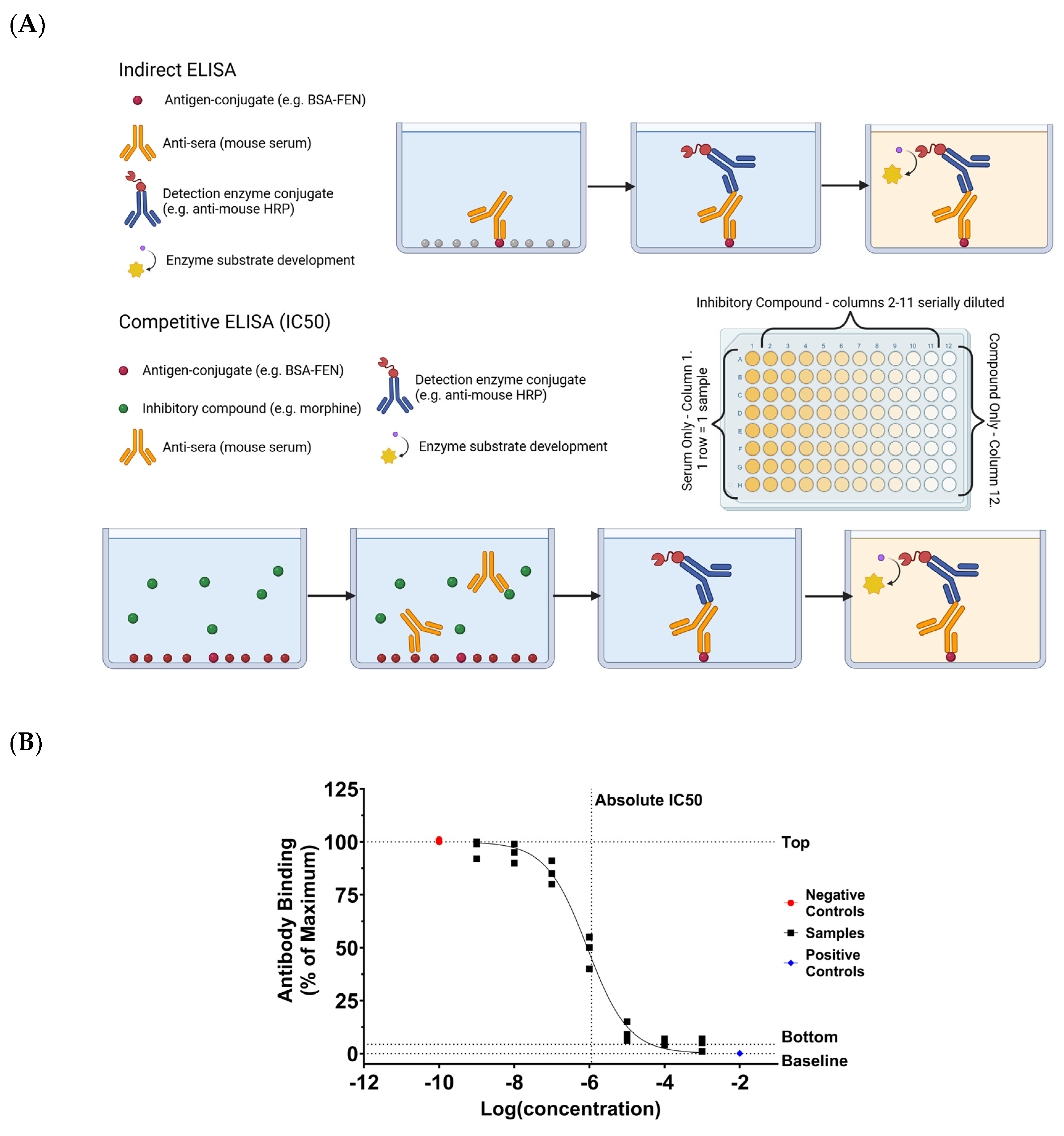

Table 1.
Select key pharmacokinetic, pharmacodynamic and chemical characteristics of clinically used opioid compounds pertinent to opioid vaccine development and testing.
Table 1.
Select key pharmacokinetic, pharmacodynamic and chemical characteristics of clinically used opioid compounds pertinent to opioid vaccine development and testing.
| Compound1 | Fentanyl | Bupre-norphine | Morphine | Oxycodone | Methadone | Naltrexone | Naloxone | Remi-fentanil | Su-fentanil | Al-fentanil |
|---|---|---|---|---|---|---|---|---|---|---|
|
Molecular weight (g/mol) |
336.5 g/mol [12] |
467.6 g/mol [13] |
285.3 g/mol [14] |
315.4 g/mol [15] |
309.4 g/mol [16] |
341.4 g/mol [17] |
327.4 g/mol [18] | 376.4 g/mol [19] | 386.6 g/mol [20] | 416.5 g/mol [21] NOTE: Fast onset and short duration of action, used as an analgesic supplement |
| Calculated Molar Concentration (mM) | ||||||||||
| Plasma | 6.0 x 10⁻⁷ |
4.7 x 10⁻⁶ | 5.8 x 10⁻⁶ (Immediate Release) 3.2 x 10⁻⁶ (Controlled Release) |
1.6 x 10⁻⁴ (Immediate Release) 1.2– 1.5 x 10⁻⁵ (Controlled Release) |
3.8 x 10⁻⁴ | 8.9 x 10⁻⁶ |
8.6 x 10⁻⁶ |
1.5 x 10⁻⁵ |
1.9 x 10⁻⁵ |
1.3 – 3.3 x 10⁻⁵ |
| Serum | - | 1.7 x 10⁻⁷ - 2.2 x 10⁻⁶ |
2.8 x 10⁻⁴ (~ 5 minutes after IV dose of 10 mg to healthy volunteer) 0.03 (60 minutes after administration to chronic cancer patients with severe pain) |
Oxycodone: 3.6 x 10⁻³ Noroxycodone: 2.2 x 10⁻³ Oxymorphone: 1.7 x 10⁻⁵ Noroxymorphone: 2.7 x 10⁻⁴ |
1.1 x 10⁻⁴ | 7.5 x 10⁻⁶ |
2.0 x 10⁻⁶ |
- | 1.9 x 10⁻⁵ – 3.9 x 10⁻⁵ |
3.3 X 10⁻⁵ mM |
|
Maximum Recommended Adult Dose* |
#IV: 1-2 mcg/kg, usual max dose of 100 mcg q1-2 hours for severe pain in opioid naïve adults [22] |
Buccal: 900 mcg every 12 hours for chronic pain; 32 mg/day for OUD treatment [13] IM or IV: 100-300 mcg every 6-8 hours for acute pain in opioid naive patients |
PO: 15-30 mg every 4 hours [23] 1600 mg/day Dosing depends on intensity of pain and level of tolerance; can be significantly higher in some individuals [24] |
PO: 5-15mg every 4-6 hours immediate release formulations; extended release formulations are dosed every 12 hours and dose is titrated to analgesic effect to max dose of 288 mg/da [25] |
PO: 5-10 mg every 6-8 hours for post-op pain; 60-120 mg Average effective daily dose for treating OUD [26] |
PO: 50 mg once daily for OUD IM dosing: 380 mg monthly for OUD [27] |
Endotracheal: 0.8-5 mg Intranasal: 2-4 mg, IV: 0.1-0.4 mg, IM/SC: 0.4-1 mg (dose may be repeated every 2-3 minutes until reaching the desired effect[28] |
0.1 - 0.2 mcg/kg/min for analgesia 0.5 - 1 mcg/kg/min or anesthetic effect [29,30] |
IV: 0.1 mcg/kg for analgesia [31] Up to 8 mcg/kg for anesthetic effect [32] |
IV: 245 mcg/kg for anesthesia induction; 75 mcg/kg for analgesia/anesthesia [33] |
| Cmax | ||||||||||
| Plasma | 1.8 ng/mL After multidose regimen (buccal tablet 400 mcg on day 1, then every 6 hours from day 4 to day 9 (21 doses) in healthy (opioid naïve) adult human volunteers. [34] |
10 ng/mL 1 hour after up to 32 mg dosing [13] | Immediate release: 5.8 nmol/L (1.1 hour after administration) (Tmax) Controlled release: 3.2 nmol/L at Tmax (2.7 hours after administration) [35] |
Up to 500 ng/mL in opioid tolerant cancer patients receiving 400 mg/day (ref: Comer articles and Minnesota groups) Controlled release: 39-47 ng/mL 40 mg dose [36] |
124-1225 ng/mL for patients on 10-225 mg/day peak plasma concentration range [16] |
26 ng/mL 2 days after 380 mg IM injection [27] 5.8-22 ng/mL 1 day after 1 gram naltrexone implant [37] |
26.2 ng/mL after 2 mg IV dose [18] | 40 ng/mL at an infusion rate of 1 mcg/kg/min.[29] | Up to 50 ng/mL after 5mcg/kg IV dose in surgical patients [38] |
For a dose of 15 mcg/kg, 30-80 ng/mL [39] |
| Serum | - | 0.4-4.6 ng/mL for single doses of 0.8 to 6.0 mg [40] |
283 nmol/L approximately 5 minutes after IV dose of 10 mg to healthy 70 kg volunteer 27-34 µM (60 minutes after administration to chronic cancer patients with severe pain) [41,42] |
3551 nM (Peak serum levels after IV dosing of oxycodone up to 840 mg daily dose) [43] |
353 ng/mL mean concentration in patients taking an average dose of 111 mg/day (dose range 40-500 mg/day) [44] |
Up to 150 mg approximately 3 hours after 100 mg PO bolus in patients taking 50 mg/day for 11-29 months [45] |
6 ng/mL, After 4 mg intranasal dose [46] |
- | 50-100 ng/mL minutes after 1500 mcg dose [47]) | 80 ng/mL (Mean value) after dose of 15 mcg/kg body weight in healthy volunteers [48] |
| LD50 in rodents2 | IV: 2.9mg/kg in rats PO: 18mg/kg in rats PO: 368 mg/kg in mice [12] IV: 11.2 mg/kg in mice SC: 62 mg/kg in mice [49] |
- | IV: 270 mg/kg in mice SC: 470 mg/kg in mice [49] |
PO: 426mg/kg in mice [15] |
- | 1100-1550 mg/kg in mice 1450mg/kg in rats [17] |
PO: 1g/kg in mice and rats SC: 286mg/kg in mice; 500mg/kg in rats [18] |
2.7 mol/kg in rats [19] |
- | - |
1 Heroin is not included here but is close in molecular structure to morphine and hydromorphone. 2 Since LD50 (=the lethal dose required to kill 50% of a test population) information in humans is extremely limited, we included LD50 information in rodents where available, acknowledging that it may be of limited relevance for human studies and may not correlate with LD50 in humans. Due to ethical and technical limitations, modern regulatory and scientific frameworks, including the Food and Drug Administration (FDA) Modernization Act 2.0 [50,51] encourage shifting away from traditional lethal dose testing and towards new approach methodologies including sophisticated human in vitro testing and emerging computational methods leveraging artificial intelligence and integration of in vitro, in chemico and in vivo data to predict safety profiles of new vaccine and immunomodulatory formulations and further de-risk human challenge studies. * Uptodate Lexidrug was used as a source for dosing information if no other reference was cited. # Transmucosal products (buccal, nasal, transdermal) have been discontinued in the US.
Disclaimer/Publisher’s Note: The statements, opinions and data contained in all publications are solely those of the individual author(s) and contributor(s) and not of MDPI and/or the editor(s). MDPI and/or the editor(s) disclaim responsibility for any injury to people or property resulting from any ideas, methods, instructions or products referred to in the content. |
© 2026 by the authors. Licensee MDPI, Basel, Switzerland. This article is an open access article distributed under the terms and conditions of the Creative Commons Attribution (CC BY) license (http://creativecommons.org/licenses/by/4.0/).
Copyright: This open access article is published under a Creative Commons CC BY 4.0 license, which permit the free download, distribution, and reuse, provided that the author and preprint are cited in any reuse.