
Submitted:
09 October 2026
Posted:
10 October 2026
You are already at the latest version
Abstract
The distinctive algebraic properties of tropical semirings and their connections to computationally difficult problems have made tropical cryptography a subject of growing interest. However, a growing body of cryptanalytic results has shown that many such schemes are vulnerable to efficient attacks. In this paper, we develop a unified mathematical framework for analyzing this phenomenon through the notion of structural collapse. Structural collapse occurs when the reconstruction problem on protocol-generated instances reduces to a problem that is polynomial-time solvable on the re-sulting instances and whose solutions yield a valid reconstruction of the cryptographic target. We examine recurring structural reduction mechanisms, including linearization, periodicity and mono-tonicity, optimization and inequality-based reformulations, and residual separability, and distin-guish structural reduction from structural collapse. We further formalize the complexity gap be-tween established worst-case hardness of unrestricted algebraic problems and polynomial-time re-construction on structured protocol-generated families. We show that structural vulnerabilities identified in a broad class of tropical and semiring-based cryptographic protocols are not caused by insufficient algebraic richness, but by structural properties that permit reductions to computationally simpler problems. The framework provides a basis for analyzing the computational structure of semiring-based cryptographic protocols and for identifying structural properties relevant to future protocol design.
Keywords:
tropical cryptography
; semiring-based cryptography
; structural collapse
; complexity gap
; tropical semiring
MSC: 94A60; 15A80; 68Q17
1. Introduction
Tropical and idempotent semiring-based algebraic structures have attracted interest as potential platforms for cryptography, particularly in the context of post-quantum security. The motivation arises from the apparent computational hardness of several associated problems, including the tropical discrete logarithm problem, the tropical semigroup action problem, the tropical semidirect product problem, and the tropical matrix power function problem. Many of these problems are known or conjectured to be computationally hard, with some exhibiting NP-hardness in the worst case. Consequently, a variety of cryptographic protocols have been proposed over tropical and related semirings, aiming to exploit this algebraic richness.
However, over the past decade, a substantial body of cryptanalytic work has shown that many such constructions are vulnerable to efficient attacks. This raises a fundamental question: why do structurally different tropical and semiring-based constructions repeatedly admit efficient cryptanalytic reductions? Many proposed schemes are motivated by the assumption that increasing the algebraic richness of a construction, whether through higher-degree polynomials, larger matrix dimensions, or more sophisticated semiring structures, enhances security. Yet schemes designed to avoid known attacks, or to increase algebraic richness have still been shown to be vulnerable to cryptanalysis. Recent attempts to improve the security of tropical cryptographic constructions have explored layered and supertropical extensions of tropical semirings. Nonetheless, cryptanalytic results show that such modifications do not necessarily prevent efficient attacks. For instance, Alhussaini and Sergeev in [1] showed that a recently proposed multi-party key exchange protocol over a modified supertropical semiring [2] can be reduced to solving one-sided linear systems, enabling complete recovery of the shared secret key.
In this paper, we develop a unified structural framework for analyzing this phenomenon. The central observation is that protocol-generated instances may possess additional algebraic structure that permits reconstruction without solving the associated unrestricted problem in its full generality. We distinguish structural reduction (transforming a reconstruction problem into another computational form) from structural collapse, which occurs only when the reduced problem is polynomial-time solvable on the resulting instances and yields a valid reconstruction of the cryptographic target. Representative mechanisms include linearization, periodicity and monotonicity, optimization- and inequality-based reformulations, and residual separability.
We further formalize the complexity gap between worst-case hardness of an unrestricted problem and polynomial-time reconstruction on a protocol-generated family. This matters because some hardness results used in tropical cryptography apply only to unrestricted decision problems, whereas cryptanalysis typically focuses on search or reconstruction on structured instances. As a result, worst-case hardness alone does not establish the computational hardness of protocol-generated reconstruction. The distinction between worst-case hardness and the hardness of instances arising in cryptographic use is well known in complexity-based cryptography. We aim to formalize how this difference becomes evident in the structured reconstruction problems generated by semiring-based protocols.
We characterize the conditions under which structural reductions yield polynomial-time reconstruction and, therefore, structural collapse. We show how coefficient reconstruction can be carried out using one-sided semiring linear systems; explain when any correct coefficient representation is enough for cryptanalytic reconstruction; clarify the gap between worst-case hardness and the complexity of protocol-generated reconstruction; introduce residual separability as another way to obtain polynomial-time reconstruction. We also analyze polynomial-time constructible marginal masking and explain why generating masks efficiently does not, on its own, provide a separate hardness assumption. Together, these results define a complexity-theoretic framework for the structured reconstruction problems created by semiring-based cryptographic protocols.
The framework developed in this paper focuses on structural reconstruction and key-recovery vulnerabilities that come from protocol-generated algebraic instances. It is not intended to provide a unified formal security model for all cryptographic primitives considered in the literature review. Different constructions, such as key-exchange protocols and signature schemes, have distinct security notions and must be analyzed within their proper security models. In this work, a structural attack is relevant only when it enables an adversary to recover the secret information, shared key, or any witness that compromises the construction’s security goal. At the same time, the absence of structural collapse does not constitute a proof of security.
The rest of the paper is organized as follows: Section 2 presents the necessary preliminaries, discusses the computational model and reviews the relevant literature; Section 3 introduces the concept of structural collapse in semiring-based cryptography; Section 4 examines the principal reduction mechanisms and the conditions under which they lead to structural collapse; Section 5 develops the concept of the complexity gap induced by structural collapse; Section 6 presents the main theoretical results; Section 7 discusses the implications of these results and proposes design principles for semiring-based cryptography; finally, Section 8 concludes the paper.
2. Preliminaries and Literature Review
In this section, we briefly recall the main algebraic notions and computational problems used throughout the paper. Standard references for tropical and max-plus algebra include [3,4,5].
2.1. Idempotent Semirings
A semiring is an algebraic structure (,⨁,⨂) consisting of a nonempty set equipped with two binary operations: addition ⊕ and multiplication ⊗, such that: (,⊕) is a commutative monoid with neutral element 0; (,⊗) is a monoid with neutral element 1; multiplication distributes over addition:
for a, b,c ∈ ; the neutral element 0 is absorbing: a⊗0 = 0⊗a = 0 .
a⊗(b⊕c) = (a⊗b)⊕(a⊗c),
(a⊕b)⊗c = (a⊗c)⊕(b⊗c);
(a⊕b)⊗c = (a⊗c)⊕(b⊗c);
A semiring is called commutative if its multiplication is commutative; that is, a⊗b = b⊗a for all a,b ∈ .
A semiring is called (additively) idempotent if
for all a ∈ .
a⊕a = a
In this paper, the term tropical semiring refers to the standard max-plus and min-plus idempotent semirings, in which tropical addition is given by maximum or minimum, respectively, while tropical multiplication is ordinary addition, i.e.:
where ℝ denotes the field of real numbers.
ℝmax,+=(ℝ ∪ {−∞},max, +), ℝmin,+=(ℝ ∪ {+∞},min, +),
In ℝmin,+, tropical addition is a⊕b = min(a,b), and tropical multiplication is a⊗b = a + b. The additive neutral element is +∞, while the multiplicative neutral element is 0.
In ℝmax,+, tropical addition is a⊕b = max(a,b), and tropical multiplication is a⊗b = a + b. The additive neutral element is −∞, while the multiplicative neutral element is 0.
These semirings are very important in tropical algebra, optimization theory, automata theory, and semiring-based cryptography.
2.2. Tropical Matrix Algebra
Let be an idempotent semiring. The set of all n × n matrices over is denoted by Mn(). Matrix addition is defined entrywise:
(A⊕B)ij= Aij⊕Bij.)
Matrix multiplication is defined by

For example, in the tropical semiring ℝmin,+, this becomes
while in ℝmax,+ it is
For a matrix A ∈ Mn(), tropical powers are defined recursively by
where I is the tropical identity matrix. For example, in the tropical semiring ℝmin,+:
A⨂0 = I,…,A⨂n = A⨂(n−1)⨂A, n ≥ 1
2.3. Tropical Linear Systems
Let be a tropical semiring. A tropical linear system is a system of equations of the form
where A ∈ Mm×n(), x ∈ n is an unknown vector, b ∈ m. Equivalently, (1) consists of scalar equations
A⊗x = b,
For the matrix equalities considered in this paper, an equality between two m × n matrices yields one scalar equation for each entry and therefore induces mn scalar equations.
2.4. Tropical Polynomials
Let (,⨁,⨂) be a commutative semiring and let x1,…,xn be commuting indeterminates over . For α ∈ ℕ, the notation denotes the α-fold semiring product of xj, with . Thus, the symbol ⊗ in the exponent notation refers to repeated semiring multiplication and does not define an operation on ℕ.
A monomial over in the indeterminates x1,…,xn is an expression of the form
where a ∈ and α1,…,αn ∈ ℕ. Its total degree is α1+…+αn.
A polynomial over the commutative semiring is an expression of the form
where ai ∈ and αij ∈ ℕ.
A polynomial system is called degree-two if every monomial has total degree at most two.
The commutativity assumption in this subsection applies only to the scalar semiring ; the matrix semiring Mn() considered elsewhere in the paper is generally noncommutative under matrix multiplication.
2.5. Computational Model, Encoding, and Protocol-Generated Reconstruction Problems
The tropical semirings introduced in Section 2.1 are algebraically defined over the extended real numbers, i.e., over ℝ ∪ {−∞} or ℝ ∪ {+∞}. For computational-complexity statements, however, algorithmic inputs must admit finite encodings. We therefore distinguish the algebraic ambient semiring from the computational domain on which an algorithm operates. For the computational-complexity analysis in this paper, we restrict protocol instances to the integer tropical semirings
This restriction concerns only the finitely encoded computational instances used in the complexity analysis and does not redefine the ambient real tropical semirings introduced in Section 2.1. Each finite integer a is represented in binary, with encoding length
where the constant accounts for the sign and the chosen integer encoding. The symbols +∞ and −∞ are represented by distinguished constant-size symbols. Thus, every scalar occurring in a computational instance has a finite binary representation.
𝓁(a) = ⌈log2(∣a∣ + 1)⌉ + O(1),
For a matrix A = (aij) ∈ Mm×n(𝕋), where 𝕋 denotes one of the finitely representable computational semirings above, its encoded length is defined by
The encoding length of a tuple of matrices, scalars, exponents, and other public parameters is the sum of the encoding lengths of its components. For a public protocol instance I, we write |I| for the total bit length of its complete encoding. Thus, the computational size of an instance is its encoded length, not the numerical value of the security parameter and not merely a matrix dimension or coefficient bound.
The cost of a tropical scalar operation is evaluated with respect to these finite representations. For example, in the max-plus setting,
a⊕b = max(a, b), a⊗b = a + b.
Thus, a tropical addition requires comparison of the encoded operands, whereas a tropical multiplication requires addition of their finite representations. Analogous remarks apply to the min-plus semiring. Hence, the cost of a scalar semiring operation depends on the bit lengths of its operands and is not regarded as constant in the bit-complexity model.
The growth of intermediate values must also be taken into account. Suppose first that a and b are integers whose binary encoding lengths are at most L. Since tropical multiplication is ordinary addition,
and the bit length of a + b is at most L + O(1). More generally, if
is an ordinary sum of t integers satisfying |ai| < 2L, then |s| < t ⋅2L, so the binary encoding length of s is
a⊗b = a + b,
s = a1+…+at,
O(L + logt).
Hence, a polynomially bounded number of successive tropical multiplications causes only polynomial growth in the encoded length of intermediate integer values.
For tropical matrices, multiplication is likewise evaluated in the bit model. The standard product of two n × n tropical matrices requires O(n3) scalar tropical operations. If all input entries have bit length at most L, then each candidate sum aik + bkj has bit length L + O(1). Therefore, a single tropical matrix multiplication has polynomial bit complexity in n and L. For nested matrix products, however, the accumulation of bit length across multiple multiplication layers must also be controlled. The following Lemma 1 provides the required bound.
We distinguish throughout the paper between algebraic-operation complexity and bit complexity. An algebraic-operation bound counts semiring additions, multiplications, comparisons, or related primitive operations. Such a bound alone does not imply a bit-complexity bound unless both the cost of each primitive operation and the growth of intermediate encodings are also controlled. Unless stated otherwise, the term polynomial time in this paper refers to bit complexity measured with respect to the total encoded input length |I|.
For the integer tropical semirings considered above, the size of intermediate values arising from nested tropical matrix operations can be bounded explicitly. This is important because an algebraic-operation bound alone does not imply a polynomial bit-complexity bound unless the entries produced during the computation also have polynomially bounded encodings.
Lemma 1 (Bit-Length Growth under Nested Tropical Matrix Products). Let
where 𝕋 = ℤ ∪ {−∞} in the max-plus case or 𝕋 = ℤ ∪ {+∞} in the min-plus case. Suppose that every finite entry of the input matrices has absolute value at most H < 2L. Then every finite entry of the tropical product
has absolute value at most tH, and hence binary encoding length at most
A1,…,At ∈ Mn(𝕋),
C = A1⊗A2⊗…⊗At
L + ⌈log2t⌉ + O(1).
The same bound applies to intermediate products, with t replaced by the corresponding number of factors.
Proof. Consider first the min-plus case. By the definition of tropical matrix multiplication, for fixed i,j ∈ {1, … , n} it follows that:
If cij is finite, then at least one of the candidate sums in the minimum is finite. Every finite candidate is an ordinary sum of exactly t finite input entries. Since each finite input entry has absolute value at most H, every finite candidate sum has absolute value at most tH. Therefore, it holds:
|cij| ≤ tH < t ⋅ 2L.
Hence every finite entry of C can be represented using at most
bits, where the constant accounts for the sign and the chosen integer encoding.
L + ⌈log2t⌉ + O(1)
The same argument applied to the partial product extends to every intermediate product, with t replaced by the number of factors involved.
The max-plus case is identical, with maximum replacing minimum and −∞ replacing +∞. This proves the claim. □
Corollary (Bit Complexity of Nested Tropical Matrix Products). Under the assumptions of Lemma 1, a sequential product of t matrices in Mn(𝕋) can be computed using
scalar tropical operations, while every finite intermediate entry has binary encoding length
O(tn3)
O(L + logt).
Consequently, if t is polynomially bounded in the encoded input length |I|, then the complete computation has polynomial bit complexity.
Proof. A tropical product of two n × n matrices requires O(n3) scalar additions and comparisons. Hence, t − 1 successive multiplications require O(tn3) scalar tropical operations. By Lemma 1, the binary encoding length of every finite intermediate entry is O(L + logt). Since integer addition and comparison are polynomial-time in the bit lengths, the complete computation is polynomial-time in the bit model whenever t is polynomially bounded in |I|. □
Tropical matrix addition does not introduce further magnitude growth, since each entry of an entrywise tropical sum is the minimum or maximum of the corresponding input entries and is therefore equal to one of them. Consequently, for expressions combining tropical matrix products and tropical sums, the relevant bit-length growth is determined by the number of scalar factors accumulated along each multiplicative term after entrywise expansion. If every such term contains at most t finitely encoded input factors satisfying the hypotheses of Lemma 1, then every finite resulting value has binary encoding length O(L + logt).
Matrix powers computed by repeated squaring satisfy the same bit-length principle. Suppose that every finite entry of A has absolute value at most H < 2L. For every positive integer s, each finite entry of A⊗s is the minimum or maximum of ordinary sums of s finite entries of A. Hence,
whenever the entry is finite, and its bit length is at most
L + ⌈log2s⌉ + O(1).
In particular, after k repeated squarings, starting from A, the resulting matrix is . Thus s = 2k, so the magnitude bound becomes 2kH, whereas the corresponding bit-length bound is L + k + O(1). This means that even though corresponds to an expanded tropical product containing 2k factors, the binary encoding length of each finite resulting entry grows only linearly with the number k of squaring steps.
The explicit protocol instance considered in Section 6.3 is defined over an integer tropical semiring and is therefore covered directly by Lemma 1 and its corollary.
The computational tasks considered below are primarily search and reconstruction problems, not merely decision problems. Given a public protocol instance I, a reconstruction problem asks for a witness w that is consistent with the public data and satisfies the algebraic relations specified by the protocol. Depending on the construction, w may be a secret exponent, a coefficient vector, a matrix factorization, an equivalent representation of a public matrix, or the shared cryptographic key itself. Importantly, cryptanalysis need not always recover the originally sampled secret. For several constructions considered in this paper, it is sufficient to recover an equivalent witness w that is consistent with the public transcript and enables reconstruction of the same cryptographic target. This distinction is important when comparing cryptographic reconstruction with known complexity results. Some worst-case hardness results used to motivate tropical cryptographic constructions apply to unrestricted decision problems, whereas cryptanalysis typically concerns a corresponding search, reconstruction, or key-recovery task. Accordingly, NP-hardness or NP-completeness of an unrestricted decision problem is used here only to characterize the worst-case complexity of the underlying problem family; it is not interpreted as a security proof for a cryptographic construction. The security relevance of such hardness results depends on the computational difficulty of the instances generated by the protocol and on the distribution induced by its generation procedure.
Since the paper examines several kinds of cryptographic constructions (including key-exchange and matrix-based protocols), not only encryption schemes, we use a general protocol-instance generation model. Let λ ∈ ℕ be a security parameter. For a given protocol, let Gen(1λ; r) ⟶ I denote the prescribed randomized generation procedure producing a public protocol instance I, where r represents the random choices made during parameter generation, key generation, and protocol execution. The family of public instances generated at security parameter λ is
λ = {I: I = 𝖦𝖾𝗇(1λ; r) for some admissible r}.
We write
The security parameter λ indexes the protocol-generated family, whereas the running time of reconstruction algorithms is measured with respect to the actual encoded length |I|. We assume that the protocol-generation procedure runs in probabilistic polynomial time in λ. Consequently, there exists a polynomial q such that |I| ≤ q(λ) for every I ∈ λ produced by the protocol. Thus, λ should not be interpreted as the size of the instance itself. Rather, it determines protocol parameters—such as matrix dimensions, exponent ranges, and coefficient bit lengths, which in turn determine the total encoding length |I|.
As a concrete illustration, suppose that a public instance contains two n × n tropical integer matrices and that every finite entry has binary encoding length at most L. The two matrices contain 2n2 entries and therefore contribute O(n2L) bits to the instance encoding, apart from the encoding of the dimensions and any additional public parameters. For example, if n = 10, L = 10, the two matrices contain 200 entries, so their entry encodings contribute on the order of 2000 bits, in addition to the encoding of the matrix dimensions and any other public parameters. Neither n = 10 nor L = 10 represents the size of the complete instance; the relevant input size is the total number of bits required to encode all public data. A complete protocol-generated instance illustrating the model Gen(1λ; r) is given in Section 6.3.
Let Rec() denote the corresponding reconstruction problem. Given I ∈ , the task is to compute a valid witness w, or information from which the relevant cryptographic target can be reconstructed according to the protocol. An algorithm for Rec() runs in polynomial time if there exists a polynomial p such that, for every input I ∈ , its running time is at most p(|I|), where |I| denotes the total encoded length of the public instance. A polynomial-time cryptanalytic reduction from Rec() to a computational problem consists of polynomial-time procedures that transform a public instance I ∈ into an instance J of , and then transform an appropriate solution of J into a valid reconstruction witness w or into information sufficient to recover the relevant cryptographic target. If the resulting instances of can be solved in polynomial time under the same encoding model, then Rec() is polynomial-time solvable. This computational model is used throughout the paper to distinguish the worst-case complexity of unrestricted algebraic problems from the complexity of structured reconstruction problems induced by cryptographic protocols.
2.6. Literature Review
Research on semiring-based cryptography has developed along several interacting directions, motivated by the expectation that non-classical algebraic settings, especially idempotent or non-commutative ones, may offer alternatives to conventional discrete-logarithm-based cryptography, particularly in the post-quantum context. At the same time, the literature increasingly shows that many such constructions are susceptible to efficient attacks once their internal algebraic structure is properly exploited.
Among the earliest and most influential protocol families are the tropical Stickel-type schemes. Stickel-type key-exchange schemes, originating from the protocol proposed by Stickel [7] and subsequently adapted to tropical algebra by Grigoriev and Shpilrain [8], form an important class of semiring-based cryptographic constructions; see also [9] for a recent survey and classification of tropical Stickel-type protocols.
In these constructions, public keys are typically built from commuting matrices or polynomials in public matrices. The literature shows that such protocols frequently reduce to recovering unknown matrices Xand Y from equations of the type X⊗D⊗Y= K, often under additional compatibility conditions. The review [10] explicitly notes that many of these protocols have been broken by attacks based on almost-linear periodicity, polynomial representations, and reductions to tropical linear systems.
Another approach concerns semidirect-product cryptography and the Semidirect Discrete Logarithm Problem (SDLP). These constructions were initially viewed as promising because Shor’s original discrete logarithm algorithm relies crucially on commutativity, while SDLP is defined in a non-commutative framework. However, subsequent cryptanalytic results have shown that this optimism is limited. Imran and Ivanyos [11] establish efficient quantum algorithms for important classes of SDLP instances, including those over solvable groups and certain matrix groups over finite fields. These results reinforce the broader message of the present work: increasing algebraic sophistication does not, by itself, eliminate structural vulnerabilities.
Recent work on tropical matrix semiring signatures [12] points in the same direction and explicitly emphasizes that worst-case NP-hardness is not a sufficient security argument, since cryptographic security depends on the hardness of the concrete structured instances generated by the protocol, not on asymptotic worst-case complexity.
A further relevant strand in the literature comes from tropical optimization and approximation theory. Krivulin’s paper [13] on tropical best approximation problems shows that expressions nonlinear in the classical sense often become linear or optimization-theoretic in tropical algebra, enabling explicit algorithms, iterative procedures, and polynomial-time subroutines. In a cryptographic context, this is a warning sign rather than a benefit: if a protocol can be reformulated as a tropical approximation or optimization problem, it may inherit algorithmic tractability rather than hardness.
More recently, marginal-set-based masking has been proposed as a way to obscure algebraic structure [14]. However, the constructions themselves are obtained by solving tropical linear systems or linear programming problems. As a result, these methods may provide obfuscation or masking, but they do not, by themselves, introduce a new hardness assumption.
Another line of work concerns tropical knapsack-type problems over matrix semirings. Paper [15] investigates subset-sum and knapsack problems over tropical matrix semigroups and proves that these problems are NP-complete in the worst case. At the same time, the authors demonstrate the existence of pseudo-polynomial algorithms, as well as polynomial-time generic algorithms for significant classes of instances. This coexistence of worst-case hardness and generic tractability provides strong evidence that algebraic problems over tropical structures may appear hard in principle, while significant classes of instances may exhibit sufficient structure to be efficiently solvable. For cryptographic applications, worst-case hardness alone is insufficient; computational hardness must also persist for instances arising with non-negligible probability under the relevant key-generation or protocol-induced distribution. Average-case complexity provides a standard framework for studying such distribution-dependent hardness. Consequently, the security relevance of a worst-case hard problem depends on whether the structured instances generated by the protocol retain the required computational difficulty. Accordingly, hardness should be assessed with respect to the distribution of instances generated by the protocol and not inferred solely from the worst-case complexity of the unrestricted problem.
The cryptanalytic results reviewed above should not be interpreted as establishing an inherent insecurity of semiring-based cryptography as a whole. Rather, they show that several proposed constructions admitted exploitable structural properties that were not excluded by their original security analyses. In modern cryptographic practice, security claims should be formulated with respect to a clearly specified security model and supported, where appropriate, by rigorous reductions to well-defined computational assumptions. The structural analysis developed in this paper is complementary to such provable-security approaches: it identifies conditions under which protocol-generated reconstruction problems admit efficient attacks. Conversely, the absence of structural collapse does not, by itself, constitute a proof of cryptographic security.
The use of a non-classical algebraic structure should not, by itself, be interpreted as evidence of post-quantum security. In particular, replacing conventional algebraic operations with tropical, idempotent, or other semiring operations does not establish resistance to quantum or classical attacks. A post-quantum security claim requires a clearly specified security model together with a computational assumption for which no efficient classical or quantum attack is known and, where appropriate, a rigorous reduction relating the security of the construction to that assumption. The structural analysis developed here is complementary to this requirement: it examines whether protocol-generated instances preserve the intended computational difficulty or instead admit efficient reconstruction through additional algebraic structure.
3. Structural Collapse in Semiring-Based Cryptography
The cryptanalytic results reviewed in the previous section reveal a striking common pattern. Existing cryptanalytic attacks may appear unrelated − some exploit periodicity, others linearization, optimization, polynomial representations, or monotonicity. Nevertheless, they all share the same mathematical feature: protocol-generated structure transforms the original reconstruction problem into another computational problem that may admit a more efficient solution method on the resulting structured instances. This observation suggests that resistance to the structural attacks considered here depends not only on the hardness of the underlying algebraic problem but also on whether the protocol preserves that hardness during instance generation, and does not imply an inherent weakness of semiring-based cryptography. Rather, they indicate that the security analysis of a particular construction should determine whether its key-generation and protocol mechanisms induce exploitable structural regularities that make the associated reconstruction problem easier than the unrestricted underlying problem. To formalize the common mechanism underlying several successful attacks on semiring-based cryptographic protocols, we introduce the notion of structural collapse.
For a family of protocol-generated public instances, let Rec() denote the associated reconstruction problem: given a public instance I ∈ , recover the original secret or an equivalent object sufficient to reproduce the cryptographic computation. All complexity statements below are understood under the encoding and computational model specified in Section 2.5.
Definition 1. (Structural collapse) Let be a family of finitely encoded instances generated by a cryptographic protocol and let Rec() denote the associated reconstruction problem. We say that Rec() exhibits structural collapse if structural properties shared by the instances in yield a deterministic algorithm that, for every I ∈ :
- performs any required structural transformation in polynomial time;
- solves the resulting reconstruction task in polynomial time;
- produces a valid solution to Rec(), or information from which the corresponding cryptographic target can be recovered in polynomial time.
The running time is measured with respect to the encoded length |I|, under the computational model specified in Section 2.5.
Thus, structural reduction does not by itself imply structural collapse; structural collapse occurs only when the resulting reconstruction problem can be solved in polynomial time and the relevant cryptographic target can be recovered efficiently.
Observation 1 (Structural Reductions in Existing Cryptanalysis). The cryptanalytic results reviewed in Section 2 exhibit several mechanisms by which protocol-generated structures can simplify reconstruction. Representative examples include linearization and algebraic representation [1,10,16,17], almost-linear periodicity [18,19], monotonicity-based search [20], and optimization-based reformulation [21]. These mechanisms represent different forms of structural reduction observed in existing cryptanalytic results. Their presence alone does not establish structural collapse in the sense of Definition 1; for a particular protocol, it is additionally necessary to show that the resulting reconstruction problem is polynomial-time solvable under the computational model of Section 2.5.
The conceptual framework of structural reduction and structural collapse is illustrated in Figure 1.
4. Structural Reduction Mechanisms in Semiring-Based Cryptanalysis
The cryptanalytic results reviewed in Section 2 exhibit several mechanisms by which the structure of protocol-generated instances can simplify reconstruction. In the terminology introduced in Section 3, these mechanisms are called structural reductions. A structural reduction constitutes structural collapse only when the reduced problem is polynomial-time solvable on the relevant protocol-generated instances and its solution yields a valid reconstruction of the cryptographic target.
4.1. Linearization and Algebraic Representation
Linearization is an important structural reduction that occurs in several semiring-based cryptographic constructions. The basic mechanism arises when a public object generated through matrix or polynomial operations can be represented as a linear combination, in the semiring sense, of known matrices with unknown scalar coefficients.
Consider a public matrix of the form
where K = {1,…,m} is a finite index set, Rk ∈ Mn() are public matrices and zk ∈ are unknown coefficients. Expanding entrywise yields
which defines a system in the unknowns zk.
Thus, the matrix relation induces n2 scalar equations in the m unknown coefficients z1,z2,…, zm. After vectorizing the entries of U and the matrices Rk, these equations can be written as a one-sided semiring linear system A⊗z = b, where Consequently, reconstruction of a coefficient representation of U is reduced to solving the induced one-sided linear system.
This type of reduction appears in several cryptanalytic settings discussed in Section 2. Matrix-polynomial representations play an important role in attacks on tropical Stickel-type constructions and related matrix-based schemes [10,16,17]. In addition, the cryptanalysis of the lex-supertropical protocol in [1] reduces the recovery problem to a one-sided linear system over the underlying semiring, from which sufficient information for shared-key recovery can be obtained. Linearization alone establishes a structural reduction, but not necessarily structural collapse. Whether collapse occurs depends on the computational complexity of the induced linear-system instances under the encoding model of Section 2.5. If the resulting instances can be solved in polynomial time, and a solution yields a valid reconstruction of the cryptographic target, then the reduction satisfies Definition 1 and constitutes structural collapse.
The formal conditions under which this mechanism leads to structural collapse are established in Section 6. In particular, the results there distinguish between recovering the originally selected coefficient vector and recovering any coefficient vector that provides a valid representation of the public matrix. For cryptanalytic purposes, the latter may already be sufficient when an equivalent representation enables reconstruction of the shared key.
Remark 1. The reduction presented here concerns a search/reconstruction problem: the objective is to find coefficients that represent the public matrix U. Therefore, it should be distinguished from decision problems concerning the existence of solutions to general tropical polynomial systems. Worst-case NP-completeness results for such decision problems do not, by themselves, determine the complexity of the reconstruction instances generated by a cryptographic protocol.
4.2. Periodicity and Monotonicity
A second class of structural reductions arises when sequences generated during protocol execution exhibit predictable behavior, such as periodicity or monotonicity. In protocols where a private exponent determines the position of a public value in such a sequence, these properties may substantially simplify exponent recovery. Periodicity and monotonicity are related in that both exploit the structure of protocol-generated sequences; however, their cryptanalytic mechanisms and complexity implications differ.
4.2.1. Almost-Linear Periodicity
Isaac and Kahrobaei [18] observed that the sequence of matrices generated by the tropical key-exchange protocol considered in their work exhibited almost-linear periodic behavior. More precisely, a matrix sequence {Hn} is almost-linearly periodic if there exist a period ρ, a linear factor ξ, and a defect d such that
for all matrix indices i,j. This structure allows exponent recovery to be reduced to the analysis of the transient and periodic parts of the sequence rather than an unrestricted search over the private exponent.
The resulting complexity conclusion, however, depends on the size of the defect and period. In particular, the attack is polynomial-time only when the portion of the sequence required to determine the periodic regime can itself be generated in polynomial time. The experimental results reported in [18] show small defects and periods for the tested protocol parameters and demonstrate the practical effectiveness of the attack, but they do not, by themselves, establish a polynomial bound for arbitrary parameter growth. Consequently, almost-linear periodicity provides a clear structural reduction, while structural collapse in the sense of Definition 1 requires an additional polynomial bound on the computational resources needed to exploit the periodic regime.
A stronger theoretical situation arises when only selected critical components of tropical matrix powers are required. The results on ultimate periodicity of critical rows and columns provide polynomial bounds on the corresponding transients (the number of initial powers that may occur before the row or column enters its ultimately periodic regime). For a tropical matrix A, let and denote the transients of the k-th row and k-th column, respectively, of the matrix-power sequence {A⊗t}. If k belongs to a critical cycle Z of length lZ, then
Since lZ ≤ n, both transients are bounded by n(n − 1). Thus, even when whole-matrix periodicity has a large transient, or is not available in the required form, protocol-relevant critical components may enter a predictable periodic regime after a polynomially bounded number of steps. This observation is particularly relevant to cryptanalytic procedures based on critical-cycle and CSR representations [19].
4.2.2. Monotonicity
A related but computationally stronger example is provided by the attack of Rudy and Monico [20]. For the tropical semidirect-product protocols considered there, let
(M,H)𝓵 = (M𝓵,H𝓵).
Using the natural partial order induced by idempotent tropical addition, they prove that
M1 ≥ M2 ≥ M3≥….
Thus, the first components of successive semigroup powers form a monotonically decreasing sequence. This order structure permits the private exponent to be located using binary search instead of exhaustive enumeration [20].
More precisely, suppose that Alice publishes A = Mm,m < 2K. An attacker first computes successive powers corresponding to
until obtaining an upper bound for m, and then performs binary search over the resulting interval. Importantly, the attacker need not recover Alice's original exponent m. It is sufficient to find an exponent m' satisfying Mm' = A, because Rudy and Monico show that such an equivalent exponent allows the attacker to reconstruct the same shared secret key. This provides a concrete example of the reconstruction approach introduced in Section 2.5: recovery of an equivalent secret representation may be cryptographically sufficient even when the originally sampled secret is not uniquely determined.
M1,M2,M4,M8,…
Therefore, periodicity and monotonicity should be regarded as two related forms of structural reduction: both exploit the order or recurrence properties of protocol-generated sequences to restrict the reconstruction problem. However, they are computationally distinct. Periodicity reduces the effective search through recurrence, whereas monotonicity may permit ordered search methods such as binary search. As in Section 4.1, the existence of such structure does not by itself imply structural collapse.
The complexity analysis in [20] makes this example particularly significant. Rudy and Monico show that exponent recovery requires at most K2 + K semigroup operations when previously computed successive squares are stored. Since tropical multiplication of k × k matrices requires O(k3) integer operations, the attack requires O(K2k3) integer operations. Taking into account the bit lengths of the matrix entries, they obtain a polynomial bit-complexity bound and expressed the attack as O(α3) bit operations in terms of the encoded size α of the transmitted matrix A. For fixed K, their estimate becomes O(α1.5) [20].
Therefore, the Rudy–Monico attack provides a particularly clear instance of structural collapse in the sense of Definition 1. The protocol-generated sequence possesses an order structure that yields a polynomial-time reconstruction procedure, and the recovered equivalent exponent is sufficient to reproduce the cryptographic target. By contrast, almost-linear periodicity should, in general, be classified as a structural reduction unless polynomial bounds on the relevant transient, period, and reconstruction procedure are established.
Consequently, periodicity and monotonicity can transform exponent recovery into a structured search over protocol-generated sequences. When this search is solvable in polynomial time with respect to the encoded input length, the reduction constitutes structural collapse in the sense of Definition 1.
4.3. Optimization-Based Structural Reduction
An additional structural reduction mechanism arises when cryptographic reconstruction can be reformulated as an optimization problem. In this setting, algebraic relations derived from the public protocol data are transformed into an optimization model whose variables encode unknown secret parameters or equivalent reconstruction. This reformulation may permit the use of established exact or heuristic optimization techniques.
A representative example is the cryptanalysis of the tropical Stickel protocol by Alhussaini and Sergeev [21]. The authors formulate the recovery problem as a mixed-integer linear programming (MILP) problem and also investigate heuristic global optimization techniques. Rather than attacking the original tropical matrix relations directly, the cryptanalysis exploits their structure to construct an optimization model from which cryptographically useful information can be recovered. Thus, the protocol-generated reconstruction problem admits an optimization-based structural reduction.
The computational interpretation of this reduction requires careful consideration. Reformulation as an optimization problem does not by itself imply polynomial-time solvability. In particular, general MILP is not a polynomial-time solvable problem, whereas heuristic optimization methods provide practical solution strategies without a general polynomial-time guarantee. Consequently, the optimization-based attack of [21] demonstrates that protocol-generated algebraic structure can enable effective cryptanalysis, but its formulation alone does not establish structural collapse in the sense of Definition 1.
More generally, optimization-based structural reduction constitutes structural collapse only when the optimization problem induced by the protocol-generated instances belongs to a polynomial-time solvable class and its solution yields a valid reconstruction of the cryptographic target. Otherwise, the reduction may still be cryptanalytically significant by producing a substantially more effective practical attack; however, it should be distinguished from polynomial-time structural collapse.
Thus, optimization can provide a powerful structural reduction of cryptographic reconstruction, but it constitutes structural collapse under Definition 1 only when polynomial-time solvability of the induced optimization problem is established.
4.4. Inequality-Based Reconstruction
Systems of inequalities provide another useful representation of reconstruction problems over idempotent semirings. In the max-plus setting, an equation of the form
implies the componentwise inequalities
for all j, together with the requirement that, for each i, equality is attained for at least one index j. Equivalently,
whenever aij is finite. Hence each equation imposes upper bounds on the unknown variables together with an attainment condition.
aij + xj ≤ bi,
xj ≤ bi − aij,
This representation is closely related to residuation methods and the solution theory of tropical linear systems [4,22]. It may simplify reconstruction by replacing a matrix or semiring equation with a family of scalar constraints whose feasibility and tightness can be analyzed separately.
However, from the viewpoint of the present study, the passage from semiring equations to inequalities should not automatically be classified as structural collapse. It is first a reformulation of the reconstruction problem. Whether it yields a structural reduction, and ultimately structural collapse in the sense of Definition 1, depends on the computational complexity of solving the resulting constraint system for the protocol-generated instances and on whether a feasible solution is sufficient to reconstruct the cryptographic target.
Thus, inequality-based formulations provide a useful tool for analyzing semiring reconstruction problems; however, additional complexity analysis is required before they can be interpreted as polynomial-time structural collapse.
Remark 2. The mechanisms described in Section 4.1, Section 4.2, Section 4.3 and Section 4.4 should be regarded primarily as structural reductions. Each exploits a regularity of protocol-generated instances to transform the original reconstruction problem into a different computational form, such as a one-sided tropical linear system, a structured search problem, an optimization problem, or a system of inequalities. However, the existence of such a reduction does not by itself imply structural collapse. In accordance with Definition 1, structural collapse occurs only when the reduced problem is polynomial-time solvable on the resulting protocol-generated instances and its solution yields a valid reconstruction of the cryptographic target. Thus, whether a particular structural reduction constitutes structural collapse must be established separately for the protocol and reduction under consideration.
The preceding mechanisms establish structural reductions of semiring-based reconstruction problems. Such a reduction does not by itself imply structural collapse: the reduced problem must additionally be solvable in polynomial time on the protocol-generated instances, and its solution must permit reconstruction of the cryptographic target. A complete numerical illustration of this distinction, including public-instance generation, linearization, alternative coefficient recovery, and shared-key reconstruction, is given in Section 6.3.
4.5. Structural Reduction Versus Structural Collapse
The mechanisms examined in this section expose a common pattern. Protocol-generated algebraic structure may transform a reconstruction problem into a more structured computational form, such as a one-sided tropical linear system, a search over a periodic or monotone sequence, an optimization problem, or a system of inequalities. Such a transformation constitutes a structural reduction, but it does not by itself imply that reconstruction is computationally easy.
Structural collapse occurs only when the reduced reconstruction problem is polynomial-time solvable on the relevant protocol-generated instances and its solution yields a valid reconstruction of the cryptographic target. Thus, the distinction between structural reduction and structural collapse depends not on the form of the reduction alone, but on the computational complexity of the resulting reconstruction problem under the encoding model of Section 2.5.
This distinction provides the basis for the complexity-gap analysis developed in the next section, where the relationship between the complexity of the underlying general problem and that of protocol-generated reconstruction is explicitly examined.
5. The Complexity Gap Induced by Structural Collapse
The distinction between structural reduction and structural collapse raises a broader complexity-theoretic question: how does the hardness of an unrestricted computational problem relate to the complexity of reconstruction on instances generated by a cryptographic protocol? This section examines this distinction and introduces the notion of a complexity gap between general problem hardness and protocol-generated reconstruction.
5.1. From Worst-Case Hardness to Protocol-Generated Complexity
A principal motivation for tropical and semiring-based cryptography is the existence of computationally difficult algebraic problems underlying tropical mathematics. In particular, the decision problem for one-sided tropical polynomial systems of degree two is NP-complete in the worst case [23]. These systems (for example, in ℝmax,+) include expressions of the form
which arise naturally in tropical algebra and optimizations.
Similarly, other problems used in tropical cryptography, such as tropical matrix factorization, tropical matrix power function, and certain semigroup action problems are NP-hard or widely regarded as computationally intractable in the worst case [10].
The distinction between worst-case hardness and effective complexity is illustrated by recent results on tropical knapsack-type problems [15]. Another example is shown in [1], where the authors argue that exact cover enumeration in the supertropical semiring is NP-complete in theory but remains easy on protocol-generated instances because the resulting systems contain very few tangible equations.
These examples highlight that worst-case computational hardness alone is insufficient to justify cryptographic security. The decisive factor is the computational complexity of the structured instances generated by the protocol, which may differ fundamentally from an unrestricted algebraic problem. This observation motivates the notion of the complexity gap, developed in the following sections.
5.2. Protocol-Generated Instance Families
To formalize this distinction, let Π denote an unrestricted computational problem with instance space . Let be the family of protocol-generated instance sets, where λ ⊆ , and let
denote the family of instances generated by a cryptographic protocol with security parameter λ. Let Rec() denote the associated reconstruction problem defined in Section 2.5.
The problems Π and Rec() play different roles. The former describes the unrestricted computational problem used to motivate a hardness assumption, whereas the latter concerns the structured instances produced by the protocol and asks for recovery of a cryptographically sufficient reconstruction from the public data.
Worst-case complexity results are established for arbitrary instances of a computational problem. However, cryptographic protocols generate only a structured subclass of instances determined by the protocol design. Every public transcript is produced according to fixed algebraic rules involving secret parameters, public matrices, and protocol-specific operations rather than being an arbitrary element of the instance space.
More formally, let Π be a computational problem over an idempotent semiring, let denote the set of all instances of Π, and let ⊆ be the subset generated by a cryptographic protocol. The subclass possesses structural properties that are absent from the unrestricted problem.
- Constructive generation. Every instance is generated from valid secret parameters and, therefore, satisfies the defining algebraic relations of the protocol.
- Low-dimensional parameterization. Unknown quantities usually depend on a relatively small number of secret coefficients, exponents, or polynomial parameters rather than arbitrary matrix entries.
- Algebraic dependencies. Public objects are related through polynomial expressions, matrix powers, commuting families, semidirect products, or other algebraic constructions prescribed by the protocol.
- Guaranteed feasibility. Because each public transcript is produced by honest protocol execution, the associated reconstruction problem always possesses at least one valid solution.
These properties distinguish protocol-generated instances from the unrestricted instances considered in complexity theory. Consequently, forms a highly structured subclass that may admit reductions unavailable for the unrestricted problem.
The distinction between the full instance space and the protocol-generated subclass is fundamental. Worst-case complexity characterizes the computational behavior of the entire problem class, whereas cryptographic security depends on the complexity of the structured instances produced by the protocol. Consequently, the relevance of an underlying hardness assumption to a semiring-based cryptographic construction depends on the computational complexity of the reconstruction problem on the protocol-generated family , rather than solely on the worst-case complexity of an unrestricted algebraic problem.
The relationship between the full instance space , the protocol-generated subclass , and the structurally collapsed problem is shown in Figure 2.
5.3. Structural Collapse as a Source of the Complexity Gap
Definition 2 (Complexity Gap). Let Π be an unrestricted computational problem with instance space , and let ⊆ be a family of instances generated by a cryptographic protocol. Let Rec() denote the corresponding reconstruction problem. We say that the protocol exhibits a complexity gap with respect to Π if Π has an established worst-case hardness result, while Rec() is solvable in deterministic polynomial time with respect to the encoded input length.
Structural collapse (in the sense of Definition 1) provides a mechanism by which such a complexity gap may emerge. The role of structural collapse should therefore be distinguished from that of structural reduction. A structural reduction transforms the reconstruction problem into a different computational form but does not by itself establish polynomial-time solvability. Structural collapse occurs only when the resulting reconstruction problem is polynomial-time solvable and yields a valid reconstruction of the cryptographic target. Consequently, only reductions satisfying these additional conditions establish the polynomial-time side of the complexity gap.
The mechanisms examined in Section 4 illustrate this difference. Linearization may lead to structural collapse when the induced one-sided tropical linear systems are polynomial-time solvable on the relevant generated instances. Periodicity provides a structural reduction whose complexity depends on the bounds governing the periodic regime, whereas monotonicity yields a concrete polynomial-time collapse in the Rudy–Monico attack [20]. Optimization-based and inequality-based reformulations may substantially simplify reconstruction, but they should not be classified as structural collapse unless polynomial-time solvability of the induced instances is established.
Thus, the complexity gap is not caused merely by the presence of algebraic structure. Rather, it arises when protocol-generated structure enables polynomial-time reconstruction despite an established worst-case hardness result for the unrestricted problem used to motivate the cryptographic construction.
Proposition 2 (Complexity under Structural Reduction). Let Π be a computational problem over an idempotent semiring, let be its instance space, and let ⊆ be a family of instances generated by a cryptographic protocol. Suppose that there exists a polynomial-time computable transformation ϕ: ⟶ (Π') to instances of a computational problem Π', together with a polynomial-time reconstruction procedure that, for every instance I ∈ , transforms a solution of ϕ(I) returned by the solver into a valid solution to the reconstruction problem Rec().
Then Rec() can be solved with polynomial overhead relative to the cost of solving the corresponding instances of Π'. If these instances of Π' are polynomial-time solvable with respect to their encoded input length, then Rec() is polynomial-time solvable, and exhibits structural collapse in the sense of Definition 1.
Proof. Let I ∈ be an instance generated by the protocol. The attacker first computes the transformed instance J = ϕ(I). Since ϕ is polynomial-time computable, this step requires time polynomial in the encoded input length |I|. The attacker then solves the resulting instance J of Π'. By assumption, a solution of J returned by the solver can be transformed in polynomial time into a valid reconstruction of Rec().
Let TRec(I) denote the total running time required to obtain a valid solution to Rec() from the protocol-generated instance I, and let denote the running time required to solve the reduced instance J = ϕ(I) of Π'. Since the transformation ϕ and the final reconstruction procedure are polynomial-time computable, there exist polynomials p1 and p2 such that
Here, p1(|I|) represents the cost of transforming I into the instance ϕ(I), represents the cost of solving that instance, and p2(|I| + |ϕ(I)|) represents the cost of converting the obtained solution into a valid reconstruction of Rec().
Since ϕ is polynomial-time computable, |ϕ(I)| is polynomially bounded in |I|. Therefore, if the corresponding instances ϕ(I) of Π' are polynomial-time solvable, all three terms in (3) are polynomially bounded in |I| . Hence Rec() is polynomial-time solvable with respect to the encoded input length, and the protocol-generated family exhibits structural collapse in the sense of Definition 1. □
The distinction between worst-case computational complexity and the complexity of structured subclasses of instances is a fundamental principle in computational complexity and modern cryptography. Worst-case hardness results characterize the most difficult instances of a computational problem, but they do not, by themselves, determine the complexity of restricted families of instances generated by specific algorithms or cryptographic protocols. Consequently, worst-case NP-hardness alone cannot be regarded as evidence for cryptographic security. This principle is well established in complexity theory and cryptography. As emphasized by Goldreich [24], cryptographic security is determined by the computational difficulty of the instance distributions generated by a protocol rather than by arbitrary worst-case instances. Accordingly, the security of a cryptographic construction depends on the effective complexity of the problems it actually generates.
Semiring-based cryptography provides a particularly natural illustration of this distinction [1,9,11,12,15,16,18,19,20]. Protocol-generated instances satisfy additional algebraic constraints arising from polynomial representations, commuting matrix families, matrix powers, semidirect-product constructions, and other protocol-specific mechanisms. Semidirect-product constructions provide another example of this phenomenon. In the tropical setting, cryptanalysis of semidirect-product key exchange has shown that structural properties of the protocol-generated matrix sequences can be exploited without solving the underlying problem in its unrestricted form [25]. Thus, the introduction of a semidirect-product structure does not, by itself, prevent structural reductions.
As demonstrated by the cryptanalytic results reviewed in Section 2, these structural properties frequently admit polynomial-time reductions that are unavailable for unrestricted instances.
5.4. Complexity Landscape
The preceding discussion shows that computational complexity in semiring-based cryptography should be considered at three distinct levels: worst-case complexity, generic-case complexity, and the complexity of protocol-generated instances (see Table 1). These levels describe fundamentally different computational regimes and should not be conflated when assessing cryptographic security.
Worst-case complexity describes the most difficult instances of an unrestricted problem family and gives an important theoretical characterization of the underlying computational problem. However, worst-case hardness does not imply that the instances generated by a specific cryptographic protocol are equally difficult.
Generic-case complexity describes the computational behavior of typical instances relative to a specified distribution or asymptotic model. Although this perspective can provide information beyond worst-case analysis, the relevant distribution need not coincide with the highly structured distribution induced by a cryptographic protocol.
Protocol-generated complexity concerns the reconstruction problem on the specific family of instances produced by the protocol. For cryptographic purposes, this is the most directly relevant level: if the associated reconstruction problem is polynomial-time solvable with respect to the encoded public-instance length, then the protocol-generated family exhibits structural collapse in the sense of Definition 1, irrespective of the worst-case hardness of the unrestricted problem.
Among these regimes, protocol-generated reconstruction complexity is the most directly relevant to the structural cryptanalysis considered in this paper. Worst-case and generic-case analyses remain important, but neither alone determines whether the structured instances produced by a protocol admit efficient reconstruction. In particular, structural collapse occurs when the associated reconstruction problem is polynomial-time solvable with respect to the encoded input length.
6. Main Theorems
In this section, we formalize the structural mechanisms underlying the repeated failure of semiring-based cryptographic constructions.
Let (,⨁,⨂) be an additively idempotent semiring and let Mn() denote the semiring of n × n matrices over , equipped with tropical matrix addition and multiplication. We consider cryptographic protocols whose security is based on computational problems over Mn(), including the Tropical Discrete Logarithm Problem (TDLP), the Tropical Semigroup Action Problem (TSAP), Two-sided Tropical Linear Systems, the Tropical Matrix Power Function (TMPF), and tropical polynomial factorization. These problems constitute the principal hardness assumptions underlying tropical cryptography [10].
6.1. Reduction to Linear Systems
We begin with the basic algebraic form that arises repeatedly in tropical Stickel-type protocols. In the standard setting, Alice’s public key has the form
where X and Y are chosen from commuting families generated by public matrices. In the polynomial case, this is written as
so that
U = X⊗W⊗Y,
Introducing the auxiliary coefficients zαβ = xα⊗yβ and the public matrices
we can represent the public matrix as
Rαβ = M⊗α⊗W⊗N⊗β,
Thus, reconstruction of a coefficient representation of U can be reduced to a one-sided semiring linear system in the auxiliary unknowns zαβ. Importantly, this reduction does not require recovery of the original coefficients xα and yβ separately. For cryptanalytic purposes, an alternative coefficient representation may already be sufficient when it enables reconstruction of the shared key, as established in Section 6.2.
This reduction appears explicitly in the cryptanalysis of tropical Stickel-type protocols in [26], where the auxiliary variables zαβ = xα⊗yβ transform the matrix reconstruction equation into a one-sided tropical linear system. The following theorem abstracts this mechanism from the particular tropical Stickel construction to coefficient reconstruction over an arbitrary additively idempotent semiring.
Theorem 3.
Let (,⊕,⊗) be an additively idempotent semiring, and suppose that
where U,R1,…,Rm ∈ Mn( ), the matrices Ri are known, and z1,…,zm ∈ are unknown coefficients. Then reconstruction of a coefficient vector representing U reduces in polynomial time to the one-sided semiring linear system:
Proof. Let us write the equality (4) entrywise. For each pair (γ,δ) ∈ {1,…,n}2, we have:
Hence, the original matrix reconstruction problem induces n2 scalar equations in the m unknown coefficients z1,…,zm. After fixing an ordering of the matrix entries, these equations form a one-sided semiring linear system
where A is the n2 × m matrix whose column i is the vectorization of Ri, and b is the vectorization of U. Constructing A and b requires only reading and rearranging the entries of the public matrices and therefore can be performed in time polynomial in the encoded input length under the computational model of Section 2.5.
A⊗z = b,
Conversely, if satisfies the induced system, then every entry satisfies
Therefore,
Thus, every solution of the induced one-sided system provides a valid coefficient representation of U. □
6.2. Recovery of the Shared Key from Any Solution
A key observation underlying the cryptanalysis of the initial tropical Stickel protocol is that recovering the original coefficients is unnecessary. Once the public matrix U has been represented by any coefficient family satisfying the induced linear system, that representation can be combined with the other party's public key to reconstruct the shared secret [26]. The following theorem abstracts this mechanism.
Theorem 4.
Let be a commutative additively idempotent semiring, and suppose Alice’s public key is
for some coefficient family rαβ ∈ . Suppose Bob's public key is
V = q1(A)⊗W⊗q2(B),
where q1(A) commutes with every A⊗α, and q2(B) commutes with every B⊗β. Then the shared key can be reconstructed from the coefficient family {rαβ} as
V = q1(A)⊗W⊗q2(B),
where q1(A) commutes with every A⊗α, and q2(B) commutes with every B⊗β. Then the shared key can be reconstructed from the coefficient family {rαβ} as
Proof. Substituting Bob’s public matrix V into (5) gives:
By associativity and the assumed commutation, we obtain:
hence
A⊗α⊗q1(A) = q1(A)⊗A⊗α,q2(B)⊗B⊗β = B⊗β⊗q2(B),
Since rαβ satisfies the defining equation for U, the expression in parentheses is precisely U. Therefore
which is Bob’s shared-key expression. By correctness of the protocol, this equals Alice’s shared key as well. Therefore, any coefficient representation of U satisfying (5) is sufficient to reconstruct the shared secret. □
K = q1(A)⊗U⊗q2(B),
Remark 3. Theorem 4 formalizes the mechanism underlying the attack described in [8]: the attacker does not need to recover Alice's original factorization or polynomial coefficients. It is sufficient to obtain any coefficient representation of U satisfying the induced linear system, because such a representation can be combined with Bob's public matrix to reconstruct the shared key.
Theorem 5.
Assume the hypotheses of Theorem 4. Suppose that the one-sided semiring linear system induced by the public matrix U is polynomial-time solvable with respect to its encoded input length. Then the corresponding reconstruction problem is polynomial-time solvable, and the protocol-generated family exhibits structural collapse in the sense of Definition 1.
Proof. By Theorem 3, reconstructing a coefficient representation of U reduces in polynomial time to solving the induced one-sided semiring linear system. By assumption, this system is polynomial-time solvable with respect to its encoded input length, yielding a coefficient family {rαβ} representing U. By Theorem 4, any such coefficient representation is sufficient to reconstruct the shared key. The reconstruction requires only a polynomial number of semiring matrix additions and multiplications. Under the computational assumptions of Section 2.5, these operations are polynomial-time computable in the encoded input length.
Therefore, the complete reconstruction procedure runs in polynomial time. Hence the corresponding protocol-generated family exhibits structural collapse in the sense of Definition 1. □
Corollary. Every tropical Stickel-type protocol whose public transcript induces a polynomial-time solvable one-sided tropical linear system and for which any valid coefficient representation is sufficient to reconstruct the shared key, exhibits structural collapse.
This corollary provides a general complexity-theoretic explanation for the recent cryptanalysis of the original tropical Stickel protocol and its variants [26]. The attack does not require recovery of the original private coefficients; instead, it exploits a reduction of the public reconstruction problem to a one-sided tropical linear system. When this system is polynomial-time solvable and its solutions permit reconstruction of the shared key, the protocol-generated family exhibits structural collapse in the sense of Definition 1.
Theorem 5 is a sufficient-condition result. It does not assert that the induced one-sided semiring linear system is polynomial-time solvable for arbitrary semirings or arbitrary protocol-generated instances. Rather, it states that structural collapse follows whenever polynomial-time solvability of the induced reconstruction system is established for the protocol-generated family under consideration.
6.3. End-to-End Case Study: Illustrating Structural Collapse in a Tropical Stickel-Type Construction
We now illustrate the preceding results by a complete small instance of the tropical Stickel-type construction. The purpose of the example is not to propose cryptographic parameter sizes, but to show explicitly the entire chain from protocol-generated public data to structural reduction and shared-key reconstruction.
Consider the integer min-plus semiring . For a concrete illustration of the generation model introduced in Section 2.5, fix λ= 10 and a random tape r0 such that the generator outputs the following small instance with n= 2 and D= 1. The numerical parameters are chosen solely to permit complete explicit calculation and are not intended to represent cryptographically secure parameter sizes. Let the public matrices generated by the protocol be
The tropical (min-plus) identity matrix is
Alice's public value
Alice selects the degree-one polynomial values
with secret coefficients
XA = x0⊗I⊕x1⊗M,YA = y0⊗I⊕y1⊗N,
x0 = 1,x1 = 0,y0 = 1,y1 = 2.
She calculates
Alice's public value is
U= XA⊗W⊗YA.
Since
she obtains
Bob's public value
Bob independently chooses
with
XB = a0⊗I⊕a1⊗M,YB = b0⊗I⊕b1⊗N,
a0 = 0,a1 = 1,b0 = 1,b1 = 0.
Hence
Bob publishes
Public instance
The resulting complete public instance is represented as
where 𝓘 = (n= 2,D = 1,M,N,W,U,V).
Gen(110; r0) = 𝓘,
Here M,N,W are the public protocol parameters and U,V are the transmitted public values. The coefficient tuples used by Alice and Bob are private, so they are not included in 𝓘. The choice λ= 10 serves only to instantiate the generation model of Section 2.5 for this explicit example and should not be interpreted as a cryptographic security level.
Honest shared-key computation
Alice computes
whereas Bob computes
KA = XA⊗V⊗YA,
KB = XB⊗U⊗YB.
Direct calculation gives
We now show that an adversary can reconstruct this value without recovering Alice's original polynomial coefficients.
Structural reduction of Alice's public value
Expanding Alice's public matrix gives
where
and
zαβ = xα + yβ
Rαβ = M⊗α⊗W⊗N⊗β.
The four public basis matrices are
The combined coefficient vector determined by Alice's private coefficients is
z= (z00, z01, z10, z11) = (2, 3, 1, 2).
Writing the representation of Uentrywise gives the one-sided min-plus linear system
This is precisely the one-sided tropical linear system associated with the public matrix equation in Theorem 3. The unknowns are now the four scalar quantities z00,z01,z10,z11, and not the original private polynomial factors.
Recovery of an alternative coefficient representation
For a min-plus system
one necessarily has for every i,j. Hence, each coefficient must satisfy:
which yields the residual lower-bound vector
For the four matrices above,
Consequently,
This vector is clearly different from Alice's original coefficient vector
z= (2, 3, 1, 2).
Nevertheless,
Since this vector reproduces U, it is a valid alternative coefficient representation. Thus, the adversary has reconstructed a valid representation of Alice's public value without recovering Alice's original coefficients.
Shared-key recovery from the alternative solution
The adversary now uses Bob's public matrix Vand computes
Since , it follows that:
The four weighted matrices are
Taking their tropical sum gives
Thus, the adversary obtains exactly the honest shared value even though This explicitly demonstrates the phenomenon formalized in Theorem 5: recovery of Alice's original private polynomial coefficients is unnecessary. A valid alternative representation of the public matrix is sufficient for shared-key reconstruction. In this example, the nonlinear-looking two-sided public relation is first transformed into a one-sided tropical linear system, the system admits a directly computable alternative solution, and that solution reconstructs the shared cryptographic target.
Complexity interpretation.
The preceding computation is intentionally small and serves to exhibit the reconstruction mechanism explicitly. It should not be interpreted as an asymptotic complexity result. For a general protocol-generated instance, the matrices Rαβ are computable from the public data, the public matrix relation reduces to a one-sided tropical linear system, and any valid solution can be used to reconstruct the shared value as above. Consequently, whenever the induced system is solvable in time polynomial in the encoded public-instance length, the reconstruction procedure satisfies the structural-collapse criterion of Definition 1. For the integer tropical setting considered here, the required matrix operations have polynomial bit complexity under the bounds established in Lemma 1 and its Corollary. Thus, the example illustrates both the algebraic reconstruction mechanism and the encoded computational model used throughout the paper.
6.4. Worst-Case Hardness vs Structured Instances
The unrestricted decision problem for systems (2) is NP-complete in the worst case [23]. Under the asymptotic model considered in [23], solvable random systems have asymptotic density zero, and the corresponding decision problem is generically polynomial-time decidable. These results illustrate that worst-case complexity and the computational behavior of restricted instance families need not coincide.
Cryptographic protocols introduce a different type of restriction. Rather than sampling arbitrary instances from the unrestricted problem class, a protocol generates instances according to a prescribed algebraic construction. The resulting family may therefore possess structural properties that are absent from general instances. Consequently, a worst-case hardness result for the unrestricted problem does not, by itself, determine the complexity of reconstruction on the protocol-generated family.
Proposition 6.
NP-completeness of the unrestricted one-sided tropical polynomial system problem of degree two does not, by itself, imply that the corresponding reconstruction problem on a protocol-generated family is computationally hard.
Proof. The NP-completeness result of [23] applies to the unrestricted decision problem of one-sided tropical polynomial systems of degree two. By contrast, a cryptographic protocol generates only a structured family of instances determined by its algebraic construction. Moreover, cryptanalysis generally concerns a reconstruction problem rather than the unrestricted decision problem itself.
Therefore, the worst-case NP-completeness result does not directly establish the computational complexity of reconstruction on the protocol-generated family. In particular, if the additional structure of the generated instances permits a polynomial-time reduction to a problem that is polynomial-time solvable and whose solutions yield a valid cryptographic reconstruction, then structural collapse occurs in the sense of Definition 1, as illustrated by Theorems 3–5. Hence worst-case NP-completeness of the unrestricted decision problem alone is insufficient to establish hardness of protocol-generated reconstruction. □
Remark 4. Proposition 6 does not assert that protocol-generated instances are necessarily easy to analyze; rather, it states that worst-case NP-completeness of the unrestricted problem alone is insufficient evidence for the hardness of the associated reconstruction problem on protocol-generated instances. Establishing such hardness requires a separate analysis of the structure and computational complexity of the generated family.
6.5. Marginal Masking and Computational Hardness
Marginal sets have recently been proposed as algebraic masking mechanisms in semigroup- and semiring-based constructions. In the tropical matrix setting considered in [26], the required masking elements are obtained through one-sided tropical linear systems and linear-programming formulations. This raises the question of whether the generation of such masks introduces an independent computational hardness assumption.
Theorem 7.
Suppose that a semiring-based protocol employs marginal sets generated by a polynomial-time procedure using a polynomial number of calls to tropical linear-system or linear-programming algorithms. Then the marginal masking layer is polynomial-time computable with respect to the encoded input length. Consequently, the generation of the masking layer does not, by itself, constitute an independent computational hardness assumption.
Proof. In [14], solutions of
are constructed through one-sided tropical linear systems using maximal-solution characterizations. Likewise, pairs (X,Y) satisfying the equation
and related equations of the form
are obtained through systems of linear constraints and linear-programming procedures [14]. By hypothesis, the masking procedure makes only polynomially many calls to such polynomial-time subroutines. The remaining operations required to construct the marginal elements are also polynomial-time computable under the encoding model of Section 2.5. Hence the complete masking procedure runs in polynomial time with respect to the encoded input length.
A⊗X = A and X⊗A = A
X⊗A⊗Y = A
A⊗X⊗B⊗Y⊗C = A⊗B⊗C
In this sense, marginal masking should be regarded as an algebraic transformation of the protocol data rather than, by itself, as an independent computational hardness assumption. □
Corollary.Polynomial-time constructible marginal sets should be regarded as algebraic masking mechanisms; their efficient construction alone does not establish an independent computational hardness assumption.
Remark 5. Theorem 7 concerns the computational complexity of constructing the marginal masking layer. It does not assert that the presence of such a layer can never increase the difficulty of a particular reconstruction problem. Establishing such an effect requires a separate analysis of the resulting protocol-generated reconstruction problem.
6.6. Complexity Gap Theorem
Theorem 8. (Complexity gap for structured tropical cryptographic instances).Letbe the family of protocol-generated instance sets over an idempotent semiring , with λ ⊆ , where is the instance space of the unrestricted problem. Define
Assume that for every λ ∈ ℕ, every instance I ∈ λ satisfies the following conditions:
- the public data admit a representation
- 2.
- reconstruction of the shared key reduces in polynomial time to solving the induced one-sided semiring linear system for the coefficients zi;
- 3.
- the induced one-sided linear system is polynomial-time solvable with respect to its encoded input length; and
- 4.
- any coefficient representation obtained from a solution of the induced system is sufficient to reconstruct the shared key in polynomial time.
Then: the reconstruction problem on is polynomial-time solvable with respect to the encoded input length. Hence the protocol-generated family exhibits structural collapse in the sense of Definition 1.
If, in addition, the unrestricted problem used to motivate the protocol possesses an established worst-case hardness result, then the protocol exhibits a complexity gap with respect to that unrestricted problem in the sense of Definition 2.
Proof. By Theorem 3, the public matrix reconstruction problem can be transformed in polynomial time into the induced one-sided semiring linear system. By assumption, this system is polynomial-time solvable with respect to its encoded input length. By condition 4 and Theorem 4, a solution of the induced system yields a coefficient representation from which the shared key can be reconstructed in polynomial time. Hence, the complete reconstruction problem on is polynomial-time solvable with respect to the encoded input length. Therefore, exhibits structural collapse in the sense of Definition 1.
If the unrestricted problem used to motivate the protocol additionally possesses an established worst-case hardness result, then its worst-case hardness coexists with polynomial-time solvability of reconstruction on the protocol-generated family. By Definition 2, this constitutes a complexity gap with respect to the unrestricted problem. □
Theorem 8 formalizes one mechanism through which a complexity gap may arise in tropical and semiring-based cryptography. For protocol families satisfying its hypotheses, the relevant reconstruction complexity is determined by the induced structured problem rather than by the worst-case complexity of the unrestricted problem alone. This does not imply that every tropical cryptographic construction admits such a reduction; the conclusion applies to protocol-generated families for which the required structural reduction, polynomial-time solvability, and key-reconstruction conditions can be established.
Related phenomena have been observed in several areas of tropical cryptanalysis. Tropical knapsack-type problems provide a further illustration of the distinction between worst-case and restricted-instance complexity. Buchinskiy, Kotov, and Treier [15] proved that the knapsack and subset-sum problems for the considered max-plus and max-times matrix semigroups are NP-complete and admit pseudo-polynomial algorithms. Moreover, for the max-times matrix semigroup, they established polynomial-time generic algorithms for both problems. Thus, even within the same algebraic problem class, worst-case NP-completeness may coexist with substantially lower complexity on a generic set of instances. The cryptanalysis of the lex-supertropical key-exchange protocol [1] further shows that extending the algebraic platform beyond the classical tropical setting does not by itself eliminate exploitable structure. Similarly, Chavhan and Chaudhari [27] demonstrated that a tropical signature construction motivated by the hardness of tropical matrix factorization can be attacked using algebraic and SMT-based methods that bypass the nominal underlying hard problem. These examples support the broader principle that worst-case hardness of an ambient algebraic problem should be supplemented by a direct complexity analysis of the reconstruction problems induced by the protocol.
6.7. Structural Collapse via Separability
The preceding results show how structural collapse may arise when protocol-generated reconstruction problems are reduced to polynomial-time solvable one-sided semiring linear systems. Linearization, however, is not the only mechanism that may yield efficient reconstruction. Certain representations admit a stronger property, which we call residual separability: candidate coefficients can be obtained independently through componentwise residual bounds and then verified directly in polynomial time.
Definition 3 (Residual Separability).A representation
is called residually separable if each candidate coefficientcan be computed independently from componentwise residual bounds determined by U and Ri, and validity of the resulting vector
is determined by direct verification of
Theorem 9.
Let (,⨁,⨂) be a totally ordered idempotent semifield, and suppose that
where U,R1, …,Rm ∈ Mn(), the matricesR1, R2 … Rm are public, and the coefficients z1, z2 … zm ∈ are unknown. Assume that every matrix entry ((Rk())ij) is multiplicatively invertible. For k = 1,…,m, define
where ∧ denotes the finite infimum with respect to the natural order of . Then the following statements hold:
- Every coefficient vector (z1, z2 … zm) representing U satisfies
- 2.
- The residual vector represents U if and only iffor every 1 ≤ i,j ≤ n;
- 3.
- Whenever the verification condition in statement 2 holds,is the greatest coefficient vector, with respect to the natural order, among all coefficient vectors representing U;
- 4.
- The residual vectorand its verification can be computed in O(mn2) semiring operations.
Proof. 1. Suppose that
Since every summand of an idempotent sum is bounded above by the sum with respect to the natural order, for every k,i,j,
zk⊗((Rk())ij⪯Uij.)
Multiplying both sides by the multiplicative inverse gives
Since this inequality holds for every pair (i,j),
This proves assertion (1).
2. By construction, the vector satisfies all componentwise residual bounds, i.e.,
Hence:
Taking the idempotent sum over k gives
Therefore, represents U precisely when equality holds for every matrix entry:
for every pair (i,j).
3. If the verification condition holds, then is a coefficient vector representing U. By part 1, every other solution (coefficient vector) z satisfies , k = 1, ...,m. Hence is the greatest solution vector with respect to the natural order.
4. For each k, computing requires evaluating n2 residual expressions. Hence all residual coefficients are computed in O(mn2) semiring operations. Verification of the reconstructed representation requires the same asymptotic number of operations. Thus, the complete reconstruction-and-verification procedure requires O(mn2) semiring operations.
Under the computational model of Section 2.5, if the relevant semiring operations, inversions, and comparisons are polynomial-time computable with respect to the encoding length, the procedure runs in deterministic polynomial time. □
Corollary 1 (Max-Plus Residual Reconstruction).Let
be a system over the max-plus semiring ℝmax,+ = (ℝ ∪ {−∞},max,+).
Assume that all entriesused in the residual computation are finite. For each k = 1,…,m,
Then every coefficient vectorrepresenting U satisfies Moreover,represents U if and only if
for every pair (i,j). When this condition holds, is the componentwise greatest solution and can be reconstructed and verified in polynomial time under the computational model of Section 2.5.
Corollary 2 (Min-Plus Residual Reconstruction).Let
be a system over the min-plus semiring ℝmin,+ = (ℝ ∪ {+∞},min,+).
Assume that all entriesused in the residual computation are finite. For each k = 1,…,m,
Then every coefficient vector representing U satisfiesMoreover,represents U if and only if
for every pair (i,j). When this condition holds, is the componentwise least solution and can be reconstructed and verified in polynomial time under the computational model of Section 2.5.
Corollary 3 (Structural Collapse under Residual Separability). Suppose that the reconstruction problem of a semiring-based protocol is residually separable, satisfies the hypotheses of Theorem 9, and that any valid coefficient representation obtained by residual reconstruction is sufficient to reconstruct the cryptographic target in polynomial time. Then the corresponding protocol-generated family exhibits structural collapse in the sense of Definition 1.
Proof. By Theorem 9, the residual coefficient vector can be computed and its validity verified in polynomial time with respect to the encoded input length. By assumption, whenever the resulting coefficient representation is valid, it permits polynomial-time reconstruction of the cryptographic target. Hence the complete reconstruction procedure is polynomial-time solvable with respect to the encoded input length. Therefore, the protocol-generated family exhibits structural collapse in the sense of Definition 1. □
Residual separability complements the linearization results of Theorems 3–5. Whereas those theorems establish structural reduction to one-sided tropical linear systems and characterize when this reduction yields structural collapse, Theorem 9 provides a different reconstruction mechanism based on independent residual computations followed by polynomial-time verification. Under the additional conditions of Corollary 3, this mechanism yields structural collapse. Thus, residual separability provides a second mechanism by which protocol-generated structure can lead to polynomial-time reconstruction.
6.8. Discussion
The results established in this section provide a unified mathematical framework for analyzing how structural properties of protocol-generated instances can lead to efficient reconstruction in semiring-based cryptography. Although the underlying protocols differ substantially in their algebraic formulation, some constructions generate structured public instances that retain sufficient information for reconstruction without recovery of the original secret representation. This phenomenon is captured in the present framework by the notion of structural collapse.
Theorems 3–5 describe one such mechanism. They show how coefficient reconstruction can be reduced to a one-sided semiring linear system, why recovery of the original secret coefficients may be unnecessary, and under which conditions polynomial-time solvability of the induced system yields structural collapse. In particular, any valid coefficient representation may suffice when it permits reconstruction of the cryptographic target.
Proposition 6 and Theorem 8 place this mechanism in a broader complexity-theoretic setting. They formalize the distinction between worst-case hardness of an unrestricted algebraic problem and the complexity of reconstruction on the structured instances generated by a protocol. Theorem 7 complements this analysis by showing that polynomial-time construction of a marginal masking layer does not, by itself, constitute an independent computational hardness assumption.
Theorem 9 provides a second reconstruction mechanism based on residual separability. Instead of solving an induced linear system, candidate coefficients are obtained independently from componentwise residual bounds and subsequently verified. Under the additional conditions of Corollary 3, this polynomial-time reconstruction-and-verification procedure yields structural collapse.
Taken together, these results show how structural collapse can produce the complexity gap discussed in Section 5: an unrestricted problem may possess established worst-case hardness, while reconstruction on the corresponding protocol-generated family is polynomial-time solvable. The analysis therefore emphasizes that worst-case hardness of an underlying algebraic problem should be supplemented by a direct complexity analysis of the structured reconstruction problems induced by the protocol.
7. Implications and Design Principles for Semiring-Based Cryptography
The framework developed in this paper has direct implications for the analysis and design of semiring-based cryptographic constructions. Structural collapse provides a common perspective for understanding how protocol-generated structure may transform a reconstruction problem into a polynomial-time solvable form, even when the associated unrestricted algebraic problem possesses substantial worst-case complexity.
Increasing the algebraic richness of a construction does not, by itself, prevent such collapse. Higher-degree polynomial representations, noncommutative operations, masking mechanisms, or alternative semiring structures may alter the algebraic form of a protocol while preserving structural properties that enable efficient reconstruction. Consequently, the security analysis of a proposed construction should examine not only the nominal hardness of its underlying algebraic problem but also the computational structure of the instances actually generated by the protocol.
The analysis developed in this paper suggests several design principles for future semiring-based cryptographic constructions:
- Resist protocol-induced linearization. Public transcripts should be analyzed for reductions to polynomial-time solvable one-sided semiring linear systems.
- Resist residual separability. Secret parameters should not be independently reconstructible from componentwise residual bounds followed by efficient verification.
- Analyze optimization and inequality reformulations. Reconstruction problems should be examined for polynomial-time solvable optimization, linear-programming, or inequality-based formulations.
- Limit algebraic transparency. Public representations should be examined for alternative coefficient representations or algebraic invariants that can be efficiently reconstructed and that are sufficient to recover the cryptographic target.
These principles are not sufficient conditions for cryptographic security. Rather, they identify structural properties that should be examined when determining whether a protocol-generated reconstruction problem admits an efficient attack.
Several directions remain open for future research, including the construction of nonseparable algebraic protocols, the identification of hardness assumptions that remain difficult on protocol-generated instances, the development of hybrid architectures resistant to known structural reductions, and a systematic complexity theory of protocol-generated instance families.
A central challenge is therefore to determine whether semiring-based constructions can remain practically efficient while avoiding structural collapse. Addressing this question requires direct analysis of protocol-generated reconstruction complexity instead of relying solely on worst-case hardness results.
8. Conclusion
In this paper, we developed a mathematical framework for analyzing structural collapse in tropical and semiring-based cryptography. The framework captures situations in which algebraic structure introduced by a protocol transforms the associated reconstruction problem into a polynomial-time solvable form. This provides a common perspective on cryptanalytic mechanisms based on linearization, optimization and inequality reformulations, periodicity and monotonicity, and residual reconstruction.
The results formalize the distinction between the worst-case complexity of an unrestricted algebraic problem and the complexity of reconstruction on protocol-generated instances. In particular, reductions to one-sided semiring linear systems may yield structural collapse when the induced systems are polynomial-time solvable and their solutions permit reconstruction of the cryptographic target. Residual separability provides a second reconstruction mechanism based on independently computed residual bounds followed by polynomial-time verification. The analysis of marginal masking further shows that polynomial-time construction of such a masking layer does not, by itself, constitute an independent computational hardness assumption.
These results clarify the complexity gap that may arise between worst-case hardness and protocol-generated reconstruction complexity. Worst-case hardness of an underlying algebraic problem alone does not establish hardness of the structured instances generated by a cryptographic protocol. Security analysis should therefore examine whether the protocol preserves the intended computational difficulty or introduces additional structure that enables efficient reconstruction.
The framework does not imply that every semiring-based cryptographic construction is insecure, nor does the absence of the mechanisms identified here guarantee security. Rather, it provides criteria for detecting structural properties that may lead to efficient cryptanalysis. Future work should investigate protocol-generated hardness more directly, characterize additional mechanisms of structural collapse, and develop constructions in which secret parameters remain sufficiently coupled to resist known reconstruction techniques. We emphasize that employing non-classical algebraic structures should not be regarded as evidence of post-quantum security unless the resulting protocol is supported by an appropriate computational hardness assumption and security analysis.
More broadly, developing a systematic complexity theory of protocol-generated instance families remains an important open problem. Such a theory would complement classical worst-case complexity analysis and provide a more rigorous basis for evaluating whether semiring-based cryptographic constructions preserve computational hardness on the instances they actually generate.
Funding
This research received no external funding.
Data Availability Statement
The original contributions presented in this study are included in the article.
Conflicts of Interest
The author declares no conflicts of interest.
References
- Alhussaini, S.; Sergeev, S. Cryptanalysis of Multi-Party Key Exchange Protocols over a Modified Supertropical Semiring. Cryptol. ePrint Arch. 2025, Paper 2025/2062. Available online: https://eprint.iacr.org/2025/2062.
- Ponmaheshkumar, A.; Ramalingam, J.; Perumal, R. Multi-party key exchange scheme based on supertropical semiring. Cryptologia 2025, 49(6), 552–572. [Google Scholar] [CrossRef]
- Cuninghame-Green, R. Mini–max algebra, v. 166. In Lecture Notes in Economica and Mathematical Systems; Springer-Verlag: Berlin, 1979. [Google Scholar]
- Butkovic, P. Max-Linear Systems: Theory and Algorithms; Springer: Berlin/Heidelberg, Germany, 2010. [Google Scholar]
- Akian, M.; Gaubert, S.; Guterman, A. Tropical Polyhedra Are Equivalent to Mean Payoff Games. Int. J. Algebra Comput. 2012, Vol. 22(No. 01), 1250001. [Google Scholar] [CrossRef]
- Grigoriev, D. Complexity of solving tropical linear systems. Comput. Complex. 2013, vol. 22(issue 1), 71–87. [Google Scholar] [CrossRef]
- Stickel, E. A new method for exchanging secret keys. In Proceedings of the Third International Conference on Information Technology and Applications (ICITA’05), Washington, DC, USA, 4–7 July 2005; Volume 2, pp. 426–430. [Google Scholar]
- Grigoriev, D.; Shpilrain, V. Tropical Cryptography. Commun. Algebra 2014, 42(6), 2624–2632. [Google Scholar] [CrossRef]
- Durcheva, M. Cryptography Based on (Idempotent) Semirings: Abandoning Tropicality? Encyclopedia 2025, 5(1), 26. [Google Scholar] [CrossRef]
- Durcheva, M. Tropical cryptography–The state of the art and future prospects. Athens J. Sci. 2025, 12, 189–204. [Google Scholar] [CrossRef]
- Imran, M.; Ivanyos, G. Efficient quantum algorithms for some instances of the semidirect discrete logarithm problem. Des. Codes Cryptogr. 2024, 92, 2825–2843. [Google Scholar] [CrossRef]
- Sferlazza, A. Breaking digital signatures from tropical matrix semirings. Cryptology {ePrint} Archive 2026, Paper 2026/327. [Google Scholar]
- Krivulin, N. Tropical Solution of Discrete Best Approximation Problems. Mathematics 2025, 13, 3660. [Google Scholar] [CrossRef]
- Buchinskiy, I.; Kotov, M.; Ponmaheshkumar, A.; Perumal, R. Marginal sets in semigroups and semirings. Int. J. Comput. Math. Comput. Syst. Theory 2026, 1–33. [Google Scholar] [CrossRef]
- Buchinskiy, I.; Kotov, M.; Treier, A. On tropical knapsack-type problems. Int. J. Algebra Comput. 2026, v.60, 1–21. [Google Scholar] [CrossRef]
- Kotov, M.; Ushakov, A. Analysis of a key exchange protocol based on tropical matrix algebra. Math. Cryptol. 2018, 12, 137–141. [Google Scholar] [CrossRef]
- Liu, J.; Zhang, H.; Jia, J. A linear algebra attack on the non-commuting cryptography class based on matrix power function. In International Conference on Information Security and Cryptology; Springer: Cham, Switzerland, 2016; pp. 343–354. [Google Scholar]
- Isaac, S.; Kahrobaei, D. A closer look at the tropical cryptography. Int. J. Comput. Math. Comput. Syst. Theory 2021, 6(2), 137–142. [Google Scholar] [CrossRef]
- Alhussaini, S.; Collett, C.; Sergeev, S. On the tropical two-sided discrete logarithm and a key exchange protocol based on the tropical algebra of pairs. Commun. Algebra 2024, vol. 52(no. 10), 4115–4134. [Google Scholar] [CrossRef]
- Rudy, D.; Monico, C. Remarks on a Tropical Key Exchange System. J. Math. Cryptol. 2021, vol. 15(no. 1), 280–283. [Google Scholar] [CrossRef]
- Alhussaini, S.; Sergeev, S. Attacking Tropical Stickel Protocol by MILP and Heuristic Optimization Techniques. J. Cybersecur. Priv. 2025, 5, 82. [Google Scholar] [CrossRef]
- Akian, M.; Gaubert, S.; Guterman, A. Linear independence over tropical semirings and beyond. In Proceedings of the International Conference on Tropical and Idempotent Mathematics; Litvinov, G.L., Sergeev, S.N., Eds.; AMS, 2009; vol. 495 of Contemporary Mathematics, pp. 1–38. [Google Scholar]
- Buchinskiy, I.; Kotov, M.; Treier, A. On the Complexity of the Problem of Solving Systems of Tropical Polynomial Equations of Degree Two. In Mathematical Optimization Theory and Operations Research: Recent Trends. MOTOR , Communications in Computer and Information Science, 2024; Eremeev, A., Khachay, M., Kochetov, Y., Mazalov, V., Pardalos, P., Eds.; Springer: Cham; vol 2239.
- Goldreich, O. Foundations of Cryptography, Vol. I; Cambridge University Press, 2004. [Google Scholar]
- Muanalifah, A.; Sergeev, S. On the tropical discrete logarithm problem and security of a protocol based on tropical semidirect product. Commun. Algebra 2022, 50(2), 861–879. [Google Scholar] [CrossRef]
- Alhussaini, S.; Sergeev, S. On the security of the initial tropical Stickel protocol and its modification based on Linde-de la Puente matrices. Applicable Algebra in Engineering, Communications and Computing, 2025. [Google Scholar]
- Chavhan, S.; Chaudhari, S. A Comprehensive Break of the Tropical Matrix-Based Signature Scheme. Cryptology Archive 2026, Paper 2026/387. [Google Scholar]
Figure 1.
Structural reduction and structural collapse in protocol-generated reconstruction problems.
Figure 1.
Structural reduction and structural collapse in protocol-generated reconstruction problems.
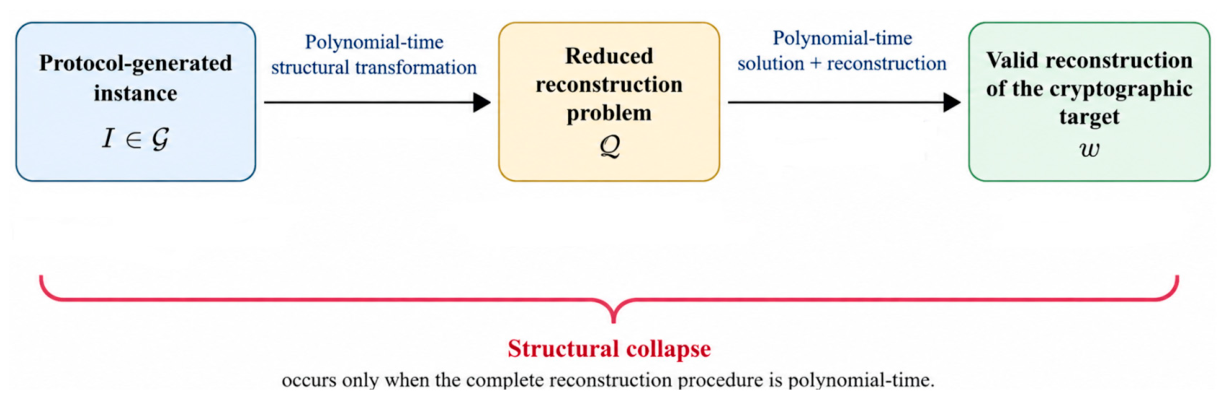
Figure 2.
Relationship between protocol-generated instances, structural collapse, and complexity gap.
Figure 2.
Relationship between protocol-generated instances, structural collapse, and complexity gap.
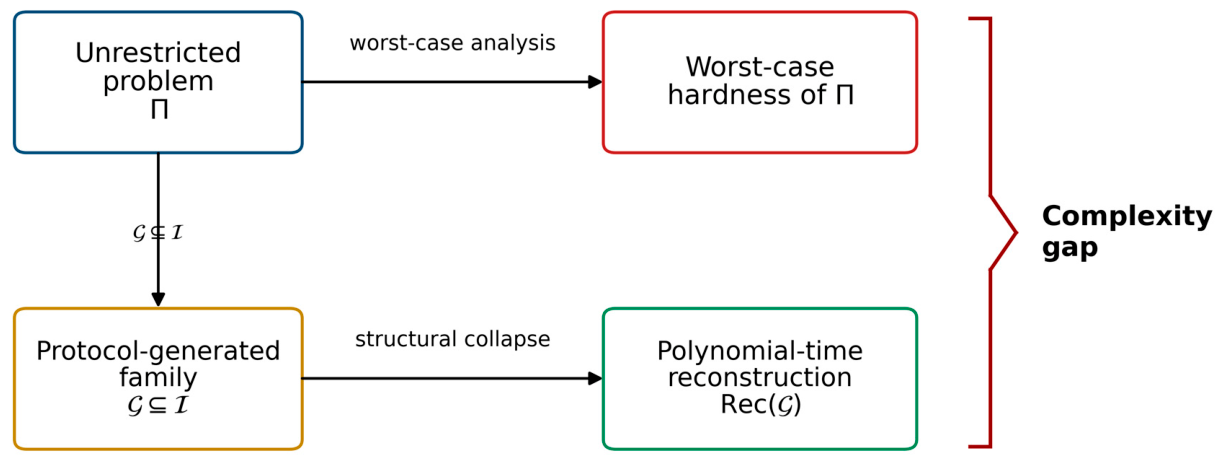

Table 1.
Comparison of complexity regimes relevant to semiring-based cryptography.
| Complexity regime |
Instance Class |
Main question |
Cryptography relevance |
|---|---|---|---|
| Worst-case | All instances of the unrestricted problem |
How hard are the hardest instances? |
Establishes general hardness, does not determine the difficulty of protocol-generated instances |
| Generic case | Typical instances under a specific distribution or asymptotic model |
How hard are typical instances? |
Describes typical computational behavior, but the distribution may differ from that induced by the protocol |
| Protocol-generated | Structured family produced by the protocol |
How hard is reconstruction on actual instances? |
Most directly relevant to whether public protocol data permit efficient reconstruction |
Disclaimer/Publisher’s Note: The statements, opinions and data contained in all publications are solely those of the individual author(s) and contributor(s) and not of MDPI and/or the editor(s). MDPI and/or the editor(s) disclaim responsibility for any injury to people or property resulting from any ideas, methods, instructions or products referred to in the content. |
© 2026 by the authors. Licensee MDPI, Basel, Switzerland. This article is an open access article distributed under the terms and conditions of the Creative Commons Attribution (CC BY) license (http://creativecommons.org/licenses/by/4.0/).
Copyright: This open access article is published under a Creative Commons CC BY 4.0 license, which permit the free download, distribution, and reuse, provided that the author and preprint are cited in any reuse.