

Submitted:
09 October 2026
Posted:
10 October 2026
You are already at the latest version
Abstract
Background. Evidence on the relationship among possible bruxism, self-reported TMD symptoms, and chronotype in dental students is limited. To explore the association among possible bruxism, self-reported temporomandibular disorder (TMD) symptom severity, and chronotype profiles within a population of dental students. Methods. A cross-sectional study was conducted among 258 dental students at the Uşak University Faculty of Dentistry in 2025. Possible awake and sleep bruxism were assessed using self-reported questions, self-reported TMD symptom severity was assessed through the Fonseca Anamnestic Index (FAI), and chronotype profile was determined via the Morningness–Eveningness Questionnaire (MEQ). Statistical analyses were performed using SPSS version 24.0, including chi-square tests and multivariable logistic regression to evaluate independent associations between chronotype, TMD symptom severity, and possible awake and sleep bruxism, with statistical significance set at α = 0.05. Results. Chi-square analyses revealed a statistically significant correlation (p = 0.005) between the chronotype profile and possible awake bruxism. A significant association was observed between possible awake and sleep bruxism and self-reported TMD symptom severity (p < 0.001). No significant association was found between chronotype profile and self-reported TMD symptom severity (p = 0.159). Results of the multivariable logistic regression indicated that chronotype was not independently associated with either possible awake or sleep bruxism after adjustment for potential confounders (p > 0.05). In contrast, self-reported TMD symptom severity showed a strong dose-response association with both conditions (p < 0.05). Conclusions. Self-reported TMD symptom severity was independently associated with both possible awake and sleep bruxism, whereas chronotype profile showed no independent association after adjustment for potential confounders. Considering dental students as a population exposed to irregular schedules, exploring the links between bruxism, self-reported TMD symptoms, and chronotype may provide insight into how biological rhythm-related factors intersect with oral health in dental education settings.
Keywords:
bruxism
; sleep bruxism
; temporomandibular joint disorders
; chronotype
1. Introduction
“Sleep bruxism (SB) is a masticatory muscle activity during sleep that is characterized as rhythmic (phasic) or non-rhythmic (tonic) and is not a movement disorder or a sleep disorder; awake bruxism (AB) is a masticatory muscle activity during wakefulness that is characterized by repetitive or sustained tooth contact and/or by bracing or thrusting of the mandible and is not a movement disorder” [1]. SB is generally described a sleep-related masticatory muscle activity that is often non-pathological, whereas AB is conceptualized as a behavior largely driven by psychosocial and contextual factors such as stress, attention, and emotional regulation [2].
Recently, circadian rhythm, an individual’s internal biological clock regulating physiological processes including the sleep-wake cycle, has gained attention [3]. The chronotype profile shows an individual's circadian rhythm. Reports indicate the existence of three distinct profiles. The morningness profile typically engages in activities during the day, the eveningness profile generally engages in activities at night, while the intermediate profile engages in activities both during the day and at night [3].
Bruxism and TMD possess a multifactorial and complex etiology that includes biological, psychological, and environmental factors [4,5,6,7,8,9,10]. Bruxism has been related with adverse outcomes such TMD, muscle pain, and teeth abrasion [2]. At the same time, recent findings indicate that it may also have beneficial effects, including the preservation of upper airway patency and supporting cognitive functions in the elderly patients.
Academic responsibilities, social demands, and lifestyle choices frequently compel young adults to diverge from their inherent biological cycles, resulting in circadian misalignment [11,12]. Such disruptions have been associated with impaired sleep quality, heightened stress responses, and an increased risk of developing parafunctional activities such as bruxism, along with TMD [13,14,15,16]. University students, particularly dental students facing academic and clinical schedules, represent a suitable population for evaluating the SB, AB, chronotype profiles, self-reported TMD severity and the associations of these variables.
Previous studies examined the frequency of SB, AB, chronotypes, TMD, and TMD and the associations of these variables [17,18,19]. Few research have investigated the association between chronotype profile and TMD [11,12]. Available evidence on the association between self-reported TMD symptom severity and chronotype profile in dental students remains limited. Thus, the aim of this study was to examine the associations among dental students' possible SB, AB, self-reported TMD symptom severity, and chronotype profile. Three null hypotheses were tested in this study. The first stated that possible bruxism would not be significantly associated with self-reported TMD symptom severity. The second stated that chronotype profile would not be significantly associated with possible bruxism. The third stated that chronotype profile would not be significantly associated with self-reported TMD symptom severity.
2. Material and Method
2.1. Study Design and Ethical Approval
This study was reported according to the STROBE Statement. In 2025, this cross-sectional research was conducted. Among undergraduate dental students enrolled in the 5-year dental curriculum at the Faculty of Dentistry, Uşak University. Students aged between 18 and 30 years were invited to participate voluntarily. Individuals were excluded if they reported psychiatric or neurological disorders, previously diagnosed sleep disorders, chronic systemic diseases that could affect sleep, shift work or irregular work schedules, or the use of medications such as anxiolytics, hypnotics, or analgesics that might influence sleep or circadian rhythm. Incomplete questionnaires were also excluded from analysis. Before data collection, all participants were informed about the study and provided written informed consent. Ethical approval was obtained from the Uşak University Ethics Committee [25.09.2025/848-848-06]. All procedures were conducted in accordance with the principles of the Declaration of Helsinki, as revised in 2013.
2.2. Sample Size and Participants
Sample size estimation was performed using the Raosoft calculator with a 95% confidence interval, 5% allowable error, and an assumed 50% response distribution. According to this calculation, at least 242 participants were required. A pilot assessment was conducted with 50 students to evaluate the internal consistency of the study instruments. Cronbach’s alpha values were 0.88 for the bruxism questionnaire, 0.86 for the TMD-related symptom questionnaire, and 0.90 for the chronotype assessment tool. Data from the pilot participants were not included in the final analysis. Figure 1. shows flow diagram of participant recruitment and selection.
2.3. Data Collection
Data were obtained through an anonymous online questionnaire created on a digital survey platform such as Google Forms. The survey link was shared through student WhatsApp groups, and completion required approximately 15 to 20 minutes. All responses were kept confidential and analyzed anonymously. No missing data were identified in the final dataset. The questionnaire included items related to demographic characteristics, possible awake bruxism, possible sleep bruxism, chronotype profile, and TMD-related symptoms.
2.3.1. Identification of Possible AB and SB
In the present study, possible awake and sleep bruxism were identified on the basis of self-reported yes/no responses. All items related to bruxism were answered dichotomously [20].
2.3.2. Assessment of the Self-Reported TMD Symptom Severity
Self-reported TMD-related symptoms were assessed using the Fonseca Anamnestic Index, a commonly used screening instrument that categorizes symptom severity on the basis of patient-reported complaints rather than clinical diagnosis. The validated Turkish version was used. Each item was scored as 0, 5, or 10, and the total score was used to classify participants as having no, mild, moderate, or severe self-reported TMD symptoms [21].
2.3.3. Assessment of the Chronotype Profile
Chronotype profile was evaluated using the Morningness–Eveningness Questionnaire. The validated Turkish version of the scale was administered, and participants were categorized as morning, intermediate, or evening type according to the total score [22].
2.4. Statistical Analysis
Statistical analyses were performed using SPSS version 24.0 (IBM, Armonk, NY, USA). Distributional characteristics were examined with the Kolmogorov–Smirnov test. Associations between categorical variables were evaluated using chi-square tests. In addition, multivariable logistic regression models were constructed to determine independent associations after adjustment for possible confounders. The results are presented as adjusted odds ratios (aORs) with 95% confidence intervals (95% CIs). Statistical significance was set at α = 0.05.
3. Results
The current study involved 258 dentistry students in total (174 females and 84 males). The participants ranged in age from 18 to 29 years, with a mean age of 21.1 ± 1.5 years. 54 students (20.9%) from the first year, 58 students (22.5%) from the second year, 59 students (22.9%) from the third year, 37 students (14.3%) from the fourth year, and 50 students (19.4%) from the fifth year made up the distribution of participants during the dental program's five academic years.
While possible SB was not significantly related to gender (p = 0.174) (Table 2), the analysis revealed a significant association between possible AB and gender (p = 0.011) (Table 1). Compared to male participants, female participants had a higher frequency of potential SB and AB. (Table 1 and Table 2).

Table 1.
Associations between gender, chronotype profile, self-reported TMD and possible AB.
|
Possible AB |
||||
| Yes (%) | No (%) | Total (%) | p-Value | |
| Gender |
0.011 |
|||
| Female | 74(77.1) | 100(61.7) | 174(67.4) | |
| Male | 22(22.9) | 62(38.3) | 84(32.6) | |
| Chronotype Profile |
0.005 0.005 |
|||
| Eveningness | 20(58.8) | 14(41.2) | 34(100) | |
| Intermediate |
68(32.5) | 141(67.5) | 209(100) | |
| Morningness |
8(53.3) | 7(46.7) | 15(100) | |
| Self-reported TMD |
< 0.001 |
|||
| No | 9(12.7) | 62(87.3) | 71(100) | |
| Mild | 39(33.9) | 76(66.1) | 115(100) | |
| Moderate | 27(62.8) | 16(37.2) | 43(100) | |
| Severe | 21(72.4) | 8(27.6) | 29(100) | |
1 AB: awake bruxism, TMD: temporomandibular disorder; 2 Pearson Chi-square test. Values displayed in bold indicate statistical associations, p < 0.05.
81.0% of participants (n = 209) were categorized as an intermediate profile, 13.2% (n = 34) as an eveningness profile, and 5.8% (n = 15) as a morningness profile. Gender was not significantly associated with chronotype profile (p = 0.560). (Table 3). The research revealed a relationship between chronotype profile and possible AB (p = 0.005) (Table 1). participants with an eveningness profile more frequently reporting possible AB. Among participants reporting possible AB, the highest prevalence was observed in the eveningness chronotype (58.8%), followed by the morningness chronotype (53.3%) and intermediate chronotype (32.5%). However, chronotype profile was not significantly associated with possible SB (p = 0.626) (Table 2). Regarding possible SB, the prevalence was 44.1% in the eveningness group, 35.9% in the intermediate group, and 33.3% in the morningness group.
Table 2.
Associations between gender, chronotype profile, self-reported TMD and possible SB.
| Possible SB | ||||
| Yes (%) | No (%) | Total (%) | p-Value | |
| Gender |
0.174 |
|||
| Female | 69(39.7) | 105(60.3) | 174(100) | |
| Male | 26(30.9) | 58(69.1) | 84(100) | |
| Chronotype Profile |
0.626 |
|||
| Eveningness |
15(44.1) | 19(55.9) | 34(100) | |
| Intermediate | 75(35.9) | 134(64.1) | 209(100) | |
| Morningness |
5(33.3) | 10(66.7) | 15(100) | |
| Self-reported TMD | ||||
| No | 11(15.5) | 60(84.5) | 71(100) |
< 0.001 |
| Mild | 32(27.8) | 83(72.2) | 115(100) | |
| Moderate | 26(60.5) | 17(39.5) | 43(100) | |
| Severe | 26(89.7) | 3(10.3) | 29(100) | |
1 SB: sleep bruxism; TMD: temporomandibular disorder; 2 Pearson Chi-square test. Values displayed in bold indicate statistical associations, p < 0.05.
Table 3.
Association between chronotype profile, self-reported TMD and gender.
| Gender | ||||
| Female | Male | Total (%) | p-value | |
| Fonseca TMD Type |
0.118 |
|||
| No | 49(69.0) | 22(31.0) | 71(100) | |
| Mild | 70(60.9) | 45(39.1) | 115(100) | |
| Moderate | 31(72.1) | 12(27.9) | 43(100) | |
| Severe | 24(82.8) | 5(17.2) | 29(100) | |
| Chronotype Profile |
0.560 |
|||
| Eveningness | 23(67.6) | 11(32.4) | 34(100) | |
| Intermediate |
139(66.5) |
70(33.5) |
209(100) |
|
| Morningness |
12(80.0) | 3(20.0) | 15(100) | |
1 TMD: temporomandibular disorder; 2 Pearson Chi-square test. Values displayed in bold indicate statistical associations, p <0 .05.
Both possible AB and SB were significantly associated with self-reported TMD symptom severity (p < 0.001) (Table 1 and Table 2). Gender was not significantly associated with self-reported TMD symptom severity (p = 0.118) (Table 3). Chronotype profile was not significantly associated with self-reported TMD symptom severity (p = 0.159) (Table 4).
The outcomes of the multivariable logistic regression analyses for possible AB and SB are presented in Table 5 as adjusted odds ratios (aORs) with 95% confidence intervals (95% CIs). Chronotype was not independently associated with possible AB and SB after adjustment for potential confounders. In contrast, self-reported TMD symptom severity showed a strong dose-response association with both conditions, with progressively higher odds observed from mild (aOR = 2.19, 95% CI: 1.01–4.77, p = .049) to moderate (aOR = 8.69, 95% CI: 3.43–22.05, p < 0.001) and severe self-reported TMD (aOR = 53.96, 95% CI: 13.48–216.04, p < 0.001). Gender was associated with possible AB, with lower odds observed in males, whereas academic year was not significantly associated with either outcome.
4. Discussion
The first null hypothesis was rejected, whereas the second was only supported at the unadjusted level and not confirmed in multivariable analyses. The third null hypothesis was accepted.
Previous studies reported that AB was more prevalent than SB among dental students [17,18,19]. In the present study, 62.8% (n = 162) of the participants reported possible AB, whereas 36.8% (n = 95) reported possible SB, consistent with previous reports. Although Serra-Negra et al. [18] reported that female dental students had higher rates of bruxism however Jokubauskas et al. [19] found no significant difference between male and female dental students. In the present study, gender was associated with possible AB, with lower odds observed in males. The inconsistency of the results may have emerged from the multifactorial nature of bruxism.
A relatively high prevalence of self-reported TMD symptom severity (72.5%) was identified in the present study. According to TMD categories on the FAI, the prevalence of self-reported TMD symptom severity among university students in Türkiye was 60.50% in another study [14]. Stress factors related to academic workload and awareness of symptoms may explain the higher prevalence of self-reported TMD symptom severity among dental students. However, FAI includes non-specific symptoms (e.g., headache, stress), which may have inflated prevalence rates especially in dental students. In addition to that, dental students who may be familiar with mechanisms, potential bias should also be considered.
The association between bruxism and TMD was controversial and not entirely elucidated [16,22,23,24]. While some authors have reported an association [24,25,26] others have not identified such a relationship [23,27,28]. Wieckiewicz et al. [24] reported that SB prevalence is not a definitive predisposing factor for TMD when patients are evaluated for SB using polysomnography (PSG). In a systematic review [29], it was found that the evidence suggesting a direct correlation between bruxism and TMD was predominantly of low-to-moderate quality, highlighting the necessity for further high-quality research to clarify this relationship. In the present study, both possible AB and SB were significantly associated with self-reported TMD symptom severity (p < 0.001). After adjustment, mild TMD was associated with a modest increase in odds (aOR = 2.19, 95% CI: 1.01–4.77), whereas moderate and severe TMD showed substantially stronger associations (aOR = 8.69, 95% CI: 3.43–22.05; and aOR = 53.96, 95% CI: 13.48–216.04, respectively), supporting a severity-dependent gradient. It should be considered that both bruxism and self-reported TMD symptom severity were assessed through self-reported instruments, the observed associations may be overestimated due to common method bias.
Previous studies represented inconsistent findings concerning the association between chronotype profile and bruxism, especially within dental student populations [18,19,30,31]. Although an association has been reported by some authors [31], this finding has not been corroborated by others [19,30]. A significant association between eveningness chronotype and possible AB was identified in the present study (p = 0.005), consistent with the findings of Kirarslan et al. [17]. Moreover, possible AB showed an unadjusted association with eveningness chronotype. However, the attenuation of this association after adjustment for confounders in the present study suggests that this relationship may be influenced by behavioral or psychosocial factors rather than representing an independent chronotype effect (p > 0.05). These findings suggested that circadian rhythm related factors may play an indirect role in bruxism related behaviors [31], highlighting the necessity for additional multidimensional research. However, Bilir et al. [30] found no association between chronotype profile and either type of bruxism among dental students. This gap may be attributed to variations in the research populations, as the two investigations were conducted among students from different institutional settings, one from a private university and the other from a public university.
Wei et al. [32] suggested that disturbance of circadian rhythms, particularly by the overexpression of the clock gene Per1, might induce temporomandibular joint osteoarthritis (TMJOA). However, these observations should be regarded as hypothesis-generating rather than explanatory. Gębska et al. [33] reported a statistically significant association between chronotype profile and TMD symptoms, especially among individuals with a Type D personality on physiotherapy students. In another study, Wei et al. [11] revealed a significantly lower frequency of TMD among individuals who had morningness chronotype than those who had intermediate or eveningness chronotypes. Dan et al. [12] stated a statistically significant association between eveningness chronotype profile and TMD severity. Also, they reported that a morningness chronotype could serve as a preventive factor for TMD.
Chao Xu et al. [34] who demonstrated that circadian preference alone does not causally influence TMD-related pain through Mendelian randomization. Kirarslan et al. [17] examined the associations among possible AB, chronotypes and TMD symptoms in dental students, they reported eveningness chronotypes reported more frequent head, neck, and face pain, but no association between chronotype profile and TMJ pain or noise.
According to previous research, the most prevalent chronotype profile among dentistry students in this study was the intermediate one, and there was no significant association between gender and chronotype profile [18,30]. No statistically significant association was identified between chronotype profile and self-reported TMD symptom severity (p = 0.159). Although in the present study self-reported TMD symptoms were evaluated using the FAI, Wei et al. [11] used both the DC/TMD clinical examination and CBCT-based morphological measurements. Using CBCT may have enhanced the sensitivity for identifying structural anomalies related to chronotype profile. While Dan et al. [12] included a broader range of university students, including undergraduate, graduate, and doctorate students, the present study population was limited to undergraduate dental students, who may have different ways of dealing with academic stress and sleep regulation. Additionally, Dan et al. [12] included a group of patients with confirmed TMD diagnoses, allowing for a stronger contrast with healthy controls.
One of the study's drawbacks was the use of self-reporting tools to assess the severity of SB, AB, and TMD. The self-reporting approach introduced a risk of common-method bias, measurement bias, interpretation bias, and overestimation of associations. Self-reported possible bruxism does not constitute a clinical diagnosis [19]. Although validated questionnaires were commonly used in observational studies, they were inherently subjective [23]. The FAI is a screening tool rather than a diagnostic instrument [35] and higher FAI scores should not be construed as indicating clinically confirmed TMD.
This study was conducted during a regular academic period when teaching and learning activities were ongoing, considering that examination stress could act as a triggering factor. The cross-sectional methodology of the present study precluded causal interpretation of the findings and allowed only the assessment of associations among the studied variables. To more comprehensively characterize the observed associations, future investigations using longitudinal study designs were recommended. In addition to that, ecological momentary assessment (EMA) or experience sampling methods (ESM) should be used for the assessment of AB, PSG/electromyography (EMG) should be employed for the assessment of SB, and magnetic resonance imaging (MRI) and DC/TMD should be used for the assessment of TMD.
In addition, since the study population consisted of undergraduate dental students, a highly specific group, inclusion of broader young adult populations beyond dental education was considered necessary to enhance the external validity and generalizability of the results. Therefore, interpretations of the current results should be made cautiously.
5. Conclusions
Chronotype profile was associated with possible awake bruxism in unadjusted analyses; however, chronotype showed no independent association with either possible awake or sleep bruxism after adjustment for potential confounders. No meaningful association was observed between chronotype profile and self-reported TMD symptom severity. Self-reported TMD symptom severity was strongly associated with both possible awake and sleep bruxism, demonstrating a clear severity-dependent (dose–response) relationship. Overall, the interplay between chronotype, bruxism behaviors, and TMD symptoms appears complex and multifactorial, underscoring the need for cautious interpretation and longitudinal investigation among dental students.
Author Contributions
BY, CK and STK designed the research study. BY and STK performed the research. CK provided help. BY and STK analyzed the data. BY and STK wrote the manuscript. All authors contributed to editorial changes in the manuscript. All authors read and approved the final manuscript.
Funding
The authors received no financial support for the research, authorship, and/or publication of this article. The author did not receive support from any organization for the submitted work.
Institutional Review Board Statement
Ethical approval was obtained from the Uşak University Ethics Committee (Approval No: 848-848-06; September 25, 2025). All procedures performed in studies involving human participants were in accordance with the ethical standards of the institutional and/or national research committee and with the 1964 Helsinki declaration and its later amendments or comparable ethical standards (25.09.2025/ Approval No: 848-848-06). The participants received written informed consent and confirmed their participation in the study after reading the informed consent form.
Data Availability Statement
The datasets generated and analyzed during the current study are available from the corresponding author upon reasonable request. The datasets used and/or analyzed during the current study are available from the corresponding author upon reasonable request.
Conflicts of Interest
The authors declare that they have no conflicts of interest. The authors have no competing interests to declare that are relevant to the content of this article.
Artificial Intelligence Statement:
During the preparation of this manuscript, the author used ChatGPT (OpenAI; GPT-4) solely for language editing and improving readability (grammar, sentence structure, and clarity) in selected parts of the manuscript (Abstract, Introduction, Discussion). The AI tool was not used for data analysis, statistical processing, interpretation of results, or generation of scientific conclusions. All AI-assisted content was reviewed, verified, and edited by the authors. The authors retain full responsibility for the integrity, accuracy, and originality of the work.
Abbrevıatıons
SB, Sleep Bruxism; AB, Awake Bruxism; TMD, Temporomandibular Disorders; FAI, Fonseca Anamnestic Index; MEQ, Morningness–Eveningness Questionnaire.
References
- Verhoeff, M.C.; Lobbezoo, F.; Manfredini, D.; Ahlberg, J.; Raphael, K.G.; Wetselaar, P.; et al. Updating the Bruxism Definitions: Report of an International Consensus Meeting. J. Oral Rehabil. 2025, 52(9), 1335–1342. [Google Scholar] [CrossRef] [PubMed]
- Lobbezoo, F.; Ahlberg, J.; Manfredini, D. The advancement of a discipline: The past, present and future of bruxism research. J. Oral Rehabil. 2024, 52, 1–4. [Google Scholar] [CrossRef] [PubMed]
- Horne, J.A.; Ostberg, O. A self-assessment questionnaire to determine morningness-eveningness in human circadian rhythms. Int. J. Chronobiol. 1976, 4(2), 97–110. [Google Scholar] [PubMed]
- Zieliński, G.; Wieckiewicz, M.; Smardz, J.; et al. Global co-occurrence of bruxism and temporomandibular disorders: A meta-regression analysis. Dent. Med. Probl. 2025, 62(2), 309–321. [Google Scholar] [CrossRef] [PubMed]
- Orzeszek, S.; Wieckiewicz, M.; Smardz, J.; et al. Assessment of the relationship between sleep bruxism, reported pain and headache, selected health factors, and general health conditions among temporomandibular disorder patients: A preliminary report. Dent. Med. Probl. 2025, 62(2), 393–399. [Google Scholar] [CrossRef] [PubMed]
- Manfredini, D.; Ahlberg, J.; Lobbezoo, F. Bruxism definition: Past, present, and future—What should a prosthodontist know? J. Prosthet. Dent. 2022, 128(5), 905–912. [Google Scholar] [CrossRef] [PubMed]
- Wieckiewicz, M.; Smardz, J.; Martynowicz, H.; et al. Determination of pain intensity, pain-related disability, anxiety, depression, and perceived stress in Polish adults with temporomandibular disorders: A prospective cohort study. Front. Integr. Neurosci. 2022, 16, 1026781. [Google Scholar] [CrossRef] [PubMed]
- Błaszczyk, B.; Martynowicz, H.; Smardz, J.; et al. Exploring the associations of sleep bruxism and obstructive sleep apnea with migraine among patients with temporomandibular disorder: A polysomnographic study. Headache 2025, 65(2), 242–257. [Google Scholar] [CrossRef] [PubMed]
- Yap, A.U.; et al. Accuracy of the Fonseca Anamnestic Index for identifying pain-related and/or intra-articular temporomandibular disorders. CRANIO. 2024, 42(3), 259–266. [Google Scholar] [CrossRef] [PubMed]
- Emodi-Perlman, A.; et al. Impact of long-term stress on awake bruxism: An observational longitudinal within-subject study of stress-related changes. Dent. Med. Probl. 2025, 62(6), 1059–1067. [Google Scholar] [CrossRef] [PubMed]
- Wei, J.; et al. The prevalence of temporomandibular disorder and temporomandibular morphology among diverse chronotype profiles. Chronobiol. Int. 2023, 40(10), 1444–1453. [Google Scholar] [CrossRef] [PubMed]
- Dan, R.; et al. The association between chronotype profile and temporomandibular disorders among college students. Oral Dis. 2024, 30(7), 4573–4584. [Google Scholar] [CrossRef] [PubMed]
- Juliatte, T.P.R.; et al. Circadian preference and its relationship with possible sleep and awake bruxism in adults assisted by the public health system. Chronobiol. Int. 2022, 39(1), 68–76. [Google Scholar] [CrossRef] [PubMed]
- Özdinç, S.; et al. Temporomandibular joint disorder determined by Fonseca Anamnestic Index and associated factors in 18-to 27-year-old university students. CRANIO. 2020, 38(5), 327–332. [Google Scholar] [CrossRef] [PubMed]
- Cui, Y.; et al. A nomogram for predicting the risk of temporomandibular disorders in university students. BMC Oral Health 2024, 24(1), 1047. [Google Scholar] [CrossRef] [PubMed]
- Chien, Y.C.; et al. When should sleep bruxism be considered in the diagnosis of temporomandibular disorders? Oral Surg. Oral Med. Oral Pathol. Oral Radiol. 2020, 130(6), 645–650. [Google Scholar] [CrossRef] [PubMed]
- Kirarslan Karagoz, O.; et al. Possible sleep and awake bruxism, chronotype profile and TMD symptoms among Turkish dental students. Chronobiol. Int. 2021, 38(9), 1367–1374. [Google Scholar] [CrossRef] [PubMed]
- Serra-Negra, J.M.; et al. Self-reported awake bruxism and chronotype profile: A multicenter study on Brazilian, Portuguese and Italian dental students. CRANIO 2021, 39(2), 113–118. [Google Scholar] [CrossRef] [PubMed]
- Jokubauskas, L.; et al. Interrelationships between distinct circadian manifestations of possible bruxism, perceived stress, chronotype and social jetlag in a population of undergraduate students. Chronobiol. Int. 2019, 36(11), 1558–1569. [Google Scholar] [CrossRef] [PubMed]
- Lobbezoo, F.; Ahlberg, J.; Glaros, A.G.; Kato, T.; Koyano, K.; Lavigne, G.J.; et al. Bruxism defined and graded: An international consensus. J. Oral Rehabil. 2013, 40(1), 2–4. [Google Scholar] [CrossRef] [PubMed]
- Arikan, H.; Citaker, S.; Ucok, C. Psychometric properties of the Fonseca Anamnestic Index (FAI) for temporomandibular disorders: Turkish version, responsiveness, reliability, and validity study. Disabil. Rehabil. 2024, 46(7), 1408–1415. [Google Scholar] [CrossRef] [PubMed]
- Pündük, Z.; Gür, H.; Ercan, I. A reliability study of the Turkish version of the mornings-evenings questionnaire. Turk. J. Psychiatry (In Turkish) 2005, 16(1), 40–45. [Google Scholar]
- Wu, J.; et al. Temporomandibular disorders among medical students in China: Prevalence, biological and psychological risk factors. BMC Oral Health 2021, 21(1), 549. [Google Scholar] [CrossRef] [PubMed]
- Wieckiewicz, M.; et al. Distribution of temporomandibular disorders among sleep bruxers and non-bruxers: A polysomnographic study. J. Oral Rehabilitation 2020, 47(7), 820–826. [Google Scholar] [CrossRef] [PubMed]
- Mortazavi, N.; et al. Is bruxism associated with temporomandibular joint disorders? A systematic review and meta-analysis. Evid.-Based Dent. 2023, 24(3), 144. [Google Scholar] [CrossRef] [PubMed]
- Karacay, B.C.; Sahbaz, T. Investigation of the relationship between probable sleep bruxism, awake bruxism and temporomandibular disorders using the Diagnostic Criteria for Temporomandibular Disorders (DC/TMD). Dent. Med. Probl. 2023, 60(4), 601–608. [Google Scholar] [CrossRef] [PubMed]
- Nogueira Coutinho, E.M.; et al. Association between self-reported sleep bruxism and temporomandibular disorder in undergraduate students from Brazil. CRANIO 2020, 38(2), 91–98. [Google Scholar] [CrossRef] [PubMed]
- Sinclair, A.; et al. Temporomandibular disorders in patients with polysomnographic diagnosis of sleep bruxism: A case-control study. Sleep Breath. 2022, 26, 1–8. [Google Scholar] [CrossRef] [PubMed]
- Jiménez-Silva, A.; et al. Sleep and awake bruxism in adults and its relationship with temporomandibular disorders: A systematic review from 2003 to 2014. Acta Odontol. Scand. 2017, 75(1), 36–58. [Google Scholar] [CrossRef] [PubMed]
- Bilir, H.; Yılmaz, B. An Evaluation of the Relationship Between Self-Reported Sleep/Awake Bruxism and the Chronotype Profiles of the Dental Students. Cumhur. Dent. Journal. 2022, 25(1), 48–53. [Google Scholar] [CrossRef]
- Serra-Negra, J.M.; et al. Relationship of self-reported sleep bruxism and awake bruxism with chronotype profiles in Italian dental students. CRANIO 2019, 37(3), 147–152. [Google Scholar] [CrossRef] [PubMed]
- Wei, J.; et al. Circadian rhythm disruption upregulating Per1 in mandibular condylar chondrocytes mediating temporomandibular joint osteoarthritis via GSK3β/β-catenin pathway. J. Transl. Med. 2024, 22(1), 662. [Google Scholar] [CrossRef] [PubMed]
- Gębska, M.; et al. Chronotype profile, stress, depression level, and temporomandibular symptoms in students with type D personality. J. Clin. Med. 2022, 11(7), 1886. [Google Scholar] [CrossRef] [PubMed]
- Chou, Y.C.; et al. Application of near-infrared-to-blue upconversion luminescence for the polymerization of resin cements through zirconia discs. Dent. Mater. 2024, 40(8), 1208–1215. [Google Scholar] [CrossRef] [PubMed]
- Xu, C.; et al. Exploring the causal effects of sleep characteristics on TMD-related pain: A two-sample Mendelian randomization study. Clin. Oral Investig. 2024, 28(7), 384. [Google Scholar] [CrossRef] [PubMed]
Figure 1.
Flow diagram of participant recruitment and selection.
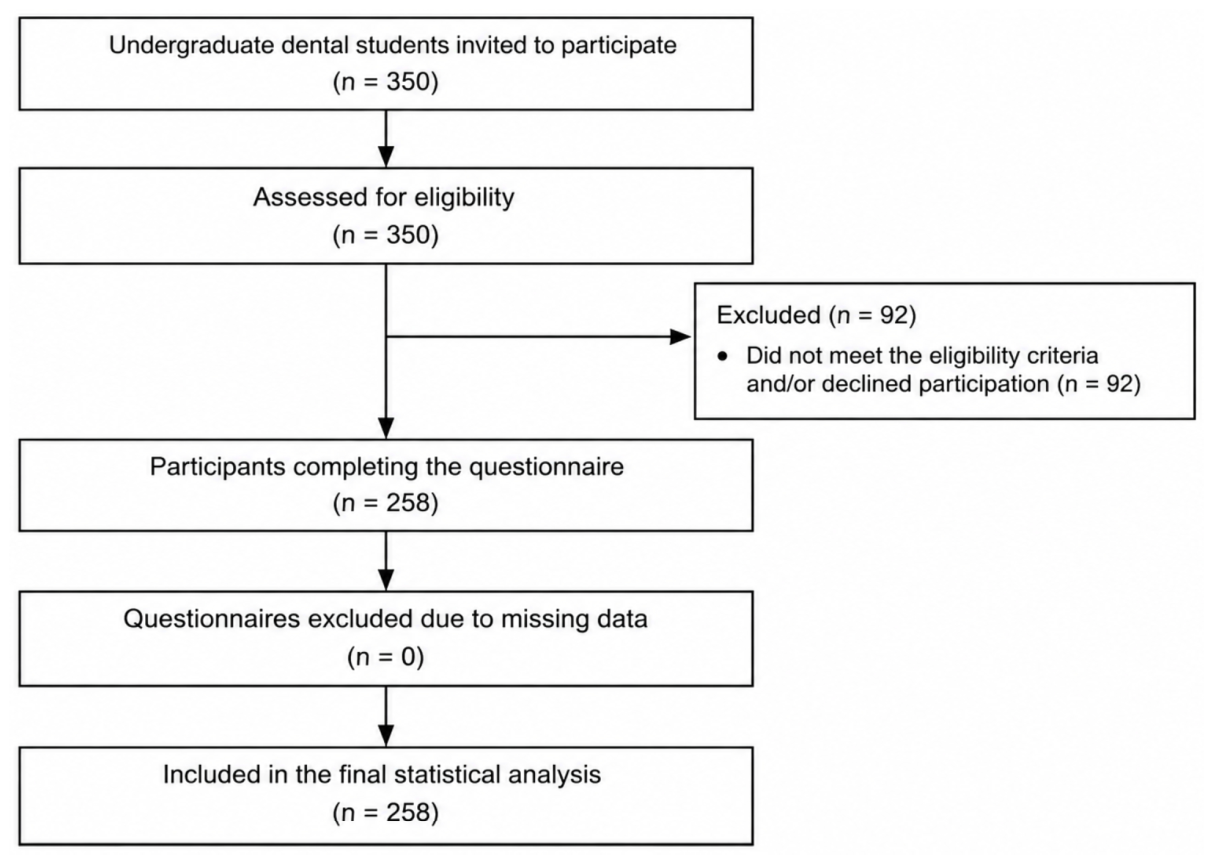
Table 4.
Association between chronotype profile and Self-reported TMD.
| Chronotype Profile | |||||
| Eveningness | Intermediate | Morningness | Total (%) | p-Value | |
| Self-reported TMD | |||||
| No | 6(8.5) | 58(81.7) | 7(9.9) | 71(100) |
0.159 |
| Mild | 15(13.0) | 95(82.6) | 5(4.3) | 115(100) | |
| Moderate | 9(20.9) | 34(79.1) | 0(0.0) | 43(100) | |
| Severe | 4(13.8) | 22(75.9) | 3(10.3) | 29(100) | |
1 TMD: temporomandibular disorder; 2 Fisher exact test. Values displayed in bold indicate statistical associations, p < 0.05.
Table 5.
Multivariable binary logistic regression analyses. Reference categories were morning chronotype, no TMD, first academic year, and female gender.
Table 5.
Multivariable binary logistic regression analyses. Reference categories were morning chronotype, no TMD, first academic year, and female gender.
| Variable | Category |
Possible AB OR (95% CI) |
p-value |
Possible SB OR (95% CI) |
p-value |
| Chronotype | Evening vs Morning | 0.87 (0.20–3.79) | 0.855 | 1.23 (0.25–6.09) | 0.803 |
| Intermediate vs Morning | 0.31 (0.09–1.11) | 0.071 | 1.06 (0.25–4.40) | 0.941 | |
| Self-reported TMD | Mild vs No TMD | 4.16 (1.78–9.74) | 0.001 | 2.19 (1.01–4.77) | 0.049 |
| Moderate vs No TMD | 14.66 (5.31–40.46) | <0.001 | 8.69 (3.43–22.05) | <0.001 | |
| Severe vs No TMD | 21.94 (6.93–69.50) | <0.001 | 53.96 (13.48–216.04) | <0.001 | |
| Academic year | 2nd vs 1st | 1.35 (0.56–3.25) | 0.498 | 1.28 (0.52–3.16) | 0.591 |
| 3rd vs 1st | 1.09 (0.42–2.81) | 0.864 | 0.99 (0.37–2.62) | 0.978 | |
| 4th vs 1st | 0.89 (0.32–2.47) | 0.815 | 1.93 (0.72–5.19) | 0.194 | |
| 5th vs 1st | 0.41 (0.16–1.07) | 0.067 | 0.82 (0.32–2.11) | 0.677 | |
| Gender | Male vs Female | 0.43 (0.22–0.84) | 0.013 | 0.78 (0.41–1.50) | 0.453 |
1 AB: awake bruxism; SB: sleep bruxism; TMD: temporomandibular disorder; Values displayed in bold indicate statistical associations, p < 0.05.
Disclaimer/Publisher’s Note: The statements, opinions and data contained in all publications are solely those of the individual author(s) and contributor(s) and not of MDPI and/or the editor(s). MDPI and/or the editor(s) disclaim responsibility for any injury to people or property resulting from any ideas, methods, instructions or products referred to in the content. |
© 2026 by the authors. Licensee MDPI, Basel, Switzerland. This article is an open access article distributed under the terms and conditions of the Creative Commons Attribution (CC BY) license (http://creativecommons.org/licenses/by/4.0/).
Copyright: This open access article is published under a Creative Commons CC BY 4.0 license, which permit the free download, distribution, and reuse, provided that the author and preprint are cited in any reuse.