

Submitted:
08 October 2026
Posted:
09 October 2026
You are already at the latest version
Abstract
We examined factors associated with severe psychosocial maladaptation in adults with epilepsy and described profiles relevant to personalized rehabilitation. This observational study included 480 adults aged 25-45 years assessed in clinical rehabilitation settings during 2018-2026. Neurological, psychiatric, cognitive, and psychosocial characteristics were evaluated. Multivariable logistic regression estimated adjusted odds ratios (ORs) and 95% confidence intervals (CIs). Discrimination was evaluated using the area under the receiver operating characteristic curve (AUC). Anxiety symptoms occurred in 59.2%, depressive symptoms in 55.4%, cognitive impairment in 60.8%, and sleep disturbance in 65.0%. Severe maladaptation affected 263 participants (54.8%). Stigma-related distress had the largest adjusted OR (2.67; 95% CI, 1.78-4.01). Depressive symptoms, low adherence, anxiety symptoms, cognitive impairment, sleep disturbance, and drug-resistant epilepsy also retained associations with the outcome. The AUC was 0.82 (95% CI, 0.78-0.86), with a bootstrap-corrected AUC of 0.80. Five predominant rehabilitation profiles were identified. Multidimensional assessment may help identify individual rehabilitation priorities. The observational associations do not establish causality or intervention effectiveness. Calibration and external validation are required before individual clinical use of the model.
Keywords:
epilepsy
; psychopathological symptoms
; psychosocial maladaptation
; cognitive impairment
; stigma
; medication adherence
; clinical profiles
; personalized rehabilitation
1. Introduction
Epilepsy is a common chronic neurological disease whose consequences extend to emotional well-being and social functioning. The World Health Organization estimates that approximately 50 million people have epilepsy worldwide and that active epilepsy affects 4-10 per 1000 people [1]. Psychiatric and cognitive difficulties, stigma, and restrictions in daily activities contribute to the burden of the condition alongside recurrent seizures. Assessment should therefore consider patients' ability to maintain independence and social participation as well as seizure characteristics.
Depression and anxiety are among the most frequent psychiatric comorbidities of epilepsy. In a systematic review of 23 observational studies of adults, Lu et al. reported an overall prevalence of 24.2% for major depressive disorder and 25.6% for anxiety disorders [2]. These findings support systematic assessment of emotional symptoms during clinical evaluation and rehabilitation.
Frequency estimates depend on the population and diagnostic approach. In the same review, depression estimates were 43.4% in questionnaire-based studies, 21.8% in studies using clinical interviews, and 13.0% in studies based on medical records or databases [2]. Symptom screening, clinical diagnosis, and documentation of previously diagnosed disorders capture different aspects of psychiatric morbidity. Screening results consequently require interpretation in relation to the thresholds used and the characteristics of the sample.
Comparative international evidence also supports an association between epilepsy and psychiatric disorders. Kwon et al. reported an odds ratio (OR) of 2.45 for depression (95% confidence interval (CI), 1.94-3.09) and 2.11 for anxiety disorders (95% CI, 1.73-2.58) in people with epilepsy compared with those without epilepsy [3]. These estimates describe differences in odds between populations and support the inclusion of mental health assessment in epilepsy care.
Psychiatric conditions may coexist and create more complex clinical presentations. In another meta-analysis, Kwon et al. found concomitant depression and anxiety disorders in 9.2% of people with epilepsy and 2.4% of people without epilepsy in two population-based studies [4]. Although this comparison was based on few studies, it supports investigating combinations of difficulties when assessing rehabilitation needs.
Sleep is another important component of assessment. Bergmann et al. reviewed 25 studies involving 8196 people with epilepsy and controls. Studies using the Pittsburgh Sleep Quality Index (PSQI) showed a mean difference of 1.27 points (95% CI, 0.76-1.78), indicating poorer sleep quality in participants with epilepsy [5]. Findings differed across sleep measures, and between-study heterogeneity was substantial. Individual assessment should therefore consider the nature of sleep complaints and the instrument used.
The social consequences of epilepsy also require attention. Silva et al. reported a pooled stigma prevalence of 35% (95% CI, 29-41%) [6]. Felt stigma, experienced discrimination, and emotional distress related to stigma are connected but distinct constructs. Distinguishing them helps identify individual difficulties and appropriate forms of psychological and social support.
Emotional difficulties are associated with quality of life. Tsigebrhan et al. reviewed mental health comorbidities in people with epilepsy in low- and middle-income countries; 19 studies contributed to the quality-of-life meta-analysis. Depression was associated with a standardized mean difference of -1.16 (95% CI, -1.70 to -0.63), and the corresponding estimate for anxiety was -0.64 (95% CI, -1.14 to -0.13) [7]. These are standardized differences rather than changes in points on an individual scale. High heterogeneity limits direct transfer of the effect sizes to a particular clinical cohort.
The relationship between epilepsy and comorbid difficulties is complex. Psychiatric, neurological, and cognitive conditions can influence treatment selection, while epilepsy treatment may have favorable or unfavorable effects on these conditions. Kanner emphasizes addressing comorbidities alongside seizure control [8]. This approach is relevant to personalized care because it considers clinical presentation, treatment tolerability, and individual needs.
Evidence on everyday functioning is less extensive than evidence on quality of life. In the review by Tsigebrhan et al., only one study directly examined functioning in relation to psychiatric comorbidity [7]. This supports investigating psychosocial maladaptation through the joint assessment of emotional and cognitive difficulties, sleep, stigma, adherence, and epilepsy characteristics.
We hypothesized that severe psychosocial maladaptation in adults with epilepsy would be associated with a combination of clinical, psychological, and social factors. Depressive and anxiety symptoms, cognitive impairment, poor sleep, stigma-related distress, and low adherence might retain associations with maladaptation after mutual adjustment for the variables included in the model.
The aim was to characterize psychiatric, cognitive, and psychosocial difficulties, identify factors associated with severe psychosocial maladaptation, and describe clinical profiles relevant to personalized rehabilitation planning. The results may inform priorities for medical, psychological, and social assessment; the effectiveness of profile-based rehabilitation requires separate evaluation.
2. Materials and Methods
2.1. Study Setting and Population
This observational analytical study included 480 adults with confirmed epilepsy, aged 25-45 years, assessed in Samarkand, Uzbekistan, during 2018-2026. Assessments were conducted at the multidisciplinary clinic of Samarkand State Medical University, the Samarkand Regional Mental Health Center, and outpatient psychoneurological services of family polyclinics in Samarkand city and region. The study was coordinated by the Department of Psychiatry, Medical Psychology and Narcology of Samarkand State Medical University. The clinical rehabilitation cohort comprised 211 women (44.0%) and 269 men (56.0%) and was not a population-based sample. Reporting was organized with reference to the Strengthening the Reporting of Observational Studies in Epidemiology (STROBE) recommendations [9].
Participants underwent neurological, psychiatric, cognitive, and psychosocial assessment during treatment and rehabilitation. Epilepsy diagnosis was based on clinical history, seizure semiology, medical records, and available electroencephalography (EEG) and neuroimaging findings. The practical International League Against Epilepsy (ILAE) definition was used: at least two unprovoked or reflex seizures more than 24 h apart; one such seizure with a probability of recurrence of at least 60% over the next 10 years; or an epilepsy syndrome [10]. Epilepsy type was classified using the 2017 ILAE framework [11].
2.2. Eligibility Criteria
Inclusion criteria were confirmed epilepsy; age 25-45 years; inpatient or outpatient treatment with rehabilitation follow-up; ability to complete clinical, psychometric, and cognitive assessment; and written informed consent.
Exclusion criteria were severe decompensated somatic disease; intellectual impairment preventing reliable assessment; an acute psychotic condition requiring urgent specialist care; a severe substance use disorder; or refusal to participate.
2.3. Variables and Operational Definitions
Demographic and social variables included age, sex, education, marital status, employment, disability, and urban or rural residence. Family support, financial difficulties, access to antiseizure medications (ASMs), and limitations in daily, family, and occupational activities were also recorded.
Clinical variables included age at onset, epilepsy duration and type, seizure frequency, precipitating factors, hospitalizations, current ASMs, number of medications, adverse effects, and drug resistance. The protocol defined the seizure observation period as the preceding 90 days, with the total divided by three to estimate mean monthly frequency using seizure diaries and available medical records.
Drug-resistant epilepsy was defined according to the ILAE consensus as failure of adequate trials of two tolerated, appropriately chosen and used ASM schedules, whether as monotherapy or in combination, to achieve sustained seizure freedom [12].
Anxiety and depressive symptoms were assessed with the Hospital Anxiety and Depression Scale anxiety and depression subscales (HADS-A and HADS-D) [13]. The original HADS comprises 14 items, seven per subscale; responses are scored from 0 to 3, giving a total of 0-21 points for each subscale. The scale refers to the preceding week. The study threshold was ≥11 points per subscale. Reaching this threshold indicated clinically relevant screening symptoms and was not equated with a confirmed psychiatric diagnosis.
Additional psychiatric manifestations were assessed in a clinical psychiatric interview with reference to ICD-10 diagnostic criteria [14]. Screening symptoms and established diagnoses were recorded separately. Obsessive-compulsive manifestations included recurrent intrusive thoughts, images, or urges and/or ritualized behaviors associated with distress or functional interference. Psychotic manifestations included delusions and hallucinations; their relationship to seizures, altered consciousness, and medication was explored during assessment.
Dysphoric and behavioral manifestations included irritability, anger, dysphoric tension, interpersonal conflict, and impaired behavioral regulation affecting everyday functioning. Personality-related difficulties described enduring emotional and behavioral characteristics that impeded relationships and functioning; the history of longstanding characteristics was distinguished from current symptoms. Adjustment difficulties described emotional or behavioral responses to identifiable stressors associated with limitations in family, social, or occupational functioning. The presence, duration, and functional consequences of manifestations were recorded during the interview. Domains could coexist. An individual symptom was not equated with a diagnosis of the corresponding disorder.
Global cognitive screening used the Montreal Cognitive Assessment (MoCA), with a study threshold below 26 points [15]. Results were interpreted in relation to education and the assessment context.
Attention and executive functions were assessed with EpiTrack [16]. The study protocol specified a maximum score of 49 points and a threshold of ≤28 points. In the updated scoring system, this threshold corresponds to severely impaired attention and executive performance, whereas 29-31 points indicates milder impairment [17]. The combined cognitive indicator was positive when MoCA was <26 and/or EpiTrack was ≤28. This was a study-specific screening definition; interpretation depends on the scoring conventions of the version administered.
Sleep complaints were assessed in a clinical interview. When Pittsburgh Sleep Quality Index (PSQI) results were available, a global score >5 indicated poor sleep quality over the preceding month [18]. The PSQI is a self-report questionnaire rather than a diagnostic interview; its seven components are scored from 0 to 3, giving a global score of 0-21. Clinical complaints and questionnaire results were treated as distinct sources of information.
Quality of life was assessed with the 31-item Quality of Life in Epilepsy Inventory (QOLIE-31), which produces scores from 0 to 100, with higher scores indicating better quality of life [19]. Global functioning was assessed with the Global Assessment of Functioning (GAF) scale [20]. Family relationships, employment, independence, and social activity were considered separately.
Felt stigma was assessed with the three-item Jacoby scale, scored from 0 to 3, with ≥1 point indicating felt stigma [21]. Stigma-related emotional distress was additionally rated from 0 to 10. The study protocol specified a threshold of ≥4 points in the presence of felt stigma; this was a study-specific operational definition.
Medication adherence was assessed through a structured clinical interview and available information on missed or irregular antiseizure medication doses. The protocol also provided for the eight-item Morisky Medication Adherence Scale (MMAS-8): scores <6 indicate low adherence, scores from 6 to <8 indicate intermediate adherence, and a score of 8 indicates high adherence [22].
The primary outcome was severe psychosocial maladaptation: a GAF score of 50 or lower together with clinically significant impairment in at least one social, occupational, or family domain. Quality of life, adherence, stigma-related distress, and clinical rehabilitation profiles were additional characteristics. The principal operational definitions are summarized in Table 1.
Data were obtained from clinical interviews, neurological and psychometric assessments, cognitive testing, and medical records.
2.4. Clinical Rehabilitation Profiles
Clinical rehabilitation profiles were determined from the combination of identified symptoms and their effects on everyday functioning. Clinically relevant difficulties in the affective, anxiety-phobic, cognitive, and dysphoric-behavioral domains were first identified using the criteria described in Section 2.3. For each affected domain, limitations in independence, employment, family relationships, and social activity were then assessed.
The predominant domain was the one that most restricted functioning and determined the immediate rehabilitation priority. Predominant depressive manifestations defined the affective profile; anxiety, fears, and avoidance defined the anxiety-phobic profile; impaired memory, attention, and executive functions defined the cognitive-deficit profile; and irritability, dysphoria, and impaired behavioral regulation defined the dysphoric-behavioral profile. Scores from different psychometric instruments were not directly compared. They were used to identify the respective difficulties, while predominance was determined from functional consequences.
When several domains were affected, a single predominant profile was retained if one domain clearly exerted the greatest functional impact. The mixed maladaptive profile was assigned when clinically relevant difficulties affected at least two domains and the interview and functional assessment did not support identifying one predominant domain. Coexisting manifestations were recorded separately.
Each classified participant was assigned one profile. These categories described rehabilitation needs; they were neither independent psychiatric diagnoses nor a separately validated classification.
2.5. Statistical Analysis
Categorical variables were summarized as frequencies and percentages, and quantitative variables as means and standard deviations (SDs). Percentages used the total cohort or the relevant comparison group as the denominator.
Categorical comparisons used Pearson's chi-square test or Fisher's exact test when expected cell counts were small. Quantitative comparisons between independent groups used the Mann-Whitney U test. Tests were two-sided, and p < 0.05 was considered statistically significant.
Multivariable binary logistic regression evaluated factors associated with severe psychosocial maladaptation. The outcome was its presence or absence. Seven explanatory variables were included on clinical grounds: depressive symptoms, anxiety symptoms, cognitive impairment, sleep disturbance, stigma-related distress, low adherence, and drug-resistant epilepsy.
Results were expressed as adjusted ORs and 95% CIs. Adjustment refers to the simultaneous inclusion of the seven specified predictors. Regression coefficients and interval limits displayed in the results table were obtained by logarithmic transformation of the reported ORs and their CI limits.
Discrimination was assessed using receiver operating characteristic (ROC) analysis and the area under the ROC curve (AUC), with a 95% CI. Internal validation included bootstrap correction for optimism; both the apparent and corrected AUCs were reported.
3. Results
3.1. Cohort Characteristics
The analytical cohort comprised 480 adults. Severe psychosocial maladaptation was recorded in 263 participants (54.8%); the other 217 participants (45.2%) did not meet the study definition.
Mean age was 35.0 ± 6.2 years. There were 269 men (56.0%) and 211 women (44.0%). Mean epilepsy duration was 8.8 ± 4.4 years, and mean monthly seizure frequency was 3.1 ± 1.6.
Focal epilepsy was recorded in 299 participants (62.3%) and generalized epilepsy in 181 (37.7%). Drug-resistant epilepsy was present in 119 (24.8%). Polytherapy was used by 214 participants (44.6%), and ASM adverse effects were recorded in 187 (39.0%). The demographic, clinical, and psychosocial characteristics are summarized in Table 2.
3.2. Psychiatric, Cognitive, and Psychosocial Manifestations
Sleep disturbance was the most frequent assessed manifestation, recorded in 312 participants (65.0%). Cognitive impairment occurred in 292 (60.8%), anxiety symptoms in 284 (59.2%), and depressive symptoms in 266 (55.4%). Figure 1 shows the presence and absence of selected manifestations.
Personality-related and adjustment difficulties were recorded in 197 participants (41.0%), dysphoric and behavioral symptoms in 168 (35.0%), obsessive-compulsive symptoms in 116 (24.2%), and psychotic symptoms in 38 (7.9%). These categories were not mutually exclusive.
QOLIE-31 scores below 50 were recorded in 249 participants (51.9%), and stigma-related distress in 276 (57.5%). These findings described distinct areas of quality of life and psychosocial difficulty.
QOLIE-31 scores were lower in participants with depressive symptoms than in those without these symptoms: 43.6 ± 10.8 versus 57.5 ± 11.4 (p < 0.001). The corresponding values for participants with and without anxiety symptoms were 45.2 ± 11.2 and 56.8 ± 12.0 (p < 0.001). Participants with cognitive impairment had lower GAF scores: 50.8 ± 9.7 versus 61.5 ± 10.2 (p < 0.001).
Low adherence was more frequent in participants with depressive symptoms than in those without them (52.3% versus 30.8%) and in those with anxiety symptoms compared with those without them (51.4% versus 30.1%). Stigma-related distress was also more frequent with depressive symptoms (65.4% versus 47.7%) and anxiety symptoms (64.8% versus 46.9%). All these comparisons had p < 0.001.
3.3. Clinical Rehabilitation Profiles
The affective profile was assigned to 118 participants (24.6%), the anxiety-phobic profile to 104 (21.7%), the cognitive-deficit profile to 96 (20.0%), the mixed maladaptive profile to 90 (18.8%), and the dysphoric-behavioral profile to 72 (15.0%). The distribution is presented in Table 3 and Figure 2.
Each assigned profile described the predominant rehabilitation need while allowing coexisting manifestations in other domains. Assignment to the five categories was mutually exclusive for the reported distribution.
3.4. Multivariable Modelling
The multivariable model evaluated the mutually adjusted associations of the seven clinically selected predictors with severe psychosocial maladaptation. Results are presented in Table 4.
Stigma-related distress had the largest point estimate of the adjusted OR: 2.67 (95% CI, 1.78-4.01; p < 0.001). Associations were also found for depressive symptoms (OR, 2.42; 95% CI, 1.62-3.61; p < 0.001), low adherence (OR, 2.31; 95% CI, 1.55-3.45; p < 0.001), and anxiety symptoms (OR, 2.15; 95% CI, 1.43-3.22; p < 0.001).
Cognitive impairment remained associated with the outcome (OR, 1.88; 95% CI, 1.25-2.82; p = 0.002), as did sleep disturbance (OR, 1.76; 95% CI, 1.17-2.64; p = 0.006) and drug-resistant epilepsy (OR, 1.54; 95% CI, 1.01-2.34; p = 0.044).
The apparent AUC was 0.82 (95% CI, 0.78-0.86), and the bootstrap-corrected AUC was 0.80. These values characterize discrimination within the cohort used to develop the model.
4. Discussion
4.1. Main Findings and Comparison with Previous Studies
Severe psychosocial maladaptation was associated with psychiatric symptoms, cognitive impairment, sleep disturbance, and treatment adherence. Stigma-related distress had the largest adjusted OR point estimate, 2.67 (95% CI, 1.78-4.01). Depressive symptoms, low adherence, and anxiety symptoms retained associations after mutual adjustment for the included variables. The findings support considering rehabilitation needs alongside epilepsy characteristics.
Psychiatric difficulties in epilepsy reflect interacting biological and psychosocial processes. Mula et al. describe a bidirectional relationship between epilepsy and psychiatric comorbidity and discuss potentially shared mechanisms, including altered regulation of the stress response [23]. These mechanisms provide a conceptual context, but neuroendocrine or molecular pathways were not directly assessed in this study.
The international evidence supports increased psychiatric morbidity in epilepsy. Kwon et al. combined 27 studies involving 565,443 people with epilepsy and reported ORs of 2.11 for anxiety disorders (95% CI, 1.73-2.58) and 2.45 for depression (95% CI, 1.94-3.09) compared with people without epilepsy [3]. Their outcomes and comparison populations differ from our analysis of factors associated with maladaptation within a clinical epilepsy cohort.
Anxiety and depressive symptoms were recorded in 59.2% and 55.4% of our participants, respectively. These frequencies describe a treatment and rehabilitation cohort and cannot be interpreted as population prevalence estimates. Clinical selection may favor inclusion of people with greater functioning difficulties. Screening symptoms also differ from diagnoses established in a psychiatric interview. Variation in sampling and definitions limits direct comparison of percentages across studies.
Depressive and anxiety symptoms were associated with lower QOLIE-31 scores. The differences between symptom groups were substantial in the reported comparisons: 43.6 ± 10.8 versus 57.5 ± 11.4 for depressive symptoms and 45.2 ± 11.2 versus 56.8 ± 12.0 for anxiety symptoms. The direction agrees with Tsigebrhan et al.'s findings on depression and quality of life in low- and middle-income settings [7]. Emotional assessment is therefore relevant to identifying rehabilitation priorities.
Talıbov et al. also reported associations between psychiatric comorbidity, quality of life, and perceived stigma in a prospective single-center study [24]. They used the revised 90-item Symptom Checklist (SCL-90-R), followed by the Mini International Neuropsychiatric Interview (MINI) in participants with elevated screening scores. Our study classified anxiety and depressive symptoms through screening; similarities in the direction of associations should therefore be considered alongside differences in diagnostic procedures.
Stigma-related distress was recorded in 57.5% of the cohort. Silva et al.'s meta-analysis of 22 studies and 6072 participants yielded a pooled stigma prevalence of 35% (95% CI, 29-41%) [6]. Our measure concerns distress related to stigma, whereas the meta-analysis combined different forms and measurements of stigma. The percentages consequently do not establish that stigma was more prevalent in our cohort.
Concerns about disclosing epilepsy and negative reactions from others may restrict social participation and access to support. Stigma-related distress was more frequent among participants with depressive or anxiety symptoms. This supports a hypothesis of interacting emotional and social difficulties, but the analysis did not establish their temporal order or mediation pathways.
Cognitive impairment occurred in 60.8% of participants and retained an association with severe maladaptation (OR, 1.88; 95% CI, 1.25-2.82). GAF scores were lower in participants with cognitive impairment (50.8 ± 9.7 versus 61.5 ± 10.2). Witt and Helmstaedter note that cognitive difficulties may be present early in adult epilepsy, including before medication exposure [25]. Baseline cognition, disease characteristics, and treatment should therefore be considered when interpreting cognitive status.
The association with functioning is relevant to everyday planning and medication-taking routines. Screening measures cannot determine the contribution of each cognitive domain. Future work should relate memory, attention, and executive difficulties to specific occupational and daily-life limitations. Repeated assessment may help distinguish persistent deficits from state-related changes, although the effectiveness of such monitoring was not tested here.
Sleep disturbance was recorded in 65.0% of participants and remained associated with maladaptation (OR, 1.76; 95% CI, 1.17-2.64). Zöllner et al. found poor sleep quality in 221 of 449 participants (49.2%) at four specialist centers in Germany and reported associations with anxiety, depression, and poorer quality of life [26]. Differences in definitions, clinical selection, and cohort composition may contribute to different frequencies. Screening findings require assessment of the nature of the sleep difficulty.
Low adherence was recorded in 42.7% of participants and was associated with maladaptation (OR, 2.31; 95% CI, 1.55-3.45). It was more frequent in participants with depressive or anxiety symptoms. Emotional difficulties, problems organizing daily activities, and dissatisfaction with treatment are possible explanations. The data do not establish whether low adherence preceded maladaptation or resulted from it.
Drug-resistant epilepsy retained an association with the outcome, but the estimate was less precise (OR, 1.54; 95% CI, 1.01-2.34), with the lower CI limit close to one. Polytherapy and ASM adverse effects were recorded in 44.6% and 39.0% of participants. The analysis cannot separate the contribution of individual drugs or regimens from disease severity and treatment indications. Comparing OR point estimates does not establish the causal importance of individual factors.
4.2. Implications for Personalized Rehabilitation
The five profiles describe predominant rehabilitation needs. The affective and anxiety-phobic profiles were the most frequent, at 24.6% and 21.7%. Kwon et al. support the possibility of multiple psychiatric conditions in people with epilepsy [4]. Assigning one predominant profile does not imply the absence of other difficulties. Reproducible use will require explicit classification rules and assessment of agreement between clinicians.
The relevance to personalized medicine lies in connecting multidimensional assessment to individual priorities. Prominent emotional symptoms may warrant a diagnostic psychiatric assessment; cognitive difficulties may warrant neuropsychological evaluation; and social impairment may warrant assessment of support and barriers to participation. Priorities should incorporate patients' own goals. The proposed profiles offer a basis for evaluating care organization, while their effect on rehabilitation outcomes remains to be tested.
The apparent AUC of 0.82 and the bootstrap-corrected AUC of 0.80 characterize discrimination in the analyzed dataset.
4.3. Strengths, Limitations, and Further Research
Strengths include the assessment of 480 adults and the joint consideration of neurological, psychiatric, cognitive, and psychosocial characteristics.
Recruitment in treatment and rehabilitation settings may introduce selection bias, and the age range of 25-45 years limits generalizability. Changes in treatment and service provision during 2018-2026 may also have influenced the findings. Screening thresholds do not establish psychiatric diagnoses; cognitive measures may depend on education, language, and test version. Self-reports across several domains may strengthen observed associations. The outcome definition may overlap conceptually with the psychopathological predictors included in the model.
Further studies should independently validate the model and follow changes in functioning, quality of life, and adherence prospectively. Evaluation of profile-based care will require a comparative study with prespecified outcomes.
The findings support multidimensional assessment of adults with epilepsy who have adaptation difficulties. Such assessment may identify individual needs; the selection and effectiveness of specific rehabilitation interventions require separate evidence.
5. Conclusions
In this clinical cohort, severe psychosocial maladaptation was associated with stigma-related distress, depressive and anxiety symptoms, cognitive impairment, sleep disturbance, low adherence, and drug-resistant epilepsy. Emotional symptoms were associated with poorer quality of life, and cognitive impairment with poorer global functioning. The results support considering these domains alongside seizure characteristics when identifying rehabilitation needs.
The five predominant clinical profiles may help organize individualized assessment and rehabilitation priorities. The model discriminated between participants with and without severe maladaptation within the cohort, but its clinical use requires calibration and external validation. The observational findings establish associations and do not demonstrate the effectiveness of profile-based rehabilitation.
Author Contributions
Conceptualization and investigation, A.S.V.; methodology, Z.M.; resources, A.A.G.; data curation, U.K.; formal analysis, A.T.S.; visualization, Z.R.; writing - original draft preparation, A.A.G.; writing - review and editing, U.K. and S.S.A.; supervision, F.T.K. All authors have read and agreed to the final version of the manuscript.
Funding
This research received no external funding.
Institutional Review Board Statement
The study was conducted in accordance with the Declaration of Helsinki and approved by the ethics committee of Samarkand State Medical Institute (now Samarkand State Medical University), Samarkand, Uzbekistan (Protocol No. 10, 15 January 2018).
Informed Consent Statement
Written informed consent was obtained from all participants included in the study.
Data Availability Statement
The data presented in this study are available upon reasonable request to the corresponding author, subject to ethical restrictions and patient confidentiality. Access to de-identified data is governed by applicable institutional data-sharing rules.
Acknowledgments
During preparation of this manuscript, ChatGPT (OpenAI; accessed on 3-4 October 2026) was used for English translation, language and structural editing, formatting, and preparation of figures from the supplied aggregate values. Patient-level data were not analyzed using this service. The authors are responsible for reviewing and verifying the output and for the final content of this manuscript.
Conflicts of Interest
The authors declare no conflicts of interest.
Abbreviations
| Abbreviation | Definition |
| AUC | Area under the ROC curve |
| ASM | Antiseizure medication |
| CI | Confidence interval |
| EEG | Electroencephalography |
| GAF | Global Assessment of Functioning |
| HADS | Hospital Anxiety and Depression Scale |
| HADS-A | HADS anxiety subscale |
| HADS-D | HADS depression subscale |
| ICD-10 | International Classification of Diseases, 10th revision |
| ILAE | International League Against Epilepsy |
| MINI | Mini International Neuropsychiatric Interview |
| MMAS-8 | Eight-item Morisky Medication Adherence Scale |
| MoCA | Montreal Cognitive Assessment |
| OR | Odds ratio |
| PSQI | Pittsburgh Sleep Quality Index |
| QOLIE-31 | 31-item Quality of Life in Epilepsy Inventory |
| ROC | Receiver operating characteristic |
| SCL-90-R | Revised 90-item Symptom Checklist |
| SD | Standard deviation |
| STROBE | Strengthening the Reporting of Observational Studies in Epidemiology |
References
- World Health Organization. Epilepsy. 7 February 2024. Available online: https://www.who.int/news-room/fact-sheets/detail/epilepsy (accessed on 4 October 2026).
- Lu, E.; Pyatka, N.; Burant, C.J.; Sajatovic, M. Systematic literature review of psychiatric comorbidities in adults with epilepsy. J. Clin. Neurol. 2021, 17, 176–186. [Google Scholar] [CrossRef]
- Kwon, C.S.; Rafati, A.; Ottman, R.; Christensen, J.; Kanner, A.M.; Jetté, N.; Newton, C.R. Psychiatric comorbidities in persons with epilepsy compared with persons without epilepsy: A systematic review and meta-analysis. JAMA Neurol. 2025, 82, 72–84. [Google Scholar] [CrossRef]
- Kwon, C.S.; Rafati, A.; Gandy, M.; Scott, A.; Newton, C.R.; Jette, N. Multipsychiatric comorbidity in people with epilepsy compared with people without epilepsy: A systematic review and meta-analysis. Neurology 2024, 103, e209622. [Google Scholar] [CrossRef]
- Bergmann, M.; Tschiderer, L.; Stefani, A.; Heidbreder, A.; Willeit, P.; Högl, B. Sleep quality and daytime sleepiness in epilepsy: Systematic review and meta-analysis of 25 studies including 8,196 individuals. Sleep Med. Rev. 2021, 57, 101466. [Google Scholar] [CrossRef]
- Silva, M.H.L.E.; Lima, J.V.S.; Lopes, I.P.S.; Silva, A.C.V.; Lucchi, I.M.; Oliveira, G.P.; Vieira, L.A.M.; Bruno, G.O.M.; Resende, E.P.F. Stigmas in epilepsy: Systematic review and meta-analysis. J. Epilepsy Res. 2025, 15, 23–32. [Google Scholar] [CrossRef]
- Tsigebrhan, R.; Derese, A.; Kariuki, S.M.; Fekadu, A.; Medhin, G.; Newton, C.R.; Prince, M.J.; Hanlon, C. Co-morbid mental health conditions in people with epilepsy and association with quality of life in low- and middle-income countries: A systematic review and meta-analysis. Health Qual. Life Outcomes 2023, 21, 5. [Google Scholar] [CrossRef]
- Kanner, A.M. Management of psychiatric and neurological comorbidities in epilepsy. Nat. Rev. Neurol. 2016, 12, 106–116. [Google Scholar] [CrossRef]
- von Elm, E.; Altman, D.G.; Egger, M.; Pocock, S.J.; Gøtzsche, P.C.; Vandenbroucke, J.P.; STROBE Initiative. The Strengthening the Reporting of Observational Studies in Epidemiology (STROBE) statement: Guidelines for reporting observational studies. PLoS Med. 2007, 4, e296. [Google Scholar] [CrossRef]
- Fisher, R.S.; Acevedo, C.; Arzimanoglou, A.; Bogacz, A.; Cross, J.H.; Elger, C.E.; Engel, J., Jr.; Forsgren, L.; French, J.A.; Glynn, M.; Hesdorffer, D.C.; Lee, B.I.; Mathern, G.W.; Moshé, S.L.; Perucca, E.; Scheffer, I.E.; Tomson, T.; Watanabe, M.; Wiebe, S. ILAE official report: A practical clinical definition of epilepsy. Epilepsia 2014, 55, 475–482. [Google Scholar] [CrossRef]
- Scheffer, I.E.; Berkovic, S.; Capovilla, G.; Connolly, M.B.; French, J.A.; Guilhoto, L.; Hirsch, E.; Jain, S.; Mathern, G.W.; Moshé, S.L.; Nordli, D.R.; Perucca, E.; Tomson, T.; Wiebe, S.; Zhang, Y.H.; Zuberi, S.M. ILAE classification of the epilepsies: Position paper of the ILAE Commission for Classification and Terminology. Epilepsia 2017, 58, 512–521. [Google Scholar] [CrossRef]
- Kwan, P.; Arzimanoglou, A.; Berg, A.T.; Brodie, M.J.; Hauser, W.A.; Mathern, G.; Moshé, S.L.; Perucca, E.; Wiebe, S.; French, J. Definition of drug resistant epilepsy: Consensus proposal by the ad hoc Task Force of the ILAE Commission on Therapeutic Strategies. Epilepsia 2010, 51, 1069–1077. [Google Scholar] [CrossRef]
- Zigmond, A.S.; Snaith, R.P. The hospital anxiety and depression scale. Acta Psychiatr. Scand. 1983, 67, 361–370. [Google Scholar] [CrossRef]
- World Health Organization. The ICD-10 Classification of Mental and Behavioural Disorders: Diagnostic Criteria for Research; World Health Organization: Geneva, Switzerland, 1993; Available online: https://www.who.int/publications/i/item/9241544554 (accessed on 4 October 2026).
- Nasreddine, Z.S.; Phillips, N.A.; Bédirian, V.; Charbonneau, S.; Whitehead, V.; Collin, I.; Cummings, J.L.; Chertkow, H. The Montreal Cognitive Assessment, MoCA: A brief screening tool for mild cognitive impairment. J. Am. Geriatr. Soc. 2005, 53, 695–699. [Google Scholar] [CrossRef]
- Lutz, M.T.; Helmstaedter, C. EpiTrack: Tracking cognitive side effects of medication on attention and executive functions in patients with epilepsy. Epilepsy Behav. 2005, 7, 708–714. [Google Scholar] [CrossRef]
- Lähde, N.; Basnyat, P.; Raitanen, J.; Lehtimäki, K.; Rosti-Otajärvi, E.; Peltola, J. Longitudinal EpiTrack assessment of executive functions following vagus nerve stimulation therapy in patients with drug-resistant epilepsy. Epilepsia Open 2024, 9, 150–163. [Google Scholar] [CrossRef]
- Buysse, D.J.; Reynolds, C.F., III; Monk, T.H.; Berman, S.R.; Kupfer, D.J. The Pittsburgh Sleep Quality Index: A new instrument for psychiatric practice and research. Psychiatry Res. 1989, 28, 193–213. [Google Scholar] [CrossRef]
- Cramer, J.A.; Perrine, K.; Devinsky, O.; Bryant-Comstock, L.; Meador, K.; Hermann, B. Development and cross-cultural translations of a 31-item quality of life in epilepsy inventory. Epilepsia 1998, 39, 81–88. [Google Scholar] [CrossRef]
- Aas, I.H.M. Global Assessment of Functioning (GAF): Properties and frontier of current knowledge. Ann. Gen. Psychiatry 2010, 9, 20. [Google Scholar] [CrossRef]
- Jacoby, A. Felt versus enacted stigma: A concept revisited. Evidence from a study of people with epilepsy in remission. Soc. Sci. Med. 1994, 38, 269–274. [Google Scholar] [CrossRef]
- Morisky, D.E.; DiMatteo, M.R. Improving the measurement of self-reported medication nonadherence: Response to authors. J. Clin. Epidemiol. 2011, 64, 255–257. [Google Scholar] [CrossRef]
- Mula, M.; Kanner, A.M.; Jetté, N.; Sander, J.W. Psychiatric comorbidities in people with epilepsy. Neurol. Clin. Pract. 2021, 11, e112–e120. [Google Scholar] [CrossRef]
- Talıbov, T.; İnci, M.; Ismayılov, R.; Elmas, S.; Büyüktopçu, E.; Kepenek, A.O.; Şirin, G.; Polat, I.; Özkan, M.; Bebek, N. The relationship of psychiatric comorbidities and symptoms, quality of life, and stigmatization in patients with epilepsy. Epilepsy Behav. 2024, 156, 109838. [Google Scholar] [CrossRef]
- Witt, J.A.; Helmstaedter, C. Cognition in the early stages of adult epilepsy. Seizure 2015, 26, 65–68. [Google Scholar] [CrossRef]
- Zöllner, J.P.; Mann, C.; Willems, L.; von Podewils, F.; Langenbruch, L.; Bierhansl, L.; Knake, S.; Menzler, K.; Schulz, J.; Gaida, B.; Rosenow, F.; Strzelczyk, A. Sleep quality and its correlates in people with epilepsy: A multicenter cross-sectional study in Germany. Epilepsia 2025, 66, 4764–4779. [Google Scholar] [CrossRef]
Figure 1.
Presence and absence of selected clinical, cognitive, and psychosocial manifestations in adults with epilepsy (n = 480). Categories may coexist.
Figure 1.
Presence and absence of selected clinical, cognitive, and psychosocial manifestations in adults with epilepsy (n = 480). Categories may coexist.
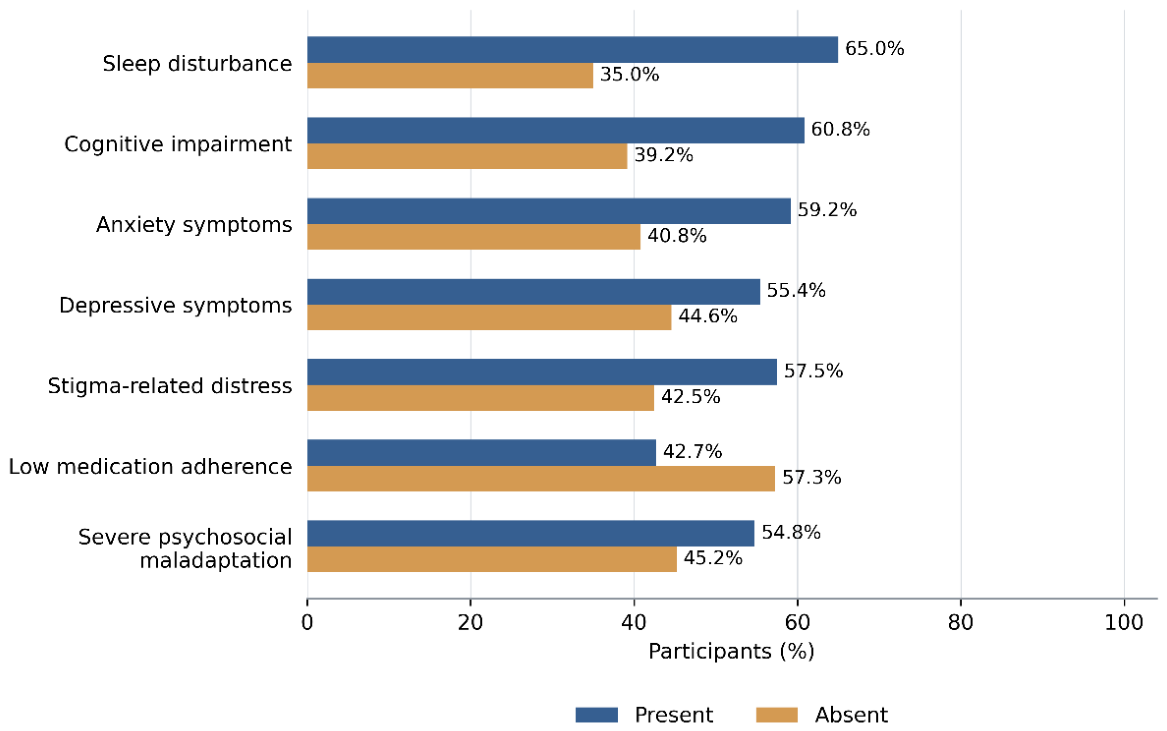
Figure 2.
Distribution of predominant clinical rehabilitation profiles among 480 adults with epilepsy. Labels show percentage and participant count. Coexisting difficulties in other domains are permitted.
Figure 2.
Distribution of predominant clinical rehabilitation profiles among 480 adults with epilepsy. Labels show percentage and participant count. Coexisting difficulties in other domains are permitted.
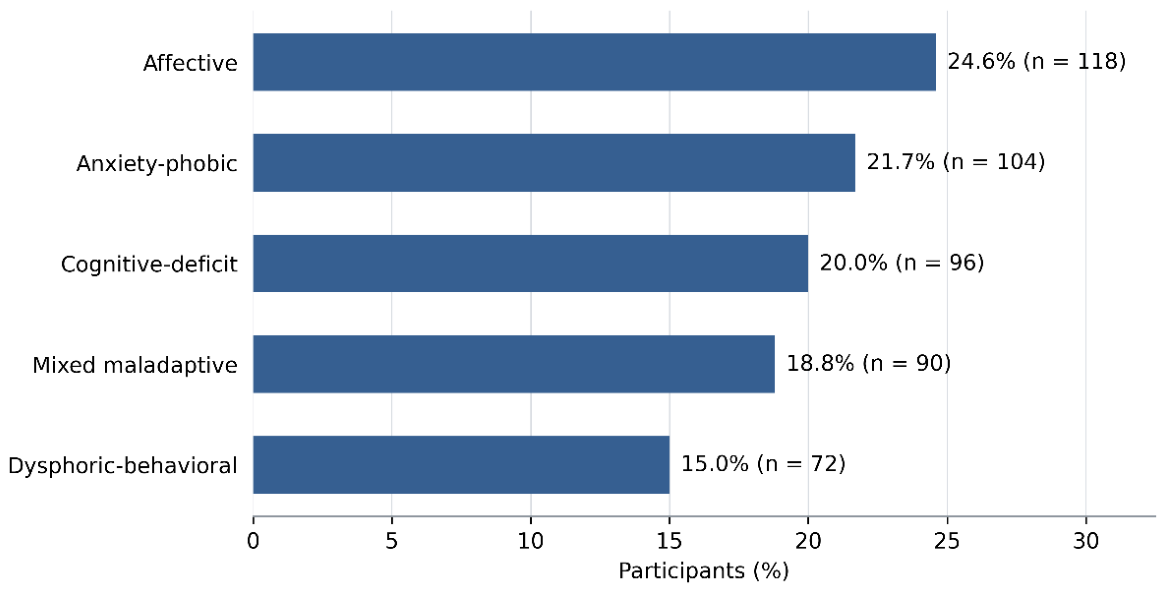

Table 1.
Operational definitions specified in the study protocol.
| Variable | Operational definition |
|---|---|
| Seizure observation period | Preceding 90 days; total divided by three for mean monthly frequency. Seizure diaries and available medical records. |
| Additional psychiatric disorders | Clinical psychiatric interview with reference to ICD-10; manifestations and functional consequences are described in Section 2.3. Symptoms and established diagnoses are recorded separately. |
| Anxiety and depression | HADS-A ≥11 and HADS-D ≥11 points; each subscale ranges from 0 to 21 and refers to the preceding week. |
| Global cognitive screening | MoCA <26 points, interpreted in relation to education and test version. |
| EpiTrack | Protocol: maximum 49 points; threshold ≤28. In the updated scoring system, this threshold indicates severely impaired attention and executive performance. |
| Combined cognitive indicator | Positive screening when MoCA <26 and/or EpiTrack ≤28. |
| Sleep quality | PSQI >5 when a result is available; range 0-21, referring to the preceding month. Sleep complaints are additionally assessed in a clinical interview. |
| Quality of life | QOLIE-31: 31 items, seven subscales, range 0-100; higher scores indicate better quality of life. |
| Felt stigma | Three-item Jacoby scale; total 0-3; felt stigma present at ≥1 point. |
| Stigma-related distress | Self-rating from 0 to 10; study threshold ≥4 points in the presence of felt stigma. |
| Medication adherence | MMAS-8: <6, low; 6 to <8, intermediate; 8, high. Additional sources: clinical interview and information on medication use. |
| Severe psychosocial maladaptation | GAF ≤50 with clinically significant impairment in at least one social, occupational, or family domain. |
Table 2.
Demographic, clinical, and psychosocial characteristics of adults with epilepsy.
| Characteristic | Total cohort (n = 480) |
|---|---|
| Demographic characteristics | |
| Age, years | 35.0 ± 6.2 |
| Women | 211 (44.0) |
| Men | 269 (56.0) |
| Clinical characteristics | |
| Epilepsy duration, years | 8.8 ± 4.4 |
| Seizures per month | 3.1 ± 1.6 |
| Focal epilepsy | 299 (62.3) |
| Generalized epilepsy | 181 (37.7) |
| Drug-resistant epilepsy | 119 (24.8) |
| ASM polytherapy | 214 (44.6) |
| ASM adverse effects | 187 (39.0) |
| Low medication adherence | 205 (42.7) |
| Psychiatric and cognitive manifestations | |
| Anxiety symptoms | 284 (59.2) |
| Depressive symptoms | 266 (55.4) |
| Cognitive impairment | 292 (60.8) |
| Sleep disturbance | 312 (65.0) |
| Obsessive-compulsive symptoms | 116 (24.2) |
| Dysphoric and behavioral symptoms | 168 (35.0) |
| Personality-related and adjustment difficulties | 197 (41.0) |
| Psychotic symptoms | 38 (7.9) |
| Quality of life and psychosocial functioning | |
| QOLIE-31 score <50 | 249 (51.9) |
| Severe psychosocial maladaptation | 263 (54.8) |
| Stigma-related distress | 276 (57.5) |
Note: Values are mean ± SD or n (%). Manifestations may coexist in one participant. Percentages use n = 480 as the denominator.
Table 3.
Distribution of predominant clinical rehabilitation profiles.
| Profile | n (%) |
|---|---|
| Affective | 118 (24.6) |
| Anxiety-phobic | 104 (21.7) |
| Cognitive-deficit | 96 (20.0) |
| Mixed maladaptive | 90 (18.8) |
| Dysphoric-behavioral | 72 (15.0) |
Note: One predominant profile per participant; n = 480. Percentages may sum to 100.1% because of rounding.
Table 4.
Mutually adjusted associations with severe psychosocial maladaptation (n = 480).
| Variable | β (95% CI) | Adjusted OR (95% CI) |
p |
|---|---|---|---|
| Stigma-related distress | 0.982 (0.577-1.389) | 2.67 (1.78-4.01) | <0.001 |
| Depressive symptoms | 0.884 (0.482-1.284) | 2.42 (1.62-3.61) | <0.001 |
| Low medication adherence | 0.837 (0.438-1.238) | 2.31 (1.55-3.45) | <0.001 |
| Anxiety symptoms | 0.765 (0.358-1.169) | 2.15 (1.43-3.22) | <0.001 |
| Cognitive impairment | 0.631 (0.223-1.037) | 1.88 (1.25-2.82) | 0.002 |
| Sleep disturbance | 0.565 (0.157-0.971) | 1.76 (1.17-2.64) | 0.006 |
| Drug-resistant epilepsy | 0.432 (0.010-0.850) | 1.54 (1.01-2.34) | 0.044 |
Note: ORs are adjusted for the seven predictors shown. β = ln(OR); interval limits are ln-transformed from the reported rounded OR CI limits. These are derived coefficients, not a reanalysis of individual data. The reference for each binary predictor is absence of the feature. CI, confidence interval; OR, odds ratio.
Disclaimer/Publisher’s Note: The statements, opinions and data contained in all publications are solely those of the individual author(s) and contributor(s) and not of MDPI and/or the editor(s). MDPI and/or the editor(s) disclaim responsibility for any injury to people or property resulting from any ideas, methods, instructions or products referred to in the content. |
© 2026 by the authors. Licensee MDPI, Basel, Switzerland. This article is an open access article distributed under the terms and conditions of the Creative Commons Attribution (CC BY) license (http://creativecommons.org/licenses/by/4.0/).
Copyright: This open access article is published under a Creative Commons CC BY 4.0 license, which permit the free download, distribution, and reuse, provided that the author and preprint are cited in any reuse.