
Submitted:
06 October 2026
Posted:
08 October 2026
You are already at the latest version
Abstract
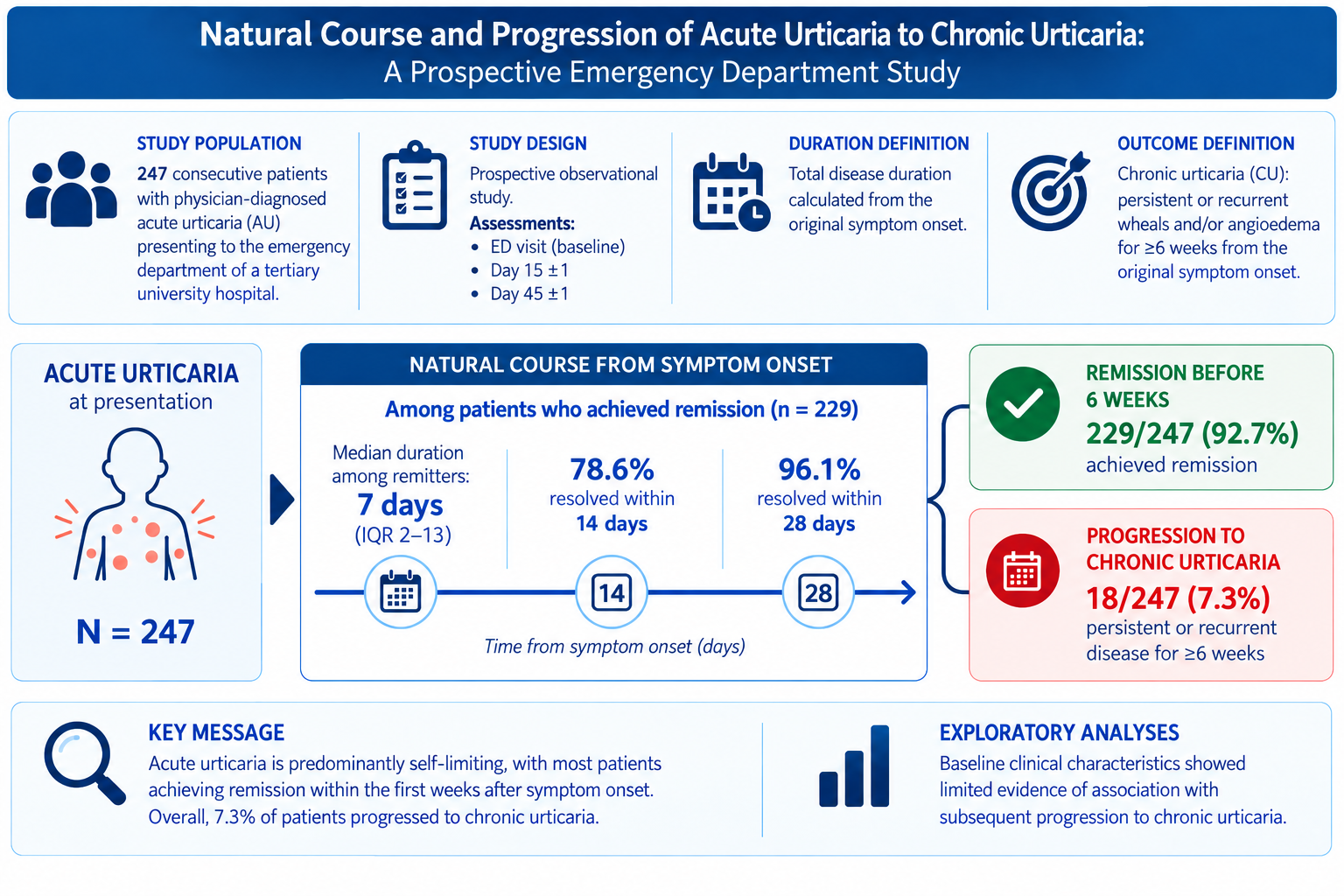
Background/Objectives: Acute urticaria (AU) is generally self-limiting, but prospective data on its natural course and progression to chronic urticaria (CU) remain limited. To characterize the natural course of AU, determine the proportion of patients progressing to CU, and explore baseline clinical characteristics associated with subsequent progression. Methods: We conducted a prospective ob-servational study of 247 consecutive patients with physician-diagnosed AU presenting to a tertiary university emergency department. Patients were assessed at the index visit and followed at Day 15 ±1 and Day 45 ±1. Total disease duration was calculated from original symptom onset, and CU was defined as recurrent wheals and/or angioedema persisting for ≥6 weeks. Baseline associations with CU progression were explored with correction for multiple comparisons. Results: Overall, 229/247 patients (92.7%) achieved remission before 6 weeks and 18/247 (7.3%) progressed to CU. Among patients achieving remission, median episode duration was 7 days (IQR, 2–13); 78.6% and 96.1% achieved complete resolution within 14 and 28 days, respectively. Patients progressing to CU had longer symptom duration before emergency department assessment than those achieving remission (median, 144 vs 8 hours; FDR-adjusted p=0.001), although this reflected prior disease persistence and was not considered an independent prognostic factor. No other baseline characteristic remained significantly associated with CU progression after multiple-comparison correction. Conclusions: AU was predominantly self-limiting, with most patients achieving remission within the first weeks after symptom onset and 7.3% progressing to CU. These findings provide prospective data on the natural course of AU and the transition from acute to chronic disease. Further identification and validation of clinical and biological markers associated with disease persistence may support per-sonalized risk assessment and individualized follow-up.
Keywords:
acute urticaria
; chronic urticaria
; disease progression
; natural history
; personalized medicine
; precision medicine
Copyright: This open access article is published under a Creative Commons CC BY 4.0 license, which permit the free download, distribution, and reuse, provided that the author and preprint are cited in any reuse.