

Submitted:
06 October 2026
Posted:
08 October 2026
You are already at the latest version
Abstract
To provide a comprehensive context, this review first elaborates on the history, mechanism of action, environmental fate, toxicological profile, and general toxicokinetics of Glyphosate (GLY). While the primary ingredient in Roundup®, GLY is traditionally characterized by rapid systemic clearance and low bioaccumulation, this review challenges that paradigm by proposing the skeletal system acts as a critical ‘deep compartment’ for long-term sequestration. Due to the strong affinity of its phosphonate functional group for bone minerals, GLY binds readily to hydroxyapatite, the same mineral matrix targeted by bisphosphonates. Research indicates that while GLY levels decline rapidly in soft tissues, the skeleton acts as a significant reservoir, maintaining high concentrations long after initial exposure. We propose a dual role for the skeleton: first, as "victim," in which sequestered GLY induces oxidative stress and disrupts mineral structure; and second, as "perpetrator," in which the herbicide is released back into the bloodstream during bone remodeling. This endogenous release suggests that physiological states involving high bone turnover, such as pregnancy, lactation, and postmenopause, may trigger chronic internal exposure, even without external intake. Finally, current safety assessments likely suffer from a "one-compartment bias," underestimating GLY’s true biological half-life and its contribution to chronic diseases like renal failure and cancer.
Keywords:
glyphosate
; skeleton
; toxicokinetics
; bioaccumulation
Introduction
Glyphosate overview and origin: Glyphosate (GLY) is a broad-spectrum, non-selective, systemic herbicide. Chemically, it is an organic acid known as N-(phosphonomethyl)glycine, a synthetic derivative of the amino acid glycine bearing a phosphonomethyl group attached to the nitrogen atom [1] (Figure 1).
GLY was originally recognized as a potent mineral chelator, a property documented decades ago [2], well before its herbicidal efficacy was discovered. Its properties as an herbicide were subsequently identified in 1970 by a Monsanto research team led by John E. Franz [3]. Better than an incidental finding, GLY was developed through a deliberate synthetic strategy to optimize the herbicidal activity of structurally related compounds. Following its commercialization in 1974 under the trade name Roundup, GLY rapidly ascended to become the most widely applied herbicide globally [4].
Mechanism of Action and agricultural application of GLY: GLY exerts its herbicidal effect by targeting and inhibiting the enzyme 5-enolpyruvylshikimate-3-phosphate synthase (EPSPS), the sixth enzyme of the shikimate pathway found in plants and microorganisms [5,6,7]. EPSPS possesses a two-domain structure with a distinctive fold formed by a 6-fold replication of a protein-folding unit comprising two parallel helices and a four-stranded sheet. The active site is in the interdomain cleft near the crossover segments where the two domains converge [7]. EPSPS catalyzes the transfer of an enolpyruvyl group from phosphoenolpyruvate (PEP) onto shikimate-3-phosphate (S3P) for the biosynthesis of three essential aromatic amino acids: phenylalanine, tyrosine, and tryptophan [5,6,7,8]. These amino acids are critical for protein synthesis and serve as precursors for secondary metabolites, including lignin and growth regulators [9].
Schönbrunn et al. [6] provided the first atomic-resolution crystallographic identification of GLY's interaction with EPSPS at 1.5–1.6 Å resolution. The researchers showed that GLY occupies the binding site of the natural substrate, PEP, and that the two-domain enzyme closes upon ligand binding, thereby forming the active site in the interdomain cleft [6,7]. The binding site is dominated by charged residues (Lys-22, Arg-124, Lys-411) that are also involved in PEP binding. Schönbrunn’s data support an induced-fit mechanism in which initial S3P binding triggers the structural rearrangement required for subsequent GLY binding. By acting as a competitive inhibitor that mimics PEP, GLY binds to the enzyme's active site and halts the production of these vital compounds. Because the shikimate pathway is absent in mammals and other animals, GLY was long considered selectively toxic only to plants and microorganisms [6]. This physiological distinction formed the original scientific premise that GLY would be nontoxic to humans, as the molecule lacks a specific biological target in human systems [10]
The applied significance of this selectivity was implemented in 1996 with the commercial introduction of "Roundup Ready" transgenic crops. These cultivars were genetically engineered to express a GLY-insensitive class of EPSPS derived from Agrobacterium sp. strain CP4. Because the CP4 EPSPS enzyme binds GLY in a condensed, non-inhibitory conformation, it confers robust herbicide resistance while allowing the plant's shikimate pathway to function unhindered. This highly effective pairing of broad-spectrum herbicides and resistant crops fundamentally revolutionized global weed management across millions of hectares, particularly in soybean, maize, and cotton cultivation [4,11].
GLY Expansion: Global Scale, Applications, and Weed Resistance: The convergence of broad-spectrum efficacy, cost-effectiveness, and compatibility with conservation tillage practices drove an exponential expansion of GLY use after 1996, directly coinciding with the commercial introduction of "Roundup Ready" transgenic crops. By 2014, global sales exceeded 825,000 tons annually [4]. In agricultural centers such as Argentina, between 180 and 200 million liters of the formulation are applied annually across 23 million hectares of transgenic cultivars [12,13]. Beyond traditional agronomic sectors, GLY is utilized extensively in forestry management, urban landscapes, and roadside corridors, making it one of the most ubiquitous synthetic compounds in contemporary terrestrial environments [4,13,14].
Global application of GLY has been projected to exceed 920,000 tons by 2025 [13]. Furthermore, the global GLY market is projected to reach $15.42-$24.45 billion by 2032 [15]. However, this intensive, repeated reliance on GLY as a mono-therapeutic weed management tool has exerted immense selection pressure, culminating in documented resistance in at least 20 weed species across five continents [16]. This resistance has evolved via diverse biological mechanisms [16]. These pathways include altered sensitivity of the EPSPS enzyme to target-site mutations, gene amplification resulting in enzyme overexpression, restricted translocation of the herbicide to active metabolic sinks (as observed in resistant goosegrass), and accelerated carbon flux through the shikimate pathway [16]. The diversity of these adaptive mechanisms among distinct weed species underscores the significant evolutionary pressure exerted by widespread GLY use, posing severe challenges to the long-term sustainability of modern weed management systems.
Environmental Fate, Sorption Dynamics, and Degradation of GLY: The environmental behavior of GLY in soil and aquatic systems is governed heavily by localized physicochemical conditions. In typical temperate soils, GLY exhibits an average half-life of approximately 30 days, driven predominantly by microbial degradation [14]. The compound displays a strong affinity for soil matrices, binding tightly to aluminum and iron oxides, clay minerals, and organic matter [17]. This sorption behavior limits its bioavailability and vertical mobility, generally preventing significant leaching into groundwater aquifers under standard agricultural conditions. However, subsurface transport can still occur through macropores in structured soils, particularly during heavy rainfall events [17].
The primary metabolic pathway of GLY yields aminomethylphosphonic acid (AMPA), a degradation product that is more environmentally persistent than its parent compound. AMPA tends to accumulate in the environment with repeated applications, a phenomenon exacerbated by cold and dry climatic conditions [18]. Field data underscore this persistence. For instance, in agricultural basins across Argentina, AMPA was detected in 88.5% of stream sediment samples, whereas its parent compound, GLY, was found in 66% [12]. Beyond South American basins, recent global monitoring confirms that this environmental distribution spans diverse hydrological matrices across North America, Europe, and Oceania. In the United States, a comprehensive evaluation in New York State demonstrated the widespread occurrence of both compounds across surface water, drinking water, and wastewater systems, with geometric mean concentrations peaking in stormwater runoff and wastewater effluents [19]. This urban and industrial input is mirrored in Europe; long-term monitoring of the Llobregat and Besòs river basins in Barcelona, Spain, revealed that AMPA consistently exceeded GLY at 95% of sampling sites, severely complicating downstream drinking water treatment trains [20]. The vulnerability of groundwater and soil is further highlighted in the karstic regions of Mexico, where intensive agricultural practices have led to significant soil accumulation and subsequent vertical leaching of both GLY and AMPA into subsurface aquifers [21]. Furthermore, point-source management remains a critical challenge; multi-plant surveys in Australia detected GLY in 100% of wastewater treatment plant influents and 82% of treated effluents, releasing an estimated 5,000 kg of the herbicide into aquatic environments annually [22]. Despite its widespread, multi-pathway global presence across these surface, ground, soil, and wastewater systems, GLY does not bioaccumulate in trophic webs due to its high water solubility, and its overall environmental impact quotient remains lower than that of most alternative synthetic herbicides [14].
Human Health and Toxicological Profile of GLY: The health profile of GLY remains highly contested in modern toxicology, characterized by a stark divergence between major regulatory assessments and a prominent international classification body.
The prevailing position among global regulatory agencies is that GLY does not pose a carcinogenic risk to humans at realistic dietary or environmental exposure levels. The US Environmental Protection Agency (EPA), the European Food Safety Authority (EFSA), the European Commission, and the joint FAO/WHO Meeting on Pesticide Residues (JMPR) all conclude that standard exposure does not present a cancer risk [23]. In 2022, the European Chemicals Agency (ECHA) concluded that GLY does not meet the scientific criteria for classification as a carcinogen or mutagen. Following a comprehensive risk assessment by the European Food Safety Authority (EFSA) in 2023, the European Commission renewed the authorization of GLY for an additional 10 years [23]. Conversely, the International Agency for Research on Cancer (IARC) classified GLY as "probably carcinogenic to humans" (Group 2A) in 2015 [24]. Tarazona et al. [23] explained that the divergence between the European Union (EU) and IARC arises from the use of different datasets and divergent evaluation methodologies. A subsequent expert panel review published in Critical Reviews in Toxicology challenged the IARC classification [25]. The authors concluded that the animal tumor data cited by IARC lacked statistical power, consistency, and clear dose-response relationships. At the same time, the available epidemiological evidence failed to establish a robust causal link to non-Hodgkin lymphoma (NHL).
Beyond carcinogenicity, more recent literature highlights broader physiological impacts associated with commercial herbicide formulations. Peillex and Pelletier [26] compiled evidence indicating that both GLY and its commercial mixtures induce cytotoxic and genotoxic effects, promote oxidative stress, disrupt estrogen receptor signaling, and impair immune function. While these effects are highly pronounced in aquatic organisms, they typically manifest only at elevated exposure levels in mammals. Expanding on these findings, a comprehensive 15-year review (2010-2025) by Klátyik et al. [27] identified potential links to metabolic syndrome and to reproductive and endocrine disruptions. This review emphasized that the toxicity historically attributed to GLY is frequently driven by co-formulants like polyethoxylated tallow amine (POEA). Added to enhance plant penetration, these surfactant co-formulants often exhibit significantly higher inherent toxicity than the active ingredient alone.
Systemic exposure to GLY and its primary metabolite, AMPA, is well documented, with both compounds frequently detected in human and animal tissues [28,29]. A robust body of literature connects this systemic body burden to diverse adverse health outcomes, including endocrine disruption [30], oxidative stress [31,32], DNA damage [33] and toxic impacts on the hepatic and renal systems [34]. Furthermore, exposure has been linked to dermatological and respiratory conditions, the development of antibiotic tolerance, and an elevated risk of neurological disorders [34]. Despite these documented hazards, regulatory frameworks remain relatively permissive, as evidenced by several jurisdictions that have recently extended authorizations for continued use.
Regardless of ongoing disparities in risk assessment between US and European regulatory authorities, the increasing detection of GLY residues in human biological matrices underscores widespread exposure. The ubiquitous presence of these residues in blood, urine, and breast milk across both general and pediatric populations highlights pervasive, continuous environmental and dietary pathways [35,36,37].
GLY Exposure and Toxicokinetics: Humans and animals are exposed to GLY through multiple pathways, primarily via the oral ingestion of contaminated food and drinking water [38]. Exposure risk increases significantly within occupational and environmental settings, particularly in agricultural regions, exhibiting a clear upward trend over time. For example, a longitudinal study in rural Southern California tracking adults from 1993 to 2016 documented a dramatic surge in urinary GLY concentrations from 118.3 pM to 1.83 nM, representing a 1,450% increase over approximately two decades [39]. Concurrently, the proportion of individuals exceeding the limit of quantification (LOQ; 0.03 µg/L) climbed from 12% to 70% [39]. Within the broader general population, GLY concentrations ranging from 1.54 to 44.9 nM have been detected across various biological matrices, including urine, maternal milk, umbilical cord serum, and maternal blood [35]. A parallel trend was observed in Germany, where the percentage of individuals exceeding the GLY LOQ (0.18 nM) rose from 10% to 56.4% over a 12-year period [36]. Taken together, these epidemiological data underscore the widespread and compounding nature of global GLY exposure.
Toxicokinetic evaluations in animal models demonstrate that the gastrointestinal tract absorbs approximately 30–36% of ingested GLY [40,41]. Metabolically, GLY undergoes minimal biotransformation and is excreted largely unchanged, predominantly via feces and secondarily through urine [10,42,43]. Following oral administration, the compound exhibits rapid clearance with a half-life of approximately 6 hours, characterizing both the α (distribution) and β (elimination) phases [44]. Because the kidneys serve as the primary route of systemic clearance, total ingested GLY can be reliably extrapolated from urinary excretion levels [45]. Elevated urinary GLY residues therefore function as a robust biomarker for high exposure, a relationship strongly validated by the Farm Family Exposure Study [46]. Furthermore, chronically ill individuals exhibit significantly higher urinary GLY residues compared to healthy cohorts [28]. This suggests that chronic diseases may impair the metabolic biotransformation of GLY, reduce its breakdown, and lead to greater systemic accumulation, ultimately reflected in elevated urinary excretion.
Despite its rapid clearance profile, residual GLY can still accumulate in various tissues and organs post-exposure. At slaughterhouses, GLY residues have been detected in cattle tissues, including the gastrointestinal tract, liver, skeletal muscle, spleen, and kidneys [28]. Furthermore, tracing studies using a single dose of 14C-radiolabeled GLY in rats revealed systemic distribution to the bone, blood, thyroid, testes, ovaries, kidneys, lungs, liver, and spleen [47]. This radiolabeled compound exhibited a β-phase elimination half-life of 7.5 days in males and 14 days in females, with bone demonstrating the highest propensity for bioaccumulation [47]. To date, however, a critical knowledge gap remains regarding the exact retention time and long-term kinetics of GLY accumulation in tissues, particularly bone, following chronic, low-dose exposure to this herbicide.
Skeletal Sequestration and the Pharmacokinetic Fallacy of Rapid Elimination: Current toxicokinetic assessments of GLY emphasize that 30–36% of an oral dose is absorbed and rapidly cleared via renal excretion [40,44]. However, these traditional frameworks often suffer from a "one-compartment" bias. While GLY concentrations in highly perfused organs, such as the liver, lungs, and heart, decline rapidly, residues remain persistently elevated in bone tissue, revealing a significant deep peripheral compartment [40,41,44,47,48,49,50]
Pharmacokinetic data demonstrates a staggering bone-to-blood tissue ratio of 131 at 168 hours post-exposure, far exceeding that of any other organ system.[47,50]. This deep-tissue sequestration is driven by GLY and its primary metabolite AMPA, acting as a powerful chelator with a specific affinity for the hydroxyapatite crystals that comprise the bone matrix [51,52,53,54]. Consequently, the skeleton functions as a "slow-exchange" reservoir, capturing these hazardous compounds during acute exposure peaks and retaining them long term.
This skeletal accumulation is intimately tied to bone remodeling, the continuous physiological process by which old or damaged bone is resorbed by osteoclasts and subsequently replaced by new tissue. This mechanism is essential for maintaining skeletal strength, repairing microdamage from mechanical loading, and regulating systemic calcium homeostasis [55]. Interestingly, bone turnover rates peak during childhood and adolescence and decline progressively with age. Intriguingly, epidemiological data mirror this temporal pattern, showing that the highest circulatory GLY levels occur in children and adolescents and decrease with age [37,56]. This distinct correlation suggests a potential interplay between bone remodeling dynamics and systemic GLY circulation, in which accelerated bone turnover may continuously liberate sequestered GLY into the bloodstream. However, this hypothetical association has yet to be empirically tested.
Interfacial Chemistry and Skeletal Bioaccumulation of GLY: To understand GLY's chemical affinity for skeletal tissues, its baseline interaction with bone mineral hydroxyapatite (Hap) must be evaluated. Thermodynamic insights from Hernández-Barreto et al. [51] demonstrate a highly favorable, exothermic binding process between GLY and biogenic (B)Hap. By pairing immersion enthalpy calorimetry with density functional theory (DFT) modeling, the authors revealed that the GLY–Hap interaction energy significantly exceeded that of the water–hydroxyapatite interaction. This thermodynamic gradient enables GLY to readily displace water molecules within the mineral’s surface hydration shell. Furthermore, DFT modeling confirmed that this behavior is driven by chemisorption, establishing a covalent-like coordination network rather than weak physisorption or simple electrostatic attraction. Although originally studied for environmental remediation, these fundamental binding parameters provide a clear chemical rationale for transforming the mineralized matrix from a passive barrier into a high-affinity chemical sink for GLY in vivo.
Molecular Coordination and Structural Mimicry: This interfacial chemistry is driven by the precise coordination chemistry of GLY’s three functional groups: a phosphate (–PO₃H₂), a carboxylate (–COOH), and an amine (–NH₂). The phosphonate group serves as the primary driver of skeletal affinity. Because Hap constitutes approximately 65% of bone by weight, its surface presents dense arrays of calcium ions (acting as Lewis acid sites) and inorganic phosphate groups. As described by Raina et al. [49], the mineralized skeletal matrix can act as a metabolic sink or "waste dump" for circulating trace elements and exogenous drugs. Importantly, molecules bearing phosphonate or bisphosphonate functional groups exhibit highly specific, high-affinity binding to bone via calcium-phosphate coordination. Because GLY possesses a phosphonate structure, it acts as a structural analog to bisphosphonates, a class of pharmaceuticals renowned for high bone affinity and decades-long skeletal retention.
At the molecular level, GLY’s phosphonate coordinates to surface Ca²⁺ ions via ligand exchange, forming stable inner-sphere surface complexes. While DFT modeling of GLY–metal complexes shows that binding stability to divalent cations follows a transition-metal-preferred trend (Zn > Cu > Co > Fe >> Ca > Mg), the dominant surface Ca²⁺ ions on Hap still support a moderate, chemically significant interaction [54]. Furthermore, because inorganic phosphate and GLY's phosphonate group occupy nearly identical binding geometries, they compete directly for surface mineral sites. While soil chemistry benchmarks show that phosphate typically outcompetes GLY on iron oxides, the competitive landscape within the calcium-phosphate matrix of bone mineral favors persistent accumulation. Ultimately, this structural mimicry transforms the mineralized skeletal matrix into an active chemical sink, challenging the classical paradigm of GLY as an exclusively soft-tissue-distributed xenobiotic.
In Vivo Toxicokinetic and Skeletal Retention: This strong mineral affinity directly influences in vivo toxicokinetics, shifting the view of GLY as a rapidly cleared, soft-tissue-only contaminant. According to the Agency for Toxic Substances and Disease Registry (ATSDR) [57], GLY exhibits low systemic absorption and minimal metabolism in mammals. Approximately 30–36% of an oral dose is absorbed from the gastrointestinal tract, whereas dermal absorption is negligible (1–3%). Less than 1% of the absorbed dose is converted to its primary metabolite, AMPA, a process likely mediated by gastrointestinal bacteria rather than liver enzymes. Consequently, the vast majority of GLY is excreted unchanged via feces and urine within 48 to 72 hours [57].
Despite this rapid systemic clearance, a measurable fraction of circulating GLY distributes to the skeletal system, exhibiting distinct retention characteristics. 1) Skeletal Bioaccumulation: Data from rat models demonstrate that after a single oral dose of radiolabeled GLY, skeletal radioactivity peaks at approximately 6 hours, accounting for 4.7% of the administered dose [47]; 2) Prolonged Elimination: GLY is eliminated from the skeletal matrix far more slowly than from blood or soft tissues. At 96 hours post-exposure, 1.7% of the dose remains in the bone, resulting in an increasing bone-to-blood tissue ratio over time; 3) Compartmental Clearance: Conversely, when GLY is administered intravenously or intraperitoneally, it is detected in the bone marrow but clears relatively quickly, exhibiting an estimated half-life of only 4.2 to 7.6 hours [47,50].
While GLY does not appear to act as a major skeletal toxin at low doses—with significant morphological effects, such as ossification delays, restricted to high, maternally toxic doses—its persistent affinity for the bone matrix and potential links to bone marrow-related malignancies, such as multiple myeloma, remain subjects of ongoing scientific scrutiny [57].
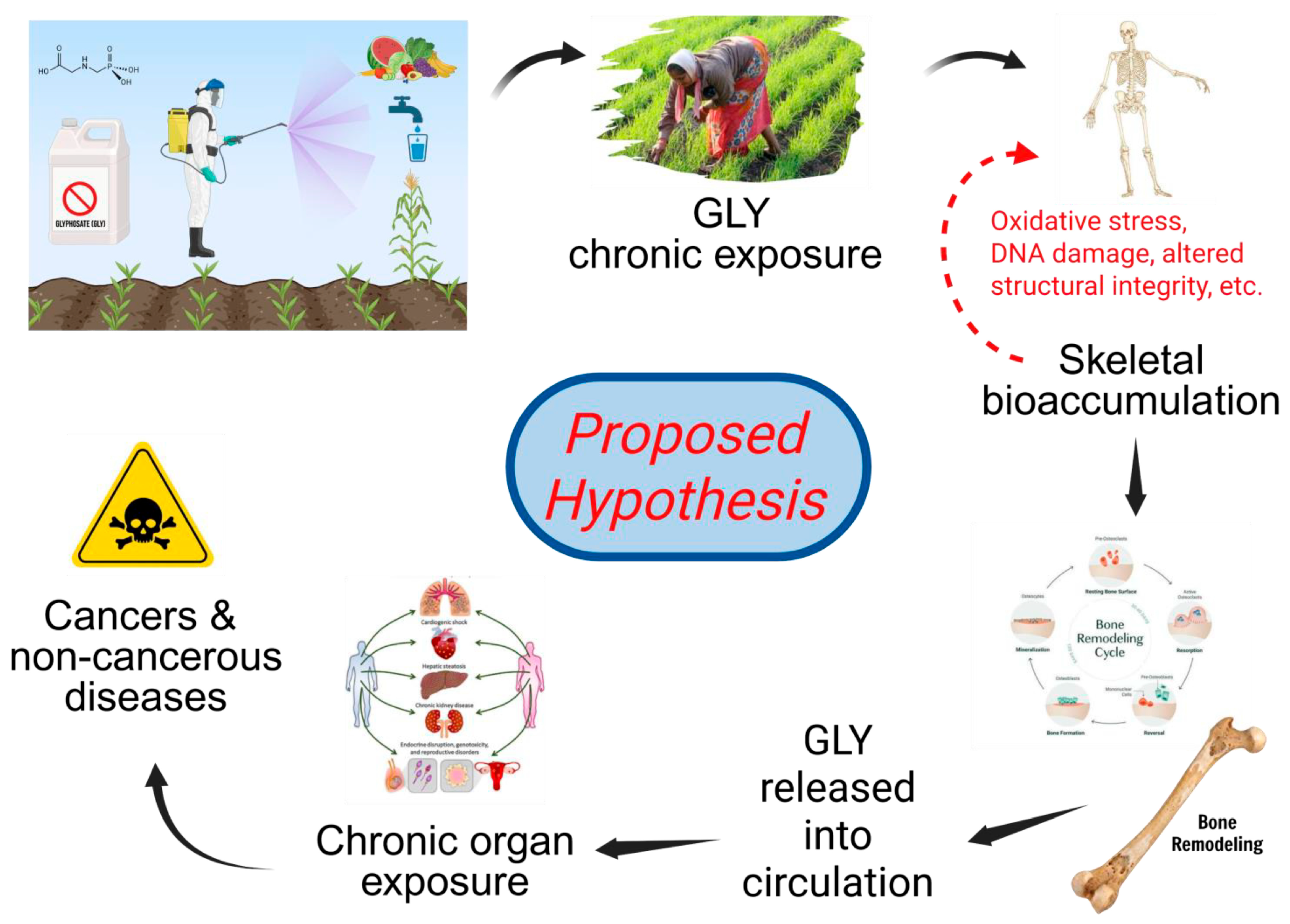
Proposed Hypotheses: Dual Role of the Skeleton as Victim and Perpetrator in GLY Metabolism(Figure 2).
In a review, McGowan [58] argued that the skeleton function as a critical, timed-release reservoir for environmental pollutants, extending systemic risk far beyond initial exposure. Environmental pollutants sequestered within the mineralized matrix are later remobilized to damage peripheral tissues during periods of accelerated skeletal turnover. For instance, the skeleton serves as the primary storage depot for heavy metals such as lead, harboring approximately 90% of the body's total lead burden. Although this initial sequestration shields soft tissues from acute toxicity, the bone-bound lead remains subject to bone remodeling, a natural, lifelong physiological process responsible for maintaining skeletal integrity, repairing microdamage, and regulating systemic mineral homeostasis. This continuous turnover means the trapped lead possesses a metabolic half-life of 15 to 25 years, ensuring its systemic persistence long after the external source of pollution has been eliminated. When bones is resorbed during the bone remodeling process, these pollutants are liberated back into the circulation and become highly bioavailable, transforming the skeleton into an endogenous source of chronic exposure. Based on these established skeletal kinetics, we hypothesize that GLY behaves in a similar manner, acting as both a target and a continuous source of toxicity through the following pathways:
a) The Skeleton as Victim: GLY bioaccumulates within the skeletal matrix, posing a direct threat to bone health and systemic mineral balance. Bone is a dynamic, living tissue that relies on a steady equilibrium between bone resorption by osteoclasts and bone formation by osteoblasts [55]. Thus, GLY accumulation might disrupt this delicate balance through three distinct pathways: 1) Molecular disruption: GLY exposure induces systemic oxidative stress, DNA damage, and endocrine disruption [30,31,33]. When sequestered within the bone matrix, GLY directly affects the localized niche, compromising cellular viability and function; 2) Altered Structural Integrity: GLY possesses a strong affinity for mineral surfaces, where it’s binding likely disrupts hydroxyapatite crystal formation. Consequently, this chemical interference weakens overall bone strength and impairs the vital repair of microdamage caused by routine weight-bearing stress [51,55]; 3) Pediatric Vulnerability: Bone remodeling rates peak during childhood and adolescence. Because of this rapid turnover, young skeletons absorb GLY much more efficiently, compounding their developmental toxicity risks. This mechanism aligns with epidemiological data showing significantly higher urinary GLY levels in pediatric populations compared to adults [37].
b) The Skeleton as Perpetrator: The core of this hypothesis proposes that the skeleton functions as a primary driver of chronic toxicity, maintaining systemic exposure long after external exposure has ceased. 1) The resorption-release mechanism: Bone remodeling is a continuous process essential for calcium homeostasis. During the bone resorption phase, osteoclasts resorb the mineralized matrix [55]. This breakdown frees trapped GLY and its primary metabolite, AMPA, back into the circulatory system; 2) the second wave of intoxication: Because GLY bioaccumulates in a dose-dependent manner [47,50], the skeletal reservoir builds over time. Subsequent bone turnover continually releases these stored toxins back into the bloodstream, establishing a persistent internal dose. Consequently, even if an individual moves to a GLY-free environment or switches to an organic diet, their own skeleton continues to perpetrate intoxication; 3) Metabolic triggering events: Any physiological state that accelerates bone resorption will inevitably trigger an influx of released GLY. These high-risk states include PTH surges, pregnancy, lactation, and postmenopausal osteoporosis [59,60,61,62]. In these populations, the skeleton acts as a ticking clock of stored systemic toxicity.
c) Systemic Consequences: The Organ-Injury Cycle: Once mobilized from the skeletal reservoir, circulating GLY travels via the bloodstream to vulnerable organ systems. This chronic internal exposure inflicts secondary damage that is frequently misattributed to recent, external exposures: 1) Carcinogenesis: Continuous, endogenous release from the skeleton drives a high lifetime cumulative dose. This chronic exposure significantly elevates cancer risks, consistent with GLY's classification as a probable human carcinogen [24]; 2) renal and neurological damage: The kidneys are subjected to a constant flux of re-released GLY during filtration, contributing to progressive renal impairment or failure [34]. Simultaneously, sustained systemic levels cross biological barriers, inducing oxidative stress in the brain and elevating the risk of chronic neurological diseases [31,34]; 3) Respiratory and dermatological manifestations: The constant presence of circulating toxins triggers chronic, systemic inflammatory cascades. This persistent inflammation frequently surfaces clinically as severe skin conditions and respiratory disorders [63].
Conclusion: We propose that the skeleton serves as both a primary reservoir and an endogenous, sustained-release delivery system for GLY (Figure 2). Current safety models rely heavily on a simplistic ingestion-excretion framework that completely overlooks skeletal storage. If the skeleton acts as both a victim of bioaccumulation and a perpetrator of redistribution, standard safety thresholds are dangerously inadequate. Future toxicological research must prioritize determining the retention half-life of GLY in bone tissue. Furthermore, studies must investigate how common clinical interventions for bone disease (such as PTH therapies or bisphosphonates) might inadvertently accelerate or modulate systemic toxicokinetics. Until toxicology accounts for this skeletal stronghold, the true, long-term toll of GLY on human health will remain drastically underestimated.
Author Contributions
Conceptualization, J.I.A., T.L.F.G., C.J.M. and N.D.D.; methodology, J.I.A. and T.L.F.G.; investigation, J.I.A., T.L.F.G., C.J.M. and N.D.D.; writing original draft preparation, J.I.A.; writing review and editing, J.I.A., T.L.F.G., C.J.M. and N.D.D.; visualization, J.I.A.; supervision, J.I.A. and N.D.D.; funding acquisition, J.I.A. All authors have read and agreed to the published version of the manuscript.
Funding
An intramural grant from the College of Veterinary Medicine, University of Florida partially supported this research.
Conflict of Interest
The authors have no conflicts of interest.
Abbreviations
AMPA: Aminomethylphosphonic acid; ATSDR: Agency for Toxic Substances and Disease Registry; (B)Hap: Biogenic Hydroxyapatite; -COOH: Carboxyl group; DFT: Density Functional Theory; EFSA: European Food Safety Authority; EPA: Environmental Protection Agency (US); EPSPS: 5-enolpyruvylshikimate-3-phosphate synthase; EU: European Union; FAO: Food and Agriculture Organization of the United Nations; GLY: Glyphosate; Hap: Hydroxyapatite; IARC: International Agency for Research on Cancer; JMPR: Joint FAO/WHO Meeting on Pesticide Residues; LOQ: Limit of Quantification; NH₂: Amine group; NHL: Non-Hodgkin lymphoma; PEP: Phosphoenolpyruvate; –PO₃H₂: Phosphonate group; POEA: Polyethoxylated tallow amine; PTH: Parathyroid hormone; S3P: Shikimate-3-phosphate; WHO: World Health Organization;
References
- National Center for Biotechnology Information. Compound summary for CID 3496, Glyphosate (3D-Conformer section). PubChem. Retrieved [Date You Accessed It], from https://pubchem.ncbi.nlm.nih.gov/compound/Glyphosate#section=3D-Conformer. 2024.
- Toy ADF, U. E. Aminomethylenephosphinic acids, salts thereof, and process for their production. United States Patent Office, Patent. 3:160,632 1964.
- Baird, D. D. U., R.P.; Homesley, W.B.; Franz, J. E., Introduction of a new broad spectrum post emergence herbicide of a new broad spectrum post emergence herbicide class with utility for herbaceous perennial weed control. . Proc. North Cent. Weed Control Conf 1971, Proceedings 26th North Central Weed Control Conf, 64–68.
- Benbrook, C. M., Trends in glyphosate herbicide use in the United States and globally. Environ Sci Eur 2016, 28, (1), 3. [CrossRef] [PubMed]
- Healy-Fried, M. L.; Funke, T.; Priestman, M. A.; Han, H.; Schonbrunn, E., Structural basis of glyphosate tolerance resulting from mutations of Pro101 in Escherichia coli 5-enolpyruvylshikimate-3-phosphate synthase. J Biol Chem 2007, 282, (45), 32949–55. [CrossRef] [PubMed]
- Schonbrunn, E.; Eschenburg, S.; Shuttleworth, W. A.; Schloss, J. V.; Amrhein, N.; Evans, J. N.; Kabsch, W., Interaction of the herbicide glyphosate with its target enzyme 5-enolpyruvylshikimate 3-phosphate synthase in atomic detail. Proc Natl Acad Sci U S A 2001, 98, (4), 1376–80. [CrossRef] [PubMed]
- Stallings, W. C.; Abdel-Meguid, S. S.; Lim, L. W.; Shieh, H. S.; Dayringer, H. E.; Leimgruber, N. K.; Stegeman, R. A.; Anderson, K. S.; Sikorski, J. A.; Padgette, S. R.; Kishore, G. M., Structure and topological symmetry of the glyphosate target 5-enolpyruvylshikimate-3-phosphate synthase: a distinctive protein fold. Proc Natl Acad Sci U S A 1991, 88, (11), 5046–50. [CrossRef] [PubMed]
- Eschenburg, S.; Healy, M. L.; Priestman, M. A.; Lushington, G. H.; Schonbrunn, E., How the mutation glycine96 to alanine confers glyphosate insensitivity to 5-enolpyruvyl shikimate-3-phosphate synthase from Escherichia coli. Planta 2002, 216, (1), 129–35. [CrossRef] [PubMed]
- Maeda, H.; Dudareva, N., The shikimate pathway and aromatic amino Acid biosynthesis in plants. Annu Rev Plant Biol 2012, 63, 73–105. [CrossRef] [PubMed]
- WHO, Environmental Health Criteria 159, Toxicological Evaluations - Glyphosate. In International Programme on Chemical Safety, W. H. O., Ed. Geneva, Switzerland, 1994.
- Funke, T.; Han, H.; Healy-Fried, M. L.; Fischer, M.; Schonbrunn, E., Molecular basis for the herbicide resistance of Roundup Ready crops. Proc Natl Acad Sci U S A 2006, 103, (35), 13010–5. [CrossRef] [PubMed]
- Aparicio, V. C.; De Geronimo, E.; Marino, D.; Primost, J.; Carriquiriborde, P.; Costa, J. L., Environmental fate of glyphosate and aminomethylphosphonic acid in surface waters and soil of agricultural basins. Chemosphere 2013, 93, (9), 1866–73. [CrossRef] [PubMed]
- Maggi, F.; la Cecilia, D.; Tang, F. H. M.; McBratney, A., The global environmental hazard of glyphosate use. Sci Total Environ 2020, 717, 137167. [CrossRef] [PubMed]
- Duke, S. O., Glyphosate: environmental fate and impact. . Weed Science 2020, 68, (3), 201–207. [CrossRef]
- Glyphosate Market - Market Analysis, Sustainable Growth Insights 2025-2032. Hyderabad: DataM Intelligence. https://www.datamintelligence.com/research-report/glyphosate-market. DATAM Intelligence 2025.
- Pline-Srnic, W., Physiological Mechanisms of Glyphosate Resistance. Weed Technology 2006, 20, (2), 290–300. [CrossRef]
- Borggaard, O. K.; Gimsing, A. L., Fate of glyphosate in soil and the possibility of leaching to ground and surface waters: a review. Pest Manag Sci 2008, 64, (4), 441–56. [CrossRef] [PubMed]
- Bento, C. P. M.; Goossens, D.; Rezaei, M.; Riksen, M.; Mol, H. G. J.; Ritsema, C. J.; Geissen, V., Glyphosate and AMPA distribution in wind-eroded sediment derived from loess soil. Environ Pollut 2017, 220, (Pt B), 1079–1089. [CrossRef] [PubMed]
- Li, Z. M.; Kannan, K., Occurrence and distribution of glyphosate and aminomethylphosphonic acid in surface water, drinking water, wastewater and other water types from New York State, USA. Water Res 2025, 286, 124232. [CrossRef] [PubMed]
- Roca, A.; Ballesteros, R.; Boleda, M. R.; Dalmau, J.; Ganzer, M.; Minoves, M.; Rubirola, A.; Paraira, M.; Farré, M. J., Glyphosate and AMPA in source water and drinking water: Occurrence, fate, and treatment implications in Barcelona (Spain). Journal of Environmental Chemical Engineering 2026, 14, (5), 124338. [CrossRef]
- Osten, J. R.; Borges-Ramirez, M. M.; Ruiz-Velazco, N. G.; Helguera, E.; Arellano-Aguilar, O.; Peregrina-Lucano, A. A.; Lozano-Kasten, F., Glyphosate and AMPA in Groundwater, Surface Water, and Soils Related To Different Types of Crops in Mexico. Bull Environ Contam Toxicol 2025, 114, (3), 44. [CrossRef] [PubMed]
- Campbell, G.; Tscharke, B. J.; Prasad, P.; Knight, E. R.; Reeks, T.; Jackson, A.; Thomas, K. V.; Mueller, J. F.; Kaserzon, S. L., Occurrence and fate of glyphosate and AMPA in wastewater treatment plants in Australia. Science of The Total Environment 2025, 969, 178964. [CrossRef] [PubMed]
- Tarazona, J. V.; Court-Marques, D.; Tiramani, M.; Reich, H.; Pfeil, R.; Istace, F.; Crivellente, F., Glyphosate toxicity and carcinogenicity: a review of the scientific basis of the European Union assessment and its differences with IARC. Arch Toxicol 2017, 91, (8), 2723–2743. [CrossRef] [PubMed]
- Guyton, K. Z.; Loomis, D.; Grosse, Y.; El Ghissassi, F.; Benbrahim-Tallaa, L.; Guha, N.; Scoccianti, C.; Mattock, H.; Straif, K.; International Agency for Research on Cancer Monograph Working Group, I. L. F., Carcinogenicity of tetrachlorvinphos, parathion, malathion, diazinon, and glyphosate. Lancet Oncol 2015, 16, (5), 490–1. [CrossRef] [PubMed]
- Williams, G. M.; Aardema, M.; Acquavella, J.; Berry, S. C.; Brusick, D.; Burns, M. M.; de Camargo, J. L. V.; Garabrant, D.; Greim, H. A.; Kier, L. D.; Kirkland, D. J.; Marsh, G.; Solomon, K. R.; Sorahan, T.; Roberts, A.; Weed, D. L., A review of the carcinogenic potential of glyphosate by four independent expert panels and comparison to the IARC assessment. Crit Rev Toxicol 2016, 46, (sup1), 3–20. [CrossRef] [PubMed]
- Peillex, C.; Pelletier, M., The impact and toxicity of glyphosate and glyphosate-based herbicides on health and immunity. J Immunotoxicol 2020, 17, (1), 163–174. [CrossRef] [PubMed]
- Klátyik, S.; Simon, G.; Takács, E.; Oláh, M.; Zaller, J. G.; Antoniou, M. N.; Benbrook, C.; Mesnage, R.; Székács, A., Toxicological concerns regarding glyphosate, its formulations, and co-formulants as environmental pollutants: a review of published studies from 2010 to 2025. Archives of Toxicology 2025, 99, (8), 3169–3203. [CrossRef] [PubMed]
- Krüger, M. S., P.; Schrödl, W.; Hoppe, H. W.; Lutz, W.; Shehata, A., Detection of Glyphosate Residues in Animals and Humans. J Environ Anal Toxicol 2014, 4, (2), 1–5.
- Connolly, A.; Coggins, M. A.; Galea, K. S.; Jones, K.; Kenny, L.; McGowan, P.; Basinas, I., Evaluating Glyphosate Exposure Routes and Their Contribution to Total Body Burden: A Study Among Amenity Horticulturalists. Ann Work Expo Health 2019, 63, (2), 133–147. [CrossRef] [PubMed]
- Ingaramo, P.; Alarcon, R.; Munoz-de-Toro, M.; Luque, E. H., Are glyphosate and glyphosate-based herbicides endocrine disruptors that alter female fertility? Mol Cell Endocrinol 2020, 518, 110934. [CrossRef] [PubMed]
- Mesnage, R.; Brandsma, I.; Moelijker, N.; Zhang, G.; Antoniou, M. N., Genotoxicity evaluation of 2,4-D, dicamba and glyphosate alone or in combination with cell reporter assays for DNA damage, oxidative stress and unfolded protein response. Food Chem Toxicol 2021, 157, 112601. [CrossRef] [PubMed]
- Faria, M.; Bedrossiantz, J.; Ramirez, J. R. R.; Mayol, M.; Garcia, G. H.; Bellot, M.; Prats, E.; Garcia-Reyero, N.; Gomez-Canela, C.; Gomez-Olivan, L. M.; Raldua, D., Glyphosate targets fish monoaminergic systems leading to oxidative stress and anxiety. Environ Int 2021, 146, 106253. [CrossRef] [PubMed]
- Wozniak, E.; Sicinska, P.; Michalowicz, J.; Wozniak, K.; Reszka, E.; Huras, B.; Zakrzewski, J.; Bukowska, B., The mechanism of DNA damage induced by Roundup 360 PLUS, glyphosate and AMPA in human peripheral blood mononuclear cells - genotoxic risk assessement. Food Chem Toxicol 2018, 120, 510–522. [CrossRef] [PubMed]
- Samsel, A.; Seneff, S., Glyphosate, pathways to modern diseases III: Manganese, neurological diseases, and associated pathologies. Surg Neurol Int 2015, 6, 45. [CrossRef] [PubMed]
- Gillezeau, C.; van Gerwen, M.; Shaffer, R. M.; Rana, I.; Zhang, L.; Sheppard, L.; Taioli, E., The evidence of human exposure to glyphosate: a review. Environ Health 2019, 18, (1), 2. [CrossRef] [PubMed]
- Conrad, A.; Schroter-Kermani, C.; Hoppe, H. W.; Ruther, M.; Pieper, S.; Kolossa-Gehring, M., Glyphosate in German adults - Time trend (2001 to 2015) of human exposure to a widely used herbicide. Int J Hyg Environ Health 2017, 220, (1), 8–16. [CrossRef] [PubMed]
- Grau, D.; Grau, N.; Gascuel, Q.; Paroissin, C.; Stratonovitch, C.; Lairon, D.; Devault, D. A.; Di Cristofaro, J., Quantifiable urine glyphosate levels detected in 99% of the French population, with higher values in men, in younger people, and in farmers. Environ Sci Pollut Res Int 2022, 29, (22), 32882–32893. [CrossRef] [PubMed]
- Prevention, O. o. C. S. a. P., Glyphosate. Dietary exposure analysis in support of registration review. 2017, 1–20.
- Mills, P. J.; Kania-Korwel, I.; Fagan, J.; McEvoy, L. K.; Laughlin, G. A.; Barrett-Connor, E., Excretion of the Herbicide Glyphosate in Older Adults Between 1993 and 2016. JAMA 2017, 318, (16), 1610–1611. [CrossRef] [PubMed]
- WHO, Data Sheets on Pesticides: Glyphosate; International Programme on Chemical Safety, World Health Organization, Food and Agriculture Organization. In Geneva, Switzerland, 1996.
- Brewster, D. W.; Warren, J.; Hopkins, W. E., 2nd, Metabolism of glyphosate in Sprague-Dawley rats: tissue distribution, identification, and quantitation of glyphosate-derived materials following a single oral dose. Fundam Appl Toxicol 1991, 17, (1), 43–51. [CrossRef] [PubMed]
- Roberts, T. Metabolic Pathways of Agrochemicals-Part 1: Herbicides and Plant Growth Regulators; The Royal Society of Chemistry: Cambridge, UK, 1998; pp 396–399.
- Williams, G. M.; Kroes, R.; Munro, I. C., Safety evaluation and risk assessment of the herbicide Roundup and its active ingredient, glyphosate, for humans. Regul Toxicol Pharmacol 2000, 31, (2 Pt 1), 117–65. [CrossRef] [PubMed]
- FAO/WHO Pesticide residues in food –2016. Toxicological evaluations. ; https://www.inchem.org/documents/jmpr/jmpmono/v2016pr01.pdf, 2017.
- Niemann, L. S., C.; Pfeil, R.; Solecki, R., A critical review of glyphosate findings in human urine samples and comparison with the exposure of operators and consumers. Journal fu¨r Verbraucherschutz und Lebensmittelsicherheit 2015, 10, 3–12. [CrossRef]
- Acquavella, J. F.; Alexander, B. H.; Mandel, J. S.; Gustin, C.; Baker, B.; Chapman, P.; Bleeke, M., Glyphosate biomonitoring for farmers and their families: results from the Farm Family Exposure Study. Environ Health Perspect 2004, 112, (3), 321–6. [CrossRef] [PubMed]
- Ridley, W. M., K., The Metabolism of Glyphosate in Sprague-Dawley Rats-Part I. Excretion and Tissue Distribution of Glyphosate and Its Metabolites Following Intravenous and Oral Administration. In Environmental Protection Agency, Office of Prevention, Pesticides, and Toxic Substances, Office of Pesticide Programs, U.S. Government Printing Office: , Unpublished report no. 86139 (MSL 7215), R. n., 1988, submitted to U.S. Environmental Protection Agency by Monsanto Company. Reregistration Eligibility Decision (RED) Glyphosate; EPA-738-F-93-011; U.S., Ed. Washington, DC, USA, 1994.
- Samsel, A. S., S., Glyphosate, pathways to modern diseases IV: cancer and related pathologies. Journal of Biological Physics and Chemistry 2015, 15. [CrossRef]
- Raina, D. B.; Liu, Y.; Jacobson, O. L. P.; Tanner, K. E.; Tagil, M.; Lidgren, L., Bone mineral as a drug-seeking moiety and a waste dump. Bone Joint Res 2020, 9, (10), 709–718. [CrossRef] [PubMed]
- Data evaluation report. Test material: C14-Glyphosate; specific activity 5mCi/mmole. A study of the plasma and bone marrow levels of glyphosate following the intraperitoneal administration in the rat. MRID 00132685. Included in Memorandum: Glyphosate-List A chemical for reregistration-rereview of toxicology studies for acceptability (HED pages 77-80). Received via Freedom of Information Act request. In Agency, U. S. E. P., Ed. 1992.
- Hernandez-Barreto, D. F.; Hernandez-Cocoletzi, H.; Moreno-Pirajan, J. C., Biogenic Hydroxyapatite Obtained from Bone Wastes Using CO(2)-Assisted Pyrolysis and Its Interaction with Glyphosate: A Computational and Experimental Study. ACS Omega 2022, 7, (27), 23265–23275. [CrossRef] [PubMed]
- Sen, K. D., J.; Mondal, N., Box–Behnken optimization of glyphosate adsorption on to biofabricated calcium hydroxyapatite: kinetic, isotherm, thermodynamic studies. Applied Nanoscience 2021, 11, 687–697. [CrossRef]
- Congur, G. E., A., Development of a Disposable Aptasensor Using Carboxymethyl Cellulose and Hydroxyapatite Nanoparticles for Voltammetric Detection of Glyphosate. Journal of The Electrochemical Society 2023, 170, 056508. [CrossRef]
- Caetano, M. S.; Ramalho, T. C.; Botrel, D. F.; da Cunha, E. F. F.; de Mello, W. C., Understanding the inactivation process of organophosphorus herbicides: A DFT study of glyphosate metallic complexes with Zn2+, Ca2+, Mg2+, Cu2+, Co3+, Fe3+, Cr3+, and Al3+. International Journal of Quantum Chemistry 2012, 112, (15), 2752–2762. [CrossRef]
- Parfitt, A. M., Targeted and nontargeted bone remodeling: relationship to basic multicellular unit origination and progression. Bone 2002, 30, (1), 5–7. [CrossRef] [PubMed]
- Verroken, C.; Zmierczak, H. G.; Goemaere, S.; Kaufman, J. M.; Lapauw, B., Bone Turnover in Young Adult Men: Cross-Sectional Determinants and Associations With Prospectively Assessed Bone Loss. J Bone Miner Res 2018, 33, (2), 261–268. [CrossRef] [PubMed]
- Toxicological profile for glyphosate. In https://www.atsdr.cdc.gov/toxprofiles/tp214.pdf, Services, D. o. H. a. H., Ed. Agency for Toxic Substances and Disease Registry (ATSDR) 2020.
- McGowan, J. A., Bone: target and source of environmental pollutant exposure. Otolaryngol Head Neck Surg 1996, 114, (2), 220–3. [CrossRef] [PubMed]
- Eriksen, E. F.; Hodgson, S. F.; Eastell, R.; Cedel, S. L.; O'Fallon, W. M.; Riggs, B. L., Cancellous bone remodeling in type I (postmenopausal) osteoporosis: quantitative assessment of rates of formation, resorption, and bone loss at tissue and cellular levels. J Bone Miner Res 1990, 5, (4), 311–9. [CrossRef] [PubMed]
- Hellmeyer, L.; Ziller, V.; Anderer, G.; Ossendorf, A.; Schmidt, S.; Hadji, P., Biochemical markers of bone turnover during pregnancy: a longitudinal study. Exp Clin Endocrinol Diabetes 2006, 114, (9), 506–10. [CrossRef] [PubMed]
- Miller, M. A.; Omura, T. H.; Miller, S. C., Increased cancellous bone remodeling during lactation in beagles. Bone 1989, 10, (4), 279–85. [CrossRef] [PubMed]
- O'brien, C. A.; Plotkin, L. I.; Galli, C.; Goellner, J. J.; Gortazar, A. R.; Allen, M. R.; Robling, A. G.; Bouxsein, M.; Schipani, E.; Turner, C. H.; Jilka, R. L.; Weinstein, R. S.; Manolagas, S. C.; Bellido, T., Control of bone mass and remodeling by PTH receptor signaling in osteocytes. PLoS. One 2008, 3, (8), e2942. [CrossRef] [PubMed]
- Camacho, A.; Mejia, D., The health consequences of aerial spraying illicit crops: The case of Colombia. J Health Econ 2017, 54, 147–160. [CrossRef] [PubMed]
Figure 1.
Molecular structure of glyphosate (GLY). (A) Chemical structure depiction and (B) three-dimensional chemical structure model. Atom color coding: carbon (gray), oxygen (red), nitrogen (blue), hydrogen (white), and phosphorus (orange). [Adapted from National Center for Biotechnology Information (2024), PubChem Compound Summary for CID 3496, GLY (3D-Conformer section)]. https://pubchem.ncbi.nlm.nih.gov/compound/Glyphosate#section=3D-Conformer.
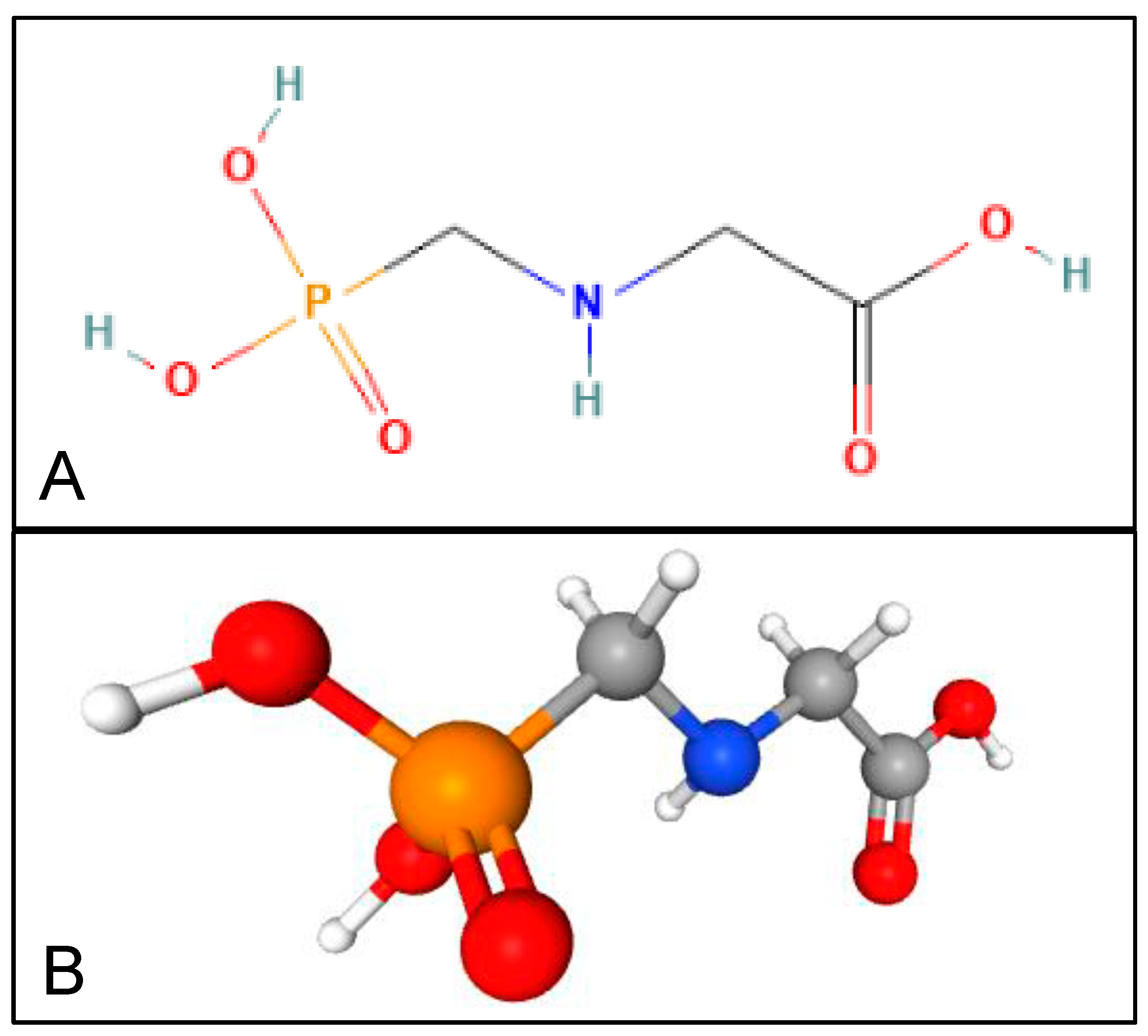
Figure 2.
Proposed hypothesis for the role of the skeleton in glyphosate (GLY) toxicity. This schematic illustrates the dual role of the skeleton as both a target and an endogenous driver of systemic toxicity following chronic GLY exposure and subsequent skeletal accumulation. (a) The Skeleton as Victim: GLY bioaccumulates within the bone matrix, disrupting the dynamic equilibrium between osteoblasts and osteoclasts. This localized accumulation drives toxicity through molecular disruption, inducing oxidative stress, DNA damage, and endocrine dysregulation, while direct GLY binding to mineral surfaces impairs hydroxyapatite crystal formation and compromises bone structural strength. (b) The Skeleton as Perpetrator: The skeleton serves as a long-lasting endogenous reservoir that perpetuates chronic toxicity. This proceeds via the resorption-release mechanism, in which osteoclastic activity during normal bone remodeling releases the chronically trapped GLY and AMPA back into circulation. This creates a persistent internal dose as the skeletal reservoir continually leaches GLY over time, which can ultimately culminate in various malignant and non-malignant pathologies throughout the body. Interestingly, metabolic triggering events that accelerate bone resorption, such as pregnancy, lactation, postmenopausal osteoporosis, or parathyroid hormone (PTH) surges, can precipitate a massive influx of stored GLY back into the bloodstream, amplifying systemic exposure.
Disclaimer/Publisher’s Note: The statements, opinions and data contained in all publications are solely those of the individual author(s) and contributor(s) and not of MDPI and/or the editor(s). MDPI and/or the editor(s) disclaim responsibility for any injury to people or property resulting from any ideas, methods, instructions or products referred to in the content. |
© 2026 by the authors. Licensee MDPI, Basel, Switzerland. This article is an open access article distributed under the terms and conditions of the Creative Commons Attribution (CC BY) license (http://creativecommons.org/licenses/by/4.0/).
Copyright: This open access article is published under a Creative Commons CC BY 4.0 license, which permit the free download, distribution, and reuse, provided that the author and preprint are cited in any reuse.