

Submitted:
06 October 2026
Posted:
08 October 2026
You are already at the latest version
Abstract
Artificial intelligence (AI) is increasingly being used to support the assessment of geomechanical containment risk in geological CO₂ storage; however, the suitability of different model families remains strongly dependent on the task, data representation, and target variable. This systematic review followed PRISMA 2020 and analyzed 63 studies published between 2021 and 2026, identified through IEEE Xplore, Web of Science, ScienceDirect, and Scopus. The evidence was synthesized according to AI family, application, inputs, outputs, dataset origin, validation strategy, predictive performance, computational efficiency, and relationship with geomechanical containment risk. CNN/U-Net, FFNN/MLP/DNN, and conventional machine-learning methods were the most frequently used families, while FNO, recurrent models, GNN, PINN, GAN/cGAN, and reduced-order approaches addressed more specialized spatial, temporal, physical, and optimization tasks. Only 17 studies (27%) predicted at least one direct geomechanical response or risk indicator, whereas 42 studies (66.7%) relied exclusively on synthetic or simulation-generated data. AI surrogates consistently reduced computational cost, enabling rapid scenario evaluation and optimization, but field validation of directly geomechanical models remained limited. Overall, no universally superior architecture was identified; model suitability is task-dependent. Future progress requires hybrid datasets, external field validation, uncertainty quantification, and reproducible workflows integrating AI with multiphysics simulation and monitoring data.
Keywords:
artificial intelligence
; carbon capture and storage
; geomechanical risk
; containment integrity
; surrogate modeling
; review
1. Introduction
Carbon Capture and Storage (CCS) is a strategy aimed at reducing CO₂ emissions through their capture, transport, and injection into geological formations capable of retaining CO₂ over long periods. Storage alternatives include deep saline aquifers, depleted hydrocarbon reservoirs, and other geological formations with suitable capacity, injectivity, and containment conditions [1,2]. The feasibility of these projects depends not only on the amount of CO₂ that can be stored but also on maintaining the integrity of the containment system during and after injection. Consequently, reservoir characterization, pressure management, caprock response, fault stability, and well integrity are fundamental components of safety assessment [2,3,4].
CO₂ injection alters pore pressure and, consequently, the effective stress state of the reservoir and surrounding units. These perturbations can induce deformation, surface displacement, changes in stresses acting on discontinuities, and, under certain conditions, fault reactivation, caprock fracturing, or induced seismicity [5,6,7,8,9,10]. Analyses conducted at sites such as In Salah have demonstrated the relationship between injection, pressure evolution, and observed surface deformation [5], while studies integrating microseismic observations with geomechanical modeling have highlighted the importance of monitoring for identifying changes associated with the mechanical response of the subsurface [6]. Complementarily, coupled poromechanical models show that pressure increases can alter fault stability and promote slip depending on the stress state, mechanical properties, and orientation of discontinuities [8,9,10]. These mechanisms make geomechanical risk assessment a central component of containment assurance.
The concept of containment risk, however, encompasses phenomena with different degrees of proximity to geomechanical failure. Some variables directly represent the mechanical response of the system, such as stress, strain, plastic deformation, displacement, fault slip, dilation, Coulomb Failure Function (CFF), Safety Factor, or explicit stability categories [11,12,13,14,15,16,17,18,19,20,21,22,23,24,25,26,27]. Other variables, such as pressure, bottom-hole pressure, CO₂ saturation, plume migration, and pressure drop, describe conditions that may promote a geomechanical response but do not, by themselves, constitute evidence of failure [28,29,30,31,32,33,34,35,36,37,38]. Additionally, leakage and well integrity assessment [30,39,40,41,42,43,44,45], as well as seismic, microseismic, and structural characterization of faults [46,47,48,49,50,51,52,53,54,55,56,57,58,59,60,61,62,63], provide relevant information for establishing containment conditions. Distinguishing among these levels is necessary to prevent the accurate prediction of a hydrogeological or structural variable from being automatically interpreted as a direct prediction of geomechanical risk.
Traditionally, these phenomena have been studied using numerical models that integrate multiphase flow, geomechanics, petrophysical properties, structural geometry, and operational conditions [1,2,3,4,5,6,7,8,9,10]. Coupled models make it possible to evaluate, among other aspects, the relationship between pressure and deformation, caprock stability, fault response, and the effects of injection strategies [3,4,7,8,9,10]. Likewise, well placement, injection rates, and, in some cases, brine extraction can be used to control pressure buildup and reduce conditions that are unfavorable to mechanical stability [64,65]. However, the incorporation of geological heterogeneity, multiple operational scenarios, and uncertainty analysis considerably increases computational cost. This becomes particularly restrictive in problems requiring hundreds or thousands of simulations, such as optimization, Monte Carlo analysis, uncertainty quantification, or dynamic risk assessment.
In this context, artificial intelligence (AI) and machine learning have begun to be used as complementary tools to physics-based simulation. A substantial portion of the literature employs AI models as surrogates to approximate relationships among reservoir properties, operational conditions, and system responses, with evaluation times considerably shorter than those required by the original numerical models [11,12,13,15,16,17,18,19,24,25,26,27,28,29,30,31,35,36,37,38,39,43,66,67,68,69,70,71]. This capability is particularly relevant when the same physical representation must be evaluated repeatedly within optimization, uncertainty analysis, or decision-support workflows.
The architectures employed have evolved according to the representation of the problem. Fully connected networks and conventional machine learning methods have been applied primarily to tabular variables, scalar regression, risk classification, and screening [13,15,16,19,20,23,25,28,31,39,40,42,43,44,57,60,61,66,67,68,69,70]. In contrast, convolutional and U-Net architectures have enabled the preservation of the spatial structure of images, seismic volumes, and three-dimensional fields of pressure, saturation, or deformation [11,22,24,26,27,35,46,47,52,53,54,62,72]. The U-Net architecture, originally developed as an encoder–decoder scheme with skip connections, provides a mechanism for combining multiscale information and preserving spatial detail during reconstruction [73], characteristics that have favored its adaptation to subsurface problems.
More recently, operator learning methods, particularly Fourier Neural Operators (FNOs), have been applied to the approximation of mappings between fields governed by physical systems [12,29,30,36,38]. FNOs operate on functional representations and use convolutions in the spectral domain to approximate operators associated with partial differential equations [34]. In geological CO₂ storage, this characteristic has enabled their use as surrogates for pressure, saturation, and, in some cases, responses directly related to geomechanical risk, such as vertical displacement and Safety Factor [12,29,30,36,38]. In parallel, recurrent models have been used to capture temporal dependencies [32,33,41,49,74], while graph-based architectures [17,71], physics-informed models [21,34], GAN/cGAN [14,63], reduced-order models [18,59] and reinforcement learning [37,75,76] have progressively expanded the range of available strategies.
The incorporation of AI has also extended beyond simulation surrogates. Segmentation and pattern-recognition techniques have been used for automatic fault interpretation in seismic data[47,52,53,54,62,74]; unsupervised learning methods have been applied to monitoring signals and events [50,55,56]; PointNet has enabled the direct representation of microseismic point clouds for the reconstruction of fault geometries [48]; and models based on experimental or field data have been employed to evaluate seal properties, integrity, permeability, and rock-mechanics responses [20,22,40,51,57,58,60,61]. This diversity demonstrates that AI is involved at different stages of a safety workflow, including characterization, monitoring, prediction, integrity assessment, and operational optimization.
Despite these advances, the literature presents limitations that make it difficult to determine which methods are truly transferable to CCS projects. The generation of high-fidelity geomechanical responses continues to rely primarily on simulations, because directly acquiring variables such as three-dimensional stress fields, deformation, slip, or near-failure states in the field is considerably more difficult than observing pressure, seismic data, or monitoring signals. For this reason, numerous recent studies train models on synthetic realizations derived from coupled simulators [11,12,13,15,16,17,18,19,23,24,25,26,27,28,29,30,31,33,34,35,36,38,41,42,43,44,63,64,71,72,75,76]. Although this strategy enables the generation of controlled ground truth and the exploration of broad parameter spaces, it also implies that the AI model may learn the assumptions and simplifications of the simulator used to generate the data. Performance within the simulated domain therefore does not constitute sufficient evidence of generalization to a different geological formation or to operational conditions not represented during training.
On the other hand, real-world data appear more frequently in characterization and monitoring tasks, where seismic records, well logs, microseismicity, acoustic emission, and other observations are available [20,22,40,46,47,48,50,51,52,53,54,55,56,57,58,60,61,62]. This asymmetry between the availability of observations and the availability of direct geomechanical responses poses a challenge for the development of safety-oriented models. In addition, studies employ different architectures, input variables, targets, scales, and metrics, making it difficult to directly compare values of R², RMSE, accuracy, F1, IoU, or relative errors obtained from non-equivalent problems. Previous literature on geological storage risk has also indicated that geological and operational uncertainty is an inseparable component of safety assessment [77,78,79,80,81,82].
These characteristics imply that model selection cannot be based solely on which architecture achieves the highest predictive metric in a given study. Suitability should instead be assessed according to the task to be addressed, including the ability to represent spatial heterogeneity, temporal dependence, flow–geomechanics coupling, physical consistency, data requirements, computational efficiency, interpretability, uncertainty quantification, and, especially, evidence of validation against independent or field data. An FFNN may be sufficient to approximate a scalar response [13,15,16,28], whereas a CNN/U-Net may be more suitable for three-dimensional fields [11,24,26,27], a recurrent model for temporal sequences [32,33,41,74], an FNO for repeated mappings between fields [12,29,36,38], or a GNN for domains whose connectivity can be represented explicitly [17,71]. Physics-informed approaches also provide a means of constraining the solution space through known physical relationships [21,34], although this does not eliminate the need for independent validation.
Despite the rapid expansion of these applications, the available evidence remains fragmented across studies addressing characterization, prediction of hydro-operational variables, leakage, integrity, geomechanical response, and optimization. This fragmentation makes it difficult to directly determine what it means for a method to be “suitable” for assessing geomechanical containment risk. In particular, it is necessary to distinguish between techniques that directly predict a mechanical response or stability criterion and those that provide indirect information that must subsequently be interpreted within a risk assessment framework. The origin of the data, level of validation, generalization, uncertainty, and computational cost must also be considered jointly.
In response to this need, the present study conducts a systematic literature review following PRISMA 2020 [83], aimed at addressing the following research question: Which artificial intelligence-based techniques, methods, and models are most suitable for assessing geomechanical containment risk in CCS projects? Rather than relying exclusively on predictive performance metrics, the review evaluates the suitability of the methods according to the task, the nature of the inputs and outputs, their direct or indirect relationship with geomechanical risk, data origin, validation strategy, computational efficiency, incorporation of physical knowledge, generalization, and reproducibility. The analysis includes 63 studies selected through a systematic search and eligibility process and proposes a taxonomy that distinguishes direct geomechanical assessment, hydro-mechanical or operational proxies, leakage and integrity, characterization and monitoring, and risk-constrained optimization. This structure is intended to provide a framework for interpreting the available evidence without assuming that a single architecture is superior across all geological CO₂ storage scenarios.
2. Materials and Methods
This systematic review was conducted following the PRISMA 2020 recommendations [83], with the aim of identifying, organizing, and comparing artificial intelligence (AI)-based techniques, methods, and models used for the assessment of geomechanical containment risk in carbon capture and storage (CCS) projects. The methodological process included defining the information sources, designing the search strategy, establishing eligibility criteria, removing duplicate records, screening the studies, reviewing the full texts, and extracting and synthesizing the relevant information. The review was guided by the following research question: Which artificial intelligence-based techniques, methods, and models are most suitable for the assessment of geomechanical containment risk in CCS projects?
2.1. Information Sources and Search Strategy
The final literature search was conducted on August 30, 2026, across IEEE Xplore, Web of Science, ScienceDirect, and Scopus. A unified search strategy was designed and structured into three conceptual blocks: (i) artificial intelligence and machine learning, (ii) CO₂ capture and geological storage, and (iii) geomechanical containment risk. Terms belonging to the same block were combined using the Boolean operator OR, while the three blocks were connected using AND.
The general conceptual strategy was defined using the following search equation:
(("artificial intelligence" OR AI OR "machine learning" OR "deep learning" OR "neural network*" OR CNN OR ANN OR "support vector machine*" OR SVM OR "random forest*" OR "gradient boosting" OR XGBoost OR "Gaussian process*" OR "surrogate model*" OR UNet OR "U-Net" OR "Fourier neural operator" OR FNO)
AND
("carbon capture" OR CCS OR "carbon capture and storage" OR "carbon capture utilization and storage" OR CCUS OR "CO2 storage" OR "CO₂ storage" OR "carbon dioxide storage" OR "CO2 sequestration" OR "CO₂ sequestration" OR "geological storage" OR "geologic storage" OR "geological CO2 storage" OR "CO2 geological storage" OR "CO2 injection")
AND
("geomechanical risk" OR "geomechanical risk assessment" OR "geomechanical stability" OR "geomechanical response" OR (geomechanic* AND (risk* OR integrity OR leakage OR stability OR hazard*)) OR (caprock AND (integrity OR leakage OR failure OR risk*)) OR (wellbore AND (integrity OR leakage OR failure)) OR (fault* AND (reactivation OR slip OR "induced seismicity")) OR (("safety factor" OR "factor of safety") AND (geomechanical OR geomechanics OR caprock OR reservoir)) OR (("vertical displacement" OR "vertical deformation" OR "surface displacement" OR "surface uplift" OR subsidence) AND (geomechanical OR geomechanics OR caprock OR reservoir OR "CO2 storage")))).
AND
("carbon capture" OR CCS OR "carbon capture and storage" OR "carbon capture utilization and storage" OR CCUS OR "CO2 storage" OR "CO₂ storage" OR "carbon dioxide storage" OR "CO2 sequestration" OR "CO₂ sequestration" OR "geological storage" OR "geologic storage" OR "geological CO2 storage" OR "CO2 geological storage" OR "CO2 injection")
AND
("geomechanical risk" OR "geomechanical risk assessment" OR "geomechanical stability" OR "geomechanical response" OR (geomechanic* AND (risk* OR integrity OR leakage OR stability OR hazard*)) OR (caprock AND (integrity OR leakage OR failure OR risk*)) OR (wellbore AND (integrity OR leakage OR failure)) OR (fault* AND (reactivation OR slip OR "induced seismicity")) OR (("safety factor" OR "factor of safety") AND (geomechanical OR geomechanics OR caprock OR reservoir)) OR (("vertical displacement" OR "vertical deformation" OR "surface displacement" OR "surface uplift" OR subsidence) AND (geomechanical OR geomechanics OR caprock OR reservoir OR "CO2 storage")))).
The equation above represents the common conceptual search strategy. Its syntax was adapted to the characteristics of each information source, including the available search fields, proximity operators, truncation rules, and other platform-specific restrictions. The search was limited to documents published between 2021 and 2026 and written in English.
2.2. Eligibility Criteria
The inclusion and exclusion criteria were established to select the most relevant articles for achieving the objective of the review, which is presented in the following section. Initially, titles, keywords, and abstracts were reviewed. Subsequently, the remaining scientific articles were read in full, applying the same criteria to select the final set of studies.
2.2.1. Inclusion criteria
- Research articles or full conference papers presenting original research.
- Studies conducted in the context of geological CO₂ storage, CCS, or CCUS with a storage component.
- Studies that explicitly implement an artificial intelligence or machine learning technique, method, or model as part of the analysis.
- Studies in which AI is used to estimate, predict, classify, approximate, or analyze variables, responses, or indicators related to geomechanical containment risk, such as seal rock integrity, fault reactivation, well integrity, deformation, stresses, safety factor, ground heave, subsidence, or other geomechanical responses associated with CO₂ storage.
2.2.2. Exclusion criteria
- Studies not related to geological CO₂ storage or focused exclusively on capture, utilization, transport, adsorption materials, or other processes unrelated to geological containment.
- Studies that do not implement artificial intelligence or in which AI is used for a task unrelated to the geomechanical assessment of containment.
- Studies focused solely on storage capacity, plume migration, petrophysical properties, or other reservoir variables when a geomechanical containment response or implication is not evaluated.
- Review articles, book chapters, theses, editorials, conference abstracts, or other documents that do not constitute complete primary research.
- Documents written in a language other than English or published outside the 2021–2026 timeframe.
2.3. Study Selection Process
Records retrieved from the different information sources were consolidated into a single bibliographic matrix. Before screening, duplicate records were identified and removed by comparing bibliographic identifiers, mainly DOI, title, authors, and publication year; potentially duplicated cases were manually verified.
The selection process was conducted in two stages. In the first stage, the title, keywords, and abstract of each record were examined to determine their initial compliance with the eligibility criteria. In the second stage, the full text of the studies that passed the initial screening was reviewed, and the same inclusion and exclusion criteria were applied again. For documents excluded during full-text assessment, the main reason for exclusion was recorded. The number of records identified, duplicates removed, documents screened, full texts assessed, and studies ultimately included was represented using a PRISMA flow diagram.
2.4. Data Extraction and Organization
For each included study, information was extracted into a structured matrix. Bibliographic and methodological data relevant to addressing the research question were collected. The fields considered included: title, authors, publication year, keywords, study motivation and objective; geomechanical component or phenomenon analyzed; AI technique, algorithm, or architecture; type of problem addressed (e.g., regression, classification, or surrogate modeling); input and output variables; source and nature of the data (synthetic, experimental, or field data); numerical or physical model used for data generation, when applicable; training and validation scheme; evaluation metrics; baseline or comparison models; main results; reported limitations; and the relationship of the method to the assessment of containment risk in CCS.
2.5. Synthesis and Comparison of the Studies
The selected studies were analyzed through a qualitative and comparative synthesis. AI methods were grouped according to their methodological family and the type of geomechanical response they aimed to estimate or represent. When the information was available, the comparison considered predictive performance, the metrics used, data requirements, the ability to represent spatial or spatiotemporal relationships, computational cost, generalization, incorporation of physical knowledge, and limitations associated with their application to CCS scenarios.
Because the studies may employ different datasets, input and output variables, scales, metrics, and experimental configurations, the suitability of a technique was not determined solely on the basis of the highest value of a given metric. Instead, the available evidence was evaluated contextually, considering the correspondence between the capabilities of the method and the geomechanical problem analyzed. This strategy made it possible to identify trends, advantages, limitations, and research gaps without assuming that numerical results from heterogeneous studies are directly comparable.
3. Results
This section presents the results obtained through the application of the systematic review methodology. First, the process of study identification, selection, and eligibility is described in accordance with PRISMA. Subsequently, the main findings of the articles included in the review are presented and analyzed.
3.1. Study Selection Process
The application of the search strategy across the four databases identified 304 records: ScienceDirect (n = 120), IEEE Xplore (n = 4), Scopus (n = 90), and Web of Science (n = 90). Before the selection process began, 16 duplicate records were removed, leaving 288 records to be assessed through the review of titles, keywords, and abstracts.
At this first stage, 208 records were excluded because they did not meet the established eligibility criteria. As a result, 80 articles were selected for full-text assessment. During this second stage, an additional 17 articles were excluded, mainly because they did not include an indicator related to geomechanical containment risk, did not implement artificial intelligence techniques, or fell outside the scope of geological CO₂ storage and CCS projects. Ultimately, 63 studies met the defined criteria and were included in the final synthesis of the systematic review. Figure 1 summarizes the complete study selection process.
3.2. Temporal Evolution and General Characteristics of AI Model-Based Research
The temporal distribution of the 63 included studies shows that research on artificial intelligence applied to the assessment of containment risk in geological CO₂ storage has been markedly concentrated in the most recent years. After consolidating conference versions that subsequently resulted in extended journal publications, 7 studies were identified in 2022, 7 in 2023, 6 in 2024, 23 in 2025, and 20 in 2026.
During the 2022–2024 period, scientific output remained relatively stable, with between six and seven studies published per year. Altogether, 20 of the 63 studies (31.7%) were published during these three years. The most pronounced change occurred in 2025, when the annual number increased from six to 23 studies, equivalent to a 283.3% increase compared with 2024. In 2026, a further 20 studies were identified, maintaining a level of scientific output considerably higher than that observed before 2025. Overall, 43 studies (68.3%) were published during 2025–2026, indicating that more than two-thirds of the corpus correspond to the two most recent years analyzed. See Figure 2.
The increase in publications was also accompanied by a diversification of artificial intelligence architectures. During the early years of the analyzed period, fully connected neural networks (FFNN/MLP/DNN), conventional machine learning methods, and convolutional architectures were already being used for prediction, characterization, and surrogate modeling tasks [11,13,26,28,31,39,46,60,66,67]. From 2023 onward, operator learning approaches, particularly Fourier Neural Operators (FNOs), appeared in the corpus [29], and were subsequently applied to spatiotemporal prediction and optimization problems [12,30,36,38]. In 2024, reinforcement learning strategies were introduced for operational management and optimization [37], and were later extended to control and optimization problems under risk constraints [75,76]. The first applications of Graph Neural Networks (GNNs) identified in the corpus appeared in 2025 for surrogate modeling and optimization [71], and were subsequently used to represent multiphysics and geomechanical responses [33]. Finally, in 2026, explicit applications of
Physics-Informed Neural Networks (PINNs) were identified for subsurface structure reconstruction and physics-based prediction [21,34]. This evolution reflects an expansion of the methodological repertoire rather than a replacement of earlier techniques, as FFNNs, CNN/U-Net architectures, and classical ML methods continued to be used in 2025–2026 for regression, classification, characterization, integrity assessment, and prediction of geomechanical responses [15,16,19,20,23,24,25,27,44,61,62].
This methodological expansion, however, was not accompanied by an equivalent shift in data sources. Of the 63 studies included, 42 (66.7%) relied exclusively on synthetic or simulation-generated data [11,12,13,15,16,17,18,19,23,24,25,26,27,28,29,30,31,32,33,34,35,36,37,38,39,41,42,43,44,49,59,63,66,67,68,69,70,71,72,74,75,76]. In contrast, 14 studies (22.2%) used real, experimental, or field data [20,22,40,46,50,51,52,55,56,57,58,60,61,62], whereas 6 (9.5%) combined real and synthetic information [14,21,47,48,53,54]. The remaining study, representing 1.6% of the corpus, used a Fuzzy/AHP framework without a conventional machine learning training dataset [45]. Therefore, although scientific output increased substantially from 2025 onward and more diverse architectures were incorporated, numerical models and physics-based simulators continued to constitute the primary source of data for training and evaluating AI models.
3.3. Taxonomy of AI Applications for Geomechanical Containment Risk
The inductive classification of the 63 studies resulted in five main functions. The most frequent category was characterization and monitoring, with 18 studies (28.6%), followed by direct geomechanical assessment, with 16 studies (25.4%), optimization and decision support, with 14 (22.2%), leakage or well integrity assessment, with 8 (12.7%), and assessment through hydro-mechanical or operational proxies, with 7 (11.1%). See Figure 3.
The first category groups models whose primary output is information required for subsequent risk assessment, including fault segmentation and geometry, seismic interpretation, seal properties, permeability, microseismic clustering, and representation of monitoring signals [46,47,48,50,51,52,53,54,55,56,57,58,59,60,61,62,63]. In these cases, AI improves system characterization, but the resulting prediction does not, by itself, constitute a mechanical failure assessment.
The second category comprises studies whose primary objective directly includes a mechanical response or an instability indicator, such as deformation, displacement, stress, Coulomb Failure Function, Safety Factor, slip tendency, fault reactivation, or an explicit integrity classification [11,13,14,15,17,18,19,20,22,23,24,25,26,27,36,74]. Study [12] should also be included in this functional category when considering the nature of its output because, although its primary purpose is optimization, its FNOs directly predict vertical displacement and Safety Factor.
Studies based on proxies primarily use pressure, WBHP, pressure drop, saturation, or state variables as intermediate representations of conditions that may promote a geomechanical response [28,29,31,32,33,34,35]. Although their physical relationship with risk is relevant, these outputs should not be interpreted as equivalent to failure, deformation, or fault reactivation.
The leakage and integrity category includes models designed to estimate the presence, location, or magnitude of leakage, migration through faults, remaining service life of sealing elements, or the risk of loss of containment [30,39,40,41,42,43,44,45]. Finally, optimization studies use AI either as a surrogate model or as a decision policy to select well location and operation, injection rates, brine production, pressure management, or multi-objective strategies subject to constraints [12,36,37,38,66,67,68,69,70,71,72,74,75,76].
The functional taxonomy therefore shows that “AI applied to geomechanical risk” encompasses different degrees of proximity to the phenomenon of containment loss. This distinction becomes particularly evident when comparing the architectures employed.
3.4. Artificial Intelligence Methods and Architectures
The most represented families were CNN/U-Net architectures and their variants, with 13 studies (20.6%), followed by FFNN/MLP/DNN models, with 12 studies (19.0%), and classical ML/ensemble methods, with 8 studies (12.7%). Sequential RNN/LSTM/Transformer models and FNO/U-FNO architectures appeared in five studies each (7.9%). The remainder of the corpus was distributed among unsupervised learning and reinforcement learning, with three studies each, and GNNs, GAN/cGAN models, PINNs, autoencoders/DL-ROMs, and unspecified physics–ML frameworks, with two studies per family. PointNet and Fuzzy/AHP appeared once each. See Table 1.
Architectures designed to capture temporal dependencies or mappings between fields showed a more pronounced degree of specialization. The five studies based primarily on RNN/LSTM/Transformer models were distributed across characterization [41], leakage prediction [41], optimization [74], and prediction using temporal proxies [32,33]. The five studies using FNO/U-FNO architectures focused mainly on surrogate modeling and optimization: [29] predicted hydro-operational variables, [30] addressed leakage assessment using an accelerated surrogate, and [12,36,38] incorporated the neural operator into optimization workflows [12,29,30,36,38]. It is important to note that [12] represents a relevant exception within this group, as its FNO is not limited to pressure or saturation but directly predicts vertical displacement and Safety Factor to explicitly incorporate geomechanical risk into the optimization process.
The less frequent methodological families showed an even more specific correspondence with particular applications. The three unsupervised approaches were used exclusively for characterization and monitoring [50,55,56], whereas the three reinforcement learning studies focused exclusively on optimization and operational control [37,75,76]. The two GNN studies were used, respectively, for multiphysics prediction including geomechanical responses [17] and well-placement optimization using a pressure and saturation surrogate [71]. GAN/cGAN models addressed deformation/fracture inference [14] and subsurface characterization from surface deformation [63]; PINNs were used for physics-based fracture reconstruction [21] and pressure-drop prediction [34]; and Autoencoder/DL-ROM approaches were applied to model-order reduction for geomechanical analysis [18] and to the extraction of surface-deformation representations for monitoring [59]. The two hybrid physics–ML workflows with incompletely specified architectures were oriented toward seal characterization [51,58], whereas PointNet was used for geometric fault reconstruction from microseismic event point clouds [48], and Fuzzy/AHP was applied to hierarchical leakage-risk assessment [45].
More recent architectures did not necessarily imply a more direct relationship with geomechanical risk. Among the five studies based on FNO/U-FNO architectures, several used pressure, saturation, or other flow variables as intermediate outputs or as the basis for decision-making workflows [29,30,36,38], whereas [12] explicitly incorporated vertical displacement and Safety Factor as geomechanical outputs within the optimization process. Complementarily, classical ML methods continued to be used for outputs directly related to stability and integrity, including reactivation, risk classification, slip, and Safety Factor [19,20,23,25]. Similarly, CNN/U-Net models produced both indirect outputs, such as pressure and saturation [35,72], and distributed geomechanical responses, including deformation and displacement [11,24,26,27]. Consequently, the proximity of an approach to geomechanical risk is not determined by the novelty or complexity of its architecture, but by the target variable, the degree of physical coupling represented, and the evidence used to validate its predictions.
3.5. Input Variables and Geomechanical Information Used
The input information was heterogeneous and frequently multimodal. Because a single study may incorporate several variable families, the frequencies reported in this subsection are multilabel and therefore do not sum to 100%. Petrophysical variables appeared in 42 of the 63 studies (66.7%), geological or structural variables in 40 (63.5%), pressure or state variables in 37 (58.7%), and operational or injection-related variables in 32 (50.8%). Temporal variables appeared in 26 studies (41.3%), whereas explicitly geomechanical information was identified in 25 of the 63 studies (39.7%).
Among the petrophysical inputs, permeability and porosity were recurrent in flow surrogates as well as in coupled and optimization models [11,12,15,17,24,25,26,27,28,29,30,35,36,38,69,70,71,72,74]. The combination of petrophysical variables with pressure/state variables appeared in 28 studies, whereas petrophysical variables combined with operational variables were identified in 27. This pattern reflects the prominent role of flow models and reservoir simulators in dataset generation.
In contrast, explicit mechanical properties—such as Young’s modulus, Poisson’s ratio, stresses, cohesion, friction, poroelastic parameters, or equivalent variables—appeared in 25 studies. The combination of geomechanical and structural information was observed in 17 studies, whereas geomechanical information combined with pressure/state variables was identified in 13. These variables were concentrated mainly in studies focused on seal integrity, fault reactivation, surface deformation, and coupled models [11,13,14,15,16,18,19,20,21,22,23,24,25,26,27].
Seismic data were used as inputs in 15 studies (23.8%), whereas six studies (9.5%) explicitly employed microseismicity or Acoustic Emission (AE). Seismic-based studies were predominantly focused on the geometry and properties of faults or seals [46,47,52,53,54,57,60,62], whereas microseismicity and AE were used mainly as monitoring information and for fracture detection [21,22,48,49,50,56].
Consequently, the review shows that a substantial proportion of models associated with “geomechanical risk” do not necessarily use explicit geomechanical variables as inputs. In many cases, AI operates on petrophysical properties, pressure, saturation, injection-related variables, or seismic information, and its output is only subsequently used within a geomechanical interpretation. This distinction becomes even more important when examining the predicted variables.
3.6. Predicted Variables and Their Relationship with Geomechanical Containment Risk
The nature of the output was one of the main distinguishing elements across the corpus. Although 16 studies had direct geomechanical assessment as their primary function, 17 of the 63 studies (27.0%) predicted at least one explicitly geomechanical response or indicator because [12], functionally classified as an optimization study, directly predicted vertical displacement and Safety Factor
Within these studies, spatially distributed mechanical responses were identified, including plastic deformation and displacement [11], vertical displacement and Safety Factor [12], shear slip and fracture parameters [14], effective mean stress [16], surface displacement [17], CFF and traction variation [18], stress fields [21], deformation and displacement [24], uplift and Safety Factor [25], and surface displacement[26,27]. Other models directly predicted failure indicators or risk classifications, such as Fail/Non-Fail [13], slip tendency [15], Reactive/Non-Reactive [19], Safe/Transitional/Risk [20], integrity risk [22], and Slip/No Slip [23].
3.7. Dataset Sources, Validation, and Generalization
The predominance of synthetic data was one of the most consistent characteristics of the corpus. Of the 63 studies, 42 (66.7%) used exclusively datasets generated through simulators or physics-based models, 14 (22.2%) used real-world, field, or experimental data, 6 (9.5%) combined synthetic and real data, and one (1.6%) did not use a conventional ML training dataset.
This distribution varied substantially across application types. See Table 4.
The most pronounced contrast is observed between characterization and prediction. 15 of the 18 characterization/monitoring studies (83.3%) used real or hybrid data, mainly due to the availability of seismic information, well logs, microseismicity, acoustic emission (AE), and other observation systems [46,47,48,50,51,52,53,54,55,56,57,58,60,61,62]. The remaining three studies in this category used synthetic or simulated information [49,59,63]. In contrast, all 14 studies classified as optimization and decision support relied exclusively on synthetic or simulation-generated data [12,36,37,38,66,67,68,69,70,71,72,74,75,76]. Similarly, all seven studies classified as hydro-mechanical or operational proxies used exclusively synthetic data [28,29,30,31,32,33,34,35]. This dependence becomes even more evident when considering the directness of the output. Among the 17 studies that predicted a direct geomechanical response or indicator, 13 (76.5%) used exclusively synthetic data, two used real data [20,22], and two combined real and synthetic data [14,21].
The use of a geomodel calibrated from a real site was not considered equivalent to using real data for AI training. For example, several studies used properties or geometries derived from IBDP, Aquistore, Mt. Simon, Smeaheia, or other real-world settings, but the samples provided to the model were generated through simulation [12,24,25,27,35,36,38,69,71,76]. Accordingly, these studies were classified as synthetic or field-informed, but not as field validations.
Likewise, the presence of real data did not necessarily imply external validation. In some studies, the model was applied to real datasets after synthetic training [47,48,53], whereas in others, field evaluation was primarily qualitative or structural [53,62]. Consequently, the ability to generalize to previously unseen geological formations remains unevenly documented across the literature.
3.8. Predictive Performance and Computational Efficiency
The metrics used reflected the heterogeneity of the tasks addressed across the corpus. Based on the extracted information, R² was reported in 29 of the 63 studies (46.0%), RMSE in 27 (42.9%), MAE in 18 (28.6%), and MSE in 12 (19.0%). Classification and segmentation tasks additionally incorporated metrics such as accuracy, precision, recall, F1, IoU/Jaccard, and AUC [13,19,20,22,23,40,41,42,43,46,62], whereas surrogates designed for spatial fields used relative errors, L2 norms, SSIM, and other metrics specific to spatial reconstructio [11,12,17,24,26,27,35,36,38,63].
These frequencies are multilabel and therefore do not represent mutually exclusive categories. Moreover, the heterogeneity of the outputs prevents the metrics from being interpreted as a common performance scale: an R² calculated for a scalar regression [16,25,28], an IoU obtained in a segmentation or structural reconstruction task [46,63], and a relative error computed over a three-dimensional field [11,26,27] quantify different predictive properties. Consequently, performance was compared within groups of comparable tasks and outputs rather than through a global ranking of architectures.
3.8.1. Scalar Regression and Temporal Prediction
Dense models showed high performance in problems formulated using a relatively small number of scalar variables, particularly for pressure, aggregated geomechanical responses, and other regression outputs [15,16,28,31]. In [28], the FFNN used to predict WBHP achieved test values of R² = 0.975, AAPE = 0.855%, and RMSE = 9.22 kPa; in addition, the reported evaluation time was approximately 0.1 s per evaluation, compared with about 5600 s for the reference numerical simulation. In turn, [16] reported R² values ranging from 0.9978 to 0.9994 for effective mean stress, depending on the optimizer used, although the training cost varied considerably across the evaluated configurations.
Temporal models mainly addressed pressure evolution, production, migration, and other time-dependent variables [32,33,41,74]. [74] achieved approximately R² = 96.5% for CH₄ production and 96.1% for CO₂ sequestration using an LSTM, whereas [33] reported mean relative pressure errors on the order of 3.4–4.7% across the evaluated scenarios. Because these studies predicted different variables and used different domains, temporal scales, and datasets, their numerical results are not directly comparable [33,74].
Among physics-informed approaches, [34] employed PDP-PINN to predict pressure drop and achieved R² = 0.9866, RMSE = 6.50 Pa, and MAE = 4.44 Pa on the synthetic benchmark considered, with inference over 36,335 samples completed in approximately 1.34 s. However, this study was conducted using two-dimensional synthetic simulations, and the authors themselves noted the need for extension to 3D domains and validation with field data before operational application.
3.8.2. Prediction of Spatial and Spatiotemporal Fields
Convolutional architectures, neural operators, and other reduced-order models were used primarily when the target consisted of spatial or spatiotemporal fields of pressure, saturation, displacement, or other distributed variables [11,12,17,24,26,27,29,30,35,36,38].
Study [26] obtained relative errors of 5.3% for saturation, 0.31% for pressure, and 1.2% for surface displacement over 500 test realizations. Evaluation of the surrogate required less than one second for a batch of 100 geomodels, compared with approximately 0.8 h per high-fidelity simulation. In [27], using a strategy designed to reduce the number of coupled geomechanical simulations required for training, the median relative errors over 500 new realizations were 3.9% for saturation, 0.8% for pressure, and 2.6% for displacement; a joint evaluation of the three outputs required approximately 0.15 s, compared with about 120 min for a fully coupled simulation.
FNO/U-FNO-based models also showed substantial reductions in evaluation cost for problems requiring repeated approximations of physical fields [12,29,30,36,38]. Study [12] reported an approximate 7200× speedup between an FNO evaluation and the coupled simulation used as reference. [38] reported an approximate 1190× speedup per forward run for the IBDP case and an end-to-end reduction greater than 11× when data generation and training were included. In turn, [36] achieved SSIM > 0.95 for pressure and approximately 0.987 for saturation. These values should be interpreted within the context of each study because the error definitions, spatial domains, and computational costs included in the speedup calculations were not uniform [12,36,38].
A similar reduction in computational cost was observed for graph-based architectures. In [17], the GNN performed inference in approximately 40–100 ms per snapshot, compared with several hours required by the reference THMC simulations. However, the model was trained using a library of only 48 THMC scenarios, employed 38 × 45 columnar representations, and used linear poroelastic geomechanics that did not explicitly incorporate plasticity, fault slip, or fracture propagation. Therefore, the result demonstrates fast emulation capability within the simulated domain but does not constitute operational validation of a digital twin at a real CCS site.
3.8.3. Fault Detection and Characterization
Studies on fault detection and structural characterization showed greater heterogeneity in both validation strategies and evaluation metrics [46,47,48,49,52,53,54,56,57,62]. In [46], some models achieved overall accuracy values above 99%, but the metrics specifically associated with the fault class were lower and varied according to image orientation and quality. This indicates that, in problems where the background class is spatially dominant, high overall accuracy does not necessarily imply an equivalent ability to identify the structural features of interest.
Other studies relied primarily on structural or qualitative evaluations. [53] compared the fault-throw volumes obtained by the model with manual interpretation and the observed tectonic structure, whereas [62] applied a pretrained Nested-Residual U-Net to real 3D seismic data from the San Juan Basin but did not report metrics such as accuracy, IoU, or F1 against an independent ground truth. Using a different representation of the problem, [48] employed PointNet to estimate the location, size, and orientation of fault planes from point clouds of microseismic events, reducing parameter errors relative to the previous LSTM-based approach. However, the model was trained using synthetic catalogs generated with simplified GEOS models that do not fully incorporate heterogeneity or advanced fault mechanics.
3.8.4. Leakage and Integrity Prediction
Models focused on leakage and integrity showed high performance mainly when evaluated using simulation-generated datasets [30,39,41,42,43,44]. [41] achieved R² values of approximately 0.94–0.96 for continuous variables associated with migration, together with F1 values close to 0.90 for classification. [42] reported R² = 0.9996 for leakage location and R² = 1.0000 for leakage size using KNNR on the analyzed synthetic dataset, although performance decreased for lower-magnitude leakage cases. Likewise, [43] achieved 99.92% accuracy for CO₂ leakage classification and a median R² ≈ 0.995 for the corresponding time series, also using simulation-generated information.
These values indicate high predictive capability within the simulated domains considered [41,42,43], but they represent a different type of evidence from that obtained in studies based directly on field data. For example, [40] used data from 146 wells in the Permian Basin and achieved an AUC of 0.84 for classification. The difference between these two groups prevents a numerically higher value obtained from simulations from being automatically interpreted as evidence of superior performance under real-world conditions [40,41,42,43].
3.8.5. Geomechanical Response and Computational Efficiency
Among the studies that predicted responses or indicators directly related to geomechanics, high performance was observed in several classification and regression problems, although substantial differences again emerged in data origin and validation schemes [12,13,14,15,16,17,18,19,20,21,22,23,24,25,26,27].
[19] achieved up to 99% accuracy for reactivation classification using an ANN on synthetic scenarios; the average inference time was approximately 0.00065 s, compared with about 2218 s for the coupled simulation used as reference. [23] achieved 99.7% accuracy using Random Forest for Slip/No Slip classification, also using simulation-generated data. In contrast, [58], based on real experimental rock-mechanics data, reported more moderate screening performance, with balanced accuracy = 0.861 and Macro F1 = 0.863 using repeated stratified cross-validation.
For continuous tasks, [25] achieved R² = 0.962 for uplift and 0.998 for Safety Factor, reducing evaluations that required approximately 1.5–5 h of simulation to about 20 s using regression-tree proxies. [15] reduced the computational cost from approximately 5 CPU-h per simulation to times on the order of milliseconds per trajectory evaluated using the surrogate model. [18] showed that more than ten thousand CFF evaluations could be completed in less than one minute once the DL-ROM had been trained. However, this latter study also identified difficulties in reconstructing stress fields from displacements and larger errors in scenarios associated with abrupt well shutdowns, showing that computational cost reduction does not necessarily eliminate errors in behaviors outside the dominant patterns represented during training.
Taken together, studies that provided explicit information on execution times reported computational cost reductions ranging from approximately two orders of magnitude to five or more orders of magnitude under specific configurations [12,15,17,19,25,26,27,28,35,37,38,71]. However, these speedup factors do not constitute a directly comparable metric across studies because they differ in hardware, domain size, spatial resolution, number of time steps, parallelization, definition of an inference, and whether the reported cost includes only execution of the trained model or also dataset generation and training.
The combined synthesis of predictive performance therefore reveals two distinct patterns: on the one hand, numerous models achieve low errors or high predictive metrics within the distributions on which they were trained and evaluated [12,15,17,19,25,26,27,28,35,37,38,71]; on the other hand, comparability across architectures remains limited by the heterogeneity of targets, datasets, metrics, and validation protocols. For this reason, numerical performance alone is insufficient to determine which AI family is most suitable for containment risk assessment; it must be interpreted together with the type of predicted variable, the origin of the data, and the level of validation achieved.
3.9. Evidence Gaps Identified in the Literature
The first cross-cutting gap is the dependence on synthetic data, which affects 42 of the 63 studies and becomes more pronounced in tasks more directly related to geomechanical response. A total of 76.5% of the studies with direct geomechanical outputs rely exclusively on simulations, while all studies addressing optimization and hydro-operational proxies are based on synthetic data.
The second gap is the asymmetry between field characterization and field-based geomechanical prediction. Seismic data, well logs, microseismicity, and experimental tests provide a relatively broad real-world basis for characterization and monitoring; however, few studies use mechanical responses directly observed in CCS projects as targets for training or validating predictive models.
The third gap concerns the absence of common benchmarks and metrics. R² was used in 29 studies, RMSE in 27, MAE in 18, and MSE in 12, but these metrics were applied to different variables, scales, datasets, and units. Segmentation and classification tasks additionally used accuracy, precision, recall, F1, IoU, and AUC, whereas spatial surrogates incorporated relative L2 error and SSIM. This heterogeneity prevents a global quantitative comparison across methodological families.
Reproducibility was also limited. Publicly available code was identified in only 12 of the 63 studies (19.0%) [14,15,17,18,20,26,27,35,37,56,71,75]. Specific hardware specifications for training or inference were identified in 16 of the 63 studies (25.4%). Numerous studies reported the software used but did not provide CPU, GPU, memory, or training-time information, limiting reproducible comparisons of computational efficiency.
Finally, generalization capability was evaluated heterogeneously. Some studies used unseen geological realizations, blind tests, cross-validation, or synthetic-to-real transfer [20,47,48,53,61], whereas others evaluated models exclusively within distributions generated by the same simulator used to construct the training data. Therefore, the available results provide stronger evidence for the technical feasibility of these models as surrogates or characterization tools than for their general ability to transfer across CCS sites with different geological properties, stress states, and operational conditions.
Overall, the results indicate that the literature has developed a diverse set of techniques capable of accelerating simulations, characterizing structures, and approximating variables related to containment. However, the available evidence does not support a universally superior architecture: suitability depends on the task and, particularly, on whether the objective is to predict a scalar variable, represent a spatial field, capture temporal dynamics, characterize a structure, optimize an operational decision, or directly estimate a geomechanical response. The limited field validation of the models most directly related to geomechanics constitutes the main constraint on extrapolating their predictive performance toward general applicability in CCS projects.
4. Discussion
The 63 studies reviewed show that the incorporation of artificial intelligence into the assessment of geological CO₂ storage safety has progressed from relatively focused regression and characterization problems toward spatial and spatiotemporal surrogates, physics-informed models, and optimization and control frameworks. However, this methodological growth does not allow the identification of a universally superior architecture. Instead, the evidence shows that model suitability depends primarily on the representation of the problem, the target variable, data availability, and the degree of proximity between that variable and the geomechanical mechanism of containment loss. This distinction is particularly relevant because only 17 of the 63 studies directly predicted a geomechanical response or indicator, whereas a substantial portion of the literature used pressure, saturation, leakage, seal properties, fault geometry, or monitoring signals as variables indirectly related to risk.
4.1. AI Suitability Depends on the Task Rather Than on a Universal Architecture
The coexistence of FFNNs, CNN/U-Net architectures, conventional ML methods, FNOs, recurrent models, GNNs, PINNs, and other architectures largely reflects the fact that studies represent the geomechanical problem in different ways. FFNN/MLP/DNN models were particularly useful when the inputs and outputs could be represented as low-dimensional vectors, such as reservoir properties, operational conditions, pressure, or scalar risk indicators [13,15,16,28,31,43,44,57,66,67,69,70]. Their lower structural complexity enables rapid evaluations and makes them suitable as scalar surrogates, but limits their ability to explicitly represent spatial connectivity, geological heterogeneity, and complex three-dimensional fields.
In contrast, CNNs and U-Net architectures were used mainly when spatial structure had to be explicitly preserved, including fault interpretation, pressure and saturation fields, deformation, and surface displacement [11,22,24,26,27,35,46,47,52,53,54,62,72]. This correspondence between architecture and representation explains why convolutional networks frequently appear in the most spatially distributed problems within the corpus. However, the ability to reconstruct a field with high similarity to the simulator does not necessarily imply an ability to generalize beyond the geological distribution used during training [11,24,26,27].
FNO/U-FNO models extend this logic by approximating operators between physical fields and are particularly attractive when a simulation must be evaluated hundreds or thousands of times within uncertainty analysis or optimization [12,29,30,36,38]. In this context, their main advantage is not only predictive accuracy but also the possibility of temporarily replacing computationally expensive simulations within iterative workflows. [12] provides a particularly relevant example because it extends this approach beyond pressure and saturation by predicting vertical displacement and Safety Factor within a multi-objective optimization framework explicitly constrained by geomechanical risk.
RNN/LSTM and other sequential models, in turn, are more clearly justified when temporal history constitutes an essential component of the problem, such as pressure evolution, migration, production, or well condition [32,33,41,49,74]. GNNs provide an alternative when spatial connectivity can be naturally represented through graphs [17,71], whereas PINNs and other physics-informed approaches introduce physical constraints into the learning process [21,34]. However, the available evidence for these latter families remains more limited than for CNN/U-Net, FFNN, or conventional ML methods, and their methodological potential should therefore not yet be conflated with consolidated evidence of applicability in CCS.
Consequently, the question of which models are “most suitable” requires a conditional answer: FFNNs and conventional ML offer advantages for tabular regression and classification; CNN/U-Net architectures for spatially distributed fields and structures; recurrent models for temporal dependence; FNOs for mappings between fields and repeated evaluations; GNNs for domains in which connectivity is relevant; and PINNs for problems in which explicitly introducing physical constraints may be beneficial. This interpretation avoids comparing architectures solely on the basis of R², RMSE, or accuracy values obtained from non-equivalent problems.
4.2. Prediction of Geomechanical Variables Versus Prediction of Proxies
One of the main conceptual findings of this review is that predicting a variable related to CO₂ storage does not necessarily amount to directly assessing geomechanical containment risk. Pressure, saturation, and plume migration are fundamental variables for understanding system evolution [28,29,30,31,32,33,34,35,36,37,38], but loss of mechanical integrity depends on how these perturbations interact with the stress state, mechanical properties, discontinuities, and failure criteria.
This distinction explains why models with very high performance in predicting pressure or saturation cannot automatically be interpreted as models of caprock failure or fault reactivation. Studies that advance toward stress, strain, displacement, slip, CFF, Safety Factor, or explicit failure classifications provide a more direct relationship with the phenomenon of interest [11,12,13,14,15,16,17,18,19,20,21,22,23,24,25,26,27]. This does not diminish the value of proxies; on the contrary, they can be highly useful as part of an assessment chain. However, a distinction must be made between predicting the conditions that may induce a geomechanical response and predicting the geomechanical response itself.
This distinction also has implications for validation. A small error in pressure does not necessarily guarantee a small error in a failure indicator near a critical threshold. Small deviations in pressure, stress, or mechanical properties may alter a Safe/Fail or Slip/No-Slip classification or the value of a Safety Factor when the system is close to instability. Therefore, models intended to support safety-related decisions should be evaluated not only through average errors in the physical field but also according to their ability to correctly preserve critical zones, extremes, and threshold crossings [12,13,15,19,20,23,25].
4.3. Dependence on Simulations as the Main Barrier Between Performance and Field Applicability
The predominance of synthetic datasets constitutes the main cross-cutting limitation of the reviewed evidence. Of the 63 studies, 42 (66.7%) relied exclusively on simulation-generated information, and among the 17 studies with directly geomechanical outputs, 13 (76.5%) used exclusively synthetic data. This pattern is not unexpected: directly observing stress, strain, slip, or the three-dimensional evolution of properties during CO₂ injection at reservoir scale is significantly more difficult than generating these variables using numerical simulators.
Simulators provide an essential advantage: they make it possible to construct large numbers of input–output pairs under controlled conditions and to explore scenarios that cannot be directly observed [11,12,15,16,18,19,24,25,26,27]. However, the AI model primarily learns to reproduce the behavior of the simulator and its underlying assumptions. Therefore, a surrogate may exhibit very low errors relative to the reference numerical model while still retaining biases arising from the simulator’s physics, parameterization, geometry, boundary conditions, or constitutive simplifications.
This issue is clearly observed in some of the most recent studies. The GNN in [17] uses only 48 THMC scenarios for training, represents the system using 38 × 45 maps, and employs a linear poroelastic geomechanical formulation that does not capture plasticity, explicit fault slip, or fracture propagation. Similarly, [34] acknowledges that PDP-PINN was evaluated on synthetic 2D simulations and that the transition toward operational CCS requires 3D domains, uncertainty quantification, and validation with field data.
The contrast with characterization studies is substantial. The greater availability of seismic data, well logs, microseismicity, AE, and other field information allowed 15 of the 18 characterization/monitoring studies to use real or hybrid datasets [46,47,48,50,51,52,53,54,55,56,57,58,60,61,62]. Consequently, the literature currently provides a stronger empirical basis for observing and characterizing the system than for training models that directly predict its future mechanical response.
A particularly relevant strategy for reducing this gap is the use of synthetic-to-field or hybrid approaches. [48] uses synthetic microseismic catalogs for training and subsequently applies the workflow to data from the Illinois Basin–Decatur Project; however, the authors themselves acknowledge that the physical models used to generate the training data simplify heterogeneity and fault mechanics. [14] combines surrogate training with an application to hydraulic-fracturing tilt data, although this validation does not directly correspond to a CCS project. These studies indicate a pathway toward field deployment, while also showing that transfer across domains remains an open problem.
4.4. Incorporating Physics Can Improve Plausibility but Does Not Replace Validation
Physics-informed or physics-constrained models have emerged as an alternative for reducing dependence on purely statistical relationships [21,29,34,74]. Incorporating equations, conservation constraints, or mechanical criteria can restrict physically inconsistent solutions and may be particularly useful when data availability is limited. However, embedding physics within the model does not eliminate the need to verify that the incorporated physical representation adequately reflects the real system.
In [34], incorporating Darcy’s law regularizes pressure-drop prediction, but the study itself acknowledges limitations associated with boundary conditions, abrupt heterogeneity transitions, and the use of synthetic 2D data. In [17], the multiphysics structure is provided by the THMC simulator, but the mechanical component remains restricted to linear poroelasticity. Therefore, “physics-informed” should not be automatically interpreted as “field-valid” or as a guarantee of complete representation of failure mechanisms.
A particularly relevant direction is the integration of AI, multiphysics simulation, and monitoring observations. Approaches using InSAR, microseismicity, seismic data, or AE can provide observations that help update or constrain simulation-generated models [22,48,50,53,55,56,59,63]. However, even these systems present observability limitations. The InSAR framework in [63] uses a relatively coarse input resolution, assumes homogeneous geomechanical properties within each facies, and acknowledges the need for real-world validation and the incorporation of additional information, such as BHP and time-series data.
4.5. The Main Operational Advantage of AI Is the Reduction in Evaluation Cost
One of the most consistent conclusions across surrogate-model families is their ability to drastically reduce the time required for repeated evaluations [12,15,17,19,25,26,27,28,38,71]. This characteristic is particularly important in CCS because risk assessment often requires exploration of geological uncertainty, variation in operational parameters, optimization, and continuous updating.
The reported speedups range from tens or hundreds of times faster to several orders of magnitude, depending on the problem [12,15,17,19,25,26,27,28,38,71]. The importance of these results does not necessarily lie in the exact value of the acceleration factor, which depends on the hardware and on how each evaluation is defined, but rather in the fact that they enable tasks that would be computationally prohibitive using full-physics simulation, such as Monte Carlo analysis, multi-objective optimization, or near-real-time assessment.
However, this advantage introduces an important trade-off: the computational cost is shifted from inference to data generation and training. A prediction that requires only milliseconds may first require hundreds or thousands of high-fidelity simulations [12,26,27,35,36,38]. For this reason, the benefit of a surrogate increases when the model will be queried repeatedly and decreases when only a limited number of simulations are required.
Moreover, high inference speed does not eliminate the possibility of errors under poorly represented scenarios. [18] shows that the DL-ROM can perform thousands of evaluations rapidly, but also reports difficulties in adequately reconstructing stress fields and larger errors when abrupt operational changes associated with well shutdown occur. This result reinforces the need to treat fast models as emulators operating within a defined domain of validity rather than as unrestricted replacements for physics-based simulation.
4.6. Uncertainty, Extremes, and Generalization Should Play a Central Role
Containment risk assessment has a characteristic that distinguishes this problem from conventional regression: decisions are often conditioned by low-frequency but high-consequence events, such as fault reactivation, fracturing, or loss of integrity. Therefore, optimizing only average errors may conceal poor performance precisely in critical scenarios.
Part of the corpus has begun to address this issue through ensembles, Monte Carlo analysis, Bayesian inference, predictive intervals, or sensitivity analysis [12,14,15,17,18,24,25,35,37,68,75]. [17] incorporates an ensemble to represent epistemic uncertainty and provide predictive intervals, although this uncertainty remains conditioned by the limited library of simulation-generated scenarios. [14] integrates a cGAN surrogate with Bayesian inference to estimate fracture properties from surface deformation.
Even so, uncertainty quantification is not standardized across the literature. Some studies quantify parametric uncertainty, others variability across geological realizations, and others the predictive uncertainty of the model. The absence of a systematic distinction among aleatoric, epistemic, geological, and model-form uncertainty makes it difficult to compare the actual level of confidence across architectures.
For risk-oriented applications, generalization should be progressively evaluated using unseen geological realizations, operational conditions outside nominal configurations, different sites, perturbations or observational noise, and, ultimately, field data. Some studies already use realization-level splits, blind tests, or synthetic-to-real transfer [17,20,47,48,53,61], but this practice is not yet uniform.
4.7. Reproducibility Remains Insufficient for Robust Comparison of Architectures
The heterogeneity identified in evaluation metrics, data partitions, hardware, and code availability also limits the ability to compare methods. Only 12 of the 63 studies (19.0%) provided clearly identifiable study-specific public code [14,15,17,18,20,26,27,35,37,56,71,75], while sufficiently detailed hardware information was identified in approximately one quarter of the corpus.
This issue is particularly relevant in studies emphasizing computational efficiency. A reported speedup depends on the CPU/GPU, grid size, number of realizations, temporal resolution, batch size, and whether the costs of data generation and training are included. Therefore, comparing factors such as 100×, 1000×, or 10⁵× across studies may be misleading when the evaluation protocols are not harmonized [12,15,17,19,25,26,27,28,35,37,38,71].
A useful benchmark for future research should specify, at a minimum, the dataset, variable units and ranges, realization-level data splitting, complete architecture, hyperparameters, hardware, training time, inference time, and output-specific metrics. For geomechanical models, it would also be important to incorporate metrics related to the preservation of extremes and failure thresholds rather than relying solely on average errors.
4.8. Implications for the Development of AI Systems Oriented Toward Geomechanical Risk
The reviewed evidence suggests that an AI system specifically designed for geomechanical containment risk assessment should integrate more than one methodological characteristic. First, it should preserve the spatial nature of the problem when reservoir properties and mechanical responses are distributed three-dimensionally, as occurs with U-Net, FNO, and GNN approaches [11,12,17,24,26,27,38,71]. Second, it should explicitly represent temporal evolution when risk depends on the history of injection and pressure dissipation [26,32,33,35,41,74].
Third, the outputs should be more closely aligned with variables that are directly interpretable from a geomechanical perspective—such as stress, strain, displacement, slip, CFF, Safety Factor, or explicit integrity indicators—rather than being limited to pressure and saturation [11,12,13,15,16,18,19,20,21,22,23,24,25,26,27]. Fourth, uncertainty quantification should be incorporated, particularly when the model is used for operational decision-making [12,15,17,24,25,35,37,75]. Finally, simulation-based evidence should be progressively complemented with real-world monitoring and characterization data [14,20,22,46,47,48,50,53,55,56,62].
In this context, the current evidence does not justify selecting “FNO,” “U-Net,” “GNN,” or “PINN” as a universal solution. A spatial architecture such as U-Net may be sufficient when the problem is defined on a regular grid; an FNO may be advantageous when repeated evaluations of mappings between fields are required; a GNN may be more natural for unstructured geometries or explicit connectivity; and a physics-informed model may be particularly useful when data availability is limited and sufficiently well-established physical relationships are available [11,12,17,21,24,26,27,29,34,38,71,75]. The choice should be derived from the physical and data structure of the problem rather than solely from the performance reported for an architecture in another study.
4.9. Research Priorities
Based on the identified gaps, future research should focus primarily on closing the gap between simulation and field application rather than on introducing progressively more complex architectures. The literature already shows that multiple model families can reproduce reference simulations with high accuracy [11,12,16,19,25,26,27,28,34,36,42,43]. The more critical question is whether this accuracy can be maintained in the presence of heterogeneities, uncertainties, and mechanisms that were not represented in the training set.
In particular, hybrid datasets combining coupled simulations with seismic data, microseismicity, InSAR, pressure records, well observations, and mechanical properties would be highly relevant [14,21,47,48,53,54]. Greater evaluation under near-failure scenarios, rather than only under nominal conditions, is also needed, together with cross-site validation and prospective studies in which predictions are generated before the corresponding observations become available.
Finally, the integration of surrogate modeling, monitoring, and dynamic updating represents a logical direction for future CCS digital twins. However, these systems should maintain a clear distinction between the AI model and the reference physical model. As explicitly acknowledged in [17], a surrogate can serve as a rapid forecasting and screening layer without replacing verification through high-fidelity simulation and site-specific evidence.
4.10. Limitations of This Review
The results of this review should also be interpreted in light of the characteristics of the corpus. First, the studies use different definitions of geomechanical risk and outputs ranging from pressure to explicit failure, which prevents a global quantitative meta-analysis. Second, the predominance of synthetic datasets means that the number of studies is not equivalent to the number of independent field validations. Third, multiple articles use related scenarios, sites, or simulators and, although directly duplicated versions were consolidated, complete independence among all datasets cannot be assumed.
Likewise, reproducibility information was incomplete in numerous articles, particularly regarding code, hardware, hyperparameters, and detailed validation protocols. For this reason, the comparisons developed in this review should be interpreted as a qualitative synthesis based on the available evidence rather than as an absolute ranking of performance.
In summary, the reviewed literature shows that the main current contribution of AI to geomechanical containment risk assessment does not lie in replacing physics-based models, but rather in reducing their computational cost, extracting information from complex observations, and facilitating the exploration of large uncertainty and decision spaces [12,15,17,18,24,25,26,27,28,38,48,53,71]. The available evidence indicates that method selection should be task-dependent: convolutional architectures and neural operators offer advantages for spatial fields; dense networks and conventional ML remain useful for tabular and scalar problems; sequential models are appropriate when temporal dependence predominates; and physics-informed and graph-based approaches provide additional mechanisms for incorporating physical structure or connectivity. However, the main constraint to advancing toward operational applications remains the limited field validation of models that directly predict geomechanical responses. Consequently, future progress will depend less on exclusively increasing architectural complexity and more on integrating multiphysics simulation, real-world observations, uncertainty quantification, and external validation within reproducible workflows.
5. Conclusions
This systematic review analyzed 63 studies on the use of artificial intelligence in problems related to the assessment of geomechanical containment risk in CCS projects. The evidence shows that the field has evolved from applications primarily based on regression, classification, and characterization toward surrogate models capable of approximating physical fields, spatiotemporal models, optimization frameworks, and approaches incorporating explicit physical information. However, the reviewed studies do not support the existence of a universally superior AI architecture. Suitability depends on the nature of the problem, the representation of the data, the target variable, and the degree of relationship between that variable and the physical mechanisms of containment loss.
FFNN/MLP/DNN architectures and classical machine learning methods showed utility mainly in scalar, tabular, classification, and screening problems [13,15,16,19,20,23,25,28,31,39,40,42,43,44,57,60,61,66,67,68,69,70]. CNN/U-Net architectures were used predominantly when the spatial distribution of information needed to be preserved, including fault characterization, pressure, saturation, deformation, and displacement [11,22,24,26,27,35,46,47,52,53,54,62,72]. RNN/LSTM/Transformer models were mainly oriented toward problems involving temporal dependence [32,33,41,49,74], whereas FNO/U-FNO models were used as surrogates for physical fields and within optimization processes requiring numerous evaluations [12,29,30,36,38]. GNNs, PINNs, GAN/cGAN models, DL-ROMs, and other approaches broaden the available alternatives for representing connectivity, physical constraints, inverse problems, and model-order reduction, although the evidence for these methods within the corpus remains more limited [14,17,18,21,34,48,59,63,71].
A central distinction of this review is that predicting variables related to CO₂ storage does not necessarily amount to directly predicting geomechanical risk. Of the 63 studies, 17 (27.0%) predicted at least one explicitly geomechanical response or indicator, including stress, deformation, displacement, slip, CFF, Safety Factor, reactivation, or integrity categories [11,12,13,14,15,16,17,18,19,20,21,22,23,24,25,26,27] . The remainder of the corpus addressed the problem through hydro-operational variables, leakage, structural characterization, monitoring, or optimization. Pressure, saturation, and plume migration constitute physically relevant information for storage safety [28,29,30,31,32,33,34,35,36,37,38], but they should be regarded as proxies or intermediate variables when they are not explicitly translated into a mechanical response or failure criterion.
The reduction in computational cost constitutes one of the most consistent outcomes of AI application. Various surrogate models reduced evaluations requiring minutes or hours of simulation to seconds, milliseconds, or large-scale evaluations completed in considerably shorter times [12,15,17,19,25,26,27,28,35,37,38,39,71]. This characteristic makes AI particularly relevant for uncertainty analysis, Monte Carlo analysis, optimization, multi-scenario assessment, and potential near-real-time decision-support systems. However, these speedups are not directly comparable across studies because of differences in hardware, spatial resolution, problem size, reference simulators, and the definition of the computational cost considered.
The main limitation of the available evidence is its dependence on synthetic and simulation-generated data. Of the 63 studies, 42 (66.7%) used exclusively synthetic data, whereas only 14 used real or experimental data and six combined both sources. This dependence increases precisely in the applications most closely related to geomechanics: 13 of the 17 studies with direct geomechanical outputs (76.5%) were trained and evaluated exclusively on simulated data. Consequently, high performance against simulators primarily demonstrates emulation capability within the physical and parametric spaces considered, but does not, by itself, constitute evidence of generalization to field conditions.
The literature based on real-world observations is currently more developed in characterization and monitoring than in direct geomechanical prediction. Seismic data, well logs, microseismicity, acoustic emission, and InSAR have enabled models to be evaluated using real or hybrid information [14,20,21,22,46,47,48,50,51,52,53,54,55,56,57,58,60,61,62]. This suggests that one of the necessary steps toward operational systems is not merely the development of more complex architectures, but the integration of simulation-derived surrogates with real observations capable of updating, constraining, and validating predictions.
Therefore, the reviewed evidence supports a view of AI as a complementary component of geomechanical assessment rather than as an independent replacement for physics-based models. For spatial problems, CNN/U-Net, FNO, and, under certain representations, GNN approaches provide suitable mechanisms for approximating distributed fields[11,12,17,24,26,27,29,35,36,38,71]. When the problem is fundamentally temporal, sequential models are more appropriate [32,33,41,74]; whereas dense networks and classical methods remain relevant alternatives for scalar regression and classification [13,15,16,19,20,23,25,28]. Physics-informed approaches also provide a means of introducing physical consistency into the learning process [21,34], although the available evidence does not yet demonstrate a generalizable advantage over other model families under real CCS conditions.
In summary, the answer to the research question is not the identification of a single “best” model, but rather a task-dependent framework of suitability. The most appropriate methods are those whose representation is consistent with the physical and data structure of the problem, whose outputs are sufficiently close to the geomechanical mechanism being evaluated, and whose validity has been demonstrated under representative conditions. The main challenge for the next stage of research is therefore to close the gap between accuracy on simulations and field reliability through hybrid datasets, external cross-site validation, explicit uncertainty quantification, evaluation under near-failure conditions, and reproducible comparison protocols [12,14,15,17,20,21,24,25,26,27,35,47,48,53]. Under these conditions, AI can evolve from a tool primarily aimed at accelerating simulations into a reliable component of integrated monitoring, forecasting, and decision-support systems for the management of geomechanical containment risk in CCS.
Author Contributions
Conceptualization, J.D.R.P., J.W.B.B., and J.R.B.P.; methodology, J.D.R.P., J.W.B.B., and J.R.B.P.; validation, J.D.R.P.; formal analysis, J.D.R.P.; investigation, J.D.R.P.; resources, J.W.B.B. and J.R.B.P.; data curation, J.D.R.P.; writing—original draft preparation, J.D.R.P.; writing—review and editing, J.W.B.B. and J.R.B.P.; visualization, J.D.R.P.; supervision, J.W.B.B. and J.R.B.P.; project administration, J.W.B.B. All authors have read and agreed to the published version of the manuscript.
Funding
This work was supported by the Ministry of Science, Technology and Innovation of Colombia (Minciencias) and the Agencia Nacional de Hidrocarburos (ANH), under Convocatoria 951-2024, through the project entitled “Development of an Artificial Intelligence (AI)-based methodology for the assessment of geomechanical containment risk in carbon capture and storage (CCS) pro-jects in Colombia in depleted hydrocarbon reservoirs.”
Data Availability Statement
No new primary data were generated in this study. The data analyzed in this systematic review were obtained from the published studies cited in the manuscript. The information extracted and synthesized from these studies is presented within the article and its tables and figures. The original publications remain subject to the access and copyright conditions established by their respective publishers.
Acknowledgments
The authors gratefully acknowledge the institutional and academic support provided by the Universidad Nacional de Colombia during the development of this research. The authors also acknowledge the framework of Convocatoria 951-2024, which supported the advancement of this project.
Conflicts of Interest
The authors declare no conflicts of interest.
Abbreviations
The following abbreviations are used in this manuscript:
| AE | Acoustic Emission |
| AAPE | Average Absolute Percentage Error |
| AHP | Analytic Hierarchy Process |
| AI | Artificial Intelligence |
| ANN | Artificial Neural Network |
| AUC | Area Under the Curve |
| BHP | Bottom-Hole Pressure |
| CCS | Carbon Capture and Storage |
| CCUS | Carbon Capture, Utilization and Storage |
| CFF | Coulomb Failure Function |
| cGAN | Conditional Generative Adversarial Network |
| CNN | Convolutional Neural Network |
| CPU | Central Processing Unit |
| DL-ROM | Deep Learning Reduced-Order Model |
| DNN | Deep Neural Network |
| DOI | Digital Object Identifier |
| FFNN | Feedforward Neural Network |
| FNO | Fourier Neural Operator |
| GAN | Generative Adversarial Network |
| GNN | Graph Neural Network |
| GPU | Graphics Processing Unit |
| IBDP | Illinois Basin–Decatur Project |
| IEEE | Institute of Electrical and Electronics Engineers |
| InSAR | Interferometric Synthetic Aperture Radar |
| IoU | Intersection over Union |
| KNNR | K-Nearest Neighbors Regression |
| LSTM | Long Short-Term Memory |
| MAE | Mean Absolute Error |
| ML | Machine Learning |
| MLP | Multilayer Perceptron |
| MSE | Mean Squared Error |
| PDP-PINN | Pressure Drop Prediction Physics-Informed Neural Network |
| PINN | Physics-Informed Neural Network |
| PRISMA | Preferred Reporting Items for Systematic Reviews and Meta-Analyses |
| RMSE | Root Mean Squared Error |
| RNN | Recurrent Neural Network |
| SSIM | Structural Similarity Index Measure |
| SVM | Support Vector Machine |
| THM | Thermo-Hydro-Mechanical |
| THMC | Thermo-Hydro-Mechanical-Chemical |
| U-FNO | U-Net-Enhanced Fourier Neural Operator |
| WBHP | Well Bottom-Hole Pressure |
| XGBoost | Extreme Gradient Boosting |
References
- Pruess, K.; García, J. Multiphase flow dynamics during CO2 disposal into saline aquifers. Env. Geol. 2002, vol. 42(no. 2), 282–295. [Google Scholar] [CrossRef]
- Celia, M. A.; Bachu, S.; Nordbotten, J. M.; Bandilla, K. W. Status of CO2 storage in deep saline aquifers with emphasis on modeling approaches and practical simulations: STATUS OF CO2 STORAGE IN DEEP SALINE AQUIFERS. Water Resour. Res. 2015, vol. 51(no. 9), 6846–6892. [Google Scholar] [CrossRef]
- Longuemare, P.; Mainguy, M.; Lemonnier, P.; Onaisi, A.; Gérard, C.; Koutsabeloulis, N. Geomechanics in Reservoir Simulation: Overview of Coupling Methods and Field Case Study. Oil Gas. Sci. Technol.-Rev. IFP 2002, vol. 57(no. 5), 471–483. [Google Scholar] [CrossRef]
- Goodarzi, S.; Settari, A.; Zoback, M. D.; Keith, D. W. Optimization of a CO2 storage project based on thermal, geomechanical and induced fracturing effects. J. Pet. Sci. Eng. 2015, vol. 134, 49–59. [Google Scholar] [CrossRef]
- Rutqvist, J.; Vasco, D. W.; Myer, L. Coupled reservoir-geomechanical analysis of CO2 injection and ground deformations at In Salah, Algeria. Int. J. Greenh. Gas. Control 2010, vol. 4(no. 2), 225–230. [Google Scholar] [CrossRef]
- Verdon, J. P.; Kendall, J.-M.; White, D. J.; Angus, D. A. Linking microseismic event observations with geomechanical models to minimise the risks of storing CO2 in geological formations. Earth Planet. Sci. Lett. 2011, vol. 305(no. 1), 143–152. [Google Scholar] [CrossRef]
- Vilarrasa, V.; Olivella, S.; Carrera, J. Geomechanical stability of the caprock during CO2 sequestration in deep saline aquifers. Energy Procedia 2011, vol. 4, 5306–5313. [Google Scholar] [CrossRef]
- Jha, B.; Juanes, R. Coupled multiphase flow and poromechanics: A computational model of pore pressure effects on fault slip and earthquake triggering. Water Resour. Res. 2014, vol. 50(no. 5), 3776–3808. [Google Scholar] [CrossRef]
- McMillan, M.; Will, R.; Ampomah, W.; Balch, R.; Czoski, P. Coupled Geomechanical Modeling to Assess Cap Rock Integrity and Mechanical Fault Stability: Application to Farnsworth Field Unit Project. presented at the SPE Western Regional Meeting, OnePetro, Apr. 2019. [Google Scholar] [CrossRef]
- Zhao, X.; Jha, B. Role of Well Operations and Multiphase Geomechanics in Controlling Fault Stability During CO2 Storage and Enhanced Oil Recovery. J. Geophys. Res. Solid Earth 2019, vol. 124(no. 7). [Google Scholar] [CrossRef]
- Zheng, F.; Jha, B.; Jafarpour, B. Deep Neural Networks for Fast Prediction of Flow and Geomechanical Effects during Geologic CO2 Storage. SPE J. 2025, vol. 30(no. 12), 7211–7224. [Google Scholar] [CrossRef]
- Zheng, F.; Ma, M.; Viswanathan, H.; Pawar, R.; Jha, B.; Chen, B. Deep Learning–Assisted Multiobjective Optimization of Geological CO2 Storage Performance under Geomechanical Risks. SPE J. 2025, vol. 30(no. 04), 2073–2088. [Google Scholar] [CrossRef]
- Ahmadi Goltapeh, S.; Rahman, M. J.; Mondol, N. H.; Hellevang, H. Artificial Neural Network-Based Caprock Structural Reliability Analysis for CO2 Injection Site—An Example from Northern North Sea. Energies 2022, vol. 15(no. 9), 3365. [Google Scholar] [CrossRef]
- Salimzadeh, S.; Kasperczyk, D.; Sayyafzadeh, M.; Kadeethum, T. Inferring fracture dilation and shear slip from surface deformation utilising trained surrogate models. Int. J. Rock Mech. Min. Sci. 2025, vol. 188, 106077. [Google Scholar] [CrossRef]
- Lu, H.; Saló-Salgado, L.; Marzouk, Y. M.; Juanes, R. Uncertainty Quantification of Fluid Leakage and Fault Instability in Geologic CO₂ Storage. Water Resour. Res. 2025, vol. 61(no. 10), e2024WR039275. [Google Scholar] [CrossRef]
- Duodu, E. K.; Brantson, E. T.; Ju, B.; Annan, R. F.; Adjei, E. J. Prediction of pressure build-up distribution and geomechanical analysis in a CO2 sequestration reservoir using optimized artificial intelligence models. Unconv. Resour. 2026, vol. 9, 100290. [Google Scholar] [CrossRef]
- Vo Thanh, H.; Dai, Z.; Zhang, T. Toward Real-Time Digital Twins for CO₂ Storage: Graph Neural Network Ensembles for Multi-physics Forecasting and Risk Quantification. In Rock Mech Rock Eng; May 2026. [Google Scholar] [CrossRef]
- Ballini, E.; et al. Enhancing Computational Efficiency of Numerical Simulation for Subsurface Fluid-Induced Deformation Using Deep Learning Reduced Order Models. presented at the SPE Reservoir Simulation Conference, OnePetro, Mar. 2025. [Google Scholar] [CrossRef]
- de Lima, V. S.; do Nascimento Guimarães, L. J.; de Sá Beserra, L. B.; Horowitz, B.; Rojas Tueros, J. A. Analysis of structural integrity of geological reservoirs for CO2 storage regarding to fault reactivation: a forecasting model based on machine learning techniques. Neural Comput Applic 2026, vol. 38(no. 9), 344. [Google Scholar] [CrossRef]
- Rasool, M. H.; et al. , Rock mechanics–driven interpretable machine learning framework for preliminary seal integrity screening in geological CO2 storage. Green Energy Resour. 2026, vol. 4(no. 3), 100203. [Google Scholar] [CrossRef]
- Badjadi, M. A.; Zhu, H.; Zhao, P.; Liu, C.; Lei, M. Novel entropy framework for physics-guided reconstruction of subsurface fracture networks. Geoenergy Sci. Eng. 2026, vol. 266, 214624. [Google Scholar] [CrossRef]
- Zhang, X.; Tao, S. Integrity assessment method for CO₂ geological storage caprocks based on acoustic emission monitoring and machine learning. IET Conf. Proc. 2026, vol. 2025(no. 57), 162–166. [Google Scholar] [CrossRef]
- Navaid, H. B.; Eyinla, D. S.; Emadi, H. Addressing the complexities of predicting induced seismicity: A simplified hybrid approach to understanding the geomechanics of CO2 injection in faulted reservoirs. Geoenergy Sci. Eng. 2026, vol. 261, 214435. [Google Scholar] [CrossRef]
- Ben Saleh, W.; Zhang, B. Reducing geological uncertainty through coupled flow-geomechanics based surrogate models and rejection sampling of CO2 plume prediction. Geoenergy Sci. Eng. 2025, vol. 246, 213652. [Google Scholar] [CrossRef]
- Wang, Z.; et al. Uncertainty analysis of geomechanical responses: China’s first offshore carbon capture and storage project. Fuel 2025, vol. 382, 133728. [Google Scholar] [CrossRef]
- Tang, M.; Ju, X.; Durlofsky, L. J. Deep-learning-based coupled flow-geomechanics surrogate model for CO2 sequestration. Int. J. Greenh. Gas. Control 2022, vol. 118, 103692. [Google Scholar] [CrossRef]
- Han, Y.; Hamon, F. P.; Durlofsky, L. J. Accelerated training of deep learning surrogate models for surface displacement and flow, with application to MCMC-based history matching of CO2 storage operations. Geoenergy Sci. Eng. 2025, vol. 246, 213589. [Google Scholar] [CrossRef]
- Tariq, Z.; Yan, B.; Sun, S. An Intelligent Safe Well Bottom-Hole Pressure Monitoring of CO2 Injection Well into Deep Saline: A coupled Hydro-Mechanical Approach. presented at the Middle East Oil, Gas and Geosciences Show, OnePetro, Mar. 2023. [Google Scholar] [CrossRef]
- Tariq, Z.; Yan, B.; Sun, S. Physics Informed Surrogate Model Development in Predicting Dynamic Temporal and Spatial Variations During CO2 Injection into Deep Saline Aquifers. presented at the SPE Reservoir Characterisation and Simulation Conference and Exhibition, OnePetro, Jan. 2023. [Google Scholar] [CrossRef]
- Velasco Lozano, M.; Ma, Z.; Chen, B. Acing Dynamic Risk Assessment in Geologic Carbon Sequestration with Deep Learning Accelerated Modeling. In Social Science Research Network; Rochester, NY, 24 Jul 2025; p. 5364751. [Google Scholar] [CrossRef]
- Liu, M.; Fu, X.; Jia, S.; Zhang, Y.; Zhang, Y.; Yao, D. Simulation and Prediction of Injection Pressure in CO2 Geological Sequestration Based on Improved LSO Algorithm and BP Neural Networks. Geofluids 2022, vol. 2022(no. 1), 7145099. [Google Scholar] [CrossRef]
- Zingaro, G.; Hatefi Ardakani, S.; Gracie, R.; Leonenko, Y. Deep learning assisted monitoring framework for geological carbon sequestration. Int. J. Greenh. Gas. Control 2025, vol. 144, 104372. [Google Scholar] [CrossRef]
- Zhuang, X.; Su, Y.; Wang, W.; Zhang, B. Dual-temporal prediction of wellbore condition and phase behavior during transient CO2 injection and leakage in saline aquifers. Energy 2026, vol. 347, 140310. [Google Scholar] [CrossRef]
- Kibria, N. B. G.; Khandakar, A.; Ahamed, Md. F.; Kibria, H. B.; Rahman, M. A.; Ayari, M. A. PDP-PINN: A Fourier-Augmented Physics-Informed Neural Network for Pressure Drop Prediction in CO2-Injected Porous Media. IEEE Access 2026, vol. 14, 54795–54811. [Google Scholar] [CrossRef]
- Han, Y.; Hamon, F. P.; Jiang, S.; Durlofsky, L. J. Surrogate model for geological CO2 storage and its use in hierarchical MCMC history matching. Adv. Water Resour. 2024, vol. 187, 104678. [Google Scholar] [CrossRef]
- Liu, J.; Liu, J.; Zhu, Y.; Sun, W.; Zhang, D.; Pan, H. Multi-objective optimization for efficient CO2 storage under pressure buildup constraint in saline aquifer. Appl. Energy 2025, vol. 382, 125175. [Google Scholar] [CrossRef]
- Chen, J.; Gildin, E.; Kompantsev, G. Optimization of pressure management strategies for geological CO2 storage using surrogate model-based reinforcement learning. Int. J. Greenh. Gas. Control 2024, vol. 138, 104262. [Google Scholar] [CrossRef]
- Chan, C.-H.; Nagao, M.; Datta-Gupta, A. Multi-resolution deep learning for accelerated well control optimization in CO₂ storage: A field application at the Illinois Basin Decatur Project (IBDP). Int. J. Greenh. Gas. Control 2026, vol. 152, 104633. [Google Scholar] [CrossRef]
- Mehana, M.; Chen, B.; Pawar, R. Reduced-Order Models for Wellbore Leakage from Depleted Reservoirs. presented at the SPE/AAPG/SEG Unconventional Resources Technology Conference, OnePetro, Jun. 2022. [Google Scholar] [CrossRef]
- Nguyen, V. T.; Nguyen, C. T.; Ampomah, W.; Wang, S.; Pham, D.; Chu, T. H. T. Screening CO2 Storage Wells To Identify Corrective Actions with a Machine Learning Model. SPE J. 2025, vol. 30(no. 11), 6668–6682. [Google Scholar] [CrossRef]
- Lee, H.; et al. Deep learning model for fast, science-based forecasting of fluid migration along faults in geologic carbon storage scenarios. Int. J. Greenh. Gas. Control 2025, vol. 148, 104518. [Google Scholar] [CrossRef]
- Harati, S.; et al. Performance analysis of various machine learning algorithms for CO2 leak prediction and characterization in geo-sequestration injection wells. Process Saf. Environ. Prot. 2024, vol. 183, 99–110. [Google Scholar] [CrossRef]
- Baek, S.; Bacon, D. H.; Huerta, N. J. Enabling site-specific well leakage risk estimation during geologic carbon sequestration using a modular deep-learning-based wellbore leakage model. Int. J. Greenh. Gas. Control 2023, vol. 126, 103903. [Google Scholar] [CrossRef]
- Peng, H.; Xu, Z.-D.; Lu, H.; Xia, Z.; Wang, X. Risk assessment framework for closed wellbore sealing integrity failure under corrosion environment in CO2 geological sequestration. Geoenergy Sci. Eng. 2025, vol. 254, 214064. [Google Scholar] [CrossRef]
- He, Y.; Li, H.; He, Z.; Tang, Y. CO2 leakage risk prediction during CO2 storage in depleted oil and gas reservoirs. Geoenergy Sci. Eng. 2026, vol. 267, 214694. [Google Scholar] [CrossRef]
- Michie, E. A. H.; Alaei, B.; Braathen, A. Assessing the accuracy of fault interpretation using machine-learning techniques when risking faults for CO₂ storage site assessment. Interpretation 2022, vol. 10(no. 1), T73–T93. [Google Scholar] [CrossRef]
- Abubakar; Bakhorji, A. M.; Wang, H.; Chen, Y.; Alkhalifah, T.; Lin, Y. Fault MLReal: A fault delineation study for the Decatur CO2 field data using neural network predicted passive seismic locations. presented at the Third International Meeting for Applied Geoscience & Energy, GeoScienceWorld, Dec. 2023; pp. 386–390. [Google Scholar] [CrossRef]
- Wang; Sherman, C. S.; Kroll, K. A.; Morris, J. P.; Glubokovskikh, S.; Alumbaugh, D. From Cloud to Clarity: Basement Fault Mapping in CO2 Storage Using a Machine Learning-Assisted Workflow. presented at the 59th U.S. Rock Mechanics/Geomechanics Symposium, OnePetro, Jun. 2025. [Google Scholar] [CrossRef]
- Wang; Sherman, C. S.; Kroll, K. W.; Glubokovskikh, S.; Alumbaugh, D.; Morris, J. P. Unveiling the Invisible: Mapping Basement Faults Using Microseismic Clouds. presented at the 58th U.S. Rock Mechanics/Geomechanics Symposium, OnePetro, Jun. 2024. [Google Scholar] [CrossRef]
- Willis, R. M.; Yoon, H.; Harding, J. L. Wavelet Transform and Hidden Markov Model Application for Unsupervised Clustering of Microseismic Events from CO2 Injection. presented at the 58th U.S. Rock Mechanics/Geomechanics Symposium, OnePetro, Jun. 2024. [Google Scholar] [CrossRef]
- Wedberg, T. Decoding Shales for Subsurface Integrity: Predicting Reactivity, Closure, and Seal Performance from Legacy Logs. presented at the SPE Europe Subsurface Conference, OnePetro, Apr. 2026. [Google Scholar] [CrossRef]
- Khan, M.; Alohali, R. T.; Ali, S. S.; Fakhurji, L. T. Integrated Deep Learning Workflow for Enhanced Seismic Fault Prediction and Slip Analysis in CO2 Storage Reservoir Assessment. presented at the IPTC Summit on AI for the Energy Industry, OnePetro, Jan. 2026. [Google Scholar] [CrossRef]
- Hasan, H.; Mabrouk, W. M.; Metwally, A. Accelerating CCS site selection: Automated fault seal and stability analysis using seismic and AI. Lead. Edge 2025, vol. 44(no. 10), 791–796. [Google Scholar] [CrossRef]
- Vishal. AI-Driven Reservoir Characterization for CO2 Storage: Integrating CNNs for Seismic Interpretation, Machine Learning, and Statistical Validation for Uncertainty Quantification, Risk Mitigation, and Storage Optimization in the Cauvery Basin. presented at the SPE Annual Technical Conference and Exhibition, OnePetro, Oct. 2025. [Google Scholar] [CrossRef]
- Msika; Findlay, R. Using a Self-Growing Neural Network Approach to CCS Monitoring. First Break 2023, vol. 41(no. 6), 63–67. [Google Scholar] [CrossRef]
- Willis, R. M.; Yoon, H.; Silva, J. A.; Juanes, R.; Williams-Stroud, S.; Frailey, S. M. Unsupervised Clustering of Microseismic Events and Focal Mechanism Analysis at the CO2 Injection Site in Decatur, Illinois. J. Geophys. Res. Mach. Learn. Comput. 2025, vol. 2(no. 3), e2024JH000544. [Google Scholar] [CrossRef]
- Ademilola, J. A.; Pashin, J. C. Integrated multi-attribute transform and seismic driven machine learning technique for geomechanical assessment of Cenozoic reservoirs and seal integrity for carbon storage in the Central Gulf of Mexico. Int. J. Greenh. Gas. Control 2025, vol. 147, 104480. [Google Scholar] [CrossRef]
- Tharuksha, R. G. C.; Sampath, K. H. S. M. Data-Driven Prediction of Caprock Breakthrough Pressure and Permeability for CO2 Storage Integrity: A Meta-Analysis. Energies 2026, vol. 19(no. 14), 3358. [Google Scholar] [CrossRef]
- Li, Y.; Leezenberg, P. B.; Kovscek, A. R. Assessment of spatial monitoring of geological carbon storage using InSAR. Gas. Sci. Eng. 2025, vol. 138, 205591. [Google Scholar] [CrossRef]
- Rahman, M. J.; Fawad, M.; Jahren, J.; Mondol, N. H. Top seal assessment of Drake Formation shales for CO2 storage in the Horda Platform area, offshore Norway. Int. J. Greenh. Gas. Control 2022, vol. 119, 103700. [Google Scholar] [CrossRef]
- Waqar, M. F.; Qi, S.; Guo, S.; Wang, Z.; Zheng, B.; Pervaiz, M. Machine learning-based permeability prediction for CO₂ storage: A case study from the Petrel Sub-basin, Australia. Geomech. Energy Environ. 2026, vol. 47, 100867. [Google Scholar] [CrossRef]
- Huang, L.; et al. Seismic-scale fault characterization for geologic carbon storage using legacy data and machine learning. Int. J. Greenh. Gas. Control 2026, vol. 155, 104733. [Google Scholar] [CrossRef]
- Park, E.; Kim, H.; Shin, H.; Jo, H. Deep learning-assisted THM-integrated InSAR modeling for CO2 storage characterization and surface deformation forecasting. Int. J. Greenh. Gas. Control 2025, vol. 147, 104461. [Google Scholar] [CrossRef]
- Cihan; Birkholzer, J. T.; Bianchi, M. Optimal well placement and brine extraction for pressure management during CO2 sequestration. Int. J. Greenh. Gas. Control 2015, vol. 42, 175–187. [Google Scholar] [CrossRef]
- Zheng, F.; Jahandideh, A.; Jha, B.; Jafarpour, B. Geologic CO2 Storage Optimization under Geomechanical Risk Using Coupled-Physics Models. Int. J. Greenh. Gas. Control 2021, vol. 110, 103385. [Google Scholar] [CrossRef]
- Tariq, Z.; Gudala, M.; Yan, B.; Sun, S.; Rui, Z. Optimization of Carbon-Geo Storage into Saline Aquifers: A Coupled Hydro-Mechanics-Chemo Process. presented at the SPE EuropEC - Europe Energy Conference featured at the 84th EAGE Annual Conference & Exhibition, OnePetro, Jun. 2023. [Google Scholar] [CrossRef]
- Espinoza, D. N.; Xu, J.; Sun, Z.; Balhoff, M. T. Optimization of CO2 Injector Location and Rate in Compartmentalized Reservoirs. presented at the 56th U.S. Rock Mechanics/Geomechanics Symposium, OnePetro, Jun. 2022. [Google Scholar] [CrossRef]
- Darwish, H.; et al. “Risk Evaluation and Management of CO2 Storage in the Bahrain Oil Field,”. presented at the Middle East Oil, Gas and Geosciences Show (MEOS GEO) OnePetro, Sep. 2025. [Google Scholar] [CrossRef]
- Amiri, B.; Jahanbani Ghahfarokhi, A.; Rocca, V.; Ng, C. S. W. Optimization of Offshore Saline Aquifer CO2 Storage in Smeaheia Using Surrogate Reservoir Models. Algorithms 2024, vol. 17(no. 10), 452. [Google Scholar] [CrossRef]
- Musayev, K.; Shin, H.; Nguyen-Le, V. Optimization of CO2 injection and brine production well placement using a genetic algorithm and artificial neural network-based proxy model. Int. J. Greenh. Gas. Control 2023, vol. 127, 103915. [Google Scholar] [CrossRef]
- Tang, H.; Durlofsky, L. J. Graph network surrogate model for optimizing the placement of horizontal injection wells for CO2 storage. Int. J. Greenh. Gas. Control 2025, vol. 145, 104404. [Google Scholar] [CrossRef]
- Kim, K.; You, S.; Kim, D.; Wang, J. Multi-objective optimization of operation conditions by smart proxy model for geological CO2 storage design in an over-pressured aquifer in the Ulleung Basin. J. Clean. Prod. 2026, vol. 546, 147737. [Google Scholar] [CrossRef]
- Ronneberger; Fischer, P.; Brox, T. U-Net: Convolutional Networks for Biomedical Image Segmentation. arXiv 2015, arXiv:1505.04597. [Google Scholar] [CrossRef]
- Zhang, T.; et al. Physics-constrained hybrid framework for CO2-ECBM prediction and optimization in fractured coal reservoirs: A tSEDFM-ATHM-LSTM-BO approach. Fuel 2025, vol. 399, 135724. [Google Scholar] [CrossRef]
- Chen, J.; Hosseini, S. A. Optimal CO2 storage management considering safety constraints in multi-stakeholder multi-site GCS projects: A Markov game perspective. Int. J. Greenh. Gas. Control 2026, vol. 154, 104682. [Google Scholar] [CrossRef]
- Erten, G. E.; Zhang, B.; Qiao, S.; BenSaleh, W.; Boisvert, J. Deep reinforcement learning optimizing for geological CO2 storage considering geomechanical and leakage risks. Geoenergy Sci. Eng. 2026, vol. 262, 214483. [Google Scholar] [CrossRef]
- Wilson, E. J.; Johnson, T. L.; Keith, D. W. Regulating the Ultimate Sink: Managing the Risks of Geologic CO2 Storage. Environ. Sci. Technol. 2003, vol. 37(no. 16), 3476–3483. [Google Scholar] [CrossRef] [PubMed]
- Zoback, M. D.; Gorelick, S. M. Earthquake triggering and large-scale geologic storage of carbon dioxide. Proc. Natl. Acad. Sci. 2012, vol. 109(no. 26), 10164–10168. [Google Scholar] [CrossRef] [PubMed]
- Pawar, R.; et al. “Quantitative Risk Assessment of Leakage through Legacy Wells in Support of Permit Application for a Large-scale CO2 Injection Project in Southwestern US,” Nov. 25, 2022; Social Science Research Network: Rochester, NY; p. 4286329. [CrossRef]
- Chen, B.; Mehana, M. Z.; Pawar, R. J. Quantitatively evaluating greenhouse gas leakage from CO2 enhanced oil recovery fields. Adv. Geo-Energy Res. 2023, vol. 7(no. 1), 20–27. [Google Scholar] [CrossRef]
- Xiao, T.; et al. , A review of risk and uncertainty assessment for geologic carbon storage. Renew. Sustain. Energy Rev. 2024, vol. 189, 113945. [Google Scholar] [CrossRef]
- Zheng, F.; Jha, B.; Jafarpour, B. Controlled CO2 Injection into Storage Reservoirs to Minimize Geomechanical Risks Under Geologic Uncertainty. presented at the SPE Annual Technical Conference and Exhibition, OnePetro, Oct. 2023. [Google Scholar] [CrossRef]
- Page, M. J.; et al. , The PRISMA 2020 statement: an updated guideline for reporting systematic reviews. BMJ 2021, n71. [Google Scholar] [CrossRef] [PubMed]
Figure 1.
PRISMA flow diagram of the identification, selection, and inclusion process for studies on artificial intelligence techniques, methods, and models applied to the assessment of geomechanical containment risk in CCS projects.
Figure 1.
PRISMA flow diagram of the identification, selection, and inclusion process for studies on artificial intelligence techniques, methods, and models applied to the assessment of geomechanical containment risk in CCS projects.
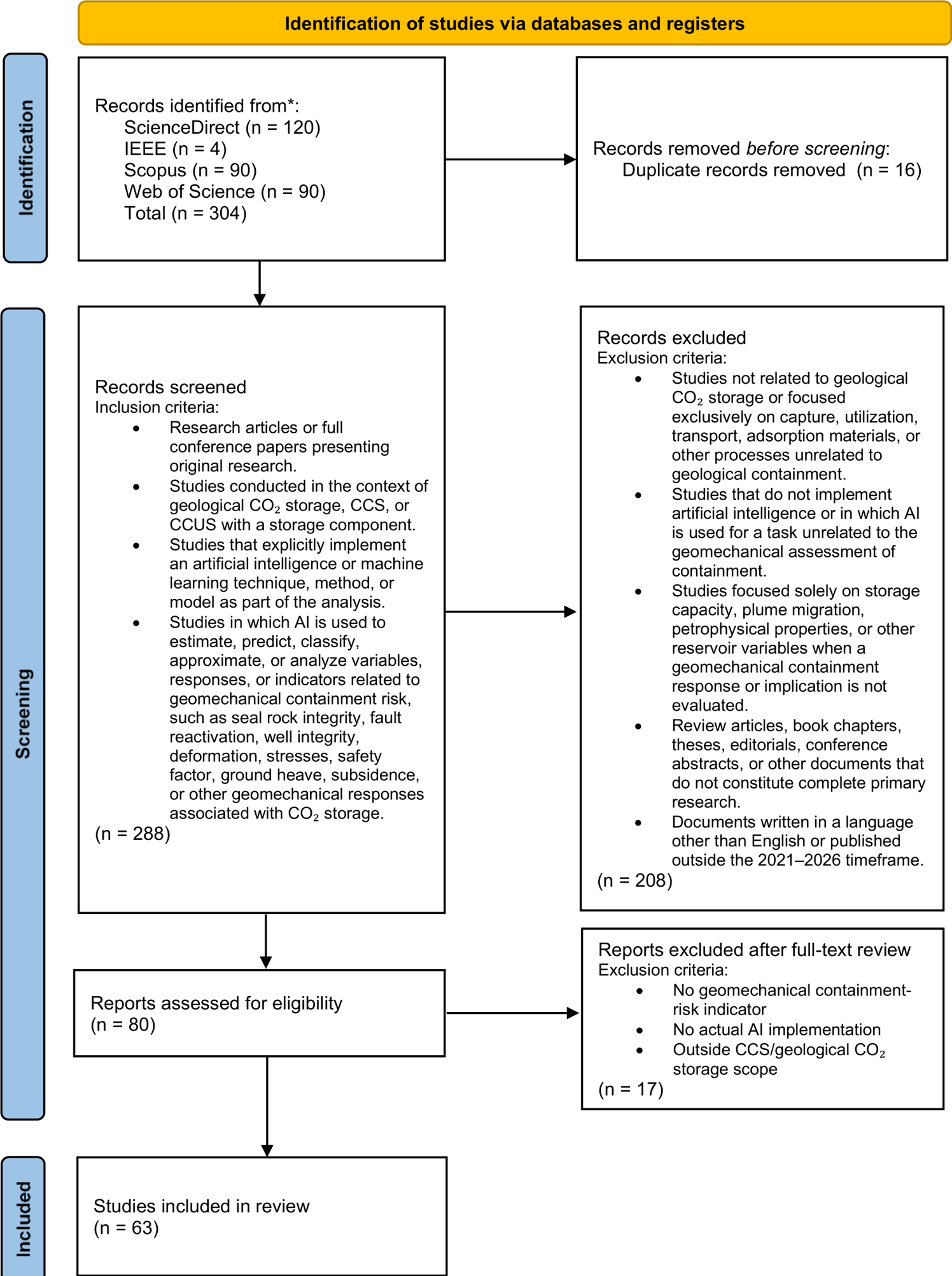
Figure 2.
Annual and cumulative number of the 63 unique studies included in the systematic review.
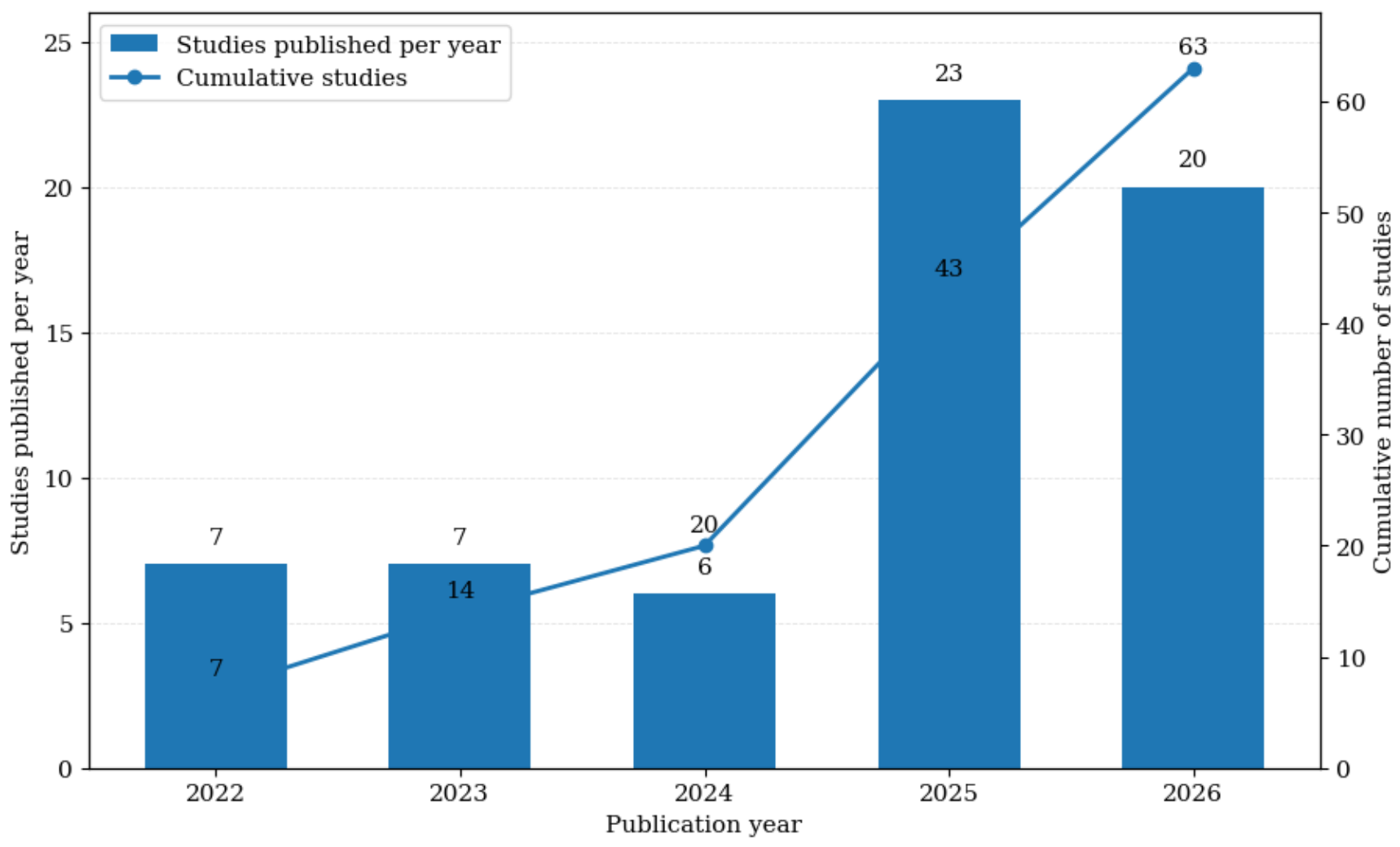
Figure 3.
Taxonomy of AI applications for CCS containment-risk assessment.
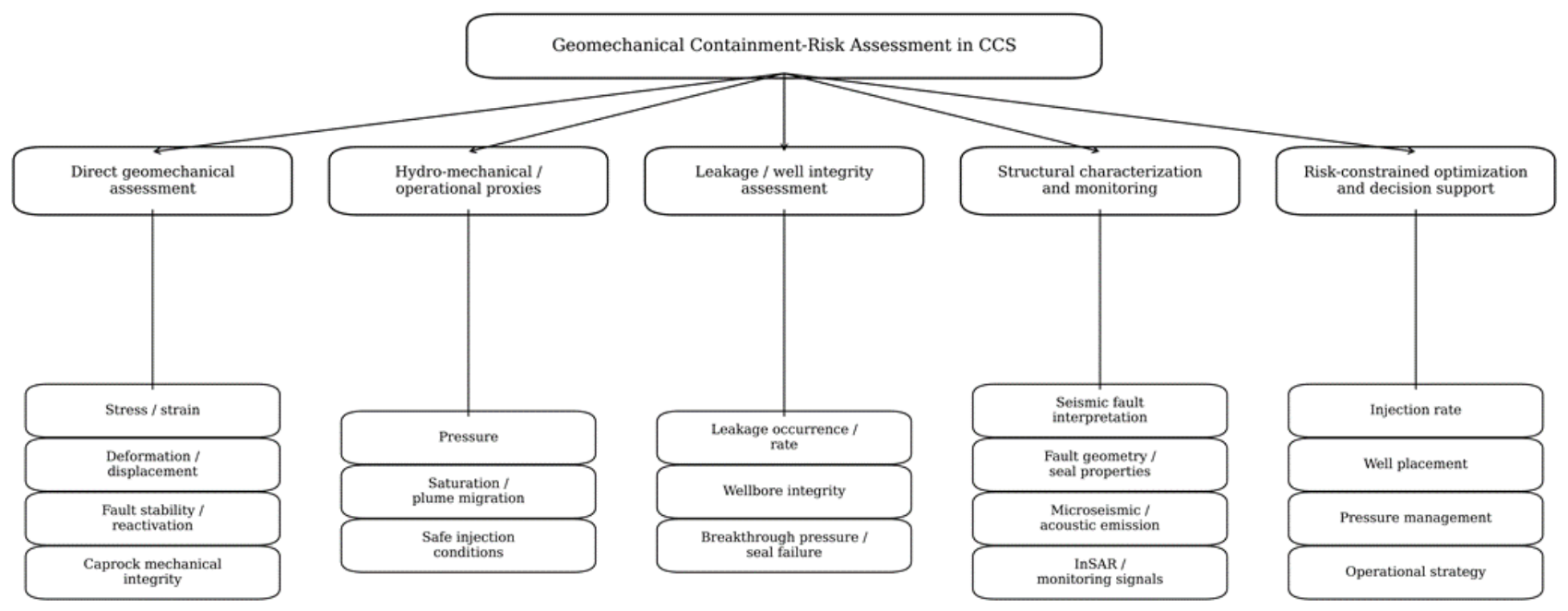

Table 1.
Comparison of the AI families used.
| Family | n | Most Frequent Task | Representation | Outputs | Main Pattern | Limitations |
|---|---|---|---|---|---|---|
| CNN/U-Net [11,22,24,26,27,35,46,47,52,53,54,62,72] |
13 | Spatial fields and characterization | Images, 3D volumes, grids | Faults, pressure, saturation, deformation | High prevalence in spatial problems | Geomechanical applications rely primarily on simulation-generated data; transfer across geological configurations and direct field validation remain limited. |
| FFNN/MLP/DNN [13,15,28,31,36,43,44,57,66,67,69,70] |
12 | Tabular regression/classification | Scalar vectors | Pressure, risk, scalar outputs | Suitable for low-dimensional mappings | Vector representations do not explicitly preserve spatial relationships; extrapolation capability is constrained by the range of variables and scenarios used for training. |
| Classical ML/ensembles [19,20,25,39,40,42,61,68] | 8 | Screening and classification | Tables/features | Leakage, slip, seal risk, properties | Presence in both synthetic and real data | Performance strongly depends on feature selection, sample size, class balance, and dataset partitioning; representation of complex spatial fields is generally indirect. |
| RNN/LSTM/Transformer [32,33,41,49,74] |
5 | Temporal dependence | Time series | Pressure, temperature, migration | Explicit temporal orientation | All five studies rely on simulated data; temporal extrapolation and transfer of learned sequences to field operations were not demonstrated. |
| FNO/U-FNO [12,29,30,36,38] |
5 | Spatiotemporal surrogates | Fields/grids | Pressure, saturation, Dz, SF | Strong association with fast simulation/optimization | All five studies use simulation-generated data; therefore, generalization beyond the domain covered by the physical model and direct transfer to field data remain unproven. |
| Unsupervised Learning [50,55,56] | 3 | Monitoring | Signals/attributes | Clusters/fingerprints | All three studies use real data | The resulting clusters depend on the quality, location, and representation of the signals and do not, by themselves, constitute direct indicators of geomechanical failure. |
| Reinforcement Learning [37,75,76] |
3 | Sequential optimization | State–action | Operational policy | All three studies focus on optimization | The policies were learned and evaluated in simulators or surrogate environments; their behavior depends on the formulation of rewards and constraints, and operational transfer to field conditions has not been demonstrated. |
| GNN [17,71] |
2 | Surrogates in discretized domains | Graphs | Physical fields/decisions | Connectivity representation | The evidence comes from simulated environments. In [17], training uses only 48 THMC scenarios, 38 × 45 maps, and linear poroelastic geomechanics without fault slip or fracture propagation; [71] is mainly restricted to pressure/saturation prediction for well optimization. |
| GAN/cGAN [14,63] |
2 | Inversion and image-to-image mapping | Maps/volumes | Slip, subsurface properties | Suitable for spatial transformation | The validation of [14] with real data corresponds to a hydraulic fracturing experiment rather than a CCS site; [63] uses a synthetic THM scenario, 32 × 32 resolution, discrete InSAR observations, and homogeneous geomechanical properties by facies, and highlights the need for field validation. |
| PINN [21,34] |
2 | Physics-based reconstruction/prediction | Coordinates/fields | Stress/fractures/pressure drop | Explicit physical constraints | The evidence remains specific to each formulation. [34] uses synthetic 2D simulations and well-defined boundary conditions and requires extension to 3D domains, uncertainty quantification, and validation with field data before operational use. |
| Autoencoder/DL-ROM [18,59] |
2 | Model-order reduction | Physical fields | CFF, latent monitoring | Compression of complex states | In [18], difficulties were observed in reconstructing stresses from displacements and representing abrupt well-shutdown events; [59] depends on synthetic scenarios and simplified noise/surface-condition assumptions for InSAR. |
| Unspecified hybrid physics–ML [51,58] |
2 | Characterization | Logs/compiled data | Seal properties | Application to real-world data | In [51] the ML architecture is not described in sufficient detail to reproduce the workflow; in [58] the compiled database lacks detailed information on mineralogy, facies, and pore structure, and extrapolation beyond the data range was not validated. |
| PointNet [48] |
1 | Fault geometry | Point cloud | Geometric parameters | Explicit geometric representation | The workflow assumes correspondence between microseismic events and approximately rectangular planes; the synthetic training data use simplified models without heterogeneity or advanced fault mechanics, making irregular, multiple, or closely spaced faults more difficult to address. |
| Fuzzy/AHP [45] |
1 | Leakage risk | Expert indicators | Risk class | High interpretability | The weights depend on the hierarchical structure and expert judgments, although this is mitigated through correlation analysis; the field application was conducted on only two wells, and therefore no evidence of external generalization is available. |
Table 3.
Relationship between AI outputs and containment risk.
| Output Level | Examples | Relationship with Risk | References |
|---|---|---|---|
| Direct geomechanical response | Stress, strain, plastic strain, displacement, uplift, slip, CFF | Direct | [11,12,14,16,17,18,21,24,25,26,27] |
| Geomechanical risk indicator | Safety Factor, slip tendency, Fail/Non-Fail, reactivation, risk class | Direct/derived | [12,13,15,19,20,22,23,25] |
| Hydro-mechanical/operational proxy | Pressure, WBHP, pressure drop, saturation, injection safety | Indirect | [28,29,30,31,32,33,34,35,36,38] |
| Leakage/integrity | Leak rate, leak location, fluid migration, remaining life | Related to loss of containment | [30,39,40,41,42,43,44,45] |
| Structural/geological characterization | Fault mask, geometry, throw, permeability, seal properties | Indirect; defines risk conditions | [46,47,48,51,52,53,54,57,58,60,61,62,63] |
| Monitoring signal | Microseismic clusters, AE, latent monitoring features | Indirect; observational | [22,49,50,55,56,59] |
| Operational decision | Injection rate, well location, brine production, policy | Risk mitigation/optimization | [12,36,37,38,66,67,68,69,70,71,72,74,75,76] |
Table 4.
Dataset source according to the primary function of the model.
| Primary Function | n | Synthetic | Real | Hybrid | No ML Dataset |
|---|---|---|---|---|---|
| Characterization/monitoring | 18 | 3 | 11 | 4 | 0 |
| Direct geomechanical assessment | 16 | 12 | 2 | 2 | 0 |
| Optimization/decision support | 14 | 14 | 0 | 0 | 0 |
| Leakage/integrity | 8 | 6 | 1 | 0 | 1 |
| Hydro-operational proxy | 7 | 7 | 0 | 0 | 0 |
| Total | 63 | 42 | 14 | 6 | 1 |
Disclaimer/Publisher’s Note: The statements, opinions and data contained in all publications are solely those of the individual author(s) and contributor(s) and not of MDPI and/or the editor(s). MDPI and/or the editor(s) disclaim responsibility for any injury to people or property resulting from any ideas, methods, instructions or products referred to in the content. |
© 2026 by the authors. Licensee MDPI, Basel, Switzerland. This article is an open access article distributed under the terms and conditions of the Creative Commons Attribution (CC BY) license (http://creativecommons.org/licenses/by/4.0/).
Copyright: This open access article is published under a Creative Commons CC BY 4.0 license, which permit the free download, distribution, and reuse, provided that the author and preprint are cited in any reuse.