

Submitted:
22 November 2026
Posted:
24 November 2026
You are already at the latest version
Abstract
Human languages share a proto-grammar of things, actions, states and relationships: STAR (States, Things, Actions, Relationships). We ask whether large language models reason with it. A grammar does not change with what is expressed, so we probe it with problems that demand different expressions: water-jug problems posed in declared worlds whose answer key is exact, varied in scale, in physics, in whether water once measured can be taken back, in reasoning budget and in the language of the prompt. We read the reasoning of Claude Opus 5.5 and Claude Sonnet 5 and, from their raw chains of thought, two open-weight models, gpt-oss-20b and Qwen3-30B-A3B. In every trace we coded, across probes, models and languages, the categories are those of human language; what varies is usage, such as writing a small state space as a list and a large one as a rule. The grammar also locates errors: nearly every wrong answer falls in one category, and when a translation shifts one word, the errors move into the category it touches: Relationship for a rule the Chinese wording narrowed, Thing for a capacity read as contents in French. Inside two open-weight models, an intervention shows that a jug's capacity and its contents are held as separate roles, carried by the words around a number: exchanging them changes the answer. The French word behind the misreading pulls a capacity toward contents.
Keywords:
large language models
; reasoning
; chain of thought
; grammar
; STAR
; declared world
; error analysis
; multilingual prompts
; state machines
; UML
; interpretability
; activation patching
1. Introduction
Reasoning about the world uses a grammar.
Human languages share a small set of categories for describing the world: the things that exist, the actions that change them, the states they are in, and the relationships that hold between them. STAR (States, Things, Actions, Relationships), the proto-grammar at the foundation of the BOLT methodology [3,4], names these four. A language model learns from text written in that grammar. When it reasons, it may use the grammar human languages share, use part of it, or use something else. A model trained to predict human text must compress the process that produced the text: people describing a world in which things change state when they are acted upon. The categories of that description are therefore among the first things such a model learns, and the material its reasoning would be built from. This paper takes a glimpse at which it uses.
The grammar of a world model has already been read.
Two earlier studies read a joint-embedding world model trained from pixels. Its latent holds the agent’s position [6], and its grammar has verbs and places but no individuated things [7]. Both studies used a declared world: an environment written as state machines, in which every thing, state, action and relationship is stated in advance and the answer key is exact. The same method can read a language model.
Different problems probe one grammar.
A grammar does not change with what is expressed. A language describes a kitchen and a proof with the same categories; what changes is which constructions are used. To read a grammar, one therefore probes it with problems that demand different expressions, and checks that the categories hold. If they changed, that would be a finding, or a sign that what is being read is not the grammar. We use a state-space problem whose states can be listed at small scale and not at large scale, and whose rules can be altered: the water-jug problem. The puzzle is an instrument here, not the subject. Scale probes how states are written. Altered physics probes which relationships fill the Relationship category. An ambiguous rule probes whether the question form is used. A world in which measured water is handed to stores that are never emptied probes what a state contains. Two open-weight models whose full chain of thought is returned test whether the reading depends on a summary or on one model family. A range of reasoning budgets tests whether the budget changes the answer or only whether one is given. The same prompts in French and Chinese test whether the grammar depends on the language of the prompt. An intervention inside two open-weight models tests whether two of the categories are represented in the model, not only written. Because the answer key is exact, every plan can be checked, so the grammar is read from reasoning that is known to work.
The findings in brief.
The models use one grammar across every probe: the things, actions, states and relationships of human language. Scale changes the construction, not the categories: a small state space is written as a list of states, a large one as a rule that generates them, built from relationships everyday language leaves implicit. At scale most of the reasoning is arithmetic, and the arithmetic uses the same grammar on a second set of things: the numbers. A procedure is a series of actions and states, so no category is missing. When water handed to a store can never return, the state must include what has been committed; Opus keeps it there, and its one error is the answer that leaves it out. The same categories appear in the raw chain of thought of two open-weight models from other labs, and they locate where each model fails: in a State, an Action or a Thing. A larger reasoning budget decides whether Opus answers, not whether its answer is right. In French and Chinese the categories are unchanged, and where a translation changed the problem, the errors moved into the one category the change touched. The models differ in which relationships they choose and in how they read a word, which is usage, not grammar. The question form is never used. Inside Qwen3-8B and Qwen3-30B-A3B, the capacity and the contents of a jug are separate roles: exchanging their directions over the words that follow a number turns a third or more of the answers into the other number, and “contient” pulls a capacity toward contents, so the French misreading can be seen in a single forward pass.
2. Related Work
What a language model represents.
Language models track entities and bind attributes to them [9,11], decode many relations with roughly linear maps [10], and can hold a world state they were never shown [13,17]. Interpretability work on Claude models found planning ahead [15]. These results concern internal representations. Li and Webb trained networks from scratch on an abstract rule task and an entity-attribute binding task, and found that symbol-like role variables and binding identifiers emerge when the training data is diverse, in transformers and in plain multilayer perceptrons alike: the data, not the architecture, drives them [14]. With a small vocabulary or tokens biased toward one role, the models bind answers to the identity of tokens instead, and fail when the roles are reversed. This paper reads the categories of the model’s stated reasoning, and tests two of them inside two open-weight models with the swap intervention of Li and Webb.
Recall and reasoning.
Controlling how a model reasons.
Agentic meta-reasoning separates the control of a run from the work it directs [2]. A controller keeps a compact state of the run, proposes next computations, evaluates them against the remaining budget and dispatches the chosen work to workers; every output is stored as an artifact, and the artifact graph records which outputs fed which work. The cycle has the shape of a SAM step: an assessed state, proposed actions, an acceptance under a constraint, and the next action. Its controller state is free text rewritten each cycle; in a declared world the state is declared. A second architecture, MIRA, separates deciding what to investigate next from carrying the investigation out, and trains the outer decisions with a critic of remaining research value [19]. Without training it lowers what the authors call strategic inertia, the tendency of consecutive steps to stay on one line of attack, by making the model revisit earlier evidence in a fresh context. The errors coded here show the same commitment at the level of a single reading: the first misreading of a trace comes early and is not revisited.
Reasoning traces are not faithful records.
3. Method
3.1. Two Lenses: STAR and UML
Each sentence of a plan or of the thinking is coded with one STAR category: a Thing (what exists and its fixed properties), a State (the value of something at a moment), an Action (what is done and its effect), a Relationship (what holds across states, such as a divisibility or an invariant), or none of these (N). A rule-based coder coded every sentence; a second coder (Claude, not a human) coded a random 20% of episodes. UML [18] is the second lens: its class diagrams name things and relationships, its state diagrams name states and the actions between them. Drawing the same world as a person describes it and as the model reasons about it shows which parts of the grammar each uses.
3.2. The Instrument: a Declared Jug World
The world has jugs of integer capacities, a tap and a drain, built as a SAM machine [5,8]: an action only proposes, an acceptor decides, and a journal records every proposal and state (Figure 1). Three actions are admissible: fill, empty, and pour until the source is empty or the receiver full. The answer key is exact at every scale. The prompt names the things and the goal, never the actions: “You have: jug A, which holds exactly a litres; jug B, which holds exactly b litres; and a tap with unlimited water. Both jugs are empty. Goal: exactly t litres in one of the jugs. Describe how you would do it.” Every plan is executed on the world, and any plan the rule-based referee did not credit was replayed against the answer key by the author or, in the altered worlds, by Claude with the author checking a seeded 20% sample (28 of 28 agreed; 4 of 4 in the hand-off world, 6 of 6 for the direct question). The adjudicator only turns the prose of a plan into actions; whether those actions reach the goal is decided by the world.
3.3. Probes Chosen to Demand Different Expressions
Table 1 lists the probes. Each one demands a different expression of the same world, so each tests whether the categories hold. Every cell ran three times, at effort high with a limit of 16,000 output tokens. The readings, instances and referee were committed before the first call.
The ladder runs from , , at R1 (six actions at minimum) through capacities of hundreds (R2), hundreds of thousands (R3), hundreds of millions (R4), 18 digits (R5) and 100 digits (R6), where the shortest solution has about actions. In the spill world, pouring X into Y removes litres from X and adds one litre less to Y, and the prompt adds “Whenever water is poured from one jug into the other, 1 litre is spilled.” In the three-jug world, A starts full, there is no tap and no drain, and . Each altered world has three scales (under 20, hundreds, low thousands).
In the hand-off world, two measuring jugs X and Y are filled from the tap and poured into each other, and either can be poured into one of two stores, Z and T. Nothing is ever emptied: there is no drain, the stores are never emptied, and overflow is final. The goal is z litres in Z and t litres in T at the same time, so every litre that leaves X or Y counts toward one of the two targets. Applied to each target separately, the textbook gcd rule calls a pair reachable; over small capacities, breadth-first search finds that 6.6% of the pairs it calls reachable cannot be reached together (traps). We used four small instances: one in which either store can be completed first (, , , ), one trap (, , , ), and two in which only one completion order works: Z first (, , , ) and T first (, , , ), each with a shortest plan of 11 actions. The prompt adds “Water can be poured into Z or T only from X or Y, and never poured out of them. There is no drain, and water cannot be thrown away.” Sonnet’s hand-off cells were run again with a limit of 32,000 tokens.
The hand-off world was also posed, unchanged, to gpt-oss-20b [24], an open-weight reasoning model that returns its full chain of thought. It ran in llama.cpp [22] at reasoning effort high, with 8 samples per instance and a limit of 32,000 tokens. Its raw traces were coded with the same codebook, and a second coder (Claude) coded 700 sampled sentences blind to the first pass. Two further codes were declared before the run: whether a trace’s state includes Z and T, and whether the trace backtracks. To ask directly whether a model can see the ambiguity of the hand-off rule, the H-Z-first prompt was followed by “Before solving anything: is any part of this problem statement ambiguous? If so, list each possible reading” (Opus and Sonnet, three runs each). Breadth-first and A* search on every hand-off instance give the baseline of how much search each instance needs.
The hand-off world was posed in the same way to a second open-weight model, Qwen3-30B-A3B [23], in its thinking version, also in llama.cpp with 8 samples per instance. To vary the reasoning budget, Opus ran the four hand-off instances at limits of 4,000, 8,000 and 32,000 output tokens, four runs each, beside the 16,000-token runs above; Sonnet ran the trap at 64,000. For the language probe the hand-off prompt was translated into French and Chinese. The French was reviewed by the author, a native speaker; the Chinese was checked by having gpt-oss-20b and Qwen3-30B-A3B translate it back into English, and by a comprehension question (“Under these rules, may water be poured from X into Y?”), since no native speaker was available. Opus ran each instance three times in each language, and the two open-weight models eight times. Every answer was adjudicated by Claude, by replaying it on the world, and every wrong answer was placed in the STAR category in which it fails. For the open-weight models two categories were coded per non-correct trace: the root, the first STAR element the trace misreads, and the surface, the rule the final answer breaks. A second coder (Claude, blind to the first) coded both; agreement is on the root over 181 traces and on the surface over 106 answers. The root coding was added after the first adjudication. Counts are compared with a two-sided Fisher exact test. Table 2 lists the models and their settings.
3.4. The Reasoning Read Is Reasoning That Works
Table 3 checks the plans before their grammar is read. Every plan either model gave on the textbook world reached its target, and every impossible target answered was proved impossible. In the altered worlds, every plan that followed the world’s stated physics reached its target. The only incorrect plans are five Sonnet plans that took another reading of the ambiguous spill sentence and one that reinterpreted the goal (Section 4.10). In the hand-off world, one Opus answer declared a reachable pair impossible, and two Sonnet plans emptied or discarded water the world forbids to discard (Section 4.5 and Section 4.7). gpt-oss-20b answered 10 of its 32 hand-off episodes and 2 answers were correct, and Qwen3-30B-A3B answered all 32 with 6 correct; their failures are analysed in Section 4.6. At every budget no Opus answer was wrong (Section 4.7). The language runs are in Section 4.8. Episodes without a plan were cut off at the token limit, which Sonnet reached far more often, or, for two Opus episodes at R6, refused by the API’s safety filter: a modular inverse of 100-digit numbers resembles cryptographic work.
4. One Grammar Across Every Probe
Table 4 summarises what each probe shows and where.
4.1. Things, Actions, States and Relationships Appear in Every World
No action was named in the prompt. Every Opus plan on the textbook world uses exactly fill, empty and pour, and no plan proposed marking, tilting or weighing a jug: the models supply the action vocabulary a person would use for the problem. The things named in the prompt are kept from the first sentence to the last at every scale, and with the jugs renamed as tanks in cubic metres the plans keep the same categories and structure. In the three-jug world, where fill and empty are refused, the plans use pours alone. Relationships appear from the smallest rung: at R1 every impossible target is proved by a capacity bound or a divisibility, never by search. States appear at every rung, as Section 4.2 shows. All four STAR categories are present in every world, at every scale, in both models.
The same categories appear in the raw chain of thought of gpt-oss-20b (Table 5). Its traces are long, 66,588 sentences for 32 episodes, and most of them are actions tried and their results. The second coder agrees with the rule-based coder at on 700 sampled sentences, more than on the Claude plans; most disagreements are sentences the rule-based coder left uncoded and the second coder coded as an action or a state. The categories are therefore not an artefact of the summary written for Claude’s thinking, nor of one model family. The traces of Qwen3-30B-A3B were not coded sentence by sentence, but every one of its non-correct traces, and every non-correct open-weight trace in French and Chinese, has its first misreading in a STAR category.
4.2. States Are Written as a List or as a Rule
At R1 a plan writes the states as a list: after each action, the content of both jugs. From R2 up, in both models and at every rung above, it writes them as a rule. An Opus plan at R2 states that after the m-th fill of B has been poured, A holds litres; that ; and that the 361st fill therefore leaves 183 litres in B. That is still a statement about states, as exact as a list, but it is generated by relationships: the gcd condition for reachability, a congruence that locates the target, and a loop with an exact count that produces the path. Everyday language has both constructions (“house 2, house 4, house 6” and “every second house”); the models choose the second when the first cannot be written.
Table 6 measures this choice in the Opus plans. The shares of STAR categories measure usage, not grammar: they show which construction is chosen. Agreement between the two coders is moderate (), so only readings that hold in both codings are reported. Action sentences fall by about two thirds from R1 to R6, and Relationship sentences rise from almost none at R1 to about a third of the plan at R5: the rule takes the place of the list.
4.3. At Scale the Same Grammar Is Applied to the Numbers
Once the jug states are written as a rule, what remains is to compute the rule’s numbers: a gcd, a modular inverse, a count of fills. At R5 and R6 that computation fills the summarised thinking. The original codebook counted only the jugs, the tap and the goal as things, so the second coder placed 82% and 87% of these sentences in no STAR category (N). A procedure, however, is a series of actions and states. Long division is actions (divide, subtract, carry, compare) that produce states (a remainder, a partial quotient, a carried digit), checked against relationships (a remainder is smaller than its divisor). We recoded every sentence of the sampled thinking that had been coded N, with numbers, digit groups and remainders counted as things. Table 7 gives the result: the N share falls to 0 to 18% at every rung, and what remains is planning talk. At scale the thinking is mostly Actions and States in a second world, the world of numbers, with Relationships that check them.
The same grammar therefore holds in both worlds the model reasons in: the jug world of the plan and the number world of the computation. The procedure in the number world works. An exact checker found one error in 68 calculations in the Opus answers at R4 to R6, an off-by-one in a 100-digit sum that does not change the verdict, and at R4 both models state the same minimal identity, (Appendix A). Because the thinking is written by a summariser, its wording may partly reflect how the summariser narrates long computations.
4.4. The Models Differ in Usage, Not in Grammar
The altered worlds change which relationships are true, and so test what fills the Relationship category. No plan used the textbook cycle in the spill world, and no trap plan in either altered world applied the textbook gcd rule. In the spill world every plan rewrites the effect of a pour, and the trap plans use the lost litre as a unit of measure. In the three-jug world the solvable plans of both models build a unit from a difference of capacities (, ).
The impossible targets of the three-jug world separate the models. Two relationships prove them. One belongs to the world: the total water is fixed, every pour moves all of it, so each jug holds 0 or all of it. The other belongs to the numbers: every capacity is a multiple of the gcd and every pour keeps it so. Opus used the world’s relationship in nine of nine proofs. Sonnet used the numbers’ relationship in seven of nine, and twice carried over its textbook converse, that every multiple of the gcd is reachable, which is false in this world. On the traps, Opus declared all six it answered impossible, by listing every reachable state or by an invariant of the world. Sonnet gave no trap plan: all nine reached the token limit. Both models use the same category; they fill it differently.
4.5. The State Includes What Has Been Committed
In the jug worlds above, a state is the content of the jugs, and any jug can be emptied. In the hand-off world nothing can be emptied: water poured into Z or T stays there. A state is therefore the content of all four jugs, and every action on X or Y is constrained by what Z and T already hold. Opus states this coupling in 11 of its 12 answers: the only way to “empty” X or Y is to pour into Z or T, so every such pour must be exactly the right amount. On the trap it uses the coupling as a budget: exactly 4 litres may ever be poured into Z and T, so the second small quantity the goal needs can never be measured. All three Opus trap answers are correct proofs of impossibility.
The one wrong Opus answer shows a state that is too small. On the T-first instance it declares the goal impossible. Its argument tracks only the contents of X and Y, and counts a return to an earlier pair as no progress, although Z and T then hold more than before. It also never pours X back into Y. The shortest plan, of 11 actions, uses both moves. The things, actions and relationships of the answer are those of the world; the error is in what its states contain. gpt-oss-20b names Z and T in its state in all 32 traces, and none of its answers loses their contents. Qwen3-30B-A3B makes the Opus error often: 13 of its 26 wrong answers pour water into a store and then plan as if it were not there.
The coupling is the relationship that makes the problem small. Search that drops any state where a store exceeds its target, because a store can never go down, proves the trap unreachable after 42 nodes; breadth-first search without it visits 1,341. Stating the relationship, as Opus does, is what lets reasoning avoid the search.
Every Claude plan that reached its goal completed the two targets in the only order that works. No plan states the order as a rule with its reason. The order is used, not stated.
Sonnet answered 3 of 12 episodes within 16,000 tokens, all on the instance where the order is free, and 3 of 9 within 32,000. It never answered the trap. Two of its 32,000-token plans state the coupling and reach the goal. The third writes the textbook method for jugs of 4 and 9 litres, with “Empty X” three times, and ends “achieved using only fills, empties, and transfers”. The prompt states that water cannot be thrown away. A recalled procedure took the place of a stated rule.
4.6. The Grammar Locates Errors
Every wrong answer in the hand-off world can be placed in one STAR category, with the others intact, except four Qwen3-30B-A3B answers: three give a wrong verdict on reachability and one fits no category (Table 8). Each model fails in characteristic places: Opus and Qwen3-30B-A3B in the State, gpt-oss in an Action and a Thing, Sonnet in a stated rule it does not apply. The eight wrong answers of gpt-oss-20b fall in two categories, Action and Thing. In five, a pour is stopped at a chosen amount (“pour exactly 3 litres from Y into Z”): the Action has another meaning than in the world, where a pour runs until the source is empty or the receiver full. The prompt does not state that rule, and the Claude models assume it; gpt-oss takes the other reading. In two, “jug X, which holds exactly 2 litres” is read as X starting full: a fixed property of a Thing is read as a State. One answer empties a jug the prompt forbids to empty. No gpt-oss answer leaves the stores out of its state, which is where the one Opus error lies. Qwen3-30B-A3B fails most often there.
An error can start in one category and surface in another. In the open-weight traces the first misreading (the root) and the rule the answer breaks (the surface) were coded separately. The clearest case is a Chinese wording that narrowed a rule (Section 4.8): in 19 of gpt-oss’s 27 wrong answers (20 for the second coder) the root is that Relationship and the surface is an Action. With pours between X and Y read as forbidden, the goal looks unreachable, and the model gives a pour another effect (“pour only 1 litre”) rather than conclude that the goal is impossible.
4.7. The Reasoning Budget Decides Whether an Answer Is Given
Table 9 gives the Opus answers on the hand-off world at four limits on output tokens. Below a threshold the limit cuts Opus off before it answers; above it, its answer is right. No answer at 4,000, 8,000 or 32,000 tokens is wrong, and the false impossibility on the T-first instance at 16,000 tokens does not recur in the eight T-first answers at 8,000 and 32,000. The threshold follows the argument each instance needs. A route on the free instance takes about 1,900 output tokens at every limit. The T-first route takes 5,700 to 8,500. A proof that the trap is impossible takes about 9,800 (Figure 2b), which is why no trap answer is given below 32,000: all four at 32,000 prove it, three by listing the reachable states of X and Y, one by parity. Sonnet at 64,000 tokens gave one trap answer, which discards water the prompt forbids to discard, and reached the limit twice.
4.8. A Translation Moves the Errors into One Category
In French and Chinese, every answer and every trace uses the same categories as in English. What changes is how one word is read, and the grammar shows which. Opus answers 12 of 12 in French and 12 of 12 in Chinese (final wording), against 11 of 12 in English; with three runs per cell, a difference of one answer is within sampling.
A first Chinese wording of the hand-off rule, 只能从X或Y往Z或T里倒水 (“one can only pour water from X or Y into Z or T”), can be read as allowing no other pour. Asked whether water may be poured from X into Y, Opus answered no in three of three runs under that wording, yes in three of three under the final wording (Z和T里的水只能从X或Y倒进去, “the water in Z and T can only be poured in from X or Y”), and yes, yes and unclear in English. Both back-translations of the first wording read naturally in English and did not reveal the narrowing. Under the first wording Opus answered 8 of 12. That drop alone is within sampling (12 of 12 under the final wording, ); what marks it is that all four failures are in one category, a Relationship read more narrowly than stated, for both coders. The two models read the same sentence differently: Opus adopted the narrow reading in 5 of 12 answers, gpt-oss-20b in 27 of 27, all of them wrong ().
The French prompt renders “holds exactly a litres” as “contient exactement a litres”. “Contient” can state a capacity but leans to contents, and the errors move into Thing (Table 10, Figure 2a). In English a failure almost never starts by reading the jugs as full; in French it is the most common first misreading for both open-weight models. Qwen3-30B-A3B answers 2 of 32 in French and 6 of 32 in English, a difference within sampling (); what changes sharply is where its errors start. 26 of its 32 French traces assume full jugs, usually within the first 4% of the trace. Opus never read “contient” as contents. The Chinese 正好装 does not have this effect.
The raw chain of thought of gpt-oss-20b is written in English under every prompt, quoting the French or Chinese, and never switches language partway through, which is how its reasoning format was trained. Opus’s thinking is returned as a summary in English, so its language is not measured. The language of a trace says nothing about a language of thought; what the traces show is that the errors follow the wording of the prompt, and fall in the category that wording touches.
4.9. Capacity and Contents Are Separate Roles Inside the Model
The traces show the categories in what the models write, and the French errors show one word moving a number from one role to another. Both are read from the output. To test whether the roles exist inside a model and steer its answer, we applied the swap intervention of Li and Webb [14] to the two open-weight models whose weights can be read: Qwen3-8B and Qwen3-30B-A3B, the model whose French traces read capacity as contents. The weights are the full bf16 releases, not the quantized files of the traces above.
The swap.
Each prompt states one jug with two sentences: its capacity c (2 to 9 litres) and its contents w (less than c), each in one of five English or four French wordings, in either order, followed by one question: the capacity, or the contents. The answer is the next token, a single digit, so it can be read without generation. The 7,216 prompts are generated from the declared world, with the answer known. For each layer, a role direction is the mean activation over contents phrases minus the mean over capacity phrases, taken on two wordings per role and averaged over the digit values, so that it carries the role and not the number. The swap adds that direction to every token of the capacity phrase, from the number to the period, and subtracts it on the contents phrase (Figure 3). If the model reads the role from the phrase, the answer becomes the other number. The swap is scored on 480 English test prompts whose wordings were not used to compute the direction, all answered correctly before the swap.
Controls.
Four controls separate a role swap from other effects: a random direction of the same size at every layer; the same swap on one sentence only; the swap on the number token alone, without the words after it; and moving the digit itself to a third value, which should change the value of the answer, not its role.
The roles are carried by the phrase.
The swap turns 44% of answers into the other number in Qwen3-8B and 34% in Qwen3-30B-A3B (Table 11, Figure 4). Choosing the layer on half of the prompts and scoring it on the other half gives 42% and 30%. A random direction of the same size flips nothing at any layer, and the swap on one sentence alone flips under 2%: the answer changes when both roles are exchanged, and only then. Patched on the number token alone, the same direction flips 7% and 2%. The value and the role come apart: moving the digit to a third value makes the model answer that digit on 90% or more of prompts in the middle layers, and flips the role almost never (0.2% or less). The model reads the value from the number and the role from the words around it.
The larger model is weaker and later: its effect sits at about 70% of depth against 55% in the smaller one, and it moves capacity answers far more than contents answers. A good reader of the role is not a good handle on it: a linear probe reads the role almost perfectly at the period of each sentence, in English and French and in both models, yet in Qwen3-8B a swap along the probe’s direction, or at the period alone, flips 3% of answers or less.
“Contient” moves a capacity toward contents.
On the axis from capacity (English capacity phrases, 0) to contents (English contents phrases, 1), the number in “La cruche A contient exactement c litres” sits at 0.42 in Qwen3-8B, against 0.09 for the three other French capacity wordings and 0.01 for English “holds” (layer 20, number token). Compared within the same sentence order it is 0.22 to 0.43 nearer contents. In Qwen3-30B-A3B the lean shows in the answers (Figure 5). When a contents sentence comes first and “contient exactement” second, the model answers the contents question with the capacity on 87 of 176 prompts (49%). With the capacity sentence first it never does (0 of 176), nor with the three other French capacity wordings (0 of 1,056). Qwen3-8B makes the same error on 8 of the 176. This is the misreading of Table 10, a capacity read as contents, reproduced in a single forward pass, and it depends on what was read before: after a sentence has stated the contents, “contient” is read as stating them again.
4.10. The Question Form Is Never Used
“1 litre is spilled” does not say where the litre is lost. In the world, the source loses one litre more than the receiver gains. Five Sonnet plans took the other reading, in which the receiver gains one litre less than the space it has; three fail on the world and two reach the target by coincidence. Every Opus plan follows the world’s reading or states none. In 141 episodes of the altered worlds and 117 Opus episodes on the textbook world, no model asked a question. An ambiguous sentence becomes an action rule, chosen without saying that a choice was made.
The hand-off rule “never poured out of them” is ambiguous as well: “them” can be Z and T, or include X and Y. gpt-oss-20b weighs both readings in its raw chain of thought in 31 of 32 traces, then chooses one; its answers state the reading in 3 of 10. No reading is visible in any of the 33 Claude episodes. Asked directly whether the statement is ambiguous, Opus lists other ambiguities in all three runs and, in one, quotes the sentence and calls it clear; Sonnet’s one complete answer names both readings and adopts one with a reason. The three models differ in whether the second reading is available: Opus does not see it, Sonnet sees it when asked, gpt-oss sees it unprompted. None asks. The 51 episodes of the budget probe and the 36 Opus episodes in French and Chinese show no reading of the ambiguity either. Human language has a question form; in these probes the models did not use it. Assistant training rewards answering, and may be the reason.
4.11. The Same Sentences in a Human Language and as the Models Write Them
Table 12 renders five sentences about the jug worlds, written in English (the language of most prompts), as the models write them. As in the study of the world model [7], the renderings are illustrative: they are condensed from the plans and restate the measured findings.
Figure 6 draws the jug world in UML twice: as a person describes it, and as the models write it. Both diagrams have the same classes, the same three actions and the same states. The models make explicit the relationships everyday language leaves implicit (reachability, the congruence that locates the target, the loop with its count), and write the states as one counting state with a guard rather than as a path. The arithmetic is a second, smaller world with the same grammar: numbers as things, operations as actions, remainders as states.
5. Discussion
Is it the grammar that was read?
The categories held across every probe: scale, targets, vocabulary, altered actions, altered relationships, a world that commits what it measures, a second model, two models from other labs read from their raw chains of thought, four reasoning budgets and three languages. What changed was usage: the choice between a list and a rule, and the choice of which relationship to state. That is what a grammar read through different problems should look like. The one apparent exception, the arithmetic at scale, was a limit of the codebook: counted with numbers as things, it is the same grammar applied to a second world. This is what the training objective predicts: a model that learned to predict human descriptions of the world reasons with the categories of those descriptions, so reading the categories reads what the model learned.
A state holds what constrains the next action.
The hand-off world adds no category. It changes what a State must contain: once water is committed to a store, the store’s content constrains every later action on the measuring jugs. Opus writes its states that way in almost every answer, and its one error is the answer whose states leave the stores out. Read through STAR, an error can sit in one category while the others are intact.
The grammar gives errors an address.
The models fail in characteristic categories: Opus and Qwen3-30B-A3B in a State, gpt-oss in an Action and a Thing, Sonnet in a stated rule it does not apply. A pass rate says that a model failed; the category says where, and the root says where the failure started. This is the practical use of reading the grammar: an error in the State calls for a different remedy (keep what is committed in view) than an error in an Action (state the action’s rule).
A translation is a change to the declared world.
A declared world is stated in words, and the model reasons about the world the words state. A translation that shifts one word therefore changes the world: the first Chinese wording removed pours between X and Y, and “contient” made full jugs a reading. In both cases the errors fell in the one category the shift touched, Relationship and Thing, while the other categories held. A single word that moves a reading from one role to another is what a binding to the token, not to its role, would produce [14]; the declared world shows which role it moved. The models differ in how readily they take a shifted reading: the narrowed rule was taken by gpt-oss in every answer and by Opus in fewer than half, and “contient” was read as contents by Qwen in most traces and by Opus never. A translation can be checked by asking the model about the rule it states; read through the error categories, the check shows what changed. The categories held in every language while the errors followed single words. A representation shared across languages would produce exactly this: the meaning is common to the languages, and the word is the way into it.
The roles are carried by phrases, not by words.
Inside the models, the capacity and the contents of a jug are separate roles: exchanging them changes the answer, and no other change that was tried does. The role is not stored on the number. The number carries the value; the words that follow it carry the role. Li and Webb found role variables at single tokens in small networks trained from scratch [14]; in these pretrained models the role of a number is spread over its phrase. This is the distinction STAR draws: one Thing, the jug, with a fixed property, its capacity, and a State, its contents, each named by a phrase. It also explains how a single word can move an error. “Contient” sits between the two roles, and what was read before decides which way it falls: after a sentence has stated the contents, the larger model reads it as stating them again.
The budget sets whether an answer is given, not what it is.
Below a threshold the token limit cut Opus off before it answered; above it, the answer was right. A shorter limit removed answers and did not produce worse ones. The threshold is set by the argument the instance needs, and a proof of impossibility needs several times the tokens of a route.
Control and object-level work are two worlds with one grammar.
Inside a single trace, the models reason in two worlds: the jug world of the plan and the number world of the computation. Agentic meta-reasoning makes the same split explicit, with a controller that reasons about the run and workers that reason about the task [2]. Our results predict that one grammar serves both levels: the controller’s things (artifacts, budget), actions (read, write, run workers, stop), states and relationships (which option is worth its cost). Its artifact graph is the journal of a procedure, artifacts as states and dispatches as actions, and could be read with STAR in the same way.
The two kinds of model use complementary parts of the same grammar.
The joint-embedding world model learned actions and places from pixels, and no individuated things [7]. The language models use things, actions, states and relationships, and at scale they lean on relationships to write states as rules. What the world model lacked, things and relationships, is where the language models are strongest.
The grammar is inherited, and its use is computed.
The puzzle’s actions and its gcd relationship are in the text the models learned from. The models did not discover STAR in this world; they brought it. This agrees with the finding that symbolic roles emerge from diverse training data rather than from the architecture [14]. The instances are new, and the counts and identities the models state for them appear nowhere in text.
A procedure is actions and states.
STAR needs no fifth category for computation. A procedure is a series of actions and the states they produce, and the arithmetic of the models is exactly that, on numbers. What a codebook must state is which things are in scope. Reasoning can move from the world it is about to the world it computes in, and both are read with the same grammar.
6. Scope and Limitations
The paper reads two models of one family and two open-weight models on one family of problems, with three or four repetitions per cell for the Claude models and eight for the open-weight models. The sentence-level STAR coding covers the Opus plans on the textbook ladder and the gpt-oss-20b traces; its second coder is also a model, and agreement is moderate. No human coded sentences, and the codebook was not applied to a control text that is not reasoning. Qwen3-30B-A3B was read through its errors, not sentence by sentence. The thinking of the Claude models is a summary written by a separate model, so its language and wording are not the model’s own. The altered physics is stated in the prompt, so the study reads how a stated rule is used, not how a rule is discovered by acting. Plans in the altered worlds, the budget runs and the language runs were adjudicated by a model of the same family as two of the subjects; the author checked a sample in the altered worlds and the hand-off world, not in the budget and language runs. The token limit removed more Sonnet episodes than Opus episodes, so Sonnet’s reasoning on the three-jug and hand-off traps is barely observed, and at R6 a safety filter removed two Opus episodes. The hand-off world was run at small scale only, on four instances. The open-weight models reached the 32,000-token limit in most episodes, so their answers are few, and the answers scored are those that finished within the limit; their raw traces are complete up to the limit, and their root coding covers the traces that were cut off. The open-weight models ran quantized (MXFP4 and Q4_K_M), and some differences between them may come from quantization. The open-weight models were run on the French wording with “contient” and the first Chinese wording only, so their results in those languages measure the wording as much as the language; Opus was run on the final Chinese wording. No native Chinese speaker checked the translation. The root coding was added after the first adjudication, and on the English traces its agreement is weak ( for gpt-oss, for Qwen); the Thing row of Table 10 agrees within one or two traces. The recoding of the thinking with numbers as things was done after the results, by a model, not blind. The UML renderings and the five sentences are illustrative summaries of measured findings, not outputs of the models.
The role swap is partial: at its best layer it moves 30 to 44% of answers, and the rest stay correct. It was run on one jug with single digits, on two models of one family, and only the two roles of capacity and contents. It adds the same direction to every token of a phrase, so part of its effect may come from word features that separate the roles, such as “water”; a random direction of the same size rules out generic disruption, not such a lexical direction. Contents phrases are longer than capacity phrases, so the swap touches more contents tokens. The larger model ran in bf16 and the smaller one with float32 arithmetic on bf16 weights, and both used full weights, not the quantized files of the traces. Only one French wording is ambiguous by design, and its misreading in the larger model depends on sentence order. Choosing the probe’s layer on one held-out wording per role proved too easy to separate layers, so the probe results serve only as a comparison.
7. Reproducibility
The worlds, answer keys, referee, instances, runners, coders and checker are worlds of polytrion, built on the SAM library [8]. Every transcript, journal, coding, adjudication and amendment is committed with the declarations, and the results files list each reading with its source. The open-weight runs are Kaggle notebooks that embed their prompts and check them by hash before running. The role-swap prompts are generated from the same declared world; the runs used Qwen3-8B and Qwen3-30B-A3B from Hugging Face on cloud GPUs, with a fixed seed, and record every prompt, answer, direction norm and flip. Code and data are available from the author upon request.
Use of AI tools.
The author used Claude (Anthropic), an AI model, to write and run the study code under the author’s direction, to act as second coder and, in the altered worlds, the budget and language runs and for the open-weight models, as adjudicator, as stated above, to draft the translations, to write and run the role-swap code, and to draft and edit the text. The subjects of the study are also Claude models. The author designed the study, reviewed the French translation, approved every declared reading before its data existed, adjudicated the plans on the textbook world, checked a seeded sample of the adjudication in the altered worlds, and takes full responsibility for the content.
8. Conclusions
A declared world lets the grammar of a language model’s reasoning be read from reasoning that is known to work, through problems that demand different expressions. Given only the things and the goal, the Claude models supplied the actions a person would use. At the smallest scale they listed the states; as the state space grew they wrote them as a rule: the gcd, a modular inverse and a loop with an exact count. At scale the same grammar is applied to the numbers, and the arithmetic on numbers of up to 100 digits was almost exact. When the world departs from the textbook, the recalled method is almost never applied blindly. When water handed off can never return, Opus writes its states as everything committed so far, and its one error is the answer whose states leave the stores out; Qwen3-30B-A3B makes that error most often. The raw chains of thought of two open-weight models from other labs use the same categories, so they are not an artefact of a summary or of one model family. The categories give each error an address, and the root of an error can lie in another category than the rule the answer breaks. A larger reasoning budget decides whether Opus answers, not whether it is right; a proof of impossibility costs several times a route. In French and Chinese the categories are unchanged, and where a translation shifted one word, the errors moved into the one category the shift touched: a narrowed rule into Relationship, a capacity read as contents into Thing. No model asks what an ambiguous rule means. In every trace we read, across probes, models and languages, the grammar is the same: the things, actions, states and relationships shared by human languages. Only its usage changes. These categories are part of what a model learns when it learns to predict human text, and reading them shows where that learning holds and where a single word can turn it. Inside the open-weight models the same categories are represented, not only written: a jug’s capacity and its contents are separate roles carried by the words around a number, exchanging them changes the answer, and the French word that misled the traces pulls a capacity toward contents. Set beside the earlier studies, the world model and the language models use complementary parts of that grammar, and the same declared worlds can read both.
Funding
This research received no external funding.
Data Availability Statement
The declared readings, amendments, instances, transcripts, journals, codings and results files are available from the author upon request.
Acknowledgments
The open-weight models ran on GPU time provided by Kaggle.
Conflicts of Interest
The author is the founder of Cognitive Fab LLC, which develops polytrion and the SAM library used in this study, and a co-author of the book that introduced BOLT. The author has no affiliation with Anthropic.
Appendix A. A Full Plan at R4
The complete closed-book answer of one R4-T1 episode (capacities 673,515,121 and 628,170,691 litres, target 302,503,203 litres), with markdown formatting removed. Every number in it is exact, and the action count it states matches the answer key’s minimum of 752,598,148.
Solution: repeatedly fill A and pour it into B
1. Check that it is possible. The Euclidean algorithm gives gcd(673,515,121, 628,170,691) = 1. Every whole number of litres is a multiple of 1, and 302,503,203 is smaller than both jugs, so the target can be reached.
2. Find how many times to fill A. We need whole numbers n and m such that . The extended Euclidean algorithm gives the smallest suitable values: n = 181,595,319 (fillings of A); m = 194,703,756 (times B fills up). Check: 181,595,319 × 673,515,121 = 122,307,193,249,318,599, and 194,703,756 × 628,170,691 = 122,307,192,946,815,396. The difference is exactly 302,503,203. The opposite approach (filling B and pouring into A) would need 478,811,365 fillings, so this direction is shorter.
3. The procedure. Repeat this loop: (1) Fill A from the tap. (2) Pour A into B until A is empty or B is full. (3) If B is full, empty B and continue pouring A into B. After each complete cycle, B holds ( 673,515,121) mod 628,170,691 litres, where k is the number of times A has been filled. Because A is smaller than twice B, B needs emptying at most once per cycle.
4. When to stop. After 181,595,318 complete cycles, B holds 257,158,773 L. By then B has been emptied 194,703,755 times. Fill A for the 181,595,319th time and pour it into B. B needs only 628,170,691 − 257,158,773 = 371,011,918 L to become full. At the moment B is full, A holds 673,515,121 − 371,011,918 = 302,503,203 litres. Stop.
Summary: The goal is reached after 181,595,319 fillings of A and 194,703,755 emptyings of B. That is about 752.6 million individual fill, pour and empty actions, which is long but completely mechanical.
References
- Chen, Y.; et al. Reasoning models don’t always say what they think. arXiv 2025, arXiv:2505.05410. [Google Scholar]
- Dahal, P.; Bakhtin, A.; Cohen, T.; et al. Thinking before thinking: Scaling agentic inference through meta-reasoning. arXiv 2026, arXiv:2609.38147. [Google Scholar]
- Dubray, J.-J.; Greenfield, J.; Hastings, G.H. B = mc2: Business Strategy for a Multidimensional World; Apple Books, 2012; Available online: https://books.apple.com/us/book/b-mc2/id584185735.
- Dubray, J.-J. BOLT: Business Outcome Lifecycle Transformation, introduction; Convergence Modeling LLC, 2015. [Google Scholar]
- Dubray, J.-J.; Feitoza, M.; Ristic, S. Three approximations you should never use when coding. DZone. 9 June 2020. Available online: https://dzone.com/articles/the-three-approximations-you-should-never-use-when.
- Dubray, J.-J. A declared-state audit of state recovery and planning in a joint-embedding world model. Preprints 2026. [Google Scholar] [CrossRef]
- Dubray, J.-J. A declared-world audit of the grammar a joint-embedding world model learns. Preprints 2026. [Google Scholar] [CrossRef]
- Dubray, J.-J. @cognitive-fab/sam-lib: A library for the State-Action-Model (SAM) pattern. npm package. 2026. Available online: https://www.npmjs.com/package/@cognitive-fab/sam-lib.
- Feng, J.; Steinhardt, J. How do language models bind entities in context? ICLR 2024. [Google Scholar] [CrossRef]
- Hernandez, E.; et al. Linearity of relation decoding in transformer language models. ICLR 2024. [Google Scholar] [CrossRef]
- Kim, N.; Schuster, S. Entity tracking in language models. ACL 2023. [Google Scholar] [CrossRef]
- Knuth, D.E. The Art of Computer Programming, Vol. 2: Seminumerical Algorithms, 3rd ed.; Addison-Wesley, 1997. [Google Scholar]
- Li, K.; et al. Emergent world representations: Exploring a sequence model trained on a synthetic task. ICLR 2023. [Google Scholar] [CrossRef]
- Li, M.Z.; Webb, T. What drives the emergence of symbolic mechanisms in large language models? NeurIPS 2026, arXiv:2611.13270. [Google Scholar] [CrossRef]
- Lindsey, J.; et al. On the biology of a large language model. Transformer Circuits Thread, 2025. [Google Scholar]
- McCoy, R.T.; Yao, S.; Friedman, D.; Hardy, M.; Griffiths, T.L. Embers of autoregression: Understanding large language models through the problem they are trained to solve. arXiv 2023, arXiv:2309.13638. [Google Scholar]
- Nanda, N.; Lee, A.; Wattenberg, M. Emergent linear representations in world models of self-supervised sequence models. BlackboxNLP 2023. [Google Scholar] [CrossRef]
- Object Management Group. Unified Modeling Language, version 2.5.1; OMG, 2017. [Google Scholar]
- Samanta, A.; Efroni, Y.; Sajda, P.; Hassani, K.; Goyal, A. Learning what to investigate next: Meta-reasoning for long-horizon research agents. arXiv 2026, arXiv:2610.02525. [Google Scholar]
- Turpin, M.; Michael, J.; Perez, E.; Bowman, S.R. Language models don’t always say what they think: Unfaithful explanations in chain-of-thought prompting. NeurIPS 2023. [Google Scholar] [CrossRef]
- Wu, Z.; et al. Reasoning or reciting? Exploring the capabilities and limitations of language models through counterfactual tasks. NAACL 2024. [Google Scholar] [CrossRef]
- Gerganov, G.; et al. llama.cpp: LLM inference in C/C++. 2025. Available online: https://github.com/ggml-org/llama.cpp.
- Qwen Team. Qwen3 technical report. arXiv 2025, arXiv:2505.09388. [Google Scholar]
- OpenAI. gpt-oss-120b and gpt-oss-20b model card. arXiv 2025, arXiv:2508.10925. [Google Scholar]
Figure 1.
The declared jug world. The model’s words reach the world only as proposals. The acceptor decides, the state is returned, and the journal records everything. In the closed-book mode the model writes a whole plan, which the referee executes on the world afterwards.
Figure 1.
The declared jug world. The model’s words reach the world only as proposals. The acceptor decides, the state is returned, and the journal records everything. In the closed-book mode the model writes a whole plan, which the referee executes on the world afterwards.
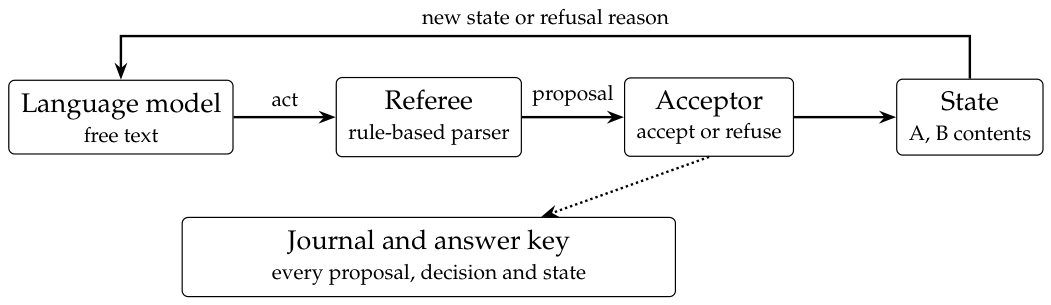
Figure 2.
(a) Share of non-correct open-weight traces whose first misreading is a capacity read as starting contents, by prompt language (gpt-oss French: reviewed wording). (b) Output tokens per correct Opus answer at a 32,000-token limit, by instance: proving the trap impossible costs several times a route.
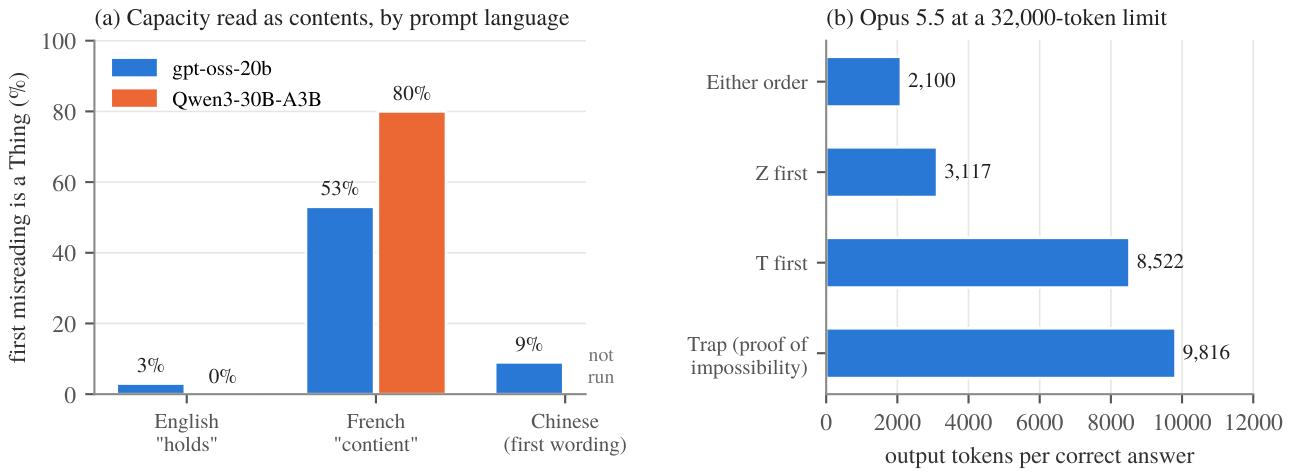
Figure 3.
The role swap. At one layer, every token from the number to the period is moved along the role direction: the capacity phrase toward contents, the contents phrase toward capacity. The digits are not touched. A flip is an answer that becomes the other number.
Figure 3.
The role swap. At one layer, every token from the number to the period is moved along the role direction: the capacity phrase toward contents, the contents phrase toward capacity. The digits are not touched. A flip is an answer that becomes the other number.
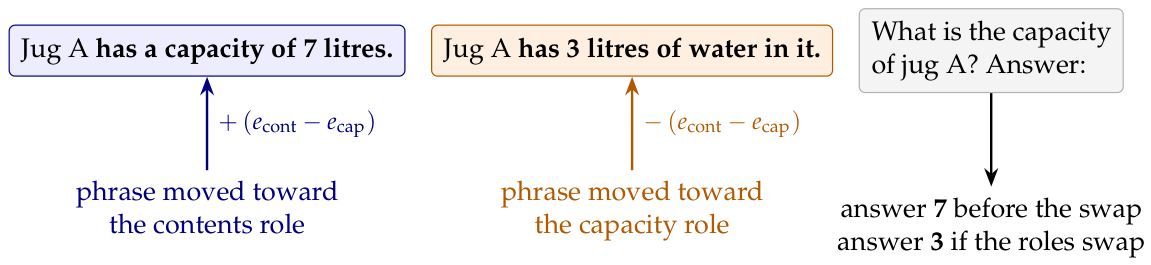
Figure 4.
Share of answers that become the other number after the swap, by layer, as a fraction of depth. The swap over the phrase works in a band of middle layers; on the number token alone it barely moves answers; a random direction never does.
Figure 4.
Share of answers that become the other number after the swap, by layer, as a fraction of depth. The swap over the phrase works in a band of middle layers; on the number token alone it barely moves answers; a random direction never does.
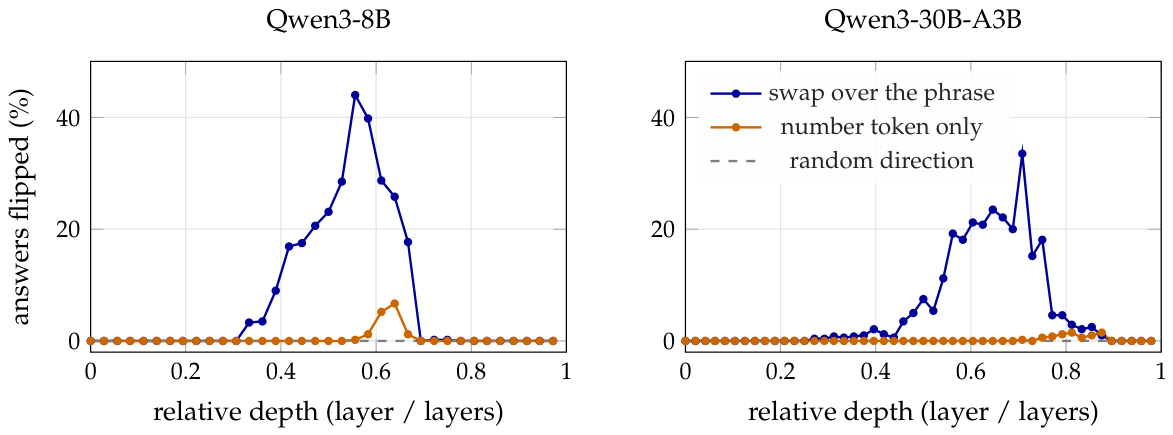
Figure 5.
The “contient” misreading in a single forward pass. Share of French contents questions answered with the capacity: 8 and 87 of 176 prompts when a contents sentence precedes “contient exactement”, none in the other order or with other capacity wordings (0 of 176 and 0 of 1,056).
Figure 5.
The “contient” misreading in a single forward pass. Share of French contents questions answered with the capacity: 8 and 87 of 176 prompts when a contents sentence precedes “contient exactement”, none in the other order or with other capacity wordings (0 of 176 and 0 of 1,056).
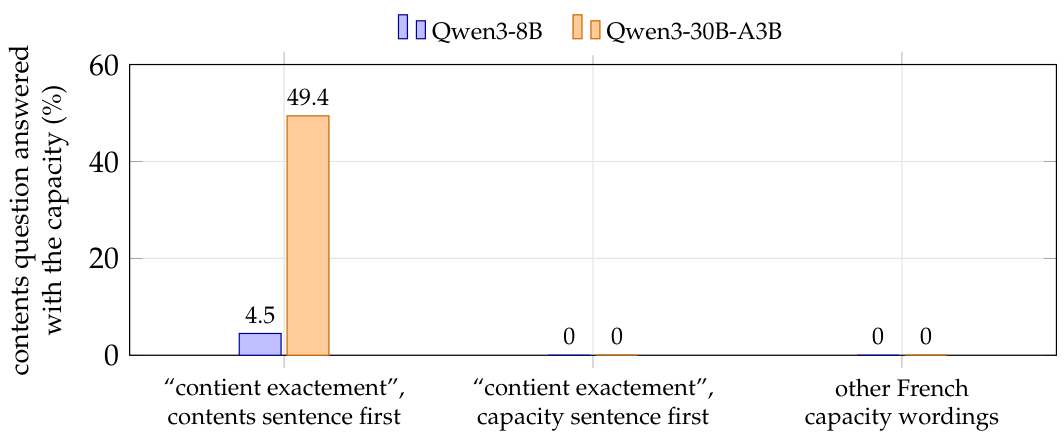
Figure 6.
One grammar, two constructions. The jug world in UML as a person describes it (a, b) and as the language models write it (c, d). Both use the same classes, actions and states. The shaded classes are relationships the models state explicitly and everyday language leaves implicit. The states are written as a list in the human description (b) and as a rule in the models (d): one counting state with a guard and an exact count that generates the path, whose individual states (grey, dashed) are generated without being listed. The Number class is the second world the models compute in: its things are numbers, its actions arithmetic operations, its states remainders, in the same grammar.
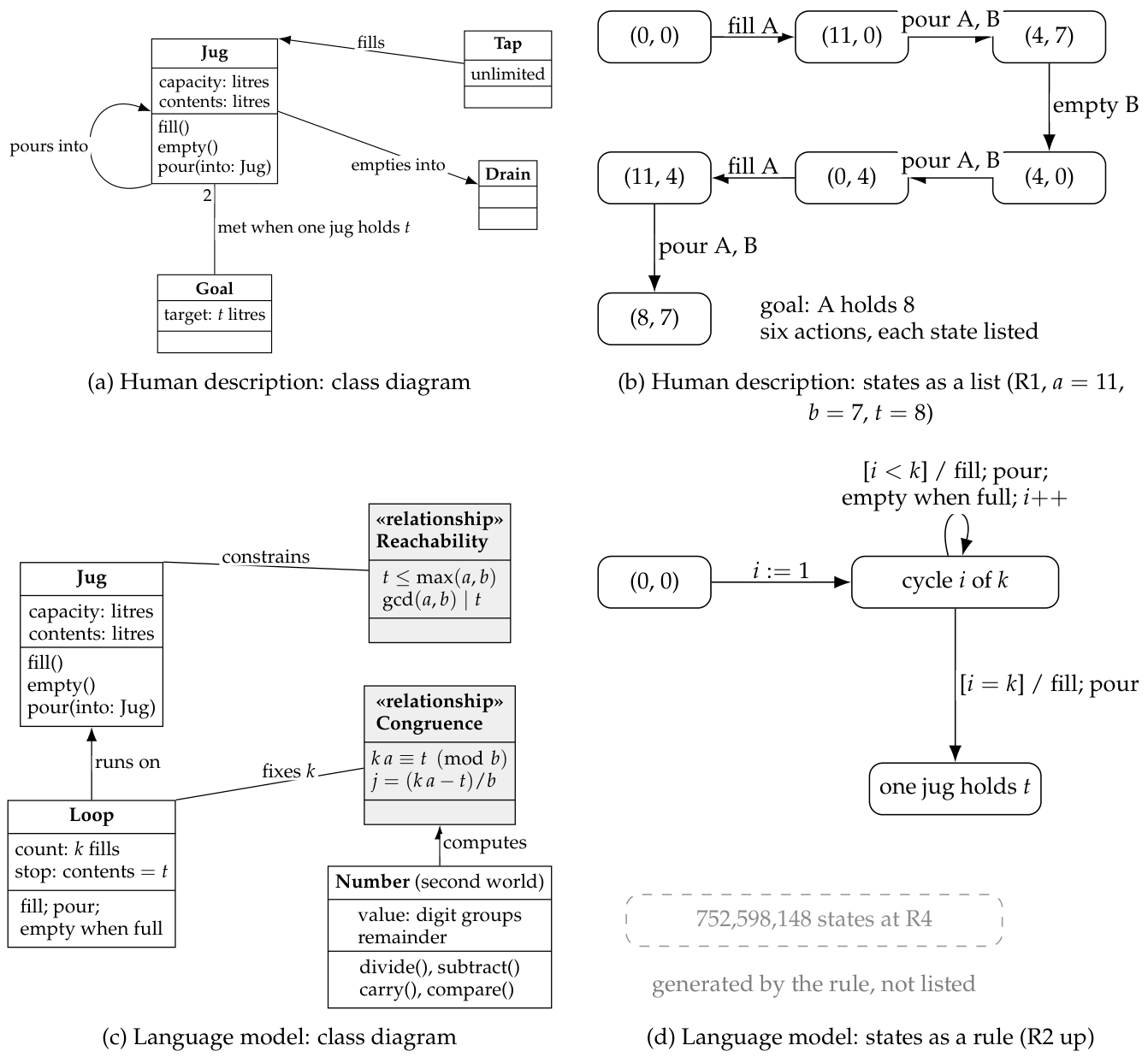

Table 1.
The probes, why each was chosen, and what each probes. A trap is an instance on which the textbook gcd rule gives the wrong verdict.
Table 1.
The probes, why each was chosen, and what each probes. A trap is an instance on which the textbook gcd rule gives the wrong verdict.
| Probe | What changes | Why | What it probes |
| Scale, R1 to R6 | Capacities from under 20 litres to 100 digits | At R1 the states can be listed; from R2 up they cannot | How states are written when they cannot be listed |
| Four targets per rung | Solvable; impossible by gcd; impossible by capacity; equal to a capacity | Each target needs a different argument | Which relationships prove impossibility |
| Tanks instead of jugs (Opus) | The names and vocabulary of the things | Removes the words of the puzzle | Whether the categories depend on the words |
| Spill world | Every pour loses one litre | Rewrites the effect of one action | Whether an action’s rule is read from the world |
| Three jugs, no tap | Fill and empty are refused; the total is fixed | Removes two actions and adds a conserved quantity | Which relationship fills the category: the world’s or the numbers’ |
| Traps in both altered worlds | The textbook relationship gives the wrong verdict | A recalled relationship becomes false | Whether a recalled relationship is used blindly |
| Ambiguous rule | “1 litre is spilled” does not say from where | Two readings are possible | Whether the question form is used |
| Hand-off world | Two measuring jugs hand water to two stores that are never emptied; no drain | Water handed off stays committed, and the goal couples the two stores | What a state contains, and whether a completion order is stated |
| Open-weight models, raw trace | gpt-oss-20b and Qwen3-30B-A3B beside the two Claude models | Their full chain of thought is returned, not a summary | Whether the grammar depends on a summary or a model family |
| Direct question | “Is any part of this statement ambiguous?” | Separates not seeing an ambiguity from not raising it | Whether a second reading is available to the model |
| Second model | Claude Sonnet 5 beside Claude Opus 5.5 | One model gives a point, not a comparison | Whether the grammar is specific to one model |
| Reasoning budget | Opus at 4,000 to 32,000 output tokens on the hand-off world | A harder instance needs more reasoning | Whether the budget changes the answer or only whether one is given |
| Language of the prompt | The hand-off prompt in French and in Chinese | The same world, stated in other words | Whether the grammar, and the place of errors, depend on the language |
Table 2.
Models and settings. Claude models through the Anthropic API; open-weight models in llama.cpp release b6500 on two NVIDIA T4 GPUs provided by Kaggle.
Table 2.
Models and settings. Claude models through the Anthropic API; open-weight models in llama.cpp release b6500 on two NVIDIA T4 GPUs provided by Kaggle.
| Model | Weights | Sampling | Limit and runs |
| Claude Opus 5.5 | API, claude-opus-5-5 | effort high, adaptive thinking, API defaults | 16,000 tokens, 3 per cell; 4,000 to 32,000 tokens, 4 per cell (budget) |
| Claude Sonnet 5 | API, claude-sonnet-5 | effort high, adaptive thinking, API defaults | 16,000 and 32,000 tokens, 3 per cell; 64,000 on the trap |
| gpt-oss-20b | MXFP4 (ggml-org) | reasoning effort high, temperature 1.0, top-p 1.0 | 32,000 tokens, 8 per instance |
| Qwen3-30B-A3B-Thinking-2507 | Q4_K_M (bartowski) | temperature 0.6, top-p 0.95, top-k 20 | 32,000 tokens, 8 per instance |
Table 3.
The plans whose grammar is read: plans given, and plans correct among them, per world and model.
Table 3.
The plans whose grammar is read: plans given, and plans correct among them, per world and model.
| World | Model | Plans given | Correct |
| Textbook ladder (72 episodes) | Opus 5.5 | 68 | 68 |
| Sonnet 5 | 59 | 59 | |
| Spill (27) | Opus 5.5 | 24 | 24 |
| Sonnet 5 | 19 | 15 (13 of 13 with the world’s reading) | |
| Three jugs (27) | Opus 5.5 | 24 | 24 |
| Sonnet 5 | 16 | 16 | |
| Hand-off (12) | Opus 5.5 | 12 | 11 |
| Sonnet 5 | 3 | 3 | |
| Hand-off at 32k (9) | Sonnet 5 | 3 | 2 |
| Hand-off at 32k (32) | gpt-oss-20b | 10 | 2 |
| Hand-off at 32k (32) | Qwen3-30B-A3B | 32 | 6 |
| Hand-off at 4k, 8k, 32k (48) | Opus 5.5 | 36 | 36 |
| Hand-off trap at 64k (3) | Sonnet 5 | 1 | 0 |
| Hand-off in French (12) | Opus 5.5 | 12 | 12 |
| Hand-off in Chinese (12) | Opus 5.5 | 12 | 12 |
Table 4.
Results at a glance: what each probe shows, and the section that reports it.
| Probe | Finding | Section |
| Every probe | Things, actions, states and relationships appear in every world, model and language | Section 4.1 |
| Scale | States are written as a list at the smallest scale and as a rule from the next scale up | Section 4.2 |
| Scale | The arithmetic of large instances uses the same grammar, with numbers as things | Section 4.3 |
| Altered physics | The same category is filled differently: Opus with a relationship of the world, Sonnet with one of the numbers | Section 4.4 |
| Hand-off world | A state must include committed water; the one Opus error leaves it out | Section 4.5 |
| Open-weight models | Wrong answers fall in single categories, each model in characteristic ones: Opus and Qwen in the State, gpt-oss in an Action and a Thing | Section 4.6 |
| Reasoning budget | The limit decides whether Opus answers, not whether the answer is right | Section 4.7 |
| Prompt language | The categories are unchanged; a word that shifts in translation moves the errors into one category | Section 4.8 |
| Inside the model | Capacity and contents are separate roles carried by the words around a number; “contient” pulls a capacity toward contents | Section 4.9 |
| Ambiguous rule | No model asks what the rule means | Section 4.10 |
Table 5.
STAR usage in the raw chain of thought of gpt-oss-20b on the hand-off world: rule-based coder over all sentences, and second coder (Claude, blind) over a seeded sample of 700 sentences.
Table 5.
STAR usage in the raw chain of thought of gpt-oss-20b on the hand-off world: rule-based coder over all sentences, and second coder (Claude, blind) over a seeded sample of 700 sentences.
| Coder | A | S | R | T | N |
| Rule-based (66,588 sentences) | 49% | 15% | 7% | 1% | 28% |
| Second coder (700 sentences) | 59% | 19% | 4% | 0.4% | 17% |
Table 6.
STAR usage in sampled Opus plans on the textbook ladder: share of Action (A) and Relationship (R) sentences, rule-based coder/second coder. Samples are 3 to 5 episodes per rung.
Table 6.
STAR usage in sampled Opus plans on the textbook ladder: share of Action (A) and Relationship (R) sentences, rule-based coder/second coder. Samples are 3 to 5 episodes per rung.
| Rung | A | R |
| R1 | 62/50% | 0/12% |
| R2 | 28/35% | 18/17% |
| R3 | 30/24% | 24/29% |
| R4 | 27/27% | 29/24% |
| R5 | 18/18% | 29/32% |
| R6 | 18/16% | 18/27% |
Table 7.
STAR usage in the summarised thinking of sampled Opus episodes, with numbers counted as things: share of sentences in no STAR category before and after the recoding, and the Action, State and Relationship shares after it. The recoding is post hoc, by Claude, not blind.
Table 7.
STAR usage in the summarised thinking of sampled Opus episodes, with numbers counted as things: share of sentences in no STAR category before and after the recoding, and the Action, State and Relationship shares after it. The recoding is post hoc, by Claude, not blind.
| Rung | Sentences | N before | N after | A | S | R |
| R1 | 8 | 25% | 0% | 62% | 0% | 25% |
| R2 | 22 | 45% | 18% | 18% | 23% | 41% |
| R3 | 27 | 63% | 4% | 33% | 19% | 44% |
| R4 | 25 | 48% | 4% | 40% | 16% | 40% |
| R5 | 60 | 82% | 12% | 35% | 30% | 22% |
| R6 | 53 | 87% | 13% | 51% | 19% | 17% |
Table 8.
Wrong answers in the hand-off world in English, all budgets, by the STAR category in which the error lies. Qwen is Qwen3-30B-A3B.
Table 8.
Wrong answers in the hand-off world in English, all budgets, by the STAR category in which the error lies. Qwen is Qwen3-30B-A3B.
| Category | Error | Opus | Sonnet | gpt-oss | Qwen |
| State | committed water left out of the state | 1 | 0 | 0 | 13 |
| Action | a pour or fill with another effect than in the world | 0 | 0 | 5 | 6 |
| Thing | capacity read as content | 0 | 0 | 2 | 0 |
| Action (stated rule) | a jug emptied, or water discarded, against the prompt | 0 | 2 | 1 | 3 |
| Verdict | a reachable goal called impossible, or a route claimed on the trap | 0 | 0 | 0 | 3 |
| Other | 0 | 0 | 0 | 1 |
Table 9.
Opus 5.5 on the hand-off world by limit on output tokens: correct answers over runs. No answer at any limit was wrong; “cut off” means no answer within the limit. The 16,000 column is from the runs above.
Table 9.
Opus 5.5 on the hand-off world by limit on output tokens: correct answers over runs. No answer at any limit was wrong; “cut off” means no answer within the limit. The 16,000 column is from the runs above.
| Instance | 4,000 | 8,000 | 16,000 | 32,000 |
| Either order | 4/4 | 4/4 | 3/3 | 4/4 |
| Z first | 4/4 | 4/4 | 3/3 | 4/4 |
| T first | cut off | 4/4 | 2/3 | 4/4 |
| Trap | cut off | cut off | 3/3 | 4/4 |
Table 10.
Share of non-correct traces whose first misreading is a Thing: capacity read as starting contents. First coder, second coder in brackets where it differs. gpt-oss French: two wordings that differ only in how the tap is described. Chinese: the first wording. English against reviewed French, Fisher exact test: for gpt-oss-20b, for Qwen3-30B-A3B.
| Model | English “holds” | French “contient” | Chinese 正好装 |
| gpt-oss-20b | 3% (7%) | 29% and 53% (50%) | 9% (3%) |
| Qwen3-30B-A3B | 0% | 80% | not run |
Table 11.
The role swap on 480 English test prompts. Flip: the answer becomes the other number. Held-out: the layer chosen on half of the prompts, scored on the other half.
Table 11.
The role swap on 480 English test prompts. Flip: the answer becomes the other number. Held-out: the layer chosen on half of the prompts, scored on the other half.
| Qwen3-8B | Qwen3-30B-A3B | |
| Answers correct before the swap (English) | 100% | 99.95% to 100% |
| Swap over the phrase: peak flip (layer) | 44.0% (20 of 36) | 33.5% (34 of 48) |
| held-out | 42.1% | 30.0% |
| capacity question/contents question | 52.9%/35.0% | 58.3%/8.8% |
| Swap on the number token only | 6.7% | 1.5% |
| Random direction, same size | 0% | 0% |
| One sentence only | 0.8% or less | 1.7% or less |
| Digit moved to a third value: flips the role | 0.2% or less | 0.2% or less |
Table 12.
Five sentences in English and the same sentences as the models write them (illustrative, condensed from the plans). Every rendering uses the same categories as the human sentence. What varies is the construction: a state written as a list or as a rule, and which relationship fills a Relationship.
| Human sentence (English) | the same sentence as the models write it | construction used |
| Fill A, then pour A into B until B is full; A now holds 4 litres. | fill A: (11, 0); pour A into B: (4, 7). | the states written as a list, as in the human sentence |
| Keep filling B and pouring it into A, and empty A when it is full, until B holds 183 litres. | divides 183; ; so the 361st fill of B leaves 183 litres in B. | the state written as a rule: a congruence locates it and a loop with an exact count produces it |
| Each time you pour, one litre is spilled. | Opus: the source loses one litre more than the receiver gains, so a pour into a full jug removes one litre. Sonnet, in 5 of 19 plans: the receiver gains one litre less than the space it has. | an ambiguous sentence becomes an action rule; the question form is not used |
| There are only 3 litres, so no jug can ever hold 2. | Opus: the total is fixed at 3 and every pour moves all of it, so each jug holds 0 or 3. Sonnet: every capacity is a multiple of 3 and every pour keeps every content one; 2 is not. | the same category, Relationship, filled differently: Opus with one of this world, Sonnet with one of the numbers |
| Water poured into Z or T can never be poured out. | Opus: the only way to “empty” X or Y is to pour into Z or T, so every such pour must be exactly the right amount; exactly 4 litres may ever be poured into Z and T. | a Relationship of the world that couples four jugs; the state holds what has been committed |
Disclaimer/Publisher’s Note: The statements, opinions and data contained in all publications are solely those of the individual author(s) and contributor(s) and not of MDPI and/or the editor(s). MDPI and/or the editor(s) disclaim responsibility for any injury to people or property resulting from any ideas, methods, instructions or products referred to in the content. |
© 2026 by the author. Licensee MDPI, Basel, Switzerland. This article is an open access article distributed under the terms and conditions of the Creative Commons Attribution (CC BY) license.
Copyright: This open access article is published under a Creative Commons CC BY 4.0 license, which permit the free download, distribution, and reuse, provided that the author and preprint are cited in any reuse.