
Submitted:
04 October 2026
Posted:
07 October 2026
You are already at the latest version
Abstract
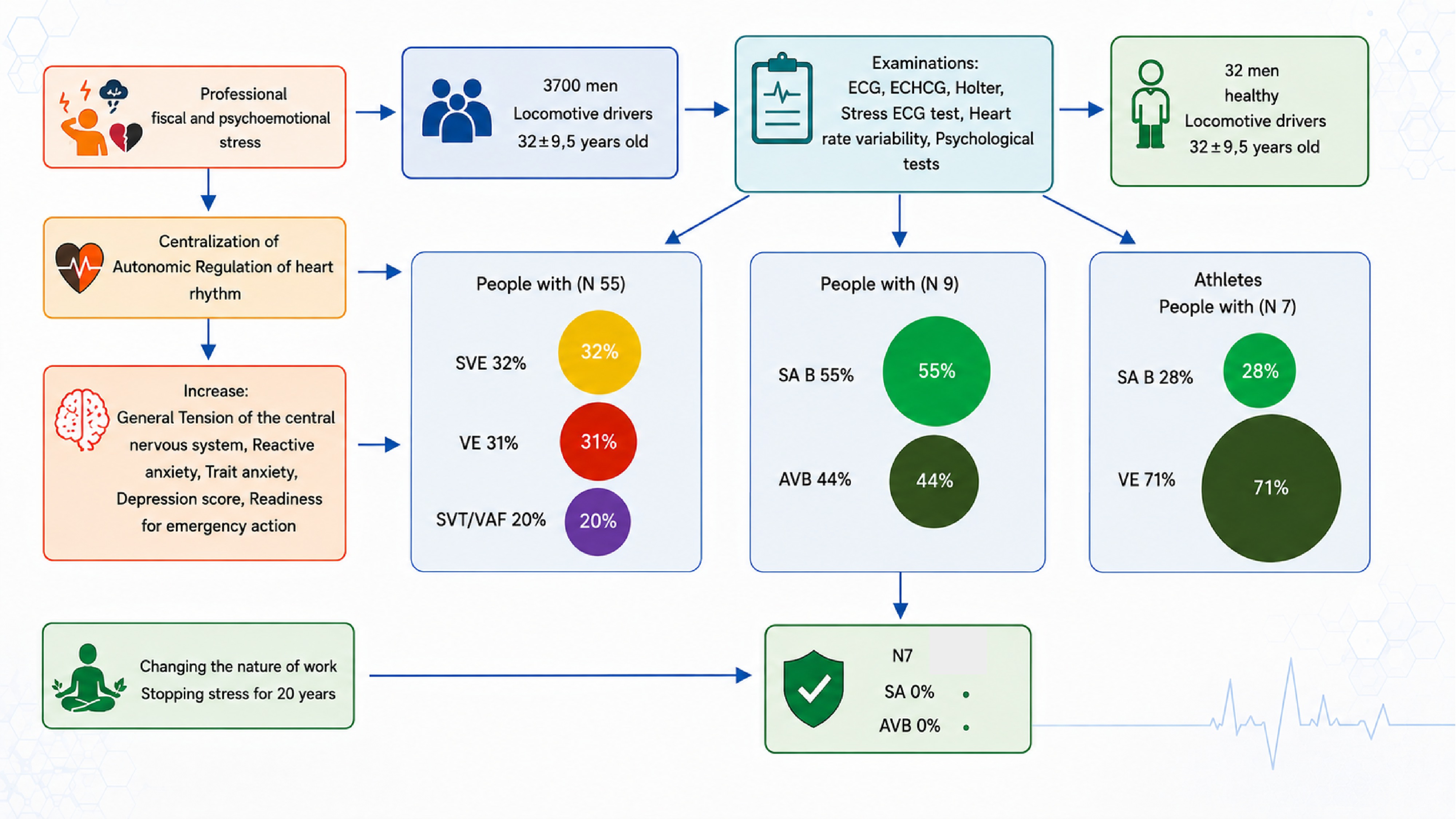
Cardiac rhythm and conduction disturbances may pose a potential safety hazard in occupations requiring sustained attention and rapid decision-making [1, 2]. The aim of our study was to estimate the prevalence of cardiac rhythm and conduction disturbances and examine their association with non-invasive stress markers in a sample of railway workers. Methods: A total of 3,700 male locomotive engineers (mean age 32.5 ± 9.5 years) underwent a comprehensive medical examination including resting ECG, 24-hour ambulatory monitoring, echocardiography, exercise testing, heart rate variability analysis, and psychological assessment. Results: Cardiovascular disturbances were detected in 537 (14.5%) of the examined subjects, 71 of whom (1.9%) had cardiac rhythm and conduction disturbances without any identifiable structural or clinical causes. These 71 patients were divided into three groups: non-athletes with atrial or ventricular tachyarrhythmias (N=55, Group 1), non-athletes with second-degree sinoatrial or atrioventricular block (N=9), and athletes with any rhythm or conduction disturbances (N=7). Compared with the control group, these individuals, and particularly non-athletes, demonstrated higher levels of anxiety, reduced stress tolerance, and altered autonomic nervous system parameters consistent with increased physiological stress. Conduction abnormalities were predominantly functional, with resolution during exercise and no progression to pacemaker indication in a subset of 7/11 patients with baseline sinoatrial/atrioventricular block followed over the long term. Conclusions: In this large occupational cohort, cardiac rhythm and conduction abnormalities were in the absence of structural heart disease were uncommon. Their association with markers of autonomic dysfunction and psychological stress points to a potential contribution of occupational stress in the pathogenesis of idiopathic arrhythmias in otherwise healthy workers.
Keywords:
cardiac rhythm abnormalities
; cardiac conduction disorders
; occupational medicine
; psychological stress
; heart rate variability
Copyright: This open access article is published under a Creative Commons CC BY 4.0 license, which permit the free download, distribution, and reuse, provided that the author and preprint are cited in any reuse.