
Submitted:
04 October 2026
Posted:
07 October 2026
You are already at the latest version
Abstract
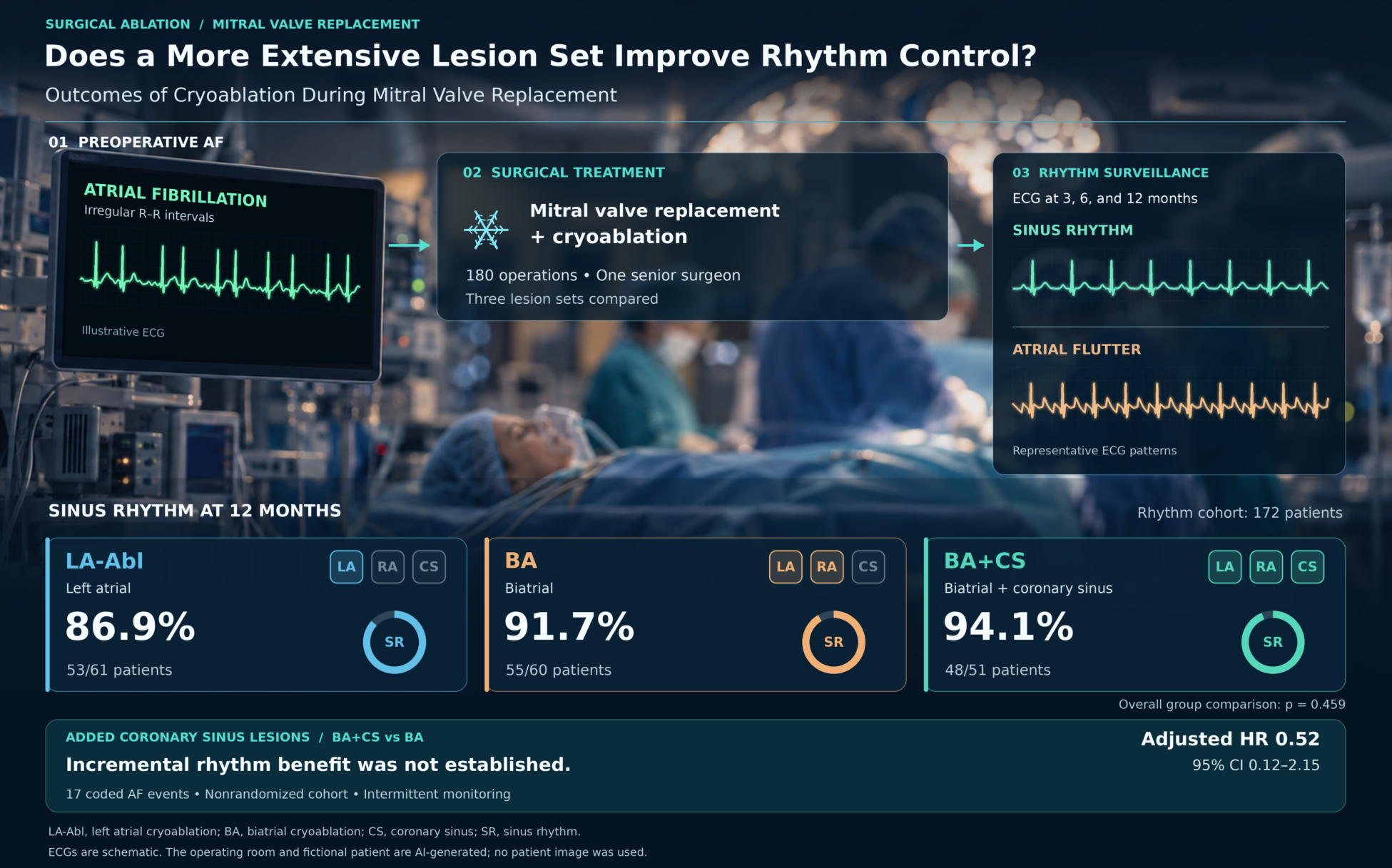
We evaluated whether complementary coronary sinus (CS) lesions improve rhythm outcomes beyond biatrial cryoablation during mitral valve replacement. This single-center cohort included 180 adults operated on by one senior surgeon between January 2020 and September 2025, with follow-up through May 2026. Left atrial ablation (LA-Abl; n=65), biatrial ablation (BA; n=63), and BA with complementary CS lesions (BA+CS; n=52) were compared. After excluding three early deaths and five patients without follow-up records, 172 patients underwent rhythm assessment. The primary outcome was time to first recorded atrial fibrillation (AF) after discharge. Seventeen AF events were recorded. The primary Cox estimate favored BA+CS over BA without statistical significance (hazard ratio [HR] 0.52; 95% confidence interval [CI] 0.12–2.15); the numerical trend persisted after adjustment for baseline clinical and echocardiographic burden and surgical year (HR 0.54; 95% CI 0.13–2.20). Larger left atrial diameter and lower ejection fraction were associated with AF. Twelve-month sinus rhythm rates were 86.9%, 91.7%, and 94.1%, respectively (p=0.459). Weighted estimates varied by method. Outcome sensitivity analyses showed no significant advantage. An incremental CS benefit was not established; limited events, nonrandomized selection, and intermittent monitoring warrant cautious interpretation and larger studies with standardized surveillance.
Keywords:
atrial fibrillation
; mitral valve surgery
; cryoablation
; coronary sinus
; biatrial ablation
; mitral isthmus
Copyright: This open access article is published under a Creative Commons CC BY 4.0 license, which permit the free download, distribution, and reuse, provided that the author and preprint are cited in any reuse.