

Submitted:
03 October 2026
Posted:
06 October 2026
You are already at the latest version
Abstract
Allostatic accounts explain migraine chronification as the cumulative cost of repeated attacks, and an active-inference account explains the single attack as a reset forced by unresolved interoceptive prediction errors. This article proposes that one variable joins them: the predictability of the attacks themselves. As attack frequency approaches 15 days a month, the uncertainty left by cues as weak as those patients report nears its maximum, and the hypothesis adds that threshold-driven attacks dilute the reliability of the cues. The proposed response is a rise in the weight given to bodily signals, felt as uncertainty and clinically as anticipatory anxiety, expressed in the salience network and paid for in fragmented sleep and strained clearance and energy supply, which lower the attack threshold. Graded against the evidence, salience-network change and rising allostatic load have direct but small support, the interoceptive findings are small and conflicting, the anxiety link is indirect and confounded by medication overuse, the sleep link indirect and unstratified, the clearance findings rest on an indirect imaging proxy, and slow-wave sleep loss is contradicted. Six predictions are stated with the results that would refute them and with what rival accounts expect; one tests the ordering of the loop directly.
Keywords:
chronic migraine
; predictive processing
; interoception
; salience network
; sleep
; allostasis
; medication overuse
1. Introduction
Chronic migraine affects 1 to 2% of the general population and develops from episodic migraine at an annual conversion rate of about 3% [1]. Its clinical signature is more than a higher count of headache days. In the clinic, patients describe attacks that arrive without the cues that used to announce them, and between attacks they carry anxiety, poor sleep and cognitive complaint. The International Headache Society argues that prevention should aim at disease progression as well as at attacks, and acknowledges that some of the changes of chronic migraine may not be reversible [2]. In the pivotal fremanezumab trial in chronic migraine, 38% and 41% of treated patients reached a 50% reduction in monthly headache days, against 18% on placebo [3]. Blocking the principal neuropeptide mediator of trigeminovascular nociception thus leaves most patients short of a response that is itself only a halving. What keeps the remainder in place is the subject of this paper.
Two frameworks already address it. Borsook and colleagues proposed that migraine is a model disease of allostatic load, in which repeated attacks and stressors drive a feed-forward cascade of brain-state change [4], and later described it as a model of how the brain monitors and reacts to physiological signals that depart from their baseline [5]; the present paper applies that error-monitoring view to the predictability of the attacks themselves. Pensato and colleagues framed the attack as an evolutionarily conserved, energy-restoring response and chronification as allostatic overload [6], and Calabrò and colleagues showed in a proof-of-concept study that the proportion of patients with a high allostatic-load index rose from 16% in low-frequency episodic migraine to 40% in chronic migraine [7]. Sedley and colleagues explained the single attack within active inference: unresolved interoceptive prediction errors are amplified during the premonitory phase until the attack enforces physiological stability [8]. Blumenfeld and colleagues connected allostatic load to central sensitisation, which they called hypervigilance, and wrote that "ostensibly innocuous stressors are then sufficient to trigger an attack" [9]. That sentence describes, in prose, the loss of cue diagnosticity from which the present paper starts. Seymour has recast pain as a precise control signal for reinforcement learning whose magnitude is tuned by uncertainty and controllability, with uncertainty-based modulation underlying what is usually called attention or salience [10]. Psychiatric comorbidity has long been treated as a risk factor for chronification [11], and the fear-avoidance model explains how fear of pain sustains pain [12].
These accounts do not state what changes computationally when a patient moves from six attacks a month to twenty, or why that change should recruit anxiety, sleep and metabolism together. Recent reviews supply pieces. Ho and Ryan describe chronic pain as a triple-network attractor constrained by sleep, autonomic balance and interoception [13]; Lu and colleagues propose a stage-specific circuit model in which chronic migraine may reflect more persistent network reconfiguration [14]; Zhang and colleagues reviewed the neuroimmune substrate of chronification [15]; and glymphatic reviews have asked, without answering, whether repeated attacks or repeated poor nights impair clearance over time [16,17]. What this paper adds is an ordering of these known elements around one variable, and predictions on which that ordering can fail.
The proposal is that chronification is organised by the loss of attack predictability. Once attacks arrive on half of all days, the residual uncertainty about tomorrow is near its maximum for cues as weak as those patients report, attacks on cue-free days become common, and, if the added attacks are threshold-driven, the cues themselves lose reliability. The brain's response, on this account, is to raise the weight it gives to bodily signals, felt as uncertainty about the body and clinically as anticipatory anxiety. That state is expressed in the salience network and in fragmented sleep, and it has a metabolic price; each of these lowers the threshold for the next attack. Previous work has described chronic migraine as a multi-stratum systems failure in which rigid priors form one stratum [18] and has proposed forecast-triggered pre-emptive dosing as a treatment strategy [19]. The present paper places predictability at the top of that cascade and derives predictions from the placement.
2. Approach
This is a hypothesis-driven narrative review. Europe PMC and CrossRef were searched between 10 and 14 September 2026 without date or language limits, with an update search on 23 September 2026, pairing migraine with terms for each proposed link and for medication overuse. Reviews from 2024 to 2026 were retrieved for positioning; primary reports were preferred for empirical claims. Each link was also searched with negation-oriented terms (normal, no difference, a direction opposite to the one proposed), and the contradicting studies found are cited. Selection was by relevance to the argument, without formal quality assessment or record counts. Every reference was checked against its indexed record. Table 1 grades each link as direct, indirect, absent or contradicted, or as arithmetic where no evidence is needed, and notes whether its evidence survives stratification by medication overuse.
3. The Upstream Variable
That chronic migraine attacks come "out of the blue" is a clinical commonplace; making it precise starts with what a trigger is.
In a secondary analysis of 4195 diary days from 95 people with episodic migraine, Turner and colleagues found that exposures such as caffeine, alcohol, stress and mood related to the next day's headache only modestly and conditionally on current headache status; re-expressed as surprisal, the information-theoretic unexpectedness of the day's value, the associations were simplified and strengthened, with an odds ratio of 1.35 per standard deviation of summed surprisal for new-onset headache [20]. A prospective replication in 109 patients found that surprisal in the preceding period raised the odds of an attack within 24 hours (odds ratio 2.15, attenuated to 1.88 after allowing for between-person variability) [21]. In both studies the predictive quantity was a change against expectation.
How reliable are such cues? In a 90-day smartphone study of 328 people with episodic migraine, participants endorsed a mean of 28 triggers each, of which on average 2.2 were statistically associated with their attacks, and even the most commonly endorsed triggers were confirmed in fewer than one third of those who suspected them [22]. Individual Cox models over 90-day paper diaries in 326 patients found an attack-associated profile for 87% of patients, averaging four factors and unique in 85% of cases [23]. Cues exist for most patients, then, but they are idiosyncratic and weak. In a prospective app study of 229 attacks, premonitory symptoms were recorded before the pain in 27.5%, and they were right in 85% of the cases in which patients reported them; 68% of patients predicted at least one attack, but only 35% more than half [24]. Whether the premonitory phase keeps its likelihood ratio as frequency rises is a measurement the hypothesis needs.
Whether chronic migraine is less predictable than episodic migraine cannot be read from these data, because all were collected in episodic migraine or without stratification. Checklist studies of trigger endorsement do not support it: in 200 consecutive clinic patients, those with chronic migraine were no more or less likely than those with episodic migraine to report triggers or multiple triggers [25], and in 498 patients the chronic group endorsed stress and oversleeping as triggers more often than the episodic group [26]. Endorsement measures belief, and belief may well be preserved, or inflated, when reliability falls.
As attack frequency rises, two things happen to predictability. The first is arithmetic. Let the base rate be the probability that a given day carries a migraine attack, and consider a cue with sensitivity and specificity of 0.75. At a daily probability of 0.15, roughly five attack days a month, the probability that a cue-free day brings an attack is 0.06, and the uncertainty that remains after the cue has been seen (the conditional entropy of the outcome) is 0.51 bit. At a daily probability of 0.50, fifteen days a month, the probability that a cue-free day brings an attack is 0.25 and the residual uncertainty is 0.81 bit, close to its maximum of one bit. The information the cue carries rises, from 0.10 to 0.19 bit, because there is more to predict. The share of attacks that arrive without the cue stays at 25% at both frequencies, because sensitivity is fixed. What the base rate changes is the residual uncertainty and the monthly count of unheralded attacks, roughly one against four. Residual uncertainty is also not monotonic: it peaks at fifteen days a month and falls again toward near-daily headache, where tomorrow is almost certain. The arithmetic therefore cannot carry the hypothesis on its own, and it is the same under every account of chronification.
The second is empirical and is the hypothesis proper. If the additional attacks of chronic migraine are threshold-driven, as the sensitisation literature implies, each cue's likelihood ratio is diluted: the same cue precedes a smaller fraction of attacks, the share of unheralded attacks rises above its fixed-reliability value, and the per-cue hazard ratio in an N-of-1 model falls. That is measurable with the designs already used in episodic migraine [22,23], stratified by monthly migraine days and by medication overuse (prediction 1, Table 2). A rise in the share of unheralded attacks is therefore evidence of dilution, since the base rate alone leaves that share unchanged, and that share is the variable the later predictions use. The endorsement studies [25,26] do not bear on it, because endorsement is not a hazard ratio. Because dilution is also what the allostatic account expects once sensitisation has set in [9], prediction 1 tests only whether the first link exists.
4. Precision and Interoception
In predictive processing the brain maintains a generative model of its sensory causes, including the interoceptive causes that report on the body, and updates it by weighting prediction errors by their expected reliability, or precision [27]. Edwards and colleagues explained functional neurological symptoms as percepts held with undue precision after attentional modulation of synaptic gain [28], and Hechler and colleagues modelled chronic pain as a state in which the prior probability of pain is high and harmless sensations are resolved as pain [29]. When a source of evidence stops predicting outcomes, an inference machine can lower the precision of that source and fall back on priors, or it can raise the weight of the evidence that remains in the hope of finding a better cue. The hypothesis here is the second: faced with a body whose attacks have become uninformative, the brain raises the weight it gives to interoceptive and somatosensory signals, so that ordinary physiological fluctuation, which a well-calibrated system discounts as noise, is weighed as evidence. The clinical correlate is attention to the body between attacks. This construct differs from the hypervigilance of Blumenfeld and colleagues, which denotes a lowered neuronal activation threshold [9]; the two may coexist, and the present paper keeps them apart.
Direct tests are recent, small and inconsistent. Koreki and colleagues compared 15 patients with chronic migraine, 11 with episodic migraine and 23 controls. Patients had lower heartbeat-tracking accuracy than controls (median 0.50 versus 0.78, p = 0.014) together with much higher interoceptive sensibility, so that the discrepancy between how sensitive they believed themselves to be and how they performed, the trait prediction error, was large; the chronic group also showed a larger trial-by-trial state prediction error than the episodic group (2.30 versus 1.75, p = 0.046) and more somatoform dissociation [30]. Jones and colleagues, in 58 unmedicated women, found no difference in heartbeat accuracy between migraine groups and controls, but the high-frequency group was the most likely to continue activities despite physical discomfort, and the low-frequency group had the lowest confidence in its interoceptive judgements [31]. Kökönyei and colleagues found in 23 patients that attack frequency scaled with pain-anticipation activity in midcingulate and caudate [32].
A rise in the weight given to bodily signals is a claim about attention and gain; accuracy is a separate quantity. It is consistent with a felt sensitivity that outruns performance, which is what Koreki found in migraine against controls, but the contrasts that bear on chronification are the chronic-versus-episodic ones, and those are the state prediction error and dissociation findings alone. The hypothesis does not predict better heartbeat tracking, and the two accuracy results conflict. Koreki's pattern is equally compatible with Hechler's alternative, in which a precise prior of threat dominates a noisy channel. The available data therefore suggest that interoceptive processing differs with attack frequency and leave the sign of the precision change open; Table 1 grades the link accordingly.
Sedley and colleagues place interoceptive prediction error at the start of the attack [8]; the present proposal places a change in the weighting of interoceptive evidence at the start of chronification. On the attack-level account, a premonitory phase amplifies unresolved errors until the attack resolves them. On the chronification account, a brain that can no longer predict attacks keeps its interoceptive gain high, so that the premonitory amplification does not fully switch off between attacks. That is one reading of the interictal state of chronic migraine; medication overuse, depression and sleep disorder supply others, and the readings are not exclusive.
5. Felt Uncertainty
Precision is a computational quantity. Its subjective side is supplied by the affective neuroscience of Panksepp and of Merker, who located the elemental form of consciousness in upper brainstem structures [33,34] (a position recently defended with pain as the test case [35]), and by Solms, who formalised the claim within the free energy principle: consciousness "adaptively determines which uncertainties must be felt (i.e., prioritized) in any given context. In short, consciousness is felt uncertainty" [36]. On Solms's account every affect is a felt change in expected uncertainty about the organism's homeostatic future; what makes the affect anxiety is supplied by the anxiety literature. Grupe and Nitschke argued that uncertainty about a possible future threat produces anxiety when it disrupts the ability to avoid or mitigate the threat [37]. Peters, McEwen and Friston made the physiological consequence explicit: the essence of stress is uncertainty, understood as expected surprise, and when the brain cannot reduce it, "a persistent cerebral energy crisis may develop, burdening the individual by allostatic load" [38]. Stephan and colleagues proposed that chronically enhanced surprise about bodily signals, combined with a metacognitive belief of low control, produces fatigue and then depression [39].
These sources give the affective profile of chronic migraine a computational reading. A body whose attacks no longer announce themselves is a body about which the patient's usual actions no longer reduce uncertainty. On this reading the affect that accompanies a high bodily gain is anxiety about the body, and the affect that accompanies failed active inference is helplessness.
The epidemiology is consistent with that reading without testing it. In the American Migraine Prevalence and Prevention (AMPP) survey, people with chronic migraine were approximately twice as likely as those with episodic migraine to have depression, anxiety and chronic pain [40]. In the Eurolight project, the odds of anxiety rose from 4.2 in men and 2.4 in women with migraine to 10.4 and 7.1 in those with probable medication-overuse headache, a contrast between migraine and overuse that does not separate episodic from chronic migraine [41]. Fear of the next attack has its own construct, cephalalgiaphobia, described by Peres and colleagues in twelve patients, eleven of them with chronic migraine and all overusing acute medication as phobic avoidance [42]. In a two-year pilot cohort of 126 patients scored with a non-validated four-item interview, moderate-to-high frequency was associated with higher cephalalgiaphobia scores, and patients with chronic migraine scored higher with medication overuse than without; patients whose frequency worsened over the two years had higher scores at follow-up (p = 0.038), an association at the end of the interval that does not establish that fear preceded the rise [43]. A validated inventory measures attack-related fear along three axes: fear of consequences, attention and anticipation, and fear-avoidance [44].
Of the studies reviewed here, one speaks against a simple version of the affective claim. Pistoia and colleagues studied 65 women with episodic migraine, 65 with chronic migraine and 65 controls, all screened free of psychiatric comorbidity. Catastrophising, helplessness and rumination rose from controls to episodic to chronic migraine, and trait anxiety was higher in the chronic group than in controls; but "the three groups showed similar decision-making styles, intolerance of uncertainty, and strategies for coping with uncertainty" [45]. That trait intolerance of uncertainty does not differ is compatible with the present hypothesis, which concerns state uncertainty about the body generated by the disease. The positive findings of the same study are the constructs of the fear-avoidance model [12] and support that model at least as well; a diathesis account in which an anxious personality causes chronification [11] is a third reading. In the loop proposed here, affect is generated by unpredictability and then feeds back on frequency, so the discriminating question is whether attack-related fear tracks measured unpredictability once frequency and trait anxiety are controlled. That is prediction 3.
6. The Salience Network
Menon's triple-network model assigns the salience network, anchored in dorsal anterior cingulate and anterior insula, the job of deciding which internal or external signals deserve the resources of the executive and default-mode networks [46]. The anterior insula is also the cortical site where interoceptive predictions and errors are compared [27], and its function and structure are altered in migraine [47]. If chronification raises the weight of bodily signals, this is where it should show.
The imaging literature supports a salience-network change in chronic migraine while disagreeing about its sign. In 15 patients with episodic migraine without aura, Tso and colleagues found heightened intrinsic connectivity of the anterior insula that did not correlate with attack frequency [48]. In 29 women with chronic migraine, Androulakis and colleagues found all three networks less coherent than in controls, the salience network included; more frequent moderate-to-severe headache days went with decreased salience-network connectivity, cutaneous allodynia with increased connectivity, and medication overuse made no difference [49]. Lee and colleagues found one independent component, labelled the pain matrix, with higher degree centrality in 18 patients with chronic migraine than in 44 with episodic migraine, unchanged after adjustment for allodynia, depression and anxiety [50]. The largest of these studies, 91 patients with chronic migraine and medication overuse against 35 controls, found increased connectivity of the salience and default-mode networks with sensorimotor regions, reduced global and local efficiency of salience nodes, and an association between allodynia severity and salience-to-sensorimotor connectivity [51]; it contained no chronic-migraine group without overuse.
Together these studies describe a salience system more tightly coupled to sensory and sensorimotor cortex and less internally coherent, with the coupling tracking allodynia, the clinical marker of central sensitisation, and the loss of coherence tracking headache frequency in the cohort of Androulakis and colleagues. That pattern fits a network driven by high-weight somatosensory and interoceptive input, which is what the term capture is meant to convey. Ho and Ryan describe the same configuration in chronic pain as an attractor stabilised by sleep and interoceptive constraints [13]; the present account adds what biases salience toward the body in migraine and ties that bias to a measurable property of the attacks. Whether the pattern is cause or consequence cannot be decided from cross-sectional data.
7. The Cost of Vigilance
7.1. Sleep
Patients with chronic migraine say they sleep badly: in the meta-analysis by Stanyer and colleagues, subjective sleep quality was worse in migraine than in controls (g = 0.75), with subgroup estimates of 1.03 in chronic and 0.63 in episodic migraine [52]. The objective picture is narrower. Across six adult polysomnographic studies in the same meta-analysis, the one significant difference was a small reduction in the percentage of REM sleep (g = −0.22); slow-wave sleep did not differ in adults or in children, an absence the authors called "noteworthy" while cautioning that macroscopic staging can miss changes in sleep intensity [52]. A blinded polysomnographic study of 50 patients found more interictal awakenings and a trend toward more slow-wave sleep, read by its authors as relative sleep deprivation [53]. A 2026 systematic review of objective sleep in migraine reports reduced sleep efficiency, more awakenings and altered arousal profiles across the attack cycle [54], and a polysomnographic comparison of 65 patients with chronic and 45 with episodic migraine found a lower REM percentage in the chronic group (21.4% versus 24.4%, p = 0.008) [55].
A claim that chronification abolishes slow-wave sleep is contradicted by these data and is not made here. What the data support is fragmentation and REM reduction, the latter also in a direct comparison of chronic with episodic migraine. Whether fragmentation predicts attacks prospectively is less clear. In 98 adults with episodic migraine followed with actigraphy and diaries for six weeks, diary-reported low sleep efficiency raised the odds of headache on the following day by 39%, while short sleep and poor subjective quality did not, and actigraphic wake after sleep onset above 53 minutes was associated with lower odds of same-day migraine [56]. The diary and actigraphic measures point in opposite directions, and Table 1 records both. Modifying sleep behaviour may modify the disease: in a randomised trial of 43 women with transformed migraine, 48.5% of those given behavioural sleep instructions had reverted to episodic migraine by the final visit [57], and a pilot randomised trial of cognitive-behavioural therapy for insomnia in 31 patients with chronic migraine found 60% lower odds of headache at follow-up, an effect that did not survive correction for multiple comparisons and was partly shared by the control intervention [58].
Mechanistic work on sleep-dependent clearance points to sleep microstructure; stage percentage is the wrong grain. Hauglund and colleagues showed in mice that synchronised infraslow oscillations in noradrenaline, cerebral blood volume and cerebrospinal fluid are the strongest predictors of glymphatic clearance during non-REM sleep, and that zolpidem, which suppresses the oscillation, suppresses the flow [59]. The hypothesis here is that a tonically vigilant noradrenergic system disturbs that oscillation. Two cautions apply. The oscillation was measured with fibre photometry in mice, and its human proxies, the arousal index and the cyclic alternating pattern, would have to be related to clearance in patients before this link can be graded higher; no such study was found in the searches described in Section 2. And the locus coeruleus does not act on migraine in one direction: in rats its disruption inhibited dural-evoked trigeminocervical responses while increasing susceptibility to cortical spreading depression [60]. Prediction 4 is framed with those limits.
7.2. Clearance
Glymphatic exchange of cerebrospinal and interstitial fluid along perivascular spaces is markedly increased during sleep in mice [61], although a later mouse study measured reduced brain clearance during sleep and anaesthesia [62]; in humans, one night of total sleep deprivation impairs tracer clearance from most regions of the brain [63].
Human migraine studies have mostly used diffusion-tensor imaging along the perivascular space (DTI-ALPS), an indirect proxy for glymphatic function, and they disagree. Wu and colleagues found lower ALPS values in chronic than in episodic migraine and controls, correlated with disability and subjective sleep quality, but the difference was carried by medication overuse: without overuse, chronic migraine (median 0.73) resembled episodic migraine (0.71) [64]. Within episodic migraine, two studies of 74 and 71 patients found lower ALPS values in high-frequency than in low-frequency patients [65,66]; in the first, sleep quality neither differed between the frequency groups nor correlated with ALPS. Ornello and colleagues, in 106 patients, found that a lower ALPS index was associated with more monthly headache days only in participants with poor sleep quality, a result that held after adjustment for medication overuse [67]. Against these, Lee and colleagues (92 patients, 80 controls) and Cao and colleagues (37 patients, 29 controls) found no DTI-ALPS difference from controls and no correlation with attack frequency or other clinical variables [68,69], and Zhang and colleagues found ALPS values higher in chronic migraine than in episodic migraine and controls [70]. A 2026 systematic review finds abnormalities more consistently in chronic and high-frequency migraine, no evidence on causation, and animal attack models that impair glymphatic influx, so a frequency-related ALPS difference is equally compatible with attacks impairing clearance [17]. The Ornello interaction is the most informative human finding for the present model because it ties clearance to frequency through sleep; it is cross-sectional and uses a subjective sleep measure.
The model does not use the popular claim that CGRP accumulates behind a failed glymphatic system and then blocks it. What Nelson-Maney and colleagues showed, in mice, is CGRP impairing cerebrospinal fluid drainage through meningeal lymphatic vessels, with lymphatic-specific deletion of its receptor protective in migraine models [71].
7.3. Energy
Interictal energy metabolism in migraine is measurably altered. Phosphorus spectroscopy in 19 patients with migraine without aura showed reduced phosphocreatine and ATP in occipital cortex [72], and Gross and colleagues have argued that the attack is a response to cerebral energy deficit or to oxidative stress that exceeds antioxidant capacity [73]. A crossover trial of exogenous beta-hydroxybutyrate in 41 patients with episodic migraine was negative [74]. In a nitroglycerin mouse model of chronic migraine, region-specific proteomics pointed most strongly to thalamic mitochondrial impairment, with structural disruption and dysfunction that a mitophagy inducer partly reversed [75].
Gross's reading places energy deficit upstream of the attack; Peters, McEwen and Friston place it downstream of unresolved uncertainty, because resolving uncertainty is what a brain spends energy on [38]. The two readings are compatible if the loop closes: a vigilant brain with fragmented sleep spends more and clears less, the resulting energy strain lowers the attack threshold, and the attack that follows is one more event the model failed to predict. Evidence that the energy findings of episodic migraine progress into chronic migraine along this path is indirect, and the thalamic mouse data, the mechanistic anchor cited here, carry no information about sleep or precision.
8. Allostatic Overload, Overuse and Remission
Allostasis is regulation by prediction [76]: the organism adjusts its set points in anticipation of demand and pays for sustained anticipation with wear on the systems that mediate it [77]. In migraine, Calabrò and colleagues found an odds ratio of 2.78 for a high allostatic-load index in chronic relative to low-frequency episodic migraine, with blood pressure and heart rate the individual markers that differed [7]. Central sensitisation belongs in the same picture: in a web-based cohort of 2331 patients, lifetime depression predicted allodynia, and in those followed for a mean of 93 weeks allodynia independently predicted an increase in migraine days [78]. On the present hypothesis, a predictive regulator arrives at overload by losing the ability to predict its own attacks, and the sustained anticipation that follows is the allostatic demand.
Medication overuse is the confound that runs through this evidence. It is one of the most important modifiable risk factors for chronic migraine [1] and has a pharmacology of its own, so the loop treats it as an independent cause by which every link must be stratified. Cephalalgiaphobia was described in patients who overused acute medication as phobic avoidance [42] and scores higher in chronic migraine with overuse than without [43]; the Eurolight anxiety gradient is a migraine-versus-overuse contrast [41]; the largest salience-network cohort cited here consists of overuse patients [51]; and the ALPS difference reported by Wu and colleagues was carried by overuse [64]. Two findings resist it: overuse made no difference to network coherence in the cohort of Androulakis and colleagues [49], and the Ornello interaction held after adjustment for overuse [67]. The interoceptive studies did not stratify by overuse. The hypothesis adds one claim of its own: in patients with the phobic pattern described by Peres and colleagues, medication taken in the absence of pain is an attempt to act on a threat that cannot be timed, so unpredictability should precede incident overuse (Table 2, prediction 6). This does not make overuse in general a consequence of unpredictability.
A positive-feedback loop also needs an exit, because chronic migraine remits. In the AMPP cohort, 26% of people with chronic migraine had remitted within two years and only 34% had persistent chronic migraine; remission was predicted by lower baseline frequency (15 to 19 against 25 to 31 headache days) and by the absence of allodynia, and preventive use did not favour it [79]. A loop that a quarter of patients leave within two years has low gain, and the account has to say what cuts it. Its answer is dilution: patients whose attacks remain largely cue-driven, with few threshold-driven attacks and no allodynia, have cues that still work, and their loop does not close. Remitters should therefore have the lowest share of unheralded attacks and no allodynia, which can be tested by adding diary-derived unpredictability to cohorts of the kind in which the absence of allodynia predicted remission [79] and allodynia predicted progression [78]. An awkward fact remains: the patients at 15 to 19 days, closest to the entropy maximum of Section 3, are the most likely to remit, a further reason to rest the hypothesis on dilution instead of residual entropy. Interventions that interrupt the vigilant state, such as behavioural sleep modification [57] and withdrawal of overused medication, are candidate exits.
9. The loop and Its Predictions
Figure 1 assembles the proposal, and Table 1 grades each of its links. The closing arrow, from a lowered threshold to more attacks, rests on prospective data in which allodynia predicted an increase in migraine days [78]. The other arrows rest on indirect or cross-sectional evidence; the loss of slow-wave sleep, which a reader might expect here, is contradicted.
Table 2 states six predictions, each with its refuting result and with what three rival accounts predict: Sedley's attack-level active inference, the Borsook and Pensato allostatic account, and the psychiatric diathesis or fear-avoidance account. Prediction 1 is shared with the allostatic account and tests whether the first link exists. Predictions 2 to 4 ask whether interoceptive weighting, attack-related fear and sleep fragmentation follow the share of unheralded attacks within strata of frequency; the rivals tie them to frequency, to load or to trait anxiety. Prediction 5 is the test of ordering: informational forecasting, a forecast shown to the patient with no linked treatment, should reduce attack-related fear and slow progression, and do so also in patients with low baseline anxiety. Because acute medication and avoidance cannot be held identical between arms, acute-medication days are a pre-specified covariate. If prediction 5 fails, the loop may still exist, but predictability is not its upstream variable.

Table 2.
Predictions, the result that would refute each, and what rival accounts predict (entries marked "implied" are what the account would have to say; the cited account has not addressed the quantity).
Table 2.
Predictions, the result that would refute each, and what rival accounts predict (entries marked "implied" are what the account would have to say; the cited account has not addressed the quantity).
| No. | Prediction | Measurement | Result that would refute | Sedley 2024 (attack-level active inference) | Borsook 2012 / Pensato 2023 (allostatic overload) | Diathesis / fear-avoidance |
| 1 | Per-cue hazard ratios fall as attack frequency rises, independent of base rate | N-of-1 Cox models over three-month diaries [22,23], stratified by monthly migraine days and overuse | Hazard ratios unchanged or larger in chronic migraine | Compatible (implied) | Predicted, through sensitisation [9] | No change (implied) |
| 2 | Within strata of frequency, interoceptive weighting tracks the share of unheralded attacks | Longitudinal interoceptive sensibility and prediction-error measures [30]; anticipatory midcingulate and caudate responses [32] | No association within frequency strata | Tracks attack count (implied) | Tracks allostatic load (implied) | Tracks trait anxiety (implied) |
| 3 | Within strata of frequency and overuse, attack-related fear tracks the share of unheralded attacks after adjustment for trait anxiety | Fear of Attacks in Migraine Inventory [44] with diary-derived unheralded-attack share | Fear explained by frequency, trait anxiety or overuse with no residual effect | Silent | Fear tracks load (implied) | Fear tracks trait anxiety and frequency; no residual effect of unpredictability |
| 4 | Within strata of frequency, patients with a higher share of unheralded attacks show more sleep fragmentation | Polysomnographic arousal index and cyclic alternating pattern; diaries | No association within frequency strata | Silent | Fragmentation tracks load (implied) | Fragmentation tracks anxiety (implied) |
| 5 | Informational forecasting (forecast shown, no linked treatment) reduces attack-related fear and slows progression, also in patients with low baseline anxiety | Forecast versus sham-forecast arms with the same preventive regimen; acute-medication days as pre-specified covariate; outcomes fear of attacks and transition rate, stratified by baseline anxiety | No effect on fear or transition, or effect confined to anxious patients | No effect of information alone (implied) | No effect of information alone (implied) | Benefit only through anxiety reduction |
| 6 | Baseline diary-derived unpredictability predicts incident medication overuse after adjustment for frequency and pain intensity | Prospective diary cohort with overuse ascertained at follow-up | Incident overuse explained by frequency and pain intensity alone | Silent | Overuse follows load, not unpredictability (implied) | Overuse follows fear-avoidance, not unpredictability |
10. Therapeutic Corollaries
If the account is right, nociceptive blockade is necessary and, by the responder data, insufficient [3]. Three classes of intervention address the upstream variable.
The first restores predictability directly. If attacks can be forecast for an individual, even imperfectly, an instrument gives back the cue that the disease has taken away. A closed loop has been proposed in which wearable autonomic data and individual forecasts trigger pre-emptive dosing in the prodrome [19]; the present hypothesis adds that forecasting should affect fear and progression separately from its effect on attack count, which is prediction 5.
The second targets the affective reading of the state. The fear-of-attacks literature already frames anticipation and avoidance as treatment targets [44], and the fear-avoidance model has produced treatments for musculoskeletal pain [12]. Pain reprocessing therapy, which reappraises pain as a brain-generated signal, produced a large effect in chronic back pain [80]; the nociceptive substrates differ, so the parallel is one of mechanism, and migraine needs its own trial.
The third targets sleep continuity, with the behavioural sleep and insomnia trials of Section 7.1 as early evidence [57,58]. On the present account these act where vigilance feeds into clearance and energy.
11. Limitations and Conclusion
The weaknesses of the proposal are the weaknesses of its evidence, and Table 1 lists them. The upstream claim, that chronic migraine dilutes the likelihood ratio of its cues, is graded absent in Table 1 and is the first thing to measure. The interoceptive data come from two small accuracy studies that disagree and leave the sign of the precision change open. The network data are cross-sectional, disagree on sign, and are dominated by medication overuse. The sleep arm rests on fragmentation and REM reduction, with the objective fragmentation measure in the prospective study of Bertisch and colleagues pointing the wrong way, and the clearance arm rests on an indirect imaging proxy, with four positive findings (one dependent on overuse, two in episodic migraine, one conditional on poor sleep) against two null studies and one reversed. The energy arm is anchored in a mouse. Most of the human samples are female, and the account has nothing yet to say about sex. What the proposal offers in return is an ordering of findings that the field holds separately, three rival accounts stated alongside it, and six measurements that would show it to be wrong, one of which tests the ordering itself.
Chronic migraine, on this account, is what happens to a predictive organism when its own attacks stop being predictable: a regulator that can no longer integrate each day's evidence into the next, in the sense in which process philosophy describes an organism as a pattern of such integrations [81]. Treatments that give predictability back would then be candidates for modifying the disease alongside nociceptive blockade.
Statements and Declarations
Ethics Approval and Consent
Not applicable; this article reports no new data from human participants or animals.
Competing Interests
The author declares no competing interests.
Funding
No funding was received for this work.
Data Availability
Data sharing is not applicable to this article, as no new data were created or analysed.
Related Manuscripts
Two preprints by the author are cited in the Introduction. A third, "The Inferential Organism: A Loop-Theoretic Bound on Pharmacological Intervention" (Preprints.org, posted 7 September 2026, https://doi.org/10.20944/preprints202609.0488.v1), treats chronic symptom disorders as failures of active inference and shares the general inferential framing of this paper without addressing migraine predictability. None contains the present hypothesis.
Use of Artificial Intelligence
The concept, argument and all scientific decisions in this article are the author's. Claude (Anthropic) was used, under the author's direction, to draft and edit the text, to search the literature and to verify references against primary sources. The author reviewed and verified all content and takes full responsibility for it.
References
- May A, Schulte LH. Chronic migraine: risk factors, mechanisms and treatment. Nat Rev Neurol. 2016;12(8):455–464. [CrossRef]
- Pozo-Rosich P, Caronna E, Sacco S, Peres MFP, Ashina S, Özge A, Ahmed F, Velez-Jimenez MK, Jenkins B, Wang SJ, et al. Early treatment in migraine—a call to shift prevention from attacks to disease progression: a position statement from the International Headache Society. Cephalalgia. 2025;45(10):3331024251387721. [CrossRef]
- Silberstein SD, Dodick DW, Bigal ME, Yeung PP, Goadsby PJ, Blankenbiller T, Grozinski-Wolff M, Yang R, Ma Y, Aycardi E. Fremanezumab for the preventive treatment of chronic migraine. N Engl J Med. 2017;377(22):2113–2122. [CrossRef]
- Borsook D, Maleki N, Becerra L, McEwen B. Understanding migraine through the lens of maladaptive stress responses: a model disease of allostatic load. Neuron. 2012;73(2):219–234. [CrossRef]
- Borsook D, Aasted CM, Burstein R, Becerra L. Migraine mistakes: error awareness. Neuroscientist. 2014;20(3):291–304. [CrossRef]
- Pensato U, Cevoli S, Pierangeli G, Cortelli P. The evolutionary meaning of migraine. Cephalalgia. 2023;43(12):3331024231209303. [CrossRef]
- Calabrò C, Di Tillo E, Pensato U, Zenesini C, Favoni V, Fontana C, Cevoli S, Tossani E, Cortelli P, Grandi S, et al. Migraine chronification as an allostatic disorder: a proof-of-concept study. Neurol Sci. 2024;45(6):2775–2782. [CrossRef]
- Sedley W, Kumar S, Jones S, Levy A, Friston K, Griffiths T, Goldsmith P. Migraine as an allostatic reset triggered by unresolved interoceptive prediction errors. Neurosci Biobehav Rev. 2024;157:105536. [CrossRef]
- Blumenfeld A, Durham PL, Feoktistov A, Hay DL, Russo AF, Turner I. Hypervigilance, allostatic load, and migraine prevention: antibodies to CGRP or receptor. Neurol Ther. 2021;10(2):469–497. [CrossRef]
- Seymour B. Pain: a precision signal for reinforcement learning and control. Neuron. 2019;101(6):1029–1041. [CrossRef]
- Buse DC, Silberstein SD, Manack AN, Papapetropoulos S, Lipton RB. Psychiatric comorbidities of episodic and chronic migraine. J Neurol. 2013;260(8):1960–1969. [CrossRef]
- Vlaeyen JWS, Linton SJ. Fear-avoidance and its consequences in chronic musculoskeletal pain: a state of the art. Pain. 2000;85(3):317–332. [CrossRef]
- Ho T, Ryan M. Chronic pain as a state-constrained brain network disorder: a dynamical systems model integrating physiological regulation and self-organisation. Front Pain Res (Lausanne). 2026;7:1825571. [CrossRef]
- Lu D, Yao M, Bu F, He P, Wang S, Xu L, Chen W, Feng Q. Neural circuit dysfunctions in migraine: a stage-specific dynamic perspective. Neurol India. 2026;74(5):775–784. [CrossRef]
- Zhang J, Simoes R, Guo T, Cao YQ. Neuroimmune interactions in the development and chronification of migraine headache. Trends Neurosci. 2024;47(10):819–833. [CrossRef]
- Burgos AF, Olson PA, Vgontzas A. The glymphatic system and its relationship to migraine. Curr Neurol Neurosci Rep. 2024;24(10):517–525. [CrossRef]
- Bagheri K, Sahrai H, Safari Dehnavi N, Taheri N, Norouzi A, Talebi M, Mosaddeghi-Heris R, Naseri A. The emerging role of the meningeal lymphatic and glymphatic systems in migraine pathophysiology: a systematic review. J Headache Pain. 2026;27(1):158. [CrossRef]
- Sulter GA. Chronic migraine as an emergent systems failure: integrating upstream neuroimmunology, gut–brain dysregulation, and computational chronification [preprint, version 2]. Preprints.org. 2026 [posted 2026 Jul 16]. [CrossRef]
- Sulter GA. From predictive coding to preventive processing: forecast-triggered pre-emptive treatment of migraine [preprint, version 1]. Preprints.org. 2026 [posted 2026 Aug 31]. [CrossRef]
- Turner DP, Lebowitz AD, Chtay I, Houle TT. Headache triggers as surprise. Headache. 2019;59(4):495–508. [CrossRef]
- Turner DP, Patel T, Caplis E, Houle TT. Information-theoretic trigger surprisal and future headache activity. JAMA Netw Open. 2025;8(11):e2542944. [CrossRef]
- Casanova A, Vives-Mestres M, Donoghue S, Mian A, Martin PR. An observational study of self-reported migraine triggers and prospective evaluation of the relationships with occurrence of attacks enabled by a smartphone application (app). Headache. 2022;62(10):1406–1415. [CrossRef]
- Peris F, Donoghue S, Torres F, Mian A, Wöber C. Towards improved migraine management: determining potential trigger factors in individual patients. Cephalalgia. 2017;37(5):452–463. [CrossRef]
- Gago-Veiga AB, Pagán J, Henares K, Heredia P, González-García N, De Orbe MI, Ayala JL, Sobrado M, Vivancos J. To what extent are patients with migraine able to predict attacks? J Pain Res. 2018;11:2083–2094. [CrossRef]
- Andress-Rothrock D, King W, Rothrock J. An analysis of migraine triggers in a clinic-based population. Headache. 2010;50(8):1366–1370. [CrossRef]
- Doğan H, Piri Cinar B, Iyilikci O, Uluduz E, Eyüpoglu S, Iskender M, Kadioglu U, Uluduz D, Özge A. Navigating migraine chronicity: the role of environmental risk factors and triggers. Front Neurol. 2025;16:1688987. [CrossRef]
- Seth AK. Interoceptive inference, emotion, and the embodied self. Trends Cogn Sci. 2013;17(11):565–573. [CrossRef]
- Edwards MJ, Adams RA, Brown H, Pareés I, Friston KJ. A Bayesian account of 'hysteria'. Brain. 2012;135(Pt 11):3495–3512. [CrossRef]
- Hechler T, Endres D, Thorwart A. Why harmless sensations might hurt in individuals with chronic pain: about heightened prediction and perception of pain in the mind. Front Psychol. 2016;7:1638. [CrossRef]
- Koreki A, Bhatia V, Logan AM, Khan U, Onaya M, Garfinkel S, Critchley H, Edwards M, Nirmalananthan N, Yogarajah M. Interoception and dissociation in migraine: a case-control study of chronic and episodic subtypes. Front Neurol. 2025;16:1643260. [CrossRef]
- Jones S, Komes J, Benzaquén E, Vuong QC, Sedley W. Interoception in migraine is characterised by normal accuracy but altered sensibility and behaviour. Sci Rep. 2025;16(1):1404. [CrossRef]
- Kökönyei G, Galambos A, Kocsel N, Szabó E, Édes AE, Gecse K, Baksa D, Pap D, Kozák LR, Bagdy G, et al. Inter-individual differences in pain anticipation and pain perception in migraine: neural correlates of migraine frequency and cortisol-to-dehydroepiandrosterone sulfate (DHEA-S) ratio. PLoS One. 2021;16(12):e0261570. [CrossRef]
- Panksepp J. Affective consciousness: core emotional feelings in animals and humans. Conscious Cogn. 2005;14(1):30–80. [CrossRef]
- Merker B. Consciousness without a cerebral cortex: a challenge for neuroscience and medicine. Behav Brain Sci. 2007;30(1):63–81; discussion 81–134. [CrossRef]
- Devor M, Baron M. Brainstem theory of consciousness. Neuroscientist. 2026 [epub ahead of print 2026 Aug 25]. [CrossRef]
- Solms M. The hard problem of consciousness and the free energy principle. Front Psychol. 2019;9:2714. [CrossRef]
- Grupe DW, Nitschke JB. Uncertainty and anticipation in anxiety: an integrated neurobiological and psychological perspective. Nat Rev Neurosci. 2013;14(7):488–501. [CrossRef]
- Peters A, McEwen BS, Friston K. Uncertainty and stress: why it causes diseases and how it is mastered by the brain. Prog Neurobiol. 2017;156:164–188. [CrossRef]
- Stephan KE, Manjaly ZM, Mathys CD, Weber LA, Paliwal S, Gard T, Tittgemeyer M, Fleming SM, Haker H, Seth AK, et al. Allostatic self-efficacy: a metacognitive theory of dyshomeostasis-induced fatigue and depression. Front Hum Neurosci. 2016;10:550. [CrossRef]
- Buse DC, Manack A, Serrano D, Turkel C, Lipton RB. Sociodemographic and comorbidity profiles of chronic migraine and episodic migraine sufferers. J Neurol Neurosurg Psychiatry. 2010;81(4):428–432. [CrossRef]
- Lampl C, Thomas H, Tassorelli C, Katsarava Z, Laínez JM, Lantéri-Minet M, Rastenyte D, Ruiz de la Torre E, Stovner LJ, Andrée C, et al. Headache, depression and anxiety: associations in the Eurolight project. J Headache Pain. 2016;17:59. [CrossRef]
- Peres MF, Mercante JP, Guendler VZ, Corchs F, Bernik MA, Zukerman E, Silberstein SD. Cephalalgiaphobia: a possible specific phobia of illness. J Headache Pain. 2007;8(1):56–59. [CrossRef]
- Giannini G, Zanigni S, Grimaldi D, Melotti R, Pierangeli G, Cortelli P, Cevoli S. Cephalalgiaphobia as a feature of high-frequency migraine: a pilot study. J Headache Pain. 2013;14:49. [CrossRef]
- Klan T, Bräscher AK, Klein S, Diezemann-Prößdorf A, Guth AL, Gaul C, Witthöft M. Assessing attack-related fear in headache disorders—structure and psychometric properties of the Fear of Attacks in Migraine Inventory. Headache. 2022;62(3):294–305. [CrossRef]
- Pistoia F, Salfi F, Saporito G, Ornello R, Frattale I, D'Aurizio G, Tempesta D, Ferrara M, Sacco S. Behavioral and psychological factors in individuals with migraine without psychiatric comorbidities. J Headache Pain. 2022;23(1):110. [CrossRef]
- Menon V. Large-scale brain networks and psychopathology: a unifying triple network model. Trends Cogn Sci. 2011;15(10):483–506. [CrossRef]
- Borsook D, Veggeberg R, Erpelding N, Borra R, Linnman C, Burstein R, Becerra L. The insula: a "hub of activity" in migraine. Neuroscientist. 2016;22(6):632–652. [CrossRef]
- Tso AR, Trujillo A, Guo CC, Goadsby PJ, Seeley WW. The anterior insula shows heightened interictal intrinsic connectivity in migraine without aura. Neurology. 2015;84(10):1043–1050. [CrossRef]
- Androulakis XM, Krebs K, Peterlin BL, Zhang T, Maleki N, Sen S, Rorden C, Herath P. Modulation of intrinsic resting-state fMRI networks in women with chronic migraine. Neurology. 2017;89(2):163–169. [CrossRef]
- Lee MJ, Park BY, Cho S, Kim ST, Park H, Chung CS. Increased connectivity of pain matrix in chronic migraine: a resting-state functional MRI study. J Headache Pain. 2019;20(1):29. [CrossRef]
- Demichelis G, Fedeli D, Ciullo G, Medina Carrion JP, D'Amico D, Erbetta A, Gianeri R, Ferraro S, Montisano DA, Guastafierro E, et al. Triple network disruption in medication overuse headache: functional signatures and clinical impact. J Headache Pain. 2025;26(1):268. [CrossRef]
- Stanyer EC, Creeney H, Nesbitt AD, Holland PR, Hoffmann J. Subjective sleep quality and sleep architecture in patients with migraine: a meta-analysis. Neurology. 2021;97(16):e1620–e1631. [CrossRef]
- Engstrøm M, Hagen K, Bjørk MH, Stovner LJ, Gravdahl GB, Stjern M, Sand T. Sleep quality, arousal and pain thresholds in migraineurs: a blinded controlled polysomnographic study. J Headache Pain. 2013;14:12. [CrossRef]
- Munday V, Watson E, Wei DY, Nesbitt AD, Goadsby PJ, Holland PR, Rosenzweig I. Sleep macro- and microstructure in migraine and cluster headache: a systematic review of objective assessments. J Headache Pain. 2026;27(1):33. [CrossRef]
- Błaszczyk B, Martynowicz H, Więckiewicz M, Budrewicz S, Waliszewska-Prosół M. Sleep bruxism and sleep architecture in chronic migraine: a polysomnographic study. Dent Med Probl. 2025;62(6):1069–1077. [CrossRef]
- Bertisch SM, Li W, Buettner C, Mostofsky E, Rueschman M, Kaplan ER, Fung J, Huntington S, Murphy T, Stead C, et al. Nightly sleep duration, fragmentation, and quality and daily risk of migraine. Neurology. 2020;94(5):e489–e496. [CrossRef]
- Calhoun AH, Ford S. Behavioral sleep modification may revert transformed migraine to episodic migraine. Headache. 2007;47(8):1178–1183. [CrossRef]
- Smitherman TA, Walters AB, Davis RE, Ambrose CE, Roland M, Houle TT, Rains JC. Randomized controlled pilot trial of behavioral insomnia treatment for chronic migraine with comorbid insomnia. Headache. 2016;56(2):276–291. [CrossRef]
- Hauglund NL, Andersen M, Tokarska K, Radovanovic T, Kjaerby C, Sørensen FL, Bojarowska Z, Untiet V, Ballestero SB, Kolmos MG, et al. Norepinephrine-mediated slow vasomotion drives glymphatic clearance during sleep. Cell. 2025;188(3):606–622.e17. [CrossRef]
- Vila-Pueyo M, Strother LC, Kefel M, Goadsby PJ, Holland PR. Divergent influences of the locus coeruleus on migraine pathophysiology. Pain. 2019;160(2):385–394. [CrossRef]
- Xie L, Kang H, Xu Q, Chen MJ, Liao Y, Thiyagarajan M, O'Donnell J, Christensen DJ, Nicholson C, Iliff JJ, et al. Sleep drives metabolite clearance from the adult brain. Science. 2013;342(6156):373–377. [CrossRef]
- Miao A, Luo T, Hsieh B, Edge CJ, Gridley M, Wong RTC, Constandinou TG, Wisden W, Franks NP. Brain clearance is reduced during sleep and anesthesia. Nat Neurosci. 2024;27(6):1046–1050. [CrossRef]
- Eide PK, Vinje V, Pripp AH, Mardal KA, Ringstad G. Sleep deprivation impairs molecular clearance from the human brain. Brain. 2021;144(3):863–874. [CrossRef]
- Wu CH, Chang FC, Wang YF, Lirng JF, Wu HM, Pan LH, Wang SJ, Chen SP. Impaired glymphatic and meningeal lymphatic functions in patients with chronic migraine. Ann Neurol. 2024;95(3):583–595. [CrossRef]
- Cai X, Sun W, Cai M, Li D, Chen Z, Li H, Yuan B, Li Y, Liu Z, Zhang Y. Impaired glymphatic function contributes to high-frequency attacks in patients with episodic migraine. J Headache Pain. 2025;26(1):132. [CrossRef]
- Zhang Y, Zhou J, Feng X, Yun Z. Glymphatic dysfunction in high-frequency episodic migraine: evidence from DTI-ALPS and exploratory white matter analysis. Brain Res Bull. 2026;245:112110. [CrossRef]
- Ornello R, Salfi F, Vittorini MG, Innocenzi A, De Santis F, Bruno F, Pistoia F, Ferrara M, Splendiani A, Sacco S. The potential role of sleep quality in the relationship between glymphatic function and migraine frequency: insights from a cross-sectional study. Headache. 2026;66(3):576–583. [CrossRef]
- Lee DA, Lee HJ, Park KM. Normal glymphatic system function in patients with migraine: a pilot study. Headache. 2022;62(6):718–725. [CrossRef]
- Cao Y, Huang M, Fu F, Chen K, Liu K, Cheng J, Li Y, Liu X. Abnormally glymphatic system functional in patients with migraine: a diffusion kurtosis imaging study. J Headache Pain. 2024;25(1):118. [CrossRef]
- Zhang X, Wang W, Bai X, Zhang X, Yuan Z, Jiao B, Zhang Y, Li Z, Zhang P, Tang H, et al. Increased glymphatic system activity in migraine chronification by diffusion tensor image analysis along the perivascular space. J Headache Pain. 2023;24(1):147. [CrossRef]
- Nelson-Maney NP, Bálint L, Beeson AL, Serafin DS, Kistner BM, Douglas ES, Siddiqui AH, Tauro AM, Caron KM. Meningeal lymphatic CGRP signaling governs pain via cerebrospinal fluid efflux and neuroinflammation in migraine models. J Clin Invest. 2024;134(15):e175616. [CrossRef]
- Reyngoudt H, Paemeleire K, Descamps B, De Deene Y, Achten E. 31P-MRS demonstrates a reduction in high-energy phosphates in the occipital lobe of migraine without aura patients. Cephalalgia. 2011;31(12):1243–1253. [CrossRef]
- Gross EC, Lisicki M, Fischer D, Sándor PS, Schoenen J. The metabolic face of migraine—from pathophysiology to treatment. Nat Rev Neurol. 2019;15(11):627–643. [CrossRef]
- Putananickal N, Gross EC, Orsini AL, Schmidt S, Hafner P, Gocheva V, Nagy S, Henzi BC, Rubino D, Vogt DR, et al. Efficacy and safety of exogenous beta-hydroxybutyrate for preventive treatment in episodic migraine: a single-centred, randomised, placebo-controlled, double-blind crossover trial. Cephalalgia. 2022;42(4–5):302–311. [CrossRef]
- Xie W, Li R, Tang W, Ma Z, Miao S, Li C, Yang C, Li B, Wang T, Gong Z, et al. Proteomics profiling reveals mitochondrial damage in the thalamus in a mouse model of chronic migraine. J Headache Pain. 2023;24(1):122. [CrossRef]
- Sterling P. Allostasis: a model of predictive regulation. Physiol Behav. 2012;106(1):5–15. [CrossRef]
- McEwen BS. Protective and damaging effects of stress mediators. N Engl J Med. 1998;338(3):171–179. [CrossRef]
- Louter MA, Bosker JE, van Oosterhout WP, van Zwet EW, Zitman FG, Ferrari MD, Terwindt GM. Cutaneous allodynia as a predictor of migraine chronification. Brain. 2013;136(Pt 11):3489–3496. [CrossRef]
- Manack A, Buse DC, Serrano D, Turkel CC, Lipton RB. Rates, predictors, and consequences of remission from chronic migraine to episodic migraine. Neurology. 2011;76(8):711–718. [CrossRef]
- Ashar YK, Gordon A, Schubiner H, Uipi C, Knight K, Anderson Z, Carlisle J, Polisky L, Geuter S, Flood TF, et al. Effect of pain reprocessing therapy vs placebo and usual care for patients with chronic back pain: a randomized clinical trial. JAMA Psychiatry. 2022;79(1):13–23. [CrossRef]
- Whitehead AN. Process and reality: an essay in cosmology. Corrected ed. Griffin DR, Sherburne DW, editors. New York (NY): Free Press; 1978. First published 1929 (Gifford Lectures 1927–1928).
Figure 1.
The proposed loop of migraine chronification. Rising attack frequency raises residual uncertainty about the next day and, on the hypothesis, dilutes each cue (loss of predictability); the brain is proposed to raise the weight of interoceptive evidence (the sign of the change is open, Section 4); that weight is felt as uncertainty and expressed as anticipatory anxiety and salience-network capture; the vigilant state fragments sleep and disturbs the noradrenergic micro-architecture of non-REM sleep on which glymphatic clearance is proposed to depend; clearance and energy supply fall; the attack threshold falls; and the next attack is less predictable still. Solid arrow: prospective evidence in migraine (allodynia predicting an increase in migraine days). Dashed arrows: indirect, cross-sectional or inferred evidence (Table 1). Two measured relations, surprisal of exposures to attacks and frequency to allostatic load, feed the loop but are not drawn as arrows.
Figure 1.
The proposed loop of migraine chronification. Rising attack frequency raises residual uncertainty about the next day and, on the hypothesis, dilutes each cue (loss of predictability); the brain is proposed to raise the weight of interoceptive evidence (the sign of the change is open, Section 4); that weight is felt as uncertainty and expressed as anticipatory anxiety and salience-network capture; the vigilant state fragments sleep and disturbs the noradrenergic micro-architecture of non-REM sleep on which glymphatic clearance is proposed to depend; clearance and energy supply fall; the attack threshold falls; and the next attack is less predictable still. Solid arrow: prospective evidence in migraine (allodynia predicting an increase in migraine days). Dashed arrows: indirect, cross-sectional or inferred evidence (Table 1). Two measured relations, surprisal of exposures to attacks and frequency to allostatic load, feed the loop but are not drawn as arrows.
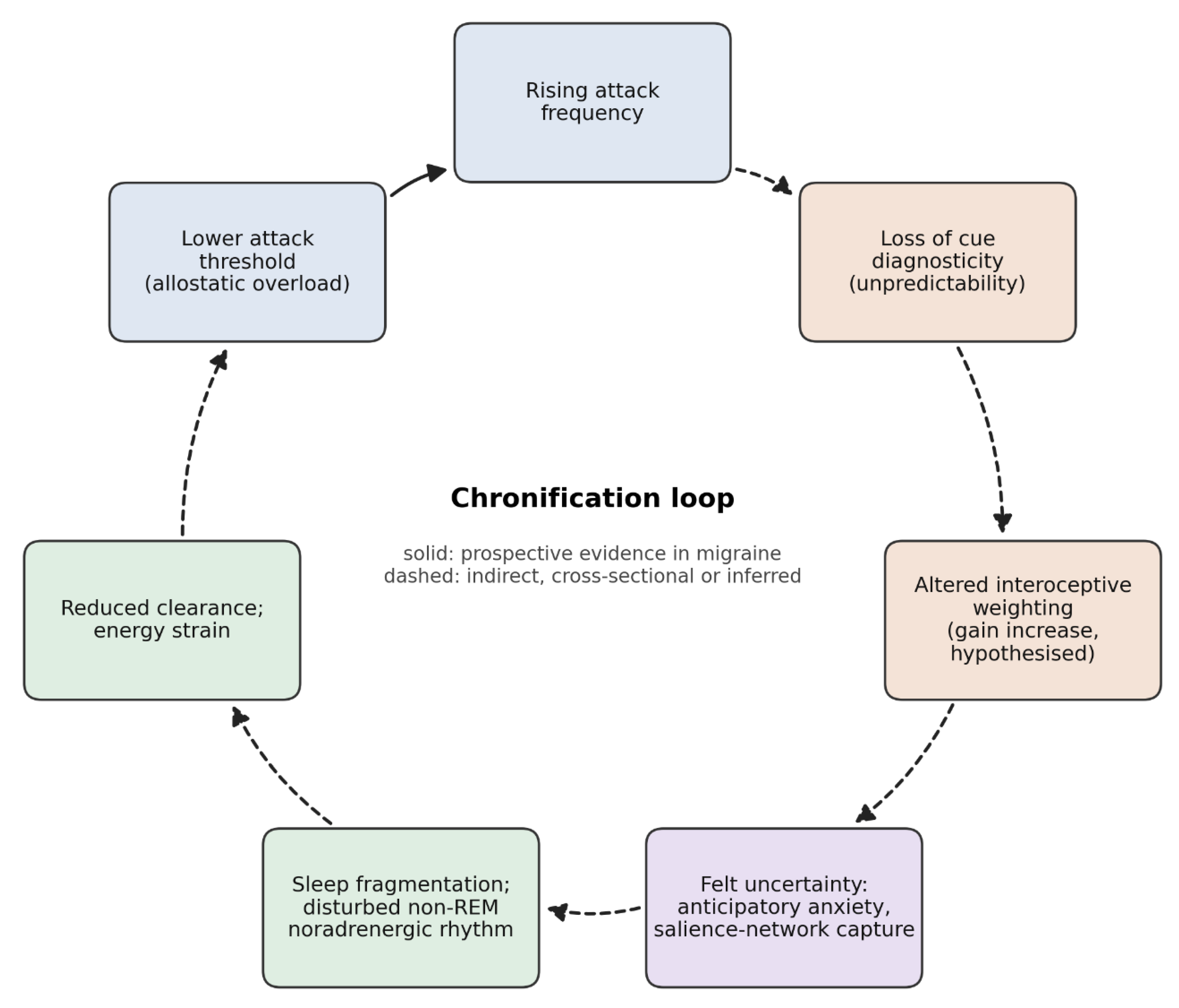
Table 1.
Evidence grading for each link of the proposed loop.
| Link | Best evidence | Grade | What contradicts or limits it | Survives stratification by medication overuse? |
| Surprisal of exposures predicts attacks | Turner 2019 (n = 95, OR 1.35 per SD); Turner 2025 (n = 109, OR 2.15) [20,21] | Direct, episodic migraine | Not stratified by chronic status | Not examined |
| Rising frequency raises residual uncertainty and the count of cue-free attack days | Arithmetic of base rate (Section 3) | Follows from base rate; same under all accounts; non-monotonic above 15 days | Does not by itself distinguish the hypothesis | Not applicable |
| Cue likelihood ratios are diluted in chronic migraine | — | Absent (prediction 1); shared with the allostatic account [9] | Endorsement studies show no fewer triggers in chronic migraine [25,26] | To be tested |
| Interoceptive weighting changes with frequency | Koreki 2025 (state prediction error CM > EM, p = 0.046; sensibility–accuracy discrepancy against controls) [30]; Kökönyei 2021 [32] | Indirect, small; sign of precision change open | Jones 2025 finds normal accuracy [31]; Koreki's accuracy deficit fits a precise-prior reading equally | Not stratified |
| Felt uncertainty → anxiety gradient | Buse 2010; Lampl 2016; Giannini 2013 [40,41,43] | Indirect (association) | Trait intolerance of uncertainty does not differ [45]; diathesis account predicts the same gradient | Lampl and Giannini are overuse-dependent |
| Salience-network capture | Demichelis 2025 (n = 91); Androulakis 2017 (coherence falls with moderate-to-severe headache days); Lee 2019 [49,50,51] | Direct, cross-sectional | Sign disagrees across studies (reduced intranetwork coherence) | Androulakis: no overuse effect; Demichelis: all overuse |
| Vigilance → slow-wave sleep loss | — | Contradicted [52,53] | Replaced by fragmentation and REM reduction [54,55] | Not applicable |
| Vigilance → sleep fragmentation | Munday 2026; Stanyer 2021 (subjective); Błaszczyk 2025 (REM) [52,54,55] | Indirect | In Bertisch 2020, diary-reported low efficiency raised next-day odds while objective fragmentation went with lower same-day odds [56]; sleep quality equal across episodic frequency groups [65] | Not stratified (Błaszczyk adjusted for migraine medication, not overuse) |
| Fragmented sleep → impaired clearance | Xie 2013; Eide 2021; Hauglund 2025 [59,61,63] | Indirect (rodent; human total deprivation) | Clearance reduced during sleep in mice [62]; ALPS unrelated to sleep quality in Cai 2025 [65]; the link would be tested by measuring sleep microstructure and ALPS together in migraine; locus coeruleus effects divergent [60] | Not applicable |
| Impaired clearance with rising frequency | Wu 2024 (chronic < episodic); Cai 2025 and Zhang 2026 (high- < low-frequency episodic); Ornello 2026 interaction with sleep [64,65,66,67] | Indirect (ALPS proxy), cross-sectional, heterogeneous | Lee 2022 and Cao 2024 null, including for frequency; Zhang 2023 reversed [68,69,70] | Wu: difference carried by overuse; Ornello: held after adjustment for overuse |
| Clearance failure → CGRP accumulation | — | Absent; omitted | Evidence runs CGRP → impaired efflux [71] | Not applicable |
| Energy strain lowers threshold | Reyngoudt 2011; Xie 2023 [72,75] | Indirect | Episodic and murine data; negative ketone trial [74] | Not examined |
| Frequency → allostatic load | Calabrò 2024 (OR 2.78) [7] | Direct | Small, cross-sectional; direction unknown | Not stratified; authors cannot exclude cardiovascular effects of analgesic overuse |
| Lowered threshold → more attacks | Louter 2013 (allodynia predicts increase in migraine days) [78]; Manack 2011 (absence of allodynia predicts remission) [79] | Direct, prospective | Allodynia is a proxy for threshold | Not stratified |
CM chronic migraine, EM episodic migraine, OR odds ratio, SD standard deviation, ALPS analysis along the perivascular space.
Disclaimer/Publisher’s Note: The statements, opinions and data contained in all publications are solely those of the individual author(s) and contributor(s) and not of MDPI and/or the editor(s). MDPI and/or the editor(s) disclaim responsibility for any injury to people or property resulting from any ideas, methods, instructions or products referred to in the content. |
© 2026 by the authors. Licensee MDPI, Basel, Switzerland. This article is an open access article distributed under the terms and conditions of the Creative Commons Attribution (CC BY) license (http://creativecommons.org/licenses/by/4.0/).
Copyright: This open access article is published under a Creative Commons CC BY 4.0 license, which permit the free download, distribution, and reuse, provided that the author and preprint are cited in any reuse.