

Submitted:
01 October 2026
Posted:
06 October 2026
You are already at the latest version
Abstract
Background: Zero-dose children, operationalised as children who have not received the first dose of a diphtheria–tetanus–pertussis-containing vaccine (DTP1), signal failure of initial contact with routine immunisation services. We estimated zero-dose prevalence and examined associated inequalities among children aged 12–23 months in Lao PDR. Methods: We analysed data from the 2023 Lao Social Indicator Survey III (LSIS III). DTP1 receipt was classified from home-based records and caregiver recall. Analyses accounted for the complex survey design. Separate survey-weighted logistic regression models used a prespecified core adjustment set. We assessed outcome availability and extreme-case prevalence bounds. Results: Of 1,876 age-eligible children, 1,509 had classifiable DTP1 status. Weighted zero-dose prevalence among classifiable children was 12.8% (95% CI 10.6–15.4); the extreme-case range among all eligible children was 10.4–29.2%. DTP1 status was unclassifiable for 19.6% and was disproportionately unavailable among dis-advantaged groups. Adjusted odds ratios (aORs) were higher for children in the Central than Northern region (aOR 3.96, 95% CI 2.31–6.80), and among Mon-Khmer-headed (aOR 2.72, 95% CI 1.51–4.89) and Hmong-Mien-headed households (aOR 3.48, 95% CI 1.82–6.63) than Lao-Tai-headed households. Children whose mothers had no formal education had higher adjusted odds than children whose mothers had secondary education or higher (aOR 2.09, 95% CI 1.18–3.68). Conclusions: Geographic, ethnolinguistic and ed-ucational inequalities characterised zero-dose status. The findings support locally tailored investigation, culturally and linguistically appropriate engagement, community identi-fication of zero-dose children, integration with maternal and child health services, and improved vaccination documentation.
Keywords:
zero dose
; DTP1
; immunisation equity
; Lao PDR
; MICS
1. Introduction
Childhood vaccination is among the most consequential public-health interventions: modelling across 112 low- and middle-income countries estimated that vaccination against 10 pathogens would avert approximately 50 million deaths over the lifetimes of cohorts vaccinated during 2000–2019 [1]. Investments in childhood immunisation also generate substantial economic returns [2]. Nevertheless, these benefits remain unequally distributed, and millions of children do not make initial contact with routine immunisation services.
The Immunization Agenda 2030 defines zero-dose children programmatically as those not reached by routine immunisation; non-receipt of DTP1 is the operational monitoring proxy [3,4,5]. This group differs from children who initiate but do not complete a multidose series [6]. Zero-dose status can therefore reveal exclusion at the point of entry to the vaccination system rather than failure of continuity alone. Global recovery after COVID-19-related disruption has been incomplete [7,8], while national averages can obscure locally concentrated gaps [9,10].
Across low- and middle-income countries, zero-dose status is associated with intersecting geographic, socioeconomic, ethnolinguistic and health-service disadvantages [11,12]. It frequently overlaps with non-use of other maternal and child health services [13]. Such concentration matters for both equity and disease control because spatially clustered non-vaccination can sustain outbreak risk even when aggregated coverage appears adequate [14,15]. Zero-dose populations are heterogeneous across remote-rural, urban and conflict-affected settings, so effective responses require local evidence rather than a single universal intervention [16].
Lao PDR is mountainous, sparsely populated and ethnolinguistically diverse. Routine immunisation is delivered through fixed facilities, outreach and mobile services, but access varies with geography, infrastructure, language and service availability. Recent national survey data provide an opportunity to characterise DTP1 non-receipt among children who became eligible during the COVID-19 period [17]. A district-level Lao study reported important gaps but was not nationally representative [18]; earlier studies examined vaccination status, coverage or timeliness using older data and broader outcomes [19,20,21,22].
We therefore estimated the national prevalence of DTP1-defined zero-dose status among children aged 12–23 months using LSIS III 2023, examined associations with contextual, household, maternal, child and maternal health-service characteristics, and quantified uncertainty arising from unclassifiable DTP1 status. We hypothesised that zero-dose status would be socially and geographically patterned and that outcome availability itself could be unequal.
2. Materials and Methods
2.1. Study Design and Data Source
We conducted a cross-sectional secondary analysis of the 2023 Lao Social Indicator Survey III (LSIS III), implemented by the Lao Statistics Bureau with the Ministry of Health and UNICEF using the Multiple Indicator Cluster Survey (MICS) framework [17,23]. We linked the children-under-five, household, women and birth-history datasets. The child file provided vaccination information, age, sex, survey weights, strata and primary sampling units; the other files supplied household, maternal, health-service and birth characteristics.
2.2. Study Population
The target population comprised children aged 12–23 months. Data collection occurred from March to September 2023, so included children were born approximately between April 2021 and September 2022 and became eligible for DTP1 during the COVID-19 period. The age restriction is standard for household-survey reporting of routine childhood vaccination and limits the additional opportunity for catch-up vaccination among older children.
2.3. Outcome Classification
Zero-dose status was defined as non-receipt of DTP1. Receipt was confirmed by an exact date or vaccination mark on a home-based record, or by affirmative caregiver report following vaccination-history probing. When vaccination-history information did not resolve status, responses to whether the child had ever received a DTP-containing vaccine and the number of doses were used. Affirmative evidence of at least one dose took precedence over a conflicting negative response. Children whose status remained unresolved were classified as having unclassifiable DTP1 status and excluded from the primary analytic sample (Figure 1).
2.4. Explanatory Variables
Variables were prespecified within contextual, household, maternal, child and maternal health-service domains. Contextual factors were geographic region and urban/rural residence. Household factors included wealth quintile and household-head ethnicity, religion, sex, age, education and household size. Maternal factors included age, education, marital status and weekly mass-media exposure. Child factors included age, sex, birth plurality and birth order. Health-service factors included antenatal-care visits, skilled birth attendance and maternal tetanus-toxoid vaccination. Sparse ethnicity and religion categories were combined before analysis. Definitions followed the LSIS III questionnaire and analysis plan.
2.5. Survey Design and Statistical Analysis
Analyses used R version 4.5.3 and incorporated child sampling weights, strata and primary sampling units, with primary sampling units nested within strata. The survey design was defined before restriction to the target age and classifiable outcome. A lonely-primary-sampling-unit adjustment based on the overall sample was used where a stratum contained only one primary sampling unit. Weighted prevalence estimates used logit-based 95% confidence intervals. Province-level estimates were descriptive because several provinces had few zero-dose observations. Regional and provincial maps were prepared using QGIS to verify and prepare administrative boundaries and R to link the LSIS III 2023 geospatial boundaries to survey-weighted prevalence estimates. No spatial smoothing or formal spatial-cluster analysis was performed.
Survey-weighted univariable logistic regression estimated crude odds ratios. A separate adjusted model was fitted for each factor. Each model included the applicable variables from a prespecified core set: geographic region, residence, household wealth quintile, household-head ethnicity, maternal education, child age group and child sex. When a core variable was the factor of interest, the model included that factor and the other six core variables; non-core factors were added individually to all seven. Joint Wald tests evaluated multi-category factors. Multicollinearity was assessed using variance inflation factors and transformed generalised variance inflation factors, with 2.5 used as a cautious screening threshold. All tests were two-sided, and p-values below 0.05 were interpreted as statistical evidence of association.
2.6. Missing Data and Sensitivity Analyses
Children with unclassifiable DTP1 status were excluded from the primary prevalence and association analyses. To assess potential selection bias, we estimated the weighted proportion unclassifiable across the prespecified core characteristics and compared groups using survey-adjusted Wald tests. We also calculated extreme-case prevalence bounds among all eligible children by first assuming that every unclassifiable child had received DTP1 and then assuming that none had received it. Missing covariates were handled by model-specific complete-case analysis; no values were imputed.
2.7. Ethical Considerations
LSIS III used de-identified data collected under a protocol approved by the National Ethics Committee for Health Research of Lao PDR in November 2022, with informed consent obtained during the original survey. UNICEF approved access to the relevant data. KIT Royal Tropical Institute granted this secondary analysis an exemption from full ethical review on 23 July 2026. The analysis involved no participant contact or attempt at re-identification.
2.8. Use of Generative AI-Assisted Technology
During preparation of the analysis and manuscript, the corresponding author used OpenAI Codex and Anthropic Claude to review the analysis code for syntax, consistency and potential errors. All suggestions were independently reviewed, tested and validated by the corresponding author against the study protocol, data structure and statistical outputs. ChatGPT was used for language editing and improving the clarity and organization of the manuscript. These tools did not independently determine the analytical methods, perform autonomous statistical decision-making or formulate the study conclusions. The corresponding author verified the final code, numerical results, references and manuscript content and takes full responsibility for the integrity of the work.
3. Results
3.1. Analytic Sample and Outcome Availability
The children-under-five dataset contained 9,346 children. After excluding 7,470 outside the target age range, 1,876 children aged 12–23 months remained eligible. DTP1 status was classifiable for 1,509 (80.4%) and unclassifiable for 367 (19.6%). Among classifiable children, 171 were zero-dose and 1,338 were non-zero-dose on an unweighted basis. Covariate missingness ranged from 0% to 9.1% and was highest for maternal tetanus vaccination (138 children; 9.1%), antenatal-care visits (96; 6.4%), and birth plurality and birth order (88 each; 5.8%). Adjusted-model samples ranged from 1,371 to 1,459.
3.2. Prevalence and Inequalities
Table 1 presents selected prevalence estimates among children with classifiable DTP1 status; complete estimates are provided in Supplementary Table S2. Weighted zero-dose prevalence was 12.8% (95% CI 10.6–15.4). Prevalence was 18.6% in the Central region, 7.2% in the North and 7.9% in the South. Province-level estimates varied more widely (Figure 2): Savannakhet had the highest estimated prevalence (40.9%), followed by Xaysomboun (23.3%). This heterogeneity indicates that regional estimates concealed substantial within-region variation. Prevalence was 24.6% among children in Hmong-Mien-headed households, 17.2% in Mon-Khmer-headed households and 8.5% in Lao-Tai-headed households. Prevalence was also higher among children whose mothers had no education (24.9%) than among those whose mothers had secondary education or higher (10.8%).
3.3. Adjusted Associations
Figure 3 presents adjusted associations; complete crude and core-adjusted estimates are provided in Supplementary Table S3. After core adjustment, the Central region had higher odds of zero-dose status than the North (aOR 3.96, 95% CI 2.31–6.80), whereas evidence for a difference between the South and North was inconclusive. Household-head ethnicity was associated with zero-dose status overall (joint Wald p<0.001): adjusted odds were higher for Mon-Khmer-headed (aOR 2.72, 95% CI 1.51–4.89) and Hmong-Mien-headed households (aOR 3.48, 95% CI 1.82–6.63) than Lao-Tai-headed households. Maternal education was associated overall (p=0.035), with higher odds among children whose mothers had no education than among those whose mothers had secondary education or higher (aOR 2.09, 95% CI 1.18–3.68).
Household-head religion was associated with zero-dose status overall (joint Wald p=0.003). Compared with Buddhist-headed households, the other religion/no religion category had higher adjusted odds (aOR 7.50, 95% CI 2.27–24.81); however, this estimate was based on only 30 children and was imprecise. Household-head education was also associated overall (p=0.044); primary education was associated with lower adjusted odds than secondary education or higher (aOR 0.60, 95% CI 0.38–0.96), while no education or early childhood education showed no clear difference. Antenatal-care attendance did not meet the prespecified threshold in the overall joint test (p=0.079), although no attendance versus at least four visits produced an aOR of 2.27 (95% CI 1.05–4.92). The wealth-quintile joint test was borderline (p=0.052) without a monotonic gradient. No clear adjusted association was observed for residence, sex or age of the household head, household size, maternal age, marital status or mass-media exposure, child age, sex, birth plurality or birth order, skilled birth attendance, or maternal tetanus vaccination. VIF and transformed GVIF values were approximately 1.06–1.35, below the prespecified threshold of 2.5, indicating no potentially problematic multicollinearity.
3.4. Outcome-Classification Uncertainty
Table 2 shows outcome-classification uncertainty and selected inequalities in unclassifiable DTP1 status. If every unclassifiable child was assumed to have received DTP1, weighted prevalence among all eligible children was 10.4%; if every unclassifiable child was assumed not to have received DTP1, prevalence was 29.2%. Outcome availability was socially patterned. The weighted proportion unclassifiable was 31.8% in the poorest households, 30.9% in Hmong-Mien-headed households, 34.7% among children whose mothers had no education and 21.6% in rural areas, compared with 9.8%, 12.6%, 13.0% and 11.1% in their respective comparison groups.
4. Discussion
In this analysis of nationally representative survey data, approximately one in eight children with classifiable DTP1 status was zero-dose. The strongest and most consistent inequalities were geographic and ethnolinguistic: children in the Central region and those living in Mon-Khmer- or Hmong-Mien-headed households had substantially higher adjusted odds than the reference groups. Maternal education also showed an overall association. Equally important, DTP1 status was unavailable for nearly one-fifth of eligible children, and this unclassifiable group was disproportionately rural, poor, ethnolinguistically disadvantaged, and born to mothers with less education.
The estimated prevalence applies to children whose DTP1 status could be classified from records or recall. The extreme-case interval of 10.4–29.2% is intentionally broad: neither endpoint is presented as the truth. Instead, the bounds quantify how much inference depends on an outcome whose availability was socially patterned across observed characteristics. Household surveys remain essential for equity monitoring [23], but vaccination documentation and recall limitations can shape both coverage estimates and comparisons between population groups.
The higher adjusted odds in the Central region should not be interpreted as uniform regional underperformance. Province-level estimates were heterogeneous. National and regional averages can conceal fine-scale clustering [15], and geographic immunisation analyses require careful attention to spatial scale and uncertainty [32]. The result therefore supports targeted district- and village-level investigation of missed settlements, population lists, outreach continuity, transport, vaccine availability and record reconciliation rather than a single intervention applied across the entire region.
Ethnolinguistic inequalities persisted after adjustment for region, residence, wealth, maternal education, child age and sex. Similar disparities have been reported across many countries [24] and in earlier Lao vaccination research [22,26,29]. The categories used here identify population differences but do not measure causal mechanisms. Geography, language, discrimination, trust, mobility, service design and historical relationships with public institutions may overlap. Research from rural Lao PDR underscores the importance of trust and locally grounded engagement [27]. Responses should therefore be co-designed, use non-stigmatising language and avoid treating broad ethnolinguistic groups as homogeneous.
Children whose mothers had no education had higher adjusted odds than those whose mothers had secondary education or higher. Maternal education may influence access to information and confidence navigating services, although the study did not measure health literacy or language proficiency. Prior evidence links maternal health literacy with childhood vaccination [30]. Oral, visual and local-language communication may reduce reliance on literacy, but interventions should be tested for acceptability and effectiveness rather than assumed to work.
No antenatal care was associated with higher odds in the category-specific comparison, but the overall factor test did not meet the prespecified threshold. The result is therefore exploratory. Limited maternal-service contact and zero-dose status may share upstream determinants, and inequalities in maternal health-service use have been documented in Lao PDR [31]. Linking immunisation counselling and referral to maternal services may be useful, but facility-based integration alone cannot reach families already excluded from facility care. Multisectoral and pro-equity strategies commonly combine identification, community engagement, adapted delivery and health-system strengthening [34,35,36].
The absence of a monotonic adjusted wealth gradient does not show that economic disadvantage is irrelevant. Asset-based wealth indices measure relative socioeconomic position and do not directly capture transport costs, seasonal access, income or opportunity costs [28]. Adjustment for region, residence, ethnicity and maternal education also changes the estimand from the total social gradient to a conditional association. Equity monitoring should therefore examine multiple dimensions rather than rely on a single socioeconomic indicator [25,33].
Strengths include recent nationally representative data; explicit incorporation of weights, clustering and stratification; a prespecified adjustment set; transparent category-specific and overall tests; and direct assessment of outcome availability. Limitations include the cross-sectional design, residual confounding, multiple comparisons, small subgroups, reliance on records and caregiver recall, and complete-case covariate handling. The factor-specific models do not provide mutually adjusted causal effects and should not be ranked as causal determinants. Children became DTP1-eligible during the COVID-19 period, so cohort-period disruption cannot be separated from persistent structural barriers. Available variables did not measure travel time, outreach frequency, vaccine supply, language, trust or service quality.
The findings support a practical sequence: disaggregate DTP1 coverage and outcome availability; identify locations and groups with high or uncertain prevalence; investigate local mechanisms; co-design feasible responses; and evaluate reach, acceptability, cost and equity before scale-up. Documentation improvement should reconcile home-based records, facility registers and caregiver information while recognising that missing information may also signal weak service contact.
5. Conclusions
Zero-dose vaccination among children aged 12–23 months in Lao PDR was characterised by geographic, ethnolinguistic and educational inequalities. Among children with classifiable status, weighted prevalence was 12.8%; however, socially patterned outcome unavailability produced an extreme-case range of 10.4–29.2% among all eligible children. National monitoring should report classification uncertainty alongside disaggregated coverage. Locally tailored investigation, culturally and linguistically responsive engagement, community identification, improved vaccination documentation and appropriate links with maternal and child health services should be piloted and evaluated before wider implementation.
Supplementary Materials
The following supporting information can be downloaded at the website of this paper posted on Preprints.org, Table S1, Characteristics of the analytical sample; Table S2, Prevalence of zero-dose status; Table S3, Univariable and core-adjusted factor-specific associations; Table S4, Distribution of unclassifiable DTP1 status across selected characteristics.
Author Contributions
Conceptualization, N.M.N.P. and A.Z.; methodology, N.M.N.P., H.H.A. and A.Z.; software, N.M.N.P.; validation, H.H.A. and A.Z.; formal analysis, N.M.N.P.; investigation, N.M.N.P.; data curation, N.M.N.P.; writing—original draft preparation, N.M.N.P.; writing—review and editing, N.M.N.P., H.H.A. and A.Z.; visualization, N.M.N.P.; project administration, N.M.N.P. All authors have read and agreed to the published version of the manuscript.
Funding
This research received no external funding.
Institutional Review Board Statement
The study was conducted in accordance with the Declaration of Helsinki. The LSIS III survey protocol was approved by the National Ethics Committee for Health Research of Lao PDR in November 2022. Ethical review and approval for this secondary analysis were waived by the KIT Royal Tropical Institute Research Ethics Committee on 23 July 2026 because it used an existing de-identified dataset, involved no participant contact and posed no additional foreseeable risk to participants.
Informed Consent Statement
Informed consent was obtained from participants or their caregivers during the original LSIS III survey. No additional consent was required for this secondary analysis of de-identified data.
Data Availability Statement
The data presented in this study are available from UNICEF through the MICS data-access process, subject to registration and approval: https://mics.unicef.org/surveys. Restrictions apply to the availability of the unit-level data; the authors are not authorised to redistribute them. The analytic code and non-disclosive derived outputs will be deposited in a publicly accessible repository before publication.
Acknowledgments
The authors thank the Lao Statistics Bureau, the Ministry of Health of Lao PDR, UNICEF and the LSIS III participants. The authors also thank Dr. Nyan Win Myint, Dr. Moh Moh Kyi and Dr. Htun Aung Kyaw for reviewing the manuscript and providing technical input. During the preparation of this study and manuscript, the corresponding author used OpenAI Codex (OpenAI), Claude (Anthropic) and ChatGPT (OpenAI), accessed in September 2026. Codex and Claude were used to assist with code review and error checking, while ChatGPT was used for language editing and improvements to clarity and organization. The corresponding author reviewed and edited the output, verified all results and references against the underlying analysis and source materials, and takes full responsibility for the article’s content.
Conflicts of Interest
The authors declare no conflicts of interest.
Abbreviations
The following abbreviations are used in this manuscript:
| AI | Artificial intelligence |
| aOR | Adjusted odds ratio |
| CI | Confidence interval |
| COVID-19 | Coronavirus disease 2019 |
| DTP | Diphtheria–tetanus–pertussis |
| DTP1 | First dose of a diphtheria–tetanus–pertussis-containing vaccine |
| KIT | KIT Royal Tropical Institute |
| LSIS III | Lao Social Indicator Survey III |
| MICS | Multiple Indicator Cluster Surveys |
| PDR | People’s Democratic Republic |
| UNICEF | United Nations Children’s Fund |
References
- Toor, J.; Echeverria-Londono, S.; Li, X.; Abbas, K.; Carter, E.D.; Clapham, H.E.; et al. Lives saved with vaccination for 10 pathogens across 112 countries in a pre-COVID-19 world. eLife 2021, 10, e67635. [Google Scholar] [CrossRef]
- Ozawa, S.; Clark, S.; Portnoy, A.; Grewal, S.; Brenzel, L.; Walker, D.G. Return on investment from childhood immunization in low- and middle-income countries, 2011–20. Health Aff. (Millwood) 2016, 35(2), 199–207. [Google Scholar] [CrossRef]
- World Health Organization. Immunization Agenda 2030 [Internet]; World Health Organization: Geneva, 1 Aug 2026; Available online: https://www.who.int/teams/immunization-vaccines-and-biologicals/strategies/ia2030.
- World Health Organization. Implementing the Immunization Agenda 2030 [Internet]; World Health Organization: Geneva, 1 Aug 2026; Available online: https://www.who.int/publications/m/item/implementing-the-immunization-agenda-2030.
- Gavi; the Vaccine Alliance. Zero-dose children and missed communities [Internet]; Gavi, the Vaccine Alliance: Geneva, 1 Aug 2026; Available online: https://www.gavi.org/our-alliance/strategy/phase-5-2021-2025/equity-goal/zero-dose-children-missed-communities.
- Cata-Preta, B.O.; Santos, T.M.; Mengistu, T.; Hogan, D.R.; Barros, A.J.D.; Victora, C.G. Zero-dose children and the immunisation cascade: understanding immunisation pathways in low- and middle-income countries. Vaccine 2021, 39(32), 4564–4570. [Google Scholar] [CrossRef]
- World Health Organization; United Nations Children's Fund. Global childhood immunization coverage inches forward despite conflict and hesitancy [Internet]; World Health Organization: Geneva, 15 [ Jul 2026; Available online: https://www.who.int/news/item/15-07-2026-global-childhood-immunization-coverage-inches-forward-despite-conflict-and-hesitancy---unicef--who.
- World Health Organization; United Nations Children's Fund. COVID-19 pandemic fuels largest continued backslide in vaccinations in three decades [Internet]; World Health Organization: Geneva, 15 [ Jul 2022; Available online: https://www.who.int/news/item/15-07-2022-covid-19-pandemic-fuels-largest-continued-backslide-in-vaccinations-in-three-decades.
- World Health Organization. WHO Immunization Data portal [Internet]; World Health Organization: Geneva, 1 Aug 2026; Available online: https://immunizationdata.who.int.
- Utazi, C.E.; Pannell, O.; Aheto, J.M.K.; Wigley, A.; Tejedor-Garavito, N.; Wunderlich, J.; et al. Assessing the characteristics of un- and under-vaccinated children in low- and middle-income countries: a multilevel cross-sectional study. PLoS Glob. Public Health 2022, 2(4), e0000244. [Google Scholar] [CrossRef]
- Farrenkopf, B.A.; Zhou, X.; Shet, A.; Olayinka, F.; Carr, K.; Patenaude, B.; et al. Understanding household-level risk factors for zero-dose immunization in 82 low- and middle-income countries. PLoS ONE 2023, 18(12), e0287459. [Google Scholar] [CrossRef]
- Wendt, A.; Santos, T.M.; Cata-Preta, B.O.; Arroyave, L.; Hogan, D.R.; Mengistu, T.; et al. Exposure of zero-dose children to multiple deprivation: analyses of data from 80 low- and middle-income countries. Vaccines 2022, 10(9), 1568. [Google Scholar] [CrossRef]
- Santos, T.M.; Cata-Preta, B.O.; Mengistu, T.; Victora, C.G.; Hogan, D.R.; Barros, A.J.D. Assessing the overlap between immunisation and other essential health interventions in 92 low- and middle-income countries using household surveys: opportunities for expanding immunisation and primary health care. EClinicalMedicine 2021, 42, 101196. [Google Scholar] [CrossRef]
- World Health Organization; United Nations Children's Fund; Gavi; the Vaccine Alliance. Increases in vaccine-preventable disease outbreaks threaten years of progress [Internet]; World Health Organization: Geneva, 24 [ Apr 2025; Available online: https://www.who.int/news/item/24-04-2025-increases-in-vaccine-preventable-disease-outbreaks-threaten-years-of-progress--warn-who--unicef--gavi.
- Masters, N.B.; Eisenberg, M.C.; Delamater, P.L.; Kay, M.; Boulton, M.L.; Zelner, J. Fine-scale spatial clustering of measles nonvaccination that increases outbreak potential is obscured by aggregated reporting data. Proc. Natl. Acad. Sci. U S A 2020, 117(45), 28506–28514. [Google Scholar] [CrossRef]
- Wigley, A.; Lorin, J.; Hogan, D.; Utazi, C.E.; Hagedorn, B.; Dansereau, E.; et al. Estimates of the number and distribution of zero-dose and under-immunised children across remote-rural, urban, and conflict-affected settings in low- and middle-income countries. PLoS Glob. Public Health 2022, 2(10), e0001126. [Google Scholar] [CrossRef]
- United Nations Children's Fund Lao PDR. Lao Social Indicator Survey III (LSIS III) [Internet]; UNICEF Lao PDR: Vientiane, 2025; Available online: https://www.unicef.org/laos/reports/lao-social-indicator-survey-iii-lsis-iii.
- United Nations Children's Fund Lao PDR. New study sheds light on reaching more children with vaccines in Lao PDR [Internet]; UNICEF Lao PDR: Vientiane, 22 [ Sep 2025; Available online: https://www.unicef.org/laos/press-releases/new-study-sheds-light-reaching-more-children-vaccines-lao-pdr.
- Xeuatvongsa, A.; Hachiya, M.; Miyano, S.; Mizoue, T.; Kitamura, T. Determination of factors affecting the vaccination status of children aged 12–35 months in Lao People's Democratic Republic. Heliyon 2017, 3(3), e00265. [Google Scholar] [CrossRef]
- Hefele, L.; Syphan, S.; Xayavong, D.; Homsana, A.; Kleine, D.; Chanthavilay, P.; et al. Timeliness of immunisation with the pentavalent vaccine at different levels of the health care system in the Lao People's Democratic Republic: a cross-sectional study. PLoS ONE 2020, 15(12), e0242502. [Google Scholar] [CrossRef]
- Phoummalaysith, B.; Yamamoto, E.; Xeuatvongsa, A.; Louangpradith, V.; Keohavong, B.; Saw, Y.M.; et al. Factors associated with routine immunization coverage of children under one year old in Lao People's Democratic Republic. Vaccine 2018, 36(19), 2666–2672. [Google Scholar] [CrossRef]
- Ichimura, Y.; Yanagisawa, N.; Thandar, M.M.; Pathammavong, C.; Phounphenghuk, K.; Nouanthong, P.; et al. The determinants of immunization coverage among children aged 12–35 months: a nationwide cross-sectional study in Lao People's Democratic Republic. BMC Public Health 2022, 22, 2259. [Google Scholar] [CrossRef]
- Hancioglu, A.; Arnold, F. Measuring coverage in MNCH: tracking progress in health for women and children using DHS and MICS household surveys. PLoS Med. 2013, 10(5), e1001391. [Google Scholar] [CrossRef]
- Cata-Preta, B.O.; Santos, T.M.; Wendt, A.; Hogan, D.R.; Mengistu, T.; Barros, A.J.D.; et al. Ethnic disparities in immunisation: analyses of zero-dose prevalence in 64 countries. BMJ Glob. Health 2022, 7(5), e008833. [Google Scholar] [CrossRef]
- Ali, H.A.; Hartner, A.M.; Echeverria-Londono, S.; Roth, J.; Li, X.; Abbas, K.; et al. Vaccine equity in low- and middle-income countries: a systematic review and meta-analysis. Int. J. Equity Health 2022, 21(1), 82. [Google Scholar] [CrossRef]
- Dekker, T.; Hefele, L.; Neven, A.; Hübschen, J.M.; Essink, D.R.; Black, A.P. Factors associated with hepatitis B vaccination in Laos: findings from the Multiple Indicator Cluster Surveys in 2011/12 and 2017. Lancet Reg. Health West Pac. 2024, 46, 101059. [Google Scholar] [CrossRef]
- Phrasisombath, K.; Kubota, S.; Elliott, E.M.; Horiuchi, S.; Ounaphom, P.; Phimmachak, L.; et al. Reaching the unreached through building trust: a mixed-method study on COVID-19 vaccination in rural Lao PDR. BMJ Glob. Health 2024, 9(6), e014680. [Google Scholar] [CrossRef]
- Poirier, M.J.P.; Grépin, K.A.; Grignon, M. Approaches and alternatives to the wealth index to measure socioeconomic status using survey data: a critical interpretive synthesis. Soc. Indic. Res. 2020, 148(1), 1–46. [Google Scholar] [CrossRef]
- Kitamura, T.; Komada, K.; Xeuatvongsa, A.; Hachiya, M. Factors affecting childhood immunization in Lao People's Democratic Republic: a cross-sectional study from nationwide, population-based, multistage cluster sampling. Biosci. Trends 2013, 7(4), 178–185. [Google Scholar] [CrossRef]
- Johri, M.; Subramanian, S.V.; Sylvestre, M.P.; Dudeja, S.; Chandra, D.; Koné, G.K.; et al. Association between maternal health literacy and child vaccination in India: a cross-sectional study. J. Epidemiol. Community Health 2015, 69(9), 849–857. [Google Scholar] [CrossRef]
- Ahissou, N.C.A.; Nonaka, D.; Takeuchi, R.; de los Reyes, C.; Uehara, M.; Khampheng, P.; et al. Trends in sociodemographic and economic inequalities in the use of maternal health services in Lao People's Democratic Republic from 2006 to 2017: MICS data analysis. Trop. Med. Health 2023, 51(1), 56. [Google Scholar] [CrossRef]
- Allorant, A.; Bergen, N.; Danovaro-Holliday, M.C.; Lorin, J.; Corrêa, G.C.; Boyda, D.; et al. Assessing geographic inequalities in childhood immunisation coverage: a critical scoping review of spatial analysis methods. Vaccines 2026, 14(7), 572. [Google Scholar] [CrossRef]
- Arsenault, C.; Harper, S.; Nandi, A.; Mendoza Rodríguez, J.M.; Hansen, P.M.; Johri, M. An equity dashboard to monitor vaccination coverage. Bull. World Health Organ. 2017, 95(2), 128–134. [Google Scholar] [CrossRef]
- Oyo-Ita, A.; Oduwole, O.; Arikpo, D.; Effa, E.E.; Esu, E.B.; Balakrishna, Y.; et al. Interventions for improving coverage of childhood immunisation in low- and middle-income countries. Cochrane Database Syst. Rev. 2023, 12, CD008145. [Google Scholar] [CrossRef]
- United Nations Children's Fund. Multisectoral zero-dose strategies to improve routine immunization and other child outcomes: operational guidance and summary [Internet]; UNICEF: New York, 3 Aug 2026; Available online: https://www.unicef.org/documents/multisectoral-zero-dose-strategies-improve-routine-immunization-and-other-child-outcomes.
- Dadari, I.; Higgins-Steele, A.; Sharkey, A.; Charlet, D.; Shahabuddin, A.; Nandy, R.; et al. Pro-equity immunization and health systems strengthening strategies in select Gavi-supported countries. Vaccine 2021, 39(17), 2434–2444. [Google Scholar] [CrossRef]
Figure 1.
Hierarchical classification of DTP1-defined zero-dose status among children aged 12–23 months.
Figure 1.
Hierarchical classification of DTP1-defined zero-dose status among children aged 12–23 months.
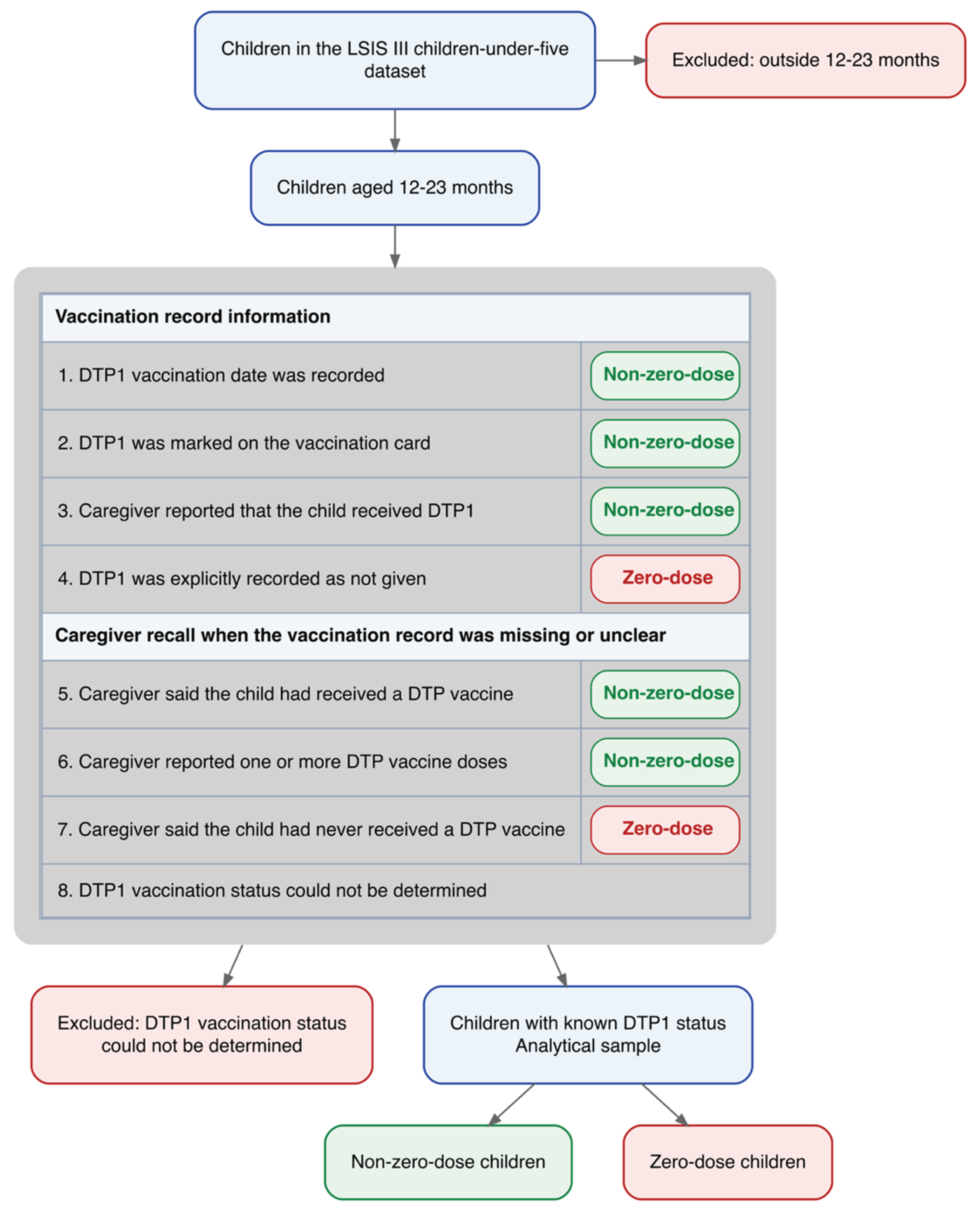
Figure 2.
Survey-weighted prevalence of zero-dose status among children aged 12–23 months with classifiable DTP1 status in Lao PDR: (A) prevalence by region and (B) prevalence by province. Province-level estimates are descriptive. Administrative boundaries were obtained from the LSIS III 2023 geospatial package.
Figure 2.
Survey-weighted prevalence of zero-dose status among children aged 12–23 months with classifiable DTP1 status in Lao PDR: (A) prevalence by region and (B) prevalence by province. Province-level estimates are descriptive. Administrative boundaries were obtained from the LSIS III 2023 geospatial package.
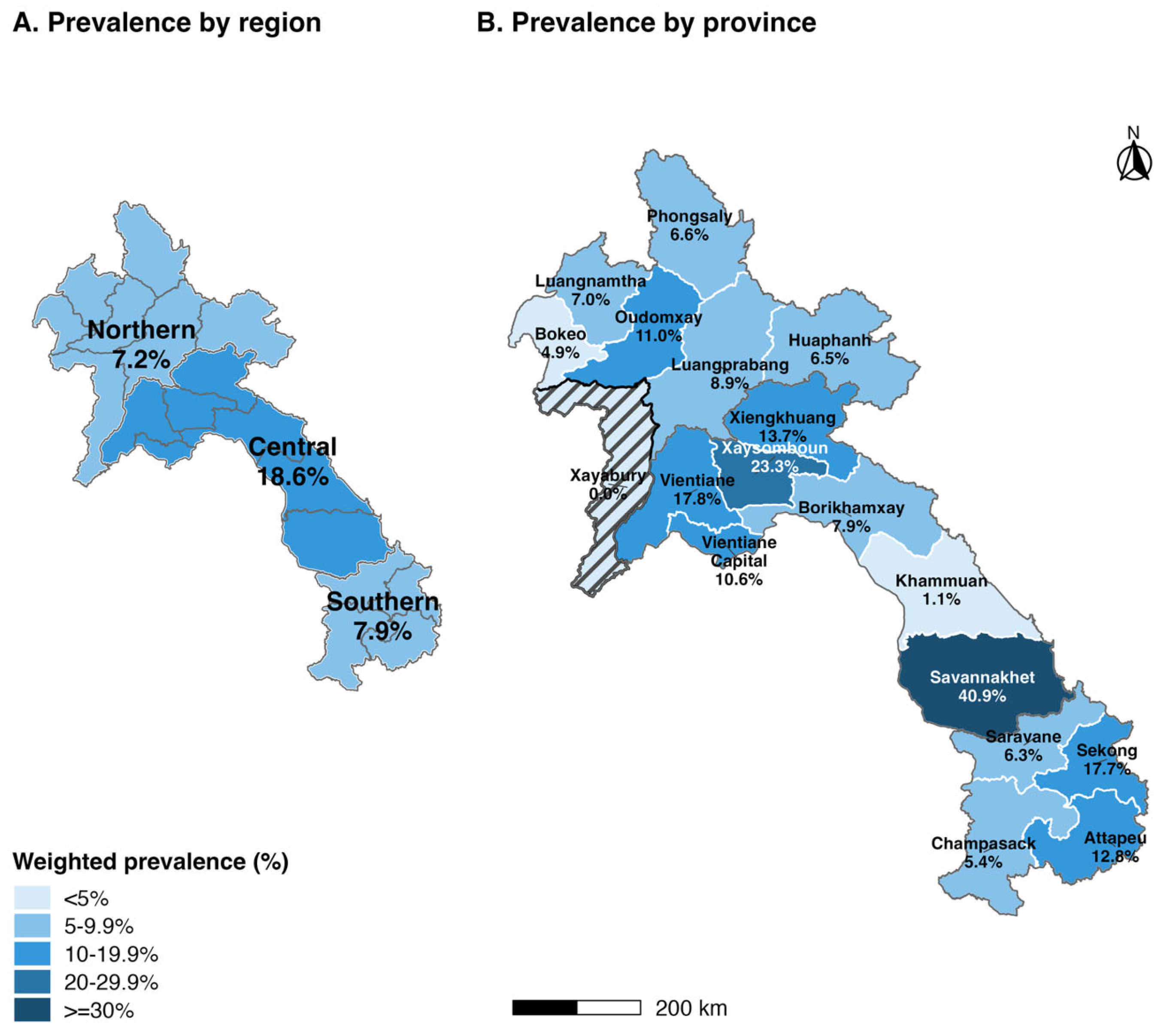
Figure 3.
Core-adjusted odds ratios for factors associated with zero-dose status among children aged 12–23 months in Lao PDR. Points show adjusted odds ratios and horizontal lines show 95% confidence intervals. Each factor was estimated in a separate survey-weighted model using the applicable prespecified core adjustment variables.
Figure 3.
Core-adjusted odds ratios for factors associated with zero-dose status among children aged 12–23 months in Lao PDR. Points show adjusted odds ratios and horizontal lines show 95% confidence intervals. Each factor was estimated in a separate survey-weighted model using the applicable prespecified core adjustment variables.
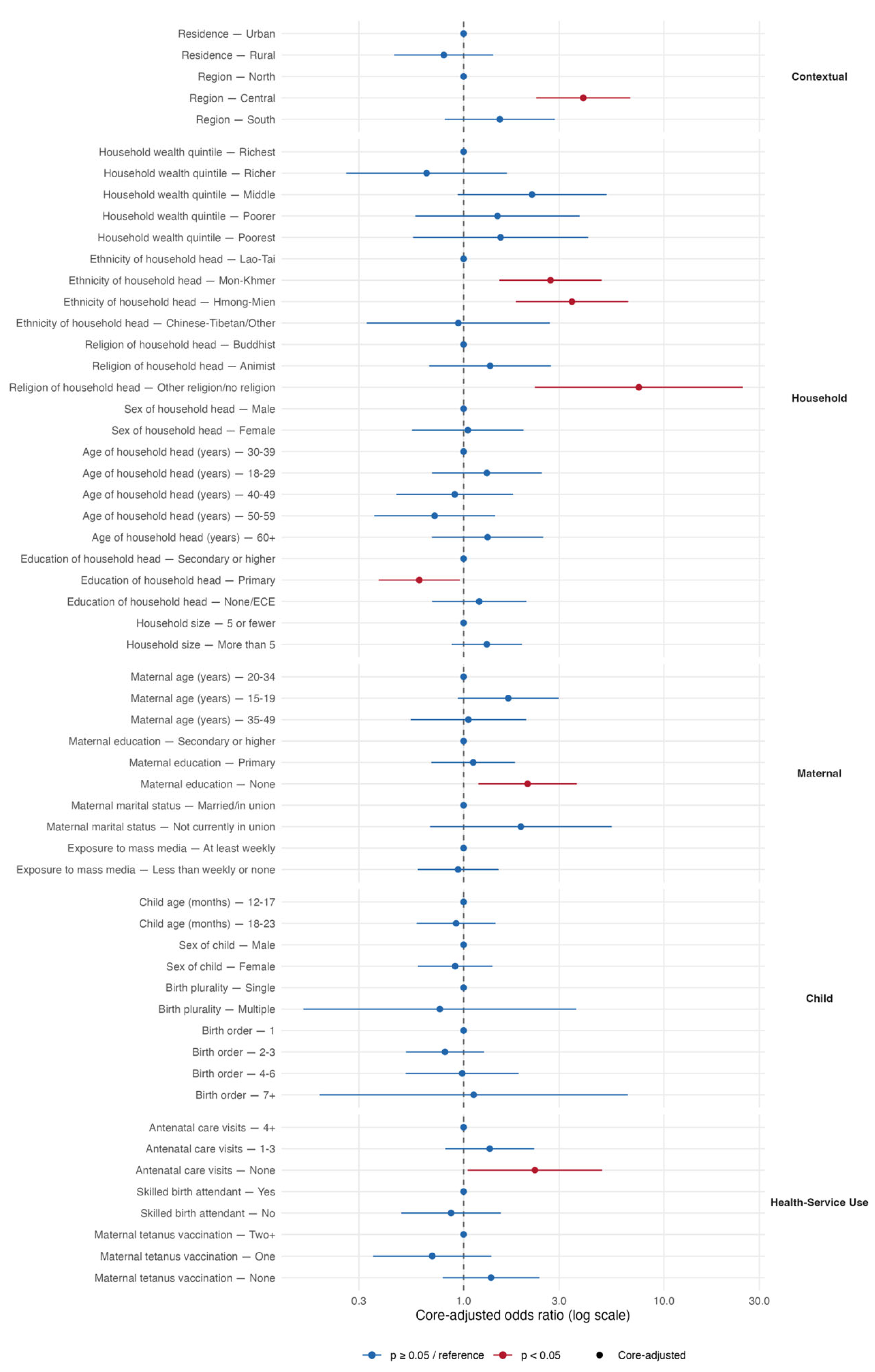

Table 1.
Selected zero-dose prevalence estimates among children with classifiable DTP1 status.
| Characteristic | Category | Total n | Zero-dose n | Weighted prevalence (95% CI) |
|---|---|---|---|---|
| Overall | All classifiable children | 1,509 | 171 | 12.8% (10.6–15.4) |
| Region | North | 626 | 43 | 7.2% (5.0–10.4) |
| Central | 585 | 94 | 18.6% (14.6–23.4) | |
| South | 298 | 34 | 7.9% (5.0–12.3) | |
| Residence | Urban | 397 | 45 | 12.5% (8.2–18.5) |
| Rural | 1,112 | 126 | 12.9% (10.4–15.8) | |
| Household-head ethnicity | Lao-Tai | 678 | 41 | 8.5% (6.1–11.7) |
| Mon-Khmer | 445 | 57 | 17.2% (12.4–23.4) | |
| Hmong-Mien | 266 | 67 | 24.6% (18.4–32.1) | |
| Chinese-Tibetan/Other | 120 | 6 | 5.0% (2.1–11.1) | |
| Maternal education | Secondary or higher | 877 | 94 | 10.8% (8.3–13.8) |
| Primary | 415 | 46 | 12.6% (8.9–17.6) | |
| None | 167 | 28 | 24.9% (16.4–36.0) | |
| Antenatal-care visits | 4+ | 1,025 | 99 | 11.2% (8.6–14.3) |
| 1–3 | 292 | 42 | 16.3% (11.5–22.6) | |
| None | 96 | 25 | 29.6% (16.7–46.9) |
Table 2.
Outcome-classification uncertainty and selected inequalities in unclassifiable DTP1 status.
Table 2.
Outcome-classification uncertainty and selected inequalities in unclassifiable DTP1 status.
| Analysis/characteristic | Category | Estimate (95% CI) |
|---|---|---|
| Primary prevalence | Classifiable DTP1 status | 12.8% (10.6–15.4) |
| Lower extreme | All unclassifiable assumed vaccinated | 10.4% (8.6–12.4) |
| Upper extreme | All unclassifiable assumed zero-dose | 29.2% (26.2–32.5) |
| Unclassifiable DTP1 | All eligible children | 19.6% unweighted |
| Residence | Urban | 11.1% (8.1–14.9) |
| Rural | 21.6% (18.6–24.8) | |
| Wealth | Richest | 9.8% (6.1–15.3) |
| Poorest | 31.8% (26.3–37.9) | |
| Household-head ethnicity | Lao-Tai | 12.6% (10.1–15.6) |
| Mon-Khmer | 24.3% (18.8–30.8) | |
| Hmong-Mien | 30.9% (25.0–37.5) | |
| Maternal education | Secondary or higher | 13.0% (10.8–15.7) |
| None | 34.7% (26.9–43.3) |
Disclaimer/Publisher’s Note: The statements, opinions and data contained in all publications are solely those of the individual author(s) and contributor(s) and not of MDPI and/or the editor(s). MDPI and/or the editor(s) disclaim responsibility for any injury to people or property resulting from any ideas, methods, instructions or products referred to in the content. |
© 2026 by the authors. Licensee MDPI, Basel, Switzerland. This article is an open access article distributed under the terms and conditions of the Creative Commons Attribution (CC BY) license (http://creativecommons.org/licenses/by/4.0/).
Copyright: This open access article is published under a Creative Commons CC BY 4.0 license, which permit the free download, distribution, and reuse, provided that the author and preprint are cited in any reuse.