

Submitted:
02 October 2026
Posted:
06 October 2026
You are already at the latest version
Abstract
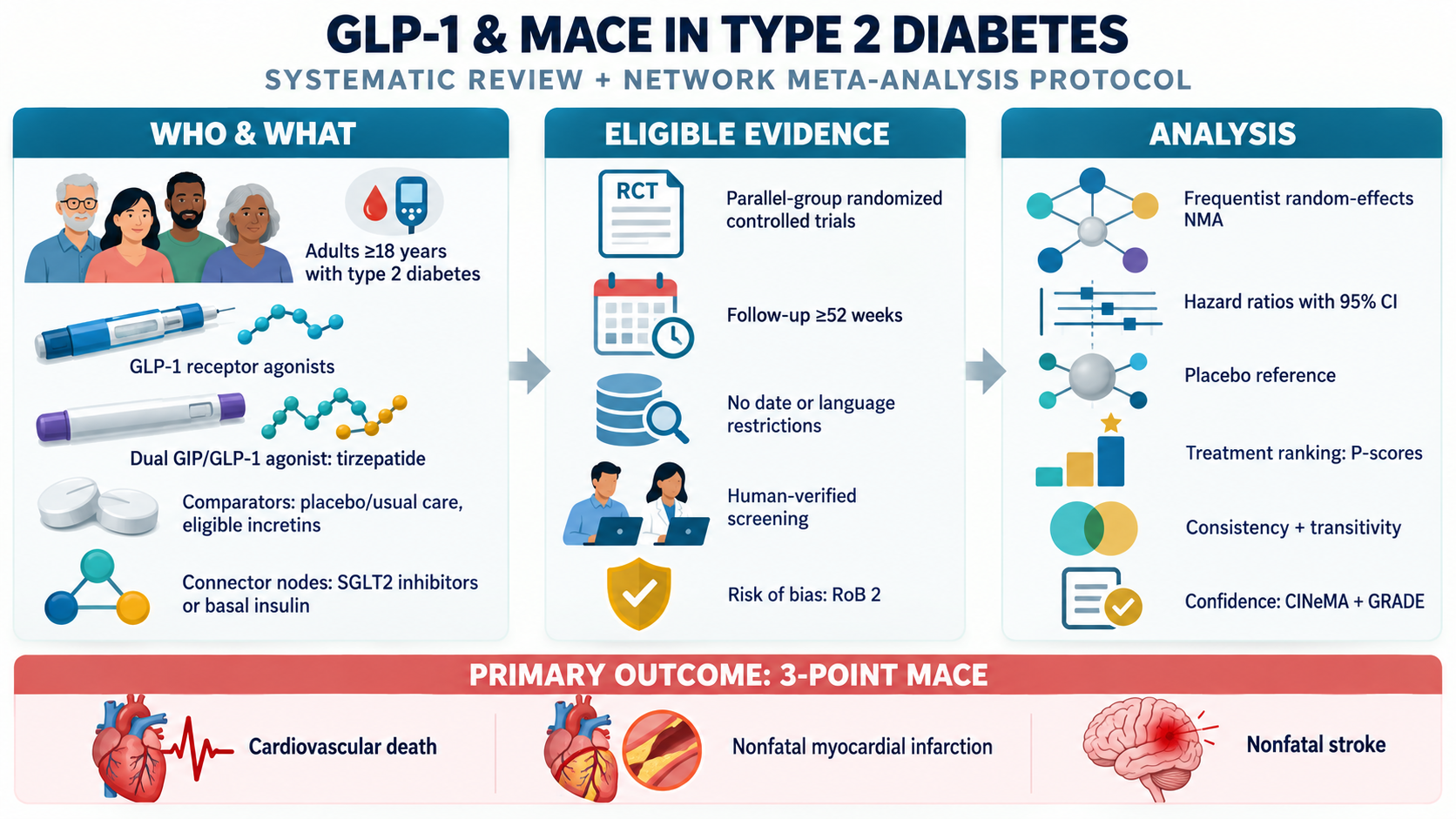
Background: Type 2 diabetes is a cause of cardiovascular morbidity and mortality. Although gluca-gon-like peptide-1 receptor agonists and dual glucose-dependent insulinotropic polypeptide/GLP-1 receptor agonists improve cardiovascular outcomes, their comparative effects across the class re-main uncertain because direct head-to-head evidence is limited. Objective: To compare these agents for major adverse cardiovascular events (MACE) and establish a treatment hierarchy. Methods: This systematic review and network meta-analysis will include parallel-group randomized controlled trials with at least 52 weeks of follow-up involving adults with type 2 diabetes. Eligible trials will compare a GLP-1 receptor agonist or tirzepatide with placebo, standard care, another eligible in-cretin therapy, or, as connector nodes, an SGLT2 inhibitor or basal insulin. The primary outcome is time to first three-point MACE, comprising cardiovascular death, nonfatal myocardial infarction, and nonfatal stroke. MEDLINE, Cochrane CENTRAL, Web of Science, ClinicalTrials.gov, and WHO ICTRP, will be searched without date or language restrictions. Study selection and data extraction will involve human verification, and risk of bias will be assessed using RoB 2. A frequentist ran-dom-effects network meta-analysis will estimate hazard ratios, using placebo as the reference, and rank treatments with P-scores. Transitivity, heterogeneity, and inconsistency will be evaluated through prespecified effect modifiers, node-splitting, and design-by-treatment interaction methods. Confidence in network estimates will be assessed with CINeMA, alongside GRADE for pairwise comparisons. Ethics and dissemination: Ethical approval is unnecessary because only published data will be used. Results, datasets, search strategies, and analytic code will be disseminated through publications, presentations, bilingual summaries, and open repositories.
Keywords:
glucagon-like peptide-1 receptor agonists
; diabetes mellitus
; type 2
; cardiovascular diseases
; myocardial infarction
; stroke
; network meta-analysis
; systematic review
Copyright: This open access article is published under a Creative Commons CC BY 4.0 license, which permit the free download, distribution, and reuse, provided that the author and preprint are cited in any reuse.