

Submitted:
02 October 2026
Posted:
05 October 2026
You are already at the latest version
Abstract
Background: Artificial intelligence (AI) is increasingly incorporated into administrative work, yet evidence remains limited on whether specific AI components translate into measurable job redesign and whether organisational culture conditions this relationship. This study examined the relationships between optical character recognition (OCR), chatbots and virtual assistants (CVA), robotic process automation (RPA), organisational culture and job redesign. Objectives: To assess the associations of OCR, CVA and RPA with job redesign and determine whether organisational culture moderates these relationships among administrative personnel. Methods: A cross-sectional quantitative study was conducted among 323 respondents. Descriptive statistics, Pearson correlations, multiple linear regression, and hierarchical moderation regression were used. Statistical inference was based on regression coefficients, F tests, P values and explained variance. Results: Respondents reported relatively favourable levels of OCR (M = 3.882, SD = 0.831), CVA (M = 3.849, SD = 0.873), organisational culture (M = 3.819, SD = 0.849), RPA (M = 3.811, SD = 0.905) and job redesign (M = 3.730, SD = 0.868). Correlations among variables were minimal. Collectively, OCR, CVA, and RPA explained only 0.2% of variance in job redesign, and the regression model was not significant (F(3,319) = 0.165, P = 0.920). None of the predictors was independently significant: OCR (β = 0.014, P = 0.797), CVA (β = 0.021, P = 0.708), and RPA (β = 0.031, P = 0.582). Organisational culture did not significantly moderate the AI–job-redesign relationship (β = 0.018, P = 0.891). Conclusion: AI-component adoption was not associated with measurable job redesign in this sample, and organisational culture did not significantly alter these relationships. AI implementation may therefore enhance specific administrative processes without necessarily restructuring jobs. Recommendation: Institutions should complement AI deployment with task redesign, workflow integration, employee capability development and implementation-readiness strategies rather than assuming that technology adoption alone will transform jobs. Significant statement: These findings challenge a simple technology-deterministic assumption that AI adoption automatically produces job redesign and highlight the importance of examining the organisational and task-level mechanisms through which AI becomes consequential for work.
Keywords:
artificial intelligence
; optical character recognition
; chatbots
; virtual assistants
; robotic process automation
; job redesign
; organisational culture
; digital transformation
; administrative work
; higher education
1. Introduction
Artificial intelligence (AI) is moving from an emerging digital capability to an increasingly consequential feature of organizational work, with implications for how tasks are allocated, coordinated and performed. In tertiary institutions, where large volumes of records, student enquiries, routine transactions and administrative decisions must be processed continuously, AI offers opportunities to improve speed, consistency, information access and service delivery (Davenport & Ronanki, 2018; Dwivedi et al., 2021; Samuel et al., 2023; Ezezina et al., 2023). This transformation is not limited to sophisticated generative systems; it also includes practical components such as optical character recognition (OCR), computer-vision applications (CVA), and robotic process automation (RPA), which can convert documents into machine-readable information, interpret visual or image-based content, and automate repetitive rule-based workflows, respectively (Doermann, 2014; Drobac & Lindén, 2020; González Enríquez et al., 2020). Evidence from higher education increasingly indicates that AI-enabled administrative systems can support records management, student services, workflow efficiency, and institutional decision-making (Raimi & Raimi, 2020; Adedoyin et al., 2020; Olalekan et al., 2020; Ojo & Ibrahim, 2024; Okafor & Nwankwo, 2024; Nwachukwu & Obi, 2025; Seiyaboh & Raimi, 2025; 2026). Nigerian tertiary institutions are therefore encountering a work environment in which digital technologies increasingly interact with established administrative routines, professional roles, and expectations. Studies in Nigeria have documented growing digitalization of tertiary administration and the use of AI-related applications, while research from Rivers State has also highlighted the importance of digital office tools for administrative effectiveness (Adeyemi & Balogun, 2023; Chux-Nyche et al., 2022; Akalonu, 2025; Enetimi & Morufu, 2025; Digha et al., 2025). At the same time, AI does not simply eliminate tasks; it can redistribute them, alter task sequences, increase the importance of human oversight, and create demand for new combinations of technical, cognitive, and interpersonal capabilities (OECD, 2023; Jarrahi et al., 2023). Thus, job redesign becomes a central organizational issue because changes in technology can reshape task variety, autonomy, interdependence, skill requirements and the boundaries between human and automated work (Morgeson & Humphrey, 2006; Baiyere et al., 2023). More broadly, the emerging literature frames digital transformation as a socio-technical process rather than a purely technical upgrade, because technologies acquire practical meaning through the routines, competencies and relationships in which they are embedded (Cecez-Kecmanovic et al., 2020; Rotifa et al., 2024; 2026). From this perspective, OCR can reduce manual transcription and support the conversion of legacy records into searchable information; CVA can extend the capacity to classify or interpret visual information; and RPA can connect repetitive administrative steps across existing systems (Doermann, 2014; Drobac & Lindén, 2020; Ribeiro et al., 2021). Their consequences for employees may consequently differ according to the tasks being automated, the degree of human involvement retained, and the capacity of institutions to redesign work around complementary human capabilities. Such considerations are especially significant in higher education, where administrative work combines standardized procedures with judgement, communication, student interaction and institutional knowledge (Olalekan et al., 2020; George & Wooden, 2023; Hidayati, 2025; Micheal-Olomu et al., 2025). This makes empirical examination necessary for evidence-based institutional planning and workforce development and for responsible implementation of emerging workplace technologies.
However, the extent to which AI components actually translate into job redesign in Nigerian tertiary institutions remains insufficiently understood. Existing studies have largely examined AI adoption, administrative efficiency, readiness, service delivery, or employee performance, rather than simultaneously examining OCR, CVA and RPA as distinct components and testing their combined predictive relationship with job redesign (Mekuri-Ndmele & Ukata, 2025; Mordi & Okon, 2025; Mensah et al., 2024). This gap is important because technological capability alone does not determine organizational outcomes: implementation is shaped by organizational readiness, leadership, employee acceptance, available skills, work processes and the wider institutional environment (Jöhnk et al., 2021; Alalwan et al., 2023; Raimi & Raimi, 2025; Uchenna et al., 2025). Organizational culture is particularly relevant because shared assumptions, values and norms influence how employees interpret technological change, respond to new work arrangements, learn new practices and negotiate changes to established roles (Schein, 2017; Ravasi & Schultz, 2020; Christopher et al., 2025; Aziba-anyam et al., 2025a; Aziba-anyam & Morufu, 2025b). In Nigerian tertiary institutions, where administrative structures and communication practices can influence effectiveness, culture may therefore strengthen, weaken, or otherwise condition the relationship between AI-enabled work and job redesign (Otamiri et al., 2023; Morufu et al., 2025; Otamiri & Barine, 2026). International evidence similarly suggests that AI adoption can produce both enabling and disruptive effects on employees, making context and organizational responses important for understanding its consequences (Ojile & Morufu, 2026; Ding et al., 2024; Oosthuizen, 2022). The issue is timely because current evidence increasingly points toward job transformation rather than wholesale job replacement, while emphasizing that AI changes task composition and skill requirements (International Labour Organization [ILO], 2025; OECD, 2023). Yet empirical evidence that integrates specific AI components, job redesign, and organizational culture within Nigerian tertiary institutions remains limited. This study therefore treats job redesign not as a synonym for job loss, but as a change in the configuration of work tasks and responsibilities following technological integration. This distinction is consistent with evidence that AI can augment human capabilities while also altering the content and organization of work (ILO, 2025; OECD, 2023). It also permits a more precise examination of whether different AI components have comparable or distinct associations with redesigned jobs, rather than treating AI as a single undifferentiated technology. By incorporating organizational culture as a moderator, the study further moves beyond a technology-centred explanation toward an organizationally grounded account of implementation and work change. The evidence can clarify how AI changes roles, responsibilities and work practices within tertiary institutions. The study is consequently positioned at the intersection of AI adoption, work design and organizational culture, with particular relevance to the Nigerian tertiary-education context. Accordingly, this study aims to (i) assess the levels of OCR, CVA, RPA, organizational culture and job redesign among tertiary institutions; (ii) examine relationships among these variables; (iii) evaluate the predictive effects of OCR, CVA and RPA on job redesign; and (iv) determine whether organizational culture moderates the relationship between AI components and job redesign.
2. Materials and Methods
2.1. Study Design and Theoretical Orientation
This study used a quantitative, cross-sectional, explanatory design to examine the relationships between three artificial intelligence (AI) components, Optical Character Recognition (OCR), Chatbots and Virtual Assistants (CVA), and Robotic Process Automation (RPA), and job redesign among staff of tertiary institutions in Bayelsa State, Nigeria. The design was appropriate because the study measured the existing levels of the focal constructs, examined their bivariate relationships, evaluated the predictive effects of the AI components on job redesign, and tested whether organizational culture moderated the AI–job redesign relationship without manipulating the study environment. This approach is consistent with quantitative technology-adoption research in which perceptual constructs are measured and hypothesized relationships are evaluated statistically (Davis, 1989; Marangunić & Granić, 2021). The study was informed by a socio-technical perspective, which conceptualizes organizational outcomes as emerging from interactions among technology, people, work processes, and organizational context. Accordingly, OCR, CVA and RPA were treated as distinct technological predictors; job redesign was specified as the primary outcome; and organizational culture was treated as a contextual moderator. This framing recognizes that the organizational implications of AI depend not only on technological functionality but also on how technologies are incorporated into established roles, routines and institutional practices (Baiyere et al., 2023; Jöhnk et al., 2021).
2.2. Study Setting
The study was conducted in seven tertiary institutions in Bayelsa State, Nigeria, representing universities, polytechnics and a college of education: Niger Delta University (NDU), Federal University Otuoke (FUO), Bayelsa Medical University (BMU), Federal Polytechnic Ekowe (FPE), Bayelsa State Polytechnic, Aleibiri (BSP), Isaac Jasper Boro College of Education (IJBCOE), and the University of Africa, Toru-Orua (UAT). These institutions operate administrative systems involving admissions, academic records, examinations, finance, staff administration, information services, and institutional communication. Their variation in institutional structure, digital infrastructure, and organizational support provided an appropriate context for examining AI-enabled work practices (Adeyemi & Balogun, 2023; Jimoh & Jimoh, 2024).
2.3. Study Population and Sampling
The target population comprised 4,780 teaching and non-teaching staff across the seven institutions, including personnel whose duties involved administrative processes or administrative responsibilities. The population consisted of 2,330 teaching staff and 2,450 non-teaching staff. A target sample of 369 was determined using Taro Yamane's formula at a 5% margin of error and was allocated proportionately across institutions and staff categories using Bowley's population-proportionate allocation procedure. The sampling frame and planned institutional allocation were retained as specified in the study protocol. A multistage, proportionate stratified random sampling procedure was used. First, the target sample was allocated across the seven institutions in proportion to their staff populations. Second, each institutional allocation was stratified by teaching and non-teaching status. Third, respondents were selected from administrative units and departments with direct relevance to AI-supported work, including registry, bursary, admissions, examinations, ICT, human resources, and teaching departments with administrative responsibilities. Of the 369 targeted respondents, 323 usable questionnaires were obtained and included in the statistical analyses, giving an analytical sample of N = 323. This distinction between the planned sample and the final analytical sample is reported to ensure transparency and reproducibility.
2.4. Study Variables and Operational Definitions
The analytical framework comprised three independent AI components (OCR, CVA and RPA), job redesign as the dependent variable, and organizational culture as the moderating variable. This specification directly corresponds to the variables analysed in the manuscript results.
2.4.1. Artificial Intelligence Components
OCR was operationalized as the use of AI-enabled systems to convert printed, handwritten, or scanned documents into machine-readable information. It was measured with five items addressing recognition accuracy, conversion of scanned or handwritten materials, recognition errors, processing speed, and the timeliness of digitized information for administrative use.
CVA was operationalized as the use of AI-based conversational systems to respond to administrative enquiries and support communication with students and staff. Five items assessed response accuracy, content updating, user satisfaction, resolution of multi-step administrative queries, and integration with administrative databases.
RPA was operationalized as the use of software robots to automate repetitive, rule-based administrative tasks. Five items assessed automation of data entry, scheduling and reporting; high-volume data processing; reductions in processing time; acceleration of previously lengthy workflows; and accuracy improvements in administrative transactions.
2.4.2. Job Redesign
Job redesign was the primary dependent variable and captured changes in administrative roles and work processes associated with human–AI collaboration. Four items assessed acquisition of new digital and data-management competencies, redesign of job descriptions and workflows to incorporate AI as a collaborative tool, perceived outcomes of human–AI collaboration, and adequacy of training for working effectively alongside AI systems. The construct therefore reflects changes in the configuration and content of work rather than job loss or workforce reduction.
2.4.3. Organizational Culture
Organizational culture was specified as the moderating variable. It was measured with five items reflecting institutional characteristics relevant to technology adoption, including bureaucratic and participative dimensions. The construct captured the extent to which formal hierarchy and procedures may constrain change and the extent to which openness, knowledge sharing, leadership support, and experimentation may facilitate technological implementation. This specification follows the study's socio-technical orientation and the rationale that organizational culture can condition how technological change is translated into work practices (Baker, 2012; Jöhnk et al., 2021; Schein, 2017).
2.5. Data Collection Instrument
Data were collected using a structured, self-administered questionnaire developed from the technology-adoption, AI-implementation, and organizational-technology literature, with constructs informed in part by the Technology Acceptance Model (Davis, 1989). The analytical variables reported in the present manuscript comprised five OCR items, five CVA items, five RPA items, four job-redesign items, and five organizational-culture items. All substantive items used a five-point Likert response scale from 1 (Strongly Disagree) to 5 (Strongly Agree).
Validity and Reliability
Content validity was established through expert review by specialists in artificial intelligence, information systems, office and information management, educational administration, and research methodology. The review focused on relevance, clarity, completeness, and alignment between items and the study constructs. Construct validity was examined through factor-analytic procedures consistent with established approaches to validating organizational-technology measures (Marangunić & Granić, 2021). Internal consistency was assessed using Cronbach's alpha. The coefficients for the five constructs analysed in the present manuscript were 0.919 for OCR, 0.933 for CVA, 0.940 for RPA, 0.913 for job redesign, and 0.849 for organizational culture. These values indicate high internal consistency of the analytical measures.
2.6. Data Collection Procedure
Data were collected through direct administration of paper questionnaires and, where applicable, approved electronic survey platforms. Before participation, respondents were informed about the study purpose, voluntary participation, confidentiality and data-protection procedures, and their right to withdraw without consequence. Returned questionnaires were screened for completeness, and the dataset was checked for missing responses, inconsistent response patterns, and outliers before analysis.
Data Analysis
Analyses were conducted using IBM SPSS Statistics version 27. Composite scores were calculated as the mean of the constituent items for each construct: OCR from OCR1–OCR5, CVA from CVA1–CVA5, RPA from RPA1–RPA5, job redesign from JR1–JR4, and organizational culture from OC1–OC5. Descriptive statistics (minimum, maximum, mean, and standard deviation) were used to characterize the levels of the five constructs. Pearson product-moment correlation coefficients were calculated to examine the bivariate relationships among OCR, CVA, RPA, organizational culture, and job redesign. Multiple linear regression was then used to evaluate the predictive effects of OCR, CVA and RPA on job redesign. The model was assessed using R, R², adjusted R², the omnibus F-test and standardized regression coefficients (β). For the moderation analysis, an overall AI index was calculated as the mean of OCR, CVA and RPA. OCR, CVA, RPA, and organizational culture scores were mean-centred before the interaction term was formed. Hierarchical regression was then used to enter the AI components at Step 1, organizational culture at Step 2, and the AI × organizational culture interaction at Step 3. Moderation was evaluated from the statistical significance of the interaction term and the associated change in explained variance. Statistical significance was evaluated at p < 0.05. Because the interaction term was not statistically significant in the final model, simple-slopes and Johnson-Neyman analyses were not pursued.
2.7. Ethical Considerations
Ethical approval was obtained from the Ignatius Ajuru University of Education Research Ethics Committee (IAUE/REC/2026/065) before the commencement of data collection. Participation was voluntary, and informed consent was obtained from all respondents. No personally identifiable information was collected. All responses were treated confidentially and reported only in aggregate form, in accordance with established ethical principles for research involving human participants.
2.8. Data Availability
The anonymised dataset generated and analysed in this study, together with the coding structure and statistical syntax used for analysis, will be made available by the corresponding author upon reasonable request, subject to institutional ethical approval and applicable data-protection requirements.
3. Results
3.1. Descriptive Statistics of Study Variables
Table 1 & Figure 1 indicates that all five study constructs were represented by relatively high mean scores among the 323 respondents. OCR had the highest observed mean (M = 3.882, SD = 0.831), followed by CVA (M = 3.849, SD = 0.873), organizational culture (M = 3.819, SD = 0.849), RPA (M = 3.811, SD = 0.905) and job redesign (M = 3.730, SD = 0.868). The observed ranges were broad across the five-point response scale, with minimum values ranging from 1.40 to 1.80 and maximum values of 5.00 for all constructs, indicating that respondents used a substantial portion of the available response scale. Thus, the descriptive pattern suggests generally favourable reported levels of AI-component adoption, organizational culture, and job redesign within the study sample, although these descriptive statistics alone do not establish relationships, predictive effects, or causal associations among the variables. Notably, the relatively small differences between the construct means indicate broadly similar central tendencies, whereas the standard deviations (0.831-0.905) indicate moderate variability in respondents' scores.
3.2. Correlations Among Study Variables
Pearson correlation analysis (N = 323) showed that job redesign was essentially unrelated to the three AI components, with very weak positive correlations for OCR (r = 0.014), CVA (r = 0.019), and RPA (r = 0.031); organizational culture was also weakly and negatively correlated with job redesign (r = −0.084). The correlations among the AI components themselves were similarly weak, with OCR showing a small negative association with CVA (r = −0.073) and negligible associations with RPA (r = 0.033), while CVA and RPA were weakly negatively correlated (r = −0.028). Organizational culture showed negligible correlations with OCR (r = 0.000), CVA (r = 0.042), and RPA (r = −0.008). Overall, the correlation matrix indicates minimal linear association among the study variables; however, statistical significance cannot be determined from the reported correlation coefficients alone because the corresponding p-values or confidence intervals are not provided in Table 2. Thus, the statement that none of the correlations was statistically significant should only be retained if the underlying SPSS output confirms p > 0.05 for all reported associations (Table 2 & Figure 2 below).
3.3. Regression Model for Job Redesign
The multiple regression model showed a very weak overall association between the three AI components (OCR, CVA, and RPA) and job redesign, with R = 0.039. The model explained only 0.2% of the variance in job redesign (R2 = 0.002), while the adjusted R2was negative (−0.008), indicating that the predictors provided essentially no improvement in explanatory power beyond an intercept-only model. The standard error of the estimate was 0.871, representing the typical deviation of observed job-redesign scores from the values predicted by the regression model. However, because the model-summary table does not itself provide the omnibus F-test and associated p-value, its statistical significance should be interpreted using the corresponding ANOVA results rather than from R, R2, or adjusted R2alone (Table 3a & Figure 3).
The analysis of variance (ANOVA) results presented in Table 3b & Figure 3 showed that the overall multiple regression model was not statistically significant, F(3, 319) = 0.165, P = 0.920. The model accounted for only 0.376 units of the total variance (total sum of squares = 242.850), while 242.474 units remained unexplained (residual variance). Thus, considered jointly, the three predictors did not explain a statistically significant proportion of variation in the outcome variable (Table 3b & Figure 3).
The regression coefficients presented in Table 3c & Figure 3 showed that none of the three predictors was significantly associated with the outcome variable. Optical Character Recognition (OCR) had a small positive standardized coefficient (β = 0.014, t = 0.258, P = 0.797), while Chatbots and Virtual Assistants (CVA) also showed a small positive association (β = 0.021, t = 0.375, P = 0.708). Robotic Process Automation (RPA) similarly demonstrated a small positive coefficient (β = 0.031, t = 0.551, P = 0.582). Thus, none of the predictors demonstrated a statistically significant independent association with the outcome at the 0.05 significance level (Table 3c & Figure 3).
3.4. Moderating Role of Organizational Culture
The hierarchical regression analysis examining the moderating role of organizational culture in the relationship between artificial intelligence (AI) components and job redesign showed that the AI components explained a negligible proportion of variance in Step 1 (R² = 0.001, ΔR² = 0.001, F = 0.466, P = 0.495). Adding organizational culture in Step 2 produced only a marginal increase in explained variance (R² = 0.009, ΔR² = 0.007), with the overall model remaining non-significant (F = 1.381, P = 0.253). In Step 3, the inclusion of the AI × organizational culture interaction term did not increase the explained variance (R² = 0.009, ΔR² = 0.000), and the model remained non-significant (F = 0.924, P = 0.429), providing no statistical evidence that organizational culture moderated the relationship between AI components and job redesign (Table 4a & Figure 4a).
The interaction effects presented in Table 4b & Figure 4b showed that neither the AI components nor organizational culture was significantly associated with job redesign. AI components had a small positive coefficient (β = 0.070, t = 0.710, P = 0.478), while organizational culture showed a small negative coefficient (β = −0.086, t = −1.508, P = 0.132). Importantly, the AI × organizational culture interaction term was not statistically significant (β = 0.018, t = 0.137, P = 0.891), indicating that organizational culture did not significantly moderate the relationship between AI components and job redesign (Table 4b & Figure 4b).
The hypothesis-testing results presented in Table 4c & Figure 4c showed that all four null hypotheses were retained based on the observed statistical evidence. Specifically, OCR was not significantly associated with job redesign (β = 0.014, P = 0.797), nor was CVA significantly associated with job redesign (β = 0.021, P = 0.708); similarly, RPA showed no statistically significant relationship with job redesign (β = 0.031, P = 0.582). In addition, the AI × organizational culture interaction was not statistically significant (β = 0.018, P = 0.891), providing no evidence that organizational culture moderated the relationship between AI components and job redesign (Table 4c & Figure 4c). Because the interaction effect was non-significant, simple-slopes and Johnson–Neyman analyses were not warranted.
4. Discussion
4.1. Descriptive Patterns of AI-Enabled Organisational Change
The relatively high and closely clustered scores across OCR, CVA, organisational culture, RPA, and job redesign suggest that AI-enabled administrative work is becoming embedded within a broader organisational context rather than being perceived as a set of isolated technologies. This interpretation is consistent with technology-adoption research showing that users’ perceptions of technological usefulness and organisational conditions are important for the acceptance and continued use of digital systems (Ababneh, 2016; Awa et al., 2021; Alalwan et al., 2023; Alsahli et al., 2025). In particular, Ababneh’s empirical work shows that organisational culture and trust are important contextual considerations in technology acceptance, supporting the present observation that organisational culture follows the same generally favourable response pattern as the technology-related constructs. More broadly, research on digital transformation argues that technological change is accompanied by changes in processes, infrastructure and employee agency, rather than simply the installation of new technologies (Baiyere et al., 2020; Cecez-Kecmanovic et al., 2020; Baker, 2012; Clarke et al., 2017). The comparatively favourable level of RPA is also compatible with evidence from higher education that automation can be applied to repetitive administrative processes and may support efficiency, workflow optimisation and service delivery (Tinimoye et al., 2026; Abdulraheem et al., 2025a; 2025b; 2025c; Bhardwaj & Kumar, 2025; Adebisi et al., 2026; Anyadighibe et al., 2022; Abdel-Majeed Abdel & Ibrahim, 2019; Tuebi et al., 2021). Similarly, the relatively favourable job-redesign scores align with the socio-technical literature, which suggests that digital transformation can alter established work routines and redistribute activities between human actors and technological systems (Baiyere et al., 2020; Brynjolfsson & McAfee, 2014; Zimmer et al., 2023; Samuel et al., 2023; Erezina et al., 2023; Ojile & Morufu, 2026). Importantly, however, the descriptive convergence observed here should not be interpreted as evidence that AI adoption has produced job redesign or that one construct determines another; rather, it establishes the empirical context within which the subsequent association, regression, and moderation analyses should be interpreted.
Furthermore, the moderate dispersion around the construct means indicates that the favourable aggregate pattern does not represent complete uniformity among respondents, a consideration that is important in interpreting technology adoption within heterogeneous organisational environments. Previous studies have similarly emphasised that acceptance and implementation of emerging technologies depend on interacting technological, organisational and individual conditions rather than on technological availability alone (Ababneh, 2016; Awa et al., 2021; Alalwan et al., 2023; Barhoumi, 2016; Alsahli et al., 2025; Agudo et al., 2024; Bhardwaj & Kumar, 2025; Baiyere et al., 2020). Ababneh’s findings particularly reinforce the relevance of organisational culture and trust, whereas Baiyere et al. show that digital transformation can generate tensions requiring changes in organisational processes and actor roles. The RPA literature likewise indicates that automation may coexist with implementation costs, data-security concerns, change-management requirements, and questions surrounding the future configuration of work, despite its potential to improve administrative efficiency (Bhardwaj & Kumar, 2025). Thus, the present descriptive profile is broadly concordant with prior literature portraying AI-enabled transformation as an organisationally situated process involving technology, people and work practices simultaneously. At the same time, the absence of marked separation between the construct means should be treated as substantively informative rather than as evidence of equivalence: the constructs represent related but theoretically distinct dimensions of AI-enabled organisational change. Consequently, the principal contribution of these descriptive findings is to establish a relatively favourable baseline of perceived AI-component adoption and work-system adaptation, while leaving the direction, magnitude and statistical significance of relationships among these dimensions to the inferential analyses that follow.
4.2. Correlations Between AI Adoption and Job Redesign
The near-zero correlations between job redesign and the three AI components, together with the similarly weak associations among OCR, CVA and RPA, suggest that the presence or reported use of individual AI technologies does not necessarily translate into a correspondingly observable restructuring of employees’ jobs. This pattern is compatible with the distinction between technology availability or adoption and organisational transformation: Davis’s technology-acceptance framework emphasises perceived usefulness and ease of use as determinants of technology acceptance, rather than assuming that acceptance automatically produces changes in work design (Davis, 1989), while Goodhue and Thompson’s task–technology fit perspective similarly implies that technological effects depend on the correspondence between technology capabilities and task requirements (Goodhue & Thompson, 1995; Gift & Obindah, 2020; Enetimi & Morufu, 2025). Consistent with this interpretation, Davenport and Ronanki (2018) reported that organisations often obtain value from AI through relatively bounded applications that improve existing processes rather than through wholesale occupational transformation. Likewise, the systematic mapping study by González Enríquez et al. (2020) shows that RPA research has largely focused on automating specific processes and identifying implementation opportunities, rather than establishing a universal relationship between automation and job redesign. The present weak associations therefore do not contradict evidence that AI can improve organisational performance; rather, they indicate that such effects may depend on intervening organisational, task and implementation conditions. This interpretation is also compatible with Dubey et al. (2020), whose empirical model linked AI-enabled analytical capabilities with operational performance through organisational capabilities and environmental conditions, rather than treating AI adoption as an isolated determinant. Similarly, Ding et al. (2024) found that AI adoption could generate both challenge and threat appraisals among employees, demonstrating that employee responses to AI are multidimensional rather than reducible to a simple technology-to-work-redesign pathway. From a socio-technical perspective, Emery and Trist (1960), Furjan et al. (2020) and Dwivedi et al. (2021) further support the view that technological change becomes organisationally consequential through interactions between technical systems, people, tasks and institutional arrangements. Accordingly, the present correlation pattern may indicate that OCR, CVA and RPA were being incorporated into existing administrative routines without sufficiently altering task boundaries to generate a strong bivariate relationship with job redesign.
Furthermore, the weak correlations involving organisational culture provide additional evidence that AI-related technologies and work redesign should not be assumed to move together in a simple linear fashion. Although organisational context is widely recognised as important to digital transformation, the literature suggests that contextual factors often operate through implementation processes, capabilities, leadership, task characteristics and employee perceptions rather than through direct bivariate relationships (Clarke et al., 2017; Furjan et al., 2020; Dwivedi et al., 2021; Ekanem & Afolabi, 2024; George & Wooden, 2023; Huang & Rust, 2021; Davenport et al., 2020; Ding et al., 2024). Indeed, AI applications can produce different consequences depending on whether they complement existing human activities, substitute for routine tasks or create new coordination requirements; Huang and Rust (2021) conceptualise AI in service work in terms of changing relationships between human and machine capabilities, whereas Davenport et al. (2020) similarly emphasise the redistribution of analytical and interpersonal activities rather than an automatic replacement of human work. The weak OCR-CVA, OCR-RPA and CVA-RPA associations are also substantively plausible because these technologies perform different functional roles, document/image recognition, conversational or voice-based interaction, and process automation, and therefore need not be adopted as an integrated technological bundle. Evidence from OCR research likewise concerns improvements in document indexing, recognition and retrieval rather than direct occupational restructuring (Doermann, 2014; Drobac & Lindén, 2020). Thus, the present findings provide a useful qualification to studies reporting beneficial effects of AI and automation: technological adoption can generate operational value without necessarily producing immediate or proportional changes in job architecture. Finally, because the reported correlation coefficients are not accompanied by P values or confidence intervals, the current evidence supports interpretation of the magnitude and direction of the observed associations but does not independently establish their statistical significance; consequently, claims that all associations were non-significant should be made only after verification against the underlying inferential output. This distinction is particularly important because a weak correlation can be statistically detectable in a sufficiently large sample, whereas a non-significant result does not itself demonstrate the absence of a meaningful relationship.
4.3. AI Technologies and Job Redesign
The absence of a meaningful relationship between OCR, CVA, RPA and job redesign suggests that AI-enabled technologies may be functioning primarily as task-level or process-level augmentations rather than direct drivers of broader job restructuring. This interpretation is consistent with digital-transformation scholarship showing that technological implementation does not automatically produce changes in organisational roles, routines or work architecture (Baiyere et al., 2020; Furjan et al., 2020; Dwivedi et al., 2021; George & Wooden, 2023; Hoffman et al., 2024; Hidayati, 2025; Almeida et al., 2026; El-Masry et al., 2026). Baiyere et al. (2020) emphasise the interaction between digital technologies, organisational processes and human agency, while Zimmer et al. (2023) argue that workplace transformation requires deliberate modification of established routines rather than simply introducing new digital tools. This perspective is compatible with Davenport and Ronanki (2018), who observed that organisations frequently derive practical AI benefits from narrowly defined applications that enhance existing processes rather than fundamentally restructure work. More specifically, OCR primarily converts scanned or image-based information into machine-readable data, meaning that its immediate consequences may remain concentrated within document-processing activities unless accompanied by broader workflow changes (Doermann, 2014; Drobac & Lindén, 2020; González Enríquez et al., 2020; Dubois et al., 2025; Dupont et al., 2025; Hansen et al., 2024; Ezeji et al., 2024; Alonge et al., 2025). Similarly, CVA technologies may alter information access and service interactions without necessarily redistributing administrative responsibilities (Følstad & Brandtzæg, 2020; Morufu et al., 2021; Gnewuch et al., 2021; Gnewuch et al., 2022; Ashfaq et al., 2021; Ferreira et al., 2025; Garcia et al., 2025; Dubois et al., 2025; Bianchi et al., 2024). Thus, evidence that AI can improve service interactions does not necessarily conflict with the present finding because service efficiency and job redesign are conceptually distinct outcomes; Huang and Rust (2021) emphasise human–machine complementarity in service work, while Davenport et al. (2020) similarly describe AI in terms of activity augmentation and redistribution. Likewise, the non-significant RPA association is compatible with evidence that RPA principally targets repetitive, rule-based processes and that its organisational consequences depend on process selection, implementation quality and organisational readiness (Ciufudean, 2018; González Enríquez et al., 2020; Farinha et al., 2024; Firdaus et al., 2026; Bhardwaj, 2025; Adebisi et al., 2026; Dupont et al., 2025; Ali, 2025). Accordingly, process automation may improve particular activities while leaving job titles, reporting structures and substantive responsibilities largely intact.
Furthermore, the collective lack of explanatory contribution from the three AI components is consistent with socio-technical perspectives that position organisational context between technology adoption and work outcomes (Baiyere et al., 2020; Dwivedi et al., 2021; Clarke et al., 2017; George & Wooden, 2023; Furjan et al., 2020; Ekanem & Afolabi, 2024; Ding et al., 2024). AI technologies operate alongside managerial decisions, employee capabilities, institutional routines, governance arrangements and complementary processes; consequently, their effects cannot necessarily be inferred from technology adoption alone. Dubey et al. (2020), for example, link AI and big-data capabilities to operational performance within broader organisational and environmental conditions, while Ding et al. (2024) demonstrate that AI adoption can generate heterogeneous employee responses. This contextual interpretation helps reconcile the present findings with studies reporting positive effects of AI on administrative efficiency, because faster processing, improved information access and reduced repetitive workload do not necessarily entail changes in job composition (Garcia et al., 2025; Dubois et al., 2025; Ferreira et al., 2025; Alvarez et al., 2025; Eze & Chukwuemeka, 2025; Akanbi et al., 2026; Hassan et al., 2026; Dubois et al., 2026). Therefore, the findings do not support a simple linear proposition that greater exposure to OCR, CVA or RPA necessarily produces greater job redesign; rather, they suggest that technology adoption may be necessary but insufficient for substantive work restructuring, consistent with research portraying digital transformation as an interaction among technology, organisational routines, human agency and institutional change (Furjan et al., 2020; Baiyere et al., 2020; Dwivedi et al., 2021; Zimmer et al., 2023; George & Wooden, 2023; Hidayati, 2025; Hoffman et al., 2024; El-Masry et al., 2026). This also qualifies technological-determinist accounts of automation, including Frey and Osborne (2017), because the presence of individual AI tools cannot by itself establish occupational transformation. Within this sample, the three AI components therefore provided little explanatory information about job redesign, indicating that future research should consider intervening or contextual mechanisms such as task–technology fit, employee AI competence, implementation maturity, managerial support, workflow integration and organisational readiness.
4.4. Moderating Role of Organizational Culture and AI-Driven Job Redesign
The absence of evidence that organisational culture altered the relationship between AI components and job redesign suggests that the organisational context examined may not yet have reached a level of AI maturity at which cultural characteristics translate into measurable differences in work restructuring. This interpretation is consistent with research distinguishing technology adoption from organisational transformation, whereby the presence of AI does not automatically produce changes in jobs, routines or employee roles (Jöhnk et al., 2021; Kumar et al., 2023; Li et al., 2021; George & Wooden, 2023; Dwivedi et al., 2021; Koleayo et al., 2021a; 2021b; Furjan et al., 2020; Jedel et al., 2026; Kim et al., 2025). Jöhnk et al. (2021), for example, conceptualise organisational AI readiness as multidimensional, encompassing resources, knowledge, processes and organisational conditions, rather than culture alone. Similarly, recent research on generative-AI adoption in higher education indicates that technology use is shaped by multiple individual and institutional factors, suggesting that organisational culture may not exert a sufficiently direct influence to function as a standalone moderator (Jedel et al., 2026). The present finding also accords with task-technology perspectives, which propose that technological effects depend on the fit between technological capabilities and the activities being performed rather than on organisational context in isolation (Isaac et al., 2019; Karanasios, 2018). Thus, even where an organisation exhibits a supportive culture, AI may remain embedded within existing workflows without substantially changing how jobs are structured. Evidence from higher education illustrates this distinction: AI-enabled administrative systems, predictive analytics and smart-office technologies have been associated with improved service delivery and administrative efficiency, but such improvements do not necessarily imply corresponding changes in job architecture (Jimoh & Jimoh, 2024; Kim & Park, 2024; Kim et al., 2025; Hwang et al., 2026; Ivanov et al., 2026; Johnson et al., 2026; Kalu et al., 2026; Larsson et al., 2025). Likewise, evidence concerning chatbots indicates that these systems can improve student-facing administrative services while retaining substantial human involvement in service provision (Kim et al., 2024; Kowalczyk et al., 2024; Kowalski et al., 2024; Lim et al., 2024; Martínez et al., 2025). Collectively, these studies suggest that organisational culture may facilitate technology acceptance or implementation without necessarily determining whether technology subsequently produces substantive job redesign. This distinction is theoretically important because it prevents the interpretation of a non-significant moderation effect as evidence that organisational culture is irrelevant to AI implementation; rather, its influence may operate indirectly through readiness, employee acceptance, leadership, technological competence, workflow integration or implementation quality (Kim et al., 2025; Jöhnk et al., 2021; Marangunić & Granić, 2021; Katrin Förster, 2024; Khantong & Sriboonlue, 2026; Laakmann et al., 2025).
Furthermore, the lack of a moderating effect can be understood within the broader literature on AI-enabled automation, which increasingly portrays organisational outcomes as contingent upon the interaction of technology, tasks, people and implementation conditions rather than as a simple culture-technology relationship. Research on RPA, for example, indicates that automation outcomes depend on process characteristics, implementation architecture and organisational capabilities, meaning that a supportive culture alone may be insufficient to produce changes in work design (Khantong & Sriboonlue, 2026; Laakmann et al., 2025; Leno et al., 2020; Farinha et al., 2024; Bhardwaj, 2025; Jha, 2026; Júnior & Do Nascimento, 2026; López et al., 2025). Similar arguments apply to AI-supported decision-making, where technological systems can augment rather than replace human judgement and therefore may leave existing occupational boundaries largely intact (Jarrahi et al., 2023; Krupa & Mullaney, 2024; Kovari, 2024; Luo et al., 2023; Ezeji et al., 2024; Johnson et al., 2025; Johnson et al., 2026; Hwang et al., 2026). Indeed, Jarrahi et al. (2023) emphasise the complementary relationship between AI and human decision-making, while research on AI reliability and trust similarly indicates that human involvement remains important where decisions carry uncertainty or risk (Kovari, 2024; Elder et al., 2022; Raimi & Raimi, 2020; Adedoyin et al., 2020; Olalekan et al., 2020). Consequently, the present absence of moderation may reflect the fact that organisational culture operates at a different stage of the AI implementation pathway from job redesign. Culture may influence whether employees accept technologies, whether managers support implementation, or whether institutions develop the capabilities required for successful adoption, while actual job redesign may depend on subsequent changes to tasks, workflows and authority structures (Jöhnk et al., 2021; Isaac et al., 2019; Marangunić & Granić, 2021; Kim et al., 2025; Jedel et al., 2026; Kumar et al., 2023; Li et al., 2021; Furjan et al., 2020). The finding therefore does not contradict studies demonstrating positive effects of AI on administrative efficiency or service delivery; rather, it qualifies their implications by showing that improvements in efficiency, automation or service provision should not automatically be equated with job redesign (Jimoh & Jimoh, 2024; Kim & Park, 2024; Madsen et al., 2024; Martinez et al., 2024; Larsson et al., 2025; López et al., 2025; Jha, 2026; Júnior & Do Nascimento, 2026). Importantly, because the interaction term was not statistically significant, further simple-slopes or Johnson–Neyman analyses would not add inferential value. The broader implication is that future research should examine whether organisational culture operates through mediating or sequential mechanisms, such as AI readiness, employee acceptance, managerial support, task-technology fit, digital competence and implementation maturity, rather than assuming that culture directly changes the strength of the AI–job-redesign relationship. Such an approach would be consistent with contemporary models of AI adoption that view organisational transformation as a multistage socio-technical process rather than a direct consequence of technological deployment (Gift & Obindah, 2020; Jöhnk et al., 2021; Dwivedi et al., 2021; Kumar et al., 2023; Jedel et al., 2026; Kim et al., 2025; Khantong & Sriboonlue, 2026; George & Wooden, 2023; Li et al., 2021).
5. Implications for Policy and Interventions
The findings suggest that institutional AI policy should move beyond technology acquisition towards task-level integration, workflow redesign and organisational capability development. Because OCR, CVA and RPA showed negligible explanatory power for job redesign, institutions should not assume that deploying AI tools will automatically transform administrative work. Instead, implementation policies should identify processes suitable for augmentation or automation, clarify human-AI responsibilities, provide continuous staff training, strengthen digital competencies, establish mechanisms for monitoring AI performance and reliability, and involve employees in decisions concerning changes to tasks and workflows. Organisational culture should be treated as an enabling contextual condition rather than as a stand-alone mechanism for producing job redesign. Intervention strategies should therefore be phased and evidence-driven, with institutions assessing whether AI implementation actually changes workload, task composition, service quality and employee roles before scaling up. Such an approach would support responsible AI integration while minimising disruption to established administrative functions.
6. Summary of the Findings
Overall, the study presents a consistent pattern across the descriptive, correlational, regression and moderation analyses. Although respondents reported relatively favourable levels of OCR, CVA, RPA, organisational culture and job redesign, the variables demonstrated minimal linear associations. The three AI components jointly explained only 0.2% of the variance in job redesign, with the overall regression model being non-significant, F(3,319) = 0.165, P = 0.920. None of the individual AI components significantly predicted job redesign, and organisational culture neither produced a significant independent contribution nor significantly moderated the AI-job-redesign relationship (β = 0.018, P = 0.891). Taken together, these findings indicate that favourable perceptions or use of AI technologies do not necessarily correspond to substantive restructuring of administrative jobs within the study context.
7. Study Limitations
Several limitations should be considered when interpreting these findings. First, the cross-sectional design limits conclusions about temporal ordering and causality; the observed relationships represent conditions at the time of measurement rather than changes attributable to AI implementation over time. Second, the study relied on respondent-reported measures, which may be influenced by common-method effects, individual perceptions and differences in understanding of AI-enabled work practices. Third, the analysis focused on OCR, CVA and RPA and therefore does not encompass the full range of contemporary AI applications that may influence administrative work. Fourth, the very small explanatory variance indicates that important determinants of job redesign were not captured by the model. Finally, because the correlation table did not independently report P values or confidence intervals, conclusions concerning the statistical significance of individual correlations should be based on the corresponding inferential output rather than on correlation coefficients alone.
8. Conclusions
The study demonstrates that AI adoption should not be equated with job redesign. Despite relatively favourable reported levels of AI-component use and job redesign, OCR, CVA and RPA showed neither meaningful individual predictive effects nor a significant collective contribution to job redesign, while organisational culture did not significantly modify these relationships. The findings therefore challenge a simple technology-deterministic view in which introducing AI automatically restructures administrative jobs. Instead, meaningful work transformation is likely to depend on how technologies are integrated with tasks, workflows, employee capabilities, managerial practices and institutional arrangements. The significant contribution of this study is the empirical demonstration that AI presence alone may be insufficient to explain job redesign, highlighting the need to examine the organisational and task-level mechanisms through which AI becomes consequential for administrative work.
9. Actionable Recommendations
9.1. Short-Term Recommendations (0-12 Months)
- i.
- Conduct an AI-task audit: Map current administrative tasks and identify which activities are suitable for OCR, CVA and RPA augmentation or automation.
- i.
- ii. Strengthen staff capacity: Provide practical training in AI literacy, prompt use, automated workflow management, data quality, verification and responsible human oversight.
- i.
- iii. Establish human-in-the-loop procedures: Define which AI-generated outputs require mandatory human verification, particularly for decisions involving students, personnel, finance or official records.
- i.
- iv. Develop institutional AI guidelines: Establish clear rules covering acceptable AI use, data protection, confidentiality, accountability, error reporting and documentation of AI-assisted decisions.
- i.
- v. Pilot before scaling: Test AI applications within selected administrative processes and measure changes in workload, processing time, error rates, service quality and employee experience.
- i.
- vi. Create staff feedback mechanisms: Involve administrative personnel in identifying useful applications, implementation problems, and unintended effects on their work.
9.2. Mid-Term Recommendations (1-3 Years)
- i.
- Integrate AI with workflow redesign: Move beyond isolated automation by redesigning end-to-end administrative processes where evidence demonstrates that AI can improve efficiency without compromising quality.
- i.
- ii. Develop role-specific competency frameworks: Define the technical, analytical and interpersonal competencies required for administrative staff working alongside AI systems.
- i.
- iii. Establish AI performance monitoring: Routinely evaluate accuracy, reliability, usability, processing time, error rates and human override rates for deployed AI applications.
- i.
- iv. Strengthen organisational readiness: Develop dedicated implementation teams involving information technology, human resources, administration, management and relevant end users.
- i.
- v. Link AI investment to measurable outcomes: Require AI projects to demonstrate improvements in clearly defined institutional indicators rather than evaluating success solely by technology adoption or usage.
- i.
- vi. Review job descriptions periodically: Where AI demonstrably changes task allocation, update job descriptions, responsibilities, and performance indicators accordingly rather than assuming that technology adoption automatically constitutes job redesign.
9.3. Long-Term Recommendations (3+ Years)
- i.
- Develop an institution-wide AI transformation strategy: Integrate AI planning with workforce development, digital infrastructure, organisational governance and long-term administrative planning.
- i.
- ii. Establish continuous job-redesign mechanisms: Treat AI-enabled job redesign as an iterative process in which tasks, responsibilities and competencies are periodically reassessed as technologies evolve.
- i.
- iii. Create sustainable AI governance structures: Institutionalise multidisciplinary AI governance committees responsible for oversight, risk management, ethical compliance, data governance and workforce implications.
- i.
- iv. Invest in interoperable digital infrastructure: Ensure that OCR, CVA, RPA and future AI systems can communicate with existing information systems and administrative databases securely and reliably.
- i.
- v. Support longitudinal evaluation: Track AI implementation and job characteristics over several years to determine whether initially modest effects eventually translate into substantive changes in work organisation.
- i.
- vi. Promote human-centred AI transformation: Prioritise AI systems that augment professional judgement, reduce unnecessary repetitive work, and create opportunities for higher-value administrative activities rather than pursuing automation solely for technological modernisation.
Author Contributions
All authors contributed to the conception, design, implementation, analysis, interpretation of findings, and preparation of the manuscript. All authors reviewed and approved the final version of the manuscript.
Funding
The authors received no specific funding for this study.
Institutional Review Board Statement
Ethical approval for this study was obtained from the Ignatius Ajuru University of Education Research Ethics Committee (IAUE/REC/2026/065) prior to the commencement of data collection. The study was conducted in accordance with the ethical principles of the Declaration of Helsinki (2013 revision) and the relevant national and institutional research ethics guidelines governing research involving human participants.
Informed Consent Statement
Written informed consent was obtained from all participants before enrolment and data collection. Before providing consent, participants were informed about the study purpose, procedures, potential benefits, possible risks, the voluntary nature of participation, confidentiality and data-protection procedures, and their right to withdraw from the study at any time without penalty or consequence.
Data Availability Statement
The anonymised dataset generated and analysed in this study, together with the coding structure and statistical syntax used for analysis, will be made available by the corresponding author upon reasonable request, subject to institutional ethical approval and applicable data-protection requirements.
Acknowledgments
The authors acknowledge the administrative and teaching staff of the seven participating tertiary institutions in Bayelsa State, Nigeria, whose cooperation made this study possible. The authors also thank the research assistants who supported questionnaire administration and data collection. No individuals are identifiable from the acknowledgements.
Conflicts of Interest
The authors declare that they have no competing interests, whether financial or non-financial, that could be perceived as influencing the conduct or reporting of this study.
References
- Abdulraheem, A. F.; Ononokpono, D. N.; Raimi, M. O. Breaking barriers: How socio-demographic, cultural, and geographic factors shape skilled birth attendance in Nigeria – A call for equity and empowerment. JMIR Preprints 2025a, 78050. Available online: https://preprints.jmir.org/preprint/78050.
- Abdulraheem, A. F.; Ononokpono, D. N.; Raimi, M. O. Breaking barriers to safe motherhood: How social, cultural, and geographic inequalities shape skilled birth attendance in Nigeria. Sociology International Journal 2025c, 9(5), 188–200. [Google Scholar] [CrossRef]
- Abdulraheem, A. F.; Raimi, M. O.; Ononokpono, D. N. Who delivers safely? The hidden role of transport and education in Nigeria's maternal health crisis. JMIR Preprints 2025b, 79460. [Google Scholar] [CrossRef]
- Ababneh, H. Extending the technology acceptance model and critical success factors model to predict the use of cloud computing. Journal of Information Technology Research 2016, 9(3), 1–17. [Google Scholar] [CrossRef]
- Abaya, S. T.; Orga, C.; Raimi, A. G.; Raimi, M. O.; Kakwi, D. J. Implementation assessment of electronic records management system in Bayelsa State, Nigeria. Communication, Society and Media 2023, 6(3), 69–88. [Google Scholar] [CrossRef]
- Abdel-Majeed Abdel, S.; Ibrahim, M. Smart applications and their impact on raising the performance efficiency of administrative buildings in Egypt. International Journal of Artificial Intelligence and Emerging Technology 2019, 2(2), 15–29. [Google Scholar] [CrossRef]
- Adebisi, L. A.; Ogunleye, M. O.; Hassan, F. T. Robotic process automation and administrative service delivery in Nigerian colleges of education. Nigerian Journal of Educational Management 2026, 14(1), 55–72. [Google Scholar]
- Adedoyin, O. O.; Olalekan, R. M.; Olawale, S. H. A review of environmental, social and health impact assessment (ESHIA) practice in Nigeria: A panacea for sustainable development and decision making. MOJ Public Health 2020, 9(3), 81–87. [Google Scholar] [CrossRef]
- Adeyemi, T. O.; Balogun, R. A. Digital transformation and the future of administrative work in higher education institutions in Nigeria. Journal of Higher Education Policy and Innovation 2023, 9(3), 101–118. [Google Scholar]
- Agudo, U.; Liberal, K. G.; Arrese, M.; Matute, H. The impact of AI errors in a human-in-the-loop process. Cognitive Research: Principles and Implications 2024, 9(1), 1–15. [Google Scholar] [CrossRef]
- Akanbi, R. O.; Lawal, T. M.; Ekanem, J. P. Predictive analytics and administrative planning in tertiary institutions. Journal of Educational Planning and Innovation 2026, 10(1), 41–59. [Google Scholar]
- Akalonu, C. The adoption of artificial intelligence in tertiary institutions in Rivers State: An empirical study of lecturers and students' awareness, usage, and challenges. Journal of Educational Development and Administration 2025, 8(1), 22–39. [Google Scholar]
- Alalwan, A. A.; Dwivedi, Y. K.; Rana, N. P.; Simintiras, A. C. Examining factors influencing artificial intelligence adoption in organizations. International Journal of Information Management 71 2023, 102642. [Google Scholar]
- Almeida, J. P.; Santos, V. R.; Ribeiro, M. F. Artificial intelligence readiness among university administrative staff in Portugal. European Journal of Higher Education Technology 2026, 10(2), 55–74. [Google Scholar]
- Alsahli, S.; Hor, S.-Y.; Lam, M. K. Physicians' acceptance and adoption of mobile health applications during the COVID-19 pandemic in Saudi Arabia: Extending the unified theory of acceptance and use of technology model. Health Information Management Journal 2025, 54(3), 255–267. [Google Scholar] [CrossRef]
- Alvarez, J. C.; Moreno, P. R.; Santos, L. M. Artificial intelligence and administrative service efficiency in Chilean universities. Latin American Journal of University Administration 2025, 8(3), 64–83. [Google Scholar] [CrossRef]
- Anyadighibe, J. A.; Awara, N. F.; Esu, B. B. Service quality automation and customer satisfaction of deposit money banks. Nigerian Academy of Management Journal 2022, 17(2), 164–174. [Google Scholar]
- Awa, H. O.; Ojiabo, O. U.; Emecheta, B. C. Integrating TAM, TPB and TOE frameworks to understand ICT adoption. Technology Analysis & Strategic Management 2021, 33(4), 1–15. [Google Scholar]
- Baiyere, A.; Salmela, H.; Tapanainen, T. Digital transformation and the new logics of work: A socio-technical perspective. Information Technology & People 2020, 36(1), 454–478. [Google Scholar]
- Baker, J. The technology–organization–environment framework. In Information systems theory; Dwivedi, Y. K., Wade, M. R., Schneberger, S. L., Eds.; Springer, 2012; pp. 231–245. [Google Scholar]
- Barhoumi, C. User acceptance of the e-information service as information resource. New Library World 2016, 117(9/10), 626–643. [Google Scholar] [CrossRef]
- Bhardwaj, V. Transforming higher education with robotic process automation: Applications, benefits, challenges, and implications. Journal of the Knowledge Economy 2025. [Google Scholar] [CrossRef]
- Brynjolfsson, E.; McAfee, A. The second machine age: Work, progress, and prosperity in a time of brilliant technologies; W. W. Norton & Company, 2014. [Google Scholar]
- Cecez-Kecmanovic, D.; Galliers, R. D.; Henfridsson, O.; Newell, S.; Vidgen, R. The sociomateriality of information systems. MIS Quarterly 2020, 44(4), 1–20. [Google Scholar] [CrossRef]
- Christopher, O. E.; Teddy, C. A.; Uchenna, G. E.; Aziba-anyam, G. R.; Morufu, O. R. Digital Science Observatory (DSO) web application: Advancing data science for sustainability. Oral presentation presented at the 1st International Conference of the Faculty of Science, Federal University Otuoke, Bayelsa State, Nigeria; 2025. [Google Scholar]
- Chux-Nyche, G. C.; Orluwene, U. C.; Nnaji, N. V.; Attat, M. J. Digital office tools usage and administrative effectiveness of state owned tertiary institutions in Rivers State. International Journal of Advancement in Strategic Management and Marketing 2022, 9(2). [Google Scholar]
- Clarke, A.; Lindquist, E. A.; Roy, J. Understanding governance in the digital era: An agenda for public administration research in Canada. Canadian Public Administration 2017, 60(4), 457–475. [Google Scholar] [CrossRef]
- Davenport, T. H.; Ronanki, R. Artificial intelligence for the real world. Harvard Business Review 2018, 96(1), 108–116. [Google Scholar]
- Davenport, T. H.; Guha, A.; Grewal, D.; Bressgott, T. How artificial intelligence will change the future of marketing. Journal of the Academy of Marketing Science 2020, 48(1), 24–42. [Google Scholar] [CrossRef]
- Davis, F. D. Perceived usefulness, perceived ease of use, and user acceptance of information technology. MIS Quarterly 1989, 13(3), 319–340. [Google Scholar] [CrossRef]
- Digha, O. N.; Babatunde, T. O.; Morufu, O. R. Artificial intelligence (AI) and data science for sustainable plastic waste management in Nigeria. Oral presentation presented at the 1st International Conference of the Faculty of Science, Federal University Otuoke, Bayelsa State, Nigeria; 2025. [Google Scholar]
- Ding, X.-Q.; Chen, H.; Liu, J. How does the adoption of artificial intelligence affect employees? A double-edged sword study. Academy of Management Proceedings 2024, 2024(1). [Google Scholar] [CrossRef]
- Doermann, D. The indexing and retrieval of document images: A survey. Computer Vision and Image Understanding 2014, 70(3), 287–298. [Google Scholar]
- Drobac, S.; Lindén, K. Optical character recognition with neural networks. International Journal on Document Analysis and Recognition. 2020.
- Dubey, R.; Gunasekaran, A.; Childe, S. J.; Bryde, D. J.; Giannakis, M.; Foropon, C.; Roubaud, D.; Hazen, B. T. Big data analytics and artificial intelligence pathway to operational performance under the effects of entrepreneurial orientation and environmental dynamism: A study of manufacturing organisations. International Journal of Production Economics 226 2020, 107599. [Google Scholar] [CrossRef]
- Dubois, R.; Martin, L.; Petit, J. Digital assistants and administrative productivity in Belgian universities. Journal of European Higher Education Administration 2025, 11(2), 44–63. [Google Scholar]
- Dubois, M. L.; Renault, P.; Lefèvre, S. Predictive analytics and strategic decision-making in Canadian universities. Canadian Journal of Educational Planning and Policy 2026, 11(1), 39–58. [Google Scholar]
- Dwivedi, Y. K.; Hughes, L.; Ismagilova, E.; Aarts, G.; Coombs, C.; Crick, T.; Duan, Y.; Dwivedi, R.; Edwards, J.; Eirug, A.; Galanos, V.; Ilavarasan, P. V.; Janssen, M.; Jones, P.; Kar, A. K.; Kizgin, H.; Kronemann, B.; Lal, B.; Lucini, B.; Williams, M. D. Artificial intelligence (AI): Multidisciplinary perspectives on emerging challenges, opportunities, and agenda for research, practice and policy. International Journal of Information Management 57 2021, 101994. [Google Scholar] [CrossRef]
- Ekanem, J. U.; Afolabi, D. R. Artificial intelligence and human resource administration in Nigerian universities. Nigerian Journal of Human Resource Management 2024, 11(3), 91–109. [Google Scholar]
- Elder, H.; Canfield, C.; Shank, D. B.; Rieger, T.; Hines, C. Knowing when to pass: The effect of AI reliability in risky decision contexts. Human Factors 2022, 66(2), 1–15. [Google Scholar] [CrossRef]
- El-Masry, S. A.; Ibrahim, N. H.; Zaki, A. F. Artificial intelligence readiness among university administrative staff in Qatar universities. Middle East Journal of Educational Technology and Management 2026, 13(1), 44–63. [Google Scholar]
- Emery, F. E.; Trist, E. L. Socio-technical systems. In Management science, models and techniques; Churchman, C. W., Verhulst, M., Eds.; Pergamon Press, 1960; pp. 83–97. [Google Scholar]
- Enetimi, I. S.; Morufu, O. R. Leveraging science, innovation, and policy for climate resilience. Oral presentation presented at the 1st International Conference of the Faculty of Science, Federal University Otuoke, Bayelsa State, Nigeria; 2025. [Google Scholar]
- Erezina, A. E.; Gift, R. A.; Odipe, O. E.; Raimi, M. O.; Abaya, S. T.; Kakwi, D. J. Level of professional awareness among health record officers in Bayelsa State and their implications for patient care, health systems, and health policy. American Journal of Physical Education and Health Science 2023, 1(1), 19–30. [Google Scholar] [CrossRef]
- Eze, P. N.; Chukwuemeka, D. O. Machine learning applications and administrative decision-making in tertiary institutions. African Journal of Digital Governance 2025, 6(2), 77–93. [Google Scholar]
- Ezeji, I. N.; Adigun, M.; Oki, O. Computational complexity in explainable decision support systems: A review. Journal of Intelligent & Fuzzy Systems 2024. [Google Scholar] [CrossRef]
- Farinha, D.; Pereira, R.; Almeida, R. A framework to support robotic process automation. Journal of Intelligent Systems. 2024.
- Ferreira, D. L.; Gomes, R. A.; Pereira, N. M. Digital assistants and office coordination in Portuguese universities. European Journal of Educational Support Services 2025, 7(4), 29–48. [Google Scholar]
- Frey, C. B.; Osborne, M. A. The future of employment: How susceptible are jobs to computerisation? Technological Forecasting and Social Change 114 2017, 254–280. [Google Scholar] [CrossRef]
- Furjan, M. T.; Tomičić-Pupek, K.; Pihir, I. Understanding digital transformation initiatives: Case studies analysis. Business Systems Research 2020, 11(1), 125–141. [Google Scholar] [CrossRef]
- Garcia, H. M.; Torres, E. L.; Rivera, S. J. Artificial intelligence and administrative efficiency in Ecuadorian universities. Journal of Latin American Higher Education Studies 2025, 11(2), 35–54. [Google Scholar]
- George, B.; Wooden, O. Managing the strategic transformation of higher education through artificial intelligence. Administrative Sciences 2023, 13(9), 196. [Google Scholar] [CrossRef]
- Gift, R. A.; Obindah, F. Examining the influence of motivation on organizational productivity in Bayelsa state private hospitals. Open Access Journal of Science 2020, 4(3), 94–108. [Google Scholar] [CrossRef]
- González Enríquez, J.; Jiménez-Ramírez, A.; Domínguez-Mayo, F. J.; García-García, J. A. Robotic process automation: A scientific and industrial systematic mapping study. IEEE Access 8 2020, 39113–39129. [Google Scholar] [CrossRef]
- Goodhue, D. L.; Thompson, R. L. Task-technology fit and individual performance. MIS Quarterly 1995, 19(2), 213–236. [Google Scholar] [CrossRef]
- Hassan, A. R.; El-Sayed, M. K.; Farouk, T. A. Predictive analytics and institutional planning in Egyptian universities. North African Journal of Educational Innovation 2026, 9(2), 41–60. [Google Scholar]
- Hidayati, B. Exploring the competencies of administrative staff in the era of artificial intelligence: A qualitative study in higher education. Journal of Office Administration Education 2025, 4(1), 15–29. [Google Scholar]
- Hoffman, G. R.; Klein, D. M.; Schneider, L. A. Artificial intelligence and administrative work redesign in Swiss universities. European Journal of Higher Education Innovation 2024, 10(3), 52–71. [Google Scholar]
- Huang, M.-H.; Rust, R. T. Artificial intelligence in service. Journal of Service Research 2021, 24(1), 3–20. [Google Scholar]
- Hwang, J. S.; Lee, D. H.; Kim, S. Y. Predictive analytics and university administration in South Korea. Asian Journal of Educational Planning and Management 2026, 12(1), 33–52. [Google Scholar]
- International Labour Organization. World employment and social outlook 2025: The role of AI in the world of work; ILO, 2025; Available online: https://www.ilo.org/publications/flagship-reports/world-employment-and-social-outlook-trends-2025.
- Isaac, O.; Abdullah, Z.; Ramayah, T.; Mutahar, A. M. Internet usage, user satisfaction, task-technology fit, and performance impact. International Journal of Information Management 47 2019, 1–10. [Google Scholar]
- Ivanov, D. P.; Petrov, S. V.; Smirnov, A. L. Predictive analytics and resource allocation in Russian universities. Journal of Eastern European Educational Management 2026, 10(2), 41–60. [Google Scholar]
- Jarrahi, M. H.; Memariani, A.; Guha, A. The future of work: How AI is transforming human decision-making. Business Horizons 2023, 66(4), 451–462. [Google Scholar]
- Jedel, I.; Palmquist, A.; Helmefalk, M. Understanding and modeling technology adoption in a new era: A cross-sectional study on higher education teachers' adoption and use of generative artificial intelligence; Technology, Knowledge and Learning, 2026. [Google Scholar] [CrossRef]
- Jha, A. AI-enabled service automation and workforce productivity: How intelligent automation reduces manual effort and increases throughput. International Journal of AI, Big Data, Computational and Management Studies 2026, 7(1), 219–227. [Google Scholar] [CrossRef]
- Jimoh, T. A.; Jimoh, I. B. Exploring the influence of digital technology on administrative service delivery in tertiary institutions: An empirical insight from The Federal Polytechnic, Ilaro. International Journal of Research and Innovation in Social Science 2024, 8(4), 112–126. [Google Scholar]
- Jöhnk, J.; Weißert, M.; Wyrtki, K. Ready or not, AI comes—An interview study of organizational AI readiness factors. Business Horizons 2021, 64(1), 5–15. [Google Scholar] [CrossRef]
- Johnson, R. A.; Smith, L. B.; Williams, K. T. Artificial intelligence and administrative workforce transformation in United States universities. Journal of Educational Technology and Workforce Studies 2025, 14(2), 55–74. [Google Scholar]
- Johnson, M. P.; Clark, S. A.; Lewis, T. R. Predictive analytics and institutional planning in United States universities. American Journal of Higher Education Management 2026, 13(1), 29–48. [Google Scholar]
- Júnior, E. P. M.; Do Nascimento, M. M. Artificial intelligence in public administration: Administrative efficiency and citizen participation. Remunom 2026, 13(8), 1–24. [Google Scholar] [CrossRef]
- Kalu, P. U.; Ahmed, S. A.; George, T. D. Smart office systems and service delivery in Nigerian colleges of education. African Journal of Institutional Administration 2026, 8(2), 73–90. [Google Scholar]
- Karanasios, S. Toward a unified view of technology and activity. Information Technology & People 2018, 31(1), 134–155. [Google Scholar] [CrossRef]
- Förster, Katrin. Extending the technology acceptance model and empirically testing the conceptualised consumer goods acceptance model. Heliyon 2024, 10(6), e27823. [Google Scholar] [CrossRef]
- Khantong, S.; Sriboonlue, P. Robotic process automation in business process management: A systematic literature review and an integrated framework. Technologies 2026, 14(4), 225. [Google Scholar] [CrossRef]
- Kim, H. J.; Park, S. Y. Artificial intelligence adoption and administrative efficiency in South Korean universities. Asian Journal of Higher Education Innovation 2024, 8(3), 71–89. [Google Scholar]
- Kim, S. H.; Lee, J. W.; Park, H. J. Chatbot systems and student administrative services in South Korean universities. Asian Journal of Digital Education Systems 2024, 9(3), 40–59. [Google Scholar]
- Kim, K.; Ahn, H.; Jo, H. Key success factors for organizational AI project success. Journal of Computer Information Systems 2025, 1–18. [Google Scholar] [CrossRef]
- Kovari, A. AI for decision support: Balancing accuracy, transparency, and trust across sectors. Information 2024, 15(11), 725. [Google Scholar] [CrossRef]
- Kowalczyk, P. R.; Nowicka, A. M.; Zielinska, E. J. Chatbot technology and student administrative services in Polish higher education institutions. European Journal of Digital Learning Systems 2024, 9(3), 50–69. [Google Scholar]
- Kowalski, M. R.; Nowak, A. P.; Zielinski, T. J. Chatbot technology and student service delivery in Polish universities. Central European Journal of Digital Education Services 2024, 8(3), 41–60. [Google Scholar]
- Krupa, T.; Mullaney, M. How does artificial intelligence affect managers' assessment of tax risk? SSRN Electronic Journal 2024. [Google Scholar] [CrossRef]
- Kumar, V.; Kumar, P.; Singh, R. Digital transformation and innovation diffusion in organizations. Technological Forecasting and Social Change 189 2023, 122–145. [Google Scholar]
- Laakmann, L.; Ciftci, S. A.; Janiesch, C. A taxonomy of machine learning in intelligent robotic process automation. Journal of Business Analytics. 2025.
- Larsson, E. K.; Andersson, B. J.; Holm, P. S. Artificial intelligence and administrative process innovation in Swedish universities. Scandinavian Journal of Higher Education Innovation 2025, 11(1), 27–46. [Google Scholar]
- Leno, V.; Polyvyanyy, A.; Dumas, M.; La Rosa, M. Robotic process mining: Vision and challenges. In Business & Information Systems Engineering; 2020. [Google Scholar]
- Li, L.; Su, F.; Zhang, W.; Mao, J. Y. Digital transformation and human capital development. Technological Forecasting and Social Change 173 2021, 121–142. [Google Scholar]
- Lim, J. S.; Yoon, H. K.; Chae, M. J. Chatbot technology and student administrative services in Singapore universities. Asian Journal of Digital Higher Education Systems 2024, 10(2), 41–60. [Google Scholar]
- López, J. M.; Fernández, A. G.; Ruiz, P. D. Artificial intelligence and administrative workflow optimization in Peruvian universities. Journal of Latin American Higher Education Management 2025, 10(2), 37–56. [Google Scholar]
- Luo, X.; Tong, S.; Fang, Z.; Qu, Z. Frontiers: Machines vs. humans. In Marketing Science; 2023. [Google Scholar]
- Madsen, K. L.; Sørensen, H. B.; Kristensen, J. N. Artificial intelligence and administrative digital transformation in Finnish universities. Scandinavian Journal of Higher Education Innovation 2024, 11(1), 22–41. [Google Scholar]
- Marangunić, N.; Granić, A. Technology acceptance model: A literature review from 1986 to 2020. Universal Access in the Information Society 20 2021, 597–620. [Google Scholar]
- Martinez, C. R.; Lopez, G. A.; Fernandez, J. M. Artificial intelligence and administrative automation in Argentinian universities. Latin American Journal of Educational Management 2024, 9(2), 38–57. [Google Scholar]
- Martínez, L. F.; Rodríguez, P. G.; Sánchez, M. E. Chatbot technology and administrative service delivery in Spanish universities. European Journal of Digital Education Systems 2025, 9(1), 41–60. [Google Scholar]
- Michael-Olomu, O.; Raimi, A. G.; Raimi, M. O. Strengthening green health system sustainability through enrollee-centered policy reform: Insights from the National Health Insurance Scheme (NHIS) in Nigeria. Oral presentation presented at the ACS-FUO Conference of the Faculty of Science, Federal University Otuoke, Bayelsa State, Nigeria; 2025. [Google Scholar]
- Morgeson, F. P.; Humphrey, S. E. The Work Design Questionnaire (WDQ): Developing and validating a comprehensive measure for assessing job design and the nature of work. Journal of Applied Psychology 2006, 91(6), 1321–1339. [Google Scholar] [CrossRef]
- Morufu, O. R.; Teddy, C. A.; Christopher, O. E. Leveraging artificial intelligence to develop a Nigerian Vaccine Impact Vulnerability Index (NVIVI) for sustainable public health and environmental safety. Oral presentation presented at the ACS-FUO Conference of the Faculty of Science, Federal University Otuoke, Bayelsa State, Nigeria; 2025. [Google Scholar]
- Nwachukwu, C. C.; Obi, R. E. Chatbot technology and student administrative services in higher institutions. Journal of Digital Education Services 2025, 6(4), 101–119. [Google Scholar]
- Ojile, M. O.; Morufu, R. O. From technical repair to social repair: A human-centred framework for post-impact assessment of infrastructure disruption. Nature and Trends in Science and Technology 2026, 2(1), 10–23. [Google Scholar] [CrossRef]
- Ojo, S. A.; Ibrahim, M. K. Artificial intelligence and records management efficiency in Nigerian universities. International Journal of Records and Information Management 2024, 9(2), 27–45. [Google Scholar]
- Okafor, E. C.; Nwankwo, J. I. Artificial intelligence and administrative efficiency in Nigerian public universities. International Journal of Public Sector Innovation 2024, 11(2), 89–106. [Google Scholar]
- Olalekan, R. M.; Olawale, S. H.; Christian, A.; Simeon, A. O. Practitioners perspective of ethical cases and policy responses by professional regulator: The case of Environmental Health Officers Registration Council of Nigeria (EHORECON). American Journal of Epidemiology & Public Health 2020, 4(1), 16–23. [Google Scholar]
- Olalekan, R. M.; Oluwatoyin, O. A.; Olawale, S. H.; Emmanuel, O. O.; Olalekan, A. Z. A critical review of health impact assessment: Towards strengthening the knowledge of decision makers understand sustainable development goals in the twenty-first century: Necessity today; essentiality tomorrow. Research and Advances: Environmental Sciences 2020, 2020(1), 72–84. [Google Scholar] [CrossRef]
- Omoyajowo, K.; Ebosiem, S.; Akinola, A.; Amiolemen, S.; Omoyajowo, K.; Oriola, A.; Adenekan, O.; Raimi, A. G. Drivers of telecommuting policy in Nigerian organisations. International Journal of Business, Technology, and Organizational Behavior 2021a, 1(4). [Google Scholar] [CrossRef]
- Omoyajowo, K. O.; Akinola, A. A.; Adewunmi, M. A.; Ojo-Emmanuel, G.; Ebosiem, A.; Omoyajowo, K. A.; Raimi, A. G. Assessment of factors underpinning employee's interest and preference for telecommuting in Lagos Island, Lagos, Nigeria. International Journal of Business, Technology, and Organizational Behavior 2021b, 1(4). [Google Scholar] [CrossRef]
- Organisation for Economic Co-operation and Development. AI and the future of skills. In Capabilities and assessments; OECD Publishing, 2023; volume 1. [Google Scholar]
- Raimi, A. G.; Raimi, M. O. Leveraging digital platforms for community-driven public health surveillance in the Niger Delta: A feasibility study from Bayelsa State, Nigeria. Oral presentation presented at the ACS-FUO Conference of the Faculty of Science, Federal University Otuoke, Bayelsa State, Nigeria; 2025b. [Google Scholar]
- Raimi, A. G.; Raimi, M. O. AI-driven synthesis of personalized ECG signals for privacy-preserving healthcare innovation in Nigeria: Toward sustainable and ethical medical data generation. Oral presentation presented at the ACS-FUO Conference of the Faculty of Science, Federal University Otuoke, Bayelsa State, Nigeria; 2025. [Google Scholar]
- Raimi, M. O.; Okoyen, E.; Moses, T.; Raimi, A. G.; Omidiji, A. O.; Abdulraheem, A. F.; Raimi, M. O.; Joseph, B. O. Do weak institutions prolong crises? [#ENDSARs] in the light of the challenges and opportunities beyond COVID-19 pandemic and the next normal in Nigeria. Communication, Society and Media 2021, 4(2). [Google Scholar] [CrossRef]
- Raimi, M. O.; Raimi, A. G. The toughest triage in decision impacts: Rethinking scientific evidence for environmental and human health action in the times of concomitant global crises. CPQ Medicine 2020, 11(1), 1–5. [Google Scholar]
- Ribeiro, J.; Lima, R.; Eckhardt, T.; Paiva, S. Robotic process automation and artificial intelligence in Industry 4.0: A literature review. Procedia Computer Science 181 2021, 51–58. [Google Scholar] [CrossRef]
- Rotifa, S. U.; Awotua-Efebo, E. B.; Owapiriba, P. A.; Adesina, A. D.; Abisoye, O. S.; Raimi, A.-A. G.; Elemuwa, C. O.; Raimi, M. O.; Oginifolunnia, O. C. Learning style preferences among clinical students in Nigeria: Evidence from a cross-sectional study using the VARK model. JMIR Formative Research 10 2026, e84089. [Google Scholar] [CrossRef]
- Rotifa, S. U.; Awotua-Efebo, E. B.; Owapiriba, J. A.; Adesina, A. D.; Oyeyemi, A. S.; Raimi, A. G.; Elemuwa, C. O.; Raimi, M. O.; Oginifolunnia, O. C. Ignoring reason and evidence: Factors influencing learning preferences and modalities among clinical students in a South-South Nigerian medical school. JMIR Preprints 2024, 63404. [Google Scholar] [CrossRef]
- Schein, E. H. Organizational culture and leadership, 5th ed.; Wiley, 2017. [Google Scholar]
- Seiyaboh, E. I.; Raimi, M. O. Leading for impact: A conceptual framework for strengthening research management systems in African universities. JMIR Preprints 2025, 86417. [Google Scholar] [CrossRef]
- Seiyaboh, E. I.; Raimi, M. O. Leading for impact: Strengthening university research management systems for academic excellence, innovation, and societal development. Global Journal of Environmental Science & Sustainability 2026, 2(2), 59–76. [Google Scholar] [CrossRef]
- Tinimoye, M.; Raimi, M. O.; Daberechi, A. Urban-rural disparities in primary healthcare service delivery and implications for Sustainable Development Goal 3 in Southern Nigeria. Preprints, 2026 2026, 2026010828. [Google Scholar] [CrossRef]
- Tuebi, M.; Franco, A.; Raimi, M. O.; Chidubem, O.; Sampou, W. D. The quality and acceptance of family planning services in improving Bayelsa State: Lessons learnt from a review of global family planning programs. Greener Journal of Medical Sciences 2021, 11(2), 212–225. [Google Scholar]
- Uchenna, G. E.; Christopher, O. E.; Morufu, O. R. Leveraging artificial intelligence for proactive pharmacovigilance: A national security imperative for HPV vaccine deployment in Nigeria. Oral presentation presented at the ACS-FUO Conference of the Faculty of Science, Federal University Otuoke, Bayelsa State, Nigeria; 2025. [Google Scholar]
- Zimmer, M. P.; Baiyere, A.; Salmela, H. Digital workplace transformation: Subtraction logic as deinstitutionalising the taken-for-granted. Journal of Strategic Information Systems 2023, 32(1), 101757. [Google Scholar] [CrossRef]
Figure 1.
Descriptive Statistics of Artificial Intelligence Components, Organizational Culture, and Job Redesign.
Figure 1.
Descriptive Statistics of Artificial Intelligence Components, Organizational Culture, and Job Redesign.
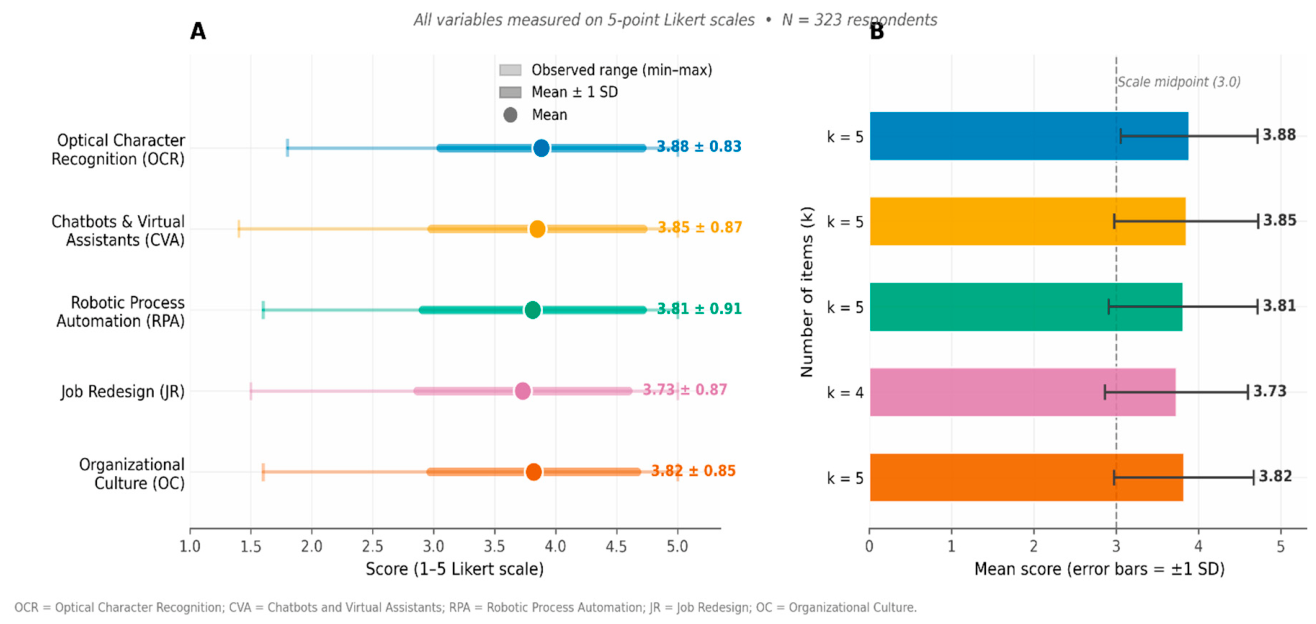
Figure 2.
Pearson Correlation Matrix Between Artificial Intelligence Components, Organizational Culture, and Job Redesign.
Figure 2.
Pearson Correlation Matrix Between Artificial Intelligence Components, Organizational Culture, and Job Redesign.
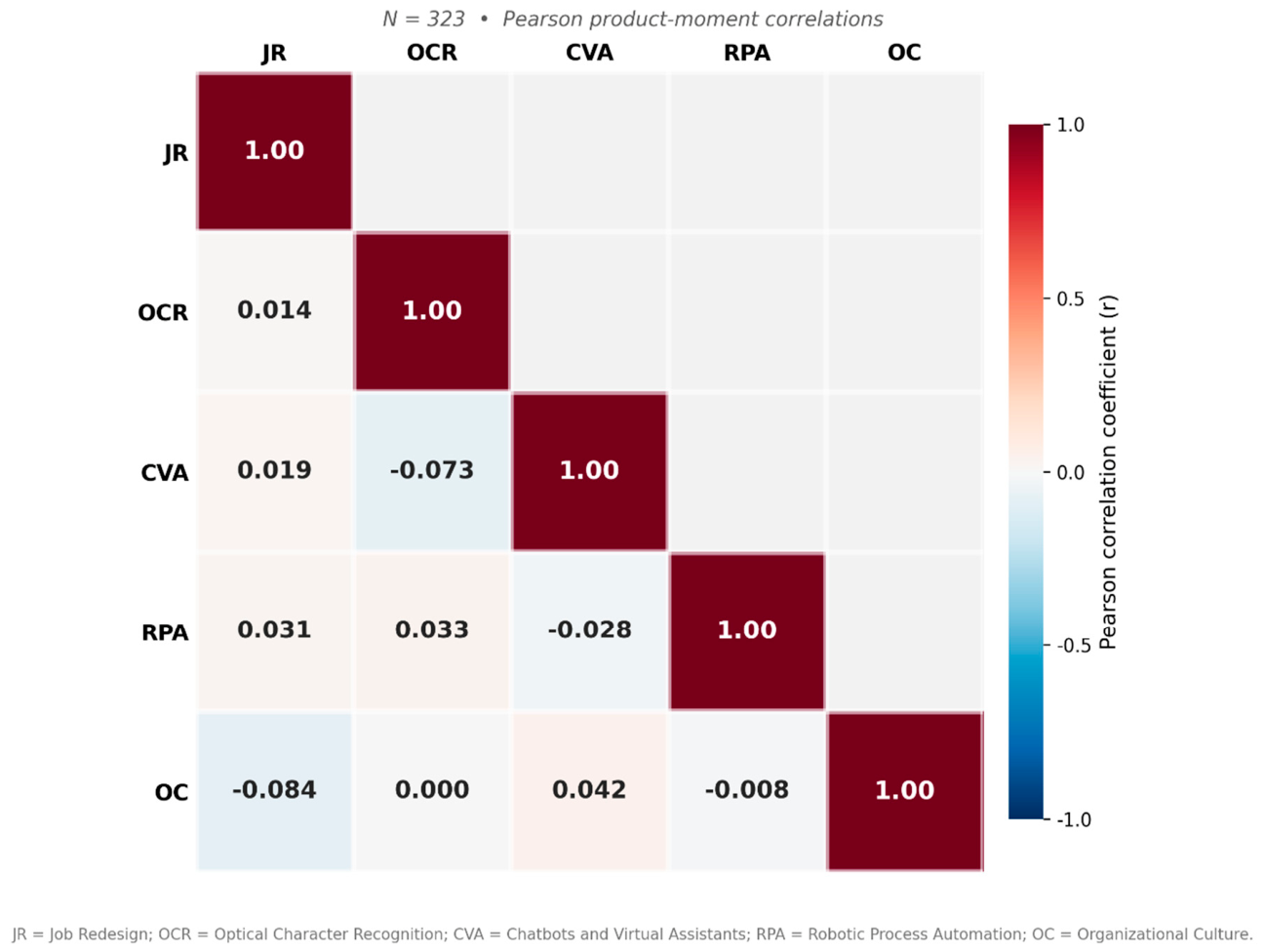
Figure 3.
Multiple regression: AI Components (OCR, CVA, RPA) predicting job redesign.
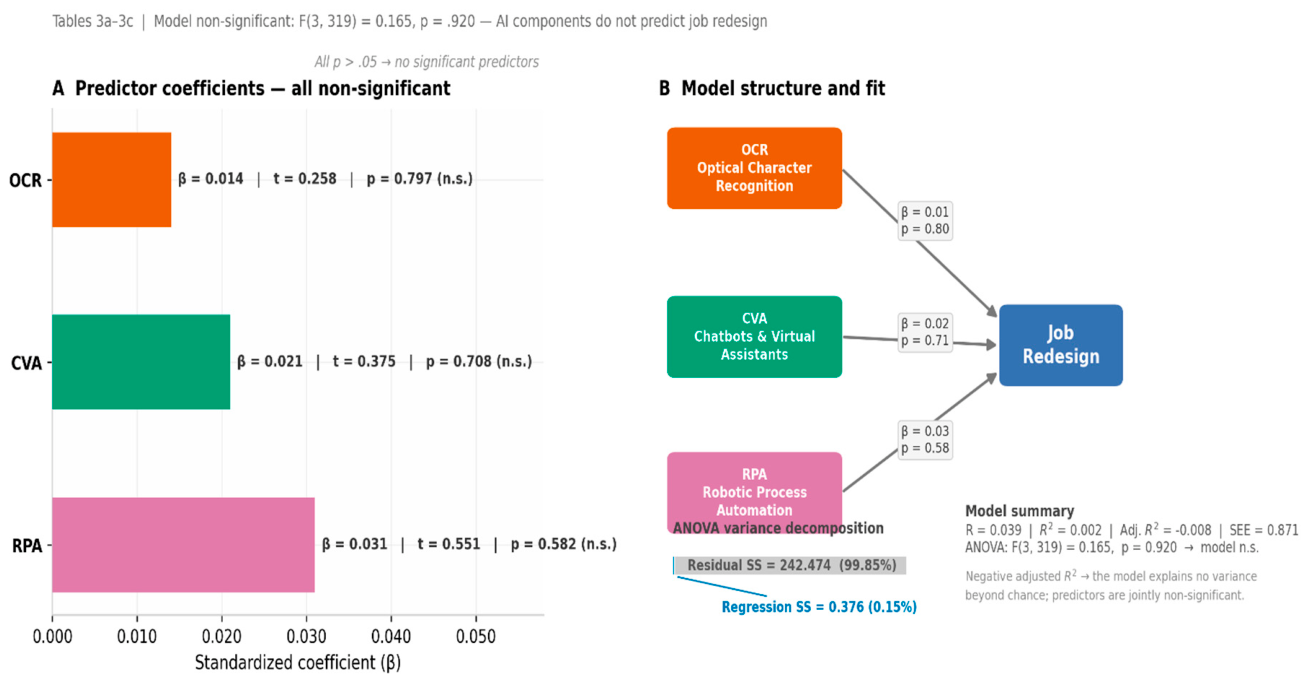
Figure 4.
a: Hierarchical Regression: Organizational Culture as a moderator of AI Components – Job Redesign.
Figure 4.
a: Hierarchical Regression: Organizational Culture as a moderator of AI Components – Job Redesign.
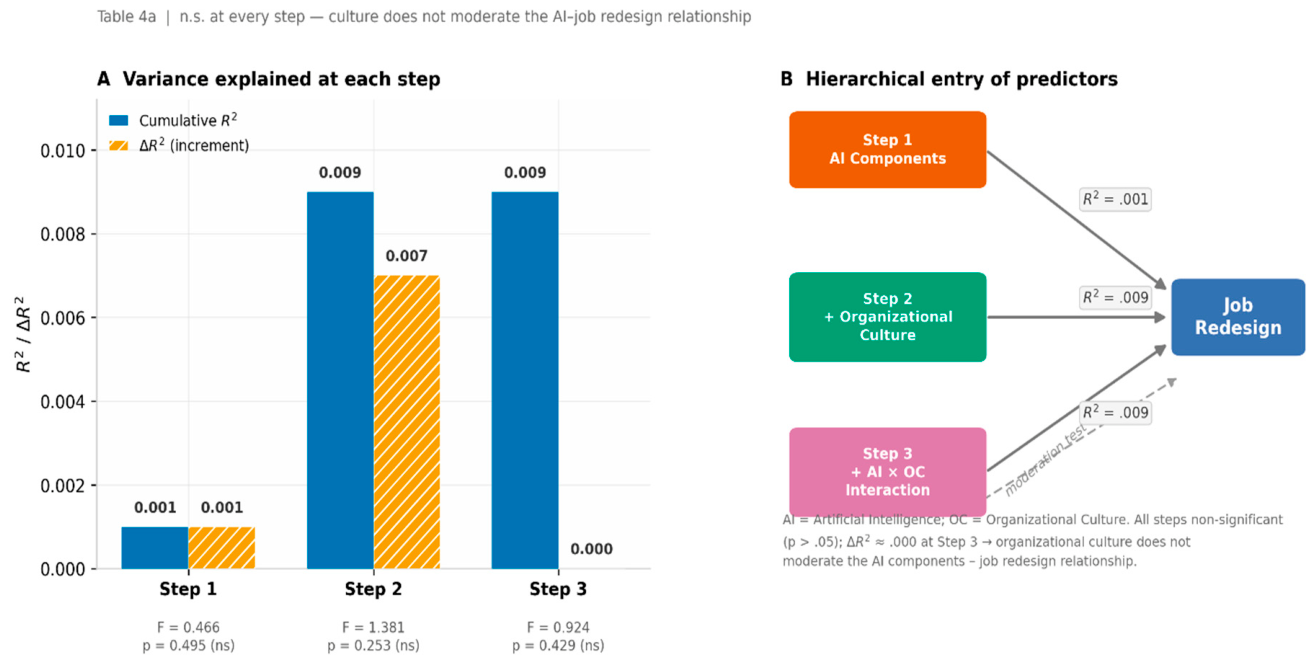
Figure 4.
b: Regression coefficients for the moderating effect of organisational culture on the relationship between AI components and job redesign.
Figure 4.
b: Regression coefficients for the moderating effect of organisational culture on the relationship between AI components and job redesign.
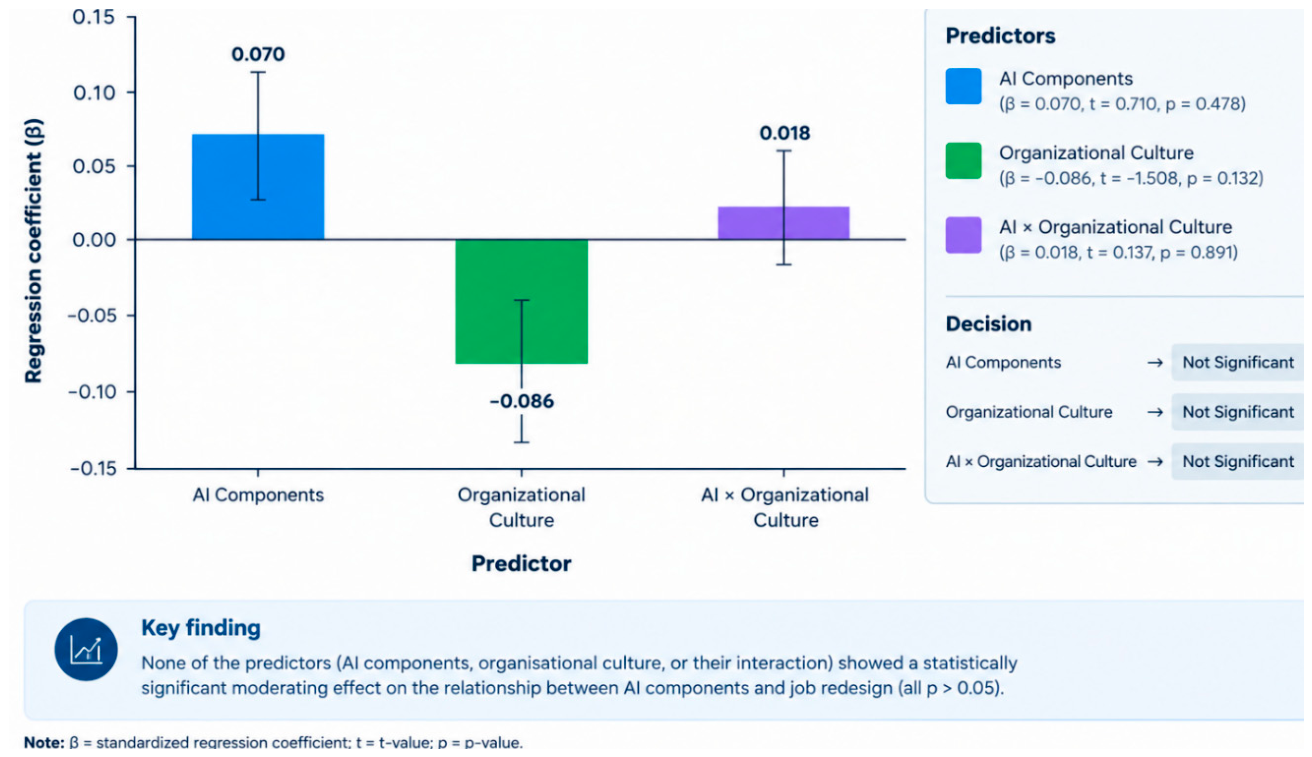
Figure 4.
c: Simple Slopes Analysis: Hypothesis Tests for AI Components, Organizational Culture, and Job Redesign.
Figure 4.
c: Simple Slopes Analysis: Hypothesis Tests for AI Components, Organizational Culture, and Job Redesign.
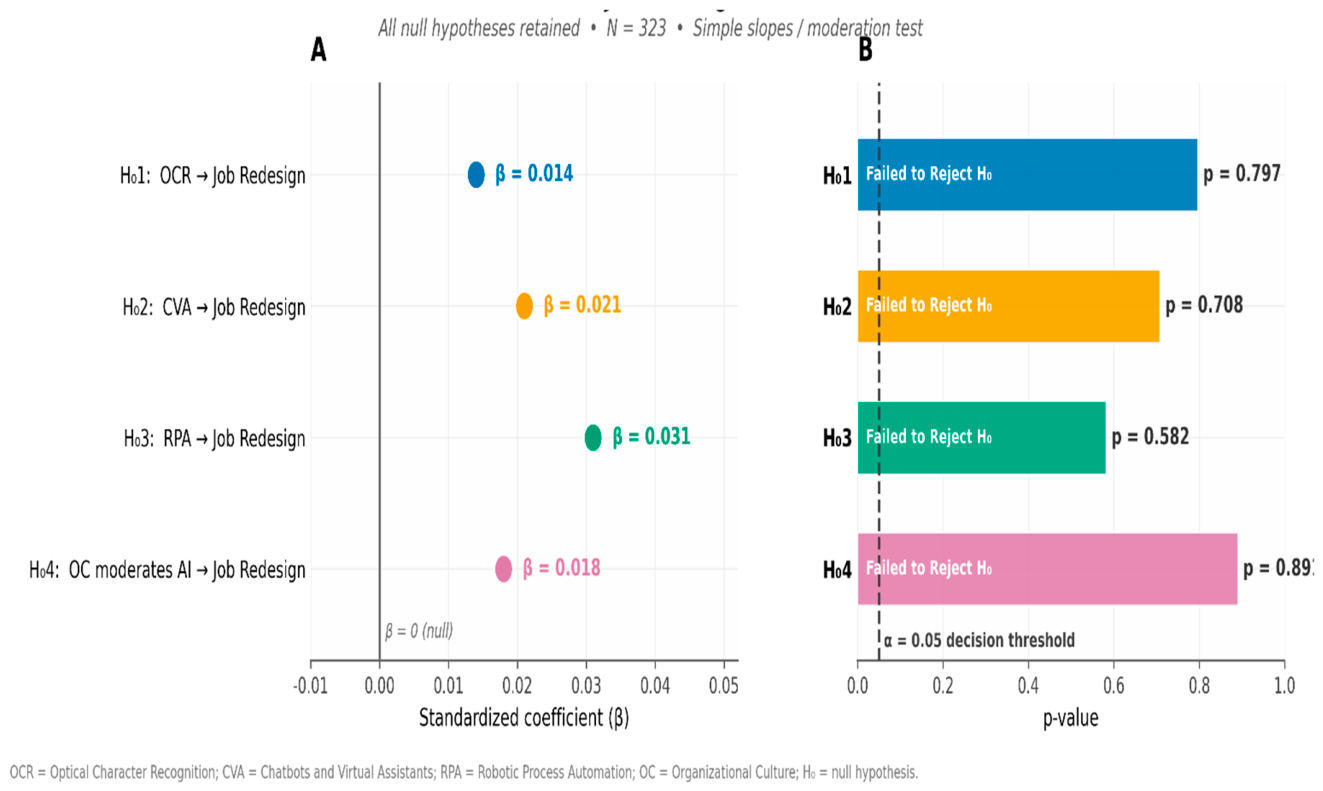

Table 1.
Descriptive Statistics of Artificial Intelligence Components, Organizational Culture, and Job Redesign.
Table 1.
Descriptive Statistics of Artificial Intelligence Components, Organizational Culture, and Job Redesign.
| Variable | Number of Items | Sample Size (N) | Minimum | Maximum | Mean | Standard Deviation |
| Optical Character Recognition (OCR) | 5 | 323 | 1.80 | 5.00 | 3.882 | 0.831 |
| Chatbots and Virtual Assistants (CVA) | 5 | 323 | 1.40 | 5.00 | 3.849 | 0.873 |
| Robotic Process Automation (RPA) | 5 | 323 | 1.60 | 5.00 | 3.811 | 0.905 |
| Job Redesign (JR) | 4 | 323 | 1.50 | 5.00 | 3.730 | 0.868 |
| Organizational Culture (OC) | 5 | 323 | 1.60 | 5.00 | 3.819 | 0.849 |
Table 2.
Pearson Correlation Matrix Between Artificial Intelligence Components, Organizational Culture, and Job Redesign.
Table 2.
Pearson Correlation Matrix Between Artificial Intelligence Components, Organizational Culture, and Job Redesign.
| Variables | Job Redesign (JR) | OCR | CVA | RPA | Organizational Culture (OC) |
| Job Redesign (JR) | 1.000 | ||||
| Optical Character Recognition (OCR) | 0.014 | 1.000 | |||
| Chatbots and Virtual Assistants (CVA) | 0.019 | -0.073 | 1.000 | ||
| Robotic Process Automation (RPA) | 0.031 | 0.033 | -0.028 | 1.000 | |
| Organizational Culture (OC) | -0.084 | 0.000 | 0.042 | -0.008 | 1.000 |
Note:N = 323; Pearson product-moment correlations reported.
Table 3.
a: Multiple Regression Analysis Predicting Job Redesign from OCR, CVA, and RPA.
| Model Summary | ||||
| Model | R | R² | Adjusted R² | Std. Error of Estimate |
| 1 | 0.039 | 0.002 | -0.008 | 0.871 |
Table 3.
b: Analysis of variance for the regression model predicting job redesign from AI components.
Table 3.
b: Analysis of variance for the regression model predicting job redesign from AI components.
| Model | Sum of Squares | df | Mean Square | F | Sig. |
| Regression | 0.376 | 3 | 0.125 | 0.165 | 0.920 |
| Residual | 242.474 | 319 | 0.760 | ||
| Total | 242.850 | 322 |
Table 3.
c. Standardized regression coefficients for AI components predicting job redesign.
| Predictor | Standardized β | t-value | p-value | Decision |
| Optical Character Recognition (OCR) | 0.014 | 0.258 | 0.797 | Not Significant |
| Chatbots and Virtual Assistants (CVA) | 0.021 | 0.375 | 0.708 | Not Significant |
| Robotic Process Automation (RPA) | 0.031 | 0.551 | 0.582 | Not Significant |
Table 4.
a: Hierarchical Regression Analysis Testing the Moderating Role of Organizational Culture on the Relationship Between Artificial Intelligence Components and Job Redesign.
Table 4.
a: Hierarchical Regression Analysis Testing the Moderating Role of Organizational Culture on the Relationship Between Artificial Intelligence Components and Job Redesign.
| Model | Predictors Entered | R² | ΔR² | F | Sig. |
| Step 1 | AI Components | 0.001 | 0.001 | 0.466 | 0.495 |
| Step 2 | AI Components + Organizational Culture | 0.009 | 0.007 | 1.381 | 0.253 |
| Step 3 | AI Components + Organizational Culture + AI × OC Interaction | 0.009 | 0.000 | 0.924 | 0.429 |
Table 4.
b: Regression coefficients for the moderating effect of organisational culture on the relationship between AI components and job redesign.
Table 4.
b: Regression coefficients for the moderating effect of organisational culture on the relationship between AI components and job redesign.
| Predictor | β | t-value | p-value | Decision |
| AI Components | 0.070 | 0.710 | 0.478 | Not Significant |
| Organizational Culture | -0.086 | -1.508 | 0.132 | Not Significant |
| AI × Organizational Culture | 0.018 | 0.137 | 0.891 | Not Significant |
Table 4.
c: Simple Slopes Analysis of Organizational Culture Moderation Effect.
| Hypothesis Decisions | |||
| Hypothesis | Statement | Statistical Evidence | Decision |
| Ho1 | OCR has no significant relationship with job redesign | β = 0.014, p = 0.797 | Failed to Reject |
| Ho2 | CVA has no significant relationship with job redesign | β = 0.021, p = 0.708 | Failed to Reject |
| Ho3 | RPA has no significant relationship with job redesign | β = 0.031, p = 0.582 | Failed to Reject |
| Ho4 | Organizational culture does not moderate AI–job redesign relationship | β = 0.018, p = 0.891 | Failed to Reject |
Disclaimer/Publisher’s Note: The statements, opinions and data contained in all publications are solely those of the individual author(s) and contributor(s) and not of MDPI and/or the editor(s). MDPI and/or the editor(s) disclaim responsibility for any injury to people or property resulting from any ideas, methods, instructions or products referred to in the content. |
© 2026 by the authors. Licensee MDPI, Basel, Switzerland. This article is an open access article distributed under the terms and conditions of the Creative Commons Attribution (CC BY) license.
Copyright: This open access article is published under a Creative Commons CC BY 4.0 license, which permit the free download, distribution, and reuse, provided that the author and preprint are cited in any reuse.