

Submitted:
01 October 2026
Posted:
05 October 2026
You are already at the latest version
Abstract
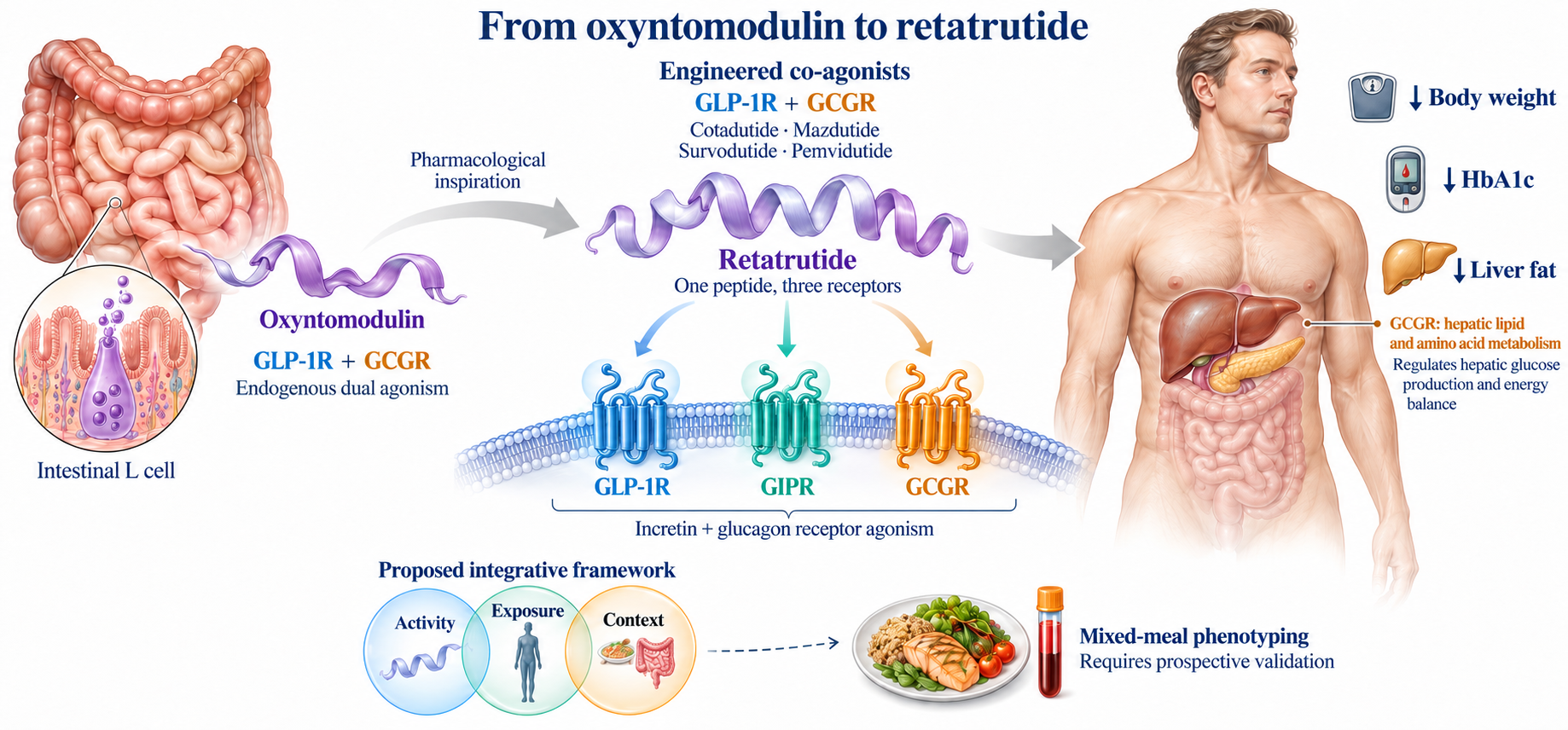
Oxyntomodulin (OXM), an endogenous proglucagon-derived peptide with dual glucagon-like peptide-1 receptor (GLP-1R) and glucagon receptor (GCGR) agonism, provides a physiological precedent for contemporary multi-receptor pharmacology. Recognition that GCGR signaling regulates not only hepatic glucose production but also amino acid turnover, lipid metabolism, substrate oxidation, and energy expenditure prompted the development of engineered GLP-1R/GCGR co-agonists, including cotadutide, mazdutide, survodutide, and pemvidutide. Retatrutide extends this strategy by integrating GIPR, GLP-1R, and GCGR agonism within a single long-acting peptide and has produced substantial improvements in body weight, glycemic control, and cardiometabolic parameters in phase 2 and phase 3 trials. This review examines the evolutionary and structural relationships of the proglucagon–Class B1 GPCR system, OXM biosynthesis and receptor pharmacology, the mechanistic rationale for therapeutic GCGR agonism, and the molecular and clinical development of dual and triple agonists. We further address receptor balance, the GIPR agonism–antagonism paradox, and the unresolved attribution of clinical effects to individual receptor components. Finally, we propose an Activity–Exposure–Context framework for interpreting polyagonist pharmacology and discuss prospective enteroinsular phenotyping using standardized mixed-meal testing as a testable strategy to investigate interindividual variability in therapeutic response.
Keywords:
oxyntomodulin
; retatrutide
; glucagon receptor
; GIP receptor
; GLP-1 receptor
; Class B1 GPCR
; polyagonism
; receptor pharmacology
; mixed-meal tolerance test
; treatment-response heterogeneity
1. Introduction
Obesity and type 2 diabetes mellitus (T2DM) involve persistent disturbances in energy balance, glucose regulation, and nutrient partitioning, with clinical consequences extending beyond body weight and fasting glucose to cardiovascular and metabolic liver disease [1,2,3]. The biological response to weight reduction further complicates long-term treatment: hunger can remain elevated after weight loss [4], while energy requirements decline, including an adaptive component that cannot be explained solely by the loss of metabolically active tissue [5,6]. These compensatory responses make maintenance of reduced weight a distinct therapeutic challenge rather than a simple continuation of initial weight loss.
Long-acting glucagon-like peptide-1 receptor (GLP-1R) agonists established that pharmacological manipulation of nutrient-responsive endocrine pathways can produce substantial weight reduction alongside glycemic improvement [7,8,9]. Semaglutide and the dual glucose-dependent insulinotropic polypeptide receptor (GIPR)/GLP-1R agonist tirzepatide extended this therapeutic paradigm [7,10,11,12]. Their clinical success encouraged the development of unimolecular multi-receptor agonists but did not establish that adding a receptor target necessarily improves efficacy or safety. Clinical comparisons therefore remain specific to the molecules, doses, populations, exposure profiles, and endpoints tested.
Reduced food intake is an important mechanism of established incretin-based obesity therapies [13,14,15]. This has renewed interest in complementary pathways affecting hepatic substrate handling and, potentially, energy expenditure [16,17]. Glucagon receptor (GCGR) agonism is particularly relevant because it introduces both an opportunity and a liability: GCGR signaling can promote hepatic lipid oxidation, amino acid turnover, and substrate mobilization [17,18,19], while stimulation of hepatic glucose production can oppose glycemic control [18,19,20]. The therapeutic question is therefore not whether glucagon is intrinsically beneficial or detrimental, but whether selected metabolic actions of GCGR signaling can be harnessed within a pharmacological context that preserves glycemic control.
Oxyntomodulin (OXM), an endogenous proglucagon-derived peptide, provides a physiological example of dual GLP-1R/GCGR agonism [21,22,23]. Early human studies demonstrated reductions in energy intake and body weight following pharmacological OXM administration [24,25,26], whereas receptor-based experiments subsequently helped distinguish GLP-1R- and GCGR-dependent components of its metabolic actions [23,27,28,29]. Engineered GLP-1R/GCGR co-agonists translated this endogenous pharmacological precedent into long-acting molecules with tunable receptor activity [28,29], and retatrutide extended this strategy by incorporating GIPR agonism within a single peptide [30,31]. This trajectory is conceptual rather than genealogical: contemporary co-agonists exploit pharmacological principles exemplified by OXM but do not necessarily share an OXM-derived chemical scaffold.
This review integrates the evolutionary and structural biology of the proglucagon–Class B1 G protein-coupled receptor system with native OXM pharmacology, the molecular differentiation of GLP-1R/GCGR co-agonists, and the development of GLP-1R/GIPR/GCGR triagonism culminating in retatrutide. Particular emphasis is placed on how receptor affinity, potency, efficacy, signaling, pharmacokinetic exposure, and biological context collectively shape the metabolic phenotype of multi-receptor agonists. We further examine the mechanistic paradox whereby both GIPR agonism and antagonism can enhance weight reduction, distinguish whole-drug clinical efficacy from receptor-specific causal attribution, and propose an Activity–Exposure–Context framework for interpreting polyagonist pharmacology. Finally, we discuss whether standardized mixed-meal testing coupled with enteroinsular phenotyping could provide a testable precision-pharmacology strategy for investigating interindividual heterogeneity in therapeutic response.
1.1. Literature Search and Evidence Interpretation
This article was designed as a narrative review. Targeted searches of PubMed/MEDLINE, Scopus, Web of Science, and ClinicalTrials.gov were performed using combinations of terms related to “oxyntomodulin,” “proglucagon,” “glucagon receptor,” “GLP-1 receptor,” “GIP receptor,” “Class B1 GPCR,” “dual agonist,” “co-agonist,” “triagonist,” “retatrutide,” “cotadutide,” “mazdutide,” “survodutide,” “pemvidutide,” “obesity,” “type 2 diabetes,” “MASLD,” and “MASH.” Additional targeted searches addressed GIPR agonism and antagonism, receptor signaling and trafficking, treatment-response heterogeneity, and mixed-meal testing. Priority was given to original mechanistic and structural studies, randomized clinical trials, and relevant high-quality reviews. Because this was a narrative review, no formal risk-of-bias assessment or quantitative evidence synthesis was performed. Peer-reviewed publications, structural database deposits, and sponsor communications are distinguished where relevant. Metabolic dysfunction-associated steatotic liver disease (MASLD) and metabolic dysfunction-associated steatohepatitis (MASH) follow the multisociety nomenclature consensus; historical terminology is retained in cited article titles [32].
2. Evolutionary Diversification of the Proglucagon–Class B1 GPCR System
The proglucagon system exemplifies the evolutionary diversification of peptide hormones from a common precursor into ligands with distinct but interconnected metabolic functions [33,34,35]. Tissue-specific processing of proglucagon generates glucagon, GLP-1, GLP-2, OXM, glicentin, and the major proglucagon fragment, whereas GIP originates from a distinct precursor [35,36,37,38,39]. In parallel, GCGR, GLP-1R, GLP-2R, and GIPR belong to an evolutionarily related subgroup of Class B1 G protein-coupled receptors that retains substantial conservation in ligand recognition and receptor activation while supporting specialized physiological functions [33,36,37,40]. This combination of ligand diversification and conserved receptor architecture provides the evolutionary and structural framework for understanding both the endogenous cross-reactivity of peptides such as OXM and the rational design of modern dual and triple receptor agonists [31,40,41,42].
2.1. Tissue-Specific Processing of Proglucagon
The human GCG gene encodes preproglucagon, which is converted to proglucagon following removal of its N-terminal signal peptide. Proglucagon subsequently undergoes tissue-specific post-translational processing by prohormone convertases, generating distinct but structurally related bioactive peptides [38,39]. In pancreatic α-cells, prohormone convertase 2 (PC2) predominantly processes proglucagon to generate glucagon and the major proglucagon fragment (MPGF) [39]. In contrast, enteroendocrine L cells of the intestine predominantly express prohormone convertase 1/3 (PC1/3), which generates glicentin, OXM, GLP-1, GLP-2, and related peptide products [38,39]. Thus, differential processing of a common precursor enables the proglucagon system to generate tissue-specific endocrine outputs without requiring separate genes for each peptide.
This molecular organization supports complementary physiological responses to fasting and nutrient ingestion. Pancreatic glucagon promotes hepatic glucose production and contributes to amino acid catabolism, ureagenesis, lipid oxidation, and substrate mobilization during fasting and metabolic demand [19,20,43]. By contrast, intestinal GLP-1 couples nutrient ingestion to glucose-dependent insulin secretion, regulation of glucagon secretion, gastrointestinal motility, satiety, and reduced energy intake [8,39]. GLP-2 primarily acts on the gastrointestinal tract, where it promotes intestinal growth, mucosal integrity, nutrient absorption, and adaptive responses of the intestinal epithelium [44,45,46]. OXM occupies a distinctive position within this processing network because a single intestinal proglucagon-derived peptide retains agonist activity at both GLP-1R and GCGR [21,22,23]. The physiological roles of glicentin and MPGF remain less completely defined [47]. Moreover, the metabolic effects of administered OXM should not be equated with proof that endogenous circulating OXM produces equivalent receptor engagement in humans [21,22].
2.2. Functional Diversification Across Vertebrates
Evolutionary diversification of the glucagon peptide family generated structurally related peptides with distinct physiological functions across vertebrates [33,34,35]. In mammals, glucagon primarily coordinates metabolic adaptation to fasting through GCGR-dependent regulation of hepatic glucose production, amino acid catabolism, ureagenesis, lipid oxidation, and substrate mobilization [19,20,43]. In mammalian physiology, GLP-1 has prominent postprandial functions linking nutrient ingestion to glucose-dependent insulin secretion, regulation of glucagon secretion, gastrointestinal motility, satiety, and energy intake [8,39], whereas GLP-2 primarily supports intestinal growth, epithelial integrity, nutrient absorption, and intestinal adaptation [44,45,46]. These functional differences illustrate how diversification within a common peptide family can support complementary aspects of fasting, feeding, and gastrointestinal physiology.
Like other proglucagon-derived peptides, OXM is generated through tissue-specific processing of the common precursor; its distinctive pharmacological feature is dual receptor activity [21,34,38]. Its 37-amino acid sequence contains the complete 29-amino acid glucagon sequence followed by an eight-residue C-terminal extension, preserving sufficient structural compatibility to activate both GCGR and GLP-1R [21,22,23]. OXM is less potent than glucagon at GCGR and less potent than GLP-1 at GLP-1R, but its ability to engage both receptors within a single endogenous peptide provides a physiological example of receptor cross-reactivity within the proglucagon system [21,22,23]. This dual pharmacology links anorectic and insulinotropic GLP-1R signaling with GCGR-dependent regulation of hepatic substrate metabolism and energy balance [21,22,23,27].
Comparative endocrinology further indicates that the physiological roles of glucagon-related peptides and their receptors have diversified across vertebrate lineages rather than remaining fixed throughout evolution [33,34,35,48]. Differences in peptide processing, receptor repertoires, ligand selectivity, and metabolic function have been described across species [33,35,48]. Thus, the contemporary mammalian actions of glucagon, GLP-1, GLP-2, and OXM represent specialized outcomes within an evolutionarily conserved peptide–receptor system. The persistence of structural relatedness despite functional diversification is particularly relevant to metabolic pharmacology because it provides the molecular context in which endogenous cross-reactivity—and subsequently engineered multi-receptor agonism—can occur.
2.3. Receptor Diversification and Conserved Structural Compatibility
GCGR, GLP-1R, GLP-2R, and GIPR belong to an evolutionarily related subgroup of Class B1 G protein-coupled receptors characterized by a large N-terminal extracellular domain (ECD) coupled to a seven-transmembrane domain (TMD) [33,40,49,50]. Peptide recognition follows the general two-domain architecture characteristic of Class B1 GPCRs: the C-terminal region of the peptide is primarily engaged by the ECD, whereas the peptide N-terminus penetrates the transmembrane core and contributes directly to receptor activation [49,50,51]. Conservation of this binding architecture provides a common structural framework for ligand recognition, while sequence and conformational differences within the ECD, extracellular loops, and transmembrane binding pocket confer receptor-specific pharmacology [41,49,50,51].
This combination of structural conservation and receptor-specific accommodation enables related peptide ligands to display different degrees of cross-reactivity. OXM provides the most relevant endogenous example for metabolic pharmacology, activating both GLP-1R and GCGR despite lower potency than the corresponding cognate ligands [21,22,23]. Glucagon can also activate GLP-1R under selected experimental conditions, further illustrating that ligand recognition within this receptor subgroup is not governed by absolute one-ligand–one-receptor specificity [23,51]. Structural studies of engineered dual agonists have subsequently shown how a single peptide can preserve a shared receptor-binding architecture while establishing distinct interactions with GLP-1R and GCGR [41].
Recent structural deposits provide additional examples of OXM-bound receptor complexes: GLP-1R–Gs (PDB 9MZE, 2.20 Å) and GCGR–Gs (PDB 9N0E, 2.30 Å) [52,53]. The ligand deposited in 9MZE contains Lys34 rather than the Arg34 present in the human OXM sequence shown in Figure 1; the deposit should therefore not be described as an exact structural determination of that human sequence [52,54]. These database records are distinguished from peer-reviewed structural reports.
This conserved molecular compatibility created an exploitable design space for medicinal chemistry. Sequence substitutions can modify proteolytic stability, receptor affinity, potency, efficacy, and relative activity across GLP-1R, GCGR, and GIPR, while lipidation and other chemical modifications can independently alter pharmacokinetic exposure [28,29,30,31,40,41]. Consequently, modern dual and triple agonists are not defined simply by the number of receptors they activate, but by the combination of receptor-specific pharmacology and sustained exposure achieved by the engineered molecule. Retatrutide exemplifies this principle: a single peptide can engage GIPR, GLP-1R, and GCGR through a combination of conserved Class B1 recognition features and receptor-specific molecular interactions [31,42].
2.4. GIP Within the Related Receptor Family
GIP is encoded by a gene distinct from GCG and is secreted predominantly by enteroendocrine K cells of the proximal small intestine in response to nutrient ingestion [36,55]. GIP is a major component of the enteroinsular axis, enhancing glucose-dependent insulin secretion through activation of GIPR and contributing to postprandial nutrient handling [36,55]. Beyond the pancreatic β-cell, GIPR is expressed in multiple metabolically relevant tissues and cell populations, including adipose and neuronal compartments, where its activation can influence lipid handling, energy balance, and feeding behavior [55,56,57,58]. The physiological consequences of GIPR signaling are therefore strongly dependent on cellular context, metabolic state, and duration of receptor activation [55,56,57,58].
Although GIP does not arise from proglucagon processing, GIPR belongs to the same evolutionarily related Class B1 GPCR subgroup as GLP-1R and GCGR and shares key structural principles of peptide recognition and receptor activation [33,40,49,50,51]. This receptor-level relationship is pharmacologically important because a single engineered peptide can accommodate the conserved binding architecture of GIPR, GLP-1R, and GCGR while retaining receptor-specific interactions [31,42]. GIPR can therefore be integrated into unimolecular polyagonists not because GIP is a product of proglucagon processing, but because its receptor occupies a structurally compatible region of Class B1 GPCR pharmacology.
The clinical development of tirzepatide established that sustained GIPR/GLP-1R co-agonism can produce substantial improvements in glycemic control and body weight [11,12]. However, the contribution of GIPR cannot be inferred simply from differences between tirzepatide and selective GLP-1R agonists, because these molecules also differ in sequence, receptor pharmacology, pharmacokinetic exposure, dose, and treatment context. This distinction becomes particularly important for retatrutide, in which GIPR activity is integrated with GLP-1R and GCGR agonism within the same molecular scaffold [31]. The mechanistic role of GIPR in multi-receptor therapy therefore requires consideration of receptor activity, exposure, and tissue context rather than attribution based solely on whole-drug clinical efficacy.
2.5. From Evolutionary Relationships to Pharmacological Design
The evolutionary diversification of proglucagon-derived peptides and their receptors generated related ligands with distinct physiological functions while preserving sufficient structural compatibility for cross-receptor recognition [33,34,35,36,37]. OXM exemplifies this principle at the endogenous level by demonstrating that a single proglucagon-derived peptide can engage both GLP-1R and GCGR [21,22,23]. At the receptor level, conservation of the Class B1 binding architecture provides a molecular basis for this cross-reactivity, whereas differences within extracellular and transmembrane interaction surfaces preserve receptor-specific pharmacology [41,49,50,51]. GIP extends this framework beyond the proglucagon-derived peptide family because, although encoded independently, GIPR retains sufficient structural compatibility with GLP-1R and GCGR to be incorporated into the same multi-receptor design space [31,40,42].
Medicinal chemistry transformed this endogenous and structural compatibility into a tunable pharmacological strategy. Amino acid substitutions can alter receptor affinity, potency, efficacy, proteolytic stability, and relative activity across GLP-1R, GCGR, and GIPR, whereas lipidation and other conjugation strategies can prolong systemic exposure and modify the temporal profile of receptor engagement [28,29,30,31,40]. Consequently, modern polyagonism is better understood not as replication of a native hormone, but as the deliberate engineering of shared receptor recognition, receptor-specific activity, and pharmacokinetic exposure within a single molecular scaffold. GLP-1R/GCGR co-agonists represent the first therapeutic implementation of this principle, whereas GLP-1R/GIPR/GCGR triagonists extend it to three related Class B1 receptors [28,29,30,31]. This transition from endogenous receptor cross-reactivity to quantitatively engineered multi-receptor pharmacology provides the conceptual foundation for the development of retatrutide. Figure 1 summarizes precursor processing, the human OXM sequence, and the dual-receptor concept.
3. Oxyntomodulin: From Endogenous Dual Agonism to Modern Polyagonism
OXM occupies a distinctive position within the proglucagon system because dual GLP-1R/GCGR agonism is encoded within a single endogenous peptide [21,22,23]. Its pharmacological relevance derives from the convergence of three properties: structural continuity with glucagon, measurable agonist activity at both GLP-1R and GCGR, and metabolic effects on food intake, glucose regulation, body weight, and energy balance following exogenous administration [21,22,23,24,25,27]. OXM therefore provides an endogenous pharmacological precedent for unimolecular receptor co-activation and a mechanistic starting point for understanding the subsequent development of engineered GLP-1R/GCGR co-agonists.
3.1. Discovery and Biochemical Structure
Early investigations of intestinal glucagon-like immunoreactivity revealed that the gastrointestinal tract contained glucagon-related peptides that were immunologically and biochemically distinct from pancreatic glucagon [61]. These observations contributed to the historical concept of enteroglucagon, which initially encompassed heterogeneous glucagon-immunoreactive material rather than a single molecular entity [61]. Subsequent isolation and structural characterization by Bataille and colleagues identified a 37-amino acid peptide, originally termed glucagon-37 and subsequently recognized as OXM [59,62].
Human OXM comprises the complete 29-amino acid sequence of glucagon followed by the C-terminal octapeptide KRNRNNIA [54]. This structural organization preserves the glucagon pharmacophore while modifying receptor recognition sufficiently to generate a pharmacological profile distinct from that of pancreatic glucagon. OXM activates GCGR with lower potency than native glucagon and GLP-1R with lower potency than native GLP-1 [21,22,23]. Its dual activity arises from recognition of the complete peptide by two structurally related Class B1 receptors rather than from a simple assignment of GCGR activity to the glucagon sequence and GLP-1R activity to the C-terminal extension [23,41].
No distinct OXM-specific receptor has been established. Instead, its best-characterized metabolic actions are mediated through GLP-1R and GCGR [21,22,23,63]. This receptor architecture is central to the pharmacological significance of OXM: a single endogenous peptide engages two receptors that later became deliberately combined targets in metabolic drug development.
3.2. Biosynthesis, Secretion, and Physiological Context
OXM is generated in enteroendocrine L cells through PC1/3-dependent processing of proglucagon and corresponds to the C-terminal 37-amino acid region of glicentin, conventionally designated glicentin (33–69) [38,39,60]. Because GLP-1 and OXM arise from the same intestinal precursor-processing pathway, both peptides can be released within the coordinated enteroendocrine response to nutrient ingestion [38,39]. Nutrient exposure increases circulating OXM immunoreactivity, consistent with a postprandial secretory pattern [22,60].
Accurate quantification of endogenous OXM remains analytically challenging because OXM, glucagon, and glicentin share overlapping peptide sequences [60,64,65]. Immunoassay cross-reactivity, rapid peptide degradation, sample handling, and the distinction between total immunoreactivity and intact bioactive peptide can substantially influence reported concentrations [64,65]. Mass-spectrometric approaches have strengthened molecular identification of proglucagon-derived peptides in human plasma and provide an important complement to immunochemical measurements [64,65].
The physiological context of OXM differs fundamentally from pharmacological administration. Endogenous OXM is released as one component of a broader postprandial endocrine response, whereas experimental administration exposes GLP-1R and GCGR to concentrations and temporal profiles determined by dose and route of delivery [21,22]. This distinction becomes particularly relevant when endogenous OXM biology is used to inform the design of long-acting co-agonists, whose receptor engagement can persist far beyond the physiological postprandial signal.
3.3. Receptor Pharmacology
3.3.1. GLP-1R-Dependent Actions
OXM activates GLP-1R with lower potency than native GLP-1 but retains sufficient receptor activity to produce biologically relevant effects on feeding and glucose regulation [21,22,23]. In receptor-dissection experiments, Baggio and colleagues demonstrated that the acute anorectic response to intracerebroventricular OXM was abolished in GLP-1R-deficient mice but retained in GCGR-deficient mice [23]. These findings identify GLP-1R as a major mediator of the acute anorectic action of OXM.
GLP-1R activation also provides a mechanistic basis for the insulinotropic and glucoregulatory actions of OXM. Studies in humans have demonstrated glucose-lowering activity following administration of native OXM [66], whereas experimental models have shown improvements in β-cell function and glucose regulation [67]. Interestingly, OXM did not reproduce every physiological action associated with native GLP-1 under the conditions examined; in mice, improved glucose regulation occurred without inhibition of gastric emptying [67]. These observations illustrate that engagement of the same receptor does not necessarily generate an identical integrated physiological response when ligand potency, receptor trafficking, concurrent GCGR activation, and exposure differ.
3.3.2. GCGR-Dependent Actions
In parallel with GLP-1R activation, OXM engages GCGR and thereby accesses metabolic pathways associated with hepatic substrate handling and energy expenditure [21,22,23,27]. Experimental studies using OXM analogues have shown that GCGR activation contributes to increases in energy expenditure and to metabolic effects that cannot be reproduced completely by matched GLP-1R activation alone [27,29]. Studies employing receptor-deficient models and pharmacologically matched comparators further supported a contribution of GCGR to body-weight regulation and lipid metabolism within dual-agonist pharmacology [28,29].
These findings provided an important conceptual shift in metabolic pharmacology. GCGR activation had traditionally been viewed predominantly through its capacity to stimulate hepatic glucose production, whereas OXM and subsequently engineered co-agonists demonstrated that GCGR signaling could be incorporated into a broader metabolic intervention when accompanied by sufficient incretin activity [17,18,19,20,28,29]. The resulting therapeutic principle is not unrestricted glucagon action, but controlled GCGR engagement within a receptor context capable of maintaining glycemic control.
3.3.3. Affinity, Potency, Efficacy, and Signaling Context
Affinity, potency, and efficacy describe distinct dimensions of ligand–receptor pharmacology. Affinity reflects ligand binding, potency describes the concentration required to produce a defined response, and efficacy describes the response that a ligand can generate within a specified receptor system [40,51]. Accordingly, the lower potency of OXM relative to GLP-1 at GLP-1R or glucagon at GCGR does not by itself establish partial agonism. Estimates of maximal response depend on receptor density, coupling efficiency, signal amplification, assay duration, and the endpoint measured [23,40,51].
This distinction is particularly relevant for Class B1 GPCRs, for which cAMP generation, β-arrestin recruitment, receptor internalization, recycling, and sustained signaling can display ligand-dependent differences [51,68]. At GLP-1R, OXM can produce robust cAMP responses while exhibiting lower maximal recruitment of β-arrestin and GRK2 than GLP-1 in heterologous systems [69]. Such pathway-dependent differences demonstrate that the pharmacological phenotype of OXM cannot be reduced to a single EC50 or Emax value.
More broadly, ligand-specific receptor trafficking provides a mechanism by which acute signaling potency and sustained biological activity may diverge. Studies with engineered GLP-1R agonists have shown that altered receptor internalization and recycling can prolong insulinotropic responses despite reduced acute signaling potency [68]. Although these findings should not be directly assigned to OXM or retatrutide without experimental confirmation, they establish an important design principle for multi-receptor pharmacology: receptor activity is multidimensional and temporally regulated.
3.4. Early Human Metabolic Evidence
The translational relevance of OXM was established by early controlled studies in humans. Acute intravenous administration reduced subsequent energy intake, demonstrating that the anorectic activity observed experimentally was preserved in humans [26]. Repeated subcutaneous administration for four weeks subsequently produced a mean body-weight reduction of 2.3 kg, compared with 0.5 kg with placebo [24]. Although modest by contemporary standards, these findings provided early clinical proof that pharmacological exposure to a dual GLP-1R/GCGR agonist could influence human energy balance.
A randomized crossover study further suggested that the metabolic actions of OXM extended beyond suppression of food intake. OXM increased activity-related energy expenditure by approximately 26% and total energy expenditure by approximately 9%, while resting energy expenditure was not significantly increased [25]. The distinction is mechanistically important because it argues against describing the human OXM signal simply as an increase in resting metabolic rate. Together with experimental receptor studies, these findings contributed to the hypothesis that GLP-1R-mediated appetite suppression and GCGR-associated metabolic actions could be combined within a single therapeutic strategy [25,27,28,29].
Native OXM nevertheless differs substantially from contemporary co-agonists in receptor potency, molecular stability, pharmacokinetic exposure, and dosing duration. Its early human studies therefore established biological and translational proof of concept, rather than predicting the magnitude of weight reduction subsequently achieved with engineered long-acting molecules. The principal early human findings are summarized in Table 1.
3.5. Pharmacological Limitations and the Transition to Co-Agonists
Despite its informative receptor pharmacology, native OXM has properties that limit its direct therapeutic use. The peptide is rapidly cleared, susceptible to enzymatic degradation, and less potent at GLP-1R and GCGR than their respective cognate ligands [21,22,23,60]. Sustained therapeutic co-activation therefore required molecular engineering rather than simple replacement of the endogenous peptide.
Sequence modification and chemical conjugation provided complementary solutions. Amino acid substitutions increased resistance to proteolysis and allowed relative GLP-1R/GCGR activity to be adjusted, whereas lipidation and other half-life extension strategies prolonged systemic exposure [28,29,70,71]. These modifications transformed receptor co-activation from an endogenous pharmacological observation into a controllable drug-design variable.
The limited development of native OXM as a replacement therapy should therefore not be interpreted as failure of the OXM concept. The concept succeeded through molecular engineering rather than hormone replacement. Engineered GLP-1R/GCGR co-agonists retained the therapeutically attractive principle demonstrated by OXM—simultaneous engagement of complementary receptor systems—while departing substantially from its native sequence, potency ratio, and pharmacokinetic profile [28,29,30,31]. This transition established the pharmacological bridge from endogenous dual agonism to the modern generation of long-acting co-agonists and, ultimately, triagonists such as retatrutide.
4. Reappraising Glucagon Receptor Agonism
The therapeutic reappraisal of GCGR signaling emerged from an apparent paradox. Excessive glucagon action contributes to hyperglycemia in T2DM, yet the same receptor regulates hepatic lipid and amino acid metabolism, substrate oxidation, and whole-body energy balance [18,19,20]. Recognition of this broader physiology shifted the pharmacological question from whether glucagon should simply be inhibited to whether selected GCGR-mediated metabolic actions could be harnessed while maintaining glycemic control. This conceptual transition provided the rationale for combining GCGR agonism with incretin receptor activation [16,28,29,30,31].
4.1. From GCGR Antagonism to Controlled Agonism
The hyperglucagonemia of diabetes and the capacity of glucagon to stimulate hepatic glucose production provided a strong mechanistic rationale for GCGR antagonism [18,72,73]. Pharmacological blockade of GCGR reduced glycemia in clinical studies, confirming that excessive glucagon signaling contributes materially to glucose dysregulation in T2DM [72,73,74]. However, chronic suppression of GCGR also revealed metabolic consequences beyond glucose lowering.
Clinical studies with the small-molecule GCGR antagonist LY2409021 demonstrated this trade-off. Glycemic improvement and elevations in hepatic aminotransferases were reported in phase 2 studies [74]. A separate investigation documented increased hepatic fat content [75], while ambulatory blood-pressure changes were characterized in another clinical study [76]. These findings indicated that sustained GCGR inhibition modifies a broader metabolic network encompassing hepatic lipid handling and systemic physiology, rather than selectively suppressing glucose production.
In parallel, experimental studies increasingly demonstrated that GCGR activation regulates processes potentially advantageous in obesity and metabolic disease, including amino acid catabolism, ureagenesis, fatty acid oxidation, substrate mobilization, and energy expenditure [17,19,20]. This led to a different therapeutic strategy: rather than maximizing or abolishing GCGR signaling, controlled GCGR agonism could be combined with incretin receptor activation to retain catabolic and substrate-mobilizing actions while counterbalancing its hyperglycemic potential [16,28,29,30,31]. The emergence of GLP-1R/GCGR co-agonists therefore represents a pharmacological reconciliation of two apparently opposing observations—glucagon can contribute to diabetic hyperglycemia while simultaneously engaging metabolic pathways of potential therapeutic value.
4.2. Hepatic Carbon and Nitrogen Metabolism
The liver is a principal target of glucagon action. GCGR signaling stimulates hepatic glucose production but also coordinates amino acid uptake and catabolism, ureagenesis, fatty acid oxidation, ketogenesis, and broader substrate partitioning [19,20,43]. These actions position glucagon as an endocrine regulator of both carbon and nitrogen metabolism, linking nutrient availability to hepatic substrate utilization.
Amino acid metabolism is particularly important within this framework. The liver–α-cell axis describes a reciprocal relationship in which glucagon promotes hepatic amino acid disposal and ureagenesis, whereas circulating amino acids stimulate pancreatic α-cell glucagon secretion [19,43]. Disruption of hepatic glucagon signaling can therefore alter circulating amino acid concentrations and α-cell function, while metabolic liver disease can modify hepatic responsiveness to glucagon [19,20,43]. This feedback system expands the biological significance of GCGR beyond its classical role in glucose counter-regulation.
GCGR signaling also influences hepatic lipid metabolism. Experimental evidence supports increased fatty acid oxidation and ketogenesis under glucagon action, providing a mechanistic rationale for investigating GCGR agonism in metabolic liver disease [17,20]. Imaging-based reductions in liver fat with retatrutide and survodutide are consistent with this broader metabolic framework [77,78]. Histological MASH and fibrosis endpoints provide a different level of evidence and are evaluated separately [79,80]. However, hepatic responses during treatment arise in parallel with reduced energy intake, weight loss, altered insulin action, and changes in substrate delivery, making the net phenotype an integrated consequence of multiple pathways.
This distinction is particularly relevant when interpreting changes in adiposity. Hepatic fatty acid oxidation and whole-body negative energy balance can contribute to loss of adipose mass without requiring a major direct lipolytic action of glucagon on human adipocytes [20,81]. Tissue-specific receptor expression and substrate flux must therefore be considered when linking systemic weight loss to cellular GCGR mechanisms.
4.3. Energy Expenditure and Metabolic Adaptation
The potential contribution of GCGR signaling to energy expenditure represents one of the most attractive—and mechanistically unresolved—aspects of glucagon-containing polyagonism. Experimental glucagon pharmacology, OXM analogues, and engineered GLP-1R/GCGR co-agonists have demonstrated increases in energy expenditure under selected conditions, particularly in rodent models [17,27,28,82]. Early human studies with native OXM also identified increased activity-related and total energy expenditure, although resting energy expenditure was not significantly increased [25]. Together, these findings provide biological plausibility for an energetic component of GCGR-containing pharmacology.
Interpretation becomes more complex during substantial weight loss. Total energy expenditure normally declines as body mass decreases, reflecting reductions in metabolically active tissue as well as adaptive thermogenesis [5,6]. Consequently, a pharmacological effect on energy expenditure need not appear as an absolute increase above pretreatment values. Attenuation of the decline expected for a given change in fat-free mass, fat mass, energy intake, and physical activity could also represent a biologically relevant effect. Longitudinal studies should therefore distinguish absolute expenditure from expenditure adjusted for changing body composition and should measure physical activity and energy intake concurrently.
The mechanistic link between GCGR activation and human energy expenditure remains incompletely resolved. Candidate pathways include hepatic substrate cycling, sympathetic and neuroendocrine responses, altered nutrient oxidation, and endocrine mediators induced downstream of glucagon signaling [17,20,82]. Their relative contribution is likely to depend on species, dose, duration of exposure, nutritional state, and the accompanying activity of GLP-1R and GIPR.
FGF21 illustrates the importance of testing these mechanisms directly. Although glucagon can influence hepatic FGF21 biology experimentally, circulating FGF21 decreased at several retatrutide doses in the MASLD substudy while liver fat declined markedly [77]. This dissociation argues against a simple model in which sustained elevation of circulating FGF21 is required to explain the hepatic response to retatrutide. More broadly, the magnitude of weight loss produced by a GCGR-containing polyagonist cannot by itself quantify the contribution of increased energy expenditure or any individual GCGR-dependent pathway.
5. Engineering GLP-1R/GCGR Co-Agonism
The transition from native OXM to engineered GLP-1R/GCGR co-agonists transformed dual receptor activation from an endogenous observation into a controllable pharmacological strategy. Medicinal chemistry enabled receptor activity, proteolytic stability, and pharmacokinetic exposure to be tuned through complementary molecular modifications, allowing investigators to test whether GCGR engagement could add metabolic effects to GLP-1R agonism while preserving glycemic control [28,29,40]. This principle subsequently generated several clinical candidates that share GLP-1R/GCGR agonism but differ substantially in molecular architecture, receptor pharmacology, dosing, and therapeutic development.
5.1. From Proof of Concept to Tunable Receptor Co-Agonism
Early synthetic co-agonist studies established that GLP-1R/GCGR pharmacology could be deliberately engineered and experimentally dissected. Day and colleagues developed a glucagon-based peptide with combined GLP-1R and GCGR activity that improved body weight, adiposity, and glucose metabolism in rodent models [28]. Pocai and colleagues subsequently used pharmacologically matched peptide comparators and receptor-deficient models to distinguish the contribution of GCGR activity from GLP-1R agonism alone [29]. Together, these studies provided mechanistic proof of concept that simultaneous activation of GLP-1R and GCGR could generate metabolic effects beyond those obtained with the corresponding GLP-1R-selective comparator [28,29].
A central insight from these experiments was that receptor balance is an engineered property rather than a fixed characteristic of dual agonism. Amino acid substitutions can simultaneously alter proteolytic stability, receptor affinity, potency, intrinsic efficacy, and signaling behavior, whereas lipidation and other conjugation strategies modify albumin association, clearance, and duration of systemic exposure [28,29,40]. Consequently, two peptides with apparently similar GLP-1R:GCGR potency relationships in vitro may generate different pharmacological phenotypes in vivo if their exposure profiles, receptor efficacy, or tissue accessibility differ.
Matched comparator molecules therefore became particularly informative for mechanistic studies. By maintaining similar GLP-1R activity and pharmacokinetic properties while modifying GCGR engagement, such designs can more directly interrogate the incremental contribution of glucagon receptor signaling [29]. This experimental logic established the foundation for subsequent clinical co-agonists, in which receptor pharmacology and half-life extension were optimized simultaneously rather than sequentially.
5.2. Pharmacological Differentiation of Clinical GLP-1R/GCGR Co-Agonists
Cotadutide (MEDI0382; AstraZeneca, Cambridge, UK) provided early clinical proof of concept for sustained GLP-1R/GCGR co-agonism in humans. Developed as a once-daily subcutaneous peptide, its clinical program examined not only body weight and glycemic control but also mixed-meal glucose responses, insulin secretion, gastric emptying, and hepatic metabolism [83,84]. In the phase 2a study reported by Ambery and colleagues, cotadutide reduced postprandial glucose exposure and body weight relative to placebo [84]. The program is particularly informative mechanistically because it incorporated controlled nutrient challenges and organ-level metabolic measurements early in clinical development.
Mazdutide (IBI362/LY3305677; Innovent Biologics, Suzhou, China) represents a distinct development strategy based on a long-acting OXM analogue with GLP-1R/GCGR co-agonist activity. Its clinical program progressed to phase 3 evaluation in obesity, providing large-scale evidence that dual receptor agonism can support substantial and sustained weight reduction [85,86]. In GLORY-1, mean body-weight changes at week 48 under the treatment-policy estimand were −11.00% with 4 mg and −14.01% with 6 mg, compared with +0.30% with placebo [85]. GLORY-2 subsequently extended the program to the 9-mg dose in a distinct phase 3 population [86]. Together, these studies position mazdutide as an advanced clinical implementation of GLP-1R/GCGR co-agonism in obesity and metabolic disease. The disclosed sequence contains Aib2 and a Lys20-linked (AEEA)2–γGlu–C20 fatty-diacid side chain, with C-terminal amidation [87]. In a separate high-dose phase 1 study, the terminal half-life at 16 mg was approximately eight days at week 20; this estimate is specific to that regimen and should not be treated as a dose-independent constant [88].
Survodutide (BI 456906; Boehringer Ingelheim, Ingelheim am Rhein, Germany; developed in collaboration with Zealand Pharma, Søborg, Denmark) has followed a different translational trajectory, with parallel development in obesity and metabolic liver disease. In biopsy-characterized MASH, phase 2 evaluation demonstrated histological improvement of MASH without worsening of fibrosis [79]. Its obesity program subsequently progressed to phase 3: in SYNCHRONIZE-1, mean body-weight changes at week 76 under the treatment-regimen estimand were −12.2% and −13.0% with 3.6 and 6.0 mg, respectively, compared with −5.4% with placebo [89]. This combination of obesity and histological liver-disease development makes survodutide particularly informative for evaluating the metabolic and hepatic consequences of sustained GLP-1R/GCGR co-agonism.
Pemvidutide (ALT-801; Altimmune, Gaithersburg, MD, USA) provides another pharmacologically distinct implementation of GLP-1R/GCGR co-agonism and has been developed with particular emphasis on obesity and MASH. In the IMPACT trial, treatment increased the proportion of participants achieving MASH resolution without worsening of fibrosis at 24 weeks, whereas the coprimary endpoint of fibrosis improvement was not met [80]. This divergence between steatohepatitis resolution and fibrosis response illustrates that hepatic outcomes within the same co-agonist program may evolve on different biological and temporal scales.
Importantly, these molecules represent distinct implementations of a shared receptor strategy rather than interchangeable members of a homogeneous pharmacological class. They differ in peptide sequence, relative GLP-1R/GCGR activity, half-life-extension strategy, dosing schedule, clinical populations, and development priorities [40,79,80,83,84,85,86,89,90,91,92]. Cotadutide incorporates a palmitoyl-based conjugation strategy, survodutide uses a C18 diacid-containing modification, and pemvidutide employs a glycolipid-surfactant conjugation platform [90,91,92]. Mazdutide is a long-acting OXM analogue with a distinct molecular design [85,86]. These differences provide a natural experiment in how receptor pharmacology and pharmacokinetic engineering can generate divergent clinical development trajectories despite a shared GLP-1R/GCGR target pair (Figure 2; Table 2).
5.3. What the Dual-Agonist Generation Established
Clinical development of GLP-1R/GCGR co-agonists established that pharmacologically meaningful GCGR activity can coexist with improved glycemic control when integrated with GLP-1R agonism [79,80,83,84,85,86,89]. Across development programs, dual agonism has been associated with reductions in body weight and improvements in metabolic liver phenotypes, providing human translational support for the principle initially suggested by OXM and engineered preclinical co-agonists [28,29,79,80,83,84,85,86,89].
Importantly, the diversity of these programs demonstrates that receptor combination alone does not define the clinical phenotype. Cotadutide emphasized early metabolic physiology, mazdutide progressed to large phase 3 obesity trials, survodutide combined advanced obesity development with histological MASH evaluation, and pemvidutide generated a distinct obesity–liver development program [79,80,83,84,85,86,89]. Their differences in sequence, relative receptor activity, molecular modification, pharmacokinetic exposure, dose, and clinical population represent multiple implementations of the same receptor pair rather than a uniform GLP-1R/GCGR class effect.
A second lesson concerns receptor balance. Descriptors such as “balanced”, “GLP-1R-preferential”, or “GCGR-preferential” are meaningful only when anchored to a defined assay system, reference ligand, and exposure profile [31,40]. Relative potency measured in vitro does not directly specify relative receptor contribution in vivo, and a prominent hepatic or weight phenotype does not itself establish tissue selectivity. The clinically expressed phenotype instead emerges from the interaction between receptor pharmacology, pharmacokinetic exposure, and biological context.
Dual-agonist programs and preclinical triagonist studies support related pharmacological strategies rather than a strictly sequential clinical lineage. The experimental incorporation of GIPR activity into a GLP-1R/GCGR-active peptide preceded the clinical development of retatrutide [30,31]. The relevant design question is whether simultaneous GIPR, GLP-1R, and GCGR activation can integrate insulinotropic, anorectic, and substrate-mobilizing pathways within a single molecule [30,31].
6. From Dual Agonism to Retatrutide
The transition from GLP-1R/GCGR co-agonism to triple GIPR/GLP-1R/GCGR agonism introduced a third component into an already integrated pharmacological system. GIPR was particularly attractive because of its established insulinotropic activity, its metabolic actions beyond the pancreatic β-cell, and the clinical validation of sustained GIPR/GLP-1R co-agonism [11,12,55]. Preclinical triagonists subsequently demonstrated that agonist activity at GIPR, GLP-1R, and GCGR could be incorporated within a single peptide and produce substantial metabolic effects [30,95,96]. Retatrutide translated this principle into a long-acting molecule designed for sustained activation of all three receptors [31].
6.1. Rationale for Incorporating GIPR
Early unimolecular dual incretins and experimental triagonists established that GIPR activity could be combined with GLP-1R and GCGR agonism within a single peptide scaffold [30,95,96]. The rationally designed GIPR/GLP-1R/GCGR triagonist reported by Finan and colleagues produced greater reductions in body weight and improvements in glucose and lipid metabolism than comparator interventions in rodent models, providing preclinical proof of concept for triple receptor agonism [30]. These experiments established the feasibility of the receptor combination before retatrutide entered clinical development.
GIPR adds pharmacological actions that are complementary to, but not redundant with, GLP-1R and GCGR signaling. In pancreatic β-cells, GIPR activation enhances glucose-dependent insulin secretion, providing a mechanism that can support glycemic control during simultaneous GCGR activation [36,55]. GIPR signaling also operates in neuronal and adipose compartments implicated in feeding behavior, nutrient handling, and energy balance [55,56,57,58]. Within a triagonist, GIPR activity can therefore contribute to an integrated phenotype involving insulin secretion, appetite regulation, nutrient partitioning, and metabolic adaptation.
The relative contribution of GIPR is expected to vary with biological context. Glucose concentration, β-cell functional reserve, insulin sensitivity, receptor expression, and concurrent GLP-1R and GCGR activity can all influence the integrated response [31,55,97,98]. Triple agonism is therefore better understood as coordinated receptor pharmacology than as the addition of a single GIPR-mediated “glycemic shield” to a GLP-1R/GCGR co-agonist.
6.2. The GIPR Agonism–Antagonism Paradox
The pharmacology of GIPR presents an apparent paradox: both receptor agonism and receptor antagonism can enhance weight reduction when combined with GLP-1R-active pharmacology [56,57,58,99]. Tirzepatide provides clinical validation of sustained GIPR/GLP-1R agonism [11,12], whereas maridebart cafraglutide combines GIPR antagonism with GLP-1R agonism and has produced substantial weight reduction in clinical development [99]. These observations indicate that opposite modes of GIPR modulation can converge on favorable energy-balance phenotypes through mechanistically distinct pathways.
One proposed mechanism involves exposure-dependent receptor desensitization. Sustained GIPR agonism can attenuate subsequent receptor responsiveness in adipocyte systems, producing a state that shares some functional features with receptor antagonism [57]. This mechanism provides a potential explanation for convergence under prolonged exposure, but GIPR regulation is cell-type dependent. Receptor desensitization in adipocytes does not imply equivalent signaling adaptation in pancreatic β-cells or GIPR-expressing neuronal populations.
Neural circuit studies provide evidence for an additional explanation based on anatomical separation of GIPR function. In mice, GIPR agonism can suppress food intake through GIPR-expressing GABAergic neurons, whereas the weight-lowering effects of GIPR antagonism depend more strongly on concurrent GLP-1R signaling [56]. Regional receptor-disruption experiments further implicate area-postrema GIPR in anorectic responses to agonism and hypothalamic GIPR in the ability of antagonism to enhance GLP-1R-associated weight reduction [58]. Thus, agonism and antagonism may converge on body-weight reduction by engaging different cellular populations and circuit-level mechanisms rather than by producing pharmacologically equivalent receptor states.
Selective GIPR agonism provides an additional experimental test of this biology. LY3537021 (Eli Lilly and Company, Indianapolis, IN, USA) has undergone preclinical characterization and phase 1 evaluation in healthy participants and individuals with T2DM [100]. Short-term administration produced evidence of pharmacological activity, including reductions in body weight, demonstrating that GIPR agonism can generate measurable metabolic effects independently of GLP-1R co-agonism [100]. However, the fasting-glucose reductions in participants with T2DM were transient and were not significantly different from placebo at day 29 [100]. Whether selective GIPR agonism can produce durable obesity treatment comparable with multi-receptor approaches remains an open clinical question.
Together, these findings support a model in which the metabolic consequences of GIPR modulation depend on direction of receptor modulation, duration of exposure, cellular localization, and concurrent receptor signaling [56,57,58,99,100]. This context dependence provides a mechanistic bridge to the Activity–Exposure–Context framework developed later in this review and argues for direct physiological characterization rather than classification based solely on circulating GIP concentrations.
6.3. Molecular Architecture, Receptor Activity, and Pharmacokinetic Exposure
Retatrutide (LY3437943; Eli Lilly and Company, Indianapolis, IN, USA) is a 39-amino acid, GIP-based peptide engineered to activate GIPR, GLP-1R, and GCGR within a single long-acting molecular scaffold [31,42]. Its sequence incorporates the noncanonical amino acid α-aminoisobutyric acid (Aib) at positions 2 and 20, α-methyl-L-leucine at position 13, and a C-terminal amide [31,42]. A C20 fatty-diacid moiety is conjugated through the side chain of Lys17, promoting albumin association and markedly prolonging systemic exposure [31,42]. The resulting pharmacokinetic profile supports once-weekly administration, with a clinical elimination half-life of approximately six days [31,97]. The molecular architecture of retatrutide, including its sequence modifications, lipid-conjugation site, and relative receptor activities, is summarized in Figure 3.
Retatrutide was not engineered to reproduce the potency of the three endogenous hormones equally. In functional assays used during its pharmacological characterization, retatrutide displayed approximately 8.9-fold the potency of native GIP at GIPR, 0.4-fold the potency of GLP-1 at GLP-1R, and 0.3-fold the potency of glucagon at GCGR [31,42]. Because each value is normalized to a different cognate ligand, these ratios describe receptor-specific functional potency within the corresponding assay rather than a common quantitative scale of receptor engagement. In vivo receptor contribution additionally depends on intrinsic efficacy, receptor abundance, tissue accessibility, drug exposure, and signaling kinetics. Thus, the pharmacological identity of retatrutide is defined by simultaneous but quantitatively distinct activity at three related receptors under sustained systemic exposure (Figure 3).
6.4. Structural Basis of Triple Receptor Recognition
Cryo-electron microscopy has resolved retatrutide bound to Gs-coupled GLP-1R, GIPR, and GCGR, providing a structural explanation for how a single peptide can activate three related Class B1 GPCRs [42]. Across the three complexes, the N-terminal region of retatrutide penetrates the transmembrane receptor core and participates in activation, whereas the more C-terminal helical region engages the extracellular domain and extracellular receptor surfaces (Figure 3) [42]. This overall architecture is consistent with the conserved two-domain recognition mechanism characteristic of peptide-activated Class B1 GPCRs.
Despite this shared binding mode, retatrutide is accommodated differently by each receptor. Variations in extracellular-loop geometry and residues within the extracellular ends of the transmembrane helices generate receptor-specific interaction networks superimposed on the conserved binding architecture [42]. Structure–function and mutagenesis studies identified receptor-specific determinants that modify retatrutide potency, demonstrating that triple agonism emerges from shared molecular recognition combined with receptor-specific accommodation rather than from three physically separable pharmacophores within the peptide [42].
This distinction has direct implications for peptide engineering. Sequence substitutions that improve interaction with one receptor can simultaneously alter recognition by the other two, making receptor balance an emergent property of the complete peptide–receptor interface [31,42]. The structural data therefore provide a molecular basis for rationally tuning multi-receptor activity, but functional characterization remains necessary to determine how individual contacts influence potency, efficacy, signaling kinetics, and receptor trafficking.
Cryo-EM structures represent stabilized receptor conformations and should be integrated with dynamic pharmacological measurements. Available retatrutide structures predominantly resolve Gs-coupled active states [42]; β-arrestin recruitment, internalization, recycling, endosomal signaling, and long-term receptor regulation require complementary functional experiments [41,51,68]. This distinction is particularly important when comparing retatrutide with GLP-1R/GCGR co-agonists whose signaling and trafficking profiles may differ despite overlapping receptor targets.
7. Clinical Development of Retatrutide
The clinical development of retatrutide has progressed from early pharmacokinetic and dose-escalation studies to randomized phase 2 and phase 3 trials encompassing T2DM, obesity, and metabolic liver disease. Across these studies, escalating receptor exposure has been associated with dose-dependent effects on glycemic control, body weight, and cardiometabolic phenotypes, providing clinical translation of the triple-agonist pharmacology described above [77,97,98,101,102,103,104,105,106]. The rationale and design of the TRIUMPH registrational program have been reported separately from trial outcomes [107].
7.1. Early Clinical Development and Phase 2 Proof of Concept
First-in-human and phase 1b studies established the pharmacokinetic profile, initial tolerability, and metabolic activity of retatrutide, supporting once-weekly administration and subsequent dose-ranging development [31,97]. In people with T2DM, the randomized phase 2 trial compared retatrutide with placebo and dulaglutide and demonstrated substantial dose-dependent improvements in glycemic control and body weight [101]. At the highest evaluated dose, HbA1c decreased by approximately 2.02 percentage points at week 24, while body weight decreased by approximately 16.94% at week 36 [101]. These findings provided early clinical evidence that simultaneous GIPR/GLP-1R/GCGR agonism could achieve substantial glycemic and weight effects within the same therapeutic program.
The phase 2 obesity trial extended these observations to adults without diabetes; its primary weight endpoint was assessed at week 24 [102]. At the later 48-week assessment, participants receiving 12 mg retatrutide achieved a mean body-weight reduction of 24.2%, compared with 2.1% with placebo [102]. Weight reduction was dose dependent and continued throughout much of the observation period, establishing a strong clinical efficacy signal and providing the rationale for the subsequent TRIUMPH phase 3 obesity program [102].
Retatrutide also produced marked changes in hepatic steatosis. In the phase 2 MASLD substudy, which included 98 participants with baseline liver fat ≥10%, treatment with 12 mg produced a mean relative reduction in liver fat of 82.4% at week 24, compared with a 0.3% increase with placebo, as assessed by MRI-PDFF [77]. This finding established a substantial imaging-based hepatic response and strengthened interest in glucagon-containing polyagonism for metabolic liver disease [77]. MRI-PDFF quantifies hepatic steatosis rather than histological MASH resolution or fibrosis, preserving an important distinction between imaging and histological liver endpoints.
7.2. Phase 3 Efficacy in Type 2 Diabetes
Phase 3 development in T2DM addressed a central pharmacological question for retatrutide: whether sustained GCGR agonism could be incorporated into a GIPR/GLP-1R/GCGR triagonist while preserving robust glycemic control. TRANSCEND-T2D-1 provided the first phase 3 evidence in people with relatively early T2DM inadequately controlled with diet and exercise, demonstrating dose-dependent reductions in HbA1c, fasting glucose, and body weight [98]. The trial randomized 537 participants. At week 40, retatrutide 12 mg reduced HbA1c by 1.94 percentage points and body weight by 15.3%, compared with reductions of 0.81 percentage points and 2.6%, respectively, with placebo under the treatment-regimen estimand [98]. These findings established that pharmacologically meaningful GCGR activity can coexist with substantial glucose lowering when integrated with simultaneous GIPR and GLP-1R agonism.
TRIUMPH-2 extended phase 3 evaluation to 1,152 adults with obesity or overweight and T2DM treated for 80 weeks [105]. Under the treatment-regimen estimand, mean body-weight changes were −11.9%, −16.8%, and −18.8% with retatrutide 4, 9, and 12 mg, respectively, compared with −5.1% with placebo [105]. Under the efficacy estimand, the corresponding reductions were −12.7%, −19.1%, and −20.8%, compared with −4.0% with placebo [105,108]. In the reported primary analysis, mean HbA1c changes were −1.38, −1.50, and −1.45 percentage points with retatrutide 4, 9, and 12 mg, respectively, compared with −0.45 percentage points with placebo [105]. The efficacy estimand addresses a hypothetical scenario in which randomized participants remained on study intervention, with allowed dose interruptions or modifications, without initiating prohibited weight-management treatment; glycemic rescue is additionally addressed for glycemic endpoints [108]. It is not an analysis restricted to observed treatment completers and should be distinguished from the treatment-regimen estimand.
Together, TRANSCEND-T2D-1 and TRIUMPH-2 demonstrate that substantial weight reduction and glycemic improvement can coexist during sustained triple-receptor agonism in T2DM [98,105]. This finding is mechanistically relevant because GCGR activation is intrinsically capable of increasing hepatic glucose production, whereas the integrated pharmacology of retatrutide produces a net glucose-lowering phenotype. The clinical data therefore support the principle that the metabolic consequences of GCGR agonism depend on its incorporation within a broader receptor and exposure context rather than on GCGR activation in isolation.
The two trials also represent different metabolic settings. TRANSCEND-T2D-1 examined relatively early T2DM managed with diet and exercise, whereas TRIUMPH-2 evaluated participants with both excess adiposity and established T2DM [98,105]. This distinction is relevant to multi-receptor pharmacology because β-cell reserve, insulin sensitivity, adiposity, and disease duration may influence the integrated response to simultaneous GIPR, GLP-1R, and GCGR activation. These variables provide a clinical rationale for the Activity–Exposure–Context framework developed later in this review.
7.3. Phase 3 Efficacy in Obesity and Obesity-Related Complications
The TRIUMPH program extended retatrutide development from metabolic proof of concept to long-term treatment of obesity and its associated complications. TRIUMPH-1 randomized 2,339 adults with obesity, or overweight with at least one weight-related complication, without diabetes to placebo or retatrutide 4, 9, or 12 mg and evaluated body-weight change over 80 weeks [104]. Under the treatment-regimen estimand, mean body-weight changes were −17.6%, −23.7%, and −25.0%, respectively, compared with −3.9% with placebo [104]. Under the efficacy estimand, the corresponding reductions were −19.0%, −25.9%, and −28.3%, compared with −2.2% with placebo [103,104]. At the 12-mg dose, 45.3% of participants achieved ≥30% weight reduction under the efficacy estimand, illustrating the depth of response observed within the trial [103,104].
A prespecified extension of TRIUMPH-1 evaluated continued treatment through week 104 in a subset of participants with baseline BMI ≥35 kg/m2. Under the efficacy estimand reported by the sponsor, mean body-weight reductions reached −27.9%, −29.5%, and −30.3% across the 4-mg-to-maximum-tolerated-dose, 9-mg-to-maximum-tolerated-dose, and 12-mg-to-maximum-tolerated-dose strategies, respectively [103]. These results describe a selected extension population that completed the main study and tolerated the assigned dose; they should not be generalized to all participants originally randomized or conflated with the primary 80-week analysis [103].
The phase 3 program has also evaluated retatrutide in populations in which obesity coexists with clinically important complications. In sponsor-reported TRIUMPH-3 results, adults with severe obesity and established cardiovascular disease, with or without T2DM, achieved mean body-weight reductions of −21.6% and −22.6% with retatrutide 9 and 12 mg, respectively, compared with −3.2% with placebo at week 80 under the efficacy estimand [109]. The trial also documented substantial changes in several cardiovascular risk markers, including triglycerides, non-HDL cholesterol, systolic blood pressure, waist circumference, and high-sensitivity C-reactive protein [109]. However, the observed MACE analyses were not powered to establish cardiovascular-event reduction; for MACE-3, the reported in-study hazard ratio was 1.12 (95% CI 0.64–1.96) [109]. Thus, TRIUMPH-3 presently provides evidence of weight and cardiometabolic risk-factor modification rather than demonstrated cardiovascular-outcome benefit.
Sponsor-reported TRIUMPH-4 results concern adults with obesity or overweight and knee osteoarthritis without diabetes [106]. At week 68, mean body-weight reductions under the efficacy estimand were −26.4% with 9 mg and −28.7% with 12 mg, compared with −2.1% with placebo [106]. Retatrutide simultaneously produced substantial improvements in WOMAC pain and physical function; mean WOMAC pain scores decreased by 4.5 and 4.4 points with 9 and 12 mg, respectively, compared with 2.4 points with placebo [106]. These findings extend the clinical phenotype of retatrutide beyond body-weight reduction to an obesity-associated functional complication in which mechanical loading, mobility, inflammation, and weight loss may interact.
Across the TRIUMPH program, the magnitude of weight reduction varies according to population and clinical context. Weight loss has been numerically greater in trials enrolling participants without T2DM than in TRIUMPH-2, which enrolled participants with T2DM [103,104,105,106,109]. This pattern is consistent with observations from other incretin-based obesity therapies, but the TRIUMPH trials were not designed as randomized comparisons between diabetic and non-diabetic metabolic states. The cross-trial difference therefore provides a hypothesis-generating example of how baseline metabolic context may influence the phenotypic expression of the same multi-receptor intervention rather than a quantitative estimate of a diabetes-specific modifier of treatment efficacy.
7.4. Tolerability and Safety
The substantial efficacy of retatrutide is accompanied by a tolerability profile dominated by gastrointestinal adverse events, with their frequency generally increasing at higher doses. In TRIUMPH-1, nausea occurred in 28.6%, 38.4%, and 42.4% of participants receiving retatrutide 4, 9, and 12 mg, respectively, compared with 14.8% with placebo [103,104]. Discontinuation because of adverse events occurred in 4.1%, 6.9%, and 11.3%, respectively, compared with 4.9% with placebo [103,104]. These findings make dose escalation, achieved dose, and treatment persistence important components of the clinical interpretation of retatrutide efficacy.
Dysesthesia emerged as a notable adverse event in TRIUMPH-1, occurring in 5.1%, 12.3%, and 12.5% of participants receiving 4, 9, and 12 mg, respectively, compared with 0.9% with placebo [103,104]. Urinary tract infections were reported in 7.5%, 8.8%, and 8.4% of the corresponding retatrutide groups compared with 5.3% with placebo [103,104]. The biological basis and reproducibility of these signals across populations require continued characterization within the broader phase 3 program.
The magnitude of weight reduction achieved with retatrutide also increases the importance of evaluating body composition, nutritional adequacy, and physical function. Glucagon biology provides an additional mechanistic rationale for this assessment because GCGR signaling participates in hepatic amino acid uptake, catabolism, and ureagenesis [19,43]. Longitudinal evaluation of fat mass, lean mass, dietary protein intake, muscle strength, physical performance, and circulating amino acid profiles will therefore be important for defining the qualitative composition of profound pharmacological weight loss rather than relying on total body weight alone.
Safety interpretation must also distinguish cardiometabolic risk-factor modification from clinical outcome evidence. Retatrutide has produced substantial reductions in body weight and improvements in glycemic and cardiometabolic measures across phase 2 and recently reported phase 3 trialsin glycemia, blood pressure, circulating lipids, waist circumference, inflammatory markers, and hepatic steatosis across its development program [77,98,104,105,106,109]. These changes are clinically relevant, but cardiovascular, renal, and liver-event benefits require appropriately powered outcome trials. The sponsor-reported MACE analyses from TRIUMPH-3 illustrate this distinction: confidence intervals were wide and did not establish a cardiovascular-event benefit despite marked improvements in several cardiovascular risk factors [109]. Finally, the long-term benefit–risk profile of triple-receptor agonism will depend not only on maximal efficacy but also on treatment persistence, dose tolerability, nutritional and functional consequences of large weight reductions, and outcomes during prolonged exposure. These considerations are particularly relevant for chronic obesity treatment, in which therapeutic benefit is expected to extend over years rather than the duration of a registration trial.
8. The Causal Attribution Gap in Multi-Receptor Pharmacology
Clinical trials establish the therapeutic effects of a multi-receptor agonist as an integrated molecule, whereas mechanistic pharmacology seeks to determine how individual receptor components contribute to those effects. This distinction becomes particularly important for retatrutide because GIPR, GLP-1R, and GCGR regulate overlapping but non-identical aspects of insulin secretion, appetite, hepatic substrate metabolism, and energy balance [19,20,31]. The magnitude of the clinical response therefore defines the efficacy of triple agonism but does not, by itself, quantify the contribution of each receptor. Resolving this causal attribution gap requires experimental designs that perturb individual receptor components while preserving the remaining pharmacology as closely as possible.
8.1. From Whole-Drug Efficacy to Receptor-Specific Mechanisms
Randomized clinical trials of retatrutide estimate the treatment effect of the complete GIPR/GLP-1R/GCGR triagonist under the exposure conditions achieved in the study population [77,98,101,102,103,104,105,106,109]. Because the three receptor activities are delivered simultaneously within the same molecular scaffold, conventional placebo-controlled trials cannot decompose the observed reduction in body weight, HbA1c, or liver fat into independent GIPR-, GLP-1R-, and GCGR-mediated components. Cross-trial comparisons with selective GLP-1R agonists or GIPR/GLP-1R co-agonists face the same limitation because molecular structure, receptor pharmacology, dose, pharmacokinetic exposure, population, treatment duration, and statistical estimands differ across development programs [7,8,9,10,11,12].
Preclinical co-agonist studies provide a useful experimental model for receptor-specific attribution. Pocai and colleagues compared peptides designed to retain similar GLP-1R activity and pharmacokinetic properties while modifying GCGR activity, and receptor-deficient models were used to test whether individual receptor components were required for specific metabolic effects [29]. This approach moves mechanistic inference closer to a controlled perturbation: the more closely two molecules are matched for sequence-dependent properties, exposure, and non-target receptor activity, the more informative the remaining receptor difference becomes.
For triagonists, the ideal experimental framework would extend this strategy to a matched molecular series in which GIPR, GLP-1R, or GCGR activity is systematically attenuated while the remaining receptor pharmacology and pharmacokinetic exposure are preserved. Receptor-selective antagonism or genetic perturbation can provide complementary evidence, particularly in preclinical models. Convergence across matched ligands, receptor perturbation, structural pharmacology, and physiological measurements would provide stronger causal attribution than any single approach alone. These complementary designs are summarized in Figure 5.
8.2. Dissecting Energy Intake, Energy Expenditure, and Metabolic Adaptation
The contribution of GCGR to retatrutide-associated weight reduction is particularly difficult to resolve because body weight reflects the cumulative interaction between energy intake, energy expenditure, nutrient absorption, physical activity, and changes in body composition. GLP-1R and GIPR signaling can influence feeding behavior [13,56,58], whereas experimental GCGR pharmacology provides a mechanistic basis for altered substrate utilization and energy expenditure [17,27,28,29]. Determining their relative contributions therefore requires direct longitudinal measurements rather than inference from body-weight change alone.
A mechanistic human study could evaluate energy balance at complementary stages of treatment. Early measurements, obtained before substantial divergence in body weight, would be particularly informative for detecting pharmacological effects on food intake, substrate oxidation, or energy expenditure that precede major changes in body composition. Later measurements, performed after clinically meaningful weight loss, could determine whether treatment modifies the expected metabolic adaptation to reduced body mass [5,6]. Standardization of recent energy intake, dietary protein, physical activity, and measurement conditions would be necessary because these variables influence both glucagon physiology and energy expenditure [19,20].
Indirect calorimetry can quantify resting energy expenditure and respiratory exchange ratio, whereas accelerometry and free-living energy-expenditure methods provide complementary information about physical activity and total energy requirements. These measurements should be interpreted alongside longitudinal fat mass and fat-free mass because absolute energy expenditure normally decreases during weight loss as metabolically active tissue is reduced [5,6]. A pharmacological attenuation of adaptive thermogenesis could therefore manifest as a smaller-than-expected decline in energy expenditure, rather than an absolute increase above pretreatment values.
The most informative mechanistic endpoint would consequently integrate measured energy intake, absolute and body-composition-adjusted energy expenditure, physical activity, and longitudinal body composition. Such a design could test whether GCGR-containing polyagonism modifies the energetic adaptation to weight loss and quantify the extent to which changes in intake and expenditure contribute to the observed phenotype.
8.3. Dissecting Direct Hepatic Pharmacology from Systemic Weight-Loss Effects
The liver provides a second major setting in which receptor-specific causal attribution remains unresolved. GCGR is highly relevant to hepatic metabolism and regulates glucose production, amino acid catabolism, ureagenesis, fatty acid oxidation, and ketogenesis [19,20,43]. Retatrutide and survodutide produce substantial imaging-based reductions in hepatic steatosis [77,78], making direct hepatic GCGR signaling an attractive mechanistic explanation. However, hepatic substrate delivery also changes rapidly when food intake decreases, insulin sensitivity improves, and adipose-tissue mass is reduced.
Temporal resolution can help distinguish these mechanisms. Changes in hepatic substrate flux occurring before substantial weight loss would provide stronger evidence for an early pharmacological effect than measurements obtained only after large differences in body weight have emerged. Stable-isotope tracer studies could quantify endogenous glucose production, lipolytic substrate delivery, hepatic lipid synthesis, fatty acid oxidation, and amino acid turnover, while serial MRI-PDFF could characterize the subsequent trajectory of hepatic steatosis [19,20,77].
Matched pharmacological comparators would strengthen this approach further. A triagonist and a comparator with closely matched GIPR/GLP-1R activity and exposure but attenuated GCGR activity could test whether GCGR contributes incrementally to early hepatic substrate remodeling. Histological studies would address a different level of disease biology by distinguishing steatosis reduction from MASH resolution and fibrosis improvement [77,79,80].
Importantly, weight loss itself lies on the causal pathway between treatment and several hepatic outcomes. Statistical adjustment for achieved weight loss can therefore answer an association-based question but cannot reproduce a randomized experiment in which GCGR activity differs while other pharmacological components remain constant. Combining temporal phenotyping, tracer physiology, matched receptor pharmacology, imaging, and histology would provide a substantially stronger framework for determining how direct hepatic receptor activity and systemic energy balance jointly contribute to liver outcomes.
8.4. A Convergent Strategy for Causal Attribution
No single experimental platform can fully resolve receptor-specific contributions to multi-agonist pharmacology. Structural studies define molecular recognition; cellular assays characterize receptor activity and signaling; matched ligands and receptor perturbation test causal dependence; metabolic physiology measures integrated organ-level responses; and randomized clinical trials establish therapeutic efficacy. These approaches address different levels of biological organization and become most informative when their conclusions converge.
For retatrutide, the unresolved question is therefore not whether GIPR, GLP-1R, and GCGR are pharmacologically active—the molecular and functional evidence establishes that they are [31,42]—but how their relative contributions change across tissues, exposure levels, metabolic states, and clinical endpoints. This distinction provides the mechanistic basis for considering receptor balance as an Activity–Exposure–Context problem rather than as a fixed potency ratio.
9. Receptor Balance as an Activity–Exposure–Context Framework
The concept of receptor balance is central to multi-receptor drug design, but its biological meaning extends beyond a fixed ratio of in vitro potencies. For a unimolecular polyagonist, the integrated response emerges from at least three interacting dimensions: the intrinsic pharmacology of the molecule at each receptor, the exposure achieved at receptor-accessible sites over time, and the biological context in which those receptors operate. We therefore propose an Activity–Exposure–Context (AEC) framework for interpreting receptor balance across experimental systems and clinical populations (Figure 6).
9.1. Moving Beyond a Single Potency Ratio
Receptor balance is frequently described using relative EC50 values across the component receptors of a multiagonist. Such measurements are useful for molecular characterization but remain dependent on assay system, receptor abundance, signal amplification, reference ligand, and experimental duration [31,40,42]. Normalization to the cognate endogenous ligand provides an informative receptor-specific reference—for example, the relative activities of retatrutide at GIPR, GLP-1R, and GCGR shown in Figure 3—but does not place the three receptors on a common physiological scale [31,42].
The in vivo phenotype of a polyagonist therefore cannot be represented by potency alone. A receptor activated with lower potency in vitro may remain biologically important under sustained systemic exposure, whereas high potency at another receptor may be modified by receptor abundance, desensitization, tissue accessibility, or downstream amplification. Receptor balance is consequently better conceptualized as a dynamic relationship between molecular activity, pharmacokinetic exposure, and biological context rather than as a single invariant potency ratio.
9.2. Activity: Receptor Recognition, Efficacy, and Regulation
The Activity dimension encompasses the molecular and cellular properties that determine how a ligand engages and activates each receptor. These include binding affinity, functional potency, maximal response, signaling kinetics, pathway preference, receptor internalization, recycling, and sustained signaling [40,42,51,68]. For multi-receptor agonists, these properties should ideally be characterized across all intended targets using comparable experimental platforms and cognate reference ligands.
A single cAMP EC50 captures only one dimension of this pharmacology. Two ligands with similar cAMP potency can differ in maximal response, β-arrestin recruitment, receptor trafficking, or duration of signaling [51,68]. Conversely, lower acute potency can coexist with prolonged biological activity when receptor internalization or recycling differs. These observations are particularly relevant to GLP-1R and GCGR pharmacology and provide a mechanistic basis for distinguishing receptor activation from the broader temporal pharmacological phenotype of a ligand.
Biased agonism represents a specialized component of Activity. Formal evidence of signaling bias requires comparison of at least two signaling pathways relative to an appropriate reference agonist under controlled experimental conditions [51,68]. Accordingly, cAMP efficacy, β-arrestin recruitment, and receptor internalization should be reported as distinct properties. This distinction is especially relevant to the clinical GLP-1R/GCGR co-agonists discussed in Section 5, for which pathway-specific signaling and trafficking have been characterized to different degrees.
9.3. Exposure: Receptor Activity Across Time and Tissue
The Exposure dimension describes the concentration–time profile of pharmacologically available ligand at receptor-accessible sites. For long-acting peptide agonists, systemic exposure is shaped by dose, absorption, albumin association, distribution, proteolytic stability, clearance, and dosing interval [31,40,97]. Lipidation and related conjugation strategies therefore influence not only apparent half-life but also the temporal conditions under which receptor pharmacology is expressed.
This distinction is particularly important for multiagonists. Two molecules with similar receptor-potency relationships in vitro can generate substantially different in vivo responses if their concentration–time profiles differ. Similarly, the relative contribution of individual receptors may change across the dosing interval if their activation thresholds, receptor reserve, desensitization, or tissue accessibility differ. Receptor balance may therefore be time dependent even when the molecular sequence of the drug remains unchanged.
Activity and exposure are also experimentally interdependent. Chemical modifications introduced to prolong half-life can alter peptide–receptor interactions or the fraction of ligand available for receptor engagement, while increasing dose can modify the duration and magnitude of receptor activation. Pharmacological characterization should therefore integrate concentration–response relationships with pharmacokinetic measurements rather than treating receptor potency and clinical dose as independent descriptors [28,29,40].
9.4. Context: Biological State Determines Phenotypic Expression
The Context dimension encompasses the cellular, tissue, metabolic, and clinical conditions under which receptor activity and exposure are translated into physiology. Relevant variables include receptor abundance, β-cell functional reserve, insulin sensitivity, nutritional state, hepatic disease, body composition, neural circuitry, and the physiological adaptations that accompany progressive weight loss [19,20,43,56,57,58,99,100].
GCGR provides a clear example. Hepatic substrate mobilization produced by GCGR activation may have a different net glycemic consequence when β-cell function and incretin-stimulated insulin secretion are preserved than when insulin secretory capacity is severely impaired [19,20,97,98]. GIPR provides another example: agonism and antagonism can converge on weight reduction through different cellular and neural mechanisms depending on exposure and receptor location [56,57,58,99,100]. Thus, the same molecular receptor activity need not generate an identical organism-level phenotype across metabolic states.
Clinical development of retatrutide provides a translational illustration of this principle. Substantial weight reduction occurs both in populations with and without T2DM, but the magnitude of response differs numerically across phase 3 populations [98,104,105,106,109]. Because these studies were not randomized comparisons of metabolic states, they do not quantify a diabetes-specific modifier of treatment efficacy; nevertheless, they illustrate why disease phenotype should be incorporated into mechanistic interpretation rather than treated as a passive background variable.
The therapeutic objective itself is part of Context. A receptor profile optimized for glycemic control may differ from one optimized for obesity, hepatic disease, or preservation of physical function. Receptor balance should therefore be evaluated relative to a defined therapeutic objective and its associated efficacy, tolerability, and safety constraints rather than against a universal “optimal” GLP-1R:GIPR:GCGR ratio [110].
9.5. Integrating Activity, Exposure, and Context
Activity, Exposure, and Context are analytically separable but biologically interdependent. Molecular modifications alter receptor activity and exposure; exposure determines the duration and concentration range over which receptor activity is expressed; and biological context determines how those signals are translated into cellular, organ-level, and clinical responses. The AEC framework therefore conceptualizes receptor balance as a dynamic pharmacological phenotype rather than a fixed molecular constant (Figure 6).
This framework also generates experimentally testable questions. Does a given receptor-activity profile retain the same relative contribution across the dosing interval? Does GCGR activity produce different hepatic or glycemic consequences according to β-cell reserve or liver phenotype? Do baseline enteroinsular responses identify biological contexts in which GIPR-, GLP-1R-, or GCGR-containing pharmacology is expressed differently? Addressing these questions requires integration of receptor pharmacology, pharmacokinetics, metabolic phenotyping, and longitudinal clinical outcomes. Table 4 summarizes the corresponding measurement domains.
10. Toward Precision Polyagonism: Response Heterogeneity and Research Priorities
The clinical development of multi-receptor agonists has demonstrated substantial average improvements in body weight, glycemic control, and metabolic health, yet these population-level effects coexist with considerable interindividual variability [11,12,77,102]. As polyagonist pharmacology becomes increasingly tunable, a major translational challenge will be to determine whether this heterogeneity reflects differences in drug exposure, receptor pharmacology, metabolic state, treatment persistence, or interactions among these factors. The Activity–Exposure–Context framework developed in Section 9 provides a structure for investigating this variability prospectively and for moving from population-level efficacy toward mechanistically informed precision pharmacology.
10.1. Response Heterogeneity as a Dynamic Phenotype
Interindividual response to metabolic pharmacotherapy is multidimensional. Changes in body weight, HbA1c, hepatic steatosis, appetite, tolerability, body composition, and physical function need not occur in parallel, and the magnitude of response depends on dose achieved, duration of exposure, treatment persistence, and baseline metabolic phenotype [11,12,77,102,111]. Consequently, categorical labels such as “superresponder” and “nonresponder” may obscure continuous and time-dependent treatment trajectories.
Timing is particularly important when defining response. A post hoc analysis of SURMOUNT-1 demonstrated that some participants with limited early weight reduction during tirzepatide treatment subsequently achieved clinically meaningful weight loss with continued therapy [111]. The analysis included participants who received at least 75% of assigned doses and had weight measurements at baseline and weeks 12, 24, and 72, limiting generalization to patients with interrupted treatment or missing follow-up [111]. Early response therefore does not necessarily define the eventual magnitude of treatment effect, particularly during dose escalation. Longitudinal trajectories provide more information than a single threshold and should be prioritized when investigating biological heterogeneity.
Once differences in achieved dose, pharmacokinetic exposure, adherence, and treatment duration are accounted for, residual variability may reflect biological factors including β-cell functional reserve, insulin sensitivity, central and peripheral receptor responsiveness, adaptive energy expenditure, body composition, hepatic phenotype, and neuroendocrine responses to nutrient ingestion [5,6,31,111]. These variables map naturally onto the Activity–Exposure–Context framework and provide candidate dimensions for prospective metabolic phenotyping.
10.2. Mixed-Meal Phenotyping as a Testable Precision-Pharmacology Strategy
A standardized mixed-meal tolerance test (MMTT) provides an experimentally tractable approach for characterizing the enteroinsular component of biological Context before and during polyagonist therapy. Nutrient challenges simultaneously engage glucose-dependent insulin secretion, glucagon regulation, endogenous incretin release, gastrointestinal nutrient handling, and β-cell responsiveness, thereby generating a dynamic physiological phenotype that cannot be captured by fasting hormone concentrations alone [39,112].
The use of mixed-meal challenges in metabolic drug development is already established. Controlled cotadutide studies incorporated mixed-meal glycemia and related metabolic measurements as pharmacodynamic endpoints [83,84], while standardized MMTTs have been evaluated for reproducible assessment of β-cell function [112]. We propose extending this paradigm by testing whether pretreatment and early-treatment enteroinsular responses provide incremental predictive information for subsequent response to multi-receptor agonists.
A candidate protocol would standardize meal energy and macronutrient composition, fasting duration, ingestion time, concomitant medications, and sampling conditions. We propose serial measurement of plasma glucose, C-peptide, insulin, glucagon, and total and intact GLP-1 and GIP. Prior work supports reproducible measurement of selected β-cell-function endpoints [112] and analyte-specific protection against ex vivo peptide degradation [113], not validation of this complete panel for selecting a polyagonist. OXM could be incorporated as an exploratory analyte when an analytically specific assay is available, given the substantial sequence overlap among OXM, glucagon, and glicentin discussed in Section 3 [60,64,65]. A representative sampling scheme could include 0, 15, 30, 60, 90, and 120 min, with extension to 180 min in protocols designed to capture delayed nutrient absorption (Table 5).
Analytical rigor is essential because total and intact incretin concentrations represent different biological quantities influenced by secretion, degradation, and clearance; they are not direct measurements of receptor sensitivity or of secretion and degradation rates [65,113]. Collection procedures should be validated for the intended analyte and include appropriate protection from ex vivo degradation, rapid temperature-controlled processing, standardized storage, and assay-specific assessment of cross-reactivity [64,65,113]. Candidate physiological features could include glucose and hormone area-under-the-curve (AUC) measurements, C-peptide responses interpreted relative to the glucose stimulus, postprandial glucagon suppression, and temporal relationships among incretin secretion and insulin response.
The central hypothesis is that a reproducible dynamic enteroinsular phenotype may explain a portion of interindividual response heterogeneity beyond routinely measured clinical variables. Demonstrating association with an outcome would represent an initial step; treatment selection would require evidence that the biomarker provides incremental predictive information and identifies differential response between therapeutic alternatives. Prospective studies should therefore incorporate standardized treatment and titration, achieved exposure, adherence, prespecified outcomes, biomarker-by-treatment interaction testing, and external validation.
This hypothesis is directly testable. Enteroinsular phenotyping may improve prediction of weight, glycemic, hepatic, or tolerability responses, or it may add little once drug exposure, disease severity, and early treatment response are considered. Either result would clarify the biological determinants of polyagonist response and define the potential role of dynamic nutrient testing in precision metabolic pharmacology.
10.3. Engineering the Next Generation of Polyagonists
The next generation of polyagonists should be designed to test defined physiological hypotheses rather than to maximize receptor number. The causal-attribution framework described in Section 8 provides one strategy: matched molecular series can systematically vary GCGR, GIPR, or GLP-1R activity while preserving the remaining receptor pharmacology and exposure as closely as possible [28,29]. Such experiments could determine whether modification of a specific receptor component alters energy expenditure, hepatic substrate flux, glycemic control, body composition, or tolerability.
Future molecular engineering may also distinguish among receptor selectivity, signaling selectivity, and tissue exposure. These represent related but mechanistically distinct strategies. Tissue-directed delivery modifies where a ligand becomes pharmacologically available; biased agonism modifies the relative signaling pathways engaged after receptor activation; and changes in ligand residence, receptor internalization, recycling, or subcellular signaling can modify the temporal organization of receptor activity [40,51,68]. Each strategy therefore requires molecular, cellular, physiological, and ultimately clinical validation.
The liver illustrates the importance of this distinction. Increasing hepatic exposure to a GCGR agonist could enhance effects on lipid oxidation and amino acid metabolism while simultaneously increasing hepatic glucose production [19,20]. Likewise, reduced β-arrestin recruitment or altered receptor internalization in an experimental system may modify signaling duration without necessarily improving clinical efficacy or tolerability [51,68]. The relevant translational question is therefore whether a defined molecular modification improves a prespecified benefit–risk phenotype under sustained exposure.
Additional receptor combinations should similarly be justified by a defined physiological objective rather than by receptor count alone. The trajectory from OXM to retatrutide demonstrates that conserved Class B1 receptor architecture creates molecular opportunities for polyagonism; medicinal chemistry determines how those opportunities are engineered, and clinical pharmacology determines whether they translate into therapeutic benefit [30,31,40]. The most informative next-generation strategy may therefore be a carefully controlled change in receptor activity, signaling, or exposure rather than the addition of another receptor target.
10.4. Quality and Durability of Metabolic Response
As pharmacological weight reduction approaches magnitudes historically associated primarily with metabolic surgery, evaluation of treatment response should extend beyond maximum mean body-weight change. Relevant dimensions include persistence of treatment effect, body composition, physical function, nutritional status, glycemic stability, hepatic disease activity, tolerability, and ultimately cardiovascular, renal, hepatic, and mortality outcomes.
For T2DM, profound improvement in HbA1c during active pharmacotherapy represents therapeutic control rather than drug-free remission. The international consensus defines remission using an HbA1c below 6.5% measured at least three months after cessation of glucose-lowering pharmacotherapy [114]. This distinction becomes increasingly relevant as multi-receptor agonists produce HbA1c concentrations below conventional diagnostic thresholds in substantial proportions of treated participants [98,105].
For metabolic liver disease, reduction or normalization of hepatic fat by MRI-PDFF, histological MASH resolution, fibrosis improvement, and prevention of cirrhosis-related clinical events represent distinct levels of therapeutic evidence [77,79,80]. Their temporal trajectories may differ, emphasizing the importance of sufficiently long follow-up and endpoint-specific interpretation.
Profound weight loss also increases the importance of determining which tissues are being lost and which functions are preserved. Longitudinal assessment of body composition should therefore be integrated with dietary protein intake, physical activity, muscle strength, and functional performance. This question is particularly relevant to glucagon-containing pharmacology because GCGR signaling participates directly in hepatic amino acid uptake, catabolism, and nitrogen disposal [19,43].
Ultimately, precision polyagonism will require simultaneous optimization of several dimensions: magnitude and durability of metabolic benefit, tolerability, functional tissue preservation, organ-specific disease modification, and long-term clinical outcomes. The next major advance may therefore arise not from adding another receptor, but from determining which receptor activity, at what exposure, and in which biological context produces the most favorable therapeutic phenotype.
11. Conclusions
OXM provides an endogenous pharmacological precedent for simultaneous GLP-1R and GCGR activation and illustrates how conserved structural relationships within the Class B1 GPCR family can support cross-receptor peptide recognition [21,33,34,41]. Medicinal chemistry transformed this biological precedent into tunable GLP-1R/GCGR co-agonism by modifying receptor activity, molecular stability, and pharmacokinetic exposure [28,29]. The resulting clinical programs established that GCGR agonism, historically regarded primarily as a diabetogenic liability, can be incorporated into metabolically effective therapies when integrated with incretin receptor activation.
Retatrutide represents the most advanced clinical expression of this strategy by combining GIPR, GLP-1R, and GCGR agonism within a single long-acting peptide [31,42]. Phase 2 and phase 3 studies demonstrate that this pharmacology can produce profound reductions in body weight together with substantial improvements in glycemic control and metabolic phenotypes across obesity and T2DM [77,98,101,102,103,104,105,106,109]. At the same time, the diversity of responses across populations, the distinct development trajectories of GLP-1R/GCGR co-agonists, and the GIPR agonism–antagonism paradox demonstrate that receptor combination alone is insufficient to explain the clinical phenotype.
We therefore propose that receptor balance is better understood as an Activity–Exposure–Context relationship: molecular receptor activity defines what a ligand can engage, pharmacokinetic exposure determines when and for how long that activity is expressed, and biological context determines how receptor signaling is translated into physiology. Within this framework, standardized mixed-meal phenotyping provides a testable strategy for investigating whether dynamic enteroinsular responses contribute predictive information to interindividual treatment heterogeneity.
The next phase of polyagonist development should therefore move beyond increasing receptor number toward mechanistically defined receptor activity, controlled exposure, and prospective identification of the biological contexts in which those properties produce the greatest therapeutic benefit. The trajectory from OXM to retatrutide suggests that the future of metabolic polyagonism may depend less on discovering additional targets than on learning how to engineer—and eventually personalize—the interactions among receptors already embedded within conserved endocrine networks.
Author Contributions
Conceptualization, H.I.S.-C.; Methodology, H.I.S.-C.; Investigation, all authors; Visualization, H.I.S.-C.; Writing—original draft preparation, all authors; Writing—review and editing, all authors; Supervision, H.I.S.-C.; Project administration, H.I.S.-C. All authors have read and agreed to the published version of the manuscript.
Funding
This research received no external funding.
Institutional Review Board Statement
Not applicable. This article is a narrative review of previously published literature and reports no new human or animal experimentation.
Informed Consent Statement
Not applicable.
Data Availability Statement
No new data were created or analyzed in this study. Data sharing is not applicable to this article; all sources used for the synthesis are cited in the manuscript.
Acknowledgments
During manuscript preparation, the authors used ChatGPT Astra (OpenAI) for literature organization and preparation of illustrative figure drafts. The authors reviewed and edited the outputs and take responsibility for the final content.
Conflicts of Interest
The authors declare no conflicts of interest.
Abbreviations
| AEC | Activity–Exposure–Context |
| AP | area postrema |
| AUC | area under the curve |
| cAMP | cyclic adenosine monophosphate |
| DPP-4 | dipeptidyl peptidase-4 |
| EC50 | half-maximal effective concentration |
| ECD | extracellular domain |
| ECL | extracellular loop |
| Emax | maximal measured response |
| FGF21 | fibroblast growth factor 21 |
| GCGR | glucagon receptor |
| GIPR | glucose-dependent insulinotropic polypeptide receptor |
| GLP-1R | glucagon-like peptide-1 receptor |
| GPCR | G protein-coupled receptor |
| GRK2 | G protein-coupled receptor kinase 2 |
| HbA1c | glycated hemoglobin |
| MASLD | metabolic dysfunction-associated steatotic liver disease |
| MASH | metabolic dysfunction-associated steatohepatitis |
| MMTT | mixed-meal tolerance test |
| MRI-PDFF | magnetic resonance imaging proton density fat fraction |
| OXM | oxyntomodulin |
| PC1/3 | prohormone convertase 1/3 |
| PC2 | prohormone convertase 2 |
| PK | pharmacokinetics |
| T2DM | type 2 diabetes mellitus |
| TMD | transmembrane domain |
References
- Ruze, R.; Liu, T.; Zou, X.; Song, J.; Chen, Y.; Xu, R.; et al. Obesity and type 2 diabetes mellitus: connections in epidemiology, pathogenesis, and treatments. Front. Endocrinol. 2023, 14, 1161521. [Google Scholar] [CrossRef]
- Smith, R.L.; Soeters, M.R.; Wüst, R.C.I.; Houtkooper, R.H. Metabolic Flexibility as an Adaptation to Energy Resources and Requirements in Health and Disease. Endocr. Rev. 2018, 39, 489–517. [Google Scholar] [CrossRef]
- Powell-Wiley, T.M.; Poirier, P.; Burke, L.E.; Després, J.P.; Gordon-Larsen, P.; Lavie, C.J.; et al. Obesity and Cardiovascular Disease: A Scientific Statement From the American Heart Association. Circulation 2021, 143, e984–e1010. [Google Scholar] [CrossRef]
- Sumithran, P.; Prendergast, L.A.; Delbridge, E.; Purcell, K.; Shulkes, A.; Kriketos, A.; Proietto, J. Long-Term Persistence of Hormonal Adaptations to Weight Loss. N. Engl. J. Med. 2011, 365, 1597–1604. [Google Scholar] [CrossRef]
- Rosenbaum, M.; Leibel, R.L. Adaptive thermogenesis in humans. Int. J. Obes. (Lond.) 2010, 34 Suppl 1, S47–S55. [Google Scholar] [CrossRef]
- Müller, M.J.; Enderle, J.; Bosy-Westphal, A. Changes in Energy Expenditure with Weight Gain and Weight Loss in Humans. Curr. Obes. Rep. 2016, 5, 413–423. [Google Scholar] [CrossRef]
- Wilding, J.P.H.; Batterham, R.L.; Calanna, S.; Davies, M.; Van Gaal, L.F.; Lingvay, I.; et al. Once-Weekly Semaglutide in Adults with Overweight or Obesity. N. Engl. J. Med. 2021, 384, 989–1002. [Google Scholar] [CrossRef]
- Drucker, D.J. Mechanisms of Action and Therapeutic Application of Glucagon-like Peptide-1. Cell Metab. 2018, 27, 740–756. [Google Scholar] [CrossRef]
- Knudsen, L.B.; Lau, J. The Discovery and Development of Liraglutide and Semaglutide. Front. Endocrinol. 2019, 10, 155. [Google Scholar] [CrossRef]
- Jastreboff, A.M.; Aronne, L.J.; Ahmad, N.N.; Wharton, S.; Connery, L.; Alves, B.; et al. Tirzepatide Once Weekly for the Treatment of Obesity. N. Engl. J. Med. 2022, 387, 205–216. [Google Scholar] [CrossRef]
- Frías, J.P.; Davies, M.J.; Rosenstock, J.; Pérez Manghi, F.C.; Fernández Landó, L.; Bergman, B.K.; et al. Tirzepatide versus Semaglutide Once Weekly in Patients with Type 2 Diabetes. N. Engl. J. Med. 2021, 385, 503–515. [Google Scholar] [CrossRef]
- Aronne, L.J.; Horn, D.B.; le Roux, C.W.; Ho, W.; Falcon, B.L.; Gomez Valderas, E.; et al. Tirzepatide as Compared with Semaglutide for the Treatment of Obesity. N. Engl. J. Med. 2025, 393, 26–36. [Google Scholar] [CrossRef]
- Drucker, D.J. GLP-1 physiology informs the pharmacotherapy of obesity. Mol. Metab. 2022, 57, 101351. [Google Scholar] [CrossRef]
- Friedrichsen, M.; Breitschaft, A.; Tadayon, S.; Wizert, A.; Skovgaard, D. The effect of semaglutide 2.4 mg once weekly on energy intake, appetite, control of eating, and gastric emptying in adults with obesity. Diabetes Obes. Metab. 2021, 23, 754–762. [Google Scholar] [CrossRef]
- Blundell, J.; Finlayson, G.; Axelsen, M.; Flint, A.; Gibbons, C.; Kvist, T.; et al. Effects of once-weekly semaglutide on appetite, energy intake, control of eating, food preference and body weight in subjects with obesity. Diabetes Obes. Metab. 2017, 19, 1242–1251. [Google Scholar] [CrossRef]
- Sánchez-Garrido, M.A.; Brandt, S.J.; Clemmensen, C.; Müller, T.D.; DiMarchi, R.D.; Tschöp, M.H. GLP-1/glucagon receptor co-agonism for treatment of obesity. Diabetologia 2017, 60, 1851–1861. [Google Scholar] [CrossRef]
- Conceição-Furber, E.; Coskun, T.; Sloop, K.W.; Samms, R.J. Is Glucagon Receptor Activation the Thermogenic Solution for Treating Obesity? Front. Endocrinol. 2022, 13, 868037. [Google Scholar] [CrossRef]
- Unger, R.H.; Cherrington, A.D. Glucagonocentric restructuring of diabetes: A pathophysiologic and therapeutic makeover. J. Clin. Invest. 2012, 122, 4–12. [Google Scholar] [CrossRef]
- Winther-Sørensen, M.; Galsgaard, K.D.; Santos, A.; Trammell, S.A.J.; Sulek, K.; Kuhre, R.E.; et al. Glucagon acutely regulates hepatic amino acid catabolism and the effect may be disturbed by steatosis. Mol. Metab. 2020, 42, 101080. [Google Scholar] [CrossRef]
- Kajani, S.; Laker, R.C.; Ratkova, E.; Will, S.; Rhodes, C.J. Hepatic glucagon action: Beyond glucose mobilization. Physiol. Rev. 2024, 104, 1021–1060. [Google Scholar] [CrossRef]
- Pocai, A. Action and therapeutic potential of oxyntomodulin. Mol. Metab. 2014, 3, 241–251. [Google Scholar] [CrossRef]
- Holst, J.J.; Rosenkilde, M.M. Oxyntomodulin - past, present and future. Peptides 2025, 188, 171393. [Google Scholar] [CrossRef]
- Baggio, L.L.; Huang, Q.; Brown, T.J.; Drucker, D.J. Oxyntomodulin and glucagon-like peptide-1 differentially regulate murine food intake and energy expenditure. Gastroenterology 2004, 127, 546–558. [Google Scholar] [CrossRef]
- Wynne, K.; Park, A.J.; Small, C.J.; Patterson, M.; Ellis, S.M.; Murphy, K.G.; et al. Subcutaneous oxyntomodulin reduces body weight in overweight and obese subjects: A double-blind, randomized, controlled trial. Diabetes 2005, 54, 2390–2395. [Google Scholar] [CrossRef]
- Wynne, K.; Park, A.J.; Small, C.J.; Meeran, K.; Ghatei, M.A.; Frost, G.S.; et al. Oxyntomodulin increases energy expenditure in addition to decreasing energy intake in overweight and obese humans: A randomised controlled trial. Int. J. Obes. (Lond.) 2006, 30, 1729–1736. [Google Scholar] [CrossRef]
- Cohen, M.A.; Ellis, S.M.; Le Roux, C.W.; Batterham, R.L.; Park, A.; Patterson, M.; et al. Oxyntomodulin suppresses appetite and reduces food intake in humans. J. Clin. Endocrinol. Metab. 2003, 88, 4696–4701. [Google Scholar] [CrossRef]
- Scott, R.; Minnion, J.; Tan, T.; Bloom, S.R. Oxyntomodulin analogue increases energy expenditure via the glucagon receptor. Peptides 2018, 104, 70–77. [Google Scholar] [CrossRef]
- Day, J.W.; Ottaway, N.; Patterson, J.T.; Gelfanov, V.; Smiley, D.; Gidda, J.; et al. A new glucagon and GLP-1 co-agonist eliminates obesity in rodents. Nat. Chem. Biol. 2009, 5, 749–757. [Google Scholar] [CrossRef]
- Pocai, A.; Carrington, P.E.; Adams, J.R.; Wright, M.; Eiermann, G.; Zhu, L.; et al. Glucagon-like peptide 1/glucagon receptor dual agonism reverses obesity in mice. Diabetes 2009, 58, 2258–2266. [Google Scholar] [CrossRef]
- Finan, B.; Yang, B.; Ottaway, N.; Smiley, D.L.; Ma, T.; Clemmensen, C.; et al. A rationally designed monomeric peptide triagonist corrects obesity and diabetes in rodents. Nat. Med. 2015, 21, 27–36. [Google Scholar] [CrossRef]
- Coskun, T.; Urva, S.; Roell, W.C.; Qu, H.; Loghin, C.; Moyers, J.S.; et al. LY3437943, a novel triple glucagon, GIP, and GLP-1 receptor agonist for glycemic control and weight loss: From discovery to clinical proof of concept. Cell Metab. 2022, 34, 1234–1247.e9. [Google Scholar] [CrossRef]
- Rinella, M.E.; Lazarus, J.V.; Ratziu, V.; Francque, S.M.; Sanyal, A.J.; Kanwal, F.; et al. A multisociety Delphi consensus statement on new fatty liver disease nomenclature. J. Hepatol. 2023, 79, 1542–1556. [Google Scholar] [CrossRef]
- Irwin, D.M. Evolution of receptors for peptides similar to glucagon. Gen. Comp. Endocrinol. 2014, 209, 50–60. [Google Scholar] [CrossRef]
- Irwin, D.M. Variation in the Evolution and Sequences of Proglucagon and the Receptors for Proglucagon-Derived Peptides in Mammals. Front. Endocrinol. 2021, 12, 700066. [Google Scholar] [CrossRef]
- Hwang, J.I.; Yun, S.; Moon, M.J.; Park, C.R.; Seong, J.Y. Molecular evolution of GPCRs: GLP1/GLP1 receptors. J. Mol. Endocrinol. 2014, 52, T15–T27. [Google Scholar] [CrossRef]
- Irwin, D.M. Evolution of genes for incretin hormones and their receptors. Vitam. Horm. 2010, 84, 1–20. [Google Scholar] [CrossRef]
- Sivarajah, P.; Wheeler, M.B.; Irwin, D.M. Evolution of receptors for proglucagon-derived peptides: Isolation of frog glucagon receptors. Comp. Biochem. Physiol. B Biochem. Mol. Biol. 2001, 128, 517–527. [Google Scholar] [CrossRef]
- Dhanvantari, S.; Seidah, N.G.; Brubaker, P.L. Role of prohormone convertases in the tissue-specific processing of proglucagon. Mol. Endocrinol. 1996, 10, 342–355. [Google Scholar] [CrossRef]
- Holst, J.J. The physiology of glucagon-like peptide 1. Physiol. Rev. 2007, 87, 1409–1439. [Google Scholar] [CrossRef]
- Sangwung, P.; Ho, J.D.; Siddall, T.; Lin, J.; Tomas, A.; Jones, B.; et al. Class B1 GPCRs: Insights into multireceptor pharmacology for the treatment of metabolic disease. Am. J. Physiol. Endocrinol. Metab. 2024, 327, E600–E615. [Google Scholar] [CrossRef]
- Li, Y.; Zhou, Q.; Dai, A.; Zhao, F.; Chang, R.; Ying, T.; et al. Structural analysis of the dual agonism at GLP-1R and GCGR. Proc. Natl. Acad. Sci. USA 2023, 120, e2303696120. [Google Scholar] [CrossRef]
- Li, W.; Zhou, Q.; Cong, Z.; Yuan, Q.; Li, W.; Zhao, F.; et al. Structural insights into the triple agonism at GLP-1R, GIPR and GCGR manifested by retatrutide. Cell Discov. 2024, 10, 77. [Google Scholar] [CrossRef]
- Wewer Albrechtsen, N.J.; Pedersen, J.; Galsgaard, K.D.; Winther-Sørensen, M.; Suppli, M.P.; Janah, L.; et al. The Liver–α-Cell Axis and Type 2 Diabetes. Endocr. Rev. 2019, 40, 1353–1366. [Google Scholar] [CrossRef]
- Drucker, D.J. Glucagon-like Peptide 2. Trends Endocrinol. Metab. 1999, 10, 153–156. [Google Scholar] [CrossRef]
- Markovic, M.A.; Brubaker, P.L. The roles of glucagon-like peptide-2 and the intestinal epithelial insulin-like growth factor-1 receptor in regulating microvillus length. Sci. Rep. 2019, 9, 13010. [Google Scholar] [CrossRef]
- Drucker, D.J. Gut adaptation and the glucagon-like peptides. Gut 2002, 50, 428–435. [Google Scholar] [CrossRef]
- Holst, J.J. Glucagon and other proglucagon-derived peptides in the pathogenesis of obesity. Front. Nutr. 2022, 9, 964406. [Google Scholar] [CrossRef]
- Irwin, D.M.; Mojsov, S. Diversification of the functions of proglucagon and glucagon receptor genes in fish. Gen. Comp. Endocrinol. 2018, 261, 148–165. [Google Scholar] [CrossRef]
- Yang, D.H.; Zhou, C.H.; Liu, Q.; Wang, M.W. Landmark studies on the glucagon subfamily of GPCRs: from small molecule modulators to a crystal structure. Acta Pharmacol. Sin. 2015, 36, 1033–1042. [Google Scholar] [CrossRef]
- Hollenstein, K.; de Graaf, C.; Bortolato, A.; Wang, M.W.; Marshall, F.H.; Stevens, R.C. Insights into the structure of class B GPCRs. Trends Pharmacol. Sci. 2014, 35, 12–22. [Google Scholar] [CrossRef]
- Cary, B.P.; Zhang, X.; Cao, J.; Johnson, R.M.; Piper, S.J.; Gerrard, E.J.; et al. New Insights into the Structure and Function of Class B1 GPCRs. Endocr. Rev. 2023, 44, 492–517. [Google Scholar] [CrossRef]
- Zhang, X.; Belousoff, M.J.; Wootten, D.; Sexton, P.M. Cryo-EM structure of the GLP-1R–Gs complex with oxyntomodulin. Protein Data Bank. 2026, 9MZE. [Google Scholar] [CrossRef]
- Zhang, X.; Jiang, Y.; Belousoff, M.J.; Wootten, D.; Sexton, P.M. Cryo-EM structure of GCGR–Gs complex with oxyntomodulin. Protein Data Bank. released. 2026, 9N0E. [Google Scholar] [CrossRef]
- UniProt Consortium. Pro-glucagon, Homo sapiens, UniProtKB P01275; sequence version 3. UniProtKB 2026. Available online: https://www.uniprot.org/uniprotkb/P01275/entry (accessed on 30 September 2026).
- Kagdi, S.; Lyons, S.A.; Beaudry, J.L. The interplay of glucose-dependent insulinotropic polypeptide in adipose tissue. J. Endocrinol. 2024, 261, e230361. [Google Scholar] [CrossRef]
- Gutgesell, R.M.; Khalil, A.; Liskiewicz, A.; Maity-Kumar, G.; Novikoff, A.; Grandl, G.; et al. GIPR agonism and antagonism decrease body weight and food intake via different mechanisms in male mice. Nat. Metab. 2025, 7, 1282–1298. [Google Scholar] [CrossRef]
- Killion, E.A.; Chen, M.; Falsey, J.R.; Sivits, G.; Hager, T.; Atangan, L.; et al. Chronic glucose-dependent insulinotropic polypeptide receptor (GIPR) agonism desensitizes adipocyte GIPR activity mimicking functional GIPR antagonism. Nat. Commun. 2020, 11, 4981. [Google Scholar] [CrossRef]
- Lewis, J.E.; Montaner, M.; Nuzzaci, D.; James-Okoro, P.-P.; Harada, N.; Inagaki, N.; et al. Distinct brain regions mediate regulation of food intake in response to GIPR agonism or antagonism. Nat. Metab. 2026, 8, 1669–1678. [Google Scholar] [CrossRef]
- Bataille, D.; Tatemoto, K.; Gespach, C.; Jörnvall, H.; Rosselin, G.; Mutt, V. Isolation of glucagon-37 (bioactive enteroglucagon/oxyntomodulin) from porcine jejuno-ileum. Characterization of the peptide. FEBS Lett. 1982, 146, 79–86. [Google Scholar] [CrossRef]
- Baldissera, F.G.; Holst, J.J.; Knuhtsen, S.; Hilsted, L.; Nielsen, O.V. Oxyntomodulin (glicentin-(33–69)): Pharmacokinetics, binding to liver cell membranes, effects on isolated perfused pig pancreas, and secretion from isolated perfused lower small intestine of pigs. Regul. Pept. 1988, 21, 151–166. [Google Scholar] [CrossRef]
- Bataille, D.; Gespach, C.; Tatemoto, K.; Marie, J.C.; Coudray, A.M.; Rosselin, G.; et al. Bioactive enteroglucagon (oxyntomodulin): Present knowledge on its chemical structure and its biological activities. Peptides 1981, 2 Suppl 2, 41–44. [Google Scholar] [CrossRef]
- Bataille, D.; Coudray, A.M.; Carlqvist, M.; Rosselin, G.; Mutt, V. Isolation of glucagon-37 (bioactive enteroglucagon/oxyntomodulin) from porcine jejuno-ileum. Isolation of the peptide. FEBS Lett. 1982, 146, 73–78. [Google Scholar] [CrossRef]
- Pocai, A. Unraveling oxyntomodulin, GLP1’s enigmatic brother. J. Endocrinol. 2012, 215, 335–346. [Google Scholar] [CrossRef]
- Wewer Albrechtsen, N.J.; Hornburg, D.; Albrechtsen, R.; Svendsen, B.; Toräng, S.; Jepsen, S.L.; et al. Oxyntomodulin Identified as a Marker of Type 2 Diabetes and Gastric Bypass Surgery by Mass-spectrometry Based Profiling of Human Plasma. EBioMedicine 2016, 7, 112–120. [Google Scholar] [CrossRef]
- Holst, J.J.; Wewer Albrechtsen, N.J. Methods and Guidelines for Measurement of Glucagon in Plasma. Int. J. Mol. Sci. 2019, 20, 5416. [Google Scholar] [CrossRef]
- Shankar, S.S.; Shankar, R.R.; Mixson, L.A.; Miller, D.L.; Pramanik, B.; O’Dowd, A.K.; et al. Native Oxyntomodulin Has Significant Glucoregulatory Effects Independent of Weight Loss in Obese Humans With and Without Type 2 Diabetes. Diabetes 2018, 67, 1105–1112. [Google Scholar] [CrossRef]
- Maida, A.; Lovshin, J.A.; Baggio, L.L.; Drucker, D.J. The Glucagon-Like Peptide-1 Receptor Agonist Oxyntomodulin Enhances β-Cell Function but Does Not Inhibit Gastric Emptying in Mice. Endocrinology 2008, 149, 5670–5678. [Google Scholar] [CrossRef]
- Jones, B.; Buenaventura, T.; Kanda, N.; Chabosseau, P.; Owen, B.M.; Scott, R.; et al. Targeting GLP-1 receptor trafficking to improve agonist efficacy. Nat. Commun. 2018, 9, 1602. [Google Scholar] [CrossRef]
- Jørgensen, R.; Kubale, V.; Vrecl, M.; Schwartz, T.W.; Elling, C.E. Oxyntomodulin Differentially Affects Glucagon-Like Peptide-1 Receptor β-Arrestin Recruitment and Signaling through Gαs. J. Pharmacol. Exp. Ther. 2007, 322, 148–154. [Google Scholar] [CrossRef]
- Hope, D.C.D.; Vincent, M.L.; Tan, T.M.M. Striking the Balance: GLP-1/Glucagon Co-Agonism as a Treatment Strategy for Obesity. Front. Endocrinol. 2021, 12, 735019. [Google Scholar] [CrossRef]
- Ma, T.; Huo, S.; Xu, B.; Li, F.; Wang, P.; Liu, Y.; et al. A novel long-acting oxyntomodulin analogue eliminates diabetes and obesity in mice. Eur. J. Med. Chem. 2020, 203, 112496. [Google Scholar] [CrossRef]
- Unger, R.H.; Orci, L. Glucagon and the A cell: Physiology and pathophysiology (first two parts). N. Engl. J. Med. 1981, 304, 1518–1524. [Google Scholar] [CrossRef]
- Girard, J. Glucagon, a key factor in the pathophysiology of type 2 diabetes. Biochimie 2017, 143, 33–36. [Google Scholar] [CrossRef]
- Kazda, C.M.; Ding, Y.; Kelly, R.P.; Garhyan, P.; Shi, C.; Lim, C.N.; et al. Evaluation of Efficacy and Safety of the Glucagon Receptor Antagonist LY2409021 in Patients With Type 2 Diabetes: 12- and 24-Week Phase 2 Studies. Diabetes Care 2016, 39, 1241–1249. [Google Scholar] [CrossRef]
- Guzman, C.B.; Zhang, X.M.; Liu, R.; Regev, A.; Shankar, S.; Garhyan, P.; et al. Treatment with LY2409021, a glucagon receptor antagonist, increases liver fat in patients with type 2 diabetes. Diabetes Obes. Metab. 2017, 19, 1521–1528. [Google Scholar] [CrossRef]
- Kazda, C.M.; Frias, J.; Foga, I.; Cui, X.; Guzman, C.B.; Garhyan, P.; et al. Treatment with the glucagon receptor antagonist LY2409021 increases ambulatory blood pressure in patients with type 2 diabetes. Diabetes Obes. Metab. 2017, 19, 1071–1077. [Google Scholar] [CrossRef]
- Sanyal, A.J.; Kaplan, L.M.; Frias, J.P.; Brouwers, B.; Wu, Q.; Thomas, M.K.; et al. Triple hormone receptor agonist retatrutide for metabolic dysfunction-associated steatotic liver disease: A randomized phase 2a trial. Nat. Med. 2024, 30, 2037–2048. [Google Scholar] [CrossRef]
- Kaplan, L.M.; Startseva, E.; le Roux, C.W.; Wharton, S.; Bozkurt, B.; Mazo, D.F.; et al. Survodutide in adults with obesity and metabolic dysfunction-associated steatotic liver disease: SYNCHRONIZE-MASLD, a randomized, double-blind, placebo-controlled phase 3 trial. Nat. Med. 2026, 32, 2948–2958. [Google Scholar] [CrossRef]
- Sanyal, A.J.; Bedossa, P.; Fraessdorf, M.; Neff, G.W.; Lawitz, E.; Bugianesi, E.; et al. A Phase 2 Randomized Trial of Survodutide in MASH and Fibrosis. N. Engl. J. Med. 2024, 391, 311–319. [Google Scholar] [CrossRef]
- Noureddin, M.; Harrison, S.A.; Loomba, R.; Alkhouri, N.; Chalasani, N.; Sheikh, M.Y.; et al. Safety and efficacy of weekly pemvidutide versus placebo for metabolic dysfunction-associated steatohepatitis (IMPACT): 24-week results from a multicentre, randomised, double-blind, phase 2b study. Lancet 2025, 406, 2644–2655. [Google Scholar] [CrossRef]
- Galsgaard, K.D.; Pedersen, J.; Knop, F.K.; Holst, J.J.; Wewer Albrechtsen, N.J. Glucagon Receptor Signaling and Lipid Metabolism. Front. Physiol. 2019, 10, 413. [Google Scholar] [CrossRef]
- Kleinert, M.; Sachs, S.; Habegger, K.M.; Hofmann, S.M.; Müller, T.D. Glucagon Regulation of Energy Expenditure. Int. J. Mol. Sci. 2019, 20, 5407. [Google Scholar] [CrossRef]
- Parker, V.E.R.; Robertson, D.; Wang, T.; Hornigold, D.C.; Petrone, M.; Cooper, A.T.; et al. Efficacy, Safety, and Mechanistic Insights of Cotadutide, a Dual Receptor Glucagon-Like Peptide-1 and Glucagon Agonist. J. Clin. Endocrinol. Metab. 2020, 105, 803–820. [Google Scholar] [CrossRef]
- Ambery, P.; Parker, V.E.; Stumvoll, M.; Posch, M.G.; Heise, T.; Plum-Moerschel, L.; et al. MEDI0382, a GLP-1 and glucagon receptor dual agonist, in obese or overweight patients with type 2 diabetes: A randomised, controlled, double-blind, ascending dose and phase 2a study. Lancet 2018, 391, 2607–2618. [Google Scholar] [CrossRef]
- Ji, L.; Jiang, H.; Bi, Y.; Li, H.; Tian, J.; Liu, D.; et al. Once-Weekly Mazdutide in Chinese Adults with Obesity or Overweight. N. Engl. J. Med. 2025, 392, 2215–2225. [Google Scholar] [CrossRef]
- Gao, L.; Jiang, H.; Cai, H.; Tian, J.; Shi, B.; Qiu, W.; et al. Treatment With 9-mg Mazdutide for Weight Reduction in Chinese Adults With Obesity: The GLORY-2 Randomized Clinical Trial. JAMA 2026, 336, 377–388. [Google Scholar] [CrossRef]
- An, P.; Deng, H. Use of Mazdutide. 5 September 2024. Available online: https://patents.google.com/patent/US20240293513A1/en (accessed on 1 October 2026).
- Bhattachar, S.N.; Tham, L.S.; Li, Y.; Chua, L.; Ng, S.X.; Tang, Y.; et al. Mazdutide reduces body weight in adults with overweight or obesity: A high-dose Phase 1 trial. Diabetes Obes. Metab. 2025, 27, 6460–6469. [Google Scholar] [CrossRef]
- le Roux, C.W.; Wharton, S.; Startseva, E.; Kloer, I.M.; Hussain, S.A.; Unseld, A.; et al. Survodutide Once Weekly for the Treatment of Adults with Obesity. N. Engl. J. Med. 2026, 395, 776–787. [Google Scholar] [CrossRef]
- Henderson, S.J.; Konkar, A.; Hornigold, D.C.; Trevaskis, J.L.; Jackson, R.; Fritsch Fredin, M.; et al. Robust anti-obesity and metabolic effects of a dual GLP-1/glucagon receptor peptide agonist in rodents and non-human primates. Diabetes Obes. Metab. 2016, 18, 1176–1190. [Google Scholar] [CrossRef]
- Zimmermann, T.; Thomas, L.; Baader-Pagler, T.; Haebel, P.; Simon, E.; Reindl, W.; et al. BI 456906: Discovery and preclinical pharmacology of a novel GCGR/GLP-1R dual agonist with robust anti-obesity efficacy. Mol. Metab. 2022, 66, 101633. [Google Scholar] [CrossRef]
- Nestor, J.J.; Zhang, X.; Jaw-Tsai, S.; Parkes, D.G.; Becker, C.K. Design and characterization of a surfactant-conjugated, long-acting, balanced GLP-1/glucagon receptor dual agonist. Pept. Sci. 2021, 113, e24221. [Google Scholar] [CrossRef]
- National Center for Biotechnology Information. PubChem Compound Summary for CID 134694273, Cotadutide. Available online: https://pubchem.ncbi.nlm.nih.gov/compound/134694273 (accessed on 1 October 2026).
- Browne, S.K.; Harris, M.S.; Suschak, J.J., III; Georges, B.V.G.; Roberts, M.S. Therapeutic Regimens and Methods for Reducing Body Weight in a Subject with Fatty Liver Disease using a GLP-1R and GCGR Agonist. 15 August 2024. Available online: https://patents.google.com/patent/US20240269238A1/en (accessed on 1 October 2026).
- Finan, B.; Ma, T.; Ottaway, N.; Müller, T.D.; Habegger, K.M.; Heppner, K.M.; et al. Unimolecular dual incretins maximize metabolic benefits in rodents, monkeys, and humans. Sci. Transl. Med. 2013, 5, 209ra151. [Google Scholar] [CrossRef]
- Jall, S.; Sachs, S.; Clemmensen, C.; Finan, B.; Neff, F.; DiMarchi, R.D.; et al. Monomeric GLP-1/GIP/glucagon triagonism corrects obesity, hepatosteatosis, and dyslipidemia in female mice. Mol. Metab. 2017, 6, 440–446. [Google Scholar] [CrossRef]
- Urva, S.; Coskun, T.; Loh, M.T.; Du, Y.; Thomas, M.K.; Gurbuz, S.; et al. LY3437943, a novel triple GIP, GLP-1, and glucagon receptor agonist in people with type 2 diabetes: A phase 1b, multicentre, double-blind, placebo-controlled, randomised, multiple-ascending dose trial. Lancet 2022, 400, 1869–1881. [Google Scholar] [CrossRef]
- Bajaj, H.S.; Welch, M.; Shah, P.; Luna, E.; Jaouimaa, F.Z.; Liu, B.; et al. Efficacy and safety of retatrutide, a GIP, GLP-1, and glucagon receptor agonist, in people with type 2 diabetes and inadequate glycaemic control with diet and exercise (TRANSCEND-T2D-1): A double-blind, randomised, phase 3 trial. Lancet 2026, 407, 2402–2413. [Google Scholar] [CrossRef]
- Jastreboff, A.M.; Ryan, D.H.; Bays, H.E.; Ebeling, P.R.; Mackowski, M.G.; Philipose, N.; et al. Once-Monthly Maridebart Cafraglutide for the Treatment of Obesity—A Phase 2 Trial. N. Engl. J. Med. 2025, 393, 843–857. [Google Scholar] [CrossRef]
- Roell, W.; Alsina-Fernandez, J.; Qu, H.; Coskun, T.; Benson, C.; Haupt, A.; et al. Long-acting GIPR agonist LY3537021 reduces body weight and fasting blood glucose in patients with T2D: Preclinical development and phase 1 randomized ascending dose studies. Mol. Metab. 2026, 103, 102298. [Google Scholar] [CrossRef]
- Rosenstock, J.; Frias, J.; Jastreboff, A.M.; Du, Y.; Lou, J.; Gurbuz, S.; et al. Retatrutide, a GIP, GLP-1 and glucagon receptor agonist, for people with type 2 diabetes: A randomised, double-blind, placebo and active-controlled, parallel-group, phase 2 trial conducted in the USA. Lancet 2023, 402, 529–544. [Google Scholar] [CrossRef]
- Jastreboff, A.M.; Kaplan, L.M.; Frías, J.P.; Wu, Q.; Du, Y.; Gurbuz, S.; et al. Triple-Hormone-Receptor Agonist Retatrutide for Obesity - A Phase 2 Trial. N. Engl. J. Med. 2023, 389, 514–526. [Google Scholar] [CrossRef]
- Eli Lilly and Company. Lilly’s triple agonist, retatrutide, delivered powerful weight loss in pivotal Phase 3 obesity trial. Sponsor news release. 21 May 2026. Available online: https://investor.lilly.com/news-releases/news-release-details/lillys-triple-agonist-retatrutide-delivered-powerful-weight-loss (accessed on 29 September 2026).
- Jastreboff, A.M.; Kaplan, L.M.; Davies, M.J.; Wilding, J.P.H.; Ahmad, N.N.; Murray, M.; Du, Y.; Makarova, N.; Giblin, K.; Schloot, N.C.; Wang, Y. TRIUMPH-1 Investigators. Retatrutide, a Triple Hormone Receptor Agonist, for Treatment of Obesity. N. Engl. J. Med. Published online. 2026. [Google Scholar] [CrossRef]
- Bellido, V.; le Roux, C.W.; Ekinci, E.I.; et al. Retatrutide in adults with obesity and type 2 diabetes (TRIUMPH-2): A double-blind, parallel-group, randomised, placebo-controlled, phase 3 trial. Lancet Published online. 2026. [Google Scholar] [CrossRef]
- Eli Lilly and Company. Lilly’s triple agonist, retatrutide, delivered weight loss of up to an average of 71.2 lbs along with substantial relief from osteoarthritis pain in first successful Phase 3 trial. Sponsor news release. 11 December 2025. Available online: https://investor.lilly.com/news-releases/news-release-details/lillys-triple-agonist-retatrutide-delivered-weight-loss-average (accessed on 29 September 2026).
- Giblin, K.; Kaplan, L.M.; Somers, V.K.; Le Roux, C.W.; Hunter, D.J.; Wu, Q.; et al. Retatrutide for the treatment of obesity, obstructive sleep apnea and knee osteoarthritis: Rationale and design of the TRIUMPH registrational clinical trials. Diabetes Obes. Metab. 2026, 28, 83–93. [Google Scholar] [CrossRef]
- Eli Lilly and Company. Lilly’s triple agonist, retatrutide, delivered substantial weight loss and A1C reduction, underscoring its potential promise for people with obesity and type 2 diabetes. Sponsor news release. 29 September 2026. Available online: https://investor.lilly.com/node/54981 (accessed on 1 October 2026).
- Eli Lilly and Company. Lilly’s triple agonist, retatrutide, successful in two additional Phase 3 obesity trials, delivering significant improvements in weight and A1C. Sponsor news release. 23 July 2026. Available online: https://investor.lilly.com/news-releases/news-release-details/lillys-triple-agonist-retatrutide-successful-two-additional (accessed on 30 September 2026).
- McGlone, E.R.; Tan, T.M.-M. Glucagon-based therapy for people with diabetes and obesity: What is the sweet spot? Peptides 2024, 176, 171219. [Google Scholar] [CrossRef]
- Ard, J.; Lee, C.J.; Gudzune, K.; Addison, B.; Lingvay, I.; Cao, D.; et al. Weight reduction over time in tirzepatide-treated participants by early weight loss response: Post hoc analysis in SURMOUNT-1. Diabetes Obes. Metab. 2025, 27, 5064–5071. [Google Scholar] [CrossRef]
- Shankar, S.S.; Vella, A.; Raymond, R.H.; Staten, M.A.; Calle, R.A.; Bergman, R.N.; et al. Standardized Mixed-Meal Tolerance and Arginine Stimulation Tests Provide Reproducible and Complementary Measures of β-Cell Function: Results From the Foundation for the National Institutes of Health Biomarkers Consortium Investigative Series. Diabetes Care 2016, 39, 1602–1613. [Google Scholar] [CrossRef]
- Yi, J.; Warunek, D.; Craft, D. Degradation and Stabilization of Peptide Hormones in Human Blood Specimens. PLoS ONE 2015, 10, e0134427. [Google Scholar] [CrossRef]
- Riddle, M.C.; Cefalu, W.T.; Evans, P.H.; Gerstein, H.C.; Nauck, M.A.; Oh, W.K.; et al. Consensus Report: Definition and Interpretation of Remission in Type 2 Diabetes. Diabetes Care 2021, 44, 2438–2444. [Google Scholar] [CrossRef]
Figure 1.
Biosynthesis, molecular identity, and dual-receptor pharmacology of oxyntomodulin. (A) Tissue-specific proglucagon processing and intestinal generation of OXM. (B) Human OXM sequence, comprising glucagon(1–29) followed by the C-terminal octapeptide KRNRNNIA. (C) Dual GLP-1R/GCGR agonism and representative metabolic actions associated with each receptor pathway [21,22,23,27,38,41,52,53,54,59,60].
Figure 1.
Biosynthesis, molecular identity, and dual-receptor pharmacology of oxyntomodulin. (A) Tissue-specific proglucagon processing and intestinal generation of OXM. (B) Human OXM sequence, comprising glucagon(1–29) followed by the C-terminal octapeptide KRNRNNIA. (C) Dual GLP-1R/GCGR agonism and representative metabolic actions associated with each receptor pathway [21,22,23,27,38,41,52,53,54,59,60].
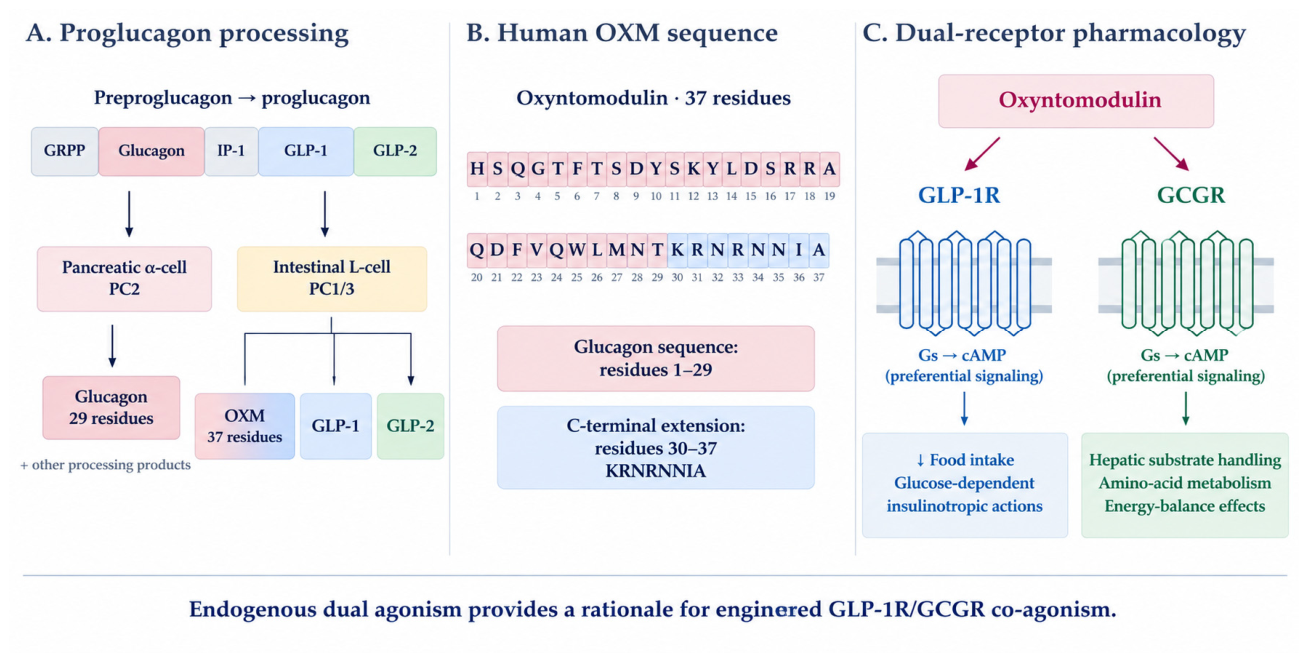
Figure 2.
Molecular diversity among clinical GLP-1R/GCGR co-agonists. Primary peptide sequences and key molecular modifications of cotadutide, mazdutide, survodutide, and pemvidutide illustrate distinct structural strategies for achieving GLP-1R/GCGR co-agonism. Modified residues and conjugation sites are highlighted. Abbreviations: Aib, α-aminoisobutyric acid; AEEA, 2-[2-(2-aminoethoxy)ethoxy]acetic acid; Ac4c, 1-aminocyclobutane-1-carboxylic acid; GCGR, glucagon receptor; GLP-1R, glucagon-like peptide-1 receptor; OXM, oxyntomodulin; γGlu, γ-glutamyl [80,83,84,85,86,87,88,89,90,91,92,93,94].
Figure 2.
Molecular diversity among clinical GLP-1R/GCGR co-agonists. Primary peptide sequences and key molecular modifications of cotadutide, mazdutide, survodutide, and pemvidutide illustrate distinct structural strategies for achieving GLP-1R/GCGR co-agonism. Modified residues and conjugation sites are highlighted. Abbreviations: Aib, α-aminoisobutyric acid; AEEA, 2-[2-(2-aminoethoxy)ethoxy]acetic acid; Ac4c, 1-aminocyclobutane-1-carboxylic acid; GCGR, glucagon receptor; GLP-1R, glucagon-like peptide-1 receptor; OXM, oxyntomodulin; γGlu, γ-glutamyl [80,83,84,85,86,87,88,89,90,91,92,93,94].
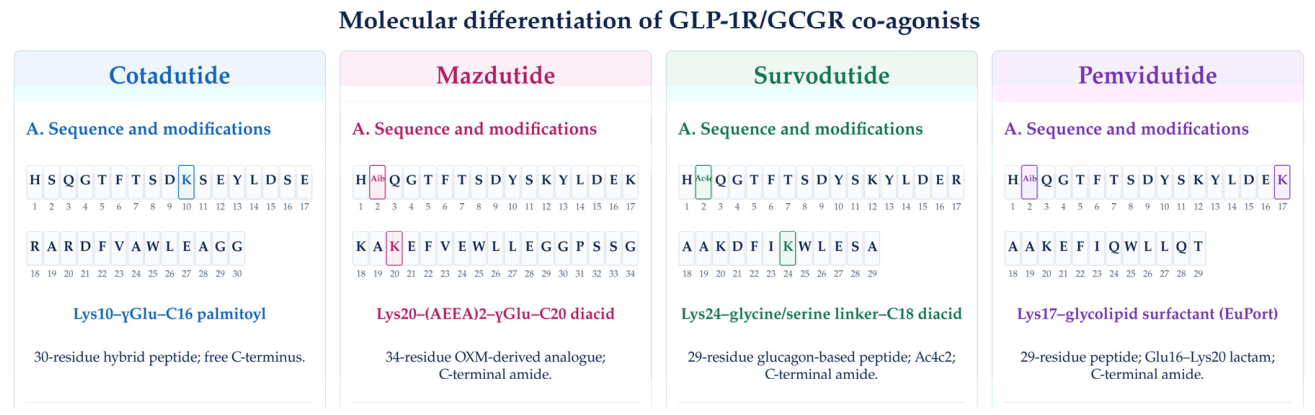
Figure 3.
Retatrutide: molecular architecture and triple-receptor recognition. (A) The 39-residue sequence highlights Aib2 and Aib20, α-methyl-L-leucine13, Lys17-linked C20 fatty-diacid conjugation, and C-terminal amidation; linker connectivity is shown schematically. (B) Gs-coupled cryo-EM structures of retatrutide bound to GLP-1R, GIPR, and GCGR (PDB 8YW3, 8YW4, and 8YW5), with cAMP potencies expressed relative to each receptor’s cognate endogenous ligand [31,42]. Panel B was cropped and resized from Li et al. [42], Figure 1b, under the Creative Commons Attribution 4.0 International (CC BY 4.0) license; the original component colors and labels were retained. (C) GIPR R196Y and GCGR Y138A reduced retatrutide cAMP potency by 107.7-fold and 26.9-fold, respectively, relative to the corresponding wild-type receptors [42]. These functional mutagenesis data do not represent experimentally resolved mutant structures or quantify receptor-specific contributions to clinical effects. Aib, α-aminoisobutyric acid; cAMP, cyclic adenosine monophosphate; GCGR, glucagon receptor; GIPR, glucose-dependent insulinotropic polypeptide receptor; GLP-1R, glucagon-like peptide-1 receptor.
Figure 3.
Retatrutide: molecular architecture and triple-receptor recognition. (A) The 39-residue sequence highlights Aib2 and Aib20, α-methyl-L-leucine13, Lys17-linked C20 fatty-diacid conjugation, and C-terminal amidation; linker connectivity is shown schematically. (B) Gs-coupled cryo-EM structures of retatrutide bound to GLP-1R, GIPR, and GCGR (PDB 8YW3, 8YW4, and 8YW5), with cAMP potencies expressed relative to each receptor’s cognate endogenous ligand [31,42]. Panel B was cropped and resized from Li et al. [42], Figure 1b, under the Creative Commons Attribution 4.0 International (CC BY 4.0) license; the original component colors and labels were retained. (C) GIPR R196Y and GCGR Y138A reduced retatrutide cAMP potency by 107.7-fold and 26.9-fold, respectively, relative to the corresponding wild-type receptors [42]. These functional mutagenesis data do not represent experimentally resolved mutant structures or quantify receptor-specific contributions to clinical effects. Aib, α-aminoisobutyric acid; cAMP, cyclic adenosine monophosphate; GCGR, glucagon receptor; GIPR, glucose-dependent insulinotropic polypeptide receptor; GLP-1R, glucagon-like peptide-1 receptor.
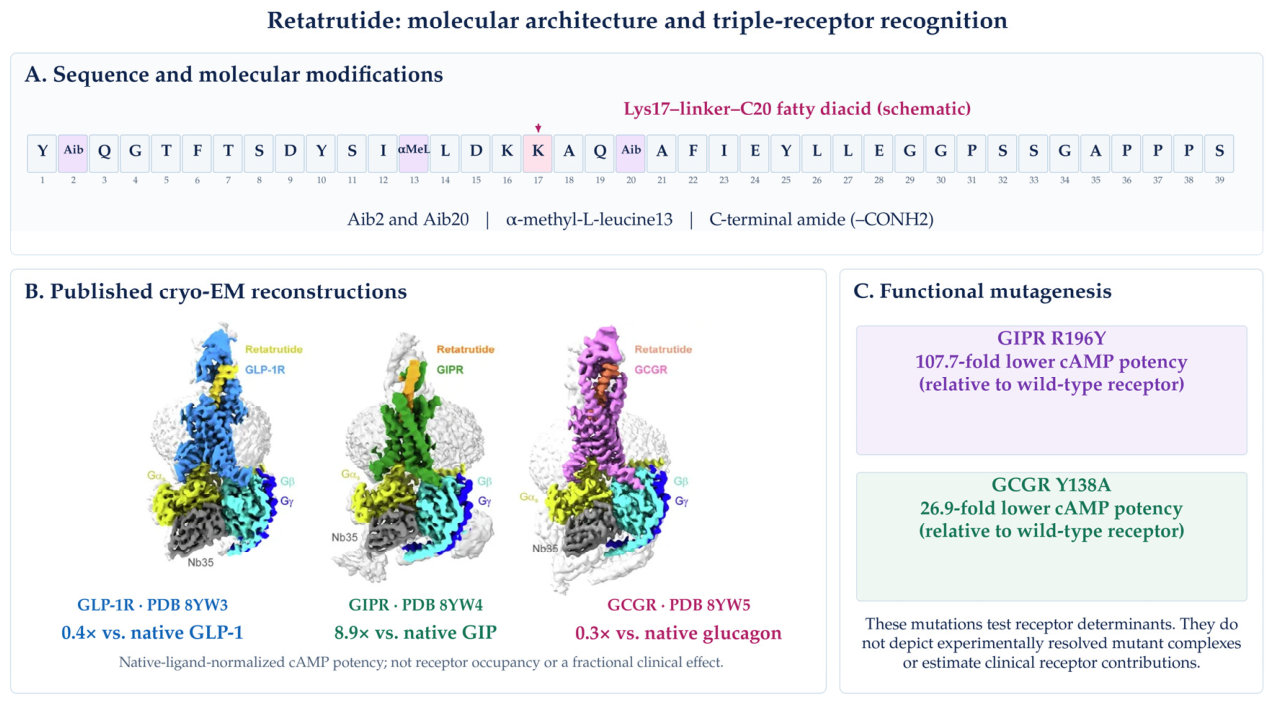
Figure 4.
Retatrutide clinical development, phase 3 weight efficacy, and tolerability. (A) Selected milestones from early clinical pharmacology through phase 2 and phase 3 development in T2DM and obesity. (B) Mean body-weight changes at week 80 in TRIUMPH-1 and TRIUMPH-2 according to the treatment-regimen and efficacy estimands; values are within-group changes from baseline and should not be interpreted as placebo-adjusted or head-to-head treatment effects. (C) Selected adverse events and adverse-event-related discontinuation in TRIUMPH-1 by assigned treatment group. Point estimates are shown without uncertainty intervals. AE, adverse event; MASLD, metabolic dysfunction-associated steatotic liver disease; MRI-PDFF, magnetic resonance imaging proton density fat fraction; T2DM, type 2 diabetes mellitus [77,97,98,101,102,103,104,105,107,108].
Figure 4.
Retatrutide clinical development, phase 3 weight efficacy, and tolerability. (A) Selected milestones from early clinical pharmacology through phase 2 and phase 3 development in T2DM and obesity. (B) Mean body-weight changes at week 80 in TRIUMPH-1 and TRIUMPH-2 according to the treatment-regimen and efficacy estimands; values are within-group changes from baseline and should not be interpreted as placebo-adjusted or head-to-head treatment effects. (C) Selected adverse events and adverse-event-related discontinuation in TRIUMPH-1 by assigned treatment group. Point estimates are shown without uncertainty intervals. AE, adverse event; MASLD, metabolic dysfunction-associated steatotic liver disease; MRI-PDFF, magnetic resonance imaging proton density fat fraction; T2DM, type 2 diabetes mellitus [77,97,98,101,102,103,104,105,107,108].
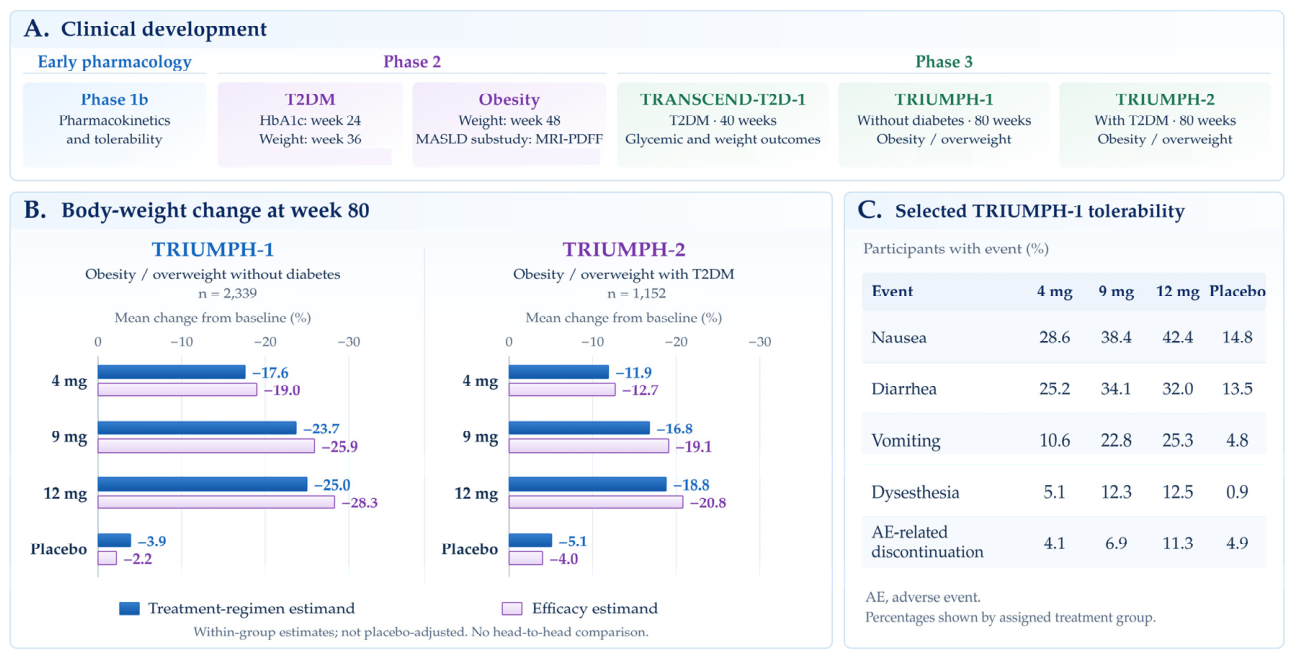
Figure 5.
Experimental strategies for receptor-specific causal attribution in multi-receptor pharmacology. (A) Molecular assays characterize ligand–receptor pharmacology, signaling, and structural determinants. (B) Receptor perturbation tests receptor dependence within an experimental model. (C) Human physiological studies characterize integrated metabolic responses but require an informative intervention or comparator for receptor-specific attribution. (D) Randomized trials estimate whole-drug treatment effects unless receptor activity is isolated by design. (E) Receptor-specific causal inference therefore relies on convergence across complementary methods rather than on an automatic hierarchy of study phases [23,27,28,29,42,56,58,68,77,102].
Figure 5.
Experimental strategies for receptor-specific causal attribution in multi-receptor pharmacology. (A) Molecular assays characterize ligand–receptor pharmacology, signaling, and structural determinants. (B) Receptor perturbation tests receptor dependence within an experimental model. (C) Human physiological studies characterize integrated metabolic responses but require an informative intervention or comparator for receptor-specific attribution. (D) Randomized trials estimate whole-drug treatment effects unless receptor activity is isolated by design. (E) Receptor-specific causal inference therefore relies on convergence across complementary methods rather than on an automatic hierarchy of study phases [23,27,28,29,42,56,58,68,77,102].
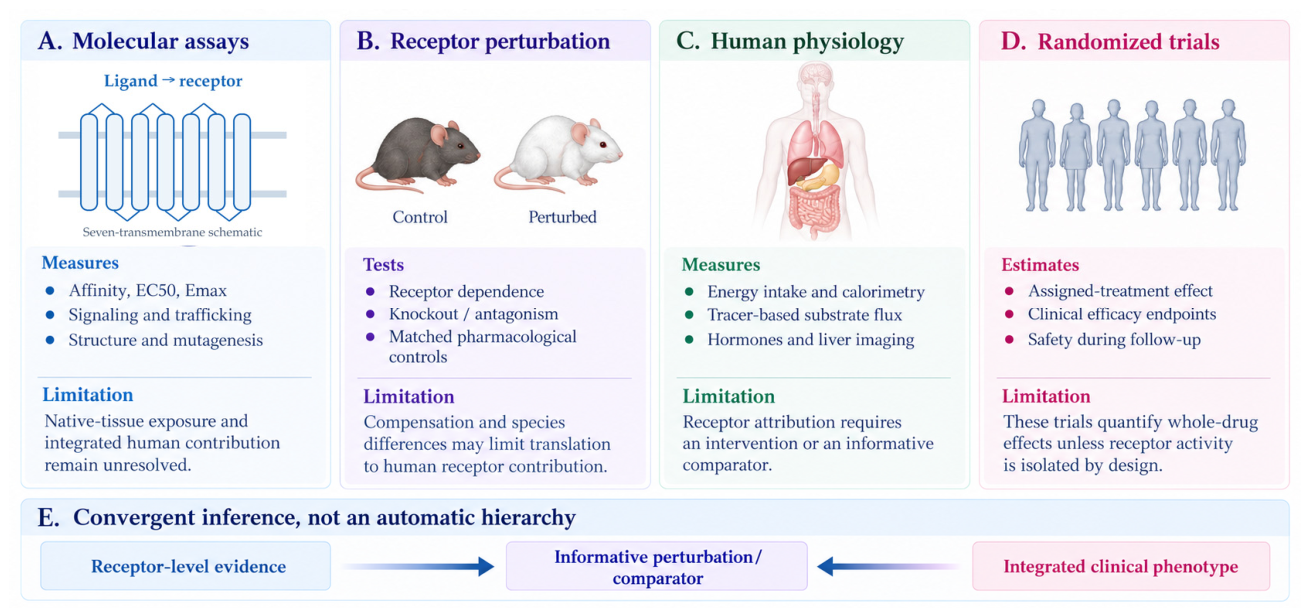
Figure 6.
Proposed Activity–Exposure–Context framework for multi-receptor pharmacology. (A) Activity encompasses receptor pharmacology, signaling, and regulation. (B) Exposure describes the concentration–time profile and accessibility of the drug to its receptor targets. (C) Context comprises cellular, tissue, and host factors that shape the physiological response to receptor activation. (D) Prospective enteroinsular phenotyping using a standardized mixed-meal tolerance test (MMTT) is proposed as a testable strategy to investigate treatment-response heterogeneity. The AEC framework is conceptual and does not constitute a validated score, mathematical model, or treatment-selection algorithm. Biomarker utility would require treatment-by-biomarker interaction testing and external validation. AEC, Activity–Exposure–Context; GCGR, glucagon receptor; GIP, glucose-dependent insulinotropic polypeptide; GIPR, GIP receptor; GLP-1, glucagon-like peptide-1; GLP-1R, GLP-1 receptor; MMTT, mixed-meal tolerance test; OXM, oxyntomodulin. Sources: [19,31,40,56,57,58,68,84,99,100,111,112,113].
Figure 6.
Proposed Activity–Exposure–Context framework for multi-receptor pharmacology. (A) Activity encompasses receptor pharmacology, signaling, and regulation. (B) Exposure describes the concentration–time profile and accessibility of the drug to its receptor targets. (C) Context comprises cellular, tissue, and host factors that shape the physiological response to receptor activation. (D) Prospective enteroinsular phenotyping using a standardized mixed-meal tolerance test (MMTT) is proposed as a testable strategy to investigate treatment-response heterogeneity. The AEC framework is conceptual and does not constitute a validated score, mathematical model, or treatment-selection algorithm. Biomarker utility would require treatment-by-biomarker interaction testing and external validation. AEC, Activity–Exposure–Context; GCGR, glucagon receptor; GIP, glucose-dependent insulinotropic polypeptide; GIPR, GIP receptor; GLP-1, glucagon-like peptide-1; GLP-1R, GLP-1 receptor; MMTT, mixed-meal tolerance test; OXM, oxyntomodulin. Sources: [19,31,40,56,57,58,68,84,99,100,111,112,113].
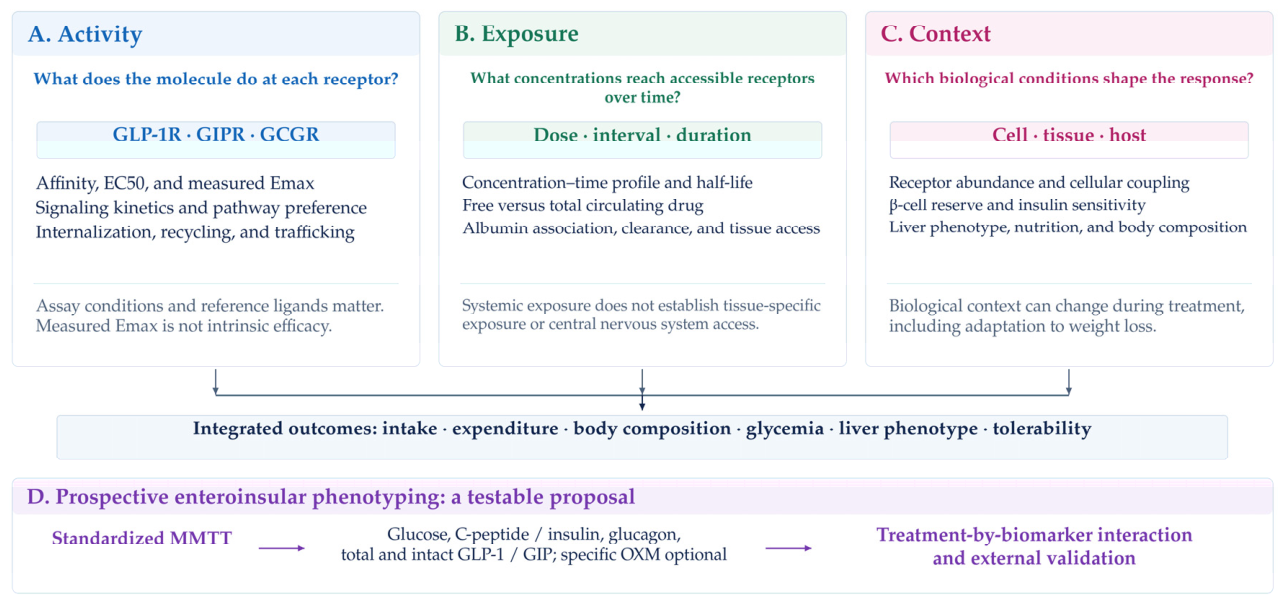

Table 1.
Early human metabolic studies of native oxyntomodulin.
| Study | Design and Population | Principal Finding | Pharmacological Contribution |
| Cohen et al., 2003 [26] | Acute controlled OXM administration in healthy adults; subsequent ad libitum meal assessment | OXM significantly reduced energy intake during the subsequent meal | Established acute anorectic activity of pharmacological OXM in humans |
| Wynne et al., 2005 [24] | Repeated subcutaneous native OXM administration for 4 weeks in adults with overweight or obesity | Mean body-weight change was -2.3 kg with OXM vs. −0.5 kg with placebo | Provided early proof of concept that sustained OXM exposure can reduce body weight in humans |
| Wynne et al., 2006 [25] | Randomized crossover study assessing food intake and components of energy expenditure | OXM reduced energy intake and increased activity-related (~26%) and total (~9%) energy expenditure, without a significant increase in resting energy expenditure | Suggested that the human metabolic actions of OXM may extend beyond appetite suppression |
| Shankar et al., 2018 [66] | Native OXM administration in adults with obesity, with and without T2DM | OXM produced glucoregulatory effects under the experimental conditions studied | Extended human OXM pharmacology from energy balance to glucose regulation |
OXM, oxyntomodulin; T2DM, type 2 diabetes mellitus. Results are reported according to the individual study designs and should not be interpreted as direct efficacy comparisons across studies.
Table 2.
Representative clinical evidence for GLP-1R/GCGR co-agonists; not a cross-trial efficacy ranking.
Table 2.
Representative clinical evidence for GLP-1R/GCGR co-agonists; not a cross-trial efficacy ranking.
| Dual Agonist | Main Therapeutic Focus | Trial/Phase | Population and Treatment | Principal Reported Outcomes |
| Cotadutide (MEDI0382) AstraZeneca/MedImmune, UK/USA |
T2DM, overweight/obesity; metabolic and hepatic physiology | NCT02548585, phase 2a [84] | 51 randomized adults with T2DM and BMI 27–40 kg/m2; once-daily SC cotadutide up to 200 μg; 41 days. | At day 41, post-MMTT glucose AUC decreased 32.78% vs. 10.16% with placebo; body weight decreased 3.84 vs. 1.70 kg, respectively [84]. GI adverse events were more frequent with cotadutide. |
| Mazdutide (IBI362/LY3305677) Innovent Biologics, China; program originated through collaboration with Eli Lilly, USA |
Obesity/overweight and T2DM | GLORY-1, phase 3 [85] | Chinese adults with overweight/obesity; once-weekly SC 4 or 6 mg | At week 48, mean weight change was -11.00% (4 mg), -14.01% (6 mg), and +0.30% placebo; ≥15% weight loss occurred in 35.7%, 49.5%, and 2.0%, respectively [85]. |
| Mazdutide (IBI362/LY3305677) Innovent Biologics, China |
Obesity, including participants with and without T2DM | GLORY-2, phase 3 [86] | 461 treated Chinese adults with obesity; 16.1% had T2DM; once-weekly SC 9 mg vs. placebo for 60 weeks | Mean weight change at week 60 was -16.65% vs. -1.50% placebo; ≥5% weight loss occurred in 84.3% vs. 33.1%. GI adverse events were predominant [86]. |
| Survodutide (BI 456906) Boehringer Ingelheim, Germany/Zealand Pharma, Denmark |
Obesity | SYNCHRONIZE-1, phase 3 [89] | 725 adults with obesity without T2DM; once-weekly SC 3.6 or 6.0 mg; 76 weeks | Treatment-regimen estimand: mean weight change -12.2% (3.6 mg), -13.0% (6 mg), vs. -5.4% placebo. ≥5% loss: 72.6%, 71.9%, and 46.3%, respectively [89]. |
| Survodutide (BI 456906) Boehringer Ingelheim, Germany/Zealand Pharma, Denmark |
MASLD/MASH and obesity | SYNCHRONIZE-MASLD, phase 3 [78] | 218 randomized adults with obesity and at-risk MASLD (216 treated); once-weekly SC 6 mg or placebo; 48 weeks. | Efficacy estimand: ≥30% relative liver-fat reduction in 84.2% vs. 24.3%; mean weight change -12.2% vs. -1.0%. Both coprimary endpoints were met [78]. |
| Survodutide (BI 456906) Boehringer Ingelheim, Germany/Zealand Pharma, Denmark |
Biopsy-confirmed MASH | Phase 2 MASH trial [79] | Adults with biopsy-defined MASH and fibrosis | Demonstrated histological improvement of MASH without worsening of fibrosis, supporting progression of the hepatic program [79]. |
| Pemvidutide (ALT-801) Altimmune, USA |
MASH and obesity | IMPACT, phase 2b [80] | 212 participants with biopsy-confirmed MASH and F2/F3 fibrosis; once-weekly SC 1.2 or 1.8 mg; 24-week primary analysis | MASH resolution without worsening fibrosis: 58% (1.2 mg), 52% (1.8 mg), vs. 20% placebo. Fibrosis improvement without worsening MASH: 33%, 36%, vs. 28%, respectively; the fibrosis endpoint was not significant [80]. |
Table 3.
Clinical development and representative outcomes of retatrutide.
| Trial/Study | Phase | Population | Treatment/Duration | Principal Clinical Outcome | Representative Result |
| T2DM dose-ranging trial (NCT04867785) [101] | 2 | 281 randomized adults with T2DM (275 in the efficacy analysis); placebo- and dulaglutide-controlled. | Retatrutide up to 12 mg once weekly; glycemic assessment at 24 weeks and weight assessment at 36 weeks | Glycemic control and body weight | At 12 mg, HbA1c decreased by 2.02 percentage points at week 24 and body weight by 16.94% at week 36 |
| Obesity dose-ranging trial (NCT04881760) [102] | 2 | 338 adults with obesity or overweight, without T2DM | Retatrutide up to 12 mg once weekly; 48 weeks | Body weight | At 12 mg, mean body-weight change was −24.2% vs. −2.1% with placebo |
| MASLD substudy of NCT04881760 [77] | 2 | 98 participants with baseline liver fat ≥10% | Retatrutide up to 12 mg once weekly; primary MRI assessment at 24 weeks | Hepatic steatosis by MRI-PDFF | At 12 mg, mean relative liver-fat change was −82.4% vs. +0.3% with placebo |
| TRANSCEND-T2D-1 [98] | 3 | 537 adults with relatively early T2DM inadequately controlled with diet and exercise | Retatrutide 4, 9, or 12 mg once weekly vs. placebo; 40 weeks | HbA1c, fasting glucose and body weight | At 12 mg, HbA1c change was −1.94 percentage points vs. -0.81 with placebo; body-weight change was -15.3% vs. -2.6%, respectively, at week 40 (treatment-regimen estimand). |
| TRIUMPH-1 [104] | 3 | 2,339 adults with obesity, or overweight plus ≥1 weight-related complication, without diabetes | 4, 9 or 12 mg once weekly; 80 weeks | Body weight | Treatment-regimen estimand: -17.6%, -23.7%, -25.0% vs. -3.9% placebo. Efficacy estimand: -19.0%, -25.9%, -28.3% vs. -2.2% placebo |
| TRIUMPH-1 extension (sponsor report) [103] | 3 extension | Participants from TRIUMPH-1 with baseline BMI ≥35 kg/m2 entering the prespecified extension | Continued treatment through 104 weeks | Long-term body-weight reduction | Mean body-weight reductions approached 30% with the highest-dose strategy during continued treatment |
| TRIUMPH-2 [105] | 3 | 1,152 adults with obesity or overweight and T2DM | 4, 9 or 12 mg once weekly; 80 weeks | Body weight and HbA1c | Treatment-regimen estimand: -11.9%, -16.8%, -18.8% vs. -5.1% placebo. Efficacy estimand: -12.7%, -19.1%, -20.8% vs. -4.0% placebo. HbA1c (reported primary analysis): -1.38, -1.50, -1.45 percentage points vs. -0.45 Efficacy-estimand body-weight values are also reported in the detailed sponsor communication [108]. |
| TRIUMPH-3 (sponsor report) [109] | 3 | Adults with severe obesity and established cardiovascular disease, with or without T2DM | 9 or 12 mg once weekly; 80 weeks | Body weight and cardiometabolic risk factors | Efficacy-estimand body-weight reductions reached −21.6% and -22.6% with 9 and 12 mg, respectively, vs. -3.2% with placebo; multiple cardiometabolic risk markers also improved |
| TRIUMPH-4 (sponsor report) [106] | 3 | Adults with obesity or overweight and knee osteoarthritis, without diabetes | 9 or 12 mg once weekly; 68 weeks | Body weight, knee pain and physical function | Efficacy-estimand body-weight reductions were -26.4% and -28.7% with 9 and 12 mg vs. -2.1% placebo; WOMAC pain and physical function also improved |
Table 4.
Experimental dimensions for characterizing Activity–Exposure–Context in multi-receptor pharmacology.
Table 4.
Experimental dimensions for characterizing Activity–Exposure–Context in multi-receptor pharmacology.
| AEC Dimension | Domain | Core Measurements | Mechanistic Question Addressed |
| Activity | Receptor pharmacology | Affinity, EC50, Emax, cognate reference ligand, receptor expression | How strongly and effectively does the molecule activate each receptor? |
| Activity | Signaling and trafficking | cAMP kinetics, β-arrestin recruitment, internalization, recycling, sustained signaling | Does receptor activation differ in pathway, magnitude, or duration? |
| Exposure | Pharmacokinetics | Dose–concentration relationship, half-life, free/total exposure, dosing interval | What receptor-active concentrations are sustained over time? |
| Context | Energy balance | Intake, expenditure, activity, fat mass, fat-free mass | How is receptor pharmacology translated into whole-body energy balance? |
| Context | Hepatic metabolism | MRI-PDFF, substrate flux, insulin action, histology where appropriate | How do direct and systemic mechanisms contribute to hepatic outcomes? |
| Context | Nitrogen and functional tissue | Protein intake, amino acids, nitrogen handling, lean mass, strength/function | How does profound weight loss interact with amino-acid metabolism and functional tissue? |
| Integrated clinical phenotype | Trial estimand | Population, dose/titration, visit, intercurrent events, discontinuation, confidence intervals | What treatment effect is being estimated and in whom? |
| Integrated clinical phenotype | Durability and outcomes | Persistence, withdrawal, cardiovascular, renal and hepatic outcomes | Does metabolic efficacy translate into durable clinical benefit? |
The AEC framework is proposed in this review as a conceptual structure for integrating molecular pharmacology, pharmacokinetic exposure, biological state, and clinical phenotype. It is not a validated scoring system or formal risk-of-bias instrument.
Table 5.
Proposed prospective mixed-meal phenotyping strategy: measurements, interpretations and validation requirements.
Table 5.
Proposed prospective mixed-meal phenotyping strategy: measurements, interpretations and validation requirements.
| Domain | Proposed Measurement | Derived Information | Validation Objective |
| Standardized nutrient challenge | Prespecified energy and macronutrient composition; fixed fasting and ingestion conditions; representative sampling at 0, 15, 30, 60, 90, and 120 min, ±180 min | Dynamic metabolic response to a reproducible nutrient stimulus | Establish within-person reproducibility and sensitivity to metabolic phenotype |
| Glycemic response | Serial plasma glucose | Excursion, peak, time-to-peak, AUC | Determine incremental association with subsequent glycemic and weight response |
| β-cell response | C-peptide and insulin interpreted relative to glucose | Stimulus-dependent insulin secretory response | Evaluate whether β-cell functional reserve modifies treatment response |
| α-cell response | Serial glucagon | Basal concentration and postprandial suppression/recovery | Test whether α-cell/hepatic-axis phenotype modifies response to GCGR-containing therapy |
| Incretin response | Total and intact GLP-1 and GIP | Concentration–time profiles reflecting secretion, degradation, and clearance; not direct receptor sensitivity. | Test association and treatment-specific predictive value |
| OXM—exploratory | Analytically specific OXM measurement | Endogenous OXM response to nutrient ingestion | Establish analytical feasibility before evaluating predictive utility |
| Preanalytical control | Validated collection matrix; protease/DPP-4 protection where appropriate; rapid temperature-controlled processing; standardized storage | Reliable preservation of intended analytes | Minimize degradation and assay-related phenotypic misclassification |
| Clinical integration | Baseline phenotype, achieved dose/exposure, adherence, and longitudinal outcomes | Multivariable treatment-response phenotype | Evaluate calibration, discrimination, incremental predictive value, and external validity |
MMTT, mixed-meal tolerance test; AUC, area under the concentration–time curve. The proposed sampling schedule and biomarker panel constitute a prospective research strategy requiring validation and are not established treatment-selection criteria.
Disclaimer/Publisher’s Note: The statements, opinions and data contained in all publications are solely those of the individual author(s) and contributor(s) and not of MDPI and/or the editor(s). MDPI and/or the editor(s) disclaim responsibility for any injury to people or property resulting from any ideas, methods, instructions or products referred to in the content. |
© 2026 by the authors. Licensee MDPI, Basel, Switzerland. This article is an open access article distributed under the terms and conditions of the Creative Commons Attribution (CC BY) license.
Copyright: This open access article is published under a Creative Commons CC BY 4.0 license, which permit the free download, distribution, and reuse, provided that the author and preprint are cited in any reuse.