

Submitted:
01 October 2026
Posted:
05 October 2026
You are already at the latest version
Abstract
Deep-learning track reconstruction methods such as hepattn and HEPTv2 perform strongly on the TrackML benchmark, but each represents detector hits from a single, architecturally bounded viewpoint. This work asks whether a channel-boosted multi-agent architecture can recover more particle tracks than either expert model achieves alone. The proposed system, CB-HMAS (Channel-Boosted Hierarchical MultiAgent System), combines a newly designed, physics-informed Relational Anchor Agent with two frozen expert peer channels (hepattn and HEPTv2) through a hyper-attention Fusion agent. A reinforcement-learning Topology Controller adjusts each peer channel’s contribution, and a meta-learning optimizer provides per-event adaptation. We evaluated the system on 210 held-out TrackML events (IDs 3000–3210, drawn from a separate data folder with zero overlap with the 1000–2300 training range). Across nearly the full range of similarity thresholds tested, the fused system exceeds both individual peer channels; at threshold 0.9 it reaches 76.0% efficiency, against 42.0% for hepattn alone and 12.2% for HEPTv2 alone. An embedding-capacity ablation identified representational capacity as a limiting factor: increasing the shared Anchor/Fusion embedding dimension from 32 to 64 raised peak efficiency from 45.7% to 76.0% under an otherwise identical configuration. Across five independent training runs with different random seeds, efficiency at threshold 0.9 is stable at 75.6% ± 2.4 percentage points, and the fused system outperforms both individual peer channels for every seed tested. These held-out results indicate that channel boosting recovers track structure that neither expert channel captures alone, and that the advantage is consistent rather than the product of a single favorable run.
Keywords:
charged-particle track reconstruction
; multi-agent systems
; channel boosting
; feature fusion
; representation learning
; TrackML
1. Introduction
Track reconstruction, the task of grouping detector hits into the trajectories of individual particles, is a foundational problem in high-energy physics data analysis. Deep learning has advanced this task substantially in recent years. Transformer-based architectures such as hepattn [1] reach efficiencies near 97% on the TrackML benchmark [2], a widely used simulated-detector dataset for evaluating particle-tracking algorithms. hepattn combines a sliding-window attention encoder for hit filtering with a MaskFormer-style decoder [3] for track assignment. Related architectures, including HEPTv2 [4], propose alternative encoding strategies with different inductive biases. Section 2 describes both architectures in more detail.
Despite their strengths, these models share a limitation: each is trained and evaluated as an independent, self-contained system, so its performance is bounded by the representation it learns. A hit-filtering transformer and a locality-aware encoder such as HEPTv2 may each capture different, complementary aspects of the same detector data, yet neither architecture is designed to use information the other could provide.
This work asks whether that restriction can be overcome. Can a system that combines several specialized expert models, through a learned and physics-aware fusion mechanism, recover more particle tracks than any single expert does on its own? We call this the channel-boosting hypothesis and test it with a purpose-built multi-agent architecture, CB-HMAS (Channel-Boosted Hierarchical Multi-Agent System), which uses hepattn and HEPTv2 as its two expert peer channels.
1.1. Contributions
- A channel-boosted multi-agent architecture that combines a newly designed, physics-informed Relational Anchor Agent with two frozen expert peer channels, coordinated by a learned Fusion agent and a reinforcement-learning Topology Controller.
- A controlled evaluation of the channel-boosting hypothesis against individual-expert baselines on held-out TrackML data, swept across the full range of clustering similarity thresholds tested (0.2–0.9) rather than at a single operating point.
- An embedding-capacity ablation that isolates representational capacity as a limiting factor in fusion quality and shows that doubling the shared embedding dimension relieves it.
- A five-seed robustness check showing that the advantage over both individual peer channels holds across independent training runs rather than depending on a single favorable initialization.
2. Background and Motivation
The hepattn architecture [1] treats hit filtering as a per-hit binary classification problem. It uses a stack of pre-norm transformer encoder layers with sliding-window self-attention and a cyclic positional encoding over the detector’s azimuthal coordinate. We reproduced this architecture directly from its published specification; Section 3.2 checks the reproduction against the parameter count expected for the published architecture.
HEPTv2 [4] is an independently designed second expert model. It encodes detector hits with a point-transformer formulation based on locality-sensitive hashing. Including it as Peer 2 lets us test the channel-boosting hypothesis with two expert channels whose architectures differ strongly: hepattn’s sliding-window attention and HEPTv2’s locality-hashing encoder process detector geometry in fundamentally different ways, which motivates the expectation that their learned representations are complementary rather than redundant.
The methodological motivation for CB-HMAS comes from a general principle in ensemble and multi-expert learning [5]: when individual models capture different, non-redundant information about the same underlying signal, a learned combination of their outputs can in principle outperform any single model. Realizing this in practice requires (i) a mechanism that can learn when and how much to trust each channel, (ii) enough representational capacity for that mechanism to express a genuinely informative combination rather than a compromise average, and (iii) confirmation, through direct experiment, that the channels being combined are sufficiently non-redundant for fusion to help. All three considerations shaped both the design of CB-HMAS and the diagnostic experiments reported here.
The multi-agent decomposition of CB-HMAS (an Anchor agent, frozen peer channels, a learned Fusion agent, a Topology Controller and a Meta-Learner) follows a design we used earlier for physics-guided, self-adaptive multi-agent reasoning in jet anomaly detection [6]. That system combined an analogous set of coordinated agents (a meta-learning optimizer, a relational reasoning agent, a fusion and communication agent, and a reinforcement-learning-based topology controller) with physical constraints embedded directly in the relational message passing. It established the multi-agent decomposition and the physics-constrained relational-reasoning pattern in a different task domain, jet anomaly detection rather than track reconstruction, and it did not test a channel-boosting fusion mechanism against individual-expert baselines as this paper does. The present work adapts the same organizing principle, an Anchor–Peer–Fusion–Topology decomposition, to charged-particle track reconstruction and focuses on whether fusing peer channels gives a measurable, quantified benefit, which the earlier work did not evaluate in this form. We do not report a numerical comparison between the two studies because they differ in task, dataset and metrics; the comparison here is architectural and methodological rather than quantitative.
3. Methodology
CB-HMAS has five coordinated modules: a Relational Anchor Agent, two frozen expert peer channels (counted together as one module), a Fusion and Communication Agent, a Topology Controller, and a Meta-Learner Optimizer. Figure 1 shows how they are connected. In what follows we call the Relational Anchor Agent the Anchor agent, the Fusion and Communication Agent the Fusion agent, and the Meta-Learner Optimizer the Meta-Learner.
3.1. Relational Anchor Agent
The Anchor agent is a physics-informed graph neural network (GNN), designed and implemented specifically for this project rather than adapted from existing work. It operates on a directed, asymmetric message-passing graph built from inner-to-outer detector-layer hit adjacency, and it produces a per-hit embedding together with a confidence score.
Physical consistency is enforced inside the agent’s own computation by combining three constraint terms into a single conservation loss:
where measures the residual deviation from a fitted circular trajectory consistent with a charged particle’s helical path, penalizes hit assignments that violate monotonically increasing radial detector-layer order, and penalizes physically implausible over-assignment of hits to a single track. The three weighting coefficients , and are learned rather than fixed. Each is parameterized through a softplus transformation that keeps it strictly positive, which prevents the optimizer from lowering the penalty simply by driving a coefficient negative instead of improving physical accuracy. This conservation loss is what makes the Anchor “physics-informed”: the constraint is part of the Anchor’s own training signal rather than a post-hoc check on its output. Section 7 notes that no separate metric or ablation currently isolates how much this term contributes to the reported efficiency gains.
3.2. Peer Channel 1: hepattn
The first expert peer channel is our reproduction of the hepattn hit-filter model [1], used strictly as a frozen feature extractor. Its parameter count, 8,171,809 (counting both trainable weights and non-trainable positional-encoding buffers), was independently verified to match the value expected for the specified architecture, which confirms that the reproduction is architecturally faithful to the original publication. The checkpoint is loaded strictly and kept in evaluation mode with gradients disabled for the whole of CB-HMAS training and evaluation.
3.3. Peer Channel 2: HEPTv2
The second expert peer channel is HEPTv2 [4], introduced in Section 2. It is likewise loaded strictly from its pretrained checkpoint and kept frozen throughout. The HEPTv2 checkpoint used for the results in Section 5 was trained for 15 epochs on 1,600 TrackML simulation events, well short of the training budget described in its original publication, so it is evaluated here as a partially trained frozen channel. We discuss this as a limitation in Section 7.
3.4. Fusion and Communication Agent
The Fusion agent combines the Anchor’s embedding with the embeddings of the two peer channels, (hepattn) and (HEPTv2), through a learned, per-hit hyper-attention weighting. Each of the three embeddings is first projected linearly into a shared embedding space of dimension d, and in Equations (2) and (3) the symbols , and denote these projected embeddings:
Here , a multi-layer perceptron (MLP), maps the concatenated per-hit embeddings to three logits, and , , are the resulting softmax weights, that is, the learned per-hit contributions of the Anchor, Peer 1 and Peer 2 embeddings. The fused per-hit embedding is their weighted sum and is the embedding used for downstream clustering. The temperature parameter ( in all reported experiments) scales the logits before the softmax. We introduced it after observing that, without temperature scaling, the learned channel weights stayed close to uniform (about 0.33 per channel) even when one channel was demonstrably more informative than the others. The softmax tends to produce moderate outputs when the logits are not strongly separated, and temperature scaling lets the agent commit more decisively to a dominant channel when the signal supports doing so. Section 5.3 reports an ablation over the shared dimension d, which identifies it as a limiting factor for fusion quality at small values. Figure 2 illustrates the mechanism.
3.5. Topology Controller
The Topology Controller is a reinforcement-learning policy trained with REINFORCE [7]. For each peer channel and each event, it selects one of four discrete actions, conditioned on the fused embedding and on each channel’s own confidence score: keep (scale factor 1.0, no change), prune (scale factor 0.0, the channel’s embedding is zeroed out before fusion), reweight_down (scale factor 0.5), or reweight_up (scale factor 1.5). The reward is the negative embedding loss (Section 3.7) obtained when the scale factor of the chosen action is applied to each peer channel’s embedding before fusion. This gives the policy a direct incentive to down-weight channels that are not currently contributing useful information.
3.6. Meta-Learner Optimizer
The Meta-Learner is a meta-learning optimizer based on model-agnostic meta-learning (MAML) [8] that performs per-event fast adaptation. The adapted parameter set is the trainable core of the system: the Anchor agent’s parameters together with the Fusion agent’s parameters, treated as a single jointly adapted model. Both peer channels remain frozen and are never part of this set. Each training event is treated as an individual adaptation task. The hits within the event are split into a support subset and a query subset; the model’s parameters are adapted with an inner-loop gradient update on the support subset, and the adapted parameters are then evaluated on the query subset to compute the outer-loop meta-gradient, which updates the shared initialization. Formally, for a task with support set and query set , the inner loop computes the adapted parameters
where is the inner-loop learning rate and is the loss evaluated on the indicated subset. The outer loop then updates the shared initialization with the query loss evaluated at the adapted parameters of Equation (4), , through the outer optimizer. In the implementation, the query loss is computed by running the model’s forward pass with the adapted parameter dictionary substituted for the live weights (functional parameter substitution), so that gradients propagate through the inner-loop update back to . The reusable meta-learning module used here defaults to a single inner-loop gradient step per task. The exact inner step count and the inner and outer learning rates used in the reported training run are set in the training script and were not independently re-verified for this manuscript. The Meta-Learner is introduced in the second phase of the training curriculum (Section 3.9), which runs for 200 outer-loop steps, and it remains active in the third phase.
Two clarifications are needed for accuracy. First, the original architecture specification for this system also describes grouping training events into meta-learning tasks by pile-up regime and feeding the Topology Controller’s per-event decisions back into the adaptation of the next event as a closed loop. Neither is implemented in the training pipeline used for the reported results, which defines each individual event as its own adaptation task and applies the Topology Controller’s actions only within the event being processed. The closed Topology-to-Meta-Learner feedback loop is therefore identified as future work (Section 7) and is not part of the evaluated system. Second, Section 5 does not report a result that separates the Meta-Learner’s individual contribution to the efficiency gains from the contributions of the Fusion agent and embedding capacity; we state this gap explicitly as a limitation in Section 7 rather than leaving it implicit.
3.7. Training Objective
Both peer channels remain frozen throughout all CB-HMAS training and are not fine-tuned as part of the multi-agent system at any stage. The trainable components (Anchor, Fusion, Meta-Learner and Topology Controller) are optimized against a per-hit embedding loss based on a binary cross-entropy (BCE) term. The loss encourages hits that belong to the same true particle to be pulled together in the fused embedding space and hits from different particles to be pushed apart:
where the mean is taken over pairs of hits , and and are the embeddings of hits i and j under whichever embedding is being evaluated: for the main training objective, or a single peer channel’s own embedding when is evaluated separately for each peer in Equation (6) below. Further, is the cosine similarity, is the sigmoid function, is a fixed temperature scaling factor applied to the cosine similarity before the BCE computation, denotes ground-truth particle identity, and is the indicator function. Hits without a valid particle association (TrackML’s noise-hit convention) are excluded from the loss. This objective resembles the InfoNCE-style contrastive embedding losses introduced by van den Oord et al. [9] and used in earlier track-reconstruction work, including HEPTv2 [4].
3.8. Margin-Based Training Correction
The embedding loss in Equation (5) optimizes the fused representation for overall clustering quality, but on its own it contains no term that compares the fused representation with the individual peer channels being combined. A margin-based correction addresses this directly. It uses a rectified linear unit (ReLU) so that the penalty applies only when the fused loss is worse than that of the better peer:
In Equation (7), is the conservation loss from Equation (1) and is its weighting coefficient in the total objective. We used in Phase 1 and reduced it to in Phases 2 and 3, reflecting a lighter conservation penalty once the Anchor’s relational structure has stabilized; in all three phases. The minimum individual-peer loss in Equation (6) is treated as a fixed target, detached from the computation graph at each training step, so that gradients from flow only through the fused representation. The correction is applied in all three phases of the training curriculum and is included in every result reported in Section 5.
3.9. Training Curriculum
Training follows a staged curriculum. Phase 1 trains the Anchor and Fusion agents jointly with standard supervised gradient descent for 20 epochs, with the Topology Controller disabled (it always selects the keep action). Phase 2 additionally activates the Meta-Learner, which enables per-event fast adaptation, and runs for 200 outer-loop steps. Phase 3 additionally activates the Topology Controller, trained with REINFORCE alongside continued supervised training of the Anchor and Fusion agents, for 15 epochs. The Topology Controller is deliberately introduced last because training reinforcement-learning and meta-learning components simultaneously from initialization is a known source of training instability. Figure 3 summarizes the curriculum.
4. Experimental Setup
Dataset. TrackML detector-hit simulation events (hits, truth, cell and particle files) [2].
Training configuration. All three training phases (Section 3.9) used TrackML events with IDs 1000–2300 (1,300 events). Phase 1 ran for 20 epochs, Phase 2 for 200 outer-loop steps and Phase 3 for 15 epochs.
Held-out evaluation set. 210 events with IDs 3000–3210, drawn from a separate data folder from the training events and confirmed to have zero overlap with the 1000–2300 training range.
Hardware. Primary development and CB-HMAS training were performed on a workstation with an NVIDIA RTX 5090 graphics processing unit (GPU).
Baselines. hepattn alone and HEPTv2 alone, each evaluated with the same clustering-based evaluation procedure that is applied to the fused system.
Evaluation metrics. Hits were clustered within each embedding space with a greedy, centroid-based clustering procedure, and the clusters were compared with the ground-truth particle assignments. Tracking efficiency is the fraction of particles recovered as a sufficiently pure predicted cluster, using a purity threshold of 0.5. Fake rate is the fraction of predicted clusters that cannot be attributed to any single true particle. Both were computed across clustering similarity thresholds from 0.2 to 0.9 (in steps of 0.1) rather than at one fixed operating point. Figure 4 summarizes the pipeline, including the identical path used for both baselines.
Ablations. An embedding/fusion-dimension capacity comparison (32 vs. 64), a five-seed repeatability check on the final configuration, and the full similarity-threshold sweep described above.
5. Results
5.1. Baseline Performance
Both individual peer channels were evaluated in isolation, under the identical clustering and scoring procedure described in Section 4. Both hepattn alone and HEPTv2 alone show zero or near-zero efficiency at loose-to-moderate similarity thresholds (0.2–0.6) and increase only at strict thresholds. At threshold 0.9, which is the highest value either channel reaches in the sweep, hepattn reaches 42.0% and HEPTv2 reaches 12.2%. Both peers therefore register non-trivial efficiency at the strictest threshold, so they are not degenerate baselines. Their absolute values are nevertheless low compared with published results, for the reasons given in Section 7.
5.2. Effect of Channel Boosting
Table 1 reports the fused (CB-HMAS) efficiency against each individual peer channel separately, together with the absolute gap over each peer, across the full similarity-threshold sweep. All values were obtained on the 210 held-out events at the final embedding dimension of 64 (Section 5.3).
The fused system meets or exceeds each individual peer channel at every threshold tested. There is a degenerate tie at threshold 0.2, where all conditions score 0.0%, and an advantage that widens from threshold 0.3 onward. The gap over HEPTv2 grows through the sweep to +65.1 percentage points (pp) at threshold 0.8 and eases slightly to +63.8 pp at 0.9. The gap over hepattn, the stronger of the two individual peers throughout, peaks at +60.7 pp at threshold 0.8 and narrows to +34.0 pp at 0.9 because hepattn’s own efficiency rises sharply at that threshold. Even so, the fused system’s absolute efficiency is highest at threshold 0.9 (76.0%). Figure 5(a) plots this comparison across the full sweep.
Table 1 also reports the fake rate of the fused system. It falls steadily as the threshold tightens, from 99.8% at threshold 0.2 to 21.8% at threshold 0.9 (Figure 5(b)), so within the fused system efficiency and fake rate improve together as the clusters become purer. This indicates that the efficiency reached by the fused system is not obtained by giving up cluster purity. Fake rates for the individual peer channels are not reported here, so purity is not compared directly across the three conditions.
5.3. Embedding-Capacity Ablation
An ablation over the shared Anchor/Fusion embedding dimension was performed to determine whether representational capacity limited the fusion result above. Table 2 compares the full threshold sweep at dimension 32 with dimension 64.
Doubling the shared embedding dimension from 32 to 64 substantially increased fused efficiency at every threshold from 0.3 onward, most sharply at 0.7–0.8, and raised the peak efficiency (at threshold 0.9) from 45.7% to 76.0% (Figure 6). Representational capacity was therefore a genuine limiting factor for fusion quality at dimension 32, not merely a minor tuning detail. Dimension 128 has not yet been evaluated in this configuration, so whether efficiency continues to improve, plateaus or degrades beyond dimension 64 remains to be tested (Section 7).
5.4. Robustness Across Random Seeds
The results reported above (Section 5.2 and Section 5.3) come from a single training run per configuration. To assess how much of the reported efficiency is attributable to a particular random initialization rather than to the channel-boosting mechanism itself, the final configuration (embedding dimension 64) was retrained from five different random seeds (42, 123, 2024, 3407 and 7777), each evaluated on the same 210 held-out events across the full similarity-threshold sweep. Table 3 reports the mean and sample standard deviation (SD) at each threshold, and Figure 7 plots the mean ± one SD against both individual-peer baselines.
At every threshold, the originally reported single-run value lies within one SD of the five-seed mean, which indicates that the point estimates in Table 1 are representative rather than a favorable outlier. From threshold 0.6 onward the coefficient of variation is small (3.1–3.6%) relative to the effect size, and even the lowest-performing seed at threshold 0.9 (72.20%) remains far above both individual-peer baselines (hepattn 42.0%, HEPTv2 12.2%). This supports treating the channel-boosting advantage reported in Section 5.2 as a stable property of the trained system rather than a single-run artifact. The five-seed check was performed only for the final (dimension 64) configuration, at every threshold. It was not repeated for the dimension-32 condition in Section 5.3, so the precision of the capacity-ablation gap itself is not currently quantified (Section 7).
6. Discussion
The central finding of this work is that channel boosting, which combines hepattn and HEPTv2 through the Anchor–Fusion–Topology mechanism described in Section 3, recovers track structure that neither individual expert channel captures alone. The results in Section 5.2 show this across a wide, contiguous range of similarity thresholds rather than at an isolated favorable point, and the five independent training runs (Section 5.4) show that it does not depend on a favorable initialization.
The embedding-capacity ablation in Section 5.3 adds an important qualification: the size of the fusion benefit is highly sensitive to the representational capacity available to the Fusion agent. At the smaller embedding dimension (32), the fused system only just exceeded hepattn alone at the best threshold (45.7% vs. 42.0%); at dimension 64, the same architecture and training procedure produced a much larger advantage (76.0% vs. 42.0%). This suggests that at least part of what might otherwise be diagnosed as a limitation of the fusion mechanism itself can instead be a limitation of the capacity it was given.
Two components of the architecture, the Meta-Learner and the physics-informed conservation loss, are described in Section 3 and are included in every training run reported here, but neither has a result in Section 5 that isolates its individual contribution to the efficiency gains. We state this plainly rather than imply otherwise. The results show that the overall system (the Anchor, both peers, the Fusion agent, the Meta-Learner and the Topology Controller, trained jointly) outperforms either individual peer channel, and that this benefit depends materially on embedding capacity. They do not yet show how much of that benefit, if any, is specifically due to the Meta-Learner’s per-event adaptation or to the physics constraint of the conservation loss, as distinct from the Fusion mechanism and embedding capacity. Section 7 and Section 7 address this directly.
A secondary observation concerns peer-channel diversity. hepattn and HEPTv2 are architecturally independent models that process detector geometry through different mechanisms (sliding-window attention versus locality-sensitive-hashing-based point encoding). The results in Section 5.2 are consistent with the general expectation that the benefit of fusion grows with the genuine diversity of the channels being combined, although the present experiments have not isolated this effect from the capacity effect in Section 5.3.
7. Limitations and Future Work
Partially trained HEPTv2 peer. The HEPTv2 checkpoint used in Section 5 was trained for 15 epochs on 1,600 events, well short of its published training budget. This bounds the HEPTv2-alone baseline and, potentially, the ceiling of the fused representation. Future work will train HEPTv2 to its published performance level and re-evaluate the fused system under an otherwise identical protocol.
Feature-convention fidelity. The 13/15-dimensional input features fed to hepattn and HEPTv2 were reconstructed from physical quantities (position, cylindrical coordinates, detector layer) rather than confirmed to match each model’s original training-time preprocessing. Confirming these conventions against the original training pipelines would remove this caveat.
Training scale. Training used 1,300 TrackML events and short phase lengths (20 epochs, 200 outer-loop steps and 15 epochs), substantially less than the full-scale training in the original hepattn and HEPTv2 publications, so absolute efficiencies are not directly comparable with published results. Training will be extended to the full available TrackML event range.
Capacity ablation. Only embedding dimensions 32 and 64 have been compared, each from a single training run. Future work will extend the ablation to dimension 128 and beyond, to determine whether the gains continue, plateau or reverse, and will repeat the 32-versus-64 comparison across multiple random seeds.
Further extensions. Two parts of the original design remain unimplemented: a closed feedback loop in which the Topology Controller’s per-event decisions inform the Meta-Learner’s adaptation of the next event, and pile-up-regime-based grouping of events into meta-learning tasks. Both will be implemented and evaluated. A third, architecturally distinct peer channel will also be added, alongside hepattn and HEPTv2, to test whether the channel-boosting benefit grows with channel diversity.
8. Conclusions
This work presented CB-HMAS, a channel-boosted multi-agent architecture for particle track reconstruction. It combines a newly designed, physics-informed reasoning agent with two frozen expert peer channels, hepattn and HEPTv2, through a learned fusion and topology-control mechanism. Evaluated on 210 held-out TrackML events across the full range of similarity thresholds tested, the fused system exceeds both individual peer channels from threshold 0.3 onward and reaches 76.0% efficiency at threshold 0.9, against 42.0% for the stronger individual peer, hepattn, and 12.2% for HEPTv2. An embedding-capacity ablation showed that this result depends materially on giving the fusion mechanism sufficient representational capacity, and a five-seed robustness check confirmed that the advantage holds across independent training runs rather than depending on a single favorable initialization. Taken together, these results directly demonstrate the central channel-boosting hypothesis: combining architecturally diverse expert models through a learned, sufficiently expressive fusion mechanism recovers track structure that neither model captures alone. The individual contributions of the Meta-Learner and the conservation loss are present in the architecture but have not yet been quantified separately, and they are the most immediate next experiments (Section 7).
Author Contributions
Dr. Asifullah Khan conceived the original idea and supervised the project. Maria Qasim carried out the implementation and experimental work and drafted the initial manuscript text. Aleesha Zainab co-supervised the project and prepared and wrote the final manuscript. All authors reviewed and approved the final version of the paper.
Nomenclature
Abbreviations are also defined where they first appear in the text.
| BCE | Binary cross-entropy |
| CB-HMAS | Channel-Boosted Hierarchical Multi-Agent System |
| GNN | Graph neural network |
| GPU | Graphics processing unit |
| MAML | Model-agnostic meta-learning |
| MLP | Multi-layer perceptron |
| pp | Percentage points |
| ReLU | Rectified linear unit |
| SD | Sample standard deviation |
References
- Van Stroud, S.; Duckett, P.; Hart, M.; Pond, N.; Rettie, S.; Facini, G.; Scanlon, T. Transformers for charged particle track reconstruction in high energy physics. Phys. Rev. X 2025, arXiv:2411.07149[hep-ex]. 15, 041046. [Google Scholar] [CrossRef]
- Amrouche, S.; et al. The tracking machine learning challenge: Accuracy phase. In The NeurIPS 2018 Competition; Springer, 2019; pp. 231–264. arXiv:1904.06778 [hep-ex].
- Cheng, B.; Schwing, A.G.; Kirillov, A. Per-pixel classification is not all you need for semantic segmentation. In Proceedings of the Advances in Neural Information Processing Systems (NeurIPS), 2021; Vol. 34. [Google Scholar]
- Miao, S.; Govil, S.; Rodgers, J.P.; Liu, M.; Duarte, J.; Hsu, S.C.; Chou, Y.T.; Li, P. HEPTv2: End-to-end efficient point transformer for charged particle reconstruction, 2026. arXiv:2606.20437.
- Dietterich, T.G. Ensemble methods in machine learning. In Proceedings of the Proc. 1st Int. Workshop on Multiple Classifier Systems (MCS), Cagliari, Italy, 2000; pp. 1–15. [Google Scholar]
- Khan, A.; Asif, H.; Zainab, A. A physics-guided and self-adaptive multi-agent framework for jet anomaly detection. Preprints.org 2026. [Google Scholar] [CrossRef]
- Sutton, R.S.; Barto, A.G. Reinforcement Learning: An Introduction, 2nd ed.; MIT Press, 2018. [Google Scholar]
- Finn, C.; Abbeel, P.; Levine, S. Model-agnostic meta-learning for fast adaptation of deep networks. In Proceedings of the Proc. Int. Conf. Machine Learning (ICML), 2017. [Google Scholar]
- van den Oord, A.; Li, Y.; Vinyals, O. Representation learning with contrastive predictive coding, 2018. arXiv:1807.03748.
Figure 1.
CB-HMAS architecture. The two frozen expert peer channels (hepattn, HEPTv2) and the trainable Relational Anchor Agent each produce a per-hit embedding for the Fusion and Communication Agent, which performs channel boosting to produce the fused embedding used for downstream clustering. The Topology Controller sets a scale factor for each peer channel’s contribution on a per-event basis, and the Meta-Learner Optimizer performs per-event fast adaptation of the Anchor and Fusion agents jointly.
Figure 1.
CB-HMAS architecture. The two frozen expert peer channels (hepattn, HEPTv2) and the trainable Relational Anchor Agent each produce a per-hit embedding for the Fusion and Communication Agent, which performs channel boosting to produce the fused embedding used for downstream clustering. The Topology Controller sets a scale factor for each peer channel’s contribution on a per-event basis, and the Meta-Learner Optimizer performs per-event fast adaptation of the Anchor and Fusion agents jointly.
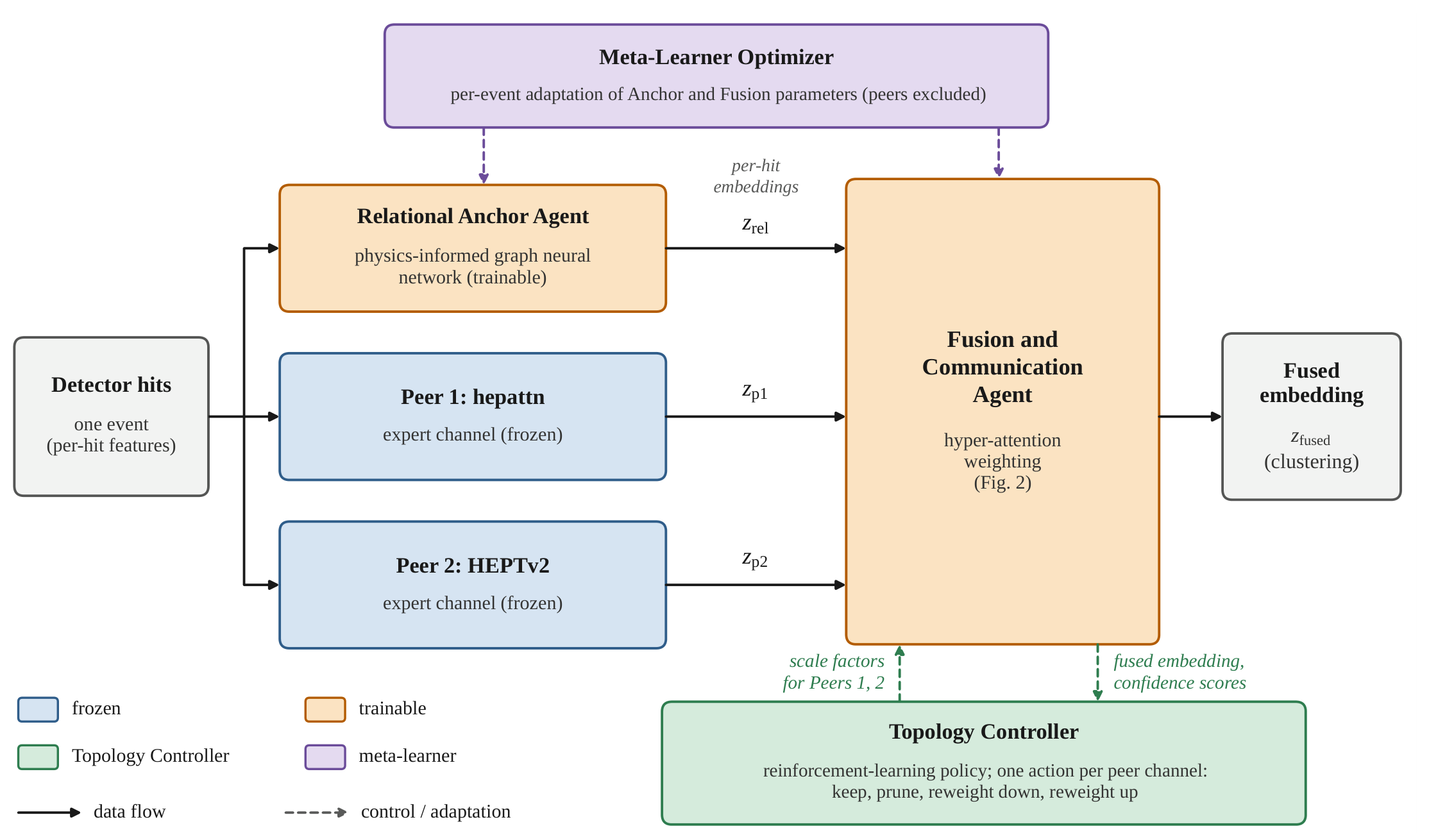
Figure 2.
Channel-boosting mechanism (internal view of the Fusion agent). Each channel’s embedding is projected linearly to the shared dimension d. The concatenated projected embeddings pass through an MLP, a temperature scaling by and a softmax to give the per-hit weights , , , which combine the (unnormalized) projected embeddings into .
Figure 2.
Channel-boosting mechanism (internal view of the Fusion agent). Each channel’s embedding is projected linearly to the shared dimension d. The concatenated projected embeddings pass through an MLP, a temperature scaling by and a softmax to give the per-hit weights , , , which combine the (unnormalized) projected embeddings into .
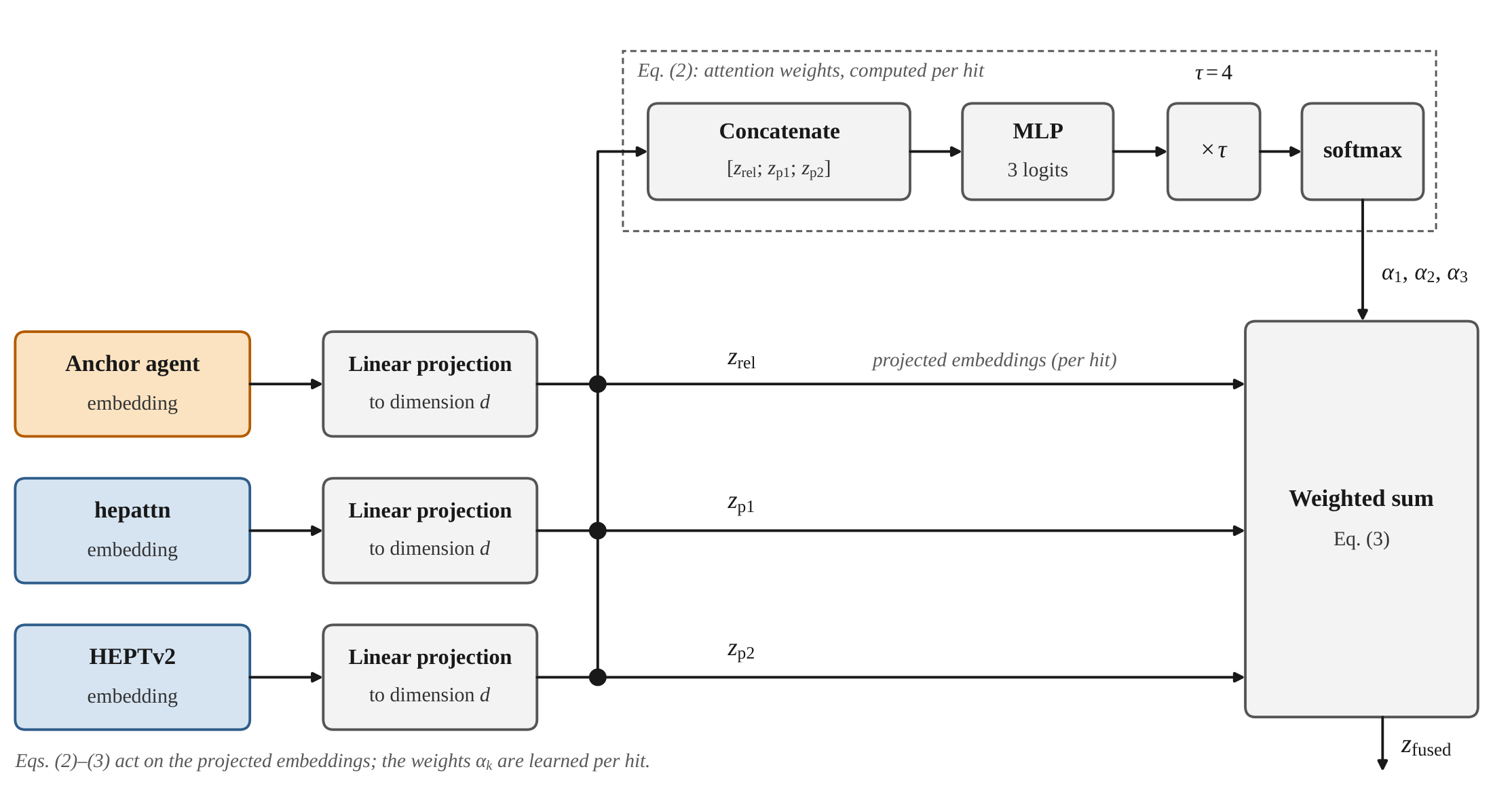
Figure 3.
The three-phase CB-HMAS training curriculum. Each phase is added on top of the components already active in the previous phase, and the Topology Controller is activated only in the final phase. Both peer channels are frozen throughout.
Figure 3.
The three-phase CB-HMAS training curriculum. Each phase is added on top of the components already active in the previous phase, and the Topology Controller is activated only in the final phase. Both peer channels are frozen throughout.
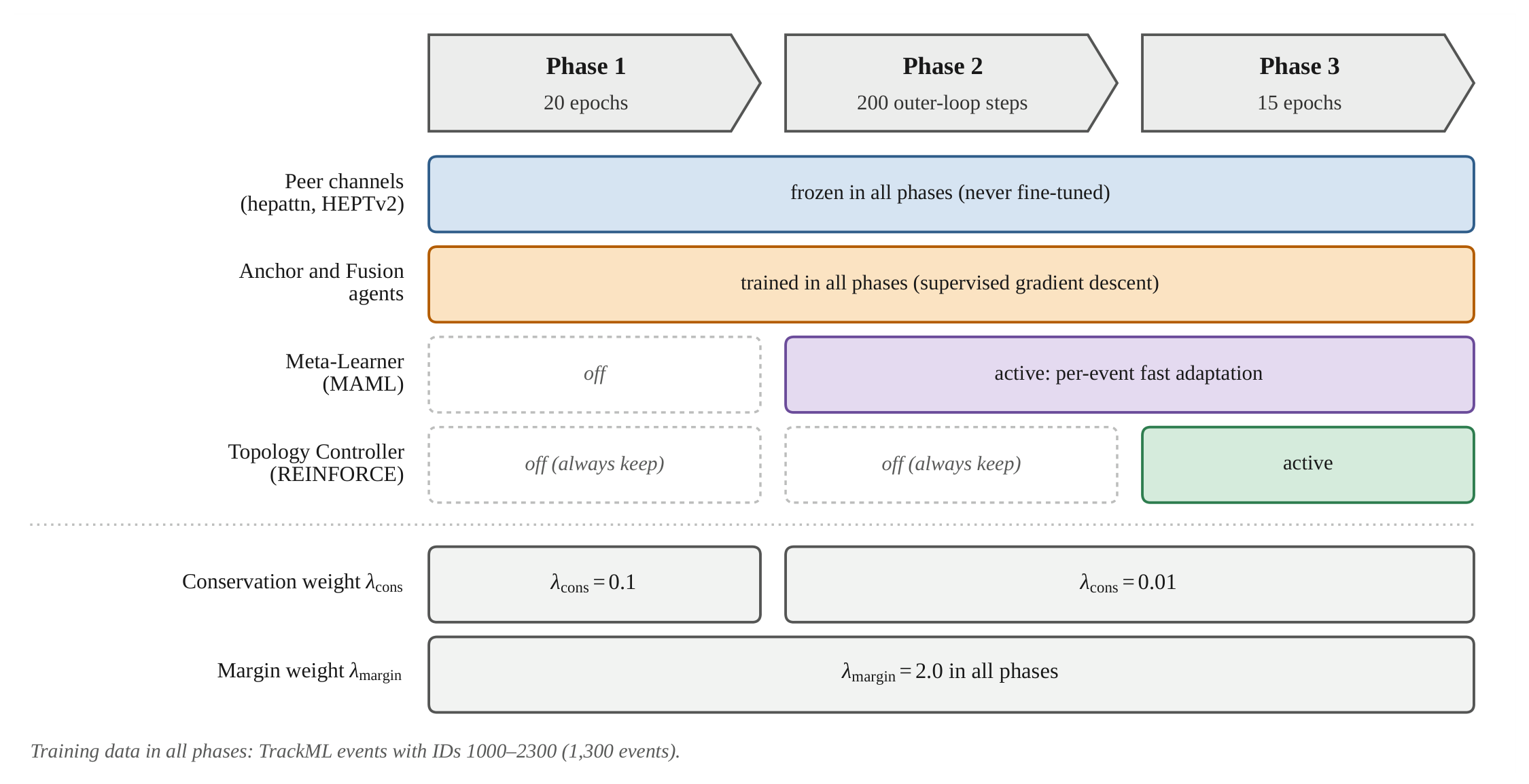
Figure 4.
Hold-out evaluation pipeline. Held-out events are encoded by CB-HMAS or by each individual peer channel alone, clustered with the same greedy centroid-based procedure across the full similarity-threshold sweep, and scored against the ground-truth particle assignments to obtain tracking efficiency and fake rate.
Figure 4.
Hold-out evaluation pipeline. Held-out events are encoded by CB-HMAS or by each individual peer channel alone, clustered with the same greedy centroid-based procedure across the full similarity-threshold sweep, and scored against the ground-truth particle assignments to obtain tracking efficiency and fake rate.
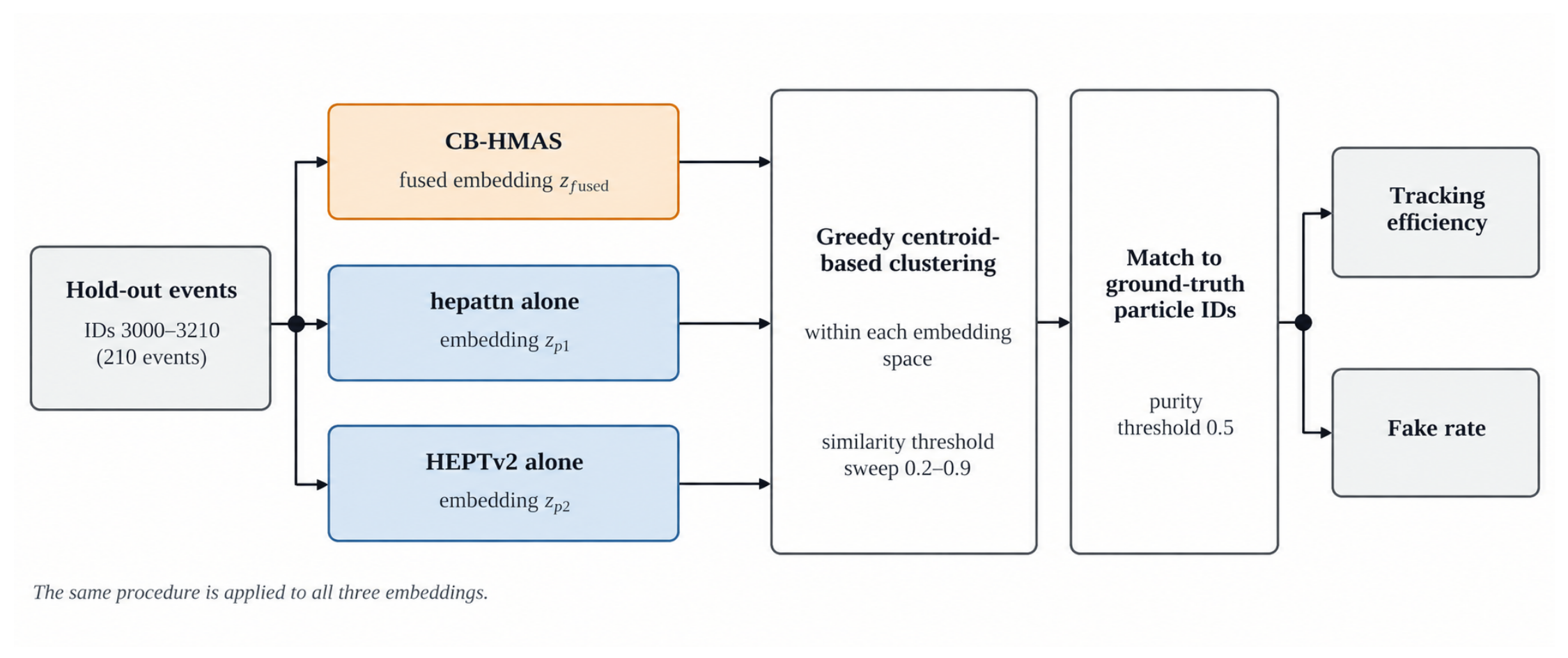
Figure 5.
(a) Tracking efficiency of CB-HMAS (fused), hepattn alone and HEPTv2 alone across the full similarity-threshold sweep. (b) Fake rate of CB-HMAS (fused) over the same sweep. Both panels use 210 held-out events and embedding dimension 64.
Figure 5.
(a) Tracking efficiency of CB-HMAS (fused), hepattn alone and HEPTv2 alone across the full similarity-threshold sweep. (b) Fake rate of CB-HMAS (fused) over the same sweep. Both panels use 210 held-out events and embedding dimension 64.
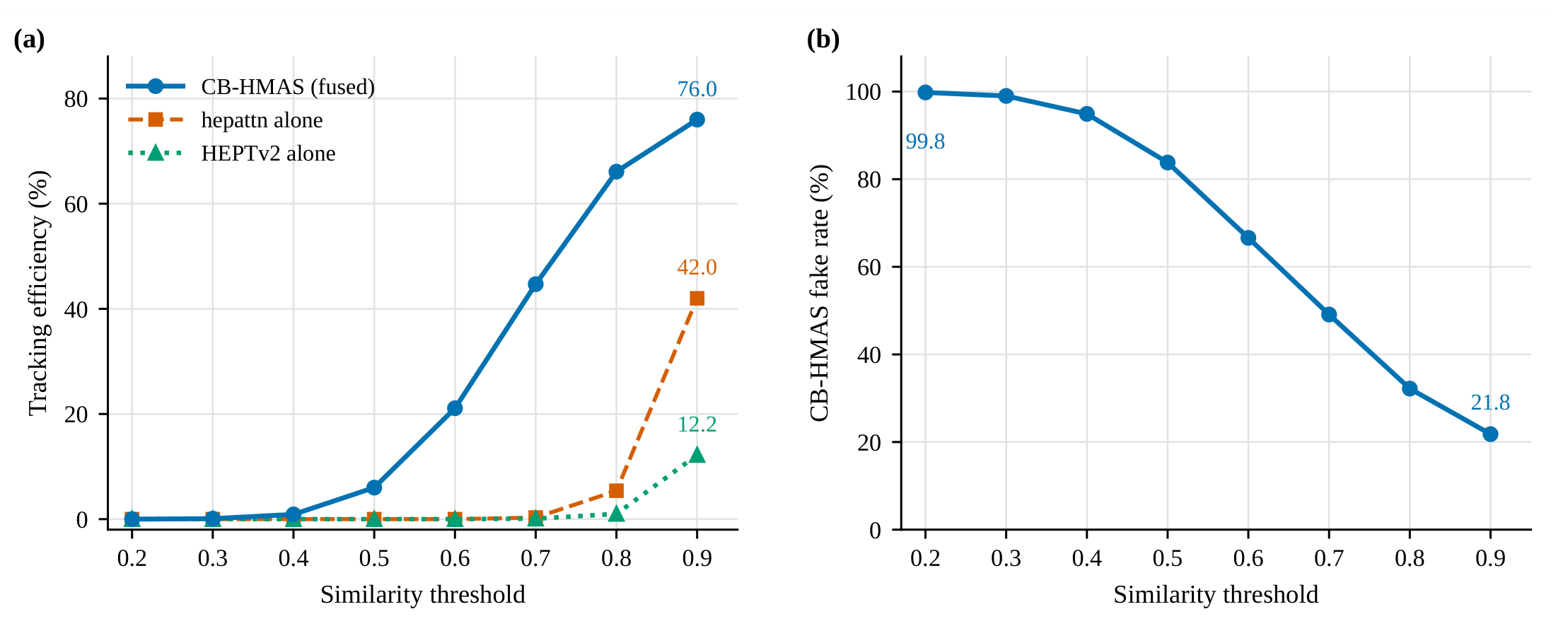
Figure 6.
CB-HMAS efficiency at embedding dimension 32 versus 64 across the similarity-threshold sweep. Doubling the shared Anchor/Fusion embedding dimension raises efficiency at every threshold from 0.3 onward, with the gap widening toward the strict end of the sweep.
Figure 6.
CB-HMAS efficiency at embedding dimension 32 versus 64 across the similarity-threshold sweep. Doubling the shared Anchor/Fusion embedding dimension raises efficiency at every threshold from 0.3 onward, with the gap widening toward the strict end of the sweep.
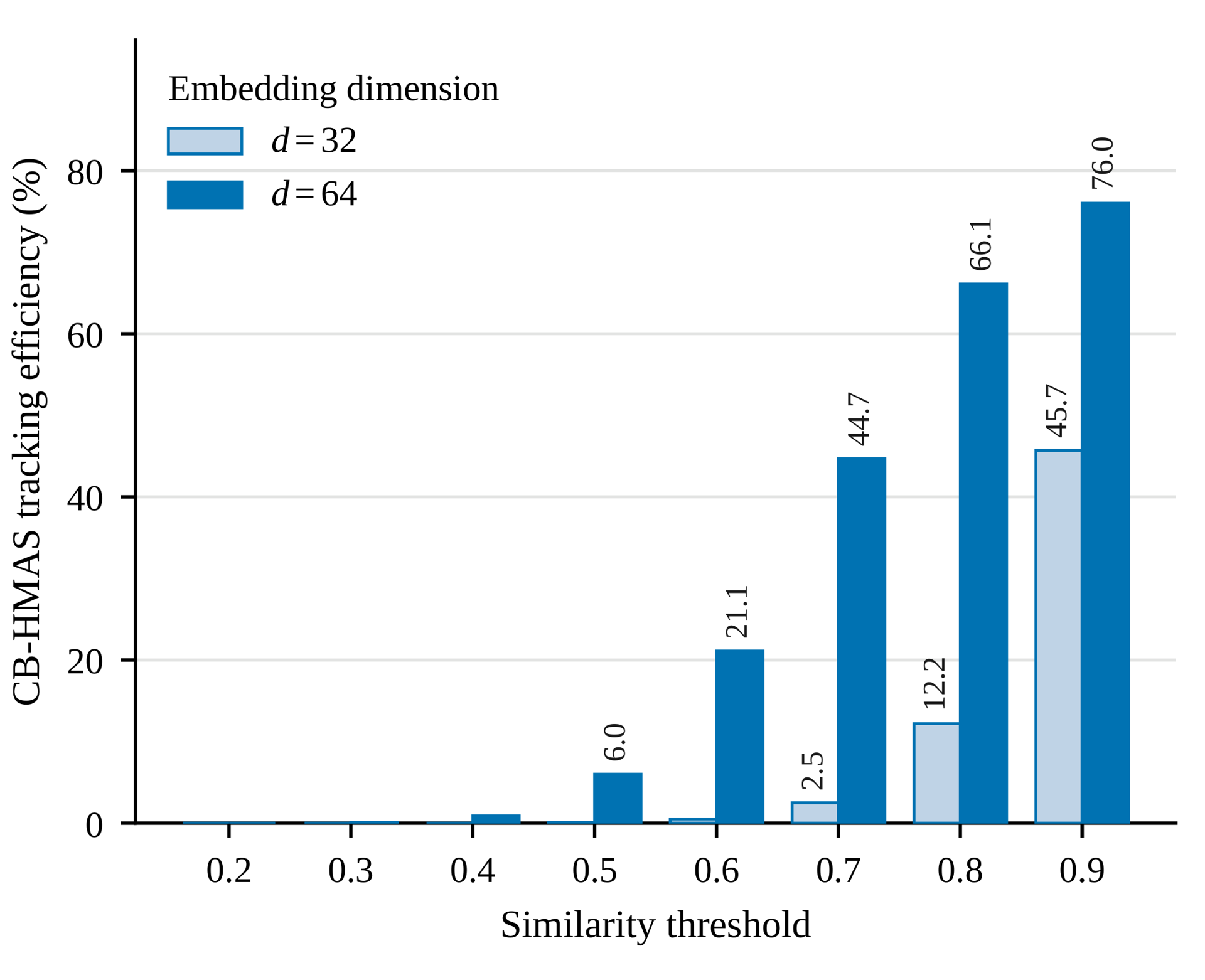
Figure 7.
CB-HMAS efficiency across five random seeds (mean ± SD; shaded band shows the minimum–maximum range) against both individual peer baselines (single runs) across the full similarity-threshold sweep. The error bars are small relative to the gap over either peer at every threshold from 0.6 onward.
Figure 7.
CB-HMAS efficiency across five random seeds (mean ± SD; shaded band shows the minimum–maximum range) against both individual peer baselines (single runs) across the full similarity-threshold sweep. The error bars are small relative to the gap over either peer at every threshold from 0.6 onward.
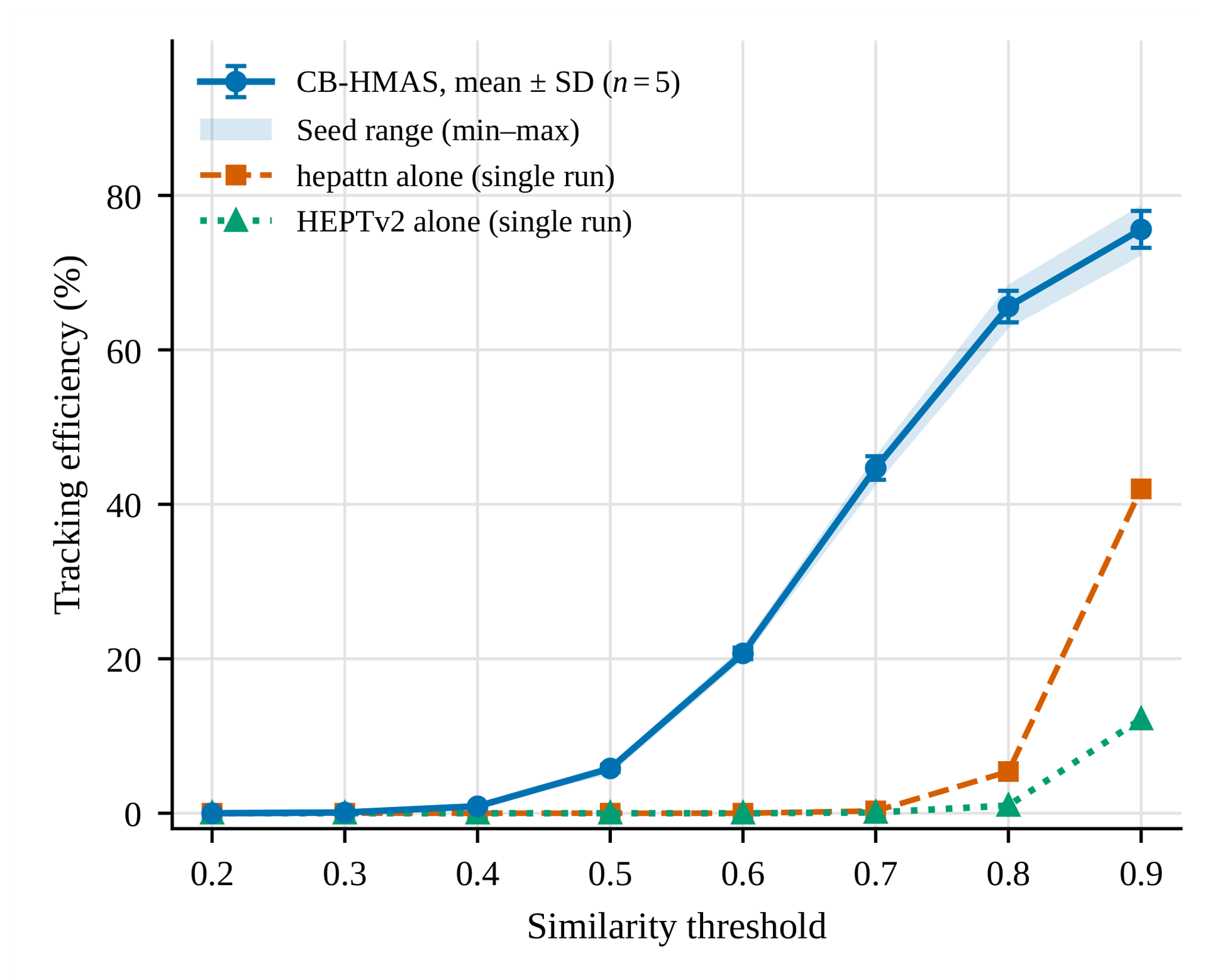

Table 1.
CB-HMAS (fused) efficiency compared with hepattn alone and HEPTv2 alone, by similarity threshold (210 held-out events, embedding dimension 64; gaps in percentage points, pp).
Table 1.
CB-HMAS (fused) efficiency compared with hepattn alone and HEPTv2 alone, by similarity threshold (210 held-out events, embedding dimension 64; gaps in percentage points, pp).
| Threshold | CB-HMAS eff. | hepattn eff. | Gap (hepattn) | HEPTv2 eff. | Gap (HEPTv2) | fake rate (CB-HMAS) |
|---|---|---|---|---|---|---|
| 0.2 | 0.0% | 0.0% | +0.0 pp | 0.0% | +0.0 pp | 99.8% |
| 0.3 | 0.1% | 0.0% | +0.1 pp | 0.0% | +0.1 pp | 99.0% |
| 0.4 | 0.9% | 0.0% | +0.9 pp | 0.0% | +0.9 pp | 94.9% |
| 0.5 | 6.0% | 0.0% | +6.0 pp | 0.0% | +6.0 pp | 83.8% |
| 0.6 | 21.1% | 0.0% | +21.1 pp | 0.0% | +21.1 pp | 66.6% |
| 0.7 | 44.7% | 0.3% | +44.4 pp | 0.1% | +44.6 pp | 49.1% |
| 0.8 | 66.1% | 5.4% | +60.7 pp | 1.0% | +65.1 pp | 32.2% |
| 0.9 | 76.0% | 42.0% | +34.0 pp | 12.2% | +63.8 pp | 21.8% |
Table 2.
Effect of the embedding/fusion dimension (32 vs. 64) on CB-HMAS efficiency, by similarity threshold.
Table 2.
Effect of the embedding/fusion dimension (32 vs. 64) on CB-HMAS efficiency, by similarity threshold.
| Threshold | dim = 32 | dim = 64 | |
|---|---|---|---|
| 0.2 | 0.0% | 0.0% | +0.0 pp |
| 0.3 | 0.0% | 0.1% | +0.1 pp |
| 0.4 | 0.0% | 0.9% | +0.9 pp |
| 0.5 | 0.1% | 6.0% | +5.9 pp |
| 0.6 | 0.5% | 21.1% | +20.6 pp |
| 0.7 | 2.5% | 44.7% | +42.2 pp |
| 0.8 | 12.2% | 66.1% | +53.9 pp |
| 0.9 | 45.7% | 76.0% | +30.3 pp |
Table 3.
CB-HMAS efficiency across five random seeds (42, 123, 2024, 3407, 7777): mean, sample standard deviation (SD) and range, by similarity threshold, with the originally reported single run for comparison.
Table 3.
CB-HMAS efficiency across five random seeds (42, 123, 2024, 3407, 7777): mean, sample standard deviation (SD) and range, by similarity threshold, with the originally reported single run for comparison.
| Threshold | Mean | SD | Range | Original run |
|---|---|---|---|---|
| 0.2 | 0.00% | 0.00% | 0.00–0.01% | 0.0% |
| 0.3 | 0.10% | 0.02% | 0.08–0.12% | 0.1% |
| 0.4 | 0.90% | 0.03% | 0.85–0.93% | 0.9% |
| 0.5 | 5.80% | 0.47% | 5.04–6.22% | 6.0% |
| 0.6 | 20.70% | 0.75% | 19.86–21.61% | 21.1% |
| 0.7 | 44.70% | 1.53% | 42.47–46.31% | 44.7% |
| 0.8 | 65.61% | 2.04% | 62.79–68.48% | 66.1% |
| 0.9 | 75.60% | 2.39% | 72.20–78.74% | 76.0% |
Disclaimer/Publisher’s Note: The statements, opinions and data contained in all publications are solely those of the individual author(s) and contributor(s) and not of MDPI and/or the editor(s). MDPI and/or the editor(s) disclaim responsibility for any injury to people or property resulting from any ideas, methods, instructions or products referred to in the content. |
© 2026 by the authors. Licensee MDPI, Basel, Switzerland. This article is an open access article distributed under the terms and conditions of the Creative Commons Attribution (CC BY) license.
Copyright: This open access article is published under a Creative Commons CC BY 4.0 license, which permit the free download, distribution, and reuse, provided that the author and preprint are cited in any reuse.