

Submitted:
01 October 2026
Posted:
05 October 2026
You are already at the latest version
Abstract
Bradač, Gishboliner and Sudakov asked whether \(R(H, K_{n,n}) = O(n^2)\) for every \(2\)-degenerate graph \(H\). The same bound is predicted by the question of Erdős, Faudree, Rousseau and Schelp on Ramsey size-linear graphs (Erdős Problem \#566) for graphs in which every \(j\)-vertex subgraph spans at most \(2j-3\) edges. We prove \(R(\widetilde{W}_k, K_{n,n}) \le (8k+16)n^2\) for the wheel \(W_k\) minus a spoke, for every \(k \ge 4\), and \(R(J, K_{n,n}) \le 20n^2\) for a graph \(J\) on eight vertices. For every bipartite graph \(F\) we prove \(R(\widetilde{W}_5, F) = O(e(F)\sqrt{\log e(F)})\), and we also obtain \(R(\widetilde{W}_5, K_n) = O(n^{5/2}/\log^{3/2} n)\). If \(\widetilde{W}_5\) is Ramsey size-linear, then \(W_5\) is an explicit minimally non-Ramsey size-linear graph. The proofs combine minimum-degree cores of graphs whose complement contains no \(K_{n,n}\), double counting of pairs with few common neighbours, and the fact that in a \(\widetilde{W}_5\)-free graph the edges lying in at least four triangles form a \(C_4\)-free graph inside every neighbourhood. We also introduce construction sequences, which give \(R(G, K_{n,n}) = O(n^2)\) for every graph admitting one. A computer search shows that \(38\) of the \(49\) minimal open cases of Problem \#566 on at most eight vertices admit such a sequence.
Keywords:
Ramsey size-linear graphs
; graph Ramsey numbers
; bipartite graphs
; degenerate graphs
; wheels
; Erdős problems
MSC: 05C55; 05D10; 05C35
1. Introduction
1.1. Background
For graphs G and H, the Ramsey number is the least N such that every graph on N vertices contains G or has a complement containing H. A graph G is Ramsey size-linear if there is a constant with for every graph H without isolated vertices. This notion was introduced by Erdős, Faudree, Rousseau and Schelp [9]. They showed that a graph with is not Ramsey size-linear, and asked whether every graph in which each j-vertex subgraph spans at most edges is Ramsey size-linear; this is Erdős Problem #566 [3]. The triangle is Ramsey size-linear by the theorems of Sidorenko [15] and Goddard and Kleitman [10], and several operations preserving Ramsey size-linearity are known [1,9]. Bradač, Gishboliner and Sudakov [5] proved, among other results, that every subdivision of with at least six vertices is Ramsey size-linear. Wigderson [18] showed that there are infinitely many minimally non-Ramsey size-linear graphs. It is shown in [2] that every graph without a -minor is Ramsey size-linear, together with a computer reduction of the open cases on at most eight vertices to 49 minimal graphs. For a survey of graph Ramsey theory we refer to [7].
Since , a positive answer to Problem #566 would give for all such G. Bradač, Gishboliner and Sudakov [5] asked whether holds for every 2-degenerate graph H. This question is a bipartite, off-diagonal analogue of the Burr–Erdős conjecture [6], proved by Lee [11], that degenerate graphs have Ramsey numbers linear in their number of vertices. They proved for every bipartite F, where is with one edge subdivided, and whenever [5].
1.2. Results
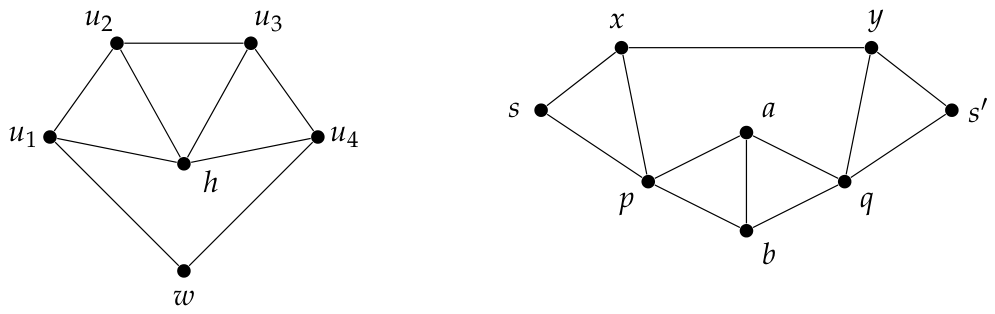
Let denote the wheel minus a spoke: a hub h adjacent to the vertices of a path , and a vertex w adjacent to and (Figure 1). It is 2-degenerate, and .
Theorem 1.
For all integers and , .
For this recovers the case of the theorem of [5] on . The graph is one of the 49 minimal open graphs of [2], and if it is Ramsey size-linear then is an explicit minimally non-Ramsey size-linear graph (see [2]). For general bipartite graphs we lose only a factor .
Theorem 2.
There is an absolute constant C such that for every bipartite graph F without isolated vertices.
The proof (Section 6) follows the three cases of [5] for . The new ingredient is that in a -free graph the edges lying in at least four triangles form a -free graph inside every neighbourhood (Lemma 5), which recovers the triangle bound used in [5]. Combined with the bound of Sudakov [17] and Li and Zang [12] on , the same lemma gives (Remark 3).
Our next result concerns the graph J shown in Figure 1. It is obtained from by subdividing one edge twice and gluing a triangle along each end edge of the subdivision path, and it is another of the 49 minimal graphs of [2].
Theorem 3.
For every integer , .
Both proofs work inside a core of the host graph in which every vertex has degree at least (Lemma 2). In such a core, pairs of vertices with few common neighbours are rare (Lemma 1), which makes it possible to embed graphs greedily and to find configurations by double counting. Section 4 turns this into a general tool: we define construction sequences and show that for every graph G admitting one (Theorem 5). As an application we test the method on the minimal open graphs of [2].
Theorem 4.
All 38 graphs are 2-degenerate, so Theorems 1–4 confirm the question of [5] for them. Every graph with a construction sequence has a vertex of degree at most two (Remark 1), so the method cannot reach graphs of minimum degree three, such as the triangular prism and . Apart from this use of the list of minimal graphs in Section 5, the present paper does not depend on [2].
1.3. Methods
All results are proved by hand. The proofs combine the absence of n-holes with minimum-degree cores and double counting (Section 2, Section 3 and Section 4), and with the lemmas of [5] listed in Section 6. The only computer-assisted statement is Theorem 4. It rests on an exhaustive search for construction sequences, whose output is a list of certificates (Appendix A) that can be checked by hand and that was checked again by an independent program. All code and data are provided as Supplementary File S1. The large language model Claude (Anthropic) was used in the preparation of this work: for literature search, for developing and checking the proofs, for writing and running the programs of Section 5 and the random tests of Lemmas 5 and 6, and for drafting the text. The author verified every proof and every computational claim, and takes full responsibility for the content of the manuscript.
1.4. Organization
Section 2 collects properties of graphs without n-holes. Section 3 proves Theorems 1 and 3. Section 4 introduces construction sequences, and Section 5 applies them to the minimal open graphs. Section 6 proves Theorem 2 and the bound for , and Section 7 discusses open problems.
Notation
All graphs are finite and simple. Throughout, denotes the host graph and G, F the graphs to be found in it or in its complement. For vertices of a graph , . An n-hole in is a pair of disjoint sets with and no edge between them. The complement contains if and only if has an n-hole, so means that every graph on N vertices without an n-hole contains G.
2. Graphs Without n-Holes
Lemma 1.
Let Γ be a graph without an n-hole.
- (a)
- If , then fewer than n vertices outside S have no neighbour in S.
- (b)
- Every induced subgraph of Γ has independence number less than .
- (c)
- Let . If , then fewer than non-neighbours of a satisfy .
- (d)
- Let . If , then fewer than n neighbours x of v satisfy .
Proof. (a) Take with ; n vertices outside S without neighbours in S would form an n-hole with . (b) An independent set of size splits into an n-hole.
(c) Let and let Y be the set of non-neighbours with ; each has at most r neighbours in X. Choose uniformly at random with . For , the probability that contains a neighbour of y is at most . Hence the expected number of vertices of Y with no neighbour in is at least , and if , then for some choice of at least n vertices of Y have no neighbour in ; any n vertices of together with n such vertices of Y form an n-hole (the two sets are disjoint because and ).
(d) Let , so that for , and Q has at least vertices and no n-hole. If Q had a set S of n vertices of Q-degree less than , then by (a) inside Q at least vertices of would have a neighbour in S. This gives , a contradiction. □
Lemma 2.
Let K be a positive integer. Every graph on vertices without an n-hole has a nonempty induced subgraph of minimum degree at least .
Proof.
Otherwise the graph is -degenerate, hence -colourable, and has an independent set of size at least , contradicting Lemma 1(b). □
Lemma 3.
Let Q be a graph with . Let τ be a tree on vertices, let be vertices of τ with v a leaf, and let be an integer. Then at least vertices x of Q satisfy the following: the set of images , over all embeddings ψ of τ into Q with , has at least elements. In particular, for paths: at least vertices of Q are endpoints of paths with ℓ edges ending at or more distinct vertices, whenever .
Proof.
Repeatedly delete a vertex of degree less than in the current graph, and let D be the set of deleted vertices. The graph is -degenerate, hence -colourable, so . The remaining graph has minimum degree at least . Order the vertices of as so that the neighbour of each () on the path to u comes earlier; this is possible because v is a leaf different from u. For embed greedily into with , choosing among the neighbours of the image of the parent of that are not yet used; at most of them are used, so there are at least choices at every step. At the last step the choices give at least distinct images of v. □
3. Proofs of Theorems 1 and 3
Proof
(Proof of Theorem 1). Let , put , and let be a graph on vertices without an n-hole. By Lemma 2 there is a nonempty induced subgraph of minimum degree at least ; it has no n-hole either. Suppose for a contradiction that does not contain . From now on, neighbourhoods and codegrees are taken in , and .
Label by a hub adjacent to , a rim path , and a vertex w adjacent to and only. Since has no , for every vertex h and every path in we have , and so
Call a pair poor if . A vertex x lies in fewer than poor pairs. Indeed, fewer than n of them have , by Lemma 1(d), since . Fewer than of them have , by Lemma 1(c) with , which applies since . Hence there are fewer than poor pairs.
For a vertex h, let be the number of unordered pairs of vertices of joined by a path with edges in . By (1) every such pair is poor, and it is counted for at most vertices h, all of which are common neighbours of the pair. Therefore
On the other hand, has at least vertices and . Apply Lemma 3 to paths with edges and : at least vertices of Q have at least partners. Hence , and . This contradicts the previous bound. □
Proof
(Proof of Theorem 3). Label J as follows: a diamond on with middle edge and tips ; a path ; a vertex s adjacent to p and x; and a vertex adjacent to y and q.
Let be a graph on vertices without an n-hole, and let be a nonempty induced subgraph of minimum degree at least (Lemma 2 with ); we work in . For a vertex v let ; by Lemma 1(d), .
The diamond. Take any vertex a. Since , there is , and b has two distinct neighbours in . Then span a diamond with middle edge and tips .
The path. Let and ; both have at least elements. If , then contains an edge by Lemma 1(b). Otherwise and both have at least n elements, so there is an edge with and . In both cases , , and is an edge.
The ears. Since , we have , so there is . Since , there is .
The eight vertices are distinct, because , , , and were chosen outside the other vertices. All twelve edges of J are present. □
4. Construction Sequences
Definition 1.
Let G be a graph. Aconstruction sequencefor G is a sequence of steps whose vertex sets partition . During the sequence we keep the set E of vertices placed so far and a set ofmarkedpairs of placed vertices, both initially empty. The allowed steps are:
- Tree step .
- is nonempty, is a tree, and every vertex of T has at most one neighbour in E. All pairs with , become marked; then T is added to E.
- Pair step .
- , the neighbours of g in E are exactly , and is marked; g is added to E.
- Wheel step ,
- allowed only as the first step. Here , , is a forest, lie in T, and v has at most one neighbour in T. The pair and all pairs with become marked, and .
A tree step with adds a vertex with at most one placed neighbour. The marked pairs record which pairs of placed vertices are guaranteed to have many common neighbours in the host graph.
Remark 1.
The last step of a construction sequence places a vertex of degree at most two in G: the new vertex of a pair step, a leaf of (or the single vertex) in a tree step, or the vertex v in a wheel step that places all of G. Hence graphs of minimum degree at least three have no construction sequence.
Theorem 5.
If a graph G on vertices admits a construction sequence, then for every .
The only step that is not a greedy choice is the wheel step, which is provided by the following double counting lemma. In it, a pair of distinct vertices is good if and bad otherwise.
Lemma 4.
Let , and . Let be a graph without an n-hole and of minimum degree at least , let τ be a tree on s vertices and let be vertices of τ with v a leaf. For a vertex h let . Then there are a vertex h and an embedding ψ of τ into such that is good.
Proof.
Every vertex x lies in fewer than bad pairs: fewer than n with the other vertex in by Lemma 1(d) (as ), and fewer than with the other vertex outside by Lemma 1(c) with . So there are fewer than bad pairs, where ; in particular for every h.
Suppose the lemma fails. For each h let and let be the number of unordered pairs over all embeddings of into . Each such pair is bad and is counted only for vertices h in the common neighbourhood of the pair, so . On the other hand and , so Lemma 3 with gives
using . Summing over h gives a contradiction. □
Proof
(Proof of Theorem 5). Fix a construction sequence for G and put and ; note and . Let be a graph on vertices without an n-hole, and let be an induced subgraph of minimum degree at least (Lemma 2). We work in and use good and bad pairs as in Lemma 4. For a vertex z let be the set of vertices forming a bad pair with z; as shown there, .
We follow the sequence and build an injective map from the placed vertices into that maps every edge of G between placed vertices to an edge and every marked pair to a good pair.
Wheel step. Extend the forest to a tree on T in which v is still a leaf, by joining its components through vertices other than v (if v is isolated in , join it by a single edge). Lemma 4 gives and an embedding of into with good. Put and on T. The edges of G inside go from h to T or lie in , so they are mapped to edges. The marked pairs are good because .
Pair step . The pair has more than common neighbours, at most of which are already used. Map g to an unused one.
Tree step . For let be the neighbourhood of the image of the placed neighbour of x, or if there is none, with the used vertices and the sets , , removed. Then , so we can choose pairwise disjoint sets of size . Root the tree at some vertex. Going from the leaves to the root, let be the set of vertices of that have a neighbour in for every child c of x. By induction for each child, so by Lemma 1(a) (note ), fewer than n vertices of are lost for each child, and . Now map the root into its set S, and then, going down, map each child c of an already mapped vertex x to a neighbour of in . The images are distinct because the sets are disjoint, the edges of and the edges to placed neighbours are mapped to edges, and every new vertex forms good pairs with all previously placed vertices because was removed from .
At the end all vertices and edges of G are mapped, so , and hence , contains G. □
Theorem 1 is the case of the sequence , and Theorem 3 the case of the sequence ; the direct proofs above give better constants.
5. The Minimal Open Graphs
For each of the 49 minimal open graphs of [2] we searched exhaustively for a construction sequence. The search is a depth-first search over the pairs with memoisation, preceded by every possible wheel step. Every sequence found was checked by an independent program, and the sequences are listed in Appendix A, so each case can be verified by hand. The outcome, grouped by core as in [2], is:
| core | graphs | with a sequence | without |
| 5 | 5 | 0 | |
| 22 | 22 | 0 | |
| four graphs with 6 vertices and 10 edges | 4 | 1 | 3 |
| triangular prism | 10 | 7 | 3 |
| 5 | 3 | 2 | |
| 1 | 0 | 1 | |
| the graph FJyKg (7 vertices, 11 edges) | 1 | 0 | 1 |
| the cubic graph GMs‵KK (8 vertices) | 1 | 0 | 1 |
| total | 49 | 38 | 11 |
The eleven graphs without a construction sequence, in graph6 format, are EtTg (the prism), ElUg (), FMohg, FlBHo, FhUk_, GhdWbC, GhUgMC, GhdYCS, GJyGcK, GMs‵KK and GhELQg (). Seven of them are 2-degenerate; the prism, , and the cubic graph GMs‵KK have minimum degree three.
The same search over all 925 graphs on at most eight vertices left open in [2] finds construction sequences for 254 of them (1, 4, 25 and 224 graphs on 5, 6, 7 and 8 vertices). Each of the remaining 671 graphs contains one of 68 minimal graphs without a construction sequence; 541 of the 671 are 2-degenerate, so they remain open instances of the question of [5].
6. Versus Arbitrary Bipartite Graphs
Bradač, Gishboliner and Sudakov proved for every bipartite F [5]. Their proof has three cases. The third uses that every neighbourhood in a -free graph is -free, which bounds the number of triangles and gives a logarithmic gain in the independence number. In a -free graph neighbourhoods need not be -free, but the following lemma recovers the same triangle bound.
Lemma 5.
Let Γ be a graph without , and call an edgestrongif its endpoints have at least four common neighbours.
- (a)
- For every vertex h and every path in , .
- (b)
- For every vertex h, the strong edges of form a -free graph.
- (c)
- If and , then has at most triangles.
Proof. (a) is (1) for . (b) If were a 4-cycle of strong edges in , then would be a path in , and (a) would give , contradicting that is strong. (c) An edge that is not strong lies in at most three triangles, so at most triangles of contain such an edge. In a triangle of with three strong edges, is a strong edge inside . By (b) and Reiman’s bound [13], there are at most such triangles. □
Lemma 6.
Every graph Q with M vertices has at least unordered pairs of vertices joined by a path with exactly three edges.
Proof.
Order the vertices as so that has minimum degree in ; then . If , choose a neighbour a of in and a neighbour of a in ; each of the at least neighbours of b in is the end of the path . So is joined in this way to at least vertices, all of which come after in the ordering. Hence every pair is counted only from its earlier endpoint, and summing over i gives at least pairs. □
The bound is tight up to the term : in a disjoint union of copies of there are exactly such pairs. This linear behaviour, compared with the quadratic number of pairs joined by paths of length two in a -free graph used for in [5], is the source of the logarithmic loss below.
We use the following results of [5], stated in the notation of this paper; is the average degree and log the natural logarithm.
- (B1)
- [5] If a bipartite graph with sides has , then there are , with , and no edges between them.
- (B2)
- [5] Every graph on vertices has an induced subgraph with and .
- (B3)
- [5] Let F have m edges, let A be a set of k vertices of largest degree in F, let have N vertices and average degree d, and let embed into . If , then extends to an embedding of F into .
- (B4)
- (B5)
- [5] Let F be bipartite with sides and m edges, let be a set of k vertices of largest degree in A and a set of ℓ vertices of largest degree in B, let have N vertices and average degree d, and let embed into . Suppose that or , and that or . Then extends to an embedding of F into .
- (B6)
Lemma 7.
Every -free graph Γ with N vertices and average degree satisfies .
Proof.
Let W be the set of vertices of degree at most , so , and let be the average degree of . If , then , since . Otherwise, Lemma 5(c) with bounds the number of triangles of by , using and . Then gives
□
Theorem 6.
There is an absolute constant C such that for every bipartite graph F without isolated vertices.
Proof.
Let F have sides and m edges, so . For m below a suitable absolute constant the statement holds with C large, since . Let , and let be a -free graph on vertices such that does not contain F. By there is an induced subgraph with vertices, average degree d and ; it is -free and does not contain F. By , ; hence and . Choosing large also gives .
Let S be the set of pairs of distinct vertices with at most three common neighbours. For a vertex x let be the set of vertices y with and .
Case 1: . Since , some x has , and as , the set has at least elements. Every has at most three neighbours in . By with there are and with , and no edges between them. Map the vertices of largest degree in A into and the vertices of largest degree in B into . Vertices of have degree at most and vertices of at most . So the two conditions of hold, since
and contains F, a contradiction.
Case 2: and . For a vertex x let be the set of neighbours of x of degree at most , let , and let be the number of pairs of S inside . Then . Also , because the vertices x counting a pair of S are common neighbours of the pair. Hence
and we fix x with , and . Let , , and let be the average degree of . By Lemma 5(a), every pair joined by a path with three edges in lies in S. So Lemma 6 gives , that is, .
Let be a set of vertices of largest degree in F (or if ). Since , statement embeds into . The images have degree at most in , and , so the condition of reads . Hence contains F, a contradiction.
Case 3: . By Lemma 7, the set W of vertices of degree at most contains an independent set I with : the proof of that lemma finds I inside W. Let and embed a set of k vertices of largest degree of F into I. If , the condition of is implied by
and using and , the first term is at most . Since , the condition holds and contains F, a contradiction. □
Remark 2
(Where the logarithm comes from). Case 2 applies only when , because Lemma 6 bounds the average degree inside by rather than by as in the case. Case 3 reaches only . For the two ranges leave a gap of a factor , and N has to be raised by this factor to close it. The obstruction is illustrated by neighbourhoods that are blow-ups of graphs of odd girth at least seven. They are -free, the number of pairs joined by paths with three edges is only linear in the number of edges, and every edge lies on a 4-cycle of the neighbourhood, hence in at most three triangles of the host by Lemma 5(a). We do not know whether for every bipartite F; Theorem 1 gives this for .
Remark 3
(Complete graphs). Lemma 7 also gives . Indeed, let Γ be -free with . A 5-cycle in a neighbourhood would form, together with h, a copy of . So every neighbourhood is -free with independence number less than n, and every degree is less than , by the theorem of Sudakov [17] and of Li and Zang [12]. If the average degree d is at least 36, Lemma 7 gives . Since is increasing for , this yields with , that is, . The earlier bound of Erdős, Faudree, Rousseau and Schelp [8] would give in the same way.
In the other direction, let be the maximum of over all subgraphs with at least three vertices. The probabilistic argument of Spencer [16], based on the Lovász local lemma, gives
for every fixed graph H. Since , this gives . For the upper bound is due to Bradač, Gishboliner and Sudakov [5]. For both graphs Problem #566 predicts .
7. Discussion and Open Problems
Remark 4
(Beyond ). For bipartite F, Theorem 2 leaves a factor , explained in Remark 2. For the best bound we know is (Remark 3), still far from the predicted . Removing the logarithm for bipartite F would require controlling neighbourhoods that are unions of dense bipartite pieces with few triangles per edge.
Remark 5
(Minimum degree three). For the prism, and , any embedding strategy must eventually place a vertex with three prescribed neighbours, and absence of n-holes gives no control over common neighbourhoods of triples. Deciding whether for the triangular prism seems to be the most natural next question in this direction.
Supplementary Materials
The following supporting information can be downloaded at https://www.mdpi.com/article/10.3390/preprints/s1, File S1 (sparse_vs_bipartite_S1.zip) contains: the list open_graphs.txt of the 925 graphs left open in [2], with the 49 minimal ones marked; the exhaustive search for construction sequences (construction_sequences.py, following Definition 1); an independent checker of construction sequences (verify_sequences.py); the script knn_census.py, which reproduces Section 5; the certificates certificates.json of Appendix A; random tests of Lemmas 5 and 6 (test_lemmas_W5.py); the expected output of every script; and a file README.txt with instructions.
Author Contributions
The author carried out all parts of this work: conceptualization, methodology, software, validation, formal analysis, investigation, and writing (original draft preparation, review and editing).
Funding
This research received no external funding.
Institutional Review Board Statement
Not applicable.
Informed Consent Statement
Not applicable.
Data Availability Statement
All data of this paper are contained in or produced by Supplementary File S1 (see Supplementary materials). The scripts require Python 3 and NetworkX, and reproduce Theorem 4, the table and the lists of Section 5, and the certificates of Appendix A.
Acknowledgments
The large language model Claude (Anthropic) was used as described in Section 1.3. The author verified all proofs and computations and takes full responsibility for the content of the manuscript.
Conflicts of Interest
The author declares no conflicts of interest.
Appendix A. Construction Sequences for the 38 Graphs
Vertices are labelled as in the graph6 encoding. A tree step is written , a pair step , and a wheel step .
| graph6 | construction sequence | |
| D]w | , | |
| Ehew | , | |
| FMjDO | , , , , , , | |
| FhEJW | , , , , , | |
| FhEKw | , , , , , | |
| FhEMg | , , , , , , | |
| FhdQW | , , , , , | |
| FheoW | , , , , | |
| Fhf_g | , , , , , , | |
| GEtBDG | , , , , , , , | |
| GFw_MC | , , , , , , | |
| GFwcAK | , , , , , , , | |
| GHFEKW | , , , , | |
| GHhGm_ | , , , , , , | |
| GHt@Kg | , , , , , , | |
| GJyGcc | , , , , , , | |
| G[EoIS | , , , , , , , | |
| G‵DbKW | , , , , , | |
| GeoJ@g | , , , , , , , | |
| Gewa?k | , , , , , , , | |
| Ggogl_ | , , , , , , , | |
| GhEKcc | , , , , , , , | |
| GhFK@c | , , , , , , | |
| GhFKBC | , , , , , , | |
| GhT@Kg | , , , , , | |
| GhUgLC | , , , , | |
| GhogKc | , , , , , , , | |
| GjCHSK | , , , , , , , | |
| GjCHSg | , , , , , , , | |
| GxOWSK | , , , , , , | |
| GxOYCS | , , , , , , | |
| GxOYCc | , , , , , , | |
| GxSAKW | , , , , , , , | |
| GxSICK | , , , , , , , | |
| GxSQCK | , , , , , , , | |
| GxU?Gs | , , , , , , | |
| GxUA?[ | , , , , , , , | |
| GxUA?k | , , , , , , , |
References
- Balister, P. N.; Schelp, R. H.; Simonovits, M. A note on Ramsey size-linear graphs. J. Graph Theory 2002, 39, 1–5. [Google Scholar] [CrossRef]
- Barría, G. Every K4-minor-free graph is Ramsey size-linear. Preprints 2026. [Google Scholar] [CrossRef]
- Bloom, T. F. Erdős Problems, https://www.erdosproblems.com, Problems #79 and #566. Accessed. (accessed on October 2026).
- Bollobás, B. Random Graphs, 2nd ed.; Cambridge University Press, 2001. [Google Scholar]
- Bradač, D.; Gishboliner, L.; Sudakov, B. On Ramsey size-linear graphs and related questions. SIAM J. Discret. Math. 2024, 38, 225–242. [Google Scholar] [CrossRef]
- Burr, S. A.; Erdős, P. On the magnitude of generalized Ramsey numbers for graphs, in: Infinite and Finite Sets (Colloq., Keszthely, 1973). Colloq. Math. Soc. János Bolyai 10, North-Holl. 1975, Vol. 1, 214–240. [Google Scholar]
- Conlon, D.; Fox, J.; Sudakov, B. Recent developments in graph Ramsey theory. In Surveys in Combinatorics 2015, London Math. Soc. Lecture Note Ser. 424; Cambridge University Press, 2015; pp. 49–118. [Google Scholar]
- Erdős, P.; Faudree, R. J.; Rousseau, C. C.; Schelp, R. H. On cycle-complete graph Ramsey numbers. J. Graph Theory 1978, 2, 53–64. [Google Scholar] [CrossRef]
- Erdős, P.; Faudree, R. J.; Rousseau, C. C.; Schelp, R. H. Ramsey size linear graphs. Comb. Probab. Comput. 1993, 2, 389–399. [Google Scholar] [CrossRef]
- Goddard, W.; Kleitman, D. J. An upper bound for the Ramsey numbers M(K3,G). Discret. Math. 1994, 125, 177–182. [Google Scholar] [CrossRef]
- Lee, C. Ramsey numbers of degenerate graphs. Ann. Math. (2) 2017, 185, 791–829. [Google Scholar] [CrossRef]
- Li, Y.; Zang, W. The independence number of graphs with a forbidden cycle and Ramsey numbers. J. Comb. Optim. 2003, 7, 353–359. [Google Scholar] [CrossRef]
- Reiman, I. Über ein Problem von K. Zarankiewicz. Acta Math. Acad. Sci. Hung. 1958, 9, 269–273. [Google Scholar] [CrossRef]
- Shearer, J. B. A note on the independence number of triangle-free graphs. Discret. Math. 1983, 46, 83–87. [Google Scholar] [CrossRef]
- Sidorenko, A. The Ramsey number of an N-edge graph versus triangle is at most 2N+1. J. Comb. Theory Ser. B 1993, 58, 185–196. [Google Scholar] [CrossRef]
- Spencer, J. Asymptotic lower bounds for Ramsey functions. Discret. Math. 1977, 20, 69–76. [Google Scholar] [CrossRef]
- Sudakov, B. A note on odd cycle-complete graph Ramsey numbers. Electron. J. Comb. 2002, 9, #N1. [Google Scholar] [CrossRef]
- Wigderson, Y. Infinitely many minimally non-Ramsey size-linear graphs. Eur. J. Comb. 2025, 128, 104175. [Google Scholar] [CrossRef]
Figure 1.
The graphs (left) and J (right), with the labels used in the proofs.
Disclaimer/Publisher’s Note: The statements, opinions and data contained in all publications are solely those of the individual author(s) and contributor(s) and not of MDPI and/or the editor(s). MDPI and/or the editor(s) disclaim responsibility for any injury to people or property resulting from any ideas, methods, instructions or products referred to in the content. |
© 2026 by the author. Licensee MDPI, Basel, Switzerland. This article is an open access article distributed under the terms and conditions of the Creative Commons Attribution (CC BY) license.
Copyright: This open access article is published under a Creative Commons CC BY 4.0 license, which permit the free download, distribution, and reuse, provided that the author and preprint are cited in any reuse.