
Submitted:
29 September 2026
Posted:
01 October 2026
You are already at the latest version
Abstract
User Interface (UI) aesthetic evaluation is a crucial task in designing products, websites, and mobile applications. Due to its dependence on individual experiences and preferences, UI evaluation is a complex and subjective process. Traditional methods typically rely on experts’ ideas or general feedback and do not account for the personal characteristics and features of users. This research introduces UIRate, a tool for UI aesthetic scoring based on user-personalized data and visual features of a UI. A dual-input model that contains an EfficientNet-based model for visual feature extraction and a multi-layer perceptron (MLP) for user feature processing was utilized. Furthermore, Grad-CAM was used as an explainability method, which provides interpretable insights about the important and unimportant areas in a UI for the predictions. In a user study with 10 professionals in the UI design sector, the results show that the model outperforms human experts at predicting scores. In addition, the positive feedback of UI designers confirms the applicability of UIRate for improvements in design. This tool is publicly available on Hugging Face and can be used for further research in the Human-Computer Interaction community.
Keywords:
aesthetic scoring
; user interface evaluation
; multimodal learning
; deep learning
; explainable artificial intelligence
1. Introduction
User interface (UI) aesthetics play a crucial role in shaping users’ initial impressions of a website, mobile application, or digital product. However, aesthetics is not a universal concept, and users with different backgrounds may have different opinions about the same interface [1]. Consequently, a global UI aesthetics scoring system cannot show a preference for different people and may cause errors for designers’ decision-making, especially when designing for a Specific target population.
Previous studies in UI aesthetic evaluation have mainly focused on the interface of the visual features and learning from these patterns [2,3,4]. While these methods can be useful for general-purpose scoring, they are not able to directly model the individual features of a target group and effectively help the designers to estimate their design for their target users. On the other hand, while human evaluation by experts is valuable, it is time-consuming [5,6], and there may be significant variation between evaluators, especially when the target user’s perceived score should be predicted based on that user’s characteristics.
This work introduces UIRate, a personalized aesthetic scoring framework that uses the UI image and the user profile features to predict an aesthetic score specifically for each user. The method uses a pre-trained EfficientNet-based [7] backbone for extracting visual features and a Multilayer Perceptron (MLP) to encode individual features into an embedding. Then, a final prediction of the aesthetic score is produced by a fusion mechanism between these two representations. In addition, this method applies Grad-CAM [8] to address the need for transparency by highlighting the regions of an image that most influence the model’s predictions.
Figure 1.
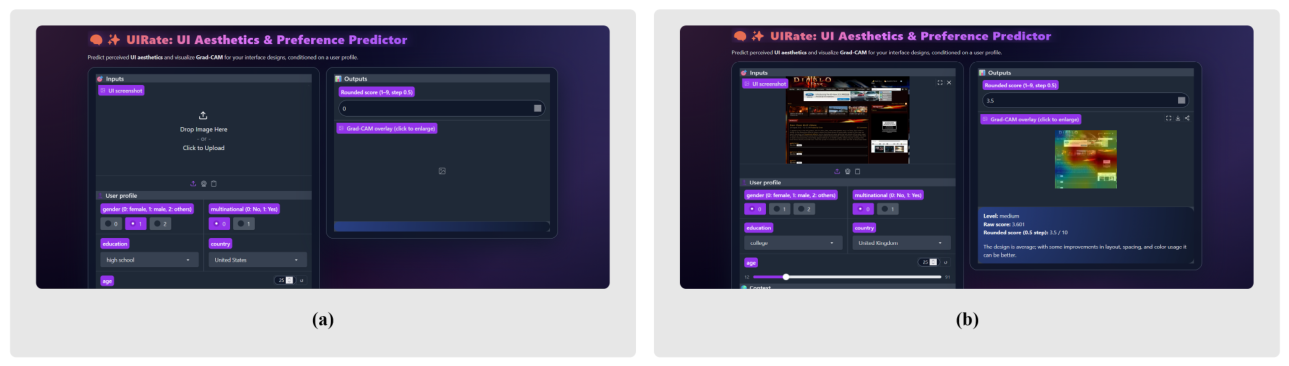
Overview of the UIRate tool interface. (a) Initial screen before providing any user information or UI input. (b) Result screen after submitting the required inputs, showing the generated aesthetic score and the tool’s output summary.
Figure 1.
Overview of the UIRate tool interface. (a) Initial screen before providing any user information or UI input. (b) Result screen after submitting the required inputs, showing the generated aesthetic score and the tool’s output summary.
2. Framework
A multimodal system is implemented to predict the users’ aesthetic preferences about webpage user interfaces (Figure 2). Unlike most of the current methods, which focus on the visual features of a webpage, this approach considers users’ information to predict a personalized score.
The model was trained on a dataset including webpage user interfaces, user features, and the rates of each user for a webpage UI [9]. User features contain demographic and experiential information, such as web usage familiarity and background. These features are represented as a vector after the pre-processing step and used as an input for the model.
This method utilized a multimodal neural network architecture that includes two parallel branches: an EfficientNet-based encoder to extract visual features of a webpage user interface and a multilayer perceptron to encode user features. The extracted features are fused and used by a regression layer to predict the scores. This method enables the exploration of the difference between various groups of users instead of a global rating for a webpage UI.
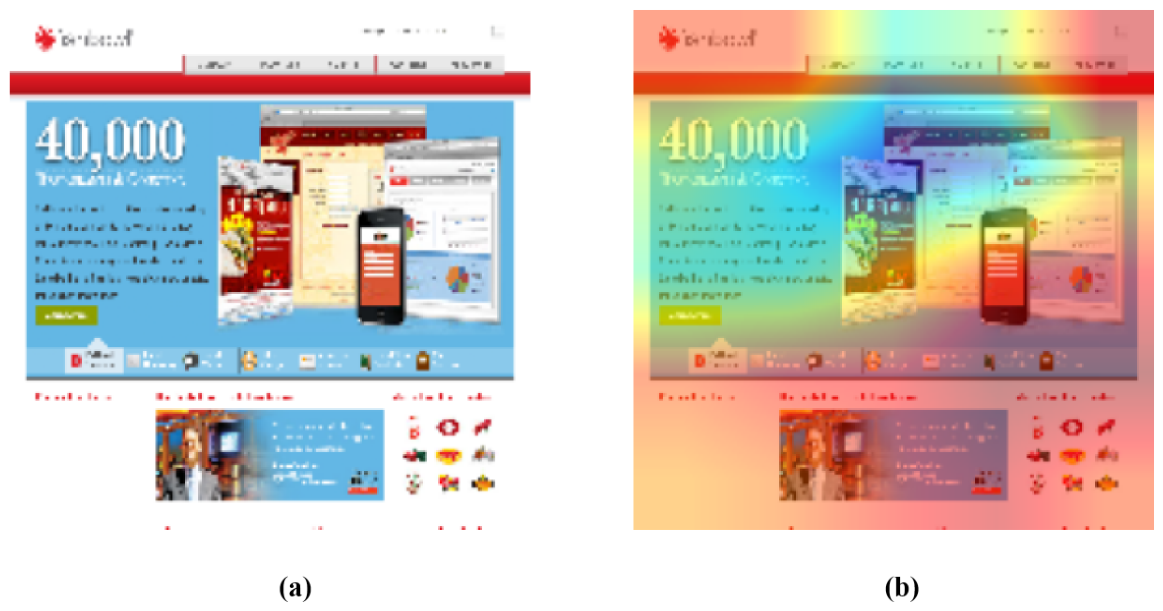
Furthermore, UIRate utilized Grad-CAM for explainability of the model by generating a heatmap that highlights the important regions of an image for the model’s decision. In addition to the score predicted by the model, this option helps designers understand the visual components that have more effect on predictions. An example of this is provided in Figure 3, where Figure 3a is the webpage UI and Figure 3b is the highlighted version.
3. Preliminary Evaluation
3.1. Technical Validation
The model was trained on a dataset containing webpage UI images, user features, and their ratings of the webpage user interfaces. The proposed multimodal method can predict a personalized aesthetic score for webpage user interfaces. On a test set that included 15% of the dataset images that the model had not seen, UIRate achieved an MAE of 1.55 and an RMSE of 1.90.
3.2. User Feedback
For the initial evaluation of the tool, a small user study was conducted with 10 people with a background in designing, such as UI designers, user experience researchers, product designers, graphic designers, and students in this field.
This user study contains two steps. First, the designers were asked to estimate the user rate for five webpage UI, using the users’ information and the webpage UI images. The results show that the mean absolute error for this task is 1.8, indicating the complexity of personalized UI rating. To compare the model with the user study, the model was used to predict on the same webpages and user information. The results show that the model with the mean absolute error of 1.28 performs better in this small user study.
In the second step, participants use the UIRate tool to evaluate the usability and explainability of the system. The results show that most of the participants find the estimation of the personalized ratings of the model beneficial. Furthermore, the highlighted regions by Grad-CAM help understand the decision-making logic of the model. Participants found this tool valuable for early-stage design evaluation. The suggestions for the improvements include increasing the consistency of highlighted visual regions in some cases.
4. Discussion and Future Work
UIRate shows that the combination of the user features with UI images can propose a framework for personalized aesthetic prediction. The initial evaluations show that using user information in addition to webpage user interfaces can provide more insights than image-based methods. Furthermore, utilizing Grad-CAM allows a comprehensible explanation of the model’s decisions.
However, this research has limitations. The proposed model was trained on one dataset, and the user study is limited. In addition, in some cases, the participants mentioned that the highlighted regions are not understandable to them and can be improved.
In the future, this method can be trained and evaluated on various datasets, including mobile applications UI and datasets with modern UI designs. Also, a user study with more participants can provide deeper insight into the performance of the model in comparison with designers, as well as its evaluation in terms of usability.
Code and Resources
The UIRate tool is publicly available on Hugging Face: https://huggingface.co/spaces/mparsaafshar/UIRate
References
- Alves, S.; Costa, R.; Montague, K.; Guerreiro, T. Citizen-Led Personalization of User Interfaces: Investigating How People Customize Interfaces for Themselves and Others. In Proceedings of the ACM on Human-Computer Interaction; SUBPAGE:STRING:BASIC, 2024; p. 8. [Google Scholar] [CrossRef]
- Leiva, L.A.; Shiripour, M.; Oulasvirta, A. Modeling how different user groups perceive webpage aesthetics. Univers. Access Inf. Soc. 2022, 4 22, 1417–1424. [Google Scholar] [CrossRef]
- Delitzas, A.; Chatzidimitriou, K.C.; Symeonidis, A.L. Calista: A deep learning-based system for understanding and evaluating website aesthetics. Int. J. Hum.-Comput. Stud. 2023, 175, 103019. [Google Scholar] [CrossRef]
- Dou, Q.; Zheng, X.S.; Sun, T.; Heng, P.A. Webthetics: Quantifying webpage aesthetics with deep learning. Int. J. Hum.-Comput. Stud. 2019, 124, 56–66. [Google Scholar] [CrossRef]
- de Souza Lima, A.L.; von Wangenheim, C.G.; Martins, O.P.; von Wangenheim, A.; Hauck, J.C.; Borgatto, A.F. A Deep Learning Model for the Assessment of the Visual Aesthetics of Mobile User Interfaces. J. Braz. Comput. Soc. 2024, 30, 102–115. [Google Scholar] [CrossRef]
- Wang, X.; Tong, M.; Song, Y.; Xue, C. Utilizing Multiple Regression Analysis and Entropy Method for Automated Aesthetic Evaluation of Interface Layouts. Symmetry 2024, Vol. 16 16, 523. [Google Scholar] [CrossRef]
- Tan, M.; Le, Q. EfficientNet: Rethinking Model Scaling for Convolutional Neural Networks. In Proceedings of the Proceedings of the 36th International Conference on Machine Learning;PMLR; Chaudhuri, K., Salakhutdinov, R., Eds.; 6 2019; Vol. 97, pp. 6105–6114. [Google Scholar]
- Selvaraju, R.R.; Cogswell, M.; Das, A.; Vedantam, R.; Parikh, D.; Batra, D. Grad-CAM: Visual Explanations from Deep Networks via Gradient-Based Localization. In Proceedings of the IEEE International Conference on Computer Vision; 2017, 2017-October; pp. 618–626. [Google Scholar] [CrossRef]
- Reinecke, K.; Gajos, K.Z. Quantifying visual preferences around the world. In Conference on Human Factors in Computing Systems - Proceedings; STRING:ARTICLE/CHAPTER: PAGE, 2014; pp. 11–20. [Google Scholar] [CrossRef]
Figure 2.
A summary of the proposed framework.
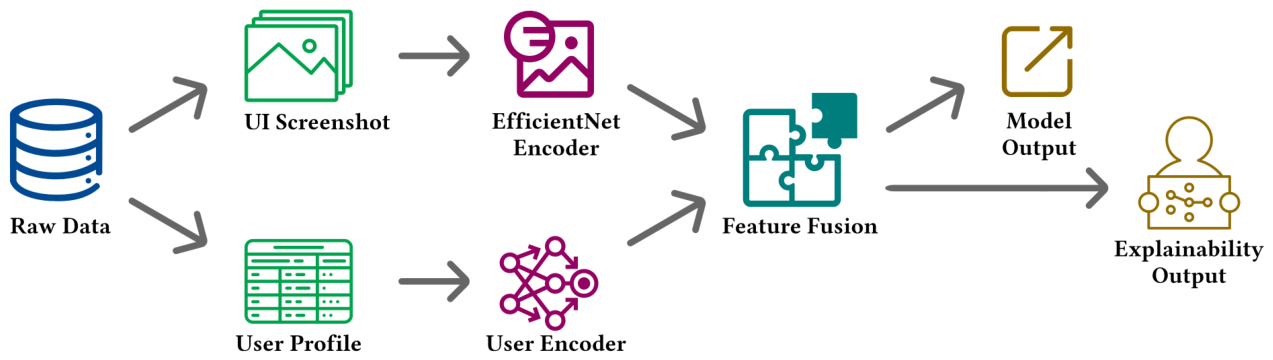
Figure 3.
The Grad-CAM explainability on a webpage user interface.
Disclaimer/Publisher’s Note: The statements, opinions and data contained in all publications are solely those of the individual author(s) and contributor(s) and not of MDPI and/or the editor(s). MDPI and/or the editor(s) disclaim responsibility for any injury to people or property resulting from any ideas, methods, instructions or products referred to in the content. |
© 2026 by the authors. Licensee MDPI, Basel, Switzerland. This article is an open access article distributed under the terms and conditions of the Creative Commons Attribution (CC BY) license (http://creativecommons.org/licenses/by/4.0/).
Copyright: This open access article is published under a Creative Commons CC BY 4.0 license, which permit the free download, distribution, and reuse, provided that the author and preprint are cited in any reuse.