

Submitted:
30 September 2026
Posted:
01 October 2026
You are already at the latest version
Abstract
Inflammatory bowel diseases (IBDs), including Crohn’s disease (CD) and ulcerative colitis (UC), are chronic immune-mediated disorders characterized by considerable clinical and biological heterogeneity. Despite major advances in biologic therapies and small molecules, a considerable proportion of patients fail to achieve sustained clinical and endoscopic remission, highlighting the therapeutic ceiling of current treatment strategies. Increasing evidence suggests that treatment failure may result from the activation of multiple, partially overlapping inflammatory pathways that are not adequately controlled by single-agent therapy. Advanced combination therapy (ACT), defined as the concomitant use of two targeted therapies with complementary mechanisms of action, has emerged as a potential strategy to overcome these limitations, particularly in patients with refractory disease, extraintestinal manifestations, or concomitant immune-mediated inflammatory diseases. This review summarizes the biological rationale, current clinical evidence, safety considerations, and practical applications of ACT in IBD. Available observational studies and emerging prospective data suggest that ACT may improve clinical and endoscopic outcomes in selected patients without a clear short-term increase in serious adverse events. However, important uncertainties remain regarding optimal patient selection, treatment sequencing, duration of therapy, de-escalation strategies, long-term safety, and cost-effectiveness.As the therapeutic landscape continues to evolve, ACT represents a promising step toward a more personalized and mechanism-based approach to IBD management. Ongoing clinical studies and the development of novel multi-target therapeutic strategies will be critical to define its future role in clinical practice.
Keywords:
inflammatory bowel disease
; Crohn’s disease
; ulcerative colitis
; advanced combination therapy
; dual-targeted therapy
; biologics
; small molecules
1. Introduction
Inflammatory bowel diseases (IBDs) are chronic, immune-mediated, and life-impairing diseases affecting the gastrointestinal tract, primarily comprising ulcerative colitis (UC) and Crohn’s disease (CD) [1].The global burden of IBD has risen substantially, affecting over 6 million people worldwide, particularly in newly industrialized countries [2]. IBD affects quality of life and imposes a significant healthcare and societal burden [3]. IBD treatment has evolved over the past three decades, moving from conventional therapies to more advanced options [4]. Biologic therapies, especially anti-TNF agents, have revolutionised IBD treatment by targeting inflammation [4]. Subsequently, additional biologics with different mechanisms of action were developed, including anti-integrins (e.g., vedolizumab) and anti-interleukin (IL)-12/23 or IL-23 inhibitors (e.g., ustekinumab, Risankizumab, guselkumab), significantly expanding therapeutic options [4]. Small-molecule drugs such as Janus kinase (JAK) inhibitors and sphingosine-1-phosphate (S1P) receptor modulators have further enriched the therapeutic armamentarium, offering oral administration and broader immunomodulatory effects [5].Despite advances in therapy and new strategies, disease control remains challenging. Only 30–50% of patients achieve clinical and endoscopic remission [6].
Primary and secondary non-response limit the effectiveness of current therapies [7]. In this setting, difficult-to-treat IBD is a major clinical challenge. It is defined by failure or loss of response to at least two advanced therapies with two different mechanisms of action or complex clinical scenarios, including recurrent postoperative disease, chronic antibiotic-refractory pouchitis and complex perianal CD [8].
Unmet needs are exacerbated by the heterogeneity of IBD. Its complex, redundant and overlapping inflammatory pathways may limit the efficacy of targeting a single cytokine or trafficking pathway, particularly in non-responders [9,10]. In this context, advanced combination therapy (ACT) has emerged as a promising strategy to enhance efficacy and overcome therapeutic ceiling [11].
2. Advanced Combination Therapy: Definition and Biological Rationale
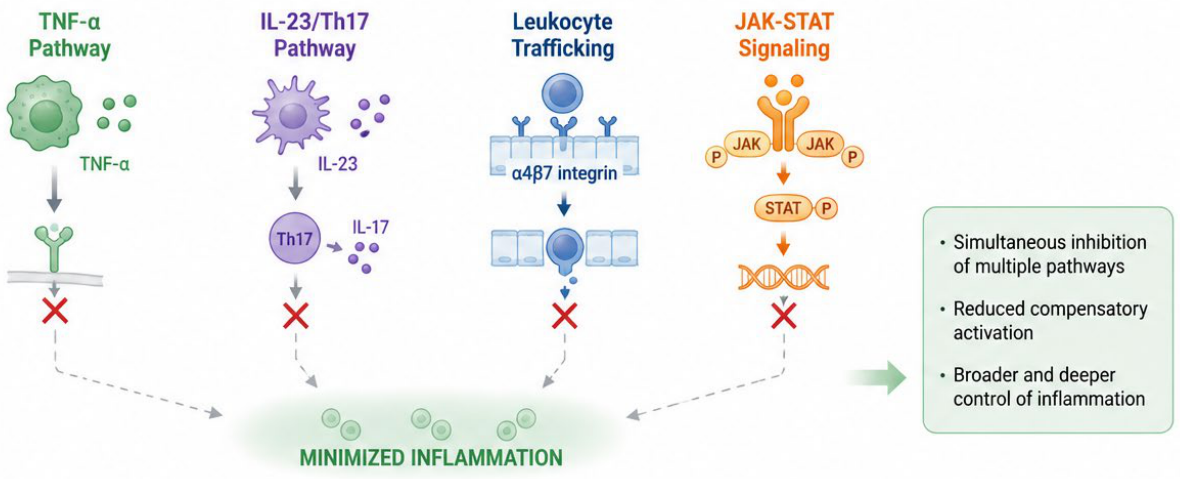
ACT in IBD refers to the concomitant use of two advanced targeted agents, usually two biologics or a biologic plus a small molecule, chosen because they act on different and complementary inflammatory pathways. In practice, ACT is conceptually different from older combination strategies such as anti-TNF plus thiopurine, where the second drug was often used to improve pharmacokinetics or reduce immunogenicity. By contrast, ACT is designed to increase efficacy through true multi-target immune modulation; accordingly, several terms, including ACT, combined advanced targeted therapy (CATT), and dual-targeted therapy (DTT) have been proposed to describe this therapeutic approach [3,4]. The rationale for ACT is based on the complementary mechanisms of action of available advanced therapies, with the aim of targeting distinct components of the inflammatory cascade and potentially overcoming the limited efficacy observed with single-pathway inhibition [4].At present, ACT for treatment of active IBD is off-label and is generally considered in highly selected patients, particularly those with refractory luminal disease, extraintestinal manifestations, or concomitant immune-mediated inflammatory diseases (IMIDs). In the absence of formal guideline recommendations, treatment decisions should be individualized and based on disease phenotype, prior treatment exposure, expected efficacy, safety considerations, and multidisciplinary assessment [12].The biological rationale for ACT reflects the complex immune architecture of IBD, which involves innate immune cells, T-cell subsets, cytokines, trafficking pathways, and intracellular signaling cascades. In this setting, inhibition of a single inflammatory pathway may be insufficient in patients whose disease is sustained by parallel or compensatory immune circuits [13].The TNF/IL-23 axis provides a relevant mechanistic example. In CD, Schmitt et al. demonstrated that anti-TNF non-response was associated with increased mucosal expression of IL-23p19, IL23R, and IL-17A during therapy, together with expansion of apoptosis-resistant TNFR2+IL23R+ T cells expressing gut-homing integrins and a mixed Th1/Th17 phenotype. IL-23 derived from CD14+ macrophages activated these IL23R-positive mucosal T cells through STAT3 signaling and reduced anti-TNF-induced apoptosis, suggesting a mechanism of molecular resistance to TNF blockade. These findings support the concept that treatment failure may reflect not only inadequate drug exposure or immunogenicity, but also adaptive activation of alternative inflammatory pathways [14]. More broadly, different advanced therapies act at distinct biological levels: anti-TNF and anti-IL-23 agents target cytokine-mediated inflammation, vedolizumab inhibits gut-selective leukocyte trafficking, and JAK inhibitors interfere with intracellular signaling downstream of multiple cytokine receptors. Combining agents with complementary mechanisms may therefore provide broader inflammatory control, particularly in patients with refractory disease, heterogeneous inflammatory profiles, or combined intestinal and extraintestinal activity[4]. Consistent with this concept, therapeutic positioning studies suggest that clinical phenotype alone may be insufficient to predict treatment response, as molecular inflammatory profiles and dominant immune pathways may differ between patients and evolve over time or after therapeutic exposure [4,13].
Figure 1.
Multi-Pathway Inhibition Through Advanced Combination Therapy in Inflammatory Bowel Disease. Created with FigureLabs.
Figure 1.
Multi-Pathway Inhibition Through Advanced Combination Therapy in Inflammatory Bowel Disease. Created with FigureLabs.
3. Patient Selection and Clinical Applications of ACT
ACT may be considered when objective inflammatory activity persists despite previous exposure to advanced therapies and further sequential monotherapy is unlikely to provide adequate disease control [4]. The lower response and remission rates observed in biologic-exposed compared with biologic-naïve patients further support the need for alternative therapeutic strategies in selected individuals [13]. Before starting ACT, disease activity should be objectively assessed to ensure that symptoms are primarily driven by ongoing inflammation. Fibrostenotic or penetrating complications, abscesses, and irreversible bowel damage may be less responsive to further pharmacological escalation and instead require surgical management [8,15]. Careful patient selection is therefore essential to distinguish potentially reversible inflammatory activity from structural complications that are unlikely to benefit from additional immunosuppression [8]. Extraintestinal disease should also be considered during patient selection. EIMs may involve the musculoskeletal, dermatologic, ocular, or hepatobiliary systems, and their activity does not necessarily parallel intestinal inflammation [16,17]. This discordance may provide a rationale for ACT, particularly when a single therapy controls one disease domain but leaves another inadequately controlled [16,17,18]. Beyond its predominant use in refractory disease or in patients with multiple active disease domains, ACT may also represent a potential evolution of the top-down paradigm. In this context, early intensive treatment could involve targeting complementary inflammatory pathways in selected patients at high risk of disease progression [11,19]. The PROFILE trial supports the potential value of early therapeutic intervention in active Crohn’s disease. At week 48, 79% of patients receiving top-down therapy had achieved sustained steroid- and surgery-free remission, compared with 15% in the accelerated step-up group. Endoscopic remission was also more frequent with top-down treatment, occurring in 67% versus 44% of patients [20]. Importantly, PROFILE evaluated conventional combination therapy rather than ACT as currently defined. Nevertheless, its findings support the broader principle that effective treatment introduced early in the disease course may achieve better outcomes than sequential therapeutic escalation [20].
This raises the possibility that ACT could represent a further extension of the top-down approach by targeting complementary inflammatory pathways early in the disease course. However, this strategy remains investigational, and current evidence does not support routine upfront ACT. Its potential benefits must therefore be balanced against safety concerns, treatment burden, cost, and the risk of overtreatment [11,19]. From a clinical perspective, ACT can therefore be considered across three distinct settings: early intensive treatment in selected high-risk patients [11,19]; add-on therapy in patients with an incomplete response to a first advanced agent [18,19]; and rescue therapy in multidrug-refractory disease [8,9]. These patient populations differ in previous therapeutic exposure, likelihood of response, acceptable risk, and treatment goals and should therefore not be considered interchangeable when interpreting ACT studies [9,12]. Regardless of the clinical setting, treatment should be accompanied by objective monitoring using biomarkers, endoscopy, and/or cross-sectional imaging [15]. Once deep remission has been achieved, de-escalation may be considered in selected patients; however, available evidence remains insufficient to define the optimal timing, treatment targets, or which component of ACT should be withdrawn [12,21].
4. Efficacy of Advanced Combination Therapy in IBD
4.1. Evidence from Randomized and Prospective Studies
Evidence from randomized and prospective studies evaluating ACT in IBD remains limited but is rapidly evolving. In CD, the earliest randomized experience evaluated natalizumab added to ongoing infliximab therapy in patients with active disease despite infliximab treatment. Combination therapy was associated with numerical improvements in CDAI scores and inflammatory markers through week 10; however, the trial was primarily designed to assess safety and tolerability and was not powered to establish efficacy superiority over infliximab alone [22]. The prospective, open-label, single arm EXPLORER study subsequently evaluated vedolizumab, adalimumab, and methotrexate in 55 biologic-naïve patients with newly diagnosed moderate- to high-risk CD. Clinical remission was achieved in 61.8% and 54.5% of patients at weeks 10 and 26, respectively, while approximately one third achieved endoscopic remission at week 26. Although these findings provided an encouraging efficacy signal, the absence of a concurrent comparator precludes firm conclusions regarding the incremental benefit of combination therapy [23]. More robust comparative evidence initially emerged in UC. In the phase 2 VEGA trial, guselkumab plus golimumab achieved a clinical response rate of 83% at week 12, compared with 75% with guselkumab and 61% with golimumab; superiority was demonstrated versus golimumab but not versus guselkumab [24]. Importantly, patients receiving combination induction subsequently transitioned to guselkumab monotherapy, providing proof of concept for a time-limited combination strategy followed by simplified maintenance [24]. More recently, the phase 2b DUET program extended randomized evidence for combined TNF/IL-23 inhibition to both CD and UC. In DUET-CD, 693 patients with moderately to severely active CD and an inadequate response or intolerance to at least one systemic therapy mechanism were randomized to placebo, guselkumab, golimumab, or one of three dose levels of JNJ-4804, a fixed-dose combination of guselkumab and golimumab. At week 48, high-dose JNJ-4804 achieved higher rates of clinical remission (50.8%) and endoscopic response (38.1%) than golimumab (25.4% and 19.8%, respectively), while the corresponding rates were numerically higher than those observed with guselkumab (42.5% and 33.9%, respectively). Treatment effects appeared particularly pronounced among patients refractory to at least two previous systemic therapy mechanisms[25]. Consistent findings were observed in DUET-UC, which randomized 572 patients with moderately to severely active UC and prior inadequate response or intolerance to systemic therapy. At week 48, the primary endpoint of clinical remission was achieved in 41.0% of patients receiving high-dose JNJ-4804, compared with 11.5% receiving golimumab and 34.0% receiving guselkumab.
High-dose JNJ-4804 was significantly superior to golimumab, whereas the difference versus guselkumab was smaller and not statistically significant [26]. As in DUET-CD, treatment effects were more pronounced among patients refractory to at least two systemic therapy mechanisms [26]. Taken together, the DUET studies provide randomized phase 2b evidence supporting the potential efficacy of simultaneous TNF/IL-23 inhibition in IBD. The combination consistently yielded higher efficacy estimates than TNF inhibition alone, whereas its incremental benefit over IL-23 inhibition was more modest in the overall study populations. Notably, the apparent treatment benefit was greater among patients refractory to multiple systemic therapy mechanisms, suggesting that this strategy may be particularly relevant in difficult-to-treat IBD. However, these findings remain based on phase 2b data, and confirmation in adequately powered phase 3 trials, together with longer-term safety and efficacy assessment, will be required before this approach can be incorporated into routine therapeutic algorithms [25,26]. Evidence is also emerging for biologic–small molecule combinations. In a multicenter, randomized, open-label controlled trial, an 8-week induction regimen with vedolizumab plus upadacitinib resulted in significantly higher clinical and endoscopic remission rates than vedolizumab monotherapy, without an apparent increase in short-term adverse events [27]. Complementary prospective evidence is provided by the VETO cohort, in which vedolizumab plus tofacitinib achieved clinical remission in more than half of patients with refractory UC by week 24 [28,29]. Overall, prospective evidence supports the potential efficacy of mechanistically complementary combinations, although the magnitude and durability of benefit appear to vary according to the therapeutic regimen, comparator, prior treatment exposure, and patient population. Completed and ongoing studies investigating ACT in IBD are summarized in Table 1.
4.2. Evidence from Clinical Practice and Real-World Studies
Real-world evidence extends these observations to more heterogeneous and heavily treatment-experienced populations, in whom medically refractory disease represents the predominant indication for ACT. In the systematic review and meta-analysis by Ahmed et al., 30 studies including 279 patients were analyzed; 211 (76%) had CD and 61 (22%) had UC [30]. Medically refractory intestinal disease accounted for 81% of treatment indications. Among 288 reported therapeutic combinations, anti-TNF plus anti-integrin therapy was the most frequently used strategy (48%), followed by vedolizumab plus ustekinumab (19%). Pooled clinical and endoscopic remission rates were 58.8% (95% CI, 42.0–74.5%) and 34.3% (95% CI, 23.5–46.1%), respectively [30]. These estimates should, however, be interpreted cautiously because of substantial heterogeneity in treatment regimens, outcome definitions, and assessment timepoints, as well as the considerably smaller population contributing to the endoscopic compared with clinical remission analysis (87 vs. 211 patients). Subsequent observational cohorts have provided additional effectiveness signals. Goessens et al. reported improvement in intestinal disease activity in 70% and in extraintestinal manifestation (EIM)/immune-mediated inflammatory disease (IMID) activity in 81% of 98 highly treatment-experienced patients [31]. Smaller retrospective series have similarly reported clinical and biochemical improvement, together with corticosteroid withdrawal in selected patients [32,33]. More recent experience with biologic–small molecule combinations has also yielded encouraging, although preliminary, results, with clinical remission rates of up to 80% at week 24 reported in a small retrospective cohort evaluating biologic–upadacitinib combinations [34]. Collectively, real-world data support the feasibility and potential effectiveness of ACT in selected patients with refractory IBD. However, the predominance of retrospective designs, limited sample sizes, substantial heterogeneity in therapeutic combinations and indications, inconsistent outcome definitions, and incomplete objective assessment preclude reliable identification of the patients most likely to benefit and of the optimal therapeutic combinations [30,35]. These limitations also underscore the need to avoid direct comparison of response rates across observational cohorts and prospective trials.
5. Safety of Advanced Combination Therapy
5.1. Safety Evidence from Randomized and Prospective Studies
Safety remains a central consideration when ACT is used because simultaneous targeting of multiple inflammatory pathways may theoretically increase the risk associated with cumulative immunosuppressive exposure. Available randomized evidence has not, however, identified a clear short-term safety signal. In the early randomized study of natalizumab added to infliximab, adverse-event rates were comparable between treatment groups, with no clinically relevant pharmacokinetic interaction identified [22]. Similarly, the VEGA trial reported a broadly comparable safety profile across treatment groups during combination induction [24].The phase 2b DUET studies provide additional randomized safety data through week 48. In DUET-CD, exposure-adjusted rates of serious adverse events and serious infections with high-dose JNJ-4804 were 18.2 and 2.9 events per 100 patient-years, respectively, and no venous thromboembolic events were reported [25]. In DUET-UC, the corresponding rates were 10.6 and 3.5 events per 100 patient-years, respectively [26]. Overall, the safety profile of JNJ-4804 was consistent with those of its component monotherapies in both studies [25,26]. Nevertheless, the duration and sample size of the phase 2 trials remain insufficient to exclude uncommon, cumulative, or delayed adverse events. Similarly, short-term induction with vedolizumab plus upadacitinib did not result in an apparent increase in adverse events compared with vedolizumab monotherapy [27]. Consistent with these findings, the meta-analysis of randomized controlled trials by Solitano et al. found no significant increase in overall adverse events (RR 0.92, 95% CI 0.80–1.05), infections (RR 0.84, 95% CI 0.47–1.49), or serious adverse events with ACT compared with monotherapy [7]. However, the precision of these estimates remains limited by the small number of controlled studies and the low frequency of serious safety outcomes.
5.2. Safety Evidence from Real-World Studies
Real-world studies provide complementary safety information in more heterogeneous and heavily pretreated populations. In the meta-analysis by Ahmed et al., adverse events and serious adverse events occurred in approximately 31% and 6.5% of patients, respectively, with infections representing the most frequently reported serious complication [30]. In the European multicenter cohort by Goessens et al., 42 significant adverse events were reported over 122 patient-years of follow-up, including 10 significant infections and one case of skin cancer [31]. Infections remain the principal practical safety concern, particularly in heavily pretreated patients and in those receiving concomitant corticosteroids or immunomodulators [30]. Baseline infectious risk assessment, optimization of vaccination status, and appropriate clinical and laboratory monitoring are therefore essential when ACT is considered [41]. Particular caution is warranted with JAK inhibitor-based combinations, for which long-term safety remains insufficiently characterized, particularly with regard to infectious and cardiovascular outcomes [7]. Nevertheless, the existing evidence base remains insufficient to characterize uncommon, cumulative, or delayed safety outcomes, including malignancy, major adverse cardiovascular events, venous thromboembolism, and opportunistic infections [9,30,31]. This uncertainty is particularly relevant because the patients most likely to receive ACT in clinical practice are frequently those with extensive prior therapeutic exposure and additional immunosuppressive burden. Larger prospective cohorts, adequately powered randomized trials, and longer-term pharmacovigilance will therefore be required to establish the safety profile of individual ACT combinations and to determine whether safety differs according to mechanism, treatment duration, or patient risk profile.
6. Challenges and Unresolved Issues
The main challenge for ACT is the gap between its strong biological rationale and the limited evidence available to define its optimal use [42]. Current studies include markedly different populations, ranging from biologic-naïve patients receiving early intensive treatment to patients with multiple previous treatment failures. A key unresolved question is therefore where ACT should be positioned within the treatment algorithm: upfront in selected high-risk patients, after an incomplete response to a first advanced therapy, or as rescue treatment in multidrug-refractory IBD [19,30,42]. Treatment duration and de-escalation remain additional unresolved issues. Available prospective evidence supports the concept of time-limited combination induction followed by simplified maintenance, which may reduce cumulative treatment exposure while preserving the benefits of multi-pathway control. However, the optimal duration of ACT, the depth of remission required before de-escalation, and which treatment component should be withdrawn remain unclear [42]. Long-term safety is also insufficiently defined, as available trials and observational cohorts remain underpowered to detect rare events such as opportunistic infections, malignancy, major cardiovascular events, and venous thromboembolism [42]. Economic sustainability represents another important challenge, as the concomitant use of two advanced therapies may substantially increase treatment costs. Formal cost-effectiveness data specifically evaluating ACT remain limited [43].
6.1. Future Perspectives
A major future goal is to improve patient selection for ACT. Biomarkers capable of identifying dominant or compensatory inflammatory pathways could support a more mechanism-based approach, helping to identify which patients are most likely to benefit from specific combinations. However, no validated biomarker currently guides ACT selection in clinical practice, and prospective studies are needed to develop and validate predictive tools [43]. Economic sustainability will also influence the future implementation of ACT. Wider availability of biosimilars may improve the affordability of selected combination strategies, as their use has already reduced the cost of biologic therapy in IBD [44]. In the future, loss of market exclusivity and the availability of generic versions of small molecules may further reduce the cost of biologic–small molecule combinations. However, lower drug costs do not necessarily translate into cost-effectiveness. Dedicated health-economic studies are needed to determine whether the higher upfront costs of ACT can be offset by better disease control and reductions in corticosteroid exposure, hospitalization, surgery, disability, and repeated treatment switching [43,44].
Beyond improving the use of conventional ACT, another future direction is the development of therapies capable of reproducing multi-pathway inhibition within a single therapeutic construct. Unlike conventional ACT, which requires the concomitant administration of two separate advanced therapies, bispecific and multi-target agents may provide complementary pathway inhibition within a single treatment, potentially simplifying therapeutic administration[45]. The TNF/IL-23 axis provides an early clinical example of this strategy. SOR102 is an orally administered bispecific inhibitor targeting TNF and IL-23p19. A first-in-human phase 1 randomized trial including patients with active UC showed an acceptable safety profile and preliminary signals of clinical and biological activity [37]. Although these findings remain exploratory, they provide early clinical support for simultaneous TNF and IL-23 inhibition [37].
A further strategy involves simultaneous inhibition of TL1A and the IL-12/23 pathway. RO7837195 (formerly PF-07261271) is a systemic bispecific antibody targeting TL1A and IL-12/23p40. The agent is currently being evaluated in a randomized, double-blind, placebo-controlled phase 2b trial in approximately 224 patients with moderately to severely active UC who have experienced failure of conventional and/or advanced therapies [46]. This ongoing study will provide prospective evidence on the efficacy and safety of simultaneous TL1A and IL-12/23 inhibition in active UC [46].
These clinical programs represent a potential evolution of the ACT concept, moving from the combination of two separate advanced therapies toward single agents designed to achieve multi-pathway inhibition[47]. However, clinical evidence remains at an early stage. Future prospective trials will need to determine whether these approaches provide greater or more durable efficacy than single-target therapies while maintaining an acceptable safety profile [47]. The major unresolved questions regarding ACT are summarized in Table 2.
7. Conclusions
ACT represents a promising strategy to address the therapeutic ceiling in IBD through simultaneous targeting of complementary inflammatory pathways. Although emerging evidence supports its potential in selected patients, its optimal positioning and long-term benefit remain to be established. Future progress will depend on better patient selection, mechanism-based biomarkers, and robust prospective evidence. In this context, the integration of rational combination strategies with precision medicine and emerging multi-target therapies may provide a path toward more effective, durable, and personalized disease control.
Author Contributions
Conceptualization V.J; writing—original draft preparation M.L. and L.C.; writing—review and editing M.L.,L.C. and F.D.; visualization M.L. and L.C.; supervision F.D, F.F., M.A., A.Z.,T.L.P.,V.S.,S.D; All authors have read and agreed to the published version of the manuscript.”.
Funding
This research received no external funding.
Institutional Review Board Statement
Not applicable.
Informed Consent Statement
Not applicable.
Data Availability Statement
No new data were created or analyzed in this study.
Acknowledgments
During the preparation of this manuscript, the authors used OpenEvidence and PubMed to support literature searches and identify relevant publications. FigureLabs (web-based platform) was used to create Figure 1. The authors independently reviewed and verified the cited sources and take full responsibility for the content of this publication.
Conflicts of Interest
The authors declare no conflicts of interest.
Abbreviations
The following abbreviations are used in this manuscript:
| ACT | Advanced combination therapy |
| CATT | Combined advanced targeted therapy |
| CD | Crohn’s disease |
| CDAI | Crohn’s Disease Activity Index |
| CI | Confidence interval |
| CRP | C-reactive protein |
| DTT | Dual-targeted therapy |
| ECCO | European Crohn’s and Colitis Organisation |
| EIMs | Extraintestinal manifestations |
| IBD | Inflammatory bowel disease |
| IBDs | Inflammatory bowel diseases |
| IL | Interleukin |
| IL23R | Interleukin-23 receptor |
| IMIDs | Immune-mediated inflammatory diseases |
| IOIBD | International Organization for the Study of Inflammatory Bowel Disease |
| JAK | Janus kinase |
| MAdCAM-1 | Mucosal addressin cell adhesion molecule-1 |
| PRO-2 | Patient-Reported Outcome-2 |
| RCTs | Randomized controlled trials |
| RR | Relative risk |
| SAEs | Serious adverse events |
| SES-CD | Simple Endoscopic Score for Crohn’s Disease |
| S1P | Sphingosine-1-phosphate |
| STAT3 | Signal transducer and activator of transcription 3 |
| Th1 | T helper 1 |
| Th17 | T helper 17 |
| TNF | Tumor necrosis factor |
| TNFR2 | Tumor necrosis factor receptor 2 |
| UC | Ulcerative colitis |
References
- Abraham, B.P.; Ahmed, T.; Ali, T. Inflammatory Bowel Disease: Pathophysiology and Current Therapeutic Approaches. In Gastrointestinal Pharmacology; Springer: Boston, MA, USA, 2017; pp. 115–146. [CrossRef]
- Hashash, J.G.; Limdi, J.K.; Shapiro, J.M.; A Shah, S. Medical management of inflammatory bowel diseases. BMJ 2025, 391, e079050. [CrossRef]
- De Bernardi, A.; Bezzio, C.; Puricelli, M.; Gilardi, D.; Saibeni, S. Combining Advanced Targeted Therapy in Inflammatory Bowel Disease: Current Practice and Future Directions. J. Clin. Med. 2025, 14, 590. [CrossRef]
- Morizot, C.; Sequier, L.; Jouzeau, J.-Y.; Moulin, D.; Netter, P.; Caron, B.; Honap, S.; Lœuille, D.; Peyrin-Biroulet, L. Advanced combination therapy in inflammatory bowel disease. Jt. Bone Spine 2025, 92, 105922. [CrossRef]
- Jun, Y.K.; Yoon, H. Small Molecule Therapy for Inflammatory Bowel Disease: JAK Inhibitors and S1PR Modulators. Korean J. Gastroenterol. 2024, 84, 51–64. [CrossRef]
- Han, S.J.; Cheon, J.H. Advanced Combination Therapy in Inflammatory Bowel Disease. Korean J. Gastroenterol. 2026, 86, 85–103. [CrossRef]
- Solitano, V.; Yuan, Y.; Singh, S.; Ma, C.; Nardone, O.M.; Fiorino, G.; Felquer, M.L.A.; Barra, L.; D'AGostino, M.-A.; Pope, J.; et al. Efficacy and safety of Advanced Combination Treatment in immune-mediated inflammatory disease: A systematic review and meta-analysis of randomized controlled trials. J. Autoimmun. 2024, 149. [CrossRef]
- Parigi, T.L.; D'AMico, F.; Abreu, M.T.; Dignass, A.; Dotan, I.; Magro, F.; Griffiths, A.M.; Jairath, V.; Iacucci, M.; Mantzaris, G.J.; et al. Difficult-to-treat inflammatory bowel disease: results from an international consensus meeting. Lancet Gastroenterol. Hepatol. 2023, 8, 853–859. [CrossRef]
- Battat, R.; Chang, J.T.; Loftus, E.V.; Sands, B.E. IBD Matchmaking: Rational Combination Therapy. Clin. Gastroenterol. Hepatol. 2024, 23, 469–479. [CrossRef]
- Atreya, R.; Neurath, M.F. IL-23 Blockade in Anti-TNF Refractory IBD: From Mechanisms to Clinical Reality. J. Crohn’s Colitis 2022, 16, ii54–ii63. [CrossRef]
- Wetwittayakhlang, P.; Lakatos, P.L. Advanced combination therapy: is it the best way to break the therapeutic ceiling?. Ther. Adv. Gastroenterol. 2024, 17. [CrossRef]
- Gisbert, J.P.; Chaparro, M. Combination therapy with biologics and/or small molecules in inflammatory bowel disease: a comprehensive review. J. Crohn's Colitis 2025, 19. [CrossRef]
- Marafini, I.; Salvatori, S.; Fonsi, A.; Monteleone, G. Optimizing Drug Positioning in IBD: Clinical Predictors, Biomarkers, and Practical Approaches to Personalized Therapy. Biomedicines 2026, 14, 191. [CrossRef]
- Schmitt, H.; Billmeier, U.; Dieterich, W.; Rath, T.; Sonnewald, S.; Reid, S.; Hirschmann, S.; Hildner, K.; Waldner, M.J.; Mudter, J.; et al. Expansion of IL-23 receptor bearing TNFR2+ T cells is associated with molecular resistance to anti-TNF therapy in Crohn’s disease. Gut 2018, 68, 814–828. [CrossRef]
- Turner, D.; Ricciuto, A.; Lewis, A.; D’aMico, F.; Dhaliwal, J.; Griffiths, A.M.; Bettenworth, D.; Sandborn, W.J.; Sands, B.E.; Reinisch, W.; et al. STRIDE-II: An Update on the Selecting Therapeutic Targets in Inflammatory Bowel Disease (STRIDE) Initiative of the International Organization for the Study of IBD (IOIBD): Determining Therapeutic Goals for Treat-to-Target strategies in IBD. Gastroenterology 2021, 160, 1570–1583. [CrossRef]
- Gordon, H.; Burisch, J.; Ellul, P.; Karmiris, K.; Katsanos, K.; Allocca, M.; Bamias, G.; Acosta, M.B.-D.; Braithwaite, T.; Greuter, T.; et al. ECCO Guidelines on Extraintestinal Manifestations in Inflammatory Bowel Disease. J. Crohn's Colitis 2023, 18, 1–37. [CrossRef]
- Greuter, T.; Rieder, F.; Kucharzik, T.; Peyrin-Biroulet, L.; Schoepfer, A.M.; Rubin, D.T.; Vavricka, S.R. Emerging treatment options for extraintestinal manifestations in IBD. Gut 2020, 70, 796–802. [CrossRef]
- Gros, B.; Varkas, G.; Speeckaert, R.; Lobaton, T. Combining advanced therapies in patients with inflammatory bowel disease and extraintestinal manifestations or associated immune-mediated diseases: who, what, when and at what cost?. Frontline Gastroenterol. 2025. [CrossRef]
- Jajoo, A.; Margolin, K.; Limketkai, B.N.; Parian, A. Evolution of Advanced Combination Treatment in Inflammatory Bowel Disease., 745–756.
- Noor, N.M.; Lee, J.C.; Bond, S.; Dowling, F.; Brezina, B.; Patel, K.V.; Ahmad, T.; Banim, P.J.; Berrill, J.W.; Cooney, R.; et al. A biomarker-stratified comparison of top-down versus accelerated step-up treatment strategies for patients with newly diagnosed Crohn's disease (PROFILE): a multicentre, open-label randomised controlled trial. Lancet Gastroenterol. Hepatol. 2024, 9, 415–427. [CrossRef]
- A Saleh, A.; Waghela, R.; Amini, S.; Moskow, J.; Irani, M.; Fan, C.; Glassner, K.; Abraham, B.P. A Guide to De-escalation of Combination Therapy in Inflammatory Bowel Disease: A Retrospective Cohort Study. Crohn's Colitis 360 2025, 7, otaf026. [CrossRef]
- Sands, B.E.; Kozarek, R.; Spainhour, J.; Barish, C.F.; Becker, S.; Goldberg, L.; Katz, S.; Goldblum, R.; Harrigan, R.; Hilton, D.; et al. Safety and tolerability of concurrent natalizumab treatment for patients with Crohnʼs disease not in remission while receiving infliximab. Inflamm. Bowel Dis. 2007, 13, 2–11. [CrossRef]
- Colombel, J.-F.; Ungaro, R.C.; Sands, B.E.; Siegel, C.A.; Wolf, D.C.; Valentine, J.F.; Feagan, B.G.; Neustifter, B.; Kadali, H.; Nazarey, P.; et al. Vedolizumab, Adalimumab, and Methotrexate Combination Therapy in Crohn’s Disease (EXPLORER). Clin. Gastroenterol. Hepatol. 2023, 22, 1487–1496.e12. [CrossRef]
- Feagan, B.G.; E Sands, B.; Sandborn, W.J.; Germinaro, M.; Vetter, M.; Shao, J.; Sheng, S.; Johanns, J.; Panés, J.; Tkachev, A.; et al. Guselkumab plus golimumab combination therapy versus guselkumab or golimumab monotherapy in patients with ulcerative colitis (VEGA): a randomised, double-blind, controlled, phase 2, proof-of-concept trial. Lancet Gastroenterol. Hepatol. 2023, 8, 307–320. [CrossRef]
- Sands, B.E.; D’HAens, G.; Dotan, I.; Terry, N.A.; Walker, M.; Bundy, V.; Perry, H.; Vetter, M.; Kobayashi, T.; Schreiber, S.; et al. 979f EFFICACY AND SAFETY OF THE FIRST CO-ANTIBODY THERAPY, JNJ-78934804, IN PATIENTS WITH MODERATELY TO SEVERELY ACTIVE CROHN’S DISEASE REFRACTORY TO SYSTEMIC THERAPIES. Gastroenterology 2026, 170. [CrossRef]
- EFFICACY AND SAFETY OF THE FIRST CO-ANTIBODY THERAPY, JNJ-78934804, IN PATIENTS WITH MODERATELY TO SEVERELY ACTIVE ULCERATIVE COLITIS REFRACTORY TO SYSTEMIC THERAPIES Available online: https://ddw.digitellinc.com/p/s/efficacy-and-safety-of-the-first-co-antibody-therapy-jnj-78934804-in-patients-with-moderately-to-severely-active-ulcerative-colitis-refractory-to-systemic-therapies-15213 (accessed on 18 August 2026).
- Yao, J.; Wu, H.; Wu, L.; Yu, Q.; Cao, X.; Xie, T.; Zhong, X.; Chen, H.; Wu, J.; Liu, X.; et al. Combined Upadacitinib and Vedolizumab as 8-Week Induction Therapy for Moderate-to-Severe Ulcerative Colitis: A Multicenter, Randomized Controlled Trial. Clin. Gastroenterol. Hepatol. 2026. [CrossRef]
- Neelam, P.B.; Mekala, D.; Patel, R.; Banerjee, R. Efficacy and Safety of Vedolizumab and Tofacitinib ( VETO ) Combination Therapy in Refractory Ulcerative Colitis Unresponsive to Anti- TNF and a Second-Line Advanced Therapy: A Prospective Cohort Nested Within a Randomised Trial. Aliment. Pharmacol. Ther. 2025, 63, 81–92. [CrossRef]
- Danese, S.; Sands, B.E.; Feagan, B.G.; Jairath, V.; Panaccione, R.; Peyrin-Biroulet, L.; Irving, P.M.; Schreiber, S.; Dotan, I.; Ferrante, M.; et al. Design and rationale for the VICTRIVA study: A randomized, double-blind, phase 3b study of vedolizumab in combination with upadacitinib in Crohn's disease. Contemp. Clin. Trials Commun. 2025, 48. [CrossRef]
- Ahmed, W.; Galati, J.; Kumar, A.; Christos, P.J.; Longman, R.; Lukin, D.J.; Scherl, E.; Battat, R. Dual Biologic or Small Molecule Therapy for Treatment of Inflammatory Bowel Disease: A Systematic Review and Meta-analysis. Clin. Gastroenterol. Hepatol. 2022, 20, e361–e379. [CrossRef]
- Goessens, L.; Colombel, J.; Outtier, A.; Ferrante, M.; Sabino, J.; Judge, C.; Saeidi, R.; Rabbitt, L.; Armuzzi, A.; Domenech, E.; et al. Safety and efficacy of combining biologics or small molecules for inflammatory bowel disease or immune-mediated inflammatory diseases: A European retrospective observational study. United Eur. Gastroenterol. J. 2021, 9, 1136–1147. [CrossRef]
- Privitera, G.; Onali, S.; Pugliese, D.; Renna, S.; Savarino, E.; Viola, A.; Ribaldone, D.G.; Buda, A.; Bezzio, C.; Fiorino, G.; et al. Dual Targeted Therapy: A Possible Option for the Management of Refractory Inflammatory Bowel Disease. J. Crohn’s Colitis 2020, 15, 335–339. [CrossRef]
- Llano, E.M.; Shrestha, S.; Burstein, E.; Boktor, M.; I Fudman, D. Favorable Outcomes Combining Vedolizumab With Other Biologics or Tofacitinib for Treatment of Inflammatory Bowel Disease. Crohn's Colitis 360 2021, 3, otab030. [CrossRef]
- Meng, M.-J.; Kuo, C.-J.; Lai, M.-W.; Chiu, C.-T.; Su, M.-Y.; Chang, M.-L.; Le, P.-H. Advanced Combination Therapy with Biologics and Upadacitinib in Refractory Inflammatory Bowel Disease: A Retrospective Study from Taiwan. J. Inflamm. Res. 2025, ume 18, 2733–2742. [CrossRef]
- A Alayo, Q.; Fenster, M.; Altayar, O.; Glassner, K.L.; Llano, E.; Clark-Snustad, K.; Patel, A.; Kwapisz, L.; Yarur, A.J.; Cohen, B.L.; et al. Systematic Review With Meta-analysis: Safety and Effectiveness of Combining Biologics and Small Molecules in Inflammatory Bowel Disease. Crohn's Colitis 360 2022, 4, otac002. [CrossRef]
- Glassner, K.; Oglat, A.; Duran, A.; Koduru, P.; Perry, C.; Wilhite, A.; Abraham, B.P. The use of combination biological or small molecule therapy in inflammatory bowel disease: A retrospective cohort study. J. Dig. Dis. 2020, 21, 264–271. [CrossRef]
- Jairath, V.; Danese, S.; D’HAens, G.R.; Feagan, B.G.; Peyrin-Biroulet, L.; E Sands, B.; Gaemers, I.; Westfall, M.; Terry, A.Q.; Roberts, K.J.; et al. Safety and pharmacokinetics of SOR102, an oral bispecific inhibitor of TNF and interleukin-23 in healthy participants and patients with ulcerative colitis: a first-in-human, double-blind, randomised, placebo-controlled, phase 1 trial. Lancet Gastroenterol. Hepatol. 2025, 11, 34–45. [CrossRef]
- Janssen Research & Development, LLC A Phase 2b Randomized, Double-Blind, Active-and Placebo-Controlled, Parallel-Group, Multicenter Study to Evaluate the Efficacy and Safety of Induction and Maintenance Combination Therapy With Guselkumab and Go-limumab in Participants With Moderately to Severely Active Crohn's Disease; clinicaltrials.gov, 2026;
- Takeda An Open-Label, Phase 4 Study to Evaluate the Efficacy and Safety of Dual Targeted Therapy With Vedolizumab Intravenous (IV) and Adalimumab Subcutaneous (SC) or Vedolizumab IV and Ustekinumab IV/SC in Moderate to Severe Crohn’s Disease (CD); clini-caltrials.gov, 2026;
- Talar-Wojnarowska, R.; Fabisiak, A.; Zatorski, H.; Płoszka, K.; Błaziak, K.; Fendler, W.; Rydzewska, G.; Małecka-Wojciesko, E.; Eder, P. Comparison of ustekinumab, infliximab and combination therapy in moderately to severely active ulcerative colitis – a study protocol of a randomized, multicenter, head-to-head COMBO-UC trial. Front. Med. 2024, 11, 1458998. [CrossRef]
- Leong, R.W.; Sakiris, A.; Arzivian, A.; Chetwood, J.D.; Chaemsupaphan, T.; Sparrow, M.P.; Kamm, M.A.; Kariayawasam, V.; For the Australian IBD Consensus Working Group Consensus Statements on Assessments and Vaccinations Prior to Commencement of Advanced Therapies for the Treatment of Inflammatory Bowel Diseases. Aliment. Pharmacol. Ther. 2024, 61, 132–144. [CrossRef]
- Solitano, V.; Hanžel, J.; Ma, C.; Battat, R.; Raine, T.; Siegmund, B.; Peyrin-Biroulet, L.; Verstockt, B.; Torres, J.; Mehandru, S.; et al. An international consensus on the design of clinical trials for advanced combination treatment (ACT) in inflammatory bowel disease. eClinicalMedicine 2025, 89, 103582. [CrossRef]
- McShane, C.; Varley, R.; Fennessy, A.; Byron, C.; Campion, J.R.; Hazel, K.; Costigan, C.; Ring, E.; Marrinan, A.; Judge, C.; et al. Effectiveness, safety, and cost of combination advanced therapies in inflammatory bowel disease. Dig. Liver Dis. 2024, 57, 274–281. [CrossRef]
- Tursi, A.; Elisei, W.; Terlizzi, A.P.; Antonino, N.; Casamassima, C.; Rizzi, F.V.; Di Pierro, F.; Di Brino, E.; De Chiara, C.; Covino, M.; et al. Impact of biosimilars on the costs of advanced therapies for inflammatory bowel diseases: a population-based study in Italy. Eur. J. Gastroenterol. Hepatol. 2026. [CrossRef]
- Eder, P.; Fabisiak, A.; Zatorski, H.; Łykowska-Szuber, L.; Stawczyk-Eder, K.; Waszak, K.; Gawron-Kiszka, M.; Dudek, P.; BzdęGa, K.; Talar-Wojnarowska, R. Advanced Combination Therapy in Inflammatory Bowel Disease: What Does the Future Hold?. BioDrugs 2026, 40, 361–380. [CrossRef]
- Genentech, Inc. A Phase IIb, Multicenter, Double-Blind, Placebo-Controlled Induction Study With an Active Treatment Extension to Assess the Efficacy, Safety, and Pharmacokinetics of RO7837195 in Patients With Moderately to Severely Active Ulcerative Colitis; clinicaltrials.gov, 2026;
- Estevinho, M.M.; Noor, N.M. Innovative pipeline therapeutics in inflammatory bowel disease: Anti-tumor necrosis factor-like ligand 1A and bispecific antibodies. Curr. Opin. Pharmacol. 2025, 86, 102596. [CrossRef]

Table 1.
Completed and ongoing studies investigating ACT in IBD.
| Study | Population | No. of patients | Drug Combination | Study Design | Primary Endpoint | Status/Results | Reference |
| Sands et al. (2007) | CD | 79 | Infliximab + Natalizumab | Double-blind RCT | Short-term safety and tolerability | Completed; demonstrated feasibility and acceptable short-term safety of dual biologic therapy | [22] |
| VEGA (Feagan et al.) | UC | 214 | Golimumab + Guselkumab | Phase 2 randomized controlled trial | Clinical response at week 12 | Completed; clinical response 83% vs. 75% with guselkumab and 61% with golimumab; superiority demonstrated vs. golimumab, but not vs. guselkumab | [24] |
| EXPLORER (Colombel et al.) | CD | 55 | Vedolizumab + Adalimumab + Methotrexate | Phase 4 open-label study | Endoscopic remission at week 26 (SES-CD ≤2 ) |
Completed; clinical remission 61.8% at week 10 and 54.5% at week 26; endoscopic remission ~34% | [23] |
| Ahmed et al. | UC CD |
61 211 |
Various ACT regimens | Systematic review and meta-analysis | Safety, clinical remission, and endoscopic remission | Completed; clinical remission 59% and endoscopic remission 34% | [30] |
| Goessens et al. | UC CD |
40 58 |
Multiple biologic and/or small-molecule combinations | Retrospective multicenter cohort | Safety, significant adverse events |
Completed; clinical improvement in 70% and EIM/IMID improvement in 81% | [31] |
| Glassner et al. | UC CD |
17 33 |
Various ACT regimens | Retrospective cohort | Clinical and endoscopic remission | Completed; clinical remission increased from 14% to 50%; endoscopic remission from 6% to 34% | [36] |
| Privitera et al. | UC CD |
5 11 |
Various ACT regimens | Multicenter retrospective cohort | Clinical effectiveness, biochemical remission, and safety | Completed. Clinical response in all patients | [32] |
| Llano et al. | UC CD |
10 3 |
Vedolizumab-based combinations | Retrospective cohort | Clinical and biochemical response | Reduced disease activity; steroid discontinuation 67% | [33] |
| Meng et al. (Taiwanese study) | UC CD |
7 9 |
Biologic + Upadacitinib | Retrospective cohort | Clinical response and remission at week 4 | Completed; Clinical remission up to 80% at week 24 with favorable short-term safety | [34] |
| DUET-UC | UC | 572 | Golimumab + Guselkumab (JNJ-4804) |
Phase 2b randomized controlled trial | Clinical remission at week 48 | High-dose JNJ-4804 achieved 41.0% remission at week 48, significantly higher than golimumab (11.5%) but not versus guselkumab (34.0%). |
[37] |
| DUET-CD | CD | 693 | Golimumab + Guselkumab (JNJ-4804) |
Phase 2b randomized controlled trial | Clinical remission and endoscopic response at week 48 | High-dose JNJ-4804 achieved 50.8% clinical remission and 38.1% endoscopic response at week 48, doubling both outcomes versus golimumab (25.4% and 19.8%). |
[38] |
| VICTRIVA | CD | 396 | Vedolizumab + Upadacitinib | Phase 3b randomized controlled trial | Clinical remission (CDAI <150) and endoscopic response at week 12 | Recruiting. | [29] |
| EXPLORER-2 | CD | 150 | Vedolizumab + Adalimumab or Ustekinumab | Phase 4 open-label study |
Endoscopic response at weeks 26 and 52 (≥50% reduction in SES-CD) |
Recruiting. | [39] |
| COMBO-UC | UC | 172 | Infliximab + Ustekinumab | Randomized multicenter trial | Clinical and endoscopic remission after induction (W14 for IFX; W16 for UST and IFX+ UST) | Recruiting. | [40] |
Table 2.
Major Unresolved Questions in ACT.
| Domain | Current evidence | Key unanswered question |
| Patient selection | ACT mainly used in refractory disease | Which biomarkers identify optimal candidates? |
| Treatment timing | Predominantly late-line therapy | Should ACT be introduced earlier in high-risk disease? |
| Combination selection | No preferred regimen established | Which mechanisms provide the greatest complementarity? |
| Safety | Acceptable short-term profile | What is the long-term risk of infections, malignancy and cardiovascular events? |
| Duration of therapy | Heterogeneous practice | How long should ACT be maintained? |
| De-escalation | Limited retrospective data | Which agent should be withdrawn and when? |
| Health economics | High treatment costs | Is ACT cost-effective in routine practice? |
Disclaimer/Publisher’s Note: The statements, opinions and data contained in all publications are solely those of the individual author(s) and contributor(s) and not of MDPI and/or the editor(s). MDPI and/or the editor(s) disclaim responsibility for any injury to people or property resulting from any ideas, methods, instructions or products referred to in the content. |
© 2026 by the authors. Licensee MDPI, Basel, Switzerland. This article is an open access article distributed under the terms and conditions of the Creative Commons Attribution (CC BY) license (http://creativecommons.org/licenses/by/4.0/).
Copyright: This open access article is published under a Creative Commons CC BY 4.0 license, which permit the free download, distribution, and reuse, provided that the author and preprint are cited in any reuse.