

Submitted:
29 September 2026
Posted:
01 October 2026
You are already at the latest version
Abstract
The multi-attribute method (MAM) is a liquid chromatography–mass spectrometry (LC–MS) platform that combines site-specific quantitation of critical quality attributes (CQAs) with non-targeted new peak detection (NPD) in a single workflow, and can consolidate several conventional chromatographic and electrophoretic assays used to control biotherapeutics. More than a decade after its introduction, MAM is widely used for characterization, yet its adoption for release and stability testing in current Good Manufacturing Practice (cGMP) quality control (QC) laboratories remains limited, primarily by technical rather than conceptual or regulatory barriers. In this review, we examine method-induced artifacts and their control during sample preparation, the role of automation, chromatographic and mass spectrometric requirements, software-dependent variability, and the parameter setting and false-positive management required for robust NPD. In addition, we summarize applications across the product lifecycle and the regulatory framework for QC implementation. For each barrier, we assess the readiness of the reported solutions for implementation and identify the gaps where further innovation is most needed. Within the literature identified, most barriers have documented solutions, although only a subset have been demonstrated across independent laboratories. This review is intended as a practical reference for laboratories developing, qualifying, or transferring MAM workflows.
Keywords:
multi-attribute method
; mass spectrometry
; critical quality attributes
; quality control
; peptide mapping
; new peak detection
1. Introduction
1.1. Biotherapeutics and Critical Quality Attributes
Biotherapeutics, dominated by monoclonal antibodies (mAbs) and related formats such as fusion proteins and antibody drug conjugates (ADCs), account for one of the largest and fastest growing categories of approved medicines, with cumulative sales projected to exceed 300 billion USD within the next several years [1]. These molecules are produced in living mammalian systems through complex processes that expose them to a wide spectrum of co- and post-translational modifications (PTMs), including N- and O-linked glycosylation, methionine and tryptophan oxidation, asparagine deamidation, aspartate isomerization, N-terminal pyroglutamate formation, C-terminal lysine clipping, glycation, and succinimide intermediate formation [2]. Individual modifications can directly modulate Fc-receptor binding, effector function, serum half-life, immunogenicity, potency and overall safety, therefore, regulatory authorities require sponsors to identify the critical quality attributes (CQAs) of each product and to demonstrate appropriate control strategy throughout the product lifecycle in accordance with Quality by Design (QbD) principles articulated in ICH Q6B, Q8, Q12, and Q14 [3].
To meet these requirements, the biopharmaceutical industry has deployed orthogonal, single-attribute assays, e.g., ion-exchange chromatography (IEX) and capillary isoelectric focusing (cIEF) for charge variants, size-exclusion chromatography (SEC) and reduced or non-reduced capillary electrophoresis–sodium dodecyl sulfate (CE-SDS) for size variants, hydrophilic interaction liquid chromatography with fluorescence detection (HILIC-FLD) of released N-glycans for glycosylation profiling [4,5]. While these techniques are mature and well-anchored in cGMP environments, they are resource-intensive, produce datasets that can be difficult to reconcile, and largely deliver macro-level descriptions of heterogeneity rather than site-specific information [6].
1.2. Principles and Workflow of the Multi-Attribute Method
The mass spectrometry-based multi-attribute method (MAM) was first introduced in 2015 to address these limitations. The MAM is fundamentally a liquid chromatography–mass spectrometry (LC–MS) based platform that consolidate, in a single experiment, the site-specific quantitation of multiple critical quality attributes (CQAs) together with a non-targeted search for previously unobserved species [7]. In peptide level bottom-up form, MAM consists of three sequential stages: (i) reproducible enzymatic digestion of the therapeutic protein, preceded by denaturation, reduction, and alkylation; (ii) reversed-phase ultra high-performance liquid chromatography (UHPLC) separation of the resulting peptides with high-resolution accurate-mass (HRAM) MS detection; and (iii) two-phase data analysis. The analysis consists of a discovery phase that builds a project-specific peptide library of attributes of interest, followed by a routine monitoring phase that performs targeted attribute quantitation and new peak detection (NPD) [8]. The discovery phase typically uses data-dependent MS/MS acquisition on a high-resolution instrument to assign peptide sequences, localize PTMs, and define the mass, retention time, and charge state of each species of interest. The monitoring phase relies only on MS1 data, which allows deployment on simpler, QC-friendly instrument configurations. The complete workflow, from sample preparation through the discovery and monitoring phases, is summarized in Figure 1 [9]. Most product instability arises from covalent modifications that MS detects with high sensitivity, which makes MAM particularly well suited to stability testing [10].
A distinguishing feature of MAM relative to traditional peptide mapping is NPD, which compares LC-MS features between test and reference samples to identify new, missing, or significantly changed signals. The combination of quantitative attribute readouts and NPD is the foundation of the MAM value proposition: a single LC–MS experiment can, in principle, replace charge-variant assays (IEX/icIEF), released N-glycan analysis (HILIC-FLD), reduced CE-SDS for clipped variants, peptide-mapping identity tests, and host cell protein (HCP) analysis for process-related impurities [11,12]. Accordingly, MAM has been applied across the product lifecycle, including clone selection, upstream and downstream process development, comparability assessment, forced-degradation studies, and HCP analysis [13,14]. MAM does not, however, capture all quality attributes: aggregates, partially assembled species, and higher-order structure fall outside standard reduced peptide mapping and continue to require orthogonal biophysical methods [15,16].
1.3. Intact MAM and Subunit MAM Workflows
While bottom-up peptide-mapping MAM provides the highest site specificity, MAM has been extended to intact MAM (iMAM) and subunit MAM [17,18,19]. iMAM uses native or denaturing intact protein with HRAM detection to provide global proteoform information with minimal sample preparation [20]. It is particularly useful for mass confirmation identity testing, glycoform profiling, glycation quantitation. When combined with cation-exchange or size-exclusion chromatography, it also supports charge- and size-variant analysis with simultaneous structural identification [21,22,23,24]. Subunit MAM, in which the molecule is reduced and optionally cleaved with IdeS or Lys-C into defined fragments before LC-MS analysis, provides intermediate resolution and is especially informative for Antibody Drug Conjugate (ADC).
Several practical implementations illustrate the value of these complementary MAM strategies. A subunit level MAM workflow, qualified for accuracy, precision, linearity, range, and specificity, was shown capable of replacing three conventional release tests: ELISA-based identity, HILIC N-glycan profiling, and the RPLC ratio assay for co-formulated mAbs [25]. An intact-mass MAM workflow optimized for direct analysis of reduced mAbs sampled from bioreactors enabled rapid in-process decisions on identity, N-glycosylation, glycation, and aglycosylation, with results consistent with orthogonal HILIC, CGE, and peptide mapping methods [26]. Building on this, a QC-compliant intact level workflow that requires no reduction step monitored attributes not readily captured by bottom-up MAM, such as correct chain assembly and presence of fragments and aggregates, under both denaturing and native conditions. In addition, intact and subunit level MAM was subsequently extended to ADC characterization, with simultaneous monitoring of conjugation variants, drug-to-antibody ratio (DAR), and site-specific modifications [27,28,29]. Bottom-up MAM and iMAM have also been integrated for the characterization of a GLP-Fc fusion protein, illustrating that the two modes together can replace several orthogonal assays in complex molecule formats [30]. Finally, the MAM platform has been extended beyond mAbs and fusion proteins to viral-vector gene therapies, with the first LC-MS based MAM workflow for adeno-associated virus (AAV) program enabling peptide-level monitoring of capsid-protein modifications and HCP impurities [31,32].
Taken together, these examples illustrate how intact- and subunit-level MAM extensions have been applied across an increasingly diverse set of biotherapeutic modalities and quality attributes. Table 1 provides an overview of the attributes, risks, and monitoring goals of MAM characterization, linking each CQA class to its traditional assays, applicable MAM level, and corresponding monitoring strategy and benefits. The three analytical levels differ in sample preparation burden, site specificity, and the attributes each can resolve, and Table 2 compares them to help select the appropriate level for a given application.
1.4. The MAM Implementation: From Broad Conceptual Acceptance to Practical QC Deployment
Beyond this expansion in scope, MAM has also moved steadily toward regulated use. Over the past decade it has been adopted widely as a characterization tool in non-GMP development laboratories, and regulatory and industry engagement has accelerated its advancement toward QC implementation. The FDA Emerging Technology Program (ETP) has evaluated the use of MAM in quality control environments, the European Federation of Pharmaceutical Industries and Associations (EFPIA) has published a regulatory position paper supporting MAM for QC release and stability testing [65], and the MAM Consortium has conducted interlaboratory studies assessing method performance across participating laboratories [47]. A retrospective review of BLAs approved between 2016 and 2020 identified filings in which MS was used in a QC capacity [64], whereas an earlier analysis of BLAs approved from 2000 to 2015 found MS used for characterization but no such QC use [33,66].
Despite this momentum, the routine deployment of MAM in cGMP QC laboratories, particularly as a replacement for established chromatographic and electrophoretic methods, has proceeded at a conservative pace. The bottleneck is no longer the conceptual or regulatory case for MAM, both of which are now well established. Instead, the obstacles are concrete and technical, and they manifest at every layer of the workflow.
1.5. Scope of This Review
Studies have mapped the concept, application, and regulatory landscape of MAM, tracing its evolution from a research stage characterization tool to a QC release and stability method embraced by major biopharmaceutical companies, MS vendors, and an increasingly active regulatory community [67]. MAM is technically feasible, regulatorily acceptable, and operationally advantageous. What is missing from the literature is a focused, problem-driven summary of the technical barriers to MAM implementation and of the practical solutions reported, often as case studies, in primary publications, conference proceedings, vendor application notes, and interlaboratory studies. This review consolidates that scattered technical knowledge into a single, barrier-by-barrier reference. For each barrier, we examine the practical solutions reported in the recent literature, evaluate their relative implementation status and limitations, and identify the gaps where further methodological innovation is most needed. Building on these observations, we offer a perspective on solutions to the technical bottlenecks that will facilitate the transition of MAM from a characterization tool to a routine cGMP QC platform. The literature in this review was assembled from primary studies indexed in PubMed and Web of Science, primarily from the past ten years, with earlier foundational studies included where relevant, supplemented by MAM Consortium interlaboratory reports, and publicly available regulatory documents. Studies were included if they reported quantitative or procedural evidence for MAM sample preparation, LC–MS instrumentation, software, new peak detection, or regulatory implementation. We aim to provide an implementation-oriented resource for scientists actively developing, qualifying, transferring, or troubleshooting MAM workflows in industrial settings.
2. Sample Preparation Barriers and Practical Solutions
Sample preparation is consistently identified as the most influential and most variable step in MAM, since the process (denaturation, reduction, alkylation, buffer exchange, digestion, quench) used to digest the intact proteins into peptides can induce artifacts such as deamidation, oxidation, and incomplete or nonspecific cleavage that directly affect attribute quantitation [68]. MAM aims to quantify the modifications that can be affected by sample handling, therefore, accurate quantitation requires method-induced artifacts to be minimized.
2.1. Enzymatic Digestion: Trypsin, Lys-C, and Beyond
Trypsin remains the primary protease for bottom-up MAM because its C-terminal lysine- or arginine-containing peptides are efficiently ionized in positive mode electrospray ionization and yield predictable MS/MS spectra that support confident peptide identification [69]. Optimization studies over the past decade converge on a set of practical conclusions. Earlier work demonstrated that complete removal of guanidine prior to digestion shortens the digestion time and minimizes trypsin self-cleavage and non-specific activity [70]. One study showed that performing tryptic mapping at pH 6.0 markedly suppressed asparagine deamidation and aspartate isomerization while still stabilizing succinimide intermediates [55]. This work has been extended to a fully qualified protocol combining pH 6.0 digestion, inclusion of methionine in all buffers, and a comparison of 2 plus 2 hours versus 20 hours incubation, showing that artificial deamidation and oxidation could be largely abolished and that digestion time did not introduce additional artifact under those conditions [57]. A subsequent study reported that quenching with trifluoroacetic acid (TFA) rather than formic acid, combined with two methionine additions, one at denaturation, one after buffer exchange, substantially reduced sample preparation-induced oxidation and improved autosampler stability of oxidation sites [39]. Digestion efficiency has also been addressed directly: a two-step digestion at distinct temperatures reduced missed cleavages while preserving recovery of hydrophobic peptides [40].
However, trypsin is not universally adequate. Tryptic mapping inherently underestimates clipped variants generated at lysine or arginine residues as the clipped peptide collapses into a tryptic fragment, can underreport glycation which blocks tryptic cleavage at modified lysines, and risks isomerization at digestion pH greater than 7.5 [51]. For these reasons, alternative or supplementary enzymes have been adopted: Lys-C is favored for its tolerance of guanidine-HCl, extensive digestion within 30 min in denaturing buffer, and a cleaner peptide fingerprint that benefits NPD. A Lys-C based MAM workflow eliminates desalting entirely and demonstrated consistent PTM quantitation between manual and automated protocols [41]. Glu-C has been used for the heavily glycosylated erythropoietin beta molecule, and studies have exploited chymotrypsin, Asp-N, pepsin, or dual-enzyme strategies for fusion proteins and adeno-associated virus (AAV) capsid proteins where tryptic coverage is insufficient [30,31,49,71]. For middle-down approaches, IdeS combined with reduction or Lys-C is now an established option for subunit-level MAM analysis [42].
2.2. Controlling Method-Induced Modifications
To obtain accurate attribute values to meet regulatory requirements, several practical recommendations are now widely adopted across industry. Methionine is included in denaturing and buffer-exchange steps to scavenge reactive oxygen species and suppress methionine oxidation [43]; phosphate and bicarbonate buffers are avoided as they accelerate asparagine deamidation [56]; reduction and alkylation are performed at pH 7-7.5 to balance reaction efficiency with artifact suppression; digestion is held at pH 7-7.5 for reasonable length to minimize deamidation while ensuring complete cleavage; and the digest is quenched by acidification with TFA together with methionine to prevent post-digestion oxidation in the autosampler [72].
Artificial oxidation, however, is not confined to sample preparation and remains a critical technical challenge across the entire MAM workflow. An investigation traced an abrupt, up to 5-fold increase in apparent methionine oxidation of an Fc-fusion protein reference standard, observed during seven-year trending, to a single bag of microcentrifuge tubes used to collect buffer-exchange samples. This study further showed that ADC oxidation levels depended on the sample preparation procedure, and on-column oxidation, which increased with column age and produced broad, noisy features that disrupted automated peak integration, was substantially reduced by flushing the LC system and column with 20 mM EDTA, implicating metal ions from acid-driven corrosion of the flow path [43]. These observations underscore the need for control strategies to minimize artificial oxidation, including qualification and change control of oxidation-sensitive consumables, system-suitability trending against a well-characterized reference standard, and metal management across the LC flow path and column lifecycle.
2.3. Solubility, Acid-Catalyzed Artifact, and Hydrophobic Peptide Handling
Beyond chemical modification, another source of bias is the differential solubility of hydrophobic tryptic peptides and their modified counterparts. Hydrophobic peptides may precipitate preferentially during acidic stop conditions, producing apparent oxidation that depends strongly on guanidine concentration in the final digest and on the hold time in autosampler [54]. This effect is particularly pronounced for tryptophan dioxidation, for which artifact-driven levels were several-fold higher under unfavorable conditions than the stable values obtained when solubility was maintained. Acid-catalyzed deamidation, often unnoticed in stored digests, can similarly affect the results. Harsh acidification (e.g., 1% TFA) promotes time-dependent deamidation during autosampler storage, whereas milder acidification (e.g., 1% formic acid, 0.1% TFA, or 0.1% difluoroacetic acid) or omitting the acidification step substantially reduces this artifact and improves confidence in deamidation results [54].
2.4. Automation for Reproducibility and Throughput
Manual sample preparation introduces considerable analyst-to-analyst and day-to-day variability, which can make it difficult to achieve the precision expected for a QC release method. Automation has therefore emerged as a pivotal part of MAM. A Hamilton-based, fully walk away peptide mapping procedure that automated a 96-well microdialysis desalting step has been developed and showed PTMs quantitation reproducibility comparable to the manual workflow, validated against forced-degradation data [63]. Another study described a tip-based, fully automated MAM sample preparation workflow [73,74]. A subsequent comparison of centrifugal, gravity-driven, and positive pressure buffer exchange tips showed that fully automated formats reduced variability relative to manual processing [75]. Other groups have implemented automated MAM sample preparation for process development and QC [76]; for example, a fast, automated trypsin digestion procedure using immobilized trypsin on magnetic beads, demonstrated cross-site robustness at four laboratories [62]. Together, these developments point to a clear industry shift toward fully automated, walk-away MAM sample preparation on robotic liquid-handling platforms such as the Hamilton Microlab STAR, Tecan Fluent, and Agilent AssayMAP Bravo, offering improved throughput, reproducibility, and inter-laboratory comparability, as well as tighter integration with LC–MS acquisition. The sample preparation barriers discussed in this section, together with their mechanistic origins and the practical solutions reported, are summarized in Table 3.
3. LC-MS Instrumentation and System Suitability
Once artifacts introduced during sample preparation are controlled, the reliability of MAM depends on the LC–MS system, which must separate closely related peptides reproducibly and detect them with sufficient resolution and mass accuracy. Most published MAM workflows use C18 reversed-phase columns; however, C4 columns have been shown to reduce tailing and carry-over of hydrophobic peptides without compromising sequence coverage [40]. Additionally, column temperature, mobile phase composition, and gradient design must be optimized to retain very hydrophilic peptides such as the deamidation hotspot peptide VSNK.
The mass spectrometers used for MAM must reconcile two competing demands: sufficient resolving power and mass accuracy to confidently assign modifications and differentiate closely related species, and the robustness, ease of operation, and footprint required in a regulated QC environment. The MAM Consortium study confirmed that the industry has converged on HRAM platforms, with linear ion-trap Orbitrap (LIT-Orbitrap), quadrupole-Orbitrap (Q-Orbitrap), and quadrupole-time-of-flight (Q-TOF) as the dominant instrument families [77]. Orbitrap analyzers offer resolving power up to 480,000 (at m/z 200) and sub-ppm to low-ppm mass accuracy with internal or external calibration, respectively. Combined with automated calibration, low maintenance requirements, and compliance-ready data systems, these features have supported their deployment in both R&D and GMP QC environments. Q-TOF instruments trade some resolving power for fast, scan-rate-independent acquisition and, when paired with compliance-ready software, have been increasingly implemented for MAM in QC settings.
Low-resolution instruments offer operational simplicity, a smaller footprint, and lower cost, which can nonetheless fill defined roles in the monitoring phase, where a fixed panel of attributes is quantified and untargeted discovery is not required [35]. A systematic comparison of instrument types quantified this trade-off: a high-resolution instrument achieved a quantitation limit of 0.002%, whereas single-quadrupole instruments in scan mode reached approximately 1%, which should nonetheless be sufficient for many routine MAM applications [52]. Consistent with this, single-quadrupole (QDa) methods have been qualified or validated per ICH for monitoring PTMs in a therapeutic mAb and for site-specific methionine and tryptophan oxidation in the heavy-chain CDRs of two co-formulated mAbs [53]. Another example is ID-MAM, in which high-resolution peptide mapping supported characterization during development and a targeted QDa method was then validated across six laboratories in four countries for identity testing, sequence variant control, and CQA quantitation in commercial release and stability testing of a bispecific antibody [34]; the same platform subsequently replaced a profile-based ion-exchange method in a commercial drug product specification, a change approved by several health authorities [37]. A multi-laboratory study conducted at the FDA illustrates what such a transfer requires. Using a single lot of rituximab subjected to long-term and accelerated stability testing as well as oxidative, pH, and heat stress, the authors quantified glycosylation, deamidation, oxidation, and N- and C-terminal variants on two Orbitrap systems and a benchtop Q-TOF across two sites, benchmarked against orthogonal HILIC-FLD and CEX-UV methods. Full validation was performed on one Orbitrap, and suitability of the other two systems was established by demonstrating comparable results. All three met the system suitability criteria for retention time and fractional peak area, although the mass-error tolerance was raised from 5 to 10 ppm for the Q-TOF, consistent with its specifications [78]. Transfer of a validated MAM between instruments and laboratories is therefore feasible, but it requires an understanding of instrument-specific capabilities and, in a regulated setting, evaluation of any differences for their potential impact on product specifications, in line with ICH Q14. Table 4 summarizes the chromatographic and mass spectrometric barriers discussed above, along with their mechanistic basis and the corresponding solutions.
4. Data Processing and Software
When instruments are matched across sites, results depend on how the data are processed. The data-processing layer is where the regulatory-compliance burden is most concentrated [83]. Several vendor software platforms are now used routinely: Thermo Fisher Scientific’s BioPharma Finder and Chromeleon CDS, Waters’ UNIFI and waters_connect with its Peptide MAM application, SCIEX OS with BioPharmaView, Genedata Expressionist, and the Protein Metrics Byos platform with its Byonic and Byologic modules. The freely available, open-source Skyline application has also been used in research settings, but it is not 21 CFR Part 11-compliant and therefore cannot be used for regulated data processing [9,82,83,84].
Inter-laboratory comparisons show that data-processing choices can contribute to between-site variability. In a three-laboratory study of nivolumab, digests prepared by a single laboratory were distributed to the participants and processed in waters_connect, UNIFI, and Skyline on nominally identical benchtop LC-MS platforms. Agreement across laboratories and software was good for most attributes, with glycoform repeatability between 0.1% and 1.1% RSD, but oxidation results diverged sharply for one peptide, ranging from 3.5% to 16% across the nine instrument and software combinations. The authors attributed this to how each package handled a broad, tailing, noisy peak: automatic integration algorithms differ between platforms, and charge state selection is user adjustable in Skyline and waters_connect but fixed in UNIFI, so different charge states were sometimes summed for the same peptide. The practical implication is that where multiple sites use different software, comparability should be evaluated early in method development, with particular attention to poorly shaped peaks, and methods validated in parallel on each platform where necessary, ideally against a well-characterized reference standard such as NISTmAb [47,82,85]. These software-related limitations, and the advances that address them, are summarized in Table 5.
5. NPD Applications, Barriers and Practical Solutions
New peak detection is the feature that elevates MAM from a quantitative peptide-mapping assay to a purity-indicating method capable of replacing conventional impurity tests. In one study, two host cell proteins, cathepsin L and recombinant human lipoprotein lipase (rhLPL), were spiked into a commercial IgG1 drug product and detected by NPD without any change to the LC–MS parameters used for attribute monitoring. At 1000 ppm, twelve new peaks were flagged and assigned to tryptic peptides of the two proteins; at 100 ppm, eight were still detected, three from cathepsin L and five from rhLPL, while spiking at 10 ppm fell below the detection limit [44]. The same acquisition therefore supports both site-specific attribute quantitation and detection of low-level process-related impurities.
Robust NPD depends on four parameters: the MS intensity threshold (IT), the fold-change detection (FCD) threshold, the mass accuracy tolerance, and the retention time tolerance window. The IT may be absolute, based on signal intensity or peak area, or relative, based on the TIC or the most abundant peak; a relative IT is generally preferred because it adapts to instrument response drift over time. The retention time window is equally decisive, since a peak that drifts outside it is reported as a new peak in one run and as a missing peak in another, so reliable alignment is a prerequisite for interpretable NPD output [48].
The intensity threshold determines whether NPD is informative or unusable, as illustrated by a platform Lys-C MAM developed for an IgG4 mAb and its co-formulations. NPD was performed in Chromeleon at intensity thresholds of 0.01%, 0.1%, and 0.3% of TIC, comparing six preparations of mAb-1 drug substance from two different bioprocesses against a single Process 2 replicate as reference. At 0.01% TIC, 22 to 24 new peaks were flagged in Process 1, but 1 to 3 were also flagged between replicate preparations of the same Process 2 material, a false-positive rate that makes the setting impractical. At 0.3% TIC, no new peaks were detected in either process, so a genuine process difference would have been missed entirely. At 0.1% TIC, the same three new peaks were consistently flagged in Process 1 with none between Process 2 replicates; they were identified as one oxidized peptide and two N-glycosylated peptides, consistent with conventional HIC and HILIC N-glycan profiling [60]. These results show that IT and FCD thresholds must be set empirically for each product and instrument configuration rather than adopted from a platform default. Controlling the conditions that generate run-to-run artifacts, including sample hold time, autosampler stability, and chromatographic carry-over, is a prerequisite for reliable NPD, because any artifact that differs between the test sample and the reference above the detection thresholds will be flagged as a new peak. Even with appropriate thresholds, false positives remain the main obstacle to routine NPD deployment. One study curated and categorized commonly observed false positives, then introduced a known peak list, a pairwise analysis approach, and a qualified NPD system suitability control strategy to address the false positive obstacle of routine NPD deployment. Using sequence-variant co-mixes as a controlled test of detection performance, the authors showed that NPD outperformed conventional control-system methods in detecting an unexpected change relative to the reference [35]. In routine use, performance can be safeguarded by bracketing analytical runs with reference standard injections and by including a spike-recovery check in system suitability [48]. Table 6 consolidates the NPD limitations discussed in this section with the practical solutions reported for each.
6. MAM Applications Across the Product Lifecycle
6.1. Cell-Line Development and Manufacturing Support
MAM is increasingly applied in early-stage development where a comprehensive CQA profile must be generated from very limited material. A nano-flow MAM platform quantified up to 23 attributes, including deamidation, oxidation, succinimide formation, terminal composition, and N-glycosylation, from low-microgram amount of 96-well clone culture material while achieving high sequence coverage [90]. Clones can therefore be selected based on product quality rather than titer alone, derisking downstream development.
The same capacity to monitor multiple attributes in parallel from a single in-process sample makes MAM well suited to QbD-driven process development [91]. In one application, daily samples taken across a 12-day fed-batch cell culture were analyzed against a workbook of 24 CQAs, revealing that most attributes remained stable while the N-glycoform distribution shifted noticeably over the course of the run, information that can be fed back into feeding strategy and harvest timing [44]. A second study demonstrated global harmonization of an automated MAM platform across sites and its capacity to support both upstream and downstream process development [92,93]. A third study applied MAM to daily in-process samples from a development mini-bioreactor and a 2000 L GMP single-use bioreactor across a 17-day process, monitoring deamidation, oxidation, glycosylation, N-terminal cyclization, and C-terminal clipping in parallel and enabling attribute trending at manufacturing scale that would otherwise require several orthogonal assays [46]. Extending this further, fully integrated online MAM systems deliver near-real-time attribute readouts that can be linked directly to process levers within a process analytical technology (PAT) control loop [50,94,95].
6.2. Comparability and Biosimilarity Assessment
Analytical comparability underpins post-change process validation and biosimilar submissions, and MAM suits this task by combining site-specific attribute quantitation with NPD-based detection of unexpected differences in a single analysis. In an assessment of seven adalimumab biosimilars against the reference product, the workflow proceeded in three steps: a discovery phase characterized the most relevant modifications of the reference product and generated the target peptide workbook; targeted monitoring of reference batch-to-batch variability defined statistical intervals from which similarity ranges were established; and biosimilarity was then evaluated against those ranges, with NPD flagging new or modified peaks relative to the reference [96,97]. This three-step structure is the transferable element, since the same logic applies to any post-change comparability assessment: establish the attribute panel, define acceptance ranges from the pre-change material, then test the new material against both the panel and NPD.
7. Regulatory Considerations for Implementing MAM in QC
The regulatory landscape for MAM is evolving rapidly. Several existing frameworks support MAM implementation: ICH Q2(R2) for analytical procedure validation, ICH Q5E for comparability, ICH Q6B for specifications, ICH Q8/Q9/Q10 for pharmaceutical development, quality risk management, and the pharmaceutical quality system, ICH Q12 for lifecycle management, and ICH Q14 for analytical procedure development. In addition, a dedicated USP general chapter for MAM now exists, covering software compliance, qualification, validation, and analytical transfer [98]. Applying the enhanced approach described in ICH Q14, in which an analytical target profile is defined for CQAs and the analytical technology is selected against that profile using prior knowledge and risk assessment, is expected to facilitate MAM development and implementation, particularly when MAM is introduced during the product lifecycle [99]. While no fundamental regulatory barrier to incorporating MAM into an overall control strategy has been identified, successful implementation requires addressing several regulatory and operational considerations, including assay bridging, New Peak Detection (NPD) validation, regional testing requirements, post-approval change management, and the development of regulatory familiarity through early and continued engagement with health authorities. In the longer term, the effort required to implement MAM may be comparable to, or potentially less than, that required for developing and maintaining multiple conventional methods.
A foundational FDA perspective on MAM implementation in cGMP environments identified four key areas for evaluation: risk assessment, method validation, NPD capability and specificity, and comparison against conventional methods [33]. FDA also supports MAM through its Emerging Technology Program, in which sponsors meet the Emerging Technology Team to identify and resolve technical and regulatory challenges before filing [100]. A milestone was reached in 2019 when, after several rounds of Emerging Technology Team review of MAM for control purposes, FDA agreed to a sunset strategy for conventional methods for one applicant: a defined plan for phasing out the conventional methods once MAM was established in the control strategy. Several companies have since established MAM in QC [4,61]. In addition, FDA awarded the U.S. Pharmacopeia a grant to create a MAM knowledge base aimed at enhancing biosimilar and interchangeable biosimilar product development [101].
The EFPIA Manufacturing and Quality Expert Group founded a "MAM as QC tool" working group in 2021, which published a regulatory position paper aiming to support MAM for QC release and stability testing. The group has identified three areas requiring further alignment: software solutions, best practices for NPD threshold definition and validation, and common standards and system suitability criteria enabling comparison across instruments and laboratories [65].
Three scenarios for introducing MAM as a QC tool have been proposed: introduction during development, after first-in-human studies but before registration; introduction in the commercial phase as a lifecycle management activity; and introduction prior to first-in-human studies for release and stability testing in place of conventional methods. All three require risk assessment, method validation, specification setting, and NPD validation. However, only the first two additionally require bridging studies against the conventional methods being replaced [38]. Applicants may also implement MAM gradually, first as an additional method and then as a replacement. The earlier MAM is introduced, the lower the bridging burden [65,85].
Deployment in a regulated environment also requires computer system validation (CSV), because the LC-MS platform is computer-controlled and the control software performs both acquisition and analysis [86,87]. CSV is resource-intensive and is performed against a specific software version, so version changes may trigger re-validation. Sponsors should therefore plan sufficient time for QC-suitable software implementation, including lifecycle and CSV documentation and operating procedures [88]. The MS and LC components must be qualified together as an integrated system, and replacing a component later in the lifecycle, such as substituting an LC stack, is feasible but requires substantial requalification [89]. The regulatory and lifecycle considerations described above are summarized in Table 7 as a reference for sponsors planning QC implementation.
8. Conclusions
MAM provides two analytical capabilities within a single LC–MS experiment: quantitation of a predefined panel of at-tributes at specific amino acid residues, and untargeted detection of species not included in that panel. Conventional assays measure categories of product-related variants indirectly, whereas MAM measures the underlying modifications directly and, through new peak detection, retains sensitivity to unanticipated changes. This combination accounts for the transition of MAM from a characterization tool to a method applied to release and stability testing, although MAM complements rather than replaces orthogonal methods for aggregates and higher-order structure.
Many of the major technical barriers examined in this review now have demonstrated mitigation strategies, although several remain insufficiently harmonized or broadly validated for routine multi-site QC deployment. Method-induced artifacts arising during denaturation, reduction, alkylation, digestion, and quenching are understood mechanistically and can be suppressed through defined control of buffer composition, pH, temperature, incubation time, and scavenger addition. Automated sample preparation has reduced analyst-dependent variability to levels consistent with QC release requirements and has demonstrated cross-site reproducibility. High-resolution accurate-mass instrumentation meets the performance requirements for targeted quantitation and new peak detection, and lower-resolution detectors have been qualified for defined monitoring applications in which the attribute panel is fixed. Compliance-ready software platforms are available for the complete workflow, and inter-laboratory studies have established benchmark values for system suitability, retention-time reproducibility, mass accuracy, and detection thresholds. Applications from clone selection through process development and biosimilar comparability demonstrate that these solutions already support decisions across the product lifecycle, and existing regulatory frameworks accommodate MAM without modification, with no regulatory impediment to incorporating it into a control strategy identified to date.
Readiness nevertheless varies by workflow domain, and technical solvability does not equate to adoption readiness. Artifact control and automated sample preparation are established and widely implemented, as is HRAM instrumentation for both targeted quantitation and NPD. Data processing and software remain at an emerging stage, since reported attribute values still depend measurably on the processing platform and no common convention exists for quantitation denominators, reporting limits, or data exchange. NPD sits between the two: performance has been benchmarked across laboratories and false-positive control strategies have been demonstrated, but threshold setting remains product- and platform-specific and no harmonized validation practice exists. Regulatory implementation is established in principle and emerging in practice, with defined introduction scenarios and accepted filings, but unresolved questions around regional import testing, NPD specification setting, and transfer between instrument platforms. Across all five domains the reported solutions remain distributed across individual studies, vendor platforms, and organization-specific practices, so each implementation continues to require substantial independent development, alongside lifecycle governance, workforce capability, and a defensible operational and economic case. The synthesis presented here is narrative and problem-driven rather than a formal systematic review; some barriers may therefore be under-represented if their solutions have not yet reached the published literature accessible to the authors.
Four areas warrant further investigation. Artificial oxidation remains incompletely controlled, since its sources include consumables and flow-path materials rather than the analytical procedure alone. The contribution of data-processing algorithms to reported attribute levels requires systematic characterization, so that software-dependent differences can be quantified. Shared contaminant libraries and standardized validation approaches for new peak detection would reduce the product-specific empirical optimization currently required. Finally, a system suitability standard that reflects sample preparation performance, in addition to instrument performance, would address a recognized limitation of current practice. The central question for MAM has shifted from whether the method can meet quality control requirements to how efficiently the field can consolidate what has already been demonstrated.
Author Contributions
Conceptualization, ZM and EG; writing-original draft preparation, ZM; writing-review and editing, ZM, EG, and RK. All authors have read and agreed to the published version of the manuscript.
Funding
This research received no external funding.
Institutional Review Board Statement
Not applicable.
Informed Consent Statement
Not applicable.
Data Availability Statement
No new data were created or analyzed in this study.
Acknowledgments
The authors gratefully acknowledge Kristin Phipps for her careful technical review and scientific input on the manuscript, and Diane Gingrich for her technical review. The authors also thank Simon Elliott and Pippa Loupe for conducting the legal review, and Shawn Allwein for his encouragement and support throughout this project.
Conflicts of Interest
The authors declare no conflicts of interest.:.
Abbreviations
The following abbreviations are used in this manuscript:
| 2D-LC | two-dimensional liquid chromatography |
| 2D-PAGE | two-dimensional polyacrylamide gel electrophoresis |
| AAV | adeno-associated virus |
| ADC | antibody–drug conjugate |
| ADCC | antibody-dependent cellular cytotoxicity |
| Asp-N | endoproteinase Asp-N |
| BLA | Biologics License Application |
| CDC | complement-dependent cytotoxicity |
| CDR | complementarity-determining region |
| CDS | chromatography data system |
| CE-SDS | capillary electrophoresis–sodium dodecyl sulfate |
| CEX | cation-exchange chromatography |
| CE-LIF | Capillary Electrophoresis with Laser-Induced Fluorescence |
| CFR | Code of Federal Regulations |
| CGE | capillary gel electrophoresis |
| cGMP | current Good Manufacturing Practice |
| cIEF | capillary isoelectric focusing |
| CQA | critical quality attribute |
| CRO | contract research organization |
| CSV | computer system validation |
| CZE | capillary zone electrophoresis |
| DAR | drug-to-antibody ratio |
| DDA | data-dependent acquisition |
| DFA | difluoroacetic acid |
| DTT | dithiothreitol |
| EDTA | ethylenediaminetetraacetic acid |
| EFPIA | European Federation of Pharmaceutical Industries and Associations |
| ELISA | enzyme-linked immunosorbent assay |
| ESI | electrospray ionization |
| ETP | Emerging Technology Program |
| FCD | fold-change detection |
| FDA | U.S. Food and Drug Administration |
| FLD | fluorescence detection |
| GLP-Fc | glucagon-like peptide–Fc fusion protein |
| Glu-C | endoproteinase Glu-C |
| GMP | Good Manufacturing Practice |
| HCP | host cell protein |
| HIC | hydrophobic interaction chromatography |
| HILIC | hydrophilic interaction liquid chromatography |
| HPLC | high-performance liquid chromatography |
| HRAM | high-resolution accurate mass |
| ICH | International Council for Harmonisation of Technical Requirements for Pharmaceuticals for Human Use |
| icIEF | imaged capillary isoelectric focusing |
| ID-MAM | identity and multi-attribute monitoring method |
| IdeS | immunoglobulin G-degrading enzyme of Streptococcus pyogenes |
| IEX | ion-exchange chromatography |
| IgG | immunoglobulin G |
| iMAM | intact multi-attribute method |
| IT | intensity threshold |
| LC | liquid chromatography |
| LC–MS | liquid chromatography–mass spectrometry |
| LC–MS/MS | liquid chromatography–tandem mass spectrometry |
| LIT | linear ion trap |
| LOD | limit of detection |
| LOQ | limit of quantitation |
| Lys-C | endoproteinase Lys-C |
| m/z | mass-to-charge ratio |
| mAb | monoclonal antibody |
| MALS | multi-angle light scattering |
| MAM | multi-attribute method |
| MS | mass spectrometry |
| MS/MS | tandem mass spectrometry |
| MS1 | full-scan precursor mass spectrum |
| NIST | National Institute of Standards and Technology |
| NPD | new peak detection |
| PAT | process analytical technology |
| PD | pharmacodynamics |
| PK | pharmacokinetics |
| ppm | parts per million |
| PTM | post-translational modification |
| Q-TOF | quadrupole time-of-flight |
| Q-Orbitrap | quadrupole orbitrap |
| QbD | Quality by Design |
| QC | quality control |
| rhLPL | recombinant human lipoprotein lipase |
| RP-HPLC | reversed-phase high-performance liquid chromatography |
| RPLC | reversed-phase liquid chromatography |
| RSD | relative standard deviation |
| SE-HPLC | size-exclusion high-performance liquid chromatography |
| SEC | size-exclusion chromatography |
| SOP | standard operating procedure |
| TCEP | tris (2-carboxyethyl) phosphine |
| TFA | trifluoroacetic acid |
| TIC | total ion current |
| UHPLC | ultra high-performance liquid chromatography |
| USP | united states pharmacopeia |
| UV | ultraviolet |
References
- Singdevsachan, S.K.; Singh Rawat, R.; Gottipamula, S.S.; Murugesan, S. Multi-attribute method for simultaneous monitoring of critical quality attributes in monoclonal antibodies: Advances, challenges, and regulatory perspectives. Anal. Bioanal. Chem. 2026, 418, 111–135. [Google Scholar] [CrossRef] [PubMed]
- Wang, Y.; Li, X.; Liu, Y.H.; Richardson, D.; Li, H.; Shameem, M.; Yang, X. Simultaneous monitoring of oxidation, deamidation, isomerization, and glycosylation of monoclonal antibodies by liquid chromatography-mass spectrometry method with ultrafast tryptic digestion. MAbs 2016, 8, 1477–1486. [Google Scholar] [CrossRef] [PubMed]
- Blue, L.E.; Guan, X.; Joubert, M.K.; Kuhns, S.T.; Moore, S.; Semin, D.J.; Wikstrom, M.; Wypych, J.; Goudar, C.T. State-of-the-art and emerging trends in analytical approaches to pharmaceutical-product commercialization. Curr. Opin. Biotechnol. 2022, 78, 102800. [Google Scholar] [CrossRef] [PubMed]
- Millan-Martin, S.; Jakes, C.; Carillo, S.; Gallagher, L.; Scheffler, K.; Broster, K.; Bones, J. Multi-Attribute Method (MAM): An Emerging Analytical Workflow for Biopharmaceutical Characterization, Batch Release and cGMP Purity Testing at the Peptide and Intact Protein Level. Crit. Rev. Anal. Chem. 2024, 54, 3234–3251. [Google Scholar] [CrossRef] [PubMed]
- Guan, X.; Eris, T.; Zhang, L.; Ren, D.; Ricci, M.S.; Thiel, T.; Goudar, C.T. A high-resolution multi-attribute method for product characterization, process characterization, and quality control of therapeutic proteins. Anal. Biochem 2022, 643, 114575. [Google Scholar] [CrossRef] [PubMed]
- Rathore, A.S.; Sarin, D.; Bhattacharya, S.; Kumar, S. Multi-attribute monitoring applications in biopharmaceutical analysis. J. Chromatogr. Open 2024, 6. [Google Scholar] [CrossRef]
- Rogers, R.S.; Nightlinger, N.S.; Livingston, B.; Campbell, P.; Bailey, R.; Balland, A. Development of a quantitative mass spectrometry multi-attribute method for characterization, quality control testing and disposition of biologics. MAbs 2015, 7, 881–890. [Google Scholar] [CrossRef] [PubMed]
- Numao, E.; Yanagisawa, K.; Hosono, M.; Yagi, Y.; Nishimura, K.; Yamazaki, K. Development of a comprehensive approach for performance evaluation of a quantitative multi-attribute method as a quality control method. Anal. Sci. 2022, 38, 739–747. [Google Scholar] [CrossRef] [PubMed]
- Zhang, Y.; Guo, J. Characterization and QC of biopharmaceuticals by MS-based ’multi-attribute method’: Advantages and challenges. Bioanalysis 2017, 9, 499–502. [Google Scholar] [CrossRef] [PubMed]
- Evans, A.R.; Capaldi, M.T.; Goparaju, G.; Colter, D.; Shi, F.F.; Aubert, S.; Li, L.C.; Mo, J.; Lewis, M.J.; Hu, P.; et al. Using bispecific antibodies in forced degradation studies to analyze the structure-function relationships of symmetrically and asymmetrically modified antibodies. MAbs 2019, 11, 1101–1112. [Google Scholar] [CrossRef] [PubMed]
- Hada, V.; Bagdi, A.; Bihari, Z.; Timari, S.B.; Fizil, A.; Szantay, C., Jr. Recent advancements, challenges, and practical considerations in the mass spectrometry-based analytics of protein biotherapeutics: A viewpoint from the biosimilar industry. J. Pharm. BioMed Anal. 2018, 161, 214–238. [Google Scholar] [CrossRef] [PubMed]
- Apostol, I.; Bondarenko, P.V.; Ren, D.; Semin, D.J.; Wu, C.H.; Zhang, Z.; Goudar, C.T. Enabling development, manufacturing, and regulatory approval of biotherapeutics through advances in mass spectrometry. Curr. Opin. Biotechnol. 2021, 71, 206–215. [Google Scholar] [CrossRef] [PubMed]
- Rogers, R.S.; Abernathy, M.; Richardson, D.D.; Rouse, J.C.; Sperry, J.B.; Swann, P.; Wypych, J.; Yu, C.; Zang, L.; Deshpande, R. A View on the Importance of "Multi-Attribute Method" for Measuring Purity of Biopharmaceuticals and Improving Overall Control Strategy. AAPS J. 2017, 20, 7. [Google Scholar] [CrossRef] [PubMed]
- Millan-Martin, S.; Jakes, C.; Carillo, S.; Rogers, R.; Ren, D.; Bones, J. Comprehensive multi-attribute method workflow for biotherapeutic characterization and current good manufacturing practices testing. Nat. Protoc. 2023, 18, 1056–1089. [Google Scholar] [CrossRef] [PubMed]
- Hwang, T.L.; Batabyal, D.; Knutson, N.; Wikstrom, M. Use of the 2D (1)H-(13)C HSQC NMR Methyl Region to Evaluate the Higher Order Structural Integrity of Biopharmaceuticals. Molecules 2021, 26. [Google Scholar] [CrossRef] [PubMed]
- Wen, J.; Batabyal, D.; Knutson, N.; Lord, H.; Wikstrom, M. A Comparison Between Emerging and Current Biophysical Methods for the Assessment of Higher-Order Structure of Biopharmaceuticals. J. Pharm. Sci. 2020, 109, 247–253. [Google Scholar] [CrossRef] [PubMed]
- Wu, G.; Yu, C.; Tong, Q.; Wang, W.; Huang, X.; Li, H.; Wang, L. Interlaboratory Co-validation of a UPLC-ToF MS MAM Method for Truncations of a Fc Fusion Protein. Curr. Pharm. Biotechnol. 2023, 24, 1315–1325. [Google Scholar] [CrossRef] [PubMed]
- Sokolowska, I.; Mo, J.; Rahimi Pirkolachahi, F.; McVean, C.; Meijer, L.A.T.; Switzar, L.; Balog, C.; Lewis, M.J.; Hu, P. Implementation of a High-Resolution Liquid Chromatography-Mass Spectrometry Method in Quality Control Laboratories for Release and Stability Testing of a Commercial Antibody Product. Anal. Chem. 2020, 92, 2369–2373. [Google Scholar] [CrossRef] [PubMed]
- Duivelshof, B.L.; Denorme, S.; Sandra, K.; Liu, X.; Beck, A.; Lauber, M.A.; Guillarme, D.; D’Atri, V. Quantitative N-Glycan Profiling of Therapeutic Monoclonal Antibodies Performed by Middle-Up Level HILIC-HRMS Analysis. Pharmaceutics 2021, 13. [Google Scholar] [CrossRef] [PubMed]
- Macchi, F.D.; Yang, F.; Li, C.; Wang, C.; Dang, A.N.; Marhoul, J.C.; Zhang, H.M.; Tully, T.; Liu, H.; Yu, X.C.; et al. Absolute Quantitation of Intact Recombinant Antibody Product Variants Using Mass Spectrometry. Anal. Chem. 2015, 87, 10475–10482. [Google Scholar] [CrossRef] [PubMed]
- Haberger, M.; Heidenreich, A.K.; Hook, M.; Fichtl, J.; Lang, R.; Cymer, F.; Adibzadeh, M.; Kuhne, F.; Wegele, H.; Reusch, D.; et al. Multiattribute Monitoring of Antibody Charge Variants by Cation-Exchange Chromatography Coupled to Native Mass Spectrometry. J. Am. Soc. Mass Spectrom. 2021, 32, 2062–2071. [Google Scholar] [CrossRef] [PubMed]
- Kumar, S.; Savane, T.S.; Rathore, A.S. Multiattribute Monitoring of Aggregates and Charge Variants of Monoclonal Antibody through Native 2D-SEC-MS-WCX-MS. J. Am. Soc. Mass Spectrom. 2023, 34, 1263–1271. [Google Scholar] [CrossRef] [PubMed]
- Bouvarel, T.; Camperi, J.; Guillarme, D. Multi-dimensional technology - Recent advances and applications for biotherapeutic characterization. J. Sep. Sci. 2024, 47, e2300928. [Google Scholar] [CrossRef] [PubMed]
- Aebischer, M.K.; Rudaz, S.; Guillarme, D. A proof of concept study on the use of online two-dimensional SEC-UV-RPLC-MS method for the multi-attribute characterization of gene therapy products. Anal. Chim. Acta 2025, 1371, 344407. [Google Scholar] [CrossRef] [PubMed]
- Liu, P.; Zhu, X.; Wu, W.; Ludwig, R.; Song, H.; Li, R.; Zhou, J.; Tao, L.; Leone, A.M. Subunit mass analysis for monitoring multiple attributes of monoclonal antibodies. Rapid Commun. Mass Spectrom. 2019, 33, 31–40. [Google Scholar] [CrossRef] [PubMed]
- Lanter, C.; Lev, M.; Cao, L.; Loladze, V. Rapid Intact mass based multi-attribute method in support of mAb upstream process development. J. Biotechnol. 2020, 314-315, 63–70. [Google Scholar] [CrossRef] [PubMed]
- Martelet, A.; Garrigue, V.; Zhang, Z.; Genet, B.; Guttman, A. Multi-attribute method based characterization of antibody drug conjugates (ADC) at the intact and subunit levels. J. Pharm. BioMed Anal. 2021, 201, 114094. [Google Scholar] [CrossRef] [PubMed]
- Carillo, S.; Criscuolo, A.; Fussl, F.; Cook, K.; Bones, J. Intact multi-attribute method (iMAM): A flexible tool for the analysis of monoclonal antibodies. Eur. J. Pharm. Biopharm. 2022, 177, 241–248. [Google Scholar] [CrossRef] [PubMed]
- Hines, A.R.; Edgeworth, M.; Devine, P.W.A.; Shepherd, S.; Chatterton, N.; Turner, C.; Lilley, K.S.; Chen, X.; Bond, N.J. Multi-Attribute Monitoring Method for Process Development of Engineered Antibody for Site-Specific Conjugation. J. Am. Soc. Mass Spectrom. 2023, 34, 1330–1341. [Google Scholar] [CrossRef] [PubMed]
- Buckley, C.; Millan-Martin, S.; Carillo, S.; Fussl, F.; MacHale, C.; Bones, J. Implementation of a LC-MS based multi-attribute method (MAM) and intact multi-attribute method (iMAM) workflow for the characterisation of a GLP-Fc fusion protein. Anal. Biochem 2024, 693, 115585. [Google Scholar] [CrossRef] [PubMed]
- Powers, T.W.; Mariani, S.; Narepekha, H.; Ryan, D.; Sankar, S.; Lerch, T.F. Development and implementation of an LC-MS-based multi-attribute method for adeno-associated virus. Mol. Ther. Methods Clin. Dev. 2025, 33, 101560. [Google Scholar] [CrossRef] [PubMed]
- Shajahan, A.; Jenkins, L.M.; Barefoot, N.; Maldonado, D.; Wolff, J.J.; Yang, Y.; Kueltzo, L.A.; Ficca, V.; Scheideman, E.; Loukinov, I.; et al. Multi-attribute monitoring (MAM) methodology for glycosylated subunit vaccines. Sci. Rep. 2025, 15, 41198. [Google Scholar] [CrossRef] [PubMed]
- Rogstad, S.; Yan, H.; Wang, X.; Powers, D.; Brorson, K.; Damdinsuren, B.; Lee, S. Multi-Attribute Method for Quality Control of Therapeutic Proteins. Anal. Chem. 2019, 91, 14170–14177. [Google Scholar] [CrossRef] [PubMed]
- Evans, A.R.; Hebert, A.S.; Mulholland, J.; Lewis, M.J.; Hu, P. ID-MAM: A Validated Identity and Multi-Attribute Monitoring Method for Commercial Release and Stability Testing of a Bispecific Antibody. Anal. Chem. 2021, 93, 9166–9173. [Google Scholar] [CrossRef] [PubMed]
- Sadek, M.; Moore, B.N.; Yu, C.; Ruppe, N.; Abdun-Nabi, A.; Hao, Z.; Alvarez, M.; Dahotre, S.; Deperalta, G. A Robust Purity Method for Biotherapeutics Using New Peak Detection in an LC-MS-Based Multi-Attribute Method. J. Am. Soc. Mass Spectrom. 2023, 34, 484–492. [Google Scholar] [CrossRef] [PubMed]
- Liu, Y.D.; Cadang, L.; Bol, K.; Pan, X.; Tschudi, K.; Jazayri, M.; Camperi, J.; Michels, D.; Stults, J.; Harris, R.J.; et al. Challenges and Strategies for a Thorough Characterization of Antibody Acidic Charge Variants. Bioengineering 2022, 9. [Google Scholar] [CrossRef] [PubMed]
- Evans, A.R.; Mulholland, J.; Lewis, M.J.; Hu, P. Targeted CQA analytical control strategy for commercial antibody products: Replacing ion-exchange chromatography methods for charge heterogeneity with multi-attribute monitoring. MAbs 2024, 16, 2341641. [Google Scholar] [CrossRef] [PubMed]
- Jiang, T.; Kwofie, F.; Attanasio, N.; Haas, M.; Higgins, J.; Kosanam, H. Exploring the Correlation between LC-MS Multi-Attribute Method and Conventional Chromatographic Product Quality Assays through Multivariate Data Analysis. AAPS J. 2024, 27, 5. [Google Scholar] [CrossRef] [PubMed]
- Carvalho, S.B.; Gomes, R.A.; Pfenninger, A.; Fischer, M.; Strotbek, M.; Isidro, I.A.; Tugcu, N.; Gomes-Alves, P. Multi attribute method implementation using a High Resolution Mass Spectrometry platform: From sample preparation to batch analysis. PLoS ONE 2022, 17, e0262711. [Google Scholar] [CrossRef] [PubMed]
- Kristensen, D.B.; Orgaard, M.; Sloth, T.M.; Christoffersen, N.S.; Leth-Espensen, K.Z.; Jensen, P.F. Optimized Multi-Attribute Method Workflow Addressing Missed Cleavages and Chromatographic Tailing/Carry-Over of Hydrophobic Peptides. Anal. Chem. 2022, 94, 17195–17204. [Google Scholar] [CrossRef] [PubMed]
- Li, X.; Rawal, B.; Rivera, S.; Letarte, S.; Richardson, D.D. Improvements on sample preparation and peptide separation for reduced peptide mapping based multi-attribute method analysis of therapeutic monoclonal antibodies using lysyl endopeptidase digestion. J. Chromatogr. A 2022, 1675, 463161. [Google Scholar] [CrossRef] [PubMed]
- Chen, B.; Lin, Z.; Zhu, Y.; Jin, Y.; Larson, E.; Xu, Q.; Fu, C.; Zhang, Z.; Zhang, Q.; Pritts, W.A.; et al. Middle-Down Multi-Attribute Analysis of Antibody-Drug Conjugates with Electron Transfer Dissociation. Anal. Chem. 2019, 91, 11661–11669. [Google Scholar] [CrossRef] [PubMed]
- Duan, Y.; Lanzillotti, M.; Riggs, D.L.; Nito, A.; Mijares, J.; Helms, A.; Ly, C.; Millea, K.; Li, X.; Zhang, H.; et al. Artificial Oxidation: A Major Challenge in Implementing Multi-Attribute Methods for Therapeutic Protein Analysis. Pharmaceuticals 2026, 19. [Google Scholar] [CrossRef] [PubMed]
- Jakes, C.; Millan-Martin, S.; Carillo, S.; Scheffler, K.; Zaborowska, I.; Bones, J. Tracking the Behavior of Monoclonal Antibody Product Quality Attributes Using a Multi-Attribute Method Workflow. J. Am. Soc. Mass Spectrom. 2021, 32, 1998–2012. [Google Scholar] [CrossRef] [PubMed]
- Kawase, N.; Urasawa, T.; Hirakura, Y.; Kawasaki, N. The Dual-Integrated Multi-Attribute Method: Simultaneous Evaluation of Post-Translational Modifications and Host Cell Proteins for Unpurified Bulk Harvest of Antibody Therapeutics. ACS Omega 2026, 11, 10505–10517. [Google Scholar] [CrossRef] [PubMed]
- Liu, Y.; Fernandez, J.; Pu, Z.; Zhang, H.; Cao, L.; Aguilar, I.; Ritz, D.; Luo, R.; Read, A.; Laures, A.; et al. Simultaneous Monitoring and Comparison of Multiple Product Quality Attributes for Cell Culture Processes at Different Scales Using a LC/MS/MS Based Multi-Attribute Method. J. Pharm. Sci. 2020, 109, 3319–3329. [Google Scholar] [CrossRef] [PubMed]
- Mouchahoir, T.; Schiel, J.E.; Rogers, R.; Heckert, A.; Place, B.J.; Ammerman, A.; Li, X.; Robinson, T.; Schmidt, B.; Chumsae, C.M.; et al. New Peak Detection Performance Metrics from the MAM Consortium Interlaboratory Study. J. Am. Soc. Mass Spectrom. 2021, 32, 913–928. [Google Scholar] [CrossRef] [PubMed]
- Pohl, T.; Merkle, P.S.; Hudelmaier, S.; Le-Minh, V.; Mertens, D.; Schmid, C.; Ossola, R.; Soenksen, C.; Zeiler, M.; Starikov, A.; et al. Development, qualification, and application of a highly efficient and robust new peak detection workflow for the LC-MS peptide mapping multi-attribute method. MAbs 2025, 17, 2572411. [Google Scholar] [CrossRef] [PubMed]
- Buettner, A.; Maier, M.; Bonnington, L.; Bulau, P.; Reusch, D. Multi-Attribute Monitoring of Complex Erythropoetin Beta Glycosylation by GluC Liquid Chromatography-Mass Spectrometry Peptide Mapping. Anal. Chem. 2020, 92, 7574–7580. [Google Scholar] [CrossRef] [PubMed]
- Chi, B.; Veyssier, C.; Kasali, T.; Uddin, F.; Sellick, C.A. At-line high throughput site-specific glycan profiling using targeted mass spectrometry. Biotechnol. Rep. (Amst) 2020, 25, e00424. [Google Scholar] [CrossRef] [PubMed]
- Liu, Y.D.; Beardsley, M.I.; Yang, F. Expanding the Analytical Toolbox: Developing New Lys-C Peptide Mapping Methods with Minimized Assay-Induced Artifacts to Fully Characterize Antibodies. Pharmaceuticals 2023, 16. [Google Scholar] [CrossRef] [PubMed]
- Zhang, Z.; Chan, P.K.; Richardson, J.; Shah, B. An evaluation of instrument types for mass spectrometry-based multi-attribute analysis of biotherapeutics. MAbs 2020, 12, 1783062. [Google Scholar] [CrossRef] [PubMed]
- Xu, C.; Khanal, S.; Pierson, N.A.; Quiroz, J.; Kochert, B.; Yang, X.; Wylie, D.; Strulson, C.A. Development, validation, and implementation of a robust and quality control-friendly focused peptide mapping method for monitoring oxidation of co-formulated monoclonal antibodies. Anal. Bioanal. Chem. 2022, 414, 8317–8330. [Google Scholar] [CrossRef] [PubMed]
- Kristensen, D.B.; Orgaard, M.; Sloth, T.M.; Comamala, G.; Jensen, P.F. Addressing Acid-Catalyzed Deamidation and the Solubility of Hydrophobic Peptides in Multi-Attribute Method Workflows. Anal. Chem. 2023, 95, 15465–15471. [Google Scholar] [CrossRef] [PubMed]
- Diepold, K.; Bomans, K.; Wiedmann, M.; Zimmermann, B.; Petzold, A.; Schlothauer, T.; Mueller, R.; Moritz, B.; Stracke, J.O.; Molhoj, M.; et al. Simultaneous assessment of Asp isomerization and Asn deamidation in recombinant antibodies by LC-MS following incubation at elevated temperatures. PLoS ONE 2012, 7, e30295. [Google Scholar] [CrossRef] [PubMed]
- Kori, Y.; Patel, R.; Neill, A.; Liu, H. A conventional procedure to reduce Asn deamidation artifacts during trypsin peptide mapping. J. Chromatogr. B Anal. Technol. BioMed Life Sci. 2016, 1009-1010, 107–113. [Google Scholar] [CrossRef] [PubMed]
- Cao, M.; Xu, W.; Niu, B.; Kabundi, I.; Luo, H.; Prophet, M.; Chen, W.; Liu, D.; Saveliev, S.V.; Urh, M.; et al. An Automated and Qualified Platform Method for Site-Specific Succinimide and Deamidation Quantitation Using Low-pH Peptide Mapping. J. Pharm. Sci. 2019, 108, 3540–3549. [Google Scholar] [CrossRef] [PubMed]
- Kshirsagar, R.; McElearney, K.; Gilbert, A.; Sinacore, M.; Ryll, T. Controlling trisulfide modification in recombinant monoclonal antibody produced in fed-batch cell culture. Biotechnol. Bioeng. 2012, 109, 2523–2532. [Google Scholar] [CrossRef] [PubMed]
- Cumnock, K.; Tully, T.; Cornell, C.; Hutchinson, M.; Gorrell, J.; Skidmore, K.; Chen, Y.; Jacobson, F. Trisulfide modification impacts the reduction step in antibody-drug conjugation process. Bioconjug Chem. 2013, 24, 1154–1160. [Google Scholar] [CrossRef] [PubMed]
- Li, X.; Pierson, N.A.; Hua, X.; Patel, B.A.; Olma, M.H.; Strulson, C.A.; Letarte, S.; Richardson, D.D. Analytical Performance Evaluation of Identity, Quality-Attribute Monitoring and new Peak Detection in a Platform Multi-Attribute Method Using Lys-C Digestion for Characterization and Quality Control of Therapeutic Monoclonal Antibodies. J. Pharm. Sci. 2023, 112, 691–699. [Google Scholar] [CrossRef] [PubMed]
- Leibe, S.; Violini, S.; Vollrath, M.; Bathke, A.; Nguyen, H.; Yu, H.; Harris, J.; Yu, C.; Stracke, J.O.; Pallat, H.; et al. Using mass spectrometry for robust identity release testing in a global quality control network. MAbs 2026, 18, 2643964. [Google Scholar] [CrossRef] [PubMed]
- Millan-Martin, S.; Jakes, C.; Carillo, S.; Buchanan, T.; Guender, M.; Kristensen, D.B.; Sloth, T.M.; Orgaard, M.; Cook, K.; Bones, J. Inter-laboratory study of an optimised peptide mapping workflow using automated trypsin digestion for monitoring monoclonal antibody product quality attributes. Anal. Bioanal. Chem. 2020, 412, 6833–6848. [Google Scholar] [CrossRef] [PubMed]
- Qian, C.; Niu, B.; Jimenez, R.B.; Wang, J.; Albarghouthi, M. Fully automated peptide mapping multi-attribute method by liquid chromatography-mass spectrometry with robotic liquid handling system. J. Pharm. BioMed Anal. 2021, 198, 113988. [Google Scholar] [CrossRef] [PubMed]
- Mans, J.; Oyugi, M.; Asmelash, B.; Sommers, C.; Rogstad, S. The Use of Mass Spectrometry in Therapeutic Protein Biologics License Applications: A Retrospective Review Revisited. J. Am. Soc. Mass Spectrom. 2023, 34, 2575–2584. [Google Scholar] [CrossRef] [PubMed]
- Bechtold-Peters, K.G.; et al. Use of Multi Attribute Method by mass spectrometry as a QC release and stability tool for biopharmaceuticals – Regulatory considerations; European Federation of Pharmaceutical Industries and Associations (EFPIA): Brussels, Belgium, 2022. [Google Scholar]
- Rogstad, S.; Faustino, A.; Ruth, A.; Keire, D.; Boyne, M.; Park, J. A Retrospective Evaluation of the Use of Mass Spectrometry in FDA Biologics License Applications. J. Am. Soc. Mass Spectrom. 2017, 28, 786–794. [Google Scholar] [CrossRef] [PubMed]
- Yang, F.; Zhang, J.; Buettner, A.; Vosika, E.; Sadek, M.; Hao, Z.; Reusch, D.; Koenig, M.; Chan, W.; Bathke, A.; et al. Mass spectrometry-based multi-attribute method in protein therapeutics product quality monitoring and quality control. MAbs 2023, 15, 2197668. [Google Scholar] [CrossRef] [PubMed]
- Pohl, T.; Gervais, A.; Dirksen, E.H.C.; D’Alessio, V.; Bechtold-Peters, K.; Burkitt, W.; Cao, L.; Greven, S.; Lennard, A.; Li, X.; et al. Technical considerations for the implementation of the multi-attribute-method by mass spectrometry in a quality control laboratory. Eur. J. Pharm. Biopharm. 2023, 188, 231–242. [Google Scholar] [CrossRef] [PubMed]
- Olsen, J.V.; Ong, S.E.; Mann, M. Trypsin cleaves exclusively C-terminal to arginine and lysine residues. Mol. Cell Proteom. 2004, 3, 608–614. [Google Scholar] [CrossRef] [PubMed]
- Ren, D.; Pipes, G.D.; Liu, D.; Shih, L.Y.; Nichols, A.C.; Treuheit, M.J.; Brems, D.N.; Bondarenko, P.V. An improved trypsin digestion method minimizes digestion-induced modifications on proteins. Anal. Biochem 2009, 392, 12–21. [Google Scholar] [CrossRef] [PubMed]
- Puranik, A.; Rasam, P.; Dandekar, P.; Jain, R. Development and optimization of a LC-MS based multi-attribute method (MAM) workflow for characterization of therapeutic Fc-fusion protein. Anal. Biochem 2023, 660, 114969. [Google Scholar] [CrossRef] [PubMed]
- Liu, Y.D.; Stepurska, K.; Legg, K.; Stephens, N.; Beardsley, M.I.; Ayalew, L.; Stella, C.; Basanta-Sanchez, M.; Yang, F. Automation streamlines peptide map preparation, analysis and reporting for biotherapeutic antibody characterization. Talanta 2026, 298, 128959. [Google Scholar] [CrossRef] [PubMed]
- Sitasuwan, P.; Powers, T.W.; Medwid, T.; Huang, Y.; Bare, B.; Lee, L.A. Enhancing the multi-attribute method through an automated and high-throughput sample preparation. MAbs 2021, 13, 1978131. [Google Scholar] [CrossRef] [PubMed]
- Ogata, Y.; Quizon, P.M.; Nightlinger, N.S.; Sitasuwan, P.; Snodgrass, C.; Lee, L.A.; Meyer, J.D.; Rogers, R.S. Automated multi-attribute method sample preparation using high-throughput buffer exchange tips. Rapid Commun. Mass Spectrom. 2022, 36, e9222. [Google Scholar] [CrossRef] [PubMed]
- Oeztuerk, M.; Le, N.H.V.; Ruehrer, E.; Shao, X.; Surma, V.M.; Hessling, B.; Pickens, C.J.; Konotop, G.V.; Thomas, P.M. Characterizing buffer exchange in automated peptide mapping sample preparation of biotherapeutics. J. Pharm. BioMed Anal. 2026, 282, 117710. [Google Scholar] [CrossRef] [PubMed]
- Hashii, N.; Obata, C.; Okada, M.; Nakamura, S.; Fukazawa, K.; Watanabe, S.; Ishii-Watabe, A. Multi-attribute method analysis of therapeutic monoclonal antibodies using an automated sample preparation system. J. Pharm. BioMed Anal. 2025, 253, 116542. [Google Scholar] [CrossRef] [PubMed]
- Mouchahoir, T.; Schiel, J.E.; Rogers, R.; Heckert, A.; Place, B.J.; Ammerman, A.; Li, X.; Robinson, T.; Schmidt, B.; Chumsae, C.M.; et al. Attribute Analytics Performance Metrics from the MAM Consortium Interlaboratory Study. J. Am. Soc. Mass Spectrom. 2022, 33, 1659–1677. [Google Scholar] [CrossRef] [PubMed]
- Shipman, J.; Oyugi, M.; Marzan, T.A.; Geerlof-Vidavsky, I.; Kirkpatrick, D.; Zhu, H.; Rasangika, M.; Rogstad, S. A Multi-Laboratory, Multi-Platform Analysis of the Multi-Attribute Method. Pharmaceuticals 2025, 18. [Google Scholar] [CrossRef] [PubMed]
- Dykstra, A.B.; Flick, T.G.; Lee, B.; Blue, L.E.; Angell, N. Chip-Based Capillary Zone Electrophoresis Mass Spectrometry for Rapid Resolution and Quantitation of Critical Quality Attributes in Protein Biotherapeutics. J. Am. Soc. Mass Spectrom. 2021, 32, 1952–1963. [Google Scholar] [CrossRef] [PubMed]
- Tomczyk, N.; Giles, K.; Richardson, K.; Ujma, J.; Palmer, M.; Nielsen, P.K.; Haselmann, K.F. Mapping Isomeric Peptides Derived from Biopharmaceuticals Using High-Resolution Ion Mobility Mass Spectrometry. Anal. Chem. 2021, 93, 16379–16384. [Google Scholar] [CrossRef] [PubMed]
- Xu, W.; Jimenez, R.B.; Mowery, R.; Luo, H.; Cao, M.; Agarwal, N.; Ramos, I.; Wang, X.; Wang, J. A Quadrupole Dalton-based multi-attribute method for product characterization, process development, and quality control of therapeutic proteins. MAbs 2017, 9, 1186–1196. [Google Scholar] [CrossRef] [PubMed]
- Butre, C.I.; D’Atri, V.; Diemer, H.; Colas, O.; Wagner, E.; Beck, A.; Cianferani, S.; Guillarme, D.; Delobel, A. Interlaboratory Evaluation of a User-Friendly Benchtop Mass Spectrometer for Multiple-Attribute Monitoring Studies of a Monoclonal Antibody. Molecules 2023, 28. [Google Scholar] [CrossRef] [PubMed]
- Hao, Z.; Yu, C.; Bathke, A.; Yim, J.; Buettner, A.; Yang, F.; Reusch, D.; Yang, Y. Protein Therapeutic Quality Control Using Multi-Attribute Method (MAM): Challenges and Current Practice in cGMP Environments. Pharmaceuticals 2026, 19, 1444. [Google Scholar] [CrossRef] [PubMed]
- Griaud, F.; Merkle, P.S.; Ritter, J.; Le-Minh, V.; Zhang, H.; Semanjski Curkovic, M.; Mittermayr, S.; Kranjc, E.; Pirher, N.; Pettelkau, J.; et al. Qualification and Implementation of a Robust Multi-Attribute Method Platform Across Multiple Laboratories for High-Resolution Process Characterization of Biopharmaceutical Products. Pharmaceuticals 2026, 19. [Google Scholar] [CrossRef] [PubMed]
- Gervais, A.; Dirksen, E.H.C.; Pohl, T.; Bechtold-Peters, K.; Burkitt, W.; D’Alessio, V.; Greven, S.; Lennard, A.; Li, X.; Lossner, C.; et al. Compliance and regulatory considerations for the implementation of the multi-attribute-method by mass spectrometry in a quality control laboratory. Eur. J. Pharm. Biopharm. 2023, 191, 57–67. [Google Scholar] [CrossRef] [PubMed]
- U.S. Food and Drug Administration. Electronic Records; Electronic Signatures (21 CFR Part 11).
- European Commission. EudraLex. EU Guidelines for Good Manufacturing Practice for Medicinal Products for Human and Veterinary Use, Annex 11: Computerised Systems 2011, Volume 4. [Google Scholar]
- International Society for Pharmaceutical Engineering. ISPE GAMP 5 Guide: A Risk-Based Approach to Compliant GxP Computerized Systems, 2nd ed.; ISPE: North Bethesda, MD, USA, 2022. [Google Scholar]
- United States Pharmacopeia. General Chapter Analytical Instrument Qualification. In United States Pharmacopeia and National Formulary (USP–NF); United States Pharmacopeial Convention: Rockville, MD, USA, 2026. [Google Scholar]
- Millan-Martin, S.; Mulligan, A.; Fussl, L.; Carillo, S.; Bones, J. High-sensitivity MAM to support early-stage activities during biotherapeutic development. J. Chromatogr. A 2026, 1774, 466862. [Google Scholar] [CrossRef] [PubMed]
- Li, X. Recent applications of quantitative mass spectrometry in biopharmaceutical process development and manufacturing. J. Pharm. BioMed Anal. 2023, 234, 115581. [Google Scholar] [CrossRef] [PubMed]
- Song, Y.E.; Dubois, H.; Hoffmann, M.; S, D.E.; Fromentin, Y.; Wiesner, J.; Pfenninger, A.; Clavier, S.; Pieper, A.; Duhau, L.; et al. Automated mass spectrometry multi-attribute method analyses for process development and characterization of mAbs. J. Chromatogr. B Anal. Technol. BioMed Life Sci. 2021, 1166, 122540. [Google Scholar] [CrossRef] [PubMed]
- Zhang, J.; Larsen, M.; Blanc, T.; Parekh, B.S.; Hsieh, M.C. The Multi-Attribute Method (MAM), An Advanced LC-MS Approach for Protein A Resin Performance and Lifecycle Evaluation. Antibodies 2026, 15. [Google Scholar] [CrossRef] [PubMed]
- Liu, Y.; Zhang, C.; Chen, J.; Fernandez, J.; Vellala, P.; Kulkarni, T.A.; Aguilar, I.; Ritz, D.; Lan, K.; Patel, P.; et al. A Fully Integrated Online Platform For Real Time Monitoring Of Multiple Product Quality Attributes In Biopharmaceutical Processes For Monoclonal Antibody Therapeutics. J. Pharm. Sci. 2022, 111, 358–367. [Google Scholar] [CrossRef] [PubMed]
- Bhattacharya, S.; Joshi, S.; Rathore, A.S. A native multi-dimensional monitoring workflow for at-line characterization of mAb titer, size, charge, and glycoform heterogeneities in cell culture supernatant. J. Chromatogr. A 2023, 1696, 463983. [Google Scholar] [CrossRef] [PubMed]
- Millan-Martin, S.; Jakes, C.; Carillo, S.; Bones, J. Multi-attribute method (MAM) to assess analytical comparability of adalimumab biosimilars. J. Pharm. BioMed Anal. 2023, 234, 115543. [Google Scholar] [CrossRef] [PubMed]
- Xu, M.; Xu, M.; Liu, T.; Mao, D.; Zheng, C.; Yu, W.; Guo, Q.; Li, Z.; Gao, T.; Ren, Y.; et al. Feasibility of Rapid Regulatory Differentiation of TNF Receptor 2-Fc Fusion Protein Products from Various Manufacturers in the Chinese Market Using a Novel Mass Spectrometry-Based Multi-attribute Method (MAM). J. Am. Soc. Mass Spectrom. 2025, 36, 2059–2071. [Google Scholar] [CrossRef] [PubMed]
- United States Pharmacopeia. General Chapter Mass Spectrometry-Based Multi-Attribute Method for Therapeutic Proteins. In United States Pharmacopeia and National Formulary (USP-NF); United States Pharmacopeial Convention: Rockville, MD, USA, 2026. [Google Scholar]
- Jackson, P.; Borman, P.; Campa, C.; Chatfield, M.; Godfrey, M.; Hamilton, P.; Hoyer, W.; Norelli, F.; Orr, R.; Schofield, T. Using the Analytical Target Profile to Drive the Analytical Method Lifecycle. Anal. Chem. 2019, 91, 2577–2585. [Google Scholar] [CrossRef] [PubMed]
- U.S. Food and Drug Administration. Advancement of Emerging Technology Applications for Pharmaceutical Innovation and Modernization: Guidance for Industry. 2017. [Google Scholar]
- United States Pharmacopeia. U.S. Pharmacopeia Awarded FDA Funding to Create a Multi-Attribute Method (MAM) Knowledge Base. 2022. [Google Scholar]
- United States Pharmacopeia. General Chapter Transfer of Analytical Procedures. In United States Pharmacopeia and National Formulary (USP-NF); United States Pharmacopeial Convention: Rockville, MD, USA, 2026. [Google Scholar]
Figure 1.
Overview of the peptide-level MAM workflow. The intact antibody is reduced, alkylated, and digested to peptides. In the discovery phase, LC-MS/MS is used to identify peptides, localize modifications, and build a product-specific peptide workbook. In the routine monitoring phase, MS1 data are acquired for targeted quantitation of predefined attributes and for new peak detection (NPD) against a reference standard. Processed results support attribute reporting and regulatory submission.
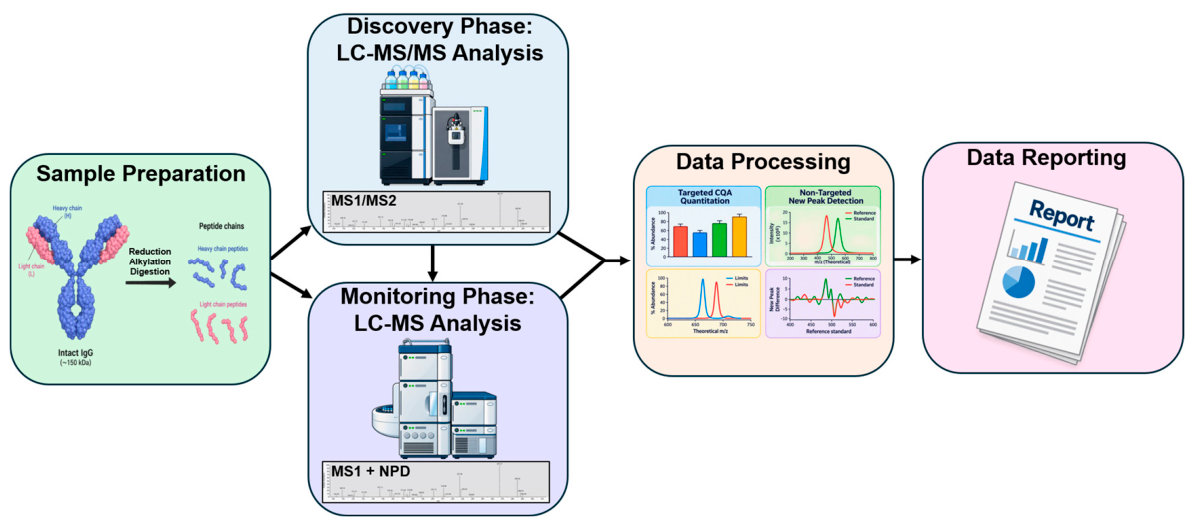

Table 1.
Attributes, Risks, and Monitoring Goals of MAM Characterization.
| CQA monitored | Patient/Product quality risks | Monitoring goals | Conventional assays | MAM levela | MAM monitoring strategy and benefits | Refs. |
| Sequence variants | Immunogenicity; loss of potency |
Identify and quantify unintended amino acid substitutions | Peptide mapping (UV); DNA sequencing | P | Higher sensitivity and specificity; QC compatible b; New Peak Detection (NPD) c; | [7,33,34,35] |
| Charge variants | Altered PK/PD; immunogenicity; reduced potency | Monitor deamidation, C-terminal lysine truncation, N-terminal pyroglutamate formation, sialylation, and glycation |
IEX; cIEF; CZE-UV | P | Attributes charge heterogeneity to residue-specific modifications | [21,36,37,38] |
| Primary structure confirmationd | Incomplete structural characterization; undetected PTMs | Achieve sequence coverage sufficient to monitor all target CQAs | LC-MS/MS peptide mapping | P | Primary structure confirmed in the same analysis as attribute quantitation; QC compatible | [14,39,40,41] |
| Size variants | Immunogenicity (aggregates); loss of potency (fragments); altered PK | Detect and quantify aggregates and fragments | SEC, CE-SDS | I (aggregates, native conditions), I, S (fragments) | Identification of aggregates and fragments by accurate masses | [17,22,23,24,28] |
| Drug-to-antibody ratio (DAR) | Toxicity; reduced potency; altered PK and immunogenicity | Maintain consistent payload distribution, confirm conjugation sites; detect payload loss and linker-related degradation products | HIC-UV, RP-HPLC, | I, S, P | Provides precise distribution of drug load and conjugation sites; detect payload and linker degradation | [27,29,42,43] |
| Process-related impurities | Safety; immunogenicity; product degradation; excipient degradation | Detect and quantify individual HCPs, residual proteases, leached affinity ligands | ELISA, LC-MS/MS, 2D-PAGE | P | Identify specific contaminant proteins; possible real-time HCPs monitoring (2D-LC MAM) | [31,44,45] |
| C-terminal lysine truncation | Charge heterogeneity; impact C1q binding | Consistency of enzymatic processing | IEX, cIEF | P | Rapid and direct site-specific quantification | [2,8,46] |
| N-terminal pyroglutamate | charge heterogeneity | Ensure consistent N-terminal Gln/Glu cyclization to pyroglutamate | IEX, cIEF, LC-MS/MS peptide mapping | P | Direct mass-based quantification; QC compatible | [7,46] |
| Purity (new peaks) | Unknown degradants or contaminants; batch-to-batch quality drift; undetected sequence variants; | Flag peaks that are new, missing or changed relative to the reference standard; enable impurity monitoring across the product lifecycle | Visual comparison of HPLC chromatograms; orthogonal purity assays | P | Automated New Peak Detection c (NPD) with mass identity for early risk mitigation; QC compatible | [13,35,47,48] |
| Glycosylation | Altered ADCC/CDC effector function and serum half-life; immunogenicity | Track site-specific glycan profiling, glycan site occupancy, and individual glycoform distribution in a single analysis | HILIC-FLD, CE-LIF | P, I, S | Site-specific glycan profiling without glycan release and labeling | [19,32,49,50] |
| eGlycation | Reduced stability; immunogenicity; altered clearance | Quantify non-enzymatic glycation at lysine residues | IEX, CZE, cIEF, boronate affinity chromatography | P, I | Site-specific glycation quantification; Distinguishes glycation from other acidic modifications | [25,26,51] |
| Oxidation | Loss of binding and potency; increased aggregation; reduced stability | Quantify site-specific methionine and tryptophan oxidation | LC-MS/MS peptide mapping, RP-HPLC, HIC, intact/subunit LC-MS | P, I, S | Simultaneous site-specific Met and Trp oxidation quantification across all sites in a single analysis; QC compatible | [43,52,53,54] |
| Deamidation & Isomerization | Reduced stability; immunogenicity; charge heterogeneity; reduced binding affinity and potency |
Quantify Asn → Asp/isoAsp and Gln → Glu; Asp → isoAsp isomerization; succinimide intermediates. | IEX, CZE, cIEF, LC-MS/MS peptide mapping | P | Site-specific resolution and quantification; Allows direct monitoring of CDR isomerization, provides structure-function link | [10,55,56,57] |
| Free thiols/unpaired cysteines | Aggregation; reduced stability; altered drug load in cysteine-conjugated ADCs | Quantify free cysteine at each site; confirm intra- and inter-chain disulfide linkages; detect trisulfide bridges | Ellman’s assay; non-reduced CE-SDS | P (non-reduced), I | Directly identify free cysteine sites and disulfide linkage; resolve disulfide isoforms by intact mass | [11,58,59] |
| Identity | Cross contamination or product mix-up at release; patient safety risk | Identity confirmation; CDR fingerprinting for lot release; cross-contamination exclusion | IEX, cIEF, ELISA, RP-HPLC (UV) | P | Sequence-based identity confirmation in the same analysis as attribute quantitation | [18,34,60,61] |
| Molecular mass | Sequence deletions or truncations; incorrect chain pairing or assembly | Confirm intact and subunit masses matches theoretical sequence mass; detect large structural variants not resolvable at peptide level | Intact or subunit level LC-MS | I, S | Direct confirmation of the assembled molecule, including chain pairing and proteoform composition; QC compatible | [20,28,30] |
| Host Cell Proteins (HCPs) | Immunogenicity; enzymatic degradation of product or formulation components | Detect, identify, quantify individual HCP at low-ppm levels; targeted monitoring of high-risk HCPs | ELISA (total HCP), 2D-PAGE | P | High specificity; high sensitivity; individual HCP identification | [31,44,45] |
a MAM analytical level: P = peptide-mapping (bottom-up) MAM; S = subunit MAM (limited proteolysis with IdeS or papain to yield ~25-50 kDa fragments); I = intact MAM (iMAM, denaturing or native LC-MS on the molecule). Multiple levels indicated where the attribute is monitored on more than one. Selection of level is a risk-based decision driven by the specific attribute, the molecular format, and the required regulatory deliverable. b QC-compatible indicates that the attribute can in principle be determined by MAM in a 21 CFR Part 11-compliant cGMP environment, and at least one sponsor has filed with regulatory agencies or publicly described its use. c New Peak Detection (NPD). NPD is a non-targeted detection capability that operates alongside but is conceptually separate from the targeted CQA quantitation. d Primary structure sequence coverage. A commonly applied acceptance criterion is ≥95% with 0 or 1 missed cleavage. e Tryptic digestion underestimates glycation; Lys-C or intact level analysis is preferred.
Table 2.
Comparison of MAM Analytical Levels: Peptide-Mapping (Bottom-up), Subunit, and Intact MAM.
| Characteristic | Peptide-Mapping (Bottom-Up) MAM | Subunit MAM | Intact MAM (iMAM) | Refs. |
| Sample preparation | Denaturation, reduction, alkylation, buffer exchange or desalting, proteolytic digestion, and post-digestion acidification | Proteolysis with IdeS and reduction; no alkylation or digestion to peptides required | Dilution, desalting, or buffer exchange | [14,25,28] |
| Sample preparation time | 2–6 h (manual); 1–2 h (automated) | 1–2 h | <30 min | [26,27,62,63] |
| Site specificity of PTM information | Highest; single-residue localization for most PTMs | Intermediate; domain- or chain-level | None; modifications observed as mass shifts on the intact molecule | [2,7,27] |
| Co-occurring modifications across the molecule | Not preserved; peptide-level analysis loses the molecular distribution | Partially preserved within each subunit | Fully preserved; joint distribution of all modifications on the assembled molecule | [20,27,28] |
| Detection of stability-indicating PTMs a | Highest; site-specific quantitation of each Met, Trp, Asn, and Asp residue | Moderate; modification quantified per chain or domain | Limited; mass-shifted species distinguished but not localized | [10,25,55] |
| Throughput | Low | Moderate | High | [2,26] |
| Deployment in cGMP QC | Mature | Established for identity; emerging for attribute monitoring | Emerging | [18,34,37,61,64] |
a Oxidation, deamidation, isomerization, and succinimide formation.
Table 3.
Sample Preparation Barriers in MAM and Practical Solutions.
| Barrier | Root cause | Practical solution(s) | Maturity a | Refs. |
| Artificial deamidation | Prolonged digestion in NH4HCO3 or phosphate at pH 7.8–8.0; rate increases with pH, buffer concentration, and ionic strength | Low-concentration Tris instead of NH4HCO3 or phosphate; 10% acetonitrile as co-solvent; digestion at or below pH 7.5; shorter digestion time | Established | [2,55,56,70] |
| Buffer exchange variability and sample loss | Guanidine must be removed before tryptic digestion; manual desalting adds variability and loss | Lys-C digestion, allowing simple dilution instead of desalting; tip-based buffer exchange | Established | [41,51,70,75] |
| Low throughput and inter-analyst or inter-laboratory variability | Labor-intensive, multi-step manual preparation limits transferability | Walk-away robotic platforms (e.g., Hamilton Microlab STAR with microdialysis, KingFisher Duo Prime, Agilent AssayMAP Bravo) | Established | [62,63,73,74,76] |
| Reduction and alkylation reagent trade-offs | TCEP reduces oxidized Met; iodoacetic acid in NaOH raises pH and yields carboxymethylation, same mass shift as Gly→Asp and Ala→Glu substitutions | Use DTT when Met oxidation is quantified; iodoacetamide instead of iodoacetic acid; quench alkylation with DTT | Consensus | [11,51,68] |
| Carbamylation in urea-based denaturation | Urea-derived isocyanate modifies Lys side chains and N-termini, blocking digestion and adding mass shifts | Guanidine-HCl instead of urea; ammonium-containing scavenger buffers; lower pH | Consensus | [68,70] |
| Artificial Met and Trp oxidation | Trace metals, peroxides, photosensitizers, dissolved O2, consumable leachables, and reagent lot variability | 20 mM L-Met in all buffers; EDTA; qualification and change control of consumables; system-suitability trending against a frozen reference standard; gravity desalting instead of spin columns | Experimental | [39,43,67] |
| Acid-catalyzed deamidation after digestion | 1% TFA drives time-dependent deamidation at 5 °C during autosampler storage, causing overestimation of deamidation levels in stability samples | Omit acidification where feasible; milder acidification (1% formic acid, 0.1% TFA, or 0.1% DFA) | Experimental | [54] |
| Missed cleavages and incomplete digestion | Gradual trypsin inactivation at elevated digestion temperatures (e.g., 75 °C); reduced accessibility at modified or structured sites | Two-step digestion at distinct temperatures; combined trypsin/Lys-C; immobilized trypsin | Experimental | [40,62,68] |
| Loss of hydrophobic CDR peptides | Aromatic-rich peptides adsorb to plate and tube surfaces; Trp oxidation increases hydrophilicity, biasing recovery and therefore Trp-oxidation quantitation | Add guanidine-HCl in the final digest; recover peptides from the original digestion plate; C4 instead of C18 columns | Experimental | [40,54] |
| Poor retention of small hydrophilic peptides (e.g., VSNK, SCDK) | Peptides elute near the void volume of reversed-phase columns, preventing reliable quantitation of the conserved Fc region deamidation site | HSS T3 column; supplementary chymotrypsin, Glu-C or Lys-C digestion; complimentary HILIC column | Experimental | [41] |
| Post-digestion instability in the autosampler | Residual protease activity; oxidation or deamidation during queuing; loss of hydrophobic peptides | Quench by acidification to pH ~3 with TFA in the presence of ~20 mM methionine | Experimental | [57,72] |
a Established, widely adopted across the industry; Consensus, recommended in multi-company consensus documents; Experimental, demonstrated in primary studies but not yet broadly validated.
Table 4.
LC Separation and MS Acquisition Barriers in MAM Workflows: Mechanistic Basis and Practical Solutions.
Table 4.
LC Separation and MS Acquisition Barriers in MAM Workflows: Mechanistic Basis and Practical Solutions.
| Challenge | Mechanistic basis | Practical solution(s) | Refs. |
| Liquid chromatography | |||
| Tailing and carry-over of hydrophobic CDR peptides | Strong retention on C18 stationary phases causes peak tailing and carry-over into subsequent injections | Less retentive C4 reversed-phase column | [40] |
| Co-elution of isobaric deamidation isomers and positional oxidation isomers | Asp/isoAsp and positional oxidation isomers are isobaric; MS1-only monitoring cannot separate co-eluting isomers, so quantitation depends on chromatographic resolution | Longer, shallower gradients across the elution window of the modified peptide; low-pH digestion to stabilize succinimide intermediates; chip-based CZE-MS for charge-based separation of deamidation products; high-resolution ion mobility for isomers that remain unresolved chromatographically | [2,55,57,79,80] |
| On-column and post-column oxidation | Metal ions accumulate in the flow path and column with age, promoted by prolonged exposure to acidic mobile phase; light exposure after the column | Periodic flushing with 20 mM EDTA; low-metal or passivated flow paths; reduced acid concentration or use TFA instead of FA; bypass of UV or diode-array detectors | [43] |
| Retention-time variability between laboratories and over long studies | Differences in pump design, columns, and solvent lines; column wear over extended stability studies | Peptide retention-time calibration mixture; reference standard injections bracketing each batch; workbook retention times updated at method transfer; wider retention-time windows supported by high mass accuracy | [47,48,77,78] |
| Run time versus throughput | Long gradients required for full sequence coverage and isomer resolution limit daily sample capacity | Chip-based CZE-MS, which resolves isomeric species in under 10 min and increases throughput up to 20-fold relative to long-gradient LC–MS; focused peptide mapping restricted to a defined attribute panel during the monitoring phase | [2,62] |
| Ion suppression by TFA | TFA acts as an ion-pairing agent that improves peak shape but suppresses ESI response relative to formic acid | Lower TFA concentration (e.g., 0.02%); difluoroacetic acid as a compromise between peak shape and sensitivity; use formic acid where separation allows | [41] |
| Mass spectrometry | |||
| In-source fragmentation of sialylated and labile glycopeptides | High declustering potential, source temperature, or collision energy producing artifactual loss of sialic acid and underestimation of sialylated glycoforms | Lower declustering potential, collision energy, and source temperature for glycopeptide monitoring | [50] |
| Mass-accuracy drift | Calibration drift across long acquisition sequences, widening the mass error | Routine external calibration; internal lock-mass calibration | [77,78] |
| Too few MS1 scans across a chromatographic peak | High-resolution scans are slow; integration becomes noisy when cycle time exceeds about one-tenth of peak width | Reduce MS1 resolution for quantitation-only runs; characterization (DDA MS/MS) separated from quantitation (MS1 only) | [14,52] |
| Low-abundance peptides missed by DDA (e.g., HCPs, sequence variants) | Top-N acquisition selects only the most abundant precursors, excluding low-abundance peptides | Data-independent acquisition with overlapping m/z windows, alone or alongside DDA | [44,45] |
| Unequal ionization efficiency of modified and unmodified peptides | Relative abundance from extracted ion chromatograms assumes equal ionization response; clipping, glycation, and shifts in hydrophobicity or charge alter the ionization efficiency | For clips, sum responses of both fragment peptides; for glycation, monitor at subunit level or with a protease that does not cleave at Lys; stable-isotope internal standards for absolute quantitation | [25,51] |
| Alkali-metal adducts reported as false new peaks | Na+ and K+ adducts form in the ESI source, particularly when use glass vials | Plastic vials; regular source cleaning; NPD filters excluding singly charged species and adduct mass patterns | [35,47] |
| High- versus low-resolution instruments for QC | Single-quadrupole detectors are simpler to qualify but lack the resolving power to resolve isotopic peaks and assign charge states for multiply charged tryptic peptides | Single-quadrupole detection for identity testing and targeted monitoring; Orbitrap or Q-TOF for characterization and NPD | [34,37,52,53,81] |
| Performance differences between platforms at method transfer | Q-TOF instruments generally offer lower resolution and wider mass tolerance than Orbitraps | Platform-specific system-suitability criteria; equivalence demonstrated through bridging studies | [17,78,82] |
Table 5.
Data Processing and Software Limitations in MAM and Practical Mitigations.
| Limitation | Mechanistic basis | Practical mitigation | Refs. |
| Quantitation and peak processing | |||
| Different relative abundances from identical raw data across software | Platforms differ in peak-integration algorithms, charge-state inclusion rules, and baseline subtraction | Lock platform, version, and processing parameters at validation; report the software workflow with each result; bridging studies when changing platforms | [77,82,84] |
| Ambiguous denominator for PTM quantitation from multiply modified peptides | The modification ratio can be calculated against the unmodified peptide, all forms of equal length, or all peptides containing the residue, each gives a different value | Select one definition, document it in the SOP, and apply it consistently; summing all modification states of the same peptide length is common practice | [8,14] |
| Charge-state selection biases quantitation | Using only the most abundant charge state biases results when modification shifts the charge distribution; summing all states can include poorly resolved minor states | Fixed charge-state range per peptide, or summation of all observed states, defined during development | [82] |
| Unstable or poorly integrated extracted ion chromatograms | Extracted ion chromatograms can include signals from neighboring species because of the co-eluting peptides; minor charge states may also be detected unstably, and shifts in retention time or peak shape change the optimal integration parameters | Select stably detected charge states and exclude unstable ones during method development; narrow the mass-extraction window; improve chromatographic resolution; verify integration and extraction for all target peaks, with manual integration where necessary | [8,14,82] |
| Deconvolution of intact and subunit spectra | Highly charged ions must be deconvoluted to monoisotopic or average masses using product-specific parameters | Validated deconvolution algorithms; deconvolution parameters established and locked per product; analyst review of deconvoluted output | [20,27,28] |
| No consensus LOD and LOQ for relative quantitation | Limits are specific to product, peptide, and modification | Attribute-specific limits established per ICH Q2(R2); stable-isotope internal standards where absolute quantitation is required | [8,33,78] |
| Discovery and workbook construction | |||
| Manual curation of MS/MS identifications | Automated searches return assignments that require expert review, including artifacts, in-source oxidation co-eluting with the unmodified peptide, and peaks whose intensity does not scale with injection volume | Defined curation criteria applied consistently (intensity cut-off, artifact exclusion); trained analyst time allocated to discovery-phase review; confirmation by retention time and MS/MS spectral inspection | [14,84] |
| Labor-intensive workbook construction | Target workbooks contain hundreds of entries built manually during discovery | Automated peptide-library construction; reuse across products with sequence homology, followed by review | [48,72] |
| Data integrity, compliance, and infrastructure | |||
| Integration adjustments scrutinized during audits | Manual adjustment of integration boundaries for low-abundance peaks may be viewed as data manipulation | Locked integration parameters with a documented review workflow; audit-trailed CDS for all routine integration; retention of original and adjusted boundaries | [85,86,87] |
| Resource-intensive qualification of the integrated LC–MS–CDS and computer system | Each component must be qualified individually and as a combined system, with documentation exceeding that of conventional QC methods | Dedicated validation planning; vendor-supplied validation packages; separation of the validated system from discovery use | [88,89] |
| Limited interoperability of data and reports | Proprietary vendor file formats and no agreed standard for workbooks, NPD thresholds, or attribute reports | Lock the data system for the product lifecycle where possible; data architecture defined before commercial filing; export results in durable formats (PDF, CSV) for archival; adopt industry harmonization of reporting formats | [65] |
| Large data volumes | High-resolution raw files are several gigabytes per run and accumulate rapidly in routine testing | Network storage with structured backup; cloud storage with Part 11 controls; retention policies aligned with regulatory expectations | [83,86] |
Table 6.
New Peak Detection Limitations and Practical Solutions.
| Limitation | Mechanistic basis | Practical mitigation | Refs. |
| No universal detection threshold | Relative intensity thresholds used across 28 laboratories ranged from 0.01% to 5.0%; appropriate values depend on product, peptide, and platform | Intensity and fold-change thresholds determined empirically per product and platform; spike-recovery experiments with calibration peptides at the reporting limit; spike-recovery testing integrated into the method transfer protocol | [47,48,60] |
| False negatives and false positives between laboratories | 25% of participants missed at least one of 15 spiked peptides, and the participant using the highest absolute threshold missed two; 39% reported new or changed peaks unrelated to the spiked peptides | Bracketing reference-standard injections; sequence-variant co-mixes with each batch; threshold set using peptides spiked at the intended detection limit; known peak list, pairwise replicate analysis, and defined system-suitability criteria | [35,47,48] |
| Random false positives from single injections | Stochastic features appear in only one injection and are reported as new peaks | Replicate injections with pairwise comparison; statistical testing across replicates | [35] |
| Artifact peaks from contaminants and adducts | Mobile-phase and system contaminants, carry-over peptides, and alkali-metal adducts generate peaks unrelated to product quality | Automated artifact filtering; dedicated LC–MS systems and mobile phases; regular system cleaning | [35,47] |
| New peaks missed through charge-state restriction | A new species may ionize mainly at a charge state excluded by the processing method | Charge-state range filters; grouping of charge states during feature detection | [48] |
| Retention-time drift over long stability studies | Drift across months produces apparent new or missing peaks for known species | Reference-standard injections bracketing each batch; workbook retention times updated per site; appropriately widened retention-time windows | [48,77] |
| Visual chromatogram comparison as the detection method | Manual comparison has no defined detection threshold; participants relying on it reported among the fewest peaks in a stressed sample | Automated, algorithm-based NPD with documented thresholds in validated software; analyst review limited to flagged peaks | [13,47] |
Table 7.
Regulatory and Lifecycle Considerations for Implementing MAM in a cGMP QC Environment.
| Consideration | Framework or guidance | Regulatory expectation | Practical considerations for MAM | Refs. |
| Regulatory landscape | ||||
| Acceptability for QC release and stability testing | ICH Q6B; EFPIA position paper | No regulatory impediment has been identified, provided MAM meets the same GMP requirements as conventional physicochemical methods and suitability is demonstrated by the sponsor | Regulatory familiarity is still developing, so suitability relative to conventional methods is expected; early engagement with health authorities is advisable | [33,64,65,85] |
| Industry harmonization | MAM Consortium; EFPIA; USP | Harmonized validation approaches, system-suitability standards, NPD threshold practices, and inter-laboratory data support broader acceptance | Consortium interlaboratory studies and the EFPIA position paper are the principal harmonization milestones to date; software solutions, NPD threshold practice, and common system-suitability standards still require alignment | [47,65,77,101] |
| Regional differences and in-country testing | National requirements (e.g., China, Russia) | Some countries require import testing in government or commercial laboratories that may not be equipped for MAM, potentially requiring two parallel control strategies | Request an exemption; apply MAM at drug substance level only; establish MAM at a qualified CRO for local testing; or retain conventional methods for those markets | [17,85,97] |
| Implementation scenarios | ||||
| Introduction before first-in-human studies | ICH Q6B; ICH Q14 | Bridging to conventional methods is not required, as conventional methods have not been used for release | Specifications are set without comparison to conventional data; earlier introduction reduces the bridging burden but requires greater initial effort | [65,85] |
| Introduction during development (after first-in-human, before registration) | ICH Q2(R2); ICH Q14 | Bridging to conventional methods is required to show equivalence or superiority for each CQA, supported by a risk assessment | Side-by-side analysis of stability and stressed batches; retained samples can be re-analyzed retrospectively; differences between methods must be explained | [38,85] |
| Introduction in the commercial phase (lifecycle management) | ICH Q12; ICH Q14 | Method bridging, risk assessment, and an appropriate post-approval change category are required | The analytical target profile supports justification of the reporting category; gradual implementation, first as an additional method, reduces submission risk | [37,99] |
| Method lifecycle | ||||
| Validation | ICH Q2(R2); 21 CFR 211.165(e) and 211.194(a)(2) | Phase-appropriate validation of precision, accuracy, linearity, specificity, LOD/LOQ, and robustness for each attribute on the specification | The number of attributes increases the validation workload; NPD requires separate validation of detection performance | [8,33] |
| Specification setting | ICH Q6B; ICH Q14 | Release and shelf-life specifications should focus on CQAs, based on process capability, stability, and clinical experience | Statistical comparison with conventional data is generally not meaningful, but offsets must be understood; a two-tiered NPD specification with alert and action limits has been proposed for clinical batches whereas after PPQ any new peak triggers investigation before release | [85] |
| Method transfer | ICH Q14; USP <1224> | Equivalent performance must be demonstrated between sending and receiving laboratories, including import-testing sites | Vendor-specific software, instrument differences, and analyst expertise complicates transfer; common platforms and a pre-transfer feasibility study reduce risk | [61,78,82,84,102] |
Disclaimer/Publisher’s Note: The statements, opinions and data contained in all publications are solely those of the individual author(s) and contributor(s) and not of MDPI and/or the editor(s). MDPI and/or the editor(s) disclaim responsibility for any injury to people or property resulting from any ideas, methods, instructions or products referred to in the content. |
© 2026 by the authors. Licensee MDPI, Basel, Switzerland. This article is an open access article distributed under the terms and conditions of the Creative Commons Attribution (CC BY) license.
Copyright: This open access article is published under a Creative Commons CC BY 4.0 license, which permit the free download, distribution, and reuse, provided that the author and preprint are cited in any reuse.