
Submitted:
28 September 2026
Posted:
01 October 2026
You are already at the latest version
Abstract
Recent analysis has shown that the progressive slowing of human mass loss under energy restriction follows from a mass reservoir whose outflow scales with surface area. The same geometry operates in the opposite direction. When mass increases, surface area increases, net outflow rises, and the rate of further accretion declines. Decelerating mass gain, like decelerating mass loss, therefore requires no direction-specific adaptive mechanism for its baseline trajectory. For fixed intake, the system approaches an equilibrium mass M* where intake equals outflow; gain from below and loss from above are mirror images of the same relation. Geometry accounts for the direction-symmetric component of deceleration; adaptive physiology, if present, must be inferred from the residual beyond that baseline. Literature's near-exclusive focus on adaptation during loss, while largely ignoring the corresponding deceleration during gain, is itself suggestive of an unevenly distributed explanatory burden. Geometry does not choose direction.
Keywords:
mass balance
; surface-area scaling
; weight gain
; weight loss
; metabolic adaptation
; geometric necessity
; Torricelli’s law
; mass accretion
Key Points
- -
- Deceleration of mass change is a geometric consequence of surface-area scaling.
- -
- The same relation produces decelerating gain and decelerating loss.
- -
- Geometry sets the baseline; adaptive physiology explains the residual.
- -
- The literature’s asymmetric focus on loss-side adaptation is not mirrored on the gain side.
- -
- Including the geometric term reduces the explanatory burden assigned to biology in both directions.
1. Introduction
The decelerating trajectory of mass loss under energy deficit has long been attributed to metabolic adaptation [1,2,3]. Formal analysis has shown that this attribution is not necessary for the deceleration itself: once the body is treated as a mass reservoir whose net outflow scales with surface area, and surface area scales with retained mass, deceleration follows as geometric necessity [4].
That demonstration concerned loss. The same premises apply without alteration to gain. If outflow is an increasing function of mass, then any sustained positive mass balance must produce a progressively smaller rate of accretion as mass rises. The reservoir empties more slowly as it empties; it also fills more slowly as it fills. The two trajectories are mirror images of one relation.
The geometric model specifies a null hypothesis: deceleration is entirely a consequence of surface-area scaling. Any adaptive component must be detected as a departure from this null. The question is therefore not whether adaptation exists, but how much of the observed deceleration it explains beyond the geometric baseline.
This paper formalizes that symmetry, specifies the baseline it implies, and clarifies what remains for adaptive physiology to explain.
2. Assumptions and Scope
The argument rests on four minimal premises:
- Single mass reservoir. The body is treated as one reservoir of retained mass M, without internal compartmental structure.
- Exogenous energy intake. Energy intake I is treated as fixed over the interval of interest. “Sustained deficit” and “sustained surplus” refer to I held below or above the maintenance requirement at the current mass, not to an indefinitely constant deficit or surplus.
- Monotone outflow. Net outflow f(M) is a monotonically increasing function of M, because the principal outflow routes cross surfaces whose aggregate area scales with mass.
- Composition affects parameters, not direction. Differences in the composition of gained or lost mass (fat versus lean tissue) alter energy density, synthesis cost, and water fraction, and therefore the quantitative shape of f(M). They do not remove the qualitative deceleration in either direction.
On the scaling of the outflow surface: for a geometrically similar body, surface area scales as A ∝ M2/3, so surface-dependent energy expenditure terms scale with the same exponent. Empirical body-surface-area formulas give exponents close to 2/3 across the human range. The argument below requires only monotonicity, not this exact exponent, but the canonical scaling motivates the assumption.
No further biological postulate is required for the baseline result.
3. The Governing Relation
Net mass balance is expressed by the continuity equation
where I is energy intake and f(M) is net outflow, which increases with M because the principal outflow routes cross surfaces whose aggregate area scales with mass.
The equilibrium mass M* satisfies
so that the dynamics can be rewritten as
Two consequences follow immediately.
- -
- If M < M*, then f(M) < f(M*), so dM/dt > 0: mass increases. Because f increases with M, the net gain f(M*) – f(M) shrinks as M rises. The trajectory decelerates.
- -
- If M > M*, then f(M) > f(M*), so dM/dt < 0: mass decreases. Because f decreases as M falls, the net loss f(M) – f(M*) shrinks as M falls. The trajectory decelerates.
Under sustained deficit the solution is decelerating loss. Under sustained surplus the solution is decelerating gain. The two are the same solution viewed from opposite sides of M*.
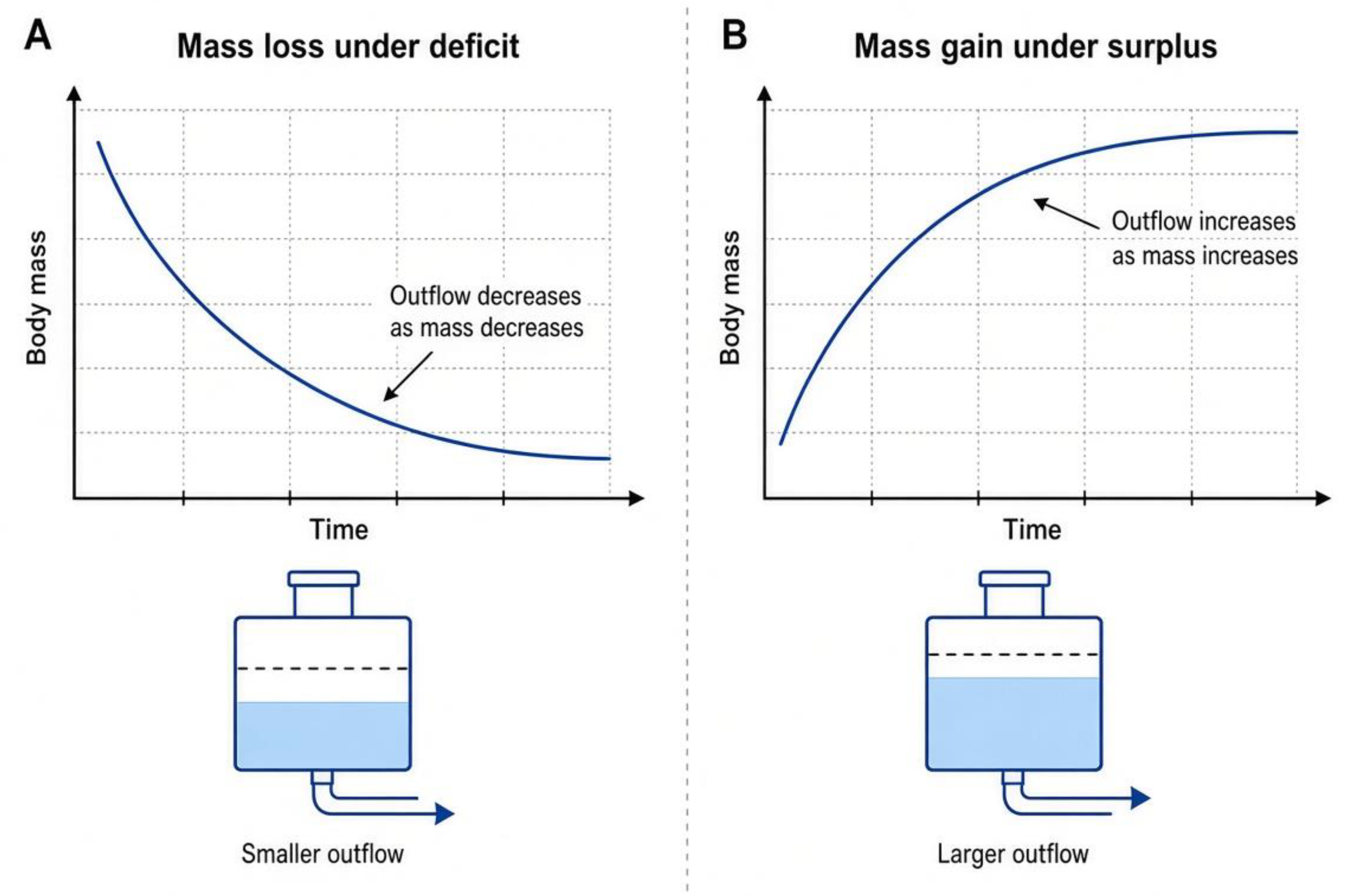
The precise functional form of f(M) shapes both curves. The existence of deceleration in both directions does not depend on that form; monotonicity is sufficient. Figure 1 illustrates both directions side by side: panel A shows decelerating loss under sustained deficit, panel B the mirror-image deceleration under sustained surplus.
Illustrative case. For the simplest choice f(M) = kM, the equation becomes
with solution
Gain from below and loss from above are then exact mirror images: both are exponential decays of the displacement |M – M*| with the same time constant. This illustrates the symmetry in its cleanest form.
4. What Geometry Explains, and What It Does Not
The geometric model does not exclude adaptive thermogenesis, nutrient partitioning, or other regulatory responses. It specifies the baseline trajectory against which any adaptive component must be detected as a residual. Geometry accounts for the direction-symmetric component of deceleration; adaptive physiology, if present, must explain departures from that baseline – changes in the effective f(M), shifts in M*, or asymmetry between the gain and loss trajectories.
Near equilibrium, the time constant of approach is 1/f’(M*). Because f’ is evaluated at the same M* in both directions, the gain and loss trajectories share the same characteristic time in the linearized regime. Any observed asymmetry in time constants is therefore a candidate signal of genuine adaptive or compositional effects.
This distinction matters for inference. A model that omits surface-area scaling will attribute the full deceleration to biology, because it has no geometric term with which to absorb any of it. Once the geometric term is included, the residual available for genuine adaptation is smaller, and its estimation becomes better posed.
In practice, the geometric baseline can be estimated from body mass and surface-area scaling alone, and the adaptive component inferred from the deviation of observed trajectories from that baseline.
5. The Asymmetry of Existing Explanation
Research on metabolic adaptation has concentrated almost exclusively on the loss side of the ledger. The corresponding slowing of mass accretion under surplus has attracted far less conceptual attention and is rarely framed as a phenomenon that demands special adaptive explanation.
This asymmetry is suggestive. If deceleration during loss required a direction-specific adaptive explanation, one would expect a parallel literature on deceleration during gain. Its relative absence suggests that the same baseline geometry has not been applied symmetrically across the two directions.
6. Consequences for Interpretation
Recognition of the geometric term in both directions tightens several common inferences.
1. Surplus does not produce linear gain indefinitely. Rising surface area increases outflow and thereby limits further accretion, independently of any adaptive response.
2. Compositional differences are parametric. Fat versus lean tissue changes energy density, synthesis cost, and water fraction – and therefore the shape of f(M) – but leaves the geometric deceleration itself intact.
3. Attribution is bounded. Models that omit surface-area scaling over-attribute both the slowing of loss and the slowing of gain to biology. Inclusion of the geometric term reduces the residual available for true adaptive physiology and improves the prospective accuracy of mass-change predictions in either direction.
4. Symmetry is the default. Any genuine asymmetry between the gain and loss trajectories must be demonstrated against the symmetric baseline, not assumed in its absence.
7. Predictions
If the geometric baseline dominates, four predictions follow.
1. Bidirectional deceleration. Deceleration should be observed under sustained surplus as well as under sustained deficit, without invoking direction-specific regulation.
2. Mirror symmetry near equilibrium. In the linearized regime around M*, the gain trajectory from M* – ∆ and the loss trajectory from M* + ∆ should decay with the same time constant 1/f’(M*).
3. Parametric, not qualitative, composition effects. Fat-versus-lean differences should shift M* and reshape f(M) without eliminating the deceleration.
4. Residual reduction. Models that include surface-area scaling should leave a smaller residual for adaptive physiology than models that omit it.
8. Limitations
The model is deliberately minimal. It treats the body as a single reservoir, holds intake exogenous, and assumes monotone outflow. It does not specify the physiological mechanisms underlying f(M), does not distinguish fat from lean tissue except through parameters, and does not address hormonal or neural regulation. These simplifications are intentional: the claim is that the qualitative symmetry of deceleration follows from geometry alone, not that geometry exhausts the physiology.
9. Conclusions
The same geometric relation that renders a direction-specific adaptive explanation unnecessary for decelerating mass loss also renders one unnecessary for decelerating mass gain. A reservoir whose outflow depends on surface area, and whose surface area depends on mass, must decelerate in both directions. Geometry sets the baseline; biology may explain the residual. Geometry does not choose direction – the literature largely did. Restoring the missing symmetry removes unnecessary asymmetry from the explanatory structure of human mass change.
Author Contributions
This is a single-authored paper.
Funding
This research did not receive any specific grant from funding agencies in the public, commercial, or not-for-profit sectors.
Institutional Review Board Statement
Not applicable.
Informed Consent Statement
Not applicable.
Data Availability Statement
All data generated or analyzed during this study can be found in the sources cited in this article.
Acknowledgments
I would like to thank my family for their unwavering support and care, as well as my colleagues for many stimulating discussions.
Conflicts of Interest
The author declares no conflict of interest.
References
- Dulloo, A.G.; Seydoux, J.; Jacquet, J. Adaptive thermogenesis and uncoupling proteins: a reappraisal of their roles in fat metabolism and energy balance. Physiol. Behav. 2004, 83(4), 587–602. [Google Scholar] [CrossRef] [PubMed]
- Major, G.C.; Doucet, E.; Trayhurn, P.; Astrup, A.; Tremblay, A. Clinical significance of adaptive thermogenesis. Int. J. Obes. (Lond) 2007, 31(2), 204–12. [Google Scholar] [CrossRef] [PubMed]
- Nunes, C.L.; Casanova, N.; Francisco, R.; et al. Does adaptive thermogenesis occur after weight loss in adults? A systematic review. Br. J. Nutr. 2022, 127(3), 451–469. [Google Scholar] [CrossRef] [PubMed]
- Manninen, A.H. Metabolic Adaptation Without Adaptation: Decelerating Mass Loss as a Geometric Consequence of a Draining Reservoir. Preprints 2026, 2026092388. [Google Scholar] [CrossRef]
Figure 1.
Geometric symmetry of mass change. (A) Mass loss under sustained deficit. Outflow declines as mass – and therefore surface area – declines, producing a decelerating trajectory. (B) Mass gain under sustained surplus. Outflow rises as mass – and therefore surface area – rises, again producing a decelerating trajectory. In both panels the solid curve is the geometric expectation. No direction-specific adaptive term is required to generate the baseline curvature.
Figure 1.
Geometric symmetry of mass change. (A) Mass loss under sustained deficit. Outflow declines as mass – and therefore surface area – declines, producing a decelerating trajectory. (B) Mass gain under sustained surplus. Outflow rises as mass – and therefore surface area – rises, again producing a decelerating trajectory. In both panels the solid curve is the geometric expectation. No direction-specific adaptive term is required to generate the baseline curvature.
Disclaimer/Publisher’s Note: The statements, opinions and data contained in all publications are solely those of the individual author(s) and contributor(s) and not of MDPI and/or the editor(s). MDPI and/or the editor(s) disclaim responsibility for any injury to people or property resulting from any ideas, methods, instructions or products referred to in the content. |
© 2026 by the author. Licensee MDPI, Basel, Switzerland. This article is an open access article distributed under the terms and conditions of the Creative Commons Attribution (CC BY) license.
Copyright: This open access article is published under a Creative Commons CC BY 4.0 license, which permit the free download, distribution, and reuse, provided that the author and preprint are cited in any reuse.