
Submitted:
29 September 2026
Posted:
30 September 2026
You are already at the latest version
Abstract
Neonatal white matter injury (WMI) arises from the interaction of developmental vulnerability with hypoxic–ischaemic, inflammatory, oxidative, and metabolic perturbations. Although experimental models have substantially advanced the understanding of these mechanisms and supported the investigation of anti-inflammatory and neuroprotective strategies, their translation into neonatal clinical practice remains challenging. Neonates are neither small adults nor little children, and experimental animals are not scaled representations of human neonates. Similar molecular pathways, cellular targets, or anatomical features across species may therefore indicate concordance in individual characteristics without establishing biological or pharmacological equivalence. In this narrative review, we examine the translational gap between experimental models of neonatal WMI and human neonatal pharmacology, focusing on developmental differences in inflammatory pathways, white matter maturation, physiology, drug disposition, and target engagement. We discuss the apparent discordance between preclinical biological plausibility and clinical neuroprotection. Thereafter, we propose an intervention-specific framework (“The Reticulum Framework”) that organizes developmental concordance, evidence gaps and uncertainty across species; its predictive value requires empirical validation. The framework conceptualizes anatomy, physiology, biochemistry, and developmental pharmacology as interacting domains constrained by biophysical principles and introduces “comparative developmental physionemes” as biologically interpret descriptors whose concordance or discordance contributes to translational equivalence. In this sense, current validated biomarkers and surrogate measures could be used to analyse the interconnection between these domains across species, considering especially cellular and molecular dynamics through omics pipelines. The Reticulum Framework proposes that biological correspondence should be evaluated according to the functional meaning that a physioneme acquires within a specific developmental system rather than by isolated similarity. Translational relevance is therefore considered intervention-specific and is assessed across anatomical, physiological, biochemical, pharmacological, biophysical, temporal, and outcome concordance as a multidimensional profile. This framework may support model selection, interpretation of experimental anti-inflammatory efficacy, identification of translational mismatches, and prioritization of candidate neuroprotective interventions for neonatal trials.
Keywords:
neonate
; inflammation
; white matter injury
; experimental model
Introduction
Translational research is pivotal to advance research on humans. However, such a statement should be unpackaged cautiously. First, neonates are not small adults [1] nor little children [2] imposing dosage and drugs which were suitable for children and adults. Moreover, humans are not mice despite sharing common pathways and physiology patterns. Despite receiving several comments by the international community, evidence from systemic inflammatory models has raised concerns about the direct translation of murine inflammatory responses to humans. Seok et al. [3], for example, reported limited correspondence between genomic responses in mouse models and human inflammatory conditions such as trauma, burns and endotoxaemia; this evidence is indirect with respect to neonatal brain injury [3,4,5,6,7,8,9,10,11]. Additionally, while scientists are aware of the time onset of induced hypoxia-ischemia in mice, neonatologists do not know when it begins in neonates [12]. Accordingly, pharmacology in neonatology is challenging [13]. The key is to explore the brain development across species in terms of benchmark of maturation and vulnerability [14]. One domain is represented by Dam et al. [15] who described the species flexibility between human and piglet neonates as a key element to bridge translational research into clinical practice. Furthermore, a shared biochemical pathway in rats and humans does not necessarily imply an identical drug response because exposure, transporters, metabolism, receptor density/affinity and downstream response could vary as underscored by Tayman et al. [16]. Pertinently, Smits et al. [17] illustrated the crosstalk between pharmacology and developmental physiology in neonatal human cohorts concerning drug disposition. Pattern recognition beyond compound specific observations are crucial to comprehend the neonatal pharmacokinetics in combination with maturation changes [18,19]. As a matter of fact they proposed a framework for hypothermia in neonates with hypoxic ischaemic encephalopathy (HIE) based on physiologically based pharmacokinetics modelling (PBPK) [20]. Magnesium sulphate illustrates the importance of distinguishing therapeutic contexts in developmental neuroprotection. Evidence from antenatal fetal neuroprotection cannot be extrapolated directly to postnatal treatment of neonatal HIE, as these settings differ in population, timing, exposure and clinical endpoints [21,22]. In the antenatal setting, the Rouse trial [22] found no significant reduction in the primary composite outcome of moderate or severe cerebral palsy or death, although moderate or severe cerebral palsy was reduced in a prespecified secondary analysis.
Inflammation is among the main drivers of brain injury like ischemic stroke and white matter injury (WMI) [23]. Specifically, WMI represents the principal target and and labelling evidence from term neonatal HIE, arterial stroke, infection and adult disease as indirect context. In this narrative review, we will zoom anti-inflammatory experimental models against white matter damage in balance with the narration of the precedent article on Antioxidants about the quadruple convergence of glucose imbalance, inflammation, oxidative stress and white matter vulnerability in neonatal neurology (Canepa et al. 2026, in submission). Thereafter, we will introduce RETICULUM framework aligning with NET, RIGEL and the Crossword Effect [21,24,25] in order to help researchers to identify animal and human correspondences (equivalences and markedness) enhancing translational research findings for drug and biomarker discoveries. Compared with the previous NET and RIGEL approaches, Reticulum specifically addresses intervention-dependent cross-species developmental translation by organizing concordance, discordance, and evidence gaps across multiple biological and translational domains. Within this translational perspective, the present review focuses on anti-inflammatory targets for neuroprotection, with particular emphasis on preterm white matter injury [26,27]. Particularly, very preterm infants with severe neonatal inflammation could have lower fractional anisotropy in multiple white matter tracts at near term age [28,29] beyond abnormal development of corpus callosum, bilateral thalamus and left superior longitudinal fasciculus [30]. The radiological studies on white matter microstructures underscore why white matter neuroprotection is uttermost important. Indeed, white matter mild lesions and intraventricular haemorrhages (IVH) could have, respectively, a negative influence on the neurodevelopmental sphere at 2 and 3 years of age [31,32].
Research questions: Do experimental models translate into neonatal clinical practice against white matter injury? Are animal in vivo studies misaligned with human neonatal phenotypes? Is similarity evidence of concordance in a feature and not evidence of equivalence between organisms?
Search strategy and narrative review reporting: A narrative literature search was conducted in PubMed/MEDLINE from database inception to 7 September 2026. No language restriction was applied at the search stage. Consistent with the exploratory design of this narrative review, the search was iterative rather than based on a single prespecified Boolean strategy. Initial searches combined terms related to neonatal populations and experimental models (e.g., “neonate”, “newborn”, “preterm”, “animal”, “rat”, “mouse/mice”) with “inflammation” and “white matter injury”. Searches were subsequently refined according to the specific translational domain under examination by adding terms related to biochemistry, oxidative stress/redox biology, developmental pharmacology, therapeutic targets and, where relevant, large-animal models such as piglets. Representative combinations included, for example, (“neonate” OR “newborn” OR “preterm”) AND (“animal” OR “rat” OR “mouse”) AND “inflammation” AND “white matter injury”, with additional domain-specific terms introduced iteratively. Study identification and selection were primarily performed by the first author on the basis of relevance to the scope and research questions of the review. Conflicting findings were retained and interpreted in relation to species, developmental stage, experimental model, biological compartment, intervention and outcome rather than being excluded solely because of discordance. The search was intended to identify representative evidence relevant to the mechanistic and translational questions of the review rather than to provide exhaustive study identification. SANRA was used to guide the reporting and methodological transparency of the narrative review; it was not used as a formal risk-of-bias assessment of individual studies [33].
1. The Pathological Anatomy and Physiology Toolbox: Defining White Matter Injury and Inflammation in Animal and Humans
We first define the relevant neonatal WMI phenotypes, then compare developmental inflammatory mechanisms and pharmacology across species, before presenting the Reticulum Framework. The review will start from scrutinizing attentively the White Matter Injury as an ischaemic perturbation involving both inflammatory and cellular dynamics. Thereafter, anti-inflammatory targets will be described in the section number 2.
The White Matter Injury: More than an Ischaemic Perturbation?
White Matter (WM) development is pivotal since neonatal age, especially in the first year of life [34]. Its maturation is involved in the optimal grade of cognitive and language functions [35]. In pathophysiology disruptions, the arterial ischaemic stroke represents a distinct condition and is considered here only as an indirect mechanistic comparator, particularly for inflammatory and brain–peripheral immune pathways [36,37,38]. Indeed, inflammation plays a crucial role in ischaemic stroke, especially involving inflammatory cells [39], with specific inflammation mechanisms in brain-peripheral crosstalk [40]. Itself, preterm White Matter Injury [41] encompasses focal necrotic lesions and diffuse injury with impaired oligodendrocyte maturation; hypoxia–ischaemia and inflammation contribute in phenotype- and developmental-stage-dependent ways. Haemorrhagic injury, venous infarction, and post-haemorrhagic ventricular dilatation are clinically related to the spectrum of brain injury in preterm infants but should be considered distinct from preterm WMI. Their occurrence, particularly that of germinal matrix–intraventricular haemorrhage, is strongly related to developmental maturity and gestational age [42,43,44,45,46,47], Conversely, isn the historical cohort reported by Zupan et al. in 1996 [48], comprising preterm infants born between 24 and 32 weeks of gestational age, admitted to the intensive care unit and surviving at least 7 days, PVL is ascertained by cranial ultrasounds and EEG tracings showing its highest incidence among infants born at 28–29 weeks of gestation. In that cohort, the authors related this gestational-age distribution to prenatal inflammatory events occurring during the days or weeks preceding delivery; in particular, the combination of intrauterine infection and premature rupture of membranes was associated with a 22% risk of PVL. This historical observation should not be interpreted as a universal contemporary gestational-age distribution of PVL because PVL could also occur in near-term (late preterm), as well as term infants, as documented by neuroimaging and autopsy studies [48]. In both very preterm and late preterm infants, gray matter injury is associated with PVL. Particularly, Holloway et al. provided experimental evidence that microglial inflammasome (increased densities of inflammasome-activated NLRP3+ microglia/ macrophages CD68+ in injured brain areas compared to uninjured regions) activation contributes to developmental white matter injury in an ex vivo neonatal mouse model combining inflammatory and hypoxic insults. An inflammasome is a defined molecular complex and should therefore be distinguished from a broader inflammatory state or biomarker profile. Conversely, inflammatory signals measured in peripheral blood or cerebrospinal fluid may be associated with neonatal brain injury but do not, by themselves, demonstrate causal activation of the corresponding pathway within the CNS or establish CNS target engagement. This distinction is particularly relevant for cross-species translation, because apparent correspondence between systemic biomarkers, CNS molecular pathways and therapeutic targets may represent different levels of biological evidence rather than functional equivalence [49] comparable with previous international research on adults. Accordingly, finding and modelling a clear and defensible correspondence are not easy tasks due to critical factors [50]. Since the activation network is a highly distributed, multi-organ systems-level architecture, mapping a distinct therapeutic molecule to a specific clinical endpoint requires navigating significant biological noise derived from distal confounding markers, proximal measurement complexity and heterogeneous organ and cell-type translation (model disconnections; shared signalling nodes) [51,52,53,54,55,56,57,58,59].
2. The Translational Pharmacology Toolbox: Defining Anti-Inflammatory Target in Animal and Humans
More generally, anti-inflammatory targets in neonates reveal a complex balance between a genetically programmed disease-tolerogenic state and a vulnerability to hyper-inflammation [60,61]. In Table 1, concordances, translational limitations and current evidence from human and mice neonates are reported from the current immunology and infectiology literature. While mouse models are vital for mechanistic research, critical evolutionary differences exist regarding how their innate and adaptive systems regulate inflammation. Both human and murine newborns exhibit a high abundance of functional, immunosuppressive Foxp3+ Treg cells [62,63]. These cells act as a natural anti-inflammatory target by suppressing Th1-skewed autoimmune responses and limiting tissue damage. Furthermore, neonatal immune responses are developmentally and context dependent rather than uniformly anti-inflammatory or Th2/Th17-skewed [61,62,63,64,65,66,67,68,69]. Their direction and magnitude vary according to gestational or postnatal age, immune-cell population, biological compartment and stimulus [61,62,63,64,65,66,67,68,69]. Consequently, apparently similar inflammatory phenotypes in human and murine neonates should not be assumed to represent equivalent immune states. This distinction is also therapeutically relevant: anti-inflammatory strategies should attenuate injury-promoting inflammation without compromising antimicrobial host defence or developmental and reparative immune functions [64,65,66]. Third, neonatal neutrophils and monocytes in both humans and mice express significantly lower levels of adhesion molecules (such as L-selectin/CD62L and Mac-1) [67]. This impairs their ability to bind to the endothelium and migrate to inflammatory sites, dampening early tissue inflammation. Both species rely on endogenous alarmins (S100A8/S100A9) to systematically reprogram TLR4 pathways post-birth [68]. This post-transcriptional brake restrains hyper-inflammation during early gut colonization. However, developmentally contingent differences or incompletely matched phenomena have been reported in adenosinergic pathways, TLR responses, type-I interferon signalling and CD71+ erythroid-cell immunoregulation pathways and immunosuppressive erythroid cells [69,70,71,72,73,74,75,76,77] impeding a reliable and complete translation from neonatal animal to human for drug discovery.
Accordingly, microglia, oligodendrocytes maturation and extracellular vesicles (EVs) could be involved both in the pathophysiology of brain injury and as, respectively, a mediator and targets for anti-inflammation drugs [83,84,85,86,87,88] for white matter damage. Astrocytes are also suggested to design tailor care in neonates with ischaemic stroke [89] translated from the homologous adult literature. Yao et al. consider and build several diseases’ inflammasomes not only as pathological mechanisms but also therapeutic targets [90] because they are multiprotein complexes regulating immune and inflammatory responses. In this sense, proteomics could be a useful molecular pipeline to disentangle further convergences and divergences among human and rat models. For instance, Gravina et al. successfully founded that lipocalin-2 - in neonatal inflammation - was associated with cerebrovascular alteration in mice and preterm infants [91]. In preterm newborn pigs, Muk et al. [92] identified infection-associated proteomic changes in plasma and cerebrospinal fluid, including pathways relevant to neuroinflammation and sepsis. The piglet model may therefore offer advantages for selected translational questions in neonatal physiology and pharmacology [93,94] although developmental equivalence remains domain specific. Likewise, developmental enzyme-ontogeny data, including CYP3A and UGT activity, can inform physiologically based pharmacokinetic models [95], but predictive accuracy requires external validation in the relevant neonatal population. In this way, perinatal pharmacology benefits from mapping metabolic enzymes (like CYP3A and UGT) across neonatal mice and piglets to build physiology-based pharmacokinetic (PBPK) models [95]. As enzyme-ontogeny data can inform PBPK models, accuracy cannot be established without a rigorous external validation.
Developmental antioxidant capacity represents an additional translational constraint in neonatal WMI. Oligodendrocyte-lineage cells, particularly pre-oligodendrocytes, show maturation-dependent vulnerability to oxidative and inflammatory injury, while mitochondrial bioenergetic disturbances can impair oligodendrocyte maturation and myelination [96,97,98]. Cross-species comparison of candidate redox measures should therefore specify the biological compartment, developmental stage, sampling time and analytical assay. For example, glutathione availability or the GSH/GSSG ratio may characterize redox state, whereas F2-isoprostanes provide an established index of lipid peroxidation and have demonstrated selective oxidative injury of the oligodendrocyte lineage in human preterm white matter [99,100]. Importantly, a reduction in oxidative-stress markers should not be interpreted as evidence of durable neuroprotection unless it is accompanied by preservation of oligodendrocyte maturation, white-matter integrity and later functional outcomes [101].
3. When Preclinical Biological Plausibility Fails to Predict Clinical Neuroprotection
Sometimes, strong mechanistic plausibility and apparently favourable preclinical effects fail to predict clinically meaningful neuroprotection in human neonates, as recognized by Pierre Gressens and Robert Galinsky in their respective publications [102,103,104,105,106] in integration with limitations and questionable practices such as limited rigor in experimental design, internal and external validity, negative bias, insufficient statistical power, selective reporting and excess significance bias [107,108,109,110,111]. Accordingly, this discordance may reflect genuine developmental and cross-species biological misalignment, but may also be amplified by methodological limitations. This animal-human misalignment reveals itself as a paradox provided that decades of successful neuroscientific research has been basing on animals. Mismatches regard additionally statistical significance of clinical outcomes such as neurodevelopment. First, the randomized trial HEAL studies erythropoietin (EPO) in combination with hypothermia in infants born at >=36 weeks with moderate/severe HIE [112]. This drugs combination does not reduce death or neurodevelopmental impairment, increasing serious adverse events. Instead, erythropoietin added to hypothermia. Instead, a systematic review and meta-analysis [113] on clinical randomized controlled trials on erythropoietin combined with hypothermia for neonatal HI shows a greatly lower odds in the EPO group (EG) versus the Control group (CG) for mortality, acute brain injury, intellectual developmental index < 70, and motor developmental index < 70 [odds ratio (OR) = 0.65, 95%CI = 0.47-0.91, p = 0.01; OR = 0.51, 95%CI = 0.25-1.01, p = 0.05; OR = 0.47, 95%CI = 0.22-1.00, p = 0.05; OR = 0.44, 95%CI = 0.20-1.00, p = 0.05]. EG and CG demonstrated neglectable differences in terms of hospital stay duration, renal failure/injury rate, incidence of neurological developmental abnormalities, and antiepileptic drug usage (p > 0.05). However, further systematic reviews and meta-analyses do not support the use of erythropoietin for treating HIE [114]. Heterogeneously, international research strives to detect the most suitable and neuroprotective drug even for neonatal white matter injury such as oral melatonin because of its anti-oxidant properties in human neonates [115]. Further, authors propose Sephin1 administration, sildenafil administration and SAMSN1 suppression for, respectively, improving white matter integrity and oligodendrocytes integrity after intracerebral haemorrhage in mice [116], reducing neuroinflammation and neuro-protect term hypoxic-ischaemic neonate rats [117,118]. Nonetheless, neuroprotective strategies against periventricular leukomalacia are further to be disentangled. Reviewing systematically the current preclinical literature until 2022, Abiramalatha et al. [119] highlight the scarcity of trials using stem cells, erythropoietin, and melatonin despite significant preclinical results. Further data are required on their neuroprotective potential in PVL before designing novel trials, investigating combinations of interventions per subgroups of preterm neonates for double reason. First, most of the tested interventions have only a partial efficacy. Second, the nature and pattern of perinatal insults to preterm brain predisposing it to pVL are substantially variable.
Besides magnesium sulphate literature [21], animal experimentations on cognitive functions are eloquent to translate this paradox in a further complementarily pertinent with white matter region dynamics, cognition, because it is a more complex phenomenon to be replicated in a cross-species manner. Although international literature developed comparative indices of cognition showing further pitfalls of current research [120,121,122,123], human studies are still needed [120,122] to avoid a notable mismatch between humans and animal models. Kanwisher et al. [120] propose models based on artificial intelligence’s neural networks to perform simulations in a virtual platform. Similarly, physiologically based pharmacokinetics (PBPK) models enables researchers and neonatologists to study drug concentration, response and administration thresholds inputting literature human data on computer software without any animal in vivo or in vitro + adult tissue models [124,125]. PBPK models integrate drug properties and developmental physiology to predict exposure and support dose selection; neonatal validation and pharmacodynamic data remain necessary. Additionally, PBPK models are mentioned by the European Society of Paediatric and Neonatal Care (ESPNIC) for double motivation [126,127,128]. First, regulatory agencies [129] are nowadays demanding population pharmacokinetics (PK), population pharmacokinetics and pharmacodynamics (PK-PD) and/or PBPK information during the different stages of new drug development in the paediatric age range. Nonetheless, PBPK models are sometimes not feasible due to lack of standardized data literature and invasiveness of plasma data collection in neonates. Third, PBPK models integrate mechanistic physiology informing extrapolation/dose prediction.
Aligned with Al Dahhan et al.'s suggestions to improve effective animal-to-human translation (Figure 1) [130], therapeutic drug monitoring (TDM) may complement PBPK modelling in neonatal and paediatric pharmacology by providing measured systemic drug concentrations [131,132,133]. However, systemic drug exposure should not be interpreted as equivalent to CNS exposure or target engagement. Model-informed dosing and opportunistic microsampling may support exposure assessment, while pharmacodynamic and safety endpoints require separate validation. related to observed exposure data. Omics-derived measures and whole-blood biophysical immune signatures should therefore be considered candidate translational measures until their reproducibility and clinical relevance have been established. As inflammation is challenging to be defined into single physiological parameters, Zeming et al. [134] sustain the whole blood biophysical immune profile in order to find correlations with immune response. This proposal is comparable with our physioneme concept as a further group created a serum context-dependent framework analysing complement deficiency and neonatal immunity [135]. Moreover, in an Italian pilot study on inflammatory and immunomodulation in neonates [136], both a TNF-α and TLR1/2-induced IL-10 concentration elevate suggesting modifications in the immunosuppressive and inflammatory state in case of infective disease. The perinatal age represents, accordingly, a critical window during which immune set points are established, with lasting immunological imprinting linked to host defense, vaccine responsiveness and risk for atopy [137].
4. The Reticulum Framework: From Developmental Similarity to Functional Equivalence
4.1. Comparative Developmental Physionemes
Experimental models should not be considered scaled representations of the human neonate. Rather, translational validity depends on the degree of alignment between species across multiple developmental domains [138,139,140,141,142,143,144,145]. We propose considering anatomy, physiology, biochemistry and developmental pharmacology [146,147,148] as complementary dimensions of this alignment, interconnected by biophysical constraints (“The Reticulum Framework”) in Figure 2 based on the Crossword Effect we previously described and applied elsewhere [25] (Canepa et al., 2026 – Antioxidants, in preparation). Individual developmental features within these dimensions may be regarded as comparative physionemes: minimal biological descriptors whose concordance—or discordance—determines the meaning of an experimental intervention across species. For operational use, each physioneme should be specified by the measured variable and unit, assay or measurement method, biological compartment, developmental window, expected relationship to treatment response, and associated uncertainty. Unlike a developmental feature or biomarker considered in isolation, a physioneme is selected specifically for its relevance to an intervention and acquires translational meaning through its comparison across species within matched developmental and experimental contexts. Accordingly, it is an intervention-relevant measurable descriptor carrying biological meaning whose meaning depends on the system relationship on the proposing paradigmatic and syntagmatic axis. The paradigmatic axis considers which elements could be replaced in a biological/chemical/anatomical position; instead, the syntagmatic axis addresses how the elements combine with each other. In a quantifiable manner, physionemes could be continuous variables. using descriptive statistics, and further pertinent tests to manage cofounding phenomena. The translational meaning of a physioneme can depend on biologically-structured context variables, including sex. For instance, difference maturation were scrutinized in specific anatomic areas such as porcine islets transplanted upon mice [149]. More generally, physionemes constitute what to be measured (i.e. GSH, CBF autoregulation, pre-OL abudance, CYP/UGT maturation; receptor sensitivity, etc.). Concordance is evaluated by comparing intervention-relevant physionemes between the two systems within the relevant developmental window. Functional equivalence is pertinent to interpret whether a concordance preserves a sufficiently similar biological meaning regarding the concerning intervention. In physionemes, proteins could be included as suggested by Nature in 2026 to translate animal evidence into human clinical applicability [150]. The Reticulum profile is the overall result which is not necessarily a unique quantification. Rather, it could be a multidimensional profile of concordances and discordances. Operationally, the Reticulum workflow begins by defining the clinical question, target population and intervention. A minimal set of intervention-relevant physionemes is then prespecified before examining outcomes, and matched evidence for each descriptor is recorded across the experimental and human systems. Each comparison is classified as concordant, discordant or unknown/insufficiently supported, with sex, injury severity, temperature and relevant co-exposures treated as context variables rather than independent evidence of equivalence. The resulting multidimensional profile is used to identify the principal translational uncertainty and the next bridging experiment required. At this stage, Reticulum does not generate a composite numerical score, because weighting and predictive performance have not been empirically validated.
4.2. Biological Markedness and Functional Equivalence
Biological chains comprising biochemical, anatomical, physiological and pharmacological elements are context-dependent, and apparently corresponding biological phenomena may therefore have different meanings across species. By analogy, the traductological concepts of functional markedness and functional equivalence [151,152] provide a concise illustration of how apparent correspondence is defined functionally within a specific context and register, rather than by formal similarity alone. A biological example is provided by Fernandes et al. [153], who directly compared renal phosphate transport in human neonates and adults with age-matched mice using transporter-specific inhibition and phosphate flux measurements in isolated brush-border membrane vesicles. Although renal phosphate reabsorption is conserved across species, the relative contributions of individual sodium-phosphate transporters differ substantially between humans and mice and vary with developmental age. Thus, a shared physiological function does not necessarily imply equivalence of the molecular mechanisms underlying that function. However, transporters dependent processes are not equivalent (i.e. humans have at least three different transporters compared with mice). In this context, biophysics phenomena represent the relational grammar within each domain that could be depicted as a vector of developmental state:
Where t represents developmental time defined relative to species- and domain-specific maturation, rather than directly comparable chronological age; A = anatomy, Ph = physiology, B = biochemistry, and PkPd = developmental pharmacology. The four entries of P(t) correspond to the anatomical, physiological, biochemical and pharmacological biological domains of Reticulum. Biophysical constraints operate across these domains, whereas temporal and outcome concordance represent evaluation axes used to assess whether domain-specific similarities retain intervention-relevant translational meaning. Considering white matter injury, the functional endpoint may then be represented by preservation of oligodendrocyte maturation and subsequent white-matter integrity, providing an outcome axis against which domain-specific concordance can be interpreted.
P(t)=[A(t),Ph(t),B(t),PkPd(t)]
As a conceptual state vector, P(t) is not itself a vector of commensurable measurements. It is a structured representation of developmental state whose domains are populated by intervention-relevant physionemes. Changing one molecular component may preserve the overall physiological “syntagm”, whereas in another developmental or species context the same substitution may alter the meaning of the entire biological sequence. In neonatal WMI, for example, pre-oligodendrocyte abundance and maturation [154] state may represent an anatomical/cellular physioneme; glutathione availability [155] a biochemical physioneme; cerebral blood-flow autoregulation and cerebral perfusion [156,157,158] as physiological physionemes [159,160,161,162]; and CYP/UGT maturation and receptor sensitivity as pharmacological physionemes for hypothermia and pantoprazole clearance [20,163]. These descriptors acquire translational meaning when considered together within the same developmental window and in relation to a specific intervention. Thus, concordance in pre-oligodendrocyte developmental state would not alone establish functional equivalence if redox capacity, cerebral perfusion, or pharmacological exposure were discordant between the experimental model and the human neonate. Silbereis et al. [164] emphasise the comprehensive understanding of oligodendrocyte development and physiology as a crucial pillar for obtaining new insights into the pathobiology of HIE and PVL as well as for the generation of more sophisticated and faithful animal models in white matter injury associated with cerebral palsy [164]. Additionally, Roohey et al. [165] relate that no single animal model has found to be ideal for all neonatal HIE research because some models were distinctly superior to others, depending upon the specific research question. The fetal sheep, newborn lamb and piglet models are ideal for the study of acute and subacute metabolic and physiologic endpoints, whereas the rodent and primate models could be used for long-term neurological and behavioral outcome experiments as well. They auspicate a standardization of the study design features, including an HI insult method that produces consistent and predictable brain damage is urgently needed. Moreover, they recommend neuroethologists to explore how well brains of various animals compare with that of the human neonate provided that developing animal models are needing to mimic clinical entities in which long-term neuro-developmental and behavioural outcomes can be assessed. For instance, Abbasi and Unsworth [166] propose in 2020 modalities to apply EEG experimental studies on asphyxiated animal models (in rodents, piglets, sheep and non-human primate monkeys) as it could provide a unique opportunity to examine from the exact time of HI event to help gain insights into HIE where human studies become difficult. In an earlier 2019 study (in utero fetal sheep model) [167], they suggest potential biomarkers of HIE in the form of HI micro scale epileptiform transients emerge along suppressed EEG/ECoG background during a latent phase of 6-7 hours. To enhance HI spike transients quantification and real-time identification accuracy in the latent phase, they fuse Reverse-Biorthogonal Wavelets with Type-1 Fuzzy classifiers tested over seven in utero preterm sheep. Notable high performance of 99.78 ± 0.10% emerge from the Rbio-Wavelet Type-1 Fuzzy classifier for automatic identification of HI spikes tested over 42h of high-resolution recordings (sampling-freq:1024Hz). Comparing animal and human models, anatomy network models [168] depict relational architecture within elements showing how anatomy equivalence is not solely corresponding to the same structure in both animals and human beings. Rather, it is related to the preservation or rearrangement of between-components relationships.
4.3. Translational Concordance as Intervention-Specific F-Equivalence
Accordingly, two organisms could possess a good equivalence along a coordinate and a poor equivalence in a further coordinate. For selected neurodevelopmental benchmarks, a P3–4 mouse may correspond approximately to the very preterm human brain; however, such correspondence is brain-region-, cellular-lineage- and developmental-process-specific and does not establish whole-system equivalence in immune maturation, redox state, renal clearance or pharmacodynamics [169,170]. Using imaging biomarkers from tractographies, Translating Time study data address multidimensional biological equivalences rather than a simple conversion of age [169]. It includes 1,125 observations from age-related changes in body, bone, dental, and brain processes to equate corresponding ages across humans, mice, and rats to boost power for comparison across humans and mice. High-resolution diffusion MR scans of mouse brains (n = 16) of either sex at sequential stages of postnatal development [postnatal day (P)3, 4, 12, 21, 60] to track brain circuit maturation (e.g., olfactory association, transcallosal pathways). This paper underscores that white matter pathways growth are heterogenous. Furthermore, corpus callosum growth largely ceases days after birth, while the olfactory association pathway grows through P60. This research team strives to detect a comparative correspondence of developmental stages. For example, a P3–4, mouse equates to a human at roughly GW24 and a P60 mouse equates to a human in teenage years. Accordingly, white matter pathway maturation is extended in mice as it is in humans, but there are species-specific adaptations (i.e. olfactory-related wiring is protracted in mice, which is linked to their reliance on olfaction). Conversely, Galinsky et al. [104] review systematically that the outcomes of magnesium sulfate (MgSO4) in preterm and term-equivalent animal models of perinatal encephalopathy are highly inconsistent between studies since none of perinatal rodent studies that suggested benefit directly controlled body or brain temperature. Moreover, most of the studies do not control for sex, study long term histological and functional outcomes or use pragmatic treatment regimens and many did not report controlling for potential study bias. Recent preterm and term human studies test the potential of MgSO4 for perinatal neuroprotection. Nonetheless, they are relatively underpowered suggesting that any improvements in neurodevelopment are at best modest or absent. In Table 2, a further applicative example of Reticulum framework on neonatal magnesium sulfate is provided. One possible guiding research question could be: “Under which developmental, biological, pharmacological and experimental conditions is the magnesium-sulfate effect observed in one system functionally informative for another?”.
Accordingly, the Reticulum Framework does not ask whether two organisms are equivalent. It describes where, when, and for which intervention their developmental states are concordant enough to support functional translation.
5. Conclusions
The translational gap in neonatal white matter neuroprotection cannot be reduced to species differences alone. It results from incomplete alignment of anatomical, physiological, biochemical and pharmacological developmental states. The Reticulum Framework in Figure 2 proposes that these dimensions should be evaluated within a common multidimensional profile, with biophysical principles defining their interactions. Experimental and human systems should therefore be regarded not as equivalent or non-equivalent per se, but as showing intervention-specific patterns of developmental concordance and discordance. Independent investigators should apply prespecified descriptors to a set of neonatal interventions with known outcomes, assess agreement and missing-data handling, and then test prospective predictions in an external dataset, comparing performance with a simpler model-selection checklist as a falsifiable added value. Additionally, it could reduce post-hoc explanations of success or failure. Validation outcomes should include survival, motor, cognitive and language development, and disability assessed at a prespecified corrected age, alongside relevant imaging, physiological or molecular endpoints, with later neurodevelopmental follow-up where feasible.. Hereafter, a proposal of cross-species concordance framework is illustrated in Figure 3. At the present, the Reticulum Framework is a hypothesis-generating/conceptual framework. In this sense, current validated biomarkers and surrogate measures could be used to analyse the interconnection between these domains across species, considering especially cellular and molecular dynamics through omics pipelines. Biological correspondence should be evaluated according to the functional meaning that a physioneme acquires within a specific developmental system rather than by isolated similarity. Translational relevance is therefore considered intervention-specific and is assessed across anatomical, physiological, biochemical, pharmacological, biophysical, temporal, and outcome concordance as a multidimensional profile. Further prospective validation strategies are needed. This approach may potentially inform a structured framework for selecting experimental models, interpreting anti-inflammatory efficacy and prioritizing candidate neuroprotective interventions for neonatal trials. In conclusion, Reticulum offers a structured way to expose developmental mismatches and prioritize bridging experiments; whether it improves prediction of clinical benefit remains to be established.
Author Contributions
LAR and MEC: Conceptualization; MEC: Writing– Draft; Writing – Review & Editing; Methodology; Investigation; Reference retrieval; LAR and PS: Writing - Review and Editing. AC, FV, SM, AP: Validation.
Funding
This research received no funding.
Data Availability Statement
All data presented in this review are available in the respective publications. No novel data were generated.
Conflicts of Interest
The authors declare no conflicts of interest.
References
- Allegaert, K.; Verbesselt, R.; Naulaers, G.; Van Den Anker, J.N.; Rayyan, M.; Debeer, A.; De Hoon, J. DEVELOPMENTAL PHARMACOLOGY: NEONATES ARE NOT JUST SMALL ADULTS…. Acta Clinica Belgica 2008, 63, 16–24. [CrossRef]
- Allegaert, K.; Van Den Anker, J. Neonates Are Not Just Little Children and Need More Finesse in Dosing of Antibiotics. Acta Clinica Belgica 2019, 74, 157–163. [CrossRef]
- Seok, J.; Warren, H.S.; Cuenca, A.G.; Mindrinos, M.N.; Baker, H.V.; Xu, W.; Richards, D.R.; McDonald-Smith, G.P.; Gao, H.; Hennessy, L.; et al. Genomic Responses in Mouse Models Poorly Mimic Human Inflammatory Diseases. Proc. Natl. Acad. Sci. U.S.A. 2013, 110, 3507–3512. [CrossRef]
- Drake, A.C. Of Mice and Men: What Rodent Models Don’t Tell Us. Cell Mol Immunol 2013, 10, 284–285. [CrossRef]
- De Souza, N. Mouse Models Challenged. Nat Methods 2013, 10, 288–288. [CrossRef]
- Dirnagl, U. Modeling Immunity and Inflammation in Stroke: Can Mice Be Trusted? Stroke 2014, 45. [CrossRef]
- Offner, H. Modeling Immunity and Inflammation in Stroke: Don’t Be Afraid of Mice? Stroke 2014, 45. [CrossRef]
- Cauwels, A.; Vandendriessche, B.; Brouckaert, P. Of Mice, Men, and Inflammation. Proc. Natl. Acad. Sci. U.S.A. 2013, 110. [CrossRef]
- Warren, H.S.; Tompkins, R.G.; Mindrinos, M.N.; Xiao, W.; Davis, R.W. Reply to Cauwels et al.: Of Men, Not Mice, and Inflammation. Proc. Natl. Acad. Sci. U.S.A. 2013, 110. [CrossRef]
- Osterburg, A.R.; Hexley, P.; Supp, D.M.; Robinson, C.T.; Noel, G.; Ogle, C.; Boyce, S.T.; Aronow, B.J.; Babcock, G.F. Concerns over Interspecies Transcriptional Comparisons in Mice and Humans after Trauma. Proc. Natl. Acad. Sci. U.S.A. 2013, 110. [CrossRef]
- Tompkins, R.G.; Warren, H.S.; Mindrinos, M.N.; Xiao, W.; Davis, R.W. Reply to Osterburg et al.: To Study Human Inflammatory Diseases in Humans. Proc. Natl. Acad. Sci. U.S.A. 2013, 110. [CrossRef]
- Dammann, O.; Ferriero, D.; Gressens, P. Neonatal Encephalopathy or Hypoxic-Ischemic Encephalopathy? Appropriate Terminology Matters. Pediatr Res 2011, 70, 1–2. [CrossRef]
- Smits, A.; Annaert, P.; Cavallaro, G.; De Cock, P.A.J.G.; de Wildt, S.N.; Kindblom, J.M.; Lagler, F.B.; Moreno, C.; Pokorna, P.; Schreuder, M.F.; et al. Current Knowledge, Challenges and Innovations in Developmental Pharmacology: A Combined Conect4children Expert Group and European Society for Developmental, Perinatal and Paediatric Pharmacology White Paper. Br J Clin Pharmacol 2022, 88, 4965–4984. [CrossRef]
- Semple, B.D.; Blomgren, K.; Gimlin, K.; Ferriero, D.M.; Noble-Haeusslein, L.J. Brain Development in Rodents and Humans: Identifying Benchmarks of Maturation and Vulnerability to Injury across Species. Prog Neurobiol 2013, 106–107, 1–16. [CrossRef]
- Dam, M.S.; Juhl, S.M.; Sangild, P.T.; Svendsen, M.N. Feeding Premature Neonates: Kinship and Species in Translational Neonatology. Social Science & Medicine 2017, 179, 129–136. [CrossRef]
- Tayman, C.; Rayyan, M.; Allegaert, K. Neonatal Pharmacology: Extensive Interindividual Variability despite Limited Size. J Pediatr Pharmacol Ther 2011, 16, 170–184. [CrossRef]
- Smits, A.; Annaert, P.; Allegaert, K. Drug Disposition and Clinical Practice in Neonates: Cross Talk between Developmental Physiology and Pharmacology. International Journal of Pharmaceutics 2013, 452, 8–13. [CrossRef]
- Allegaert, K.; Mian, P.; N. Van Den Anker, J. Developmental Pharmacokinetics in Neonates: Maturational Changes and Beyond. CPD 2018, 23, 5769–5778. [CrossRef]
- Smits, A.; Kulo, A.; N De Hoon, J.; Allegaert, K. Pharmacokinetics of Drugs in Neonates: Pattern Recognition Beyond Compound Specific Observations. CPD 2012, 18, 3119–3146. [CrossRef]
- Smits, A.; Annaert, P.; Van Cruchten, S.; Allegaert, K. A Physiology-Based Pharmacokinetic Framework to Support Drug Development and Dose Precision During Therapeutic Hypothermia in Neonates. Front. Pharmacol. 2020, 11, 587. [CrossRef]
- Canepa, M.E.; Prefumo, F.; Striano, P.; Calandrino, A.; Ramenghi, L.A. Magnesium Sulfate in Neonatal Hypoxic–Ischemic Encephalopathy: Bridging the Gap Between Molecular Neuroprotection and Clinical Outcomes. Curr. Issues Mol. Biol. 2026, 48, 844. [CrossRef]
- Rouse, D.J.; Hirtz, D.G.; Thom, E.; Varner, M.W.; Spong, C.Y.; Mercer, B.M.; Iams, J.D.; Wapner, R.J.; Sorokin, Y.; Alexander, J.M.; et al. A Randomized, Controlled Trial of Magnesium Sulfate for the Prevention of Cerebral Palsy. N Engl J Med 2008, 359, 895–905. [CrossRef]
- Hagberg, H.; Mallard, C.; Ferriero, D.M.; Vannucci, S.J.; Levison, S.W.; Vexler, Z.S.; Gressens, P. The Role of Inflammation in Perinatal Brain Injury. Nat Rev Neurol 2015, 11, 192–208. [CrossRef]
- Canepa ME, Striano P, Cangelosi D, Rossi A, Tortora D, Calandrino A, Ramenghi LA. ATLAS: A Semi-Automated Notebook Supporting Systematic Reviews in Quantitative Radiology. Insights into Imaging 2026.
- Canepa ME, Mangini S, Calandrino A, Vinci F, Petretto A, Striano P, Ramenghi LA 2026.
- Gano, D. White Matter Injury in Premature Newborns. Neonatal Network 2016, 35, 73–77. [CrossRef]
- Inder, T.E.; Volpe, J.J.; Anderson, P.J. Defining the Neurologic Consequences of Preterm Birth. N Engl J Med 2023, 389, 441–453. [CrossRef]
- Anderson, K.G.; Lazarus, M.F.; Bruckert, L.; Poblaciones, R.V.; Scala, M.; Marchman, V.A.; Feldman, H.M.; Travis, K.E. Neonatal Inflammation and Near-Term White Matter Microstructure in Infants Born Very Preterm. NeuroImage: Reports 2024, 4, 100226. [CrossRef]
- Rose, J.; Vassar, R.; Cahill-Rowley, K.; Guzman, X.S.; Stevenson, D.K.; Barnea-Goraly, N. Brain Microstructural Development at Near-Term Age in Very-Low-Birth-Weight Preterm Infants: An Atlas-Based Diffusion Imaging Study. NeuroImage 2014, 86, 244–256. [CrossRef]
- Zhou, L.; Liu, X.; He, G.; Chen, M.; Zeng, S.; Sun, C. Alteration of Fractional Anisotropy in Preterm-Born Individuals: A Systematic Review and Meta-Analysis. Journal of Obstetrics and Gynaecology 2024, 44, 2371956. [CrossRef]
- Malova, M.; Parodi, A.; Severino, M.; Tortora, D.; Calevo, M.G.; Traggiai, C.; Massirio, P.; Minghetti, D.; Uccella, S.; Preiti, D.; et al. Neurodevelopmental Outcome at 3 Years of Age in Very Low BirthWeight Infants According to Brain Development and Lesions. CPR 2024, 20, 94–105. [CrossRef]
- Tortora, D.; Martinetti, C.; Severino, M.; Uccella, S.; Malova, M.; Parodi, A.; Brera, F.; Morana, G.; Ramenghi, L.A.; Rossi, A. The Effects of Mild Germinal Matrix-Intraventricular Haemorrhage on the Developmental White Matter Microstructure of Preterm Neonates: A DTI Study. Eur Radiol 2018, 28, 1157–1166. [CrossRef]
- Baethge, C.; Goldbeck-Wood, S.; Mertens, S. SANRA—a Scale for the Quality Assessment of Narrative Review Articles. Res Integr Peer Rev 2019, 4, 5. [CrossRef]
- Stephens, R.L.; Langworthy, B.W.; Short, S.J.; Girault, J.B.; Styner, M.A.; Gilmore, J.H. White Matter Development from Birth to 6 Years of Age: A Longitudinal Study. Cerebral Cortex 2020, 30, 6152–6168. [CrossRef]
- Sket, G.M.; Overfeld, J.; Styner, M.; Gilmore, J.H.; Entringer, S.; Wadhwa, P.D.; Rasmussen, J.M.; Buss, C. Neonatal White Matter Maturation Is Associated With Infant Language Development. Front. Hum. Neurosci. 2019, 13, 434. [CrossRef]
- Yang, L.; Li, M.; Zhan, Y.; Feng, X.; Lu, Y.; Li, M.; Zhuang, Y.; Lei, J.; Zhao, H. The Impact of Ischemic Stroke on Gray and White Matter Injury Correlated With Motor and Cognitive Impairments in Permanent MCAO Rats: A Multimodal MRI-Based Study. Front. Neurol. 2022, 13, 834329. [CrossRef]
- Ramenghi, L.A.; Bassi, L.; Fumagalli, M.; Ometto, A.; Groppo, M.; De Carli, A.; Pisoni, S.; Dessimone, F.; Farè, P.; Mosca, F. Neonatal Stroke. Minerva Pediatr 2010, 62, 177–179.
- Biswas, A.; Mankad, K.; Shroff, M.; Hanagandi, P.; Krishnan, P. Neuroimaging Perspectives of Perinatal Arterial Ischemic Stroke. Pediatric Neurology 2020, 113, 56–65. [CrossRef]
- Jin, R.; Yang, G.; Li, G. Inflammatory Mechanisms in Ischemic Stroke: Role of Inflammatory Cells. Journal of Leukocyte Biology 2010, 87, 779–789. [CrossRef]
- Xie, L.; He, M.; Ying, C.; Chu, H. Mechanisms of Inflammation after Ischemic Stroke in Brain-Peripheral Crosstalk. Front. Mol. Neurosci. 2024, 17, 1400808. [CrossRef]
- eurUS.brain group; Agut, T.; Alarcon, A.; Cabañas, F.; Bartocci, M.; Martinez-Biarge, M.; Horsch, S. Preterm White Matter Injury: Ultrasound Diagnosis and Classification. Pediatr Res 2020, 87, 37–49. [CrossRef]
- Vesoulis, Z.A.; Herco, M.; Mathur, A.M. Divergent Risk Factors for Cerebellar and Intraventricular Hemorrhage. J Perinatol 2018, 38, 278–284. [CrossRef]
- Parodi A, R.LA., Morana G, Severino MS, Malova M, Natalizia AR, Sannia A, Rossi A. Low-Grade Intraventricular Hemorrhage: Is Ultrasound Good Enough? [CrossRef]
- Boswinkel, V.; Steggerda, S.J.; Fumagalli, M.; Parodi, A.; Ramenghi, L.A.; Groenendaal, F.; Dudink, J.; Benders, M.N.; Knol, R.; De Vries, L.S.; et al. The CHOPIn Study: A Multicenter Study on Cerebellar Hemorrhage and Outcome in Preterm Infants. Cerebellum 2019, 18, 989–998. [CrossRef]
- Jary, S.; De Carli, A.; Ramenghi, L.A.; Whitelaw, A. Impaired Brain Growth and Neurodevelopment in Preterm Infants with Posthaemorrhagic Ventricular Dilatation. Acta Paediatrica 2012, 101, 743–748. [CrossRef]
- El-Dib, M.; Limbrick, D.D.; Inder, T.; Whitelaw, A.; Kulkarni, A.V.; Warf, B.; Volpe, J.J.; De Vries, L.S. Management of Post-Hemorrhagic Ventricular Dilatation in the Infant Born Preterm. The Journal of Pediatrics 2020, 226, 16-27.e3. [CrossRef]
- Calandrino, A.; Minghetti, D.; Brigati, G.; Parodi, A.; Nozza, P.; Ramenghi, L.A. Disruption of Cerebellar Granular Layer as a Consequence of Germinal Matrix Intraventricular Hemorrhage in Extreme Prematurity: An Acute Direct Mechanism Too? Pediatric Neurology 2024, 152, 20–22. [CrossRef]
- Kinney, H.C. The Near-Term (Late Preterm) Human Brain and Risk for Periventricular Leukomalacia: A Review. Seminars in Perinatology 2006, 30, 81–88. [CrossRef]
- Holloway, R.K.; Ireland, G.; Sullivan, G.; Becher, J.; Smith, C.; Boardman, J.P.; Gressens, P.; Miron, V.E. Microglial Inflammasome Activation Drives Developmental White Matter Injury. Glia 2021, 69, 1268–1280. [CrossRef]
- Melo-Florián, A.; Melo-Ramírez, A. Inflammaging as a Systems-Level Integrator of Disease: Biological Foundations of Chronic Low-Grade Inflammation. IMO 2026, 0, 026230035. [CrossRef]
- Coombs, J.R.; Burgener, S.S.; Schroder, K. Clinical Inflammasome Biomarkers: Progress and Prospects. Journal of Molecular Biology 2026, 169941. [CrossRef]
- Menzel, A.; Samouda, H.; Dohet, F.; Loap, S.; Ellulu, M.S.; Bohn, T. Common and Novel Markers for Measuring Inflammation and Oxidative Stress Ex Vivo in Research and Clinical Practice—Which to Use Regarding Disease Outcomes? Antioxidants 2021, 10, 414. [CrossRef]
- Kattan, D.; Barsa, C.; Mekhijian, S.; Shakkour, Z.; Jammoul, M.; Doumit, M.; Zabala, M.C.P.; Darwiche, N.; Eid, A.H.; Mechref, Y.; et al. Inflammasomes as Biomarkers and Therapeutic Targets in Traumatic Brain Injury and Related-Neurodegenerative Diseases: A Comprehensive Overview. Neuroscience & Biobehavioral Reviews 2023, 144, 104969. [CrossRef]
- Paasch, D.; Haake, K.; Kan, C.; Ulpiano, C.; Nikolouli, E.; Jang, M.-S.; Klassen, M.-C.; Epstein, M.; Sugimura, R.; Lachmann, N. Harnessing Macrophage Signaling Pathways and Scalable Engineering for Next-Generation Immunotherapies. Sig Transduct Target Ther 2026, 11, 331. [CrossRef]
- Napodano, C.; Carnazzo, V.; Basile, V.; Pocino, K.; Stefanile, A.; Gallucci, S.; Natali, P.; Basile, U.; Marino, M. NLRP3 Inflammasome Involvement in Heart, Liver, and Lung Diseases—A Lesson from Cytokine Storm Syndrome. IJMS 2023, 24, 16556. [CrossRef]
- Fu, J.; Schroder, K.; Wu, H. Mechanistic Insights from Inflammasome Structures. Nat Rev Immunol 2024, 24, 518–535. [CrossRef]
- Vulcănescu, A.; Siminel, M.-A.; Dijmărescu, A.-L.; Manolea, M.-M.; Săndulescu, S.-M.; Rădulescu, V.M.; Gheorman, V.; Dinescu, S.-N. Molecular Mechanisms Underlying Inflammation in Early-Onset Neonatal Sepsis: A Systematic Review of Human Studies. JCM 2025, 14, 5315. [CrossRef]
- Kiser, C.; Ercan, I.; Engur, D.; Genc, S. NLRP3 Inflammasome: A Key Player in Neonatal Brain Injury. Clin Exp Pediatr 2025, 68, 475–485. [CrossRef]
- Kurul, Ş.; Simons, S.H.P.; Ramakers, C.R.B.; De Rijke, Y.B.; Kornelisse, R.F.; Reiss, I.K.M.; Taal, H.R. Association of Inflammatory Biomarkers with Subsequent Clinical Course in Suspected Late Onset Sepsis in Preterm Neonates. Crit Care 2021, 25, 12. [CrossRef]
- Basha, S.; Surendran, N.; Pichichero, M. Immune Responses in Neonates. Expert Review of Clinical Immunology 2014, 10, 1171–1184. [CrossRef]
- De Jong, R.; Tenbrock, K.; Ohl, K. New Insights in Immunometabolism in Neonatal Monocytes and Macrophages in Health and Disease. IJMS 2023, 24, 14173. [CrossRef]
- Philbin, V.J.; Levy, O. Developmental Biology of the Innate Immune Response: Implications for Neonatal and Infant Vaccine Development. Pediatr Res 2009, 65, 98R-105R. [CrossRef]
- Brown, E.; Lan, J.; Parks, O.B.; Hinck, C.S.; Hinck, A.P.; Williams, J.V.; Eddens, T. Th1 Differentiation and Function Are Inhibited in Neonates Following Human Metapneumovirus Infection. The Journal of Immunology 2025, 214, 1827–1838. [CrossRef]
- Chen, F.M.; Tse, J.K.; Jin, L.; Chook, C.Y.B.; Leung, F.P.; Tse, G.; Woo, C.W.; Xu, A.; Chawla, A.; Tian, X.Y.; et al. Type 2 Innate Immunity Drives Distinct Neonatal Immune Profile Conducive for Heart Regeneration. Theranostics 2022, 12, 1161–1172. [CrossRef]
- Tsafaras, G.P.; Ntontsi, P.; Xanthou, G. Advantages and Limitations of the Neonatal Immune System. Front. Pediatr. 2020, 8, 5. [CrossRef]
- Eddens, T.; Parks, O.B.; Williams, J.V. Neonatal Immune Responses to Respiratory Viruses. Front. Immunol. 2022, 13, 863149. [CrossRef]
- Yu, J.C.; Khodadadi, H.; Malik, A.; Davidson, B.; Salles, É.D.S.L.; Bhatia, J.; Hale, V.L.; Baban, B. Innate Immunity of Neonates and Infants. Front. Immunol. 2018, 9, 1759. [CrossRef]
- Torow, N.; Hand, T.W.; Hornef, M.W. Programmed and Environmental Determinants Driving Neonatal Mucosal Immune Development. Immunity 2023, 56, 485–499. [CrossRef]
- Antonioli, L.; Pacher, P.; Vizi, E.S.; Haskó, G. CD39 and CD73 in Immunity and Inflammation. Trends in Molecular Medicine 2013, 19, 355–367. [CrossRef]
- Joolharzadeh, P.; St. Hilaire, C. CD73 (Cluster of Differentiation 73) and the Differences Between Mice and Humans. ATVB 2019, 39, 339–348. [CrossRef]
- Kollmann, T.R.; Crabtree, J.; Rein-Weston, A.; Blimkie, D.; Thommai, F.; Wang, X.Y.; Lavoie, P.M.; Furlong, J.; Fortuno, E.S.; Hajjar, A.M.; et al. Neonatal Innate TLR-Mediated Responses Are Distinct from Those of Adults. The Journal of Immunology 2009, 183, 7150–7160. [CrossRef]
- Zhao, J.; Kim, K.D.; Yang, X.; Auh, S.; Fu, Y.-X.; Tang, H. Hyper Innate Responses in Neonates Lead to Increased Morbidity and Mortality after Infection. Proc. Natl. Acad. Sci. U.S.A. 2008, 105, 7528–7533. [CrossRef]
- Zhang, X.; Deriaud, E.; Jiao, X.; Braun, D.; Leclerc, C.; Lo-Man, R. Type I Interferons Protect Neonates from Acute Inflammation through Interleukin 10–Producing B Cells. The Journal of Experimental Medicine 2007, 204, 1107–1118. [CrossRef]
- Onufer, A.P.; Carey, A.J. Age Matters: Key Contributors to Interferon Toxicity in Infants During Influenza Virus Infection. Viruses 2025, 17, 1002. [CrossRef]
- Kumova, O.K.; Galani, I.-E.; Rao, A.; Johnson, H.; Triantafyllia, V.; Matt, S.M.; Pascasio, J.; Gaskill, P.J.; Andreakos, E.; Katsikis, P.D.; et al. Severity of Neonatal Influenza Infection Is Driven by Type I Interferon and Oxidative Stress. Mucosal Immunology 2022, 15, 1309–1320. [CrossRef]
- Elahi, S.; Ertelt, J.M.; Kinder, J.M.; Jiang, T.T.; Zhang, X.; Xin, L.; Chaturvedi, V.; Strong, B.S.; Qualls, J.E.; Steinbrecher, K.A.; et al. Immunosuppressive CD71+ Erythroid Cells Compromise Neonatal Host Defence against Infection. Nature 2013, 504, 158–162. [CrossRef]
- Elahi, S.; Vega-López, M.A.; Herman-Miguel, V.; Ramírez-Estudillo, C.; Mancilla-Ramírez, J.; Motyka, B.; West, L.; Oyegbami, O. CD71+ Erythroid Cells in Human Neonates Exhibit Immunosuppressive Properties and Compromise Immune Response Against Systemic Infection in Neonatal Mice. Front. Immunol. 2020, 11, 597433. [CrossRef]
- Pettengill, M.A.; Levy, O. Circulating Human Neonatal Naïve B Cells Are Deficient in CD73 Impairing Purine Salvage. Front. Immunol. 2016, 7. [CrossRef]
- Pettengill, M.; Robson, S.; Tresenriter, M.; Millán, J.L.; Usheva, A.; Bingham, T.; Belderbos, M.; Bergelson, I.; Burl, S.; Kampmann, B.; et al. Soluble Ecto-5’-Nucleotidase (5’-NT), Alkaline Phosphatase, and Adenosine Deaminase (ADA1) Activities in Neonatal Blood Favor Elevated Extracellular Adenosine. J Biol Chem 2013, 288, 27315–27326. [CrossRef]
- Levy, O.; Coughlin, M.; Cronstein, B.N.; Roy, R.M.; Desai, A.; Wessels, M.R. The Adenosine System Selectively Inhibits TLR-Mediated TNF-Alpha Production in the Human Newborn. J Immunol 2006, 177, 1956–1966. [CrossRef]
- Ďurčo, F.; Köstlin-Gille, N.; Poets, C.F.; Gille, C. Modulatory Activity of Adenosine on the Immune Response in Cord and Adult Blood. Pediatr Res 2021, 90, 989–997. [CrossRef]
- Ledderose, C.; Valsami, E.-A.; Elevado, M.; Stevenson, A.; Abutabikh, R.; Curatolo, J.; Junger, W.G. Adenosine Accumulation in the Blood of Newborn Mice Weakens Antimicrobial Host Defenses. Journal of Leukocyte Biology 2025, 117, qiaf003. [CrossRef]
- van Tilborg, E.; Heijnen, C.J.; Benders, M.J.; van Bel, F.; Fleiss, B.; Gressens, P.; Nijboer, C.H. Impaired Oligodendrocyte Maturation in Preterm Infants: Potential Therapeutic Targets. Prog Neurobiol 2016, 136, 28–49. [CrossRef]
- Fleiss, B.; Gressens, P. Role of Microglial Modulation in Therapies for Perinatal Brain Injuries Leading to Neurodevelopmental Disorders. In Microglia; Tremblay, M.-È., Verkhratsky, A., Eds.; Advances in Neurobiology; Springer International Publishing: Cham, 2024; Vol. 37, pp. 591–606 ISBN 978-3-031-55528-2.
- Fleiss, B.; Van Steenwinckel, J.; Bokobza, C.; K. Shearer, I.; Ross-Munro, E.; Gressens, P. Microglia-Mediated Neurodegeneration in Perinatal Brain Injuries. Biomolecules 2021, 11, 99. [CrossRef]
- Goryunov, K.; Ivanov, M.; Kulikov, A.; Shevtsova, Y.; Burov, A.; Podurovskaya, Y.; Zubkov, V.; Degtyarev, D.; Sukhikh, G.; Silachev, D. A Review of the Use of Extracellular Vesicles in the Treatment of Neonatal Diseases: Current State and Problems with Translation to the Clinic. Int J Mol Sci 2024, 25, 2879. [CrossRef]
- Lianou, A.; Tsantes, A.G.; Fortis, S.P.; Papageorgiou, E.G.; Kriebardis, A.G.; Zoumpoulakis, P.G.; Iliodromiti, Z.; Boutsikou, T.; Terpos, E.; Gavriatopoulou, M.; et al. Tiny Messengers, Big Impact: Unlocking the Power of Extracellular Vesicles in Neonatal Health and Disease. a Systematic Review. Front. Immunol. 2026, 17, 1848637. [CrossRef]
- Van Tilborg, E.; De Theije, C.G.M.; Van Hal, M.; Wagenaar, N.; De Vries, L.S.; Benders, M.J.; Rowitch, D.H.; Nijboer, C.H. Origin and Dynamics of Oligodendrocytes in the Developing Brain: Implications for Perinatal White Matter Injury. Glia 2018, 66, 221–238. [CrossRef]
- Revuelta, M.; Elicegui, A.; Moreno-Cugnon, L.; Bührer, C.; Matheu, A.; Schmitz, T. Ischemic Stroke in Neonatal and Adult Astrocytes. Mechanisms of Ageing and Development 2019, 183, 111147. [CrossRef]
- Yao, J.; Sterling, K.; Wang, Z.; Zhang, Y.; Song, W. The Role of Inflammasomes in Human Diseases and Their Potential as Therapeutic Targets. Sig Transduct Target Ther 2024, 9, 10. [CrossRef]
- Gravina, G.; Ardalan, M.; Chumak, T.; Nilsson, A.K.; Ek, J.C.; Danielsson, H.; Svedin, P.; Pekny, M.; Pekna, M.; Sävman, K.; et al. Proteomics Identifies Lipocalin-2 in Neonatal Inflammation Associated with Cerebrovascular Alteration in Mice and Preterm Infants. iScience 2023, 26, 107217. [CrossRef]
- Muk, T.; Stensballe, A.; Pankratova, S.; Nguyen, D.N.; Brunse, A.; Sangild, P.T.; Jiang, P.-P. Rapid Proteome Changes in Plasma and Cerebrospinal Fluid Following Bacterial Infection in Preterm Newborn Pigs. Front. Immunol. 2019, 10, 2651. [CrossRef]
- Sun, J.; Chong, J.; Zhang, J.; Ge, L. Preterm Pigs for Preterm Birth Research: Reasonably Feasible. Front. Physiol. 2023, 14, 1189422. [CrossRef]
- Ayuso, M.; Buyssens, L.; Stroe, M.; Valenzuela, A.; Allegaert, K.; Smits, A.; Annaert, P.; Mulder, A.; Carpentier, S.; Van Ginneken, C.; et al. The Neonatal and Juvenile Pig in Pediatric Drug Discovery and Development. Pharmaceutics 2020, 13, 44. [CrossRef]
- Buyssens, L.; Valenzuela, A.; Prims, S.; Ayuso, M.; Thymann, T.; Van Ginneken, C.; Van Cruchten, S. Ontogeny of CYP3A and UGT Activity in Preterm Piglets: A Translational Model for Drug Metabolism in Preterm Newborns. Front. Pharmacol. 2023, 14, 1177541. [CrossRef]
- Volpe, J.J.; Kinney, H.C.; Jensen, F.E.; Rosenberg, P.A. The Developing Oligodendrocyte: Key Cellular Target in Brain Injury in the Premature Infant. Intl J of Devlp Neuroscience 2011, 29, 423–440. [CrossRef]
- Back, S.A. White Matter Injury in the Preterm Infant: Pathology and Mechanisms. Acta Neuropathol 2017, 134, 331–349. [CrossRef]
- Niatsetskaya, Z.; Sosunov, S.; Stepanova, A.; Goldman, J.; Galkin, A.; Neginskaya, M.; Pavlov, E.; Ten, V. Cyclophilin D–Dependent Oligodendrocyte Mitochondrial Ion Leak Contributes to Neonatal White Matter Injury. Journal of Clinical Investigation 2020, 130, 5536–5550. [CrossRef]
- Back, S.A.; Luo, N.L.; Mallinson, R.A.; O’Malley, J.P.; Wallen, L.D.; Frei, B.; Morrow, J.D.; Petito, C.K.; Roberts, C.T.; Murdoch, G.H.; et al. Selective Vulnerability of Preterm White Matter to Oxidative Damage Defined by F2 -isoprostanes. Annals of Neurology 2005, 58, 108–120. [CrossRef]
- Saugstad, O.D. Oxidative Stress in the Newborn – A 30-Year Perspective. Neonatology 2005, 88, 228–236. [CrossRef]
- Coviello, C.; Perrone, S.; Buonocore, G.; Negro, S.; Longini, M.; Dani, C.; De Vries, L.S.; Groenendaal, F.; Vijlbrief, D.C.; Benders, M.J.N.L.; et al. Isoprostanes as Biomarker for White Matter Injury in Extremely Preterm Infants. Front. Pediatr. 2021, 8, 618622. [CrossRef]
- Gressens, P.; Le Verche, V.; Fraser, M.; Rousset, C.I.; Schwendimann, L.; Bennet, L.; George, S.A.; Wang, X.; Mallard, C.; Tilley, B.C.; et al. Pitfalls in the Quest of Neuroprotectants for the Perinatal Brain. Dev Neurosci 2011, 33, 189–198. [CrossRef]
- Fleiss, B.; Gressens, P. Neuroprotection of the Preterm Brain. Handb Clin Neurol 2019, 162, 315–328. [CrossRef]
- Galinsky, R.; Dean, J.M.; Lingam, I.; Robertson, N.J.; Mallard, C.; Bennet, L.; Gunn, A.J. A Systematic Review of Magnesium Sulfate for Perinatal Neuroprotection: What Have We Learnt From the Past Decade? Front. Neurol. 2020, 11, 449. [CrossRef]
- Shepherd, E.; Karim, T.; McIntyre, S.; Goldsmith, S.; Keir, A.; Badawi, N.; Hunt, R.W.; Galinsky, R. Neonatal Magnesium Sulphate for Neuroprotection: A Systematic Review and Meta-Analysis. Dev Med Child Neurol 2024, 66, 1157–1172. [CrossRef]
- Galinsky, R.; Bennet, L.; Groenendaal, F.; Lear, C.A.; Tan, S.; Van Bel, F.; Juul, S.E.; Robertson, N.J.; Mallard, C.; Gunn, A.J. Magnesium Is Not Consistently Neuroprotective for Perinatal Hypoxia-Ischemia in Term-Equivalent Models in Preclinical Studies: A Systematic Review. Dev Neurosci 2014, 36, 73–82. [CrossRef]
- Moradi, Y.; Khateri, R.; Haghighi, L.; Dehghani, S.; Hanis, S.M.; Valipour, M.; Najmi, Z.; Fathollahy, Z.; Allahmoradi, M.; Mansori, K. The Effect of Antenatal Magnesium Sulfate on Intraventricular Hemorrhage in Premature Infants: A Systematic Review and Meta-Analysis. Obstet Gynecol Sci 2020, 63, 395–406. [CrossRef]
- Cho, S.; Yang, J. What Do Experimental Models Teach Us About Comorbidities in Stroke? Stroke 2018, 49, 501–507. [CrossRef]
- Ter Riet, G.; Bouter, L.M. How to End Selective Reporting in Animal Research. In Methods and Principles in Medicinal Chemistry; Martic-Kehl, M.I., Schubiger, P.A., Eds.; Wiley, 2016; pp. 61–77 ISBN 978-3-527-33997-6.
- Tsilidis, K.K.; Panagiotou, O.A.; Sena, E.S.; Aretouli, E.; Evangelou, E.; Howells, D.W.; Salman, R.A.-S.; Macleod, M.R.; Ioannidis, J.P.A. Evaluation of Excess Significance Bias in Animal Studies of Neurological Diseases. PLoS Biol 2013, 11, e1001609. [CrossRef]
- Lohse, S. Reproducibility, Questionable Research Practices and Ethico-Epistemic Trade-Offs in Animal-Based Biomedicine. Euro Jnl Phil Sci 2026, 16, 25. [CrossRef]
- Wu, Y.W.; Comstock, B.A.; Gonzalez, F.F.; Mayock, D.E.; Goodman, A.M.; Maitre, N.L.; Chang, T.; Van Meurs, K.P.; Lampland, A.L.; Bendel-Stenzel, E.; et al. Trial of Erythropoietin for Hypoxic–Ischemic Encephalopathy in Newborns. N Engl J Med 2022, 387, 148–159. [CrossRef]
- He, M.; Zhao, Y.; Jiang, J.; Mo, W.; Yao, Q. Efficacy and Safety of High-Dose Erythropoietin Combined with Hypothermia Therapy in Neonatal Hypoxic-Ischemic Encephalopathy: A Systematic Review and Meta-Analysis. Mol Biotechnol 2026, 68, 987–997. [CrossRef]
- Marsia, S.; Kumar, D.; Raheel, H.; Salman, A.; Aslam, B.; Ikram, A.; Kumar, P.; Aslam, A.; Shafiq, A.; Gul, A. Evaluating the Safety and Efficacy of Erythropoietin Therapy for Neonatal Hypoxic-Ischemic Encephalopathy: A Systematic Review and Meta-Analysis. Pediatric Neurology 2024, 152, 4–10. [CrossRef]
- Garofoli, F.; Asteggiano, C.; Minniti, M.L.; Accorsi, P.; Albertini, R.; Angelini, M.; Aversa, S.; Ballante, E.; Cabini, R.F.; Caporali, C.; et al. Early Oral Melatonin Supplementation Supports White Matter Maturation in Preterm Infants: Neuroprotective Insights of an Antioxidant Molecule. Journal of Pineal Research 2026, 78, e70147. [CrossRef]
- Liu, F.; Ma, Q.; Li, X.; Li, Z.; Wang, P.; Yang, W.; Shen, Y.; Li, P.; Pu, M.; Xiao, Z.; et al. Sephin1 Alleviates White Matter Injury by Protecting Oligodendrocyte after Intracerebral Hemorrhage. J Cereb Blood Flow Metab 2026, 46, 2196–2211. [CrossRef]
- Yazdani, A.; Bleau, V.; Song, R.; Zheng, Y.; Balian, P.; Khoja, Z.; Chevin, M.; Wintermark, P. Sildenafil Reduced Neuroinflammation and Improved White Matter Injury in a Rat Model of Term Neonatal Hypoxic-Ischemic Encephalopathy. Sci Rep 2025, 16, 4123. [CrossRef]
- Wang, Y.; Gan, Z.; Zhang, J.; Wanchana, S.; Guo, X. Suppression of SAMSN1 Contributes to Neuroprotection in Neonatal Rats Suffering from Hypoxic–Ischemic Encephalopathy Injury. Ibrain 2023, 9, 3–12. [CrossRef]
- Abiramalatha, T.; Ramaswamy, V.V.; Ponnala, A.K.; Kallem, V.R.; Murkunde, Y.V.; Punnoose, A.M.; Vivekanandhan, A.; Pullattayil, A.K.; Amboiram, P. Emerging Neuroprotective Interventions in Periventricular Leukomalacia - A Systematic Review of Preclinical Studies. Expert Opinion on Investigational Drugs 2022, 31, 305–330. [CrossRef]
- Kanwisher, N. Animal Models of the Human Brain: Successes, Limitations, and Alternatives. Current Opinion in Neurobiology 2025, 90, 102969. [CrossRef]
- Hille, M.; Kühn, S.; Kempermann, G.; Bonhoeffer, T.; Lindenberger, U. From Animal Models to Human Individuality: Integrative Approaches to the Study of Brain Plasticity. Neuron 2024, 112, 3522–3541. [CrossRef]
- Zhao, X.; Bhattacharyya, A. Human Models Are Needed for Studying Human Neurodevelopmental Disorders. The American Journal of Human Genetics 2018, 103, 829–857. [CrossRef]
- McBride, S.D.; Morton, A.J. Indices of Comparative Cognition: Assessing Animal Models of Human Brain Function. Exp Brain Res 2018, 236, 3379–3390. [CrossRef]
- Zhang, W.; Zhang, Q.; Cao, Z.; Zheng, L.; Hu, W. Physiologically Based Pharmacokinetic Modeling in Neonates: Current Status and Future Perspectives. Pharmaceutics 2023, 15, 2765. [CrossRef]
- Dinh, J.; Johnson, T.N.; Grimstein, M.; Lewis, T. Physiologically Based Pharmacokinetics Modeling in the Neonatal Population—Current Advances, Challenges, and Opportunities. Pharmaceutics 2023, 15, 2579. [CrossRef]
- ESPNIC Children’s Intensive Care Textbook; Brierley, J., Tissieres, P., Deep, A., Eds.; Springer Nature Switzerland: Cham, 2025; ISBN 978-3-031-64761-1.
- Pokorná, P.; Van Den Anker, J.; Tibboel, D. Clinical Pharmacology in the Paediatric Intensive Care Unit. In ESPNIC Children’s Intensive Care Textbook; Brierley, J., Tissieres, P., Deep, A., Eds.; Springer Nature Switzerland: Cham, 2025; pp. 893–911 ISBN 978-3-031-64761-1.
- Raffaeli, G.; Pokorna, P.; Allegaert, K.; Mosca, F.; Cavallaro, G.; Wildschut, E.D.; Tibboel, D. Drug Disposition and Pharmacotherapy in Neonatal ECMO: From Fragmented Data to Integrated Knowledge. Front. Pediatr. 2019, 7, 360. [CrossRef]
- Cole, S.; Hay, J.L.; Luzon, E.; Nordmark, A.; Rusten, I.S. European Regulatory Perspective on Pediatric Physiologically Based Pharmacokinetic Models. Int. J. Pharmacokinet. 2017, 2, 113–124. [CrossRef]
- Al Dahhan, N.Z.; De Felice, F.G.; Munoz, D.P. Potentials and Pitfalls of Cross-Translational Models of Cognitive Impairment. Front. Behav. Neurosci. 2019, 13, 48. [CrossRef]
- Simeoli, R.; Dorlo, T.P.C.; Hanff, L.M.; Huitema, A.D.R.; Dreesen, E. Editorial: Therapeutic Drug Monitoring (TDM): A Useful Tool for Pediatric Pharmacology Applied to Routine Clinical Practice. Front. Pharmacol. 2022, 13, 931843. [CrossRef]
- De Rose, D.U.; Cairoli, S.; Dionisi, M.; Santisi, A.; Massenzi, L.; Goffredo, B.M.; Dionisi-Vici, C.; Dotta, A.; Auriti, C. Therapeutic Drug Monitoring Is a Feasible Tool to Personalize Drug Administration in Neonates Using New Techniques: An Overview on the Pharmacokinetics and Pharmacodynamics in Neonatal Age. IJMS 2020, 21, 5898. [CrossRef]
- Coggins, S.A.; Wade, K.C.; Downes, K.J. Advances in Pediatric Therapeutic Drug Monitoring. Pediatrics 2026, 157, e2025073013. [CrossRef]
- Zeming, K.K.; Llanora, G.; Quek, K.; Goh, C.R.; Ng, N.Z.H.; Han, J.; Yeo, K.T. Whole Blood Biophysical Immune Profiling of Newborn Infants Correlates with Immune Responses. Pediatr Res 2025, 98, 2256–2263. [CrossRef]
- Carmi, D.; Gabbay, U. Complement Deficiency and Neonatal Immunity: A Serum-Limited, Context-Dependent Framework. Pediatr Res 2026. [CrossRef]
- Leonardi, L. Inflammatory Signatures and Immunomodulation in Neonates: A Pilot Study. LA CLINICA TERAPEUTICA 2025, 176, 350–357. [CrossRef]
- Palma, P.; Farber, D.L.; Konnikova, L.; Levy, O. Immune Development in Early Life. Nat Immunol 2026, 27, 1119–1129. [CrossRef]
- Osuchowski, M.F.; Remick, D.G.; Lederer, J.A.; Lang, C.H.; Aasen, A.O.; Aibiki, M.; Azevedo, L.C.; Bahrami, S.; Boros, M.; Cooney, R.; et al. Abandon the Mouse Research Ship? Not Just Yet! Shock 2014, 41, 463–475. [CrossRef]
- Dobson, G.P. The August Krogh Principle: Seeking Unity in Diversity. Shock 2014, 42, 480. [CrossRef]
- Osuchowski, M.F.; Radermacher, P.; Remick, D.G.; Chaudry, I. The August Krogh Principle: Seeking Unity in Diversity Reply. Shock 2014, 42, 480–481. [CrossRef]
- Green, S.; Dietrich, M.R.; Leonelli, S.; Ankeny, R.A. ‘Extreme’ Organisms and the Problem of Generalization: Interpreting the Krogh Principle. HPLS 2018, 40, 65. [CrossRef]
- Clark, C.J.; Hutchinson, J.R.; Garland, T. The Inverse Krogh Principle: All Organisms Are Worthy of Study. Physiological and Biochemical Zoology 2023, 96, 1–16. [CrossRef]
- Strange, K. Revisiting the Krogh Principle in the Post-Genome Era: Caenorhabditis Elegans as a Model System for Integrative Physiology Research. Journal of Experimental Biology 2007, 210, 1622–1631. [CrossRef]
- Burggren, W.W. Putting the August Krogh Principle to Work in Developmental Physiology. Comparative Biochemistry and Physiology Part A: Molecular & Integrative Physiology 2021, 252, 110825. [CrossRef]
- Joyner, M.J.; Baker, S.E.; Senefeld, J.W.; Klassen, S.A.; Wiggins, C.C. Experiments of Nature and within Species Comparative Physiology. Comparative Biochemistry and Physiology Part A: Molecular & Integrative Physiology 2021, 253, 110864. [CrossRef]
- Heuser, S.K.; Li, J.; Pudewell, S.; LoBue, A.; Li, Z.; Cortese-Krott, M.M. Biochemistry, Pharmacology, and in Vivo Function of Arginases. Pharmacological Reviews 2025, 77, 100015. [CrossRef]
- Zhang, X.; Zhang, B.; Li, X.; Qiu, F.; Zhang, Q.; Kang, N. Targeting Pantothenate Kinases in Human Diseases: Biochemistry and Pharmacotherapy. Biochemical Pharmacology 2025, 242, 117207. [CrossRef]
- Holdgate, G.A.; Bergsdorf, C. Applications of Biophysics in Early Drug Discovery. SLAS Discovery 2021, 26, 945–946. [CrossRef]
- Cuesta-Gomez, N.; Castro, C.; Rosko, M.; Seeberger, K.; Korbutt, G.S. Sex Differences in Maturation and Function of Neonatal Porcine Islets Upon Transplantation in Mice. Xenotransplantation 2025, 32, e70039. [CrossRef]
- Schneider-Poetsch, T.; Yoshida, M.; Ito, T.; Iwasaki, S. Halting Translation by the Letter with Sequence-Selective Small Molecules. Nat Chem Biol 2026. [CrossRef]
- Salmon, L. Strategie e Tecniche Della Traduzione Poetica Nell’ambito Di Un Modello Teorico Universale. Poli-Femo 2021, 21, 49-74.
- Di Meola, C.; Gerdes, J.; Tonelli, L. Deutsch Uebersetzen und Dolmetschen: Sprachvergleichende Perspektiven Mit Blick Auf Die Didaktik; Deutsche Sprachwissenschaft International Ser; Peter Lang GmbH, Internationaler Verlag der Wissenschaften: Frankfurt a.M, 2021; ISBN 978-3-631-79478-4.
- Fernandes, A.L.; Lang, L.; Klar, J.; Giese, A.; Ehrmann, A.; Busch, R.; Auwerx, H.; Daniel, C.; Hernando, N.; Rubio-Aliaga, I.; et al. Renal Phosphate Reabsorption in Humans Depends on at Least Three Distinct Transporters Unlike in Mice. Acta Physiologica 2026, 242, e70271. [CrossRef]
- Motavaf, M.; Piao, X. Oligodendrocyte Development and Implication in Perinatal White Matter Injury. Front. Cell. Neurosci. 2021, 15, 764486. [CrossRef]
- Lee, Y.A. White Matter Injury of Prematurity: Its Mechanisms and Clinical Features. J Pathol Transl Med 2017, 51, 449–455. [CrossRef]
- Powers, W.; An, H.; Oakes, J.; Eron, J.; Robertson, K.; Sen, S. Autoregulation of White Matter Cerebral Blood Flow to Arterial Pressure Changes in Normal Subjects. J Neurol Disord Stroke 2021, 8, 1187.
- Brunsch, C.L.; Lahr, B.E.; Kooi, E.M.W. Cerebrovascular Autoregulation and Preterm Brain Injury: A Systematic Review and Meta-Analysis. Pediatr Res 2025, 98, 2035–2044. [CrossRef]
- Børch, K.; Lou, H.C.; Greisen, G. Cerebral White Matter Blood Flow and Arterial Blood Pressure in Preterm Infants. Acta Paediatrica 2010, 99, 1489–1492. [CrossRef]
- Tortora, D.; Mattei, P.A.; Navarra, R.; Panara, V.; Salomone, R.; Rossi, A.; Detre, J.A.; Caulo, M. Prematurity and Brain Perfusion: Arterial Spin Labeling MRI. NeuroImage: Clinical 2017, 15, 401–407. [CrossRef]
- Tanner, S.F.; Cornette, L.; Ramenghi, L.A.; Miall, L.S.; Ridgway, J.P.; Smith, M.A.; Levene, M.I. Cerebral Perfusion in Infants and Neonates: Preliminary Results Obtained Using Dynamic Susceptibility Contrast Enhanced Magnetic Resonance Imaging. Arch Dis Child Fetal Neonatal Ed 2003, 88, F525–F530. [CrossRef]
- Baranger, J.; Villemain, O.; Wagner, M.; Vargas-Gutierrez, M.; Seed, M.; Baud, O.; Ertl-Wagner, B.; Aguet, J. Brain Perfusion Imaging in Neonates. NeuroImage: Clinical 2021, 31, 102756. [CrossRef]
- Tang, S.; Liu, X.; He, L.; Liu, B.; Qin, B.; Feng, C. Application of a 3D Pseudocontinuous Arterial Spin-Labeled Perfusion MRI Scan Combined with a Postlabeling Delay Value in the Diagnosis of Neonatal Hypoxic-Ischemic Encephalopathy. PLoS ONE 2019, 14, e0219284. [CrossRef]
- Duan, P.; Wu, F.; Moore, J.N.; Fisher, J.; Crentsil, V.; Gonzalez, D.; Zhang, L.; Burckart, G.J.; Wang, J. Assessing CYP 2C19 Ontogeny in Neonates and Infants Using Physiologically Based Pharmacokinetic Models: Impact of Enzyme Maturation Versus Inhibition. CPT Pharmacom & Syst Pharma 2019, 8, 158–166. [CrossRef]
- Silbereis, J.C.; Huang, E.J.; Back, S.A.; Rowitch, D.H. Towards Improved Animal Models of Neonatal White Matter Injury Associated with Cerebral Palsy. Disease Models & Mechanisms 2010, 3, 678–688. [CrossRef]
- Roohey, T.; Raju, T.N.K.; Moustogiannis, A.N. Animal Models for the Study of Perinatal Hypoxic-Ischemic Encephalopathy: A Critical Analysis. Early Human Development 1997, 47, 115–146. [CrossRef]
- Abbasi, H.; Unsworth, C. Electroencephalogram Studies of Hypoxic Ischemia in Fetal and Neonatal Animal Models. Neural Regen Res 2020, 15, 828. [CrossRef]
- Abbasi, H.; Bennet, L.; Gunn, A.J.; Unsworth, C.P. Latent Phase Detection of Hypoxic-Ischemic Spike Transients in the EEG of Preterm Fetal Sheep Using Reverse Biorthogonal Wavelets & Fuzzy Classifier. Int. J. Neur. Syst. 2019, 29, 1950013. [CrossRef]
- Ziermann, J.M.; Boughner, J.C.; Esteve-Altava, B.; Diogo, R. Anatomical Comparison across Heads, Fore- and Hindlimbs in Mammals Using Network Models. Journal of Anatomy 2021, 239, 12–31. [CrossRef]
- Cottam, N.C.; Ofori, K.; Stoll, K.T.; Bryant, M.; Rogge, J.R.; Hekmatyar, K.; Sun, J.; Charvet, C.J. From Circuits to Lifespan: Translating Mouse and Human Timelines with Neuroimaging-Based Tractography. J. Neurosci. 2025, 45, e1429242025. [CrossRef]
- Semple, B.D.; Blomgren, K.; Gimlin, K.; Ferriero, D.M.; Noble-Haeusslein, L.J. Brain Development in Rodents and Humans: Identifying Benchmarks of Maturation and Vulnerability to Injury across Species. Progress in Neurobiology 2013, 106–107, 1–16. [CrossRef]
- Lingam, I.; Meehan, C.; Avdic-Belltheus, A.; Martinello, K.; Hristova, M.; Kaynezhad, P.; Bauer, C.; Tachtsidis, I.; Golay, X.; Robertson, N.J. Short-Term Effects of Early Initiation of Magnesium Infusion Combined with Cooling after Hypoxia–Ischemia in Term Piglets. Pediatr Res 2019, 86, 699–708. [CrossRef]
- Greenwood, K.; Cox, P.; Mehmet, H.; Penrice, J.; Amess, P.N.; Cady, E.B.; Wyatt, J.S.; Edwards, A.D. Magnesium Sulfate Treatment after Transient Hypoxia-Ischemia in the Newborn Piglet Does Not Protect against Cerebral Damage. Pediatr Res 2000, 48, 346–350. [CrossRef]
- Kumar, C.; Adhisivam, B.; Bobby, Z.; Bhat, B.V. Magnesium Sulfate as an Adjunct to Therapeutic Hypothermia in the Management of Term Infants with Hypoxic–Ischemic Encephalopathy: A Randomized, Parallel-Group, Controlled Trial. Indian J Pediatr 2023, 90, 886–892. [CrossRef]
- Chalak, L.F.; Kang, S.; Kota, S.; Liu, H.; Liu, Y.; Juul, S.E.; Wu, Y.W. Evaluation of Neurovascular Coupling during Neuroprotective Therapies: A Single Site HEAL Ancillary Study. Early Human Development 2023, 183, 105815. [CrossRef]
Figure 1.
General recommendations for improving animal-to-human translation, newly summarized based on Al Dahhan et al. [130]. These principles motivate the Reticulum workflow by moving from generic model selection toward prespecified, intervention-specific comparison of developmental descriptors, concordance, uncertainty and the next bridging experiment required.
Figure 1.
General recommendations for improving animal-to-human translation, newly summarized based on Al Dahhan et al. [130]. These principles motivate the Reticulum workflow by moving from generic model selection toward prespecified, intervention-specific comparison of developmental descriptors, concordance, uncertainty and the next bridging experiment required.
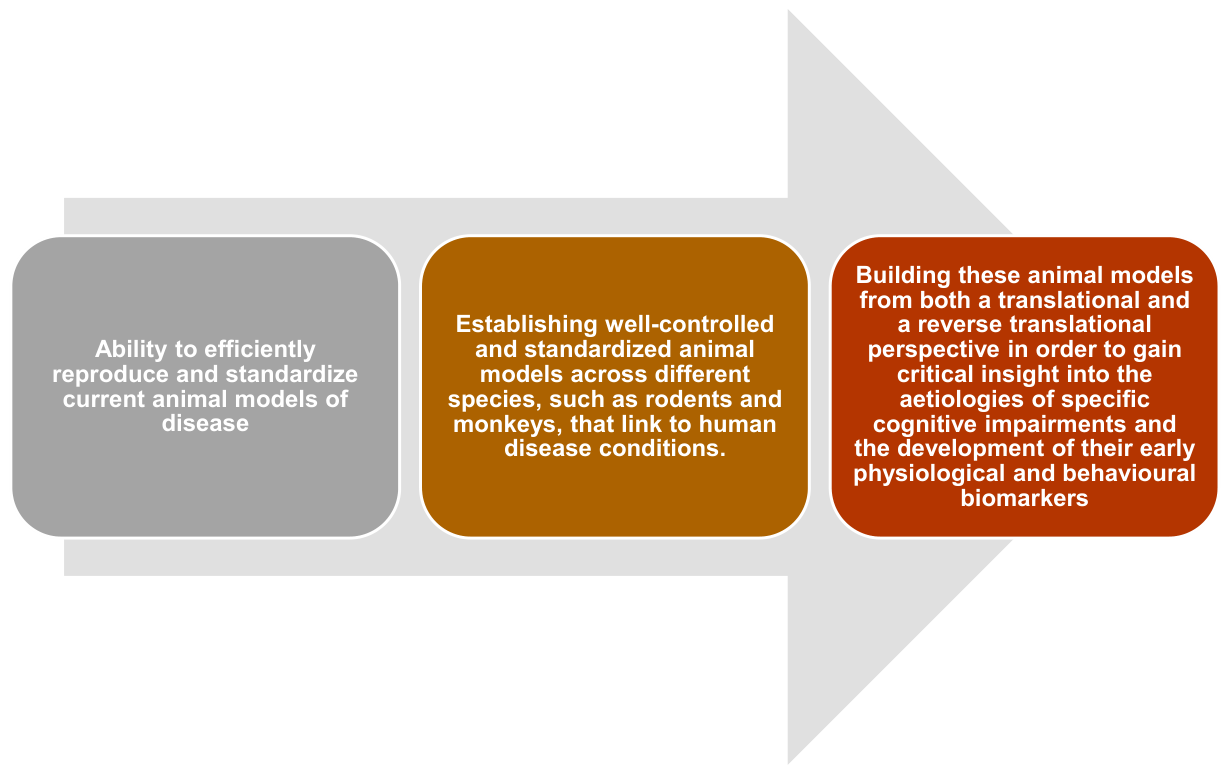
Figure 2.
The Reticulum Framework for intervention-specific developmental translation across experimental models and human neonates.
Figure 2.
The Reticulum Framework for intervention-specific developmental translation across experimental models and human neonates.
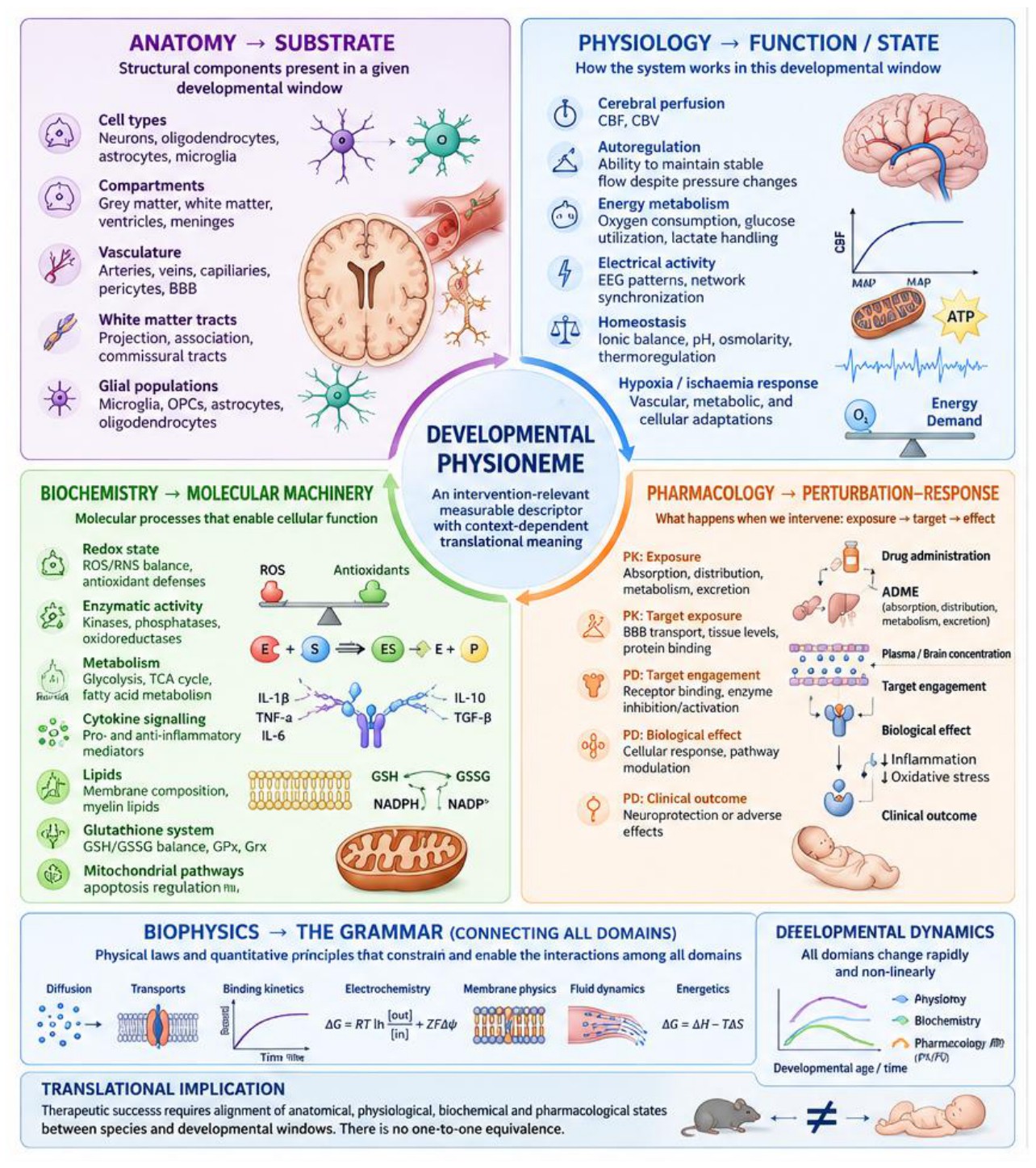
Figure 3.
Seven dimensions of translational assessment in the Reticulum Framework.
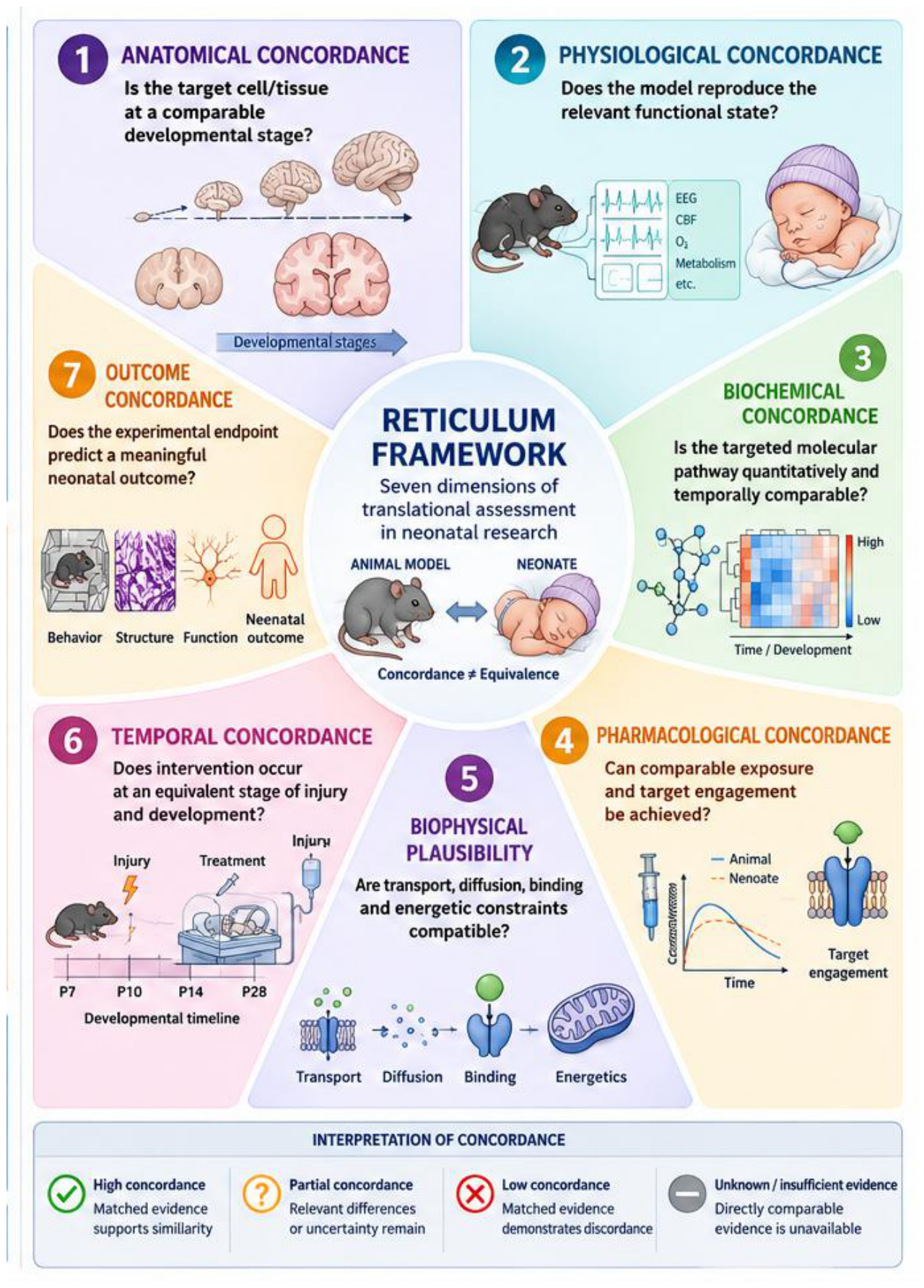

Table 1.
Candidate comparative immune physionemes in human and murine neonates: examples of cross-species concordance, discordance and incomplete comparability.
Table 1.
Candidate comparative immune physionemes in human and murine neonates: examples of cross-species concordance, discordance and incomplete comparability.
| Comparative physioneme | Human neonatal evidence/context | Murine neonatal evidence/context | Concordance | Translational limitation |
|---|---|---|---|---|
| CD39/CD73–adenosine signalling | Human cord-blood studies demonstrate developmental regulation of extracellular purine metabolism. Neonatal naïve B cells show reduced CD73 expression and enzymatic activity compared with adult B cells [78], whereas neonatal plasma displays enhanced adenosine-generating activity and reduced adenosine-catabolizing activity [79]. Functionally, the neonatal adenosine-rich environment can selectively suppress TLR-mediated TNF-α production while preserving IL-6 responses [80]. CD39 and CD73 expression is also cell-compartment specific in cord blood, with CD39 predominantly detected on monocytes and CD73 on T cells [81]30/09/2026 18:04:00 | In newborn mice (<1.5 weeks), plasma adenosine is markedly elevated relative to older animals. Enhanced AMP hydrolysis through CD73, together with reduced adenosine degradation/uptake, contributes to this phenotype and is associated with impaired neutrophil activation and weaker antimicrobial defence [82] | Partial functional concordance | Both species show a developmentally distinctive adenosinergic environment, but the underlying cellular distribution and enzymatic contributions are not directly equivalent. Human studies include cord-blood B cells, monocytes, T cells and plasma, whereas the murine study focuses predominantly on whole blood/plasma and neutrophil function. Differences in developmental age, compartment, stimulus and endpoint therefore prevent direct CD39/CD73 equivalence. |
| TLR-mediated cytokine response | In human newborns, Kollmann et al. [71]. compared cord-blood innate immune cells, including monocytes and conventional and plasmacytoid dendritic cells, with adult peripheral-blood cells after stimulation with defined TLR ligands. Neonatal cells showed a stimulus- and cytokine-specific response pattern, with reduced IL-12p70, IFN-α and IFN-γ responses, moderately reduced TNF-α, and preserved or increased IL-1β, IL-6, IL-23 and IL-10 production. | n neonatal mice, Zhao et al. .[72] examined systemic responses to LPS and other TLR agonists, including viral infection. Compared with adults, neonatal mice showed exaggerated inflammatory responses to LPS/TLR stimulation, associated with increased morbidity and mortality; T-cell manipulation demonstrated that limited T-cell control contributed to the heightened innate response | Context-dependent / incompletely comparable | Different stimuli, compartments, developmental ages and endpoints prevent interpreting this as a universal human–mouse directional discordance. |
| Type-I interferon response | Direct human neonatal evidence for the specific mechanism demonstrated in [73] is not established by that study. | Type-I IFNs protect neonatal mice from acute inflammation through IL-10-producing B cells [73]; conversely, in neonatal murine influenza, type-I IFN signalling contributes to oxidative stress and disease severity [75]; | Insufficient evidence for human–mouse concordance | The opposite functional effects observed in murine models demonstrate context/stimulus dependence within mice, not human–mouse discordance. A matched human neonatal study is required. |
| CD71+ erythroid-cell immunoregulation | In human newborns, Elahi et al. [77] identified abundant CD71+ erythroid cells in peripheral blood, with frequencies declining rapidly during the first 4 weeks of life. Human neonatal CD71+ erythroid cells suppressed cytokine production by CD14+ monocytes and T cells in vitro, with ROS production contributing to this immunoregulatory effect | n neonatal mice, CD71+TER119+ erythroid cells are abundant in neonatal lymphoid compartments and exert immunosuppressive activity [76,77].. Their depletion enhanced activation of immune cells and resistance to systemic Listeria monocytogenes infection, reducing bacterial burden and improving survival; conversely, their presence limited excessive inflammatory activation during early microbial colonization. | Partial functional concordance | Partial functional concordance is supported, but abundance, compartment, developmental persistence, experimental stimulus and downstream consequences are not directly equivalent between species. |
Table 2.
Worked application of the Reticulum Framework to postnatal magnesium sulphate for neonatal hypoxic–ischaemic encephalopathy.
Table 2.
Worked application of the Reticulum Framework to postnatal magnesium sulphate for neonatal hypoxic–ischaemic encephalopathy.
| RETICULUM domain / descriptor | Experimental evidence | Human neonatal evidence | Concordance | Main uncertainty | Consequence for the next experiment |
|---|---|---|---|---|---|
| Anatomy / developmental state — maturational state and target tissue | Newborn/term-equivalent piglet models reproduce several features relevant to term neonatal HI. After HI, MgSO₄ has been tested both alone and combined with hypothermia [106,171,172] | Postnatal MgSO₄ has been studied in term neonates with HIE, including as an adjunct to therapeutic hypothermia [173]. | Partial | “Term-equivalent” does not establish equivalence of regional/cellular maturation or injury distribution. | Prespecify matched developmental and regional/cellular descriptors, including white-matter/oligodendroglial endpoints where relevant. |
| Physiology — HI context, cerebral physiology and temperature | Lingam et al. induced HI in newborn piglets and initiated MgSO₄ + hypothermia 1 h later; hypothermia was maintained at 33.5°C for 12 h [171]. | Kumar et al. studied MgSO₄ as an adjunct to therapeutic hypothermia in term neonates with HIE [173] | Partial | Injury induction, severity, cerebral perfusion/autoregulation and cooling duration are not necessarily matched between model and infant. | Match injury severity and temperature exposure and incorporate cerebral perfusion/autoregulation measures where feasible. |
| Biochemistry— excitotoxicity, cellular injury and Mg-dependent mechanisms | Earlier newborn piglet work found no protection against cerebral damage after post-HI MgSO₄ [106]. In the MgSO₄ + hypothermia piglet study, serum Mg approximately doubled and CSF Mg rose modestly; cell death decreased and oligodendrocyte counts increased, but aEEG and MRS recovery did not improve [171]. Preclinical evidence overall has been inconsistent [106]30/09/2026 18:04:00 | Clinical trials establish exposure and clinical outcomes but do not directly demonstrate equivalence of CNS Mg-dependent, excitotoxic, inflammatory or redox target engagement in human HIE [173]. | Unknown / insufficiently comparable | Changes in experimental cellular injury do not establish the same CNS mechanism or target engagement in human neonates. | Couple exposure with prespecified pharmacodynamic CNS/systemic biomarkers and mechanistic endpoints rather than infer mechanism from outcome alone. |
| Pharmacology— dose, systemic exposure, CNS exposure and clearance | Piglets received a 180 mg/kg bolus followed by 8 mg/kg/h infusion for 48 h; serum Mg approximately doubled, whereas CSF Mg increased only ~16% [171]. | Term neonates received MgSO₄ 250 mg/kg IV once daily for 3 days, beginning within 6 h after birth [173]. | Low/partial | Nominal dose is not exposure equivalence; plasma exposure, CSF/brain exposure, clearance and target engagement differ conceptually and are incompletely matched. | Determine developmental PK and plasma-to-CNS exposure under clinically relevant hypothermic conditions before defining an equivalent regimen. |
| Biophysics — ionic gradients, transport and channel environment | The neuroprotective rationale for Mg includes effects on excitotoxic/ionic mechanisms, but systematic assessment of term-equivalent preclinical studies found inconsistent neuroprotection [106]. | Clinical efficacy cannot be inferred from preservation of the same nominal ionic/molecular target; direct CNS target-engagement evidence in cooled neonates remains limited [173]. | Unknown | Similar molecular targets do not demonstrate comparable local Mg concentration, ionic environment or functional effect across species. | Define a measurable biophysical/PD descriptor linked to Mg exposure and treatment response rather than assuming target equivalence. |
| Timing — treatment relative to insult | MgSO₄ + hypothermia was initiated 1 h after HI in the newborn piglet study [171] | MgSO₄ + hypothermia was initiated within 6 h after birth in term neonates with HIE [173]. Antenatal MgSO₄ for fetal neuroprotection represents a fundamentally different exposure context [22]. | Partial for postnatal HIE; discordant with antenatal neuroprotection | Experimental time-from-defined-HI and clinical time-from-birth are not equivalent measures of time from brain insult. Antenatal exposure precedes the clinical condition being prevented. | Anchor timing to biological injury evolution/secondary energy failure rather than chronological time alone. |
| Outcome — short-term biological vs long-term functional endpoints | Lingam et al. assessed aEEG, MRS and immunohistochemistry at 24–48 h; some histological effects occurred without corresponding improvement in aEEG/MRS [171]. Greenwood et al. reported no cerebral protection after post-HI MgSO₄ [172]. | Kumar et al. used mortality and/or major neurodevelopmental disability at 1 yearas the primary clinical outcome [173]. In the antenatal setting, Rouse et al. found no significant reduction in the primary composite of death or moderate/severe CP, although moderate/severe CP was reduced in a prespecified secondary analysis [22]. | Low / not directly comparable | Histology, MRS/aEEG and later neurodevelopment represent different levels of biological and clinical effect. | Build a translational outcome chain linking target engagement to physiological or imaging measures and subsequently to long-term neurodevelopmental outcomes [174]. |
Disclaimer/Publisher’s Note: The statements, opinions and data contained in all publications are solely those of the individual author(s) and contributor(s) and not of MDPI and/or the editor(s). MDPI and/or the editor(s) disclaim responsibility for any injury to people or property resulting from any ideas, methods, instructions or products referred to in the content. |
© 2026 by the authors. Licensee MDPI, Basel, Switzerland. This article is an open access article distributed under the terms and conditions of the Creative Commons Attribution (CC BY) license (http://creativecommons.org/licenses/by/4.0/).
Copyright: This open access article is published under a Creative Commons CC BY 4.0 license, which permit the free download, distribution, and reuse, provided that the author and preprint are cited in any reuse.