

Submitted:
30 September 2026
Posted:
30 September 2026
You are already at the latest version
Abstract
Problem-solving is widely recognised as a critical capability for addressing contemporary societal challenges, including those associated with the United Nations Sustainable Development Goals (SDGs). Despite this recognition, initiatives aimed at strengthening problem-solving capacity often yield limited or uneven results. This article argues that one reason for this persistent gap lies in how problem-solving development is conceptualised. Rather than being understood as a discrete individual skill or a set of transferable techniques, problem-solving capability is framed here as an emergent property of a complex adaptive ecosystem. Drawing on systems thinking and causal loop diagramming, the article presents an ecosystem model that explains how problem-solving skills and dispositions develop, stagnate, or decline over time. The model highlights the interaction of educational practices, professional environments, incentive structures, learning opportunities, and reflective processes, showing how these interactions give rise to reinforcing and balancing feedback loops. Particular attention is given to the tension between quick-fix approaches prioritizing speed and deep-fix approaches emphasizing long-term impact. The article addresses conditions under which problem-solving capacity can be strengthened across contexts, treating SDG 4 (Quality Education) as a key leverage point for sustainable development.
Keywords:
problem-solving
; complex adaptive systems
; ecosystem model
; causal loop diagramming
; sustainable development goals
; SDG 4
; systems thinking
; deep-fix dynamics
1. Introduction
Across policy, education, and professional discourse, problem-solving is routinely identified as a core capability for navigating contemporary challenges (Hunter, 2019; Kivunja, 2014; Neubert et al., 2015). It is invoked as essential for employability, innovation, leadership, sustainability, and social progress (Fernandes et al., 2023; Haron et al., 2019; Vasseur et al., 2017). In the context of the United Nations Sustainable Development Goals (SDGs), effective problem-solving is often treated as a prerequisite for meaningful action, underpinning efforts to address issues such as climate change, inequality, health, education, and economic development (Annan-Diab & Molinari, 2017; Stokols, 2018; Vasseur et al., 2017). Yet despite the prominence of problem-solving in strategic documents and curricula, there is growing concern that the capacity to address complex, real-world problems remains limited (Akinci-Ceylan et al., 2018; Hunter, 2019; Zeidan & Bishnoi, 2020).
One reason for this concern is that many of the problems societies face today differ from those relatively well-defined problem solving toward complex problem solving (Fischer & Neubert, 2015; Funke et al., 2018; Ney, 2022; Roos, 2024). While some problems are relatively well defined, bounded, and amenable to established procedures, others are characterised by ambiguity, uncertainty, and interdependence (Checkland & Poulter, 2020; Ney, 2022; Pearse, 2017). These latter problems are often described as complex, ill-structured, or wicked (Checkland & Poulter, 2020; Elia & Margherita, 2018; Grewatsch et al., 2023). They lack clear problem boundaries, involve multiple stakeholders with competing values, and evolve over time as interventions themselves alter the conditions of the system (Elia & Margherita, 2018; Grewatsch et al., 2023; Ney, 2022). Solutions that appear effective in the short term may generate unintended consequences or exacerbate underlying issues in the longer term (Sahin et al., 2020; Stroh, 2015; Whitmee et al., 2015).
The SDGs exemplify this type of challenge (Boeren, 2019; Vasseur et al., 2017). Although the goals themselves are clearly articulated, the problems they seek to address are deeply embedded in social, economic, political, and ecological systems (Vasseur et al., 2017; Whitmee et al., 2015). Progress toward one goal may support or undermine progress toward others, and interventions frequently operate across multiple scales, from local communities to global governance structures (Carlsen & Bruggemann, 2022; Whitmee et al., 2015). In such contexts, linear models of problem definition and solution implementation are often insufficient (Elia & Margherita, 2018, Stroh, 2015). Nevertheless, much of the discourse surrounding the SDGs continues to emphasise targets, indicators, and discrete interventions, with comparatively less attention to the capacities required to navigate the complexity of the problems themselves (Carlsen & Bruggemann, 2022; Wiek et al., 2015). SDG 4 is particularly relevant to the proposed ecosystem because it is related to quality education, which can function as a leverage point for strengthening the capabilities and dispositions needed to address complex sustainability challenges (Boeren, 2019). Education that develops systems thinking, critical reflection, collaboration, confidence, and complex problem-solving can influence individual capability, and the wider professional and organisational environments in which future decisions are made (Wiek et al., 2015; Hays & Reinders, 2020). From this perspective, progress on SDG 4 has enabling effects across other SDGs by preparing learners to engage and develop the critical thinking and problem-solving capabilities needed to engage effectively with interconnected, uncertain, and wicked problems (Boeren, 2019; Fischer & Neubert, 2015; Funke et al., 2018).
A striking feature of many sustainability initiatives is the persistence of familiar patterns: ambitious plans followed by partial implementation, short-term gains followed by stagnation or reversal, and repeated calls for renewed effort (Saxena et al., 2021; Stroh, 2015). These patterns raise questions about political will or resource allocation, also about the ways in which problems are understood and addressed (Stroh, 2015; Tainter & Taylor, 2014). In particular, they invite scrutiny of the problem-solving capabilities of individuals, organisations, and systems tasked with designing and implementing interventions (Tainter & Taylor, 2014).
At the same time, problem-solving has been a longstanding focus of research across multiple disciplines (Hayes, 2013; Stokols, 2018). Cognitive psychologists have explored the mental processes involved in solving puzzles and tasks; educational researchers have examined instructional approaches intended to foster transferable problem-solving skills; organisational scholars have investigated decision-making under uncertainty; and sustainability researchers have analysed adaptive management and systems approaches (Hayes, 2013; Elia & Margherita, 2018; Snyder & Snyder, 2008). Despite the literature, there is little consensus on why efforts to improve problem-solving so often fall short, particularly when problems are complex and embedded in dynamic systems (Grewatsch et al., 2023; Stroh, 2015).
One possible explanation lies in how problem-solving itself is conceptualised (Fischer & Neubert, 2015). Much of the literature treats problem-solving as an individual competence, typically framed as a set of skills, strategies, or heuristics that can be taught, practiced, and transferred across contexts (Fischer & Neubert, 2015; Funke et al., 2018). While this perspective has generated valuable insights, it tends to abstract problem-solving from the environments in which it is enacted (Fernandes et al., 2023; van Aken & Berends, 2018). Less attention is paid to the organisational cultures, incentive structures, time pressures, and learning conditions that shape whether and how problem-solving skills are applied in practice (Armstrong, 2010; Vanbelleghem et al., 2022).
In professional and policy settings, individuals rarely operate as autonomous problem-solvers (Holdo, 2023; Mohaghegh & Größler, 2022). Their actions are constrained and enabled by institutional norms, accountability mechanisms, resource availability, and expectations regarding speed, efficiency, and risk (Khan et al., 2018; Vanbelleghem et al., 2022). In many contexts, rapid responses and visible action are rewarded, while sustained inquiry, reflection, and experimentation are discouraged (Armstrong, 2010; Khan et al., 2018). These conditions can foster a preference for quick fixes that address immediate symptoms rather than deeper causes, even when such approaches undermine long-term effectiveness (Stroh, 2015; Vanbelleghem et al., 2022). From this perspective, limitations in problem-solving capacity cannot be fully understood by examining individuals alone (Robinson et al., 2015;Stokols, 2018). Instead, they emerge from the interaction of multiple factors operating across levels of a system (Hodgson & Spours, 2016; Stokols, 2018). Educational experiences shape how problems are framed and approached; professional environments influence which behaviours are rewarded; leadership practices signal what counts as success; and broader societal narratives define what is considered realistic or desirable (Armstrong, 2010; Boeren, 2019; Shekari et al., 2021; Stokols, 2018). Over time, these influences combine to produce patterns of problem-solving behaviour that are remarkably stable, even in the face of evidence that they are ineffective (Clark, 2008; Snoek et al., 2023).
This article argues that the development of problem-solving skills and dispositions is best understood as an emergent property of a complex adaptive ecosystem (Hodgson & Spours, 2016; Peltoniemi & Vuori, 2005). Rather than asking only how individuals learn to solve problems, it asks how systems support or constrain the development and enactment of problem-solving capability (Hodgson & Spours, 2016; Khan et al., 2018). This shift in perspective foregrounds relationships, feedback loops, and unintended consequences, and provides a way of explaining why well-intentioned efforts to strengthen problem-solving often have limited impact (Ney, 2022; Stroh, 2015; Robinson et al., 2015).
The ecosystem perspective is particularly relevant for sustainability and the SDGs, where interventions are typically embedded in complex systems and where success depends on the capacity to learn, adapt, and respond to changing conditions (Annan-Diab & Molinari, 2017; Hodgson & Spours, 2016). By focusing on the development of problem-solving capability itself, rather than on specific solutions to predefined problems, the article seeks to contribute to a more foundational understanding of what is required to address wicked problems in a sustainable manner (Grewatsch et al., 2023; Hays, 2013).
The remainder of the article develops this argument in several stages. It first clarifies the purpose and rationale for adopting an ecosystem perspective on problem-solving development. It then introduces key concepts from systems thinking and complex adaptive systems, before outlining the use of causal loop diagramming as a methodological tool (Barbrook-Johnson & Penn, 2022; Peltoniemi & Vuori, 2005). Building on this foundation, the article presents an ecosystem model of problem-solving skills and dispositions, highlighting reinforcing and balancing dynamics that shape behaviour over time. Finally, it discusses the implications of this model for sustainability and the SDGs, with particular attention to SDG 4 based on the role of education as a leverage point for systemic change.
1.1. Purpose and Rationale
Problem-solving occupies a curious position in contemporary discourse. It is repeatedly identified as essential, yet persistent doubts remain about whether existing approaches to developing problem-solving capability are adequate for the kinds of challenges societies now face (Grewatsch et al., 2023; Hays, 2013). Graduates are frequently described as underprepared for complex professional problems, organisations struggle to learn from experience, and policy initiatives often repeat patterns of short-termism and reactive decision-making (Brook et al., 2016; Hunter, 2019; Stroh, 2015). These concerns are especially pronounced in domains associated with sustainability and the SDGs, where problems are systemic, interconnected, and resistant to straightforward solutions (Grewatsch et al., 2023; Henderson & Loreau, 2023).
The persistence of these concerns suggests that the issue may not lie solely in the quantity of attention given to problem-solving, but in how it is conceptualised and supported (Fischer & Neubert, 2015; Zeidan & Bishnoi, 2020). Much of the existing literature approaches problem-solving from an individual or instructional perspective, focusing on cognitive processes, strategies, or pedagogical techniques (Davidson et al., 1994; Neubert et al., 2015; Snyder & Snyder, 2008). While such work has yielded important insights, it has been less successful in explaining why problem-solving skills do not reliably transfer across contexts, or why individuals who demonstrate strong problem-solving ability in educational settings often struggle to apply these skills effectively in professional or policy environments (Akinci-Ceylan et al., 2018; Fischer & Neubert, 2015;Hodgson & Spours, 2016; Radermacher et al., 2014).
One limitation of many problem-solving frameworks is their relative neglect of context (Fischer & Neubert, 2015; van Aken & Berends, 2018). Problem-solving is typically treated as a portable competence, something individuals can acquire and deploy as needed (Fischer & Neubert, 2015). In practice, however, problem-solving is deeply situated (Bleakley & Cleland, 2022; van Aken & Berends, 2018). It is shaped by factors like organisational cultures, incentive structures, time pressures, accountability mechanisms, and expectations about acceptable forms of action (Boeren 2019); Vanbelleghem et al., 2022; Vasseur et al., 2017). These factors influence not only which problems are addressed, but how they are framed, who is involved, and which solutions are considered viable (Grewatsch et al., 2023; van Aken & Berends, 2018).
The disconnection between individual capability and systemic conditions is particularly evident in sustainability initiatives (Grewatsch et al., 2023). Professionals working on SDG-related projects often operate under intense pressure to demonstrate progress, meet targets, and secure funding (Hays & Reinders, 2021). In such contexts, rapid, visible interventions are frequently prioritised over slower, more exploratory approaches that might yield deeper understanding (Stroh, 2015; Vanbelleghem et al., 2022). Even when individuals possess the skills and inclination to engage in reflective, systems-oriented problem-solving, the surrounding environment may actively discourage such behaviour (Hays & Reinders, 2020; Vanbelleghem et al., 2022).
The purpose of this article is to address this gap by shifting the unit of analysis from the individual problem-solver to the ecosystem in which problem-solving develops and is enacted. Rather than asking how problem-solving skills can be taught more effectively, the article asks how systems can be designed to support the sustained development and application of those skills (Hodgson & Spours, 2016). This question is motivated by the observation that problem-solving outcomes are often better explained by systemic dynamics than by individual competence alone (Grewatsch et al., 2023;Hodgson & Spours, 2016; Stokols, 2018).
To this end, the article conceptualises problem-solving skills and dispositions as components of a complex adaptive ecosystem (Hodgson & Spours, 2016; Peltoniemi & Vuori, 2005). This ecosystem encompasses educational practices, professional development, workplace norms, leadership behaviours, reward systems, and broader cultural narratives about efficiency, success, and expertise (Armstrong, 2010; Hodgson & Spours, 2016). Within such an ecosystem, patterns of problem-solving behaviour emerge through feedback loops that reinforce certain approaches while marginalising others (Peltoniemi & Vuori, 2005; Stroh, 2015).
The rationale for adopting an ecosystem perspective is threefold. First, it provides a coherent framework for integrating insights from diverse literatures, including education, organisational learning, systems thinking, and sustainability studies (Hodgson & Spours, 2016; Stokols, 2018). Second, it offers explanatory power by accounting for the persistence of suboptimal problem-solving practices, even in contexts where there is strong motivation to improve (Stroh, 2015). Third, it identifies leverage points for intervention that are not visible when problem-solving is viewed solely as an individual skill (Grewatsch et al., 2023; Stroh, 2015).
Causal loop diagrams (CLDs) are used in this article as a means of operationalising the ecosystem perspective (Barbrook-Johnson & Penn, 2022). CLDs enable the visualisation of relationships among key variables and make explicit the reinforcing and balancing dynamics that shape system behaviour over time. By modelling these dynamics, the article seeks to move beyond descriptive accounts of problem-solving challenges toward a more systematic explanation of why certain patterns endure and how they might be altered (Blair et al., 2021; Vermaak, 2016).
The contribution of this article is therefore primarily conceptual. It does not propose a new taxonomy of problem-solving skills, nor does it offer a specific instructional programme or policy prescription. Instead, it provides a model that can be used diagnostically and generatively by researchers, educators, policymakers, and practitioners (Hodgson & Spours, 2016; Stokols, 2018). By making the ecosystem of problem-solving development visible, the model supports more informed reflection on existing practices and more strategic design of interventions aimed at building sustainable problem-solving capacity (Grewatsch et al., 2023; Stroh, 2015).
In the context of the SDGs, this contribution is particularly timely (Annan-Diab & Molinari, 2017). Many sustainability challenges require long-term commitment, cross-sector collaboration, and adaptive learning (Annan-Diab & Molinari, 2017; Hays & Reinders, 2021; van de Wetering et al., 2017). Addressing such challenges effectively depends not only on technical expertise, but on the capacity to engage with complexity, uncertainty, and competing values (Brundiers & Wiek, 2017; Hays & Reinders, 2020). By foregrounding the systemic conditions that enable or constrain problem-solving, this article aims to contribute to more realistic and effective approaches to sustainable development (Boeren, 2019; Hays & Reinders, 2021; Stroh, 2015).
2. Theoretical and Conceptual Foundations
Understanding problem-solving as an emergent capability requires a conceptual framework that can account for interaction, adaptation, and change over time (Peltoniemi & Vuori, 2005). Traditional linear models, which assume stable relationships between inputs and outputs, are poorly suited to explaining phenomena that unfold within dynamic social and organisational contexts ((Thomassen & Stentoft, 2020; Grewatsch et al., 2023). For this reason, the present article draws on concepts from complex adaptive systems and ecosystem thinking to frame the development of problem-solving skills and dispositions (Peltoniemi & Vuori, 2005; Hodgson & Spours, 2016).
2.1. Complex Adaptive Systems
A complex adaptive system consists of multiple interacting elements whose collective behaviour cannot be fully explained by analysing individual components in isolation (Peltoniemi & Vuori, 2005). Such systems are characterised by nonlinearity, feedback loops, emergence, and sensitivity to initial conditions (Peltoniemi & Vuori, 2005; Stroh, 2015). Small changes in one part of the system may produce disproportionately large effects elsewhere, while substantial interventions may yield little observable impact (Grewatsch et al., 2023; Stroh, 2015). Outcomes are often unpredictable, not because they are random, but because they emerge from interactions that are difficult to trace in advance (Peltoniemi & Vuori, 2005; Ney, 2022). In particular, in Education, traditional content-based approaches are insufficient for developing the critical thinking and problem-solving capabilities required to navigate contemporary challenges (Kivunja, 2014).
Social, educational, and organisational systems exhibit many of these characteristics (Hodgson & Spours, 2016; Stokols, 2018). Individuals within such systems adapt their behaviour in response to local conditions, incentives, and experiences (Peltoniemi & Vuori, 2005; Vanbelleghem et al., 2022). Over time, these adaptations interact to produce stable patterns of behaviour that may persist even when they are recognised as ineffective or undesirable (Peltoniemi & Vuori, 2005; Stroh, 2015). From this perspective, recurring difficulties in problem-solving are not necessarily the result of individual deficits, but of system-level dynamics that shape what kinds of behaviour are possible or rewarded (Stokols, 2018; Vanbelleghem et al., 2022). Reward and recognition are part of the environmental feedback structure of the system (Armstrong, 2010; Lepper & Greene, 2015). They signal which behaviours are valued and can reinforce either quick-fix or deep-fix problem-solving patterns over time. Reward and recognition are features of the environment, like organisational conditions, incentives, or reinforcing mechanisms, because they can strengthen or weaken particular problem-solving behaviours.
In the context of problem-solving, complex adaptive systems theory draws attention to the fact that solutions alter the systems in which problems are embedded (Peltoniemi & Vuori, 2005; Stroh, 2015). Interventions designed to address one issue may create new challenges, shift responsibilities, or redistribute resources in ways that change the nature of subsequent problems (Ney, 2022; Stroh, 2015). As a result, problem-solving is an ongoing process rather than a discrete event, and its effectiveness depends on the capacity of individuals and organisations to learn and adapt over time (Grewatsch et al., 2023, Peltoniemi & Vuori, 2005).
2.2. Problem-Solving Skills and Dispositions
Skills, competencies, and dispositions relevant to problem-solving have also been examined specifically within sustainability and SDG contexts (Annan-Diab & Molinari, 2017). The literature highlights capabilities such as systems thinking, interdisciplinary collaboration, critical reflection, strategic competence, and the ability to engage with complex and interconnected sustainability challenges (González-Salamanca et al., 2020; Mitchell & Walinga, 2017; Wiek et al., 2015). Particular emphasis is placed on critical reflection (Ash & Clayton, 2009; Holdo, 2023). Critical reflection enables problem-solvers to examine assumptions, interpret outcomes, reconsider decisions, and adapt future action, thereby supporting the continuing development of problem-solving capability. Table 1 presents an indicative portfolio of skills relevant to complex problem-solving.
Additional problem-solving dispositions that appear particularly relevant include motivation, understood as the drive to understand phenomena more thoroughly, and curiosity, reflected in the inclination to ask questions, and seek deeper understanding (Fitsilis et al., 2018; Haron et al., 2019; Rahman, 2019). Motivation to engage in complex problem-solving is an intrinsic characteristic of individuals; also it is shaped by social, organisational, and reward conditions (Lepper & Greene, 2015; Grant & Shandell, 2022). It is influenced by contextual signals about what is valued, expected, and rewarded. In professional environments, these signals are conveyed through formal reward systems, informal norms, and interactions with others (Grant & Shandell, 2022). When environments emphasise immediate performance, visible outcomes, or external rewards, motivation may become oriented toward behaviours that satisfy those expectations rather than toward sustained inquiry (Lepper & Greene, 2015). By contrast, learning environments that support participation and engagement with complex problems can strengthen both motivation and problem-solving capability (Tsai et al., 2023).
Confidence and self-assurance can be understood as dispositions that influence an individual’s willingness to engage with challenging problems and assume responsibility for difficult decisions (Hays & Reinders, 2020; Nezu et al., 2012). Individuals who possess greater confidence are more likely to seek out complex problem-solving opportunities, whereas limited confidence may reduce willingness to engage with unfamiliar or high-risk tasks. Confidence is also closely connected to self-efficacy, which can strengthen problem-solving ability by supporting self-directed learning, persistence, and self-regulation (Hwang & Oh, 2021). As individuals successfully engage with challenging problems, positive experiences may further reinforce confidence and motivation, increasing their willingness to pursue additional opportunities for complex problem-solving. In professional contexts, confidence can also influence whether individuals are entrusted with leadership roles and challenging responsibilities, including participation in or leadership of problem-solving teams (Goleman, 2018; van Aken & Berends, 2018).
Ash and Clayton (2009) present critical reflection as a structured process for turning experience into learning. Holdo (2023) treats it more as an enduring orientation toward questioning assumptions and re-examining experience. Kmieciak (2021) also supports its role as a recurring reflective tendency linked to unlearning and innovative behaviour. Critical reflection is another disposition that brings the capability to question assumptions, examine experience critically, and revise understanding and future action in light of new evidence. A particularly important combination of dispositions involves critical reflection and a learning orientation, through which individuals continually examine experience, assumptions, and outcomes in order to improve future action (Hays & Reinders, 2018). Observation is also an important disposition and skill, and thoughtfulness is similarly relevant to complex problem-solving (Funke et al., 2018; Hays, 2013; Rahman, 2019; Snyder & Snyder, 2008). Open-mindedness is another important disposition, as complex problems require willingness to consider alternative perspectives (Puccio & Cabra, 2008; Snyder & Snyder, 2008) , and self-discipline is also relevant because sustained engagement with difficult problems requires persistence and continued effort (Fitsilis et al., 2018; Haron et al., 2019). The dispositions outlined include work on workforce competencies, critical thinking, complex problem-solving, and learning orientation (Fitsilis et al., 2018; Haron et al., 2019; Rahman, 2019).
2.3. Ecosystem Thinking
Ecosystem thinking builds on systems theory by emphasising interdependence, co-evolution, and sustainability (Hodgson & Spours, 2016; Peltoniemi & Vuori, 2005). An ecosystem comprises a network of actors, practices, resources, and structures that interact within a shared environment (Hodgson & Spours, 2016). Development within an ecosystem is shaped by relationships rather than by isolated actions, and changes in one area often have cascading effects across the system (Grewatsch et al., 2023; Peltoniemi & Vuori, 2005).
Applied to learning and professional development, ecosystem thinking highlights that skills and dispositions develop through participation in multiple overlapping contexts (Chaaban et al., 2023; Hodgson & Spours, 2016). Formal education, workplace practices, professional networks, leadership norms, and cultural narratives all contribute to shaping how individuals approach problems. These influences are not additive but interactive, producing patterns of behaviour that are often resistant to change (Chaaban et al., 2023; Snoek et al., 2023).
An ecosystem perspective also foregrounds issues of alignment and misalignment (Hodgson & Spours, 2016). Educational institutions need to promote reflective inquiry and critical thinking, while professional environments reward speed, compliance, and risk avoidance (Kivunja, 2014; Snyder & Snyder, 2008; Vanbelleghem et al., 2022). Such misalignments can undermine the transfer and sustained application of problem-solving skills, even when individuals are motivated to use them (Fischer & Neubert, 2015; Radermacher et al., 2014). Conversely, alignment across contexts can amplify learning and support the development of more sophisticated approaches to problem-solving (Chaaban et al., 2023; Hodgson & Spours, 2016). Chaaban et al. (2023) demonstrated that the effectiveness of university teachers in fostering sustainable change through learning is contingent upon the interplay of four interconnected systems: the individual educator, the professional development programme, the departmental unit, and the overarching institutional framework. Their findings indicate that sustained change is most achievable when these systems operate in a mutually reinforcing manner.
2.4. Problem-Solving Development as an Ecosystem
When problem-solving development is viewed as an ecosystem, attention shifts from isolated interventions to the conditions that shape behaviour over time (Hodgson & Spours, 2016; Stroh, 2015). This includes how problems are framed, which forms of expertise are valued, how success is measured, and how failure is interpreted (Armstrong, 2010; van Aken & Berends, 2018). It also includes the availability of opportunities to engage with meaningful problems, the extent to which reflection is supported, and the degree to which learning from experience is encouraged or suppressed (Ash & Clayton, 2009; Chaaban et al., 2023; Vanbelleghem et al., 2022).
Within such an ecosystem, feedback loops play a central role (Barbrook-Johnson & Penn, 2022; Stroh, 2015). For example, environments that reward rapid solutions may reinforce surface-level problem-solving, even when deeper understanding is required (Stroh, 2015; Vanbelleghem et al., 2022). Over time, these patterns become normalised, making alternative approaches less likely (Snoek et al., 2023; Stroh, 2015). Conversely, ecosystems that support inquiry, experimentation, and reflection can reinforce behaviours associated with deep problem-solving, gradually building capacity and confidence (Chaaban et al., 2023).
Importantly, ecosystem thinking does not imply that individuals lack agency (Hodgson & Spours, 2016; Stokols, 2018). Rather, it recognises that agency is exercised within constraints and affordances shaped by the system. Understanding these constraints is essential for designing interventions that do more than temporarily alter behaviour (Stroh, 2015). Without attention to systemic dynamics, efforts to improve problem-solving risk being absorbed by the very structures they seek to change (Grewatsch et al., 2023; Stroh, 2015).
2.5. Implications for Sustainability and the SDGs
The relevance of complex adaptive systems and ecosystem thinking is particularly evident in sustainability contexts (Grewatsch et al., 2023; Vasseur et al., 2017). The challenges addressed by the SDGs involve multiple stakeholders, competing priorities, and long time horizons (Annan-Diab & Molinari, 2017; Vasseur et al., 2017). They are embedded in systems that span social, economic, political, and ecological domains, and they evolve as interventions are implemented (Grewatsch et al., 2023; Whitmee et al., 2015). In such contexts, problem-solving capacity cannot be reduced to technical expertise or procedural competence (Brundiers & Wiek, 2017). It depends on the ability to navigate complexity, to recognise interdependencies, and to learn from unintended consequences (Grewatsch et al., 2023; Stroh, 2015). An ecosystem perspective provides a way of understanding how these capabilities are cultivated or undermined, and why progress toward sustainability goals is often uneven despite considerable effort (Hodgson & Spours, 2016; Stroh, 2015).
By grounding the analysis of problem-solving development in concepts from complex adaptive systems and ecosystem thinking, this article establishes a foundation for the modelling work that follows (Hodgson & Spours, 2016; Peltoniemi & Vuori, 2005). The next section introduces causal loop diagramming as a methodological tool for making these systemic dynamics explicit and for exploring how problem-solving ecosystems function over time (Barbrook-Johnson & Penn, 2022).
3. Materials and Methods: Causal Loop Diagramming
To explore problem-solving development as a complex adaptive ecosystem, this article adopts CLD as its primary methodological approach (Barbrook-Johnson & Penn, 2022). CLD originates in systems thinking and system dynamics and has been widely used to analyse complex social, organisational, and environmental phenomena (Barbrook-Johnson & Penn, 2022; Blair et al., 2021). Its value lies in its ability to make explicit the relationships and feedback processes that shape system behaviour over time (Barbrook-Johnson & Penn, 2022; Blair et al., 2021; Stroh, 2015; Vermaak, 2016).
CLDs represent systems as sets of variables connected by causal links (Barbrook-Johnson & Penn, 2022). These links indicate the direction of influence between variables and whether an increase in one variable leads to an increase or decrease in another. Feedback loops emerge when chains of causal relationships circle back to influence earlier variables. Reinforcing loops amplify change, while balancing loops counteract it. Together, these loops help explain why systems behave as they do and why certain patterns persist despite efforts to intervene (Barbrook-Johnson & Penn, 2022; Stroh, 2015). Organisations often respond to recurring problems with quick fixes that provide instant relief (Stroh, 2015). The short-term success reinforces the behaviour, but because root causes are ignored, the problems keep coming back (Stroh, 2015).
In contrast to linear models, which imply stable and predictable relationships between causes and effects, CLDs foreground dynamics, delays, and unintended consequences (Barbrook-Johnson & Penn, 2022; Stroh, 2015). They do not seek to predict precise outcomes, but to support understanding of system structure and behaviour (Barbrook-Johnson & Penn, 2022). This makes them particularly well suited to the analysis of wicked problems, where outcomes are uncertain and interventions often produce effects that differ from those intended (Grewatsch et al., 2023; Stroh, 2015).
3.1. CLD as a Sense-Making Tool
In this article, CLD is used as a conceptual and analytical tool rather than as a formal modelling technique aimed at simulation or optimisation (Barbrook-Johnson & Penn, 2022). The diagrams presented are not intended to capture all possible variables or relationships influencing problem-solving development. Instead, they focus on key factors identified through prior research, theory, and professional experience, and on the interactions among those factors that are most consequential for system behaviour. By visualising these interactions, CLDs support several forms of sense-making. First, they make assumptions about causality explicit, enabling critical scrutiny and dialogue. Second, they help identify reinforcing dynamics that may lock systems into suboptimal patterns, such as persistent reliance on quick fixes (Stroh, 2015; Vanbelleghem et al., 2022). Third, they reveal potential leverage points where relatively small changes may produce meaningful shifts in behaviour over time (Stroh, 2015; Vermaak, 2016).
Importantly, CLDs encourage a shift in perspective from events to patterns and structures (Stroh, 2015). Rather than asking why a particular problem-solving effort failed, they invite reflection on the conditions that make such failures likely (Barbrook-Johnson & Penn, 2022; Blair et al., 2021; Stroh, 2015; Vermaak, 2016). This shift is central to the ecosystem perspective advanced in this article.
3.2. Building the Problem-Solving Ecosystem Model
The ecosystem model of problem-solving development presented later in the article is built progressively through a series of CLDs (Barbrook-Johnson & Penn, 2022). Each diagram introduces a subset of variables and relationships, allowing readers to engage with the model incrementally. The final integrated diagram brings these elements together to illustrate how problem-solving skills and dispositions develop, stagnate, or decline within a system.
Variables included in the model encompass individual factors, such as motivation and confidence, as well as systemic factors, such as professional development opportunities, reward structures, time pressure, and organisational norms (Chaaban et al., 2023; Vanbelleghem et al., 2022). Particular attention is given to the role of learning from experience and critical reflection, which function as key mechanisms linking experience to capability development (Chaaban et al., 2023; Snoek et al., 2023).
The selection and organisation of variables reflect an ecosystem logic (Hodgson & Spours, 2016). Rather than privileging any single factor, the modelling approach emphasises interaction and co-dependence (Hodgson & Spours, 2016; Peltoniemi & Vuori, 2005). This approach aligns with the article’s central argument that problem-solving capability cannot be meaningfully understood or improved without attention to the systems in which it is embedded (Stokols, 2018; Grewatsch et al., 2023).
3.3. Limitations and Usefulness of CLD
As with any modelling approach, CLD has limitations (Barbrook-Johnson & Penn, 2022). Causal relationships in social systems are often complex, context-dependent, and contested (Barbrook-Johnson & Penn, 2022; Grewatsch et al., 2023). Diagrams necessarily simplify reality and reflect the perspectives and assumptions of those who construct them (Barbrook-Johnson & Penn, 2022; Blair et al., 2021; Vermaak, 2016). For this reason, the models presented here should be understood as provisional and open to refinement.
Their value lies not in their completeness, but in their capacity to support thinking and dialogue (Barbrook-Johnson & Penn, 2022). Used critically, CLDs can help researchers, educators, and practitioners surface hidden dynamics, question taken-for-granted assumptions, and explore alternative ways of organising problem-solving activity (Stroh, 2015; Vermaak, 2016). In the context of sustainability and the SDGs, where learning and adaptation are essential, such tools can support more reflective and strategic approaches to intervention (Grewatsch et al., 2023; Vasseur et al., 2017).
The next section introduces the first set of CLDs and begins the analysis of the problem-solving development ecosystem. These diagrams focus initially on the tensions between quick-fix and deep-fix approaches to problem-solving and on the feedback processes that sustain them.
4. Results: The Problem-Solving Ecosystem Core Dynamics
At the heart of the problem-solving development ecosystem lies a fundamental tension between two contrasting orientations toward action: the pursuit of quick fixes and the pursuit of deep fixes (Grewatsch et al., 2023; Stroh, 2015). This tension is not merely a matter of individual preference or competence, but a structural feature of many professional, organisational, and policy environments. Understanding how this tension is produced and sustained is essential for explaining persistent patterns of problem-solving behaviour.
4.1. Quick-Fix Dynamics
Quick fixes refer to responses that aim to resolve problems rapidly and visibly, often by addressing immediate symptoms rather than underlying causes (Stroh, 2015; Vanbelleghem et al., 2022). Such approaches are attractive in contexts characterised by time pressure, resource constraints, and strong demands for accountability (Vanbelleghem et al., 2022). They allow individuals and organisations to demonstrate responsiveness, maintain momentum, and signal competence to stakeholders (Armstrong, 2010).
Within the ecosystem, quick fixes are reinforced through multiple feedback mechanisms (Robinson, et al., 2015; Sproull, 2018). When a rapid intervention appears to alleviate a problem, even temporarily, it can generate positive recognition, relief, or reputational benefit (Armstrong, 2010; Stroh, 2015). This feedback increases the likelihood that similar approaches will be used again in future situations (Stroh, 2015). Over time, a reinforcing loop develops in which speed and decisiveness are valued more highly than depth of analysis or long-term impact (Stroh, 2015; Vanbelleghem et al., 2022).
Importantly, the effectiveness of quick fixes is often judged on the basis of short-term outcomes (Stroh, 2015). Delayed consequences, secondary effects, and long-term costs may remain invisible or be attributed to external factors (Ney, 2022; Stroh, 2015). As a result, the limitations of quick fixes can persist unchallenged, allowing them to become normalised features of organisational practice (Stroh, 2015; Vanbelleghem et al., 2022).
4.2. Deep-Fix Dynamics
Deep fixes represent an alternative orientation toward problem-solving (Ash & Clayton, 2009). They involve sustained efforts to understand problems in context, identify underlying structures and causes, and explore the interdependencies that shape system behaviour (Grewatsch et al., 2023). Deep fixes typically require time, cognitive effort, collaboration across boundaries, and tolerance for uncertainty and ambiguity.
Unlike quick fixes, the benefits of deep fixes are often delayed and less immediately visible (Stroh, 2015). Improvements may emerge gradually, and success may be difficult to attribute to any single action or individual. The deep-fix approaches are harder to justify in environments where performance is assessed through short-term metrics or where visible action is prioritised (Grewatsch et al., 2023; Armstrong, 2010).
Deep fixes offer the potential for more durable and sustainable solutions (Chaaban et al., 2023). By addressing root causes and anticipating unintended consequences, they can reduce the likelihood of problem recurrence and support learning at the system level (Grewatsch et al., 2023). However, for deep-fix approaches to take hold, the ecosystem must provide conditions that support inquiry, reflection, and learning (Ash & Clayton, 2009; Chaaban et al., 2023).
4.3. Reinforcing and Balancing Processes
The coexistence of quick-fix and deep-fix orientations gives rise to a set of reinforcing and balancing processes within the problem-solving ecosystem (Barbrook-Johnson & Penn, 2022; Stroh, 2015). Reinforcing processes amplify existing tendencies (Barbrook-Johnson & Penn, 2022). For example, repeated reliance on quick fixes strengthens habits, expectations, and reward structures that further privilege speed and visibility (Armstrong, 2010; Vanbelleghem et al., 2022). Similarly, successful experiences with deep fixes can reinforce confidence in reflective and systems-oriented approaches (Ash & Clayton, 2009; Vohs & Baumeister, 2008).
Balancing processes counteract these tendencies (Barbrook-Johnson & Penn, 2022). Recognition of the limitations of quick fixes, particularly when long-term consequences become apparent, can weaken their appeal (Stroh, 2015). Conversely, frustration with slow progress or perceived inefficiency can undermine commitment to deep-fix approaches (Vanbelleghem et al., 2022). The relative strength of these processes determines which orientation dominates over time (Barbrook-Johnson & Penn, 2022; Stroh, 2015).
Crucially, these dynamics operate at multiple levels (Stokols, 2018; Hodgson & Spours, 2016; Chaaban et al., 2023). Individual beliefs and dispositions interact with organisational norms, professional cultures, and broader societal narratives about efficiency and success (Chaaban et al., 2023, Hodgson & Spours, 2016). Changes at one level can influence behaviour at others, sometimes in unexpected ways, supporting cross-level interaction, emergence, and unexpected effects (Peltoniemi & Vuori, 2005; Stokols, 2018).
4.4. Professional Development, Education, and Training for Advanced Problem-Solving
The extensive, though not exhaustive, list of Professional Development, Education, and Training (PDET) focus areas presented in Table 2 illustrates the wide range of approaches that can contribute to capability-building for complex and sophisticated problem-solving. The PDET topics presented in Table 2 synthesise these and related approaches into a broader capability-building framework for advanced problem-solving.
4.5. Learning, Experience, and Feedback
Learning from experience (LFE) is a central mechanism linking problem-solving activity to capability development (Ash & Clayton, 2009; Cell, 1984; Tsai et al., 2023). However, experience alone does not guarantee learning (Ash & Clayton, 2009). The quality of feedback available to individuals and organisations shapes how experiences are interpreted and whether they lead to adaptation (Chaaban et al., 2023; Vanbelleghem et al., 2022).
In ecosystems dominated by quick-fix dynamics, feedback is often limited to immediate outcomes (Stroh, 2015). Success is defined narrowly, and failures may be concealed or rationalised (Armstrong, 2010; Stroh, 2015). Such conditions inhibit learning and make it difficult to recognise systemic patterns (Stroh, 2015; Vanbelleghem et al., 2022). In contrast, ecosystems that support reflection, dialogue, and critical examination of outcomes are more likely to generate meaningful learning from experience (Ash & Clayton, 2009; Chaaban et al., 2023).
According to Ash and Clayton (2009) and Cell (1984), it becomes developmental only when individuals follow a process where critically examine what happened, test their assumptions, and let feedback guide their next steps. Yet this process is only as robust as the feedback that informs it; inaccurate or partial feedback can perpetuate misunderstandings and entrench flawed reasoning (Soyer & Hogarth, 2020). For wicked problems, only through iterative reflection and adjustment can experience translate into real capability (Tsai et al., 2023).
4.6. Implications for Capability Development
The core dynamics outlined here have direct implications for the development of problem-solving skills and dispositions (Funke et al., 2018). When quick-fix approaches dominate, individuals may have limited opportunity to practice complex problem-solving, engage in reflection, or learn from failure (Ash & Clayton, 2009; Vanbelleghem et al., 2022). Over time, the lack of practice can erode confidence, reduce motivation, and reinforce superficial approaches to problem-solving (Hwang & Oh, 2021; Vanbelleghem et al., 2022).
By contrast, ecosystems that support deep-fix dynamics create conditions for capability development (Chaaban et al., 2023; Hodgson & Spours, 2016). Opportunities to engage with meaningful problems, coupled with feedback and reflection, enable individuals to refine their skills and build dispositions such as perseverance, curiosity, and tolerance for ambiguity (Ash & Clayton, 2009; Funke et al., 2018). These opportunities are not accidental; they are the product of deliberate design and alignment across the system (Chaaban et al., 2023; Hodgson & Spours, 2016).
The next section introduces the CLDs, which formalise these core dynamics and illustrates how quick-fix and deep-fix orientations interact within the problem-solving ecosystem.
4.7. Quick-Fix Problem-Solving Dynamics
As shown in Figure 1, the CLD of the problem-solving development ecosystem reveals the reinforcing feedback mechanisms that drive continued reliance on expedient, temporary solutions (Hodgson & Spours, 2016; Stokols, 2018).
The upper portion of Figure 1 represents a reinforcing loop associated with quick-fix problem-solving. As perceived problem urgency increases, pressure to act quickly also increases. Under such conditions, individuals and organisations are more likely to adopt rapid, surface-level solutions that promise immediate relief. When these interventions appear to reduce visible symptoms, they generate short-term success and positive feedback, such as recognition, reduced scrutiny, or reputational benefit (Stroh, 2015). This feedback strengthens the desirability effectiveness of quick-fix approaches, increasing their likelihood of use in future situations. Over time, the loop reinforces itself: quick fixes become the default response to problems, and alternative approaches are marginalised. Importantly, this reinforcement can occur even when quick fixes fail to address underlying causes, as long as their limitations remain temporally distant or obscured.
The reinforcing nature of this loop helps explain why superficial problem-solving practices can persist despite repeated evidence of their inadequacy (Stroh, 2015; Vanbelleghem et al., 2022). Because the feedback is immediate and salient, it outweighs more diffuse signals associated with long-term consequences
In contexts dominated by quick-fix dynamics, experience is often shallow and repetitive, that does not progress to deeper analysis (Stroh, 2015). Individuals may solve many problems, yet encounter little variation in approach or outcome. Because attention is focused on immediate resolution, opportunities to examine underlying causes or systemic patterns are limited. Over time, such experiences reinforce habitual responses rather than expanding capability.
Figure 1 thus provides a conceptual starting point for understanding why quick-fix problem-solving capacity often fails to develop as intended. Subsequent diagrams extend this analysis by incorporating additional variables related to learning, experience, reflection, and professional development.
4.8. Long-Term Loss from Quick-Fix Solutions
Figure 2 builds on the foundational dynamics introduced in Figure 1 by incorporating Long-Term Loss (Vasseur et al., 2017), Introducing the recognition and sobering comprehension of the grave consequences of Long-Term Loss, as a way of showing the damage that quick fixes cause, can be a profound and influential discovery leading potentially to significant behaviour change. from experience and the development of problem-solving capability (Ash & Clayton, 2009; Chaaban et al., 2023). While Figure 1 focuses on orientations toward action, Figure 2 begins to explain how repeated engagement in different forms of problem-solving shapes skills, dispositions, and confidence over time (Ash & Clayton, 2009; Funke et al., 2018). As more people understand the folly of quick fixes and accept responsibility for promoting or undertaking them, other things equal, they will reduce the push for quick fix solutions (Sahin et al., 2020; Vanbelleghem et al., 2022).
The Deep-Fix Reinforcing Loop
When time, resources, and organisational support allow for sustained inquiry, individuals are more likely to invest effort in understanding problems in context (Chaaban et al., 2023; Vanbelleghem et al., 2022). This involves examining underlying structures, engaging multiple perspectives, and anticipating downstream effects (Grewatsch et al., 2023).
As deep-fix approaches yield more durable solutions, they can reduce problem recurrence and improve system performance over time (Ash & Clayton, 2009; Chaaban et al., 2023). These outcomes, though often delayed, contribute to increased confidence in reflective and systems-oriented problem-solving. When such confidence is recognised and valued, it reinforces further engagement in deep-fix practices.
Unlike the quick-fix loop, the deep-fix loop depends heavily on delayed feedback (Ash & Clayton, 2009; Chaaban et al., 2023. Grewatsch et al., 2023). Its reinforcing effects are therefore more fragile and more easily disrupted by pressures for immediate results (Vanbelleghem et al., 2022). Without explicit recognition of long-term gains, deep-fix approaches may struggle to gain traction within the ecosystem.
Deep-fix approaches tend to generate richer experiences (Ash & Clayton, 2009; Funke et al., 2018). Sustained inquiry exposes individuals to complexity, ambiguity, and multiple perspectives, where the strongest source for learning is through repeated experience and reflection. Although these experiences may be more demanding and less immediately rewarding, they create conditions for meaningful learning and adaptation.
Tension and Dominance
The two reinforcing loops in Figure 1 coexist in tension. In many systems, the quick-fix loop dominates because its feedback is faster, more visible, and more easily aligned with existing performance metrics (Hodgson & Spours, 2016; Stokols, 2018). The deep-fix loop, by contrast, requires patience, trust, and a willingness to tolerate ambiguity and seeming short-term inefficiency (Ash & Clayton, 2009; Vanbelleghem et al., 2022).
Dominance of one loop over the other is not inevitable, but it is strongly influenced by contextual factors such as leadership practices, accountability regimes, and cultural expectations (Chaaban et al., 2023). Systems that consistently privilege speed and certainty are likely to amplify quick-fix dynamics, while those that support learning and reflection are better positioned to strengthen deep-fix dynamics (Stroh, 2015, Vanbelleghem et al., 2022).
Educational and Professional Implications
From an educational perspective, Figure 1 highlights the challenge of preparing individuals for complex problem-solving in environments that may not support it (Radermacher et al., 2014; Zeidan & Bishnoi, 2020). Learners may acquire sophisticated problem-solving skills, yet find limited opportunity to apply them in practice (Fischer & Neubert, 2015). Over time, this mismatch can lead to frustration, disengagement, or regression to simpler approaches (Snoek et al., 2023; Vanbelleghem et al., 2022).
In professional and policy contexts, the diagram underscores the importance of aligning incentives and evaluation criteria with desired problem-solving behaviours (Armstrong, 2010; Hodgson & Spours, 2016). Without such alignment, efforts to promote deep-fix approaches through training or policy guidance are likely to be absorbed by dominant quick-fix dynamics (Stroh, 2015; Vanbelleghem et al., 2022).
4.9. Long-Term Gain as an Outcome of Deep Problem-Solving
Figure 3 is represented by two diagrams, side by side, showing in more detail the affect of Long-Term Loss on (a) Drive for Quick Fix and (b) Drive for Deep Fix, the latter being a new addition to the elements so far portrayed. Shown in the left of the two illustrations (Figure 3.1), as recognition that Long-Term Loss from superficial problem-solving increases, Drive for Quick Fix solutions diminishes, as previously discussed, and is indicated by the minus sign ( - ). At the same time, such recognition leads to an increase in Drive for Deep Fix, as indicated by the positive sign ( + ).
Shifting to the right of the two diagrams (Figure 3.2), note that the uppermost variable (Long-Term Loss) has been supplanted by another, Long-Term Gain. Long-Term Gain is actual and perceived benefit or advantage conferred by discarding Quick-Fix solutions in favour of sophisticated solutions that take into account complexity, the nature of wicked problems, and sustainability, that is, deep analysis leading to solutions that are more likely to solve challenging problems in the long-term (Mitchell & Walinga, 2017).
As the value of Long-Term Gain is increasingly recognised and successfully applied, Drive for Quick Fix decreases ( - ) and Drive for Deep Fix increases ( + ). This is supported by an increase in Motivation leading to a reduction in Drive for Quick Fix ( - ) and an increase in
Deep Fix Solutions ( + ), assuming individuals and teams seek positive reinforcement. Reward and cognition of long-term gains can shift preferences away from immediate rewards toward outcomes that are more beneficial over time, particularly when individuals become more aware of the trade-offs between short-term and long-term consequences (Gureckis & Love, 2009). Following from this, increases in Motivation logically lead to an increase in Deep Fix Solutions ( + ), which, in turn, presumably leads to “wins”. Here, the element is termed “Apparent Wins” to reflect the delayed feedback characteristic of complex adaptive systems, where the immediate effects of an intervention may appear positive before longer-term consequences become visible (Maghsoudi & Nezafati, 2023). Results from Deep Fix Solutions might, at first blush, appear to have solved the problem, but, in the end, be revealed as not having solved the problem as intended and initially thought. This is why the line of influence from Deep-Fix Solution to Apparent Win is dashed: it might be a “win” and it might not.
Reward and Recognition Virtual Cycle
In Figure 3.3, the element is termed “Apparent Wins” to reflect the delayed feedback characteristic of complex adaptive systems, where the immediate effects of an intervention may appear positive before longer-term consequences become visible (Maghsoudi & Nezafati, 2023). Apparent wins may also generate increased reward and recognition for the problem-solver, which can strengthen motivation to continue using the same approach. This creates a reinforcing, or virtuous, feedback loop in which perceived success increases recognition and motivation, thereby encouraging further engagement in the behaviour that produced the initial outcome (Barbrook-Johnson & Penn, 2022; Stroh, 2015).
4.10. Professional Development, Education, and Training as an Influence
In Figure 4, one variable was added, PDET, that occupies a distinctive position in the ecosystem because it often sits at the intersection of education and practice. As It was presented in Table 2, PDET is a gross simplification and plays a great role in development of sophisticated problem-solving skills and dispositions. As a result, it can function either as a reinforcing influence on existing problem-solving patterns or as a balancing force that introduces alternative approaches. The system dynamics in Figure 4 are similar to those in the illustrations comprising Figure 3. The purpose of this follow-on diagram is to better explain the affect of Long-Term Gain on reduction of Drive for Quick Fix and increase in Drive for Deep Fix. This influence comes about through instruction and education, including public service communications, that build awareness of the importance of ecosystems thinking and the folly of quick fix attitudes and behaviour, and, of course, PDET that build skills for and shape dispositions towards deep fix solutions (Hodgson & Spours, 2016; Vanbelleghem et al., 2022; Wiek et al., 2015).
Figure 4 extends the problem-solving development ecosystem by incorporating motivation and reward and recognition from Figure 3 as central variables shaping behaviour. While earlier diagrams focus on learning, experience, and opportunity, Figure 4 begins to explain a persistent question: why do individuals and organisations continue to rely on superficial problem-solving approaches even when they possess the skills and knowledge to do otherwise?
Figure 4 highlights how Reward and Recognition interact with problem-solving orientations. Quick-fix solutions often generate immediate and visible outcomes, making them easier to reward. Deep-fix approaches, with their delayed and diffuse benefits, are more difficult to recognise within conventional evaluation frameworks. As a result, reward systems may unintentionally privilege superficial problem-solving, even when long-term goals call for systemic change (Armstrong, 2010; Lepper & Greene, 2015; Vanbelleghem et al., 2022). Over time, these dynamics become self-reinforcing. Individuals who are rewarded for quick fixes are more likely to repeat them, while those who invest in deeper inquiry without recognition may disengage or revert to safer strategies. The ecosystem thus stabilises around behaviours that are aligned with reward structures, regardless of their long-term effectiveness (Barbrook-Johnson & Penn, 2022; Stroh, 2015).
Motivation and Recognition to mitigate the risk
Motivation and reward structures also interact with confidence and perceived risk. Engaging in deep problem-solving often involves uncertainty, exposure to critique, and the possibility of failure. In environments where failure is penalised, individuals may avoid such risks, even when they recognise the limitations of quick fixes (Lepper & Greene, 2015; Grant & Shandell, 2022; Vanbelleghem et al., 2022).
Figure 4 illustrates how supportive recognition can mitigate perceived risk. When deep inquiry is framed as legitimate and valued, individuals are more likely to experiment, reflect, and learn from outcomes. This, in turn, supports the development of problem-solving capability and reinforces deep-fix dynamics.
The inclusion of motivation, reward, and recognition in the ecosystem model underscores that improving problem-solving capacity is not simply a matter of training individuals (Grant & Shandell, 2022; Armstrong, 2010; Hodgson & Spours, 2016). Without attention to how behaviour is incentivised and evaluated, interventions aimed at strengthening problem-solving skills are likely to be marginalised by dominant system dynamics (Lepper & Greene, 2015; Stroh, 2015; Vanbelleghem et al., 2022).
Figure 4 therefore shifts the focus from individual capability to systemic alignment. It suggests that meaningful improvement in problem-solving requires deliberate examination and redesign of reward structures to ensure they support, rather than undermine, deep and sustainable approaches.
4.11. Learning from Experience Shapes Ecosystems
Figure 5 extends the problem-solving development ecosystem by incorporating LFE under time pressure, workload, and competing demands along with PDET. These variables are central to understanding the resilience of quick-fix dynamics and the difficulty of sustaining deep-fix approaches, particularly in professional and policy environments characterised by chronic busyness.
Figure 5 presents an high-level depiction of a subsystem of the ecosystem in which develop-ment of sophisticated problem-solving skills and dispositions occurs or fails. The relationship between PDET and Oppor-tunity, as is shown, is that of a virtuous cycle. Assumptions regarding this relationship bear surfacing and discussion. As PDET increases, Opportunity (to solve real problems in real-world circumstances) increases. The major assumption or prerequisite is that the PDET provided genuinely deals with complex problem-solving, employing the tools and methods of systems thinking and based in an understanding and application of Complex Adaptive Systems (Grewatsch et al., 2023; Barbrook-Johnson & Penn, 2022; Peltoniemi & Vuori, 2005). Assuming this very large order is met, Opportunities to employ such skills and tools is more likely that is, managers would permit and even expect individ-uals to seriously undertake to contribute to the solving of challenging problems (Hays & Reinders, 2020; Hwang & Oh, 2021; Goleman, 2018). Opportuni-ties would be provided, in the first instance, and individuals would be more likely to seek out challenging problems possessing Confidence and self-assurance.
Flowing-on from Opportunity is the influence relationship to Problems Solved. Again, a positive relationship: the more opportunities, the greater the chance to problem-solve, some of which would result in solutions. The line to LFE is dashed to suggest that learning may happen from either solving or failing to solve a problem, it is often assumed to be the case, but not necessarily so. In fact, learning from an experience can be nil or even negative if the wrong lessons are learnt (Cell, 1984; Soyer & Hogarth, 2020). However, LFE is bolstered through Critical Reflection (Ash & Clayton, 2009; Holdo, 2023). As Critical Reflection increases, LFE increases as well, as does effectiveness of problem-solving. As experience in problem-solving increases, further opportunities are offered. At the same time, problems successfully solved lead to Rewards and Recognition and, in turn, higher Motivation, leading to more pursuit of PDET and Opportunity. Opportunity, Problems Solved, Reward and Recognition, and Motivation comprise a virtuous cycle. In fact, the elements beginning with PDET form a powerful virtuous cycle, one that is further enhanced by Critical Reflection. It may appear obvious that aan in-crease in PDET will lead to better problem-solving, but this is not always true, and various factors can impede or undermine the expected and desired result (Mohaghegh & Größler, 2022; Vanbelleghem, et al., 2022).
LFE is represented in Figure 5 as a mediating process between problem-solving activity and capability development (Ash & Clayton, 2009; Chaaban et al., 2023). Learning occurs when individuals reflect on outcomes, compare expectations with results, and revise their mental models accordingly. Without such processes, experience may simply confirm existing assumptions, regardless of whether those assumptions are accurate.
The availability and quality of feedback play a critical role in learning (Ash & Clayton, 2009; Chaaban et al., 2023). Immediate feedback associated with quick fixes tends to focus on visible outcomes, such as problem resolution or stakeholder satisfaction (Stroh, 2015). Feedback associated with deep fixes is often delayed and diffuse, requiring deliberate effort to interpret (Ash & Clayton, 2009; Funke et al., 2018). Making this feedback visible is therefore essential for supporting learning from complex problem-solving.
Figure 5 illustrates how LFE can either reinforce or constrain problem-solving capability, depending on ecosystem conditions. When learning is supported, experience contributes to growth and adaptation (Ash & Clayton, 2009). When learning is constrained, experience may reinforce ineffective patterns (Soyer & Hogarth, 2020). These dynamics help explain why problem-solving capacity varies widely across individuals and organisations, even within the same domain. Differences in capability are not solely the result of individual aptitude or training, but of cumulative experiences shaped by systemic conditions (Stokols, 2018; Hodgson & Spours, 2016; Chaaban et al., 2023).
Figure 6 presents the fully integrated ecosystem model of problem-solving skills and dispositions. Figure 6 shows how multiple feedback loops interact, sometimes amplifying one another and sometimes counteracting one another. These interactions help explain why problem-solving capacity can remain stubbornly resistant to change, even in contexts where there is strong recognition of its importance.
Figure 6 highlights several leverage points where intervention may have disproportionate effects. These include the design of education and professional development, the alignment of reward and recognition structures, the protection of time for reflection and learning, and the visibility of long-term consequences and gains.
However, Figure 6 depicts a range of weaknesses and systemic impediments that can constrain the development of advanced problem-solving skills and dispositions. The model suggests that degradation can occur at multiple points in the ecosystem as reinforcing dynamics, misaligned incentives, weak feedback, and limited learning opportunities interact over time (Stroh, 2015; Barbrook-Johnson & Penn, 2022). Importantly, the model suggests that interventions targeting a single element in isolation are unlikely to succeed (Stokols, 2018; Grewatsch et al., 2023; Stroh, 2015). For example, improving training without addressing reward structures may increase awareness without changing behaviour.
The integrated model makes visible the cumulative and often self-reinforcing nature of problem-solving ecosystems. Rather than depicting linear cause–effect relationships. When PDET is deficient, opportunities to engage meaningfully in problem-solving and to learn through that engagement are reduced. Where Opportunities are scarce, LFE is constrained because individuals have fewer occasions to test ideas, receive feedback, reflect on outcomes, and adapt their problem-solving approaches (Ash & Clayton, 2009; Yearwood et al., 2016). Critical reflection may still occur under these conditions; however, when opportunities for meaningful engagement are limited, there is less substantive problem-solving experience on which to reflect (Ash & Clayton, 2009; Holdo, 2023). Limited access to challenging tasks can constrain the development of capability even where individuals remain motivated to seek such opportunities. Repeated unrewarded efforts may also weaken motivation over time, consistent with reinforcement-based accounts of behaviour (Vohs & Baumeister, 2008). Thus, training can create an appearance of competence without necessarily developing the deeper capabilities required for sophisticated problem-solving (Akinci-Ceylan et al., 2018; Radermacher et al., 2014; Zeidan & Bishnoi, 2020).
Effective intervention therefore requires coordinated attention to multiple parts of the ecosystem (Stokols, 2018; Hodgson & Spours, 2016). Small, well-aligned changes can reinforce one another, gradually shifting dominant feedback loops (Stroh, 2015; Vermaak, 2016). Conversely, misaligned interventions may be absorbed by existing dynamics, producing little change or unintended effects (Stroh, 2015; Grewatsch et al., 2023).
Figure 5 and Figure 6 present two contrasting configurations of the problem-solving development ecosystem: a virtuous configuration, in which reinforcing dynamics support deeper learning and capability development, and a vicious configuration, in which reinforcing dynamics sustain superficial or ineffective problem-solving patterns (Stroh, 2015; Barbrook-Johnson & Penn, 2022). The variables and dynamic interactions represented in these models are directly relevant to the development of complex problem-solving skills and dispositions required for sustainability and progress toward the Sustainable Development Goals (Wiek et al., 2015; Grewatsch et al., 2023).
5. Discussion: Implications for Sustainability and the Sustainable Development Goals
The ecosystem model of problem-solving development has significant implications for sustainability initiatives and for efforts to advance the SDGs. Boeren (2019) conceptualises SDG 4 as a multi-level challenge in which responsibility for quality education is shared across individuals, education and training institutions, and government. Quality education should not be treated as an isolated goal, because stronger education and training systems can support progress across other SDGs by developing skills, participation, employment opportunities, health, active citizenship, and sustainability awareness. While the SDGs articulate clear aspirations, progress toward them depends on the capacity of individuals, organisations, and systems to engage effectively with complex, interconnected problems. The model developed, showed that interventions that produce rapid, measurable outputs may be favoured over those that address underlying causes but require longer-term commitment. The model presented here suggests that limitations in problem-solving capacity are not incidental obstacles, but structural features of the systems in which sustainability work is embedded. Problem-solving capacity functions as a foundational enabler across the SDGs. Weaknesses in this capacity can manifest as fragmented interventions, short-termism, and repeated cycles of reform without sustained impact. Strengthening problem-solving ecosystems therefore represents a leverage point for improving the effectiveness of sustainability efforts more broadly.
6. Conclusions
The article has shown that problem-solving capability is more effectively understood through an ecosystem perspective than as an individual skill in isolation. Drawing on systems thinking and complex adaptive systems, the analysis demonstrated how problem-solving skills and dispositions emerge from interactions among individual, educational, professional, and organisational conditions. Causal loop diagramming made these relationships visible by identifying reinforcing and balancing dynamics, delays, feedback processes, and unintended consequences that influence whether quick-fix or deep-fix approaches become dominant over time (Barbrook-Johnson & Penn, 2022; Peltoniemi & Vuori, 2005). This article has argued that the development of problem-solving skills and dispositions is best understood as an emergent property of a complex adaptive ecosystem. Rather than treating problem-solving as a discrete individual competence or a set of transferable techniques, the ecosystem perspective foregrounds the systemic conditions that shape how problems are framed, addressed, and learned from over time. By making these conditions visible, the article offers a more robust explanation for the persistence of superficial problem-solving practices and the uneven impact of efforts to improve problem-solving capacity.
Through the use of causal loop diagramming, the article has modelled key dynamics that influence problem-solving development. Figure 1 and Figure 2 establish the core tension between quick-fix and deep-fix problem-solving and show how these orientations shape learning, capability development, and longer-term outcomes. Figure 3 builds on this by mapping delayed outcomes, both gains and losses, that either entrench deep-fix habits or compound the costs of quick fixes. Figure 4 introduces PDET as a key systemic influence on opportunity, confidence, motivation, and learning from experience. Moving to the system level, Figure 5 and Figure 6 depict two possible futures, one virtuous, one vicious, where reinforcing feedback loops either cultivate or corrode robust problem-solving dispositions. Collectively, the models demonstrate how relationships, feedback loops, delays, and unintended consequences shape problem-solving capability and help explain why isolated or well-intentioned interventions may have limited impact. Together, these diagrams demonstrate that SDG progress requires more than technological innovation; it demands educational and professional frameworks that actively nurture systemic thinking and lifelong learning. In sum, these findings suggest that progress toward the SDGs depends on strengthening the systemic conditions that enable sustained learning, reflection, collaboration, and deep problem-solving. Education therefore emerges as an important leverage point for systemic change because it can shape both the capabilities and dispositions required to engage with complex and wicked problems in a more sustainable manner (Grewatsch et al., 2023; Hays, 2013).
The primary contribution of this article is conceptual. It offers a framework for thinking about problem-solving development that integrates insights from education, organisational learning, and systems thinking. As such, it provides a diagnostic and design tool rather than a prescriptive solution. Researchers may use the model to guide empirical investigation of problem-solving practices in specific contexts, while practitioners and policymakers may use it to reflect on the systemic conditions shaping their work. The integrated ecosystem model highlights that improving problem-solving capacity is not simply a matter of providing better training or encouraging individuals to think differently. Without alignment across systemic elements, such efforts are likely to be absorbed by dominant feedback loops. Conversely, small, well-coordinated changes across education, organisational design, and incentive structures can reinforce one another, gradually shifting system behaviour toward more reflective and adaptive approaches.
Future research should test the proposed ecosystem model longitudinally, which would be valuable for examining delayed effects, LFE, and the development of skills and dispositions over time. Further work could also investigate how Professional Development, Education, and Training, reward and recognition systems, leadership practices, motivation, confidence, and opportunities for authentic problem-solving interact to influence capability development. In sustainability and SDG contexts, future research should explore whether strengthening these systemic conditions produces more durable problem-solving outcomes and whether education functions as a meaningful leverage point for broader systemic change.
In the context of the SDGs, these insights are particularly salient. Sustainability challenges are characterised by complexity, interdependence, and long time horizons. Addressing them effectively requires problem-solving ecosystems that support learning, adaptation, and critical reflection. The model presented here suggests that strengthening such ecosystems is a foundational task for advancing progress across the SDGs, with SDG 4 playing a key role as a leverage point for broader systemic change.
References
- Akinci-Ceylan, S., Cetin, K. S., Fleming, R., Ahn, B., Surovek, A. E., Cetin, B., & Taylor, P. (2018, June). Bridging the gap between academia and industry in approaches for solving ill-structured problems: Problem formulation and protocol development. 2018 ASEE Annual Conference & Exposition. [CrossRef]
- Annan-Diab, F., & Molinari, C. (2017). Interdisciplinarity: Practical approach to advancing education for sustainability and for the Sustainable Development Goals. The International Journal of Management Education, 15(2), 73–83. [CrossRef]
- Armstrong, M. (2010). Armstrong’s handbook of reward management practice: Improving performance through reward. Kogan Page.
- Ash, S. L., & Clayton, P. H. (2009). Generating, deepening, and documenting learning: The power of critical reflection in applied learning. Journal of Applied Learning in Higher Education, 1(1), 25–48. [CrossRef]
- Barbrook-Johnson, P., & Penn, A. S. (2022). Causal loop diagrams. In Systems mapping: How to build and use causal models of systems (pp. 47–59). Palgrave Macmillan. [CrossRef]
- Bednarikova, M. (2015). Critical thinking as a multifaceted phenomenon: A scheme of interdisciplinary research platform. In S. Wisdom & L. Leavitt (Eds.), Handbook of research on advancing critical thinking in higher education (pp. 292–322). IGI Global. [CrossRef]
- Blair, C., Gralla, E., Wetmore, F., Goentzel, J., & Peters, M. (2021). A systems framework for international development: The data-layered causal loop diagram. Production and Operations Management, 30(12), 4374–4395. [CrossRef]
- Bleakley, A., & Cleland, J. (2022). Sticking with messy realities: How ‘thinking with complexity’ can inform health professions education research. In J. Cleland & S. J. Durning (Eds.), Researching medical education (2nd ed., pp. 197–208). Wiley-Blackwell. [CrossRef]
- Boeren, E. Understanding Sustainable Development Goal (SDG) 4 on “quality education” from micro, meso and macro perspectives. Int Rev Educ 65, 277–294 (2019). [CrossRef]
- Brook, C., Pedler, M., Abbott, C., & Burgoyne, J. (2016). On stopping doing those things that are not getting us to where we want to be: Unlearning, wicked problems and critical action learning. Human Relations, 69(2), 369–389. [CrossRef]
- Brundiers, K., & Wiek, A. (2017). Beyond interpersonal competence: Teaching and learning professional skills in sustainability. Education Sciences, 7(1), Article 39. [CrossRef]
- Carlsen, L., & Bruggemann, R. (2022). The 17 United Nations’ sustainable development goals: A status by 2020. International Journal of Sustainable Development & World Ecology, 29(3), 219–229. [CrossRef]
- Cell, E. (1984). Learning to learn from experience. State University of New York Press.
- Chaaban, Y., Al-Thani, H., & Du, X. (2023). University teachers’ professional agency for learning and leading sustainable change. Professional Development in Education, 49(6), 978–993. [CrossRef]
- Checkland, P., & Poulter, J. (2020). Soft systems methodology. In M. Reynolds & S. Holwell (Eds.), Systems approaches to making change: A practical guide (2nd ed., pp. 201–253). Springer. [CrossRef]
- Clark, R. E. (2008). Resistance to change: Unconscious knowledge and the challenge of unlearning. In D. C. Berliner & H. Kupermintz (Eds.), Changing institutions, environments, and people (pp. 75–94). Routledge.
- Conn, C., & McLean, R. (2019). Bulletproof problem solving: The one skill that changes everything. Wiley.
- Davidson, J. E., Deuser, R., & Sternberg, R. J. (1994). The role of metacognition in problem solving. In J. Metcalfe & A. P. Shimamura (Eds.), Metacognition: Knowing about knowing (pp. 207–226). MIT Press.
- Elia, G., & Margherita, A. (2018). Can we solve wicked problems? A conceptual framework and a collective intelligence system to support problem analysis and solution design for complex social issues. Technological Forecasting and Social Change, 133, 279–286. [CrossRef]
- Fernandes, A., Pereira, L., Dias, Á., & Gupta, V. (2023). Strategic problem-solving: A state of the art. IEEE Engineering Management Review, 51(3), 109–129. [CrossRef]
- Fischer, A., & Neubert, J. C. (2015). The multiple faces of complex problems: A model of problem solving competency and its implications for training and assessment. Journal of Dynamic Decision Making, 1, Article 6. [CrossRef]
- Fitsilis, P., Tsoutsa, P., & Gerogiannis, V. (2018). Industry 4.0: Required personnel competences. Industry 4.0, 3(3), 130–133.
- Funke, J., Fischer, A., & Holt, D. V. (2018). Competencies for complexity: Problem solving in the twenty-first century. In E. Care, P. Griffin, & M. Wilson (Eds.), Assessment and teaching of 21st century skills: Research and applications (pp. 41–53). Springer. [CrossRef]
- Goleman, D. (2018). What makes a leader? In W. E. Rosenbach, R. L. Taylor, & M. A. Youndt (Eds.), Contemporary issues in leadership (pp. 21–35). Routledge.
- González-Salamanca, J. C., Agudelo, O. L., & Salinas, J. (2020). Key competences, education for sustainable development and strategies for the development of 21st century skills: A systematic literature review. Sustainability, 12(24), 10366. [CrossRef]
- Grant, A. M., & Shandell, M. S. (2022). Social motivation at work: The organizational psychology of effort for, against, and with others. Annual Review of Psychology, 73, 301–326. [CrossRef]
- Grewatsch, S., Kennedy, S., & Bansal, P. (2023). Tackling wicked problems in strategic management with systems thinking. Strategic Organization, 21(3), 721–732. [CrossRef]
- Gureckis, T. M., & Love, B. C. (2009). Short-term gains, long-term pains: How cues about state aid learning in dynamic environments. Cognition, 113(3), 293–313. [CrossRef]
- Haron, M. A., Mohammad Hussain, M. A., Mohd Zulkifli, R., Mat Nashir, I., & Imam Ma’arof, N. N. (2019). Employability skills needed by vocational college graduates: Feedback from the industry. Journal of Technical Education and Training, 11(4). [CrossRef]
- Hays, J. (2013). Wicked problem: Educating for complexity and wisdom. In M. J. Thompson & D. Bevan (Eds.), Wise management in organisational complexity (pp. 134–150). Palgrave Macmillan. [CrossRef]
- Hays, J., & Reinders, H. (2018). Critical learnership: A new perspective on learning. International Journal of Learning, Teaching and Educational Research, 17(1), 1–25. [CrossRef]
- Hays, J., & Reinders, H. (2020). Sustainable learning and education: A curriculum for the future. International Review of Education, 66(1), 29–52. [CrossRef]
- Hays, J., & Reinders, H. (2021). Viability of the sustainable development ecosystem. In M. Khosrow-Pour (Ed.), Encyclopedia of organizational knowledge, administration, and technology (pp. 812–829). IGI Global. [CrossRef]
- Henderson, K., & Loreau, M. (2023). A model of Sustainable Development Goals: Challenges and opportunities in promoting human well-being and environmental sustainability. Ecological Modelling, 475, 110164. [CrossRef]
- Hesse, F. W., Care, E., Buder, J., Sassenberg, K., & Griffin, P. (2015). A framework for teachable collaborative problem solving skills. In P. Griffin & E. Care (Eds.), Assessment and teaching of 21st century skills: Methods and approach (pp. 37–56). Springer. [CrossRef]
- Hodgson, A., & Spours, K. (2016). The evolution of social ecosystem thinking: Its relevance for education, economic development and localities. Centre for Post-14 Education and Work, UCL Institute of Education.
- Holdo, M. (2023). Critical reflection: John Dewey’s relational view of transformative learning. Journal of Transformative Education, 21(1), 9–25. [CrossRef]
- Hunter, C. R. (2019). The need for and the training of complex problem-solving skills. European Journal of Human Resource Management Studies, 3(2), 73–94.
- Hwang, Y., & Oh, J. (2021). The relationship between self-directed learning and problem-solving ability: The mediating role of academic self-efficacy and self-regulated learning among nursing students. International Journal of Environmental Research and Public Health, 18(4), 1738. [CrossRef]
- Jonassen, D. H. (2011). Supporting problem solving in PBL. Interdisciplinary Journal of Problem-Based Learning, 5(2), 95–119. [CrossRef]
- Jonassen, D. H., & Hung, W. (2008). All problems are not equal: Implications for problem-based learning. Interdisciplinary Journal of Problem-Based Learning, 2(2), 6–28. [CrossRef]
- Khan, S., Vandermorris, A., Shepherd, J., Begun, J. W., Lanham, H. J., Uhl-Bien, M., & Berta, W. (2018). Embracing uncertainty, managing complexity: Applying complexity thinking principles to transformation efforts in healthcare systems. BMC Health Services Research, 18, 192. [CrossRef]
- Kivunja, C. (2014). Do you want your students to be job-ready with 21st century skills? Change pedagogies: A pedagogical paradigm shift from Vygotskyian social constructivism to critical thinking, problem solving and Siemens’ digital connectivism. International Journal of Higher Education, 3(3), 81–91. [CrossRef]
- Kmieciak, R. (2021). Critical reflection and innovative work behavior: The mediating role of individual unlearning. Personnel Review, 50(2), 439–459. [CrossRef]
- Lepper, M. R., & Greene, D. (Eds.). (2015). The hidden costs of reward: New perspectives on the psychology of human motivation. Psychology Press.
- Maghsoudi, M., & Nezafati, N. (2023). Navigating the acceptance of implementing business intelligence in organizations: A system dynamics approach. Telematics and Informatics Reports, 11, 100070. [CrossRef]
- Mitchell, I. K., & Walinga, J. (2017). The creative imperative: The role of creativity, creative problem solving and insight as key drivers for sustainability. Journal of Cleaner Production, 140, 1872–1884. [CrossRef]
- Mohaghegh, M., & Größler, A. (2022). Exploring organizational problem-solving modes: A dynamic capabilities approach. Management Decision, 60(1), 254–277. [CrossRef]
- Morley, D. A., & Jamil, M. G. (2021). Introduction: Real world learning—Recalibrating the higher education response towards application to lifelong learning and diverse career paths. In D. A. Morley & M. G. Jamil (Eds.), Applied pedagogies for higher education: Real world learning and innovation across the curriculum (pp. 1–17). Palgrave Macmillan. [CrossRef]
- Neubert, J. C., Mainert, J., Kretzschmar, A., & Greiff, S. (2015). The assessment of 21st century skills in industrial and organizational psychology: Complex and collaborative problem solving. Industrial and Organizational Psychology, 8(2), 238–268. [CrossRef]
- Ney, S. (2022). Complexity, innovation and policy design. In M. Howlett & I. Mukherjee (Eds.), Research handbook of policy design (pp. 388–406). Edward Elgar Publishing.
- Nezu, A. M., Nezu, C. M., & D’Zurilla, T. J. (2012). Problem-solving therapy: A treatment manual. Springer Publishing Company.
- Pearse, N. J. (2017). Change management in a VUCA world. In R. Elkington, M. van der Steege, J. Glick-Smith, & J. M. Breen (Eds.), Visionary leadership in a turbulent world: Thriving in the new VUCA context (pp. 81–105). Emerald Publishing. [CrossRef]
- Peltoniemi, M., & Vuori, E. (2005). Business ecosystem as the new approach to complex adaptive business environments. In Frontiers of e-Business Research 2004 (pp. 267–281). Tampere University of Technology.
- Puccio, G. J., & Cabra, J. F. (2008). Creative problem solving: Past, present and future. In T. Rickards, M. A. Runco, & S. Moger (Eds.), The Routledge companion to creativity (pp. 327–337). Routledge.
- Radermacher, A., Walia, G., & Knudson, D. (2014). Investigating the skill gap between graduating students and industry expectations. In Companion Proceedings of the 36th International Conference on Software Engineering (pp. 291–300). ACM. [CrossRef]
- Robinson, V. M. J., Meyer, F., Le Fevre, D., & Sinnema, C. (2015, April). Leaders’ problem-solving capabilities: Exploring the “quick fix” mentality [Paper presentation]. American Educational Research Association Annual Meeting, Chicago, IL, United States.
- Roos, M. (2024). Understanding a complex world. In Principles of complexity economics: Concepts, methods and applications (pp. 1–37). Springer. [CrossRef]
- Sahin, O., Salim, H., Suprun, E., Richards, R., MacAskill, S., Heilgeist, S., Rutherford, S., Stewart, R. A., & Beal, C. D. (2020). Developing a preliminary causal loop diagram for understanding the wicked complexity of the COVID-19 pandemic. Systems, 8(2), 20. [CrossRef]
- Saxena, A., Ramaswamy, M., Beale, J., Marciniuk, D., & Smith, P. (2021). Striving for the United Nations (UN) Sustainable Development Goals (SDGs): What will it take? Discover Sustainability, 2, Article 20. [CrossRef]
- Shekari, M., Arasteh, H., Sheikhi Fini, A., & Vahidinasab, V. (2021). Demand response requirements from the cultural, social, and behavioral perspectives. Applied Sciences, 11(23), 11456. [CrossRef]
- Silvius, G., & Schipper, R. (2019). Planning project stakeholder engagement from a sustainable development perspective. Administrative Sciences, 9(2), 46. [CrossRef]
- Snoek, M., Koffeman, A., & Cijvat, I. (2023). Understanding the complexity of professional development in schools through causal loop diagrams. In TEPE 2023: Transformation of knowledge in and on teacher education: Policy and practice in times of change [Conference abstract].
- Snyder, L. G., & Snyder, M. J. (2008). Teaching critical thinking and problem solving skills. Delta Pi Epsilon Journal, 50(2), 90–99.
- Sovilla, E. S., & Varty, J. (2023). Work-integrated learning: A US history with lessons learned. In K. E. Zegwaard & T. J. Pretti (Eds.), The Routledge international handbook of work-integrated learning (3rd ed., pp. 13–28). Routledge. [CrossRef]
- Soyer, E., & Hogarth, R. M. (2020). The myth of experience: Why we learn the wrong lessons, and ways to correct them. PublicAffairs.
- Spector, J. M., & Park, S. W. (2012). Argumentation, critical reasoning, and problem solving. In S. B. Fee & B. R. Belland (Eds.), The role of criticism in understanding problem solving: Honoring the work of John C. Belland (pp. 13–33). Springer. [CrossRef]
- Sproull, B. (2018). The problem-solving, problem-prevention, and decision-making guide: Organized and systematic roadmaps for managers. Productivity Press.
- Sriharan, A., Smith, T., Shea, C., & Berta, W. (2021). Using design thinking and appreciative inquiry to modernize curriculum and transform student learning. Journal of Health Administration Education, 38(1), 285–296.
- Stokols, D. (2018). Social ecology in the digital age: Solving complex problems in a globalized world. Academic Press.
- Stroh, D. P. (2015). Systems thinking for social change: A practical guide to solving complex problems, avoiding unintended consequences, and achieving lasting results. Chelsea Green Publishing.
- Tainter, J. A., & Taylor, T. G. (2014). Complexity, problem-solving, sustainability and resilience. Building Research & Information, 42(2), 168–181. [CrossRef]
- Thomassen, A. O., & Stentoft, D. (2020). Educating students for a complex future: Why integrating a problem analysis in problem-based learning has something to offer. Interdisciplinary Journal of Problem-Based Learning, 14(2). [CrossRef]
- Treffinger, D. J., Isaksen, S. G., & Stead-Dorval, K. B. (2006). Creative problem solving: An introduction (4th ed.). Prufrock Press.
- Tsai, C. A., Song, M. Y. W., Lo, Y. F., & Lo, C. C. (2023). Design thinking with constructivist learning increases the learning motivation and wicked problem-solving capability—An empirical research in Taiwan. Thinking Skills and Creativity, 50, 101385. [CrossRef]
- van Aken, J. E., & Berends, H. (2018). Problem solving in organizations: A methodological handbook for business and management students (3rd ed.). Cambridge University Press. [CrossRef]
- Vanbelleghem, S., De Regge, M., Van Nieuwenhove, Y., & Gemmel, P. (2022). Barriers and enablers of second-order problem-solving behavior: How nurses can break away from the workaround culture. Quality Management in Health Care, 31(3), 130–142. [CrossRef]
- van de Wetering, R., Mikalef, P., & Helms, R. (2017). Driving organizational sustainability-oriented innovation capabilities: A complex adaptive systems perspective. Current Opinion in Environmental Sustainability, 28, 71–79. [CrossRef]
- Vasseur, L., Horning, D., Thornbush, M., Cohen-Shacham, E., Andrade, A., Barrow, E., Edwards, S. R., Wit, P., & Jones, M. (2017). Complex problems and unchallenged solutions: Bringing ecosystem governance to the forefront of the UN Sustainable Development Goals. Ambio, 46(7), 731–742. [CrossRef]
- Vermaak, H. (2016). Using causal loop diagrams to deal with complex issues: Mastering an instrument for systemic and interactive change. In D. W. Jamieson, R. Barnett, & A. F. Buono (Eds.), Consultation for organizational change revisited (pp. 231–254). Information Age Publishing.
- Vohs, K. D., & Baumeister, R. F. (2008). Can satisfaction reinforce wanting? A new theory about long-term changes in strength of motivation. In J. Y. Shah & W. L. Gardner (Eds.), Handbook of motivation science (pp. 373–389). Guilford Press.
- Whimbey, A., Lochhead, J., & Narode, R. (2013). Problem solving & comprehension: A short course in analytical reasoning (7th ed.). Routledge.
- Whitmee, S., Haines, A., Beyrer, C., Boltz, F., Capon, A. G., de Souza Dias, B. F., Ezeh, A., Frumkin, H., Gong, P., Head, P., Horton, R., Mace, G. M., Marten, R., Myers, S. S., Nishtar, S., Osofsky, S. A., Pattanayak, S. K., Pongsiri, M. J., Romanelli, C., Soucat, A., Vega, J., & Yach, D. (2015). Safeguarding human health in the Anthropocene epoch: Report of The Rockefeller Foundation–Lancet Commission on planetary health. The Lancet, 386(10007), 1973–2028. [CrossRef]
- Wiek, A., Bernstein, M. J., Foley, R. W., Cohen, M., Forrest, N., Kuzdas, C., Kay, B., & Keeler, L. W. (2015). Operationalising competencies in higher education for sustainable development. In M. Barth, G. Michelsen, M. Rieckmann, & I. Thomas (Eds.), Routledge handbook of higher education for sustainable development (pp. 241–260). Routledge. [CrossRef]
- Xu, E., Wang, W., & Wang, Q. (2023). The effectiveness of collaborative problem solving in promoting students’ critical thinking: A meta-analysis based on empirical literature. Humanities and Social Sciences Communications, 10, Article 16. [CrossRef]
- Yearwood, D., Cox, R., & Cassidy, A. (2016). Connection-engagement-empowerment: A course design model. Transformative Dialogues: Teaching & Learning Journal, 8(3), 1–15.
- Zeidan, S., & Bishnoi, M. M. (2020). An effective framework for bridging the gap between industry and academia. International Journal on Emerging Technologies, 11(3), 454–461.
Figure 1.
High-level depiction of fundamental dynamics influencing and explaining generic problem-solving.
Figure 1.
High-level depiction of fundamental dynamics influencing and explaining generic problem-solving.
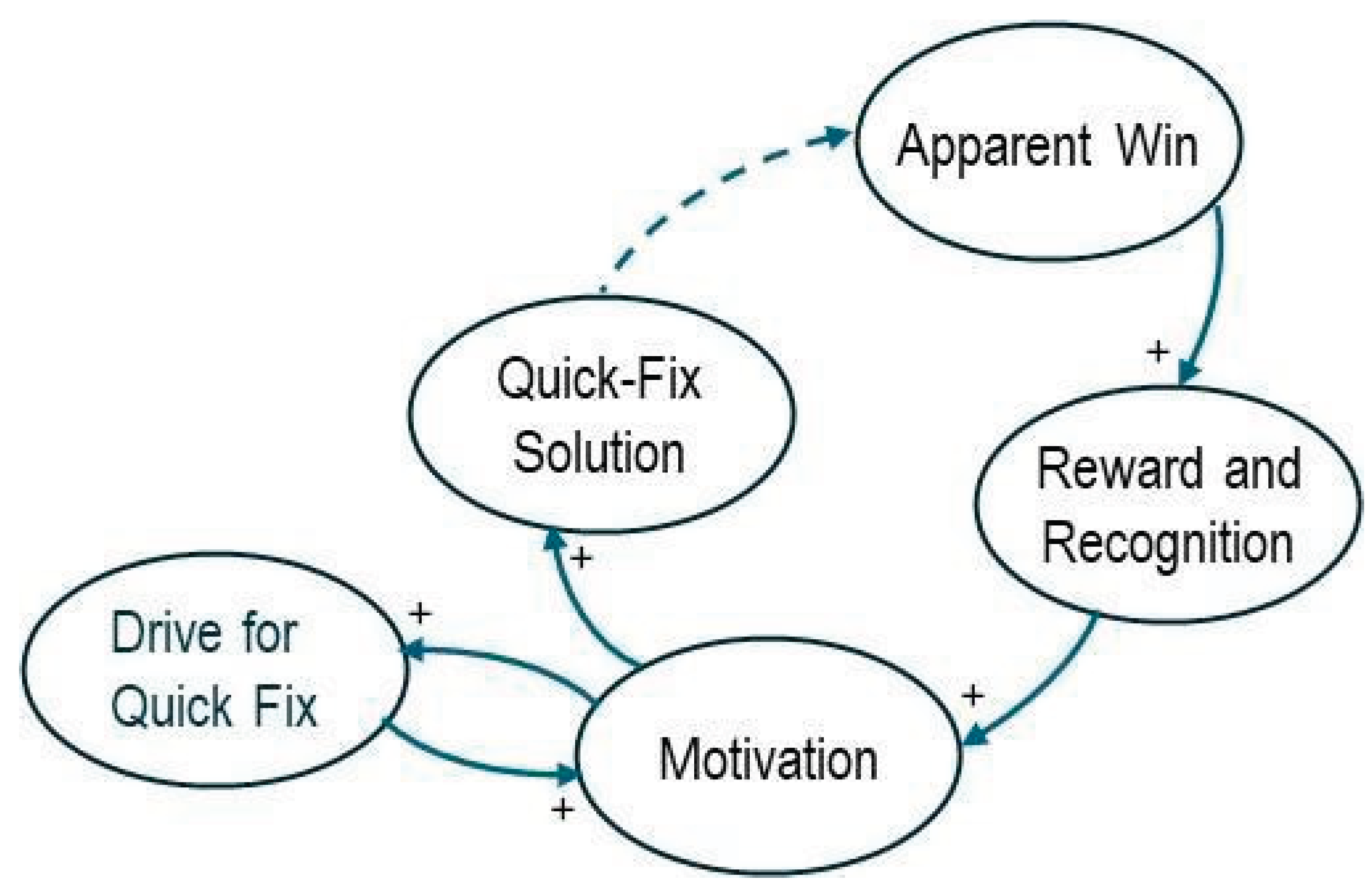
Figure 2.
High-level depiction of fundamental dynamics influencing and explaining generic problem-solving with effect of long-term loss recognition.
Figure 2.
High-level depiction of fundamental dynamics influencing and explaining generic problem-solving with effect of long-term loss recognition.
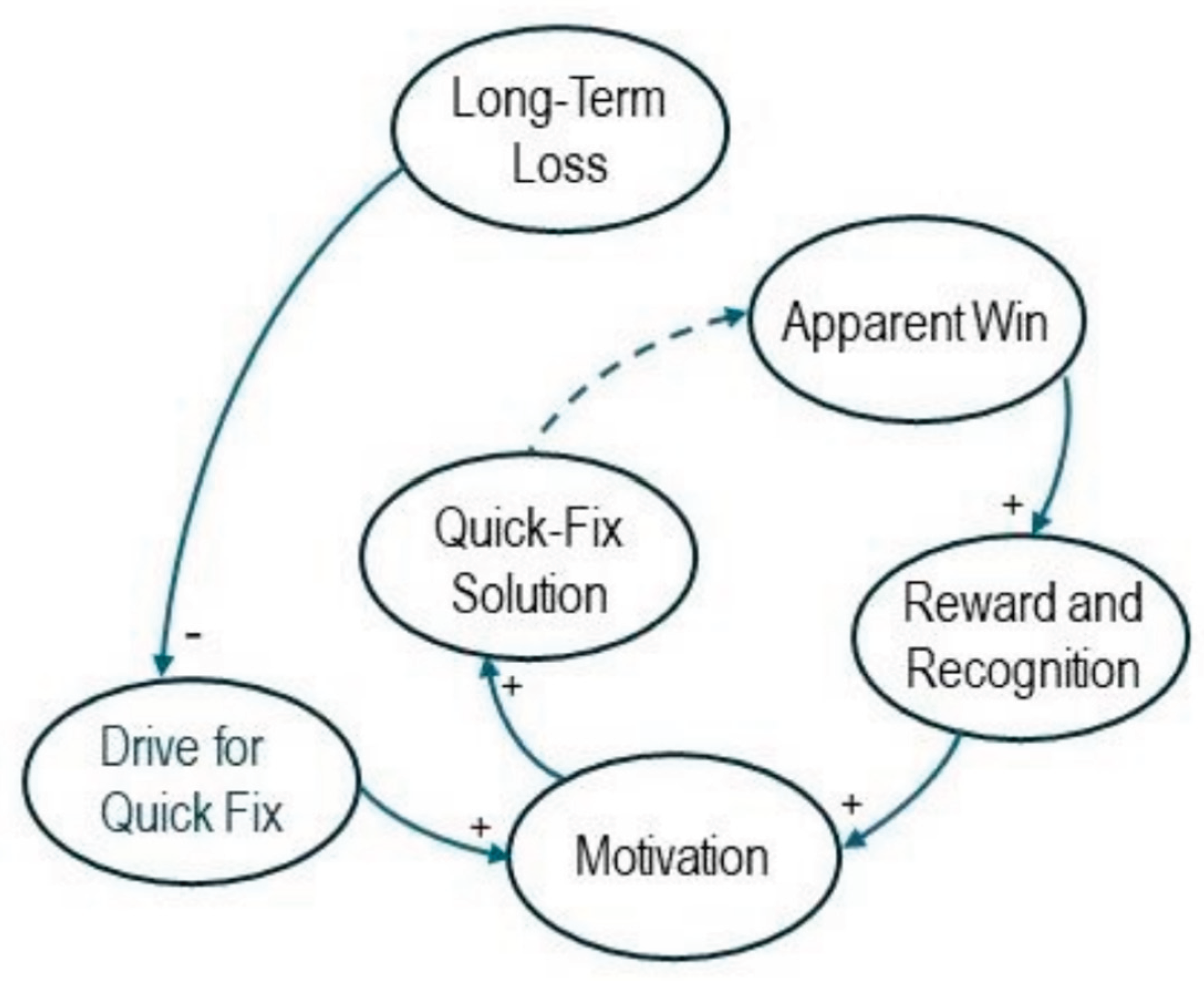
Figure 3.1 and 3.2.
Continued detailing of fundamental dynamics, with addition of comparison of effect of long-term loss and long-term gain.
Figure 3.1 and 3.2.
Continued detailing of fundamental dynamics, with addition of comparison of effect of long-term loss and long-term gain.
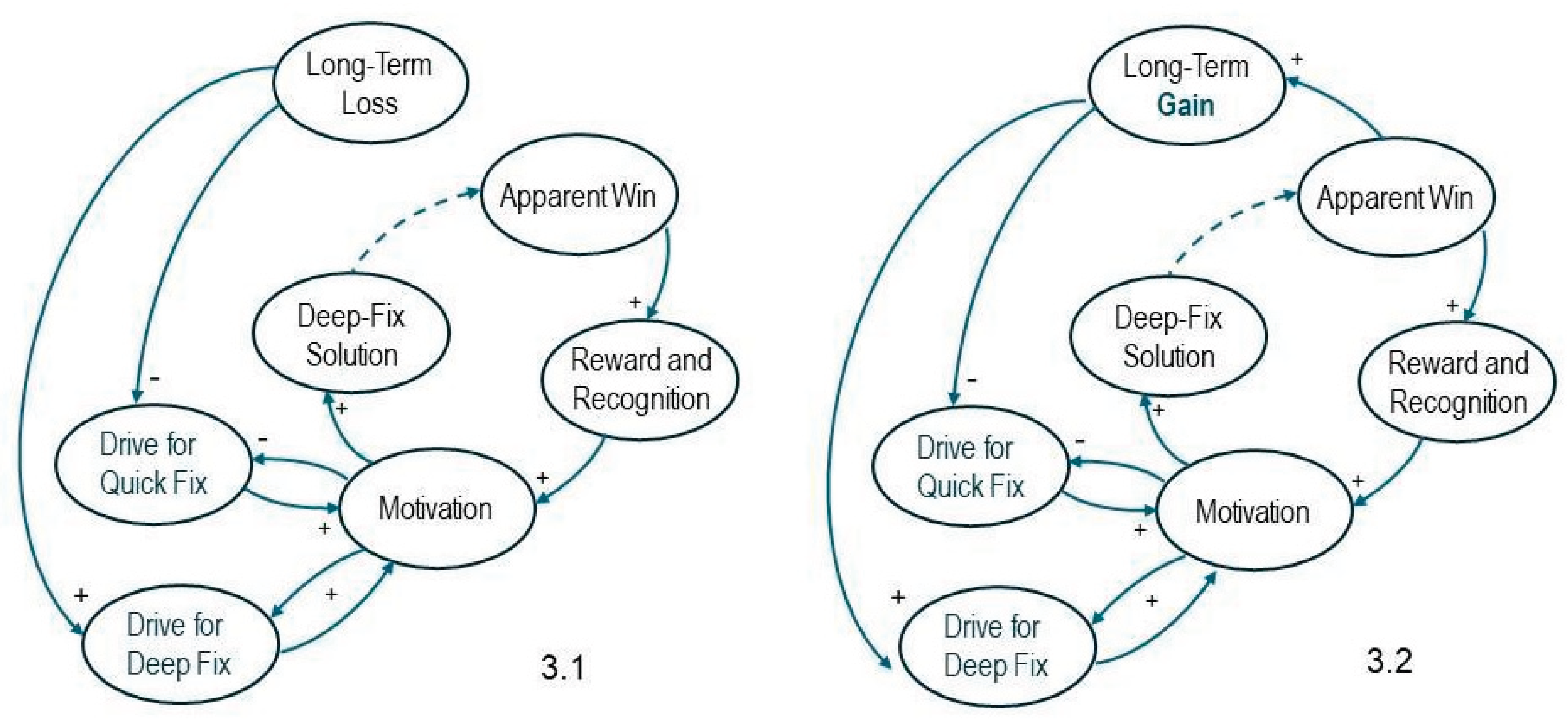
Figure 3.
3. Positive Feedback Loop of Reward and Motivation.
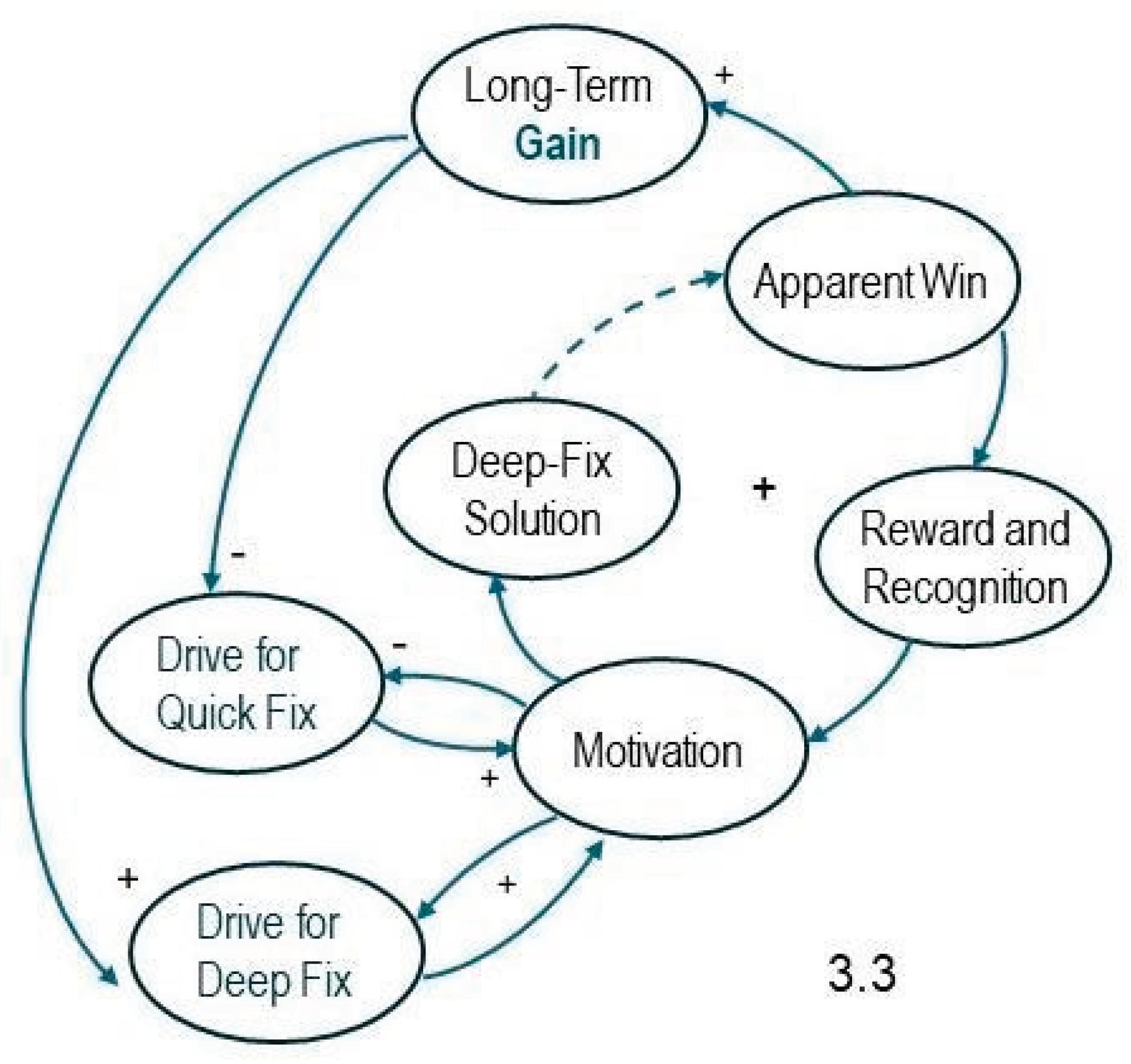
Figure 4.
High-level depiction of ecosystem model adding PDET (Professional Development, Education, and Training).
Figure 4.
High-level depiction of ecosystem model adding PDET (Professional Development, Education, and Training).
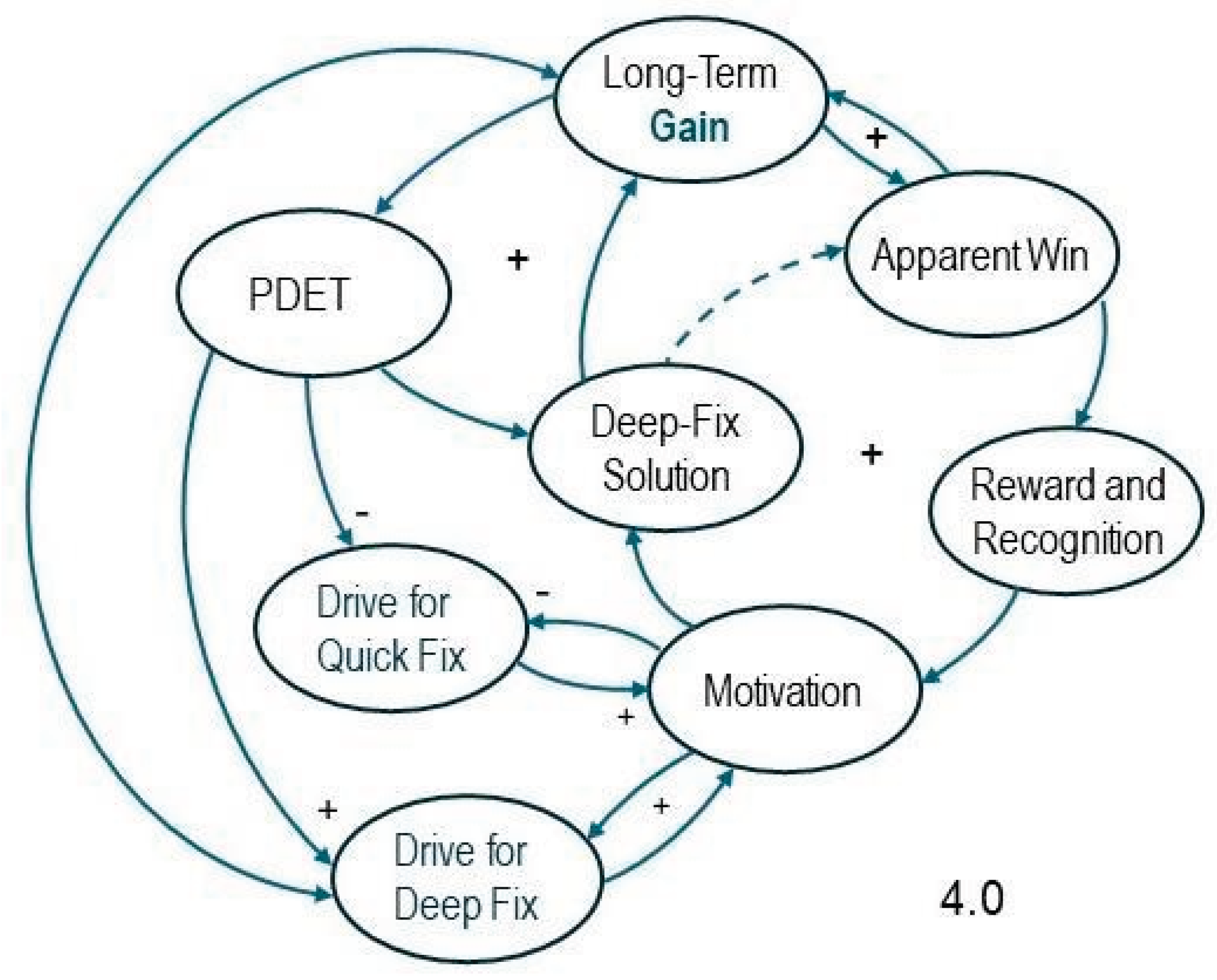
Figure 5.
Section of dynamic ecosystems map showing flow-on, a virtuous side.
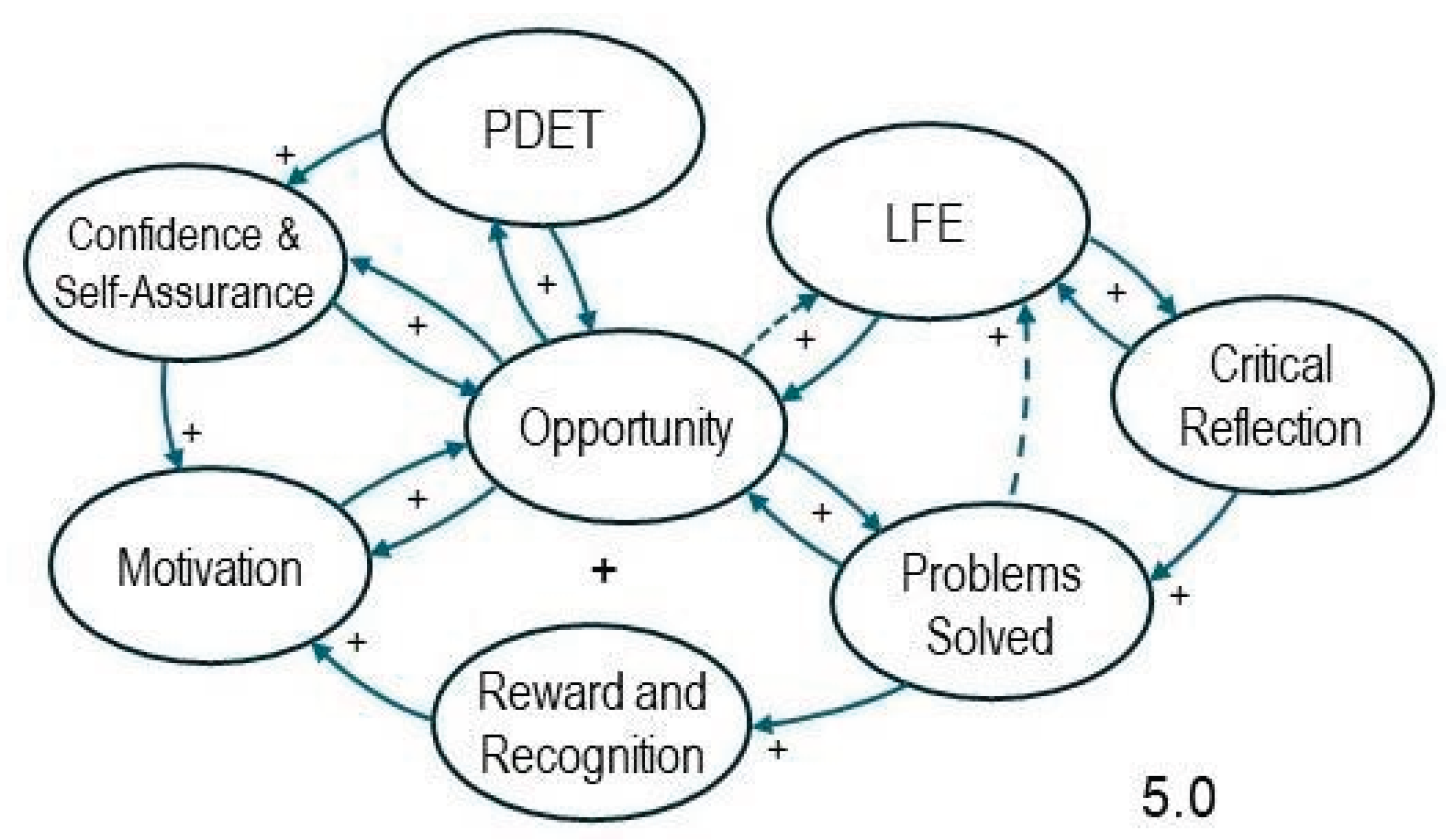
Figure 6.
Section of dynamic ecosystems map showing flow-on, a vicious side.
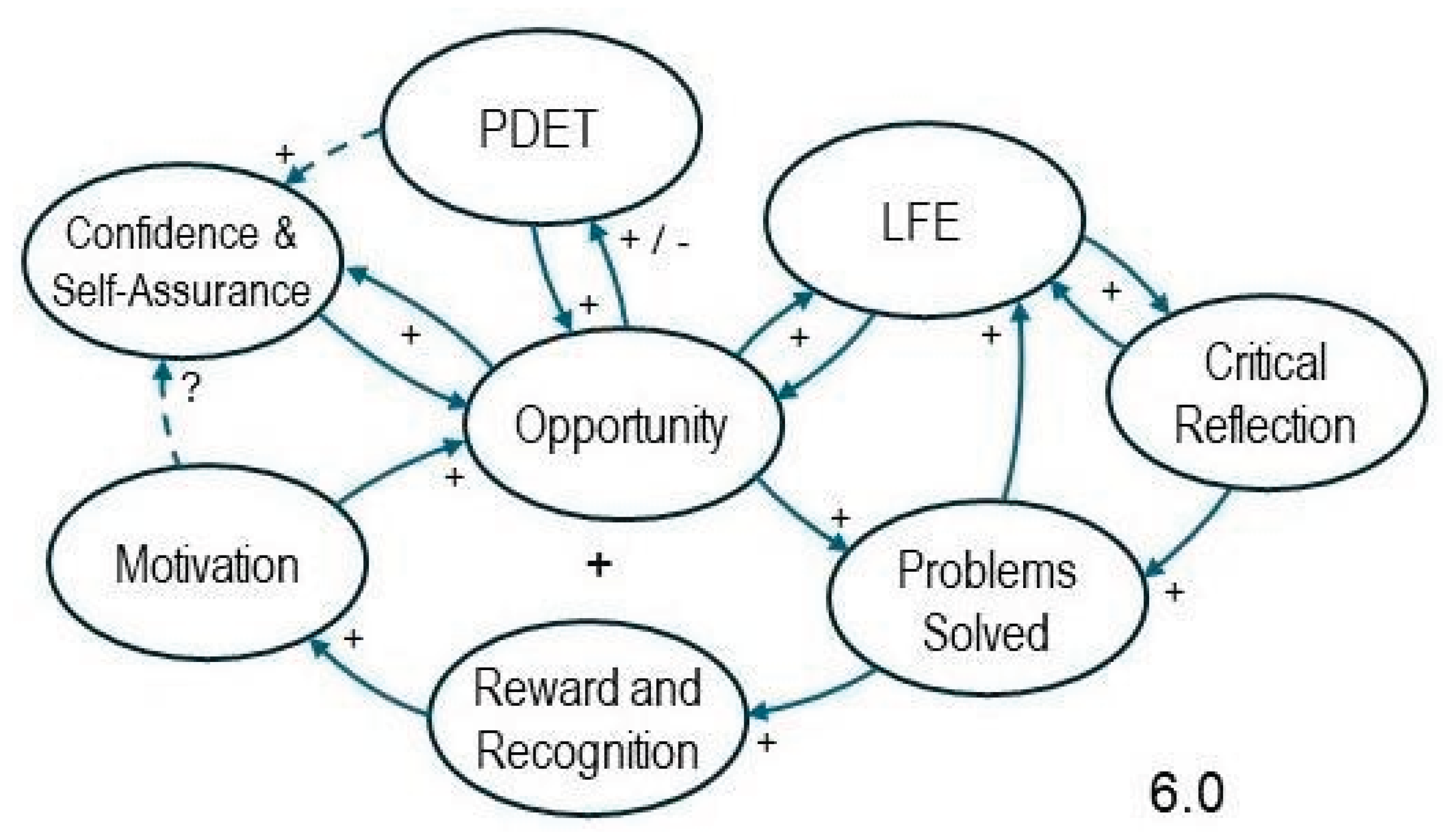

Table 1.
Portfolio of skills relevant to complex and sophisticated problem-solving.
| Skills and Dispositions for Deep-Fix Problem-Solving | |
|---|---|
| Acquire, evaluate, and synthesise information and knowledge (Bednarikova, 2017; Spector & Park, 2012) | Recognise and act upon insufficient and dubious data and information (Bednarikova, 2017; Soyer & Hogarth, 2020) |
| Interrogate and analyse information for decision-making (Spector & Park, 2012; Sproull, 2018) | Question credibility, reliability, and utility of information (Bednarikova, 2017; Soyer & Hogarth, 2020) |
| Formulate reasonable and defensible conclusions (Bednarikova, 2017; Spector & Park, 2012) | Identify and explicate causal relationships (Barbrook-Johnson & Penn, 2022; Stroh, 2015) |
| Interpret evidence (Bednarikova, 2017; Spector & Park, 2012) | Critically reflect (Ash & Clayton, 2009; Holdo, 2023) |
| Communicate and engage stakeholders (Brundiers & Wiek, 2017; Silvius & Schipper, 2019) | Collaborate with diverse others; manage conflict productively (Hesse et al., 2015; Xu et al., 2023) |
| Recognise flaws and weaknesses in arguments, claims, and lines of reasoning (Bednarikova, 2017; Spector & Park, 2012) | Surface, challenge, and verify assumptions (Brook et al., 2016; Stroh, 2015) |
| Adapt and modify plans and procedures as needed (Khan et al., 2018; Fischer & Neubert, 2015) | Plan research and develop thorough and effective problem-solving strategies; and implement them (Conn & McLean, 2019; Sproull, 2018) |
Note. Together they provide a useful overview of the capabilities professionals may require across a full cycle of problem-solving, from acquiring and evaluating information to analysing evidence, developing and adapting strategies, collaborating with stakeholders, and communicating decisions and outcomes. The compilation should therefore be viewed as a practical synthesis rather than a definitive taxonomy of problem-solving skills.
Table 2.
Indicative topic foci for professional development, education, and training that directly contribute to relevant skills and dispositions for deep fix problem-solving.
Table 2.
Indicative topic foci for professional development, education, and training that directly contribute to relevant skills and dispositions for deep fix problem-solving.
| Professional Development, Education, and Training for Advanced Problem-Solving | ||
|---|---|---|
| Real-World Relevant Education – HE (Akinci-Ceylan et al., 2018; Morley & Jamil, 2021) | Industry and Community Problem-Based Lectures – HE (Jonassen, 2011; Zeidan & Bishnoi, 2020) | Translation of Discipline Theory to Practical Application – HE (Ash & Clayton, 2009; Sovilla & Varty, 2023) |
| Student-Centred and Active Learning – HE (Snyder & Snyder, 2008; Yearwood et al., 2016) | Learner-Led Lessons – HE (Jonassen, 2011; Yearwood et al., 2016) | Understanding the Importance of Problem-Solving – HE/I (Snyder & Snyder, 2008; Zeidan & Bishnoi, 2020) |
| Training in Teamwork and Collaboration – HE/I (Brundiers & Wiek, 2017; Xu et al., 2023) | Training in Systems and Sustainability Thinking – HE/I (Grewatsch et al., 2023; Wiek et al., 2015) | Student/Participant Critique and Evaluation – HE/I (Ash & Clayton, 2009; Bednarikova, 2015) |
| Critical Reflection – HE/I (Ash & Clayton, 2009; Holdo, 2023) | Problem-Based Learning – HE/I (Jonassen, 2011; Jonassen & Hung, 2008) | Project-Based Learning – HE/I (Snyder & Snyder, 2008; Yearwood et al., 2016) |
| Cross-Disciplinary Emphasis – HE/I (Annan-Diab & Molinari, 2017; Wiek et al., 2015) | Action Learning / Action Research – HE/I (Brook et al., 2016) | Industry Experience / Work-Integrated Learning – HE/I (Sovilla & Varty, 2023) |
| Training in Problem-Solving Methods – HE/I (Treffinger et al., 2006; Whimbey et al., 2013) | Critical Thinking – HE/I (Bednarikova, 2015; Snyder & Snyder, 2008) | Collaborative Problem-Solving Teams – I (Brundiers & Wiek, 2017; Xu et al., 2023) |
| Learning Component in Projects and Major Tasks – HE/I (Snyder & Snyder, 2008; Wiek et al., 2015) | Design Thinking – HE/I (Sriharan et al., 2021; Tsai et al., 2023) | Problem-Solving Scaffolding and Support – HE/I (Jonassen, 2011; Jonassen & Hung, 2008) |
Note. HE denotes higher education, encompassing tertiary and university settings, whereas I denotse industry and corporate training. Topics relevant to both contexts are identified as HE/I.
Disclaimer/Publisher’s Note: The statements, opinions and data contained in all publications are solely those of the individual author(s) and contributor(s) and not of MDPI and/or the editor(s). MDPI and/or the editor(s) disclaim responsibility for any injury to people or property resulting from any ideas, methods, instructions or products referred to in the content. |
© 2026 by the authors. Licensee MDPI, Basel, Switzerland. This article is an open access article distributed under the terms and conditions of the Creative Commons Attribution (CC BY) license (http://creativecommons.org/licenses/by/4.0/).
Copyright: This open access article is published under a Creative Commons CC BY 4.0 license, which permit the free download, distribution, and reuse, provided that the author and preprint are cited in any reuse.