
Submitted:
26 September 2026
Posted:
29 September 2026
You are already at the latest version
Abstract
Type 2 diabetes mellitus (T2DM) self-management depends on interacting behavioral, clinical, problem-solving, and psychosocial factors that are difficult to represent using rigid categorical models. This study presents FES-T2DSC (Fuzzy Expert System for Type 2 Diabetes Self-Care), an application-specific fuzzy expert system for multidimensional self-care assessment in adults with T2DM. The system comprises four type-1 Mamdani fuzzy inference models—Basic Self-Care, Diabetes Self-Management, Problem-Solving Capacity, and Psychosocial Status—with explicit membership functions and linguistic IF–THEN rules. Development used records from 27 adults with T2DM recruited in an outpatient municipal setting in Veracruz, Mexico; 93 synthetic configurations from the original analysis are retained only as historical descriptive context, not validation evidence. The architecture preserves separate domain-level outputs and makes the encoded rule bases and membership functions inspectable. Quantitative evidence consists of an internal, non-independent archival reanalysis of archived outputs; the currently available FIS files are not established as their generators, and no external clinical validation was performed. FES-T2DSC therefore provides an integrative, rule-based architecture for multidimensional diabetes self-care assessment, while larger independent cohorts, reproducible execution pipelines, and prospective evaluation are required before external performance, generalizability, or clinical utility can be established.
Keywords:
type 2 diabetes mellitus
; fuzzy expert system
; fuzzy logic
; diabetes self-management
; multidimensional assessment
; self-care
1. Introduction
Type 2 diabetes mellitus (T2DM) represents a major challenge for healthcare systems because of its high prevalence, chronic course, and association with microvascular and macrovascular complications. Globally, an estimated 589 million adults aged 20–79 years were living with diabetes in 2024, and this number is projected to reach 853 million by 2050 [1]. T2DM accounts for approximately 90–95% of diabetes cases and is characterized by progressive impairment of -cell insulin secretion, frequently in the context of insulin resistance [2]. Because T2DM is associated with long-term vascular complications, glycemic control remains an important component of strategies aimed at reducing adverse outcomes [3]. Effective disease management also depends on sustained self-management behaviors, including dietary management, physical activity, glucose monitoring, medication taking, and other behaviors relevant to day-to-day diabetes care [4,5,6]. In parallel, artificial intelligence (AI) and machine-learning methods have increasingly been investigated for diabetes-related applications, including glycemic monitoring, prediction, personalized treatment support, and clinical decision support [7,8].
Among knowledge-based AI approaches, fuzzy logic provides a framework for representing imprecise information and gradual membership through linguistic variables, membership functions, and IF–THEN rules [9]. Rather than forcing observations into rigid categorical boundaries, fuzzy inference allows intermediate degrees of membership to be represented explicitly. This property has motivated the use of fuzzy systems in medical applications involving heterogeneous clinical and behavioral information [10,11,12].
The management of T2DM requires the active participation of individuals in sustained self-care behaviors such as healthy eating, physical activity, glucose monitoring, medication adherence, and problem-solving [13,14]. Diabetes self-management education and support (DSMES) aims to develop the knowledge, skills, and abilities required to support these behaviors and improve diabetes-related outcomes [4,15]. Self-management, however, is also shaped by socioeconomic and psychosocial conditions. Limited access to resources and services can constrain self-care [16,17], while emotional and social factors influence how individuals cope with and manage diabetes [18]. These considerations support assessment approaches that account for multiple, interacting dimensions of self-care rather than treating diabetes management as a single homogeneous construct. Self-care and self-management are related and partly overlapping concepts whose boundaries are not applied consistently across the diabetes literature; in FES-T2DSC, the labels Basic Self-Care and Diabetes Self-Management therefore denote operational assessment components rather than universally standardized or mutually exclusive constructs [19]. Current ADA guidance similarly treats self-care behaviors, problem-solving, and psychosocial factors as related elements of diabetes self-management support [20].
Prior computational systems for diabetes have addressed diagnosis and risk estimation, metabolic and complication-control assessment, physiological monitoring, dietary assessment and recommendation, regimen modification, and self-management support [21,22,23,24,25,26,27,28,29,30,31,32,33,34,35]. Importantly, previous work already includes fuzzy assessment of diabetes-relevant self-care domains, multi-output Mamdani architectures for T2DM management, and multidomain self-management decision-support approaches implemented using fuzzy, rule-based, and other computational formalisms [27,29,30,31,32,33,34,35,36,37]. Accordingly, the contribution of the present study is not the use of fuzzy inference itself, the use of multiple outputs, or the recognition of multidimensional self-care as a new construct. Within the targeted literature examined, however, we did not identify an application-specific fuzzy inference configuration organized to assess self-care in adults with established T2DM through the same four domain-specific components used in FES-T2DSC—Basic Self-Care, Diabetes Self-Management, Problem-Solving Capacity, and Psychosocial Status—while preserving a separate assessment output for each component.
To examine this configuration, the present study introduces FES-T2DSC (Fuzzy Expert System for Type 2 Diabetes Self-Care), a fuzzy knowledge-based system with an inspectable rule-based structure for multidimensional self-care assessment in adults with established T2DM. Its conceptual organization is informed by DSMES and ADCES7 principles rather than constituting a direct one-to-one implementation of those frameworks [4,5]. FES-T2DSC uses type-1 Mamdani fuzzy inference to integrate clinical, behavioral, psychosocial, and contextual information across four domain-specific models: Basic Self-Care, Diabetes Self-Management, Problem-Solving Capacity, and Psychosocial Status. Its contribution is therefore primarily integrative and application-specific rather than methodological: explicit membership functions and linguistic IF–THEN rules provide a traceable representation of how input conditions contribute to each domain-level output [38,39]. The system is intended to support the identification of self-care domains that may warrant additional educational or behavioral attention; it is not intended to provide a psychological diagnosis or to replace professional clinical judgment. Within these boundaries, FES-T2DSC is best interpreted as an inspectable multidomain assessment-support layer that structures domain-level information for subsequent human interpretation. Recommendation generation, workflow integration, decision-efficiency improvement, adaptive behavior, and clinical deployment were not implemented or evaluated in the present study.
2. Materials and Methods
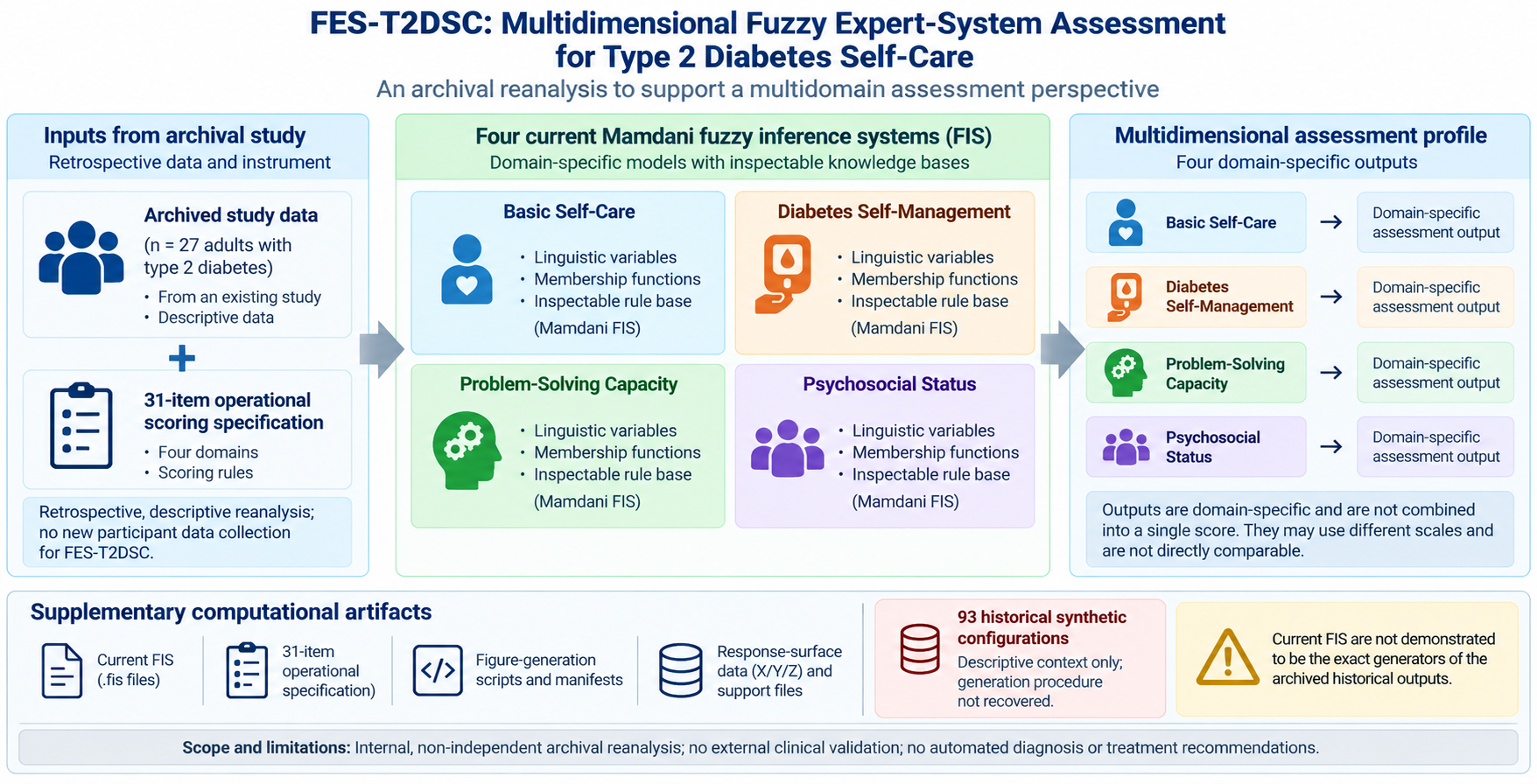
FES-T2DSC comprises four separate domain-specific type-1 Mamdani fuzzy inference models: Basic Self-Care, Diabetes Self-Management, Problem-Solving Capacity, and Psychosocial Status.
2.1. Study Setting and Reference Cohort
The original data collection involved adults with a confirmed diagnosis of T2DM recruited at the Centro de Asistencia Municipal de Nogales (Nogales, Veracruz, Mexico) in an outpatient care setting. Data collection was conducted approximately between August and October 2025 using consecutive non-probabilistic sampling. Inclusion criteria required participants to be 20–80 years of age, have a confirmed diagnosis of T2DM, have functional literacy, provide signed informed consent, and be available to complete the required clinical, laboratory, and questionnaire evaluations.
Initially, 30 individuals were considered. Three were excluded before the analytical sample was established: one because of relocation and two because economic constraints prevented continuation of the planned process. The excluded individuals were not incorporated into the analytical dataset. The final reference cohort therefore consisted of 27 participants. The analyses corresponded to a single evaluation of each participant rather than to longitudinal follow-up.
The original data-collection protocol, entitled “Estrategia de enfoque integral para mejorar el apego al autocuidado en pacientes con diabetes mellitus”, received ethics approval from the Research Ethics Committee of the Faculty of Medicine, Ciudad Mendoza Campus, Universidad Veracruzana, on 4 July 2025. The committee is identified by code CONBIOETICA-30-CEI-004-20190710. Informed consent was obtained before data collection. FES-T2DSC was developed subsequently as a secondary computational analysis of records originating from that study and was not part of the originally approved protocol.
2.2. Self-Care Assessment Instrument
Self-care information was obtained using a structured questionnaire informed by the principles of Diabetes Self-Management Education and Support (DSMES) and the ADCES7 Self-Care Behaviors framework, which encompasses healthy eating, being active, monitoring, taking medication, reducing risks, problem solving, and healthy coping [4,5]. The instrument had been developed before the present computational evaluation, using self-care and self-management domains from DSMES and ADCES7 as conceptual references rather than as a direct one-to-one implementation of those frameworks. It was subsequently implemented in an application for administration and automated score calculation.
In the present secondary analysis, a verified 31-item operational questionnaire/scoring specification (Q1–Q31) retained in the computational workbook was used to reconstruct the domain reference scores. This operational specification does not establish the exact physical questionnaire form administered during the 2025 data collection. Retained ethics documentation contains a 26-item representation, and the discrepancy between that representation and the 31-item operational specification remains unresolved. Accordingly, questionnaire responses are used here for the documented secondary scoring/reanalysis workflow rather than as evidence that the exact historical administration form has been fully reconstructed.
Use of DSMES and ADCES7 as conceptual references does not, by itself, establish independent psychometric validation, external clinical validity, or clinical effectiveness of the questionnaire.
2.3. Fuzzy Inference System Structuring
Based on the clinical parameters and questionnaire information available to the system, four separate fuzzy inference models were defined, corresponding to Basic Self-Care, Diabetes Self-Management, Problem-Solving Capacity, and Psychosocial Status. Variables were represented using linguistic sets and membership functions, and their combinations were processed through IF–THEN rules. Figure 1 summarizes the methodological and evidence-provenance framework, explicitly distinguishing the current FIS specification from the descriptive archival reanalysis of retained outputs, and Table 1 presents the input variables, outputs, and linguistic categories for each model.
Structural note: Educational Level is encoded as an input in the current Psychosocial FIS; however, inspection of the 120-rule table shows that, for every fixed combination of Emotional Status, Family Support, and Income Level antecedents, the consequent category is unchanged across all four Educational Level antecedents. Educational Level therefore does not discriminate consequent selection in the current rule base and should not be interpreted as demonstrating an educational-level effect.
The four domain-level outputs provide a multidimensional assessment with an inspectable rule-based representation designed to help identify self-care domains that may warrant additional attention according to the knowledge encoded in the rule bases. Preserving separate outputs retains domain-specific information at the output level rather than collapsing the four assessments into a single metabolic, diagnostic, or risk index.
Across the four FIS models, the implementation uses type-1 Mamdani inference with AND = minimum, OR = maximum, implication = minimum, aggregation = maximum, rule weight = 1, AND connector, and centroid defuzzification. Input variables are represented using triangular or trapezoidal membership functions according to the corresponding model.
During model development, the then-current linguistic categories and IF–THEN rule bases were reviewed by four medical specialists, including three specialists in internal medicine and one endocrinologist. They assessed the logical and clinical coherence of the categories and rules, and disagreements were discussed until consensus was reached. Their recommendations also informed the adaptation of selected variables into operative linguistic categories for fuzzy representation.
The retained artifacts preserve the final current FIS specifications but do not fully reconstruct the historical elicitation process at the level of each breakpoint and individual rule. In particular, the available documentation does not provide a complete per-rule decision log, formal inter-expert agreement measure, or one-to-one provenance from each final membership-function breakpoint to a specific empirical or expert recommendation. Reproducibility of the current artifacts should therefore be distinguished from full reproducibility of their historical development process.
The selection of variables for the fuzzy expert system was based on scientific evidence, clinical practice guideline recommendations considered in the study, and the knowledge of the participating specialists, incorporating factors related to self-care and T2DM control [4,6]. For model structuring, variables were classified according to their potential for intervention, with emphasis on factors that could be modified through self-care actions.
For continuous quantitative variables used during model development, the source manuscript reports the 95% confidence interval of the sample mean as:
In this study, the 95% confidence interval is retained only as an empirical reference used during model development; no deterministic one-to-one transformation from its limits to final membership-function breakpoints is asserted.
For notation, a trapezoidal membership function used in several model variables can be represented as:
with . Here, a and d delimit the support of the fuzzy set, while b and c define the interval of maximum membership. For shouldered trapezoidal functions at the extremes of the universe of discourse, or is permitted; in those degenerate cases, the corresponding linear branch has an empty interval and the membership function enters or leaves the plateau directly at the boundary.
The parameterization criteria retained for the current FIS specification are summarized in Table 2.
Note: Where 95% confidence intervals were considered, they served as empirical references rather than automatic clinical cutoffs. No deterministic one-to-one transformation from the confidence interval limits to the final membership-function breakpoints is asserted.
2.4. Basic Self-Care Model
The Basic Self-Care Model integrates five input variables: nutrition, daily caloric intake, physical activity frequency, exercise type, and body mass index (BMI). These variables were selected in relation to self-care components and recommendations relevant to T2DM management [4,6]. The output, Basic Self-Care Level, is represented by three linguistic categories: Poor Care, Regular Care, and Good Care.
In the current implementation, Exercise Type is encoded categorically; its numerical positions function as computational coordinates and are not interpreted as a continuous clinical scale. The rule base contains 218 rule lines corresponding to 216 unique antecedent patterns, including two exact duplicate antecedent groups and two rules with don’t-care antecedents. These structural characteristics should be considered when interpreting antecedent-space coverage.
2.5. Diabetes Self-Management Model
The Diabetes Self-Management Model integrates three input variables: glucose sampling frequency, medication adherence, and diabetes knowledge. These variables represent components relevant to diabetes self-management and are conceptually consistent with DSMES and ADCES7 self-care domains [4,5]. The output, Diabetes Self-Management Level, is represented in the current implementation by three linguistic categories: Poor, Fair, and Good.
In the current implementation, Glucose Sampling Frequency is encoded on a four-position computational universe with the labels 0–1, 2–3, 4–6, and ≥7 measurements. These numerical positions represent category coordinates rather than the raw weekly measurement counts themselves. Medication Adherence is encoded through the categorical labels Yes, No, and Sometimes. Diabetes Knowledge is encoded through the categorical labels Definition, Symptoms, and Treatment; no ordinal increase in knowledge is assumed from their numerical positions. The rule base contains 36 unique IF–THEN rules, enumerating all 4×3×3 combinations of linguistic antecedent indices. This combinatorial completeness refers to the rule table and does not by itself establish complete membership-function support across the numerical input universe.
2.6. Problem-Solving Capacity Model
The Problem-Solving Capacity Model integrates four input variables: hypoglycemia symptoms, laboratory test frequency, problem-solving ability, and educational level. Its conceptual organization is informed by the problem-solving dimension represented in ADCES7 [5], while the implemented input set constitutes an application-specific operationalization rather than a direct one-to-one mapping. Educational Level is represented through the ordered labels Basic, Secondary, Higher Education, and Postgraduate; the numerical coordinates used by the FIS are not interpreted as equal-interval quantitative differences.
The rule base contains 64 unique IF–THEN rules, enumerating all 2×4×2×4 combinations of linguistic antecedent indices. This combinatorial completeness refers to the rule table and is distinct from numerical-domain membership-function support. Its computational output universe ranges from 0 to 9 and represents the output using the linguistic categories Incorrect, Partial, and Correct. The current FIS declares this output universe as [0,9]. The raw questionnaire-derived reference score for this dimension (Ref_Problem_Q_1_9), reconstructed as described in Section 2.8, is expressed on a distinct 1-to-9 scale. The FIS output universe and the raw questionnaire-derived reference scale are therefore treated as distinct methodological objects; no requirement of numerical identity between them is assumed or asserted.
2.7. Psychosocial Status Model
The Psychosocial Status Model integrates four input variables: emotional status, family support, income level, and educational level. These variables represent emotional, familial, and socioeconomic factors relevant to diabetes self-management context [16,18]. The output, Psychosocial Status, is represented by four linguistic categories: Negative, Regular, Good, and Excellent.
Income Level is represented by fuzzy sets expressed in MXN/month. The implemented ranges are treated as model-specific computational parameters and are not interpreted as universal socioeconomic or clinical cutoffs. The rule base contains 120 unique IF–THEN rules, enumerating all 5×2×3×4 combinations of linguistic antecedent indices. This combinatorial completeness does not imply complete numerical-domain support; in the current implementation, the declared Income universe matches exactly the support of its membership functions. Inspection of the current rule table further showed that Educational Level is consequent-invariant: for each fixed combination of Emotional Status, Family Support, and Income Level antecedents, the same consequent category is assigned across all four Educational Level antecedents (30/30 groups). Educational Level is therefore encoded in the current FIS but does not discriminate consequent selection in this rule base. The resulting output is a computational domain-level estimate based on the implemented rule structure and is not intended to constitute a psychological diagnosis or an independent clinical evaluation.
Note: The currently available FIS declares an Income universe of [0,30000], matching exactly the support of its three membership functions. Educational Level uses the same ordered universe [1,4] in the Problem-Solving and Psychosocial models; the Basic category is numerically identical across both models, while the Secondary, Higher Education, and Postgraduate categories use different breakpoints between the two models. No cross-domain metric equivalence is assumed.
2.8. Archival Reanalysis Using Raw Questionnaire-Derived Reference Scores
The archived FES-T2DSC outputs from the original computational analysis were compared, in a subsequent descriptive reanalysis, with raw questionnaire-derived reference scores computed directly from the operational workbook for the 27 clinical cases. Questionnaire items were coded on five-point response scales, with unfavorable items reversed before aggregation.
During the exploratory phase of the original analysis, an additional adjustment (Ajuste_*) to these raw scores was evaluated for potential use as a comparison reference. Because no independent, prespecified criterion or formula defined this adjustment prior to and independently of the FIS outputs, it was excluded from the reanalysis reported here. All correspondence indicators reported in this manuscript use the raw questionnaire-derived reference scores (Ref_*_Q) exclusively.
The same 27 clinical cases had contributed information during model development; therefore, this evaluation should be interpreted as an internal, non-independent archival reanalysis rather than an independent test-set evaluation. Evaluation on the same data used during model development can yield optimistic performance estimates and does not by itself establish generalizability [40].
The raw reference scores were reconstructed and verified directly from the operational workbook using the following domain-specific formulas, where item values are on a 1-5 scale and reverse-scored items are transformed as (6 minus Q) before aggregation:
Basic Self-Care: mean of Q1-Q5, normalized via Equation (3). Diabetes Self-Management: mean of Q6-Q8, (6-Q9), Q10-Q12, normalized via Equation (3). Problem-Solving: mean of Q12-Q16 and Q18, normalized via Equation (3) and rescaled to a 1-9 scale via 1+8S (Ref_Problem_Q_1_9); this 1-9 scale is the reference used in Table 7. Psychosocial Status: mean of Q21, Q23, Q24, (6-Q25), Q26, (6-Q27), Q28, (6-Q29), (6-Q30), (6-Q31), rescaled to a 1-9 scale via 1+8S. These formulas were verified against the 27 archived cases with a maximum discrepancy attributable only to floating-point precision; the derivation of the raw reference scores is therefore fully reproducible.
The original analysis also included 93 synthetic configurations, yielding 120 computational configurations per model. These synthetic configurations are retained here only as historical descriptive context; the exact procedure used to generate them (sampling distributions, inter-variable dependencies, plausibility constraints, and pseudo-random seed) is not fully recoverable, and they are not used as quantitative validation evidence in the main analysis.
The source manuscript reports the coefficient of determination as:
and the root mean square error as:
For Equations (4) and (5), denotes the raw questionnaire-derived reference score and denotes the archived FES-T2DSC output; the denominator of Equation (4) is therefore computed around the mean raw reference score. Pearson’s correlation coefficient was also reported. Because the current FIS files are not established as the generators of the archived outputs, these indicators are interpreted strictly as descriptive within-sample correspondence in an archival reanalysis, not as evidence of current-model performance.
2.9. Response-Surface Regeneration and Reproducibility Environment
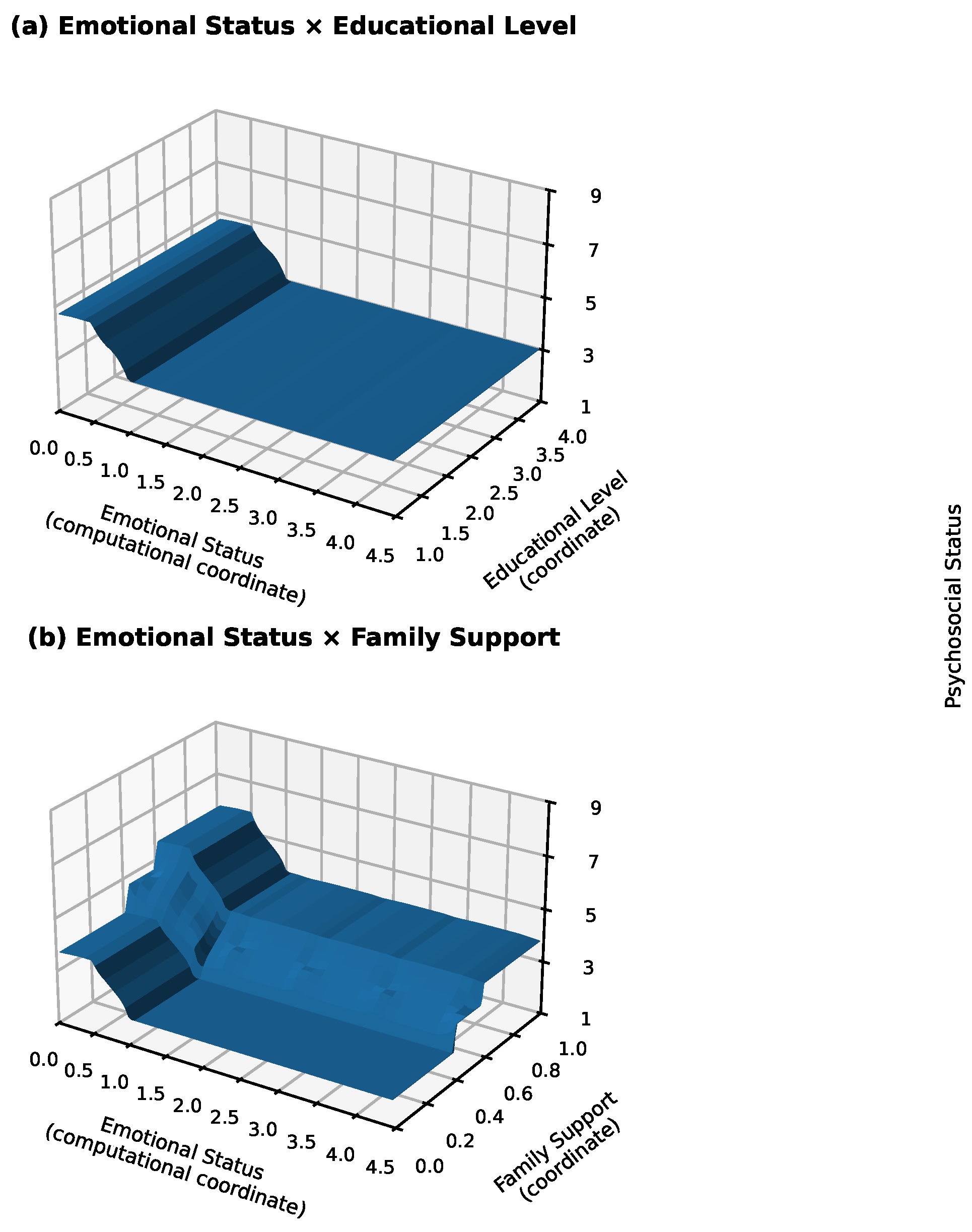
Figures 6–9 were regenerated from the four current FIS artifacts to characterize the structural behavior of those current specifications; they are not reconstructions of archived historical outputs. Each surface used a 101×101 grid spanning the declared universes of the two plotted inputs. Non-plotted inputs were held at explicit computational cross-section values: Figure 6a used Exercise Frequency = 4, Exercise Type = 0.5, and BMI = 27.5; Figure 6b used Nutrition = 0.5, Daily Caloric Intake = 1250 kcal, and BMI = 27.5; Figure 6c used Daily Caloric Intake = 1250 kcal, Exercise Frequency = 4, and Exercise Type = 0.5; Figure 7a used Diabetes Knowledge = 1; Figure 7b used Glucose Sampling Frequency = 2.5; Figure 8a used Laboratory Test Frequency = 2.5 and Educational Level = 2.5; Figure 8b used Problem-Solving Ability = 0.5 and Educational Level = 2.5; Figure 9a used Family Support = 0.5 and Income Level = 15,000 MXN/month; and Figure 9b used Income Level = 15,000 MXN/month and Educational Level = 2.5. These fixed values define computational cross-sections and are not interpreted as clinical thresholds.
The regenerated inference reproduced the operators declared in the current FIS files (AND = minimum, OR = maximum, implication = minimum, aggregation = maximum, centroid defuzzification). For Figure 6 and Figure 7, centroid outputs were evaluated on a 2001-point output grid and checked against a 1001-point grid; for Figure 8 and Figure 9, a 3001-point output grid was checked against a 1501-point grid. Grid cells with maximum rule-firing strength less than or equal to (10{-15}) were masked rather than assigned a runtime fallback value. The surface-generation artifacts include X, Y, Z, maximum-rule-firing, and support-mask matrices for each panel.
The deterministic regeneration environment used Python 3.13.5, NumPy 2.3.5, Matplotlib 3.10.8, and Pillow 12.3.0. Figure 10 vector composition additionally used CairoSVG 2.8.2, svglib 1.6.0, and ReportLab 4.4.9. The historical MATLAB release and evaluation options used in the original computational analysis were not recovered and are not inferred. The public supplementary package provides the four current FIS specifications together with non-participant computational artifacts supporting deterministic regeneration of Figure 1, Figure 2, Figure 3, Figure 4, Figure 5, Figure 6, Figure 7, Figure 8 and Figure 9 and aggregate provenance/metric artifacts for Figure 10. Participant-level analytical workbooks and case-level Figure 10 pairs are not included in the public package. The retained documentation does not document authorization for public release of the underlying participant-level records; consequently, the public materials do not provide an independent reconstruction of the historical case-level Figure 10 analysis.
3. Results
3.1. Response-Surface Analysis of the Basic Self-Care Model
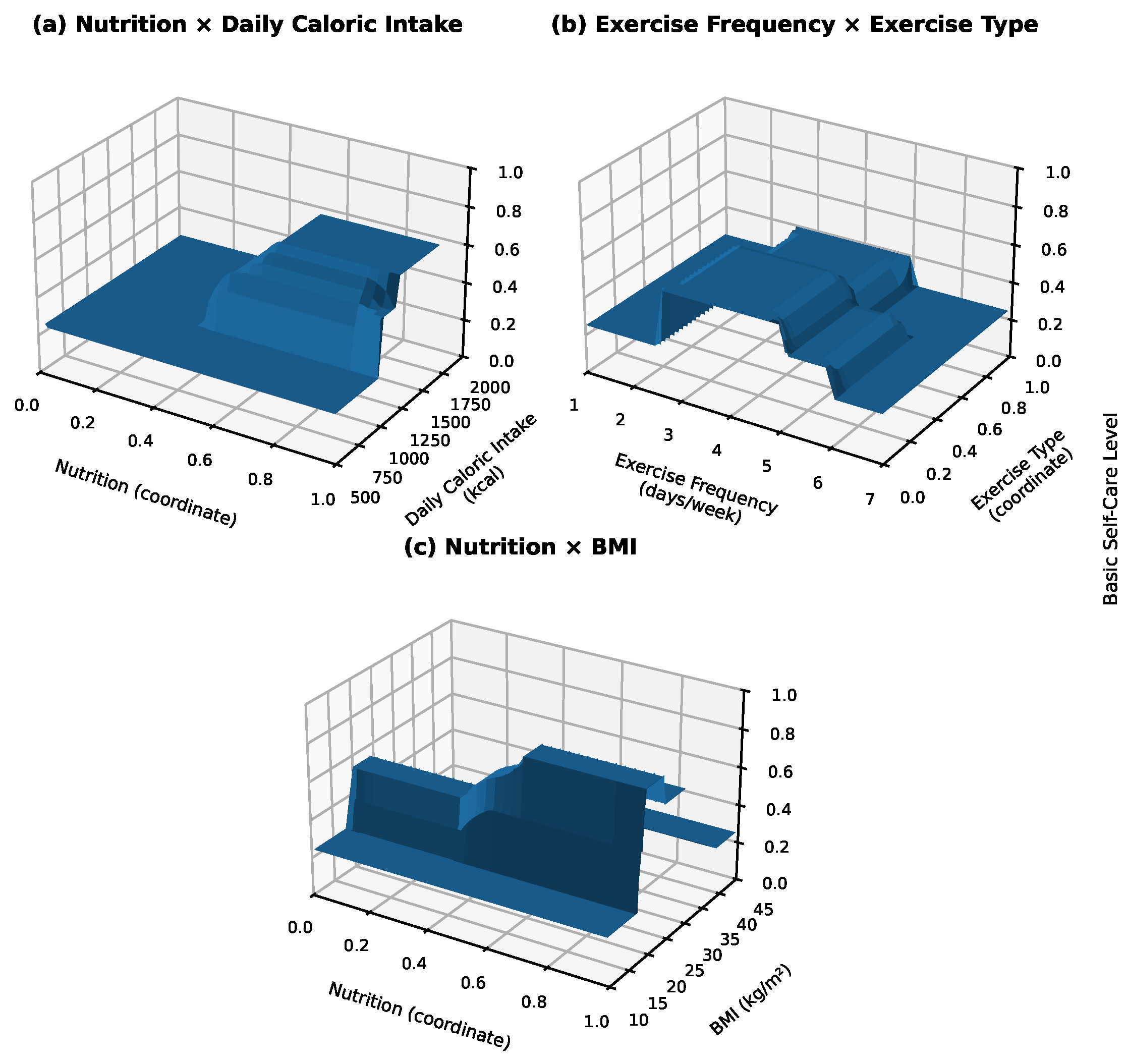
Figure 6a–c show the behavior of the Basic Self-Care Model under different combinations of its input variables. In Figure 6a, the interaction between Nutrition and Daily Caloric Intake generates a nonlinear response with transitions from lower to higher Basic Self-Care Level values as the combinations approach conditions represented as more favorable by the rule base. Transition regions and plateaus indicate that the output depends on the interaction between both variables rather than on a single factor.
Figure 6b shows the interaction between Exercise Frequency and Exercise Type. The model generates different self-care levels for different combinations of exercise frequency and modality, reflecting their joint processing through the inference rules. Figure 6c shows that the contribution of Nutrition to the estimated self-care level varies across Body Mass Index (BMI) intervals; neither variable therefore determines the system output in isolation.
Within inferentially supported regions, the regenerated surfaces show nonlinear transitions among estimated self-care levels. Grid cells at which the maximum rule-firing strength is zero are intentionally masked rather than assigned a runtime fallback value, making unsupported combinations in the current rule base visible. These surfaces describe the internal behavior of the current FIS specification and should not be interpreted as evidence of causal relationships, clinical effectiveness, or historical-output provenance.
Figure 6.
Response surfaces regenerated from the current Basic Self-Care FIS specification: (a) Nutrition and Daily Caloric Intake, with Exercise Frequency = 4, Exercise Type = 0.5, and BMI = 27.5 fixed; (b) Exercise Frequency and Exercise Type, with Nutrition = 0.5, Daily Caloric Intake = 1250 kcal, and BMI = 27.5 fixed; (c) Nutrition and BMI, with Daily Caloric Intake = 1250 kcal, Exercise Frequency = 4, and Exercise Type = 0.5 fixed. All surfaces use a 101×101 input grid. Blank cells indicate zero maximum rule-firing strength and are masked.
Figure 6.
Response surfaces regenerated from the current Basic Self-Care FIS specification: (a) Nutrition and Daily Caloric Intake, with Exercise Frequency = 4, Exercise Type = 0.5, and BMI = 27.5 fixed; (b) Exercise Frequency and Exercise Type, with Nutrition = 0.5, Daily Caloric Intake = 1250 kcal, and BMI = 27.5 fixed; (c) Nutrition and BMI, with Daily Caloric Intake = 1250 kcal, Exercise Frequency = 4, and Exercise Type = 0.5 fixed. All surfaces use a 101×101 input grid. Blank cells indicate zero maximum rule-firing strength and are masked.
3.2. Response-Surface Analysis of the Diabetes Self-Management Model
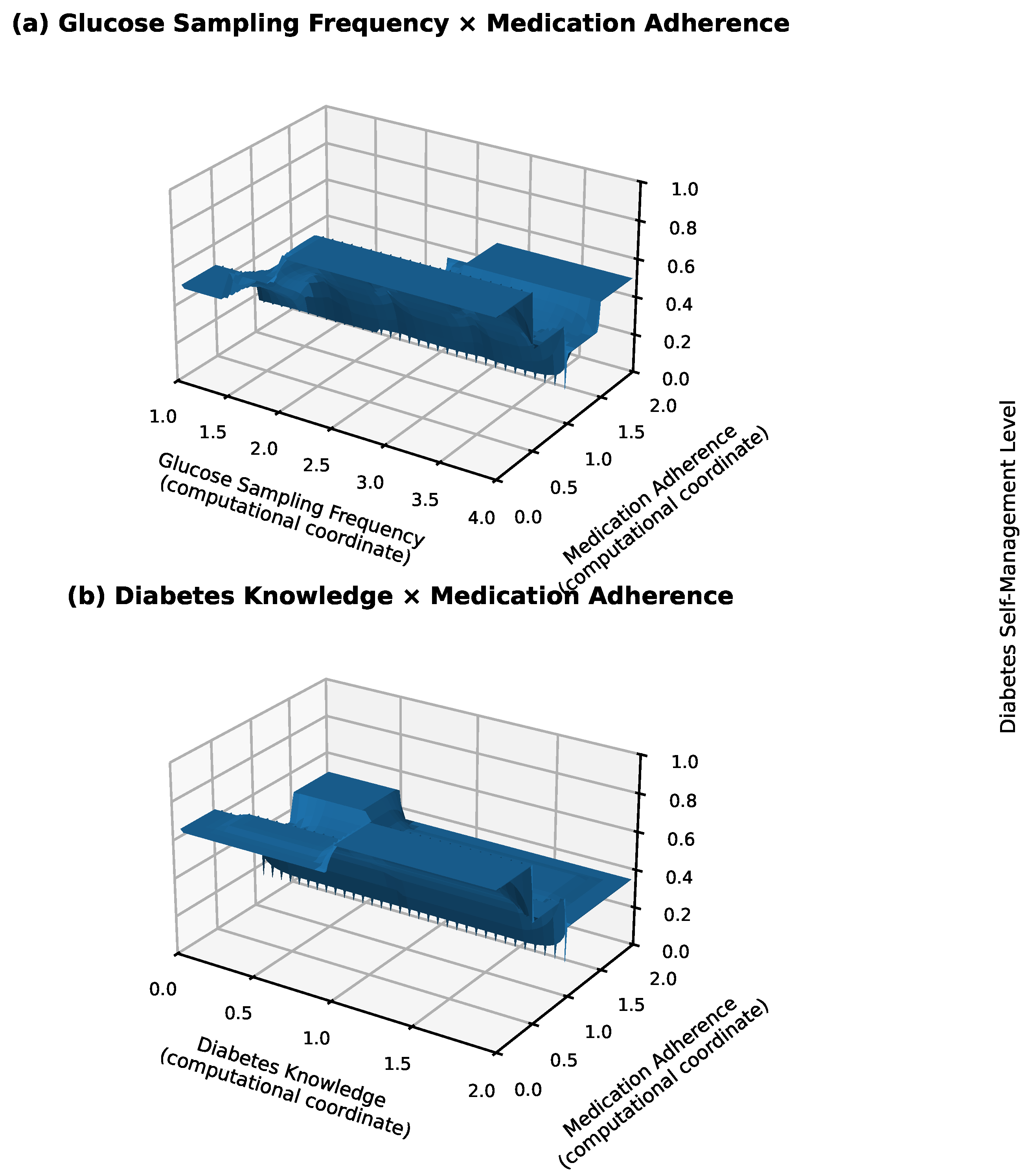
Figure 7a,b show the behavior of the current Diabetes Self-Management FIS under different combinations of its computational input coordinates. Figure 7a represents the interaction between Glucose Sampling Frequency and Medication Adherence with Diabetes Knowledge fixed at coordinate 1. Within inferentially supported regions, the surface contains lower, intermediate, and higher Diabetes Self-Management Level values, reflecting joint processing of the two varied inputs by the rule base.
Figure 7b shows the interaction between Diabetes Knowledge and Medication Adherence with Glucose Sampling Frequency fixed at coordinate 2.5. Transition regions and plateaus show that different Diabetes Knowledge coordinates can yield different outputs when combined with different Medication Adherence coordinates. Because the knowledge coordinates encode the categories Definition, Symptoms, and Treatment rather than an ordinal increase in knowledge, the surface should not be interpreted as a monotonic knowledge-effect relationship.
Grid cells at which the maximum rule-firing strength is zero are intentionally masked rather than assigned a runtime fallback value. These surfaces represent the internal behavior of the current membership functions and rule base and should not be interpreted as a direct measure of glycemic control, as evidence of causal relationships, or as proof that the current FIS generated the archived historical outputs.
Figure 7.
Response surfaces regenerated from the current Diabetes Self-Management FIS specification: (a) Glucose Sampling Frequency and Medication Adherence, with Diabetes Knowledge fixed at computational coordinate 1; (b) Diabetes Knowledge and Medication Adherence, with Glucose Sampling Frequency fixed at computational coordinate 2.5. All input axes represent the computational coordinates declared in the current FIS. Both surfaces use a 101×101 input grid. Blank cells indicate zero maximum rule-firing strength and are masked.
Figure 7.
Response surfaces regenerated from the current Diabetes Self-Management FIS specification: (a) Glucose Sampling Frequency and Medication Adherence, with Diabetes Knowledge fixed at computational coordinate 1; (b) Diabetes Knowledge and Medication Adherence, with Glucose Sampling Frequency fixed at computational coordinate 2.5. All input axes represent the computational coordinates declared in the current FIS. Both surfaces use a 101×101 input grid. Blank cells indicate zero maximum rule-firing strength and are masked.
3.3. Response-Surface Analysis of the Problem-Solving Capacity Model
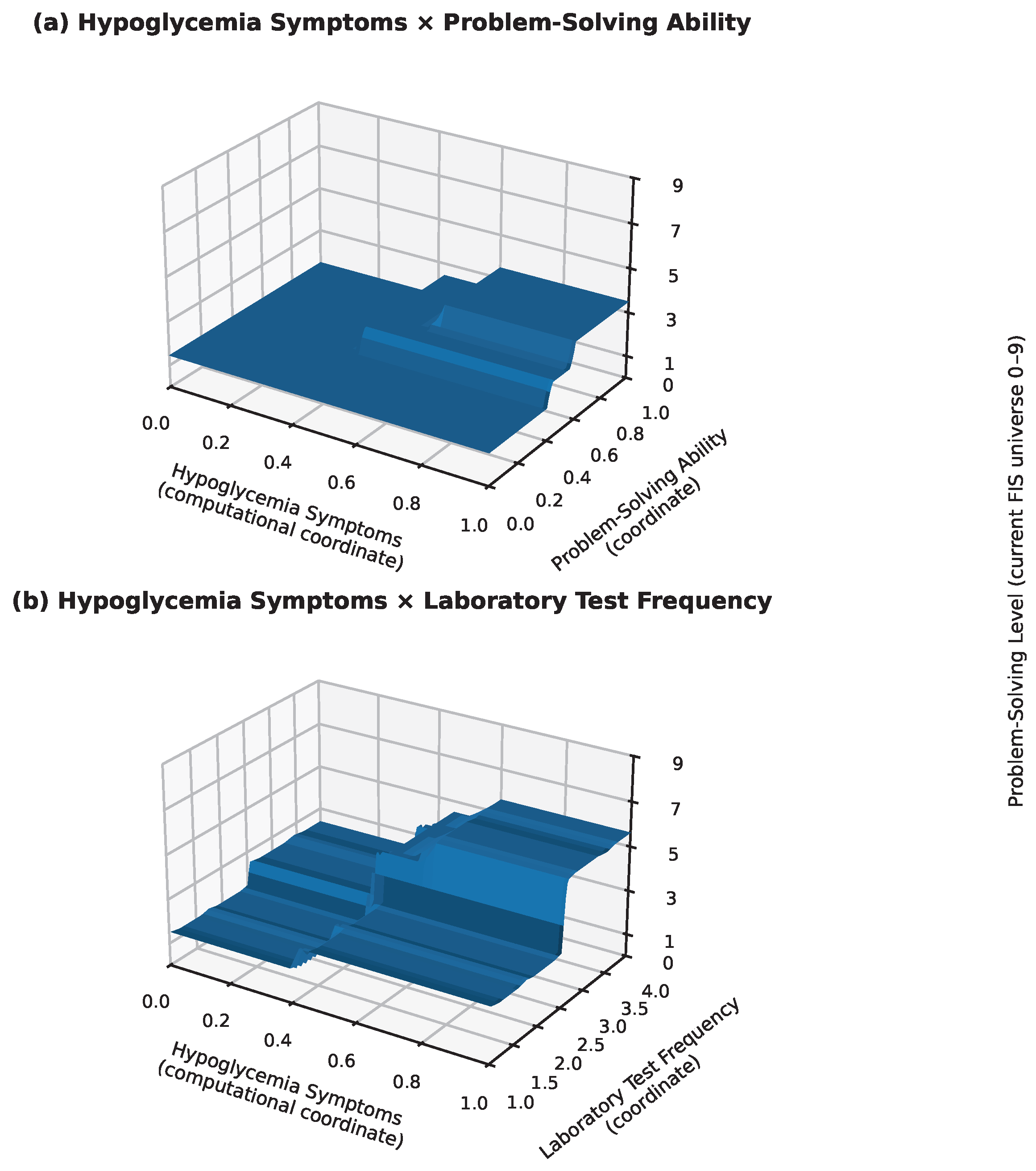
Figure 8a,b show the behavior of the current Problem-Solving Capacity FIS under different combinations of its computational input coordinates. In Figure 8a, Hypoglycemia Symptoms and Problem-Solving Ability are varied while Laboratory Test Frequency and Educational Level are fixed at computational coordinates 2.5 and 2.5, respectively. Within inferentially supported regions, the resulting surface contains lower, intermediate, and higher Problem-Solving Level values generated jointly by the rule base.
Figure 8b represents Hypoglycemia Symptoms and Laboratory Test Frequency while Problem-Solving Ability and Educational Level are fixed at computational coordinates 0.5 and 2.5, respectively. The surface shows transitions among Problem-Solving Level regions as the two varied coordinates change. Laboratory Test Frequency is represented on the current FIS coordinate universe [1,4]; these coordinates are model positions for the linguistic categories Once, Twice, Three times, and Four times rather than a validated equal-interval quantitative scale.
Grid cells at which the maximum rule-firing strength is zero are intentionally masked rather than assigned a runtime fallback value. The vertical axis represents the current FIS Problem-Solving Level universe [0,9], which is distinct from the 1–9 raw questionnaire-derived reference scale used in the archival reanalysis. These surfaces visualize the internal behavior of the current membership functions and rule base and should not be interpreted as evidence that a higher laboratory-test frequency or a particular input condition directly produces greater clinical problem-solving capacity, nor as proof that the current FIS generated the archived historical outputs.
Figure 8.
Response surfaces regenerated from the current Problem-Solving Capacity FIS specification: (a) Hypoglycemia Symptoms and Problem-Solving Ability, with Laboratory Test Frequency = 2.5 and Educational Level = 2.5 fixed; (b) Hypoglycemia Symptoms and Laboratory Test Frequency, with Problem-Solving Ability = 0.5 and Educational Level = 2.5 fixed. All input axes represent computational coordinates declared in the current FIS. The vertical axis uses the current FIS output universe [0,9], which is distinct from the 1–9 raw questionnaire-derived reference scale used in the archival reanalysis. Both surfaces use a 101×101 input grid. Blank cells indicate zero maximum rule-firing strength and are masked.
Figure 8.
Response surfaces regenerated from the current Problem-Solving Capacity FIS specification: (a) Hypoglycemia Symptoms and Problem-Solving Ability, with Laboratory Test Frequency = 2.5 and Educational Level = 2.5 fixed; (b) Hypoglycemia Symptoms and Laboratory Test Frequency, with Problem-Solving Ability = 0.5 and Educational Level = 2.5 fixed. All input axes represent computational coordinates declared in the current FIS. The vertical axis uses the current FIS output universe [0,9], which is distinct from the 1–9 raw questionnaire-derived reference scale used in the archival reanalysis. Both surfaces use a 101×101 input grid. Blank cells indicate zero maximum rule-firing strength and are masked.
3.4. Response-Surface Analysis of the Psychosocial Status Model
Figure 9a,b show the behavior of the current Psychosocial Status FIS under different combinations of its computational input coordinates. In Figure 9a, Emotional Status and Educational Level are varied while Family Support and Income Level are fixed at computational coordinates 0.5 and 15,000 MXN/month, respectively. Under this cross-section, the surface is invariant along the Educational Level axis. Inspection of the current rule table confirms that, for any fixed combination of Emotional Status, Family Support, and Income Level antecedents, the consequent category is unchanged across all four Educational Level antecedents; Figure 9a therefore should not be interpreted as demonstrating an educational-level effect.
Figure 9b shows Emotional Status and Family Support while Income Level and Educational Level are fixed at 15,000 MXN/month and computational coordinate 2.5, respectively. Emotional Status coordinates encode the current FIS categories None, Anxiety, Depression, Stress, and All; they are categorical model positions and should not be interpreted as a monotonic low-to-high emotional-severity scale. Similarly, Family Support coordinates represent the current fuzzy encoding of No and Yes rather than a validated continuous clinical scale.
Grid cells at which the maximum rule-firing strength is zero are intentionally masked rather than assigned a runtime fallback value. The 15,000 MXN/month fixed Income Level is an internal model coordinate selected as the midpoint of the declared [0,30,000] FIS universe and should not be interpreted as a universal socioeconomic or clinical cutoff. Taken together, the surfaces visualize nonlinear behavior of the current membership functions and rule base and should not be interpreted as evidence of causal associations, clinical importance rankings among inputs, or proof that the current FIS generated the archived historical outputs.
Figure 9.
Response surfaces regenerated from the current Psychosocial Status FIS specification: (a) Emotional Status and Educational Level, with Family Support = 0.5 and Income Level = 15,000 MXN/month fixed; (b) Emotional Status and Family Support, with Income Level = 15,000 MXN/month and Educational Level = 2.5 fixed. The Emotional Status, Family Support, and Educational Level axes represent computational coordinates declared in the current FIS; Income Level is the model-specific MXN/month input. Both surfaces use a 101×101 input grid. Blank cells indicate zero maximum rule-firing strength and are masked.
Figure 9.
Response surfaces regenerated from the current Psychosocial Status FIS specification: (a) Emotional Status and Educational Level, with Family Support = 0.5 and Income Level = 15,000 MXN/month fixed; (b) Emotional Status and Family Support, with Income Level = 15,000 MXN/month and Educational Level = 2.5 fixed. The Emotional Status, Family Support, and Educational Level axes represent computational coordinates declared in the current FIS; Income Level is the model-specific MXN/month input. Both surfaces use a 101×101 input grid. Blank cells indicate zero maximum rule-firing strength and are masked.
3.5. Archival Reanalysis: Correspondence in the 27 Clinical Cases
A descriptive archival reanalysis was performed by comparing the archived FES-T2DSC outputs from the original analysis with raw questionnaire-derived reference scores for the 27 clinical cases. The reference scores were reconstructed directly from Q1-Q31 using the formulas in Section 2.8 and then cross-checked against the stored raw Ref_*_Q columns (Problem-Solving using Ref_Problem_Q_1_9); Ajuste_* and Ref_*_Comparacion were excluded from all reported calculations.

Table 7.
Descriptive within-sample correspondence between archived FES-T2DSC outputs from the original analysis and raw questionnaire-derived reference scores for the 27 clinical cases.
Table 7.
Descriptive within-sample correspondence between archived FES-T2DSC outputs from the original analysis and raw questionnaire-derived reference scores for the 27 clinical cases.
| FES-T2DSC model | n | R2 | RMSE | Pearson r |
|---|---|---|---|---|
| Basic Self-Care Level | 27 | 0.971 | 0.030 | 0.988 |
| Diabetes Self-Management Level | 27 | 0.989 | 0.023 | 0.996 |
| Problem-Solving Capacity | 27 | 0.990 | 0.212 | 0.998 |
| Psychosocial Status | 27 | 0.985 | 0.224 | 0.999 |
The absolute RMSE values should be interpreted in relation to the different output scales of the four models and should not be directly compared across components. Figure 10 is generated from the same 27 case-level raw-reference/archived-output pairs underlying Table 7, and its displayed R2, RMSE, and Pearson r values are recomputed from those pairs rather than taken from aggregate table values. Because the current FIS files are not established as the generators of these archived outputs (Section 2.3), the indicators above describe within-sample correspondence in an archival reanalysis and should not be interpreted as evidence of current-model performance, validation, or generalizability.
Figure 10.
Descriptive archival within-sample correspondence between raw questionnaire-derived reference scores and archived FES-T2DSC outputs for the same 27 clinical cases underlying Table 7: (a) Basic Self-Care Level; (b) Diabetes Self-Management Level; (c) Problem-Solving Capacity; and (d) Psychosocial Status. Each panel reports n, R2, RMSE, and Pearson r recomputed from its 27 case-level pairs. The raw references were reconstructed directly from questionnaire items and cross-checked against the stored raw Ref_*_Q columns; Ajuste_* and Ref_*_Comparacion were excluded. No current FIS file was used to generate the archived y-values, and the figure does not constitute independent validation, current-model performance evidence, or evidence of generalizability.
Figure 10.
Descriptive archival within-sample correspondence between raw questionnaire-derived reference scores and archived FES-T2DSC outputs for the same 27 clinical cases underlying Table 7: (a) Basic Self-Care Level; (b) Diabetes Self-Management Level; (c) Problem-Solving Capacity; and (d) Psychosocial Status. Each panel reports n, R2, RMSE, and Pearson r recomputed from its 27 case-level pairs. The raw references were reconstructed directly from questionnaire items and cross-checked against the stored raw Ref_*_Q columns; Ajuste_* and Ref_*_Comparacion were excluded. No current FIS file was used to generate the archived y-values, and the figure does not constitute independent validation, current-model performance evidence, or evidence of generalizability.
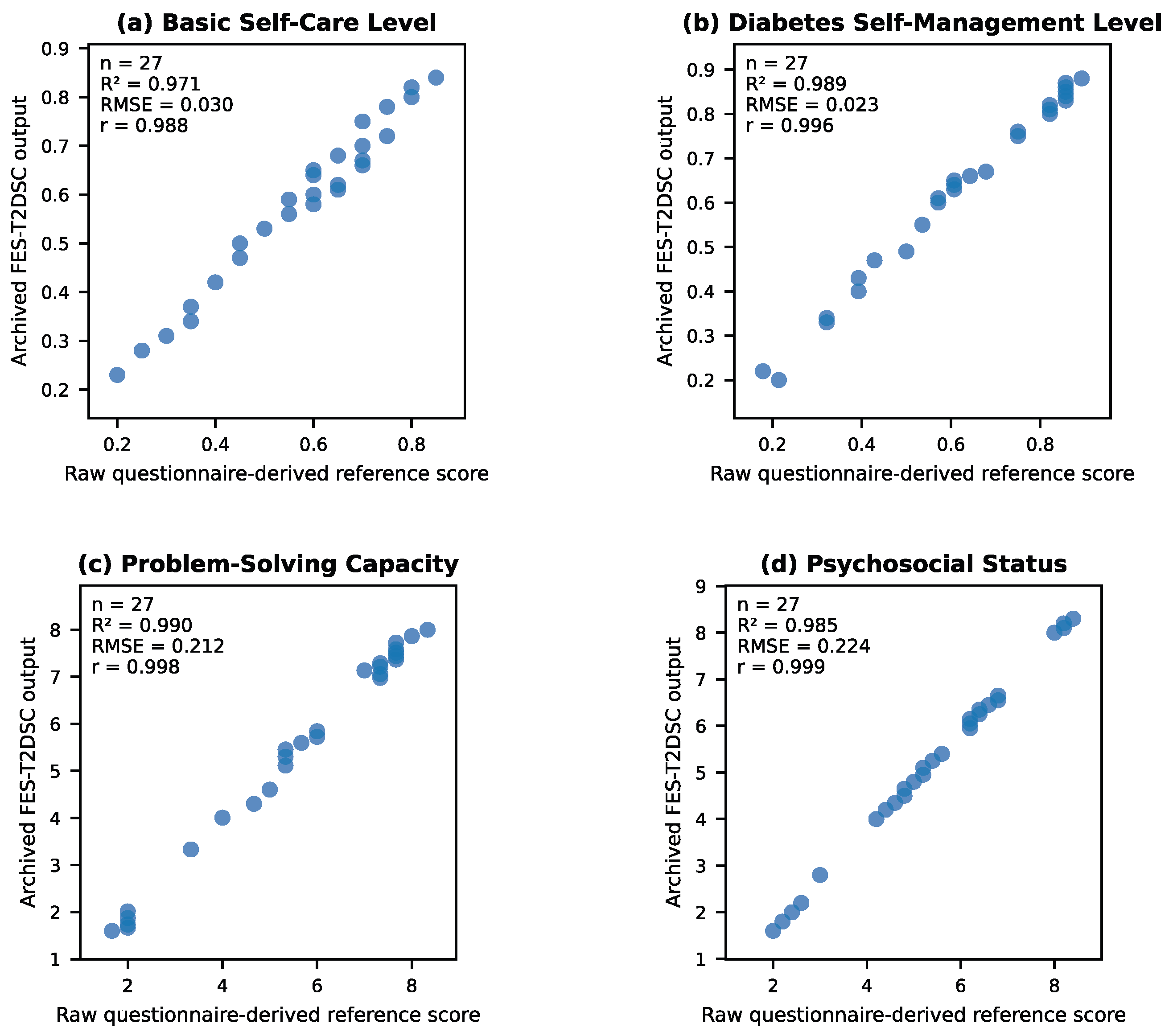
These cases do not constitute an independent test set because information from the same clinical sample had previously informed components of model development. The reported indicators therefore describe within-sample correspondence and do not establish out-of-sample performance, independent clinical validation, or generalizability.
3.6. Synthetic Configurations: Historical Descriptive Context Only
The source analysis expanded the 27 seed clinical cases with 93 synthetic configurations, yielding 120 computational configurations per model. The synthetic configurations were intended to broaden the explored computational space and do not represent additional patients or independent clinical ground truth. The exact procedure used to generate them (sampling distributions, inter-variable dependencies, plausibility constraints, and pseudo-random seed) is not fully recoverable from the retained documentation.
Because this generation procedure cannot be fully reconstructed, the resulting 120-configuration indicators are excluded from the primary quantitative evidence reported in this manuscript and are not used to support any claim of computational stability, robustness, external validity, predictive performance, or population-level fidelity.
4. Discussion
The principal scientific contribution of FES-T2DSC is the application-specific integration of four complementary self-care dimensions in people with T2DM—Basic Self-Care, Diabetes Self-Management, Problem-Solving Capacity, and Psychosocial Status—within a fuzzy rule-based architecture. This organization represents clinical, behavioral, and psychosocial conditions through gradual relationships and linguistic rules, consistent with person-centered care and diabetes self-management education frameworks that recognize the interaction of multiple factors in disease management. The demonstrated system property is an inspectable assessment-support layer that preserves domain-specific outputs and traceable rule structures; recommendation generation, clinical workflow integration, decision-efficiency improvement, adaptive behavior, and deployment effects were not evaluated.
The regenerated response surfaces in Figure 6, Figure 7, Figure 8 and Figure 9 visualize structural behavior of the currently available FIS specifications and should not be attributed to the archived historical output-generating process. For Basic Self-Care, the inspected surfaces involve Nutrition, Daily Caloric Intake, Exercise Frequency, Exercise Type, and BMI and can be discussed in relation to nutrition therapy [41], dietary patterns [42,43,44], and the dose and type of physical activity [45]. For Diabetes Self-Management, the inspected surfaces involve glucose-monitoring, medication-adherence, and diabetes-knowledge coordinates and can be discussed in relation to current glucose-monitoring recommendations [46] and diabetes education and knowledge [47,48,49], without imposing an ordinal interpretation on the knowledge categories.
For Problem-Solving Capacity, the current-FIS surfaces involving hypoglycemia symptoms, laboratory-test frequency, and problem-solving ability provide an application-specific view of a multidimensional self-management component, consistent with literature on problem-solving interventions in diabetes [50]. For Psychosocial Status, the current rule base permits inspection of Emotional Status, Family Support, and Income Level relations [18,51]; however, Educational Level is structurally consequent-invariant in the present 120-rule table and Figure 9a is correspondingly invariant along that axis. The current model therefore does not provide evidence of an educational-level effect within the Psychosocial output.
The slopes, transitions, and plateaus represented in the response surfaces can be inspected as properties of the encoded membership functions and rule bases. This direct inspectability of the encoded model structure is relevant to discussions of interpretability in clinical decision-support systems [52,53], but it should not be equated with empirically validated user- or clinician-level interpretability.
The archival reanalysis reported within-sample correspondence between archived FES-T2DSC outputs and raw questionnaire-derived reference scores in the 27 clinical cases (Table 7). Because the current FIS files are not established as the generators of these archived outputs, these quantitative indicators are treated as descriptive results of the archival reanalysis rather than as evidence of current-model performance, validity, or reproducibility.
The 93 synthetic configurations are interpreted only as historical descriptive context rather than additional clinical evidence or validation evidence. Synthetic data in health care require explicit consideration of fidelity, privacy, and task-specific utility [54,55,56]. The available materials do not support a claim that the synthetic configurations constitute statistically faithful samples from a real-world T2DM population.
Income Level and Educational Level were included as contextual variables associated with the conditions under which diabetes self-management occurs, not as intrinsic attributes of individual ability. In the current Psychosocial rule base, Educational Level is structurally redundant with respect to consequent selection; its inclusion should therefore be treated as a model-design limitation requiring reconsideration in future revision rather than as evidence that education changes the Psychosocial output. More generally, a less favorable output associated with contextual variables should not be interpreted as a personal deficit or used in isolation to establish clinical priorities. Because socioeconomic and educational conditions vary across populations, regions, and time periods, the associated thresholds and rules may introduce bias or limit transferability and would require reassessment or recalibration before use in other populations.
The reference cohort was small and predominantly female (22 of 27 participants; 81.5%) and was recruited from a single municipal outpatient setting in Nogales, Veracruz. These characteristics limit representativeness and should be considered when assessing transferability to populations with different sex distributions, socioeconomic contexts, or care settings. The clinical data corresponded to a single assessment without longitudinal follow-up.
The available documentation does not establish that the currently available FIS files generated the archived historical outputs analyzed in Section 3.5. Consequently, the current model files should not be interpreted as proven generators of those archived results.
Educational Level uses the same ordered universe [1,4] in both the Problem-Solving and Psychosocial models; the Basic category is numerically identical across both models, while the Secondary, Higher Education, and Postgraduate categories use different breakpoints between the two models. No cross-domain metric equivalence is assumed, and the available documentation does not establish a specific rationale for the different breakpoints. The Problem-Solving model’s computational output universe ([0,9]) and the raw questionnaire-derived reference scale for this dimension (1-to-9) are distinct methodological objects; the current FIS specification for this output is [0,9], and no requirement of numerical identity with the questionnaire-derived scale is assumed.
4.1. Model-Integrity Note: Membership-Function Support and Rule-Firing Considerations
A structural check of the four current FIS artifacts identified specific points within each declared input universe at which every membership function of that input evaluates to zero (e.g., Nutrition at x=0 and x=1; Daily Caloric Intake at x=500 and x=2000; Exercise Frequency at x=7; Exercise Type at x=0 and x=1; BMI at x=35 in the Basic Self-Care model; the Glucose Sampling, Medication, and Knowledge coordinates at their respective universe boundaries in the Diabetes Self-Management model; Laboratory Test Frequency at x=1 in the Problem-Solving model; and Emotional Status at x=0 and x=4.5 in the Psychosocial model). These zero-membership points are a verified structural property of the current membership-function definitions.
Whether a zero-membership point at a single input necessarily produces a global no-rule-fired condition for that case depends on the rule-base structure. The Diabetes Self-Management, Problem-Solving, and Psychosocial rule bases do not use don’t-care antecedents; therefore, if every membership function of one input evaluates to zero, every rule that references that input has zero firing strength and no rule can fire. In the Basic Self-Care rule base, however, two rules contain don’t-care antecedents (index 0) for specific inputs (Exercise Frequency and the pair Exercise Type/BMI); for those specific inputs, a zero-membership point does not by itself guarantee a global no-rule-fired condition because a rule that ignores the affected input can still be evaluated. For Nutrition and Daily Caloric Intake in the Basic Self-Care model, no rule ignores those inputs, so their zero-membership points do imply zero firing strength across all rules.
At input values for which all applicable rules have zero firing strength, runtime behavior depends on the MATLAB release and evaluation options used. Under current evalfis behavior, NoRuleFiredMessage=“warning (the current default) issues a warning and sets the defuzzified output to the mean of the output range; “none suppresses the message while using the same mean-of-range output, and “error can instead be configured to raise an error. Because the historical MATLAB release and evaluation options used for the original computational analysis were not recovered, the historical runtime behavior at these points cannot be established. The exact crisp input matrix supplied to each FIS for the 27 clinical cases was also not recovered, so it cannot currently be established whether any observed case coincided with these zero-membership points.
The Basic Self-Care rule base additionally contains 218 rule lines corresponding to 216 unique antecedent patterns, including two exact duplicate antecedent groups and two rules with don’t-care antecedents; its expanded linguistic coverage corresponds to 223 of 432 possible discrete combinations, leaving 209 combinations without an explicit rule.
Larger, independent, and more diverse cohorts and prospective study designs will be required before reproducibility, external performance, or generalizability can be established.
5. Conclusions
FES-T2DSC organizes four complementary dimensions of self-care in T2DM—Basic Self-Care, Diabetes Self-Management, Problem-Solving Capacity, and Psychosocial Status—within a type-1 Mamdani fuzzy inference architecture. Its explicit membership functions and linguistic rule bases provide an inspectable representation of how combinations of clinical, behavioral, and contextual variables contribute to separate domain-level outputs.
A descriptive archival reanalysis of the 27 clinical cases quantified within-sample correspondence between the archived outputs and the raw questionnaire-derived reference scores; the 93 synthetic configurations are retained only as historical descriptive context because their generation procedure cannot be fully reconstructed. None of these indicators should be interpreted as evidence of current-model performance, external clinical validity, independent predictive performance, or generalizability.
The intended contribution of FES-T2DSC is primarily integrative and application-specific: the present work demonstrates an inspectable multidomain assessment-support architecture, not a validated recommendation engine or deployed clinical decision workflow. Recommendation generation, workflow integration, decision-efficiency improvement, adaptive behavior, and clinical deployment remain unevaluated. Further evaluation in larger, independent, and more diverse cohorts, preferably using prospective designs and fully reproducible model-execution pipelines, is required before external performance, generalizability, decision impact, or clinical utility can be established.
Supplementary Materials
The following supporting information can be downloaded at the website of this paper posted on Preprints.org: the four current FIS files; the 31-item operational questionnaire/scoring specification; frozen PDF/PNG/SVG publication assets, portable generation scripts, and public provenance manifests for Figure 1, Figure 2, Figure 3, Figure 4, Figure 5, Figure 6, Figure 7, Figure 8 and Figure 9; response-surface X/Y/Z, maximum-rule-firing, and support-mask data archives for Figure 6, Figure 7, Figure 8 and Figure 9; and frozen publication assets, aggregate metrics, a public provenance manifest, and a fail-closed generation script for Figure 10. Full Figure 10 regeneration requires case-level analytical pairs that are not included in the public package. The retained documentation does not document authorization for public release of the underlying participant-level records; any access, if permissible, would be subject to applicable institutional, ethical, privacy, and data-governance requirements. Participant-level workbooks, the retained ethics dossier, and the superseded adjusted-analysis lineage (Ajuste_* and Ref_*_Comparacion) are not included in the public supplementary package. The generation procedure for the 93 historical synthetic configurations was not recovered and is therefore not presented as reproducible Supplementary Material.
Author Contributions
Conceptualization, Karla Cecilia Pérez Osorio; methodology, Yara Anahí Jímenez Nieto and Rita Flores Asis; software, Rita Flores Asis and Jorge Ernesto González Díaz; validation, Yara Anahí Jímenez Nieto and Karla Cecilia Pérez Osorio; formal analysis, Karla Cecilia Pérez Osorio and Rita Flores Asis; investigation, Yara Anahí Jímenez Nieto and Karla Cecilia Pérez Osorio; data curation, Nancy Aracely Cruz Ramos; writing—original draft preparation, Rita Flores Asis; writing—review and editing, Jorge Ernesto González Díaz; supervision and project administration, Adolfo Rodríguez Parada.
Funding
This research received no external funding.
Institutional Review Board Statement
The original data-collection protocol, entitled Estrategia de enfoque integral para mejorar el apego al autocuidado en pacientes con diabetes mellitus, received ethics approval from the Research Ethics Committee of the Faculty of Medicine, Ciudad Mendoza Campus, Universidad Veracruzana, on 4 July 2025. The committee is identified by code CONBIOETICA-30-CEI-004-20190710. FES-T2DSC was developed subsequently as a secondary computational analysis and was not part of the originally approved protocol. No separate amendment, waiver, or institutional determination specific to the secondary computational analysis (FES-T2DSC) was available in the retained documentation.
Informed Consent Statement
Informed consent was obtained from all participants involved in the original data collection.
Data Availability Statement
Participant-level data are not publicly available. The retained documentation does not document authorization for public release of the original participant-level records. Requests for access may be directed to the corresponding author; any access, if permissible, would be subject to applicable institutional, ethical, privacy, and data-governance requirements. The four current FIS files, the operational 31-item questionnaire/scoring specification, and non-participant computational artifacts supporting the reported figures are provided as Supplementary Materials. The exact historical crisp-input vectors used in the original FIS execution and the generation procedure for the 93 historical synthetic configurations were not recovered and are therefore not available for sharing.
Conflicts of Interest
The authors declare no conflicts of interest.
Use of Generative Artificial Intelligence
During the preparation of this manuscript, the authors used ChatGPT (OpenAI) for language refinement, selective translation assistance, editorial support, and generation of the Graphical Abstract, and Consensus to assist in identifying potentially relevant scientific literature. The manuscript translation, scientific terminology, interpretation, and final wording were reviewed and finalized by the authors based on their disciplinary expertise. The authors critically reviewed, edited, and verified all AI-assisted content and references using the original scientific sources and take full responsibility for the final content of the manuscript and Graphical Abstract.
Abbreviations
ADCES, Association of Diabetes Care & Education Specialists; ADCES7, ADCES7 Self-Care Behaviors; AI, artificial intelligence; BMI, body mass index; DSMES, Diabetes Self-Management Education and Support; FES-T2DSC, Fuzzy Expert System for Type 2 Diabetes Self-Care; FIS, fuzzy inference system; HbA1c, glycated hemoglobin; RMSE, root mean square error; R2, coefficient of determination
Appendix A. Questionnaire
Appendix A.1. Instructions
Participants were asked to select the response option that best represented their situation or behavior. The 31 items reproduced below constitute the operational questionnaire/scoring specification used in the present secondary computational reanalysis (Q1-Q31, verified against the raw reference-score formulas in Section 2.8). This operational specification does not by itself establish the exact physical form of the questionnaire administered during the original 2025 data collection; the retained ethics-committee documentation shows a 26-item representation, and this discrepancy has not been resolved. Item 22 was excluded from all domain scores because its direction could not be established unambiguously; items 17, 19, and 20 are treated as complementary information not incorporated into a domain score. Reverse-scored items were inverted as (6 minus Q) before aggregation, consistent with Equation (3).
Table A1.
Operational 31-item questionnaire/scoring specification used in the present secondary computational reanalysis.
Table A1.
Operational 31-item questionnaire/scoring specification used in the present secondary computational reanalysis.
| Item | Dimension | Questionnaire Item | Response Options |
|---|---|---|---|
| 1 | Basic Self-Care Level | My meals are balanced and include healthy foods. | Never; Rarely; Sometimes; Almost always; Always |
| 2 | Basic Self-Care Level | Do I know the amount of carbohydrates I should consume per day, and do I base my diet on this amount? | Never; Rarely; Sometimes; Almost always; Always |
| 3 | Basic Self-Care Level | I follow a specific meal plan for managing my diabetes, recommended by a nutritionist. | Never; Rarely; Sometimes; Almost always; Always |
| 4 | Basic Self-Care Level | I engage in physical activity such as walking, swimming, or aerobic exercise. | Never; Rarely; Sometimes; Almost always; Always |
| 5 | Basic Self-Care Level | How many times per week do I engage in physical activity for at least 30 minutes for my health? | Once a week; Twice a week; 3-4 times a week; 5-6 times a week; Every day |
| 6 | Diabetes Self-Management Level | I measure my blood glucose levels at home as recommended by my physician. | Never; Rarely; Sometimes; Almost always; Always |
| 7 | Diabetes Self-Management Level | I keep a record of my glucose values. | Never; Rarely; Sometimes; Almost always; Always |
| 8 | Diabetes Self-Management Level | How often do I measure my glucose values at home? | Less than once a week; Once a week; 2-4 times a week; 5-6 times a week; Every day |
| 9 | Diabetes Self-Management Level (reverse-scored) | How often do I forget to take my diabetes medications? | Never; Rarely; Sometimes; Almost always; Always |
| 10 | Diabetes Self-Management Level | I follow exactly the dose and schedule instructions for my medications. | Never; Rarely; Sometimes; Almost always; Always |
| 11 | Diabetes Self-Management Level | Could I explain to a friend how my diabetes medications work? | I could not; Very little; Basic idea; Detailed idea; Precise explanation |
| 12 | Diabetes Self-Management Level / Problem-Solving Capacity | I can identify symptoms of hyperglycemia or hypoglycemia. | Never; Rarely; Sometimes; Almost always; Always |
| 13 | Problem-Solving Capacity | I have had to take measures to correct my glucose levels when they are below the normal range. | Never; Rarely; Sometimes; Almost always; Always |
| 14 | Problem-Solving Capacity | I have had to take measures to correct my glucose levels when they are above the normal range. | Never; Rarely; Sometimes; Almost always; Always |
| 15 | Problem-Solving Capacity | I feel prepared to manage emergency situations related to my diabetes. | Never; Rarely; Sometimes; Almost always; Always |
| 16 | Problem-Solving Capacity | I seek help when I have problems managing my diabetes. | Never; Sometimes; I ask family for help; I go to the physician; I immediately inform family and physician |
| 17 | Complementary information (not incorporated into a domain score) | I regularly attend my medical follow-up appointments. | Never; Rarely; Sometimes; Almost always; Always |
| 18 | Problem-Solving Capacity | How many times per year do I undergo laboratory tests for diabetes control? | Less than once a year; Once a year; Every 6 months; Every 4 months; Every 3 months |
| 19 | Complementary information (not incorporated into a domain score) | In the past year, have I been evaluated by an ophthalmologist, podiatrist, or nutritionist? | None; Ophthalmologist only; Nutritionist only; Podiatrist only; All three |
| 20 | Complementary information (not incorporated into a domain score) | How many times per month do I check my feet? | Once a month; Twice a month; 3-4 times a month; 5-10 times a month; Every day |
| 21 | Psychosocial Status | I use relaxation techniques such as meditation or deep breathing. | Never; Rarely; Sometimes; Almost always; Always |
| 22 | Not incorporated into the score (item excluded) | I believe stress affects my glucose levels and my overall diabetes management. | Never; Rarely; Sometimes; Almost always; Always |
| 23 | Psychosocial Status | During the past month, how often did I feel calm and relaxed? | Never; Rarely; Sometimes; Almost always; Always |
| 24 | Psychosocial Status | I have sufficient support from family, friends, and health professionals. | Never; Rarely; Sometimes; Almost always; Always |
| 25 | Psychosocial Status (reverse-scored) | During the past month, I had to cancel plans because of a problem such as feeling sad, depressed, or nervous. | Never; Rarely; Sometimes; Almost always; Always |
| 26 | Psychosocial Status | In general, would you say your health status is: | Poor; Fair; Good; Very good; Excellent |
| 27 | Psychosocial Status (reverse-scored) | To what extent does your diabetes hinder the achievement of your life goals? | Never; Rarely; Sometimes; Almost always; Always |
| 28 | Psychosocial Status | How satisfied are you with your current diabetes treatment and management plan? | Very dissatisfied; Dissatisfied; Neutral; Satisfied; Very satisfied |
| 29 | Psychosocial Status (reverse-scored) | Does the cost of your diabetes medication represent a financial difficulty for you or your family? | Never; Very little; Sometimes; Considerably; Yes, substantially |
| 30 | Psychosocial Status (reverse-scored) | I have difficulty affording medical supplies such as a glucose meter, test strips, lancets, or syringes. | Never; Rarely; Sometimes; Almost always; Always |
| 31 | Psychosocial Status (reverse-scored) | I believe the cost of a healthy diet makes it difficult for me to adhere to it. | Never; Rarely; Sometimes; Almost always; Always |
References
- Genitsaridi, I.; Salpea, P.; Salim, A.; Sajjadi, S.F.; Tomic, D.; James, S.; Thirunavukkarasu, S.; Issaka, A.; Chen, L.; Basit, A.; et al. 11th edition of the IDF Diabetes Atlas: Global, regional, and national diabetes prevalence estimates for 2024 and projections for 2050. Lancet Diabetes Endocrinol. 2026, 14, 149–156. [Google Scholar] [CrossRef] [PubMed]
- American Diabetes Association Professional Practice Committee for Diabetes. 2. Diagnosis and Classification of Diabetes: Standards of Care in Diabetes—2026. Diabetes Care 2026, 49 (Suppl. 1), S27–S49. [Google Scholar] [CrossRef] [PubMed]
- Kunutsor, S.K.; Balasubramanian, V.G.; Zaccardi, F.; Gillies, C.L.; Aroda, V.R.; Seidu, S.; Khunti, K. Glycaemic control and macrovascular and microvascular outcomes: A systematic review and meta-analysis of trials investigating intensive glucose-lowering strategies in people with type 2 diabetes. Diabetes Obes. Metab. 2024, 26, 2069–2081. [Google Scholar] [CrossRef] [PubMed]
- Powers, M.A.; Bardsley, J.K.; Cypress, M.; Funnell, M.M.; Harms, D.; Hess-Fischl, A.; Hooks, B.; Isaacs, D.; Mandel, E.D.; Maryniuk, M.D.; et al. Diabetes Self-management Education and Support in Adults With Type 2 Diabetes: A Consensus Report of the American Diabetes Association, the Association of Diabetes Care & Education Specialists, the Academy of Nutrition and Dietetics, the American Academy of Family Physicians, the American Academy of PAs, the American Association of Nurse Practitioners, and the American Pharmacists Association. Diabetes Educ. 2020, 46, 350–369. [Google Scholar] [CrossRef] [PubMed]
- Association of Diabetes Care and Education Specialists; Kolb, L. An Effective Model of Diabetes Care and Education: The ADCES7 Self-Care Behaviors™. Sci. Diabetes Self-Manag. Care 2021, 47, 30–53. [Google Scholar] [CrossRef] [PubMed]
- Davies, M.J.; Aroda, V.R.; Collins, B.S.; Gabbay, R.A.; Green, J.; Maruthur, N.M.; Rosas, S.E.; Del Prato, S.; Mathieu, C.; Mingrone, G.; et al. Management of Hyperglycemia in Type 2 Diabetes, 2022. A Consensus Report by the American Diabetes Association and the European Association for the Study of Diabetes. Diabetes Care 2022, 45, 2753–2786. [Google Scholar] [CrossRef] [PubMed]
- Zargoush, M.; Ghazalbash, S.; Hosseini, M.M.; Alemi, F.; Perri, D. Machine learning driven diabetes care using predictive-prescriptive analytics for personalized medication prescription. Sci. Rep. 2025, 15, 26811. [Google Scholar] [CrossRef] [PubMed]
- Jacobs, P.G.; Herrero, P.; Facchinetti, A.; Vehi, J.; Kovatchev, B.; Breton, M.D.; Cinar, A.; Nikita, K.S.; Doyle, F.J.; Bondia, J.; et al. Artificial Intelligence and Machine Learning for Improving Glycemic Control in Diabetes: Best Practices, Pitfalls, and Opportunities. IEEE Rev. Biomed. Eng. 2024, 17, 19–41. [Google Scholar] [CrossRef] [PubMed]
- Zadeh, L.A. Fuzzy sets. Inf. Control 1965, 8, 338–353. [Google Scholar] [CrossRef]
- Thakkar, H.; Shah, V.; Yagnik, H.; Shah, M. Comparative anatomization of data mining and fuzzy logic techniques used in diabetes prognosis. Clin. eHealth 2021, 4, 12–23. [Google Scholar] [CrossRef]
- Ahmadi, H.; Gholamzadeh, M.; Shahmoradi, L.; Nilashi, M.; Rashvand, P. Diseases diagnosis using fuzzy logic methods: A systematic and meta-analysis review. Comput. Methods Programs Biomed. 2018, 161, 145–172. [Google Scholar] [CrossRef] [PubMed]
- Salvi, M.; Dogan, S.; Inamdar, M.A.; Raghavendra, U.; Gudigar, A.; Nitti, F.; Ferraris, A.; Tuncer, T.; Barua, P.D.; Molinari, F.; et al. Evolution of fuzzy logic in medical applications: Methods, trends and clinical applications. Expert Syst. Appl. 2026, 321, 132344. [Google Scholar] [CrossRef]
- Asmat, K.; Dhamani, K.; Gul, R.; Froelicher, E.S. The effectiveness of patient-centered care vs. usual care in type 2 diabetes self-management: A systematic review and meta-analysis. Front. Public Health 2022, 10, 994766. [Google Scholar] [CrossRef] [PubMed]
- Opoku, R.; Ackon, S.K.; Kumah, E.; Botchwey, C.O.-A.; Appiah, N.E.; Korsah, S.; Peprah, M. Self-care behaviors and associated factors among individuals with type 2 diabetes in Ghana: A systematic review. BMC Endocr. Disord. 2023, 23, 256. [Google Scholar] [CrossRef] [PubMed]
- Romadlon, D.S.; Tu, Y.-K.; Chen, Y.-C.; Hasan, F.; Kurniawan, R.; Chiu, H.-Y. Comparative Effects of Diabetes Self-Management Programs on Type 2 Diabetes Clinical Outcomes: A Systematic Review and Network Meta-Analysis. Diabetes Metab. Res. Rev. 2024, 40, e3840. [Google Scholar] [CrossRef] [PubMed]
- Woodward, A.; Walters, K.; Davies, N.; Nimmons, D.; Protheroe, J.; Chew-Graham, C.A.; Stevenson, F.; Armstrong, M. Barriers and facilitators of self-management of diabetes amongst people experiencing socioeconomic deprivation: A systematic review and qualitative synthesis. Health Expect. 2024, 27, e14070. [Google Scholar] [CrossRef] [PubMed]
- Hill-Briggs, F.; Adler, N.E.; Berkowitz, S.A.; Chin, M.H.; Gary-Webb, T.L.; Navas-Acien, A.; Thornton, P.L.; Haire-Joshu, D. Social Determinants of Health and Diabetes: A Scientific Review. Diabetes Care 2021, 44, 258–279. [Google Scholar] [CrossRef] [PubMed]
- Young-Hyman, D.; de Groot, M.; Hill-Briggs, F.; Gonzalez, J.S.; Hood, K.; Peyrot, M. Psychosocial Care for People With Diabetes: A Position Statement of the American Diabetes Association. Diabetes Care 2016, 39, 2126–2140. [Google Scholar] [CrossRef] [PubMed]
- Puzhakkal, S.; Kavanagh, S.; Conway, B.; Kow, C.S.; Hasan, S.S. Self-care and self-management in diabetes: Concepts, theories and practices. Int. J. Clin. Pharm. 2025, 47, 2094–2100. [Google Scholar] [CrossRef] [PubMed]
- American Diabetes Association Professional Practice Committee for Diabetes. 5. Facilitating Positive Health Behaviors and Well-being to Improve Health Outcomes: Standards of Care in Diabetes—2026. Diabetes Care 2026, 49 (Suppl. 1), S89–S131. [Google Scholar] [CrossRef] [PubMed]
- El-Sappagh, S.; Alonso, J.M.; Ali, F.; Ali, A.; Jang, J.-H.; Kwak, K.-S. An ontology-based interpretable fuzzy decision support system for diabetes diagnosis. IEEE Access 2018, 6, 37371–37394. [Google Scholar] [CrossRef]
- Colella, Y.; De Lauri, C.; Improta, G.; Rossano, L.; Vecchione, D.; Spinosa, T.; Giordano, V.; Verdoliva, C.; Santini, S. A Clinical Decision Support System based on fuzzy rules and classification algorithms for monitoring the physiological parameters of type-2 diabetic patients. Math. Biosci. Eng. 2021, 18, 2654–2674. [Google Scholar] [CrossRef] [PubMed]
- Grande-Ramírez, J.R.; Meza-Palacios, R.; Aguilar-Lasserre, A.A.; Flores-Asis, R.; Vázquez-Rodríguez, C.F. Intelligent fuzzy system to assess the risk of type 2 diabetes and diagnosis in marginalized regions. IAES Int. J. Artif. Intell. 2024, 13, 1935–1944. [Google Scholar] [CrossRef]
- Meza-Palacios, R.; Aguilar-Lasserre, A.A.; Ureña-Bogarín, E.L.; Vázquez-Rodríguez, C.F.; Posada-Gómez, R.; González-Huerta, M.A. Sistema experto difuso para el control metabólico en pacientes con diabetes mellitus tipo 2. Acta Univ. 2018, 28, 67–74. [Google Scholar] [CrossRef]
- Nagaraj, P.; Deepalakshmi, P. An intelligent fuzzy inference rule-based expert recommendation system for predictive diabetes diagnosis. Int. J. Imaging Syst. Technol. 2022, 32, 1373–1396. [Google Scholar] [CrossRef]
- Lee, C.-S.; Wang, M.-H.; Hagras, H. A Type-2 Fuzzy Ontology and Its Application to Personal Diabetic-Diet Recommendation. IEEE Trans. Fuzzy Syst. 2010, 18, 374–395. [Google Scholar] [CrossRef]
- Lee, C.-S.; Wang, M.-H.; Acampora, G.; Hsu, C.-Y.; Hagras, H. Diet assessment based on type-2 fuzzy ontology and fuzzy markup language. Int. J. Intell. Syst. 2010, 25, 1187–1216. [Google Scholar] [CrossRef]
- Meza-Palacios, R.; Aguilar-Lasserre, A.A.; Ureña-Bogarín, E.L.; Vázquez-Rodríguez, C.F.; Posada-Gómez, R.; Trujillo-Mata, A. Development of a fuzzy expert system for the nephropathy control assessment in patients with type 2 diabetes mellitus. Expert Syst. Appl. 2017, 72, 335–343. [Google Scholar] [CrossRef]
- Nnamoko, N.; Arshad, F.; England, D.; Vora, J.; Norman, J. Fuzzy Inference Model for Type 2 Diabetes Management: A Tool for Regimen Alterations. J. Comput. Sci. Appl. 2015, 3, 40–45. [Google Scholar] [CrossRef]
- Cambui, Y.R.S.; Santos, O.C.D.; Santos, M.C.S.; Santos, J.A.D. Priorização de pacientes com Diabetes Mellitus: uma abordagem via sistema especialista fuzzy. Stud. Health Sci. 2026, 7, e23924. [Google Scholar] [CrossRef]
- Ruissen, M.M.; Torres-Peña, J.D.; Uitbeijerse, B.S.; Arenas de Larriva, A.P.; Huisman, S.D.; Namli, T.; Salzsieder, E.; Vogt, L.; Ploessnig, M.; van der Putte, B.; et al. Clinical impact of an integrated e-health system for diabetes self-management support and shared decision making (POWER2DM): A randomised controlled trial. Diabetologia 2023, 66, 2213–2225. [Google Scholar] [CrossRef] [PubMed]
- Mamykina, L.; Smaldone, A.M.; Bakken, S.R.; Cole-Lewis, H.; Heitkemper, E.M.; Jia, H.; Kukafka, R.; Tobin, J.N.; Cassells, A.; Davidson, P.G.; et al. Promoting Problem-Solving Among Low-Income Adults With Type 2 Diabetes: Cluster-Randomized Controlled Trial of a Mobile Health Intervention With SMS Text Messaging (Mobile Diabetes Detective). J. Med. Internet Res. 2026, 28, e82305. [Google Scholar] [CrossRef] [PubMed]
- Groeneveld, L.; Terwee, C.B.; van der Willik, E.M.; van Ittersum, F.J.; Langendoen-Gort, M.; Pals, F.; Blom, M.T.; Beulens, J.W.J.; Elders, P.J.M.; Rutters, F. Assessment of validity, reliability, responsiveness and acceptability of seven Dutch-Flemish PROMIS computerised adaptive tests (CATs) in Dutch people with type 2 diabetes: An observational and qualitative study. BMJ Open 2025, 15, e087898. [Google Scholar] [CrossRef] [PubMed]
- Mitchell, S.E.; Kallen, M.A.; Troost, J.P.; De La Cruz, B.A.; Bragg, A.; Martin-Howard, J.; Moldovan, I.; Miner, J.A.; Jack, B.W.; Carlozzi, N.E. Four New Patient-Reported Outcome Measures Examining Health-Seeking Behavior in Persons With Type 2 Diabetes Mellitus (REDD-CAT): Instrument Development Study. JMIR Diabetes 2024, 9, e63434. [Google Scholar] [CrossRef] [PubMed]
- Burgermaster, M.; Desai, P.M.; Heitkemper, E.M.; Juul, F.; Mitchell, E.G.; Turchioe, M.; Albers, D.J.; Levine, M.E.; Larson, D.; Mamykina, L. Who needs what (features) when? Personalizing engagement with data-driven self-management to improve health equity. J. Biomed. Inform. 2023, 144, 104419. [Google Scholar] [CrossRef] [PubMed]
- Narindrarangkura, P.; Dejhansathit, S.; Khan, U.; Day, M.; Boren, S.A.; Simoes, E.J.; Kim, M.S. Developing and Evaluating SEE-Diabetes: A Patient-Centered Educational Decision Support System for Diabetes Care. J. Eval. Clin. Pract. 2025, 31, e14234. [Google Scholar] [CrossRef] [PubMed]
- Kostopoulou, K.; Lekka, D.; Pnevmatikakis, A.; Angelova, N.; Stafylas, P.; Tamouridis, S.; Bargiota, A.; Kyriazakos, S. Multidomain Behavioral Change Digital Coaching for Chronic Disease Management in Patients With Type 2 Diabetes: Framework Development and Preliminary Evaluation. JMIR Form. Res. 2025, 9, e73807. [Google Scholar] [CrossRef] [PubMed]
- Gacto, M.J.; Alcalá, R.; Herrera, F. Interpretability of linguistic fuzzy rule-based systems: An overview of interpretability measures. Inf. Sci. 2011, 181, 4340–4360. [Google Scholar] [CrossRef]
- Cao, J.; Zhou, T.; Zhi, S.; Lam, S.; Ren, G.; Zhang, Y.; Wang, Y.; Dong, Y.; Cai, J. Fuzzy inference system with interpretable fuzzy rules: Advancing explainable artificial intelligence for disease diagnosis—A comprehensive review. Inf. Sci. 2024, 662, 120212. [Google Scholar] [CrossRef]
- Efthimiou, O.; Seo, M.; Chalkou, K.; Debray, T.; Egger, M.; Salanti, G. Developing clinical prediction models: a step-by-step guide. BMJ 2024, 386. [Google Scholar] [CrossRef] [PubMed]
- Evert, A.B.; Dennison, M.; Gardner, C.D.; Garvey, W.T.; Lau, K.H.K.; MacLeod, J.; et al. Nutrition therapy for adults with diabetes or prediabetes: A consensus report. Diabetes Care 2019, 42, 731–754. [Google Scholar] [CrossRef] [PubMed]
- Szczerba, E.; Barbaresko, J.; Schiemann, T.; Stahl-Pehe, A.; Schwingshackl, L.; Schlesinger, S. Diet in the management of type 2 diabetes: umbrella review of systematic reviews with meta-analyses of randomised controlled trials. BMJ Med. 2023, 2. [Google Scholar] [CrossRef] [PubMed]
- Jing, T.; Zhang, S.; Bai, M.; Chen, Z.; Gao, S.; Li, S.; et al. Effect of Dietary Approaches on Glycemic Control in Patients with Type 2 Diabetes: A Systematic Review with Network Meta-Analysis of Randomized Trials. Nutrients 2023, 15, 3156. [Google Scholar] [CrossRef] [PubMed]
- Bonekamp, N.E.; van Damme, I.; Geleijnse, J.M.; Winkels, R.M.; Visseren, F.L.J.; Morris, P.B.; et al. Effect of dietary patterns on cardiovascular risk factors in people with type 2 diabetes. A systematic review and network meta-analysis. Diabetes Res. Clin. Pract. 2023, 195, 110207. [Google Scholar] [CrossRef] [PubMed]
- Gallardo-Gómez, D.; Salazar-Martínez, E.; et al. Optimal Dose and Type of Physical Activity to Improve Glycemic Control in People Diagnosed With Type 2 Diabetes: A Systematic Review and Meta-analysis. Diabetes Care 2024, 47, 295–303. [Google Scholar] [CrossRef] [PubMed]
- American Diabetes Association Professional Practice Committee for Diabetes. 7. Diabetes Technology: Standards of Care in Diabetes—2026. Diabetes Care 2026, 49 (Suppl. 1), S150–S165. [Google Scholar] [CrossRef] [PubMed]
- Shiferaw, W.S.; Akalu, T.Y.; Desta, M.; Kassie, A.M.; Petrucka, P.M.; Aynalem, Y.A. Effect of educational interventions on knowledge of the disease and glycaemic control in patients with type 2 diabetes mellitus: A systematic review and meta-analysis of randomised controlled trials. BMJ Open 2021. [Google Scholar] [CrossRef] [PubMed]
- Chrvala, C.A.; Sherr, D.; Lipman, R.D. Diabetes self-management education for adults with type 2 diabetes mellitus: A systematic review of the effect on glycemic control. Patient Educ. Couns. 2016, 99, 926–943. [Google Scholar] [CrossRef] [PubMed]
- Chowdhury, H.A.; Harrison, C.L.; Siddiquea, B.N.; Tissera, S.; Afroz, A.; Ali, L.; et al. The effectiveness of diabetes self-management education intervention on glycaemic control and cardiometabolic risk in adults with type 2 diabetes in low- and middle-income countries: A systematic review and meta-analysis. PLoS ONE 2024. [Google Scholar] [CrossRef] [PubMed]
- Fitzpatrick, S.L.; Schumann, K.P.; Hill-Briggs, F. Problem solving interventions for diabetes self-management and control: A systematic review of the literature. Diabetes Res. Clin. Pract. 2013. [Google Scholar] [CrossRef] [PubMed]
- Franks, P.W.; McCarthy, M.I. Exposing the exposures responsible for type 2 diabetes and obesity. Science 2016, 354, 69–73. [Google Scholar] [CrossRef] [PubMed]
- Antoniadi, A.M.; Du, Y.; Guendouz, Y.; Wei, L.; Mazo, C.; Becker, B.A.; et al. Current challenges and future opportunities for XAI in machine learning-based clinical decision support systems: A systematic review. Appl. Sci. 2021, 11, 5088. [Google Scholar] [CrossRef]
- Roychowdhury, S.; Lanfranchi, V.; Mazumdar, S. Evaluating explanation performance for clinical decision support systems for non-imaging data: A systematic literature review. Comput. Biol. Med. 2025. [Google Scholar] [CrossRef] [PubMed]
- Kaabachi, B.; Despraz, J.; Meurers, T.; Otte, K.; Halilovic, M.; Kulynych, B.; et al. A scoping review of privacy and utility metrics in medical synthetic data. npj Digit. Med. 2025, 8. [Google Scholar] [CrossRef] [PubMed]
- Giuffrè, M.; Shung, D.L. Harnessing the power of synthetic data in healthcare: innovation, application, and privacy. npj Digit. Med. 2023, 6. [Google Scholar] [CrossRef] [PubMed]
- Yoon, J.; Mizrahi, M.; Ghalaty, N.F.; Jarvinen, T.; Ravi, A.S.; Brune, P.; et al. EHR-Safe: generating high-fidelity and privacy-preserving synthetic electronic health records. npj Digit. Med. 2023, 6. [Google Scholar] [CrossRef] [PubMed]
Figure 1.
Methodological and evidence-provenance framework of FES-T2DSC, distinguishing the current fuzzy inference system specification from the descriptive archival reanalysis of retained computational outputs in the 27 clinical cases.
Figure 1.
Methodological and evidence-provenance framework of FES-T2DSC, distinguishing the current fuzzy inference system specification from the descriptive archival reanalysis of retained computational outputs in the 27 clinical cases.
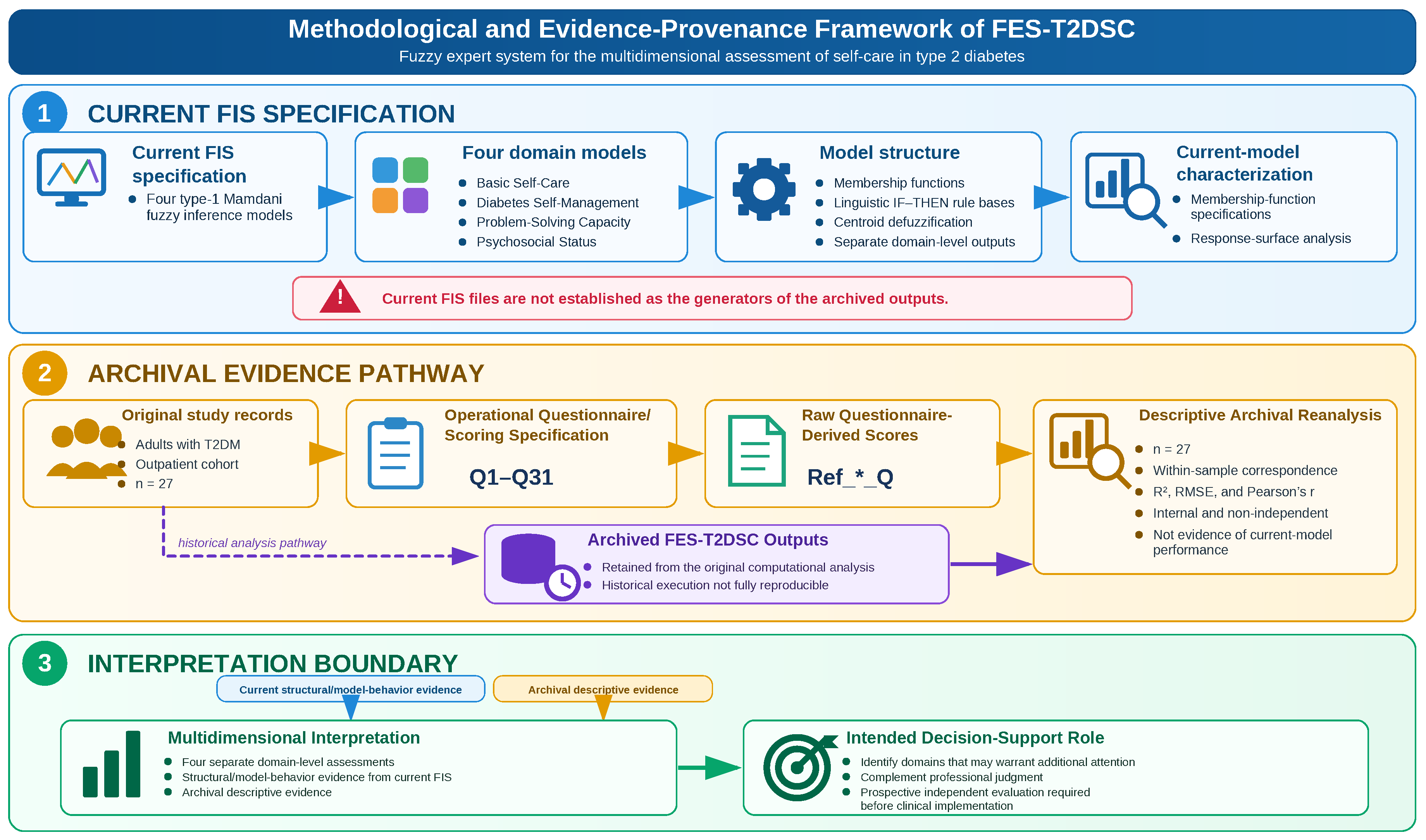
Figure 2.
Membership-function specification of the current Basic Self-Care FIS, including Nutrition, Daily Caloric Intake, Exercise Frequency, Exercise Type, BMI, and the Basic Self-Care Level output.
Figure 2.
Membership-function specification of the current Basic Self-Care FIS, including Nutrition, Daily Caloric Intake, Exercise Frequency, Exercise Type, BMI, and the Basic Self-Care Level output.
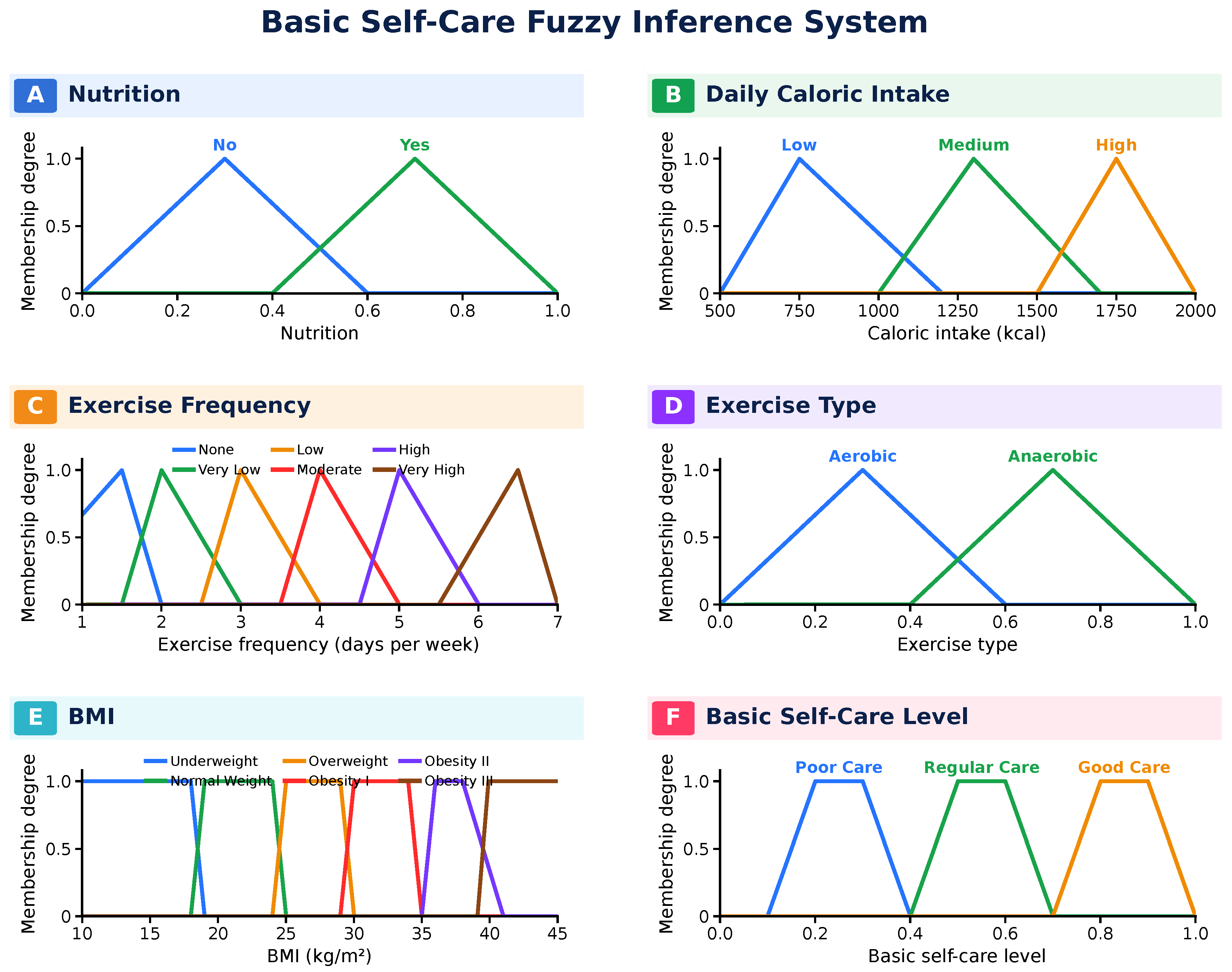
Figure 3.
Membership-function specification of the current Diabetes Self-Management Mamdani Type-1 fuzzy inference model, comprising Glucose Sampling Frequency, Medication Adherence, and Diabetes Knowledge as inputs and Diabetes Self-Management Level as the domain-level output. Numerical x-axis values represent the computational coordinates declared in the current FIS.
Figure 3.
Membership-function specification of the current Diabetes Self-Management Mamdani Type-1 fuzzy inference model, comprising Glucose Sampling Frequency, Medication Adherence, and Diabetes Knowledge as inputs and Diabetes Self-Management Level as the domain-level output. Numerical x-axis values represent the computational coordinates declared in the current FIS.
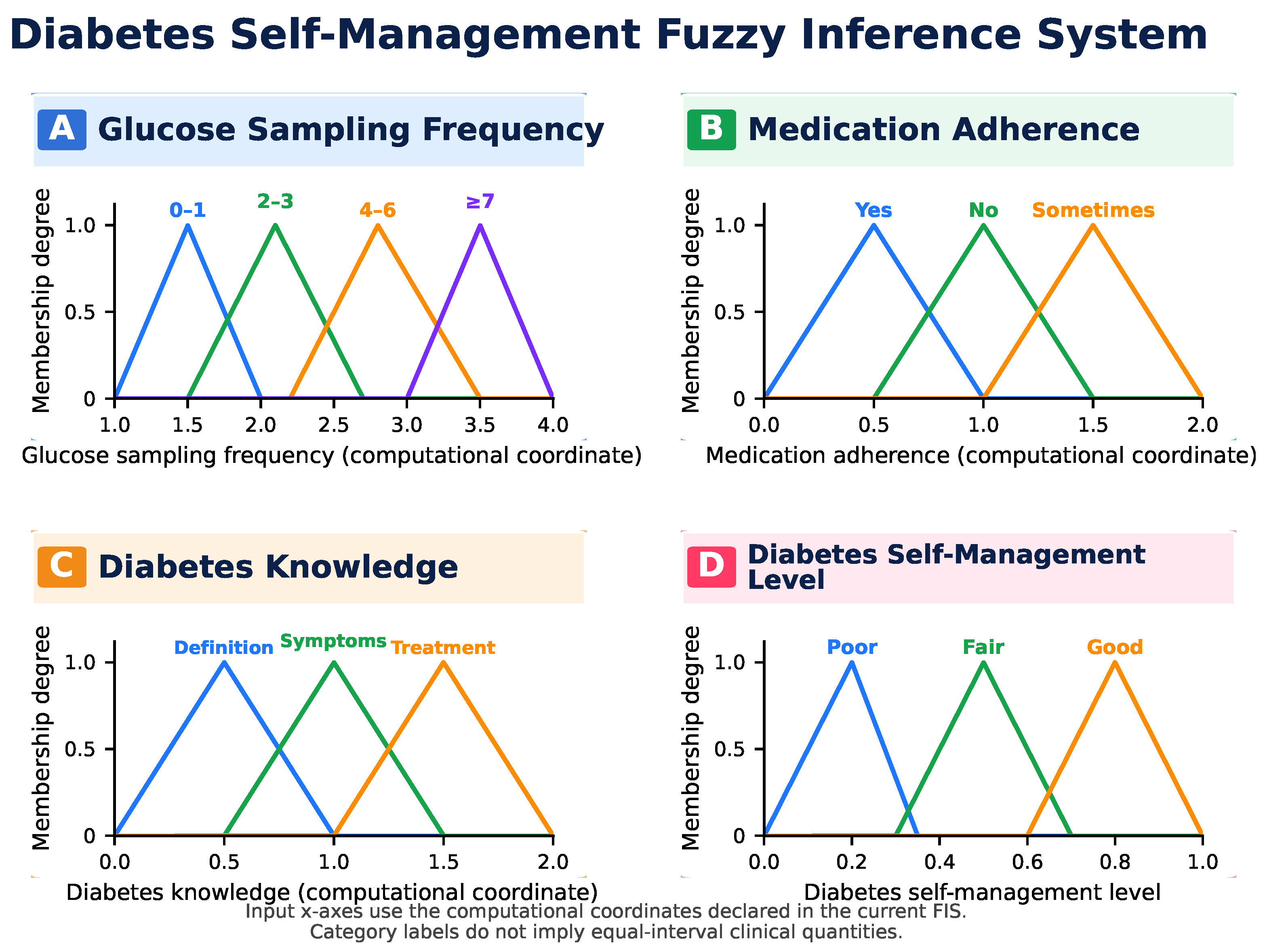
Figure 4.
Membership-function specification of the current Problem-Solving Capacity Mamdani Type-1 fuzzy inference model, comprising Hypoglycemia Symptoms, Laboratory Test Frequency, Problem-Solving Ability, and Educational Level as inputs and Problem-Solving Level as the domain-level output. Numerical x-axis values represent the computational coordinates declared in the current FIS; the FIS output universe is [0,9] and is distinct from the 1–9 raw questionnaire-derived reference scale used in the archival reanalysis.
Figure 4.
Membership-function specification of the current Problem-Solving Capacity Mamdani Type-1 fuzzy inference model, comprising Hypoglycemia Symptoms, Laboratory Test Frequency, Problem-Solving Ability, and Educational Level as inputs and Problem-Solving Level as the domain-level output. Numerical x-axis values represent the computational coordinates declared in the current FIS; the FIS output universe is [0,9] and is distinct from the 1–9 raw questionnaire-derived reference scale used in the archival reanalysis.
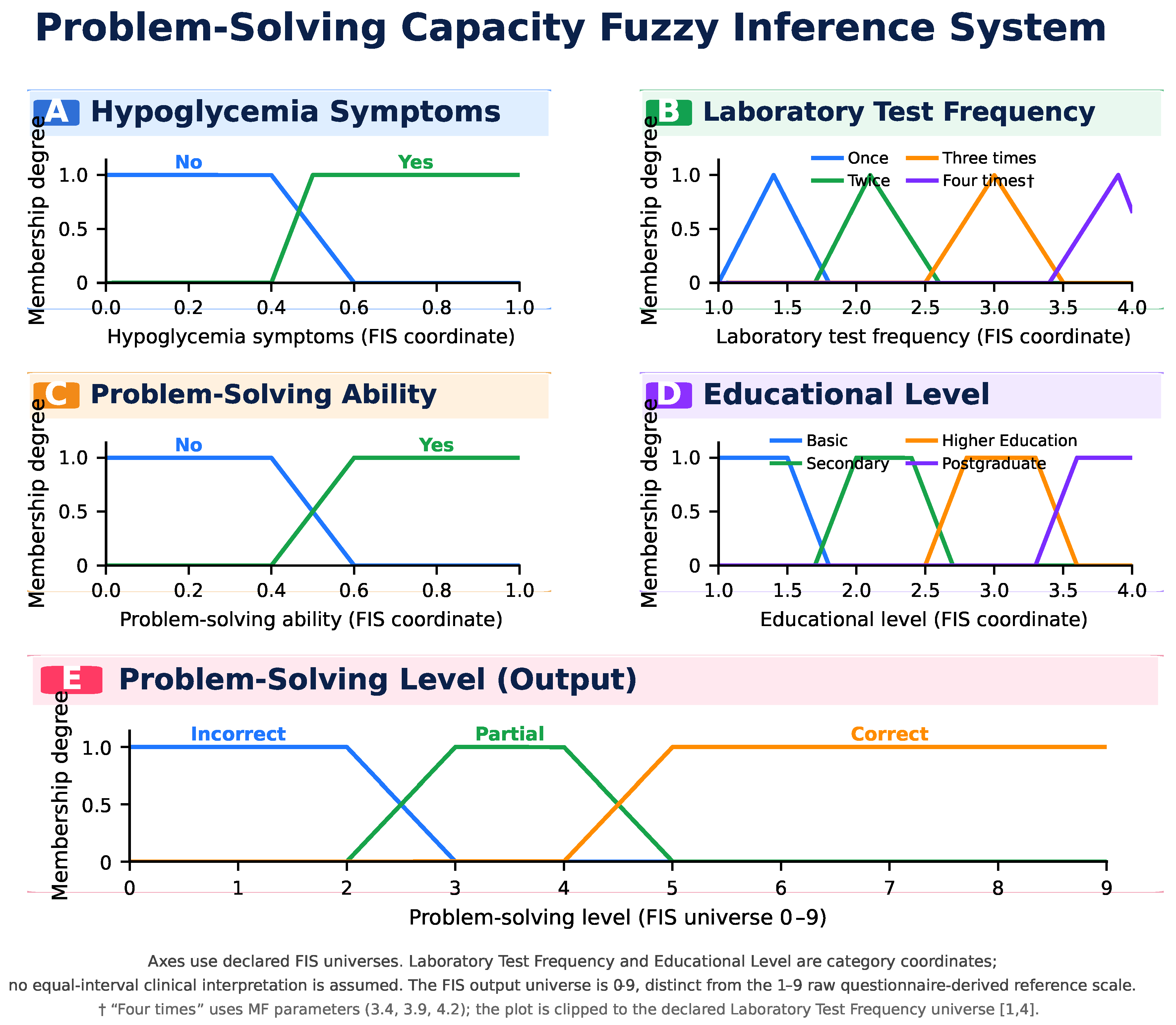
Figure 5.
Membership-function specification of the current Psychosocial Status Mamdani Type-1 fuzzy inference model, including Emotional Status, Family Support, Income Level, and Educational Level as inputs and Psychosocial Status as the output.
Figure 5.
Membership-function specification of the current Psychosocial Status Mamdani Type-1 fuzzy inference model, including Emotional Status, Family Support, Income Level, and Educational Level as inputs and Psychosocial Status as the output.
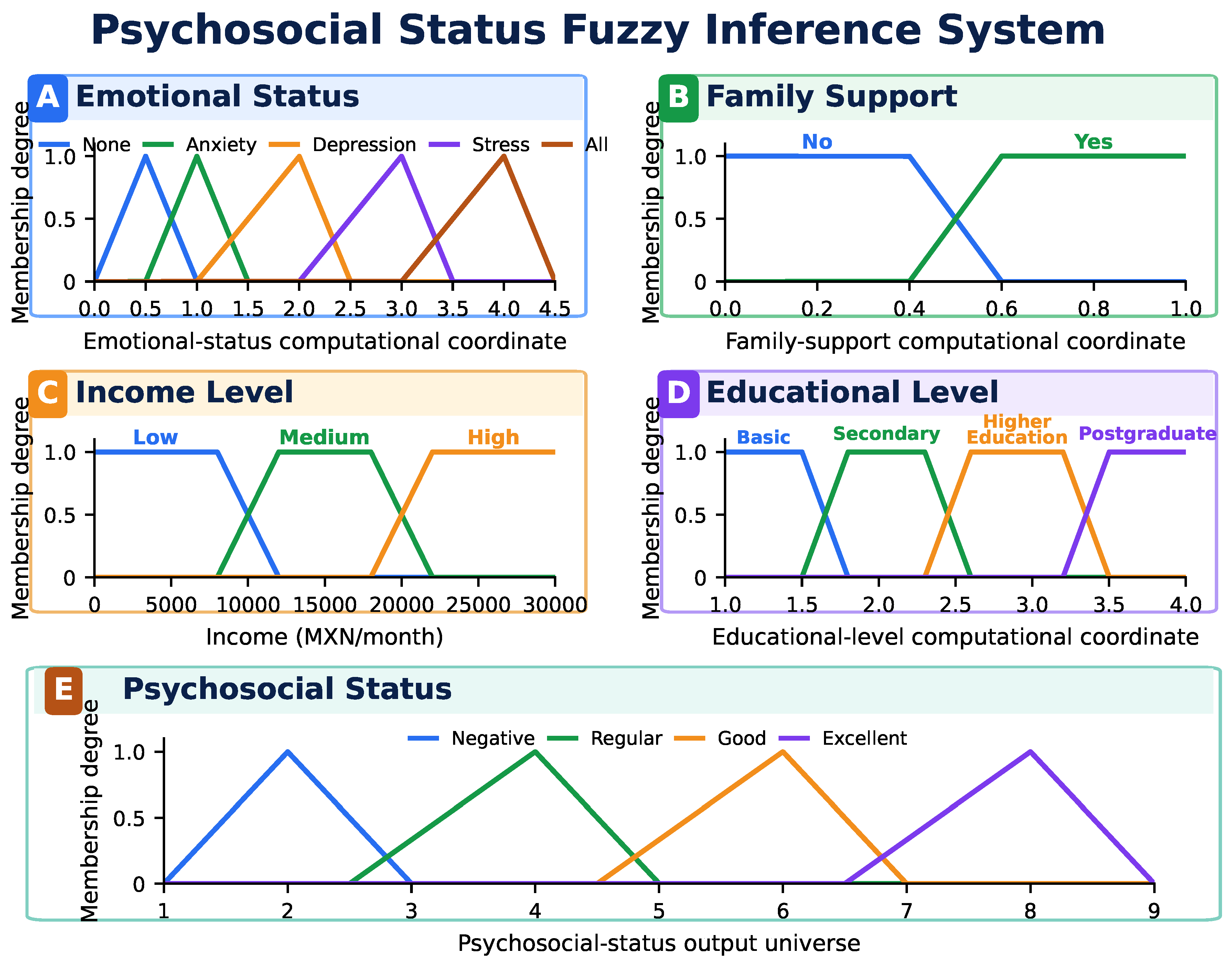
Table 1.
Input and output variables of the FES-T2DSC fuzzy inference models.
| Model | Variable | Definition in the System | Linguistic Sets/Values |
|---|---|---|---|
| Basic Self-Care | Nutrition | Nutritional condition represented in the self-care model | No; Yes |
| Basic Self-Care | Daily Caloric Intake | Daily caloric-intake level considered by the system | Low; Medium; High |
| Basic Self-Care | Exercise Frequency | Weekly frequency of physical activity represented by the model | None; Very Low; Low; Moderate; High; Very High |
| Basic Self-Care | Exercise Type | Predominant exercise modality represented by the model | Anaerobic; Aerobic |
| Basic Self-Care | Body Mass Index (BMI) | Weight-status category represented according to BMI | Underweight; Normal Weight; Overweight; Obesity I; Obesity II; Obesity III |
| Basic Self-Care | Basic Self-Care Level (Output) | Domain-level estimate generated from the five inputs | Poor Care; Regular Care; Good Care |
| Diabetes Self-Management | Glucose Sampling Frequency | Frequency category used to represent glucose monitoring | 0–1; 2–3; 4–6; ≥7 |
| Diabetes Self-Management | Medication Adherence | Medication-taking category represented by the model | Yes; No; Sometimes |
| Diabetes Self-Management | Diabetes Knowledge | Knowledge-domain category represented by the model | Definition; Symptoms; Treatment |
| Diabetes Self-Management | Diabetes Self-Management Level (Output) | Domain-level estimate generated from the three inputs | Poor; Fair; Good |
| Problem-Solving Capacity | Hypoglycemia Symptoms | Recognition of situations related to hypoglycemia | No; Yes |
| Problem-Solving Capacity | Laboratory Test Frequency | Annual laboratory follow-up category represented by the model | Once; Twice; Three times; Four times |
| Problem-Solving Capacity | Problem-Solving Ability | Ability category related to responding to diabetes-management situations | No; Yes |
| Problem-Solving Capacity | Educational Level | Educational level represented by the model | Basic; Secondary; Higher Education; Postgraduate |
| Problem-Solving Capacity | Problem-Solving Level (Output) | Domain-level estimate of problem-solving capacity | Incorrect; Partial; Correct |
| Psychosocial Status | Emotional Status | Emotional condition represented in the psychosocial model | None; Anxiety; Depression; Stress; All |
| Psychosocial Status | Family Support | Presence or absence of family support related to diabetes management | No; Yes |
| Psychosocial Status | Income Level | Socioeconomic/contextual condition represented by the model | Low; Medium; High |
| Psychosocial Status | Educational Level | Educational level represented within the psychosocial context | Basic; Secondary; Higher Education; Postgraduate |
| Psychosocial Status | Psychosocial Status (Output) | Domain-level estimate generated from the encoded psychosocial rule base | Negative; Regular; Good; Excellent |
Table 2.
Criteria used to parameterize the FES-T2DSC input variables.
| Variable | Nature | Use of 95% CI | Main Parameterization Criterion |
|---|---|---|---|
| Daily Caloric Intake | Continuous quantitative | Yes | Mean, SD, and 95% CI used as empirical references, complemented by nutritional criteria and expert review |
| Exercise Frequency | Ordinal | No | Ordinal physical-activity frequency categories represented as computational coordinates |
| BMI | Continuous quantitative | Yes | Observed distribution and 95% CI, complemented by clinical BMI categories |
| Income Level | Contextual categorical/ordinal | No | Operational socioeconomic/contextual categories reviewed during model development; not interpreted as universal clinical cutoffs |
| Nutrition | Categorical | No | Instrument structure, linguistic categories, and expert review |
| Exercise Type | Categorical/binary | No | Computational coding of categories and expert review |
| Glucose Sampling Frequency | Ordinal | No | Frequency categories, instrument structure, and expert review |
| Medication Adherence | Categorical | No | Linguistic categories and expert review |
| Diabetes Knowledge | Categorical | No | Conceptual structure and expert review |
| Hypoglycemia Symptoms | Categorical | No | Clinical/linguistic categories and expert review |
| Laboratory Test Frequency | Ordinal | No | Frequency categories and expert review |
| Problem-Solving Ability | Categorical/binary | No | Instrument structure and expert review |
| Emotional Status | Categorical | No | Linguistic categories and expert review |
| Family Support | Categorical/binary | No | Computational coding and expert review |
| Educational Level | Ordinal | No | Educational categories and expert review |
Table 3.
Linguistic labels and membership functions of the Basic Self-Care Model.
| Variable | Linguistic Label | MF | Parameters |
|---|---|---|---|
| Nutrition | Yes | Triangular | (0.4, 0.7, 1.0) |
| Nutrition | No | Triangular | (0.0, 0.3, 0.6) |
| Daily Caloric Intake | Low | Triangular | (500, 750, 1200) |
| Daily Caloric Intake | Medium | Triangular | (1000, 1300, 1700) |
| Daily Caloric Intake | High | Triangular | (1500, 1750, 2000) |
| Exercise Frequency | None | Triangular | (0, 1.5, 2) |
| Exercise Frequency | Very Low | Triangular | (1.5, 2, 3) |
| Exercise Frequency | Low | Triangular | (2.5, 3, 4) |
| Exercise Frequency | Moderate | Triangular | (3.5, 4, 5) |
| Exercise Frequency | High | Triangular | (4.5, 5, 6) |
| Exercise Frequency | Very High | Triangular | (5.5, 6.5, 7) |
| Exercise Type | Anaerobic | Triangular | (0.4, 0.7, 1.0) |
| Exercise Type | Aerobic | Triangular | (0.0, 0.3, 0.6) |
| BMI | Underweight | Trapezoidal | (0, 9, 18, 19) |
| BMI | Normal Weight | Trapezoidal | (18, 19, 24, 25) |
| BMI | Overweight | Trapezoidal | (24, 25, 29, 30) |
| BMI | Obesity I | Trapezoidal | (29, 30, 34, 35) |
| BMI | Obesity II | Trapezoidal | (35, 36, 38, 41) |
| BMI | Obesity III | Trapezoidal | (39.1, 39.9, 45, 45) |
| Basic Self-Care Level (Output) | Poor Care | Trapezoidal | (0.1, 0.2, 0.3, 0.4) |
| Basic Self-Care Level (Output) | Regular Care | Trapezoidal | (0.4, 0.5, 0.6, 0.7) |
| Basic Self-Care Level (Output) | Good Care | Trapezoidal | (0.7, 0.8, 0.9, 1.0) |
Table 4.
Linguistic labels and membership functions of the Diabetes Self-Management Model.
| Variable | Linguistic Label | MF | Parameters |
|---|---|---|---|
| Glucose Sampling Frequency | 0–1 | Triangular | (1, 1.5, 2) |
| Glucose Sampling Frequency | 2–3 | Triangular | (1.5, 2.1, 2.7) |
| Glucose Sampling Frequency | 4–6 | Triangular | (2.2, 2.8, 3.5) |
| Glucose Sampling Frequency | ≥7 | Triangular | (3, 3.5, 4) |
| Medication Adherence | Yes | Triangular | (0, 0.5, 1) |
| Medication Adherence | No | Triangular | (0.5, 1, 1.5) |
| Medication Adherence | Sometimes | Triangular | (1, 1.5, 2) |
| Diabetes Knowledge | Definition | Triangular | (0, 0.5, 1) |
| Diabetes Knowledge | Symptoms | Triangular | (0.5, 1, 1.5) |
| Diabetes Knowledge | Treatment | Triangular | (1, 1.5, 2) |
| Diabetes Self-Management Level (Output) | Poor | Triangular | (0, 0.2, 0.35) |
| Diabetes Self-Management Level (Output) | Fair | Triangular | (0.3, 0.5, 0.7) |
| Diabetes Self-Management Level (Output) | Good | Triangular | (0.6, 0.8, 1.0) |
Table 5.
Linguistic variables, membership functions, and parameters of the Problem-Solving Capacity Model.
Table 5.
Linguistic variables, membership functions, and parameters of the Problem-Solving Capacity Model.
| Variable | Linguistic Label | MF | Parameters |
|---|---|---|---|
| Hypoglycemia Symptoms | No | Trapezoidal | (0, 0, 0.4, 0.6) |
| Hypoglycemia Symptoms | Yes | Trapezoidal | (0.4, 0.5, 1, 1) |
| Laboratory Test Frequency | Once | Triangular | (1, 1.4, 1.8) |
| Laboratory Test Frequency | Twice | Triangular | (1.7, 2.1, 2.6) |
| Laboratory Test Frequency | Three times | Triangular | (2.5, 3, 3.5) |
| Laboratory Test Frequency | Four times | Triangular | (3.4, 3.9, 4.2) |
| Problem-Solving Ability | No | Trapezoidal | (0, 0, 0.4, 0.6) |
| Problem-Solving Ability | Yes | Trapezoidal | (0.4, 0.6, 1, 1) |
| Educational Level | Basic | Trapezoidal | (1, 1, 1.5, 1.8) |
| Educational Level | Secondary | Trapezoidal | (1.7, 2, 2.4, 2.7) |
| Educational Level | Higher Education | Trapezoidal | (2.5, 2.8, 3.3, 3.6) |
| Educational Level | Postgraduate | Trapezoidal | (3.3, 3.6, 4, 4) |
| Problem-Solving Level (Output) | Incorrect | Trapezoidal | (0, 0, 2, 3) |
| Problem-Solving Level (Output) | Partial | Trapezoidal | (2, 3, 4, 5) |
| Problem-Solving Level (Output) | Correct | Trapezoidal | (4, 5, 9, 9) |
Table 6.
Input and output variables and membership functions of the Psychosocial Status Model.
| Variable | Linguistic Label | MF | Parameters |
|---|---|---|---|
| Emotional Status | None | Triangular | (0, 0.5, 1) |
| Emotional Status | Anxiety | Triangular | (0.5, 1, 1.5) |
| Emotional Status | Depression | Triangular | (1, 2, 2.5) |
| Emotional Status | Stress | Triangular | (2, 3, 3.5) |
| Emotional Status | All | Triangular | (3, 4, 4.5) |
| Family Support | No | Trapezoidal | (0, 0, 0.4, 0.6) |
| Family Support | Yes | Trapezoidal | (0.4, 0.6, 1, 1) |
| Income Level (MXN/month) | Low | Trapezoidal | (0, 0, 8000, 12000) |
| Income Level (MXN/month) | Medium | Trapezoidal | (8000, 12000, 18000, 22000) |
| Income Level (MXN/month) | High | Trapezoidal | (18000, 22000, 30000, 30000) |
| Educational Level | Basic | Trapezoidal | (1, 1, 1.5, 1.8) |
| Educational Level | Secondary | Trapezoidal | (1.5, 1.8, 2.3, 2.6) |
| Educational Level | Higher Education | Trapezoidal | (2.3, 2.6, 3.2, 3.5) |
| Educational Level | Postgraduate | Trapezoidal | (3.2, 3.5, 4, 4) |
| Psychosocial Status (Output) | Negative | Triangular | (1, 2, 3) |
| Psychosocial Status (Output) | Regular | Triangular | (2.5, 4, 5) |
| Psychosocial Status (Output) | Good | Triangular | (4.5, 6, 7) |
| Psychosocial Status (Output) | Excellent | Triangular | (6.5, 8, 9) |
Disclaimer/Publisher’s Note: The statements, opinions and data contained in all publications are solely those of the individual author(s) and contributor(s) and not of MDPI and/or the editor(s). MDPI and/or the editor(s) disclaim responsibility for any injury to people or property resulting from any ideas, methods, instructions or products referred to in the content. |
© 2026 by the authors. Licensee MDPI, Basel, Switzerland. This article is an open access article distributed under the terms and conditions of the Creative Commons Attribution (CC BY) license (http://creativecommons.org/licenses/by/4.0/).
Copyright: This open access article is published under a Creative Commons CC BY 4.0 license, which permit the free download, distribution, and reuse, provided that the author and preprint are cited in any reuse.