

Submitted:
29 September 2026
Posted:
01 October 2026
You are already at the latest version
Abstract
A Subjective Logic (SL) binomial opinion (b, d, u, a) is exactly a neutrosophic triple (T, I, F) = (b, u, d) restricted to the plane T + I + F = 1, plus a base rate a. We show that SL is a retract of the neutrosophic space: every SL opinion embeds injectively, and a normalization map sends every neutrosophic tuple back to an SL opinion, losing precisely the information SL cannot express (incompleteness, intra-opinion contradiction, neutrality, open-world “neither”, and the provenance of uncertainty). We then treat four neutrosophic logics as successive extensions of SL. For (T, I, N, F) we prove that neutrosophic negation projects onto SL complement. For (T, I, N, U₁, …, Uₙ, F) we prove that SL trust discounting and evidence ageing are the projections of componentwise multi-uncertainty operators. For the n-valued refined neutrosophic logic we prove that Smarandache’s n-norm conjunction equals SL multiplication with base rates 0, and the n-conorm disjunction equals SL comultiplication with base rates 1 (verified numerically to 10⁻¹⁶). For the Refined Neutrosophic Evidential Logic (T, C, U, N, G, I₁, I₂, …, F) we show that SL’s cumulative fusion is the evidence-count special case, and that RNEL keeps the between-source conflict that SL fusion erases. We also apply neutrosophic probability to SL: an SL opinion is a complete neutrosophic probability whose indeterminate chance is resolved by the base rate, and a neutrosophic opinion separates ontic from epistemic indeterminacy. Finally, we extend all four logics and neutrosophic probability to Smarandache’s over/under/off values (components above 1 or below 0): signed evidence gives such values a Beta semantics compatible with SL, the operators keep their De Morgan and projection properties on off-tuples, and we define an over/under/off RNEL and a refined neutrosophic off-probability. Each section ends with a worked application: online reputation, cyber-threat-intelligence trust chains, physics and multi-class diagnosis, conflict-aware retrieval-augmented generation, an election with indeterminate ballots, and, for the off-extensions, fake reviews, a compromised relay, retracted sources and an over-vote.
Keywords:
subjective logic
; neutrosophic logic
; (T
; I
; N
; F)
; multi-uncertainty
; refined neutrosophic logic
; refined neutrosophic evidential logic (RNEL)
; neutrosophic probability
; belief fusion
; trust networks
; neutrosophic overset
; underset and offset
; off-evidence
; over/under/off masses
; neutrosophic off-probability
1. Introduction
Subjective Logic, developed by Jøsang [1,2], is a calculus of opinions: probability-like assessments that carry an explicit uncertainty mass . Its strength is a precise link to Bayesian statistics through the Beta and Dirichlet distributions, and a rich operator set (multiplication, fusion, trust discounting, deduction, abduction) used in trust networks, reputation systems and Bayesian reasoning [1].
Neutrosophic logic, introduced by Smarandache [3], evaluates a proposition by independent degrees of truth , indeterminacy and falsehood , with . Its refinements split , and into subcomponents: separates pure indeterminacy from neutrality [4]; adds several types of uncertainty [5]; the -valued refined logic allows truths, indeterminacies and falsehoods [6]; and the Refined Neutrosophic Evidential Logic (RNEL) names contradiction, uncertainty, neutrality and ignorance explicitly [13].
The two traditions share a structure that has not been made precise: an SL opinion is a normalized neutrosophic evaluation. This paper makes the relation exact and asks, for each of the four neutrosophic logics, three questions: (i) does it contain SL as a special case; (ii) which SL operators does it reproduce, and exactly under which conditions; (iii) what does it represent that SL cannot, and does that matter in a real application.
Contributions.
- 1.
- A general embedding–retraction framework (Section 4): SL is a retract of the neutrosophic space, and the kernel of the retraction is exactly the information SL discards.
- 2.
- as an extension of SL, with the negation-projection theorem and a reputation-system application (Section 5).
- 3.
- as an extension of SL, with the discounting- and ageing-projection theorems and a trust-chain application (Section 6).
- 4.
- The -valued refined neutrosophic logic as an extension of SL binomial, multinomial and hyper-opinions, with exact operator identities and the seven-valued logic (Section 7).
- 5.
- RNEL as an extension of SL evidence and fusion, with a conflict-preservation result and a retrieval-augmented-generation application (Section 8).
- 6.
- Neutrosophic probability applied to SL: SL opinions as complete neutrosophic probabilities, the neutrosophic opinion separating ontic from epistemic indeterminacy, and an election application (Section 9).
- 7.
- Over/under/off extensions of the four logics and of neutrosophic probability: an SL-compatible evidence semantics for values outside [0,1], operator and projection theorems on off-tuples, over/under/off RNEL, and applications to fake reviews, a compromised relay, retracted sources and an over-vote (Section 10).
SL keeps one real advantage throughout: base rates and the Beta/Dirichlet semantics give its projected probabilities a Bayesian calibration. Every extension below therefore carries the base rate as an extra parameter, so that nothing SL can do is lost.
2. Preliminaries: Subjective Logic
Definition 2.1 (binomial opinion [1,14,15]). An opinion about a proposition is a quadruple of belief, disbelief, uncertainty and base rate, with
Its projected probability is
Special opinions: absolute TRUE , absolute FALSE , dogmatic (, an ordinary probability) and vacuous .
Definition 2.2 (evidence mapping). With positive and negative observations and a non-informative prior weight (normally ), the opinion and the distribution correspond through
Definition 2.3 (multinomial and hyper-opinions). Over a domain , a multinomial opinion is with , equivalent to a Dirichlet distribution. A hyper-opinion also assigns belief to composite values (subsets of with two or more elements); this “vague belief” expresses hesitation between specific alternatives, while stays on the whole domain .
Comultiplication (OR):
Cumulative fusion of two independent sources and is equivalent to adding their evidence ; in opinion form
Trust discounting: if ’s projected trust in source is , ’s opinion about becomes, for ,
Evidence ageing with factor replaces by , which raises .
Degree of conflict [1]. For two opinions on the same , with projected distance and conjunctive certainty ,
is a relation between two opinions. No single SL opinion can carry it, because leaves no room for “much evidence for and much evidence against ” beyond the split . This is the first structural limit exploited below.
3. Preliminaries: The Neutrosophic Frameworks
Definition 3.1 (single-valued neutrosophic evaluation [3]). A proposition receives with . The sum is unconstrained: means incomplete information, means paraconsistent (conflicting) information, and is the complete, normalized case. Over/under/off extensions let components exceed (over-evidence) or fall below (anti-evidence) [5,8].
Definition 3.2 ( [4]). Indeterminacy is refined into pure indeterminacy and neutrality (a position equidistant from truth and falsehood, e.g. an impartial referee). With components possibly independent, . and are treated as positive qualities, and as negative ones. The operators are
where is a t-norm and a t-conorm. Ranking uses, in order, the score, accuracy, extended certainty and certainty functions
Definition 3.3 ( [5]). For , a proposition receives an -tuple with , where each names a distinct source or type of uncertainty (aleatory, epistemic, vagueness, ambiguity, and so on), separate from pure indeterminacy and neutrality . and are positive qualities; , and are negative ones. The operators of [5] act componentwise: under conjunction a t-norm on and and a t-conorm on , and ; under disjunction the reverse. [5] also gives over/under/off-set extensions and a total order on tuples by the cascade of score, accuracy, extended certainty and certainty functions , , for , and , applied in the order . For they reduce to the functions of Definition 3.2.
Definition 3.4 (-valued refined neutrosophic logic [6]). Truth, indeterminacy and falsehood are refined into , , with ; for independent crisp components , and dependent components are constrained together. With the priority , the -norm and -conorm on are
A particular case is the seven-valued logic [6] with (absolute truth), (relative truth), (absolute falsehood), (relative falsehood), and
is the undefined (neither) value, contradiction and ignorance.
Definition 3.5 (Refined Neutrosophic Evidential Logic, RNEL [13]). A proposition receives with truth, falsehood, and (contradiction), or (uncertainty), = neither nor (neutral), ignorance, and further indeterminacies as a given application requires.
Remark 3.6 (naming). The same logical value, “ or , but it is not known which”, is called (ignorance) in the seven-valued logic and (uncertainty) in RNEL; “neither nor ” is in the seven-valued logic and in RNEL. Section 7 and Section 8 keep each paper’s own names and state the SL counterpart explicitly.
4. General Framework: Subjective Logic as a Retract of the Neutrosophic Space
Let be the set of binomial opinions and the set of neutrosophic evaluations carrying a base rate, written .
Definition 4.1 (embedding). , . Its image is the plane .
Definition 4.2 (retraction). For with total mass , let be
In the first case the missing mass becomes uncertainty; in the second the conflicting mass is rescaled. We also define the incompleteness and the paraconsistency (internal conflict) .
Theorem 4.3. (i) on , so SL is a retract of the neutrosophic space. (ii) exactly when . (iii) Two evaluations with differ only in , or in how mass is split inside , , ; this is exactly the information SL cannot represent.
Proof. (i) For , , so the first branch returns . (ii) If both branches return and gives back ; if , has total mass . (iii) On each branch is injective once is fixed, so the fibres are parametrized by , i.e. by and . Definition 4.4 (extension of an operator). A neutrosophic operator extends an SL operator if ; it extends it strictly if moreover , i.e. it maps the SL plane into itself. The projected probability of a neutrosophic evaluation is that of its retraction, .
For refined tuples the same construction applies after the coarsening map that adds up the components of each kind: all truths into , all falsehoods into , and all indeterminacy-type components (, , , , , , , …) into . Every theorem below is proved in the form “ of the neutrosophic operator equals the SL operator”; together with Theorem 4.3 this shows each neutrosophic logic contains SL and its operators.
Evidence semantics. With , counts and prior weight , , , recovers Definition 2.2, so the Beta calibration of SL is available in every extension by keeping and .
Values and evidence. The retraction is a projection of values, not a recovery of evidence. Two evaluations with the same normalised values can come from very different amounts of supporting and opposing evidence: a tuple built from two reports and one built from two hundred reports in the same proportions have the same image in SL when the prior weight is not included, and when the total mass exceeds 1 the rescaling also hides how much of the mass was conflict. The retraction therefore guarantees that every neutrosophic evaluation has a well-defined SL image, but it does not reconstruct the underlying counts. When the counts are available they should be kept, as in the evidence model of Section 8.1 and in Neutrosophic Evidential Logic [22], which works with the evidence itself rather than with normalised values.
5. Task 1: (T, I, N, F) Neutrosophic Logic as an Extension of Subjective Logic
5.1. Embedding
SL’s single uncertainty mass mixes two different situations: evidence that is missing or undecidable, and evidence that is present but neutral (a 3-star review, an abstaining voter, an impartial referee). separates them.
Definition 5.1. The SL opinion embeds as ; the coarsening is . A tuple with and is a neutral-refined SL opinion: it has the same SL projection as but records which part of is neutrality.
5.2. Operators Designed for (T, I, N, F)
The t-norm operators of Definition 3.2 do not reduce to SL operators (with product and probabilistic sum, can exceed on normalized inputs: for and in form it gives total mass ). We therefore design a priority-product family. Every pair of components is multiplied, and the product is assigned to the component with the higher priority, using the order
(The later component in the order dominates: under falsehood absorbs everything, under truth does.) sits next to because treats as a positive quality [4]. Writing :
Negation (kept from [4]).
Conjunction.
Disjunction.
Implication , which expands to
Equivalence .
Base rates propagate as in SL: , , .
Base-rate-calibrated conjunction and disjunction. To reproduce SL for arbitrary base rates, move the SL correction mass from the indeterminacy part to (for ) or to (for ), taking from and in proportion to their size:
Theorem 5.2. For the priority-product operators:
is an involution and De Morgan’s laws hold exactly: and .
- Total mass is multiplicative,
; hence normalized inputs give normalized outputs (the SL plane is closed).
; on normalized inputs is SL multiplication with and is SL comultiplication with . The calibrated versions give SL multiplication and comultiplication for any base rates.
So with these operators is a strict extension of SL in the sense of Definition 4.4.
Proof sketch. (1) maps the conjunction order onto , which is the disjunction order, so the assignment of every product term is mirrored. (2) Every term of is assigned to exactly one output component. (3) . For , terms containing sum to , , and is the remainder, which is SL multiplication with zero base-rate correction; is dual. The calibrated corrections are exactly the SL base-rate terms of Section 2 rewritten with . All three statements were also checked numerically on 3,000 random tuples (maximum error below ), and on 5,000 random normalized pairs with random base rates for the calibrated conjunction (maximum error , no negative components).
Worked example. , in order:
| Operation | ||||
| 0.20 | 0.20 | 0.10 | 0.50 | |
| 0.30 | 0.23 | 0.19 | 0.28 | |
| 0.80 | 0.07 | 0.11 | 0.02 | |
| 0.68 | 0.16 | 0.11 | 0.05 | |
| 0.374 | 0.212 | 0.250 | 0.164 |
5.3. Comparison
- What SL loses. Two opinions with equal
can have entirely different ; SL cannot rank them apart, and its complement cannot express that “neutral about ” becomes “indeterminate about ” (the swap of ).
- What SL keeps. SL’s base rate and Beta semantics give the projected probability a calibrated meaning;
as published has no base rate. Carrying (Section 4) removes this gap.
- Ranking. SL ranks by
; ranks lexicographically by score, accuracy, extended certainty and certainty (Definition 3.2), which rewards neutrality over indeterminacy.
5.4. Application: Online Reputation with Neutral Reviews
The Beta reputation system [9] is SL applied to ratings: positive and negative ratings give . Neutral 3-star ratings must either be dropped or split half-positive, half-negative. Consider two sellers, prior weight :
| Seller | Positive | Negative | Neutral | Unreadable / ambiguous |
| A | 40 | 10 | 30 | 5 |
| B | 40 | 10 | 0 | 35 |
With the total for both, gives and .
- SL, neutrals dropped: both sellers get
; the 30 neutral customers of A vanish.
- SL projection
: both sellers get and at . SL cannot separate them.
: score and . Seller A, whose extra customers were actually served and found the service acceptable, ranks clearly above seller B, whose extra reviews carry no information.
The same pattern appears in voting with abstention () versus spoiled ballots (), and in peer review with a “neutral” recommendation versus a missing review.
6. Task 2: (T, I, N, U1, …, Un, F) Multi-Uncertainty Logic as an Extension of Subjective Logic
Notation, polarities and the ranking cascade in this section are those of [5] (Definition 3.3). As for in Section 5.2, the componentwise t-norm operators of [5] do not reduce to SL operators, so Section 6.2 designs priority-product operators whose coarsening gives SL multiplication and comultiplication; they are an additional operator family, not a replacement for those of [5].
6.1. Embedding: Where SL’s Uncertainty Comes from
In SL the uncertainty mass is produced by several distinct mechanisms, then merged: scarce evidence (), each trust-discounting step (adds ), evidence ageing (Section 2), and, in hyper-opinions, vagueness. After a few operations the origin of is lost, although it decides what to do next: collect more data, find a more reliable source, or refresh old evidence.
Definition 6.1. An SL opinion embeds as with , , and distributed over , and the by origin, for instance = evidence scarcity, = source unreliability, = ageing. The coarsening is
6.2. Operators Designed for (T, I, N, U1, …, Un, F)
The priority-product construction of Section 5.2 extends with the uncertainty components placed in one middle tier:
Inside the tier, goes to and a mixed product () is split equally between and . With the total mass:
Negation.
Each uncertainty type about is the same uncertainty about , exactly as SL keeps under complement.
Conjunction. With , , :
Disjunction is obtained from the conjunction by De Morgan, ; explicitly, it uses the reverse order, so and .
Implication , equivalence . Base rates propagate as in Section 5.2, and the calibrated versions use and with in place of , the transferred mass being taken from each indeterminacy component in proportion to its size.
Theorem 6.2. For every : is an involution; De Morgan’s laws hold; ; ; on normalized inputs and are SL multiplication () and comultiplication (), and the calibrated versions give them for any base rates. (Proof as for Theorem 5.2: maps the conjunction order onto the disjunction order and fixes the middle tier, whose equal split is symmetric. Checked numerically for , maximum error below .)
Definition 6.3 (typed trust discounting). If the observer’s projected trust in a source is , and that link’s unreliability is recorded as uncertainty type , then
Definition 6.4 (typed ageing). Ageing evidence by is typed discounting into the ageing component with
Theorem 6.5. of typed discounting is SL trust discounting, and of typed ageing is SL ageing.
Proof. After discounting, , and the indeterminacy total is , which is the SL formula of Section 2. For ageing, the aged opinion is , likewise , so it is discounting with . Proposition 6.6 (typed cumulative fusion). With , the total indeterminacy of two independent sources and , set and by the SL formula of Section 2 and
The components add up to , so of this fusion is SL cumulative fusion, and each uncertainty type is weighted by how uncertain the other source is.
6.3. Comparison
- SL delivers the correct amount of uncertainty after any chain of operators; the multi-uncertainty logic delivers the same amount (Theorems 6.2, 6.5) and its composition.
- SL has one lever for uncertainty (
); the multi-uncertainty logic ranks and acts on each separately, and its over/under/off-set extensions [5] allow above or below , which SL cannot express. In the ranking cascade of Definition 3.3 every lowers the accuracy and the extended certainties with , so two tuples with the same total uncertainty are ordered by where that uncertainty comes from.
6.4. Application: Cyber-Threat-Intelligence Trust Chains
An analyst observes malicious and benign indicators for a file (): , all uncertainty from evidence scarcity. The report reaches a security operations center through an intermediary platform (trust ), and the center trusts that platform at .
| Step | Total uncertainty | |||||
| Analyst | 0.800 | 0.100 | 0.100 | 0 | 0 | 0.100 |
| ) | 0.560 | 0.070 | 0.070 | 0.300 | 0 | 0.370 |
| ) | 0.504 | 0.063 | 0.063 | 0.270 | 0.100 | 0.433 |
SL gives only the last row’s . The multi-uncertainty tuple shows that 62% of the uncertainty ( of ) comes from the intermediary platform and only 15% from the analyst’s evidence. The right action is to obtain the report directly from the analyst, not to collect more samples.
If the analyst’s evidence is also aged by , then and the analyst’s tuple becomes , , , ; the ageing share then tells the center that refreshing the evidence matters as much as gathering more of it.
7. Task 3: The n-Valued Refined Neutrosophic Logic as an Extension of Subjective Logic
7.1. Embedding of Binomial, Multinomial and Hyper-Opinions
A binomial opinion is the refined tuple with . The refined logic also contains SL’s multinomial and hyper-opinions.
Definition 7.1. Let a hyper-opinion over assign to singletons, to composite values and to . For the proposition “the true value is ”, define the refined tuple
Theorem 7.2. Summing the truth, indeterminacy and falsehood blocks of this tuple gives exactly SL’s projection of the hyper-opinion onto the binomial opinion about : , = mass on values disjoint from , = plus mass on composites overlapping [1]. The refined tuple keeps what that projection discards: which alternatives compete with , and which vague belief could be resolved by a single discriminating test.
Proof. Block by block, the sums are the three SL expressions; the refinement only keeps their summands apart.
7.2. Operators Designed for Refined Neutrosophic Sets
Let the components be listed in a total order used for conjunction (later dominates), and write the lower cumulative sums and upper cumulative sums . The recommended order puts the strongest truth first and the strongest falsehood last, e.g.
with the absolute truth and the absolute falsehood.
Conjunction and disjunction (closed form).
If and are read as independent distributions over the ranked components, is the distribution of the worse (later) of two independent draws and the distribution of the better (earlier) one. For these are exactly Smarandache’s -norm and -conorm of Definition 3.4.
Negation is the order-reversing involution
which maps an evaluation with truths and falsehoods to one with truths and falsehoods (absolute truth absolute falsehood, relative truth relative falsehood, indeterminacies in reverse order).
Implication and equivalence ; base rates and the calibrated versions carry over from Section 5.2 with the -block sum in place of .
Theorem 7.3. For any , , : is an involution, De Morgan’s laws hold, total mass is multiplicative, and with contiguous , , blocks the coarsening maps to SL multiplication with and to SL comultiplication with on normalized inputs. (Checked numerically for , maximum error below .)
Theorem 7.4 (Smarandache’s-norm is SL multiplication). For normalized ,
Proof. With the correction terms of SL multiplication vanish, so and , which is the -norm ; then is the -norm . The disjunction case is dual, since the comultiplication corrections vanish when . Checked on 20,000 random pairs, maximum error . Example: , in . The -norm gives , equal to SL multiplication with ; with , SL moves from uncertainty to belief and gives . The base rate is therefore the single parameter separating the two calculi: Smarandache’s -norm is the most cautious member of SL’s multiplication family, and SL multiplication is the -norm followed by a base-rate-driven transfer from indeterminacy to truth.
7.3. The Seven-Valued Logic and Subjective Logic
| Seven-valued value [6] | Meaning | SL counterpart |
| absolute truth | ||
| relative truth | ) | |
| absolute falsehood | ||
| relative falsehood | in an uncertain opinion | |
| , unknown which | ||
| undefined, neither | none: SL frames are exhaustive (closed world) | |
| contradiction | between two opinions |
SL is therefore the seven-valued logic restricted to with and merged into and and merged into . The two values SL lacks are the ones Belnap’s four-valued logic calls None and Both [10].
7.4. Applications
Multi-class diagnosis. A patient with respiratory symptoms: SL hyper-opinion , , (a rapid test says “viral” but cannot separate the two), . For “flu”, SL’s binomial projection is . The refined tuple is , , , : it shows that of the uncertainty is removable by one flu-versus-COVID PCR test, while only is genuine ignorance.
Physics. The refined logic was introduced with physical examples where a system is neither of two classical states: anyons, neither bosons nor fermions; mercury at room temperature, neither a typical solid nor a typical liquid [6]. Classifying such a system in SL forces its belief into , or of the frame ; the refined logic assigns it to the neither component , which the closed SL frame cannot express.
8. Task 4: Refined Neutrosophic Evidential Logic as an Extension of Subjective Logic
8.1. Evidence Model
SL is built on evidence counts. RNEL can be built the same way, with one count per kind of report.
Definition 8.1 (RNEL evidence tuple). Let the reports about contain reports supporting , against , supporting both (contradictory), saying “ or , undetermined”, saying “neither” (the proposition is ill-posed or outside the frame), and reports of further indeterminacy type . With prior weight and ,
The ignorance component is the part of the evaluation not backed by any report, exactly as in SL.
Theorem 8.2 (SL is the evidence-count special case). If , then of Definition 2.2 with , . Moreover, RNEL cumulative fusion, defined as componentwise addition of the report counts of independent sources, projects onto SL cumulative fusion.
Proof. The first claim is Definition 2.2 term by term. For fusion, SL cumulative fusion adds [1]; the SL projection keeps only and , and it commutes with addition of counts.
8.2. Contradiction That SL Fusion Erases
Proposition 8.3. SL cumulative fusion maps “two confident sources that disagree” and “one source with balanced mixed evidence” to the same opinion.
Example. Source has , so ; source has , so ; their degree of conflict is . Their SL cumulative fusion has evidence : . A single fair coin tossed 20 times, with 10 heads, gives the same . The information that and contradict each other is lost after fusion.
Definition 8.4 (fused contradiction). When independent sources and are fused, RNEL keeps , and from the fused counts and sets
(For several sources, use the largest pairwise over all pairs, which does not depend on the order of fusion and is the default, or a certainty-weighted mean when a smoother indicator is preferred.) The total may then exceed : the fused evaluation is paraconsistent, with , and the retraction of Section 4, applied to (T, F, G), that is, after removing C, returns SL’s fused opinion.
In the example, gives , , , , while the coin gives . SL assigns both the same opinion; RNEL separates them.
8.3. Operators
RNEL is a refined neutrosophic set, so the operators of Section 7.2 apply. We recommend the order
for conjunction (reverse for disjunction), with the middle tier treated as in Section 6.2 (equal split of mixed products), and the negation
Contradiction, uncertainty, neutrality and ignorance about are the same about ; this matches Belnap’s logic, where Both and None are fixed points of negation [10]. Implication and equivalence are and . By Theorem 6.2 these operators satisfy De Morgan’s laws, and their coarsening gives SL multiplication and comultiplication ( and ), or SL with any base rates in the calibrated form.
8.4. Comparison
- SL has one uncertainty mass and records conflict only between two opinions (
).
- Belnap’s four-valued logic has Both and None but no degrees and no evidence semantics.
- RNEL keeps SL’s evidence semantics (Theorem 8.2), adds graded contradiction
and neither as Belnap does, and separates “ or ” () from lack of evidence ().
8.5. Application: Conflict-Aware Retrieval-Augmented Generation
Large language models answering from retrieved documents must distinguish four situations: the documents agree, they disagree, they are silent, or the question is ill-posed. Leyva-Vázquez and Smarandache report that when language models give neutrosophic self-evaluations without a sum constraint, 35% of evaluations fall spontaneously in the hyper-truth region [11], and propose independent neutrosophic evidence coordinates for conflict-aware retrieval [12].
Suppose a query retrieves eight passages, each weighted as five units of evidence: three support the claim, three contradict it, one says the matter is undetermined, and one shows the question rests on a false premise (neither).
| Model | |||||||
| SL cumulative fusion | 0.469 | 0.469 | — | — | — | 0.063 | 0.500 |
| SL, no evidence at all | 0 | 0 | — | — | — | 1 | 0.500 |
| RNEL | 0.357 | 0.357 | 0.686 | 0.119 | 0.119 | 0.048 | 0.500 |
The two SL rows give the same projected probability for opposite reasons (strong disagreement versus no information). RNEL gives the system a separate signal for each response: high , present both positions and flag the dispute; high , retrieve more or abstain; high , point out the false premise. Here is the degree of conflict between the supporting group, with evidence , and the contradicting group, with evidence .
The same construction applies to fact-checking with disagreeing outlets, to medical second opinions, and to intelligence analysis, where SL’s degree of conflict is already used as a warning signal [1] but is not carried forward through later operations.
8.6. Neural Implementation and an Empirical Check on Fact-Checking Data
Definition 8.1 can be computed by a neural network. The network outputs one non-negative evidence value per kind of report, (softplus activations), and the RNEL tuple follows exactly as in Definition 8.1, with (Figure 81). Trained with the Dirichlet likelihood of the observed report type, this is an evidential deep learning model [17] with five report types; if only and are kept and , the tuple reduces exactly to the binomial SL opinion of Definition 2.2 and to the belief and uncertainty of evidential deep learning (numerical error below ). We tested it on real data, which addresses the open problem of an empirical comparison stated in Section 12.
Data. Two public fact-checking data sets label each claim with the kinds of report RNEL distinguishes. AVeriTeC [18] contains 3,568 real claims checked by fact-checkers (971 supported, 2,047 refuted, 233 with conflicting evidence, 317 with not enough evidence), each with question-answer evidence. Climate-FEVER [19] contains 1,535 claims with five Wikipedia evidence sentences each (654 supported, 253 refuted, 154 disputed, 474 not enough information). We mapped supported to T, refuted to F, conflicting or disputed to C, and not enough evidence to N. ChaosNLI [20] (1,599 items, 100 annotators each) was used for U: items on which the most frequent label received less than 60% of the votes were labelled undetermined.
Method. A frozen cross-encoder (DeBERTa-v3 [21], trained on SNLI and MNLI) encodes every (evidence, claim) pair; the mean and maximum over the pieces of evidence feed a two-layer network with the RNEL head. We compared it with the same network and a flat softmax output, the same network with flat evidential output over four classes (flat EDL), a logistic regression on the pooled inference probabilities, SL cumulative and averaging fusion of one opinion per piece of evidence (b = entailment, d = contradiction, u = neutral probability, typed by thresholds on SL's degree of conflict and on u), and a rule (some evidence supports and some refutes gives C). Evaluation used grouped 5-fold cross-validation (duplicate claims never cross folds), hyperparameters and thresholds tuned inside each fold on held-out training groups, 5 training seeds, and 95% intervals from a bootstrap over claim groups and seeds. The hypotheses were preregistered in a public repository before training.
Results. Learning the evidence pays off. On the contradiction class the RNEL network is far better than SL fusion of the individual pieces of evidence (difference in F1 on C: +0.094 [0.042, 0.146] on AVeriTeC and +0.080 [0.011, 0.148] on Climate-FEVER) and than the support-and-refute rule (+0.123 [0.071, 0.176] and +0.111 [0.052, 0.174]); Table 8.1 and Figure 8.2. Typing claims from SL-fused opinions and SL's degree of conflict recovers much less of the contradiction class than the learned models, in line with Section 8.2: fused SL opinions do not keep disagreement apart from balanced evidence.
The refined head costs almost nothing in accuracy but, under this design, did not show detection power of its own. Its macro-F1 is within 0.01 of flat EDL (difference -0.005 [-0.016, 0.005] on AVeriTeC and -0.006 [-0.022, 0.011] on Climate-FEVER; the preregistered non-inferiority margin of 0.02 was met on AVeriTeC and narrowly missed on Climate-FEVER), and it did not show a higher F1 on C than a flat softmax (+0.015 [-0.008, 0.037] and -0.009 [-0.051, 0.034]); the preregistered superiority hypothesis was not supported, and the intervals remain compatible with a small benefit or harm. The reason is structural: when the report types are given as training labels, the RNEL head is a five-type evidential classifier, and its components are deterministic summaries of that typed evidence. The same holds for undetermined reports: on ChaosNLI the Spearman correlation of U with the entropy of the 100 human votes (0.234) was close to that of a flat classifier (0.217 for its probability of the undetermined class, 0.230 for its entropy); this comparison is descriptive, since the undetermined label was itself defined from the vote distribution.
What RNEL adds is a readable decomposition (Figure 8.3). Claims with conflicting evidence receive a larger contradiction share C than supported claims (0.199 against 0.082 on AVeriTeC; 0.205 against 0.139 on Climate-FEVER), and claims without enough evidence receive the largest neither share N (0.282 on AVeriTeC, 0.284 on Climate-FEVER). The tuple is normalised (), so contradiction is carried by , not by exceeding 1. The ignorance component G ranked the network's own errors about as well as the confidence of a flat softmax on AVeriTeC (AUROC 0.70 against 0.71) and worse on Climate-FEVER (0.56 against 0.66).
In short, RNEL is implementable as a neural network, reduces to SL and to evidential deep learning, costs almost nothing in accuracy, and gives a separate, interpretable signal for contradiction, neither and ignorance, while fusion in SL loses the contradiction. An advantage in detection would have to come from settings in which the report types are not given as labels, for example when the network must combine source-level evidence trained only with true or false labels; this is left for future work. The code, the preregistration, the adversarial reviews and all results are public at https://github.com/mleyvaz/rnel-neural-factcheck.
9. Neutrosophic Probability in Subjective Logic
A binomial SL opinion is a complete neutrosophic probability of a binary event, and SL’s projected probability resolves its indeterminate chance by the base rate. Neutrosophic probability [16] adds what SL lacks: indeterminacy that belongs to the experiment itself (ontic), not only to missing data (epistemic).
9.1. SL Opinions as Neutrosophic Probabilities
Definition 9.1 (neutrosophic probability [16]). For an event ,
the chances that occurs, that its occurrence is indeterminate, and that does not occur. The triple is complete if its sum is , incomplete if below , and paraconsistent if above .
Theorem 9.2.
- The map
identifies binomial opinions with complete neutrosophic probabilities of carrying a base rate.
- SL complement is the neutrosophic probability of the anti-event:
, with the same indeterminate chance.
- For a complete
, the classical probabilities consistent with it form the interval . SL’s projected probability is the point of this interval chosen by the base rate: gives the lower end, the upper end.
- When
, is a classical probability and the opinion is dogmatic.
Proof. (1) and (4) follow from the definitions. (2) The anti-event swaps occurrence and non-occurrence and keeps the indeterminate outcomes. (3) Each indeterminate outcome, once resolved, adds to the chance of or of , so the chance of ranges from to ; with covers this interval.
9.2. Neutrosophic Sample Spaces and Multinomial Opinions
A neutrosophic sample space adds an indeterminate outcome to the classical one, , with mass function and [16]. This is an SL multinomial opinion with and .
Example (die on an irregular surface [16]). With , each face has , and . This is exactly SL’s binomial projection of the multinomial opinion. With the symmetric base rate , SL gives , the classical probability of the fair die. The base rate models how an indeterminate landing would resolve if the die were rolled again.
9.3. Epistemic and Ontic Indeterminacy: The Neutrosophic Opinion
Suppose trials give occurrences of , non-occurrences and indeterminate outcomes. The neutrosophic relative frequency is . SL builds and drops the indeterminate outcomes. As grows with fixed proportions, SL’s tends to , while the neutrosophic indeterminate chance stays at . SL’s measures lack of data (epistemic); ’s indeterminacy is due to the experiment itself (ontic), e.g. an irregular surface or a damaged ballot [16].
Definition 9.3 (neutrosophic opinion). Keep both kinds as two refined indeterminacies:
Proposition 9.4. If this is the SL opinion of Definition 2.2. As with fixed proportions, and the tuple tends to the neutrosophic relative frequency. The coarsening () gives a binomial opinion, and the tuple is a refined neutrosophic evaluation in the sense of Section 7, so all operators of Section 7.2 apply.
9.4. Operators
- Complement is the same in both theories (Theorem 9.2).
- Union of independent events.
gives [16], which is the belief of SL comultiplication.
- Intersection of independent events. Both are priority products (Section 7.2), with different orders. In the book’s example of a coin tossed three times on an irregular surface, with
and , [16]. This is the closed form of Section 7.2 with the order : one indeterminate toss makes the compound outcome indeterminate. SL multiplication with uses and gives .
The difference, , is the chance that one toss is determinate but wrong while another is indeterminate. The sequence is then certainly not , so as a truth value it is false (SL), but the recorded outcome of the experiment contains an indeterminate toss (). ’s intersection therefore answers “was the outcome of the compound experiment determinate?”, while SL’s answers “is the compound event true?”.
With base rates , SL multiplication gives and , the classical probability of for a fair coin, because SL multiplication multiplies projected probabilities [7].
- Conditioning. The neutrosophic Bayes rule
acts on the chance of occurrence [16]; SL’s deduction and abduction extend Bayes’ rule to whole opinions [1]. Extending them to full neutrosophic probability triples is an open problem (Section 12).
9.5. Application: An Election with Indeterminate Ballots
Scaling up the urn of votes in [16]: 1,000 ballots give 500 for A, 300 for B and 200 indeterminate (illegible or disputed), so .
| Model | Result for A | What it suggests |
| ) | A has a clear majority; nothing to check | |
| ) | an absolute majority depends on the indeterminate ballots |
Because the lower end of the interval is below , only a recount of the 200 indeterminate ballots can decide whether A has an absolute majority. SL, with , does not flag this; the neutrosophic opinion does, while its SL projection ( at ) remains available for forecasting.
10. Task 5: Over/Under/Off Extensions of the Four Logics and of Neutrosophic Probability
Smarandache extended uncertain sets in 2007 to oversets, in which some component is above 1, undersets, in which some component is below 0, and offsets, in which some component is above 1 and some component is below 0 [24,25]. The motivation is evaluative. An employee who works 45 hours in a week when 40 are required deserves the degree of membership , above that of an employee who works only the regular full time and whose degree is ; an employee who did not work and caused damage worth half of his weekly salary deserves , below that of any employee who benefits the company [25,28]. In the same way, the uncertain logics, measures, probabilities and statistics were extended to over-, under- and off-logics, -measures, -probabilities and -statistics [25,29,31]. Here “uncertain” covers all fuzzy extensions: fuzzy, intuitionistic fuzzy, neutrosophic, spherical fuzzy, plithogenic, and others. The operators are available at each level: the neutrosophic offunion, offintersection and offcomplement for single-valued [26,30] and interval-valued [27] offsets; overnorms, undernorms, offnorms and the corresponding conorms for uncertain over/under/off-sets and -logics [29]; refined uncertain over/under/off-sets [8]; and over/under/off masses, with their fusion rules, for information fusion [23].
Section 3 recorded that [4], the multi-uncertainty logic [5] and the refined logic [8] admit over/under/off values, and the comparison table of Section 11 records that RNEL did not. This section does four things. It gives over/under/off values an evidence semantics that is compatible with SL (Section 10.2). It shows that the operators of Section 5 to 8 extend to off-tuples with all their algebraic properties, and that the projection theorems survive (Section 10.3 to 10.5). It defines off-RNEL (Section 10.6). And it extends neutrosophic probability and its refinement to over/under/off-probability (Section 10.7). Each part ends with an application.
10.1. Over/Under/Off Values and Smarandache’s Operators
Definition 10.1 (off-domain [25,26]). Fix . An off-tuple of any of the logics of Section 5 to 8 is a tuple whose components lie in . It is an over-tuple if , an under-tuple if , and a proper off-tuple if some component is above and some other below . For single-valued neutrosophic offsets, Smarandache’s operators are
with the analogous interval forms [27]; and are the offnorm and the offconorm on , with neutral elements and [29]. For , , is the usual neutrosophic complement [30].
Two complements. The offcomplement reflects about the midpoint of , and is therefore an order-reversing involution for the order that increases and decreases and . SL complement keeps fixed (Section 2), and so do the negations of Section 5 to 8, which exchange truth and falsehood and keep or permute the indeterminacy components. Both are involutions. The second is the one that projects onto SL (Theorems 5.2 and 9.2); the first is the one that satisfies De Morgan’s laws with the offunion and the offintersection. The two agree on and and differ only on indeterminacy.
10.2. Off-Evidence: An SL-Compatible Semantics for Values Outside [0,1]
The evidence mapping of Definition 2.2 is stated for counts . Smarandache’s off-masses [23] suggest the reading of a negative component: a mass of cancels a false alarm of mass , so negative evidence withdraws support. We allow the counts themselves to be signed.
Definition 10.2 (off-evidence). Let and , where and count the reports for and against that remain after retraction, and and count anti-evidence: retracted, refuted or fabricated reports of each kind, each counted as . With prior weight and , the off-opinion is
It lies on the SL plane but may leave the simplex: (under-belief) when , when , and (over-uncertainty) exactly when , that is, when the anti-evidence outweighs the evidence.
Theorem 10.3 (Beta semantics of off-opinions). Let .
(1) The off-opinion corresponds to the distribution if and only if and , equivalently and , where . Its projected probability is the mean of that distribution, .
(2) The inverse mapping , of Definition 2.2 holds unchanged.
(3) SL cumulative fusion in opinion form (Section 2) equals the addition of signed evidence, , whenever all three opinions are defined.
(4) The off-plane therefore splits into three regions: the SL simplex (); the Beta region (), in which SL’s calculus and its Beta calibration extend to under-belief and over-uncertainty; and the region or , in which no Beta distribution exists and the evaluation is an under- or over-probability in Smarandache’s sense (Section 10.7).
Proof. (1) requires ; follows from the definitions, so iff and iff when . (2) and (3) are algebraic identities in that use only : with , , and similarly for and . (4) follows from (1). The theorem answers part of the open problem of Section 12 on a Dirichlet-type semantics for over/under/off components: in the Beta region, an under-belief is an ordinary Beta distribution whose parameter lies below that of the non-informative prior. SL’s formalism requires ; its Beta semantics does not.
Over-evidence relative to a standard. A component above arises when counts are normalised by a standard , the number of reports normally required, instead of by their own total, as in Smarandache’s overtime example. The tuple then lies on the over-plane , with ; when σ > 1, the retraction of Definition 4.2 returns SL’s opinion . Note that a total mass above has two readings, paraconsistent information (Section 4) and abundant information relative to the standard; the off-notation separates them only when some single component exceeds .
10.3. Over/Under/Off (T, I, N, F)
Theorem 10.4 (priority products on off-tuples). For all off-tuples of , the priority-product operators of Section 5.2 satisfy: is an involution that maps onto itself; De Morgan’s laws hold; ; and . On the SL plane (including off-opinions of Definition 10.2), and are SL multiplication with and comultiplication with . On the over-plane , the scaled operators
keep , and .
Proof. The proofs of Theorem 5.2 use only algebraic identities (each term of is assigned to exactly one output; mirrors the priority order), which hold for real components. Since every output component is bilinear in , , and dividing by gives the last claims. The factor is the counterpart, for tuples, of the multiplier by which Smarandache’s over-conjunctive rule over-normalises the combination of two over-masses [23]. Outputs of and may leave when inputs do (for instance for ); the scaled operators, or clipping to , keep them inside, and the choice is part of the model. All claims of Theorem 10.4 were checked numerically on 3,000 random off-tuples in and on 2,000 random over-planes (maximum error below ).
Application: reputation with fake reviews. Return to seller A of Section 5.4 (40 positive, 10 negative, 30 neutral and 5 unreadable reviews, , normalised by the 87 reports). Suppose the platform then detects that 25 of the 40 positive reviews were fabricated. SL can only drop them, which leaves with neutrals dropped and : a seller who bought fake reviews still looks better than even. Off- counts each fabricated review as anti-evidence (Definition 10.2), so the truth count is and
against before the detection. The negative truth component is Smarandache’s employee who does more damage than good: the seller’s positive record is now less than nothing. The same construction applies to citation counts with retracted papers and to credit histories with fraudulent entries.
In this example the components are normalised by the original 87 reports; normalising by the signed total (37 here), as in Definitions 10.2 and 10.7, gives s = 0.520 instead of 0.509. In either case seller A still ranks above seller B (0.480), although the detection removes most of A’s advantage (0.652 before).
10.4. Over/Under/Off Multi-Uncertainty Logic
The multi-uncertainty logic already has over/under/off-set values [5]. With Definition 10.2, they also have a trust semantics.
Theorem 10.5 (typed discounting with off-trust). Definition 6.3 is defined for every real trust value , and of typed discounting is SL trust discounting for every : the indeterminacy total becomes . For (a source known to be deceptive) the discounted and are negative, and the link’s uncertainty type receives : an over-uncertainty of that type.
Proof. The computation in the proof of Theorem 6.5 is linear in and does not use . Application: a compromised relay in a threat-intelligence chain. In Section 6.4, suppose the intermediary platform is found to have been compromised and to have inverted reports, so that its trust is set to . The analyst’s becomes
with total mass . Its projection is the off-opinion , which lies in the Beta region (Theorem 10.3): at , against through an honest platform with . A claim of maliciousness relayed by a deceptive source lowers the probability of maliciousness below the base rate, and the over-uncertainty names the link responsible. SL restricted to can only set , which discards the report and returns the vacuous opinion.
Remark. A source known to invert its reports can also be modelled with positive evidence on the complement: swap belief and disbelief, (0.1, 0.8, 0.1), and discount with the positive trust |p| = 0.2. This gives (b, d, u) = (0.02, 0.16, 0.82) and P = 0.430, the same projected probability as the off-opinion, with all components in [0,1]. In general, for p = −q, P_off − P_complement = q(b + d)(2a − 1), so the two readings coincide exactly when a = 1/2. Outside the Beta region of Theorem 10.3 there is no Beta (or, for multinomial opinions, Dirichlet) distribution behind an off-opinion, whereas the complement reading always keeps one; the off-discounting keeps the more general structure.
10.5. Over/Under/Off n-Valued Refined Neutrosophic Logic
Refined uncertain over/under/off-sets are defined in [8]: every refined component , , may lie in .
Theorem 10.6. For refined off-tuples with any , , : the closed-form operators of Section 7.2 satisfy De Morgan’s laws, total mass is multiplicative, and the negation is an involution of . On the off-plane of Definition 10.2, Smarandache’s -norm and -conorm are still SL multiplication with and comultiplication with (Theorem 7.4).
Proof. The closed form telescopes, , for real components; the reversal argument for De Morgan is unchanged. The proof of Theorem 7.4 uses only . Checked numerically for on 3,000 random off-tuples, and for Theorem 7.4 on 20,000 random pairs on the off-plane with and (maximum error below ).
For off-tuples the probabilistic reading of Section 7.2 (the worse or the better of two independent draws) holds only for non-negative components; for signed components the operators act on signed measures, which is the reading that Smarandache’s under-masses require [23]. In the seven-valued logic, an over-value of the relative truth marks a truth confirmed beyond the standard (the overtime employee), and an under-value marks anti-evidence; neither changes the values , and that SL lacks.
10.6. Over/Under/Off Refined Neutrosophic Evidential Logic
Definition 10.7 (off-RNEL). In Definition 8.1, let every report count be signed: , , , and so on, where count retracted or refuted reports of each type, each counted as . With , the off-RNEL tuple is
A component is negative when the anti-evidence of its type outweighs the evidence, and above when normalised by a standard as in Section 10.2. The fused contradiction of Definition 8.4 is computed only between groups whose net evidence is non-negative; a group with net anti-evidence no longer supports its side.
Theorem 10.8. (i) If , off-RNEL is the off-opinion of Definition 10.2 with and . (ii) Off-RNEL cumulative fusion, the addition of signed counts of independent sources, projects onto SL cumulative fusion, extended to off-opinions by Theorem 10.3(3). (iii) The operators of Section 8.3 satisfy De Morgan’s laws and project onto SL multiplication and comultiplication on off-tuples, by Theorem 10.6.
Proof. (i) is Definition 10.2. (ii) follows from Theorem 10.3(3), since the SL projection keeps and and commutes with addition of counts. (iii) Theorem 10.6. For sources that report masses rather than counts, the fusion rules of [23] apply: the over-conjunctive rule with multiplier for over-masses, and averaging for under- and off-masses, since conjunctive products of negative masses are not meaningful [23].
Application: retrieval-augmented generation with retracted sources. In the example of Section 8.5, suppose that some of the three supporting passages (five evidence units each) come from articles that have since been retracted. Each retracted passage loses its and contributes as anti-evidence. The last column is SL with the retracted passages simply dropped.
| Retracted | off-RNEL | SL | ||||||
| 0 | 0.357 | 0.357 | 0.686 | 0.119 | 0.119 | 0.048 | 0.500 | 0.500 |
| 1 | 0.156 | 0.469 | 0.503 | 0.156 | 0.156 | 0.063 | 0.344 | 0.407 |
| 2 | 0.682 | 0 | 0.227 | 0.227 | 0.091 | 0.045 | 0.273 |
With two retractions the truth component is negative: the claim’s net support is less than nothing, because its remaining supporters have been discredited. The contradiction component falls to , since there is no longer a supporting group to contradict the refuting one, and the system should answer that the claim is refuted and say why, not present “both sides”. SL, which can only drop the retracted passages, still assigns the claim and cannot tell a claim with weak support from a claim whose support was withdrawn.
The column P off-RNEL is computed from the non-conflict components, T + a(U + N + G). Computing it as in Definition 4.4, through the retraction ν, which counts C among the indeterminacies, gives 0.396 instead of 0.344 for one retraction; the rows with zero and two retractions are unchanged (0.500 and 0.045).
10.7. Neutrosophic and Refined Neutrosophic Over/Under/Off-Probability
Definition 10.9 (neutrosophic off-probability [25]). A neutrosophic off-probability of an event is with components in . The refined neutrosophic off-probability [8,25] splits each chance into subcomponents, , each in ; the neutrosophic opinion of Definition 9.3 is the case , .
Proposition 10.10. (i) Theorem 9.2 extends to off-opinions: the complement is the off-probability of the anti-event, and is the point chosen by the base rate in the interval , which may now leave . (ii) An off-probability lies in the Beta region of Theorem 10.3 iff its SL projection has ; outside it, a component above or below is an over- or under-probability in Smarandache’s sense and has no Beta counterpart. (iii) Normalising by the total of the outcomes, as SL does, maps every over-probability back into and removes the information that some chance exceeded the standard.
Proof. (i) The proof of Theorem 9.2 is algebraic. (ii) Theorem 10.3(1). (iii) Division by the total mass is the retraction of Definition 4.2. Application: an over-vote. A precinct has registered voters and reports ballots for A, for B and indeterminate. Normalised by the registered voters, the standard, the neutrosophic off-probability is , and the refined off-probability with is . The over-probability is an anomaly that requires an audit. SL, which normalises by the ballots cast, gives and : a landslide, with nothing to check. Neutrosophic off-probability and SL agree on who is ahead; only the first shows that the count exceeds what the precinct could produce.
10.8. Summary
| Logic | Over/under/off values | Operators on off-tuples | Projection onto SL survives | Application |
| SL | off-opinions (Definition 10.2) | cumulative fusion, discounting with any real trust | Beta region (Theorem 10.3) | — |
| yes [4] | priority products, scaled on over-planes | yes (Theorem 10.4) | fake reviews | |
| Multi-uncertainty | yes [5] | yes (Theorem 10.5) | compromised relay | |
| -valued refined | yes [8] | closed form of Section 7.2 | yes (Theorem 10.6) | — |
| RNEL | defined here (Definition 10.7) | signed-count fusion; averaging of off-masses [23] | yes (Theorem 10.8) | retracted sources |
| Neutrosophic probability | yes [25] | as for refined tuples | Beta region (Proposition 10.10) | over-vote |
The script that checks Theorems 10.3 to 10.6 and computes the four applications (check_off_extensions.py) is available with the other materials of this paper.
11. Comparison of the Five Logics
| Feature | SL | TINF | Multi-uncertainty | -valued refined | RNEL |
| Components | ) | ||||
| unconstrained (paraconsistent after fusion) | |||||
| ) | no | yes | yes | yes | yes |
| Contradiction inside one evaluation | between two opinions) | in the seven-valued case | |||
| Neutrality separate from uncertainty | no | ||||
| Origin of uncertainty tracked | no | only | , … | ||
| “Neither” (open world) | no | no | no | in the seven-valued case | |
| Base rate and Beta/Dirichlet calibration | yes | added here (Section 4) | added here | added here | via evidence counts (Theorem 8.2) |
| Conjunction / disjunction reduce to SL | — | Theorem 5.2 | Theorem 6.2 | Theorems 7.3, 7.4 | Section 8.3 |
| Over/under/off-set values | no; off-opinions in the Beta region (Section 10.2) | yes [4] | yes [5] | yes [8] | defined in Section 10.6 |
| Application in this paper | trust, reputation | reputation with neutral ratings | trust chains in threat intelligence | multi-class diagnosis, physics | conflict-aware RAG |
TINF denotes and multi-uncertainty denotes .
Each logic in the table contains SL through the embedding of Section 4, and each keeps SL’s results through the coarsening . They differ in what they add: neutrality, typed uncertainty, refined truth and falsehood, and explicit contradiction and “neither”. Neutrosophic probability (Section 9) is the probabilistic counterpart of all five: its complete case is the SL opinion.
12. Limitations, Open Problems and Conclusion
Limitations.
- The designed operators assume independence of the two arguments, as SL multiplication does. Dependent arguments need other operators, as they do in SL.
- The priority orders (
, the middle tier for and for RNEL’s , , , ) are modelling choices. Other orders give other valid operator families with the same De Morgan and projection properties, but different refined outputs.
- The anti-evidence reading of Section 10 counts a retracted, refuted or fabricated report as −1 and normalises either by the total of the reports or by a standard. Other weights for anti-evidence, or other standards, change the numbers of the applications of Section 10 but not its theorems.
- The fused contradiction of Definition 8.4 reuses SL’s degree of conflict; a derivation from first principles of evidence is open.
- SL’s deduction, abduction and the other fusion operators (averaging, weighted, constraint) have not yet been extended; the method of Section 4 applies to them.
Open problems. Extending SL’s deduction and abduction to refined tuples and to neutrosophic probability triples; a Dirichlet-type semantics for over/under/off-set components outside the Beta region of Theorem 10.3 (inside it, Section 10.2 gives one); an empirical comparison on a public trust or fact-checking data set (a first empirical check on fact-checking data is reported in Section 8.6; a check without typed supervision remains open).
Conclusion. Subjective Logic is exactly the normalized, closed-world, base-rate-calibrated part of neutrosophic logic. Section 4 makes this precise: SL is a retract of the neutrosophic space. The four neutrosophic logics studied here extend SL in four directions: neutrality, typed uncertainty, refined truth and falsehood, and explicit contradiction and “neither”. The operators designed for them reduce exactly to SL’s multiplication, comultiplication, complement, discounting, ageing and cumulative fusion, and Smarandache’s original -norm and -conorm turn out to be SL multiplication and comultiplication at the extreme base rates and . On the probabilistic side, an SL opinion is a complete neutrosophic probability, SL’s projected probability is the base-rate point of the neutrosophic probability interval, and the neutrosophic opinion keeps the ontic indeterminacy that SL’s evidence model discards. In each application studied (reputation, threat-intelligence trust chains, diagnosis, retrieval-augmented generation, elections) the neutrosophic tuple separates cases that SL maps to the same opinion, and the separation changes the decision. Finally, Smarandache’s over/under/off values extend all four logics and neutrosophic probability without losing their relation to SL: signed evidence gives under-belief and over-uncertainty a Beta semantics, the operators keep their algebraic and projection properties on off-tuples, and components above 1 or below 0 expose what SL’s normalisation hides, from fabricated reviews and deceptive relays to retracted sources and over-votes.
References
- Jøsang, Subjective Logic: A Formalism for Reasoning Under Uncertainty, Springer, Cham, 2016. https://link.springer.com/book/10.1007/978-3-319-42337-1.
- Jøsang, A logic for uncertain probabilities, International Journal of Uncertainty, Fuzziness and Knowledge-Based Systems, 9(3), 279–311, 2001.
- F. Smarandache, A Unifying Field in Logics: Neutrosophic Logic, American Research Press, Rehoboth, 1998. https://arxiv.org/pdf/math/0101228.
- F. Smarandache, (T, I, N, F) Neutrosophic Set and Logic, Critical Review, XIV, 20–28, 2017. https://fs.unm.edu/CR/TINF-NeutrosophicSetLogic.pdf.
- F. Smarandache, From (T, I, N, F) to (T, I, N, U₁, …, Uₙ, F): A Multi-Uncertainty Neutrosophic Set and Logic, Critical Review, XIV, 29–43, 2017, https://fs.unm.edu/CR/TINU1...UnF-NeutrosophicSetLogic.pdf.
- F. Smarandache, n-Valued Refined Neutrosophic Logic and Its Applications to Physics, Progress in Physics, 4, 143–146, 2013. https://fs.unm.edu/RefinedNeutrosophicSet.pdf.
- A. Jøsang, D. McAnally, Multiplication and comultiplication of beliefs, International Journal of Approximate Reasoning, 38(1), 19–51, 2005.
- F. Smarandache, Refined Uncertain Set, Refined Nonstandard Uncertain Set, Refined Uncertain Over/Under/Off-Set, Refined Nonstandard Uncertain Over/Under/Off-Set, Neutrosophic Knowledge, 11, 5–8, 2026. https://fs.unm.edu/NK/RefinedUncertainSet-NK.pdf. [CrossRef]
- A. Jøsang, R. Ismail, The Beta reputation system, Proceedings of the 15th Bled Electronic Commerce Conference, Bled, Slovenia, 2002.
- N. D. Belnap, A useful four-valued logic, in J. M. Dunn, G. Epstein (eds.), Modern Uses of Multiple-Valued Logic, Reidel, Dordrecht, 5–37, 1977.
- M. Y. Leyva Vázquez, F. Smarandache, Breaking the chains of probability: Neutrosophic logic as a new framework for epistemic uncertainty in large language models, Neutrosophic Sets and Systems, 99, 2026; arXiv:2605.24053. [CrossRef]
- M. Y. Leyva Vázquez, F. Smarandache, Beyond scalar uncertainty: Independent neutrosophic evidence coordinates for conflict-aware retrieval-augmented generation, Neutrosophic Sets and Systems, 101, 119–138, 2026; SSRN. https://fs.unm.edu/NSS/8.BeyondScalarUncertaintyRAG.pdf. [CrossRef]
- F. Smarandache, M. Y. Leyva Vázquez, Refined Neutrosophic Evidential Logic (RNEL), manuscript, 2026.
- Subjective logic, Wikipedia, accessed 25 September 2026. https://en.wikipedia.org/wiki/Subjective_logic.
- A. Jøsang, Subjective Logic, tutorial at UAI 2016, New York, 2016. https://www.auai.org/uai2016/tutorials_pres/subj_logic.pdf.
- F. Smarandache, Introduction to Neutrosophic Measure, Neutrosophic Integral, and Neutrosophic Probability, Sitech & Education Publishing, Craiova – Columbus, 2013. https://fs.unm.edu/NeutrosophicMeasureIntegralProbability.pdf.
- M. Sensoy, L. Kaplan, M. Kandemir, Evidential deep learning to quantify classification uncertainty, Advances in Neural Information Processing Systems 31 (NeurIPS), 2018.
- M. Schlichtkrull, Z. Guo, A. Vlachos, AVeriTeC: A dataset for real-world claim verification with evidence from the web, Advances in Neural Information Processing Systems 36 (NeurIPS), Datasets and Benchmarks Track, 2023.
- T. Diggelmann, J. Boyd-Graber, J. Bulian, M. Ciaramita, M. Leippold, CLIMATE-FEVER: A dataset for verification of real-world climate claims, arXiv:2012.00614, 2020.
- Y. Nie, X. Zhou, M. Bansal, What can we learn from collective human opinions on natural language inference data?, Proceedings of EMNLP 2020, 9131-9143, 2020.
- P. He, J. Gao, W. Chen, DeBERTaV3: Improving DeBERTa using ELECTRA-style pre-training with gradient-disentangled embedding sharing, International Conference on Learning Representations (ICLR), 2023.
- M. Y. Leyva Vázquez, Neutrosophic Evidential Logic: evidence counts behind neutrosophic evaluations, manuscript, 2026.
- F. Smarandache, Introduction of Over/Under/Off Masses [in Information Fusion], Neutrosophic Sets and Systems, 99, 224–233, 2026. https://fs.unm.edu/NSS/16OverUnderOffMasses.pdf; https://fs.unm.edu/DSmT/16OverUnderOffMasses-NSS.pdf. [CrossRef]
- F. Smarandache, A Unifying Field in Logics: Neutrosophic Logic. Neutrosophy, Neutrosophic Set, Neutrosophic Probability and Statistics, 6th ed., InfoLearnQuest, Ann Arbor, 2007.
- F. Smarandache, Neutrosophic Overset, Neutrosophic Underset, and Neutrosophic Offset. Similarly for Neutrosophic Over-/Under-/Off-Logic, Probability, and Statistics, Pons Editions, Brussels, 2016. https://fs.unm.edu/NeutrosophicOversetUndersetOffset.pdf.
- F. Smarandache, Operators on Single-Valued Neutrosophic Oversets, Neutrosophic Undersets, and Neutrosophic Offsets, Journal of Mathematics and Informatics, 5, 63–67, 2016. https://fs.unm.edu/SVNeutrosophicOverset-JMI.pdf.
- F. Smarandache, Interval-Valued Neutrosophic Oversets, Neutrosophic Undersets, and Neutrosophic Offsets, International Journal of Science and Engineering Investigations, 5(54), 1–4, 2016. https://fs.unm.edu/IV-Neutrosophic-Overset-Underset-Offset.pdf.
- F. Smarandache, Degrees of Membership > 1 and <0 of the Elements With Respect to a Neutrosophic OffSet, Neutrosophic Sets and Systems, 12, 3–8, 2016. https://fs.unm.edu/NSS/DegreesOf-Over-Under-Off-Membership.pdf.
- F. Smarandache, Operators for Uncertain Over/Under/Off-Sets/-Logics/-Probabilities/-Statistics, Neutrosophic Sets and Systems, 79, 493–500, 2025. https://fs.unm.edu/NSS/29OperatorsUncertain.pdf. [CrossRef]
- F. Smarandache, Operadores con conjunto neutrosóficos de valor único Oversets, Undersets y Off-set, Neutrosophic Computing and Machine Learning, 4, 3–7, 2018. https://fs.unm.edu/NCML/OperadoresConConjuntoNeutrosoficos.pdf. [CrossRef]
- F. Smarandache, Over/Under/Off-Set, -Logic, -Measure, -Probability, -Statistics (web page), University of New Mexico, accessed 27 September 2026. https://fs.unm.edu/Over-Under-Off.htm.
Figure 8.1.
Neural implementation of RNEL. A frozen natural-language-inference encoder reads each (evidence, claim) pair; the pieces of evidence are pooled; the RNEL head outputs the evidence of Definition 8.1.
Figure 8.1.
Neural implementation of RNEL. A frozen natural-language-inference encoder reads each (evidence, claim) pair; the pieces of evidence are pooled; the RNEL head outputs the evidence of Definition 8.1.
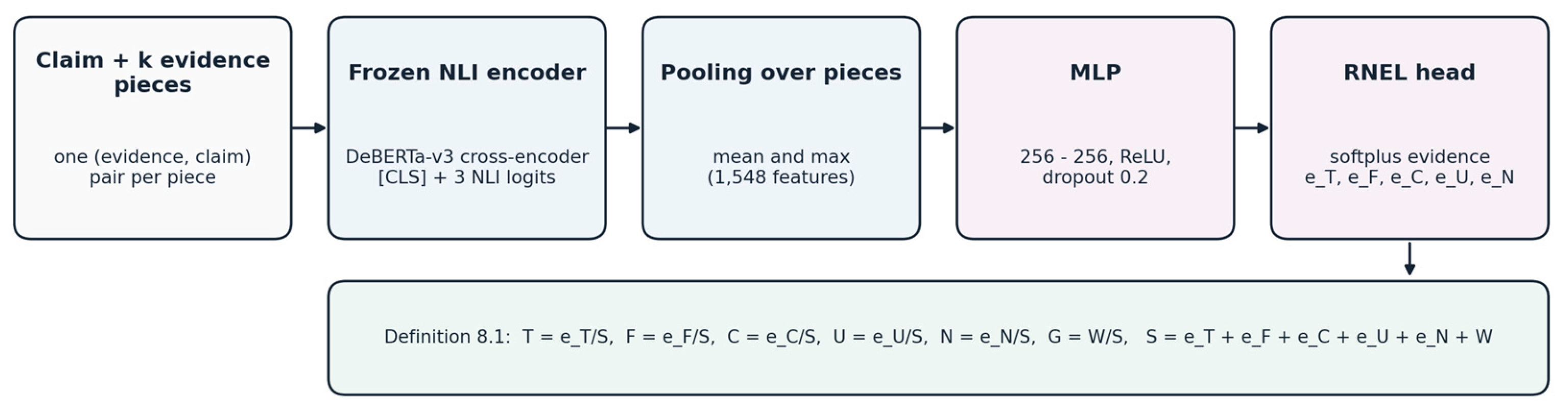
Figure 8.2.
F1 on the contradiction class C. Learned models (purple) against SL fusion and the rule (grey).
Figure 8.2.
F1 on the contradiction class C. Learned models (purple) against SL fusion and the rule (grey).
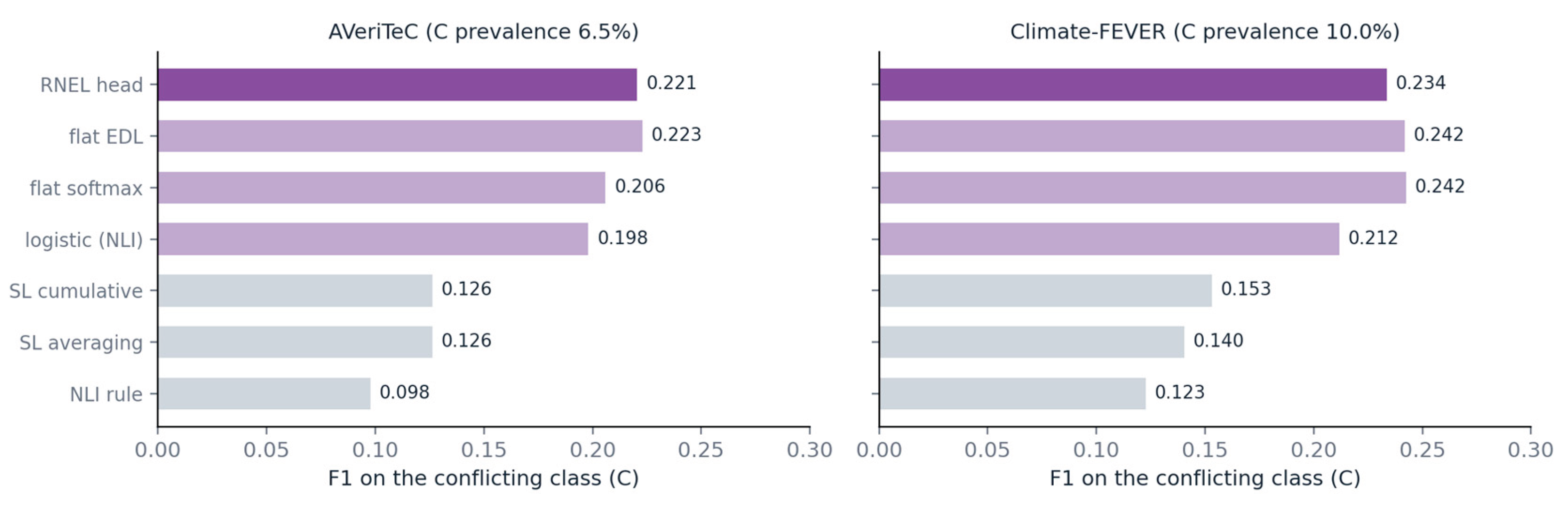
Figure 8.3.
Mean RNEL tuple of Definition 8.1 by true label (out-of-fold, mean over seeds). U is near zero because these data sets contain no undetermined labels.
Figure 8.3.
Mean RNEL tuple of Definition 8.1 by true label (out-of-fold, mean over seeds). U is near zero because these data sets contain no undetermined labels.
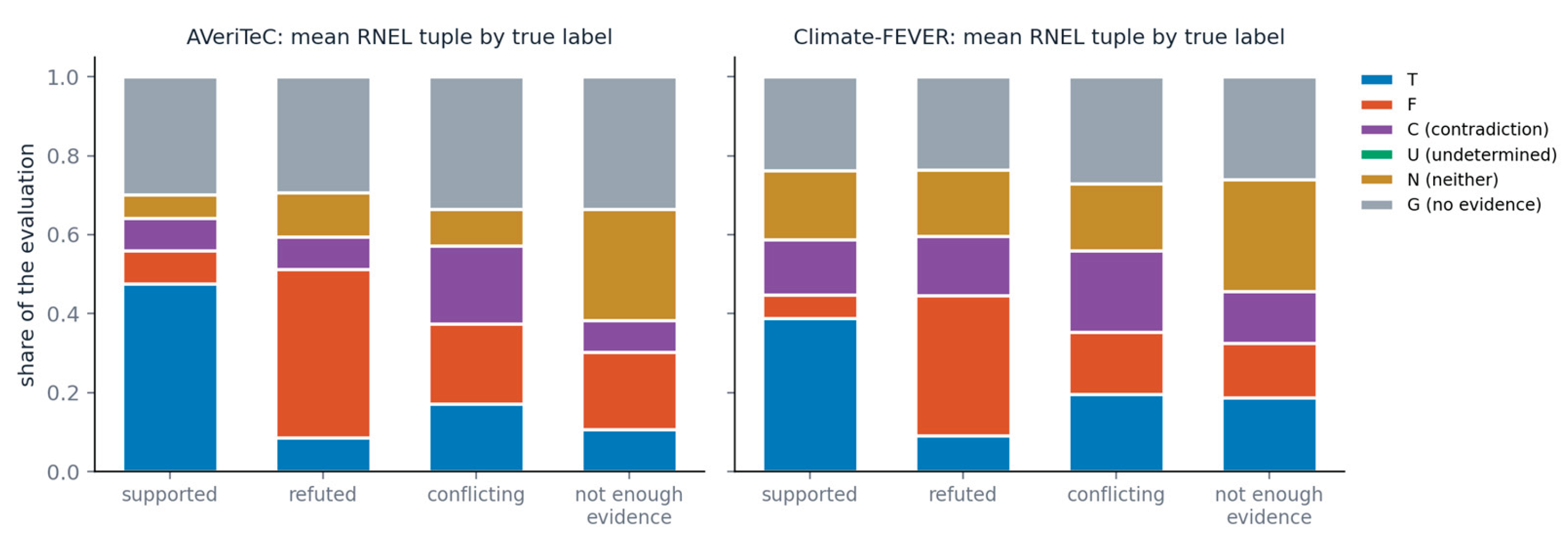

Table 8.1.
Classification into T, F, C and N (mean over 5 seeds, out-of-fold). C prevalence: 6.5% in AVeriTeC, 10.0% in Climate-FEVER.
Table 8.1.
Classification into T, F, C and N (mean over 5 seeds, out-of-fold). C prevalence: 6.5% in AVeriTeC, 10.0% in Climate-FEVER.
| Method | AVeriTeC macro-F1 | AVeriTeC F1 on C | Climate-FEVER macro-F1 | Climate-FEVER F1 on C |
|---|---|---|---|---|
| RNEL head | 0.483 | 0.221 | 0.465 | 0.234 |
| Flat EDL | 0.488 | 0.223 | 0.472 | 0.242 |
| Flat softmax | 0.469 | 0.206 | 0.467 | 0.242 |
| Logistic regression (NLI) | 0.337 | 0.198 | 0.362 | 0.212 |
| SL cumulative fusion | 0.352 | 0.126 | 0.282 | 0.153 |
| SL averaging fusion | 0.345 | 0.126 | 0.275 | 0.140 |
| Rule (support and refute gives C) | 0.334 | 0.098 | 0.288 | 0.123 |
Disclaimer/Publisher’s Note: The statements, opinions and data contained in all publications are solely those of the individual author(s) and contributor(s) and not of MDPI and/or the editor(s). MDPI and/or the editor(s) disclaim responsibility for any injury to people or property resulting from any ideas, methods, instructions or products referred to in the content. |
© 2026 by the authors. Licensee MDPI, Basel, Switzerland. This article is an open access article distributed under the terms and conditions of the Creative Commons Attribution (CC BY) license.
Copyright: This open access article is published under a Creative Commons CC BY 4.0 license, which permit the free download, distribution, and reuse, provided that the author and preprint are cited in any reuse.