

Submitted:
27 September 2026
Posted:
29 September 2026
You are already at the latest version
Abstract
This paper explores and articulates how storytelling, digital fabrication, and Indigenous partnership bridge Indigenous and non-Indigenous design methodologies through experimental and relational making. A biocultural approach situates design in dialogue with Indigenous and decolonial design theory and practice. Central to this exploration is Ometeotl, a culturally significant furniture-sculpture that materialises Indigenous onto-epistemologies of relationality between people and Place. By employing mycelium and Indigenous knowledges as material thinking and metaphor, the research demonstrates how biomaterials engage circular and decolonial methodologies, fostering responsive, relational design practice. Indigenous and non-Indigenous collaboration highlights biocultural design as creative process and cultural conversation, honouring Land, reciprocity, and living systems that sustain design. Reflecting on Ometeotl, the paper examines dynamics and outcomes of cross-cultural collaboration, diverse worldviews and values shaping respectful partnerships, and how Place, Indigenous knowledge, materials, and technology activate creative agency. Ometeotl positions biocultural, relational making as a pathway toward sustainable, diverse, and respectful futures.
Keywords:
biocultural design and fabrication
; biomaterials
; culturally significant design
; indigenous and decolonial design
1. Introduction
Indigenous and decolonial design methodologies have a vast wealth of experience to contribute to western design practice. For millennia, Indigenous cultures have cultivated relationships with the land, waters and skies, and on Place. This situates people in relation with Mother Earth, within the material and immaterial, rather than at the top of a hierarchy or anthropocentric approach. We argue that when design engages with people and Place, and is practiced in a relational approach, the position of the designer, the material and its source, the technological resources, the user, and the design practice itself contrasts with design’s dominant hegemony and mainstream design. In an extractive, western-capitalistic frame, materials are engineered to be compliant and consumed to satisfy a human-centered need, which is separate from the needs of future generations and natural resources (Munroe & Hernandez Ibinarriaga, 2022).
This paper examines how Indigenous knowledge, storytelling, digital technology, and Indigenous partnership and collaboration can bridge Indigenous and non-Indigenous design practices through experimental and biocultural design-making. The article also explores mycelium as a living biomaterial within the context of biocultural design, digital fabrication, and Indigenous and decolonial design theory and practice, to support ways of conceptualising and collaborating with the living material (Bergström et al., 2010). Central to this inquiry is Ometeotl, a culturally significant furniture-sculpture design that embodies Indigenous onto-epistemologies of relationality between people and Place in Mexico (Nahua/Aztec and Maya cultures). By employing mycelium and Indigenous knowledges as both material and metaphor, the work demonstrates the potential of living materials to engage with decolonial and Indigenous methodologies and ecological ethics.
Living materials when combined with digital fabrication also create opportunities for design to be relational to Place and land by providing opportunity for materials to express their own agency within a design. The partnership between Indigenous and non-Indigenous designers serves as a model for relational design, one that honours Place/Mother Earth, storytelling, and the living systems that sustain creativity and craft. Through this lens, the paper positions biocultural material-based design as both a process of making and a cultural dialogue toward sustainability, diversity and respectful futures.
Through a reflection on the collaboration between Indigenous and Western designers to create Ometeotl, we address several questions:
- What is the outcome and process between designers from different fields and cultures when collaborating?
- How does the diversity of worldviews, identities, practices and ways of doing create respectful partnerships through shared values?
- How can Place, Indigenous knowledge, materials and technology motivate the agency of collaboration between the Indigenous and the non-Indigenous designers?
2. Background Literature
The foundation of this research lies in both theory and practice within the fields of decolonial design and biodesign. The review begins by exploring the ontology, or the ways of being, that inform the conceptual grounding of the project through storytelling. Next, it examines the available options based on the resources for making, and technologies accessible to experts working within specific contexts and Places. Finally, it considers how onto-epistemology, technology, and design interweave to form a decolonial design practice grounded in collaboration between Indigenous and non-Indigenous designers towards a cultural significant design. These elements are all underpinned by Mother Earth/Place (the material and immaterial), cultural heritage, and expertise, which together shape a relational approach to design, providing space for material agency through the design process.
Agency in this sense refers to the way that work can be delegated to a non-human (Yaneva, 2009) in the process of creating the design, Ometeotl. For example, the dependence on the growth of the biomaterials used gives the living material a “say” in the final design that emerges through the relationship with designers (Dew & Rosner, 2018). Agency extends beyond the action of humans in the creation of Ometeotl, creating a reduced role for the designers and artists through the delegation of work, as described by Coulton and Lindley:
“in a networked world with many connected actants – both human and non-human – the notion of human centred ceases to be useful. When designing for networked ecologies prescribing a unique centre cannot properly characterize the design space.” (Coulton & Lindley, 2019, p. 467)
2.1. Storytelling
The role of storytelling for this project is essential, as it is a culturally significant design that tells a story, reviving Nahua and Mayan cosmology, stories and practice. Indigenous ways of being, knowing and doing have been passing on through storytelling and practices for many generations around our Mother Earth. Storytelling is a relational practice to Indigenous oral traditions and cultures, this include diverse Indigenous languages that are live, dynamic and relational to the Land. It serves to recover ancestral memories from the lands, waters, skies and are located while learning from the land and with the Land. This reveals truth-telling and values system from certain cultures; all are different and hold diverse wisdom (Barcham, 2023; Bobongie-Harris et al., 2021; Datta, 2018; Emberley, 2014). Storytelling helps to embrace the physical, emotional, spiritual and intellectual aspects of humans, specifically to Indigenous peoples while nurture and educate the heart, mind, body, and spirit. Involves deep listening, and deep observation and opens to dialogue, and can be passed down through words, silences, gaps, body movements, singing, dancing, etc. (Barcham, 2023; Datta, 2018; Emberley, 2014). Some of the values it holds are respect, relational accountability, responsibility, obligation while building an iterative process of resistance and resilience within (Ibinarriaga, 2025).
2.2. Biodesign: Fabricating with Life and Technology
Digital fabrication methods, including additive processes, such as 3D printing, and subtractive methods, such as CNC machining are used in design research and practice for prototyping and small-scale production which has been used to create bio-inspired designs (Ortega Del Rosario et al., 2024). Research shows that novel biomaterials provide opportunities to increase overall sustainability of digital fabrication, compared to conventional 3D printing (Faludi et al., 2019). Ubiquitous waste materials are being utilized in research to be directly 3D printed, such as coffee grounds (Rivera et al., 2023), or to apply biological processes, such as the growth of edible mushroom fungi, either by creating forms in which mycelium can grow into complex forms (Gough et al., 2023) or by directly printing mycelium materials (Elsacker et al., 2022). Functionalizing these living processes is an example of biodesign.
Biodesign is an approach within design that utilizes the processes of living systems and biological materials to address design problems. Biodesign has found a place in design research and practices in disciplines from architecture and industrial design (Andréen & Goidea, 2022; Attias et al., 2020), human-computer interaction design (BioHCI) (Bell et al., 2025; Gough et al., 2023; Merritt et al., 2020; Pataranutaporn et al., 2018), fashion (Amobonye et al., 2023) and more. It has been famed as a process of applying the bioaffordances of a material, those properties and structures that are relevant to the interaction between people and designs (Gough et al., 2021). Doing so centres issues of sustainability through biofabrication (Andréen & Goidea, 2022; Bell et al., 2024), where research has contributed new materials and new knowledge about existing biomaterials that can be renewable, recyclable, revived from waste or biodegradable (Camere & Karana, 2018). Biodesign practice presents unique challenges from materials, processes and the role of the designer (Camere & Karana, 2018).
Biodesign research has also contributed novel uses of living and organic biomaterials (Nicolae et al., 2023; Wattanavichean et al., 2025). Of note is the development of mycelium-based materials, including Composite Mycelium Materials (CMM) and Pure Mycelium Materials (PMM). Mycelium materials utilize the highly interconnected network of some fungi root systems, such as Oyster (Pleurotus species), Reishi (Ganoderma species), or Turkey Tail (Trametes species) among others. Fungi species that are “trimitic” – containing three types of cells: generative, skeletal and binding (or ligative) – produce networks that have the highest mechanical performance for use as CMM (Porter & Naleway, 2022). As these mushroom fungi spread their root network, they bind together the substrate material, ready for the conditions to be suitable for producing the fruiting body, which may be eaten or used for medicinal purposes.
CMMs use the growth substrate as part of the final material, which may include a range of materials, often waste, such as sawdust and used coffee grounds. These materials are bound into the composite by the mushroom fungi during its growth phase, and when the CMM is dried to halt the growth of the mycelium, is bound permanently. They are often created by sterilizing a substrate mixture, inoculating the sterilized substrate with mushroom spawn (from liquid culture or infected grain), and allowing the mycelium time to colonise the substrate. Once this process has taken place, the material can be broken down and forced into a mould and can be used to create 3D forms and surface textures after a few days. Once it can hold its own shape, the CMM is removed from the mould, and may be allowed a period of open growth before being dried do halt further growth, and development of the mushroom “fruiting body” – so that the substrate is not completely consumed by the fungi (Gough et al., 2023). PMMs do not include the growth substrate and can be created by growing the mushroom on a dense substrate, such as a paste, or in a liquid culture. These materials are frequently grown to resemble leather or foams, and can be chemically processed to become pliable, strong, but still biodegradable (Jiménez-Gómez & Cecilia, 2020; Jones et al., 2020).
Mycelium has been used in conjunction with digital fabrication to create moulds, that support and shape growth into complex forms (Gough et al., 2023). Advances in digital fabrication, and increasing accessibility of fabrication technologies, such as laser cutters and plastic or ceramic 3D printers, has fostered the development of an emerging body of research in biodesign. Some exploration of computational models of fungal growth have also contributed to applications of CMM, though this is an area for further exploration and optimization (Ozkan et al., 2022).
2.3. Decolonial and Indigenous Design
Indigenous design holds diverse elements that are core, this to make sure that cultural significance is at the forefront of the design outcome. These elements are Mother Earth/Country acknowledging the living spirit of the land, relationality between people and Place, positionality while incorporating cultural identity into the design, practice as an embodied experience, the unity of the material and immaterial (spirituality, energies, ancestral wisdom) aspects of the process, diverse values, as well as resilience and resistance aspects among the design. “Through Indigenous design, communities assert their resilience, conserving cultural heritage while navigating contemporary contexts, this towards cultural significant design, practices, and outcomes” (Ibinarriaga, 2025, pp. 43–44).
Decolonial design for this paper focuses on the partnership aspect, while Place, Indigenous, non-Indigenous people, and living entities such as mycelium collaborate together. The collaboration happens when the land and culture co-create, then this is abstracted by an Indigenous designer to present a culturally significant design while making with a non-Indigenous designer, utilising living and non-living materials. It is important to mention that the two human designers’ collaborators have been developing a strong partnership that has grown over the years with diverse projects together. According to Ibinarriaga, “... allies are characterised by their dedication to the values and inclusivity of Indigenous knowledges, cultural sensitivity, and collaboration, as we work together to incorporate Indigenous knowledge systems within Western systems and facilitate meaningful dialogue between Indigenous and non-Indigenous worldviews” (Ibinarriaga, 2025, p. 93). This can be seen in the relational approach the collaborators demonstrate; this project is not a consultation but a deep and true collaboration an Indigenous and a non-Indigenous designer while respect and communication are values at the forefront of the design process. “Decolonising and Indigenising design are grounded in balancing theory and practice for a better understanding of the project’s reality, foundations, and outcomes” (Ibinarriaga, 2025, p. 86).
As theory is inseparable from practice, methodology and axiology (Martin, 2017), the following section illustrates how this project transitioned from the immaterial to the material through the design-making and thinking process.
3. Methodology, Methods and Collaboration
This section outlines the methodological cultural framework (concept), detailing the methods employed in creation (making) and collaborative engagement within the partnership (collaboration), including artist involvement and the co-creative making process.
3.1. Ometeotl and Indigenous Cultural Significant Design
The methodological approach comes from the cosmology of the Ometeotl way of thinking, the diversity or duality that becomes unison while interacting, a relational way of designing and making. The Ometeotl furniture-sculpture is an example of an Indigenous design, a culturally significant design founded on Nahua and Mayan cosmology, wisdom and ancestral knowledge. Ometeotl is a furniture-sculpture that is inspired by an abstraction in the symbol Ometeotl. Ometeotl (Figure 1), translation from Nahuatl language Ome (two), Teotl (God), meaning the duality and at the same time the unison of the whole while embracing the principle of relationality and respect (Ibinarriaga, 2025).
Ometeotl design consists of a set of two chairs (duality), that when assembled (unison), which together are the abstraction and embodied presentation of ‘Ometeotl’ (Figure 1). Each couch undergoes an intervention by Indigenous artist revealing their cultural identity in the design. Decolonial and Indigenous Design is not static but transitions, evolves and grows. In Figure 1 it can be seen how this project has evolved and grown through time. This Indigenous design represents a living, evolving project that continues to grow across time and form. Its journey began with a sculpture inspired by the Mayan embodied experience of greeting someone with beauty and humility — In Lak’ech – Hala Ken (Figure 1). From this initial creation, the design transformed into a painting depicting the sacred Ometeotl symbol, rendered on a circular wooden canvas to evoke duality and unison.
Figure 1.
Evolution of the project and concept: The Mayan greeting (In Lak’ech), symbol (Ometeotl), cultural identity design activity and Ometeotl furniture sculpture. Photo by authors.
Figure 1.
Evolution of the project and concept: The Mayan greeting (In Lak’ech), symbol (Ometeotl), cultural identity design activity and Ometeotl furniture sculpture. Photo by authors.
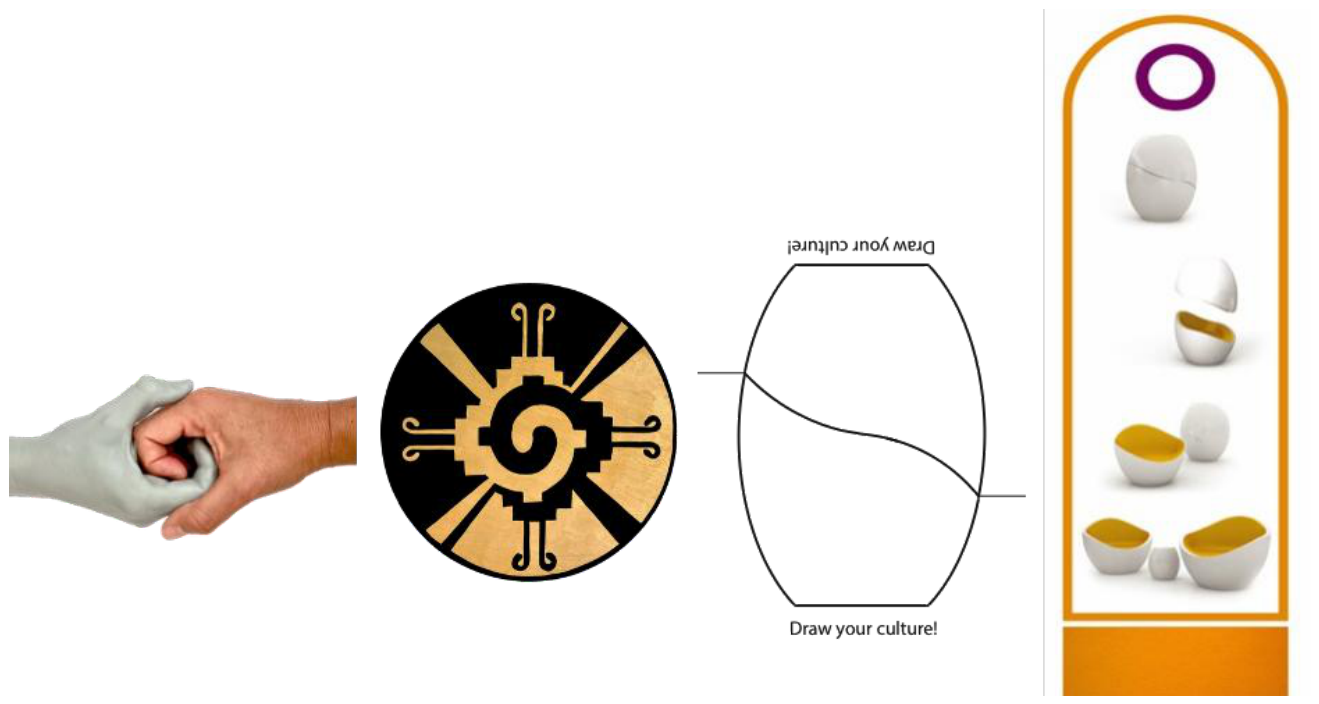
The next phase unfolded as a cultural identity workshop, inviting people from a wide range of backgrounds and countries to participate. Participants were encouraged to explore and express their own cultural identities by drawing within the abstract form of the Ometeotl symbol (Figure 2). These workshops became spaces for dialogue and exchange where individuals shared their cultural heritage and perspectives through art, they can move around, connect with others one to one, communicating their stories through verbal and non-verbal communication, and by drawing. This creative practice is boundless and runs from diverse types of design, art, engineering, and architecture while holding ancestral knowledge in the concept and informing the design.
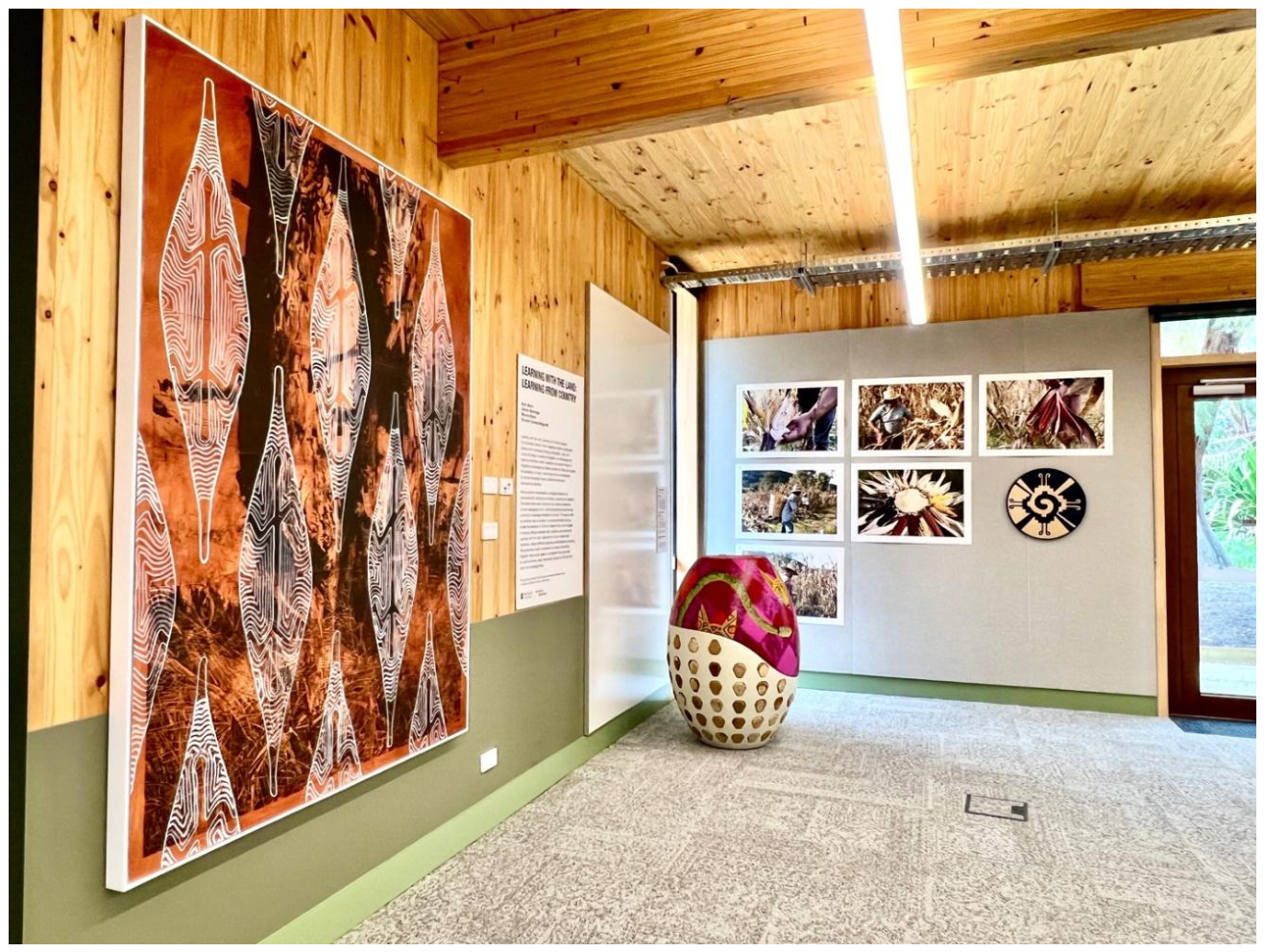
The project’s most recent stage is the creation of a prototype Ometeotl furniture-sculpture, which is the example of Indigenous design presented for this paper. This piece was exhibited as part of the show Learning with the Land: Learning from Country at the new EcoCentre sustainable building in St Kilda, Melbourne, Australia, in 2025 (Figure 3). As it continues to evolve, the project remains a testament to living Indigenous knowledge, intercultural collaboration, Indigenous partnership and the power of creative practice as a way for connection and understanding with relationality, agency and respect.
Figure 2.
Images from cultural identity activity. Photo by the authors.
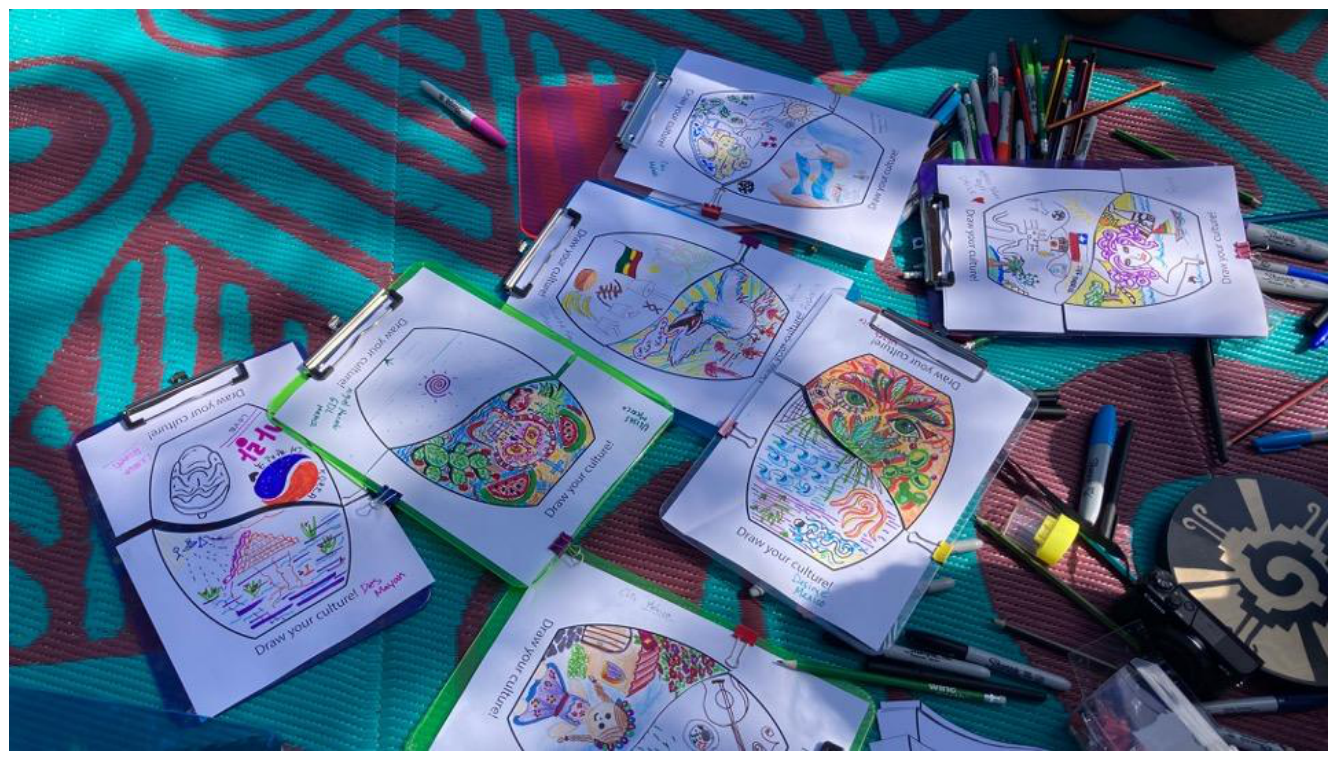
Figure 3.
Exhibition Learning from the Land: Learning from Country. ‘Corn’ by Desiree Ibinarriaga is visible on the right. Photo by the authors.
Figure 3.
Exhibition Learning from the Land: Learning from Country. ‘Corn’ by Desiree Ibinarriaga is visible on the right. Photo by the authors.
3.2. Collaborative and Artist Engagement
The Ometeotl project was a collaboration between four creatives: a designer–maker–artist, a designer responsible for constructing the structure, a biodesigner who developed corn kernels using composite mycelium material, and an artist who intervened by contributing artwork to one piece of the furniture.
Artwork shown in the right of Figure 3 is about people of the ‘Corn’ by Desiree Ibinarriaga (Nahua, Mayan, Basque, Spanish woman), artwork piece 2 ‘Kikapu’ by Ulises Resendiz (Indigenous Mexican man from North Mexico).
The artwork ‘Corn’ comes from the onto-epistemology that we, Indigenous people from the south Mexico are hijos del maiz (people of the Corn). Maiz (Corn) is ancestral and feed us from millennia, it is one of the main foods that sustain Mexican people and with globalisation now it reaches the world. El Maiz (Corn) comes from the Milpa, an ancestral agriculture from First Nations in the south of Mexico. The Milpa has been a sustainable method of growing crops for millennia. It is an ancestral agricultural practice in which maize is intercropped with other native Mexican species such as chilli, zucchini, beans, tomato, edible herbs and medicinal plants (Rodríguez-Robayo et al., 2020). These crops have become staple foods globally, consumed by both affluent and impoverished societies. On average, the Milpa system provides 64% of a family’s food needs in communities in Mexico, specifically in Mayan and Nahua cultures (Barrientos & Magaña, 2016). This ancient Indigenous tradition of intercropping provides many benefits to the grower and the community, as well as the soil, the broader ecosystem and the long-term health of our planet. Crop diversity in Milpa growing systems reduces the risk of food insecurity due to pests, bad weather etc. (Rodríguez-Robayo et al., 2020). The Milpa is not only an agricultural system; it also encapsulates social, cultural, environmental, and economic aspects as well as spiritual and cosmological beliefs of the Nahua and Mayan people. Milpa involves complex interactions and relationships between agriculturalists, as well as distinct personal relationships with both the crops and land. It highlights the significance of ancestral practices and the connections and relationship between Place and peoples while embodying interactions. The corn has many parts and elements such as the cob, ear of corn, kernel, leaves (totomoxtle), stems, ears, cob, nixtamal water, corn silk; all have a specific use to satisfy different social and cultural needs. We use all the elements of the corn, the corn holds knowledge, practices, spirituality, cosmology and has agency while being relational to the whole. The key is the diversity in the milpa and corn; we have more than 268 varieties, and each serves different purposes. This Indigenous design empowers revitalising Indigenous cosmology and Milpa practices through practice led research in the design field for the paper purposes.
The ‘The Coyote and the Rattlesnake’ visible in Figure 4 is inspired by Ulises Resendiz’ Kikapú Indigenous heritage and the flora and fauna of Coahuila, Mexico, where he was born. The work brings together the coyote and the rattlesnake as symbolic figures of adaptability, protection, and transformation, while the nopal cactus represents resilience, sustenance, and continuity in arid landscapes. The vibrant red background references Mexican textile traditions, where cochineal insects are used to produce deep, enduring reds. Through layered imagery and colour, the design reflects a living connection to place, memory, and ancestral knowledge.
3.3. Fabrication and Materials
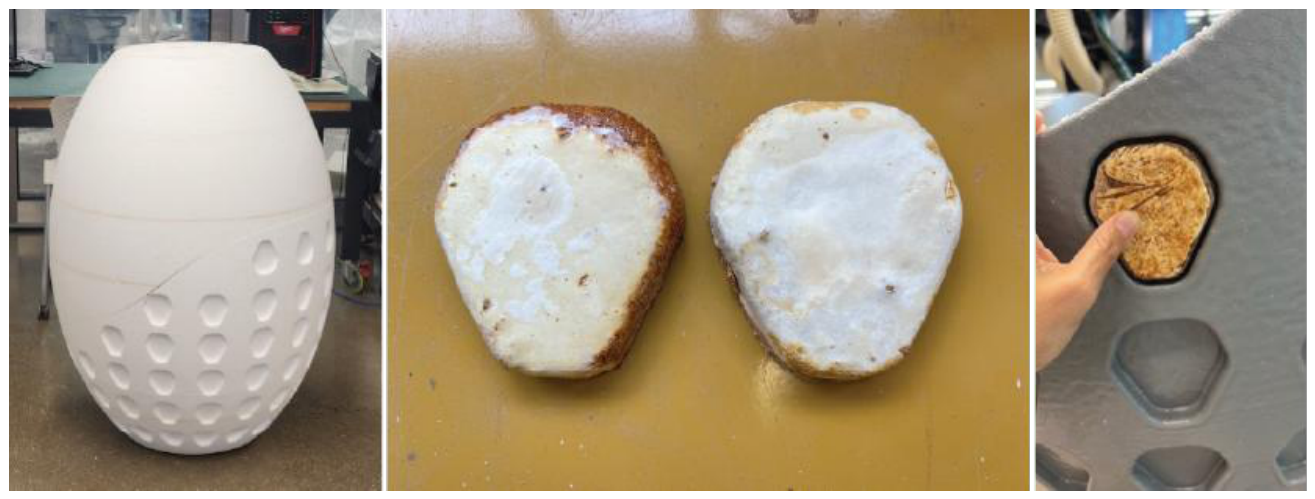
Ed Turner, a Lab Manager and Technical Officer at The University of Monash Digital Fabrication Workshop (dFab), machined the Ometeotl from High density Expanded Polystyrene foam (EPS) using a Kuka KR120 robotic arm. These were coated in polyurethane before being finished in acrylic paint. For the first iteration, two chairs were milled from the EPS foam. One of these included recessed sections to fit CMM corn kernels which were adhered to the surface (Figure 5).
Kernels that were fixed to one chair were fabricated by moulding CMM in vacuum-formed polystyrene shells. These provide a structure to which the CMM conforms as it colonises the growth media. The growth media consisted of jelutong sawdust, coffee grounds and water. Jelutong, Dyera costulata, a latex tree is farmed and used for CNC machining for its desirable stability, appearance and ease of carving, and is readily available to us from The University of Sydney Digital Modelling and Fabrication Lab (DMAF). Coffee collected from a local café serves as a source of nitrogen for the growth of the CMM. The growth media were mixed and sterilized in a steam autoclave, then inoculated with Ganoderma steyertanum, a locally endemic species of trimitic fungi that we have experience growing on these substrate mixtures. The CMM of this species typically produces a combination of white to brown colouration on the surface of the mycelium network seen in Figure 5.
Figure 5.
Left: Expanded Polystyrene carved furniture. Middle: CMM kernels. CMM Right: testing the scale of CMM growth compared to digitally fabricated and finished materials.
Figure 5.
Left: Expanded Polystyrene carved furniture. Middle: CMM kernels. CMM Right: testing the scale of CMM growth compared to digitally fabricated and finished materials.
As the fungi operates in the natural environment as a recycling system, it is prone to degradation. To help increase the phase of use as a component in the furniture, it was necessary to protect the CMM in its formed material state. To reduce the chance of infestation, and provide some surface protection, the kernels were pained with Polyvinyl Alcohol (PVOH), which provides a barrier against odour (which may attract insects) and provides some surface protection. Coatings such as PVOH also flatten the surface of the CMM and increase contrast between regions of different colouration. Conventional alternatives for finishing natural materials (such as Polyurethane varnish) were not selected due to the lifespan of these materials compared to the biodegradable CMM. PVOH is a synthetic, water-soluble plastic that can be degraded by a microorganisms, and does not threaten marine life according to some tests, though more research is needed (Alonso-López et al., 2021). The sample we acquired was created by dissolving excess 3D printer filament from DMAF, where it is used as a soluble support material for high-resolution 3D printing. In this way, we were able to utilize waste streams from two forms of digital fabrication to create over 100 kernels for Ometeotl.
4. Discussion
This discussion explores four key elements that shape the focus of this paper. First, it examines Indigenous partnerships and collaborations. Second, it considers how different perspectives, ways of being, knowing, and doing emerge among designers from diverse fields, cultural backgrounds, and perspectives. Third, it surfaces the tensions between the materiality of living and engineered materials. Finally, it discusses agency between the subjects involved as network of relational actions.
4.1. Indigenous Partnerships and Collaborations
As Ibinarriaga (2025) states, Indigenous partnerships are not about consultation but deep and meaningful collaborations, it is designing with Indigenous people not for Indigenous peoples. This project is an excellent exemplar of the development of a strong partnership that has been ongoing for a few years and has evolved into stronger projects. The strength of this collaboration was the shared experiences, knowledge and practices from the designers, the deep listening and understanding of the strengths and expertise of each and harness them as opportunities for the project to thrive. Also, the trusting of the process and taking the best decisions among the possibilities, resources and timing.
This study exemplifies a sustained and evolving Indigenous partnership that extends beyond the boundaries of a single project. Rather than concluding with one outcome, the collaboration continues to grow through ongoing dialogue, deep listening and understanding, shared knowledge and shared engagement. Its enduring contribution lies in demonstrating how respect, reciprocity, deep listening, and trust form the foundation for strengthening relationships and partnerships with Indigenous peoples and between researchers-designers.
A further contribution to knowledge emerges from the exploration of duality and unison within biocultural design realm. This work illustrates how Indigenous knowledge systems and cosmological perspectives can be materialised through diverse methodological approaches while weaving concept, materials and technology. The integration of biological and artistic elements such as the representation of Ometeotl and the corn artwork combining mycelium with non-living materials reveals how cultural and biological processes converge and thrive. Together, these practices enact a collaborative production of knowledge, reflecting on the ancestral knowledge, conceptual framework, technological and material dimensions of relational design.
4.2. Perspectives Among Diverse Designers
This contribution is imperative as it is essential to understand and listening to the diverse perspectives involved. How the two minds, worldviews, perspectives have different ways of being, knowing and doing, and how this converges in the creation and making process.
The collaboration between designers from different fields and cultural backgrounds generated both a process and an outcome rooted in mutual learning, mutual respect, adaptive creativity, material thinking, critical making and decision-making. Rather than simply merging distinct skill sets, the partnership catalysed a dialogic exchange where disciplinary methods were challenged and reinterpreted through cross-cultural-interdisciplinary understanding. The process revealed that collaboration between Indigenous and non-Indigenous designers can lead to hybrid forms of design thinking and making where intuition, narrative and material sensitivity complement technological precision in an iterative experimentation. The outcome thus embodied not only a tangible furniture-sculpture but also an expanded, relational framework for transdisciplinary design practice.
The diversity of worldviews, identities, and practices within this collaboration was negotiated and respected through shared values that guided every stage of the process. These values include respect, reciprocity, and relational care which formed the ethical foundation for partnership, ensuring that different cultural and expertise of epistemologies were held in dialogue and critical making. Through deep listening and collective decision-making, the team established a way of working that honoured both Indigenous knowledge and Western design methodologies. This co-creative approach contributed to knowledge by demonstrating how intercultural design practices can foster meaningful partnerships that move beyond representation toward genuine collaboration grounded in shared purpose.
The engagement with materials and technologies highlighted how cultural perspectives, interests, and expertise shape the design approach and the roles within the creative process. The Indigenous designer, drawing from Indigenous knowledge, approached materials as living participants, even though the approach in the making was with non-living materials. In contrast, the biodesigner (western), bringing expertise in robotic CNC and living materials (CMM), saw material as dynamic living matter responsive to technological manipulation and environmental input. Together, they explored how these perspectives could intersect to produce new forms of texture, colour, shape, and meaning. The resulting outcome became an agent where culture, material, and technology intertwined, revealing how Indigenous and Western design can co-exist and enrich one another through tactile expression and material storytelling.
4.3. Fabrication Tensions
The process to digitally fabricate and grow kernels for Ometeotl highlights tensions, compromises, and decisions when fabricating with digital and living technologies. These decisions were made according to timing, resources, material, technology, and expertise. Developing and making the chairs occurred over 8 months and involved the discussions, understanding of the concept, understanding of expertise of all the sides involved, and how to make the project reality through the methods of making and technology, buying and growing materials and the shaping of the furniture before (Figure 3) the exhibition commenced.
One tension rises between living and engineered materials used in this project, through the labour that is carried out, and the material selection. For example, the decision to use EPS was influenced by the strengths and limitations of both living and engineered materials. Creating furniture-scale, monolithic designs using CMM is challenging, but possible (Dessi-Olive, 2022). Methods such as heat-treating the CMM may have created a material that was similar to or more performant the high-strength EPS (Camilleri et al., 2025). However, both of these approaches would have required investment in infrastructure, or resources that were difficult to access, and impacted the design (e.g., increased weight) of the chairs, which was not desirable for this project. Additionally, moulding a larger CMM would typically require unsustainable materials to be consumed, such as fibreglass moulds, which is difficult to recycle and hazardous to make. These tensions and decisions highlight the challenge with further adoption of biomaterials such as CMM, when compared to conventional, unsustainable materials that have greater systematic efficiencies.
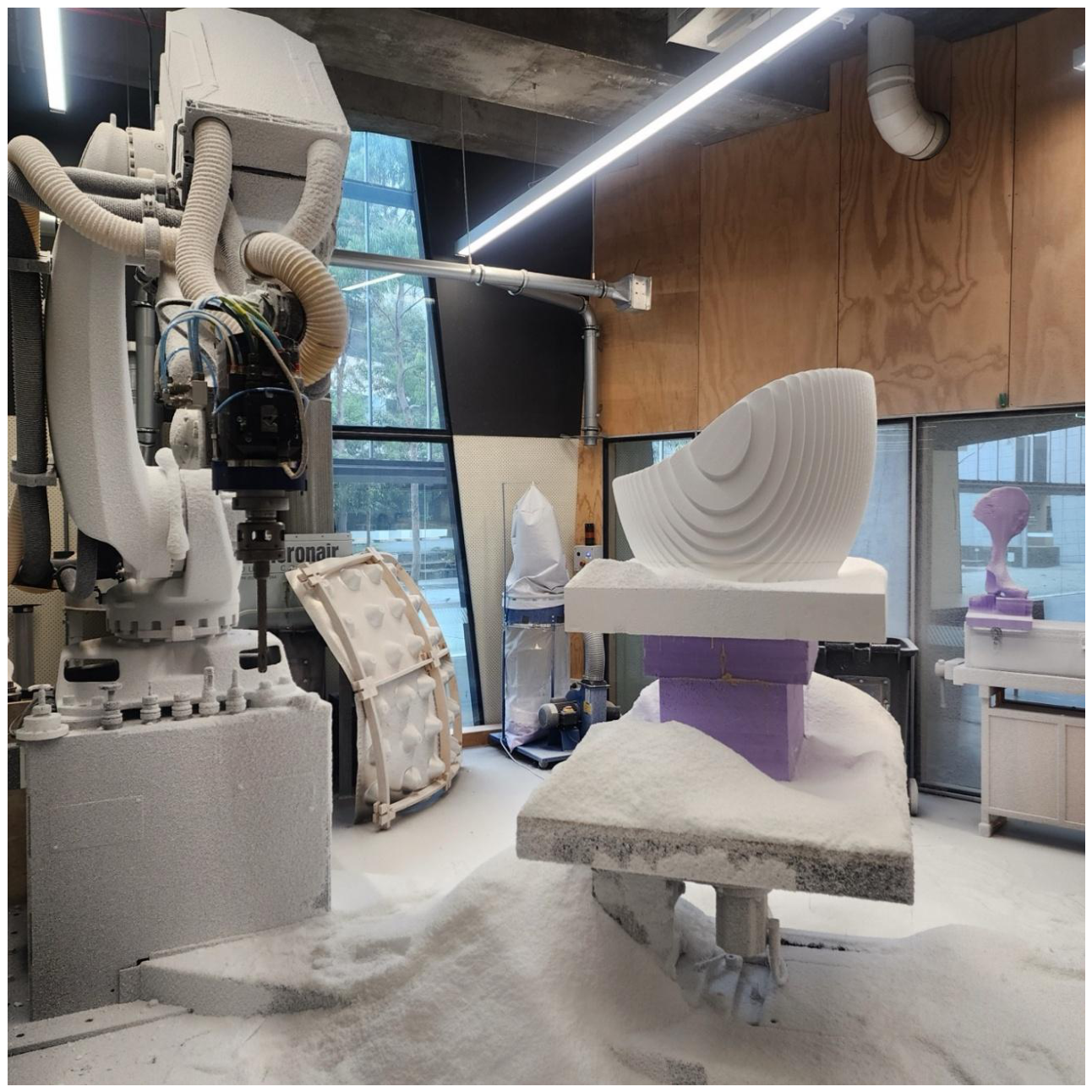
As shown in Figure 6, the subtractive fabrication process created a significant amount of excess material. Through ongoing maintenance of the relationship with the supplier of EPS used in dFab, the excess material can be recycled. However, this creates substantial labour: building trust with the supplier, cleaning the workspace before machining the foam to avoid cross-contamination, so that it remains suitable to be returned for recycling, as well as its actual collection. The surface recesses on the chair with the kernels attached also required work to position the material so that the robot was able to access the recesses. The additional CNC processes performed by the robot also increases risk of errors in the programming, which in turn requires additional supervision of the robot and attentiveness to its action. In contrast, the living fungi used to create the kernels was able to be provided with a set of conditions: a form, nutrients, incubator parameters, and time to grow autonomously and create aesthetically desirable variation that supports the concept through its material “livingness” (Ferraro et al., 2025; Karana et al., 2020). Time constraints when working with living materials requires that designers reframe their relationship to material to align with temporal aspects of life’s natural cycles (Merritt et al., 2020).
The tensions surfaced through a combination of digital fabrication and biodesign are reconciled through the contribution of the materials to the project. The imperfect fungi kernels contribute with texture and vibrancy to the concept ‘Corn’, while the precision, robot-fabricated chairs provide a self-effacing platform for the intervention of the kernels and the artist’s paint and artwork. The action of the fungal growth was essential to the concept, so we limited efforts to transform it to be “more like” an engineered material. The decisions we made utilise a range of materials and processes, and through the efforts of research in biodesign, we hope for new ways in which living materials can be creatively applied to culturally-sensitive-significant designs through digital fabrication. The burdens from these decisions are shared among the collaborators, which also include the living materials, robots, artists, and technicians.
Figure 6.
Excess material carved from the Expanded Polystyrene blocks building up around the robot. This material was recycled, which involved substantial labour for the technician. Photo by technician.
Figure 6.
Excess material carved from the Expanded Polystyrene blocks building up around the robot. This material was recycled, which involved substantial labour for the technician. Photo by technician.
4.4. Agency and Relationality of Actors and Actions
Reflecting on the way that agency was distributed within the environment (Yaneva, 2009), we outline roles of human, material and designed actors (Table 1). We examine this from a relational, rather than hierarchical, perspective, to highlight the role of non-human and human actors at the same level. The concept/ ancestral knowledge at the centre that is drawn from the practice, culture and knowledge of the Indigenous Designer created a space for agency, creativity and practice for the collaborators: Living Materials, the Western Biodesigner, Artist and Technician (Figure 7).
The Western Biodesigner further created a space for the CMM, giving opportunity for the living fungi to express agency within certain bounds, allowing for a flexible understanding of how the material should be (Bergström et al., 2010). First, the physical void of the mould where the fungi was allowed to grow and form the CMM, and second, a conceptual framing of the project, with a “desirable” form. The mycelium is an actant, the plastic mould forms a mediator, and action (binding together and transforming waste) is delegated away from human activity (Yaneva, 2009). This placed responsibility on the fungi to produce a functional, useful CMM, ready for the finishing process. The creation of the culturally significant associations that make up part of the design also comes from the interaction between the fungi and incubator, form, concept, protective grow bags. As a result, the role of the designers is diminished within a relational network.
CMM expressing agency contrasts with the relationship between the technician and the robot carving material to create the form of the chairs. The robot is controlled by the technician based on digital models and can execute programmed actions. In this sense, the CMM acts more like a generative AI than the robot. Much like generative AI, the specific outcome is unknown, but the agentic action is guided by human input and results in creative agency. This could be considered assemblage creative agency, which is distributed across the human designer, nonhuman CMM and the environmental constraints through their relationships (Loivaranta et al., 2025).
The agency of the robot and CMM are in the process, in contrast to the final artefact, which has its own agency (Figure 7). Through the relational lens, the artefact, Ometeotl, has agency because it holds and communicates knowledge, though it has no agency through the process and is entirely subject to the other actors.
Through their intervention with the Ometeotl, the artists created a form of non-verbal agency, allowing the furniture-sculpture to express itself. The Ometeotl embodies agency through its material presence, serving as both a holder and communicator of knowledge. By engaging with participants, it shares this knowledge and becomes an active, creative agent. Here, all actors and their relationships merge into one, and the culturally significant outcome, Ometeotl, embodies this relational design, where humans, non-human actors, and Place unite as a single entity, the duality and the unison of all.
5. Conclusions
This paper articulates and demonstrates that design has agency when layered and interweaves Place, cultural significance, relationality, technology and collaboration across Indigenous and non-Indigenous dimensions through creative making with living and non-living materials. By centering Mother Earth/Land/Country, living materials, and reciprocal partnerships, this article offers a decolonial and Indigenous design praxis that challenges extractive and anthropocentric Western design models and their practice of separation of material, maker, and Place. Through the Ometeotl project, relational biocultural design-making, and storytelling, the work proposes an expanded understanding of design as a living practice and ongoing cultural dialogue that is accountable to land, ancestors, present communities and future generations.
Positioning cultural significance and mycelium as both living material and metaphor, the project foregrounds the agency of living systems within design and reframes of materials as collaborators rather than compliant resources. The growth of mycelium, the temporalities of cultivation, and the partial unpredictability of biological processes redistribute authorship away from human-centered control, enacting a network of actors that includes fungi, tools, digital technologies, and Land itself. This biodesign approach exposes tensions between living and engineered materials, but instead of resolving them into a singular “sustainable solution”, the project holds these tensions as generative sites for critical reflection on the making, scale, waste, and responsibility in material choices. In doing so, it contributes to emerging conversations in design about how living materials can participate in culturally significant practices.
Ometeotl, as a culturally significant design, operates as a materialisation of Indigenous onto-epistemologies of duality, unison, and its relationality between people, land, waters, skies, technology, living and non-living entities. Digital tools allowed iterative evolution and agency, demonstrating that Indigenous design is not static form but ongoing practice, continually renewed through story, ceremony, and relationships. Story here is not an illustration added after the outcome, but it is a practice principle that binds concept, cultural significance, process, material and outcome in relational ethics of respect, reciprocity, and relational accountability.
The collaboration between Indigenous and non-Indigenous designers models a way of working that moves beyond consultation toward long-term, trust-based partnership grounded in shared values and complementary expertise. Differences in worldviews, practices, and positionalities are not smoothed out, but held in a dialogic process where Indigenous knowledges lead, and Western, digitally-mediated methods are invited into relation rather than into dominance. Designing with Place, living materials, and digital fabrication becomes a practice of ‘seeing with diverse worldviews and different eyes’, ‘every head is a world’, where Indigenous and Western ways of knowing are brought together for mutual benefit, but in a framework that is accountable first to Place and community. Through this, the project offers a concrete example of how decolonial and Indigenous design can reconfigure roles, responsibilities, and power relations within design practice and research.
Ultimately, this paper argues that biocultural, living material-based design, when grounded in Indigenous cosmologies, storytelling, and sustained partnership, can reorient design from a human-centred, problem-solving practice toward a relational culture-centre practice of making-with the land, living systems, technologies and communities. Ometeotl project exemplifies how living materials, digital technologies, and Indigenous onto-epistemologies can converge to produce culturally significant outcomes that honour Mother Earth and expand what counts as design knowledge. By foregrounding partnership and agency of all the elements and actors involved, distributed across human and more-than-human actors, and by embedding cultural heritage and ecological ethics at the core of the process, the project contributes to a future in which design is accountable, situated, and responsive to the interconnected material and immaterial realms we exist, live and collaborate in.
Author Contributions
Desiree Hernandez Ibinarriaga and Phillip Gough contributed equally to conception, drafting, and approval of this work. Phillip Gough is the corresponding author. The authors agree to be accountable for all aspects of the work in ensuring that questions related to the accuracy or integrity of any part of the work are appropriately investigated and resolved.
Institutional Review Board Statement
This research did not collect data from human participants.
Acknowledgments
Learning from the Land research partnership with funding from the Social Sciences and Humanities Research Council of Canada and MADA - Monash University. Ed Turner, Ulises Resendiz and the Digital Fabrication Workshop at Monash University, MADA faculty, and the Digital Modelling and Fabrication Lab at The Sydney University School of Architecture, Design and Planning.
Conflicts of Interest
The authors report there are no competing interests to declare.Disclosure of interest.
References
- Alonso-López, O.; López-Ibáñez, S.; Beiras, R. Assessment of Toxicity and Biodegradability of Poly(vinyl alcohol)-Based Materials in Marine Water. Polymers 2021, 13(21), 3742. [Google Scholar] [CrossRef] [PubMed]
- Amobonye, A.; Lalung, J.; Awasthi, M. K.; Pillai, S. Fungal mycelium as leather alternative: A sustainable biogenic material for the fashion industry. Sustain. Mater. Technol. 2023, 38, e00724. [Google Scholar] [CrossRef]
- Andréen, D.; Goidea, A. Principles of biological design as a model for biodesign and biofabrication in architecture. In Architecture, Structures and Construction; (0123456789); 2022. [Google Scholar] [CrossRef]
- Attias, N.; Danai, O.; Abitbol, T.; Tarazi, E.; Ezov, N.; Pereman, I.; Grobman, Y. J. Mycelium bio-composites in industrial design and architecture: Comparative review and experimental analysis. J. Clean. Prod. 2020, 246, 119037. [Google Scholar] [CrossRef]
- Barcham, M. Towards a radically inclusive design – indigenous story-telling as codesign methodology. CoDesign 2023, 19(1), 1–13. [Google Scholar] [CrossRef]
- Barrientos, L. de L. S.; Magaña, M. Á. M. Aportación de la milpa y traspatio a la autosuficiencia alimentaria en comunidades mayas de Yucatán Milpa and backyard contribution to self-sufficiency food in Mayan communities of Yucatan. Estud. Soc. 2016, 47(1), 185–203. [Google Scholar]
- Bell, F.; Alistar, M.; Buechley, L. Integrating Biomaterials and Interactive Technologies: Practice-based Perspectives on the Growth of Biodesign within Human-Computer Interaction. Res. Dir. Biotechnol. Des. 2025, 1–14. [Google Scholar] [CrossRef]
- Bell, F.; Coffie, J.; Alistar, M. Bio-Digital Calendar: Attuning to Nonhuman Temporalities for Multispecies Understanding. Proc. Eighteenth Int. Conf. Tangible Embed. Embodied Interact. 2024, TEI ’24, 1–15. [Google Scholar] [CrossRef]
- Bergström, J.; Clark, B.; Frigo, A.; Mazé, R.; Redström, J.; Vallgårda, A. Becoming materials: Material forms and forms of practice. Digit. Creat. 2010, 21(3), 155–172. [Google Scholar] [CrossRef]
- Bobongie-Harris, F.; Hromek, D.; O’Brien, G. Country, community and Indigenous research: A research framework that uses Indigenous research methodologies (storytelling, deep listening and yarning). Aust. Aborig. Stud. 2021, (2), 14–24. [Google Scholar]
- Camere, S.; Karana, E. Fabricating materials from living organisms: An emerging design practice. J. Clean. Prod. 2018, 186, 570–584. [Google Scholar] [CrossRef]
- Camilleri, E.; Narayan, S.; Lingam, D.; Blundell, R. Mycelium-based composites: An updated comprehensive overview. Biotechnol. Adv. 2025, 79, 108517. [Google Scholar] [CrossRef] [PubMed]
- Coulton, P.; Lindley, J. G. More-Than Human Centred Design: Considering Other Things. Des. J. 2019, 22(4), 463–481. [Google Scholar] [CrossRef]
- Datta, R. Traditional storytelling: An effective Indigenous research methodology and its implications for environmental research. Altern. An. Int. J. Indig. Peoples 2018, 14(1), 35–44. [Google Scholar] [CrossRef]
- Dessi-Olive, J. Strategies for growing large-scale mycelium structures. Biomimetics 2022, 7, 129. [Google Scholar] [CrossRef] [PubMed]
- Dew, K. N.; Rosner, D. K. Lessons from the Woodshop: Cultivating Design with Living Materials. In Proceedings of the 2018 CHI Conference on Human Factors in Computing Systems; 2018; pp. 1–12. [Google Scholar] [CrossRef]
- Elsacker, E.; Peeters, E.; De Laet, L. Large-scale robotic extrusion-based additive manufacturing with living mycelium materials. Sustain. Futur. 2022, 4, 100085. [Google Scholar] [CrossRef]
- Emberley, J. V. The testimonial uncanny: Indigenous storytelling, knowledge, and reparative practices; SUNY press, 2014. [Google Scholar]
- Faludi, J.; Van Sice, C. M.; Shi, Y.; Bower, J.; Brooks, O. M. K. Novel materials can radically improve whole-system environmental impacts of additive manufacturing. J. Clean. Prod. 2019, 212, 1580–1590. [Google Scholar] [CrossRef]
- Ferraro, V.; Burzio, G.; Guarino, N. What is livingness? From natural matter to a programmable one. Des. Sci. 2025, 11, e43. [Google Scholar] [CrossRef]
- Gough, P.; Perera, P. B.; Kertesz, M. A.; Withana, A. Design, mould, grow!: A fabrication pipeline for growing 3D designs using myco-materials. In Proceedings of the 2023 CHI Conference on Human Factors in Computing Systems; 2023; pp. 1–15. [Google Scholar] [CrossRef]
- Gough, P.; Yoo, S.; Tomitsch, M.; Ahmadpour, N. Applying Bioaffordances through an Inquiry-Based Model: A Literature Review of Interactive Biodesign. Int. J. Human–Computer Interact. 2021, 37(17), 1–15. [Google Scholar] [CrossRef]
- Ibinarriaga, D. H. Decolonising and indigenising design: Theory, methodologies, storytelling, and creative practice; Routledge, 2025. [Google Scholar] [CrossRef]
- Jiménez-Gómez, C. P.; Cecilia, J. A. Chitosan: A Natural Biopolymer with a Wide and Varied Range of Applications. Molecules 2020, 25(17), 3981. [Google Scholar] [CrossRef] [PubMed]
- Jones, M.; Gandia, A.; John, S.; Bismarck, A. Leather-like material biofabrication using fungi. Nat. Sustain. 2020, 4(1), 9–16. [Google Scholar] [CrossRef]
- Karana, E.; Barati, B.; Giaccardi, E. Living artefacts: Conceptualizing livingness as a material quality in everyday artefacts. Int. J. Des. 2020, 14(3), 37–53. [Google Scholar]
- Loivaranta, T.; Hautala, J.; Lundman, R. Spectrum of creative agencies in AI-based art: Analysis of art reviews. Digit. Creat. 2025, 36(3), 223–237. [Google Scholar] [CrossRef]
- Martin, B. Methodology is content: Indigenous approaches to research and knowledge. Educ. Philos. Theory 2017, 49(14), 1392–1400. [Google Scholar] [CrossRef]
- Merritt, T.; Hamidi, F.; Alistar, M.; DeMenezes, M. Living media interfaces: A multi-perspective analysis of biological materials for interaction. Digit. Creat. 2020, 31(1), 1–21. [Google Scholar] [CrossRef]
- Munroe, H.; Hernandez Ibinarriaga, D. Indigenising design: The Seven Grandfathers’ Teachings as a design methodology. Des. J. 2022, 25(3), 437–458. [Google Scholar] [CrossRef]
- Nicolae, M.; Roussel, V.; Koelle, M.; Huron, S.; Steimle, J.; Teyssier, M. Biohybrid Devices: Prototyping Interactive Devices with Growable Materials. In Proceedings of the 36th Annual ACM Symposium on User Interface Software and Technology; 2023; pp. 1–15. [Google Scholar] [CrossRef]
- Ortega Del Rosario, M. D. L. A.; Castaño, C.; Chen Austin, M. Biodesign as a Tool to Achieve Sustainable Construction Through Additive Manufacturing. In Biomimetics, Biodesign and Bionics: Technological Advances Toward Sustainable Development; Arruda, A. J. V., Palombini, F. L., Eds.; Springer Nature Switzerland, 2024; pp. 251–282. [Google Scholar] [CrossRef]
- Ozkan, D.; Morrow, R.; Zhang, M.; Dade-Robertson, M. Are Mushrooms Parametric? Biomimetics 2022, 7(2), 60. [Google Scholar] [CrossRef] [PubMed]
- Pataranutaporn, P.; Ingalls, T.; Finn, E. Biological HCI. In Extended Abstracts of the 2018 CHI Conference on Human Factors in Computing Systems - CHI ’18; 2018; Volume CHI EA ’18, pp. 1–6. [Google Scholar] [CrossRef]
- Porter, D. L.; Naleway, S. E. Hyphal systems and their effect on the mechanical properties of fungal sporocarps. Acta Biomater. 2022, 145, 272–282. [Google Scholar] [CrossRef] [PubMed]
- Rivera, M. L.; Bae, S. S.; Hudson, S. E. Designing a Sustainable Material for 3D Printing with Spent Coffee Grounds. In Proceedings of the 2023 ACM Designing Interactive Systems Conference, 2023; pp. 294–311. [Google Scholar] [CrossRef]
- Rodríguez-Robayo, K. J.; Méndez-López, M. E.; Molina-Villegas, A.; Juárez, L. What do we talk about when we talk about milpa? A conceptual approach to the significance, topics of research and impact of the mayan milpa system. J. Rural Stud. 2020, 77, 47–54. [Google Scholar] [CrossRef]
- Wattanavichean, N.; Phanthuwongpakdee, J.; Koedrith, P.; Laoratanakul, P.; Thaithatgoon, B.; Somrithipol, S.; Kwantong, P.; Nuankaew, S.; Pinruan, U.; Chuaseeharonnachai, C.; Boonyuen, N. Mycelium-Based Breakthroughs: Exploring Commercialization, Research, and Next-Gen Possibilities. Circ. Econ. Sustain. 2025, 5(4), 3211–3253. [Google Scholar] [CrossRef]
- Yaneva, A. Making the Social Hold: Towards an Actor-Network Theory of Design. Des. Cult. 2009, 1(3), 273–288. [Google Scholar] [CrossRef]
Short Biography of Authors
Desiree Ibinarriaga: Dr Desiree Ibinarriaga, an Indigenous Mexican of Chamula (Mayan), Nahua (Aztec), Basque and Spanish heritage, is Senior Lecturer in Design at Monash University and Coordinator within the Wominjeka Djeembana Indigenous Research Lab. Her award-winning practice advances Indigenous and decolonising design, research and education, fostering cultural capacity, collaboration, sustainability, and pride in identity. She is author of Decolonising and Indigenising Design (2025, Taylor & Francis) and recipient of a 2024 DIA Award.
Phillip Gough: Dr Phillip Gough is a Senior Lecturer in Design at The University of Sydney School of Architecture, Design and Planning where he is a member of the Care-Ful Technologies lab in the Design discipline. His research investigates how biomaterials can be fabricated and the impact that the use of biomaterials has on user experience with interactive technologies.
Figure 4.
Ometeotl furniture in closed and open configuration. Photo by the authors.
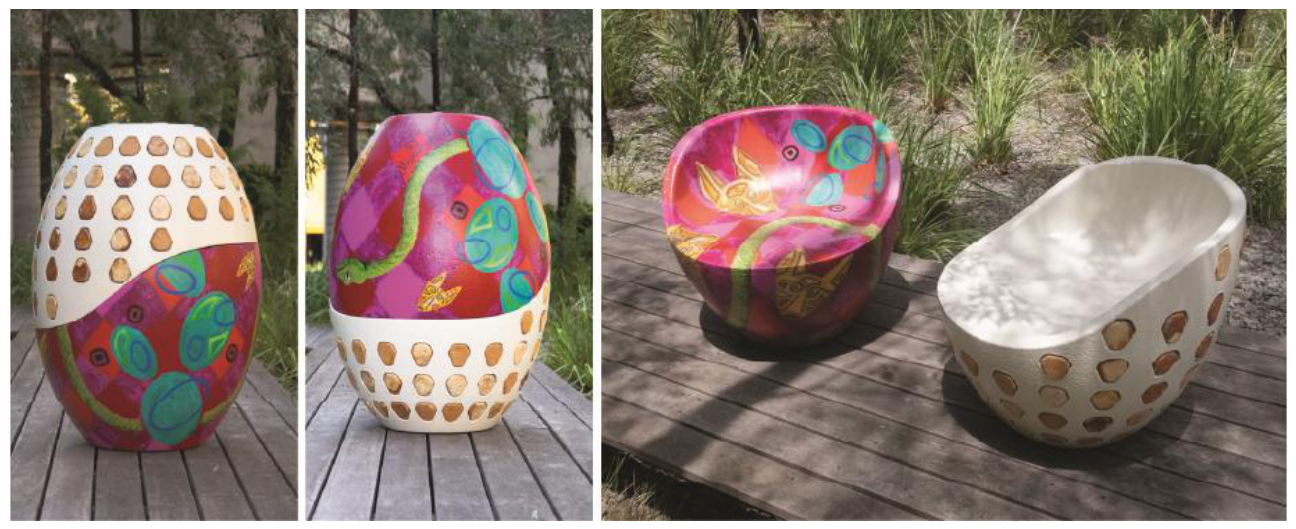
Figure 7.
A map of knowledge, contributions and responsibilities delegated to actors. Designed by authors and illustrated by Georgia Janetzki.
Figure 7.
A map of knowledge, contributions and responsibilities delegated to actors. Designed by authors and illustrated by Georgia Janetzki.
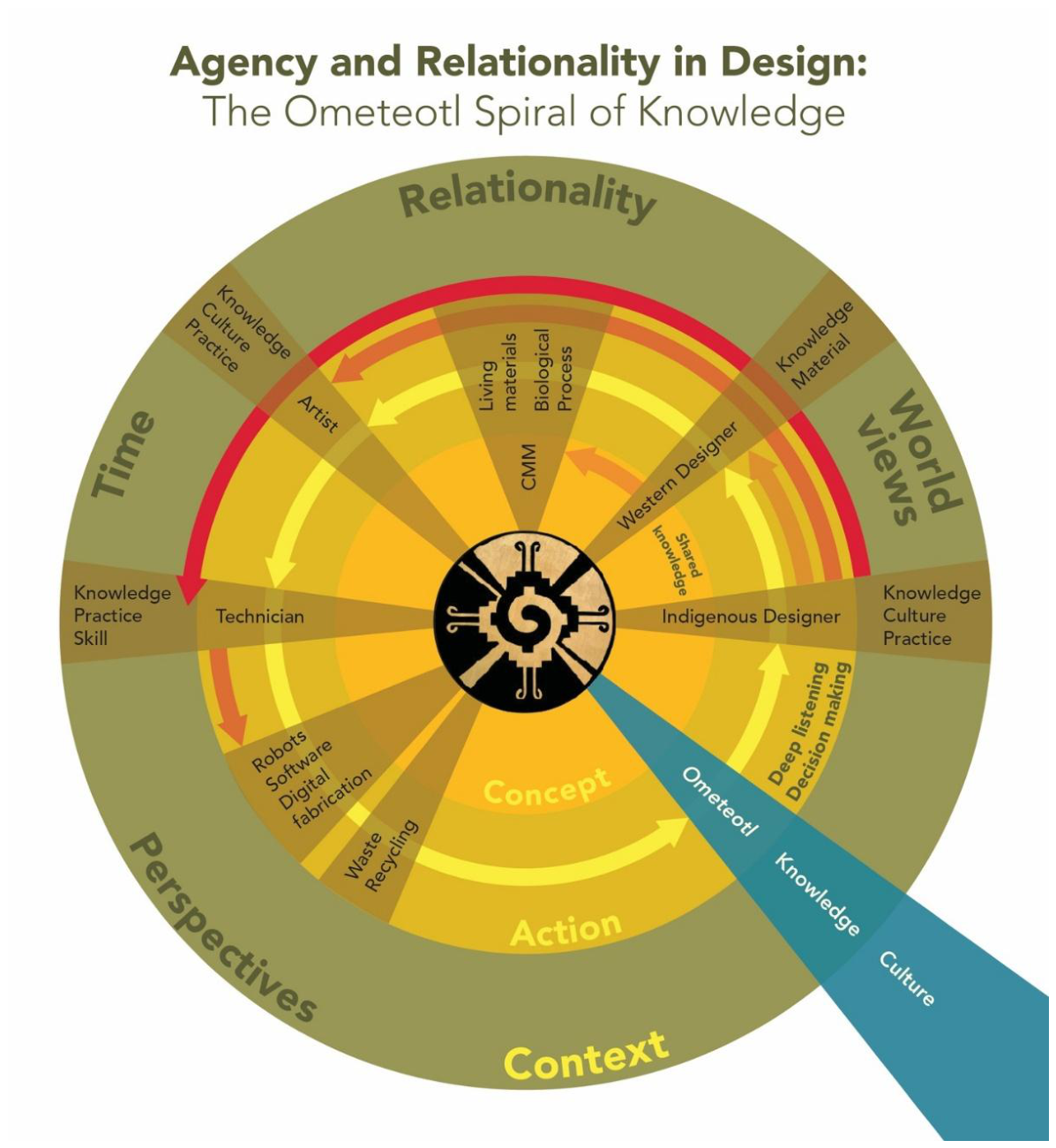

Table 1.
Roles of actors creating Ometeotl.
| Actor | Roles | Creates agency for |
|---|---|---|
| Indigenous Designer | Concept, shape, Liaison, Indigenous Knowledge, Collaboration, Partnership, Puzzle together, Process, Decision-making, Values, Materials, Outcome together | Western Designer, Technician, Artist, Artefact, Audience |
| Western Designer | Materials, Technology, Values, Concept, Shape, Collaboration, Partial Outcome | CMM, Artefact |
| Technician | Shape, Material, Partial Outcome, Finishes, Technology | Robot |
| Artist | Shape, Material, Partial Outcome, Finishes, Technology | Artefact |
| Living Material | Material, Technology, Time, Place, Partial Outcome, Concept | Artefact |
| Robot | Material, Technology, Time, Partial Outcome | No agency but a tool |
| Artefact (Outcome) | Knowledge Holding | The artifact itself |
Disclaimer/Publisher’s Note: The statements, opinions and data contained in all publications are solely those of the individual author(s) and contributor(s) and not of MDPI and/or the editor(s). MDPI and/or the editor(s) disclaim responsibility for any injury to people or property resulting from any ideas, methods, instructions or products referred to in the content. |
© 2026 by the authors. Licensee MDPI, Basel, Switzerland. This article is an open access article distributed under the terms and conditions of the Creative Commons Attribution (CC BY) license (http://creativecommons.org/licenses/by/4.0/).
Copyright: This open access article is published under a Creative Commons CC BY 4.0 license, which permit the free download, distribution, and reuse, provided that the author and preprint are cited in any reuse.