
Submitted:
25 September 2026
Posted:
29 September 2026
You are already at the latest version
Abstract
Fractal geometry provides a compact mathematical framework for generating and measuring multi-scale architectural form, but its integration with material-aware generative façade optimization remains limited. This study introduces a Hybrid Fractal–Parametric Model (HFPM) that combines recursively composed affine iterated-function-system transformations, parametric control, finite-scale box-counting, three-dimensional extrusion, and NSGA-II optimization in a reproducible Python–Blender workflow. The design vector P = (r, s, θ, d, t) controls recursion, scale, rotation, retained branch density, and thickness. Material volume is minimized while deviation from a baseline finite-scale box-counting dimension is minimized simultaneously. A balanced 300-configuration experiment characterized the design space before NSGA-II optimization with a population of 40 over 15 generations. The optimizer evaluated 603 unique non-baseline configurations; 602 passed all geometric and numerical validation checks, and 39 formed the final Pareto set. Relative to the baseline (Df = 1.9077; Vm = 0.9228 m³), material volume decreased by 34.9% within a 1% Df tolerance and by 44.6% within 2%. HFPM therefore exposes a reproducible material–complexity trade-off for early-stage fractal façade exploration without making unsupported structural-performance claims.
Keywords:
fractal geometry
; iterated function system
; generative architecture
; parametric façade
; box-counting dimension
; material efficiency
; NSGA-II
; Pareto optimization
1. Introduction
Computational architectural design has moved from the manual placement of predefined geometric elements toward rule-based and performance-driven systems in which form is generated, evaluated, and revised algorithmically. In this setting, a façade is not merely a static surface: it is a geometric system whose density, repetition, scale hierarchy, and thickness affect visual complexity, constructability, surface area, and the amount of material required. Generative design therefore creates an opportunity to treat façade development as a search problem over a controllable geometric design space rather than as a sequence of isolated manual alternatives [1,2,3].
Fractal geometry is particularly relevant to this problem because it provides formal mechanisms for representing self-similarity and multi-scale organization. Mandelbrot established the modern conceptual basis of fractal geometry [4], while Hutchinson and Barnsley formalized self-similar sets and iterated function systems (IFS) as constructive mathematical mechanisms [5,6]. Falconer subsequently systematized the mathematical foundations of fractal dimensions and their measurement [7]. Within architecture, fractal concepts have been applied to design generation, formal analysis, and the quantitative characterization of visual complexity [8,9,10,11,12,13,14,15,16,17,18,19,20]. These studies show that architectural form can be investigated across several scales rather than through a single Euclidean descriptor.
For façade analysis, box-counting is one of the most frequently used estimators because it can be applied to finite drawings, images, or geometric projections. However, the result depends on image preparation, grid placement, selected scale intervals, and regression choices [11,12]. Recent engineering studies have further shown that scale parameters, counting origins, and scaling-window selection can materially affect estimated fractal dimensions [21,22]. Accordingly, the present study treats Df as a finite-scale comparative descriptor computed under one fixed protocol rather than as an exact asymptotic Hausdorff dimension.
Parallel developments in parametric and generative design have made it possible to explore large families of alternatives and to couple geometric parameters with performance criteria [1,2,3,23,24,25,26,27,28,29,30,31,32,33]. Multi-objective evolutionary algorithms are particularly suitable when objectives conflict. In building and façade design, evolutionary optimization has been used to balance energy, daylight, comfort, aesthetics, and other performance criteria [23,24,25,26,27,28,29,30,31,32]. The recent graph-enabled façade framework of Wang et al. [32], for example, integrates parametric generation with NSGA-II, while broader reviews show that façade engineering increasingly relies on multi-criteria and multi-objective computational methods [30].
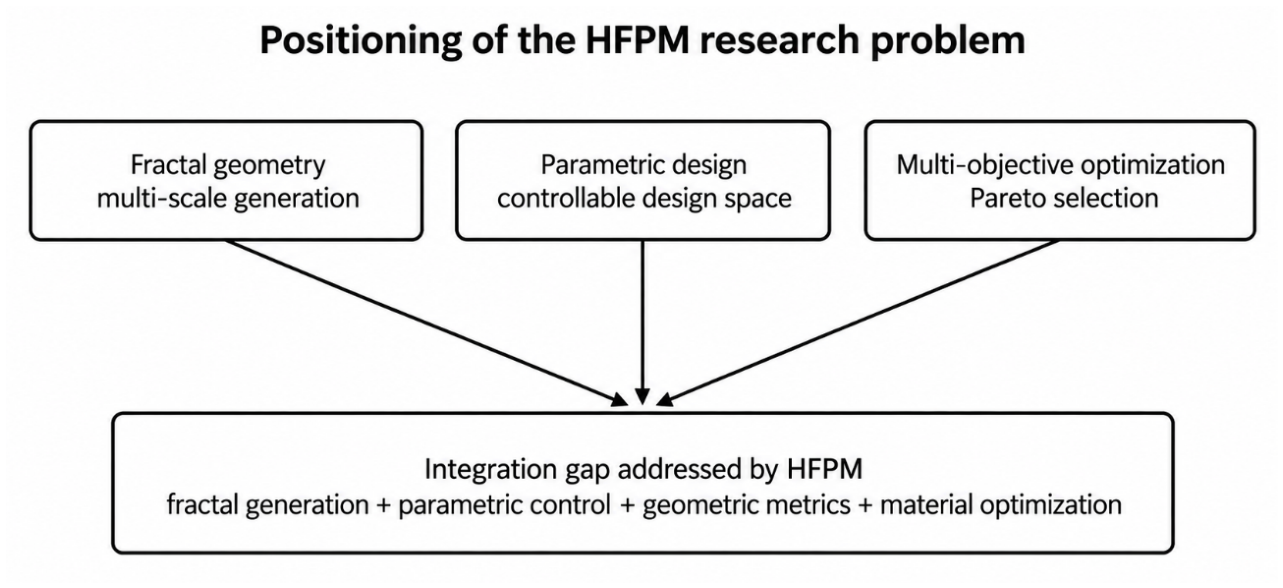
Despite these advances, a methodological gap remains between three research streams: fractal generation, parametric control, and material-aware multi-objective optimization. Fractal studies in the built environment primarily quantify or interpret complexity [13,14,15,16,17,18,19,20], whereas performance-driven façade optimization often uses non-fractal geometric generators [29,30,31,32]. Conversely, fractal generative studies demonstrate recursive form-making but rarely formulate material volume and finite-scale geometric complexity as simultaneous Pareto objectives. The present study addresses this integration gap through a Hybrid Fractal–Parametric Model (HFPM).
The research question is therefore: which fractal–parametric façade configurations can reduce material volume while keeping multi-scale geometric complexity close to a prescribed reference level? The contribution is methodological rather than structural: the study does not claim increased load-bearing capacity or mechanical strength because no finite-element or experimental structural validation is performed. Instead, it establishes and validates a reproducible computational pipeline linking recursive generation, parametric control, geometric metrics, material volume, and NSGA-II Pareto search.
Figure 1.
Positioning of the HFPM research problem at the intersection of fractal generation, parametric design, and multi-objective optimization.
Figure 1.
Positioning of the HFPM research problem at the intersection of fractal generation, parametric design, and multi-objective optimization.
The study makes four specific contributions: (i) a methodology-aligned affine IFS in which scale and rotation enter the recursive transformation matrix; (ii) a validated geometric evaluation layer separating finite-scale box-counting complexity, surface area, and material volume; (iii) a controlled design-space experiment that quantifies parameter effects before optimization; and (iv) an NSGA-II optimization that produces explicit material–complexity Pareto trade-offs and reproducible computational outputs.
2. Related Work
2.1. Fractal Geometry and Architectural Complexity
Architectural applications of fractal theory range from design criticism and visual analysis to direct algorithmic generation. Bovill [8] introduced fractal concepts as a design and analytical framework, while Ostwald and Vaughan developed a rigorous architectural box-counting methodology and emphasized the need to control scale and grid effects [9,10,11]. Vaughan and Ostwald distinguish between fractal inspiration, analytical interpretation, and algorithmic generation in architecture [10].
Recent work in Fractal and Fractional has reinforced the relevance of fractal analysis to the built environment. Lorenz and Kulcke [15] compared methods for evaluating self-similarity and architectural complexity; Kulcke and Lorenz [16] extended box-counting to observer-centred spherical panoramas; Ma et al. [17] developed a fractal-dimension-based visual complexity measure; Tara et al. [18] used voxelized 3D urban models; Ali and Mustafa [19] quantified façade complexity in office buildings; and Zhang et al. [20] compared 2D and 3D fractal characteristics of urban morphology. Katona’s façade studies [13,14] further demonstrate the value of fractal measures for analyzing architectural composition. These studies support the use of fractal metrics in architectural analysis while also highlighting their dependence on representation and measurement protocol.
The present work differs by using the box-counting estimate not only for post-hoc analysis but also as one objective in a generative optimization loop. Because the investigated objects are finite-depth prefactals represented on a raster grid, the notation Df in this paper denotes a finite-scale box-counting estimate obtained over a declared set of box scales. It is used consistently as a comparative geometric complexity metric.
2.2. IFS, L-Systems, and R-Function-Based Geometric Construction
IFS represents a fractal object through repeated affine maps and is a natural mechanism for controlled recursive geometry [5,6]. L-systems provide a complementary grammar-based description of branching and rule-governed growth [34]. R-functions provide an analytical framework for composing complex implicit geometric domains [35]. These three families of methods offer different but compatible ways of encoding recursive or composite geometry.
Within the authors’ prior research context, R-function methods have been used to construct equations for national design patterns and fractal objects [36,37], while R-functions and L-systems have been integrated for geometric modeling of fractal-structured objects [38]. Related architectural studies by Rian and co-authors show how self-similar and random fractals can inform computational architectural structures [39,40] and how IFS can support generative structural truss design [41,42]. Anarova, Sadullaeva, and Berdiyev also investigated composition-based fractal analysis of building dimensions [43]. These precedents motivate the present use of an affine IFS as the generative core and the separation of geometry generation from performance evaluation.
2.3. Parametric Generative Design and Façade Optimization
Performance-driven generative design seeks to connect geometry generation with explicit evaluation criteria. Early integrated approaches demonstrated how generative geometry and performance models can operate within one design environment [1,2]. Turrin et al. [3] showed the benefits of combining parametric modeling with genetic algorithms for performance-oriented architectural exploration. In building optimization more broadly, genetic and multi-objective methods have been applied to green-building design [23], façade parameters [24], thermal and energy performance [25], and simulation-based building design [26,27,28].
Façade design is intrinsically multi-criteria. Yi [29] combined quantitative daylight performance with an aesthetic-preference measure in multi-objective façade optimization, while Bianchi et al. [30] reviewed the state of the art in multi-criteria façade engineering and identified multi-objective optimization as a major direction. Zhang et al. [31] coupled parametric algorithms with generative residential design, and Wang et al. [32] combined graph-enabled façade generation with NSGA-II. Recent generative studies have also targeted material and structural efficiency in concrete and spatial-grid systems [33,44], while L-system-based parametric optimization has been applied to branching structural forms [45].
The optimization literature establishes NSGA-II as a mature method for bi-objective problems in which convergence and diversity must be maintained simultaneously [46,47,48]. Open-source multi-objective optimization frameworks have also supported reproducible experimentation and benchmarking [49]. However, the present research differs from conventional building-performance optimization because the decision space is generated by recursive fractal geometry and the second objective explicitly preserves a finite-scale fractal-complexity signature.
Table 1 summarizes the methodological gap addressed by HFPM.
3. Materials and Methods
3.1. HFPM Overview and Parameter Space
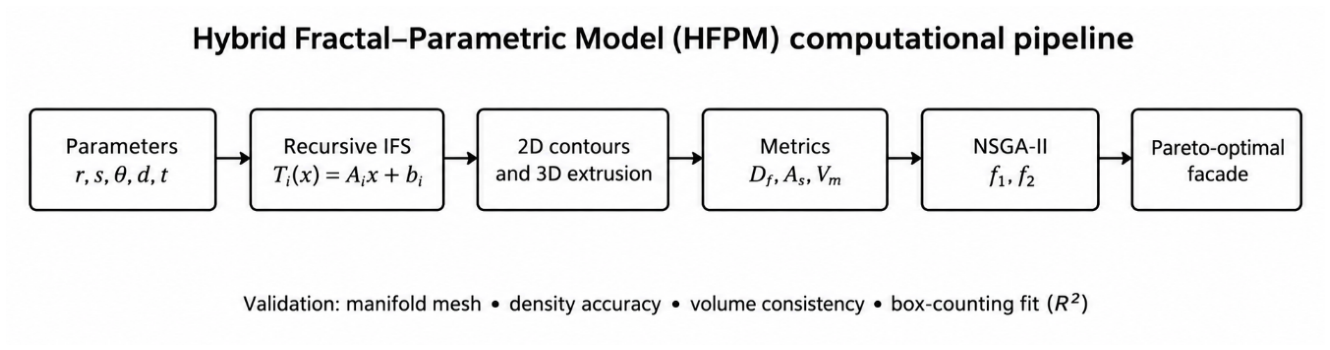
The HFPM couples recursive affine generation, deterministic density control, 3D extrusion, geometric measurement, and NSGA-II optimization. The controlled design vector is
where r is recursion depth, s is the relative child scale, θ is the local rotation magnitude, d is the retained terminal-branch density, and t is façade thickness. The experimental façade envelope is a 6 m × 6 m square. To isolate the effects of recursive geometry from trivial thickness reduction, t was fixed at 0.08 m during the controlled experiments and optimization.
P = (r, s, θ, d, t)
Figure 2.
HFPM computational pipeline used for generation, validation, metric computation, and Pareto optimization.
Figure 2.
HFPM computational pipeline used for generation, validation, metric computation, and Pareto optimization.
3.2. Methodology-Aligned Recursive IFS
The generative core uses eight affine child maps corresponding to the eight occupied positions of a 3 × 3 Sierpiński-carpet template. For child i, the recursive transformation is
where R(θi) is a planar rotation matrix and θi alternates between +θ and −θ across child branches. Affine transforms are recursively composed, so scale and rotation propagate through the hierarchy rather than being applied only to terminal tiles. The canonical translation vector bi locates each child in one of the eight non-central 3 × 3 positions. The contraction ratio is q = s/3.
Ti(x) = Aix + bi, i = 1, …, 8
To prevent overlapping terminal prisms without an expensive Boolean union, a conservative local non-overlap constraint is imposed:
s(|cos θ| + |sin θ|) ≤ 1
The terminal set contains 8r branches before density reduction. A deterministic ranking with fixed seed 42 retains exactly round(d·8r) terminal branches, which makes the realized density closely match the requested density and guarantees reproducibility across configurations.
3.3. From 2D Prefactal Geometry to a 3D Façade
Each retained terminal affine map transforms a unit square into a planar quadrilateral inside the 6 m × 6 m façade envelope. The resulting quadrilateral is extruded by thickness t to produce a closed prism. All prisms are assembled into one Blender mesh for efficient evaluation. Because the non-overlap constraint is enforced before mesh construction, the total material volume can be computed as the sum of disjoint prism volumes and independently checked against Blender’s mesh-volume calculation. All computational experiments were executed with Python 3.11 in Blender 4.5 LTS using the native bpy and bmesh APIs; the complete implementation is provided as Supplementary File S1.
S(P) = Extrude(C(P), t)
3.4. Geometric Metrics and Finite-Scale Box-Counting
Three geometric quantities are tracked separately: finite-scale box-counting dimension Df, surface area As, and material volume Vm. This separation avoids treating fractal complexity as a proxy for physical material quantity. For the projected façade geometry, box-counting is estimated from
where k is the number of boxes per side and N(k) is the number of occupied boxes. A fixed 729 × 729 raster is used. Candidate box counts per side are {3, 9, 27, 81, 243, 729}, but only scales not exceeding 3r are included; therefore r = 3 uses 3, 9, and 27 boxes per side, whereas r = 4 additionally uses 81. This fixed protocol follows the need for explicit scale-window and grid choices emphasized in architectural box-counting studies [11,12,15,16] and in recent computational sensitivity analyses [21,22]. For every accepted configuration, the log–log regression uses at least three scales and must satisfy R² ≥ 0.95.
Df ≈ slope(log k, log N(k))
Vm = Vol[S(P)]
3.5. Baseline and Objective Functions
The reference façade is defined by r = 4, s = 0.92, θ = 0°, d = 1.00, and t = 0.08 m. Its measured values are Dtarget = 1.907744 and Vref = 0.922751 m³. The 6 m × 6 m solid slab of the same thickness has a volume of 2.88 m³, but optimization is intentionally referenced to the fractal baseline rather than to the solid panel. Two normalized objectives are minimized:
Thus, f1 rewards material-volume reduction while f2 penalizes departure from the baseline multi-scale complexity. Pareto dominance is used rather than a weighted scalar objective so that the trade-off remains explicit.
3.6. Controlled Design-Space Experiment
Before evolutionary optimization, 300 configurations were generated using a balanced Latin-hypercube-style stratification of the admissible parameter space, following the variance-reduction and space-filling principle of Latin hypercube sampling [50]. Because the admissible upper bound for s depends on θ through Equation (5), the sampling is constrained rather than a textbook unconstrained Latin hypercube. This experiment served two purposes: (i) to test numerical validity and parameter coverage; and (ii) to estimate monotonic parameter effects without the adaptive sampling bias introduced by an evolutionary optimizer. Recursion levels r = 3 and r = 4 were balanced; scale, rotation, and retained density were sampled within the ranges in Table 2.
3.7. NSGA-II Optimization
NSGA-II was then applied to the same parameterization [46]. The custom Python implementation used a population of 40, 15 generations, crossover probability 0.90, mutation probability 0.20, BLX-α = 0.25 [51], and optimization seed 4201. Integer recursion depth was restricted to {3,4}; the continuous variables were repaired to their admissible ranges after crossover and mutation. Duplicate parameter vectors were cached to avoid repeated Blender evaluations. Invalid candidates received a large objective penalty and could not enter the final Pareto front. Non-dominated sorting and crowding distance were recomputed each generation to preserve both convergence and diversity [46,47,48].
A configuration was accepted as controlled-valid only when all of the following held: (i) the mesh was manifold and free of degenerate faces; (ii) density error was ≤ 0.01; (iii) the relative difference between analytical and Blender volume was ≤ 10⁻⁵; (iv) at least three box-counting scales were available; and (v) Df regression R² was ≥ 0.95. The box-counting criteria were fixed before the final optimization run to prevent post-hoc selection of favorable scaling behavior and to reflect the known sensitivity of finite-scale estimates to scale choice and counting protocol [21,22].
4. Results
4.1. Computational Validation and Dataset Quality
The NSGA-II run produced 603 unique non-baseline configurations. Of these, 602 passed all controlled validation criteria; only configuration 29 was excluded because its box-counting regression yielded R² = 0.94597, below the prespecified 0.95 threshold. All evaluated meshes were manifold and free of degenerate faces. Among valid non-baseline configurations, the maximum absolute density error was 9.66 × 10⁻⁴, the maximum relative volume discrepancy between the analytical and Blender calculations was 2.46 × 10⁻⁶, and the median box-counting R² was 0.99056. These results indicate that geometric generation and numerical measurement were internally consistent.

Table 3.
Computational validation summary for the final NSGA-II experiment.
| Metric | Value |
|---|---|
| Unique NSGA-II configurations (excluding baseline) | 603 |
| Controlled-valid configurations | 602 |
| Invalid configurations | 1 |
| Final Pareto solutions | 39 |
| Baseline Df | 1.907744 |
| Baseline material volume Vm | 0.922751 m³ |
| Baseline surface area As | 92.62362 m² |
| Maximum |density error| | 0.000966 |
| Maximum relative volume error | 2.46e-06 |
| Median box-counting R2 | 0.99056 |
4.2. Pareto Trade-Off Between Material Volume and Multi-Scale Complexity
The final non-dominated set contained 39 solutions. Figure 3 shows representative façade geometries selected at increasingly relaxed complexity tolerances. A key result is that substantial volume reduction is possible before large departures from the baseline Df occur. The closest high-performing solution (configuration 394) reduced material volume by 34.0% while Df differed from the baseline by only 0.23%. Within a 1% Df tolerance, configuration 280 reduced volume by 34.9%; within 2%, configuration 252 reduced volume by 44.6%. Relaxing the tolerance to 5% produced a 64.3% reduction.
Figure 3.
Baseline and representative Pareto-optimal façade projections selected under 1%, 2%, and 5% allowable deviation from the baseline finite-scale box-counting dimension.
Figure 3.
Baseline and representative Pareto-optimal façade projections selected under 1%, 2%, and 5% allowable deviation from the baseline finite-scale box-counting dimension.
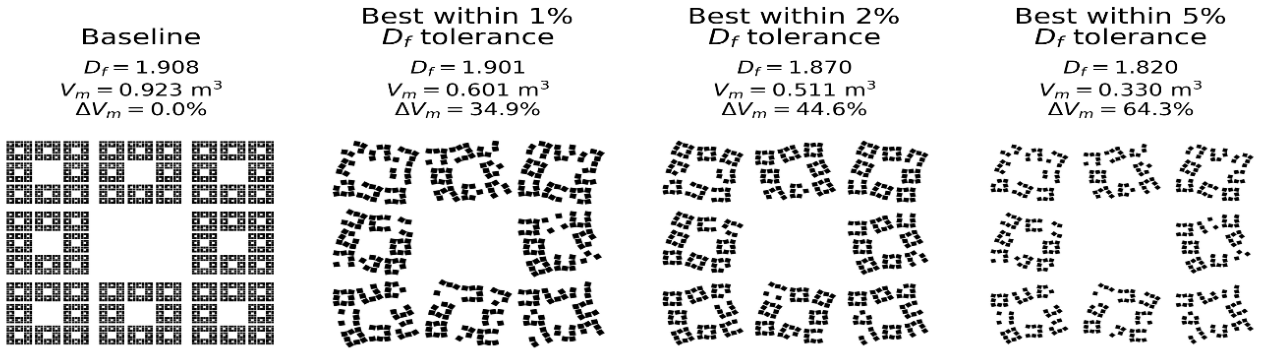
Figure 4.
NSGA-II objective space. Blue points are valid evaluated configurations, orange points form the final Pareto set, and the magenta square is the baseline.
Figure 4.
NSGA-II objective space. Blue points are valid evaluated configurations, orange points form the final Pareto set, and the magenta square is the baseline.
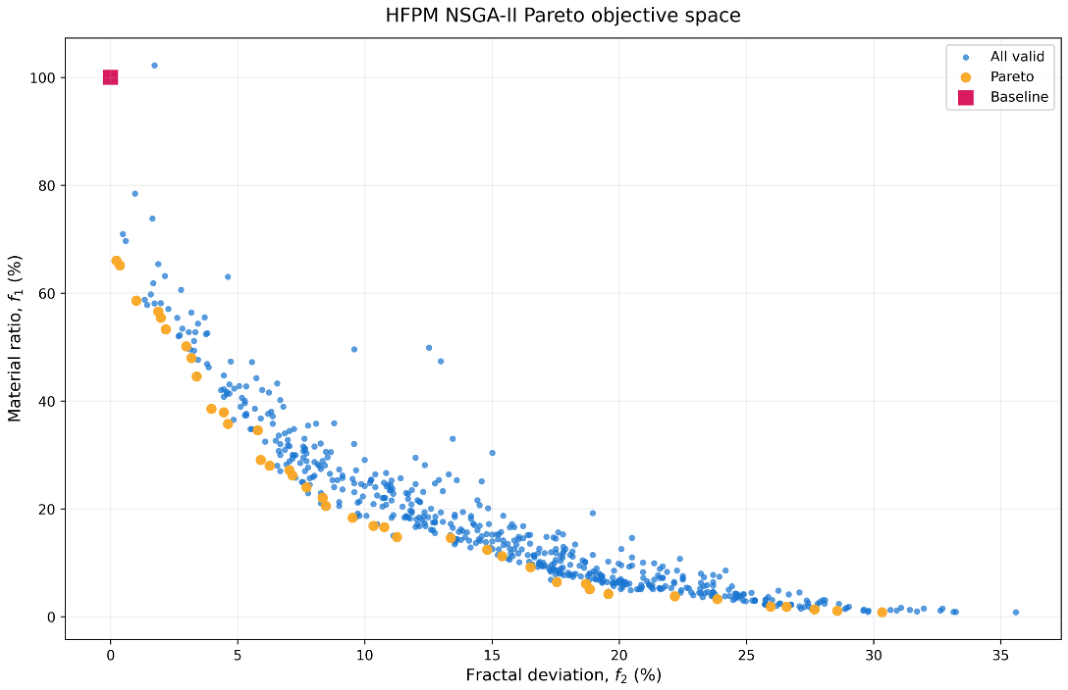
Figure 5.
Relationship between finite-scale box-counting dimension Df and material volume Vm for valid NSGA-II evaluations.
Figure 5.
Relationship between finite-scale box-counting dimension Df and material volume Vm for valid NSGA-II evaluations.
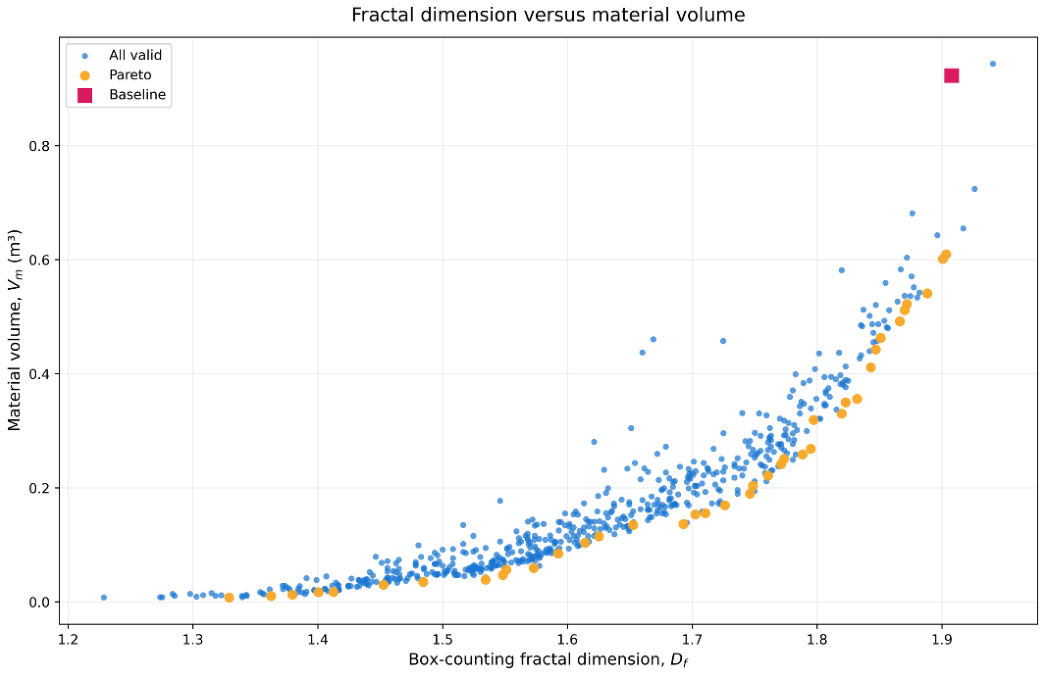
Table 4.
Representative Pareto-optimal solutions at increasing Df tolerances.
| Tolerance | Config. | r | s | θ | d | Df | Vm (m³) | Volume reduction | Actual Df dev. |
|---|---|---|---|---|---|---|---|---|---|
| 0.25% | 394 | 3 | 0.9092 | 6.047° | 0.5323 | 1.9033 | 0.6092 | 34.0% | 0.23% |
| 1% | 280 | 3 | 0.8505 | 11.230° | 0.7857 | 1.9007 | 0.6011 | 34.9% | 0.37% |
| 2% | 252 | 3 | 0.8049 | 11.842° | 0.9290 | 1.8700 | 0.5114 | 44.6% | 1.98% |
| 3% | 348 | 3 | 0.8105 | 12.436° | 0.8073 | 1.8509 | 0.4625 | 49.9% | 2.98% |
| 5% | 451 | 3 | 0.7679 | 13.984° | 0.7941 | 1.8197 | 0.3297 | 64.3% | 4.62% |
4.3. Parameter Effects from the Balanced 300-Configuration Experiment
Because NSGA-II adaptively concentrates samples near favorable regions, parameter-effect analysis was performed on the preceding balanced 300-configuration experiment rather than on the evolutionary sample itself. Spearman rank correlations show that scale s was the dominant monotonic control variable: ρ = 0.866 with Df and ρ = 0.831 with Vm. Recursion level had moderate negative associations with both metrics, while retained density had smaller but statistically detectable positive associations. Rotation θ showed no significant monotonic relationship in the balanced sample, indicating that its effect is primarily configurational and interaction-dependent rather than globally monotonic.
Table 5.
Spearman rank correlations from the balanced 300-configuration design-space experiment.
| Parameter | ρ with Df | p-value | ρ with Vm | p-value |
|---|---|---|---|---|
| Recursion level r | −0.428 | 1.18 × 10⁻¹⁴ | −0.500 | 3.35 × 10⁻²⁰ |
| Scale s | 0.866 | 5.42 × 10⁻⁹¹ | 0.831 | 3.61 × 10⁻⁷⁷ |
| Rotation θ | 0.074 | 0.202 | 0.067 | 0.248 |
| Retained density d | 0.188 | 0.00115 | 0.247 | 1.68 × 10⁻⁵ |
Figure 6.
IFS scale s versus material volume Vm. The strong monotonic tendency identified in the balanced sampling experiment is consistent with scale being the principal geometric control on material demand.
Figure 6.
IFS scale s versus material volume Vm. The strong monotonic tendency identified in the balanced sampling experiment is consistent with scale being the principal geometric control on material demand.
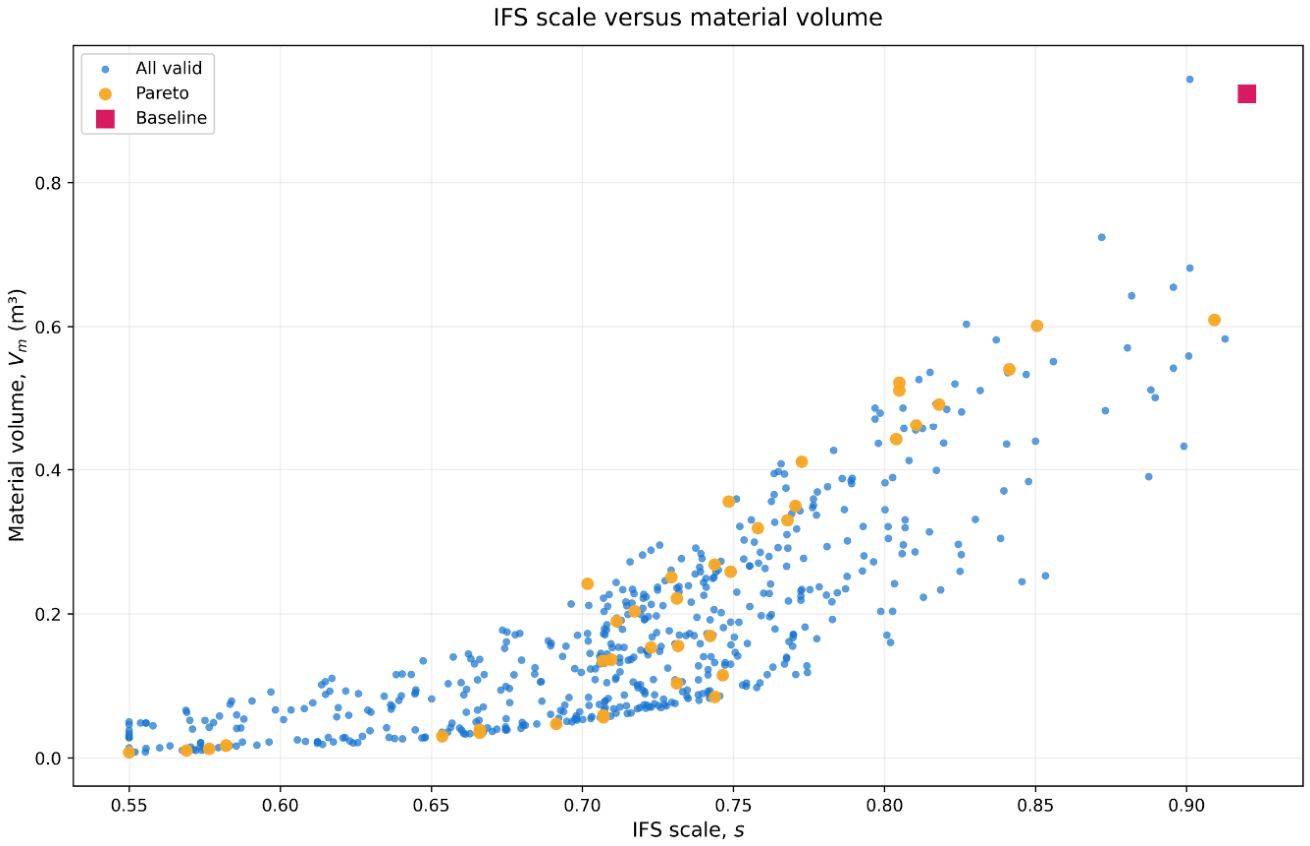
Figure 7.
Retained branch density d versus finite-scale box-counting dimension Df.
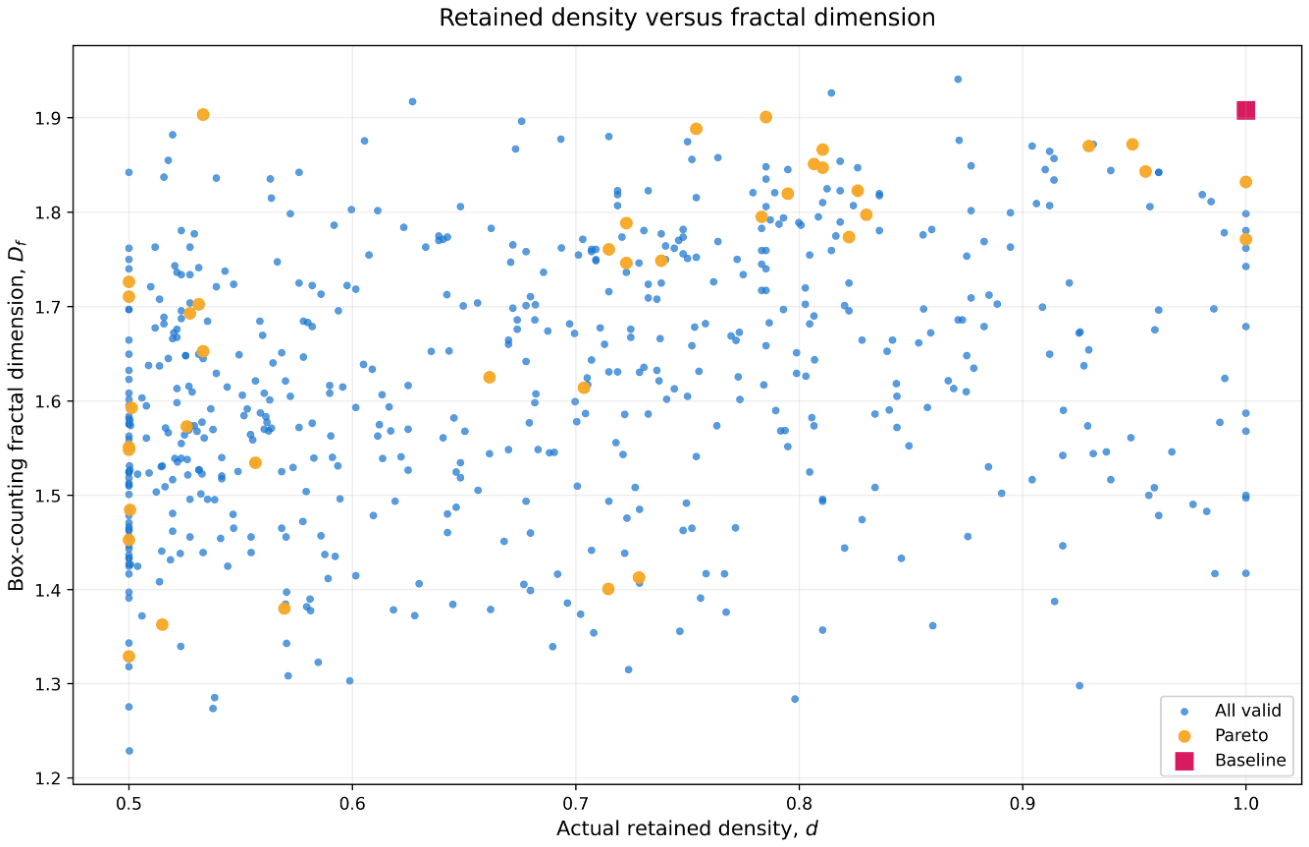
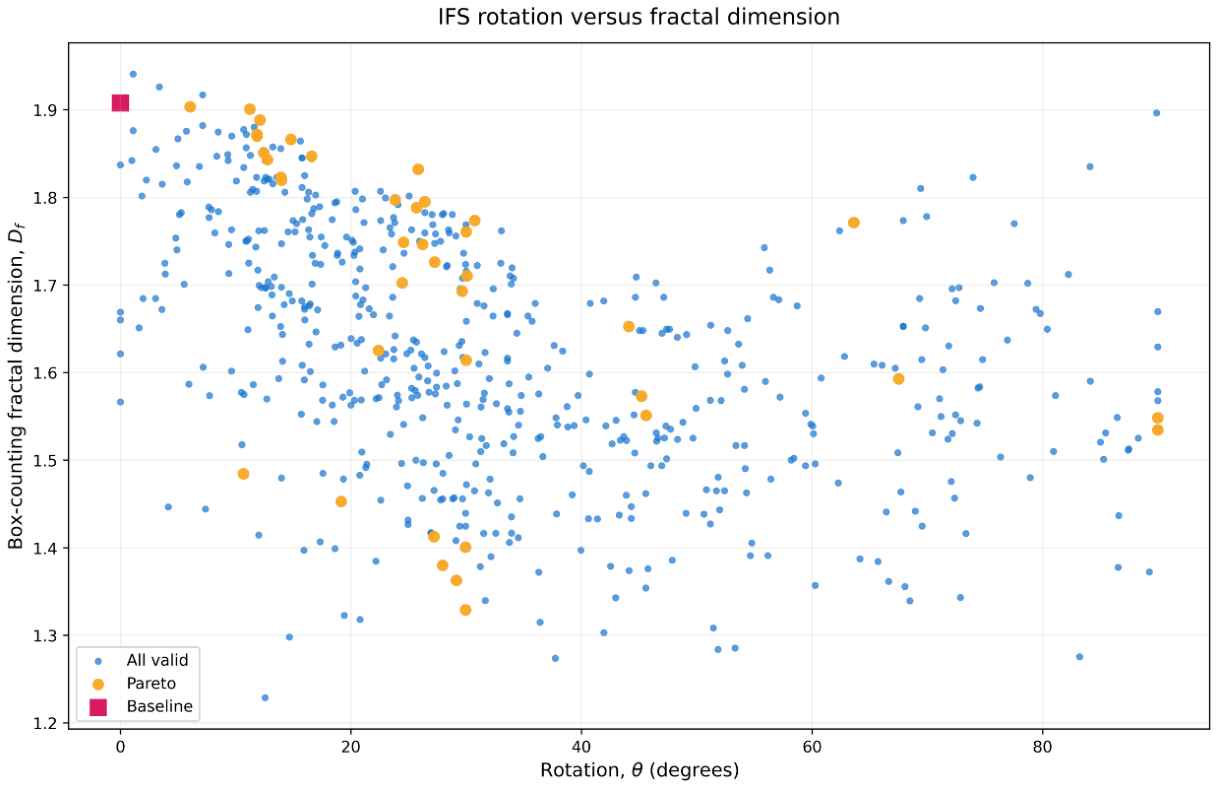
Figure 8.
Rotation θ versus finite-scale box-counting dimension Df. The dispersed pattern is consistent with a weak global monotonic effect and stronger interaction effects.
Figure 8.
Rotation θ versus finite-scale box-counting dimension Df. The dispersed pattern is consistent with a weak global monotonic effect and stronger interaction effects.
4.4. NSGA-II Convergence and Improvement over Non-Adaptive Sampling
The optimization showed progressive improvement in the complexity-matching objective. At generation 0, the smallest f2 was 0.01734 (1.734% deviation). By generation 7 it fell to 0.003682, and by generation 10 to 0.002312, after which it remained stable through generation 15. Feasible solutions within 1% of Dtarget first appeared at generation 7. The best material ratio within 2% improved from 1.022 at generation 0 to 0.554 by generation 6, corresponding to a 44.6% reduction relative to the baseline.
Figure 9.
NSGA-II convergence. Minimum fractal-deviation objective and best material ratio inside a 1% Df tolerance are shown across generations.
Figure 9.
NSGA-II convergence. Minimum fractal-deviation objective and best material ratio inside a 1% Df tolerance are shown across generations.
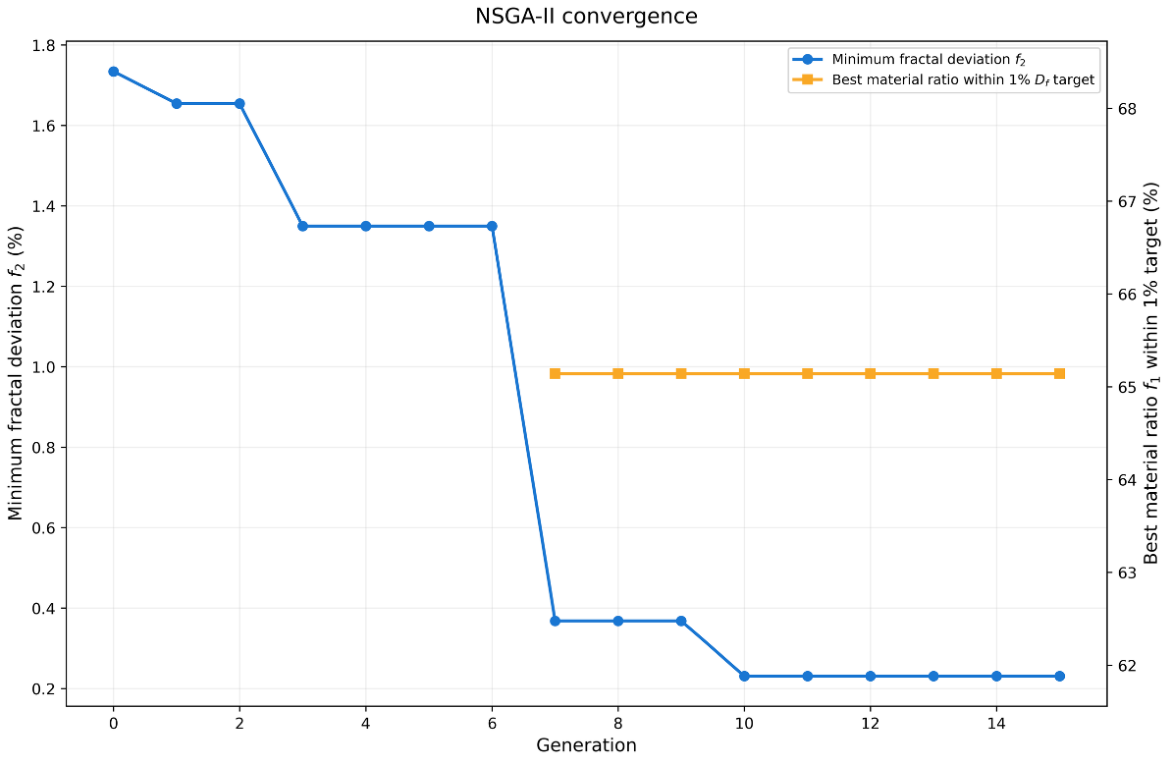
A direct comparison with the balanced 300-configuration sample quantifies the benefit of adaptive Pareto search. Within a 1% Df tolerance, the balanced sample found an 11.2% material reduction, whereas NSGA-II found 34.9%. Within 2%, the corresponding reductions were 15.0% and 44.6%. The advantage narrows when much larger complexity deviations are permitted because low-volume solutions become easier to encounter even without adaptive search.
Table 6.
Best material-volume reduction found by balanced sampling and NSGA-II at identical Df tolerances.
Table 6.
Best material-volume reduction found by balanced sampling and NSGA-II at identical Df tolerances.
| Df tolerance | Balanced 300: best reduction | Balanced config. | NSGA-II: best reduction | NSGA-II config. |
|---|---|---|---|---|
| 1% | 11.2% | 292 | 34.9% | 280 |
| 2% | 15.0% | 67 | 44.6% | 252 |
| 3% | 47.4% | 120 | 49.9% | 348 |
| 5% | 59.8% | 158 | 64.3% | 451 |
5. Discussion
5.1. Interpretation of the Material–Complexity Trade-Off
The central finding is not that a single “optimal” façade exists, but that the HFPM exposes a continuous trade-off between geometric complexity and material volume. The Pareto set contains solutions for designers who prioritize close preservation of the baseline multi-scale signature as well as solutions that accept larger geometric deviation in exchange for greater volume reduction. This is a more appropriate representation of early-stage design than a single weighted optimum because the relative value assigned to geometric complexity and material savings is project-dependent.
The 34.9% volume reduction found within 1% of the baseline Df is particularly important because it demonstrates that material savings are not solely obtained by collapsing the recursive structure into a visibly simpler pattern. Configuration 280 preserves a Df of 1.9007 while reducing Vm from 0.9228 to 0.6011 m³. At a 2% tolerance, the reduction increases to 44.6%. These values should be interpreted as geometric material-volume reductions for the modeled façade prisms, not as verified reductions in embodied carbon, cost, or structural mass in a construction-ready system.
The separation of Df, As, and Vm is methodologically significant. Earlier architectural fractal research primarily uses fractal dimension to measure or interpret visual and structural complexity [13,14,15,16,17,18,19,20]. HFPM adds a second, physically dimensioned quantity—material volume—without assuming that higher or lower Df directly implies better material efficiency. The Pareto front shows that the relationship is not one-to-one; several geometries with similar Df have substantially different Vm.
5.2. Relation to Generative and Façade Optimization Research
The results extend the performance-driven generative design paradigm established by Shea et al. [1], Turrin et al. [3], and later building-optimization studies [23,24,25,26,27,28] by making recursive fractal geometry itself part of the decision space. Compared with façade optimization studies that use daylight, energy, or aesthetic-preference objectives [29,32], HFPM uses a deliberately narrower pair of objectives to isolate the interaction between multi-scale geometry and material demand. The method is therefore complementary rather than competitive: energy, daylight, structural, and fabrication criteria can be added as further objectives or constraints in later stages.
Recent generative structural research reports substantial material savings through topology or layout optimization [33,44]. The magnitude of the geometric reductions observed here is in a comparable numerical range for some tolerance levels, but the physical meaning is different. The spatial-grid study of Wang et al. [44], for example, incorporates finite-element structural evaluation, whereas HFPM does not. Consequently, this paper avoids claims of structural efficiency and restricts its conclusion to geometric material-volume efficiency under the stated non-overlap and thickness assumptions.
5.3. Why Scale Dominates and Rotation Does Not Show a Global Monotonic Effect
The balanced design-space experiment shows that s is the strongest monotonic driver of both Df and Vm. This is expected because scale changes the area of every terminal branch at every recursive level; its effect is compounded by recursion. In contrast, θ primarily redistributes orientation and local spacing. Under the conservative non-overlap constraint, rotation does not directly change the area of an individual transformed square, so its global effect emerges through spatial arrangement, finite-scale occupancy, and interactions with s and r rather than through a simple monotonic trend.
The negative association between r and Vm may appear counterintuitive because recursion increases the number of terminal elements. In the present affine formulation, however, each additional level also applies another contraction q = s/3. The terminal area therefore decreases multiplicatively, and for the investigated s range this contraction effect can dominate the increased branch count. This illustrates why parameter effects should be measured in the implemented recursive model rather than inferred from element count alone.
5.4. Finite-Scale Fractal Measurement and Methodological Caution
The reported Df values are finite-scale box-counting estimates calculated from rasterized prefactal projections. They should not be interpreted as exact Hausdorff dimensions of an infinite IFS attractor. For a finite-depth, rotated and density-thinned façade, the estimated slope depends on the available scale window, raster resolution, and counting protocol [11,12,15,16,21,22]. Recent work on scale selection and automated scaling-window optimization reinforces the need to report these computational choices explicitly [21,22]. This limitation does not invalidate the optimization objective because every candidate is evaluated under the same declared protocol; HFPM therefore uses Df as a consistent comparative descriptor rather than an asymptotic invariant.
To reduce measurement ambiguity, HFPM uses one fixed raster resolution, a declared power-of-three scale sequence, a minimum of three scales, and an R² acceptance threshold. Future work should test grid-offset sensitivity and alternative multi-scale estimators, including lacunarity and multifractal descriptors, particularly when the method is extended to less regular façade topologies.
5.5. Limitations and Future Work
The current study has five main limitations. First, it is a geometric optimization study and does not include FEM, connection design, buckling, wind loading, fire performance, or fabrication tolerances. Second, façade thickness is fixed at 0.08 m to prevent trivial material reduction through thickness minimization; a future structural model should allow thickness to vary subject to stress, deflection, and stability constraints. Third, the search is limited to two recursion depths (r = 3 and 4) and one eight-map affine topology. Fourth, the density operator removes terminal branches deterministically but does not yet impose architectural program constraints such as windows, doors, views, or modular panelization. Fifth, material volume is a geometric proxy; embodied carbon and cost depend on material type, waste, connections, manufacturing, and logistics.
Future development should therefore integrate (i) finite-element structural analysis, (ii) daylight and thermal simulation, (iii) fabrication and minimum-feature constraints, (iv) embodied-carbon factors, and (v) additional fractal descriptors. Surrogate modeling could also reduce the computational cost of higher-dimensional multi-objective searches [26,27,28]. A particularly useful next step is a constrained three- or four-objective model balancing material volume, Df, structural performance, and environmental performance while retaining the same reproducible geometric core.
6. Conclusions
This study developed and computationally validated a Hybrid Fractal–Parametric Model for material-aware generative architectural façades. The model embeds scale and rotation in recursively composed affine IFS transformations, controls terminal-branch density deterministically, converts the resulting prefactal geometry into a 3D façade, and measures finite-scale box-counting complexity, surface area, and material volume separately. A balanced 300-configuration experiment established the behavior of the design space, after which NSGA-II evaluated 603 unique configurations. Of these, 602 passed all controlled validation criteria and 39 formed the final Pareto set. Relative to the baseline façade (Df = 1.907744; Vm = 0.922751 m³), NSGA-II achieved a 34.9% material-volume reduction within 1% of the baseline Df and 44.6% within 2%. Scale was the dominant monotonic geometric control in the balanced experiment, whereas rotation showed no significant global monotonic effect. The main contribution is therefore a reproducible method for exposing material–complexity trade-offs in fractal façade design rather than a claim of structurally optimized construction. The framework is suitable for early-stage generative exploration and provides a transparent basis for subsequent integration of structural, environmental, fabrication, and life-cycle constraints.
Supplementary Materials
The following supporting files accompany this study: S1, HFPM v3.0 Blender/Python implementation; S2, all unique NSGA-II evaluations; S3, final NSGA-II Pareto set; S4, generation-level convergence summary; S5, balanced 300-configuration design-space dataset; and S6, a Python script for regenerating the publication figures from S2–S5. These files are packaged in “HFPM_Supplementary_Materials_FINAL.zip”.
Author Contributions
Conceptualization, G.B. and S.A.; methodology, G.B., S.A. and N.K.; software, G.B. and N.K.; validation, G.B. and N.K.; formal analysis, G.B. and S.A.; investigation, G.B., S.A. and N.K.; resources, S.A. and N.K.; data curation, G.B. and N.K.; writing—original draft preparation, G.B.; writing—review and editing, G.B., S.A. and N.K.; visualization, G.B. and N.K.; supervision, S.A.; project administration, G.B. All authors have read and agreed to the published version of the manuscript.
Funding
This research received no external or institutional funding.
Institutional Review Board Statement
Not applicable. The study did not involve humans or animals.
Informed Consent Statement
Not applicable.
Data Availability Statement
The computational data supporting the reported results are provided in the Supplementary Materials (S2–S5). The Blender/Python implementation required to reproduce the HFPM generation and optimization workflow is provided as S1, and the script used to regenerate the publication figures from the supplied data is provided as S6. Additional intermediate outputs are available from the corresponding author on reasonable request.
Conflicts of Interest
The authors declare no conflicts of interest.
Abbreviations
| Abbreviation | Meaning |
| HFPM | Hybrid Fractal–Parametric Model |
| IFS | Iterated Function System |
| NSGA-II | Non-dominated Sorting Genetic Algorithm II |
| CAD | Computer-Aided Design |
| FEM | Finite Element Method |
| Df | Finite-scale box-counting dimension estimate |
| As | Surface area |
| Vm | Material volume |
| R2 | Coefficient of determination |
References
- Shea, K.; Aish, R.; Gourtovaia, M. Towards integrated performance-driven generative design tools. Autom. Constr. 2005, 14, 253–264. [Google Scholar] [CrossRef]
- Caldas, L.G.; Norford, L.K. A design optimization tool based on a genetic algorithm. Autom. Constr. 2002, 11, 173–184. [Google Scholar] [CrossRef]
- Turrin, M.; von Buelow, P.; Stouffs, R. Design explorations of performance driven geometry in architectural design using parametric modeling and genetic algorithms. Adv. Eng. Inform. 2011, 25, 656–675. [Google Scholar] [CrossRef]
- Mandelbrot, B.B. The Fractal Geometry of Nature; W.H. Freeman: San Francisco, CA, USA, 1982. [Google Scholar]
- Barnsley, M.F. Fractals Everywhere, 2nd ed.; Academic Press: Boston, MA, USA, 1993. [Google Scholar] [CrossRef]
- Hutchinson, J.E. Fractals and self similarity. Ind. Univ. Math. J. 1981, 30, 713–747. [Google Scholar] [CrossRef]
- Falconer, K. Fractal Geometry: Mathematical Foundations and Applications, 2nd ed.; Wiley: Chichester, UK, 2003. [Google Scholar] [CrossRef]
- Bovill, C. Fractal Geometry in Architecture and Design; Birkhäuser: Boston, MA, USA, 1996. [Google Scholar] [CrossRef]
- Ostwald, M.J.; Vaughan, J. The Fractal Dimension of Architecture; Birkhäuser: Cham, Switzerland, 2016. [Google Scholar] [CrossRef]
- Vaughan, J.; Ostwald, M.J. Fractal Geometry in Architecture. In Handbook of the Mathematics of the Arts and Sciences; Sriraman, B., Ed.; Springer: Cham, Switzerland, 2020; pp. 1–16. [Google Scholar] [CrossRef]
- Ostwald, M.J. The fractal analysis of architecture: Calibrating the box-counting method using scaling coefficient and grid disposition variables. Environ. Plan. B Plan. Des. 2013, 40, 644–663. [Google Scholar] [CrossRef]
- Foroutan-Pour, K.; Dutilleul, P.; Smith, D.L. Advances in the implementation of the box-counting method of fractal dimension estimation. Appl. Math. Comput. 1999, 105, 195–210. [Google Scholar] [CrossRef]
- Katona, V. Relief method: The analysis of architectonic façades by fractal geometry. Buildings 2021, 11, 16. [Google Scholar] [CrossRef]
- Katona, V. The hidden dimension of façades: Fractal analysis reveals composition rules in classical and Renaissance architecture. Fractal Fract. 2023, 7, 257. [Google Scholar] [CrossRef]
- Lorenz, W.E.; Kulcke, M. Multilayered complexity analysis in architectural design: Two measurement methods evaluating self-similarity and complexity. Fractal Fract. 2021, 5, 244. [Google Scholar] [CrossRef]
- Kulcke, M.; Lorenz, W.E. Spherical box-counting: Combining 360° panoramas with fractal analysis. Fractal Fract. 2023, 7, 327. [Google Scholar] [CrossRef]
- Ma, L.; He, S.; Lu, M. A measurement of visual complexity for heterogeneity in the built environment based on fractal dimension and its application in two gardens. Fractal Fract. 2021, 5, 278. [Google Scholar] [CrossRef]
- Tara, A.; Patuano, A.; Lawson, G. Between 2D and 3D: Studying structural complexity of urban fabric using voxels and LiDAR-derived DSMs. Fractal Fract. 2021, 5, 227. [Google Scholar] [CrossRef]
- Ali, L.A.; Mustafa, F.A. Fractal dimensional analysis of building facades: The case of office buildings in Erbil City. Fractal Fract. 2024, 8, 746. [Google Scholar] [CrossRef]
- Zhang, C.; Ping, X.; Fan, Q.; Li, C. Measurement of 2D and 3D fractal features of urban morphology from an architectural view and its influencing factors. Fractal Fract. 2024, 8, 138. [Google Scholar] [CrossRef]
- Wang, J.; Yang, G.; Yuan, Y.; Sun, J.; Pu, G. Effects of Scale Parameters and Counting Origins on Box-Counting Fractal Dimension and Engineering Application in Concrete Beam Crack Analysis. Fractal Fract. 2025, 9, 549. [Google Scholar] [CrossRef]
- Douglass, R.W. Automated Box-Counting Fractal Dimension Analysis: Sliding Window Optimization and Multi-Fractal Validation. Fractal Fract. 2025, 9, 633. [Google Scholar] [CrossRef]
- Wang, W.; Zmeureanu, R.; Rivard, H. Applying multi-objective genetic algorithms in green building design optimization. Build. Environ. 2005, 40, 1512–1525. [Google Scholar] [CrossRef]
- Wang, L.; Wong, N.H.; Li, S. Facade design optimization for naturally ventilated residential buildings in Singapore. Energy Build. 2007, 39, 954–961. [Google Scholar] [CrossRef]
- Magnier, L.; Haghighat, F. Multiobjective optimization of building design using TRNSYS simulations, genetic algorithm, and Artificial Neural Network. Build. Environ. 2010, 45, 739–746. [Google Scholar] [CrossRef]
- Evins, R. A review of computational optimisation methods applied to sustainable building design. Renew. Sustain. Energy Rev. 2013, 22, 230–245. [Google Scholar] [CrossRef]
- Nguyen, A.-T.; Reiter, S.; Rigo, P. A review on simulation-based optimization methods applied to building performance analysis. Appl. Energy 2014, 113, 1043–1058. [Google Scholar] [CrossRef]
- Machairas, V.; Tsangrassoulis, A.; Axarli, K. Algorithms for optimization of building design: A review. Renew. Sustain. Energy Rev. 2014, 31, 101–112. [Google Scholar] [CrossRef]
- Yi, Y.K. Building facade multi-objective optimization for daylight and aesthetical perception. Build. Environ. 2019, 156, 178–190. [Google Scholar] [CrossRef]
- Bianchi, S.; Andriotis, C.; Klein, T.; Overend, M. Multi-criteria design methods in façade engineering: State-of-the-art and future trends. Build. Environ. 2024, 250, 111184. [Google Scholar] [CrossRef]
- Zhang, J.; Liu, N.; Wang, S. Generative design and performance optimization of residential buildings based on parametric algorithm. Energy Build. 2021, 244, 111033. [Google Scholar] [CrossRef]
- Wang, B.; Lu, W.; Zhang, Y. A graph-enabled parametric modeling approach for façade layout generative design. J. Build. Eng. 2025, 105, 112481. [Google Scholar] [CrossRef]
- Wefki, H.; Salah, M.; Elbeltagi, E.; Alinizzi, M. Generative design-driven optimization for effective concrete structural systems. Buildings 2025, 15, 2646. [Google Scholar] [CrossRef]
- Prusinkiewicz, P.; Lindenmayer, A. The Algorithmic Beauty of Plants; Springer: New York, NY, USA, 1990. [Google Scholar] [CrossRef]
- Rvachev, V.L. Teoriya R-Funktsiy i Nekotoryye Yeye Prilozheniya [The R-Functions Theory and Some of Its Applications]; Naukova Dumka: Kyiv, Ukraine, 1982. [Google Scholar]
- Anarova, S.; Narzulloev, O.; Ibragimova, Z. Development of fractal equations of national design patterns based on the method of R-function. Int. J. Innov. Technol. Explor. Eng. 2020, 9, 134–141. [Google Scholar] [CrossRef]
- Anarova, S.A.; Ibrohimova, Z.E. Methods of constructing equations for objects of fractal geometry and R-function method. In Intelligent Human Computer Interaction; Lecture Notes in Computer Science; Springer: Cham, Switzerland, 2022; Volume 13184, pp. 425–436. [Google Scholar] [CrossRef]
- Anarova, S.A.; Sadullaeva, Sh.A.; Berdiev, G.; et al. Geometric modelling of fractal structured objects based on integration of R-function and L-system methods. In Proceedings of the ACM International Conference Proceeding Series, 2024; pp. 172–181. [Google Scholar] [CrossRef]
- Rian, I.M.; Asayama, S. Computational design of a nature-inspired architectural structure using the concepts of self-similar and random fractals. Autom. Constr. 2016, 66, 43–58. [Google Scholar] [CrossRef]
- Rian, I.M.; Sassone, M.; Asayama, S. From fractal geometry to architecture: Designing a grid-shell-like structure using the Takagi–Landsberg surface. Comput.-Aided Des. 2018, 98, 40–53. [Google Scholar] [CrossRef]
- Rian, I.M.; Sassone, M. Tree-inspired dendriforms and fractal-like branching structures in architecture: A brief historical overview. Front. Archit. Res. 2014, 3, 298–323. [Google Scholar] [CrossRef]
- Rian, I.M.; Sassone, M. Fractal-based generative design of structural trusses using iterated function system. Int. J. Space Struct. 2014, 29, 181–191. [Google Scholar] [CrossRef]
- Anarova, S.; Sadullaeva, Sh.A.; Berdiev, G. Calculation of building dimensions in the method of composition fractal analysis. In Proceedings of the 2021 International Conference on Information Science and Communications Technologies (ICISCT), Tashkent, Uzbekistan, 3–5 November 2021. [Google Scholar] [CrossRef]
- Wang, H.; Guo, T.; Zhang, Z. Generative design and evaluation of spatial grid structures based on parametric topology optimization driven by metaheuristic algorithms. Eng. Struct. 2026, 358, 122655. [Google Scholar] [CrossRef]
- Nouri, L.; Taghizadeh Azari, K.; Pourfouladi, M.; Keramat, D.; Alaghmandan, M. Form-finding and optimization of branching columns using L-systems in early stages of design: A parametric approach. J. Build. Eng. 2026, 117, 114817. [Google Scholar] [CrossRef]
- Deb, K.; Pratap, A.; Agarwal, S.; Meyarivan, T. A fast and elitist multiobjective genetic algorithm: NSGA-II. IEEE Trans. Evol. Comput. 2002, 6, 182–197. [Google Scholar] [CrossRef]
- Zitzler, E.; Deb, K.; Thiele, L. Comparison of multiobjective evolutionary algorithms: Empirical results. Evol. Comput. 2000, 8, 173–195. [Google Scholar] [CrossRef] [PubMed]
- Coello Coello, C.A. Evolutionary multi-objective optimization: A historical view of the field. IEEE Comput. Intell. Mag. 2006, 1, 28–36. [Google Scholar] [CrossRef]
- Blank, J.; Deb, K. pymoo: Multi-objective optimization in Python. IEEE Access 2020, 8, 89497–89509. [Google Scholar] [CrossRef]
- McKay, M.D.; Beckman, R.J.; Conover, W.J. A Comparison of Three Methods for Selecting Values of Input Variables in the Analysis of Output from a Computer Code. Technometrics 1979, 21, 239–245. [Google Scholar] [CrossRef]
- Eshelman, L.J.; Schaffer, J.D. Real-Coded Genetic Algorithms and Interval-Schemata. In Foundations of Genetic Algorithms 2; Whitley, L.D., Ed.; Morgan Kaufmann: San Mateo, CA, USA, 1993; pp. 187–202. [Google Scholar] [CrossRef]
Table 1.
Comparative analysis of fractal, parametric, generative, and material-oriented approaches relevant to HFPM.
Table 1.
Comparative analysis of fractal, parametric, generative, and material-oriented approaches relevant to HFPM.
| Approach | Fractal generation | Parametric control | Multi-objective optimization | Material-volume objective | Main limitation |
|---|---|---|---|---|---|
| Classical fractal modeling | Yes | Partial | No | No | Primarily form/complexity |
| IFS / L-system generation | Yes | Yes | Usually separate | No | Optimization not intrinsic |
| Parametric generative design | Partial | Yes | Yes | Partial | Fractal generator not central |
| Façade multi-objective optimization | Partial | Yes | Yes | Task-dependent | Complexity usually non-fractal |
| Material-oriented generative design | Partial | Yes | Yes | Yes | Fractal complexity rarely explicit |
| Proposed HFPM | Yes | Yes | Yes | Yes | Requires geometric and later structural validation |
Table 2.
Controlled experimental settings.
| Parameter | Symbol | Controlled setting / range | Role |
|---|---|---|---|
| Recursion depth | r | {3, 4} | Hierarchy depth and terminal count |
| Relative scale | s | 0.55–0.95, subject to Eq. (5) | IFS contraction and spacing |
| Rotation magnitude | θ | 0–90° | Recursive branch orientation |
| Retained density | d | 0.50–1.00 | Fraction of terminal branches retained |
| Thickness | t | 0.08 m (fixed) | 3D extrusion thickness |
| Panel envelope | — | 6 m × 6 m | Common comparison domain |
| Raster resolution | — | 729 × 729 | Box-counting support |
| Random seed | — | 42 | Deterministic density ranking |
Disclaimer/Publisher’s Note: The statements, opinions and data contained in all publications are solely those of the individual author(s) and contributor(s) and not of MDPI and/or the editor(s). MDPI and/or the editor(s) disclaim responsibility for any injury to people or property resulting from any ideas, methods, instructions or products referred to in the content. |
© 2026 by the authors. Licensee MDPI, Basel, Switzerland. This article is an open access article distributed under the terms and conditions of the Creative Commons Attribution (CC BY) license (http://creativecommons.org/licenses/by/4.0/).
Copyright: This open access article is published under a Creative Commons CC BY 4.0 license, which permit the free download, distribution, and reuse, provided that the author and preprint are cited in any reuse.