
Submitted:
25 September 2026
Posted:
28 September 2026
You are already at the latest version
Abstract
The progressive slowing of weight loss during caloric restriction is routinely ascribed to metabolic adaptation. This interpretation treats the deceleration as a biological adjustment whose magnitude must be estimated after the fact. The present analysis shows that the decelerating trajectory is required by geometry. The human body is a mass reservoir. Net mass outflow occurs across surfaces whose aggregate area scales with retained mass. When outflow is an increasing function of surface area, and surface area is an increasing function of mass, the rate of mass loss must decline as mass declines. This relation follows directly from the continuity equation and the geometry of surface-to-volume scaling; it does not require empirical calibration to be true in principle. Once the geometric term is acknowledged, a large fraction of what has been labelled metabolic adaptation ceases to require biological explanation. The phenomenon that has most persistently disordered obesity research is, to first order, the ordinary behaviour of a draining reservoir.
Keywords:
metabolic adaptation
; adaptive thermogenesis
; mass balance
; Torricelli’s law
; surface-area scaling
; weight-loss plateau
; geometric necessity
1. Introduction
Few observations have generated more sustained confusion in obesity research than the progressive deceleration of mass loss under sustained energy deficit. After an initial rapid phase, the rate of loss slows, frequently approaching an apparent plateau well before cumulative energy deficit would predict stabilization. The conventional response has been to invoke metabolic adaptation: a biologically orchestrated reduction in energy expenditure beyond that expected from the loss of metabolically active tissue.
This response is understandable and, as an explanatory manoeuvre, costly. Once deceleration is treated as a free biological parameter, any residual discrepancy between predicted and observed mass loss can be absorbed into an adaptation term fitted after the data are in hand. The resulting models are difficult to falsify and still more difficult to use for prospective prediction. The field has therefore devoted decades to quantifying, timing and mechanistically dissecting a phenomenon whose most salient feature – the decelerating shape of the mass-loss curve – is not optional.
The argument that follows is that the decelerating trajectory is required by geometry. Two statements suffice. First, body mass is conserved: any change equals the difference between mass inflow and mass outflow. Second, the principal routes of mass outflow cross surfaces whose total area scales with the mass contained in the reservoir. When these two statements are conjoined, the differential equation governing mass loss possesses a decelerating solution. No special adaptive machinery is required to produce the observed slowing; the slowing is what a mass reservoir of roughly constant density and geometry does when it loses mass through its surface.
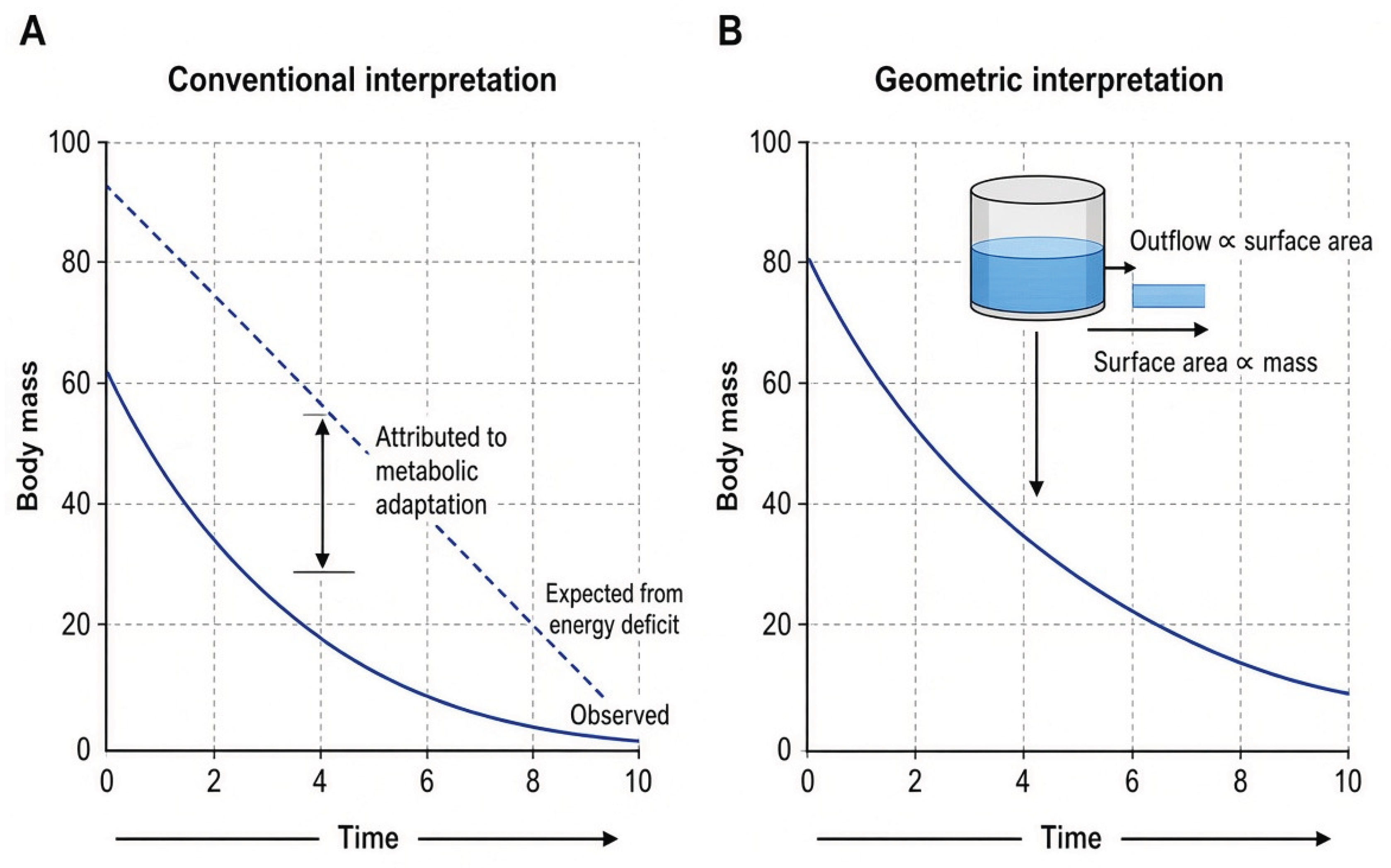
Figure 1 contrasts the two accounts.
2. The Physical Premises
The first premise is the continuity equation applied to a macroscopic object:
where M is body mass. This is not a biological hypothesis.
The second premise is that net outflow mout is an increasing function of the surface area available for exchange, and that surface area itself is an increasing function of mass. For objects of similar shape and density the latter relation is elementary geometry. Empirically it is recovered in the human data by relations of the Mosteller form
and its variants. Because the dominant mass fluxes (insensible loss, respiratory water, urine, faeces, desquamation) cross surfaces, outflow must itself rise with retained mass.
Substitution of a surface-area-dependent outflow into the continuity equation yields a decelerating solution for M(t) under constant or slowly varying inflow. The precise exponents depend on the details of the scaling and on the relative contribution of each route; the qualitative behaviour – rapid initial loss followed by progressive slowing – does not. Quantitative refinement of parameters remains useful. The existence of deceleration does not await such refinement.
3. Why Biological Interpretation is Unnecessary
Energy-balance models typically begin with an energy deficit, convert that deficit into expected mass loss by means of an assumed tissue energy density, and, when the observed loss falls short, assign the shortfall to a reduction in energy expenditure. The geometric account reverses the order of explanation. The primary datum is the mass trajectory. Because outflow declines with retained mass, the same nominal energy deficit produces progressively smaller mass changes simply because less mass is leaving the system per unit time. Part of the apparent shortfall is therefore the direct consequence of a smaller outflow, not necessarily the consequence of a lower energy expenditure.
Energy expenditure may of course change, and energy intake may be imperfectly recorded. The geometric argument does not deny these possibilities. It asserts only that they are not required to explain the characteristic shape of the curve. A model that omits surface-area scaling will systematically over-attribute slowing to physiology. Once the geometric term is restored, the residual available for biological adaptation is smaller and more tightly bounded.
4. Relation to Torricelli’s Law
Torricelli’s law states that efflux velocity under gravity scales with the square root of the height of the fluid column [1,2]. For a reservoir of constant cross-section this produces an outflow proportional to the square root of remaining volume. The human body is not a cylindrical tank. Nevertheless, once surface area is permitted to scale with mass, the same qualitative dependence reappears. The Mosteller-type relation supplies exactly that dependence. The analogy is therefore mathematical rather than metaphorical: both systems are reservoirs whose discharge rate falls as the reservoir empties.
5. Implications
If the decelerating trajectory is largely geometric, efforts to isolate a purely biological adaptive component must first subtract the geometric expectation. Models that neglect surface-area scaling will continue to generate inflated estimates of adaptation. Conversely, inclusion of the geometric term improves both the interpretability of existing data and the prospective accuracy of mass-loss forecasts. The same symmetry governs regain: when inflow is restored, the approach to a new steady state is again constrained by the surface-area relation.
6. Conclusions
The progressive slowing of human mass loss under caloric restriction has been interpreted for decades as evidence of metabolic adaptation. Geometry requires the same slowing. Torricelli’s law and the scaling of surface area with mass are established relationships; they are not hypotheses awaiting empirical confirmation. What has been missing is the recognition that these relationships already impose a decelerating trajectory. Once that recognition is granted, a substantial fraction of what has been called metabolic adaptation ceases to require biological explanation. The phenomenon that has most disordered the field is, to first order, the behaviour of a draining reservoir.
Funding
This research did not receive any specific grant from funding agencies in the public, commercial, or not-for-profit sectors.
Data Availability Statement
All data generated or analyzed during this study can be found in the sources cited in this article.
Acknowledgments
I thank Professor Francisco Arencibia-Albite for discussions on the formal structure of mass-balance models and for first directing attention to the relevance of Torricelli’s law in this context.
Conflicts of Interest
The author declares no conflict of interest.
Note on references
The limited number of references is intentional. The central claim is a geometric necessity, not an empirical generalization. Once the relevant physical relations are granted, the decelerating trajectory of mass loss follows directly; extensive citation is therefore unnecessary.
References
- Arencibia-Albite F. Empirical Evaluation of the Mass Balance Model in Human Bodyweight Regulation, 13 January 2026, PREPRINT (Version 1) available at Research Square. [CrossRef]
- Manninen AH. The Body as a Draining Tank: Torricelli's Law Explains Metabolic Adaptation to Weight Loss. Preprints 2026, 2026051650. [CrossRef]
Figure 1.
Two accounts of decelerating mass loss. (A) Conventional energy-balance interpretation. An imposed energy deficit is expected to produce approximately linear mass loss (dashed line). The observed deceleration (solid curve) is then attributed to a biological reduction in energy expenditure (metabolic adaptation). (B) Geometric interpretation. The body is treated as a mass reservoir whose net outflow scales with surface area, and surface area scales with retained mass. The decelerating trajectory is the direct solution of the resulting differential equation; no additional adaptive term is required to generate the slowing.
Figure 1.
Two accounts of decelerating mass loss. (A) Conventional energy-balance interpretation. An imposed energy deficit is expected to produce approximately linear mass loss (dashed line). The observed deceleration (solid curve) is then attributed to a biological reduction in energy expenditure (metabolic adaptation). (B) Geometric interpretation. The body is treated as a mass reservoir whose net outflow scales with surface area, and surface area scales with retained mass. The decelerating trajectory is the direct solution of the resulting differential equation; no additional adaptive term is required to generate the slowing.
Disclaimer/Publisher’s Note: The statements, opinions and data contained in all publications are solely those of the individual author(s) and contributor(s) and not of MDPI and/or the editor(s). MDPI and/or the editor(s) disclaim responsibility for any injury to people or property resulting from any ideas, methods, instructions or products referred to in the content. |
© 2026 by the authors. Licensee MDPI, Basel, Switzerland. This article is an open access article distributed under the terms and conditions of the Creative Commons Attribution (CC BY) license (http://creativecommons.org/licenses/by/4.0/).
Copyright: This open access article is published under a Creative Commons CC BY 4.0 license, which permit the free download, distribution, and reuse, provided that the author and preprint are cited in any reuse.