
Submitted:
25 September 2026
Posted:
28 September 2026
You are already at the latest version
Abstract
Background/Objectives: Strengthening public administration of epidemiological surveillance is a policy priority for the Republic of Kazakhstan amid globalization, the emergence of new pathogens, cross-border importation of quarantinable infections, and the high economic cost of recurrent epidemics. This study analyzed Kazakhstan’s sanitary-epidemiological legislation and evaluated the effectiveness of the public administration of its infectious disease surveillance system. Methods: We conducted a comparative analysis of current and repealed Kazakhstani legal acts against the World Health Organization International Health Regulations (2005), benchmarked against United States and Australian border-health law; a descriptive analysis of national infectious disease incidence per 100,000 population (2022–2024); and a multivariable ordinary least squares regression on a cross-sectional comparator sample of 12 countries (Kazakhstan, 10 Organisation for Economic Co-operation and Development [OECD] member countries, and Romania, an OECD accession candidate; 2023–2024) relating log-transformed 2024 measles incidence to 2023 second-dose (MCV2) measles vaccination coverage and the 2023 World Bank Government Effectiveness index. Results: The legal analysis identified substantial gaps, including the absence of a statutory definition of epidemiological surveillance and of public health emergency criteria, and fragmented regulation of border sanitary control. Vaccine-preventable disease incidence rose sharply in 2023–2024 despite consistently high (98.8%) average official first-dose (MCV1) measles vaccination coverage. The regression model explained 68.3% of cross-country variance in measles incidence (R² = 0.683; F(2,9) = 9.70; p = 0.006); government effectiveness was a significant predictor (B = −2.79; p = 0.007), whereas second-dose (MCV2) vaccination coverage was not (B = −0.03; p = 0.667). Conclusions: In the full-sample conventional OLS model, government effectiveness was associated with measles incidence whereas MCV2 coverage was not; however, this pattern was sensitive to the exclusion of Kazakhstan and to robust standard-error estimation, and should therefore be considered exploratory and hypothesis-generating rather than a confirmed determinant, given the small sample (n = 12). Kazakhstan should prioritize closing identified regulatory gaps and strengthening surveillance governance, informed by consolidated border-health models such as those of the United States and Australia.
Keywords:
epidemiological surveillance
; health policy
; government effectiveness
; International Health Regulations
; measles
; vaccination coverage
; public health governance
; Kazakhstan
1. Introduction
Epidemiological surveillance is an integral part of the early-warning system for new infectious disease outbreaks and for monitoring existing or “forgotten” infections. Since the beginning of the 21st century, the global community has faced large-scale outbreaks of infectious disease, including the 2003 severe acute respiratory syndrome (SARS) epidemic, the 2009 influenza A/H1N1 pandemic, Middle East respiratory syndrome coronavirus (MERS-CoV), and, most consequential in financial and economic terms, the 2019 severe acute respiratory syndrome coronavirus 2 (SARS-CoV-2, COVID-19) pandemic [1,2]. According to the World Health Organization (WHO), more than 767 million cases and approximately 6.9 million deaths were recorded worldwide during the COVID-19 pandemic [3]. In WHO’s 2021 global health estimates, COVID-19 became the second leading cause of death worldwide, displacing stroke and chronic obstructive pulmonary disease from the top rankings [4].
The economic consequences of the COVID-19 pandemic significantly affected all sectors of activity, including reduced labor productivity and lower consumer spending [5]. According to the World Bank, the damage to the global economy in 2020 is estimated at approximately US$7.4 trillion, with gross domestic product (GDP) contracting by 3.1%—more than double the GDP decline recorded during the 2009 economic crisis [6,7]. These events underscored the importance of continuously strengthening epidemiological surveillance systems and preparedness for new threats. WHO has designated a hypothetical “Disease X” as a priority area for research and development in public health emergencies [8].
At the same time, the threat to public health systems arises not only from novel pathogens but also from vaccine-preventable infections that were previously considered largely controlled. Measles is a telling example: according to joint WHO/UNICEF estimates, global coverage with the second dose of measles-containing vaccine reached only 74% in 2023, and first-dose coverage was 83%—both substantially below the 95% threshold required for durable herd immunity [32]. The consequence has been a resurgence in incidence: in 2024, the WHO European Region recorded 127,300 measles cases, the highest total since 1997 and roughly one-third of all cases reported worldwide [28]. In the current literature, the combination of epidemiological, immunological, organizational, and socio-political factors driving this resurgence is increasingly framed as a systemic problem of public health governance rather than a purely medical one [23].
The Republic of Kazakhstan has been particularly affected. In January 2024, WHO reported a rapid escalation of measles incidence in the country: 13,677 cases were registered in 2023—the highest number among countries of the WHO European Region—with more than 70% of affected children under 14 years of age unvaccinated [27]. According to UNICEF, the build-up of a susceptible population was linked to the suspension of routine immunization during the 2020 quarantine restrictions and the subsequent spread of vaccine misinformation on social media, which required a revision not only of medical but also of institutional response mechanisms [31]. This episode illustrates that even a high official measles vaccination coverage rate (first-dose, MCV1; averaging 98.8% for 2005–2024, according to official statistics) does not guarantee epidemiological resilience, which shifts the analytical focus from purely medical indicators to the quality of public administration of the surveillance system.
During the pandemic, governments of various countries implemented operational measures to ensure the effective functioning of public health systems and communications [9]. In the Republic of Kazakhstan, organizational and managerial mechanisms of state regulation of the epidemiological situation were formed and implemented, which made it possible to stabilize the situation during the COVID-19 pandemic [10]. Within the Republic of Kazakhstan, sanitary-epidemiological control authorities supervise more than 100 infectious and parasitic diseases [11]; the system operates at the republican, regional, and district/city levels through 17 territorial subdivisions in regional centers and cities of republican significance, more than 195 district/city departments, the Department of Sanitary-Epidemiological Control on Transport, the National Center of Expertise, and nine anti-plague stations providing scientific and methodological support [11].
The organizational and legal basis of this activity is governed by the Code “On the Health of the People and the Healthcare System” of 7 July 2020, No. 360-VI ZRK, together with resolutions, sanitary rules and norms, and other subordinate acts of the Committee for Sanitary-Epidemiological Control under the Ministry of Health of the Republic of Kazakhstan [14]. State policy in this domain is in the process of transformation toward a more structured approach to disease prevention [12], and since independence the system has undergone a series of structural changes, including decentralization of management and integration with international standards [13]. Nevertheless, managerial problems persist, including inconsistency among legal acts, a shortage of qualified specialists, and limited integration of digital tools into management processes [15], underscoring the need for a systemic, rather than piecemeal, evaluation of surveillance effectiveness.
Assessing the compliance of national legislation with international public-health obligations has an established methodological tradition. Katz and Kornblet [21] conducted a comparative content analysis of the national legislation of several countries against the revised International Health Regulations (IHR), showing that a structured comparison of national norms with IHR provisions against a common set of criteria can identify specific regulatory gaps and applicable models for addressing them—the method underlying the construction of Table 1 in the present study. An alternative, WHO-endorsed instrument is the Joint External Evaluation (JEE), in which a multisectoral panel of experts rates each of the 19 IHR technical areas on a three-tier qualitative scale (no capacity / limited capacity / full capacity) [22]. Because the JEE is periodic, expert-qualitative, and resource-intensive, and is not designed for continuous monitoring of legislative change between evaluation cycles, the present study applies a documentary comparative-legal method modeled on Katz and Kornblet [21], adapted to IHR criteria and supplemented with a quantitative assessment of the epidemiological consequences of the identified gaps—distinguishing this work from purely legal or purely expert-qualitative approaches.
At the regional level, the governance challenges facing public health systems in Central Asia and the Middle East were examined by Khader et al. [24], who applied a multi-stage dialogue method—semi-structured interviews with 47 experts, an online survey of 248 respondents from 17 countries in the region, and a two-day regional dialogue involving 49 senior officials—to build a consolidated vision for global health governance reform. This approach ensures broad coverage of stakeholder views but requires substantial organizational resources and does not permit a quantitative assessment of the actual performance of any single national system. At the individual level, barriers to vaccination in Kazakhstan were examined by Kassabekova et al. [25] using a mixed-methods design and the COM-B (Capability–Opportunity–Motivation–Behaviour) model: 266 participants from five stakeholder groups were interviewed in focus groups across five regions of the country, providing a detailed account of demand-side behavioral and communication barriers but leaving the institutional (regulatory-managerial) dimension of the problem outside its scope. An earlier descriptive study by Zhuzzhasarova et al. [26] used 2018–2019 statistics from the Committee for Public Health Protection to analyze the age and regional structure of measles incidence in Kazakhstan, establishing a methodological precedent for using official statistics for descriptive epidemiological analysis in the national context—a method also used in the present study for the 2022–2024 period.
At the global level, Ahmed Mohamedosman et al. [23] synthesized, in an integrative review, the medical, immunological, epidemiological, and socio-political factors behind the global resurgence of measles, identifying institutional maturity of health systems as a key but, in most reviews, not quantitatively measured factor. With respect to Kazakhstan, quantitative methods have previously been applied mainly to adjacent aspects of the health system: Akpanova et al. [13] used interrupted time-series analysis with predictive modeling to assess the impact of healthcare reforms on the epidemiology workforce over 1998–2022, and Omarova et al. [15] applied factor analysis to the digital transformation of Kazakhstan’s healthcare system. The existing literature can therefore be grouped into three relatively distinct strands: (1) qualitative dialogue-based assessments of regional public health governance without country-level quantitative verification [24]; (2) individual-behavioral studies of vaccination behavior in Kazakhstan limited to the demand side [25]; and (3) descriptive and review studies that identify institutional factors in measles incidence at a qualitative level without statistically testing their significance in cross-country comparison [23,26].
None of these strands simultaneously provides (a) a systematic comparison of the national legal framework against mandatory international standards, (b) a quantitative assessment of the actual epidemiological consequences of the identified institutional gaps based on national statistics, and (c) a statistical test of whether cross-country variation in vaccine-preventable disease incidence is associated with differences in institutional quality of governance rather than with vaccination coverage alone. This methodological gap defines the subject of the present study and justifies the choice of its methods—comparative-legal analysis, descriptive epidemiological statistics, and multivariable regression analysis—detailed in Section 2.
Accordingly, the aim of this study was to analyze the regulatory legal framework governing sanitary-epidemiological welfare and to evaluate the effectiveness of the public administration of the infectious disease surveillance system in the Republic of Kazakhstan. The following objectives were addressed: (1) to compare the compliance of current and repealed Kazakhstani legal acts with the requirements of the International Health Regulations (2005), including benchmarking against the international experience of states with high epidemiological resilience; (2) to assess the dynamics and structure of infectious and parasitic disease incidence in the Republic of Kazakhstan for 2022–2024, including vaccine-preventable diseases; (3) to identify, using multivariable regression analysis, institutional (government effectiveness) and immunization-related factors associated with cross-country variation in measles incidence in a sample of OECD countries and Kazakhstan; and (4) to formulate, on the basis of the institutional, epidemiological, and statistical findings, recommendations for improving state policy on sanitary-epidemiological welfare informed by successful international experience.
2. Materials and Methods
The theoretical basis of the study was formed from reports of the World Health Organization (WHO) and the Organisation for Economic Co-operation and Development (OECD), together with a search of the Scopus and Web of Science databases for international publications on public administration and epidemiological surveillance.
Empirical data for the comparative analysis of Kazakhstani legal acts were drawn from the “Ädilet” information-legal system of regulatory legal acts, the “Zakon” information system, and the International Health Regulations (IHR) adopted by WHO in 2005 [16]. The legislative frameworks of countries with more developed epidemiological surveillance systems were additionally analyzed to identify effective practices.
The effectiveness of public administration in the field of sanitary-epidemiological welfare was assessed using statistical data from the Bureau of National Statistics of the Republic of Kazakhstan (stat.gov.kz, health section), including the number of registered infectious diseases for 2022–2024. Analytical reviews and reports of WHO and the OECD were also used for international benchmarking of surveillance effectiveness.
To address objective 3, a comparator sample of 12 countries was formed: Kazakhstan, 10 OECD member countries—Japan, Norway, Spain, Italy, Germany, France, Poland, Denmark, Portugal, and Finland—and Romania, which is currently an OECD accession candidate rather than a full member, and is described as such throughout this manuscript rather than grouped with the OECD members. These 12 countries were the comparator set compiled by the authors for which four indicators were available: 2024 measles incidence per 100,000 population (OECD Health Statistics; WHO/Europe [27] for Kazakhstan; ECDC [28] for the 10 European OECD/Romania comparator countries; Japan Institute for Health Security surveillance data [36] for Japan), the WHO/UNICEF WUENIC estimate of second-dose (MCV2) measles vaccination coverage, most recently available for 2023 (WHO and UNICEF country immunization profiles for Kazakhstan and Japan [34,35]; ECDC Measles Annual Epidemiological Report 2024, Table 2, for the other 10 comparator countries [28]), the Government Effectiveness index from the World Bank's Worldwide Governance Indicators (latest available estimate, 2023), reflecting the quality of policy formulation and implementation and the independence of the civil service from political pressure [29,30], and, for a supplementary specification, current health expenditure per capita (World Bank data, 2023, aggregated by TheGlobalEconomy.com [30]). This comparator set is a purposive sample assembled by the authors rather than an exhaustive or randomly/systematically screened subset of all 38 current OECD member countries; a documented, reproducible screening procedure against the full OECD membership (e.g., a PRISMA-style flow recording why each of the other 28 OECD members was not included) was not part of the materials available for this analysis and is noted as a limitation in Section 4. The incidence indicator was log-transformed, ln(x + 0.05), to normalize its skewed distribution. The multivariable regression was estimated by ordinary least squares (OLS); multicollinearity was assessed using the variance inflation factor (VIF); a supplementary model including per-capita health expenditure as a control variable was also estimated. The full country-by-country dataset, with the source for every value, is provided as Table S1. The procedure for constructing and cleaning the final analytical samples across all three analytical strands (regulatory, national epidemiological, and international comparative) is shown in Figure 1.
This study relied exclusively on publicly available, aggregated legal and statistical data (national legal databases, national and international statistical portals, and published WHO, OECD, ECDC, UNICEF, and World Bank sources); it did not involve human participants, biological material, or individually identifiable data, and therefore did not require review or approval by an institutional ethics committee (see also the Institutional Review Board Statement).
Descriptive statistics and the multivariable regression analysis were performed using IBM SPSS Statistics (version 29.0; IBM Corp., Armonk, NY, USA). Statistical significance was set at p < 0.05.
During preparation of this manuscript, the authors used a generative artificial intelligence (GenAI)-based language assistant (Claude, Anthropic, San Francisco, CA, USA) to assist with translation of the manuscript from Russian into English and with the linguistic and editorial revision of text drafted by the authors. The tool was not used to generate, analyze, or interpret data, nor to design the study, select methods, or draw conclusions; all data, statistical results, interpretations, and conclusions are those of the authors, who reviewed and verified the full content of the manuscript and take full responsibility for its accuracy and scientific integrity.
3. Results
We conducted a comprehensive analysis of the sanitary-epidemiological surveillance system of the Republic of Kazakhstan, comprising an institutional comparison of national legal acts against the International Health Regulations (IHR), an assessment of the national epidemiological situation, and a comparative international and statistical analysis of policy effectiveness.
The study adopted an interdisciplinary approach combining legal, epidemiological, and statistical analysis, allowing an assessment not only of regulatory compliance but also of the actual performance of the public health surveillance system.
3.1. Institutional Compliance of National Legislation with the International Health Regulations
In the first stage, we compared the institutional compliance of Kazakhstani legal acts with the requirements of the IHR, which are binding on WHO member states and reflect international standards of epidemiological surveillance.
The comparison used the following criteria: purpose, scope, subjects, epidemiological surveillance, notification procedure, completeness of health information, declaration of a public health emergency of international concern (PHEIC), response measures, and sanitary protection of borders. Results are presented in Table 1.
The analysis showed non-compliance in several key areas, including the absence of a conceptual/definitional framework for epidemiological surveillance, insufficient regulation of public health emergencies, and the absence of a single normative act on sanitary protection of the state border.
It is important to distinguish two related but separate mechanisms compared in Table 1, row 7–8. The IHR (2005) Annex 2 decision instrument is an international notification mechanism: it guides a WHO member state in deciding whether a domestic public health event must be reported to WHO as a potential Public Health Emergency of International Concern (PHEIC), based on four criteria—seriousness, unusual/unexpected nature, risk of international spread, and risk of international travel or trade restrictions. This is conceptually distinct from a national public health emergency declaration, which is a domestic legal act triggering internal emergency powers and resource mobilization (in Kazakhstan, governed by the Law “On Civil Protection”). A state can declare a national emergency without the underlying event meeting the IHR notification threshold, and conversely can be obligated to notify WHO under Annex 2 without declaring a domestic emergency. The comparative gap identified in this study is that RK legal acts establish neither an IHR-equivalent multi-criteria WHO-notification instrument nor an explicit statutory definition of a national public health emergency of the kind used for cross-jurisdictional comparison; both gaps are relevant but analytically separate.
According to the comparative analysis, the Republic of Kazakhstan lacks a single, comprehensive legal act on sanitary protection of the state border. Regulation is based on Articles 103 and 104 of the Code and a number of current orders of the Ministry of Health of the Republic of Kazakhstan (Order No. ҚР ДСМ-317/2020 of 23 December 2020; Order No. ҚР ДСМ-293/2020 of 21 December 2020; Order No. ҚР ДСМ-5 of 11 January 2021). The Order of the Minister of National Economy of the Republic of Kazakhstan No. 107 of 18 February 2015 “On Approval of the Rules for Sanitary-Quarantine Control over the Importation and Spread of Infectious and Parasitic Diseases at the State Border of the Republic of Kazakhstan Coinciding with the Customs Border of the Customs Union, and for Ensuring Sanitary Protection of the Border and Territory of the Republic of Kazakhstan” was repealed in 2024. This indicates the fragmentary nature of the regulatory framework governing sanitary protection of the state border of the Republic of Kazakhstan.
3.2. Regulatory Fragmentation of Border Sanitary Control: International Benchmarking
To corroborate the identified institutional gaps, a comparative analysis of international experience (the United States and Australia) was conducted; results are presented in Table 2.
The results show that countries with high epidemiological resilience (the United States and Australia) operate single, comprehensive legal instruments regulating border sanitary control and epidemiological surveillance, whereas regulation in the Republic of Kazakhstan remains fragmented.
3.3. Dynamics and Structure of Infectious Disease Incidence, 2022–2024
The next stage analyzed the dynamics of infectious disease incidence for 2022–2024 (Table 3). The number of infectious diseases was obtained from the “Open Data” portal of e-government (egov.kz); incidence rates per 100,000 population were calculated using data from the Qazstat portal of the Bureau of National Statistics (stat.gov.kz).
The results show a decline in incidence across most infection groups, but a sharp increase in vaccine-preventable infections, indicating a loss of control over this group of diseases. Further analysis showed a rise in measles cases in 2023–2024, confirming the presence of systemic problems in the implementation of immunization policy.
In 2022, chronic viral hepatitis B accounted for 93.3% (2355 cases) of all registered vaccine-preventable-disease cases. In 2023, the epidemiological situation for vaccine-preventable infections deteriorated further as measles incidence came to dominate the structure of registered cases (Table 4). In 2023, 29,731 measles cases were registered nationally, compared with only 4 cases in 2022. This national annual total is substantially higher than the 13,677 cases for 2023 reported by WHO in a January 2024 situation update [27]; the two figures come from different sources with different reporting cut-off dates and, likely, different case definitions (WHO situation reports typically reflect laboratory-confirmed cases as of a specific reporting date, whereas the national annual total from Qazstat reflects all cases—confirmed and clinically diagnosed—registered by year-end). Both figures point to the same order-of-magnitude resurgence, but the two should not be treated as directly interchangeable, and the authors recommend that any comparison across sources state the case definition and reporting cut-off explicitly.
According to official statistics, average annual national coverage with the first dose of measles-containing vaccine (MCV1) in Kazakhstan for 2005–2024 was 98.8%, above the WHO-recommended threshold of >95% (Figure 2); this administrative MCV1 indicator is distinct from the second-dose (MCV2) coverage used in the 12-country cross-sectional regression in Section 3.4, which relies on WHO/UNICEF WUENIC estimates rather than national administrative reporting. In several years the reported coverage exceeds 100% (Figure 2); this is a known feature of administrative (denominator-based) coverage statistics and typically reflects catch-up vaccination of children outside the target birth cohort, denominator (population-estimate) revisions, or reporting of doses given to children older than the standard schedule age, rather than a genuine rate above the total eligible population. This administrative coverage level would, in principle, be sufficient for effective epidemiological management of the disease and for timely prevention of transmission, and its persistence through the 2023–2024 resurgence is discussed in Section 4.
Among the 12 comparator countries, the 2024 measles incidence rate per 100,000 population ranged from 0.04 in Japan to 161.07 in Romania; Kazakhstan’s rate was 140 (Figure 3).
Among the most epidemiologically stable countries—those with no or persistently low measles incidence across 2022–2024—Japan and Norway stand out; Table 5 presents these exemplar countries alongside Spain for comparison. The results show that countries with resilient surveillance systems (Japan, Norway) exhibit zero or minimal incidence, consistent with high vaccination-programme effectiveness and institutional maturity of their health systems.
We examined Japan’s surveillance experience because the WHO Western Pacific Region verified Japan as having achieved measles elimination in March 2015, a status maintained through the 2022–2024 period covered by this study [33]. Measles vaccination was introduced in Japan in 1966 and incorporated into the national routine immunization programme in 1978, and is currently delivered as a combined measles-rubella vaccine in two doses under the Immunization Act. Between 2020 and 2024, measles vaccination coverage in Japan was 93–94% [20], consistent with the country’s sustained elimination of endemic measles transmission despite coverage below the 95% herd-immunity threshold.
3.4. Multivariable Associations with Cross-Country Measles Incidence
To address objective 3, a cross-sectional comparator sample of 12 countries (Kazakhstan, 10 OECD member countries, and Romania, an OECD accession candidate; see Section 2) was compiled for which comparable data on 2024 measles incidence, 2023 second-dose (MCV2) measles vaccination coverage, and 2023 government effectiveness were available; the full dataset, with the source for every value, is provided as Table S1, and the data-compilation procedure is shown in Figure 1. The OLS regression model, with log-transformed incidence as the dependent variable, explained 68.3% of the variance (R² = 0.683; adjusted R² = 0.613; F(2,9) = 9.70; p = 0.006). The Government Effectiveness index was a statistically significant predictor of incidence (B = −2.79; p = 0.007), whereas MCV2 coverage was not (B = −0.03; p = 0.667) (Table 6). Notably, Kazakhstan's own WUENIC-estimated MCV2 coverage for 2023 was 99%—higher than its 2005–2024 administrative MCV1 average of 98.8% (Section 3.2)—yet the country still recorded the second-highest 2024 incidence in the sample, reinforcing that aggregate coverage indicators, first- or second-dose alike, are an imperfect proxy for population-level protection. Adding per-capita health expenditure to the model (Model 2) improved the raw R² (0.752) but not the adjusted R² (0.660), and increased multicollinearity substantially (VIF = 4.3–5.4 for the effectiveness index and expenditure, up from 1.39 in Model 1) without either the effectiveness index or expenditure remaining individually significant; the two-predictor Model 1 is therefore presented as the primary specification (Table 6).
Model diagnostics. Variance inflation factors for Model 1 were low for both predictors (VIF = 1.39), indicating no problematic multicollinearity. Residual diagnostics showed no evidence of non-normality (Jarque–Bera p = 0.72; Shapiro–Wilk p = 0.84) or of problematic heteroscedasticity (Breusch–Pagan LM p = 0.14, F p = 0.16), though these tests have limited power in a sample of this size. Kazakhstan had by far the largest studentized residual (5.15) of the twelve countries, reflecting a far higher measles incidence than the model predicts from its coverage and governance scores alone; Romania, the country with both the highest incidence and the lowest Government Effectiveness score, had the highest leverage (0.86) and the highest Cook's distance (8.38), with Kazakhstan's Cook's distance (3.15) the second-highest—both well above the conventional 4/n = 0.33 threshold for n = 12—while Denmark showed a smaller but still non-negligible influence (Cook's distance = 0.34). Kazakhstan and Romania were therefore both influential observations, albeit for different reasons: Kazakhstan through the size of its residual, Romania through its leverage and overall Cook's distance. A leave-one-country-out sensitivity analysis found that the association between Government Effectiveness and incidence remained negative and statistically significant (p < 0.02) when any of the other 11 countries was removed individually, including Romania (B = −2.65; p = 0.003); across those 11 single-country omissions, p-values for Government Effectiveness ranged from 0.003 to 0.017. Removing Kazakhstan itself, however, changed the picture substantially: the Government Effectiveness coefficient weakened to B = −0.71 and lost statistical significance (p = 0.249), while MCV2 coverage became statistically significant instead (B = −0.162, p = 0.004), even though the remaining 11-country model's overall fit improved (R² = 0.881); excluding Kazakhstan therefore does not simply remove significance from Government Effectiveness, it reverses which of the two predictors appears to matter. The Government Effectiveness association was, in addition, sensitive to the choice of standard-error estimator: heteroskedasticity-consistent standard errors raised its p-value from 0.007 under conventional OLS to 0.026 (HC0), 0.047 (HC1), 0.097 (HC2), and 0.241 (HC3) (full results in Table S1, sheet S7). This indicates that the association reported in Table 6 is robust to any single OECD/Romania comparator country but is substantially dependent on Kazakhstan's own data point—the country whose measles resurgence motivated this comparison in the first place—and no longer reaches conventional significance under the most conservative standard-error correction (HC3). Readers should therefore treat the Government Effectiveness association as a description of how Kazakhstan's 2024 incidence and governance score relate to the comparator sample as a whole, rather than as an effect established independently of the case that motivated the analysis; these sensitivities, together with the small sample (n = 12) and the non-systematic construction of the comparator set discussed in Section 2 and Section 4, mean the finding is best regarded as an exploratory, hypothesis-generating association rather than a robust, independently established determinant.
4. Discussion
The findings are broadly consistent with the wider body of international research on the institutional determinants of measles resurgence, while refining conclusions previously formulated mainly at a qualitative or descriptive level.
First, the identified non-compliance of several provisions of Kazakhstani legislation with IHR requirements—chiefly the absence of a unified conceptual framework for epidemiological surveillance and the fragmented regulation of sanitary protection of the state border—is consistent with the observation of Katz and Kornblet [21] that even countries with well-developed legal systems face dispersal of sanitary-epidemiological norms across multiple instruments of different levels, complicating enforcement. Comparison with the experience of the United States and Australia (Table 2) shows that consolidating such regulation into a single instrument is not a practice unique to Anglo-Saxon legal traditions but a technically achievable, rather than culturally specific, reform.
Second, the combination of high official first-dose (MCV1) measles vaccination coverage (averaging 98.8% for 2005–2024) and the sharp rise in incidence in 2023–2024 is directly corroborated by independent sources: WHO reports that more than 70% of affected children under 14 in 2023 were unvaccinated [27], and UNICEF links this to the suspension of routine immunization during the 2020 quarantine restrictions and the subsequent spread of social-media misinformation [31]; the focus-group study by Kassabekova et al. [25] independently documented persistent behavioral barriers to vaccination among parts of the population despite high aggregate coverage. This points to a substantive limitation of official vaccination-coverage statistics as an indicator of epidemiological protection: an aggregated national figure can mask local and group-level immunization failures that do not reflect the actual level of herd immunity. A similar divergence between administrative coverage figures and the epidemiological situation is visible globally: against a 95% herd-immunity threshold, global second-dose coverage was only 74% in 2023, even as individual countries reported substantially higher national figures [32].
Third, the multivariable regression results (Table 6) show that the predictor statistically associated with cross-country variation in measles incidence in this sample was not MCV2 vaccination coverage per se but the institutional indicator—government effectiveness (B = −2.79; p = 0.007). This finding is substantively consistent with the review by Ahmed Mohamedosman et al. [23], which identified institutional maturity of health systems as a key but statistically unmeasured factor in measles resurgence, and with the dialogue-based study by Khader et al. [24], which documented governance deficits in Central Asian and Middle Eastern health systems through expert assessment. The present study adds a preliminary quantitative signal in the same direction: across a relatively wide range of MCV2 coverage among the countries examined (62–99%), differences in institutional quality of governance were associated with a substantial share of cross-country variation in incidence in this small cross-sectional sample. As reported in Section 3.4, however, this association is not independent of Kazakhstan's own data point: a leave-one-country-out check showed it remained significant when any of the other 11 comparator countries was excluded but lost significance when Kazakhstan itself was excluded, at which point MCV2 coverage became the significant predictor instead (B = −0.16, p = 0.004); the association was also weakened by heteroskedasticity-robust standard errors (HC3 p = 0.24; Table S1). The purposively selected comparator countries spanned a wide range of government-effectiveness scores; because the finding is also materially dependent on Kazakhstan's own observation, this pattern should be read as motivating further, larger-sample research rather than as settling the relative importance of coverage versus governance; it tentatively suggests that policy emphasis should not rest on coverage-raising campaigns alone but should also strengthen the administrative and supervisory capacity of the health system.
Comparison with Japan and Norway, which recorded zero or near-zero measles incidence throughout 2022–2024 despite lower MCV2 coverage than Kazakhstan's (94% in each, versus 99% for Kazakhstan) but a substantially higher government effectiveness index (1.63 and 1.80, respectively, versus 0.15 for Kazakhstan), is consistent with differences in the performance of epidemiological surveillance systems relating not only to medical factors but also to managerial ones—the resilience of inter-agency coordination, the quality of enforcement, and the consistency of immunization policy implementation. That Japan and Norway sustained near-zero incidence with formally lower reported coverage than Kazakhstan's underscores the same point made in Section 3.2 and Section 3.4: a high aggregate coverage figure, whether MCV1 or MCV2, administrative or WUENIC-estimated, does not by itself guarantee protection at the population level. Japan's experience in sustaining measles elimination since 2015 [20,33] illustrates that institutional consistency can accompany formally lower vaccination coverage than Kazakhstan's, though with only two such comparator countries this observation is illustrative rather than a formal test.
Study and data limitations. This study has several limitations that should be considered when interpreting the results. First, the multivariable regression analysis is based on a cross-sectional sample of 12 countries; the small sample size limits statistical power and does not allow more than two or three predictors to be controlled simultaneously without risking model overfitting—including per-capita health expenditure (Table 6, Model 2) increased multicollinearity substantially without either the effectiveness index or expenditure remaining individually significant, which we interpret as substantive overlap between the institutional and resource dimensions rather than an absence of association between them. Relatedly, the model diagnostics reported in Section 3.4 found the association between Government Effectiveness and incidence to be robust to removing any of the 11 OECD/Romania comparator countries individually, but not robust to removing Kazakhstan itself (p rose to 0.249 without it); Kazakhstan also showed by far the largest studentized residual, whereas Romania had the highest leverage and the highest Cook's distance, of the twelve countries; the association was further weakened under heteroskedasticity-robust (HC3) standard errors (Table S1). This means the reported association should be read as describing how Kazakhstan's own incidence and governance score relate to the comparator sample, rather than as an effect demonstrated independently of the case that motivated the study, and is an important qualification of the regression finding rather than a confirmation that Kazakhstan is simply a data-entry outlier to be discounted. A further, related limitation is that the twelve-country comparator set itself (Kazakhstan, 10 OECD member countries, and Romania) was compiled by the authors rather than derived through a documented, reproducible screening of the full 38-country OECD membership; the criteria that led to the inclusion of these particular countries and the exclusion of the other 28 OECD members are not recorded in the materials available for this study, so the possibility that the comparator set is not representative of OECD countries generally cannot be excluded. Because the original selection procedure was not documented, the representativeness of the comparator set relative to the full OECD membership cannot be established. Second, vaccination coverage and government effectiveness were measured for the same period, while incidence was measured in 2024, precluding a strict causal interpretation and pointing to the need for panel data across several years in future work. Third, the official Kazakhstani statistics used (data.egov.kz, Qazstat) are aggregated administrative indicators that, as noted above, may not capture actual heterogeneity in coverage and immune status at the regional or group level; analysis using de-identified case-level or regional panel data could improve the precision of future estimates. Fourth, the comparative legal analysis (Table 1) is based on textual comparison with the IHR and does not assess enforcement practice or the effectiveness of implementation of formally compliant norms, so a gap between “law on paper” and its practical application cannot be excluded—a dimension examined, in particular, by the dialogue method of Khader et al. [24]. Finally, the study focuses on a single vaccine-preventable disease (measles) as an indicator case; extending the conclusions to the other infection groups shown in Table 3 and Table 4 requires further verification.
The study’s strengths include the triangulation of three independent methods (comparative-legal, descriptive epidemiological, and multivariable regression); the use of verified data from independent international sources (WHO, OECD, World Bank, UNICEF) for cross-country comparison; and a transparently documented sample-construction procedure (Figure 1) that supports replication and future extension as comparable panel data for other countries and years become available.
5. Conclusions
This integrated study—combining institutional analysis of Kazakhstani legislation, epidemiological assessment of incidence, international benchmarking, and multivariable regression modeling—supports the following conclusions.
1. Institutional gaps in the sanitary-epidemiological regulatory system. Kazakhstan’s legal framework was found to be only partially compliant with the International Health Regulations, evident in the absence of a unified conceptual framework for epidemiological surveillance, insufficient regulation of public health emergencies, and fragmented regulation of sanitary protection of the state border.
2. Structural fragmentation of border regulation. Comparative international analysis showed that countries with high epidemiological resilience (the United States and Australia) operate integrated legal instruments providing unified management of sanitary border control, whereas regulation in Kazakhstan remains dispersed.
3. Adverse epidemiological trends. Incidence analysis revealed a sustained increase in vaccine-preventable infections, including a sharp rise in measles cases, occurring alongside consistently high vaccination coverage—indicating an imbalance in the immunization system.
4. An international performance gap in surveillance effectiveness. Japan and Norway exhibited minimal measles incidence despite lower reported MCV2 coverage than Kazakhstan's. This descriptive pattern is consistent with, but does not establish, a possible role for institutional and managerial differences in surveillance effectiveness, as discussed in Section 3.4.
5. The systemic nature of the identified problems. Taken together, the findings indicate that the identified deficiencies are systemic rather than isolated, spanning the regulatory and organizational levels of governance simultaneously.
Supplementary Materials
The following supporting information can be downloaded at the website of this paper posted on Preprints.org.
Author Contributions
Conceptualization, A.B., A.Ch and A.S.; methodology, A.B.; formal analysis, A.B.; investigation, A.B.; data curation, A.B.; writing—original draft preparation, A.B., A.Ch; writing—review and editing, A.B., A.Ch and A.S.; supervision, A.S. All authors have read and agreed to the published version of the manuscript.
Funding
This research received no external funding.
Institutional Review Board Statement
Not applicable. This study did not involve human participants, human tissue, or animals; it is based exclusively on publicly available, aggregated legal and statistical data, and therefore did not require review or approval by an institutional ethics committee.
Informed Consent Statement
Not applicable, as the study did not involve human participants.
Data Availability Statement
The legal acts analyzed in this study are publicly available through the “Ädilet” information-legal system (https://adilet.zan.kz) and the “Zakon” information system. National epidemiological statistics are publicly available from the Open Data portal of the e-government of the Republic of Kazakhstan (https://data.egov.kz) and the Bureau of National Statistics (https://stat.gov.kz). International comparative data are publicly available from OECD Health Statistics (https://www.oecd.org/en/data/datasets/oecd-health-statistics.html), the WHO Regional Office for Europe, the European Centre for Disease Prevention and Control, the Japan Institute for Health Security, the WHO and UNICEF country immunization coverage profiles (https://immunizationdata.who.int), the World Bank Worldwide Governance Indicators (https://www.worldbank.org/en/publication/worldwide-governance-indicators), and TheGlobalEconomy.com (https://www.theglobaleconomy.com/rankings/). The analytical dataset underlying Table 6 (country name, 2024 measles incidence per 100,000 population, national measles immunization coverage, the Government Effectiveness index score, and per-capita health expenditure, with the source for each value) is provided as Table S1.
Conflicts of Interest
The authors declare no conflicts of interest.
Abbreviations
The following abbreviations are used in this manuscript:
| WHO | World Health Organization |
| IHR | International Health Regulations |
| PHEIC | Public Health Emergency of International Concern |
| OECD | Organisation for Economic Co-operation and Development |
| ECDC | European Centre for Disease Prevention and Control |
| UNICEF | United Nations Children’s Fund |
| WGI | Worldwide Governance Indicators |
| MCV2 | Second dose of measles-containing vaccine |
| OLS | Ordinary least squares |
| VIF | Variance inflation factor |
| GDP | Gross domestic product |
| JEE | Joint External Evaluation |
| RK | Republic of Kazakhstan |
| MOH RK | Ministry of Health of the Republic of Kazakhstan |
References
- Shen, Y.; Liu, Y.; Wang, Q. Progress and challenges in infectious disease surveillance and early warning. Med. Plus 2025, 2, 100071. [Google Scholar] [CrossRef]
- Obrenovic, B.; Oblakovic, G.; Asa, A.R. Bibliometric Analysis of Financial and Economic Implications during the COVID-19 Pandemic Crisis. Sustainability 2024, 16, 2897. [Google Scholar] [CrossRef]
- World Health Organization (WHO). Weekly Epidemiological Update on COVID-19—29 June 2023; WHO: Geneva, Switzerland, 2023; Available online: https://www.who.int/publications/m/item/weekly-epidemiological-update-on-covid-19---29-june-2023 (accessed on 1 June 2026).
- World Health Organization (WHO). The Top 10 Causes of Death; WHO: Geneva, Switzerland, 2021; Available online: https://www.who.int/news-room/fact-sheets/detail/the-top-10-causes-of-death (accessed on 1 June 2026).
- Faramarzi, A.; Norouzi, S.; Javan-Noughabi, J. The global economic burden of COVID-19 disease: a comprehensive systematic review and meta-analysis. Syst. Rev. 2024, 13, 68. [Google Scholar] [CrossRef] [PubMed]
- World Bank (WB). The World Bank Group’s Early Support in Addressing Coronavirus (COVID-19): An Early-Stage Evaluation; World Bank: Washington, DC, USA, 2023; Available online: https://ieg.worldbankgroup.org/evaluations/world-bank-groups-early-support-addressing-coronavirus-covid-19-economic-response (accessed on 29 May 2026).
- World Bank (WB). SDG Atlas: Goal 8—Decent Work and Economic Growth; World Bank: Washington, DC, USA, 2023; Available online: https://datatopics.worldbank.org/sdgatlas/goal-8-decent-work-and-economic-growth (accessed on 29 May 2026).
- World Health Organization (WHO). Pathogens Prioritization: A Scientific Framework for Epidemic and Pandemic Research Preparedness; WHO: Geneva, Switzerland, 2024; Available online: https://www.who.int/publications/m/item/pathogens-prioritization-a-scientific-framework-for-epidemic-and-pandemic-research-preparedness (accessed on 1 June 2026).
- Deejay, A.; Henne, K.; Carneiro Alphonso, F. Navigating a public health crisis: Governance and sensemaking during the COVID-19 pandemic in Australia. SSM Qual. Res. Health 2023, 4, 100317. [Google Scholar] [CrossRef]
- Battakova, Z.; Imasheva, B.; Slazhneva, T. Public Health Response Measures for COVID-19 in Kazakhstan. Disaster Med. Public Health Prep. 2023, 17, e524. [Google Scholar] [CrossRef] [PubMed]
- Information-Legal System of Regulatory Legal Acts of the Republic of Kazakhstan “Ädilet”. Available online: https://adilet.zan.kz/rus/docs/ (accessed on 25 May 2026).
- Kalel, Z.S.; Gulis, G.; Aringazina, A.M. Implementation of Health Impact Assessment in the Healthcare System of the Republic of Kazakhstan. Int. J. Environ. Res. Public Health 2023, 20, 2335. [Google Scholar] [CrossRef] [PubMed]
- Akpanova, T.; Rakhypbekov, T.; Semenova, Y.; Mussakhanova, A.; Turgambayeva, A.; Zhanaliyeva, M.; Zharilkassimov, R.; Kim, S.; Alzhanova, A.; Sekenova, R.; Dauletyarova, M. The Impact of Healthcare Reforms on the Epidemiology Workforce in Kazakhstan: An Interrupted Time Series Analysis with Predictive Modeling of Nationwide Data Sources from 1998 to 2022. Healthcare 2025, 13, 170. [Google Scholar] [CrossRef] [PubMed]
- Bogatyreva, L.; Taitorina, B.; Baisalova, G. Legal regulation of the healthcare system at the legislative level under emergency conditions. Bull. Inst. Legis. Leg. Inf. Repub. Kazakhstan 2023, No. 3(74). [Google Scholar]
- Omarova, A.; Zeinullina, Z.; Mazina, A. Factor analysis of the digital transformation of healthcare in the Republic of Kazakhstan. Econ. Ser. Bull. L.N. Gumilyov ENU 2025, No. 3, 190–204. [Google Scholar] [CrossRef]
- World Health Organization (WHO). International Health Regulations (2005), 2nd ed.; WHO: Geneva, Switzerland, 2008; Available online: https://www.who.int/publications/i/item/9789241580410 (accessed on 25 May 2026).
- United States Code of Federal Regulations. Title 42—Public Health, Chapter I, Subchapter F, Part 71—Foreign Quarantine, Subpart D—Health Measures at U.S. Ports: Communicable Diseases. Office of the Federal Register: Washington, DC, USA. Available online: https://www.ecfr.gov/current/title-42/chapter-I/subchapter-F/part-71/subpart-D (accessed on 14 September 2026).
- Australian Government. Biosecurity Act 2015 (Cth), No. 61, 2015, Compilation as in Force, Part 2 (Preventing Risks to Human Health, ss 33–58) and Part 3 (Human Biosecurity Control Orders, ss 59–108); Federal Register of Legislation: Canberra, Australia; Available online: https://www.legislation.gov.au/Details/C2020C00127 (accessed on 14 September 2026).
- Open Data Portal of the e-Government of the Republic of Kazakhstan. Available online: https://data.egov.kz/datasets/view?index=kazakstan_respublikasyndagy__i (accessed on 2 June 2026).
- Japan Institute for Health Security; Ministry of Health; Labour and Welfare of Japan. Infectious Disease Weekly Report—Measles Surveillance Data. formerly National Institute of Infectious Diseases. Available online: https://id-info.jihs.go.jp/en/surveillance/idwr/ (accessed on 29 May 2026).
- Katz, R.; Kornblet, S. Comparative analysis of national legislation in support of the revised International Health Regulations: potential models for implementation in the United States. Am. J. Public Health 2010, 100, 2347–2353. Available online: https://hsrc.himmelfarb.gwu.edu/sphhs_policy_facpubs/1328/ (accessed on 9 September 2026). [CrossRef] [PubMed]
- Tappero, J.W.; Cassell, C.H.; Bunnell, R.E.; et al. Joint external evaluation—development and scale-up of global multisectoral health capacity evaluation process. Emerg. Infect. Dis. 2017, 23 (Suppl.). (Suppl.). Available online: https://wwwnc.cdc.gov/eid/article/23/13/17-0949_article (accessed on 9 September 2026).
- Ahmed Mohamedosman, E.H.; Ullah, M.F.; Alnour, T.M.S.; et al. Measles challenges: global resurgence and factors affecting eradication. Ital. J. Pediatr. 2026, 52, 123. [Google Scholar] [CrossRef] [PubMed]
- Khader, Y.; Al Nsour, M.; Saad, R.; et al. Global health reform through a regional lens: the Middle East and Central Asia perspective. J. Epidemiol. Glob. Health 2026, 16, 66. [Google Scholar] [CrossRef] [PubMed]
- Kassabekova, L.; Smagul, M.; Nukenova, G.; et al. Barriers to vaccine acceptance and immunization coverage in Kazakhstan: a mixed-methods study using the COM-B framework. Front. Public Health 2025, 13, 1600363. [Google Scholar] [CrossRef] [PubMed]
- Zhuzzhasarova, A.; Baesheva, D.; Turdalina, B.; et al. Epidemiology survey of measles in Kazakhstan. Open Access Maced. J. Med. Sci. 2021, 9(B). [Google Scholar] [CrossRef]
- World Health Organization Regional Office for Europe. Kazakhstan Responds to Rapid Escalation of Measles Cases; WHO/Europe: Copenhagen, Denmark, 2024; Available online: https://www.who.int/europe/news/item/23-01-2024-kazakhstan-responds-to-rapid-escalation-of-measles-cases (accessed on 9 September 2026).
- European Centre for Disease Prevention and Control (ECDC). Measles: Annual Epidemiological Report for 2024; ECDC: Stockholm, Sweden, 2025; Available online: https://www.ecdc.europa.eu/sites/default/files/documents/MEAS-AER-2024-Report.pdf (accessed on 9 September 2026).
- World Bank. Worldwide Governance Indicators: Government Effectiveness; World Bank: Washington, DC, USA, 2025; Available online: https://www.worldbank.org/en/publication/worldwide-governance-indicators (accessed on 9 September 2026).
- TheGlobalEconomy.com. Government Effectiveness and Health Spending per Capita by Country, 2025. Available online: https://www.theglobaleconomy.com/rankings/ (accessed on 9 September 2026).
- UNICEF Kazakhstan. How a Measles Outbreak Triggered Investment in Health Systems Strengthening and Demand Generation, 2024. Available online: https://www.unicef.org/kazakhstan/en/reports/how-measles-outbreak-triggered-investment-health-systems-strengthening-and-demand (accessed on 9 September 2026).
- Jones, C.E.; Danovaro-Holliday, M.C.; Mwinnyaa, G.; et al. Routine vaccination coverage—worldwide, 2023. MMWR Morb. Mortal. Wkly. Rep. 2024, 73, 978–984. [Google Scholar] [CrossRef] [PubMed]
- World Health Organization Regional Office for the Western Pacific. Brunei Darussalam, Cambodia, Japan Verified as Achieving Measles Elimination; WHO/WPRO: Manila, Philippines, 2015; Available online: https://www.who.int/micronesia/news/detail-wpro/27-03-2015-brunei-darussalam-cambodia-japan-verified-as-achieving-measles-elimination (accessed on 14 September 2026).
- World Health Organization (WHO); UNICEF. Kazakhstan: WHO and UNICEF Estimates of Immunization Coverage, 2023 Revision; WHO: Geneva, Switzerland, 2024; Available online: https://cdn.who.int/media/docs/default-source/country-profiles/immunization/2024-country-profiles/immunization-2024-kaz.pdf (accessed on 14 September 2026).
- World Health Organization (WHO); UNICEF. Japan: WHO and UNICEF Estimates of Immunization Coverage, 2023 Revision; WHO: Geneva, Switzerland, 2024; Available online: https://cdn.who.int/media/docs/default-source/country-profiles/immunization/2024-country-profiles/immunization-2024-jpn.pdf (accessed on 14 September 2026).
- Japan Institute for Health Security. Measles in Japan, as of May 2025. Infectious Agents Surveillance Report (IASR) 2025, 46, 545. Available online: https://id-info.jihs.go.jp/surveillance/iasr/pathogens/vol46/545/545t.html (accessed on 14 September 2026).
Figure 1.
Data-processing and sample-construction workflow for the three analytical strands (legal-regulatory, national epidemiological, and international comparative). Note: prepared by the authors.
Figure 1.
Data-processing and sample-construction workflow for the three analytical strands (legal-regulatory, national epidemiological, and international comparative). Note: prepared by the authors.
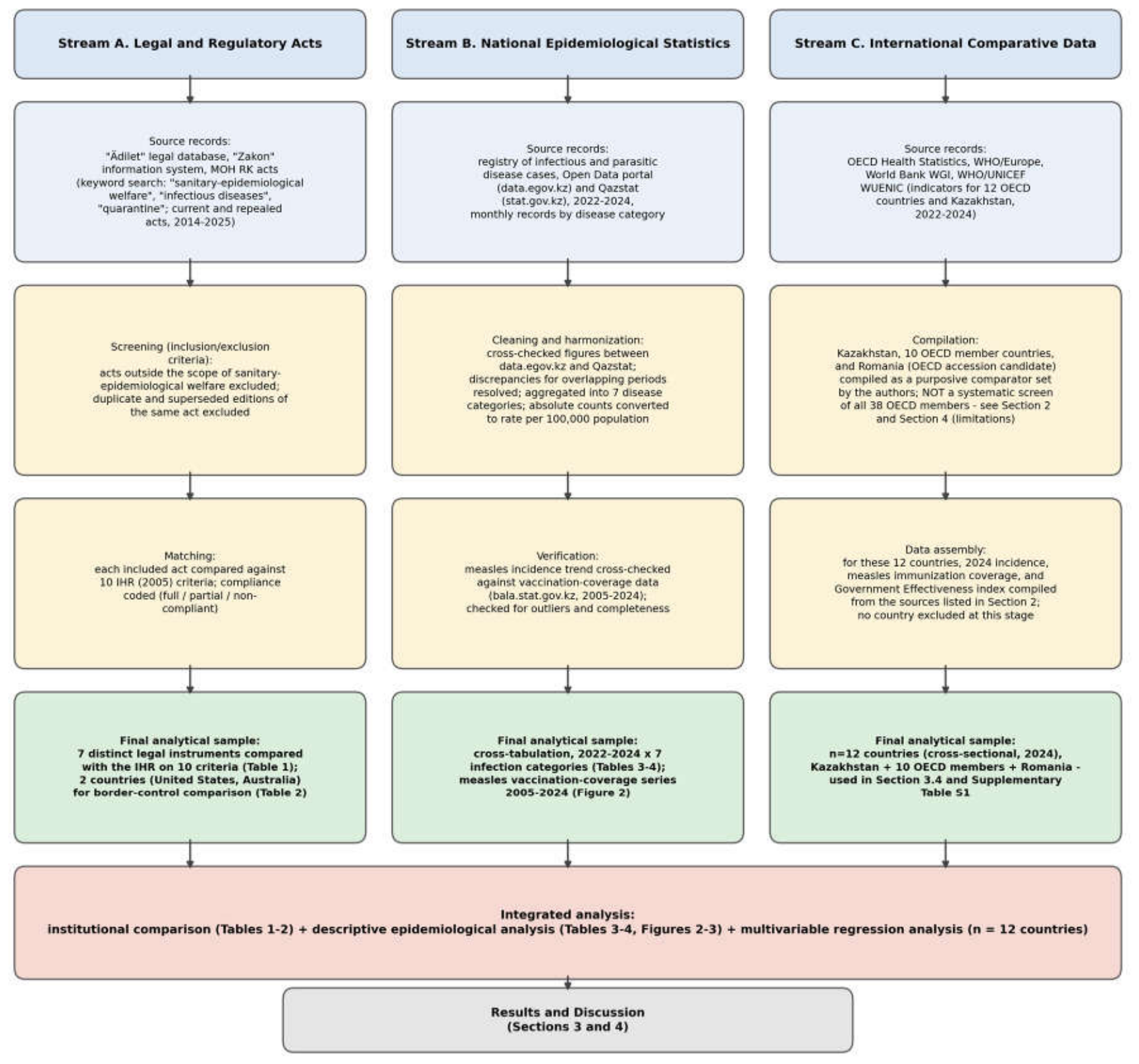
Figure 2.
First-dose (MCV1) measles vaccination coverage among children in the Republic of Kazakhstan, 2005–2024. Note: prepared by the authors based on data from https://bala.stat.gov.kz (accessed 9 September 2026).
Figure 2.
First-dose (MCV1) measles vaccination coverage among children in the Republic of Kazakhstan, 2005–2024. Note: prepared by the authors based on data from https://bala.stat.gov.kz (accessed 9 September 2026).
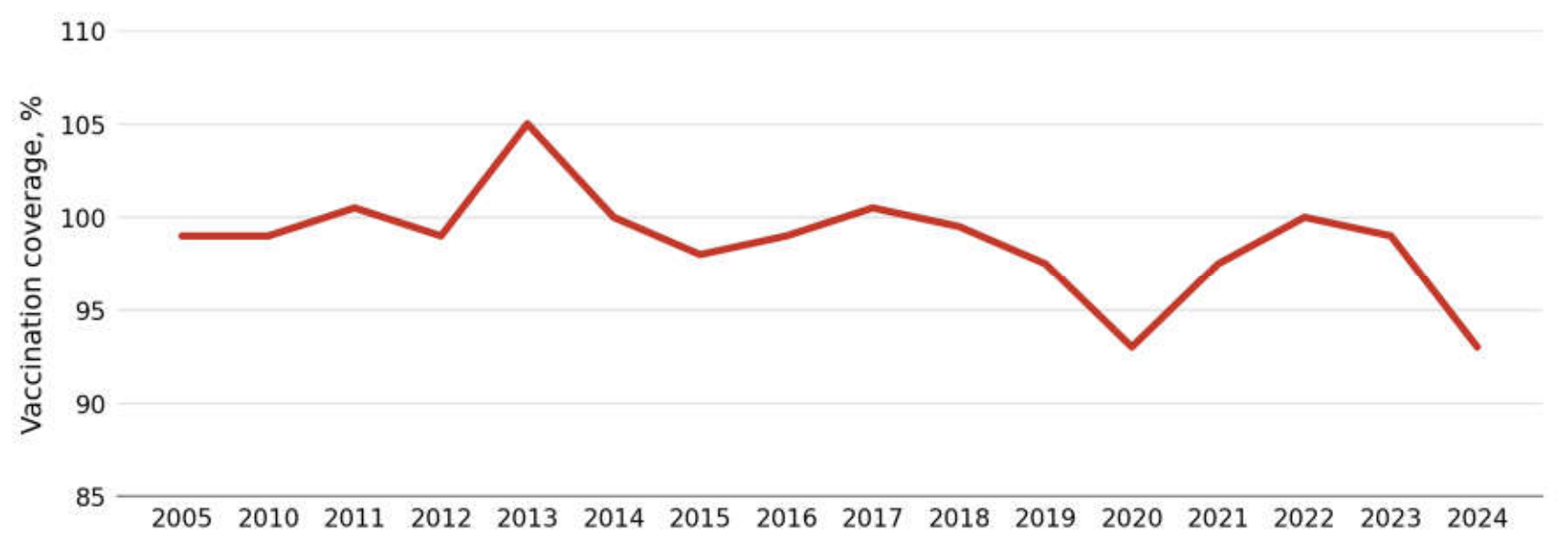
Figure 3.
Measles incidence per 100,000 population in Kazakhstan and selected comparator countries, 2024. Note: prepared by the authors based on OECD Health Statistics; WHO/Europe [27] for Kazakhstan; ECDC [28] for the 10 European OECD/Romania comparator countries; and Japan Institute for Health Security surveillance data [36] for Japan.
Figure 3.
Measles incidence per 100,000 population in Kazakhstan and selected comparator countries, 2024. Note: prepared by the authors based on OECD Health Statistics; WHO/Europe [27] for Kazakhstan; ECDC [28] for the 10 European OECD/Romania comparator countries; and Japan Institute for Health Security surveillance data [36] for Japan.
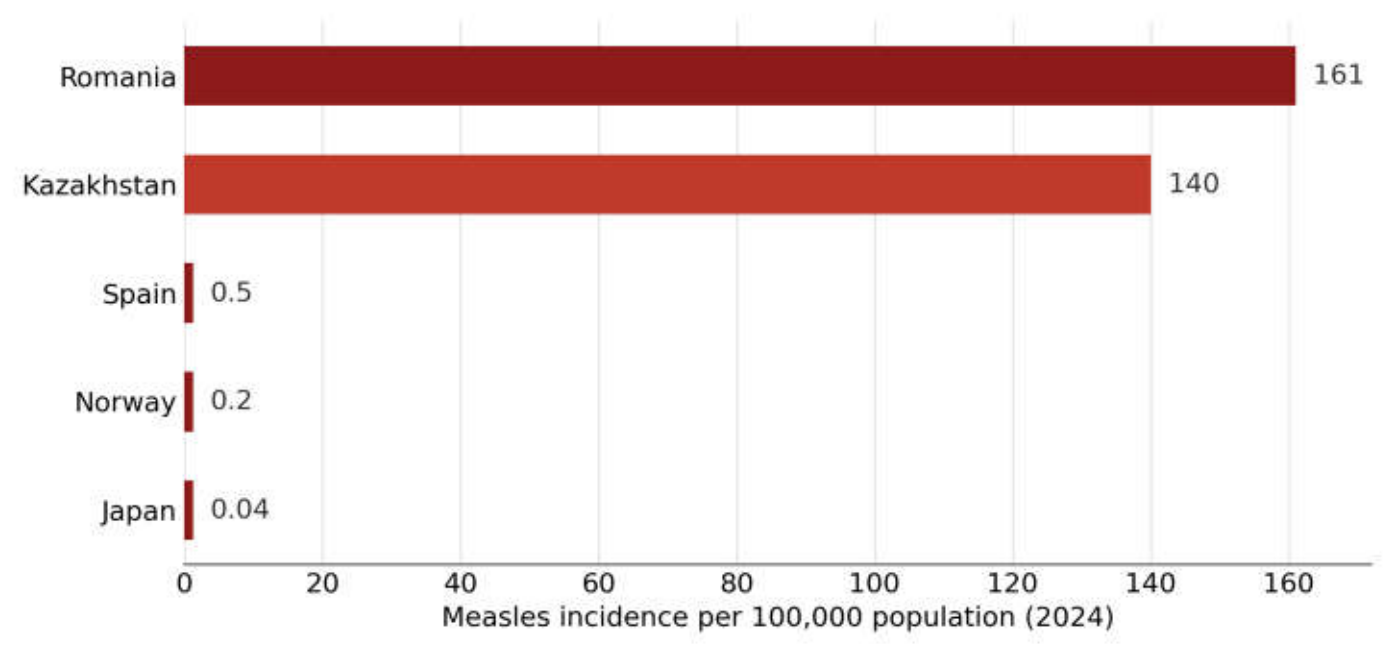

Table 1.
Comparative analysis of the compliance of RK Ministry of Health legal acts with IHR requirements.
Table 1.
Comparative analysis of the compliance of RK Ministry of Health legal acts with IHR requirements.
| No. | Criterion | IHR (2005) | RK Ministry of Health Legal Acts | Compliance | Basis / Description |
|---|---|---|---|---|---|
| 1 | Purpose | Prevention of the international spread of disease | Sanitary-epidemiological welfare of the population of the RK | Full compliance | Code, Art. 76(1)(7) |
| 2 | Scope | Disease or medical condition, regardless of origin or source | All cases of infectious disease, poisoning, and post-immunization reactions | Full compliance | Code, Arts. 104, 105 |
| 3 | Subjects | States Parties, WHO | Committee, territorial subdivisions | Full compliance | Code, Arts. 104, 105 |
| 4 | Epidemiological surveillance | Assessment of the potential for international disease spread | Registration, recording, and reporting of cases | Partial compliance | No statutory definition of epidemiological surveillance in RK MOH legal acts |
| 5 | Notification | WHO informed within 24 hours | Emergency notification within 12 hours to the territorial subdivision of the Committee | Full compliance | MOH RK Order of 26.10.2020 No. ҚР ДСМ-153/2020 |
| 6 | Completeness of health information | Case definitions, laboratory results, source and type of risk, number of cases and deaths, spread conditions, and health measures taken | Case definitions, diagnosis, laboratory confirmation and identifying data, dates of onset/first visit/last visit/hospitalization, anti-epidemic measures taken | Full compliance | MOH RK Order of 26.10.2020 No. ҚР ДСМ-153/2020 |
| 7 | Declaration of a public health emergency (PHE) | IHR Annex 2 decision instrument, applied by WHO to decide whether an event is notifiable as a potential PHEIC | Per the Law of the RK “On Civil Protection” of 11 April 2014 No. 188-V ZRK, which governs the domestic declaration of a national emergency | Not directly comparable | The IHR Annex 2 instrument and RK’s national emergency mechanism serve different purposes (see explanatory note below Table 1) |
| 8 | Criteria for declaring a PHEIC | Four criteria in the Annex 2 decision instrument: (i) seriousness of the public health impact; (ii) unusual or unexpected nature of the event; (iii) risk of international spread; (iv) risk of international travel or trade restrictions — notifiable to WHO if ≥2 of the 4 are met | Absent | Non-compliance | No equivalent multi-criteria decision instrument is established in RK MOH legal acts for either domestic or WHO notification purposes |
| 9 | Response measures | Temporary or standing recommendations | Resolutions of the Chief State Sanitary Physician | Full compliance | Established in Code, Art. 104 |
| 10 | Sanitary border control | Requirements for points of entry, cargo, goods, health documentation; measures for suspected cases specified | Rules on restrictive measures and quarantine reflected fragmentarily | Partial compliance | The single legal act on sanitary border protection was repealed; regulation now follows the Code and other RK legal acts |
Table 2.
International experience in sanitary protection of state borders.
| No. | Country | State Regulation | Content | Description |
|---|---|---|---|---|
| 1 | United States | Code of Federal Regulations, Title 42, Part 71, Subpart D (Health Measures at U.S. Ports: Communicable Diseases) | Sanitary-quarantine control at the border: points of entry, entry of persons, animals, and cargo, and measures against the threat of communicable disease spread | A single consolidated federal regulation governs the activity of ports of entry in detecting and controlling infectious disease [17] |
| 2 | Australia | Biosecurity Act 2015 (Cth), Part 2, ss 33–58 (Preventing Risks to Human Health) and Part 3, ss 59–108 (Human Biosecurity Control Orders) | Phytosanitary and epidemiological control at the border, including human biosecurity control orders for individuals | A single consolidated federal act on state border protection [18] |
Table 3.
Infectious disease incidence per 100,000 population in the Republic of Kazakhstan, 2022–2024.
Table 3.
Infectious disease incidence per 100,000 population in the Republic of Kazakhstan, 2022–2024.
| No. | Infection Group | 2022 | 2023 | 2024 | |||
|---|---|---|---|---|---|---|---|
| Abs. | Rate | Abs. | Rate | Abs. | Rate | ||
| 1 | Intestinal infections: salmonellosis, shigellosis | 43,455 | 219.8 | 41,660 | 207.9 | 40,488 | 199.5 |
| 2 | Zoonoses: plague, tularemia, anthrax, rabies | 1,113 | 5.6 | 923 | 4.6 | 780 | 3.8 |
| 3 | Vaccine-preventable: diphtheria, pertussis, measles, rubella | 2,523 | 12.8 | 32,850 | 163.9 | 33,869 | 166.9 |
| 4 | Airborne: influenza, ARI, scarlet fever | 482,801 | 2442.5 | 73,271 | 365.7 | 49,124 | 242.1 |
| 5 | Sexually transmitted and parenteral (HIV, syphilis, hepatitis) | 9,816 | 49.7 | 9,684 | 48.3 | 9,382 | 46.2 |
| 6 | Parasitic infections | 18,571 | 93.9 | 19,338 | 96.5 | 19,678 | 97.0 |
| 7 | Healthcare-associated infections | 471 | 2.4 | 480 | 2.4 | 435 | 2.1 |
Abs. = absolute number of cases; Rate = incidence per 100,000 population. Note: compiled by the authors based on source [19].
Table 4.
Structure of vaccine-preventable infectious disease incidence in the RK, 2022–2024 (%).
| No. | Infectious Disease | 2022 | 2023 | 2024 |
|---|---|---|---|---|
| 1 | Mumps | 0.4% | 0.1% | 0.4% |
| 2 | Chronic hepatitis B | 93.3% | 7.7% | 7.1% |
| 3 | Hepatitis D | 0.1% | 0.0% | 0.0% |
| 4 | Acute hepatitis B | 2.4% | 0.1% | 0.2% |
| 5 | Rubella | 0.0% | 0.0% | 0.0% |
| 6 | Measles | 0.2% | 90.5% | 85.7% |
| 7 | Acute flaccid paralysis | 3.4% | 0.2% | 0.2% |
| 8 | Haemophilus influenzae infection | 0% | 0.02% | 0% |
| 9 | Pertussis | 0% | 1% | 9.0% |
Note: compiled by the authors based on source [19]; percentages are the share of vaccine-preventable-disease cases in the given year, as reported in the original national data source, and are not adjusted to sum to 100%. The 2022 and 2023 percentages as originally reported summed to 99.8% and 99.6%, respectively, consistent with ordinary rounding of independently rounded category shares. The 2024 percentages summed to 102.6%, a larger deviation that could not be attributed to rounding or traced to a specific category without access to the disaggregated case-level records underlying source [19]; rather than proportionally rescale these values, the original, unadjusted 2024 percentages as reported in the source are shown here.
Table 5.
Measles incidence per 100,000 population in selected OECD countries with stable, low incidence, 2022–2024.
Table 5.
Measles incidence per 100,000 population in selected OECD countries with stable, low incidence, 2022–2024.
| Country | 2022 | 2023 | 2024 |
|---|---|---|---|
| Japan | 0.0 | 0.0 | <0.1 |
| Norway | 0.0 | 0.0 | 0.2 |
| Spain | 0.0 | 0.0 | 0.5 |
Note: compiled by the authors based on OECD Health Statistics. Countries shown are illustrative exemplars of stable, low-incidence surveillance performance rather than the full 12-country cross-sectional analytical sample; the full sample underlies the regression analysis in Section 3.4 and Table 6.
Table 6.
Multivariable regression analysis of factors associated with measles incidence (n = 12 countries).
Table 6.
Multivariable regression analysis of factors associated with measles incidence (n = 12 countries).
| Predictor | Model 1: B (SE) | p | Model 2: B (SE) | p |
|---|---|---|---|---|
| Constant | 5.25 (4.80) | 0.303 | 18.83 (10.12) | 0.100 |
| MCV2 coverage, % | −0.026 (0.058) | 0.667 | −0.054 (0.057) | 0.371 |
| Government Effectiveness index (WGI) | −2.792 (0.802) | 0.007 | −0.883 (1.480) | 0.567 |
| ln(health expenditure per capita) | — | — | −1.613 (1.077) | 0.173 |
| R² / adjusted R² | 0.683 / 0.613 | 0.752 / 0.660 | ||
| F | 9.70 (p = 0.006) | 8.11 (p = 0.008) | ||
| n (countries) | 12 | 12 |
Note: compiled by the authors; full dataset and sources in Table S1. Dependent variable: ln(measles incidence per 100,000 population + 0.05). Model 1: base specification (MCV2 coverage + Government Effectiveness index). Model 2: Model 1 plus ln(health expenditure per capita). B = unstandardized regression coefficient; SE = standard error.
Disclaimer/Publisher’s Note: The statements, opinions and data contained in all publications are solely those of the individual author(s) and contributor(s) and not of MDPI and/or the editor(s). MDPI and/or the editor(s) disclaim responsibility for any injury to people or property resulting from any ideas, methods, instructions or products referred to in the content. |
© 2026 by the authors. Licensee MDPI, Basel, Switzerland. This article is an open access article distributed under the terms and conditions of the Creative Commons Attribution (CC BY) license (http://creativecommons.org/licenses/by/4.0/).
Copyright: This open access article is published under a Creative Commons CC BY 4.0 license, which permit the free download, distribution, and reuse, provided that the author and preprint are cited in any reuse.